
Still scrolling through Christmas garage door photos at midnight, saving every single one, and never actually buying anything? Same here. The garage door is the last surface most of us decorate and the first thing every neighbor sees — which is exactly why it deserves more than a wreath on a nail.
We spent serious time browsing Lowe’s, Home Depot, Target, and Etsy to bring you only what’s worth your attention this year, from $12 clip-on ornaments to a $1,400 full-facade projection setup.
Inside you’ll find 22 curated ideas covering traditional red-and-green garland, printed door banners, projection and laser scenes, and a minimalist brass-hoop look for plain white doors. Budget and luxury versions sit side by side so you can see what the extra money actually buys.
In 2026 the biggest shift is the printed garage door cover — one panel, under an hour to hang, and the entire elevation changes. And stay until the end — we break down the most common mistakes that can ruin these looks.
📌 Save this to Pinterest for later — you’ll want to revisit these ideas.
1. Evergreen Garland and Crimson Velvet Bows Around the Garage Frame
Here’s the measurement that saves a second trip to the store: run garland along the frame’s full perimeter, then add three extra feet. Greens read thin at twenty feet, which is where most of your audience actually stands. Zip-tie the greenery to the frame itself, never to the door panel, and clip a wired bow every four feet instead of every two — spacing is what keeps a traditional look from tipping into chaos. Wired ribbon holds its shape through wind and rain; soft fabric ribbon collapses by week two.
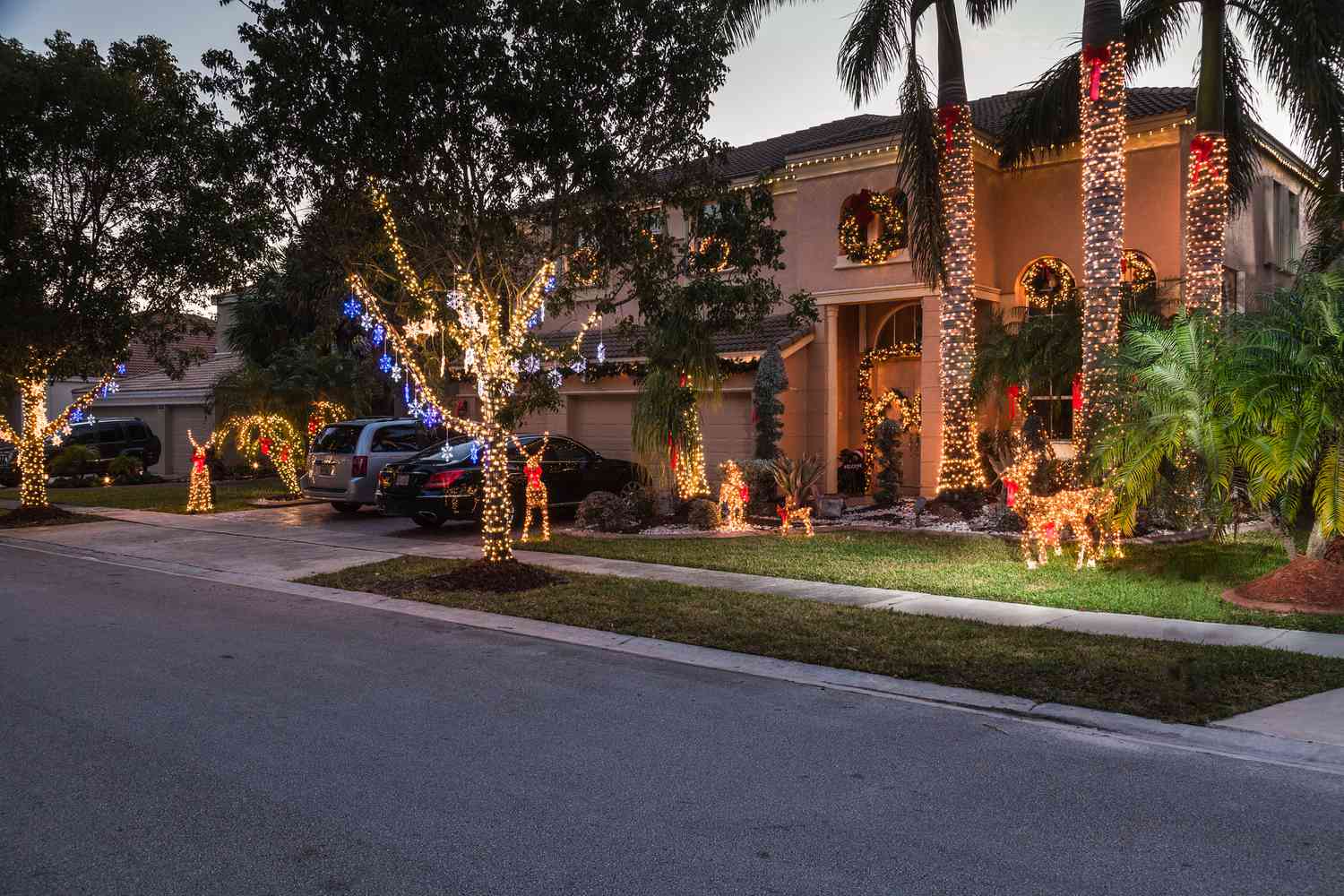
Three things carry this facade. The window wreaths repeat the garland bows at a smaller scale, so the eye keeps traveling instead of stopping. The palette holds to three notes — forest green, crimson, white — and a fourth would make it noisy. And the flanking topiary trees in urns bookend the whole composition, which is the real reason the driveway reads as designed rather than merely decorated.
2. Santa, Reindeer, and an Aurora Mural Across the Door
Printed garage door covers have quietly become the biggest holiday decor category you’ve never heard of. They cost less than a single inflatable, install in an afternoon, store flat on a closet shelf, and pack an entire scene — a sleigh under a swirling aurora sky — onto a surface that used to get nothing but a wreath. Interest in them spikes every October, and they solve the renter problem completely: nothing drilled, glued, or permanently changed.
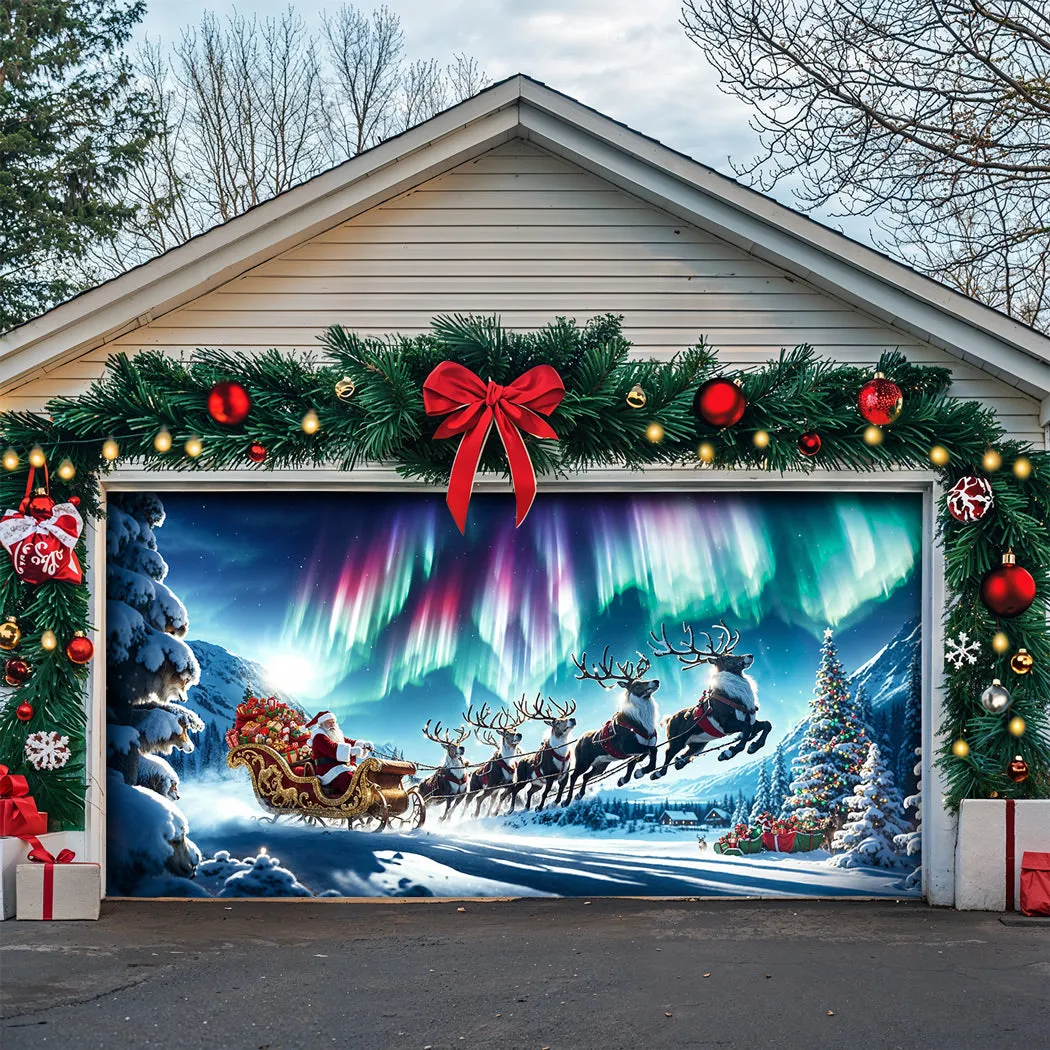
Budget a solid ninety minutes for this one, plus drying time.
- Measure the door panel, not the frame, and subtract an inch on every side.
- Order vinyl or heavy-duty outdoor polyester — paper-backed vinyl sags after the first rain.
- Wash the panel with warm soapy water and let it dry completely, or the adhesive strips fail in cold.
- Attach the top edge with the included clips, then add hook-and-loop strips at both bottom corners.
- Finish with garland over the frame to hide the top seam and add real depth.
Cost runs $90 to $250 for the banner and about $20 in hardware.
3. Eight Brass Botanical Hoops on a Clean White Door
The formula is roughly 70 percent white door, 20 percent botanical, 10 percent brass. Hold those proportions and you can swap freely: black metal rings with eucalyptus for something moodier, copper hoops with dried grasses for warmth, or matte white hoops if you want the greenery to float. What you can’t swap is the ratio — nine hoops in two different metals is exactly how minimalist looks fall apart.
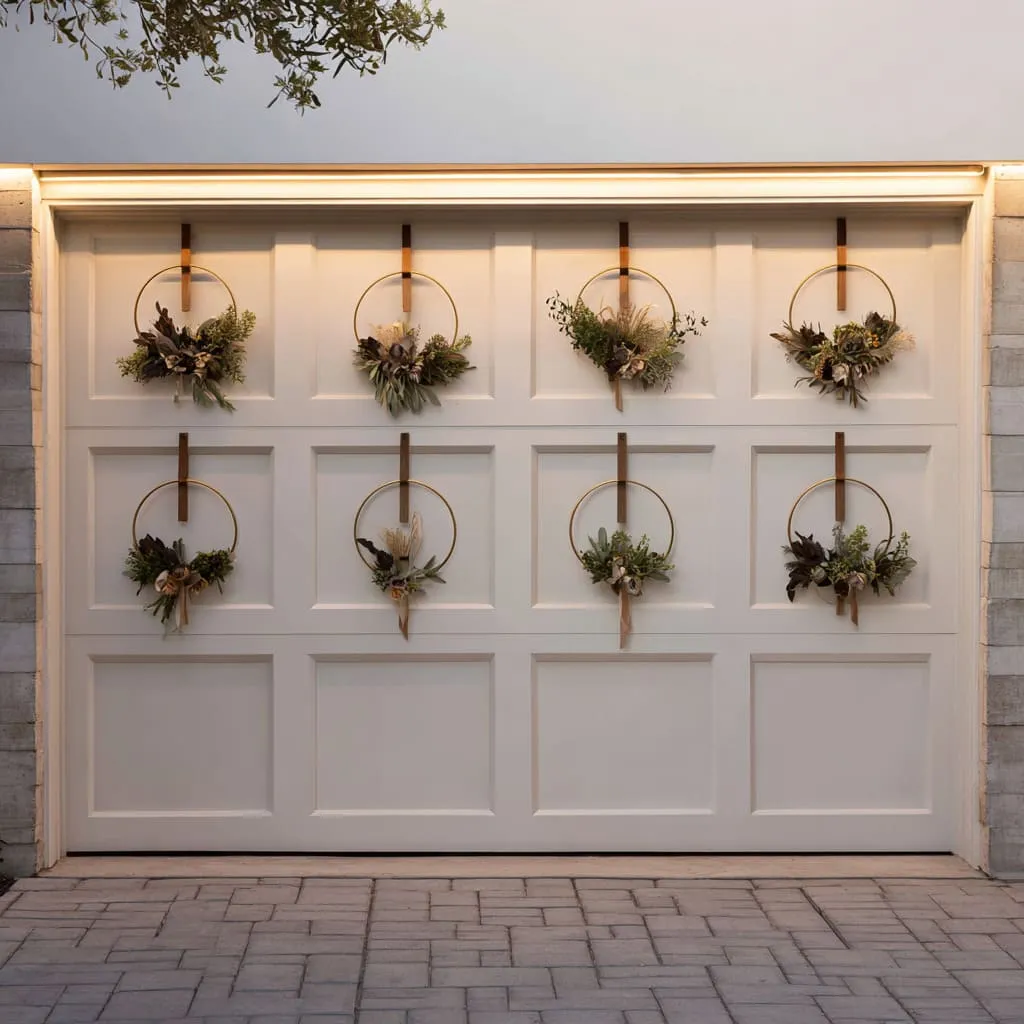
Cut every hanging strap to the same length, and let each hoop sit so its lowest bloom lands fourteen to sixteen inches below the top edge of the door. At that height the arrangements stay clear of headlights without floating in the middle of a blank panel. Mix two-thirds dried material with one-third fresh greens: dried won’t scatter needles across the driveway, and the fresh third delivers the scent.
4. Icicle Lights, a Glowing Reindeer, and a Purple-Lit Tree
Icicle lights look effortless and behave like a second job. Cheaper strands stiffen below freezing, and once a section dies you’re hunting one bad bulb with numb fingers. Buy strands rated for outdoor use with sealed sockets, plug everything into GFCI protection, and never exceed the manufacturer’s stated chain limit — usually three to five strands. One more thing: those glowing reindeer stake into frozen ground. Set them in late October, before the soil locks up for the season.
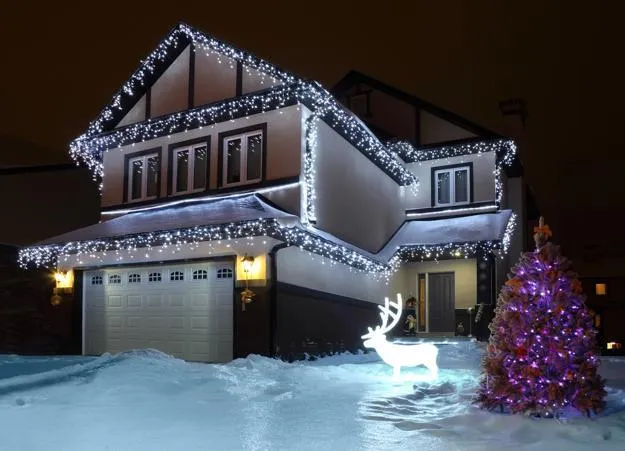
Outlining rooflines, gables, and second-story overhangs on a two-story home usually takes 180 to 260 feet of lights, and a reindeer silhouette needs about three square feet of clear space to read as an animal instead of a white blob. This look wants a facade at least 40 feet wide and enough yard to keep the figures forward of the windows. On a narrower frontage, one roofline run plus a single figure holds the shape better than a full outline.
5. A Pale Blue ‘Be Merry’ Penguin Banner on Light Brick
The one element doing all the heavy lifting is that pale blue field. Against light brick and dark shutters, a soft powder blue reads crisp and faintly Scandinavian — nothing like the red-and-green avalanche on the rest of the street. Take the blue away and you’re left with penguins and stockings on a blank door: cute, but forgettable by the second house. The color is what makes a printed banner look curated.
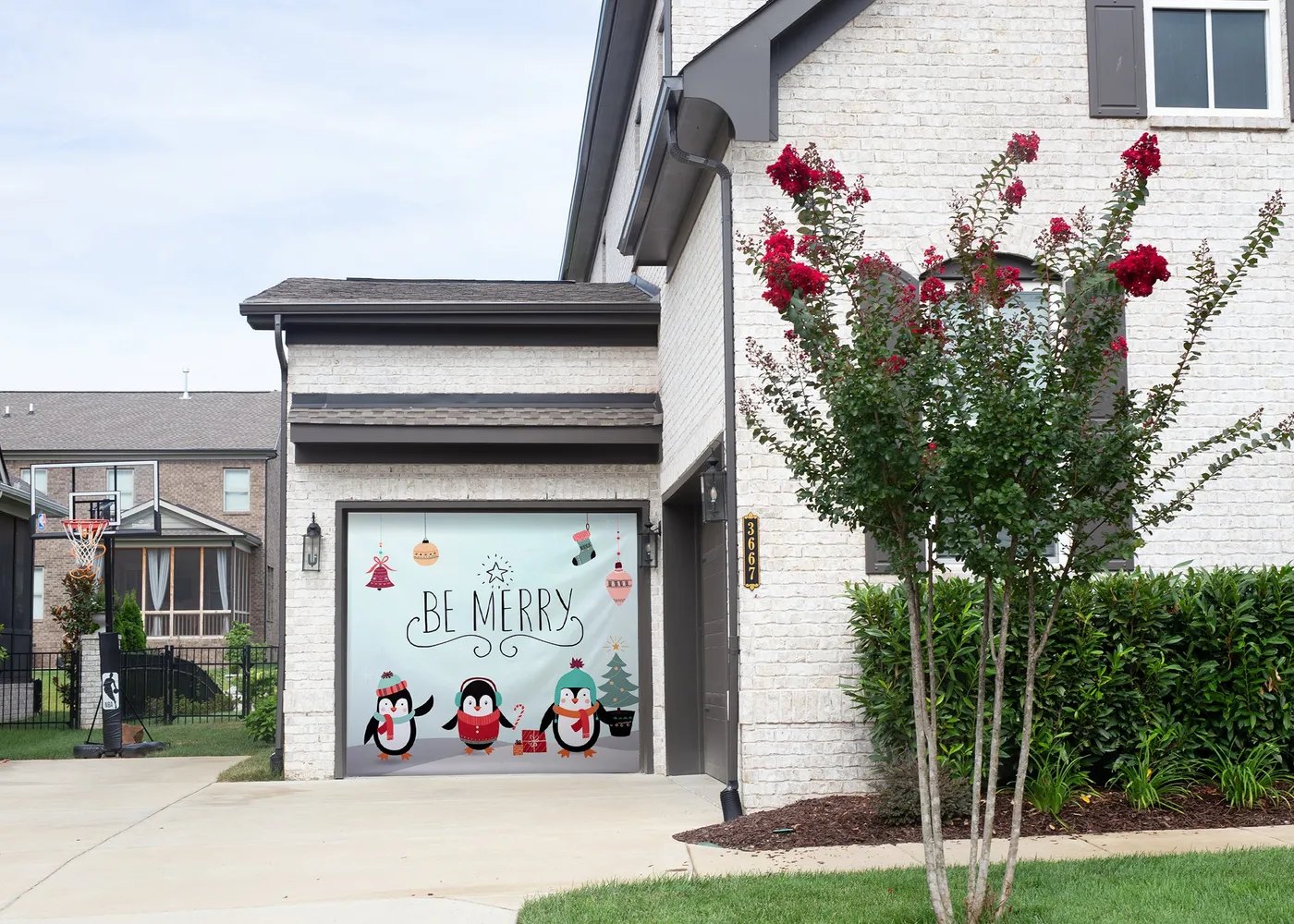
You don’t need a $150 cover. Have a local print shop run a custom vinyl banner with a snowflake graphic from a free design tool — $35 to $60 for a 16-foot span. Target carries clip-on character cutouts around $12, and light-blue LED strands at Walmart run $6 to $10. Under $100 total for the same pale cheer, which leaves money for the ornaments you’ll actually hang at eye level.
6. One Blue Winter Scene Spanning Two Garage Doors
- Two matching door banners: $180–$420
- Evergreen garland for the frame: $60–$130
- Icicle lights for the roofline: $40–$90
- Clips, hook-and-loop tape, zip ties: $15–$35
- Outdoor timer and power strip: $25–$55
- Total: $320–$730
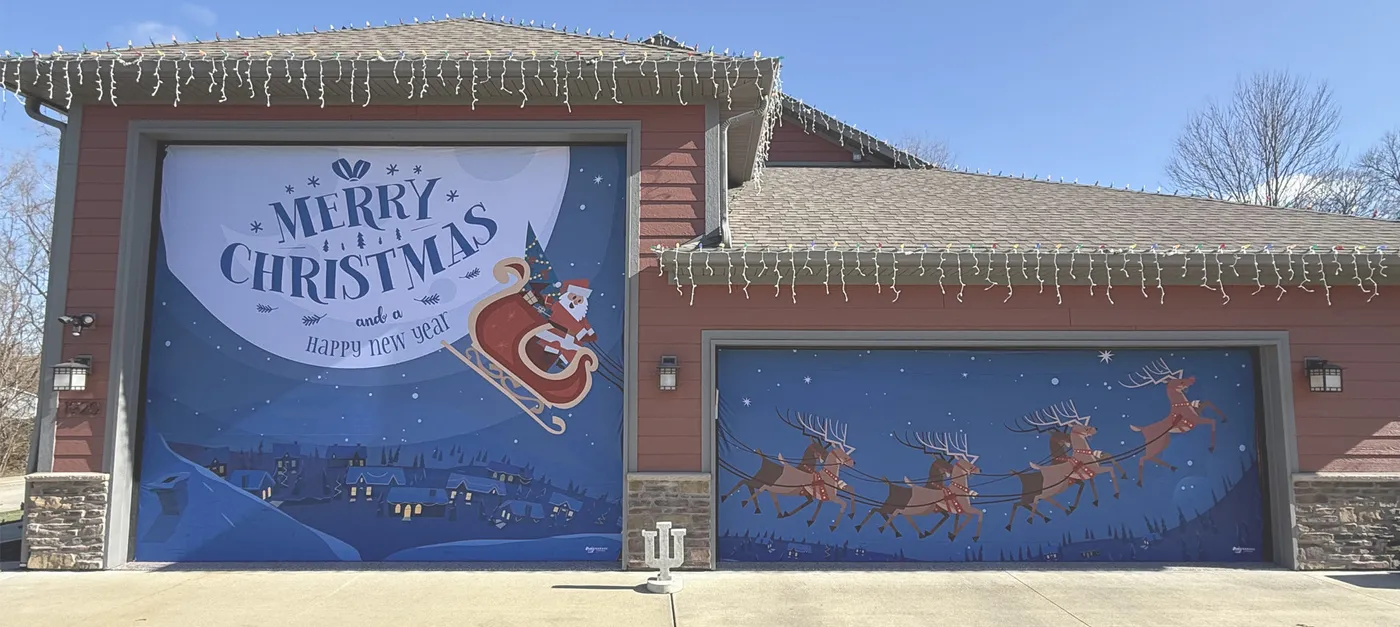
Budget alternative: print your own vinyl panels for about $70 instead of $220, or hang one banner and let garland carry the second bay.
Continuous artwork across two doors is what makes this read as one composition instead of two decorated squares. Blue is also the complement of the red siding, which is why the house looks brighter at night than it does at noon — the two hues push each other forward. Roofline icicles act as a lid, so your eye travels across the entire garage instead of dropping off the bottom edge.
- Photograph the doors while open so you know where the center stile lands.
- Mark a level line across both panels with painter’s tape.
- Hang the left banner first — it becomes your anchor.
- Butt the second banner’s artwork against the first at the stile.
- Cover the seam with a short garland swag and step back.
7. A Snowman Projected Across the Whole Facade
Home projection used to be a five-figure installation. In 2026 a decent mapping look costs under $400 with a weatherproof outdoor projector and a short video loop, which is exactly why facades full of snowflakes — and one very cheerful snowman in a top hat — are suddenly everywhere. It’s also the only display style that changes mood every fifteen minutes, so nobody gets tired of it by December 8.
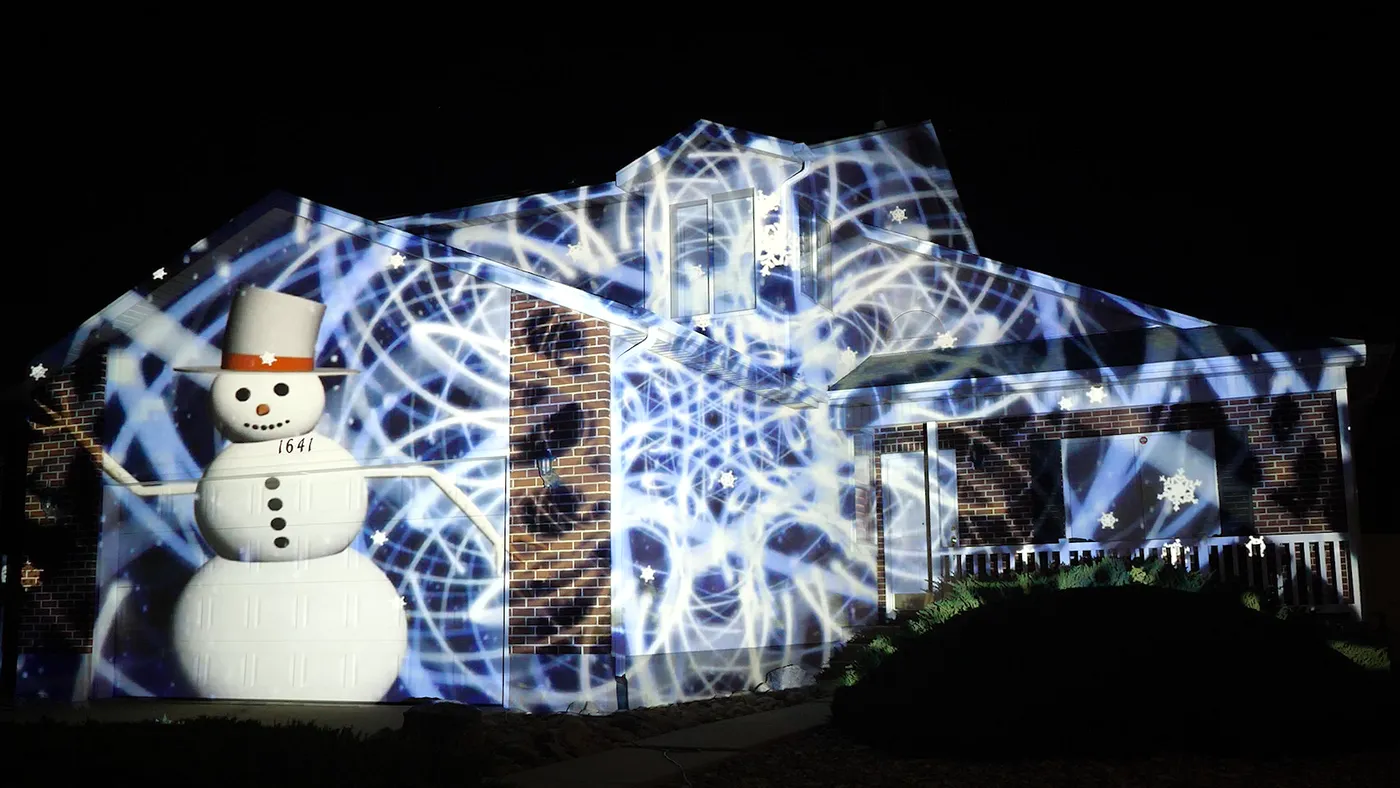
Projectors are the divas of holiday decor. They hate condensation, they hate sub-freezing cold, and they collect dust on the lens until the image softens into mush. Expect to wipe the lens weekly, bring the unit inside during ice storms, and replace a bulb or LED module every two to three years. If that sounds like work, the laser approach in Idea #15 delivers a similar glow from a sealed unit with no moving parts.
8. Inflatable Santa Sleigh Parked Above Dense Icicles
Inflatables need three things people forget: a real anchor, a protected cord, and a dry place to sleep. Put them on a timer so the blower isn’t humming at 2 a.m., stake or sandbag the base, and skip the daisy chain — one heavy-gauge outdoor cord into a GFCI outlet does the whole job. Also check what your roofline can legally hold, because wind up there is roughly twice what you feel standing in the driveway.
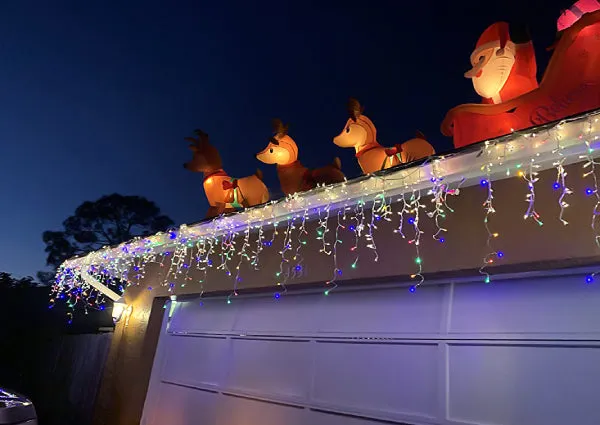
The single element holding this together is the dense multi-color icicle run along the roofline. Without it, the sleigh floats in empty space and the whole thing reads like a yard sale in the sky. Those icicles do the work a picture frame does — they give the inflatable an edge to sit against. If you buy only one thing this season, buy the lights above the door, not the thing hanging from them.
9. Permanent Eave Lighting That Becomes Christmas Overnight
Mount the channels on a 45-degree angle, set one to two inches back from the fascia edge, and aim them down the wall rather than straight out. Angled placement hides the individual diodes from anyone standing in the driveway, which is the entire difference between architectural and airport runway. Warm white at 2700K to 3000K reads festive in December and neutral in July, so the system earns its keep instead of looking like oddly thick trim eleven months a year.
Measure linear feet before ordering: a standard two-car garage is 16 feet wide, plus about two extra feet on each side for the return, and most one-story front elevations total 35 to 50 feet of eave. Two-story homes with gables often hit 80. Runs longer than 50 feet usually want a second power injection point, or the far end dims noticeably. This is the move when your facade is wide but your inflatable budget isn’t.
Professional permanent lighting runs $18 to $28 per linear foot installed — $1,200 to $2,500 on a typical single-story front. The DIY route is a pre-assembled LED track kit at roughly $6 to $9 per foot, plus a $40 smart plug and one Saturday on a ladder. Cheaper still: clip standard warm-white strands under the fascia with magnetic clips, about $25 for 50 feet.
10. Nutcrackers, Silver Baubles, and a Canopy of Warm Lights
The mix here is about 50 percent dark door and charcoal, 25 percent deep green garland, 15 percent metallic gold and silver, 10 percent red accent. That weighting is why the display looks expensive — the metals do the sparkle instead of more color. Swap gold for warm bronze and the whole thing turns rustic; swap red accents for burgundy and it goes moody and grown-up. Keep yourself to two metal finishes total, no more.
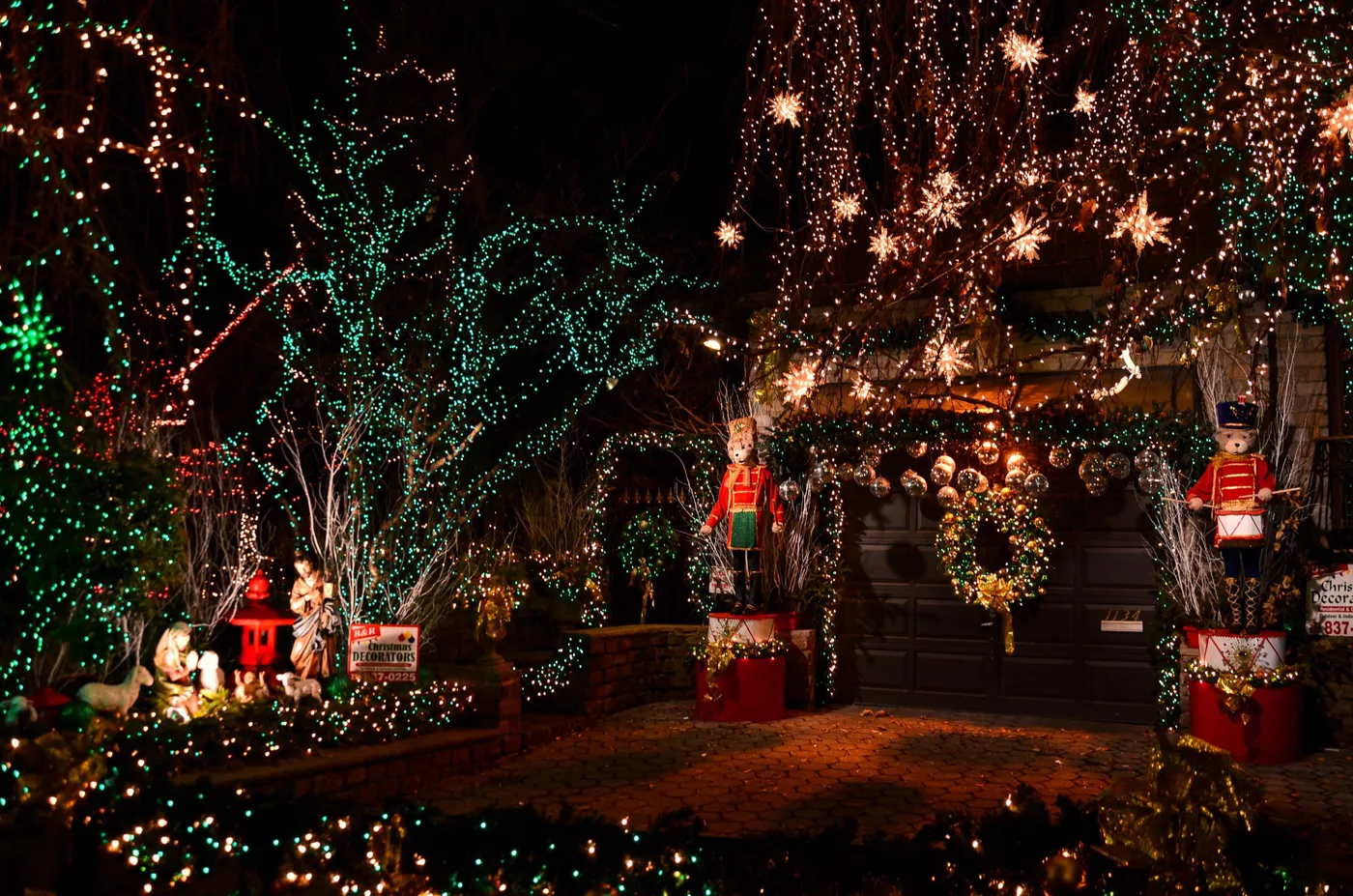
The element that turns this garage into an event is the canopy of warm string lights overhead, not the decorations on the door itself. Garland and nutcrackers are the scene; the lights are the room. That overhead glow reaches twelve feet past the door and gives people a reason to stand around in the cold. Remove it and you have a nicely decorated door — keep it and you have a destination.
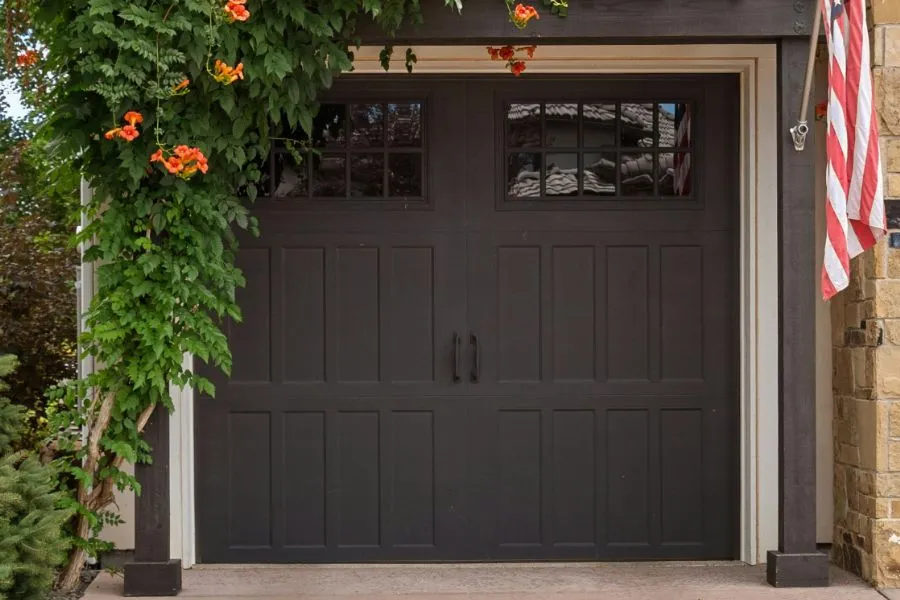
11. The Dark Paneled Door and Climbing Vines, Undecorated
Before anything festive goes up, spend half an hour prepping the door itself.
- Wipe the panel with a microfiber cloth and mild soap — road film makes every clip slip.
- Test your mounting method on a hidden jamb or the back of the door first.
- Use over-the-top frame hooks or the hinge barrels for anything heavier than two pounds.
- If you must drill, hit the frame or stile, never the flat panel face or the window mullions.
- Photograph where everything hung so next December takes ten minutes.
Materials: $0 to $20 in hooks. Time: about 30 minutes.
Dark doors swallow holiday decor. Deep brown and black panels absorb light, so garland hung on them disappears into the background unless you light it — one 2700K spotlight aimed up the door fixes that for about $30. Watch the vines too: climbing plants hold moisture against the trim and their tendrils work into any gap you leave open, so keep decor clips clear of the areas where greenery is actively growing.
12. Gingerbread Men and Peppermint Swirls Cast on the Door
Renting a projection unit for the season runs $250 to $600. Buying gets you there for $130 to $300 — a basic outdoor projector plus a downloadable gingerbread loop, and you own it for every holiday afterward. No projector at all? A pre-lit candy cane cutout set from Walmart lands around $40, and a warm roofline strand above the garage does 70 percent of the same work for $25.
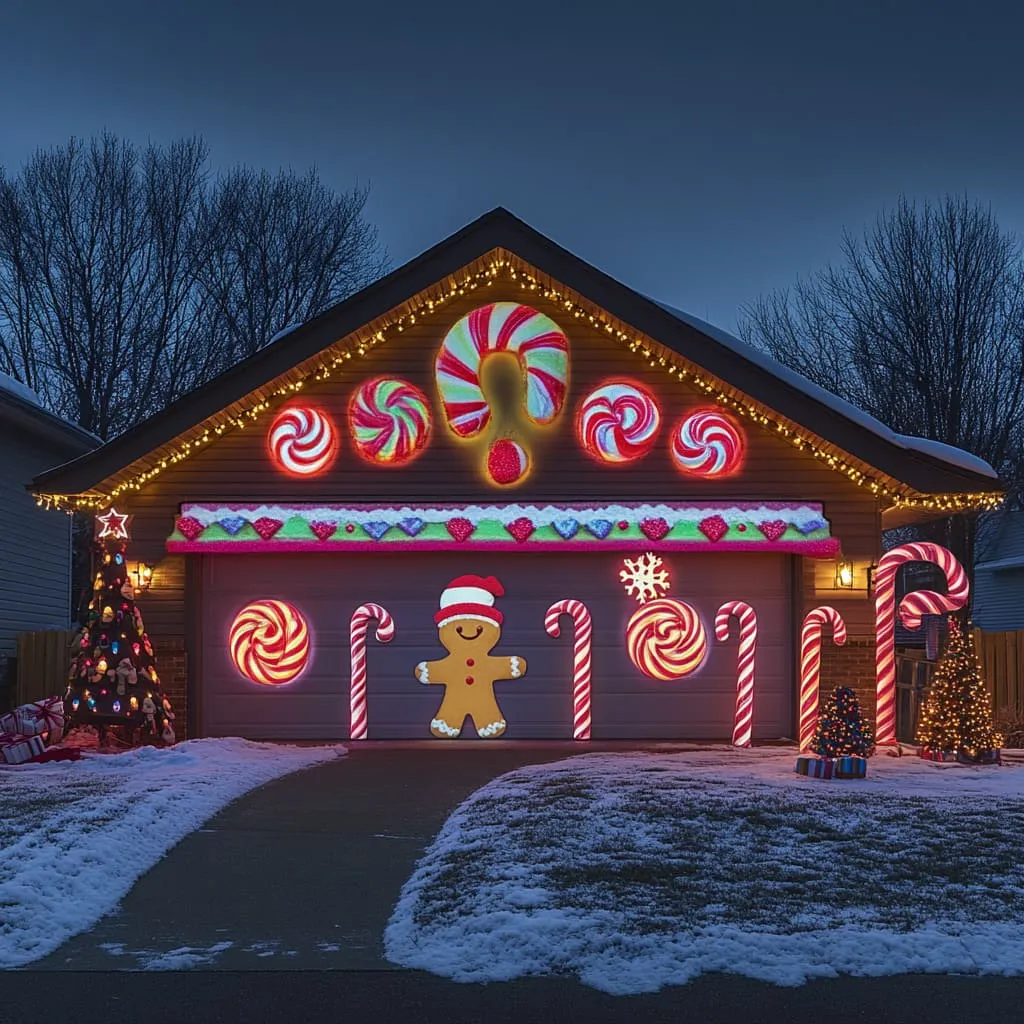
Animated, kid-facing scenes are the fastest-growing slice of holiday lighting, and it’s easy to see why: candy canes and gingerbread read instantly from the sidewalk, they photograph beautifully for the family group chat, and they’re far easier to aim than a music-synced show. The tech curve matters too — consumer projectors now run silent and draw under 60 watts, so you can leave one on all evening without guilt.
Build the scene at roughly 50 percent warm brown and cream, 30 percent candy red and white, 20 percent gold light. The trick with projected art is a consistent light temperature: warm roofline bulbs above warm projected candy keep everything storybook, while cool white bulbs on the same house make the projections look like a slideshow.
13. Blue Light Outlining a Dark-Sided Two-Story House
Blue on gray siding should feel cold, and that’s precisely why it works — the tones sit beside each other instead of fighting, and the gables and porch roof read like a line drawing. Blue also has the longest visual throw of any holiday color, so a wrapped house looks bigger from the street. The stone pillars stay dark, which gives the glowing garage a solid base to sit on rather than a floating rectangle of light.
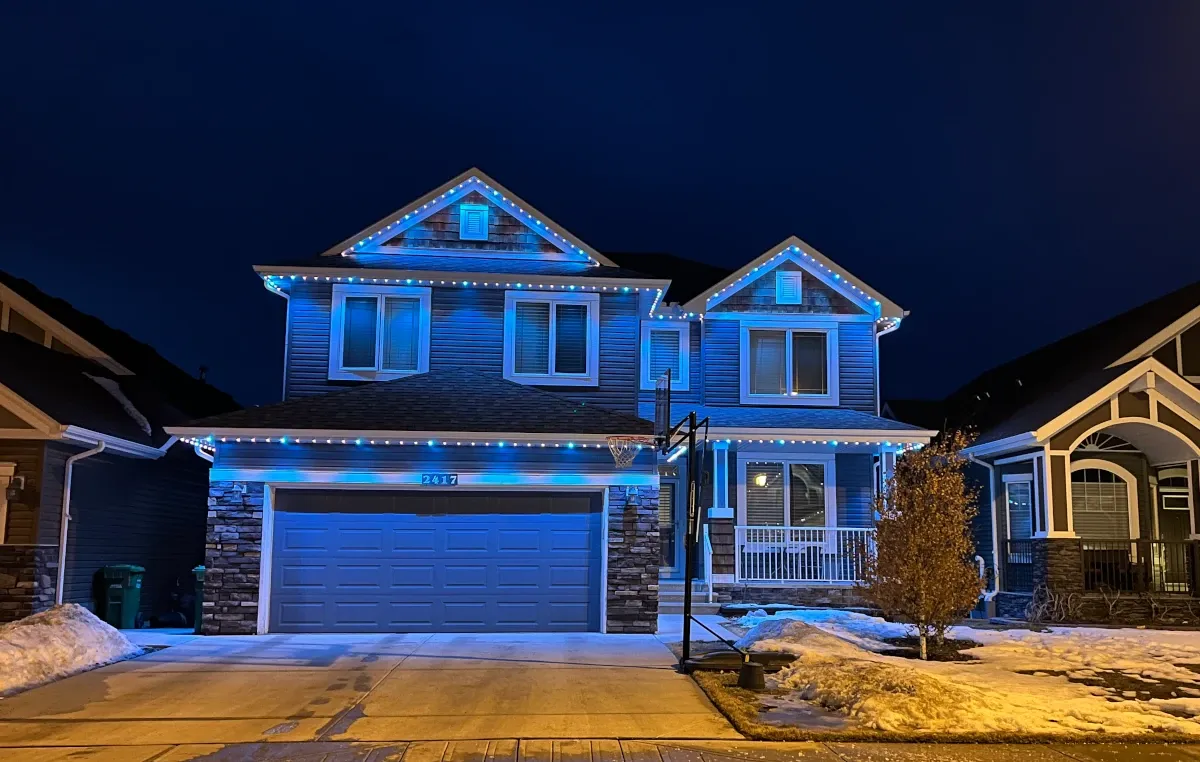
Outlining rooflines, gables, and a porch roof on a two-story home typically eats 200 to 280 feet of strand, and any run over 100 feet wants a second outlet or heavier gauge. This look is built for facades 45 feet wide and up, where the blue lines have room to travel. On a compact single-story ranch, the same color works better concentrated on one gable — see Idea #17 for a scaled-down two-color approach.
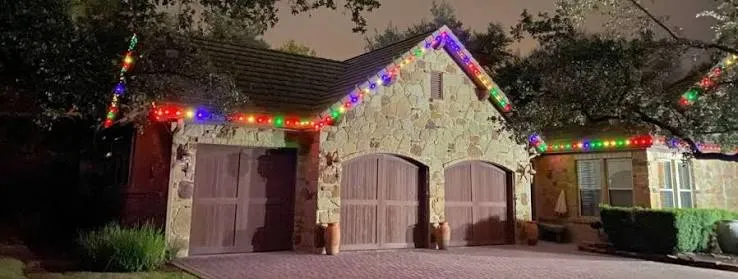
14. Multi-Color Roofline Lights Over Three Arched Wood Doors
- Multi-color LED strands (200 ft): $70–$150
- Heavy-duty outdoor cords and a timer: $35–$70
- Fascia and shingle-safe clips: $15–$30
- Urn fillers and evergreen arrangements: $80–$250
- Ceramic urns, if starting from scratch: $120–$400
- Total: $320–$900
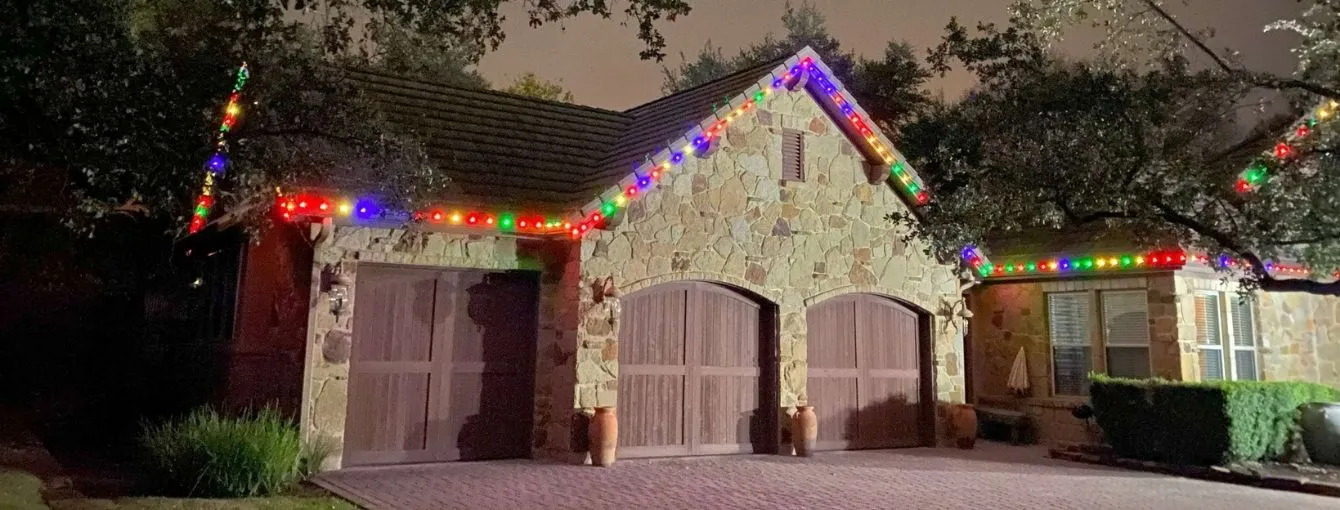
Budget alternative: skip the urns and use pre-lit potted topiaries at $35 apiece — under $400 all in.
With three arched doors, resist decorating all three identically. Match the roofline, then vary the ground level: urns with evergreen at the outer doors, one taller arrangement in the center, and nothing else. Uneven symmetry — same on the outside, different in the middle — is what keeps a wide stone facade from looking like a showroom display. Keep the multi-color bulbs to a single run, too; a second color of strand anywhere on this elevation muddies the whole thing.
15. Laser Starbursts and a Giant Star Over Brick
Laser units are the low-maintenance end of the projection family: no lens to wipe, no bulb to swap, no moving parts to freeze. What they need is placement discipline — stable surface, at least twelve feet back from the facade, aimed once and then left alone. Dust on the front glass is the only real upkeep, and it’s a five-second wipe. Expect to replace the unit every three to four years, and bring it in during ice storms no matter what the box promises. If you’d rather own a picture than a pattern, compare with Idea #7.
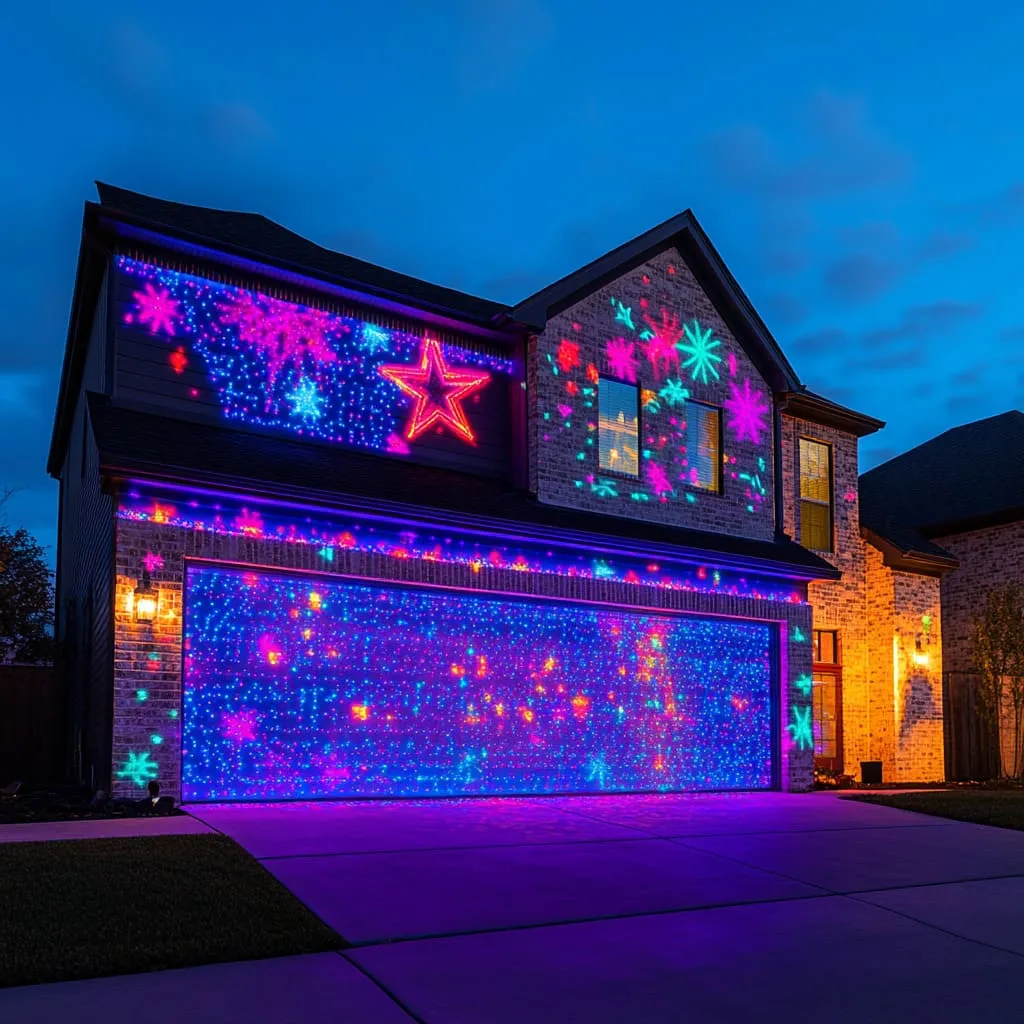
The element that gives this display its identity is the oversized star outline on the upper gable. Scattered dots and snowflakes are texture; the star is the subject. Without it, the facade looks like someone spilled confetti on a brick house. With it, your eye has somewhere to land and the whole projection reads as a composed scene instead of an accident.
16. Warm White Rooflines Above Three White Paneled Doors
Warm white has one job here: drawing the silhouette. Because the strands trace only the rooflines and gables, they give a large brick facade a clean outline instead of covering it, and the eye reads architecture rather than clutter. The cone-shaped lit topiary and the glowing foundation shrubs then repeat the light at ground level, so the composition has a top and a bottom — that’s the difference between elegant and half-finished.
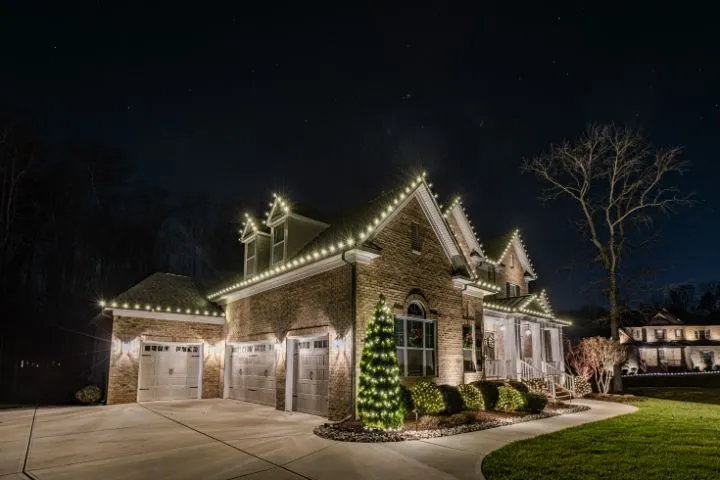
Three garage doors is a lot of white panel to keep clean in December, and warm white strands turn every dead bulb into an obvious dark gap in an otherwise perfect line. Keep one spare strand and two spare bulbs, and buy the same brand and color temperature you started with — 2700K from one manufacturer beside 3000K from another looks like two different houses at night. Check that your wall sconces aren’t washing out the roofline; if they are, move them to a separate switch.
- Clip a strand to the fascia unplugged and step across the street to check the line.
- Work from one corner outward, letting the strand sag slightly between clips.
- Keep every clip on fascia or soffit — never on shingles.
- Run cords behind downspouts and tuck them every 18 inches.
- Plug into a GFCI outlet with a timer set from 4:30 to 11 p.m.
17. Alternating Red and Green Bulbs Above Charcoal Doors
Two colors, strict alternation, nothing else: red, green, red, green along the roofline, the dark doors left completely bare, and one warm yard lamp handling the rest. That’s roughly 45 percent red light, 45 percent green light, and 10 percent warm ambient. Swap to red and warm white for a classic feel, or green and icy white for something colder — just keep the alternation even. Three-color strings almost always read as chaos at this scale.
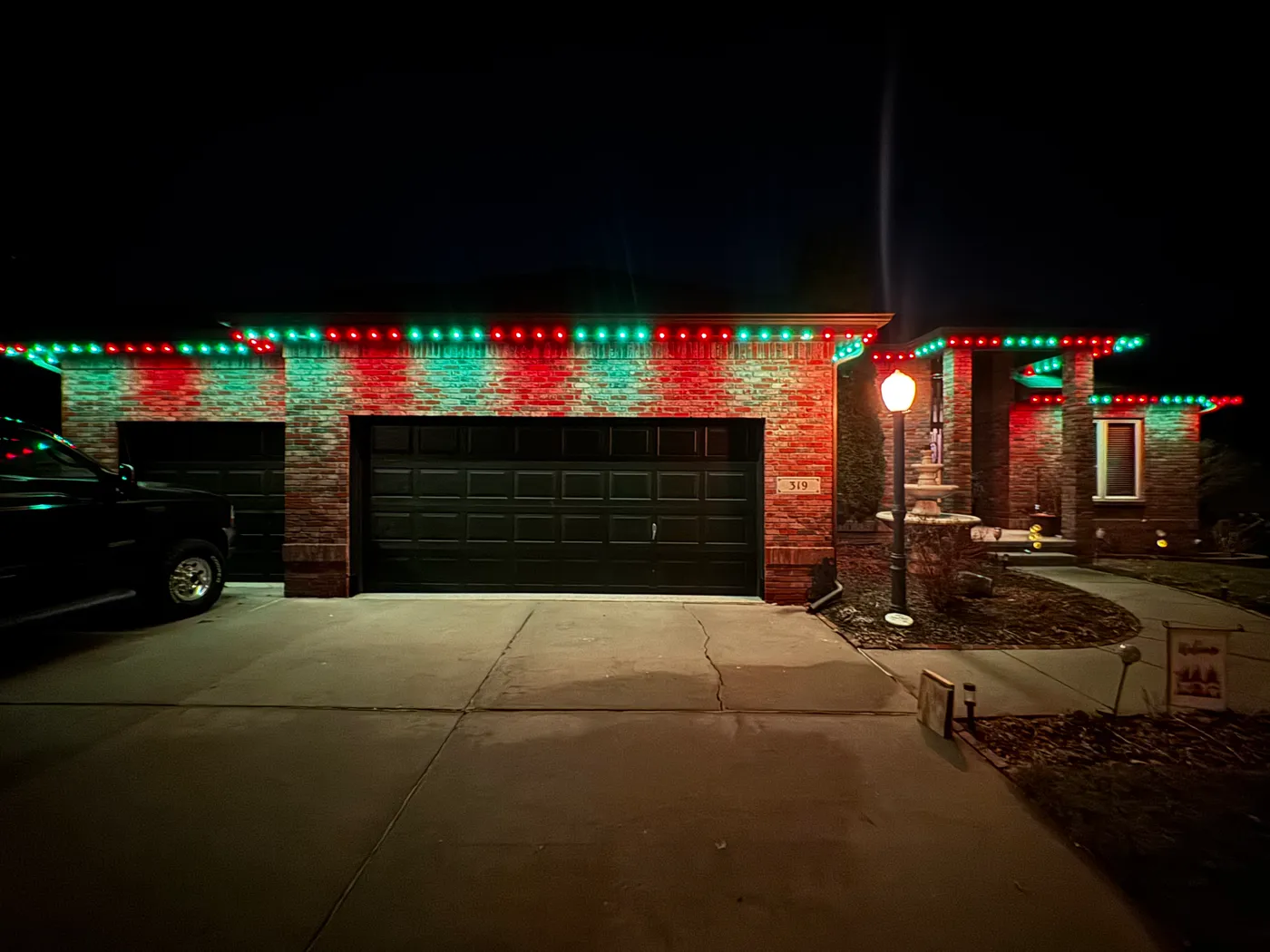
Alternating strings fail for one boring reason: the bulbs aren’t evenly spaced once you round a corner. Buy a strand with fixed 12-inch intervals, count your corners before you start, and accept that you’ll waste two or three bulbs at every turn to preserve the rhythm. It’s worth the waste — mismatched alternation is the first thing anyone notices from the sidewalk, and the fix costs about $4 in spare bulbs.
18. A Full Gingerbread House Banner Over the Garage
Printed gingerbread house covers run $120 to $300 depending on door size. The DIY version: a roll of vinyl banner material from a print shop, $45 to $75, plus a $10 pack of adhesive clips. Would rather not print anything at all? A set of weatherproof candy cane and gumdrop cutouts from Target or Walmart lands around $30, and a $12 can of fake snow spray gives the trim that frosted-cookie edge. Under $100, same sugar-rush energy. If you’re new to door covers, the install notes in Idea #2 apply here too.
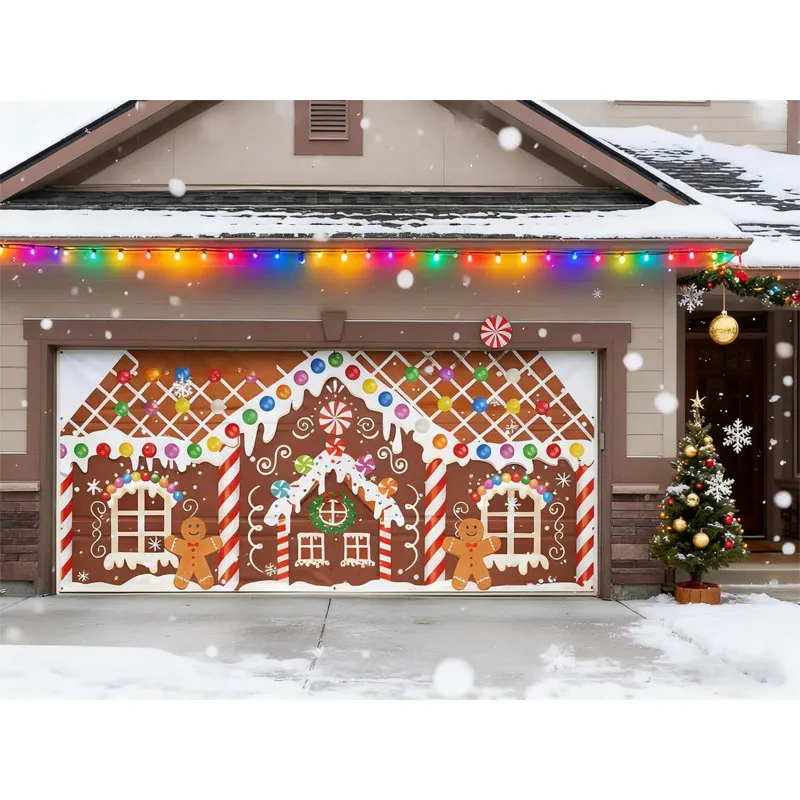
Making a banner look painted on rather than pinned up:
- Measure the door’s inner panel and order the cover one inch smaller on all sides.
- Clean and completely dry the panel — morning dew is the enemy of every adhesive.
- Attach the top edge first with the supplied clips, working left to right.
- Smooth downward with a squeegee or a cloth-wrapped credit card.
- Weight both bottom corners with hook-and-loop strips, then camouflage the top seam with garland.
Time: about 90 minutes. Cost: nothing beyond the cover.
19. Warm Roofline Outline Over X-Brace Charcoal Doors
A warm roofline run like this is usually 180 to 240 feet on a two-story with dormers, and dormers are where footage disappears — each one adds roughly 25 to 35 feet once you wrap the sides. You want at least 40 feet of frontage for this to read as an outline rather than a border, and the charcoal doors with their X-brace detail stay clean and undecorated so the light above them does the talking. On a small single-story, keep the run to the main eave and skip the dormers entirely.
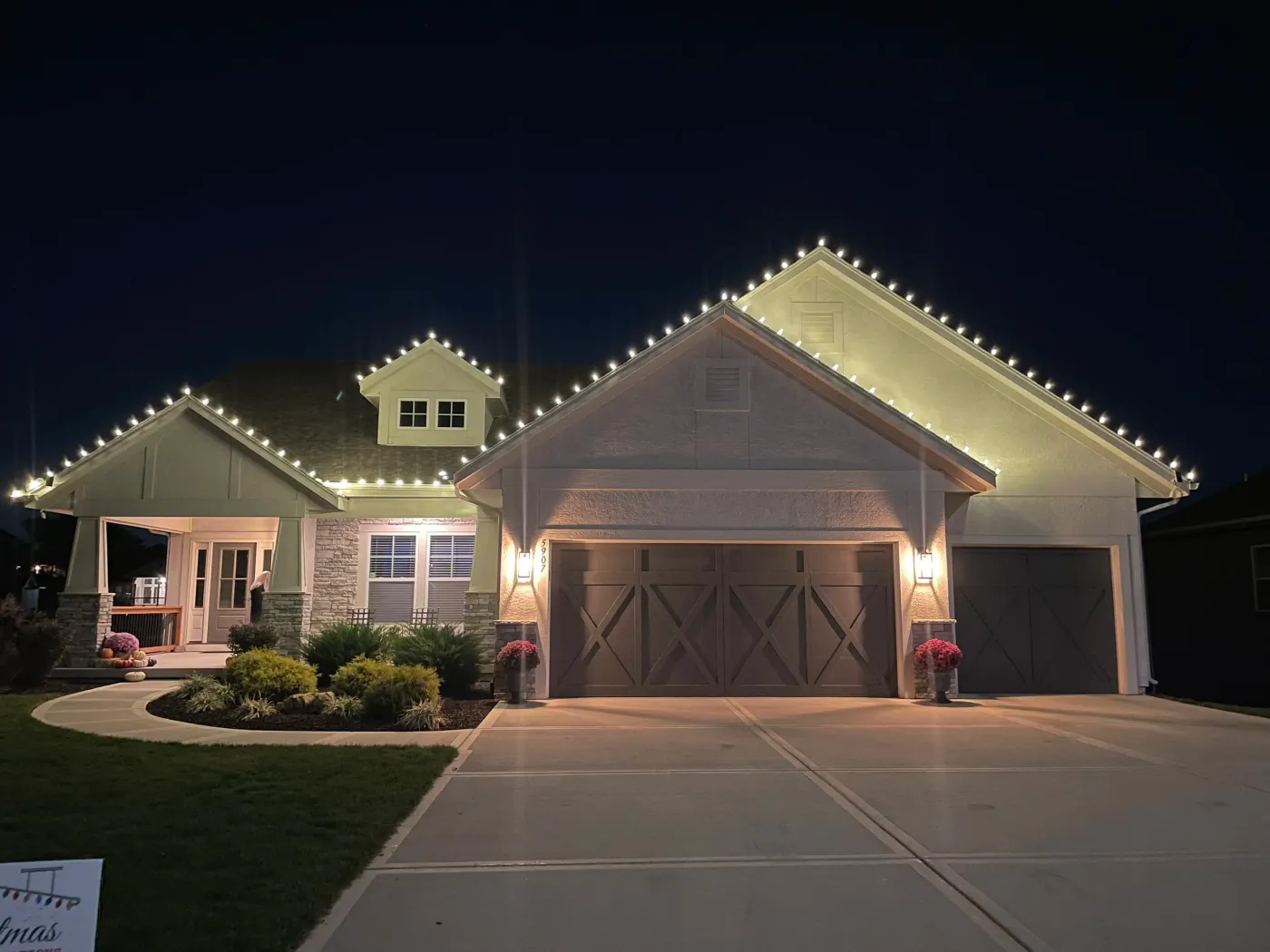
- Warm white LED strands (220 ft): $80–$170
- Fascia and shingle-safe clips: $20–$40
- Smart outdoor timer or plug: $25–$60
- Heavy-duty outdoor extension cords: $30–$70
- Ladder rental or gutter service, if needed: $0–$250
- Total: $155–$590
Budget alternative: buy 100-foot bulk spools instead of pre-cut strands and reuse last year’s clips — about $70 for the same roofline.
20. Red and White Bulbs Above White Doors With Black Hardware
Red and white is the oldest pairing in the book, and it still wins on contrast. The red strands pop against the white door panels and black hardware, so the elevation reads as clean horizontal bands — warm brick, crisp door, colored light. Sizing matters just as much: these strands follow the building’s own lines instead of crossing them, which is why a busy brick facade still looks calm at night. The lanterns flanking the larger door then anchor everything at eye level.
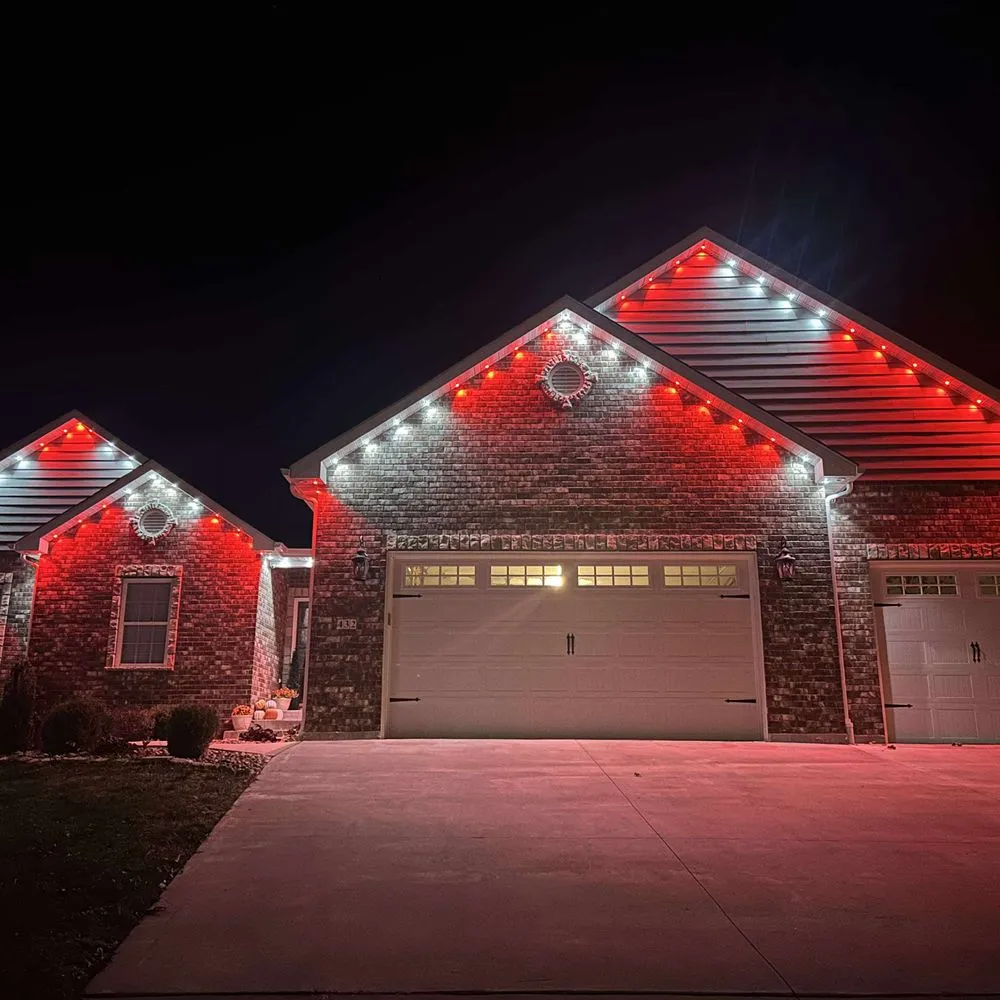
White strand lights are unforgiving. One dead bulb leaves an obvious dark dot on a pale wire against a white door, so budget for a spare strand each season and buy the same model. Expect brick to shed grit onto your clips, and recheck every connection after the first hard rain — moisture in an unsealed plug is the number one reason a strand “randomly” quits. A $6 tube of dielectric grease on the plugs saves a lot of December troubleshooting.
21. Alternating Roofline Colors on Gray Siding
Alternating color strands look fantastic and photograph terribly when the two colors sit at different brightness levels. Emerald beside magenta, for instance, always reads as green plus a blur. Test one string against your siding at night before committing to 150 feet of it, and check how the colors land on gray — cool siding mutes warm bulbs more than you’d expect. If you’re renting, keep everything clip-on: no staples, no adhesive residue on the fascia come January.
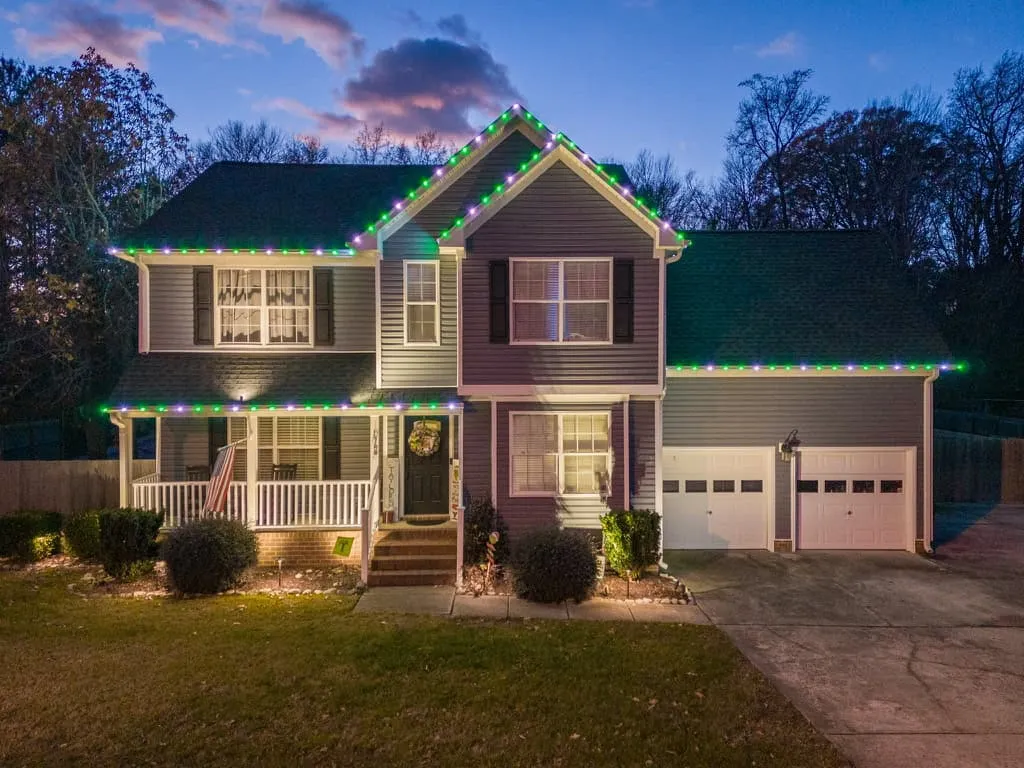
The working formula is one dominant color and one accent, run at roughly 60/40 rather than 50/50 so the eye has a clear home base. On gray siding, warm white plus green holds up best; on cream or beige, red plus warm white. The wreath on the porch door should echo the accent color, not compete with it — that single repeat is what separates planned from purchased. For a single-color version that’s easier to keep even, see Idea #16.
22. Frosted Glass Panels, Dark Grids, and Almost No Decor
The thing that makes this facade work is the pair of vertical sconces standing between the two garage bays. They give the eye a bright vertical element against a wide horizontal composition, and at the holidays they’re the only decor the house needs. Hang a wreath and run garland and you’d fight the frosted glass, which already glows softly on its own. Some elevations genuinely look better with restraint — if you want a middle ground, borrow the hoop idea from Idea #3 and hang three instead of eight.
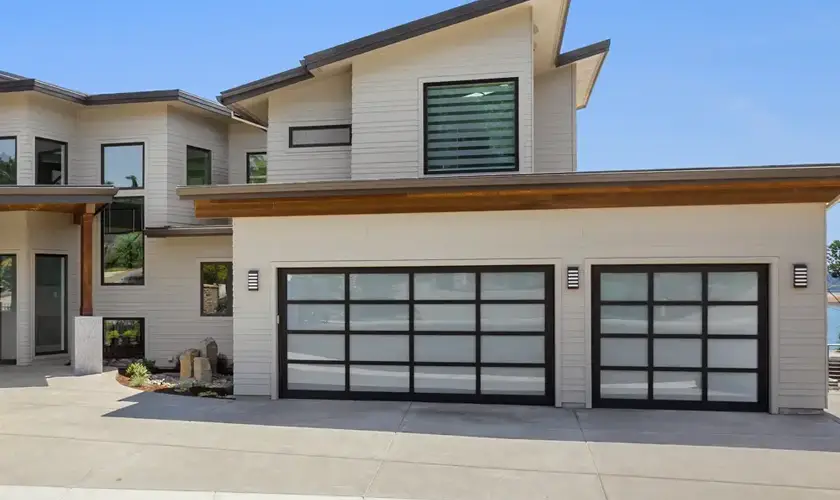
Restraint is also the cheapest look in this entire article. Two warm uplights tucked into the planters, about $40, plus small battery-operated window candles behind each frosted pane for $20. Want a touch more? Add one wreath at $25 and stop. Compare that to a $400 projection rig or three inflatables, and the quiet version starts looking less like a compromise and more like a decision.
Your Driveway Is the New Front Door
Whether you go all-in with a full gingerbread banner or keep it to eight brass hoops and a spotlight, the garage door is the one surface that greets everyone who walks, drives, or delivers to your house all December. Pick one idea, buy the pieces now while stock lasts, and give yourself a Saturday instead of a scramble.
📌 Pin your favorite to your holiday board so you can find it again next November — and tag us when it’s up.