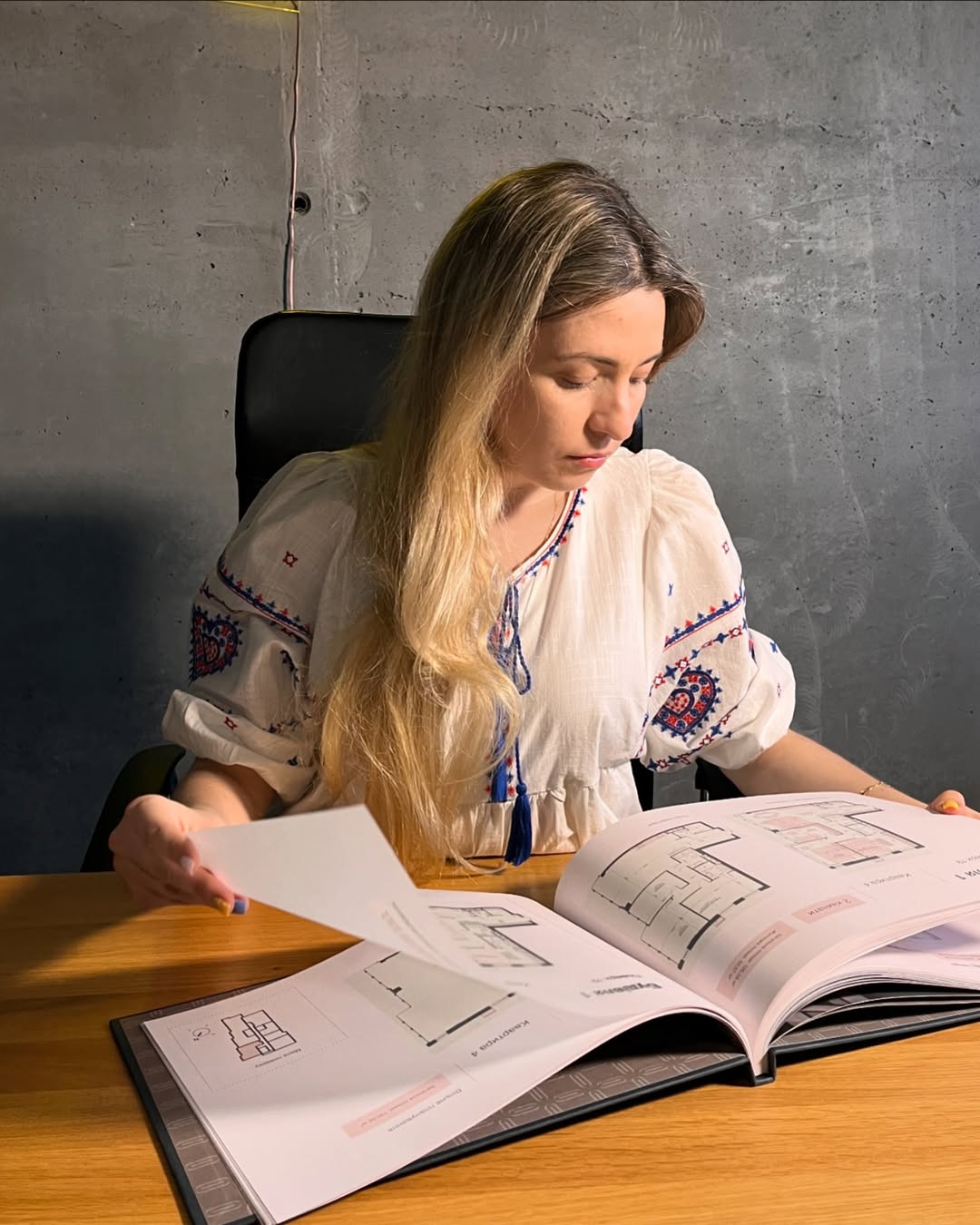
You know the moment: you’re forty pins deep into Christmas tree photos and every single one looks like it was styled by a committee of elves with a corporate glitter budget. The poinsettia-as-ornament idea is everywhere for 2026 — and honestly, it earns the hype. One well-placed bloom does more for a tree than a hundred random baubles.
We spent serious time browsing Amazon, Target, Etsy, and Walmart to bring you only what’s worth your attention this year. After filtering through hundreds of options, we narrowed it down to 26 ideas, from red velvet classics to a pink flocked tree that shouldn’t work but absolutely does — with prices spanning roughly $12 to $450.
Inside you’ll find traditional red-and-green, full glam gold, pastel whimsical, and a few real-plant moments, with budget and luxury versions compared side by side so you can see exactly where the money goes.
What makes 2026 different: the pendulum has swung from “more is more” toward texture-first decorating — velvet, felt, sheer fabric, and lamé blooms instead of flat plastic. It reads richer in photos and, more importantly, in person.
And stay until the end — we break down the most common mistakes that can ruin these looks. 📌 Save this to Pinterest for later — you’ll want to revisit these ideas.
1. Gold, White, and Rose Gold: The Full-Glam Tree With a Faux Fur Skirt
The white faux fur skirt is the quiet hero here. Without it, all that gold and glitter floats in midair. It gives the tree a soft landing, makes the metallic ornaments read as intentional rather than gaudy, and bounces warm light back up into the lowest branches. Keep the pile short — two or three inches beyond the stand — or it swallows the bottom row of ornaments.
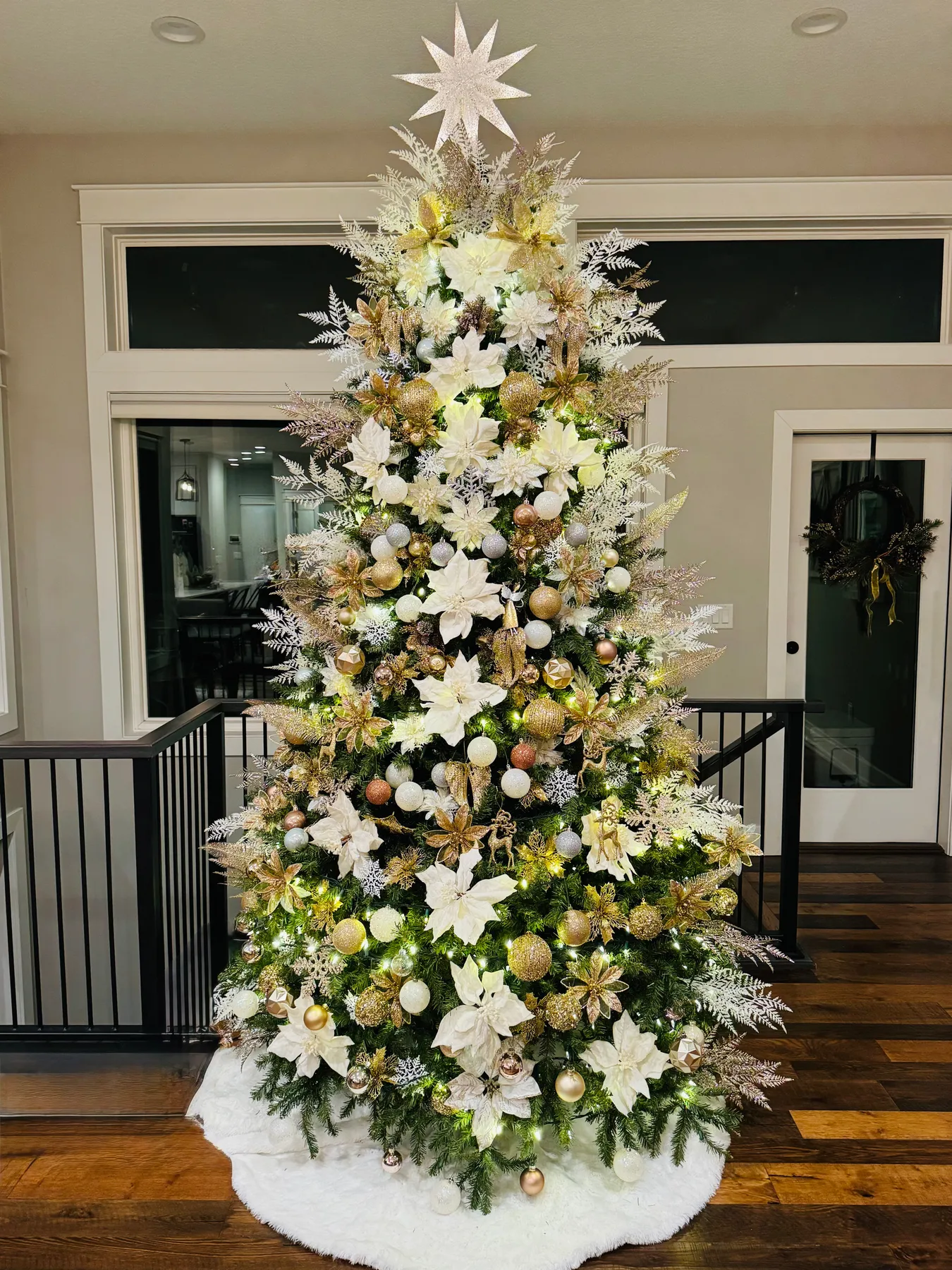
- Pre-lit 7.5 ft tree: $150–$400
- Metallic baubles, 60–90 count: $120–$260
- Poinsettia stems, 8–10: $40–$90
- Glitter star topper: $15–$40
- Faux fur skirt: $30–$70
- Picks, ferns, ribbon: $25–$60
Total: $380–$920. Budget alternative: a $60 unlit tree from Facebook Marketplace, January clearance baubles at $30, and three poinsettia stems clipped from a $9 grocery store plant.
2. One Gold Glitter Poinsettia Against Dark Green Needles
Hang your largest poinsettia about one-third of the way up the tree and just off-center — roughly at the eye level of someone 5’9″. That single placement gives the eye an anchor before it starts wandering. Then mirror it at eight o’clock with a bloom one size smaller. Skip the dead-center front spot; it photographs flat and reads like a bow substitute.
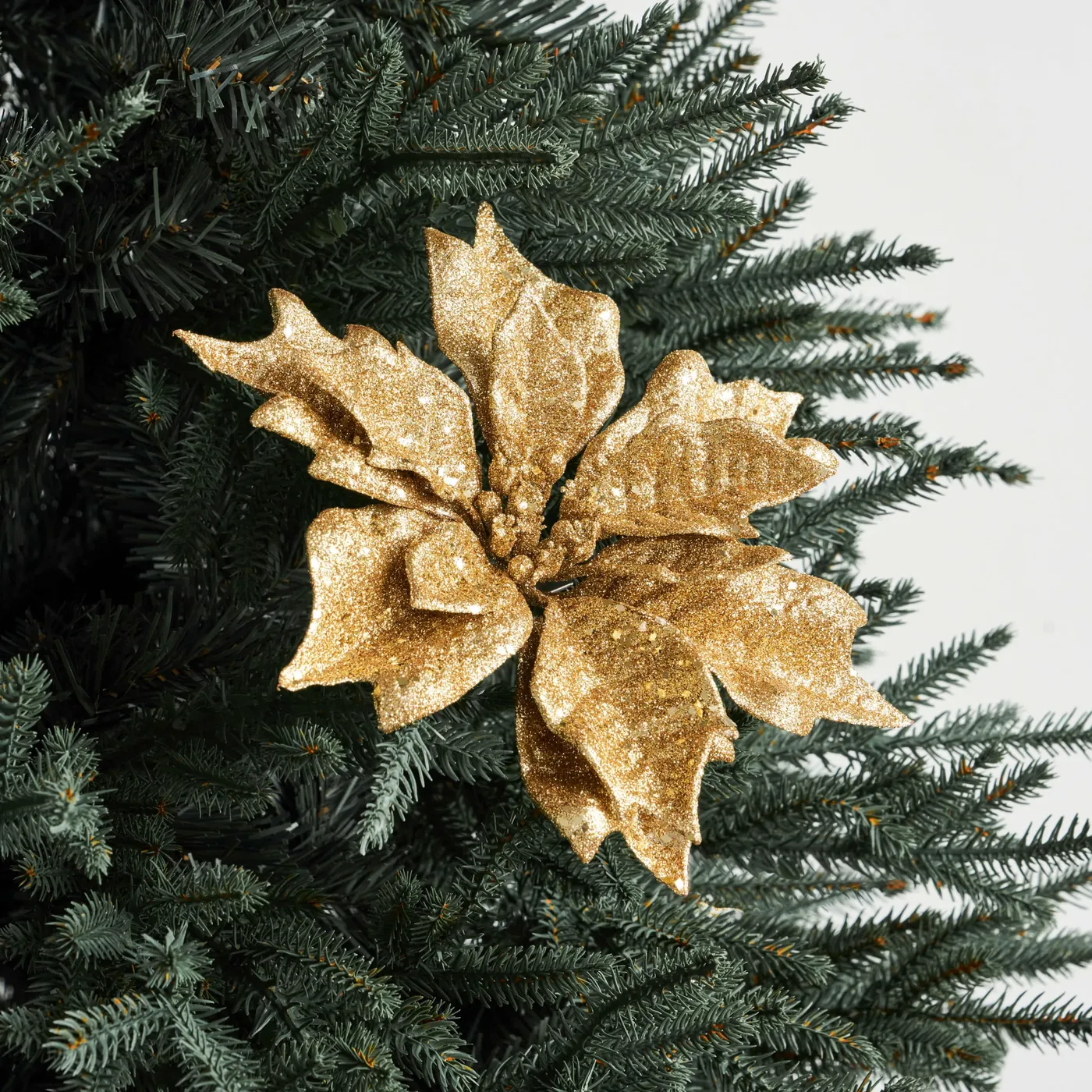
The glitter does the work because the backdrop refuses to compete. Dark green artificial needles are matte and light-absorbing, so one shimmering gold bloom becomes the brightest thing on the branch — contrast by finish, not by color. It’s also why one bloom is enough. Two or three of these clustered together and the effect cancels itself out entirely.
3. A Red Poinsettia Garland That Climbs the Staircase
For a mantel-and-railing garland that actually stays put:
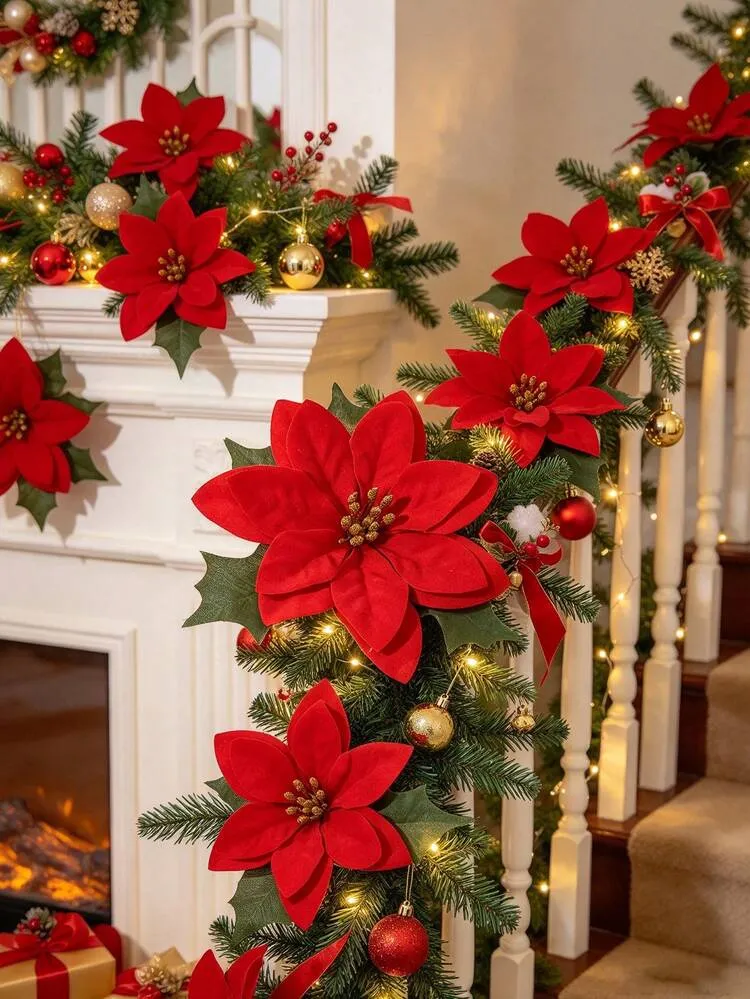
- Measure the run and buy 1.5× the length — garland compresses when it drapes.
- Anchor with clear adhesive hooks every 18 inches, not just at the ends.
- Wire poinsettia stems in at the swags, facing outward and slightly up.
- Weave lights last so the cord hides inside the pine.
- Test the whole run before you zip-tie anything permanently.
About 45 minutes for a 10-foot run, roughly $55–$80 in materials.
A lit garland near a working fireplace is a cord-management problem before it’s a decor problem. Keep the battery pack and any plug at the far end from the hearth, and never run cord across the mantel top where heat rises. Faux pine near real flame also dries out and gets brittle fast. If the fire gets used, go battery-operated and skip the mantel drape.
4. Red Poinsettias and a Single Clear Glass Ornament
Think of it as 70% green foliage, 20% red poinsettia, 10% glass and metal. The green is your neutral, the red does the talking, and the clear ornament is the punctuation mark. Swap the red for burgundy and the formula still holds. Swap the clear glass for brushed gold and you’ve warmed the whole tree up a few degrees without changing a single bloom.
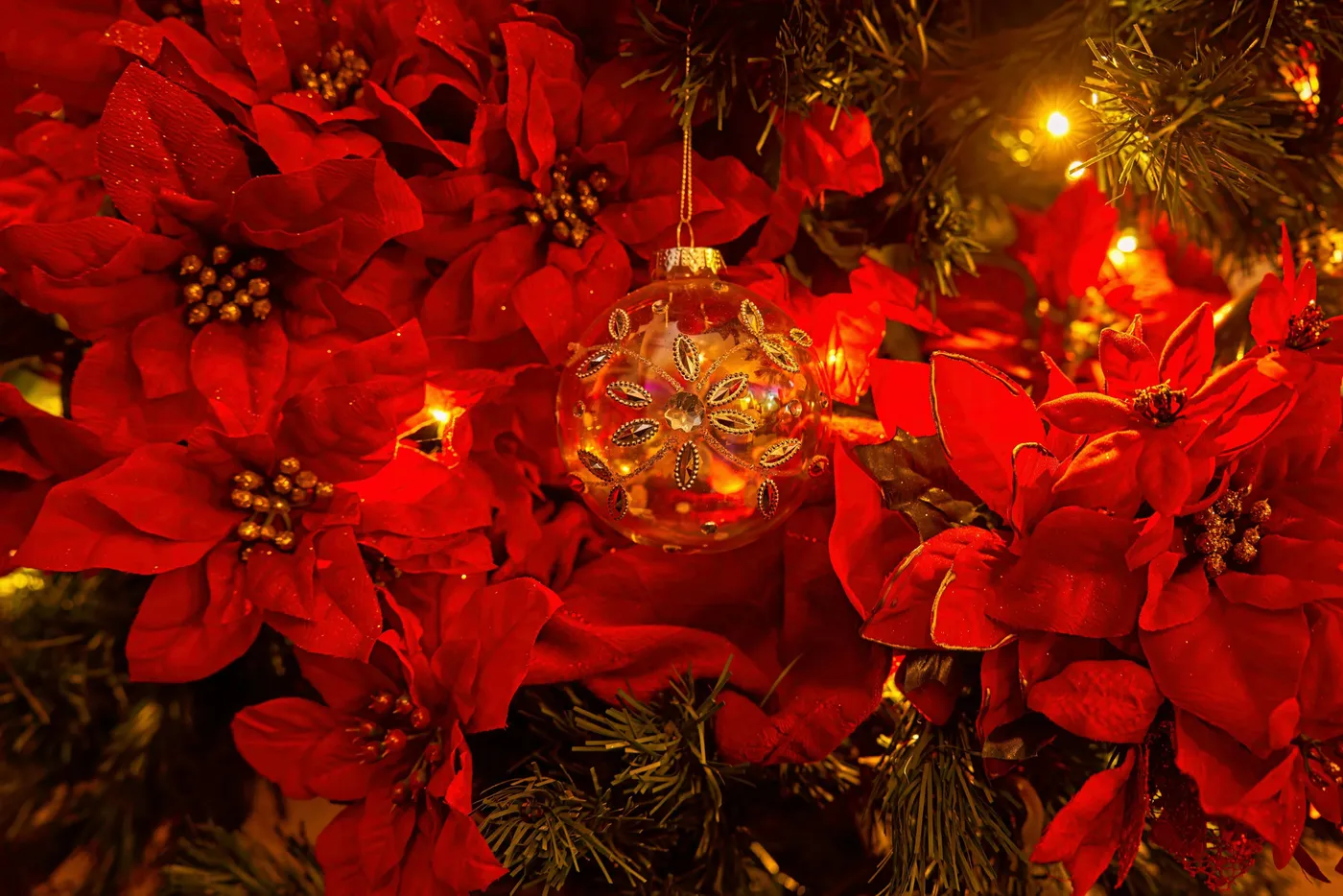
It’s the clear glass bauble. Red poinsettias alone make a tree heavy — every bloom is opaque, and after a dozen of them the branches feel weighed down. One transparent ornament lets light pass straight through and gives the eye somewhere to rest. This is the calmer, cheaper cousin of Idea #13, where the same palette goes full volume.
5. Gold Poinsettias, Glitter Pinecones, and Tiny Jingle Bells
Count the textures: matte gold spheres, glitter-coated pinecones, cut-out metal petals, coiled ribbon, tiny bells. Same color, six finishes. That’s the whole trick — the tree isn’t varied in hue, it’s varied in surface, which is why it reads rich instead of chaotic. Proof that texture repetition beats color variety almost every single time.
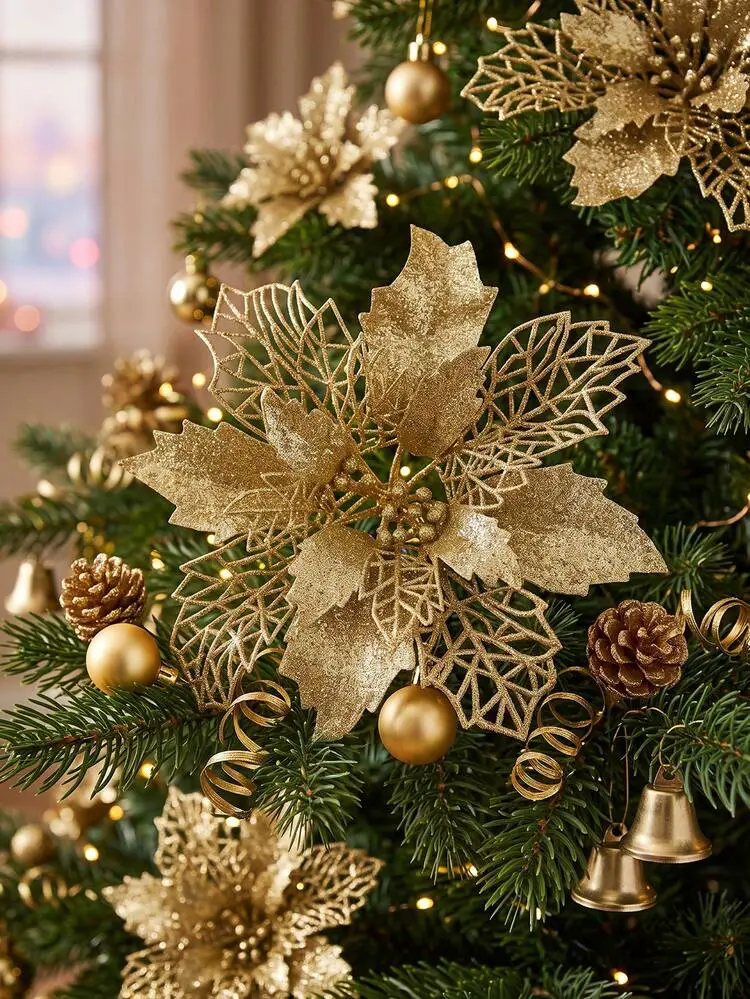
You don’t need a designer’s worth of gold. Spray-paint a bag of pinecones from a walk — $6 in paint covers thirty. Hit the dollar store for bells and matte baubles, then spend your real money on three or four good glitter poinsettias instead of fifteen mediocre ones. The formula stays the same; only the density changes.
6. A Frosted White Poinsettia Glowing Against Warm Lights
The white bloom is the move. Everyone expects red, so a single frosted white poinsettia against warm-yellow lights reads as a deliberate choice rather than a default. It also photographs beautifully — white picks up ambient glow and throws it back, which is why that background blur feels like candlelight instead of bulbs.
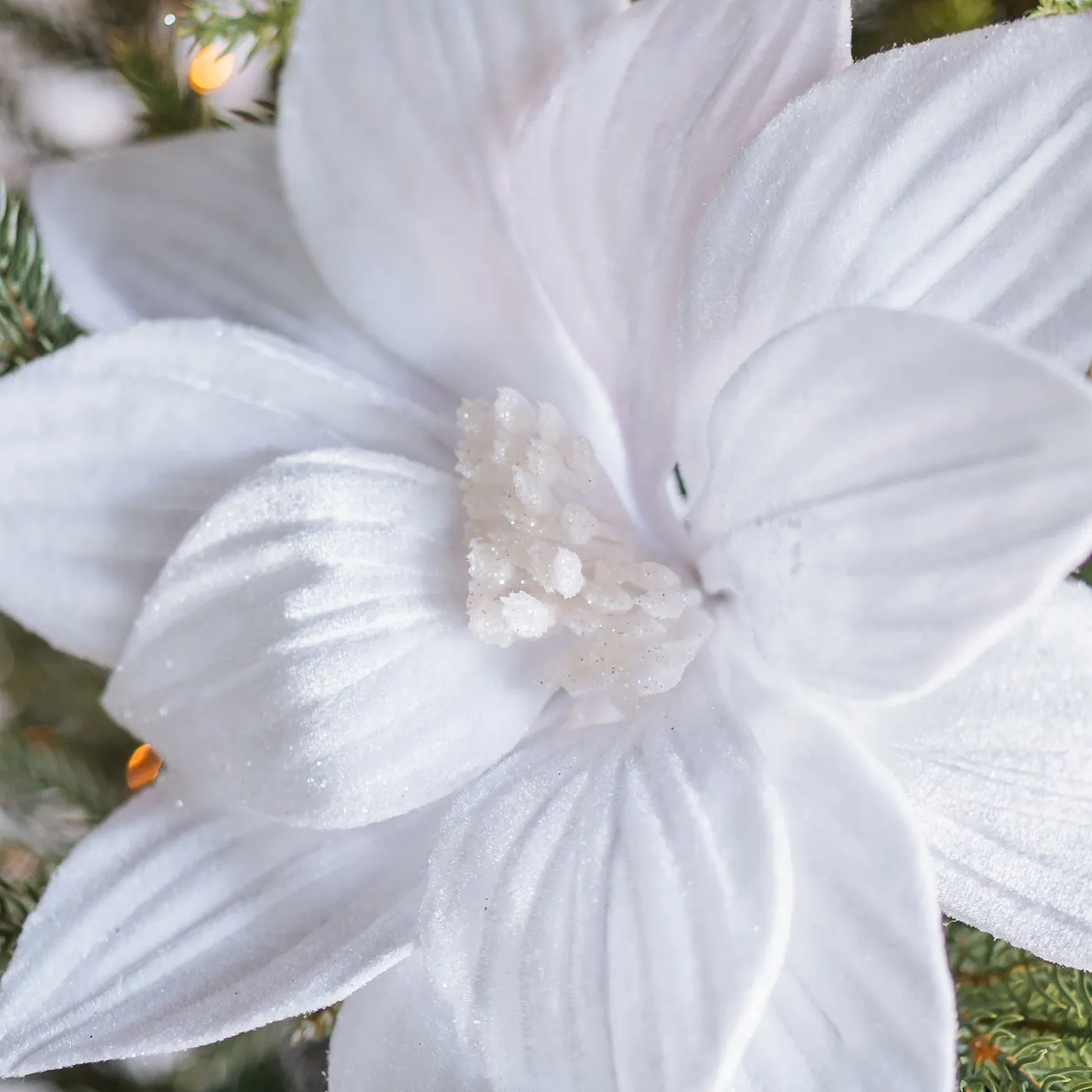
Glitter sheds. Expect a light dusting on the floor under the tree every time you move a branch, and don’t set anything fabric directly beneath it. A quick pass with a lint roller in January handles the petals. A matte acrylic sealer sprayed outdoors and dried for 24 hours locks most of the glitter in — do it before the ornaments go on the tree, not after.
7. A Gold Poinsettia With a Red Glitter Sidekick
Cluster in odd numbers and stagger the sizes: one large gold poinsettia, two medium, one small red bauble tucked just beneath. Odd groupings feel natural because the eye can’t pair them off. Even numbers of identical ornaments read as inventory. And leave a hand’s width of clear branch between clusters so the green can actually breathe.
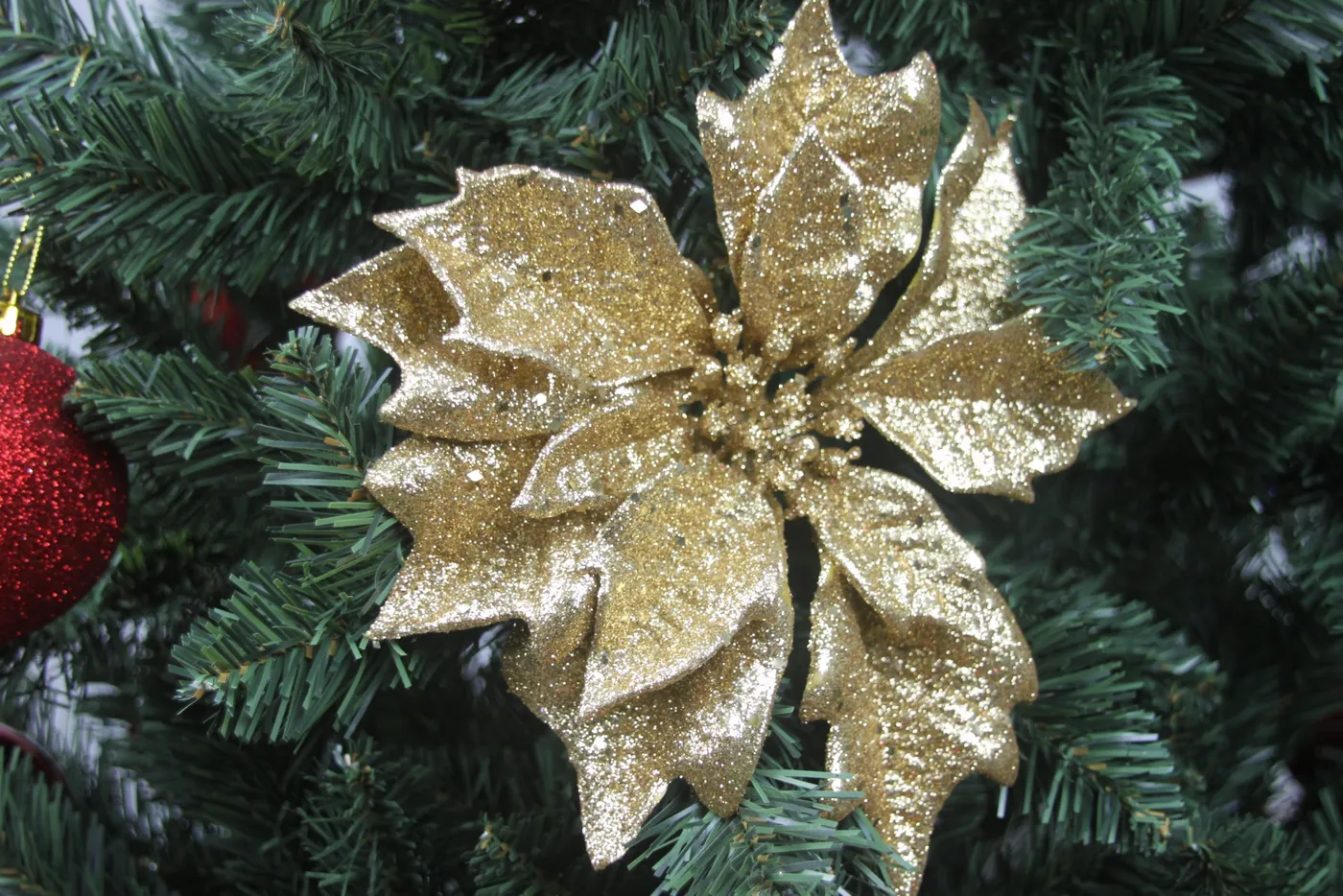
An all-glitter tree goes flat under a phone flash and under bright overhead cans. If your living room has recessed lighting on a dimmer, use it — 60% is about right. If you can’t dim, add two or three matte ornaments between the sparkly ones so the camera has something to focus on. Glitter needs shadow to look like glitter.
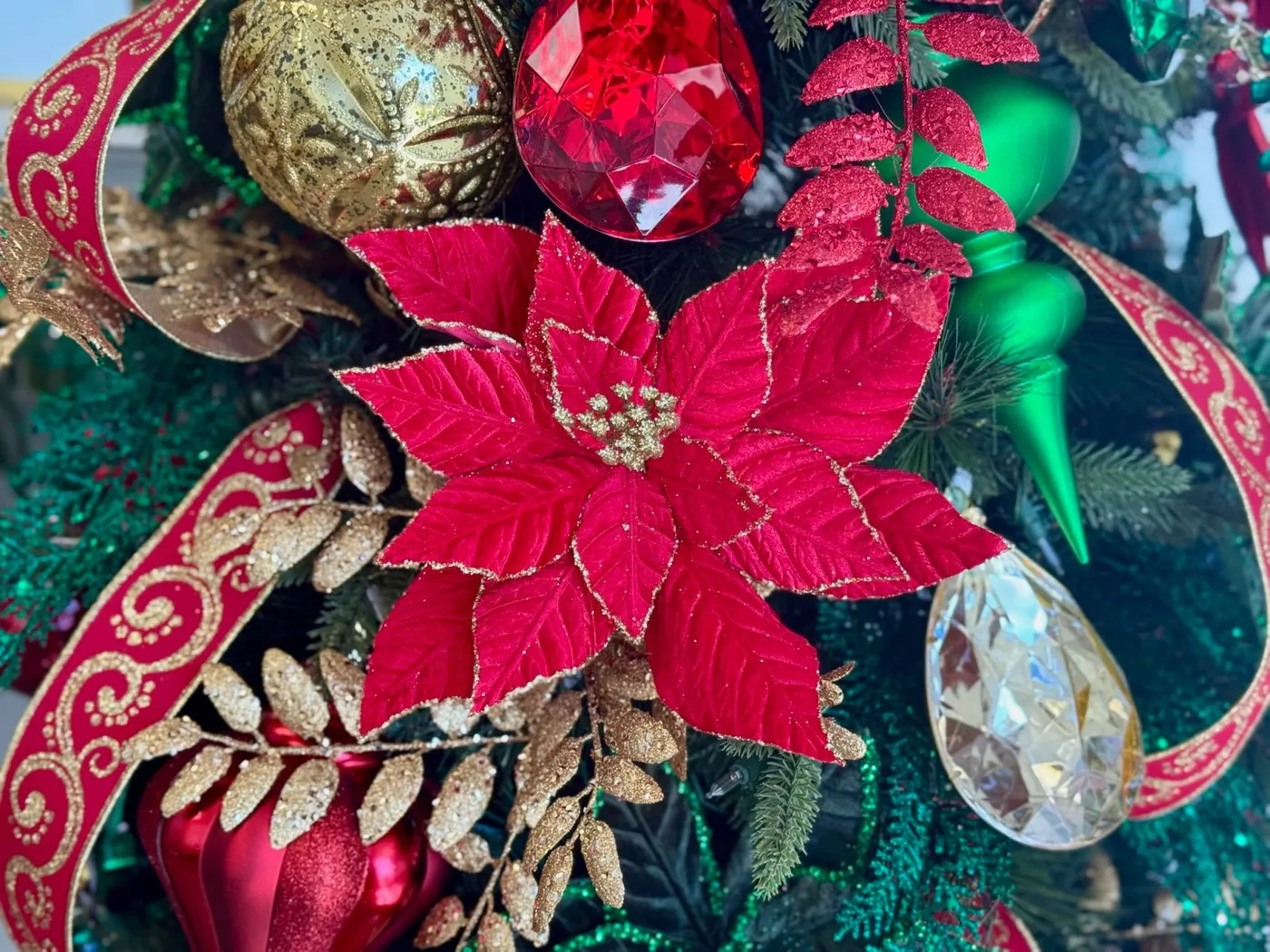
8. Red Velvet Poinsettias Woven With Gold-Glitter Ribbon
Weaving ribbon through a tree, the way it actually stays:
- Buy ribbon with wired edges — unwired collapses.
- Cut 3-foot lengths, not one long run.
- Fold each into a loose S and pinch the middle.
- Wire the pinch to a branch, tucking the ends inward.
- Step back every four placements to check the rhythm.
Twenty minutes for a 7-foot tree, around $18 in ribbon.
Sixty percent forest green, thirty percent red, ten percent gold. The green is the room, the red is the voice, the gold is the jewelry. Want it softer? Trade half the red for cream and leave the gold exactly where it is. Want it bolder? Push red to forty percent and thin the gold to one ribbon.
9. Deep Red Velvet Blooms Softened by Blurred Warm Light
Velvet. That’s it. A flocked poinsettia absorbs light while the pine needles beside it stay flat and slightly reflective, and that difference in surface is what makes the red look expensive instead of plastic. The gold glitter on the petal tips is the second thought, not the first — it just keeps the velvet from going dull in low light.
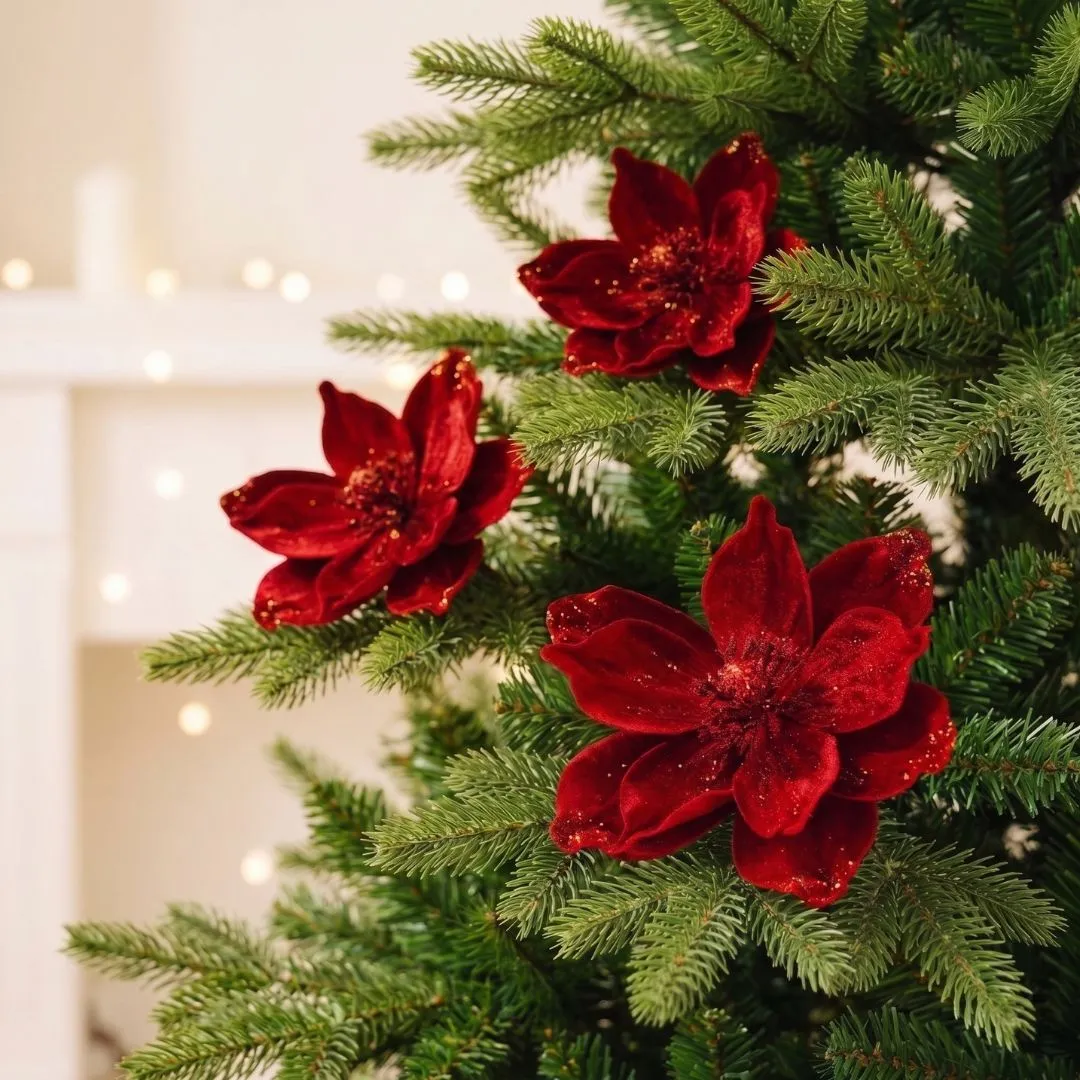
Fabric stores sell velvet remnants for $5 a yard, and one yard makes six blooms. Cut petal shapes, singe the edges so they don’t fray, layer three sizes, and hot-glue a felt circle at the back. Paint the tips with craft glue and dip in fine gold glitter — under $3 per flower. Compare with Idea #21, which is the same idea with lace.
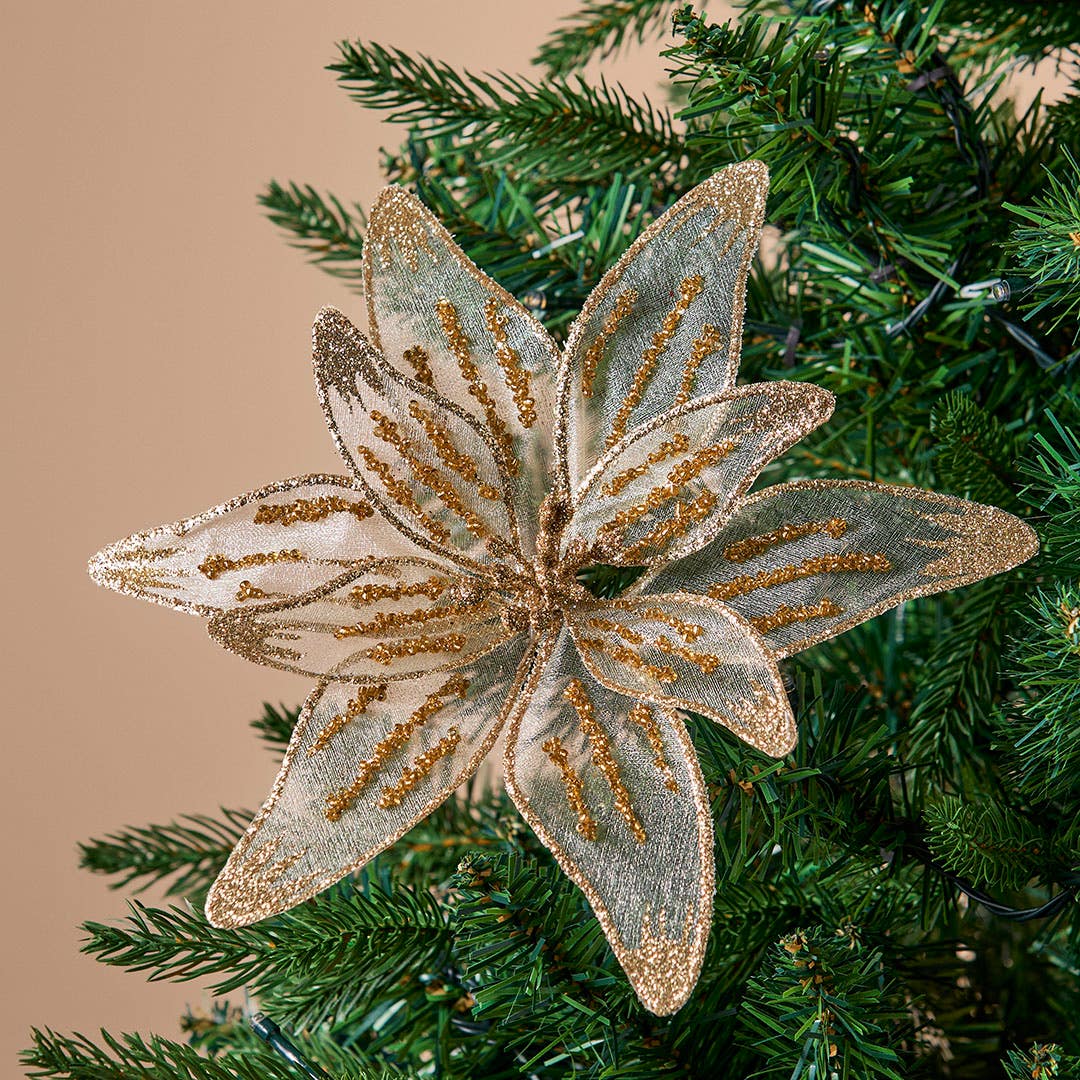
10. A Sheer Fabric Poinsettia With Gold-Glittered Petal Edges
Building the sheer petals:
- Cut organza into six petal shapes, two of each size.
- Run a thin bead of fabric glue along each edge and dip in glitter.
- Layer smallest to largest, offsetting each by about 20 degrees.
- Pierce the center and push through a wire stem.
- Bend the stem into a hook and hang.
Forty minutes per bloom, about $4 in materials. Make six.
Sheer petals droop within a week unless you stiffen them first. Dip each one in a 1:1 mix of white craft glue and water, shape it over a small cup, and let it dry overnight. They’ll hold their curl through the season and photograph sharper. This is the handmade sibling of Idea #17, where the store-bought version skips the fuss.
11. A Multicolor Poinsettia Tree in Terracotta, Sage, and Cream
Fifty percent green foliage, thirty percent red, twenty percent scatter — terracotta, sage, cream, butter yellow. The scatter is what keeps this from looking like a craft fair: it’s a fifth of the tree, no more, spread wide instead of clustered. Keep every scattered bloom in the same matte-and-glitter finish family so the color varies but the texture doesn’t.
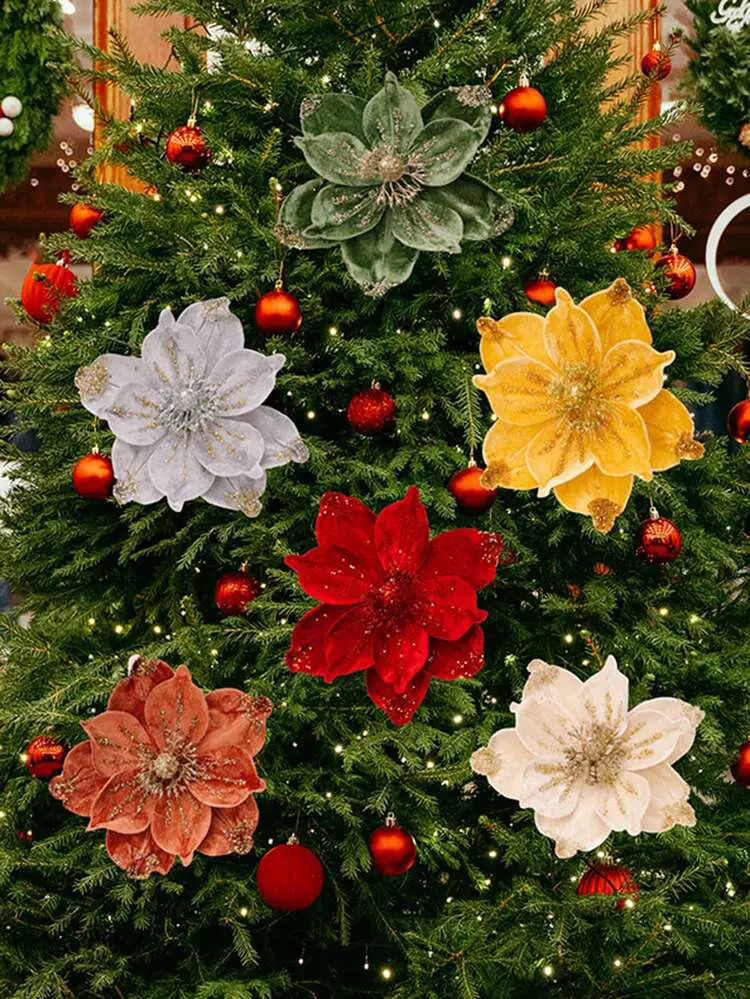
Collected trees are the 2026 reaction to five years of perfectly matched, brand-new ornament sets. Thrifted and handmade wins on Pinterest because it photographs with history — mismatched blooms look inherited, not purchased. It also has staying power: color-scattered trees don’t date the way a single trend palette does.
12. White Beaded Poinsettias With Gold-Edged Inner Petals
Two things. First, layering: a sheer inner petal showing through a solid outer one gives the flower real depth at arm’s length. Second, repetition at a large scale — these blooms run four to five inches across, spaced evenly, so they read as a pattern rather than decoration. The beads at the center catch light without adding another color, which is why the whole tree stays serene.
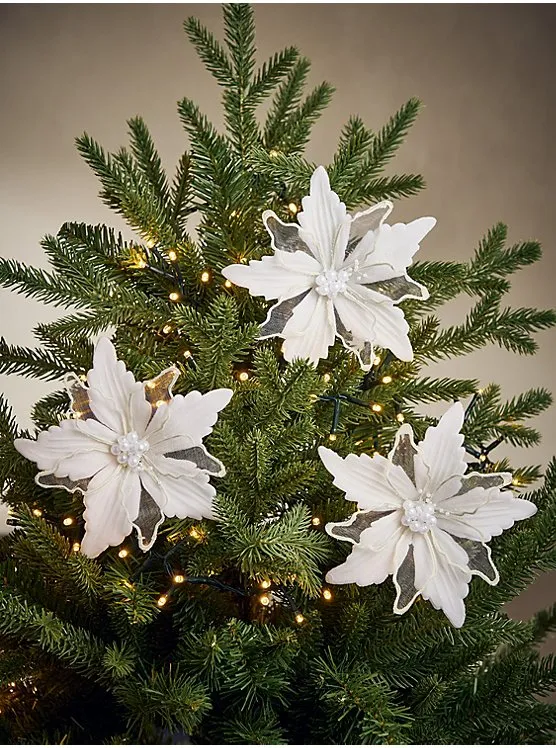
- Large white fabric poinsettias, 8–10: $60–$140
- Sheer gold-edged inner petals or DIY organza: $15–$35
- Pearlescent bead clusters: $10–$20
- Warm white string lights, 300 count: $20–$45
- Pre-lit 7.5 ft tree, if upgrading: $180–$380
Total: $105–$235 on a tree you already own. Budget swap: buy six blooms and fill the gaps with cream baubles.
13. Red Poinsettias, White Baubles, and a Fan of Presents
This look needs room to be looked at. A 9-foot tree wants a ceiling of at least 10 feet — 12 is better — and a floor footprint of 6 feet across once the gifts are out. In a room under 12 by 14 feet, drop to a 7-footer and stage the presents in one low stack instead of a fan. Small rooms can still do this; they just can’t do it wide.
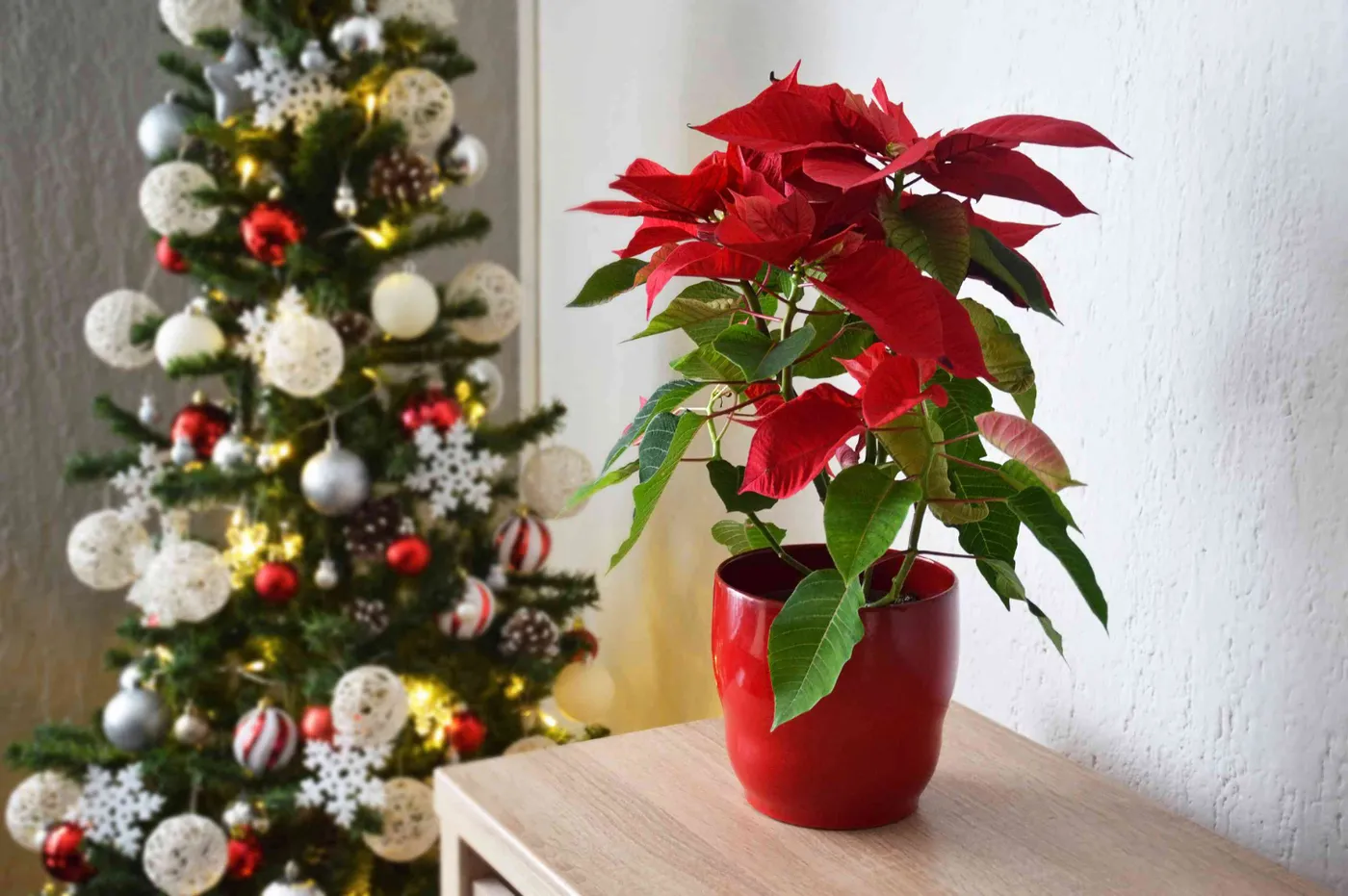
White ball ornaments are the cheapest thing in the store after New Year. Buy plain plastic spheres in January for $3 a dozen and spend your budget on poinsettia stems instead — that’s where the eye goes anyway. A 7-foot unlit tree, a $20 light strand, and a box of plain whites gets you most of this photograph for under $150.
14. A Monochrome Gold Poinsettia Tree That Glows at Night
An all-gold tree can go brassy and flat in a bright room — daylight and cool overheads both fight it. It does best in a space where the lamps are warm and dimmable. Test before you commit: string the lights, turn off the overheads, and look at it at night. If it glows, you’re fine. If it looks like a trophy, you need more matte gold and fewer sequins.
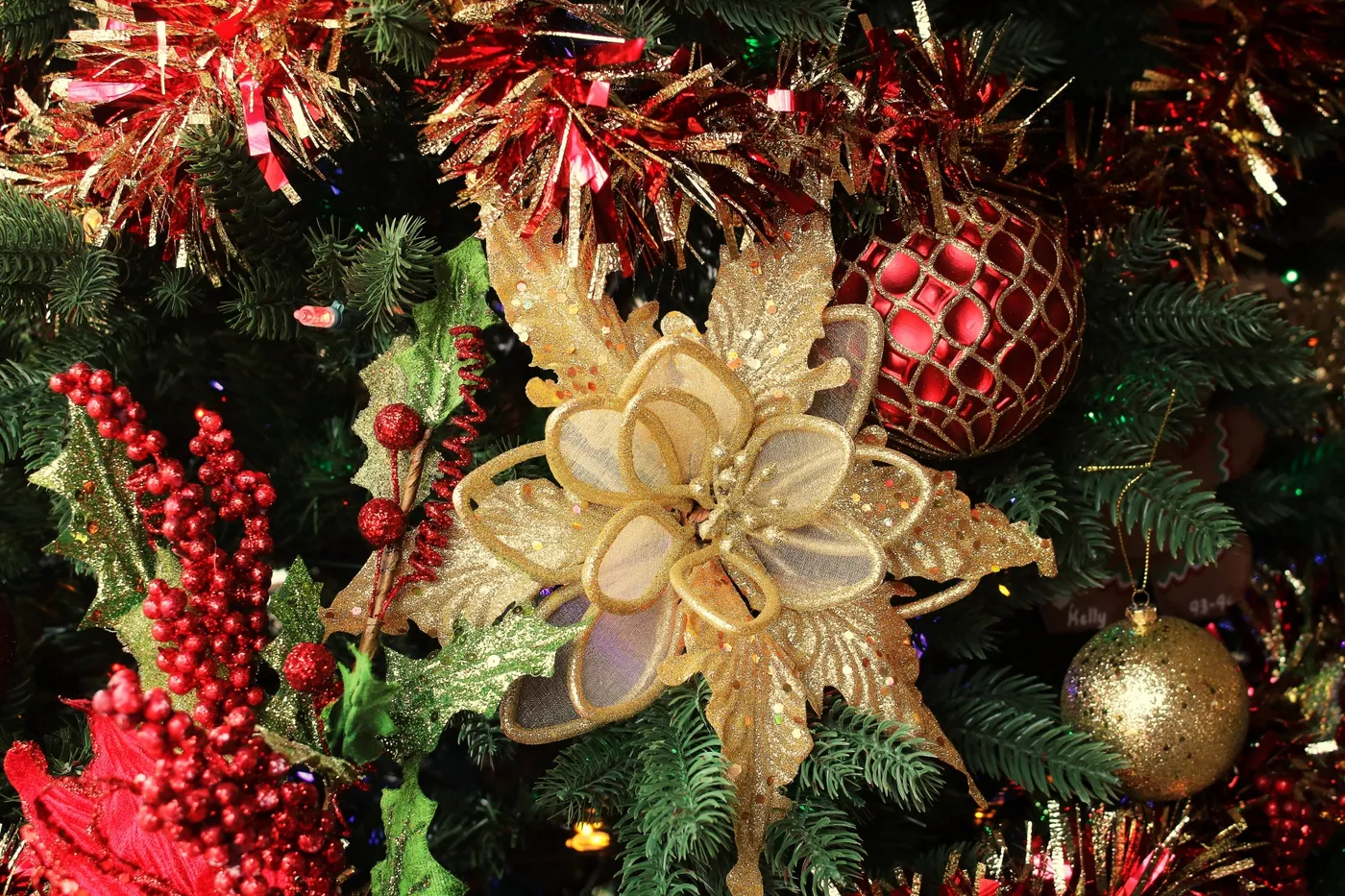
- Gold poinsettia stems, 10–14: $70–$150
- Matte gold baubles, 60 count: $35–$80
- Gold ribbon or mesh: $15–$30
- Warm white lights, 300 count: $20–$45
- Gold tree collar or skirt: $35–$90
Total: $175–$395. Cheaper route: an $8 can of gold spray paint on last year’s ornaments, pinecones, and a bundle of dried stems.
15. The Real Poinsettia: Bracts, Veins, and Yellow Nectar Drops
Real poinsettias want bright, indirect light and evenly moist soil — not wet feet, which is the number-one killer. Water when the top inch feels dry, and never let the pot sit in a saucer of standing water. Keep them away from heating vents and doors that slam, and expect bract drop within a few days of any cold draft. Six to eight weeks of good color is a realistic goal.
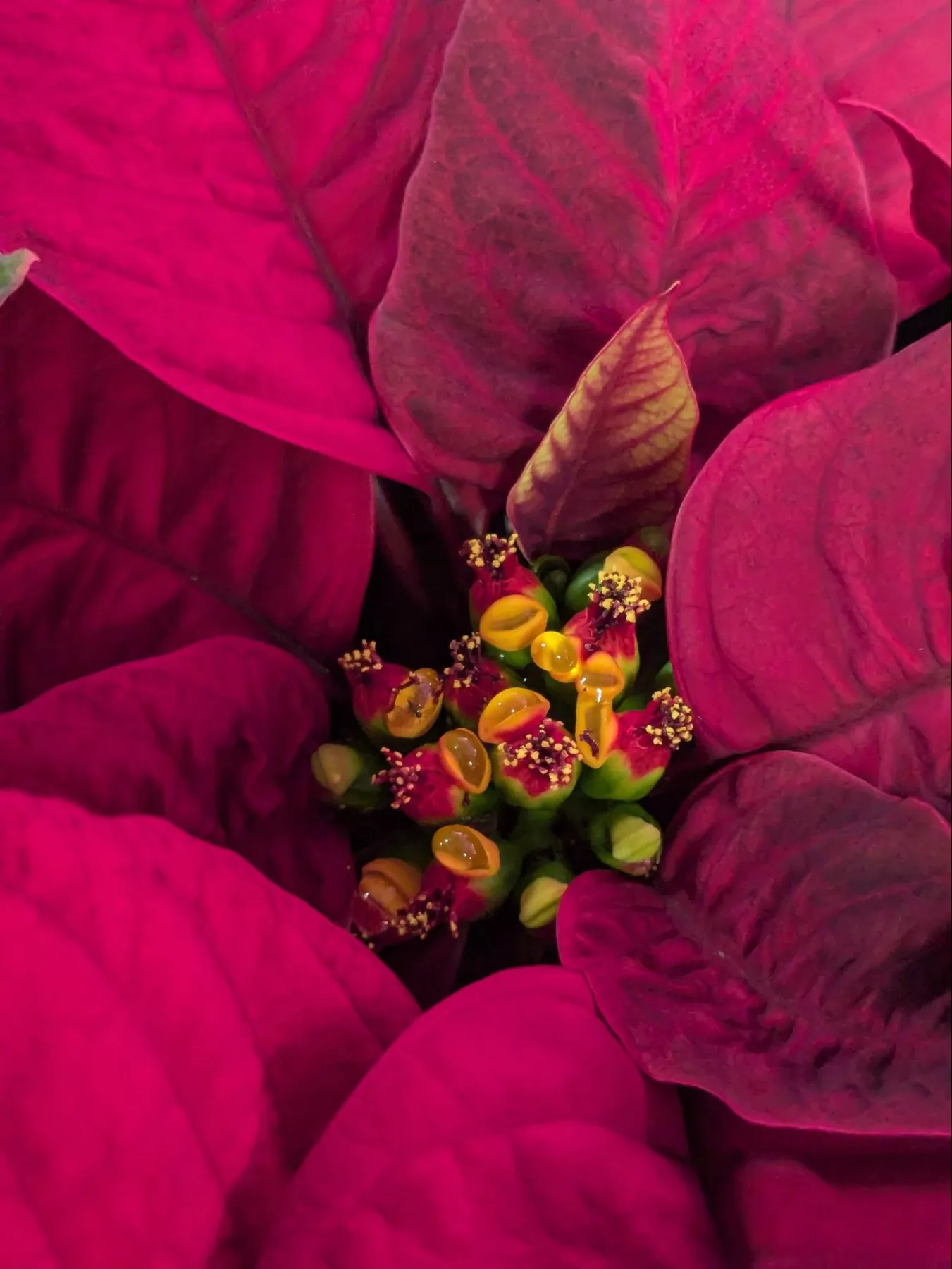
Living decor is having a moment, and 2026 buyers are splitting sharply: faux for the tree, real for everything at floor level. A single healthy poinsettia in a good pot reads as more considered than three fake ones, and it’s the one plant in the room that proves you actually like plants. Nurseries now stock compact varieties bred for tabletops.
16. Plaid Petals and Faux Snow on a Fabric Poinsettia
Making a plaid petal bloom:
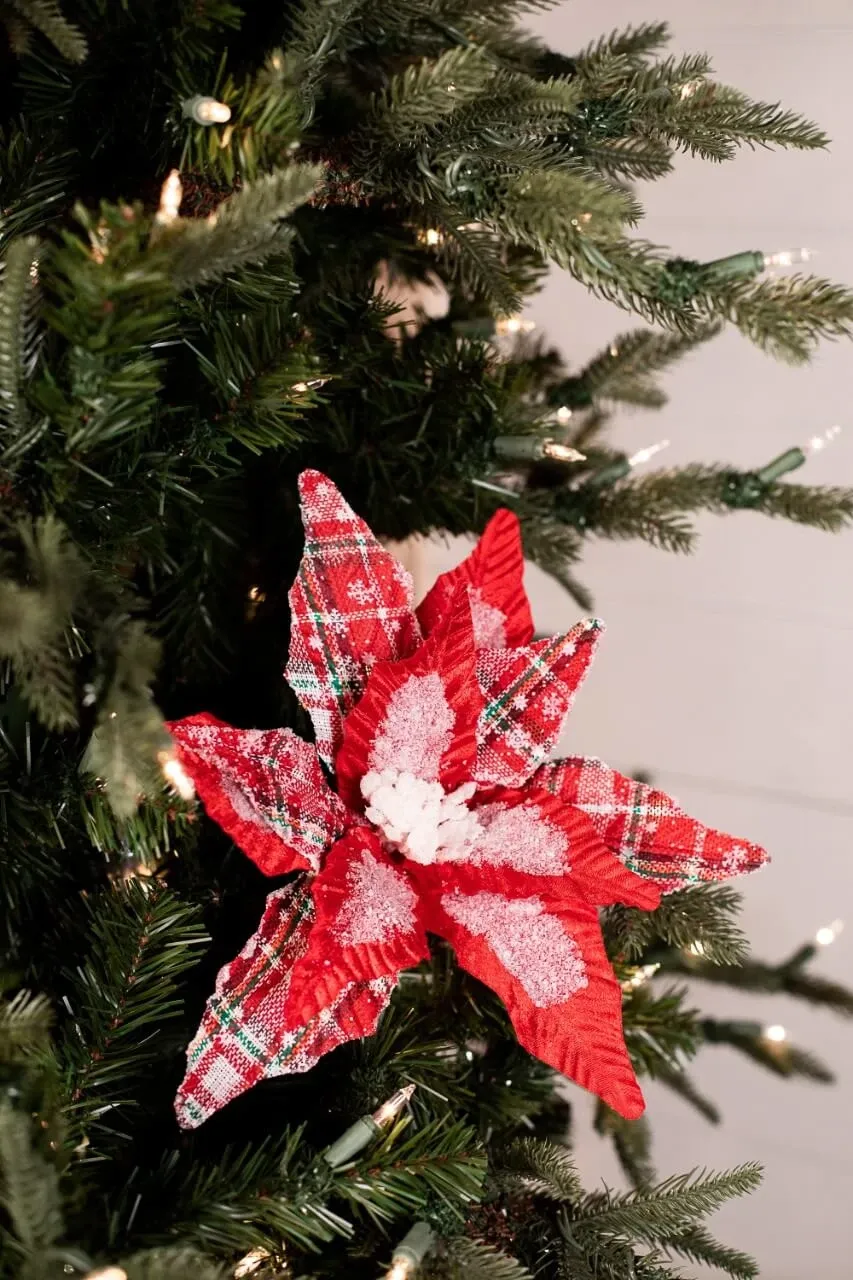
- Cut six 4-inch squares of red plaid cotton, plus two 3-inch and two 2-inch.
- Fold each square corner to corner twice, press, and trim the open end round.
- Layer and staple or hot-glue at the point.
- Dot the tips with tacky glue and dip in faux snow.
- Glue a felt circle and a wire loop at the back.
Twenty-five minutes each, roughly $8 for a set of six.
- Plaid cotton or ribbon, 2 yards: $10–$22
- Faux snow or white glitter: $5–$10
- Warm white lights, 200 count: $15–$35
- Red and white baubles, 40 count: $25–$55
- Plaid tree skirt or fabric remnant: $20–$50
Total: $75–$172 on top of a tree you already own — the least expensive theme on this whole list.
17. A Gold Fabric Poinsettia With a Faceted Beaded Center
Fabric poinsettias are heavier than glass and they slide. Skip ornament hooks and thread floral wire through the back of the bloom instead, then wrap it two or three times around a branch and twist. A hot-glued felt backing keeps the wire from tearing through. Place the biggest ones on the strongest horizontal branches, never on the drooping tips.
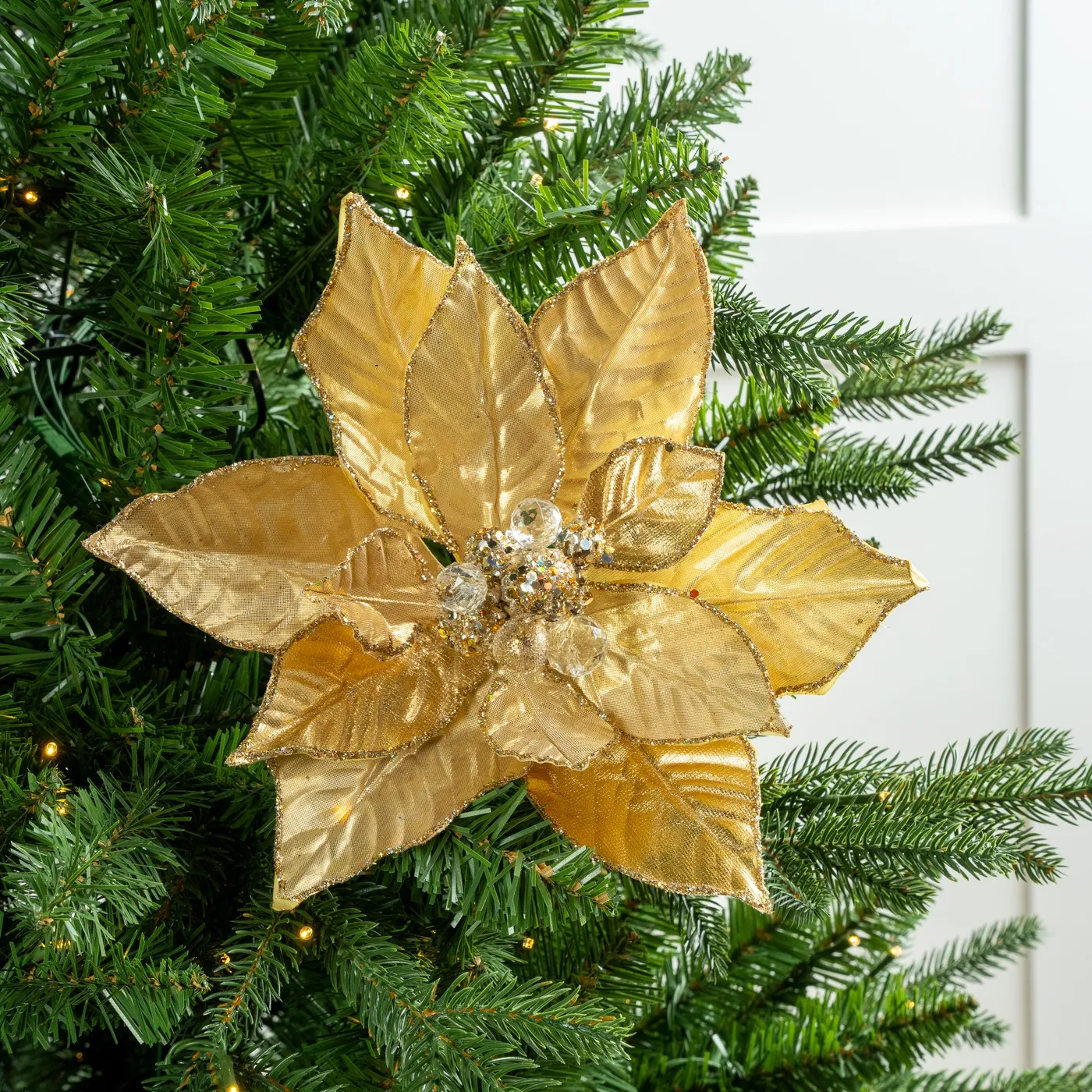
The beaded center. It’s what separates a craft-store fabric flower from something that looks made: clear faceted beads clustered tight at the middle catch the string lights and throw small points of brightness back out. Without it, gold petals read flat from across the room. It’s also the one part you can upgrade cheaply — a $4 bag of beads.
18. A Row of Potted Poinsettias Beside a Pre-Lit Tree
Dressing nursery pots so they don’t look like the grocery store:
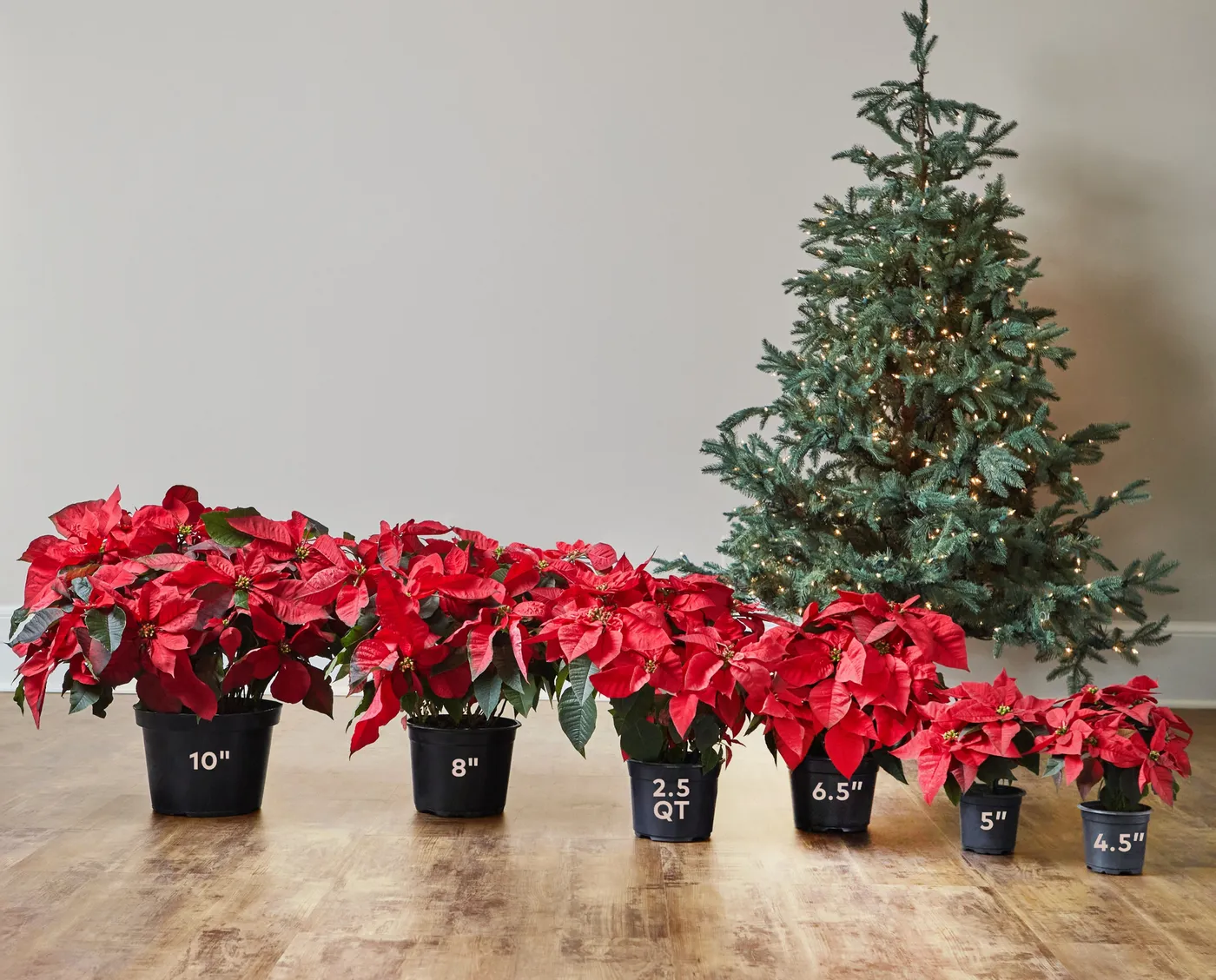
- Keep the plastic grower pot; just drop it inside something better.
- Choose a cachepot two inches wider than the grower pot.
- Tuck sheet moss over the soil to hide it.
- Group in odd numbers and stagger heights with a book or a block.
- Add a small riser so the pots read at slightly different levels.
Ten minutes, $6 to $40 per pot depending on the vessel.
One potted poinsettia per 18 inches of tree width is a good rule for a floor row — three or four plants for a 6-foot tree, five for an 8-footer. Keep the pots under 8 inches tall, or they start competing with the tree’s lower branches. Leave 24 inches of clearance between the row and the stand.
19. A Red Felt Poinsettia With a Pom-Pom Center
Felt is the cheapest good-looking ornament material there is. Two 9×12 sheets make one bloom, and a bag of pom-poms costs $3. Assemble with hot glue — no sewing, no wire, no glitter mess. Target and Walmart both sell close versions for $6 to $10 each, but the handmade ones hold up better around kids and pets because there’s nothing brittle to break. This is the kid-proof cousin of Idea #16.
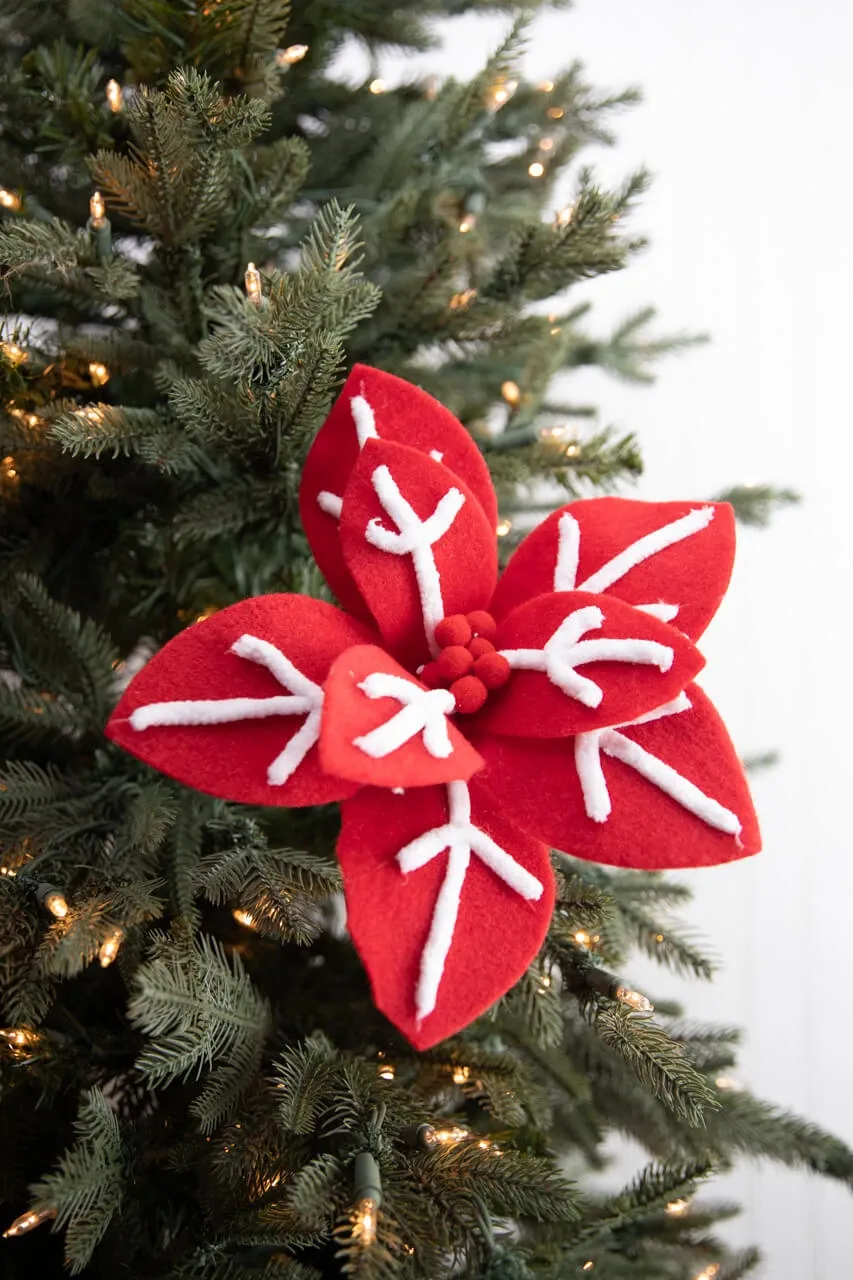
Felt pills. After two or three seasons the surface fuzzes, especially where the embroidered veins were stitched. A cheap fabric shaver fixes it in about a minute per ornament. Felt also grabs pine needles and lint, so a lint roller is your friend. Store them flat in a zip bag rather than in a tote with hooks and metal ornaments pressing against them.
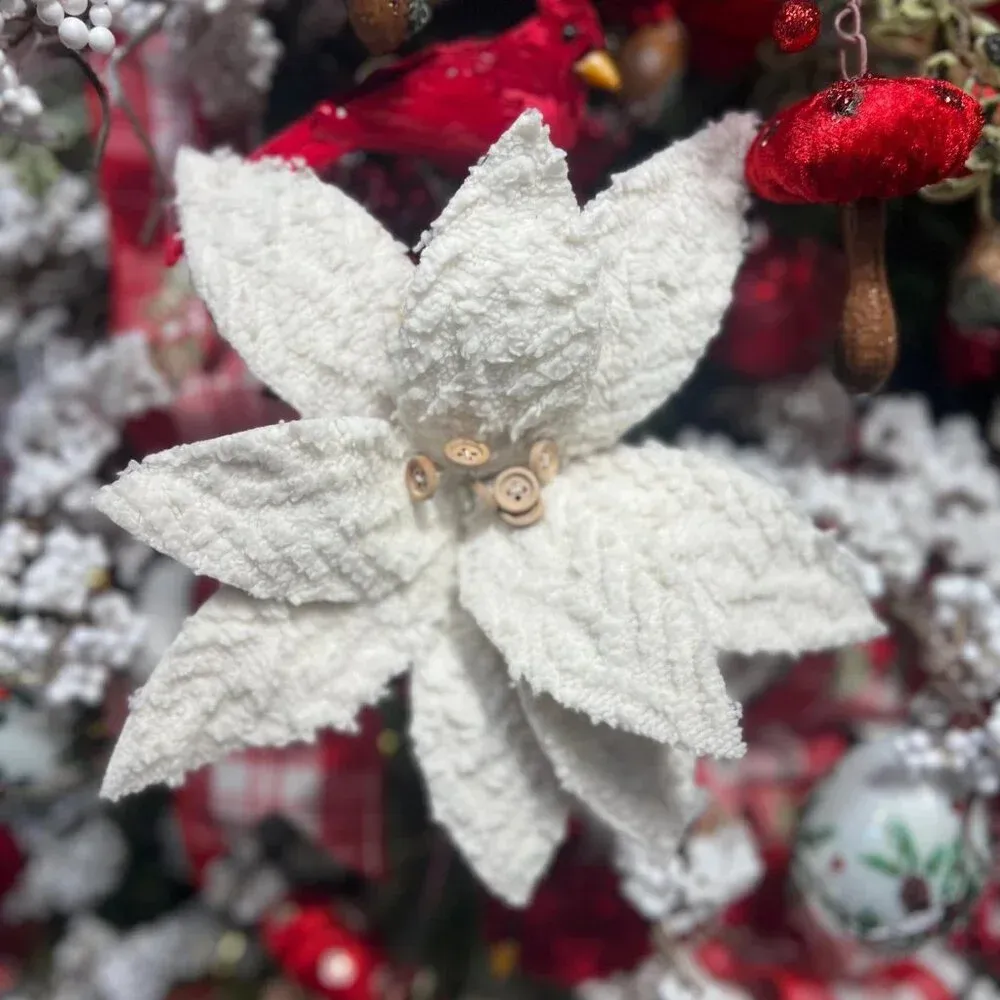
20. A White Fuzzy Poinsettia With a Wooden Button Center
Put your whimsy low. Anything small, funny, or story-driven — the wooden buttons, the cardinal, the plush mushroom — belongs in the bottom third of the tree, where a six-year-old standing next to it can actually see it. The top third gets the biggest, most graphic pieces. Same rule as a gallery wall: fine detail at eye level, big gestures up high.
Before you commit to a whimsical tree:
- Check your branch weight rating — flocked and felt pieces are heavier than glass.
- Sort ornaments by size into three piles before hanging anything.
- Decide whether kids or pets will reach the bottom third.
- Confirm the plaid you like won’t clash with the room’s rug.
Ten minutes of sorting saves an hour of rehanging.
21. Red Velvet Petals Alternating With Gold Lace
The alternating petals. Red velvet sits next to gold lace, and the eye keeps moving because neither material repeats for more than one beat. Swap the lace for more velvet and this becomes a heavy, formal ornament that disappears into the tree. The lace is what makes it feel like it came from a shop that also sells perfume.
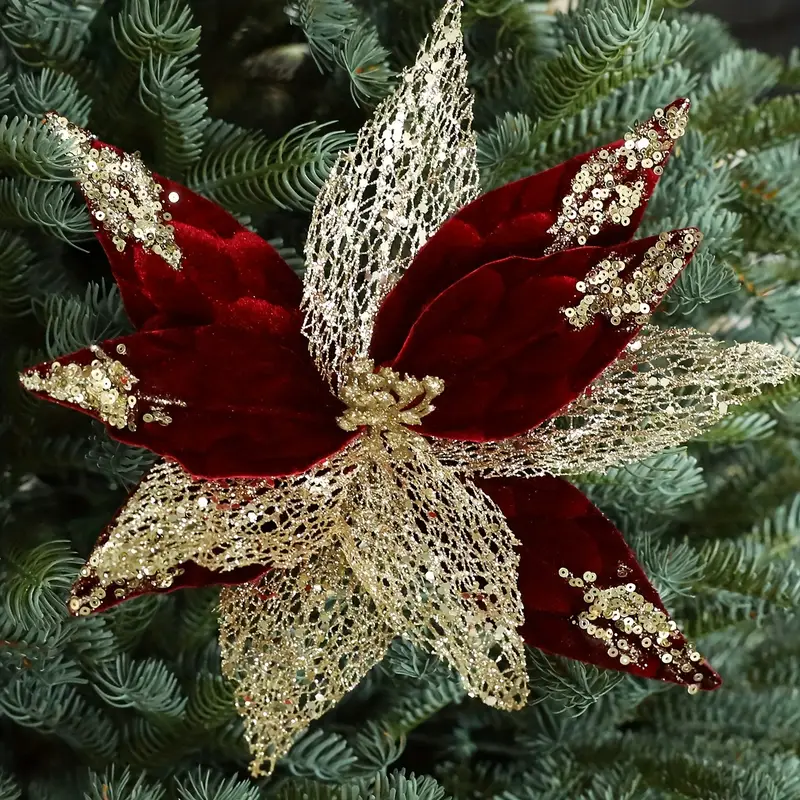
Eighty percent red velvet, fifteen percent gold, five percent sequin. That’s a dominance formula — one material clearly wins, one supports, one is a wink. Reverse it and you get a gold tree with red accents, which is a completely different room. Same three materials, completely different vote count.
22. Red and Gold, Full Traditional, With Woven Snowflake Ribbon
Width matters as much as height. A 2.5-inch ribbon suits a 7-to-7.5-foot tree; step up to 4 inches once you pass 8 feet, or it looks like thread from across the room. Blooms should run five to six inches across on a 9-footer and no more than four on anything shorter. See Idea #13 for the room-size version of this scale.
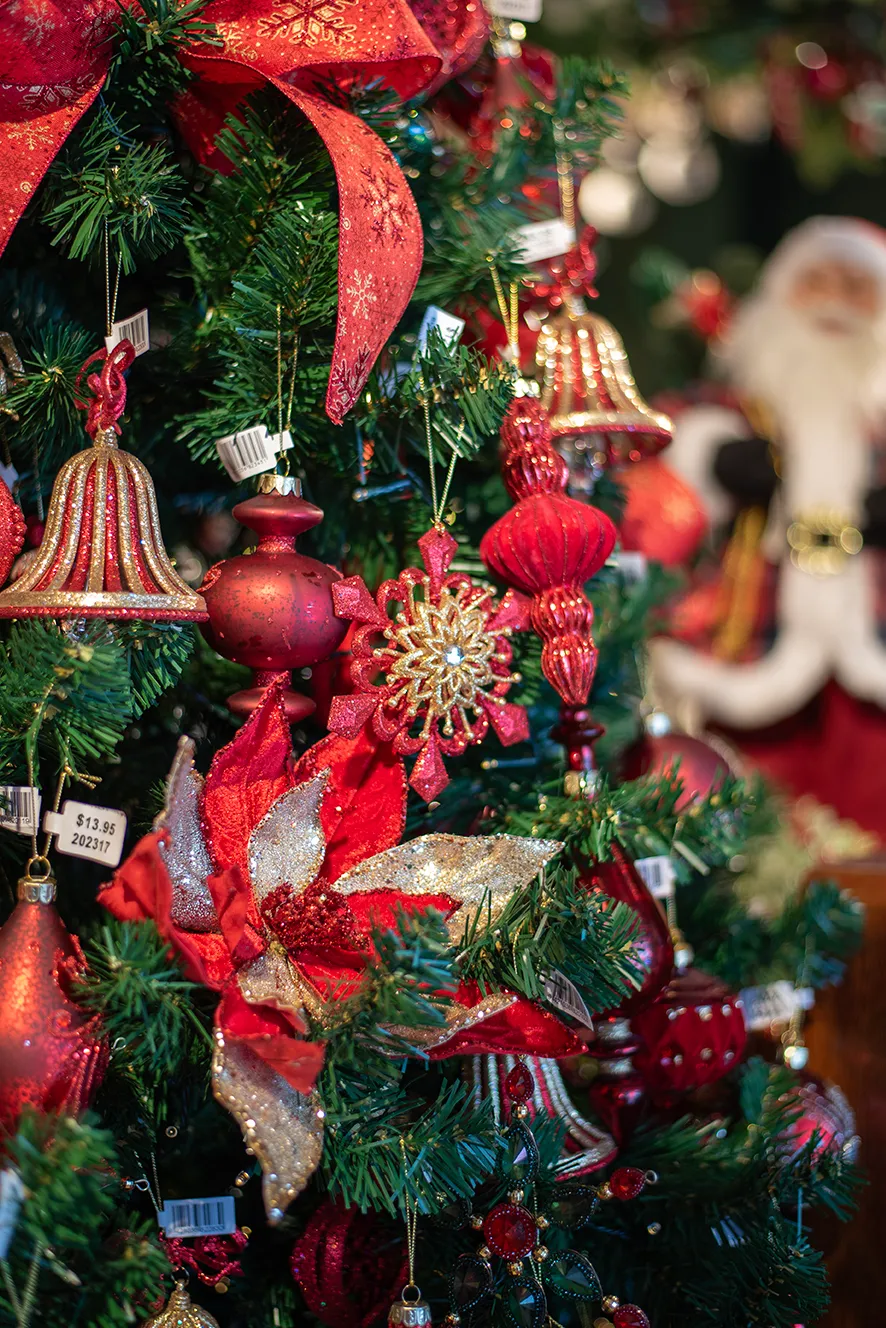
Red and gold is the easiest palette to overdo. When every ornament is both colors, the tree reads as one solid mass from three feet away and all the individual pieces vanish. Break it with bare green — leave whole sections of branch unornamented. That negative space is what makes the decorated parts look deliberate.
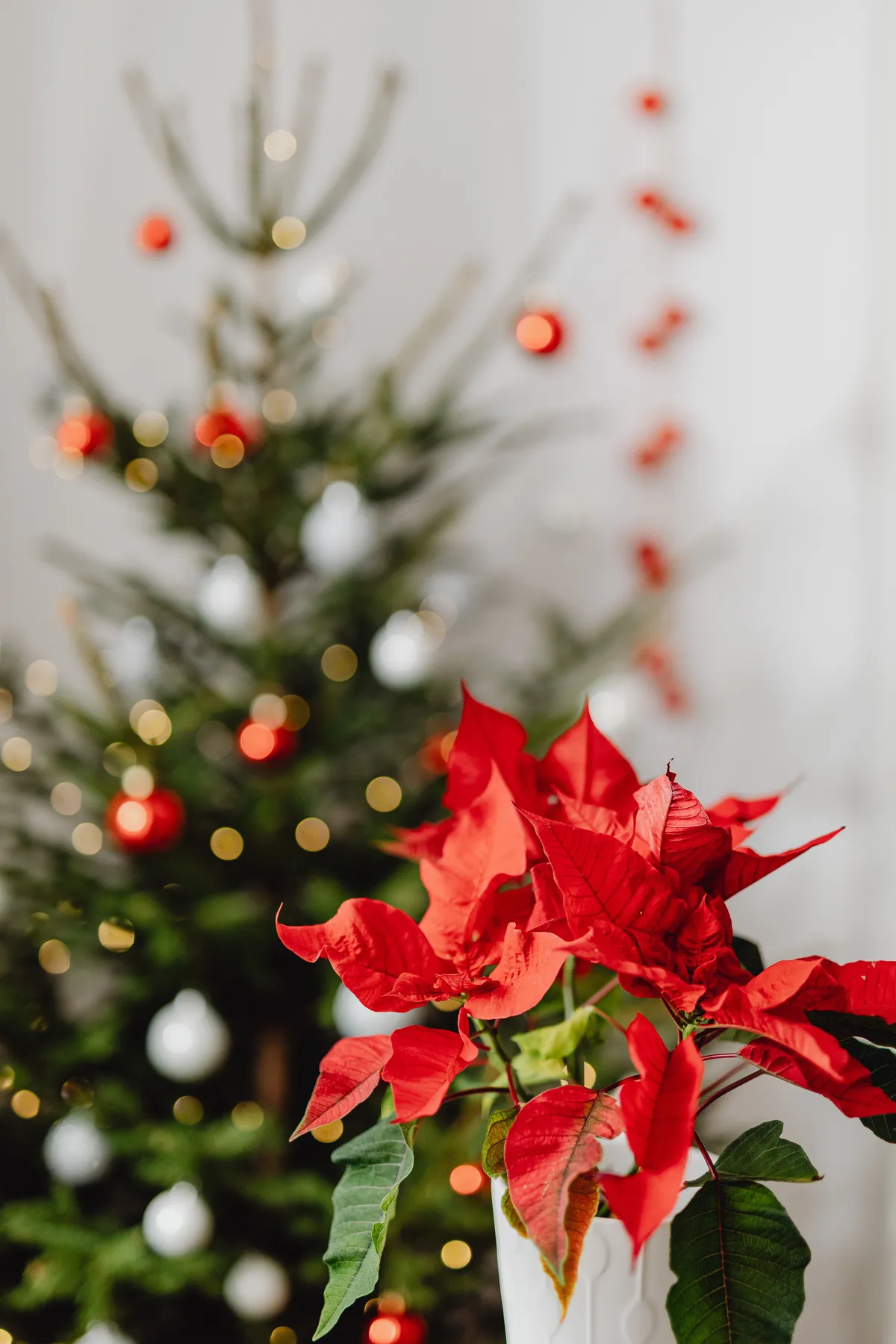
23. A Potted Poinsettia Standing In Front of a Bokeh Tree
Two layers of depth. The potted poinsettia is sharp and forward; the tree behind it is out of focus and glowing. Your eye reads the blur as distance, which makes a small corner feel like it extends past the wall. It’s a cheap trick that works every time — you don’t need a bigger room, just something soft behind something crisp.
- Red poinsettia plant, 6-inch pot: $12–$25
- White ceramic or textured planter: $15–$45
- Sheet moss for the soil: $4–$8
- Pre-lit 6.5 ft tree: $120–$280
- Red and white baubles, 30 count: $18–$40
Total: $169–$398, or about $35 if you already own the tree and just want the foreground vignette.
24. A Pink Flocked Tree With Pastel Poinsettias and a Mint Skirt
Flocked trees shed. Expect a fine pink dusting on the floor for the first two seasons, and don’t put one near a doorway or an HVAC return. They’re also hard to un-commit from — resale is slow and the color limits where it can live in your house. If you’re not sure, buy a small 4-foot pink tree and test the idea in a bedroom first.
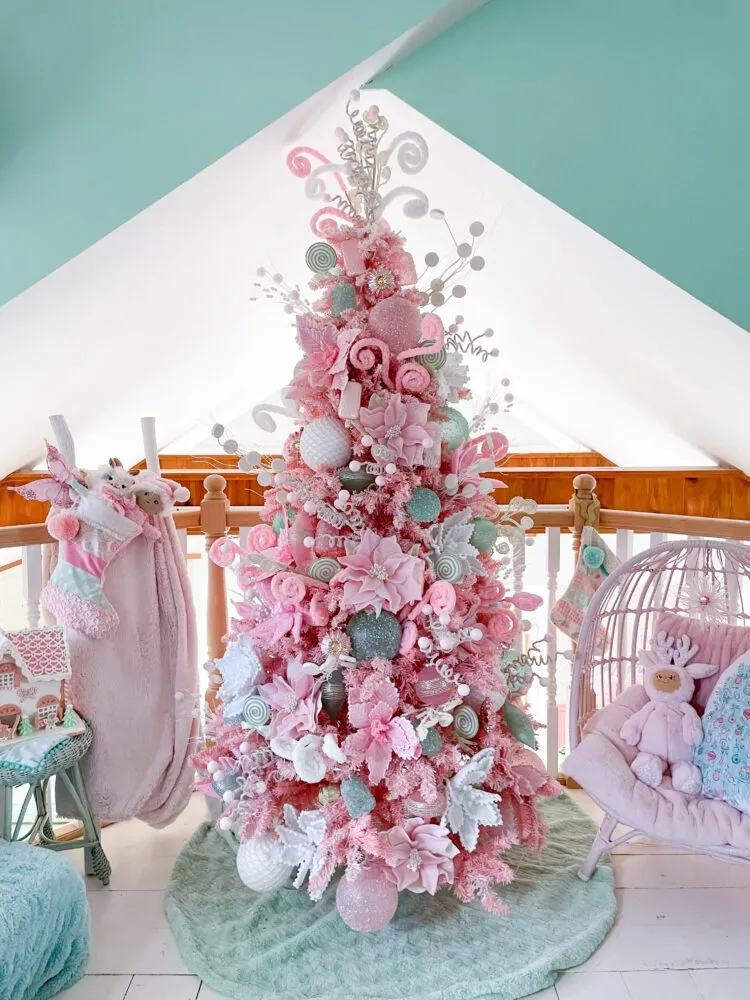
Before you go pink:
- Photograph the corner in daylight — pastels shift dramatically under warm bulbs.
- Measure ceiling clearance; flocked trees run tall and wide.
- Confirm your skirt and stockings don’t fight the mint green.
- Ask whether anyone in the house has strong feelings about a non-green tree.
Ask now, not on December 20th.
25. A Gold Sequined Poinsettia Against a Plain White Wall
One gold sequined bloom costs $12 to $25 at retail. A bag of gold sequins, a foam or felt base, and a glue gun gets you six for about $15 total — and they photograph identically from two feet away. Don’t bother with individual sequin placement; work in rows from the outside in and it goes fast. Nobody inspects the back of a tree ornament.
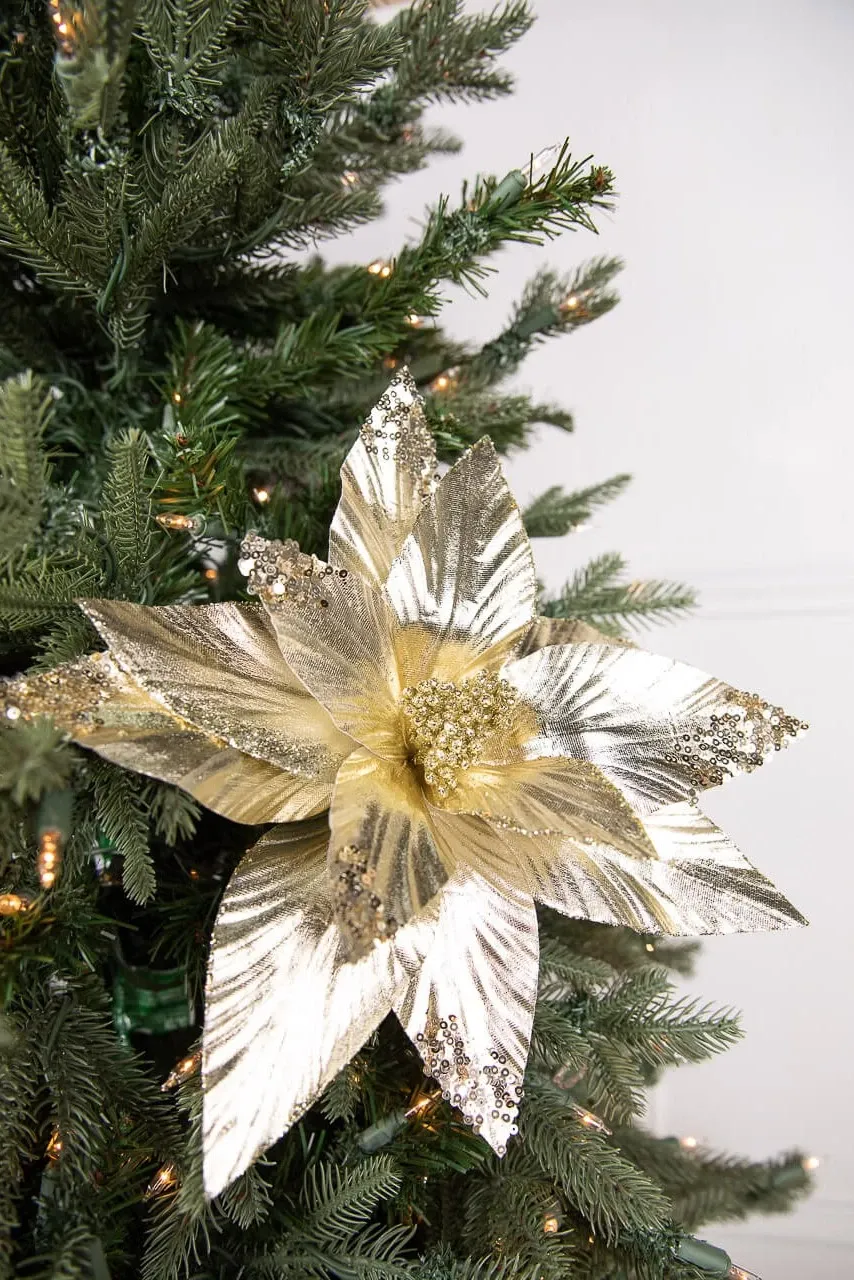
Keep 18 inches of bare wall around a tree like this. A single gold bloom against plain white reads as jewelry; the same ornament against patterned wallpaper or a busy gallery wall disappears. If you can’t find empty wall, hang a plain linen panel behind the tree — a $20 fix that does more than any new ornament.
26. A Fluted White Planter, One Red Poinsettia, a Softly Blurred Tree
The planter should be about one-third the height of the plant above it. A 12-inch-tall poinsettia wants a 4-inch-tall pot, with roughly an inch of clearance around the grower pot on every side. Any bigger and the plant looks like it’s drowning in a bucket — the most common mistake with grocery-store poinsettias. Fluted or ribbed pots hide water stains better than smooth ones.
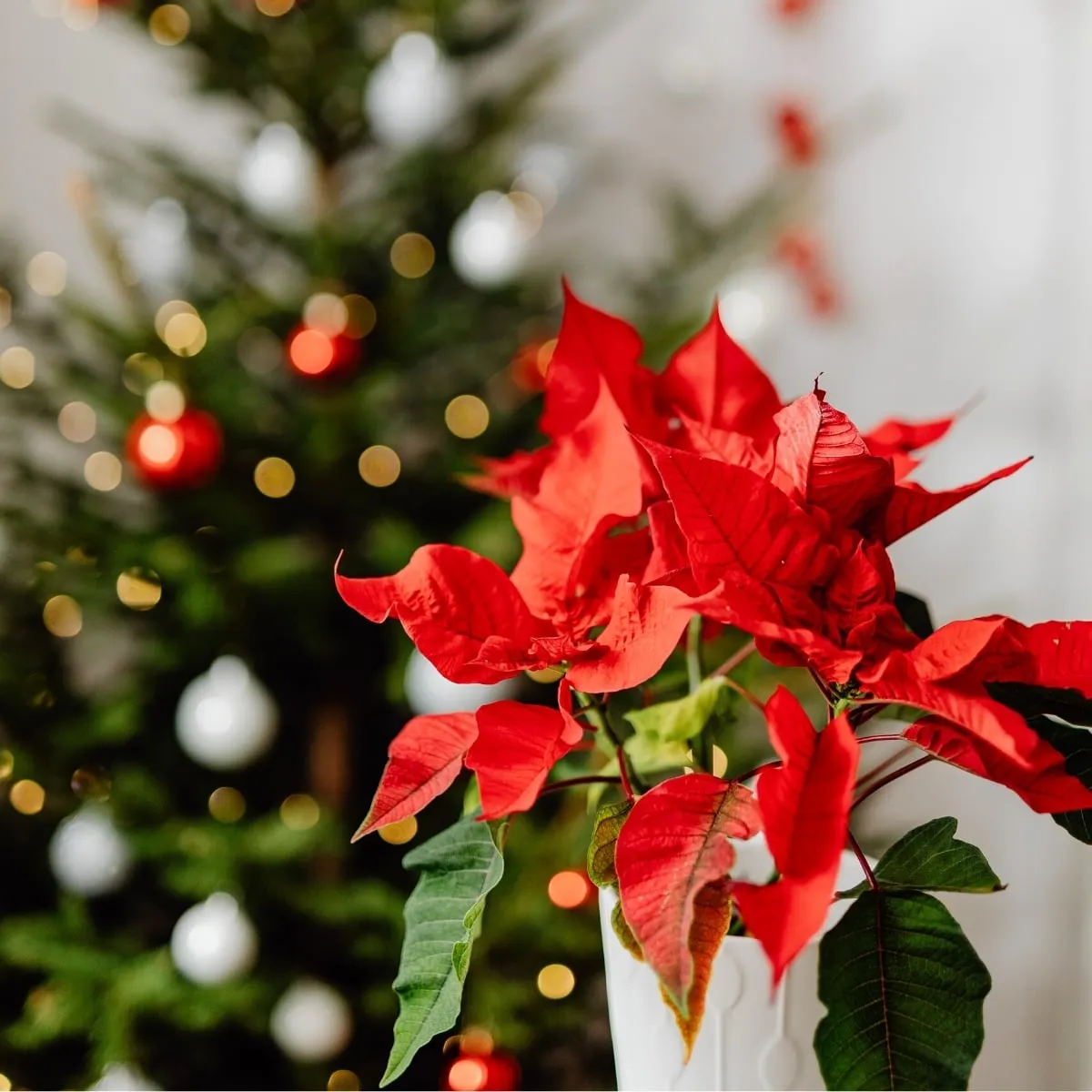
The whites echo. The fluted planter, the baubles in the tree behind, the pale edges of the bracts — all the same cool white, repeated at three depths. That echo pulls foreground and background into one composition instead of two separate objects sharing a corner. Compare with Idea #23 — same trick, warmer mood.
One Bloom, One Tree, One Very Good December
You don’t need a designer, a fortune, or a perfectly matched set of anything — you need one good poinsettia in the right spot and the patience to turn the tree a few times while you work. Start with the two or three ideas that match your actual room, buy one thing at a time, and let the rest of December handle itself.
📌 Pin your favorite version now so it’s waiting for you next November — and tag us when yours is up.