
There’s a specific kind of calm that Scandinavian Christmas decor delivers — the kind that stops your thumb mid-scroll and makes you wonder why your own table never looks like that. We went looking for the real version of it, not the staged version.
After filtering through hundreds of options across IKEA, H&M Home, Target, West Elm, and Etsy, we narrowed it down to 28 ideas that actually hold up — worth attention at every price point, from about $8 to $1,200.
Inside you’ll find minimalist Nordic tablescapes, rustic pine-and-linen dining rooms, and warm candlelit corners, with budget and luxury versions compared side by side. Every idea is shoppable with direct product links. And stay until the end — we break down the most common mistakes that can ruin these looks.
Heads up: this post contains affiliate links. If you buy through them, we may earn a small commission at no extra cost to you.
📌 Save this to Pinterest for later — you’ll want to revisit these ideas.
1. Sheepskin Benches and Flat Cutout Trees in a White Paneled Room
The pair of oversized flat cutout trees mounted on that white paneled wall is the whole idea. Take them down and you still have a lovely table — sheepskin-draped benches, pillar candles on stone holders, a striped linen runner — but you lose the silhouette that pulls your eye upward. Flat cutouts read like graphic art instead of decoration, and art doesn’t go out of season, which is exactly why they survive in a room this quiet.
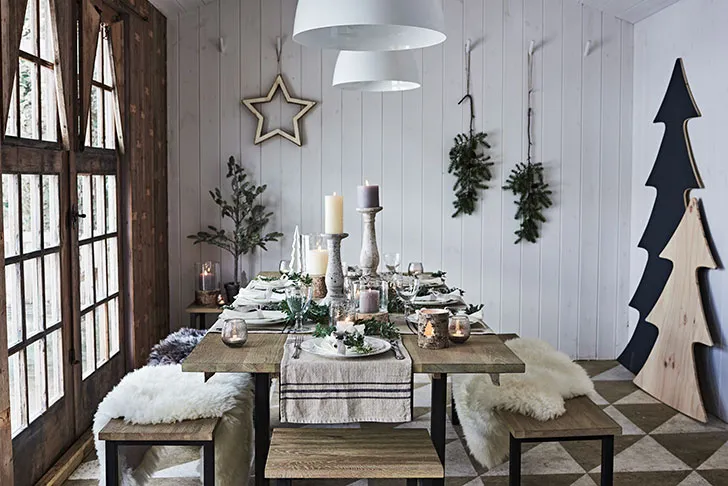
If you want hanging greenery to look intentional rather than plopped, clip three or four branch ends together, bind the stems with jute, and hang each bundle so its lowest tip sits 24 to 28 inches above the tabletop. That’s high enough to see across, low enough to feel like a canopy. Run them in odd numbers — three or five swags — and keep the spacing between bundles perfectly even.
2. Charcoal Blue Stoneware and Pinecones on a Raw Wood Table
Two things are doing the heavy lifting. First, temperature contrast: those charcoal-blue plates run cool while the raw wood table runs warm, and cool-against-warm reads as sophisticated without a single bright color anywhere. Second, the runner stays mostly empty — pinecones, a few small white cones, one clean line of pine. That negative space is the difference between a rustic table and a craft-fair table.
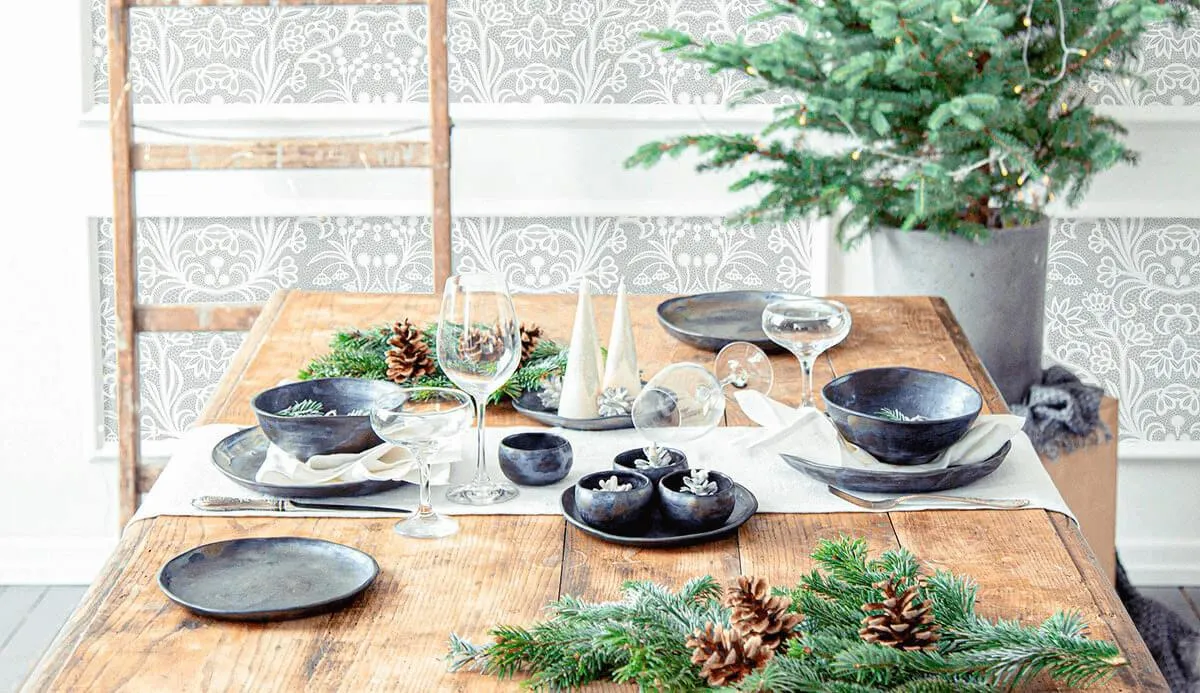
- Rustic wood dining table, or a secondhand pine table stripped and oiled: $180–$900
- Charcoal-blue ceramic dinnerware, 8 pieces: $60–$180
- White conical candleholders, set of three: $25–$70
- Pine branches, pinecones, and greenery: $15–$45
- Linen runner plus wine glasses: $35–$95
Total: about $315–$1,290
Budget alternative: skip the new table entirely and hunt Facebook Marketplace for a solid pine dining table around $80–$150, then layer in matte stoneware from Target’s Threshold line at roughly $6 a plate.
3. A Row of Brass Bells Suspended Above a Fluted Console
Suspended brass bells have quietly replaced the wreath over consoles and sideboards, and 2026 is the year they went mainstream. The appeal is that they’re an heirloom object rather than a seasonal one — no Santas, no snowflakes, nothing that dates itself. It’s the same instinct behind the broader move toward decor you’d genuinely leave up through January, and it explains why muted metals keep climbing while novelty ornaments slide.
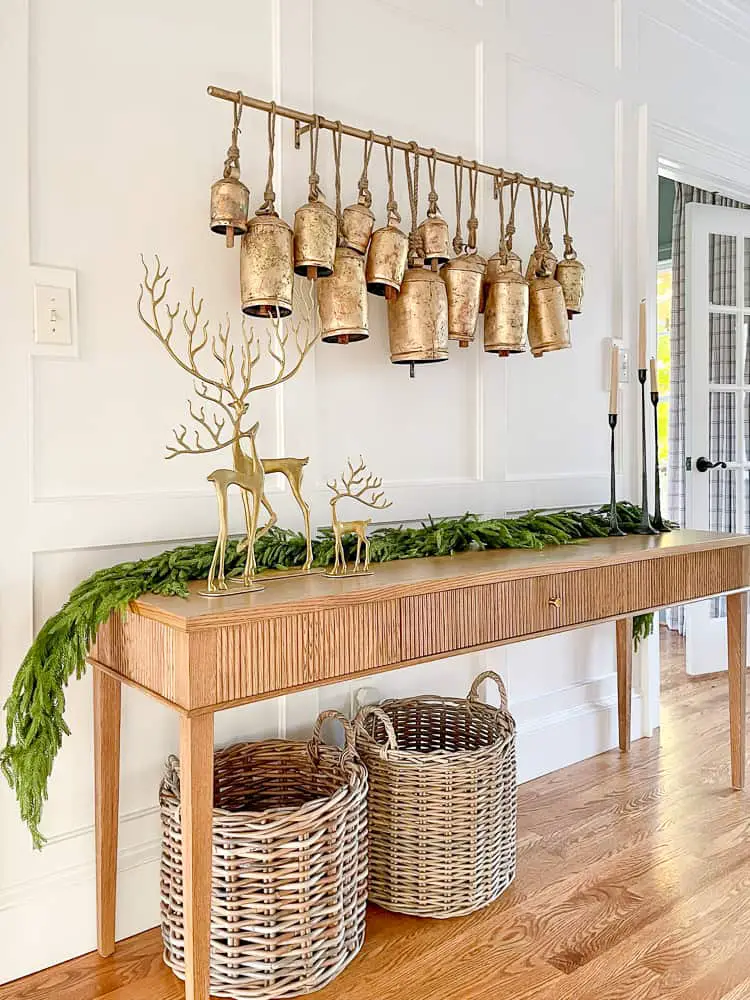
Mount the rod so its center line sits 18 to 22 inches above the console top. Lower and the bells crowd whatever you style below; higher and they float disconnected from the vignette. Space the bells 3 to 4 inches apart, mix two or three sizes, and let the two end bells hang slightly lower — an uneven bottom edge reads as collected rather than catalog-ordered. Fill the surface beneath with a long pine garland, gold reindeer, black candlesticks, and woven baskets on the lower shelf.
4. A Checkered Tablecloth and Ornaments Hanging in Midair
Here’s the formula: 50% red-and-white geometric check, 30% pale natural wood from the spindle chairs and floor, 15% evergreen green from the tree and candles, 5% glossy reflection. Swap the check for a red-and-white stripe and it still works. Swap it for solid red and the room gets loud fast — the pattern is what keeps all that red from shouting at you. To shift this into a completely different holiday, trade the check for cream-and-blue ticking and let the ornaments go navy and silver.
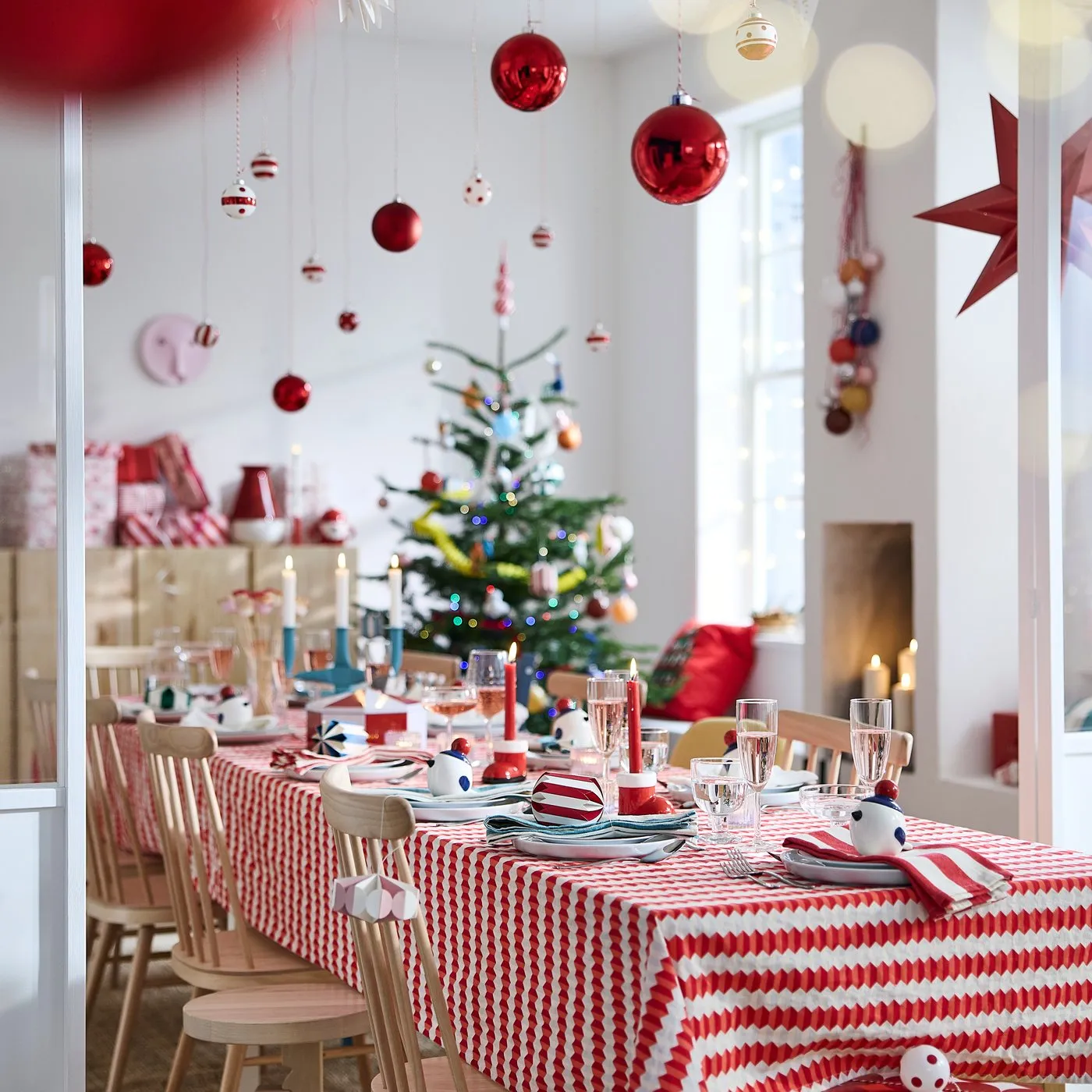
Hanging ornaments from the ceiling is a commitment, and not every room can take it. You need at least nine-foot ceilings before the ornaments clear head height, and a flat, fan-free ceiling — a ceiling fan plus a fishing-line canopy is a recipe for a genuinely bad evening. Skip it entirely in households with toddlers, or with a cat who treats dangling things as a personal challenge.
5. Blue Stoneware and Dried Thistle for a Cool-Toned Christmas Table
This restrained setup needs a narrow table to sing — 30 to 40 inches wide, seating four to six. On a wider farmhouse table the centerpiece gets lost in the middle and the place settings drift apart. If your table runs 42 inches or wider, run two parallel lines of dried botanicals instead of one, or look at the fuller garland treatment in Idea #13, which is built for long stretches. Layered blue and grey ceramics, hammered silver cutlery, and blue linen napkins with dried thistle only read as one idea when they’re close together.
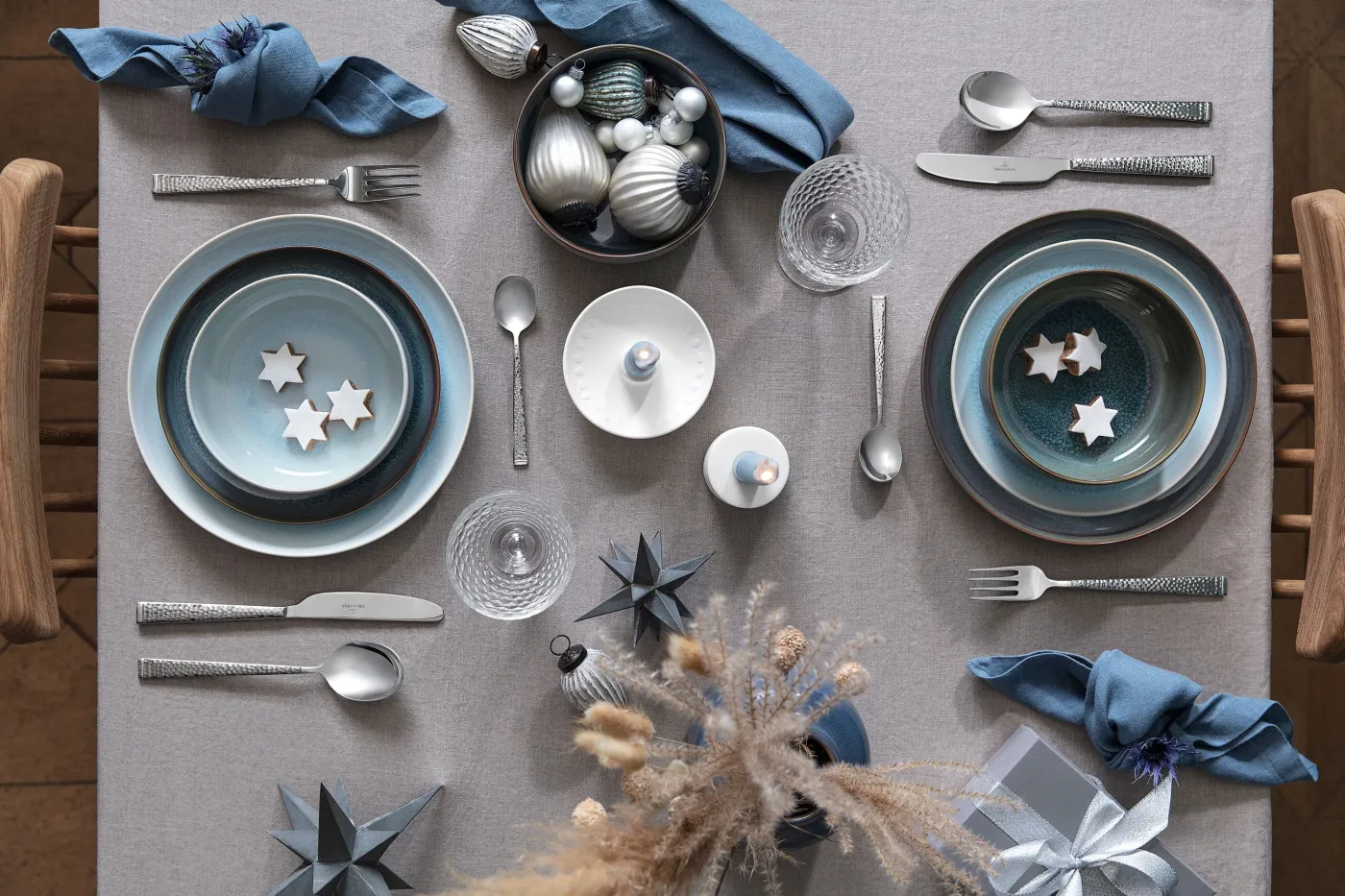
Cool-toned Christmas is genuinely cheap to pull off. H&M Home and IKEA both stock grey and dusty-blue stoneware in the $5–$12 per-piece range, and dried thistle bundles run about $8 at a craft store — or free if you forage in late autumn and hang them upside down for two weeks. Matte blue star ornaments are the one thing worth spending on, because cheap ones look like plastic.
6. Candlelight Dinner for Two With a Glowing Tree Behind It
Pillar candles look expensive and mostly aren’t — a 3-inch diameter pillar burns 40 to 60 hours for around $8. The real cost is wax. Budget for a dedicated scraper, a bottle of isopropyl alcohol for the glass holders, and a willingness to launder the tablecloth after every dinner. Or go the other direction entirely: battery pillars with a moving flame fool most guests now and cost pennies a season, especially in a room where patterned white dinnerware and crystal do most of the talking.
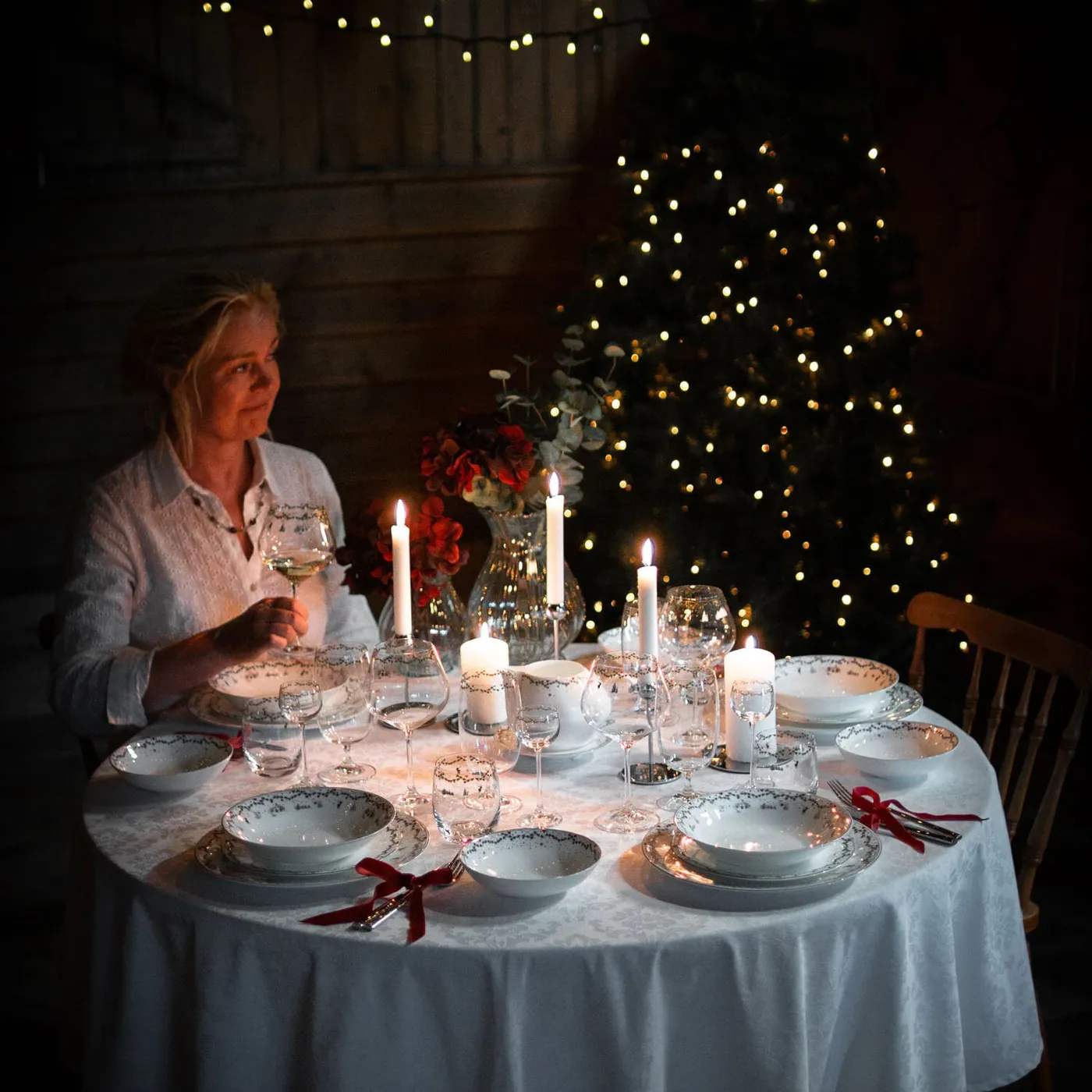
Don’t buy matching candles. Cluster three different heights — roughly 4, 6, and 9 inches — tallest in the middle-back, shortest in front, and keep every flame at least 8 inches from the nearest napkin edge. Tapers are the elegant ones but they drip; pillars in glass holders deliver the same glow with half the cleanup. If you want the flames doubled, position the glassware between the candles and the room, never behind them.
7. A Foliage Wreath Suspended Right Over the Table
The hanging wreath is the point of the entire room. Everything else — white plates, minimal glassware, a faux fur throw over one grey upholstered chair, the evergreen garland on the wall shelf behind — is supporting cast. What makes this version work is that the wreath has gaps in it. A dense, tightly packed hoop would read as a chandelier and block conversation. Sparse branches let you see the person across the table, and that’s the whole difference.
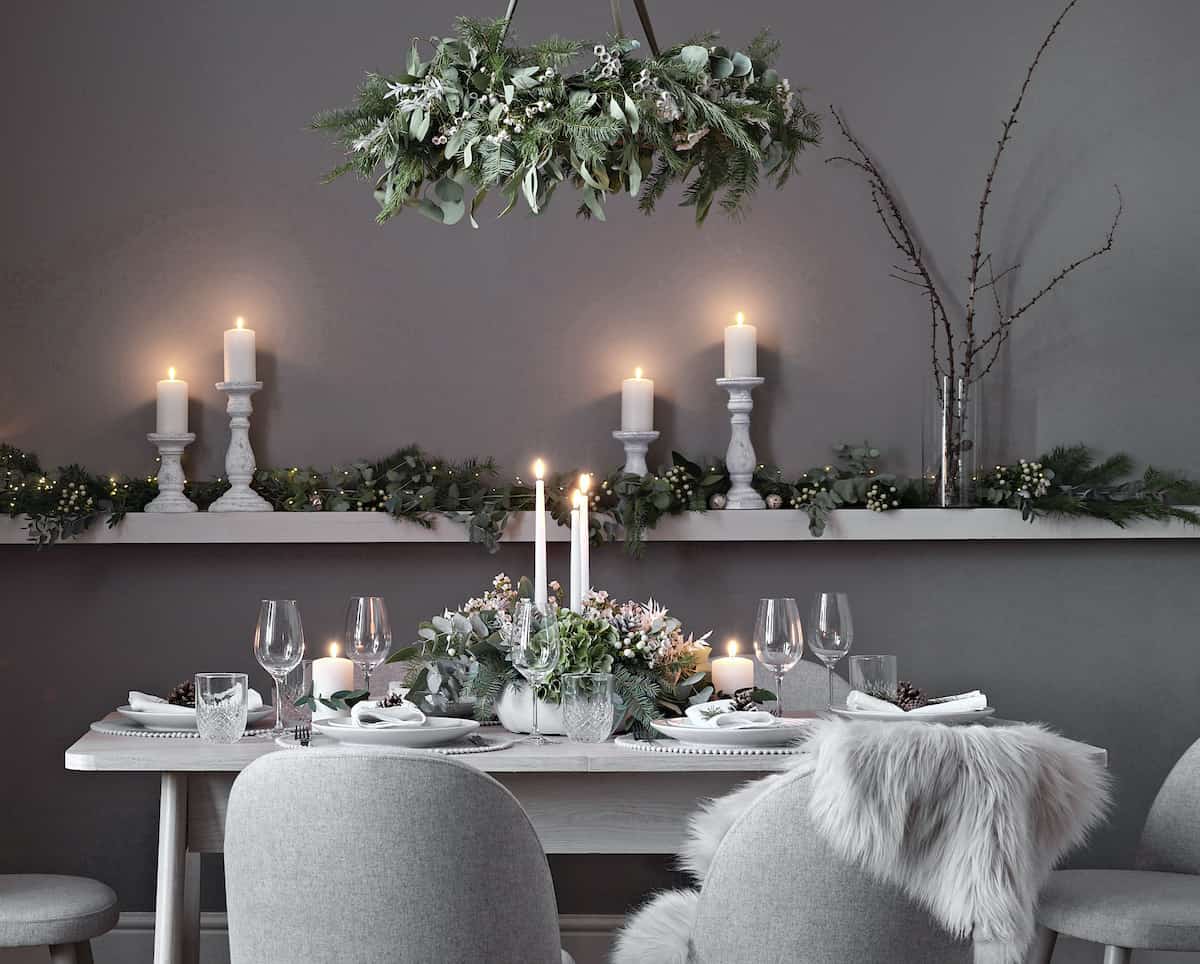
- Weigh the finished fixture — a 20-inch hoop with greenery and candles lands around 4 to 6 pounds.
- Find a ceiling joist, or use a 25-pound toggle bolt rated for twice your load.
- Hang so the wreath’s lowest point sits 30 to 34 inches above the tabletop.
- Add the candles to the wreath last, then light them one at a time. Time: about 1.5 hours. Materials: $40–$90.
8. The Quietest Tree on This List Is Wearing Only Ribbon
The math here is 70% evergreen, 25% pale beige velvet, 5% brown from the woven basket collar and textured floor. Nothing else. The trick is that the ribbon does both jobs — ornament and vertical line — because the tails hang 10 to 14 inches past the branch tips. Swap the velvet for wide satin and it goes formal; swap for linen ribbon and it turns farmhouse. Both keep the formula intact, which is why this tree never feels unfinished even though it’s technically empty.
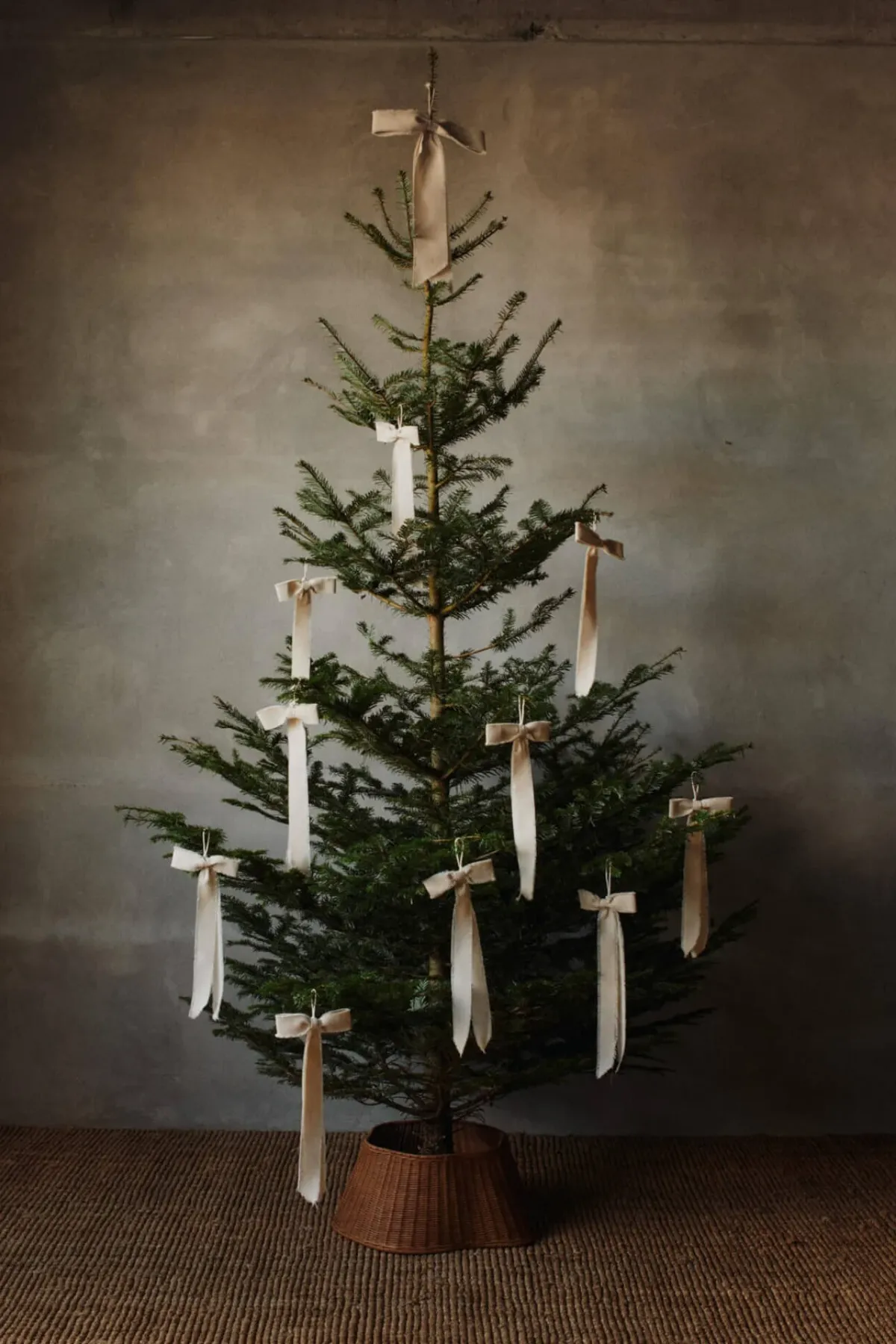
Wire-edged velvet ribbon is the one splurge that’s worth it — about $12–$18 per 10-yard roll — because it holds its shape instead of drooping. A 6-foot tree takes roughly 20 to 25 yards, so plan on three rolls. The woven basket collar runs about $25 at Target or half that at a thrift store, and a plain IKEA tree with your own warm-white lights reads almost identical once the ribbon goes on.
9. Bare Branches, Pinecones, and Fairy Lights in a Wire Basket
- Measure your window ledge or stair landing — this display needs about 18 inches of depth.
- Check for a nearby outlet, or buy a battery-operated light string rated for indoor use.
- Make sure the basket can’t be tipped by a dog, a toddler, or a vacuum cord.
- Confirm the branches clear any stair handrail by at least 6 inches.
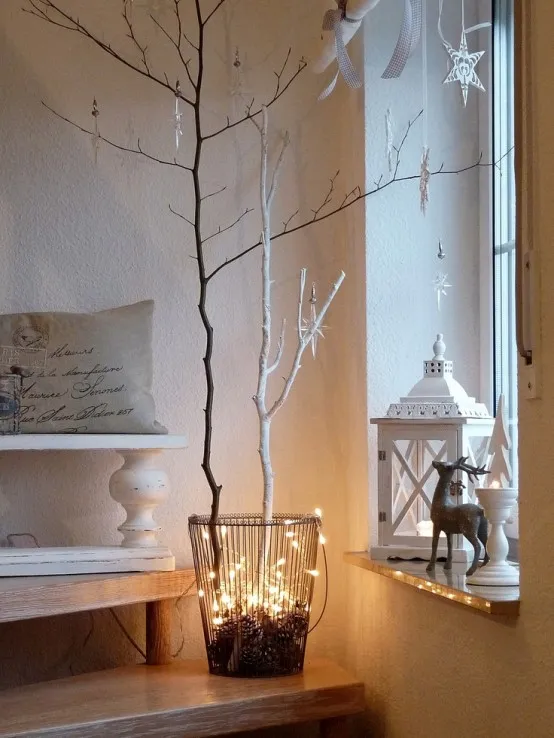
If two of those don’t check out, a shelf-top version works just as well — the white wooden lantern, small reindeer figurine, and paper stars in the window can carry the display on their own.
Bare branches shed. Not dramatically, but enough that you’ll be picking up bark flecks every few days — put a shallow tray underneath and it stops being a chore. The bigger issue is heat: fairy lights left on for eight hours in a dry basket of pinecones and twigs get warm. Switch to LED, and unplug before bed. Also confirm the basket sits perfectly level, because a wire base on a hardwood floor will slide.
10. Cinnamon Sticks, Twine, and a Lush Evergreen Runner
- Iron a linen napkin flat, then fold it into a simple band about 4 inches wide.
- Bundle two cinnamon sticks with a 12-inch length of natural twine.
- Wrap the twine around the napkin twice, then tie the cinnamon bundle on top, slightly off center.
- Trim the twine ends on an angle so they don’t fray. Time: roughly 15 minutes and under $2 per setting.
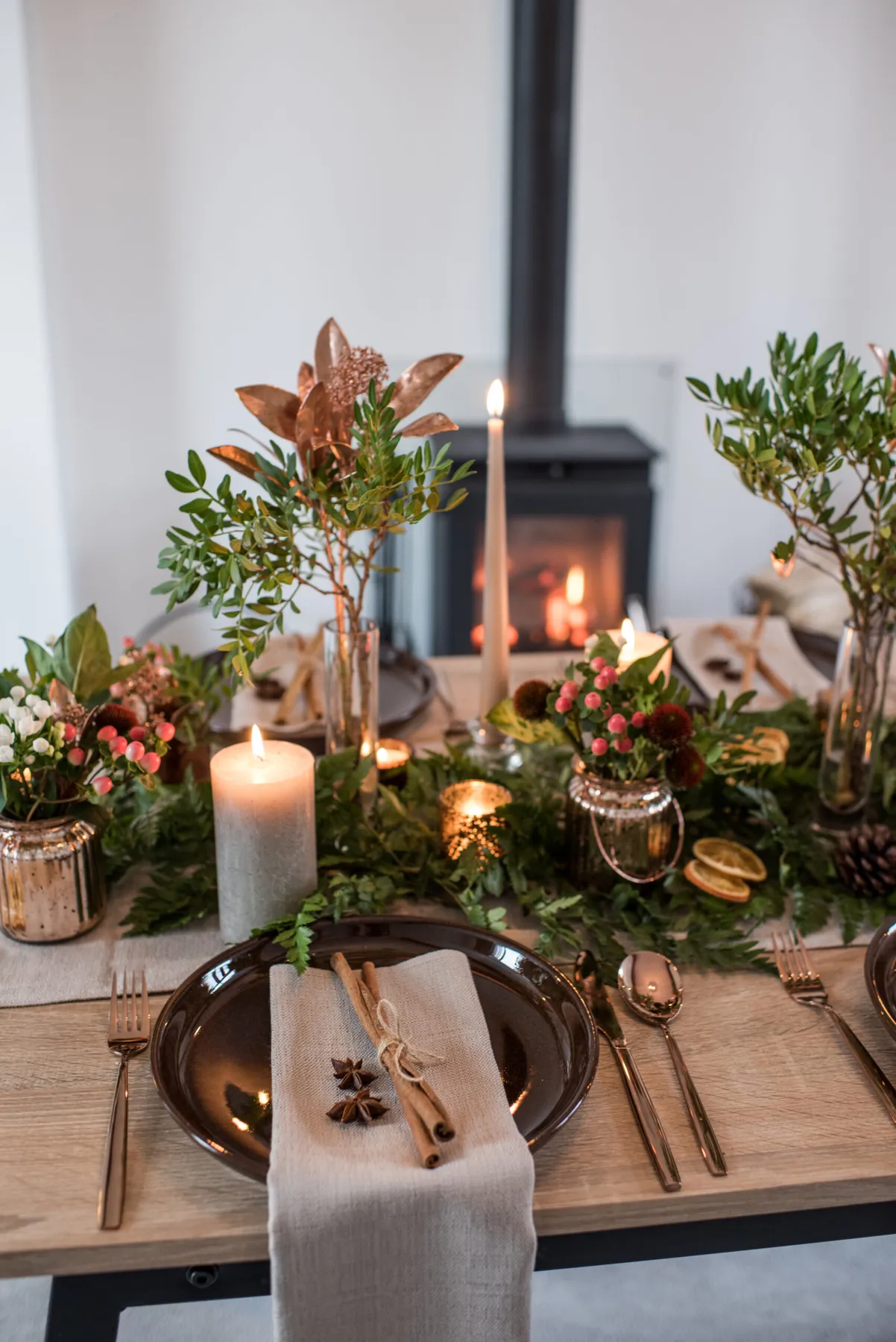
The napkin tie is the whole trick. Strip it away and you’re looking at a very nice table — dark brown plates, copper cutlery, a generous evergreen runner with dried orange slices, metallic vases, pink berries, and pillar candles. Nice, but familiar. Two cinnamon sticks and a length of twine turn a standard runner into a table that smells like a kitchen at Christmas.
11. Matte Black Plates and Polished Silver Tapers
Space your tapers 12 to 14 inches apart along the centerline — closer and the flames visually merge into one blob, farther and the arrangement reads as scattered. Keep the tallest pair at the two ends if you’re serving family-style, so nobody reaches across an open flame. And use polished silver holders rather than matte ones; a little reflection is what keeps a black-and-white table feeling warm instead of clinical, especially against a neutral linen cloth.
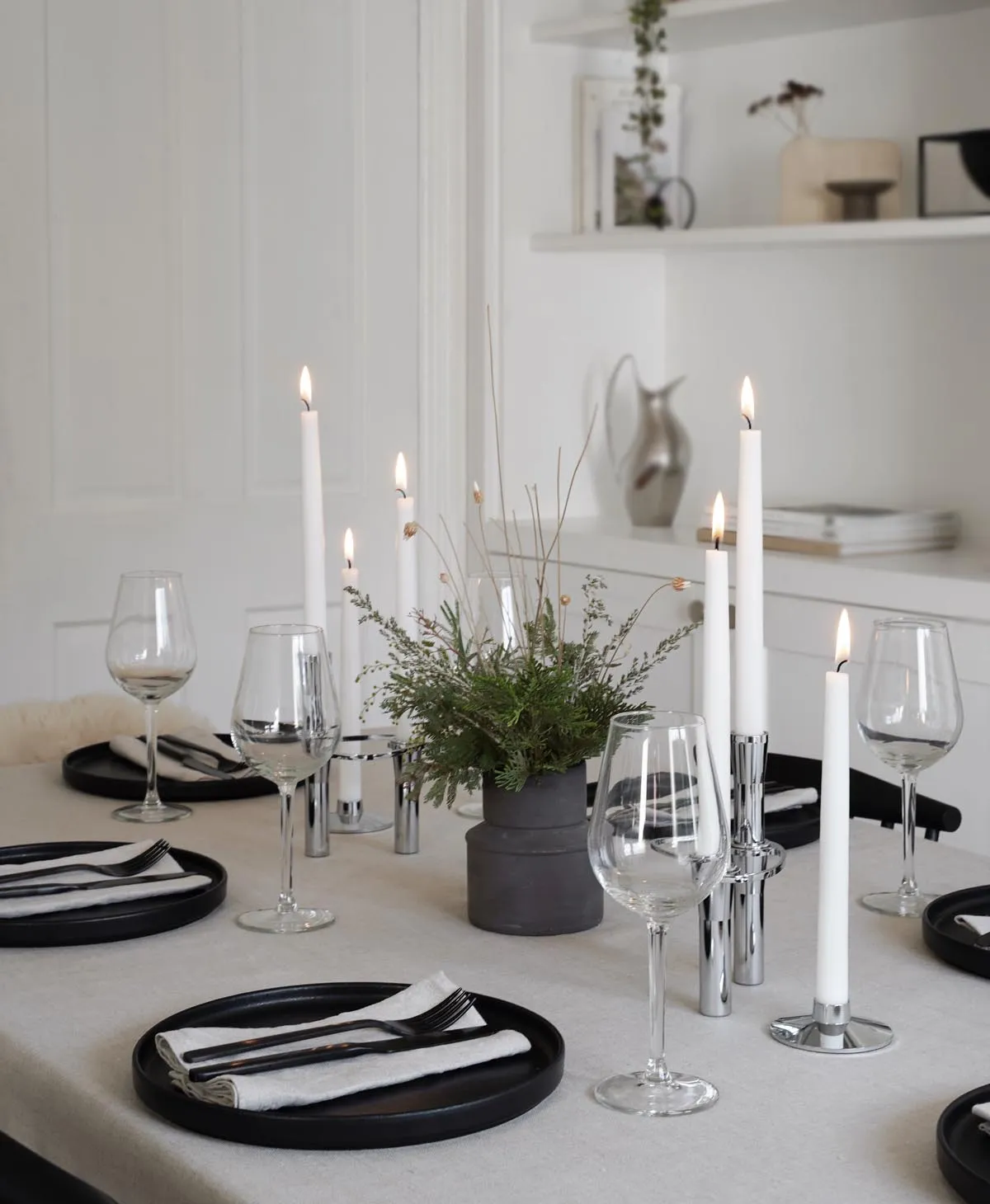
This is a small-table look. It’s happiest on a table 30 to 38 inches wide seating two to four, where the dark grey vase and its evergreen and twig arrangement can dominate. Scale it up for a larger room and you’ll want two matching arrangements rather than one bigger one — same rule applies to the candles. For a wide, long table, the layered charger setup in Idea #22 handles the extra width far better.
12. Twig Stars and Wrinkled Linen in a Moody Dining Room
Two twig stars wound with fairy lights cost about $22 each at a craft store, or around $40 for the pair if you build them from foraged twigs plus a $6 light string. The other find is the dark grey linen — a thrifted flat sheet or a Target linen-blend cloth at $25–$45 gives you the same rumpled texture. It’s supposed to look unironed. Fold it loosely, don’t press it, and let the pinecones and brass tapers sit slightly off-center.
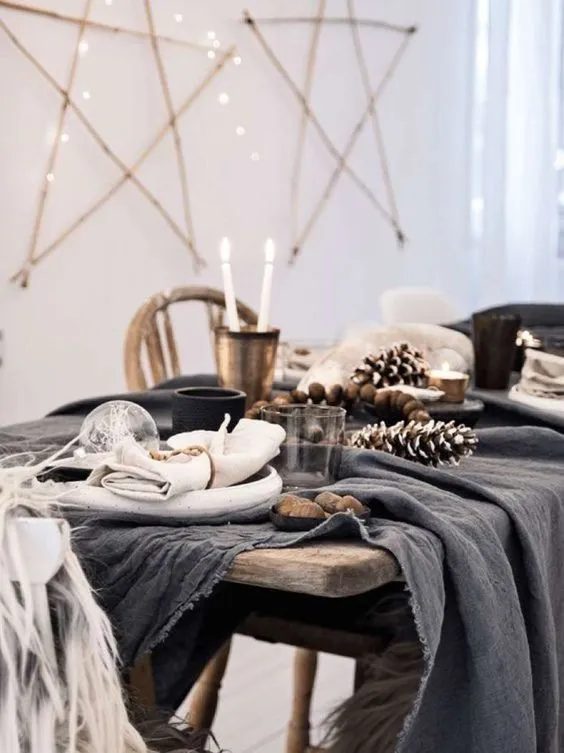
The wrinkled-linen look isn’t laziness, it’s a position. After a decade of tightly styled holiday photos, designers started letting fabric crease on purpose — the same instinct that made plaster walls and unlacquered brass popular. It signals a room is lived in. Warm unpolished brass, like the bells in Idea #3, and frost-dusted pinecones fall into that same category, which is why this one still looks current three seasons from now.
13. Black, White, and Gold — a Graphic Christmas Table
Strip out color entirely and texture has to carry the room: frosted pinecones, matte black ceramics, the sheen of gold cutlery, the crisp paper fold of origami ornaments. The other principle at work is value contrast — near-black and near-white in the same frame with almost nothing in between. The greens only sneak in as garland and candle accents, and that’s what stops the whole thing from feeling like a New Year’s Eve party.
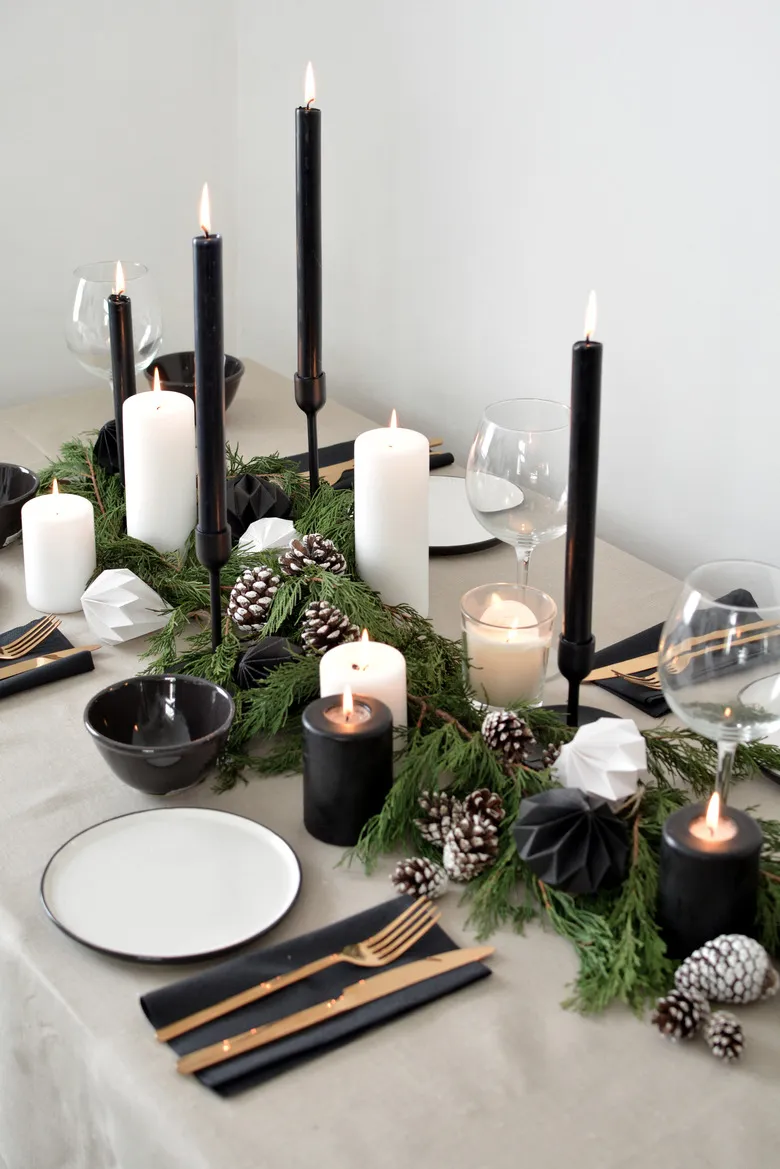
Here’s the ratio: 55% white and beige base, 30% black, 10% gold, 5% green from the garland. Change one variable at a time. Want it softer? Pull black down to 15% and let warm camel take its place. Want more drama? Push black to 40% and swap gold for pewter. Every version keeps the same skeleton — one dominant neutral, one strong dark, one metal.
14. Eucalyptus Instead of Pine — Softer, Silvery, Less Obvious
Fresh eucalyptus smells wonderful and drops leaves like it’s being paid to. Expect to sweep under the table daily, and expect the color to fade from silver-green to dusty grey within about two weeks — which honestly still looks fine. The real warning: eucalyptus is toxic to cats and dogs. If your pets are counter-surfers, use faux seeded eucalyptus instead and nobody at dinner will be able to tell, especially beside those geometric black candelabras.
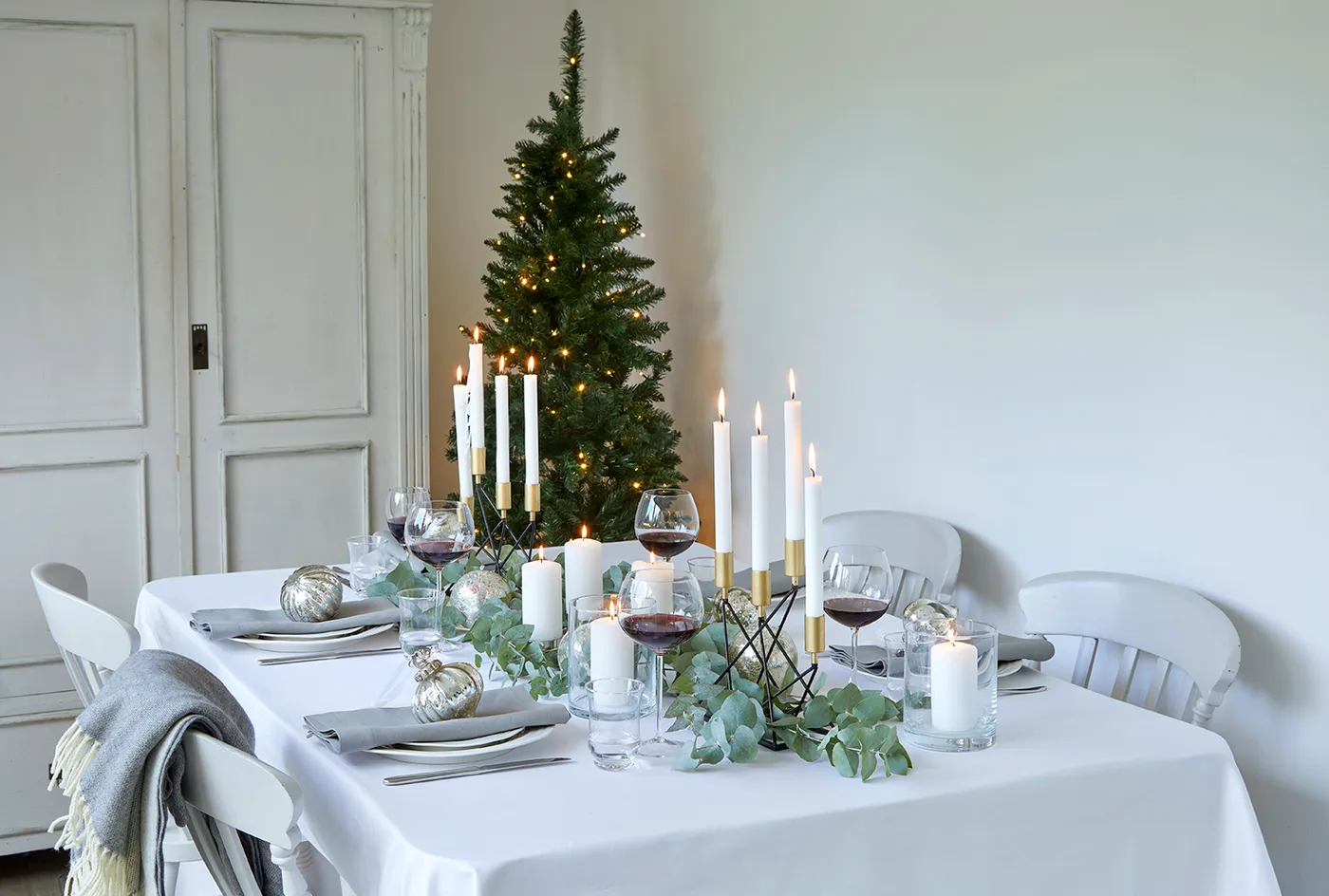
- White tablecloth and grey linen napkins: $35–$90
- Fresh eucalyptus garland, 6 feet: $45–$120
- Black geometric candle holders, set of two: $40–$110
- White pillar and taper candles: $25–$60
- Small lighted tabletop tree: $30–$85
Total: about $175–$465
Budget alternative: faux seeded eucalyptus garland runs $18–$30 and lasts for years — the look holds because the color, not the scent, is doing the work.
15. One Frosted Branch, Three White Candles, Zero Clutter
- Cut a single pine branch to about 1.5 times the height of your vase.
- Spray it lightly with floral snow from 12 inches away — any closer and it clumps.
- Let it dry 20 minutes, then shake the excess off over a bin, not the floor.
- Set the branch in a slender glass vase, then arrange three white pillars on a round tray beside it. Time: 30 minutes. Cost: under $25.
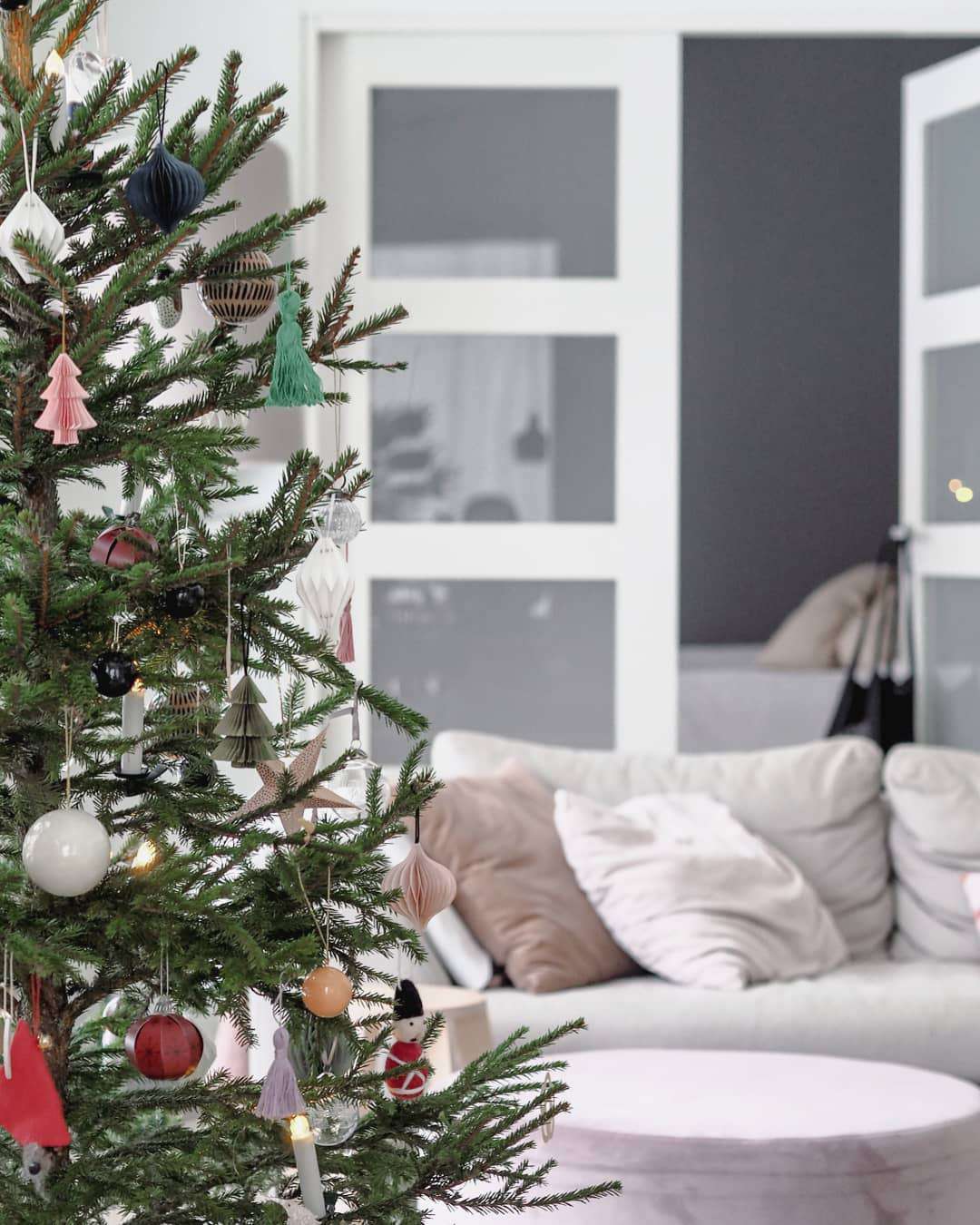
Frosted and flocked branches shed, especially the first week. Put a felt pad or shallow tray under the vase and the problem mostly vanishes. White pillar candles also leave a fine grey ring wherever they burn near a wall or a painted surface — wipe it with a dry microfiber cloth before it sets. Neither issue is serious, but skipping both means you’ll be restyling the whole surface by New Year’s.
16. Evergreen in Clear Glass and the Case for Raw Oatmeal Linen
The linen runner is the element nobody notices and everybody feels. Take it away and this becomes a slightly cold minimalist surface — clear glass, one evergreen branch, plain white ceramics, small wooden candle holders. The raw oatmeal tone is what bridges white porcelain and warm wood, and the visible weave gives the arrangement something to sit on. Choose cream instead of oatmeal and the warmth quietly disappears.
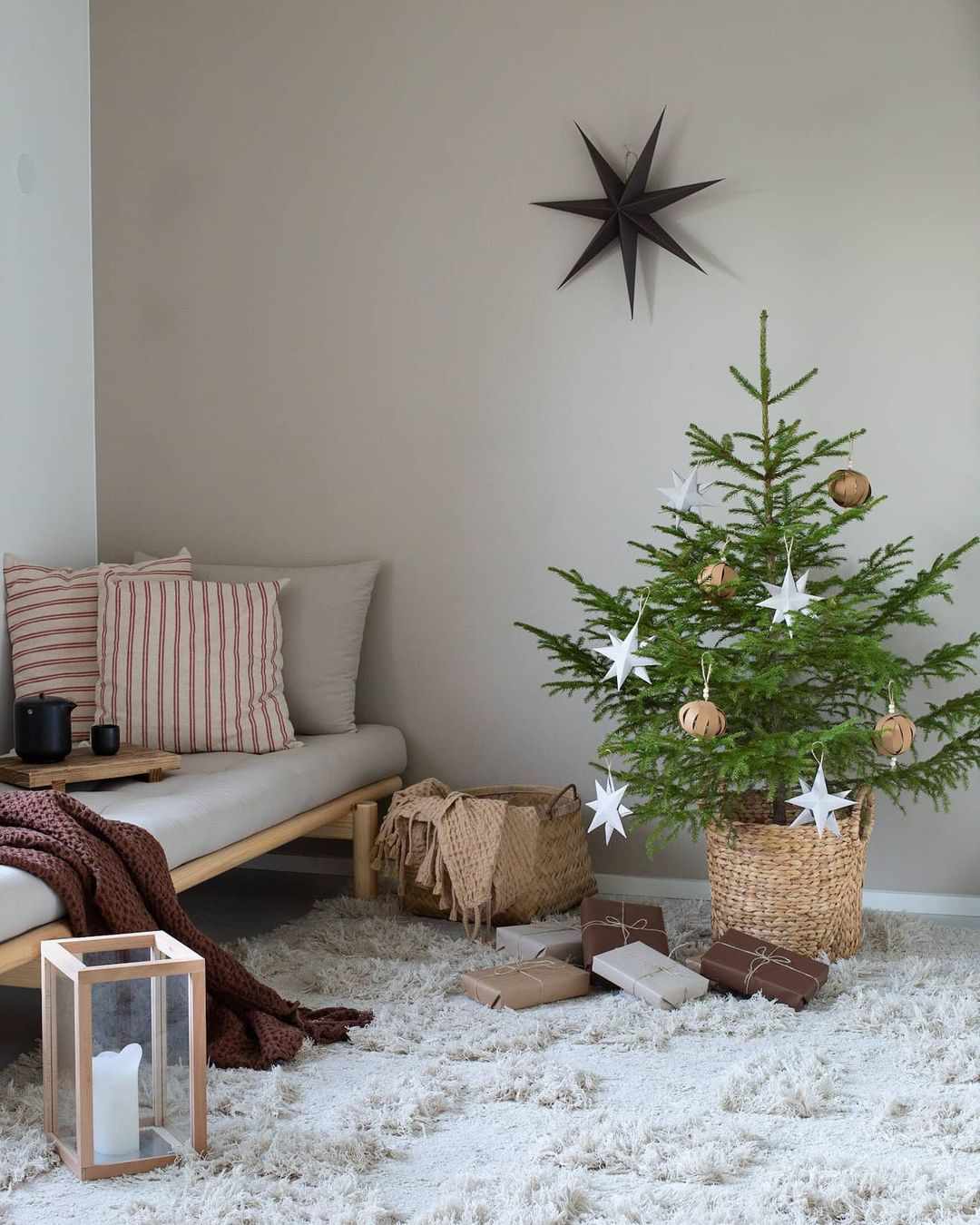
- Clear glass cylinder vases, set of three: $18–$45
- Minimalist wooden candle holders: $20–$55
- Raw linen table runner, 14 x 72 inches: $25–$70
- White ceramic tableware, four settings: $40–$120
- Fresh evergreen branches: $10–$25
Total: about $113–$315
Budget alternative: a thrifted white linen curtain panel cuts into two runners for about $8, and IKEA’s small glass vases run under $3 each.
17. Layered Green and Grey Plates on a Light Wood Table
A wooden tray is quietly doing the most important job here: it corrals white pillar candles, pine branches, red berries, and pinecones into one coherent block, so a busy centerpiece still reads as calm. The second principle is repetition — the grey round placemats echo the dark grey linen napkins, and the dark green plates echo the pine. The red berries occupy maybe 5% of the visual field, which is all the accent you need.
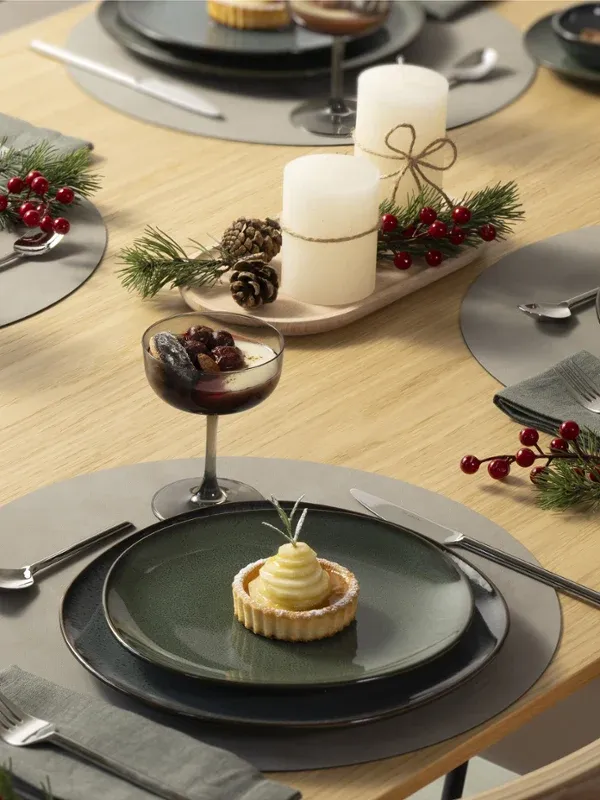
A light wood table shows everything — water rings, candle drips, cranberry juice. Use placemats and coasters every single time, and keep a beeswax-and-orange-oil polish on hand. If you have kids, or a dog with an enthusiastic tail, swap the pinecones for wood or felt versions and skip fresh berries entirely; crushed cranberries on pale oak become a permanent reminder of your good intentions. Compare with Idea #15, where white surfaces make the same problem much easier to hide.
18. Moss in Terracotta Pots and One Very Tall Candle
Terracotta pots you already own plus a $6 bag of preserved moss do most of the work here. Preserved moss runs $5–$10 a bag and never needs water — the living stuff dries out in a heated dining room within a week. The tall white pillar in a vintage green metal holder is the one piece I’d actually shop for, and I’d try a flea market first, because new metal holders almost never have that aged chalky finish.
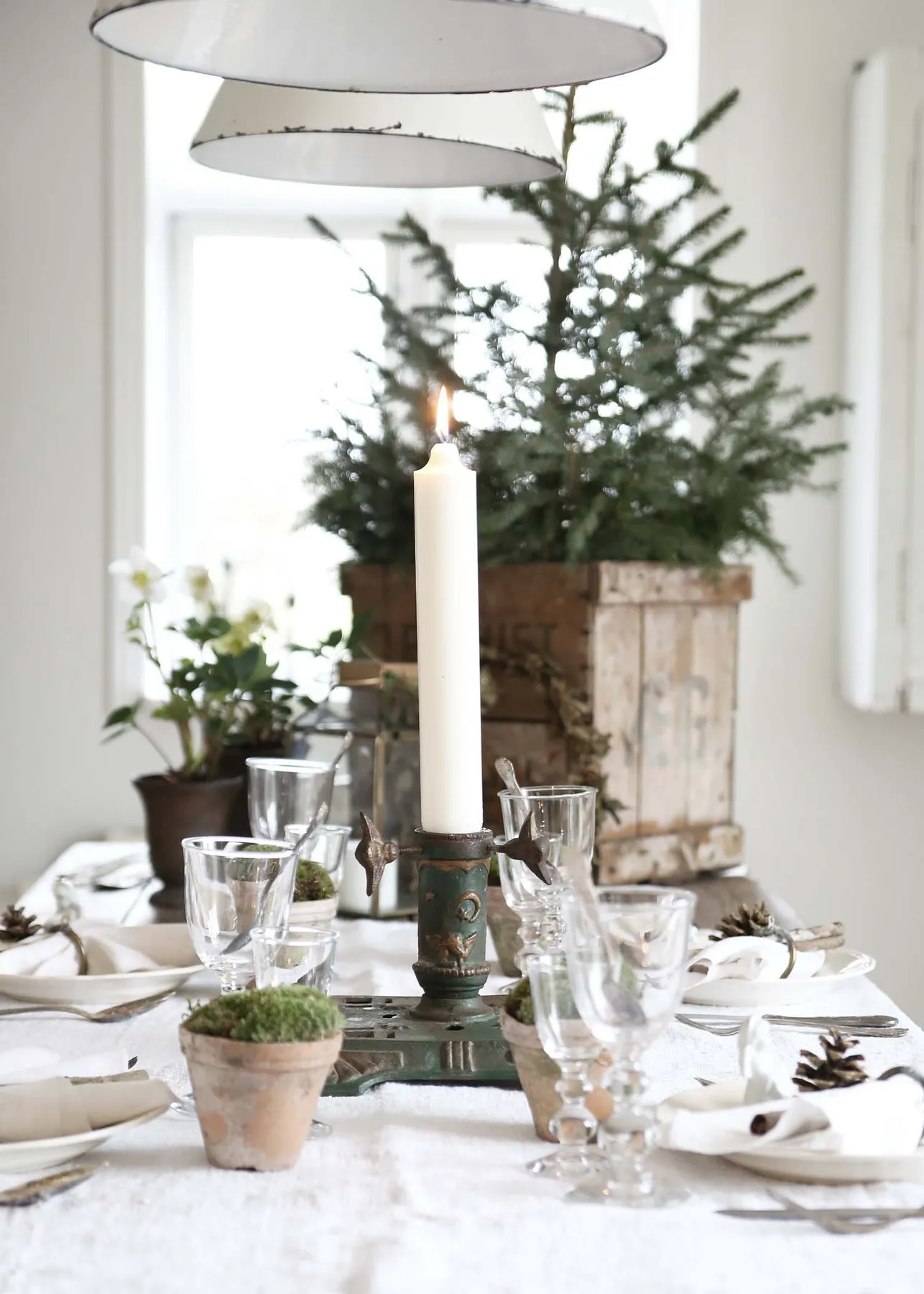
- Check that your dining table can spare 14 inches of depth for the centerpiece.
- Decide whether the pots live on the table or move to a sideboard between meals.
- Confirm the pillar candle fits its holder with zero wobble — a 3-inch candle in a 3-inch cup is a fire hazard.
- Set a replacement budget: quality pillar candles run roughly $8–$14 each.
19. Tiny Bottles of Evergreen and White Fur Throws
65% white tablecloth and dinnerware, 15% blue-grey napkins, 10% fresh green, 10% brown from the fur throws and wood. The proportions matter more than the objects — push white past 70% and the whole table starts to feel like a hotel breakfast buffet. Swap blue-grey for warm taupe and the room reads softer and more rustic; swap in charcoal and it flips modern in about ten seconds. Slender white tapers and stemmed wine glasses hold the middle either way.
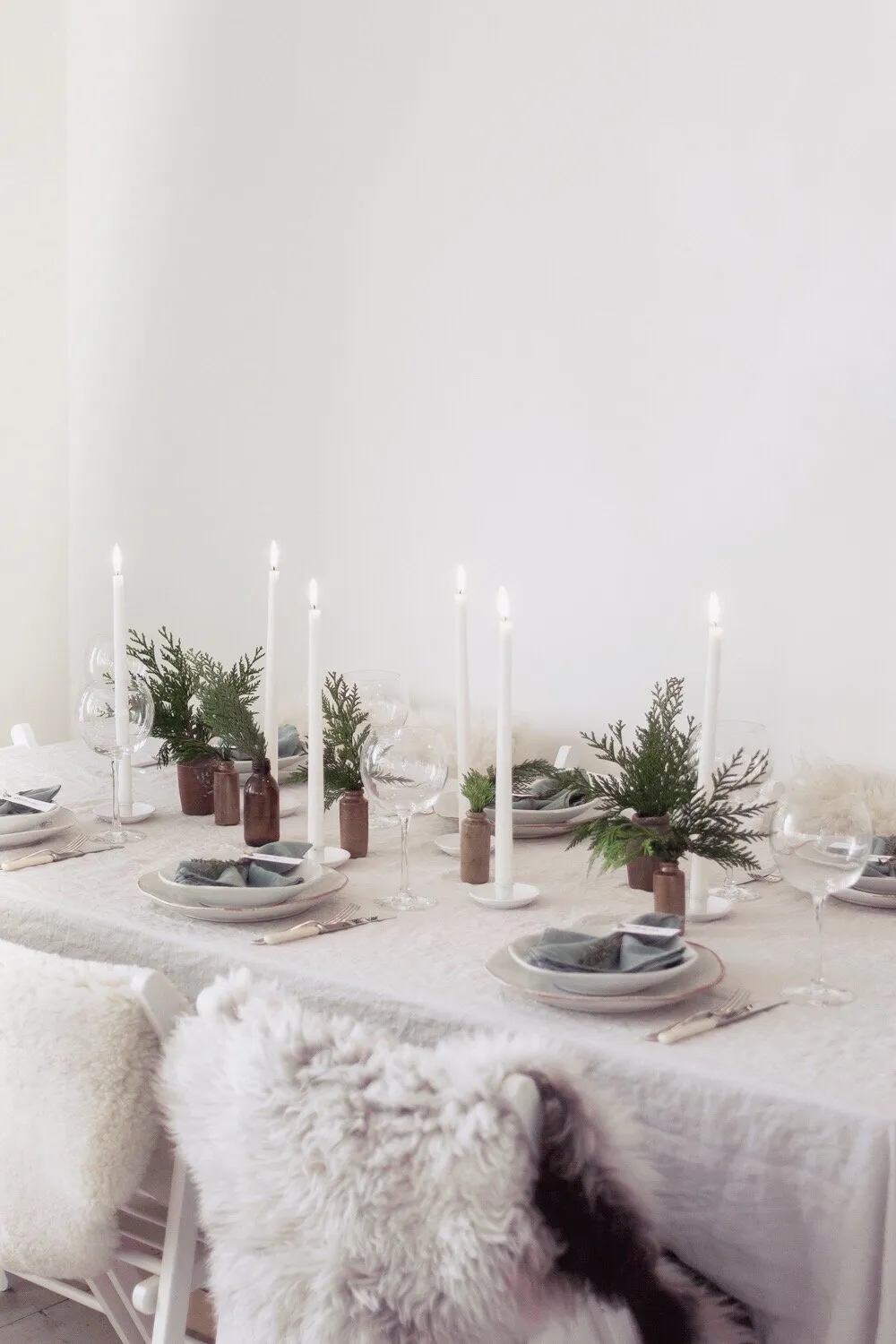
- Collect eight to twelve small glass bottles between 3 and 5 inches tall.
- Cut evergreen sprigs to about twice the bottle height.
- Fill each bottle with an inch of water and one sprig.
- Space them down the center in a loose, deliberately uneven line. Time: 20 minutes. Cost: $15–$30 if you reuse jam jars and spice bottles.
20. A Living Potted Tree Instead of an Artificial One
- Potted Norway spruce or fir, 3–4 feet: $60–$140
- Minimal white ornaments, set of 20: $25–$60
- Woven basket or linen tree collar: $25–$70
- Warm-white LED string lights: $18–$45
- Linen throw and neutral cushions: $45–$130
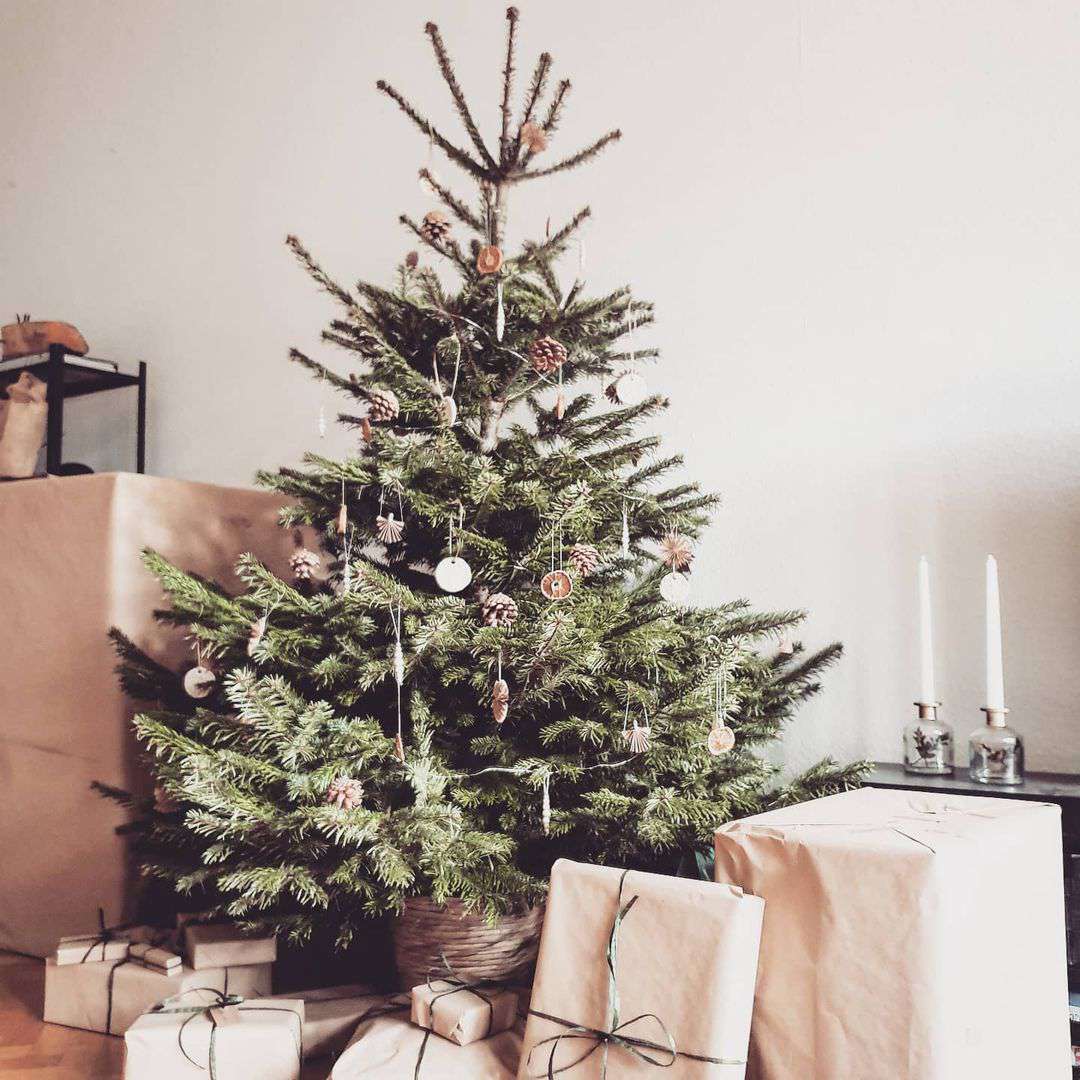
Total: about $173–$445
Budget alternative: a small potted rosemary or a 2-foot spruce at $25–$40 gives you the same silhouette on a console or in a corner nook, and you can plant it outside in spring.
A living tree is not a houseplant. It needs cool air — under 65°F ideally — and it will start dropping needles if it sits next to a radiator or a heating vent. Ten days indoors is the realistic maximum before it starts to decline. Water every other day, keep the root ball damp but never soggy, and plan to re-pot in spring if you want to keep it.
21. Real Candle Clips on a Small Tree, the Danish Way
The candle clips are what make this tree feel like an entirely different tradition — not retro, not kitschy, just older. A small tree with slim white tapers clipped to the branches throws a warm, low, flickering light that no LED string imitates, and the wrapped gifts below in patterned paper read as quiet rather than commercial. Without the candles it’s just a small tree on a herringbone floor. With them, it’s an event.
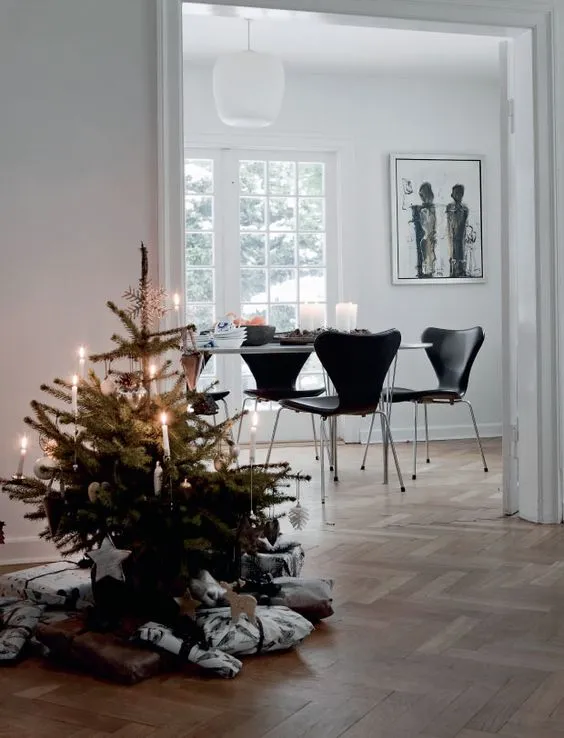
Real candles on a tree have exactly three rules. Trim every wick to 1/4 inch so the flame stays small. Keep any candle at least 12 inches from a wall, a drape, or the ceiling. And never leave the room — a clipped taper burns roughly 20 minutes, so the whole display has a natural lifespan. Buy clips rated for taper diameter, not tealights, and light the top candles first so you’re never reaching over open flame.
22. Rose Gold Chargers and Antler Candle Hurricanes
Charger plates need room to read. A 13-inch charger plus a dinner plate and a salad plate needs at least 15 inches of table edge per person, which means a table 40 inches wide and 72 inches long for six. Try this on a narrow bistro table and the chargers will overhang the edge. If your space runs smaller, the single-plate settings in Idea #10 deliver the same warmth without the footprint.
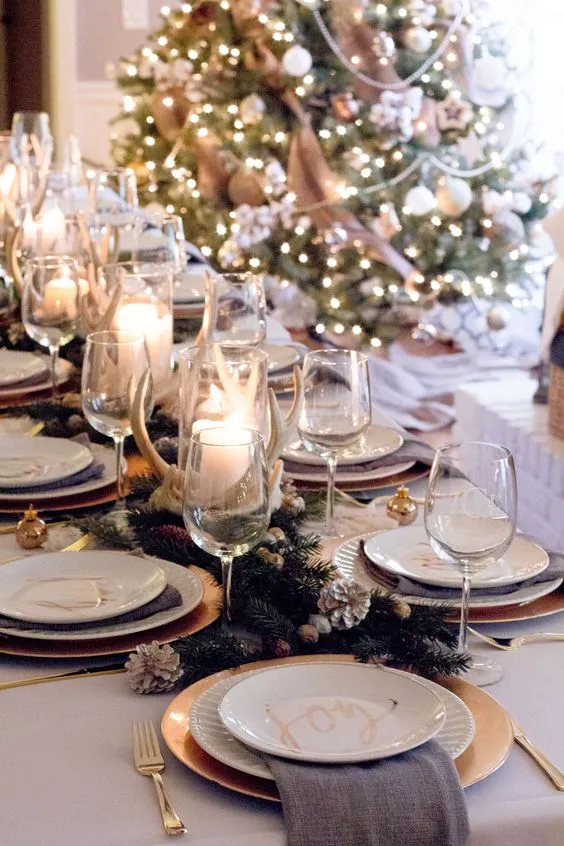
Warm metallics — rose gold, aged brass, copper — have been climbing back since the all-matte-everything era peaked, and holiday tables are where people test them first because the commitment lasts exactly one season. Antlers fit the same mood: organic, slightly unexpected, not obviously Christmas. The combination reads festive in December and ‘curated dinner party’ in January, which is the whole point.
23. Orange Tapers and Ivy on White Folding Chairs
White folding chairs are the most underrated holiday furniture there is. A set of four runs $60–$100 new, or $25–$40 on Facebook Marketplace, and simple ivy wreaths cost $8–$15 each at a craft store — or about $6 if you wrap a wire hoop with ivy from the garden. Wound around a chair back, they do everything a full garland does for a fraction of the price, and they pack flat in January.
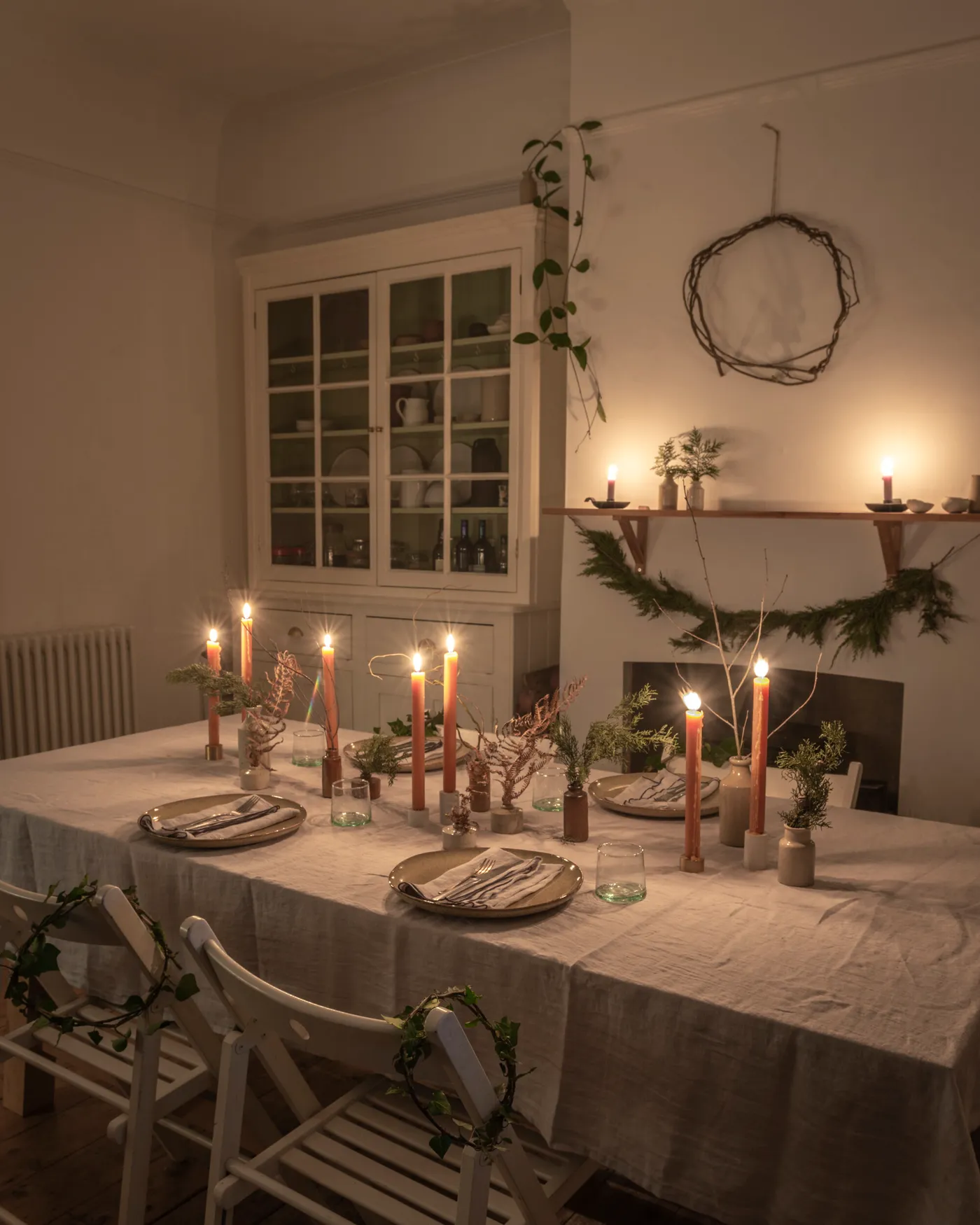
The warmth here isn’t coming from the decor, it’s coming from color temperature. Those orange tapers sit at roughly 1800K of visual heat, and every other element — off-white linen, dark wood, muted green — is deliberately cooler so the candles look hotter. The second principle is repetition: ivy on the chairs, evergreen on the mantel, a bare twig wreath on the wall. Same shape, three different scales.
24. Dusty Pink Dinnerware for Anyone Over Red and Green
Pink-tinted glassware and rose gold placemats are the two pieces that need real care. Hand wash the glasses — on most mid-price versions the tint is a coating, and dishwasher heat will cloud it permanently. Rose gold-plated flatware and placemats wear at the edges with repeated washing; if the gold is bonded to stainless, expect one or two seasons before it dulls. Either budget for replacements or buy solid brass and skip the problem altogether.
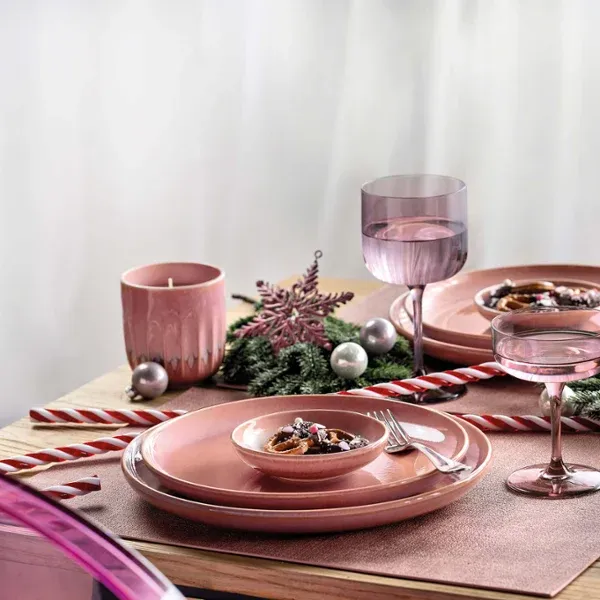
50% dusty pink, 20% rose gold, 20% deep green, 10% silver. The green is what keeps this from turning saccharine — without it, pink and gold together tip straight into a birthday party. Push pink down to 30% and let cream step in, and the same table becomes noticeably more adult. For a cooler version with identical structure, the blues in Idea #5 use the exact same math with a different lead color.
25. String Lights Across the Floor and Red Stockings on the Mantel
- Count your outlets — a floor-level light run usually needs two, plus a hidden extension cord.
- Check that the rug pile is at least half an inch deep so the wire sinks in and disappears.
- Confirm the stockings hang clear of the firebox by at least 12 inches.
- Test every strand before laying it out; one dead section ruins the whole run.
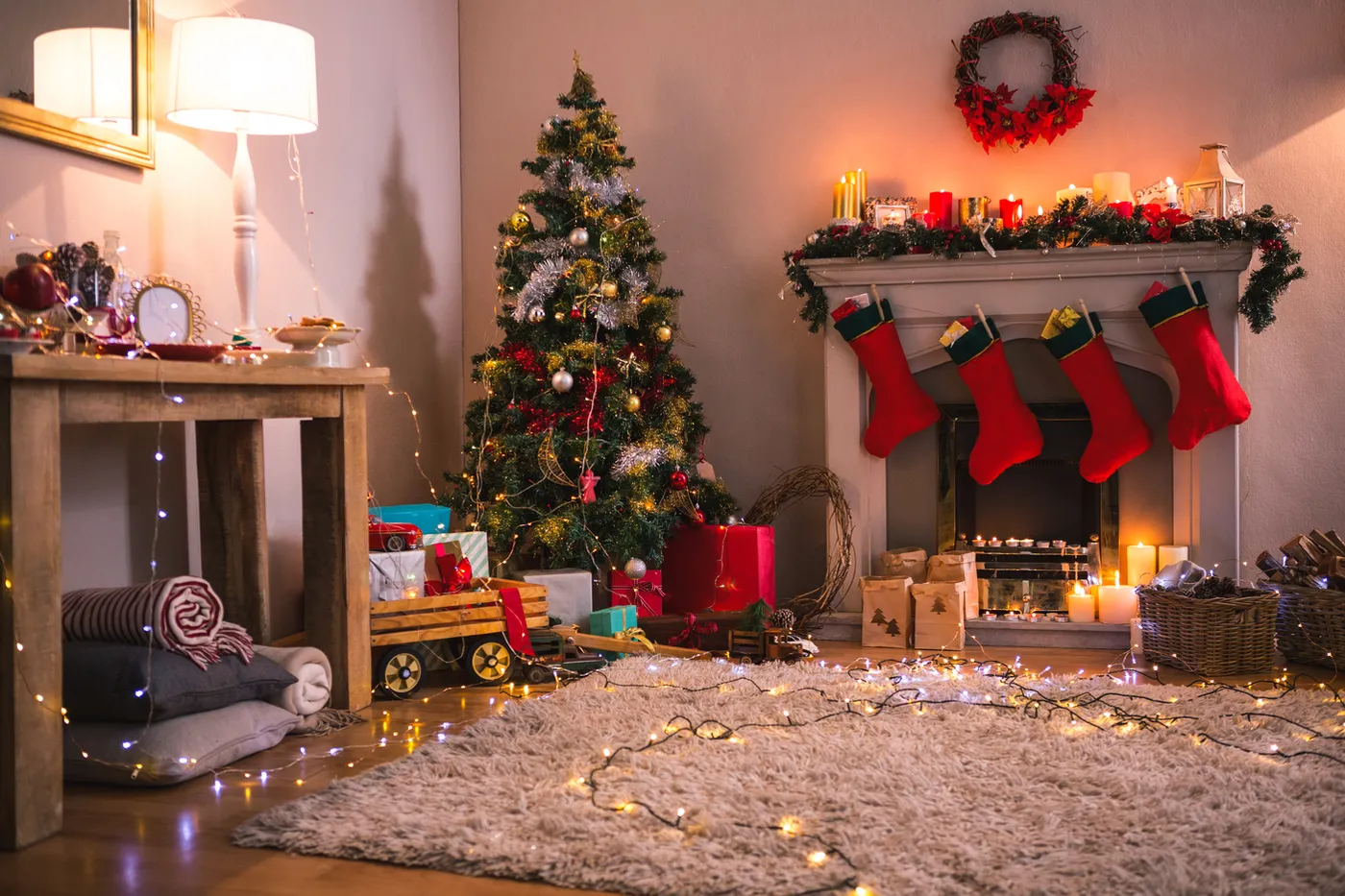
- Plug the strand in first and check for dead bulbs.
- Start at the base of the tree and work outward in a loose S-curve, never straight lines.
- Push each section down into the pile with your fingers so the wire vanishes.
- Loop once around the couch leg and once around the console so it can’t be dragged. Time: 45 minutes. Cost: $25–$60.
26. A Tabletop Frosted Tree in a Textured Woven Pot
- Frosted artificial tabletop tree, 18–24 inches: $25–$60
- Textured brown woven pot or basket: $12–$30
- Red berry clusters and pinecones: $10–$25
- Wrapped gift boxes with patterned paper: $15–$35
- Ribbon and gift tags: $6–$15
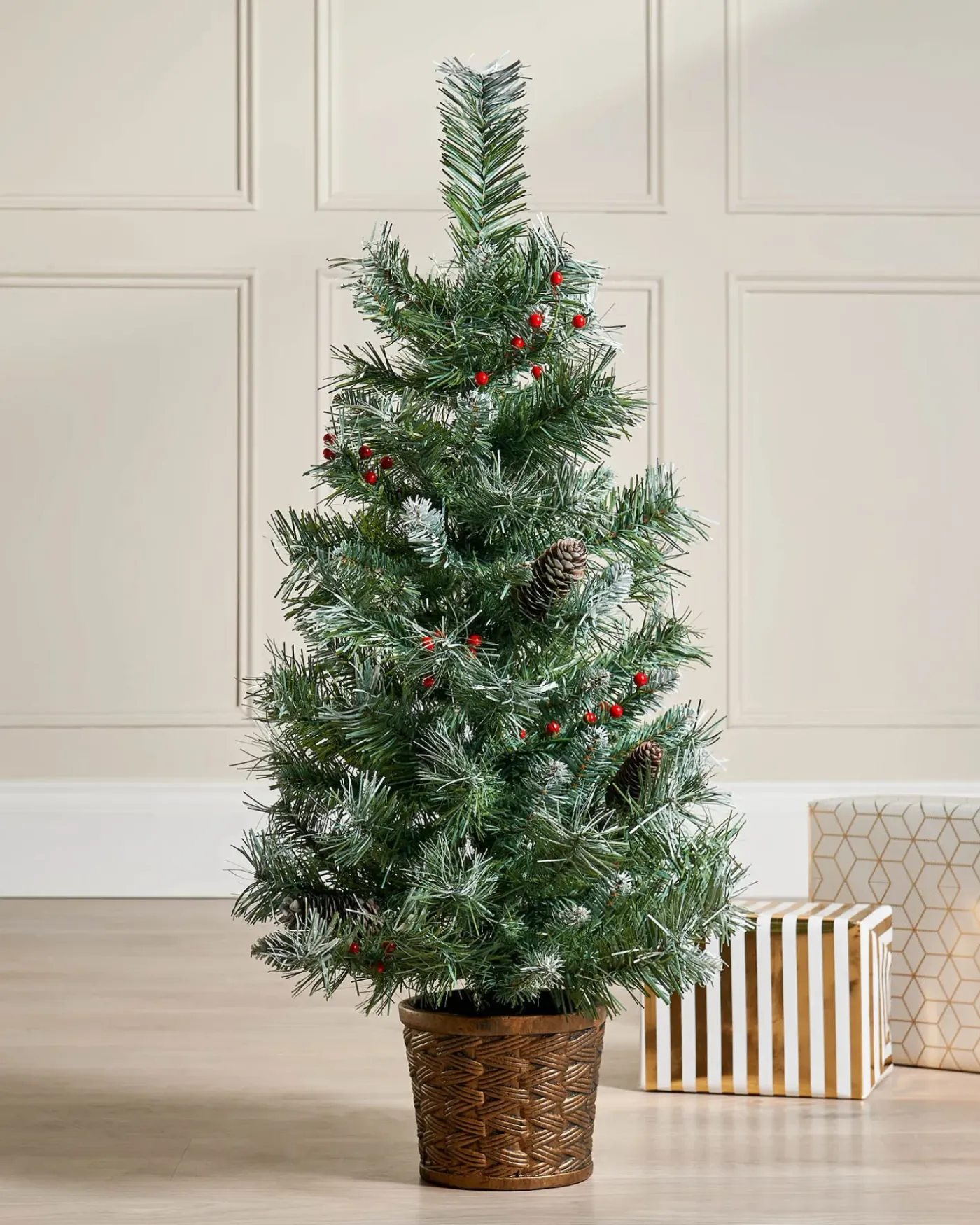
Total: about $68–$165
Budget alternative: a $12 thrift-store ceramic pot spray-painted matte brown does the job, and last year’s wrapping paper cut into strips makes perfectly good ribbon.
Proportion is everything on a tabletop tree. The pot should be roughly one-third the height of the tree — an 18-inch tree wants a 6-inch pot, no bigger. Keep decorations under 2 inches each or the tree starts looking like a bush wearing jewelry. And position it so the frosted tips catch light from the side, never directly under a lamp, which flattens every bit of that texture.
27. A Christmas Tree Next to Exposed Brick in the Kitchen
Brick holds heat and releases it slowly, which makes it a genuinely bad neighbor for a fresh tree. Keep at least three feet between the two, and more if the brick sits near the stove. On top of that, kitchen humidity swings dry a tree out fast, so you’ll be refilling the stand constantly. Check the water every morning — a cut tree can drink a quart a day in a warm room, and brown leather chairs won’t survive a tipped stand.
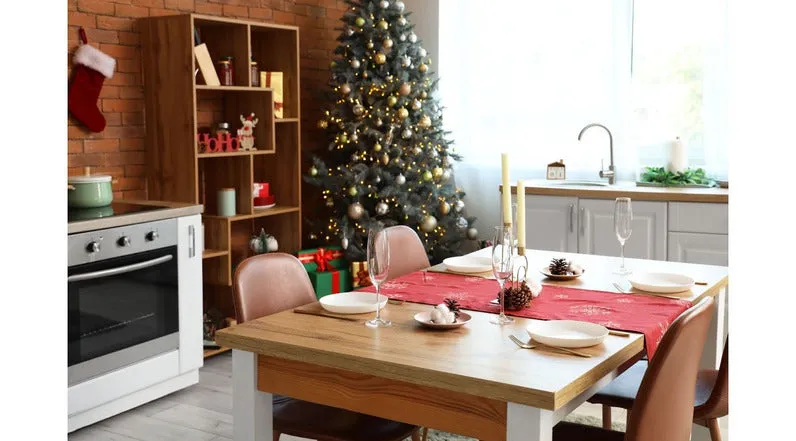
The red table runner is doing more than it looks. Without it, this corner is warm wood, brown leather, exposed brick, and white cabinetry — pleasant, but undirected. One deep red band down the center of the table pulls the tree, the stockings, and the string lights into the same conversation. It’s a $20 object holding together an entire room’s color story.
28. Plush Gnomes in Muted Grey, Beige, and Dusty Pink
Gnome ornaments split sharply into two camps. Mass-market versions run $6–$12 each and use polyester beards that look flat and stringy by January. Handmade versions with real faux fur beards start around $18–$30 on Etsy and photograph beautifully against frosted branches. If you’d rather make your own, a felt cone hat, a wood bead nose, and a 2-inch strip of faux fur come to roughly $4 per gnome.
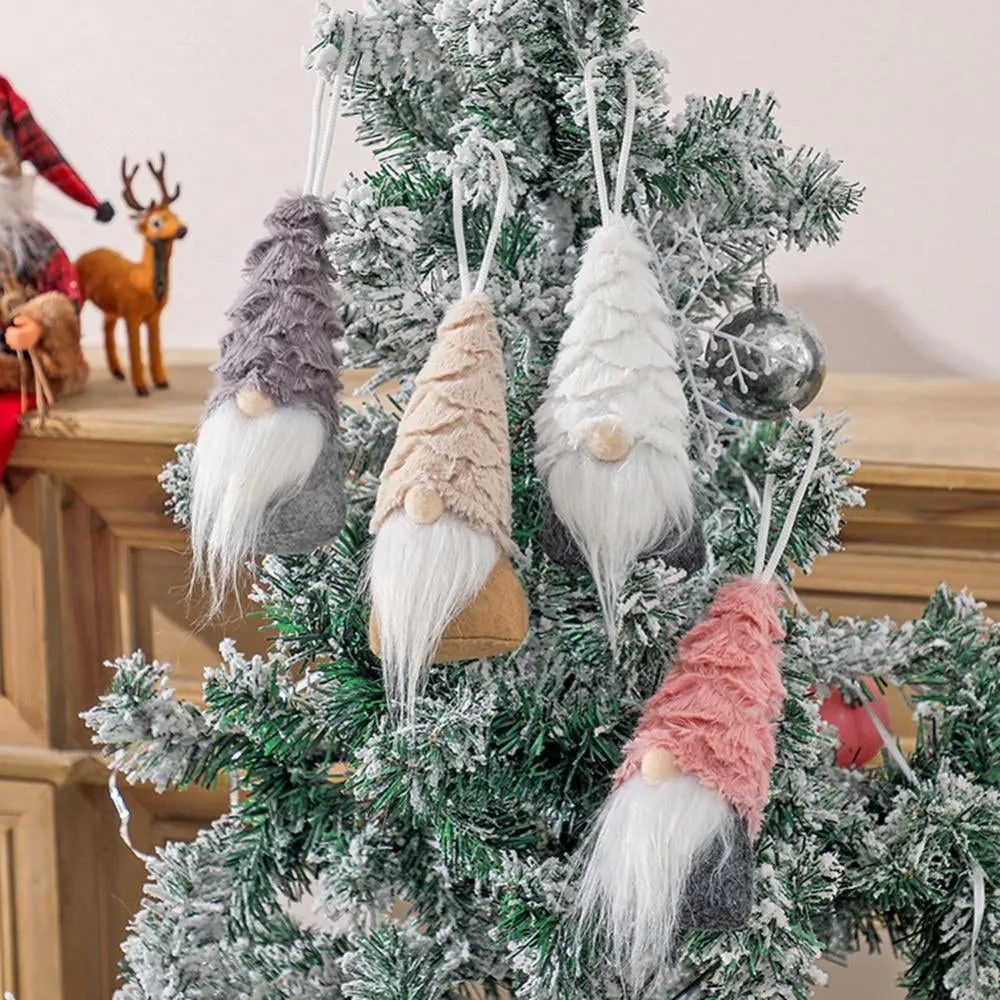
Muted gnomes are the compromise everyone landed on. Traditional red-and-white versions read too folksy for a minimalist tree, while plain baubles feel impersonal. Soft grey, beige, white, and dusty pink gnomes slip into a neutral palette without losing the whimsy, and they’ve stayed popular because they photograph so well against frosted green — which is, honestly, how most of us find them in the first place. A single silver bauble in the background keeps it from going full toy store.
Twenty-Eight Ideas, One Very Calm December
Scandinavian Christmas decorating isn’t about doing less for its own sake — it’s about choosing the four or five things that actually carry a room and letting everything else stay quiet. Start with the idea that matches the table, console, or corner you already have, then build outward one candle at a time.
📌 Pin your favorite from this list and tag us when you style it — we’d genuinely love to see how it lands in your space.