
Somewhere between the perfectly matched designer tree and the one your kid decorated with nine candy canes on a single branch, there is a third option — and that is where 2026’s most interesting Christmas trees live. A rubber chicken in a Santa suit. Iridescent toucans. Moss Bigfoots carrying tiny red gift boxes. The best trees this year are not the most tasteful ones; they are the ones with a point of view.
We spent serious time digging through Etsy, Target, World Market, and Anthropologie (plus a few very good thrift hauls) to bring you only what is worth your attention. Every idea here lands between $9 and $1,200, and budget and luxury versions sit side by side so you can see exactly where the money actually matters.
Inside: 29 curated trees covering maximalist vintage, woodland natural, playful eclectic, and frosted white styles. And stay until the end — we break down the most common mistakes that can ruin these looks.
Why now? “Collected over time” has officially replaced “matched set,” and searches for handmade and eccentric ornaments have been climbing on Pinterest all year.
📌 Save this to Pinterest for later — you’ll want to revisit these ideas.
1. A Grand Staircase Tree Framed by Blue Stained Glass
The blue does all the work. Those stained glass panels throw cool light across the marble staircase, and against that electric blue the red, gold, and silver ornaments read as embers instead of decorations. Lose the windows and you still have a beautifully trimmed tree in a handsome foyer — you just lose the reason anyone stops walking. If your entry already has one strong architectural color, build the entire tree around it and let everything else stay quiet. White paneling, crown molding, and white balusters keep the frame neutral so the contrast lands instead of turning into noise.
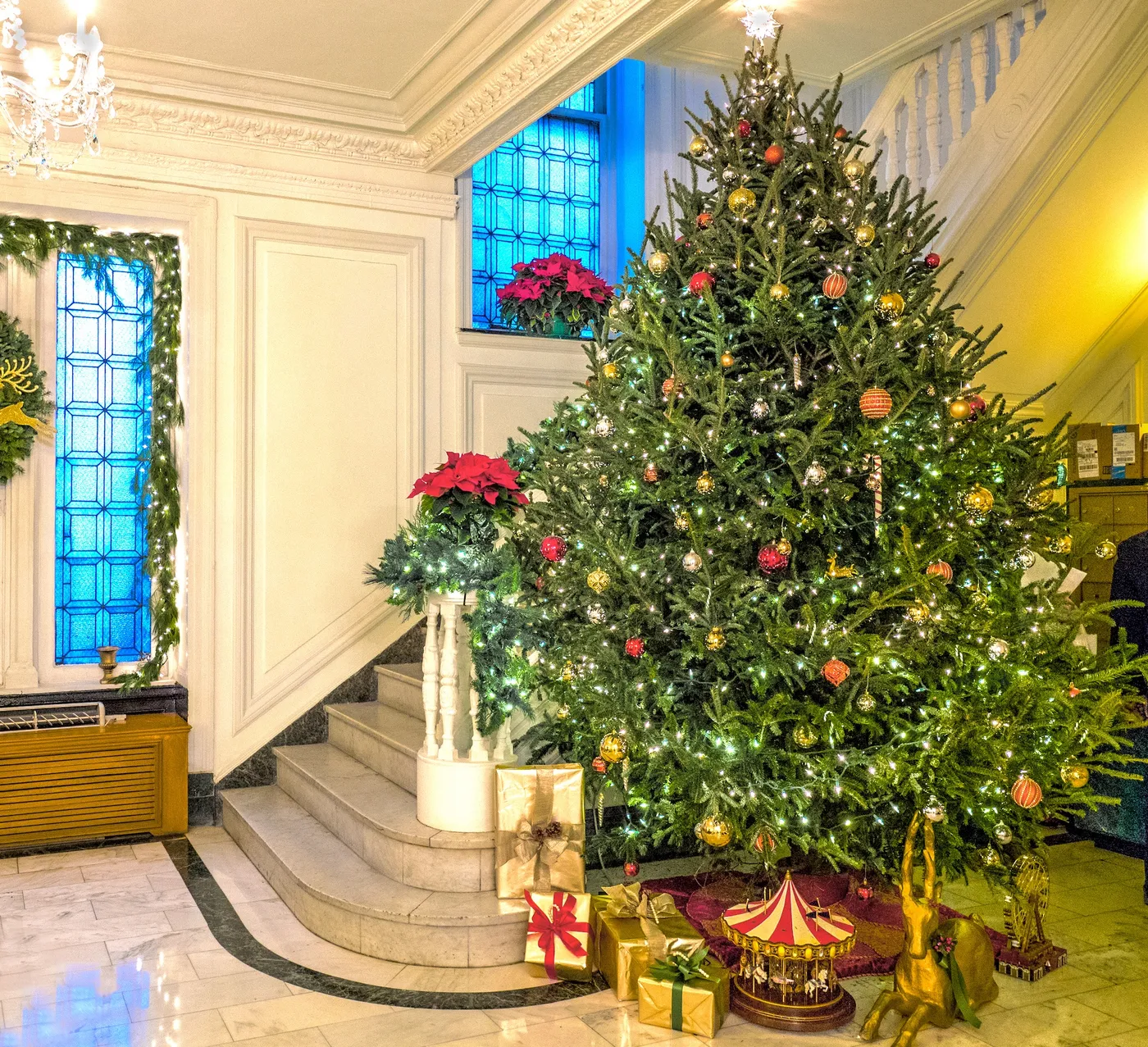
A foyer tree is mostly a volume game — the ornaments, not the tree, eat the budget.
- Pre-lit tree, 9–12 ft: $400–$1,300
- Ornaments, 250+ pieces in red, gold, and silver: $300–$700
- Extra light strands and heavy-duty extension cords: $60–$120
- Tree skirt, ribbon, and gift wrap: $80–$180
- Foyer accents — carousel, golden reindeer, poinsettias: $100–$350
Total: $940–$2,650. The budget version swaps the carousel and reindeer for thrifted figurines at $5–$15 each and builds ornament count from after-Christmas clearance at 70% off. Same density, a third of the cost.
2. Three Pink Glitter Trees and Their Little Pink Fawns
Read this group as a formula: 45% pink (hot, light, and iridescent all count as one family), 25% glitter and shine, 20% warm brown wood, 10% white brick to breathe. That is it. The wooden surface and the white wall are doing far more than they look like they are doing — without them, three pink trees on a pink surface would flatten into a single blob. Swap pink for mint and the math still holds. Swap the wood for white lacquer and you will need a third texture somewhere or the whole vignette turns sterile.
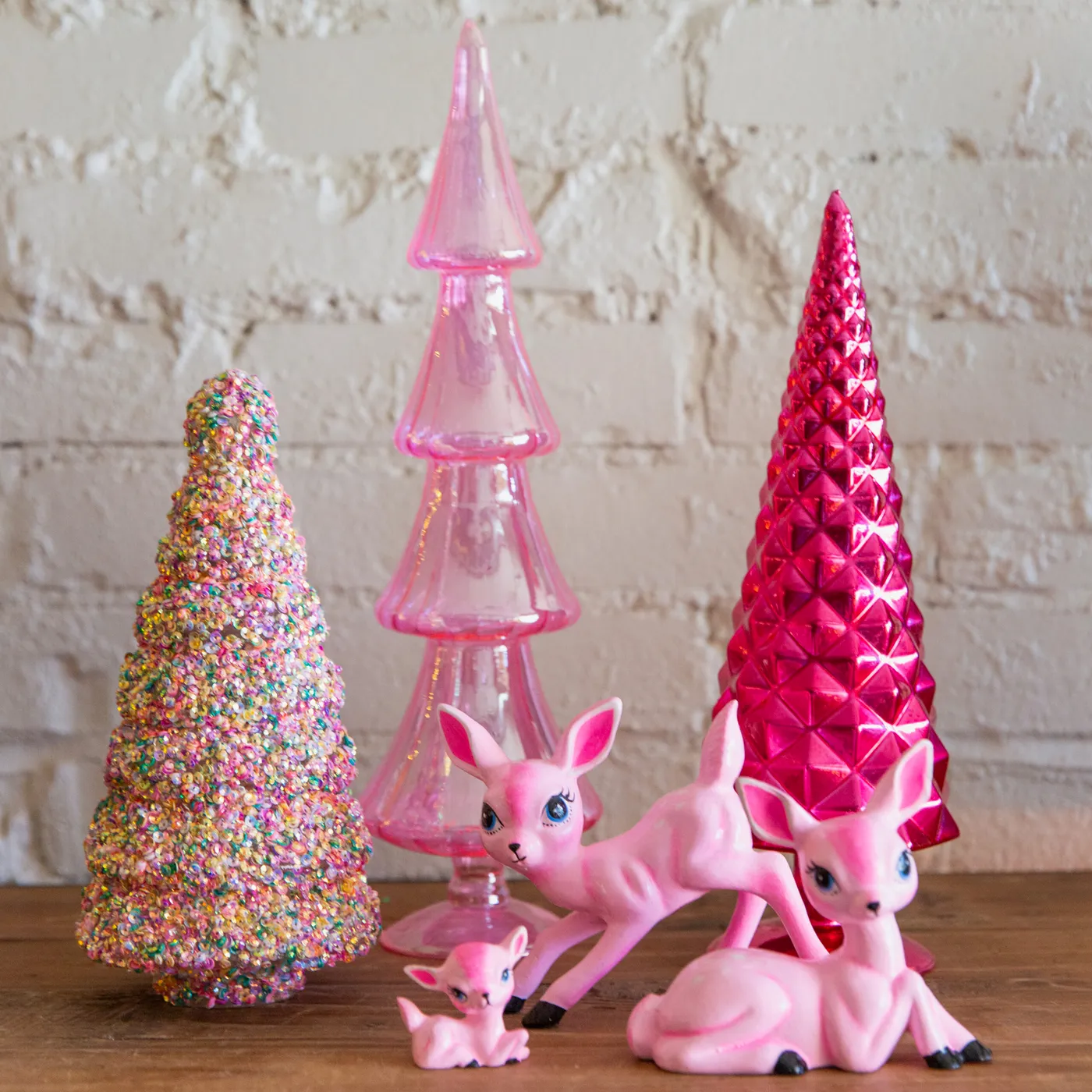
You do not need designer mini trees for this. Target’s dollar section and Walmart both run small glitter and sequin trees for $5–$12 in November, and thrift stores are full of resin deer figurines for $2–$6 — a coat of pink spray paint and they become your fawns. Total for the whole arrangement that way: $35–$60, versus $150–$220 buying new. The sequin tree is the one worth actually paying for; the other two can be the cheap ones. For a full-size version of this same one-color-many-textures trick, see Idea #11.
3. A Maximalist Vintage Ornament Tree Against Mint Walls
Two things are happening here. First, the ornaments are so dense they stop reading as individual objects and start reading as a texture — that is what makes a tree feel expensive instead of merely decorated. Second, the wall repeats the trick: blue and white plates, porcelain figures, an ornate gold mirror, all clustered where the tree can echo them. Nothing in this room is alone, and the coral pleated lampshade gives your eye one warm note to land on after all that glass and gold. The repetition between tree and walls is why the maximalism feels collected rather than chaotic.
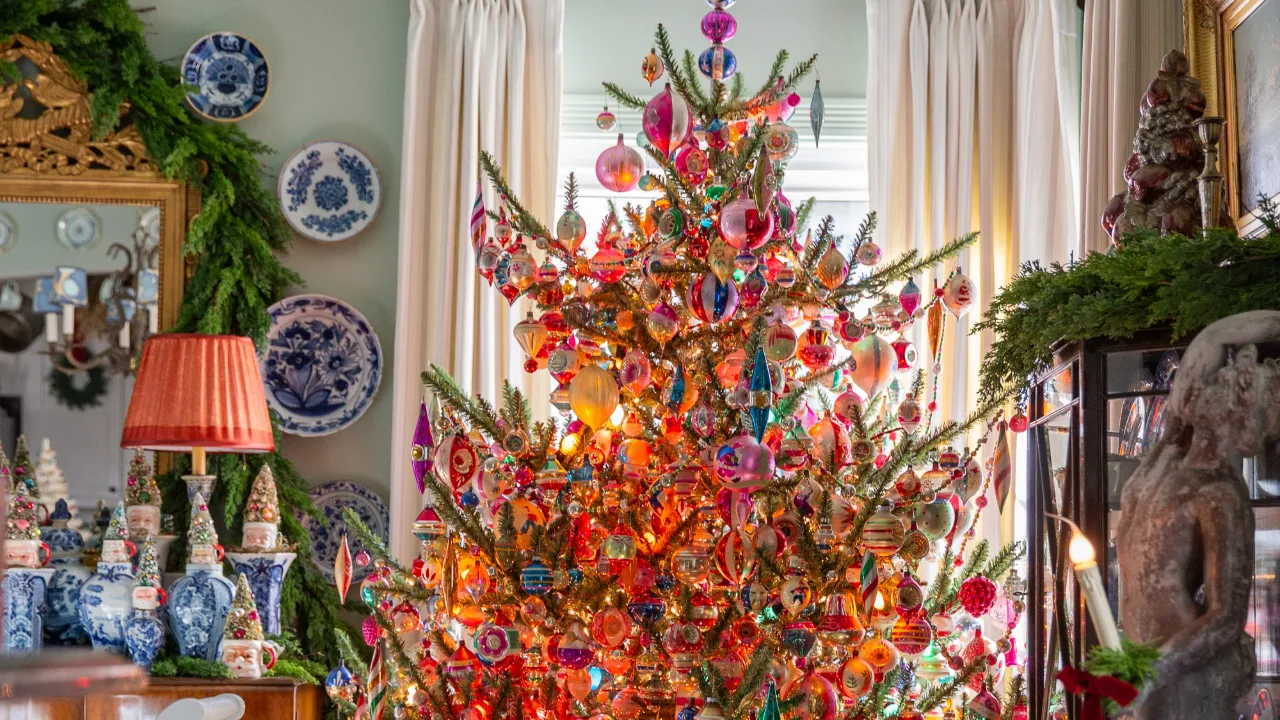
Ornament count is math, not taste. A 6-foot tree needs 120–150 ornaments to look full, a 7.5-foot tree wants 180–250, and anything over 9 feet needs 300-plus. If you are short, do not spread thin — cluster what you have at eye level, 36 to 60 inches off the floor, and leave the top third open for lights. Push the largest ornaments 4–6 inches into the branches so the tree gains real depth instead of looking like a shelf with hooks on it.
4. A Felt Monster in a Christmas Tree Costume on Top
- Sketch the creature, then cut two identical body shapes from 2mm wool felt in forest green.
- Cut the brown head, yellow star, and small pom-pom ornaments from scraps — organic shapes read better than precise ones.
- Blanket-stitch around the body with embroidery floss, leaving a 2-inch gap at the bottom.
- Stuff lightly with polyfill, stitch closed, then hand-sew the head and star on top.
- Wire a 3-inch loop of 20-gauge floral wire into the base so it sits over the leader branch.
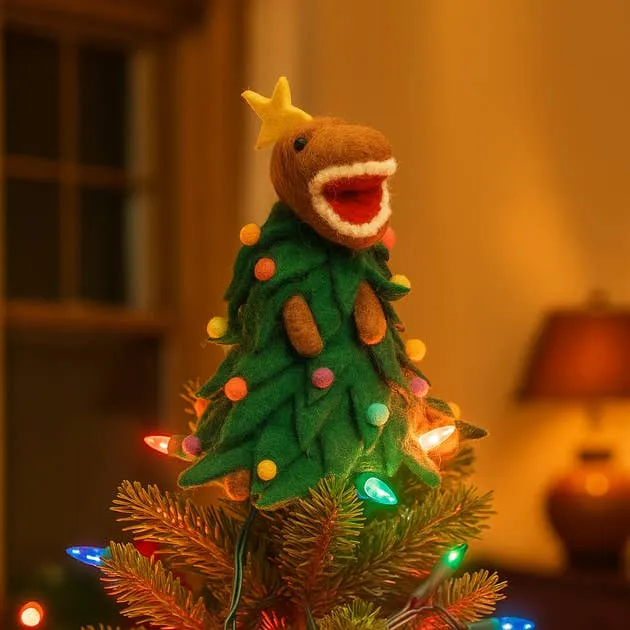
Budget about three hours and $15–$25 in materials for the first one; the second takes half that.
Weight is the trap. A stuffed felt topper can easily run 8–12 ounces, which is enough to bend a slim tree’s leader branch or tip a tabletop tree sideways. Keep it under 10 ounces, stuff it loosely, and check that your top section is at least 12 inches of straight branch. Felt also holds dust like a sweater, and if kids can reach this tree, expect it to be hugged. Vacuum it with a brush attachment in January and store it in a cotton bag, never a plastic bin.
- Weigh the finished topper — under 10 oz for tabletop trees, under 1 lb for full-size.
- Measure the top 12 inches of your tree; a split leader will not hold a stuffed shape.
- Check that the topper is at least 8% of tree height, or it looks like a hat that shrank.
- Have floral wire and a cotton storage bag ready before you start sewing.
5. Red, Gold, and Animal Print: Traditional Turned All the Way Up
It is the animal print chairs. Everything else in that room plays by the rules — red ribbons, gold angels, wreaths on the double glass doors, garland draped over the white mantel — and that is exactly why those two dark wood chairs with patterned upholstery matter. They keep the scene from sliding into hotel lobby territory. If you are going to do traditional red and gold properly, spend your one wildcard on furniture rather than ornaments. Upholstery works all year; a novelty bauble gets boxed up in January.
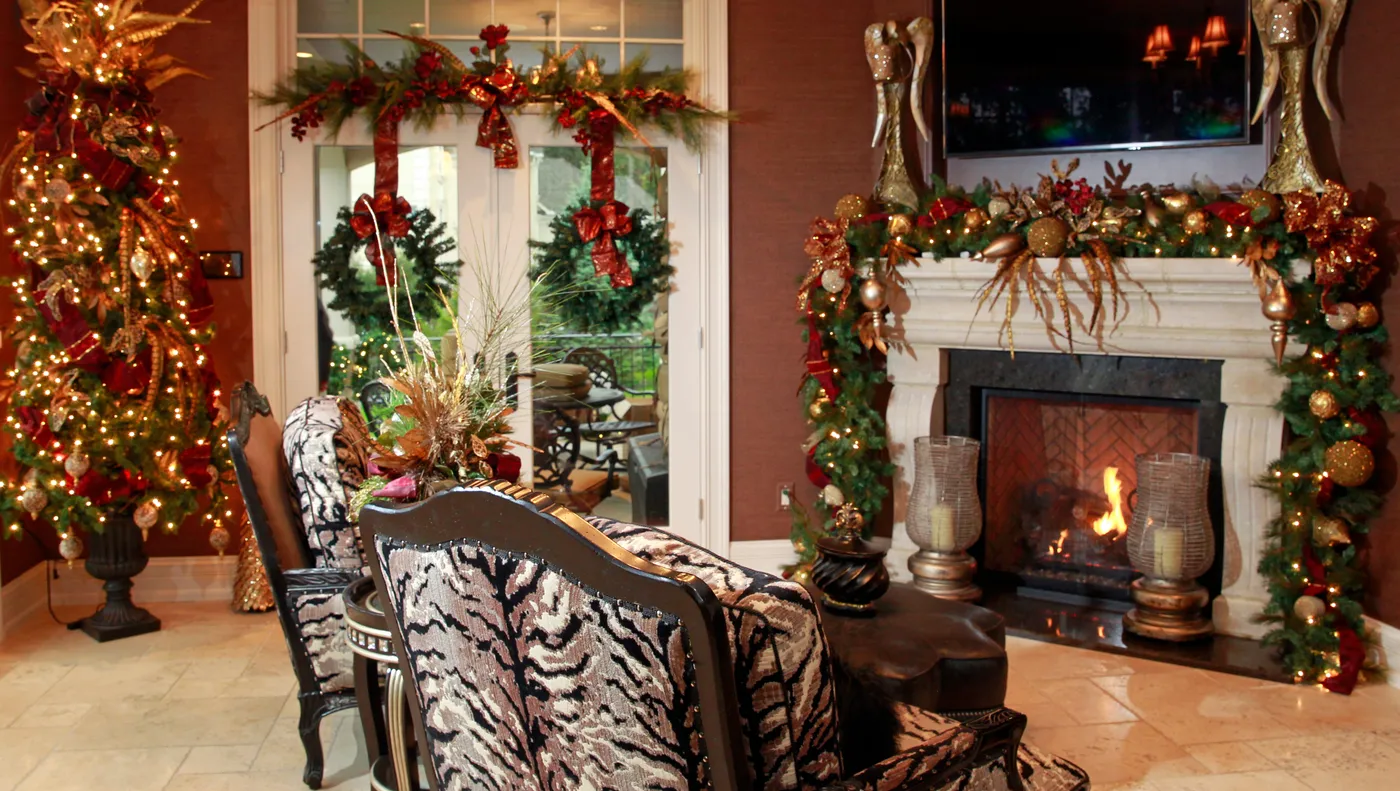
Traditional red and gold gets expensive fast because every material is dense and heavy.
- Pre-lit tree, 7.5–9 ft: $250–$800
- Red ribbons, gold baubles, angel figurines: $180–$450
- Garland, wreaths for two doors, mantel greenery: $120–$300
- Lanterns and candleholders: $50–$150
Total: $600–$1,700. Buy garland and wreaths at the end of November when craft stores run 50% off, and reuse the ribbon year to year — wired ribbon holds its shape for about five seasons before it starts to droop.
6. Eccentric Trees: When the Theme Is Honestly No Theme
This is the year the no-theme tree went mainstream. Pinterest boards have been filling up with trees built out of thrift store ornament bags, travel souvenirs, and one-off pieces people bought because they laughed — a real shift away from matched sets and toward something closer to cluttercore. Part of it is money: a collected tree is cheaper than a themed one. Part of it is that after a few years of beige minimalism, people want a tree that looks like a human lives there. Staying power? High. A tree made of memories is hard to get bored of.
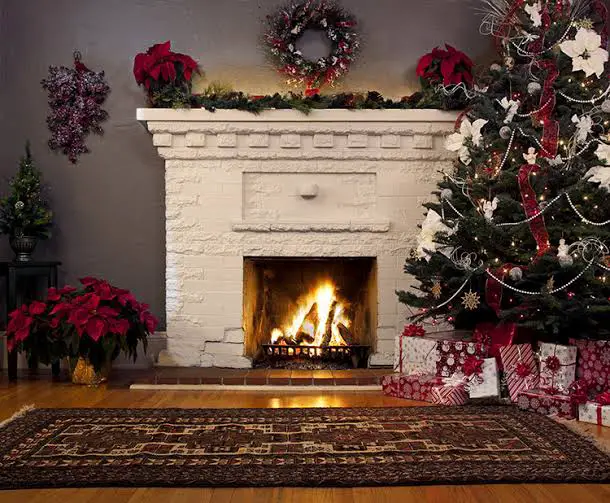
Honest warning: eccentric only works with one binding constant. Pick a color, an era, or a single motif and repeat it — vintage glass, or red, or animals — then hang everything else around that thread. Without one, a quirky tree does not read as playful, it reads as a box of ornaments someone dumped out. Plan storage before you shop, too. A collected tree needs two or three bins, not one, and fragile vintage glass wants tissue paper and a shelf that is not the garage floor. It is mistake number three at the bottom of this guide, and it is the one that quietly kills the look.
7. Copper, Owls, and a Blue-Green Tree That Skips Red
Here is the ratio: 55% blue-green and neutral leather, 30% copper and orange, 10% deep red, 5% cream. The blue-green needle color is what lets copper sing — put those same ornaments on a standard green tree and they go muddy. Nothing about this palette is fragile, either. Trade copper for brass and it gets dressier. Trade orange for mustard and it drifts mid-century. Keep the ratio and the room still works.
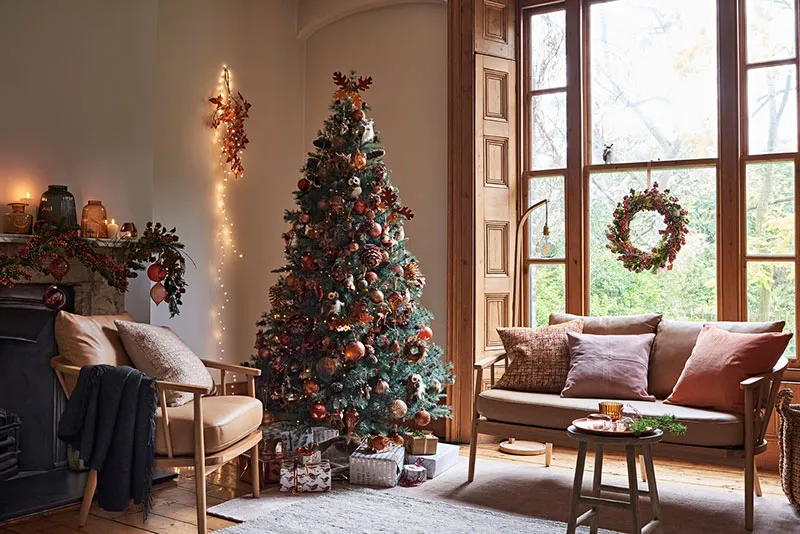
It is a temperature play. Cool blue-green needles and cool grey-beige walls sit under warm copper, orange, and amber baubles, and that push-pull is why the tree feels alive instead of flat. The woodland pieces — small owls, pinecones, leaf shapes — repeat three times across the tree and show up again in the berry wreath hanging in the window, which is enough repetition to read as intentional rather than accidental. The light brown leather sofa and armchair are doing quiet work as well: they echo the copper without ever competing with it.
8. Quirky Baubles: A Year of Collecting Beats One Shopping Trip
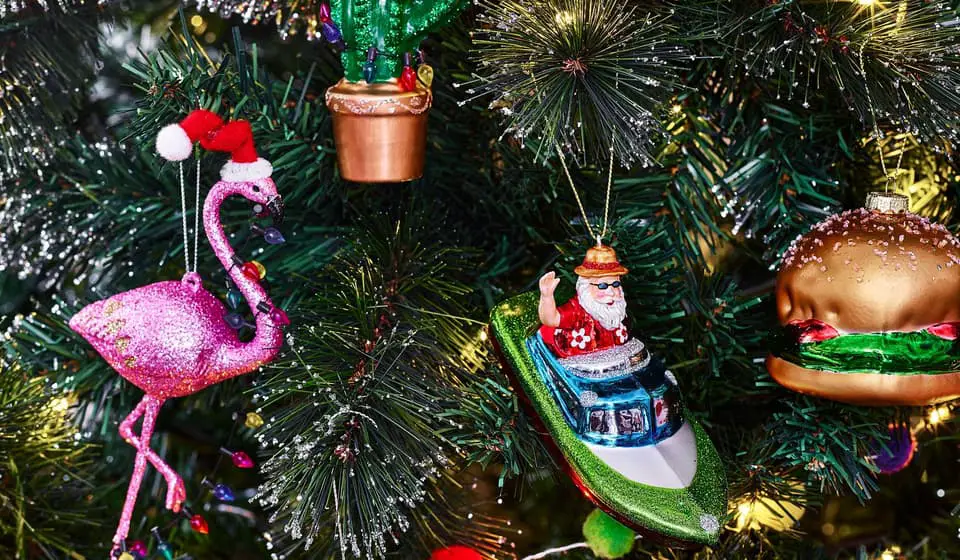
The collectible ornament market has gotten genuinely fun. Small makers on Etsy, museum gift shops, and even grocery stores now release limited seasonal baubles the way sneaker brands drop colorways, which means you can build a tree one conversation piece at a time instead of buying a 100-piece box. It is slow decorating, and that is the appeal — a tree that takes three years to finish looks like nobody else’s. Longevity-wise this is one of the safest trends to buy into, because the ornaments outlive the trend by decades.
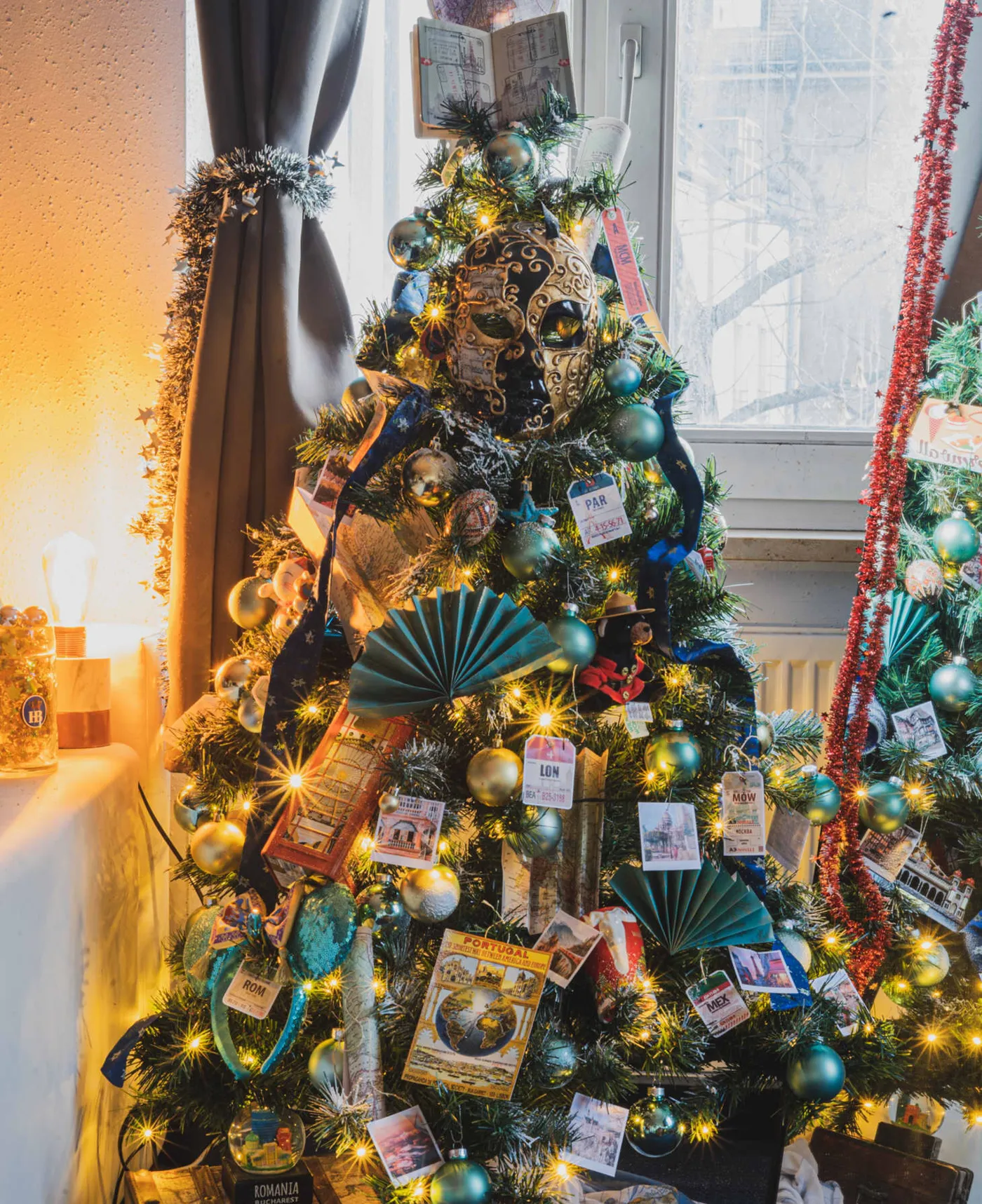
Statement baubles need to be seen. Hang them between 36 and 60 inches off the floor, the band your eye actually lands on, and give each one roughly 2 square feet of clear branch around it. If two big pieces end up within 6 inches of each other, they cancel each other out. Cluster in odd numbers of three when you own a set, and hang the oddball pieces slightly lower than the pretty ones — counterintuitively, they get noticed more down there, not less.
9. The Curved Tree With a Single Red Sphere on Top
Slender curved trees are the friendliest option for tight rooms. A 6 to 7.5 foot version needs about 30 inches of clearance on all sides and works in living rooms from roughly 250 square feet up, with 8-foot ceilings as the comfortable floor. Leave 12 inches between the curve and the ceiling — that tip needs empty air to read as a gesture instead of an accident. If your room is bigger, the fireplace-and-tree setup in Idea #25 fills a long wall better than any slim silhouette can.
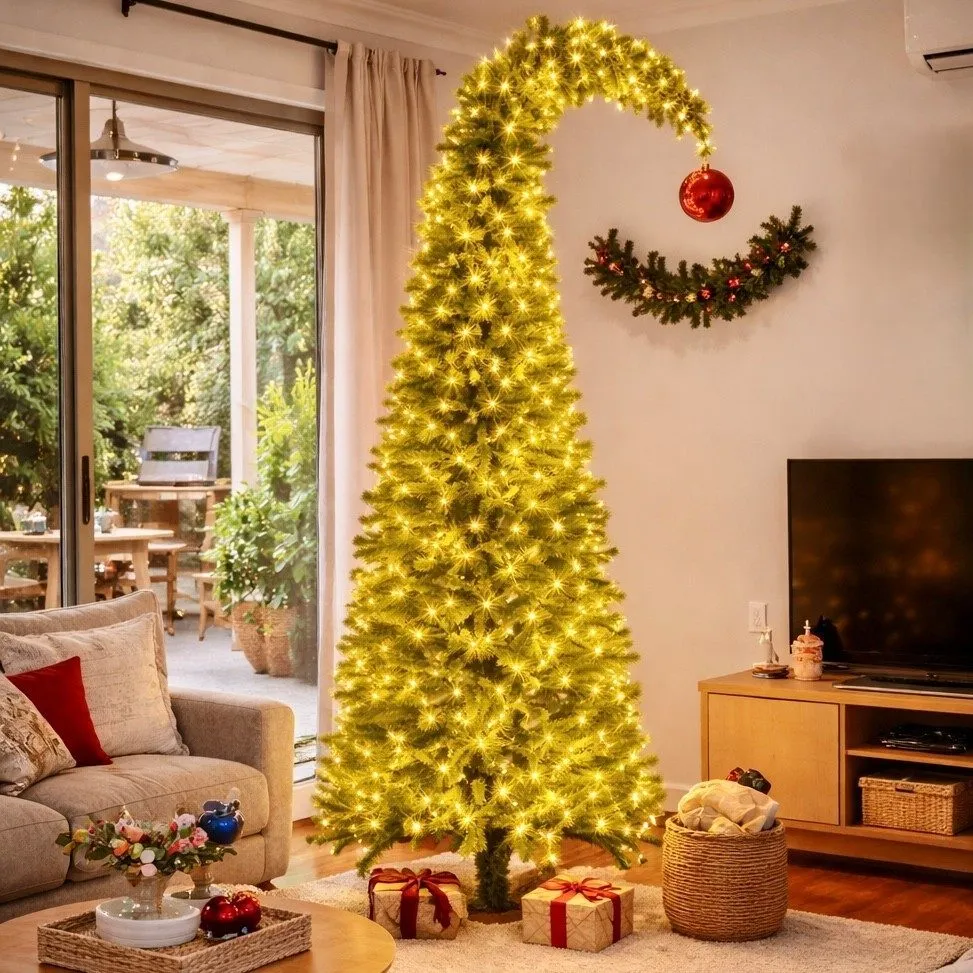
The red sphere at the tip, and the fact that the curve is left alone. Someone resisted putting a star up there, and that restraint is the entire design. The crescent garland on the white wall answers it from across the room — same green, same red berries, same curve — so the odd shape reads as deliberate rather than broken. Add a traditional topper and this becomes a slightly bent tree. Leave it bare and it becomes a sculpture.
10. Handmade Felt Mushroom Creatures Hanging in the Branches
- Cut a 2.5-inch half circle from red felt for the cap and a 1.5-inch oval from blush felt for the body.
- Fuse small white dots to the cap with a hot iron — six or seven, staggered, deliberately uneven.
- Embroider two French knots for eyes and a small curved mouth in black floss.
- Whip-stitch cap to body, leaving a gap, then stuff with a pinch of polyfill.
- Sew on two tiny brown feet and a 4-inch hemp cord loop for hanging.

About 90 minutes per ornament and $8–$12 in supplies — enough felt for six or seven creatures.
Wool-blend felt is tougher than it looks, but it does two things over time: it fades in direct sun, and it holds onto dust. Keep these off the side of the tree that faces a bright window, and clean them once a year with a lint roller or a vacuum brush attachment on low. Store felt in cotton bags with a cedar block, never in a hot attic — heat plus moisture is what invites moths, and moths love wool more than anything else on your tree. Expect five or more seasons with decent storage.
11. Sugar Skulls, Llamas, and Sloths on a Flocked Tree
The formula: 50% bright white flocked base, 30% saturated jewel tones, 15% deep blue velvet, 5% natural wood. That flocked white tree is what makes loud ornaments look curated instead of cluttered — white is a resting place, so the hot pink penguin and the sugar skulls get to be as weird as they want to be. Swap jewel tones for pastels and the whole thing softens. Swap the blue velvet armchair for something neutral and the corner loses its anchor entirely. Keep one saturated upholstered piece nearby. Always.
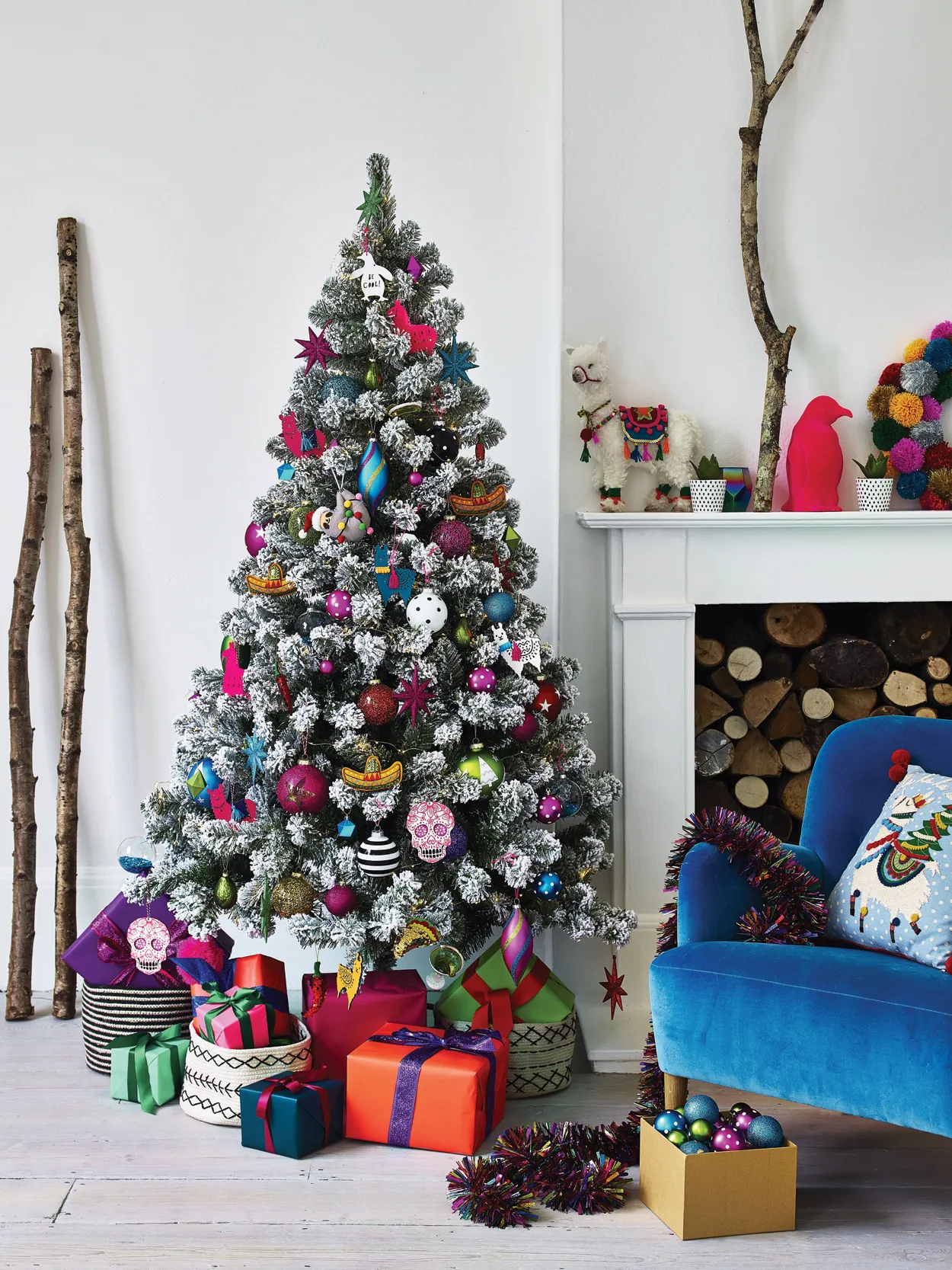
A flocked tree costs real money, but the look does not have to. A $25 can of spray flocking plus a $60 standard green tree gets you 80% of the way there, and dollar store ornaments spray-painted matte white or hot pink fill the gaps. That pom-pom wreath over the mantel is a two-hour, $12 project: a straw form, three skeins of yarn, and a hot glue gun. This whole corner on a strict budget: $150–$220 instead of $700-plus. The tabletop version of the same idea lives in Idea #2.
12. Oddball Ornaments Need a Hanging Strategy, Not Luck
Heavy or awkward ornaments need hardware, not hooks. Anything over 4 ounces gets 20-gauge floral wire looped through the cap and twisted around the branch — standard ornament hooks straighten out under weight. For glass pieces with a narrow cap, run fishing line through and tie it behind the branch; it is invisible and it will not slip. And never hang heavy pieces at the branch tip in early December. Set them 4 to 5 inches in, where the branch is thicker, and the tips stay lifted all season long instead of drooping by the 20th.
Quirky decorating works at every scale, so match the tree to the room rather than to the theme. With 8-foot ceilings, stay at 6 to 7 feet. With 9-foot ceilings, a 7.5 to 9 foot tree with a 12-inch gap above it is ideal. A room under 200 square feet wants a tabletop tree on a console, 4 feet maximum, and that is a design choice rather than a compromise. Wide rooms can carry two trees, like the pair in Idea #28, but that needs at least 10 feet of uninterrupted wall.
13. A Rubber Chicken in a Santa Suit, Topping the Tree
The joke lands because nothing else on that tree is joking — plain green branches, no other novelties, and a dark brown wall behind it that makes the yellow bird pop like a neon sign. Remove the chicken and you have an under-decorated tree. Add three more gags and you have a novelty store display. One absurd object surrounded by normal is funny. Six absurd objects is just noise. The black picture frame nearby matters too: it is the straight man, giving your eye somewhere serious to rest between laughs.
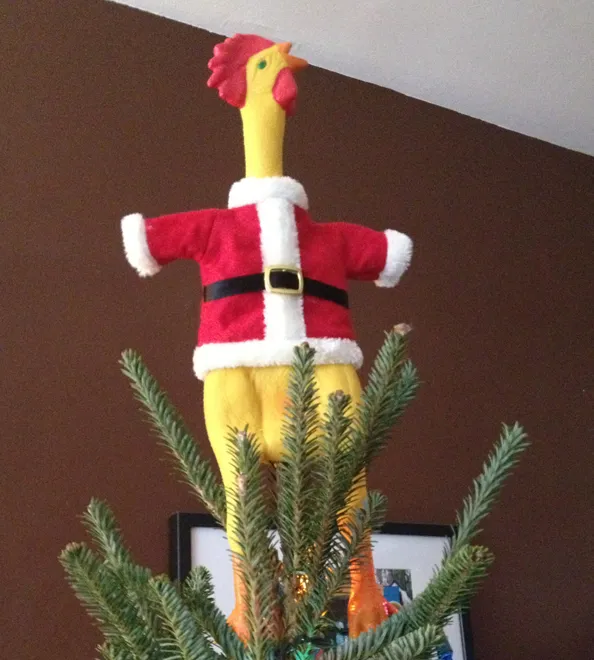
Good news first: a hollow rubber toy weighs 2 to 3 ounces, so it sits on any leader branch without bending it. The catch is heat and time. Rubber softens near a fireplace or radiator vent, and once it deforms it does not come back. Check that the Santa suit fabric is not glued with something that will stain the needles, and be honest about the joke’s shelf life — a topper you laugh at every December is worth keeping, one you wince at in year three is not.
14. Moss Bigfoots Carrying Tiny Red Gift Boxes
- Shape a 3-inch body from air-dry clay or a foam egg, then coat it in craft moss with tacky glue.
- Add legs and arms from twine-wrapped wire, pressing them in before the moss sets.
- Cut a 1.5-inch backpack from burlap, fold it, and glue a twine strap across the front.
- Fill the backpack with three miniature red gift boxes cut from cardstock plus a sprig of greenery.
- Add a small brown pouch at the waist and a hemp loop at the top for hanging.
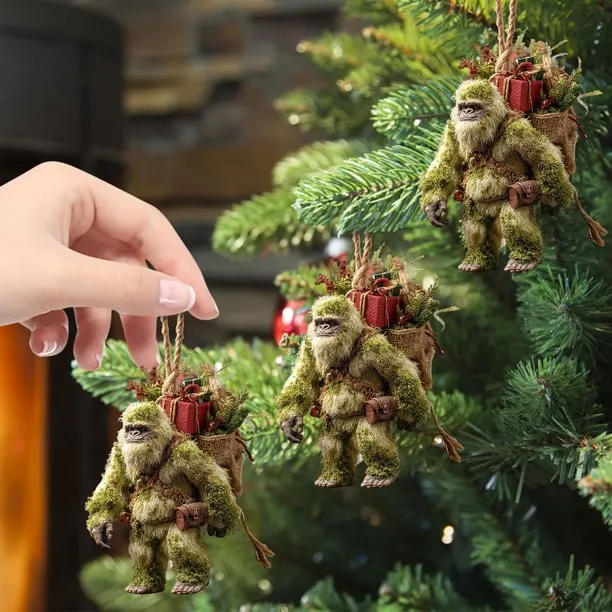
Roughly 45 minutes per figure and $6–$9 each once you own the moss and twine.
If crafting is not the plan, handmade versions run $14–$22 each on Etsy, which adds up fast for a full tree. Try a middle path: buy two or three as your statement pieces and make the rest. Dollar store moss, twine, and foam eggs bring the DIY cost under $4 per ornament, and a set of ten miniature gift boxes from a party aisle covers every backpack for about $3. Same look, roughly 60% less than buying a full set.
15. Dried Oranges, Cowhide, and Candlelight on a Radiator Cover
This is one of the most affordable looks in the whole roundup, because half of it comes from the grocery store.
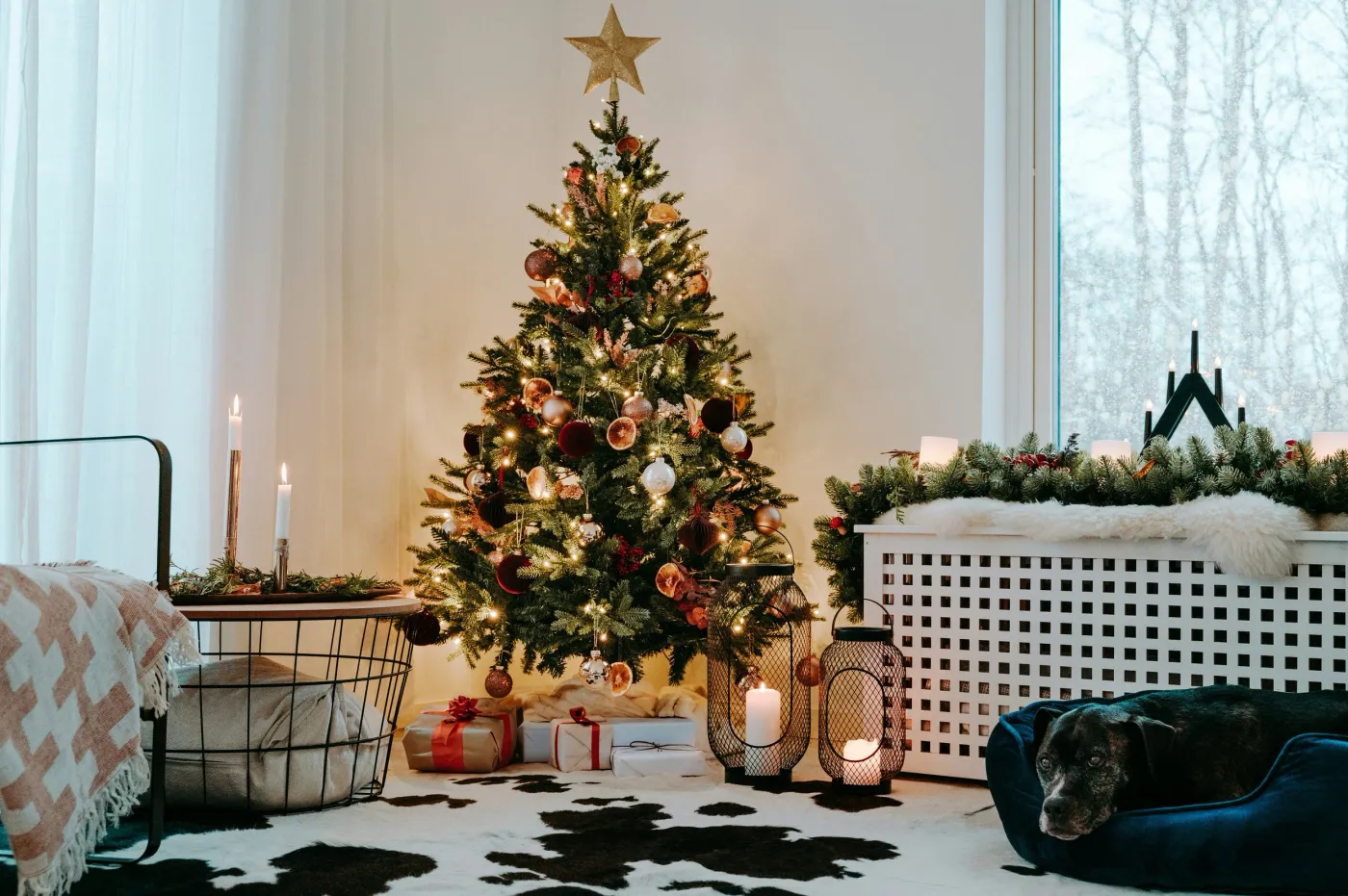
- Tree, 6–7.5 ft: $80–$300
- Six oranges, sliced and dried: $6–$10
- Mixed metallic and natural ornaments: $60–$180
- Black metal lanterns and candles: $40–$120
- Garland for the radiator cover: $20–$60
- Kraft and white wrapping paper plus ribbon: $25–$50
Total: $231–$720. The cowhide rug is the splurge — a real one runs $200–$600, while a printed version starts around $50 and reads the same from standing height.
Dried orange slices last one to two seasons if you treat them right. Bake at 200°F for three hours, cool completely, then store in an airtight container with a silica packet — any moisture left inside is what turns them brown or invites pantry moths. Skip clear-coat sprays; they yellow over time. The candles in those lanterns are the other thing to think about: never leave them burning under garland, and if that radiator cover actually gets hot, swap in LED pillars.
16. Pearl Strands Take a Classic Tree Somewhere New
The mix here is 60% traditional green-and-red, 25% pearl and warm white, 10% gold, 5% clear faceted glass. The pearl strands are the pivot point — they are what moves a standard tree from red-and-gold into heirloom territory. Trade pearls for wooden beads and it goes rustic. Trade them for crystal and it goes formal. The green and red underneath stay identical in all three versions, which is why this formula is so easy to reuse year after year without ever buying a new tree.
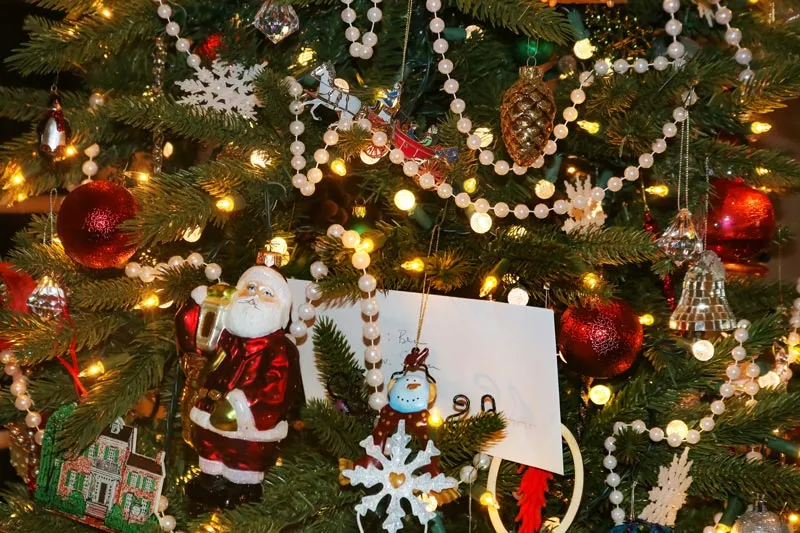
Drape pearls vertically, not in circles. Circle-wrapping a tree flattens it visually, while swags that run from the top down and dip every 18 inches create real depth — and you will use less garland. For a 7.5-foot tree, three strands of 9-foot faux pearl garland is plenty. Anchor each swag with floral wire at the back of the branch so it does not slide when the tree settles, and hang the pearls first, before ornaments. They need to go behind everything else or they look like they are strangling the baubles.
17. A Metal Frame Tree Built From Giant Glowing Ornaments
This one needs a footprint, not a room. A conical frame in this size wants about 5 feet of width and 8 feet of clear height, plus a power source within cord reach — which usually means an entry court, a covered porch, or a generous landing rather than a living room. Weight matters too, since oversized lit spheres add up fast, so the frame has to be staked or weighted at the base. With less than 4 feet of width, drop back to a wall-mounted version or a tabletop tree instead.
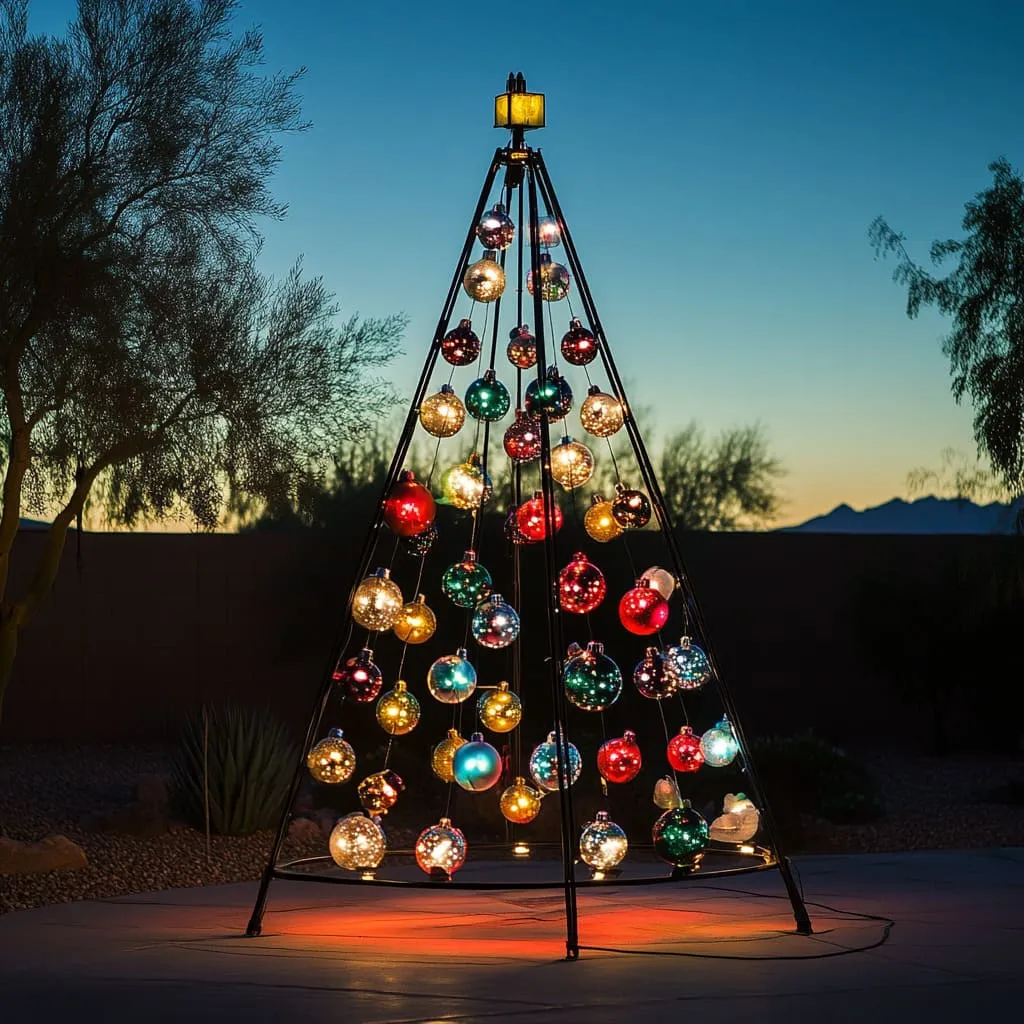
Retail versions of this installation run $400–$900. You can build one for far less: three tomato cages stacked and zip-tied into a cone for about $15, a can of matte black spray paint, and 10 to 15 oversized ornaments at $6–$12 each from big-box stores. Battery-operated puck lights taped inside each ornament give you the internal glow without a single cord on the ground. Total: $130–$200, and it folds down flat for storage.
18. An All-White Tree That Refuses to Disappear
White on white only works when the textures are fighting. Here you have flocked branches, pearl and glass ornaments, a fluffy rug, sheer fabric draped over the chandelier, and a glass table with a snowflake base — five different surfaces in one color, so the eye reads depth instead of a blank shape. The dark wood shelving beside it is the other half of the trick, giving all that white something to be bright against. The blue LED sphere adds one cool note so the room never turns into a warm blur.
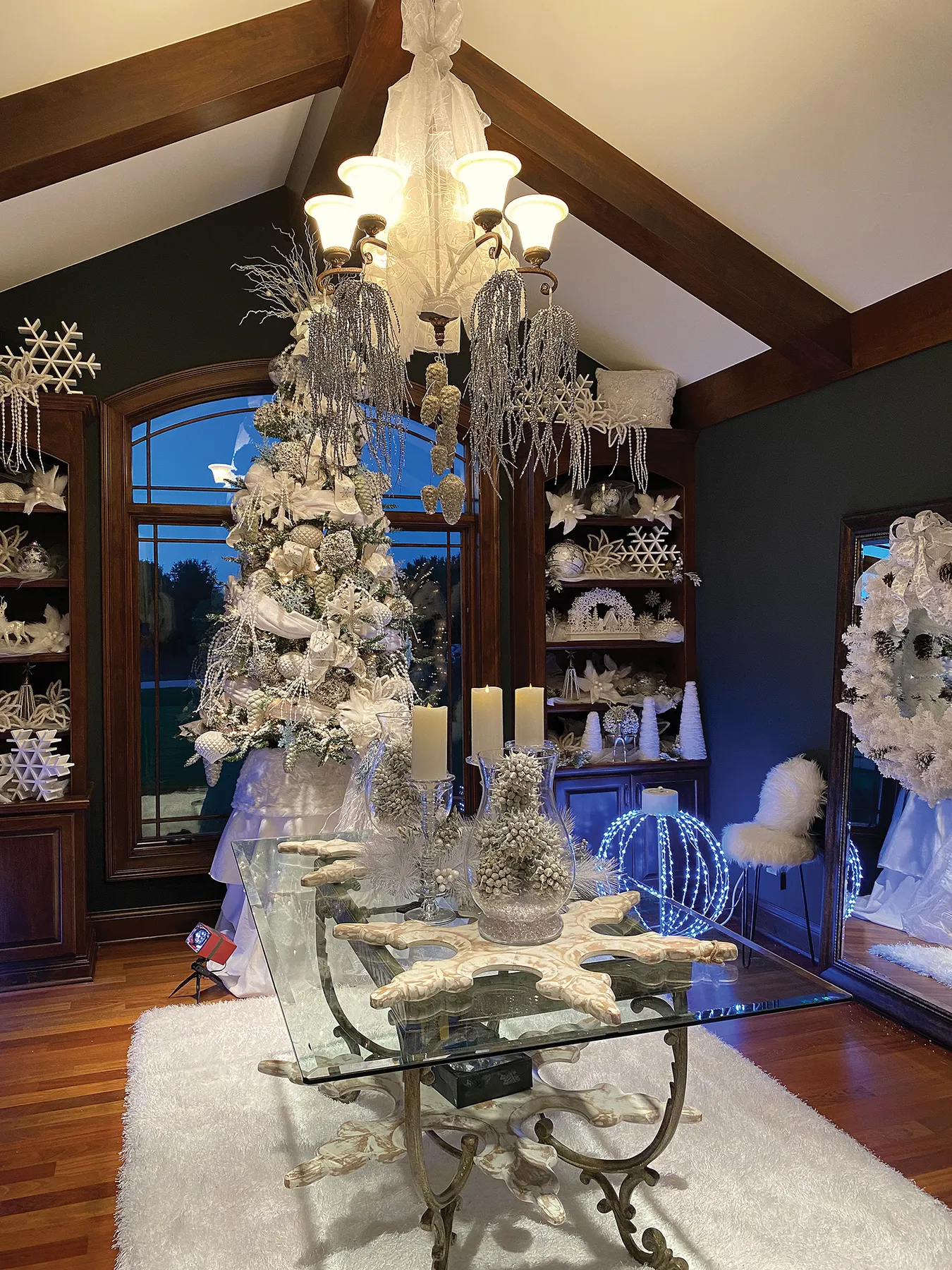
Three things to know before you commit. White trees show dust, and flocking sheds for the first two seasons, so vacuum after setup rather than before. Second, white branches yellow over time if stored in a hot garage — keep the box indoors and covered. Third, sheer fabric draped near chandelier bulbs is a genuine fire risk with incandescent bulbs, so switch to LED before you drape anything and keep fabric at least 6 inches from every bulb. The gold-and-white version of this palette lives in Idea #22.
19. A Small Tree With an Entire Collection Beside It
- Measure the wall and mantel depth — this look needs about 6 feet of horizontal display space.
- Sort the collection by material (glass, glitter, silver, ceramic) before placing a single piece.
- Confirm the surface can take the weight; glass figurines add up faster than you expect.
- Decide what stays out year-round and what is seasonal, or you will be dusting figurines in July.
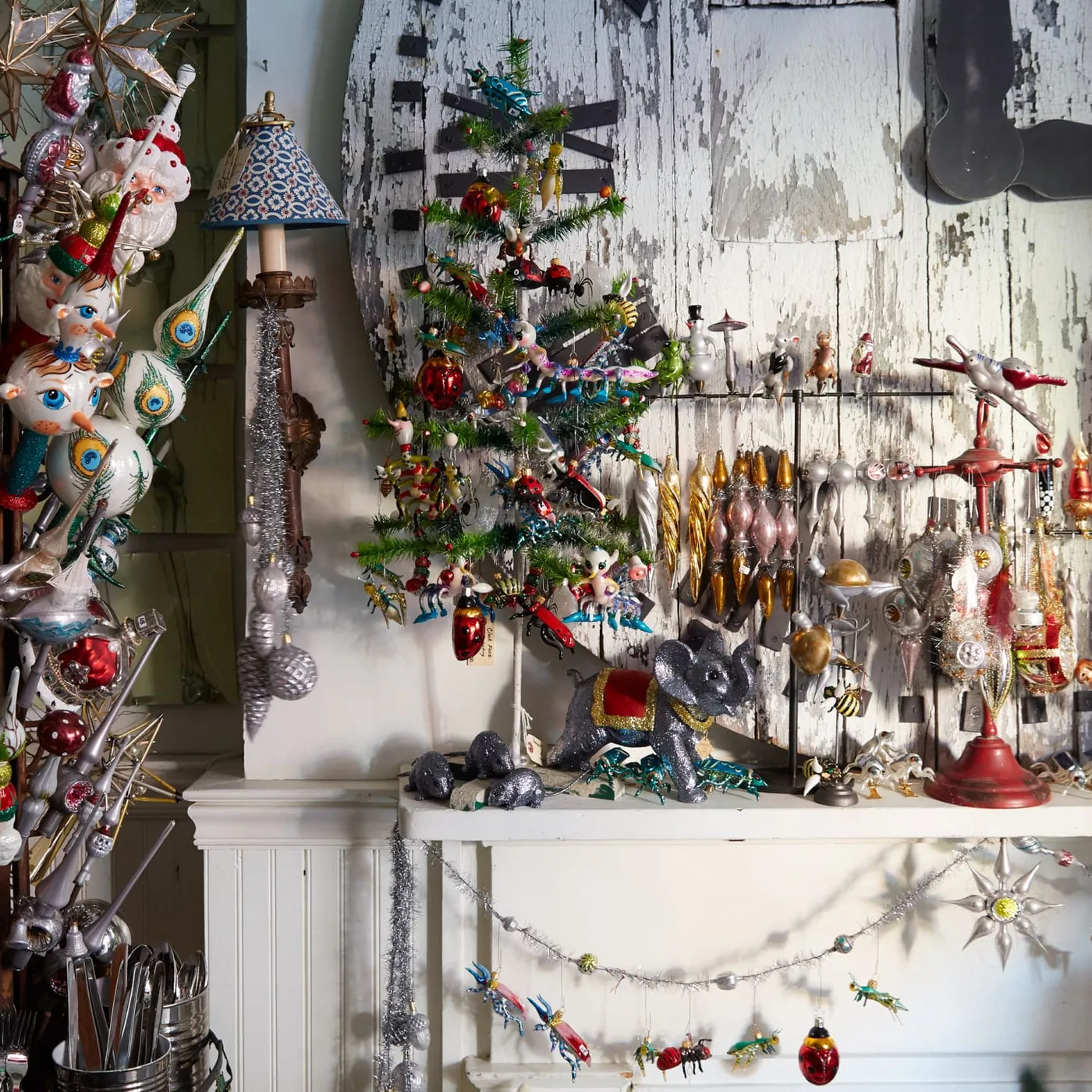
This is the idea for small rooms. A 4-foot tree against a 6-foot stretch of distressed white plank wall, with a mantel below to catch the overflow, reads as a full display without any of the footprint. Give it 24 inches of clearance on each side and keep the tree at least 15 inches off the floor on a low stand so the collection underneath stays visible. Rooms with 9-foot ceilings and 200-plus square feet can scale the same setup up — just double the tree height and the display area.
20. Cake, Cocoa, and Gingerbread Hanging in the Branches
Food ornaments work best as a cluster, not a sprinkle. Pick one bakery corner of the tree — usually the lower right, where kids and guests actually look — and group three to five pieces within 18 inches of each other, then leave the rest of the tree traditional with gold and green baubles. Size matters too: sculpted ornaments should be 3 to 5 inches tall to read from across the room, and anything under 2 inches simply vanishes into the branches. Alternate matte and glitter finishes inside the cluster so it does not become one shiny mass.

- Roll air-dry clay to 1/4-inch thickness and cut simple cake, mug, and house shapes with a knife.
- Press a small hole near the top of each piece with a skewer while the clay is soft.
- Dry for 24 hours, flipping once at the halfway point so nothing warps.
- Paint with acrylics in bakery colors, let dry, then seal with matte varnish.
- Thread narrow ribbon through the holes and knot it behind the branch.
Two hours of hands-on time, a day of waiting, and about $12 in materials for a dozen pieces.
21. Three Iridescent Toucans on a Frosted Green Tree
The toucans, but specifically how many of them: three. Not twelve, not one. A frosted tree with white and silver glitter dusting and warm white LEDs is already doing a lot of shimmer, and translucent birds catch that light in a way opaque ornaments cannot — the material throws purple and blue in different directions depending on where you stand. One bird would look like an accident. A dozen would be a theme. Three is a discovery, and that is why people stop in front of this tree.
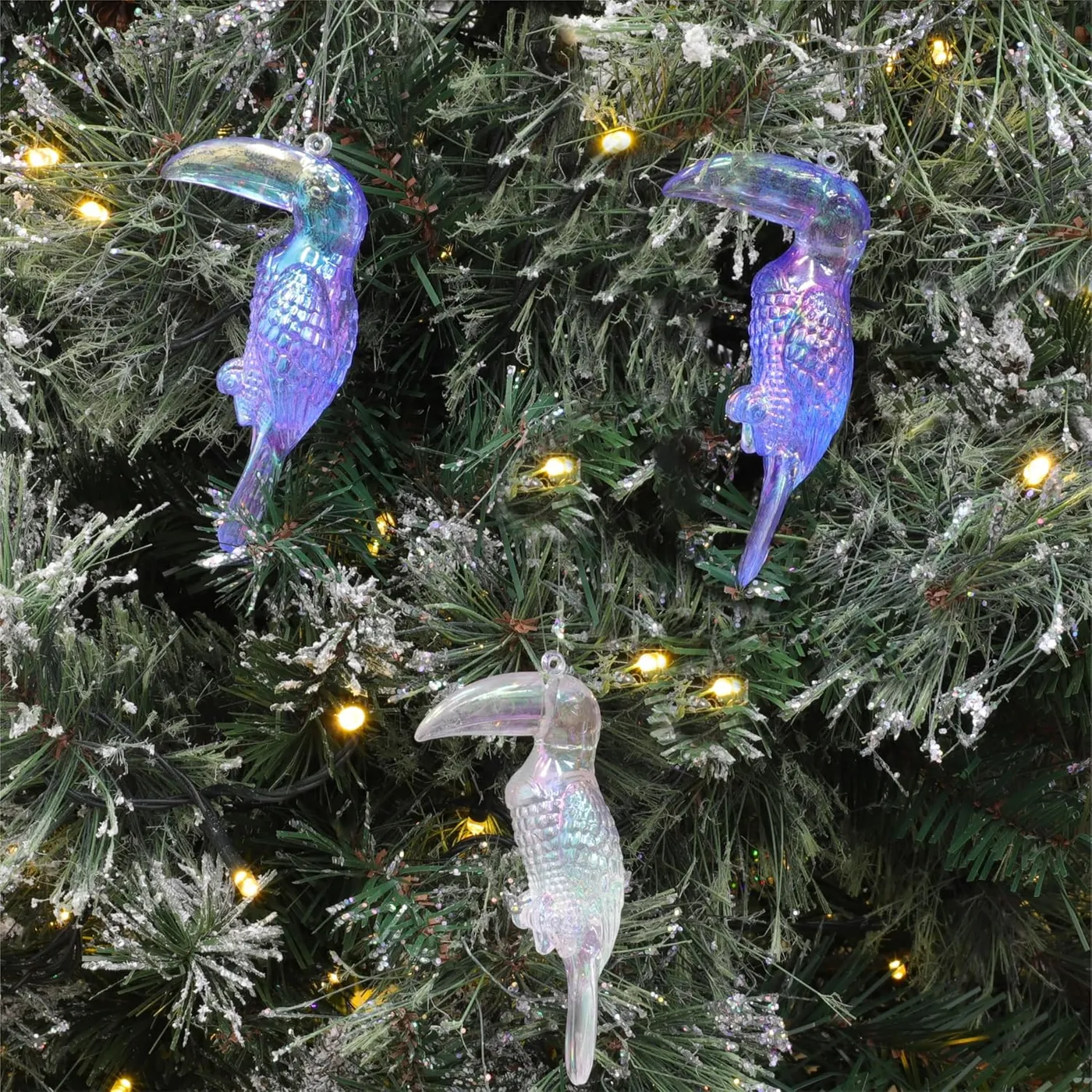
Write the formula down: 65% frosted green base, 20% warm white light, 10% iridescent accent, 5% silver glitter. The frosted green and the glitter dusting handle all the texture work, which leaves the iridescent pieces free to be the only saturated thing in the room. Swap toucans for flamingos, hummingbirds, or dragonflies and the math holds. Just do not add a second accent color — the moment a red bauble shows up, the iridescence stops being a surprise and starts being a clash.
22. Gold Twig Topper and Purple Baubles on White Hex Tile
Metallics are where this look’s money goes, and also where it saves you.
- Flocked tree, 7.5–9 ft: $350–$900
- Gold wired ribbon, 3–4 rolls: $30–$70
- Purple, green, and metallic ornament set: $120–$300
- Gold twig topper: $40–$120
- Gold tree skirt: $30–$90
- Gift wrap and gold ribbon: $25–$60
Total: $595–$1,540. Buy ribbon by the roll in the off-season and store it flat — wired ribbon crushed into a ball is why so many saved bows look tired by year three.
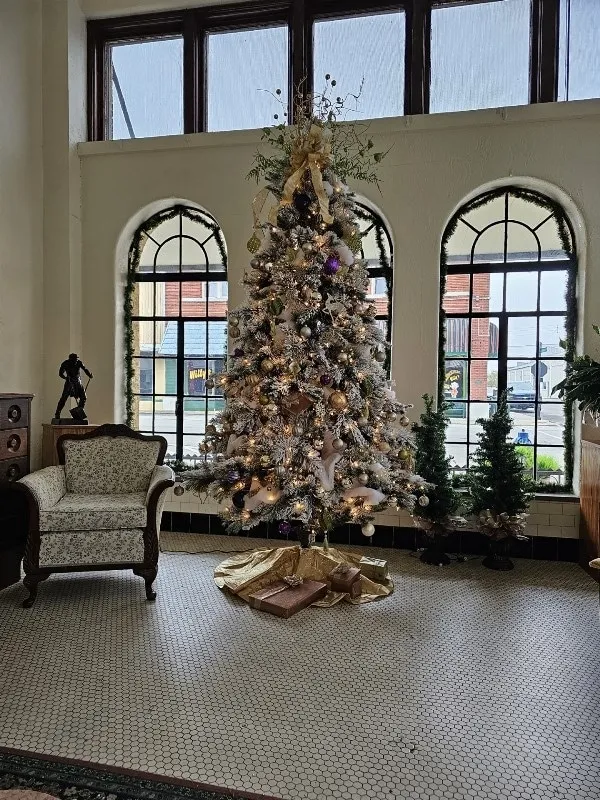
It is a frame. The gold ribbon, the gold tree skirt, and the gold twig topper create a border around the purple and green ornaments, so the jewel tones read as intentional rather than random. The white hexagonal tile floor bounces light up into the flocked branches and doubles the glow, while the tall arched windows give the whole arrangement a cool, vertical backdrop. Two smaller plain green trees flanking the main one are the quiet supporting cast that keeps the scale believable.
23. Paper Toy Cutouts and Velvet Hearts on One Branch
Paper ornaments need structure or they curl by New Year’s. Cut from 200–300 gsm cardstock, not printer paper, and punch the hanging hole with a reinforcement ring so it does not tear. Hang paper from thin wire rather than thread — thread stretches and the ornament sags sideways within a week. Space pieces at least 4 inches apart, because layered paper and beaded garland collide constantly when they are closer, and every collision bends a corner. If you are printing your own toy cutouts, size them at 3 to 4 inches wide so they hold their shape under their own weight.
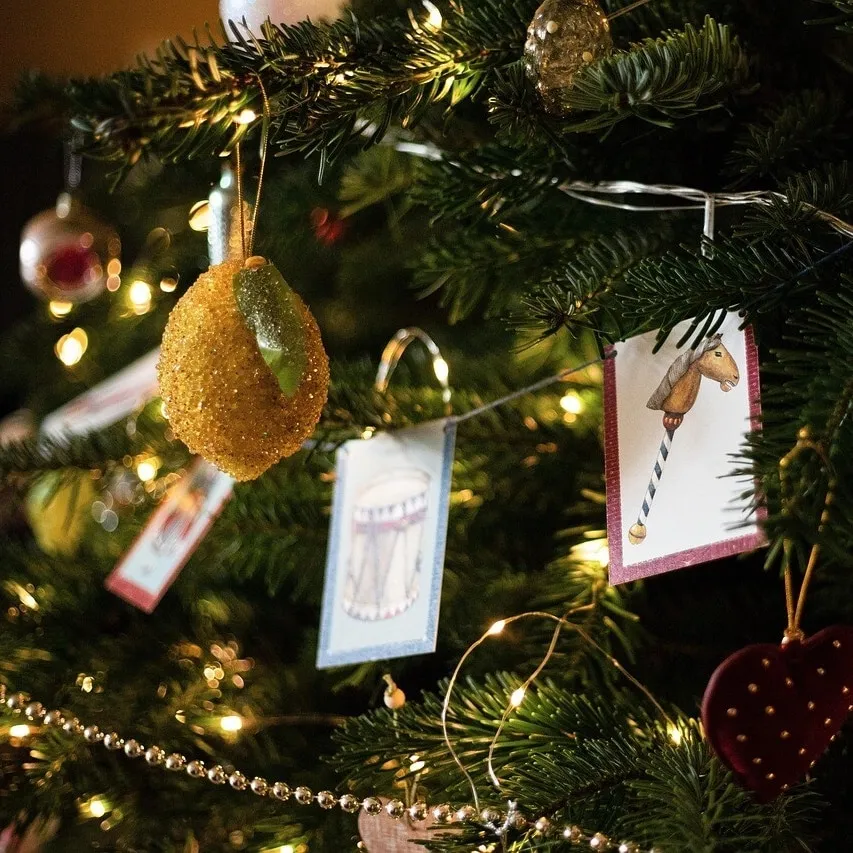
Paper and velvet are the two most temperamental materials on any tree. Paper warps with humidity, so keep it away from the kitchen, the bathroom, and any humidifier. Velvet crushes permanently if you stack ornaments in a bin. Store paper flat between acid-free tissue in a rigid box, and hang velvet hearts individually in cotton bags. Glitter will shed for the first two seasons no matter what you do, so put a mat under the tree. Realistic lifespan for both: three to five years with careful storage.
24. Gold, Light Green, and Silver Against a Mustard Wall
Metallic ornaments are the single easiest thing to fake. Dollar and discount stores sell gold and silver bauble packs at $1–$3 for six, and a $7 can of metallic spray paint turns last year’s scratched ornaments into a matched set — just wipe them with rubbing alcohol first or the paint flakes. Silver icicles are cheap everywhere at $3–$8 a pack, and the green garland draped over the abstract painting is a $12 strand from a craft store. You can get this entire tree under $200 if you already own the tree itself. The pearl-and-lace take on the same palette is in Idea #16.

Mustard walls and gold ornaments are a gorgeous pairing that can go orange on you at night. Warm bulbs in the 2000–2400K range push everything toward amber, and a textured mustard wall under that light turns the whole corner into one golden blur. Test one strand of your actual lights against the wall after dark before committing to a bulb color — 2700K keeps gold reading as gold. Silver icicles also tangle badly if stored loose, so hang them in small bundles on a hanger instead.
25. Four Red Stockings and a Fireplace Full of Glow
The lighted garland on the mantel, not the tree. It is what connects the hearth to the tree and creates two sources of glow in one sightline. Without it, the fireplace is a dark stone rectangle beside a bright tree and the room splits in half. Everything else follows from there: the four red stockings hang on the line the garland lights, the poinsettias pick up the red, and the gift wrap repeats it a third time. One continuous run of light, and an entire wall becomes one warm thing.
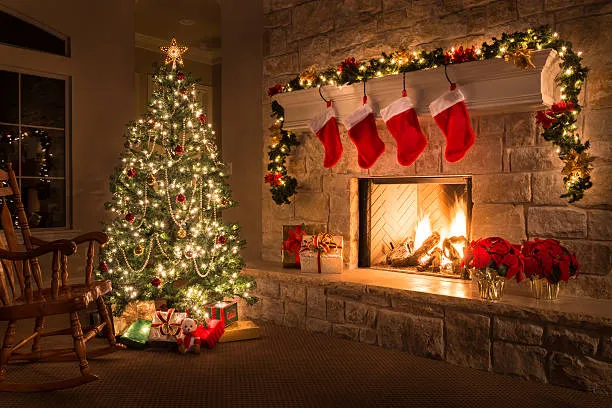
This arrangement needs room to breathe: roughly 10 x 12 feet minimum, with 8 to 9 foot ceilings, because the tree and the fireplace both want to be focal points on the same wall. You also want 36 inches of walkway between the hearth and the nearest seating, or the fire feels too close for comfort. In smaller living rooms, skip the full-size tree and use a 5 to 6 foot one pushed to the side so the mantel stays the star. A big tree in a tight room is the fastest way to make cozy turn into cramped.
26. A Frosted Pinecone Tree in the Dining Nook
Dining trees live by circulation math. Leave 36 to 42 inches between the tree and the back edge of the chairs so people can actually push away from the table, and keep ornaments above 48 inches if the tree sits within 2 feet of seating — that is the elbow zone, and it is where glass gets knocked off. Pinecones go above and below that band. The industrial spotlight in this nook is doing something smart, too: one overhead fixture with a warm bulb means the tree does not have to compete with a bright multi-paned window for attention after dark.
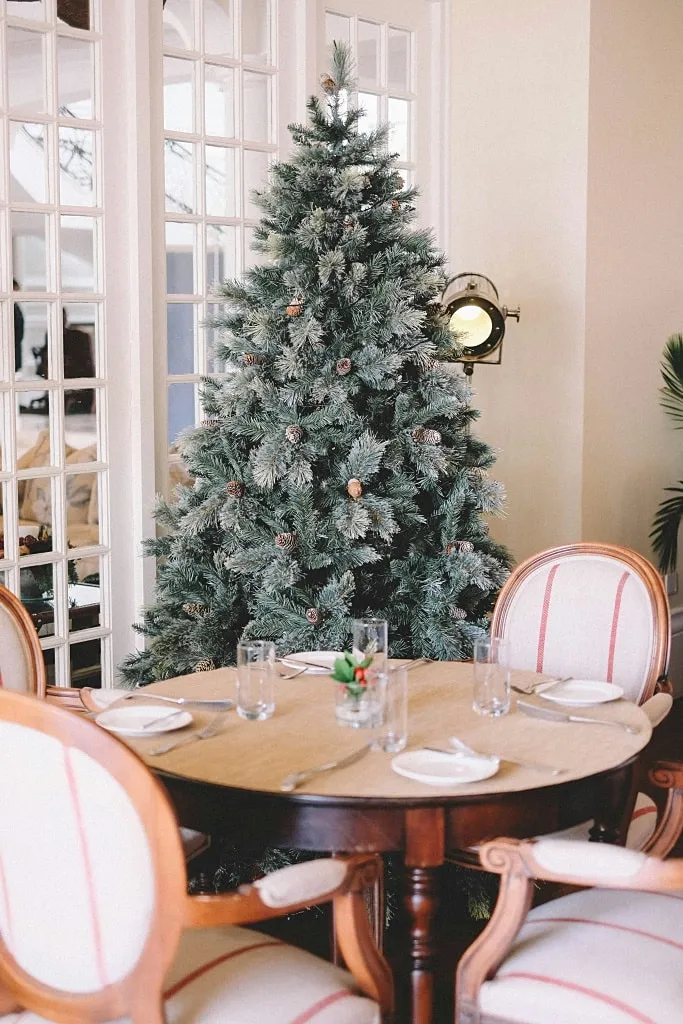
- Measure the nook and chair pullout before buying — 36 inches minimum behind the seats.
- Check outlet locations; a dining tree almost always needs a cord run under a rug.
- Note how close the tree sits to the window or a radiator — heat dries greenery fast.
- Put a waterproof mat under the stand; sap and water rings are permanent on wood floors.
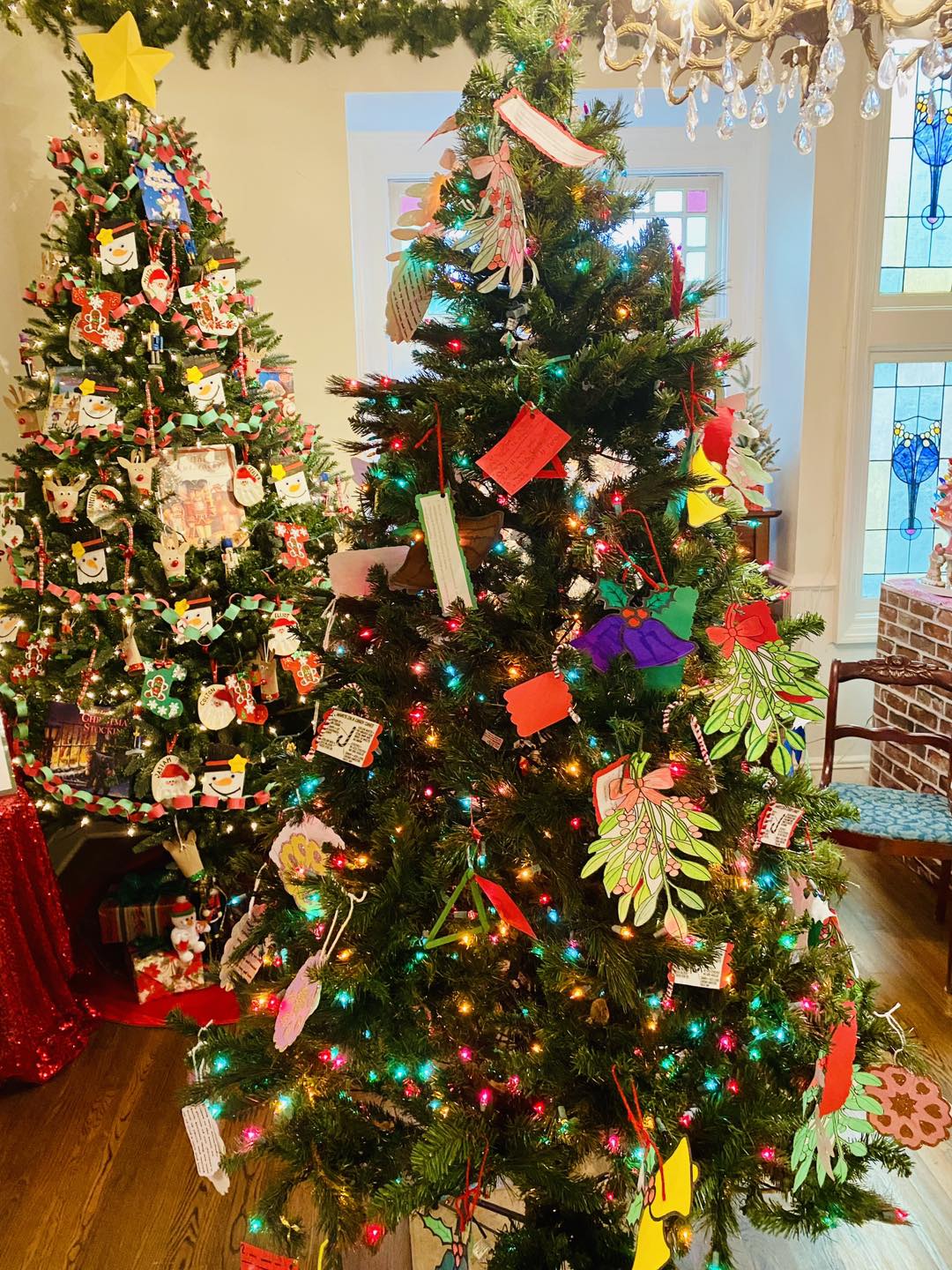
27. Two Trees, Multicolored Lights, and Handmade Everything
Handmade is genuinely cheaper here, and the multicolored lights are non-negotiable for this look.
- Two trees, 4–6 ft: $90–$400
- Multicolor LED light strands, 6–8 sets: $45–$120
- Paper, cardstock, and ribbon for ornaments: $25–$50
- Candy canes, two boxes: $8–$14
- Star topper: $10–$35
Total: $178–$619. The handwritten cards and paper cutouts are free if you keep the ones you receive each year instead of recycling them in January — that is how this kind of tree gets better annually instead of costing more.
- Collect last year’s cards and cut the illustrated fronts into 3-inch circles or rectangles.
- Punch a hole at the top and reinforce it with a small sticker or tape ring.
- Thread narrow ribbon through and knot it, leaving a 3-inch loop for the branch.
- Hang cards in groups of three at eye level, mixing sizes so nothing looks stamp-sized.
- Fill gaps with paper stars folded from the card backs — no two will match, which is the point.
An evening’s work, under $10 in materials, and a tree that tells the year’s story. See Idea #19 for how to display the overflow collection.
28. Kale, Berries, and a Tree That Looks Harvested
Foraged, botanical Christmas is having a real moment heading into 2026 — part of the broader shift toward natural materials and biophilic decorating, part of a genuine backlash against plastic-heavy holiday aisles. Designers have been tucking fresh greens, dried fruit, and stick bundles into trees for a couple of seasons, and the idea has filtered down to people raiding their own gardens and farmers markets. Will it last? The look is timeless; the fresh materials are not. That is why so much of what you see here ends up dried or faux.
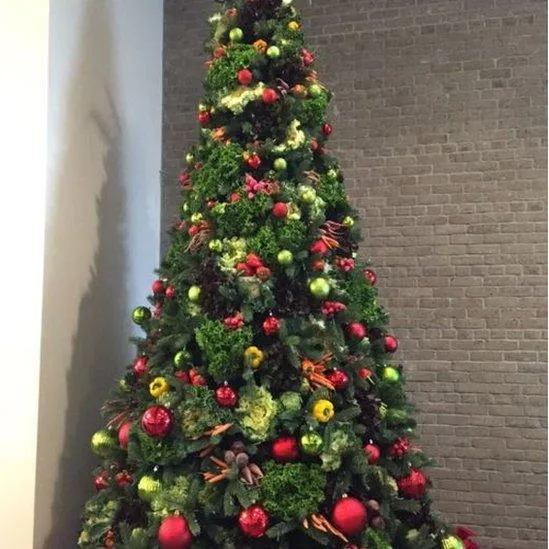
Fresh greenery in a tree has a short clock: three weeks at best before it dries and starts dropping onto your floor, and kale-like leaves curl within days in a heated room. A light mist of matte sealer helps, but it changes the texture. The practical answer is mixing faux leafy picks at $3–$6 each with a few fresh berry clusters you replace in mid-December. Dried sticks, berry clusters, and pinecones are the low-maintenance winners — they last for years and only need a quick dust in January.
29. White Baubles, Silver Spheres, and Pinecones Done Quietly
Two numbers make this tree work. First, lights: use about 100 bulbs per foot of tree height, so 700 to 800 for a 7.5-foot tree, and wrap them around individual branches rather than spiraling the outside, or you will see dark holes from across the room. Second, finish ratio: aim for 60% textured matte pieces — the white baubles, snowflake cutouts, pinecones — and 40% shiny, like the silver and dark green spheres. All matte goes flat. All shiny turns into a mirror. The mix is what gives a simple palette depth.

Restraint with texture. There are really only three materials on this tree — white, silver, and natural brown — but each one shows up in multiple finishes, so your eye keeps finding new surfaces without a single new color being introduced. The warm yellow string lights do the rest of the work: they read closer to candlelight than to LEDs, which is why a limited palette still feels cozy instead of clinical. Natural pinecones are the detail that keeps it from tipping into winter wonderland territory, adding an earthy note silver can never supply on its own.
Your Whimsical Tree Starts With One Weird Ornament
Start with the thing that makes you laugh — the rubber chicken, the moss Bigfoot, the three iridescent toucans — then build everything else around it like a straight man. Every idea in this guide is really just a supporting cast for one good decision. 📌 Pin the version that looks like your living room, and keep the mistakes section handy for the night before you decorate.