
Still scrolling Pinterest at midnight, saving holiday photos you’ll never actually make? Same. The difference between a saved pin and a finished centerpiece is usually about forty minutes and twenty dollars — and that’s the entire premise of this guide.
We spent real time digging through Target, Walmart, IKEA, craft store aisles, and Etsy to filter out the projects that only look good in staged photos, and kept the 31 that actually hold up in a real living room. Everything here lands between $1 and $162, and nearly every idea comes with a budget swap.
Inside you’ll find rustic woodland tablescapes, dense natural evergreen wreaths, pastel village wreaths, and traditional red-and-green mantels — with budget and splurge versions compared side by side.
2026 is shaping up to be the year of handmade and foraged décor; searches for natural vine wreaths and dried citrus garlands keep climbing as people move away from glitter-heavy plastic. 📌 Save this to Pinterest for later — you’ll want to revisit these ideas.
1. Cutout Paper Trees on a Pink-and-Green Table
The single element that makes this table work is the round, light-toned platform sitting under the two green cutout trees. Without it, the pinecones, red berries, light green hydrangeas, and string lights would scatter across the cloth and read as clutter. The platform gives the eye one clear place to land, and it lifts the centerpiece just enough that the kraft paper crackers with silver star cutouts still have breathing room at every setting.
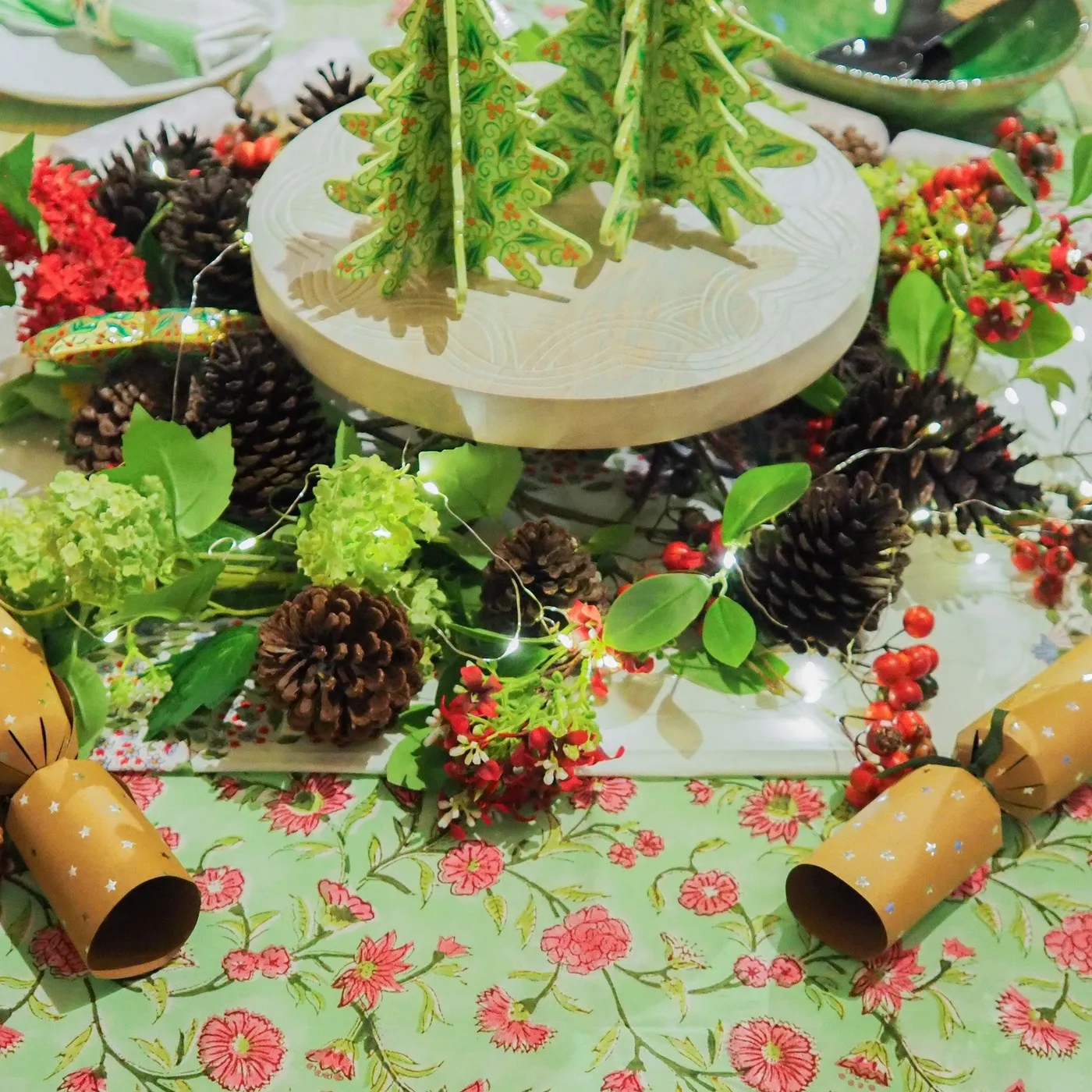
Cutout trees disappear if they don’t contrast with what’s behind them. Because the tablecloth here is pale green with a pink floral print, the trees were kept a deeper, more saturated green — same color family, different value. If your cloth is busy, choose cutouts two shades darker than the fabric and keep the light strand at 2700K warm white, so the paper edges glow instead of washing out.
2. Felt Gnomes and Burlap: A Playful Place Setting
The formula: 60% warm neutral (light brown burlap, white plates) + 30% sage green (the felt gnome hats, the tiny felt trees on the gold straws) + 10% gold. That’s why the table feels calm even with a lot going on. Swap sage for dusty blue or cranberry and the mood shifts completely while the composition stays identical. Keep burlap and white as your base and you can’t really miss.
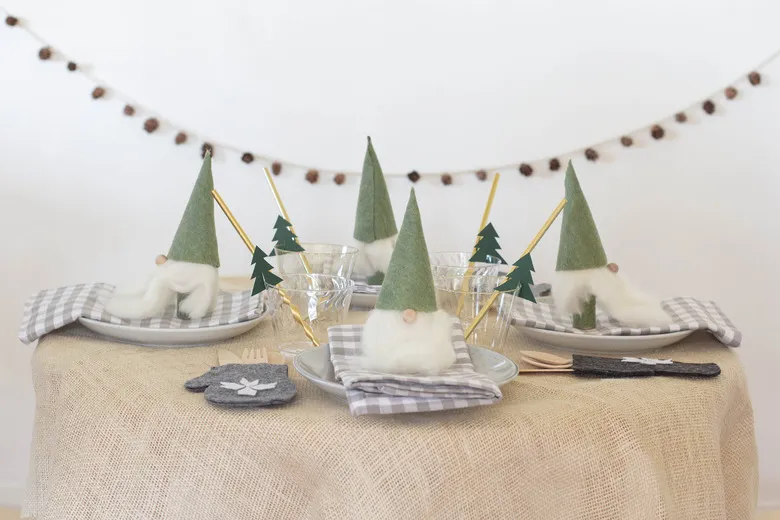
Burlap is charming, and it sheds. If you’re actually serving dinner, lay a plain white cloth underneath so fibers don’t end up in the butter. Same caution for the pinecone garland strung across the wall: pinecones are heavier than they look, and thin twine sags within a week. Use florist wire at every anchor point and give it a tug before guests arrive.
3. A Dense Evergreen Wreath Against Weathered Wood
Two things are doing the heavy lifting. First, contrast of scale — fine dense needles against fat pinecones and tight little berry clusters, three textures at three sizes, which makes the wreath read full rather than flat. Second, contrast of color temperature: cool dark green needles against warm red berries. Hung against dark weathered wood, the greens separate from the background instead of melting into it.
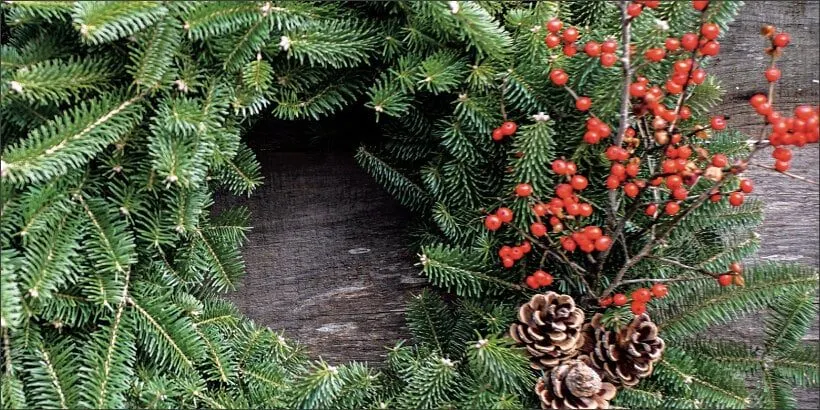
A wreath this full runs $60-$120 at a craft store. Do it for under $30 instead: buy a plain vine or wire base at a dollar store, then clip greenery from your own yard — arborvitae, boxwood, and juniper all work. Add a bag of faux red berry sprays from Walmart for $4-$6 and pinecones you collected on a walk. Wire everything on in small clusters rather than one stem at a time.
4. Flocked Grapevine Wreath with Buffalo Plaid Tails
Flocking sheds. Shake the wreath outdoors for a minute before you hang it, or you’ll find faux snow on the floor for a week. Faux flocked greenery lasts years if you store it in a bag rather than a box, but it yellows in direct sun. Hanging outside in wet weather will thin the flocking over one season. Fresh evergreen is the opposite problem — it wants a spritz of water every few days.

Ribbon tails are the most underrated part of a wreath. Cut your plaid ribbon into two tails of unequal length — roughly 14 inches and 20 inches — and finish the ends with a diagonal or shallow V cut. Unequal tails look intentional; two matching tails look like a craft kit. Wire the knot tight against the frame so the bow doesn’t droop once gravity gets involved.
5. Magnolia Leaves and Dried Blooms in the Round
Dried botanicals in holiday wreaths are having a real moment, and it isn’t only a Pinterest thing. It’s a reaction to a decade of glitter-forward decorating: people want wreaths that look gathered rather than bought, and mixing magnolia leaves with dried flowers and multicolored berries does exactly that. The bonus is longevity — this style still reads natural in January, so one wreath covers two months.

Layering the look:
- Start with an evergreen base and wire in three or four magnolia leaves — they’re your largest shapes and they set the scale.
- Tuck dried flowers in warm and pastel tones into the gaps, angling stems outward so they catch light.
- Add berries in clusters of three, alternating red, orange, and blue so it doesn’t feel matchy.
- Finish with two or three pinecones low and off-center.
About 45 minutes, roughly $25 in extras.
6. Holly and One Big Red Bow on a Dark Door
This is a big wreath — roughly 26 to 30 inches across — and that size needs a door at least 36 inches wide. On a standard 32-inch door it will cover the hinges and look squeezed. Wide wreaths also want ceiling height to feel balanced; under eight feet, drop to 20-24 inches. On a narrow entry, see Idea #20, where a smaller white wreath carries the same visual weight.

It’s the bow. Not the greenery, not the berries — the big red fabric bow with patterned tails. Take it away and you have a perfectly nice, completely anonymous wreath. The bow gives the arrangement a focal point and a bit of theater, and because it’s fabric rather than a stiff pre-tied loop, it slumps naturally and looks handmade in the best way.
7. Dried Oranges, a Brass Bell, and a Velvet Bow
- Evergreen wreath base: $25-$60
- Dried orange slices (bagged or DIY): $3-$10
- Berries and pinecones: $8-$20
- Brass bell and rope: $6-$18
- Champagne velvet ribbon: $8-$22
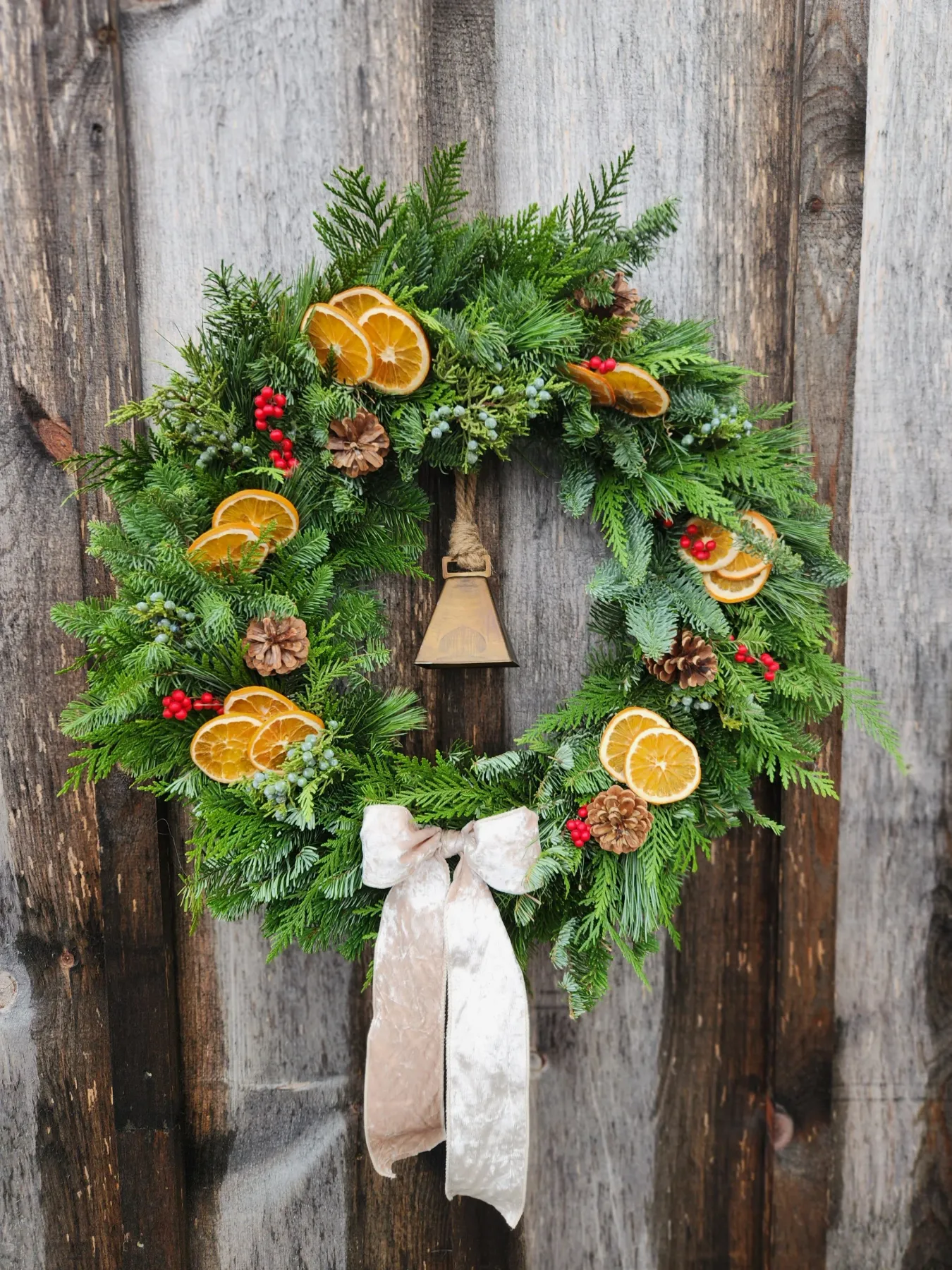
The bell is the trick. Everything else — dried orange slices, red berries, blue-grey berries, pinecones, the champagne velvet bow at the bottom — is soft and matte. The brass bell is hard and reflective, and it hangs from the top center, so the eye travels down the wreath before it settles. All-matte arrangements read flat; one reflective object gives everything else somewhere to catch the light.
8. Mercury Glass Pinecones on a Dark Wood Tray
For any tray vignette: make the tallest object about 1.5 times the height of the shortest, and overlap by roughly a third. These three mercury glass pinecones are close in size, so the stack of white books supplies the height instead. Put something vertical in the back third and let the beaded garland cross the tray’s front edge — that diagonal is what stops a tray from looking like a shelf display.
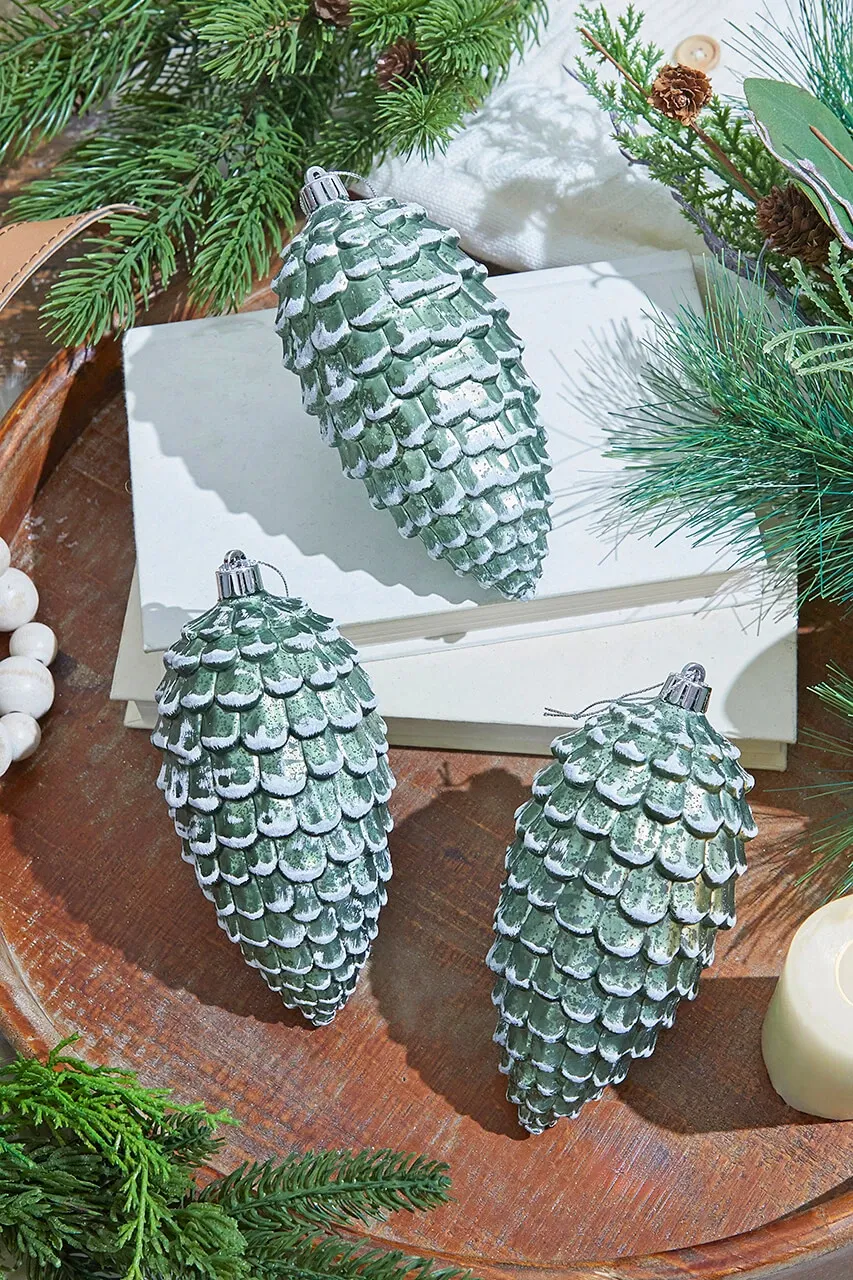
Mercury glass shows every fingerprint, and the frosted tips chip if they knock together in storage, so wrap each one in tissue. If this tray lives on a coffee table with kids or a tail-wagging dog, keep the white pillar candle unlit or move it to a side table — the faux branches make the candle look farther from the edge than it actually is.
9. A Woodland Birdhouse Table with Velvet Bow Napkins
The recipe: 55% wood and cream base + 30% deep red (velvet bows, the spotted mushroom cap) + 15% forest green plaid. The plaid cloth is the boldest thing on the table, so everything sitting on it stays inside those three colors. Switch to a plain linen and you can add a fourth color — but the moment you do, the birdhouse and mushroom stop reading as a scene and start reading as merchandise.
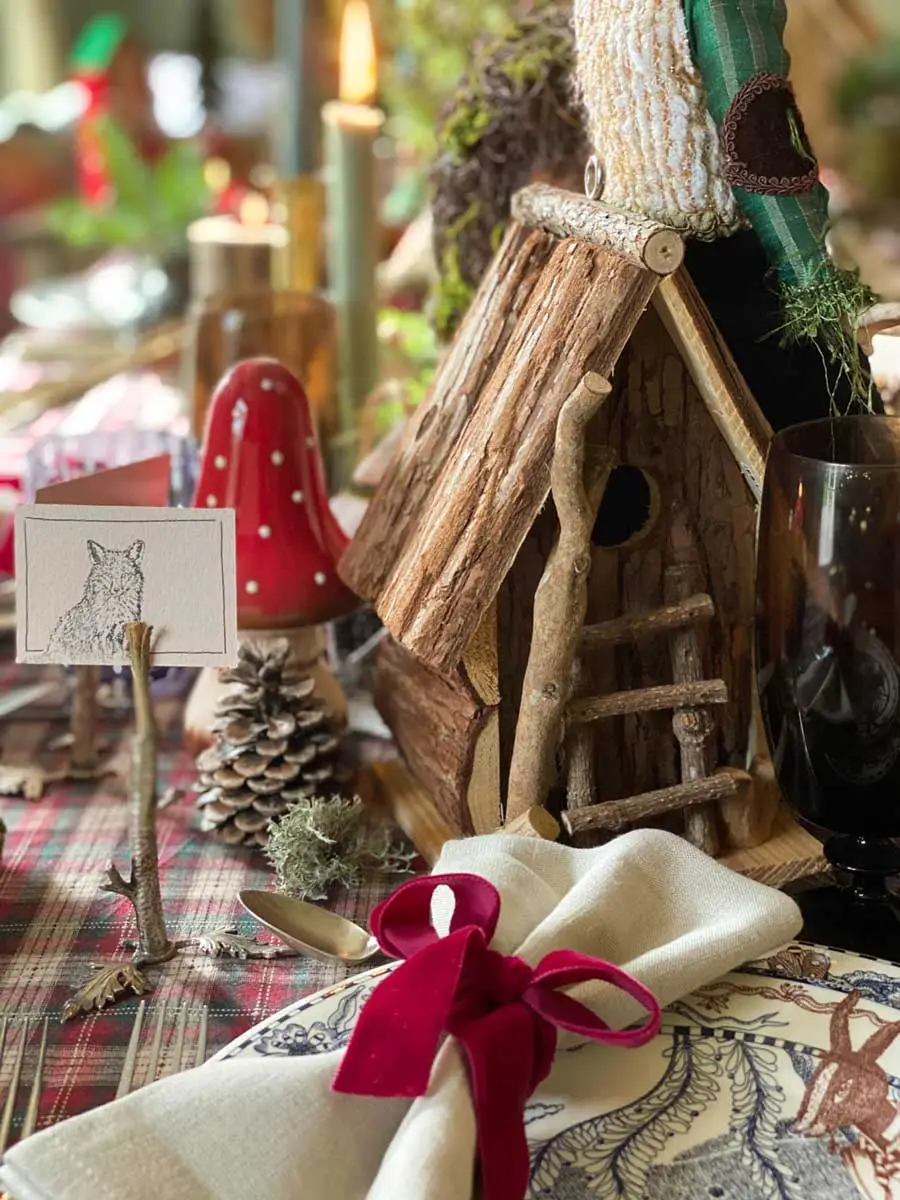
The wooden birdhouse is the splurge at $25-$45. Swap in a plain unfinished birdhouse from a craft store for $6-$10 and leave it raw — pale wood reads more woodland than stained. Red velvet ribbon runs about $3 a roll at Walmart, spotted ceramic mushrooms turn up at Target for $5-$8, and pinecones plus lichen are free on any walk through a park.
10. Grapevine Wreath with Frosted Pines and Orange Slices
Getting the frosted-and-fruit look:
- Lay the grapevine wreath flat and wire in frosted pine branches in three clusters — top-left, right, bottom — not evenly around the circle.
- Add dried orange slices in pairs so they overlap like shingles.
- Tuck red berries into the gaps where vine shows through.
- Press pinecones in deep so they sit in the branches rather than on them.
- Tie the plaid ribbon at the bottom, not the top.
Roughly 40 minutes.

Dried orange slices are the fragile part. Stored in a dry box they last years, but in a humid room they soften and can grow mold within a couple of months. If your wreath hangs near a kitchen or bathroom, use faux citrus instead. Grapevine bases are nearly indestructible and will outlive every decoration you wire onto them — which is why it pays to buy one good base.
11. An Evergreen Arch Framing the Mirror
The arch. This garland doesn’t run in a straight line across the mantel — it rises and curves to frame the mirror, which is the difference between decorated and composed. Remove the arch and you have a nice swag of greenery under a mirror. Keep it and the whole wall reads as one shape: black marble below, green curve above, mirror at the center, white shelves on both sides.
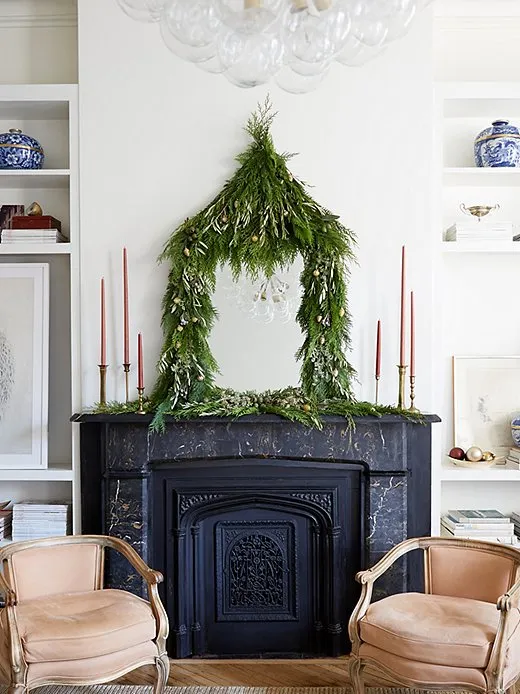
Arching garland around a mirror needs width. This fireplace is broad enough that the greenery never crowds the built-ins, and the mirror is tall enough — think 30 inches or more — that the arch reads as a frame rather than a halo. On a mantel under five feet, use two short swags at the outer corners instead. For a straighter, heavier look on a deep mantel, see Idea #14.
12. Vine Wreath with Pine Needles and Golden Berries
This is a study in asymmetry. Long pine needles sweep one direction, feathery dark foliage fills the opposite side, and a single brown pinecone sits off-center with dried grass stalks pushing past the wreath’s edge. Nothing is balanced, and that’s why it looks like something growing rather than something assembled. The yellow berries beside the red ones are the second trick — two berry colors read wilder than one.
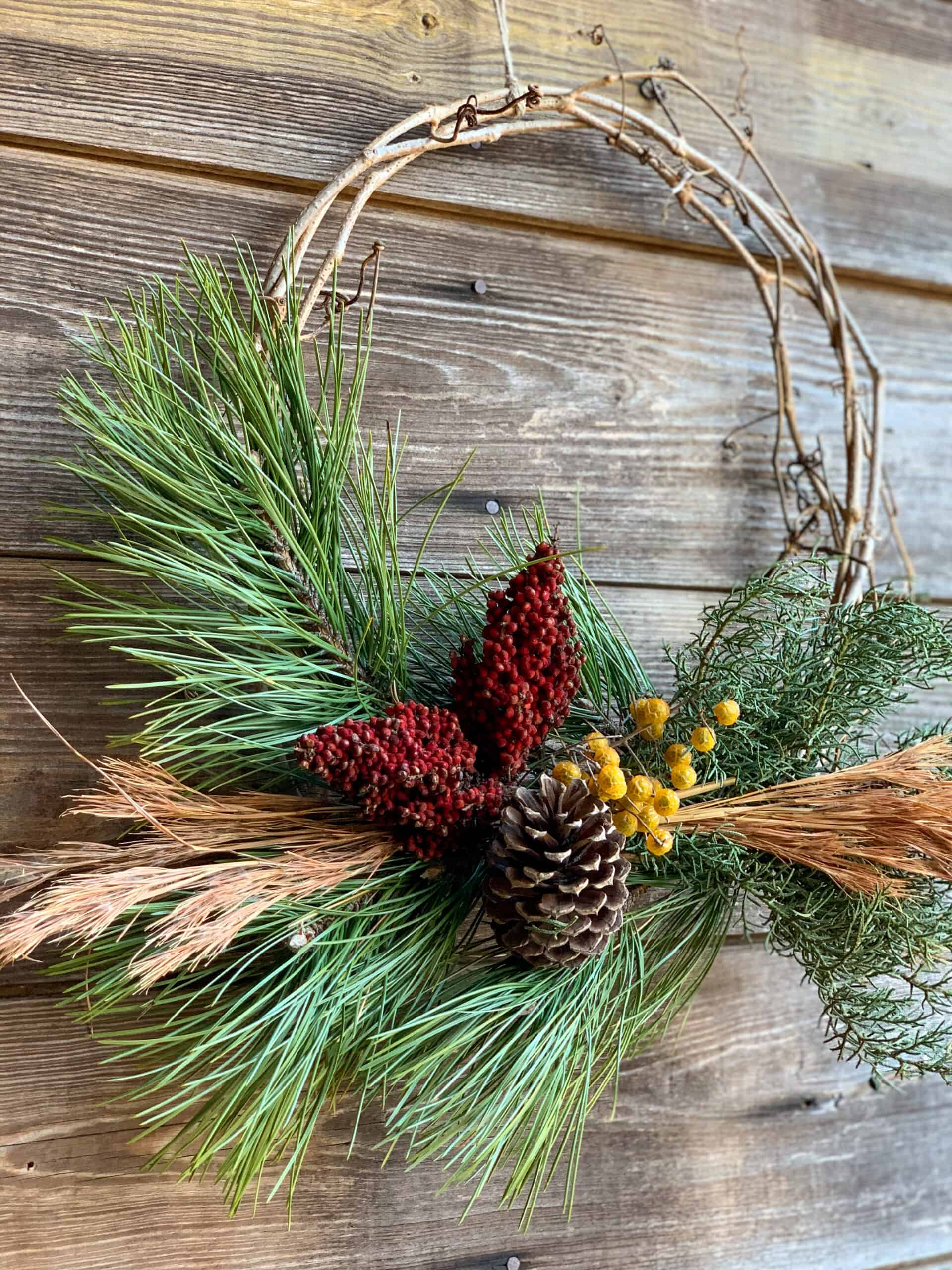
Let something break the circle. Whatever base you use, allow one element to extend three or four inches past the outer edge — here the dried grass does it, and in Idea #5 the dried flowers do the same job. A perfect ring of identical sprigs looks manufactured; one good overhang makes the whole thing read hand-tied. Keep the overhang to one side, never two.
13. The Homemade Winter Wreath Worth Making Yourself
Handmade winter wreaths have quietly replaced the store-bought statement wreath for a lot of people, and 2026 is the year the craft aisles caught up — more natural vine bases, bare-branch picks, and undyed ribbons than five years ago. Part of it is cost, part of it is the pushback against plastic. It also has staying power: a neutral wreath you made yourself won’t look dated next December.
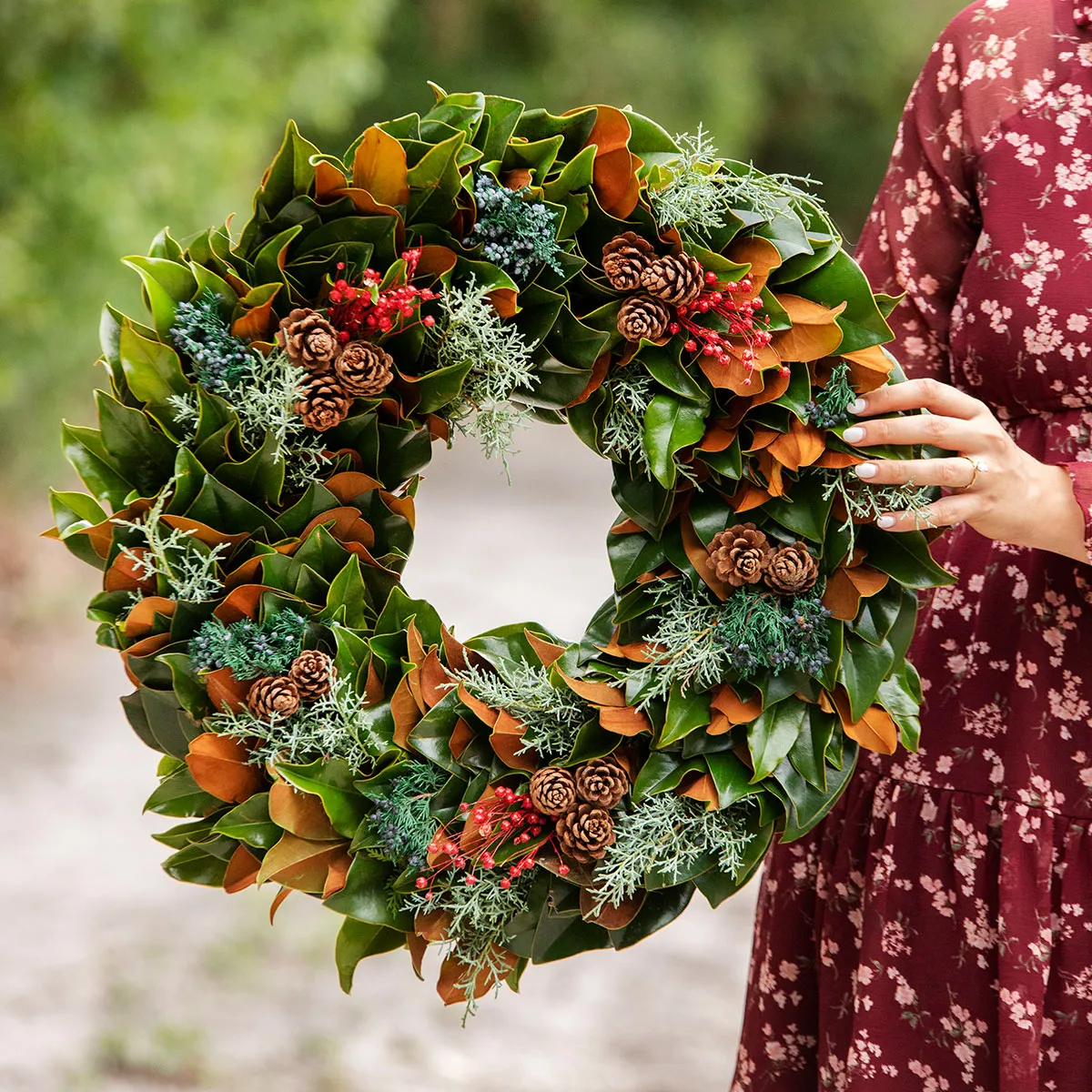
This is one of the few DIY projects that genuinely beats retail. A vine or wire base is $5-$12, a spool of florist wire is about $3, and the rest can come from a yard, a park, or a neighbor’s overgrown hedge. Budget $20-$35 total against $70-$150 for a comparable finished wreath. Thrift stores turn up vintage wreath bases for a couple of dollars year-round.
14. Fairy-Lit Garland Over a Charcoal Mantel
Fairy lights are wonderful until the battery pack dies behind the mantel. Decide where the pack lives before you commit — a plug near the hearth is ideal, batteries mean swapping every three to four weeks of evening use. Greenery near a working firebox also dries fast: if you burn real fires, keep fresh greens a foot from the opening or use faux, and never leave mantel candles unattended.
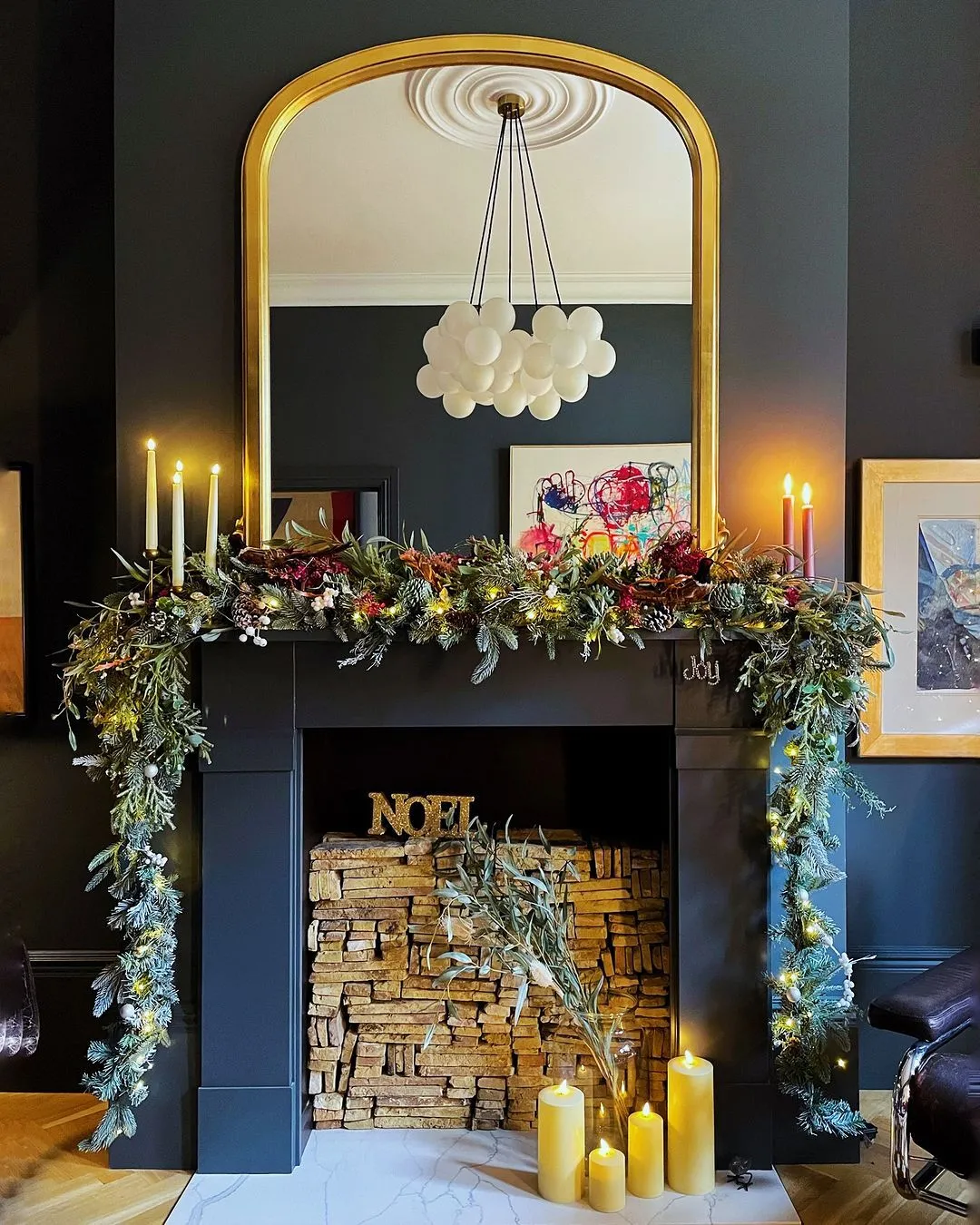
The formula: 50% dark base (charcoal stone, dark mirror frame) + 35% green garland + 10% red and white accents + 5% gold. That small gold slice does more than its share, tying the warm fairy lights to the cool stone. If your mantel is light-colored instead of charcoal, flip the metals entirely — keep the green garland but go silver and white, and skip gold.
15. A Red Pillar Candle on a Glass Cake Stand
Building the potpourri ring:
- Wrap the base of a footed glass stand with wide red ribbon and knot it at the back.
- Ring the base with green foliage sprigs, letting them fall just over the ribbon edge.
- Fill in with nuts, small pinecones, and dried seed pods, keeping everything near the same size.
- Set the red pillar candle in the center and light it only when you’re in the room.
About 20 minutes and $10-$15 using pantry nuts and gathered pods.
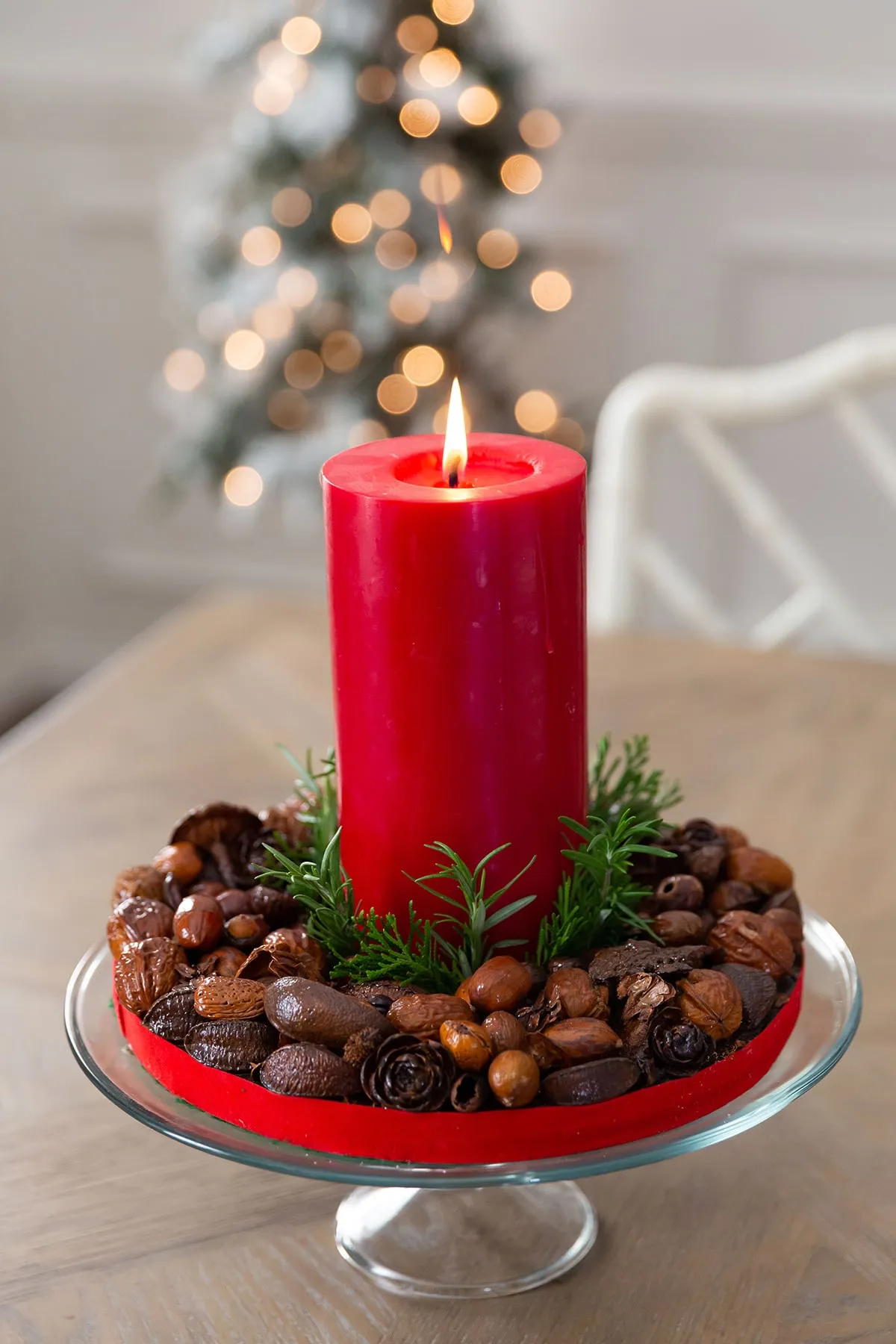
The cake stand. Take it away and this is a pile of dried things on a table. On a footed glass stand, the arrangement floats above the surface and the ribbon-wrapped base reads as a deliberate pedestal. Glass also disappears — you notice the candle and the greenery rather than the container, which is exactly what you want with a centerpiece this busy.
16. Ladybugs and Bells in a Plaid Bow
Bells tucked into a bow are the detail people remember. Thread four to six small bells onto florist wire and wind them into the knot before you cinch it, so they sit inside the fabric instead of dangling outside. With glitter foliage, place it above eye level — glitter catches light from above, and at table height it just looks dusty. Keep glitter to about a fifth of the wreath’s volume.

The surprise is what works. Berries, frosted pinecones, gold foliage, and a plaid bow is a known quantity — then you spot the tiny red ladybugs among the berries and the wreath has a personality. Whimsy has to be small and repeated, not large and singular: four ladybugs read as a wink, forty would read as a theme. Three textures plus one joke is a solid recipe.
17. Taper Candles Ringed by a Twisted Branch Wreath
This candle ring wants a table at least 36 inches wide, because the branch wreath plus foliage takes up roughly 14 inches of diameter and you still need room for plates. Ceiling height barely matters — it’s low and horizontal, so it suits standard eight-foot rooms. Compare with Idea #11, which needs a tall room and a wide mantel; this one is happy on a small dining table.
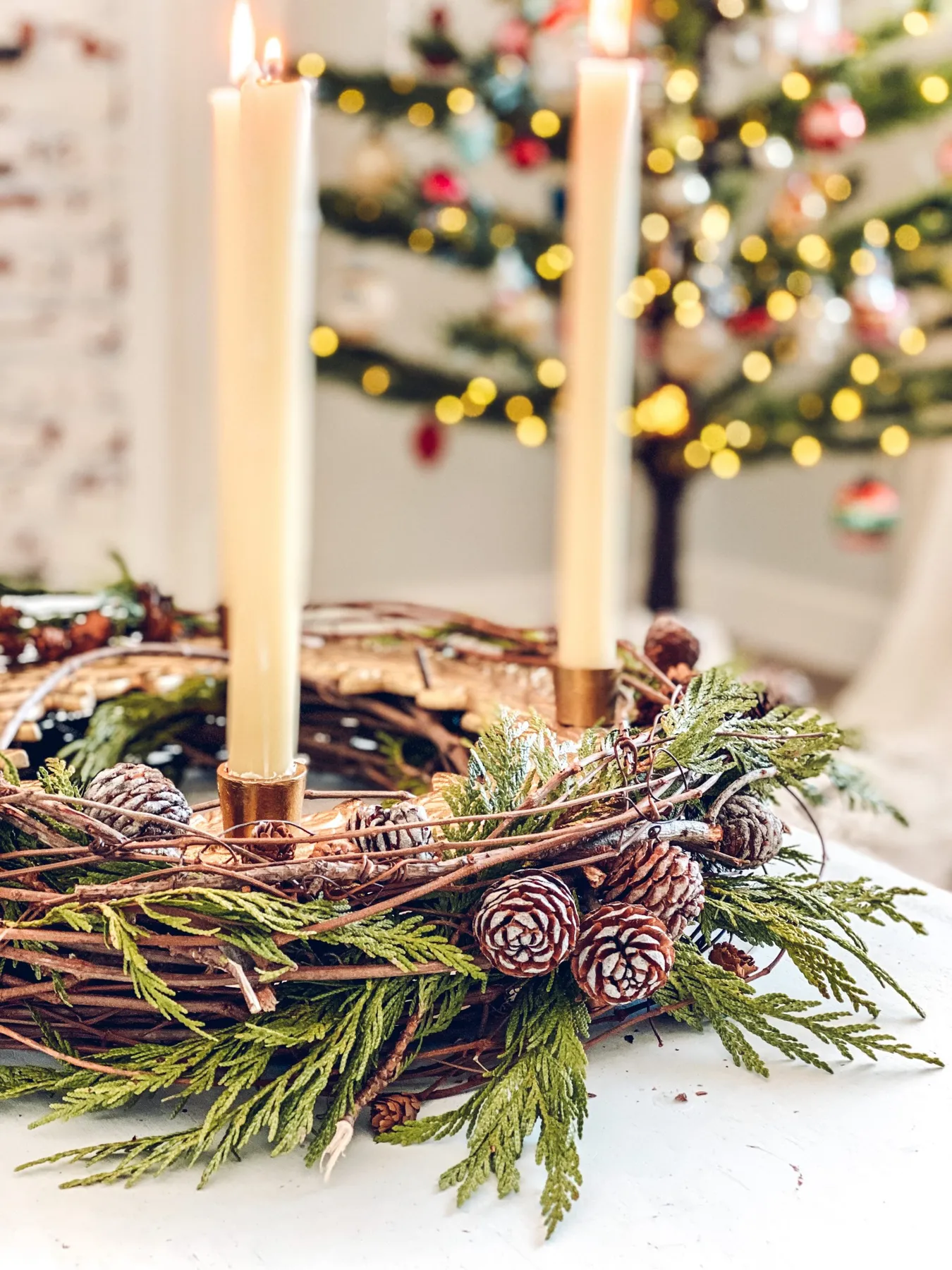
Two lit tapers at the center of a table mean nobody can see across it, and someone will lean over them. Seat more than four and trade the tapers for one low pillar or battery-operated candles with a convincing flicker. Dried branch wreaths also shed — set the whole thing on a felt pad or shallow tray so you aren’t picking twigs out of the tablecloth for a week.
18. Twig Cone Trees in a Snow-Filled Dough Bowl
- Twig cone trees, set of three: $25-$70
- Rustic wooden dough bowl or tray: $20-$55
- Artificial snow: $5-$12
- Star and ball toppers: $6-$15
- Mini bell garland: $4-$10
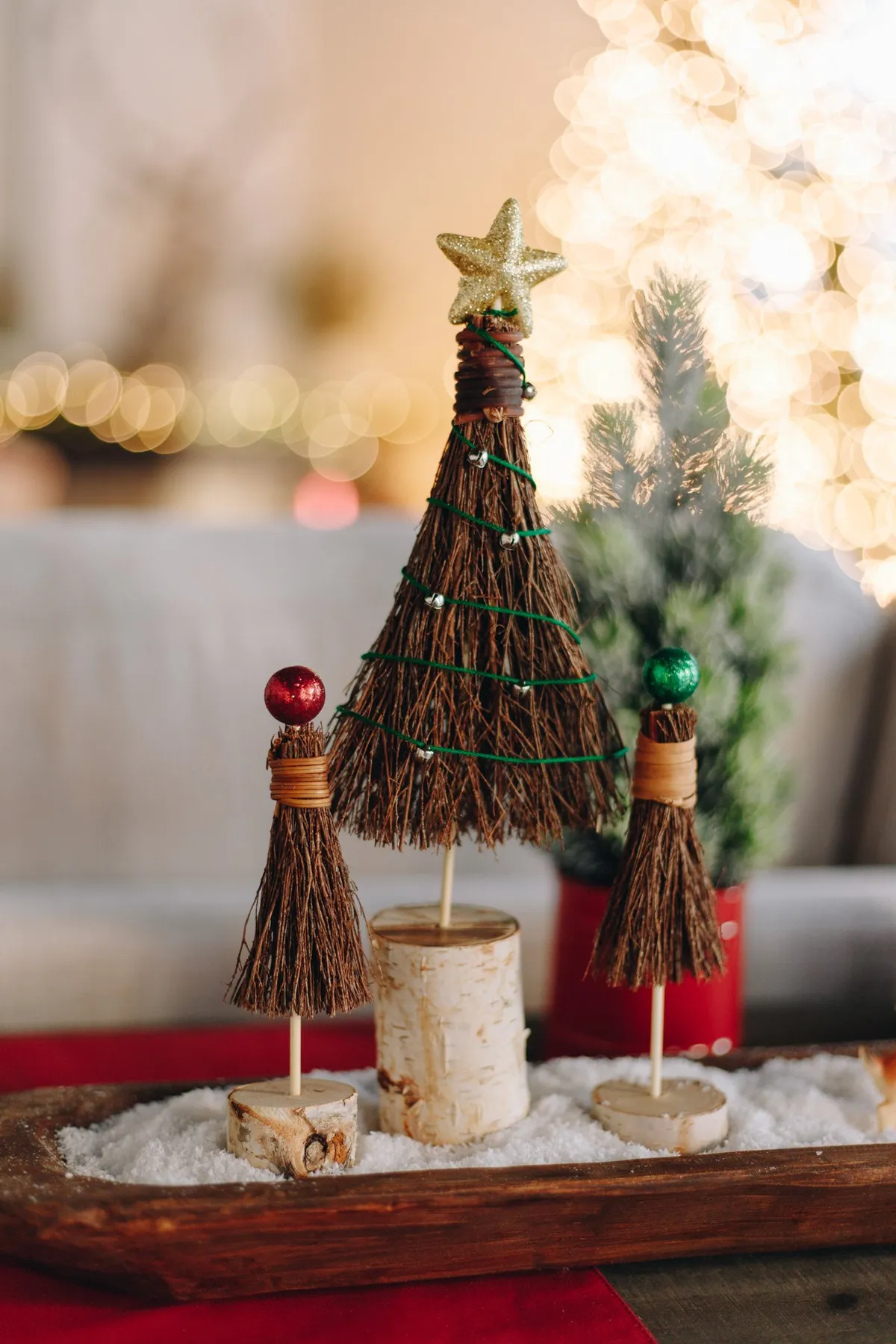
The color math is worth stealing: 70% natural brown and birch + 20% white snow + 10% metallic and color accents. That last tenth is where you get to play — gold and green here, but silver and burgundy would keep the rustic base intact. Keep the base and the accents separated; once brown creeps past 70%, a display starts to look like firewood.
19. Reindeer and Broom Trees in a Snowy Tray
Vary your tree heights: roughly one tall, two medium, two short, and never place two of the same height side by side. Put the tallest object about a third of the way in from one edge — a perfectly centered tall tree makes a tray look like a stage set. The birch log bases here do double duty, adding height while tying the miniatures back to the wooden tray.
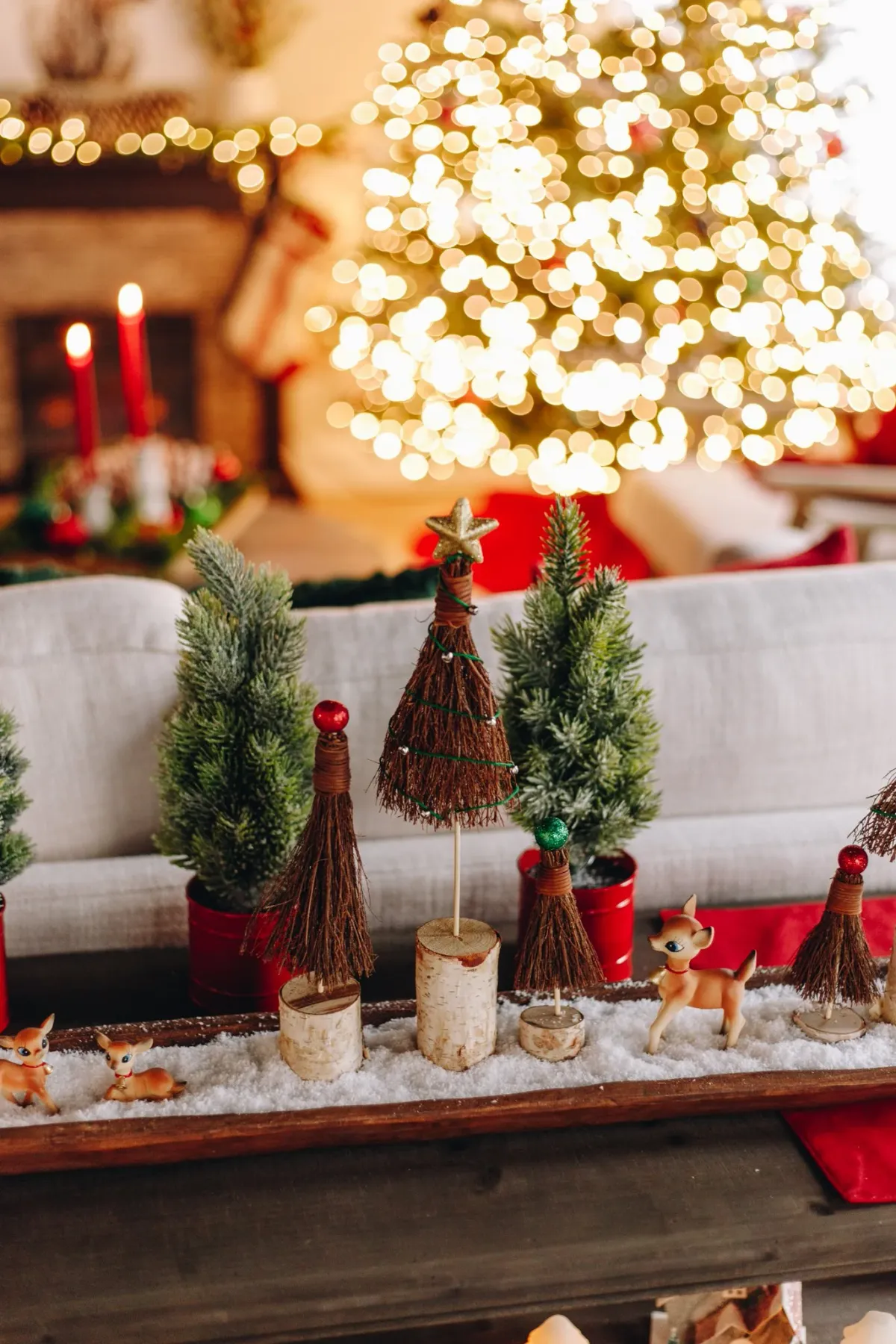
Building the snowy tray:
- Line the tray with a thin layer of faux snow, banked higher at the back.
- Set the largest tree first, then the medium ones, pressing each base down into the snow.
- Tuck the red pots in as color punctuation rather than a matched pair.
- Place reindeer figurines at the front edge, angled slightly inward.
- Fluff snow around every base so nothing looks balanced on top of it.
About 25 minutes.
20. Pastel Village Houses on a Fluffy White Wreath
Pastels plus white is the whole idea, and it shouldn’t work at Christmas, which is exactly why it does. The fluffy white base erases traditional green, so the pink and mint houses and bottle brush trees read as a little winter village rather than a holiday decoration. Small round berries in red, mint, and pale pink repeat the house colors at a smaller scale and hold it together.
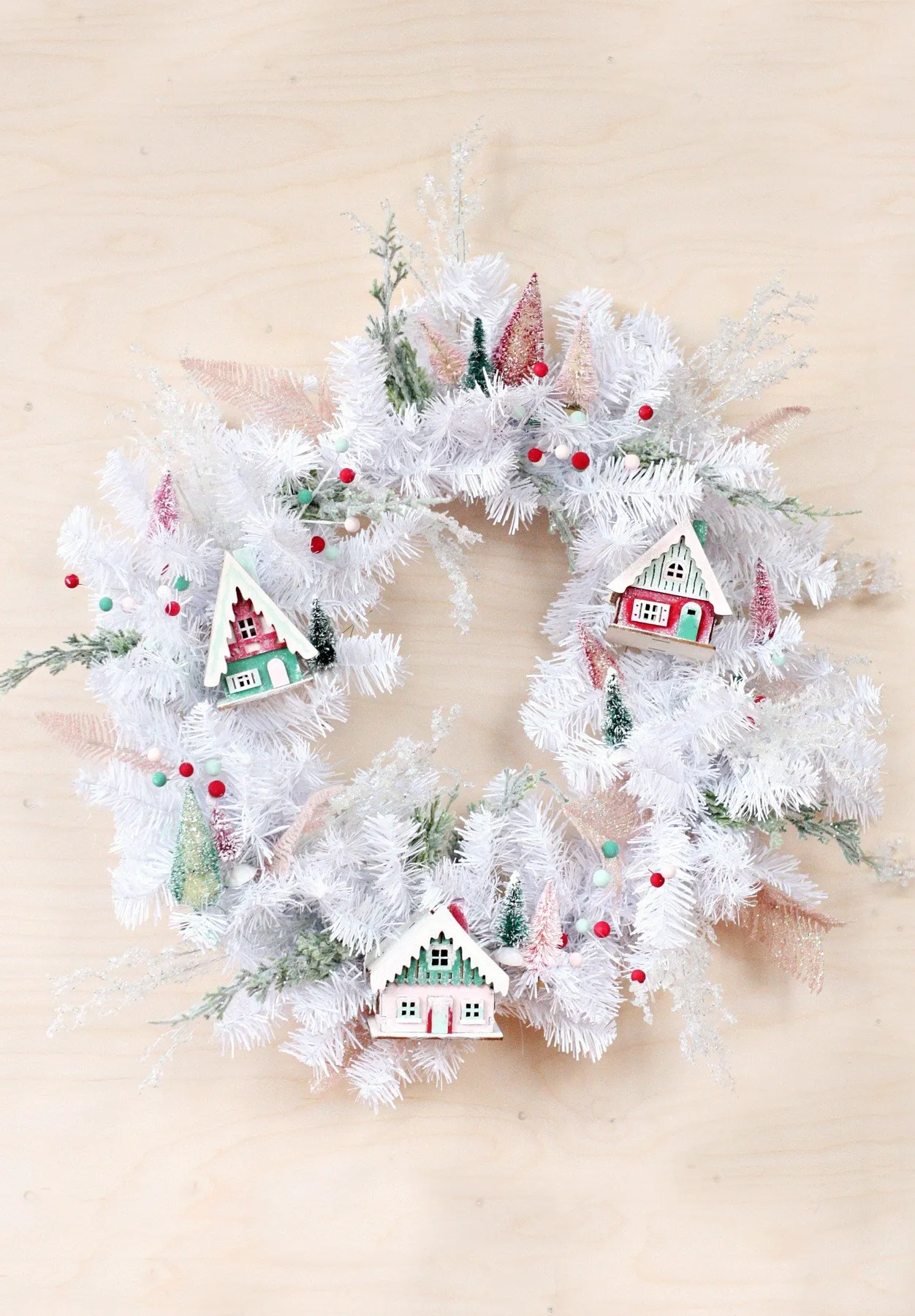
Bottle brush trees are the budget hero — a set of six in mixed colors runs $8-$14 at Target, and plain ones from a thrift store repaint in minutes. Miniature wooden houses are $1-$3 each in the unfinished wood aisle at craft stores; a few dabs of pale pink and mint craft paint finishes them. Whole wreath for under $30.
21. Star Anise and Cinnamon on a Wood Slice
The wood slice. It’s a thick, raw-edged slab sitting under everything, and it’s why a hurricane vase, red ornaments, star anise, and cinnamon sticks don’t look like a pile. The slice gives the arrangement a boundary and echoes the pinecones, dried orange, and cinnamon in one solid natural form. Without it you’d need a tray, and a tray would read far more formal than this wants to be.
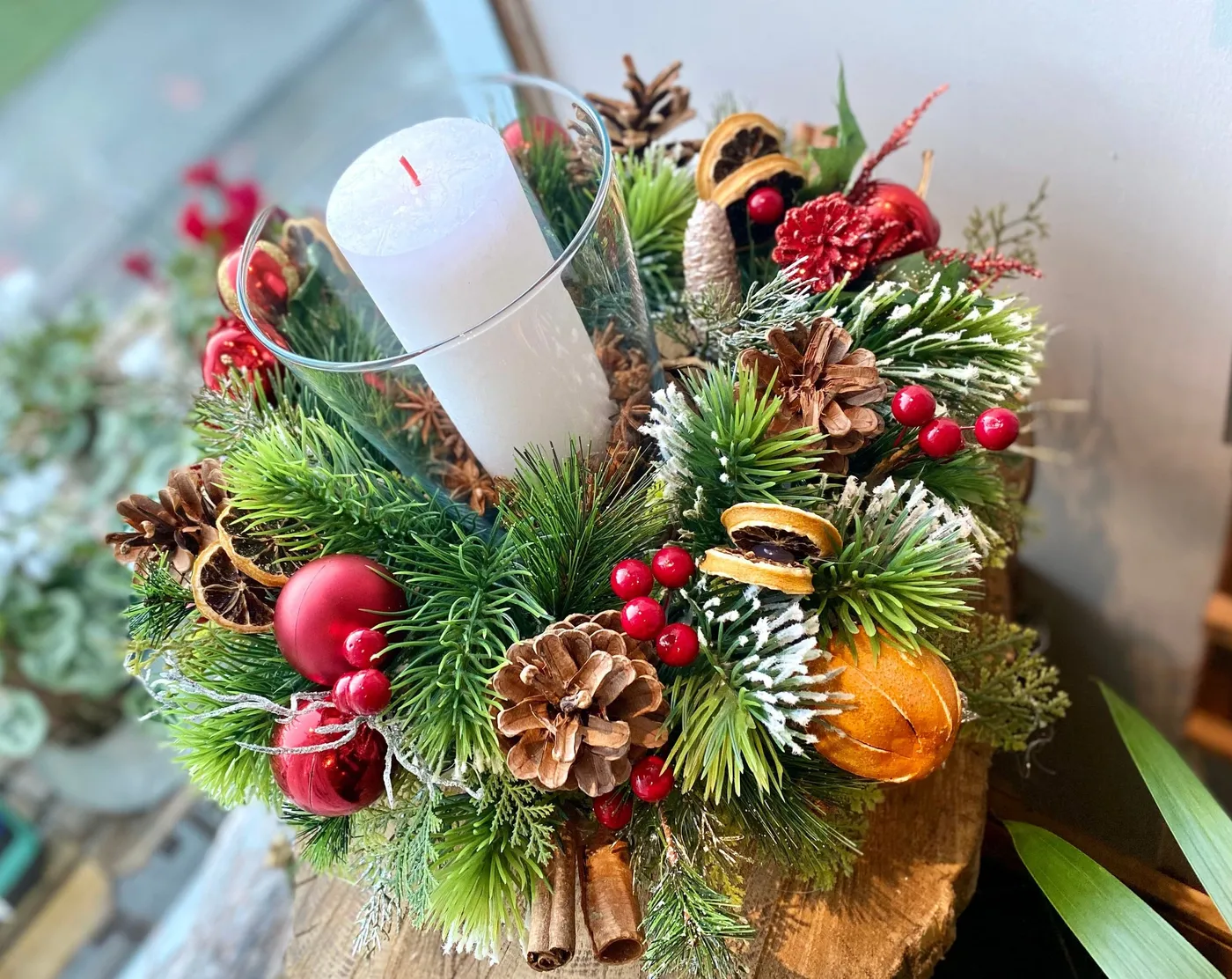
Scented décor is the trend underneath this one. Cinnamon sticks, star anise, and dried citrus release aroma passively, so a centerpiece does the work of a candle without a flame. It fits a broader 2026 shift toward décor that engages more than one sense, and it’s genuinely practical in homes with kids or pets where you’d rather not have an open flame on the table.
22. Dried Citrus Garland Over White Marble
The palette: 45% green garland + 25% white marble + 20% dried orange and cinnamon brown + 10% red berries. Notice there’s no metallic at all — the warmth comes from the fruit and the fire, so adding gold ornaments would only muddy it. If your fireplace is dark instead of white marble, shift the ratio: more green, less white, and lean harder on the orange to keep the warmth.
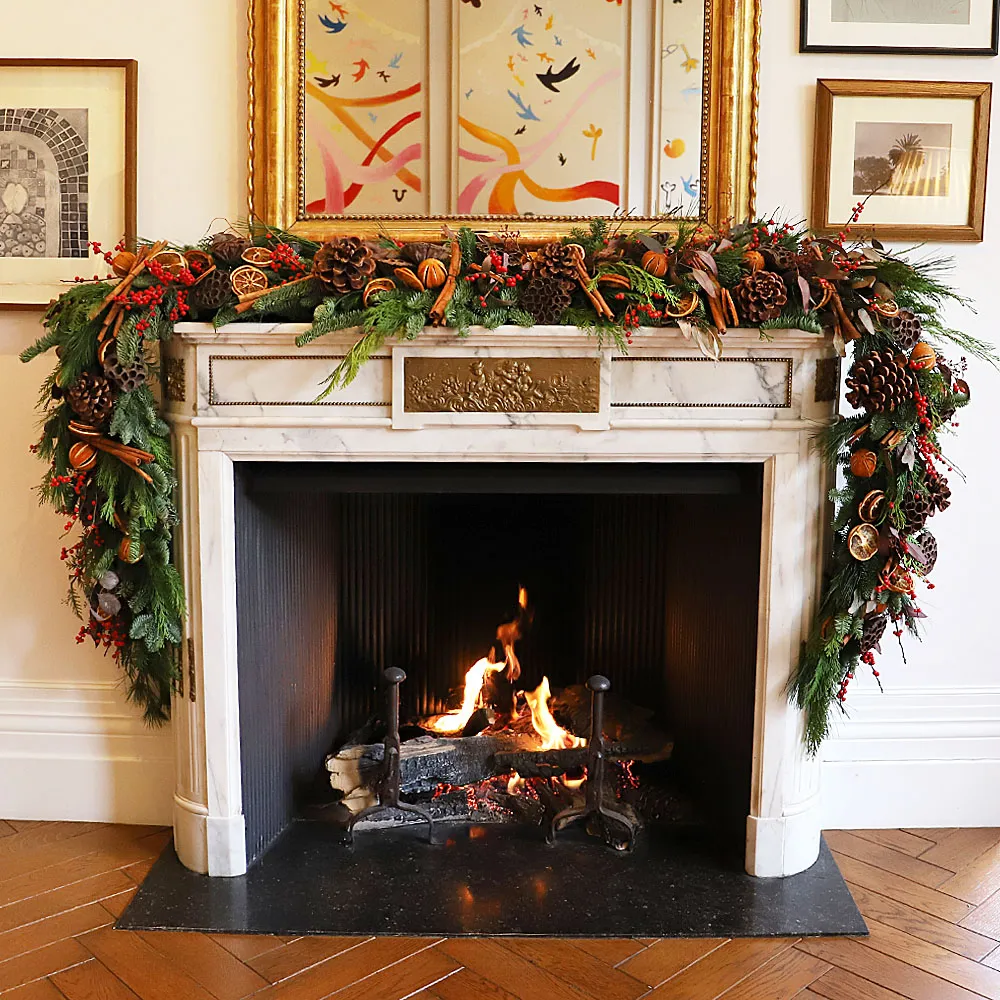
This garland suits a mantel between five and seven feet wide, and it should cascade at least 18 inches down both sides. On a shorter mantel, cascade one side only — two short falls on a narrow mantel look like curtains. In a room with a low ceiling, keep the swag on top of the mantel and skip the drape, then see Idea #28 for a lighter garland that suits smaller fireplaces.
23. Wood Slice Votives with Cinnamon and Deer Cutouts
Wood slice bases and lit votives make a lovely pair with one hazard: dried botanicals plus an open flame. Keep greenery three inches clear of the glass, and never let pine needles sit directly above a burning wick — they’ll smolder long before they catch. Trim wicks to a quarter inch before each use, and if pets investigate tables, swap in LED votives that fool the eye from a few feet away.
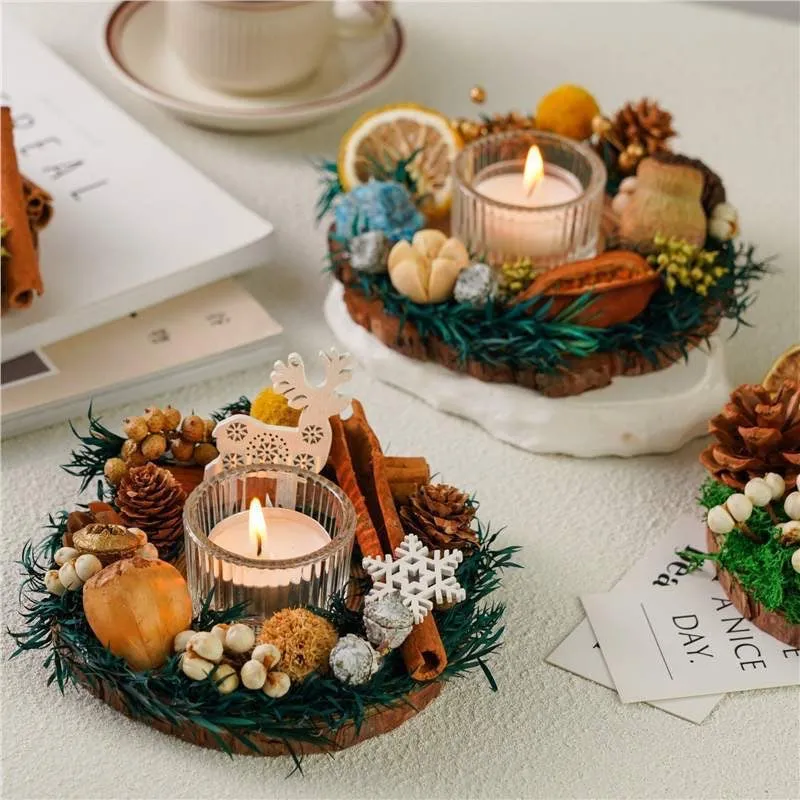
Symmetry with a twist. These two arrangements aren’t identical — the dried berries sit left on one, the deer cutout sits right on the other. When you pair two small arrangements, mirror the structure but never the exact contents. Identical pairs look mass-produced; near-pairs look collected, and it costs one extra minute of arranging.
24. Painted Pinecones Dressed as Sequined Trees
Pinecone mini trees:
- Paint three pinecones dark green with craft acrylic, working the brush down between the scales.
- While the paint is tacky, dry-brush white acrylic over the tips.
- Glue a wine cork on as a base and let it set for 20 minutes.
- Glue multicolored sequins into the gaps as ornaments.
- Top each with a small gold glitter star.
About 40 minutes plus drying, roughly $6 if you already own paint.
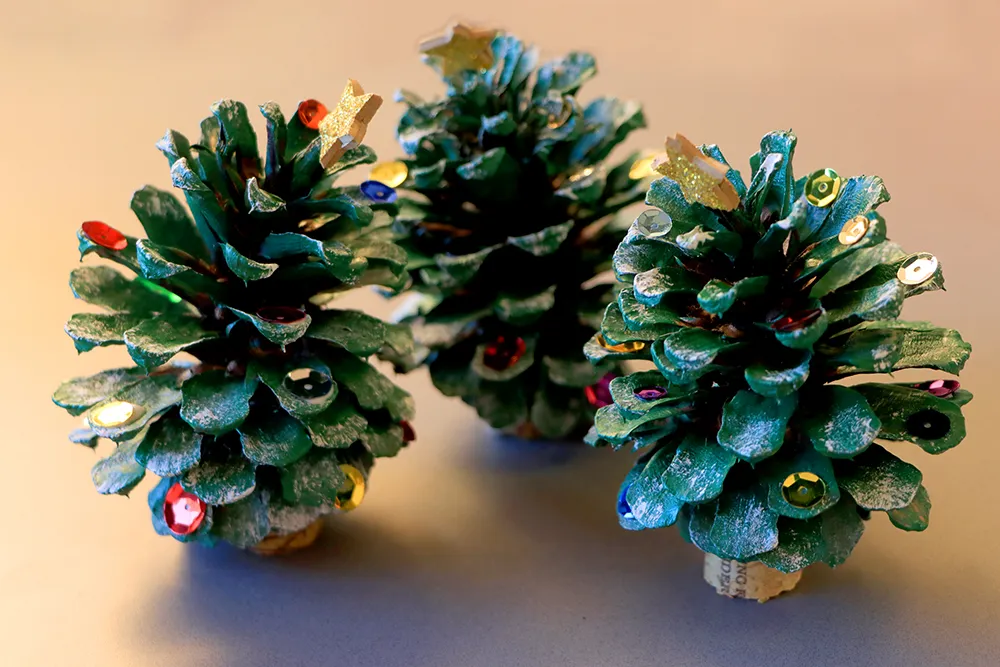
This is the cheapest project in the article. Pinecones are free if there’s a park nearby — bake them at 200°F for an hour first. Craft acrylics run $1-$2 a bottle at Walmart, a bag of mixed sequins is about $3, and corks are free from any restaurant that serves wine. Three finished trees for under $10, which beats $18 each at a boutique.
25. A Miniature Village Glowing on a Round Base
A round village base of about 12 to 14 inches works on a sideboard, an entry console, or the back of a dining table. Below 10 inches the houses and the truck start bumping into each other and the scene loses its sense of distance. Great for apartments — see Idea #19 for a tray-based version, or Idea #18 if you have more surface to fill.
Scale is doing all the work. The houses, trees, and truck are all roughly the same tiny size, so they read as a real village even though the whole scene is under a foot across. The red pickup carrying its little tree is the single spot of saturation in an otherwise white and green arrangement, which makes it the focal point without being the biggest thing there. Fairy lights finish the illusion.
26. Glittered Glass Pinecones Against Rose Gold
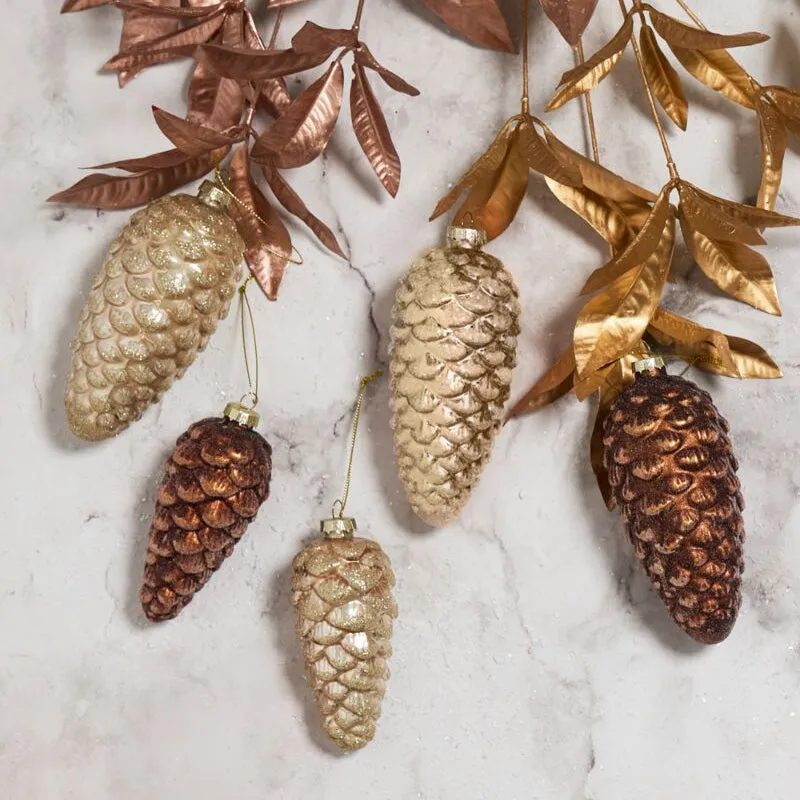
Glitter sheds. Give these glass pinecones one good shake over a bin before they go up, and don’t hang them above a pale upholstered chair. Stored in a humid basement, glass ornaments can cloud, so keep them in a sealed bin with a silica packet. Metallic branches drop a little leaf material each season — that’s normal, not a defect.
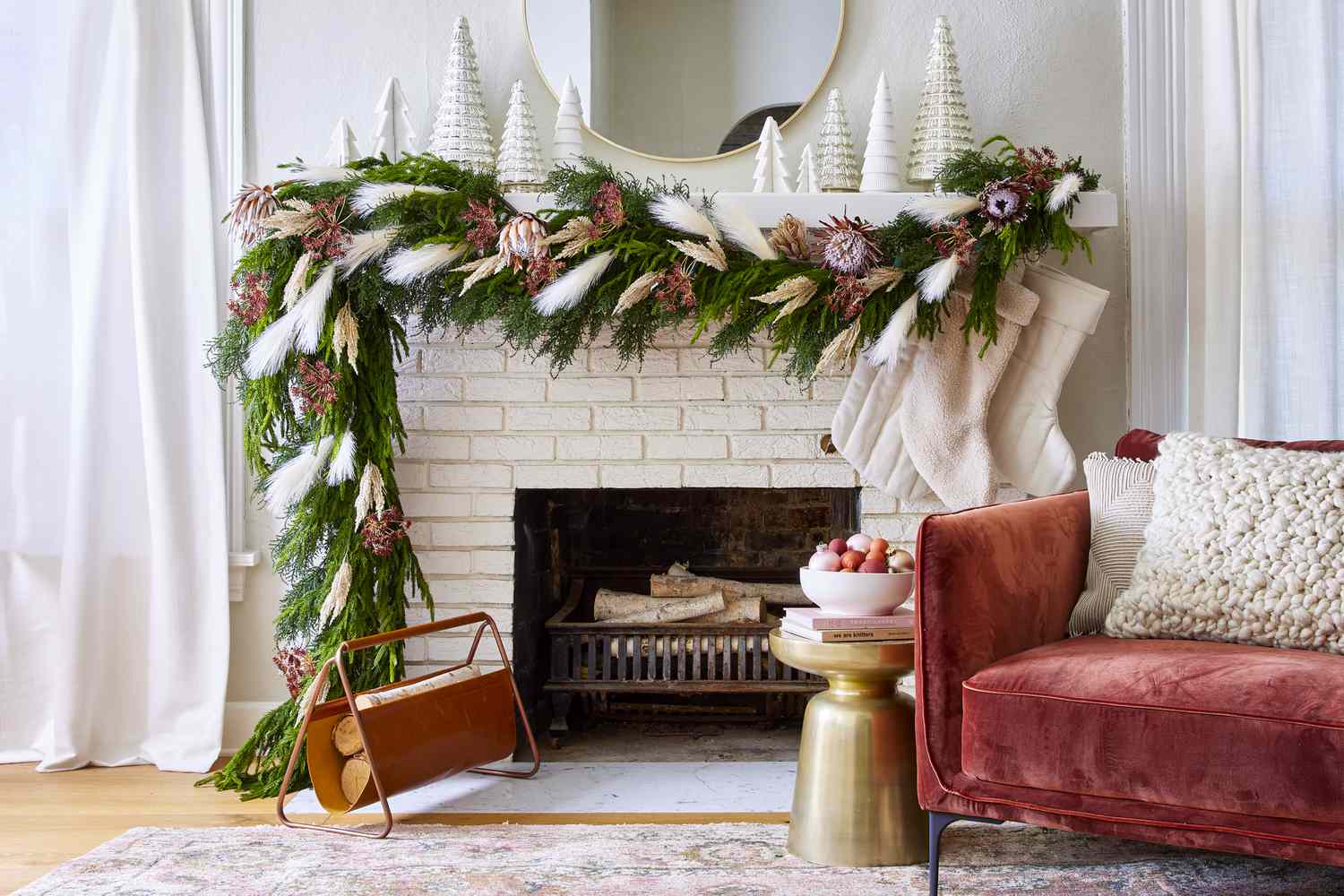
This is a monochrome metallic formula: 70% champagne and gold + 20% dark brown + 10% rose gold. That brown is essential — without it, everything goes flat and yellow. Keep metallics in one temperature family, and these are all warm golds; adding silver would split the palette. Rose gold leaves are the accent, so hold them to a fifth or less of the mix.
27. A Fabric Star Topper with Felt Balls and Bows
Tree toppers are usually too small. The rule: the topper should span about a third to a half of the width of the tree’s top section. This beige fabric star, with its gold stitching and little gold beads, is sized generously against a small tree, which is why it reads from across the room. Fluff the branches directly below it so the star sits in greenery rather than floating on bare stems.

The fabric star. Almost everything else on this tree is round — white felt balls, beige fabric bows — and round ornaments vanish into a tree’s texture. A star breaks the silhouette, and a fabric one reads softer and warmer than the glass or tinsel versions that dominate. It also matches the bows, which makes the whole tree feel like one thought instead of several.
28. Eucalyptus and Amber Beads on a White Mantel
Eucalyptus garlands look expensive and mostly aren’t, if you buy the pieces separately. A six-foot faux eucalyptus garland runs $12-$20, warm string lights about $6, and amber beads can be strung off a thrift store necklace for $3. Layered on a mantel, nobody can tell it isn’t one $80 garland. Fresh eucalyptus from a florist costs more but smells incredible for about two weeks.
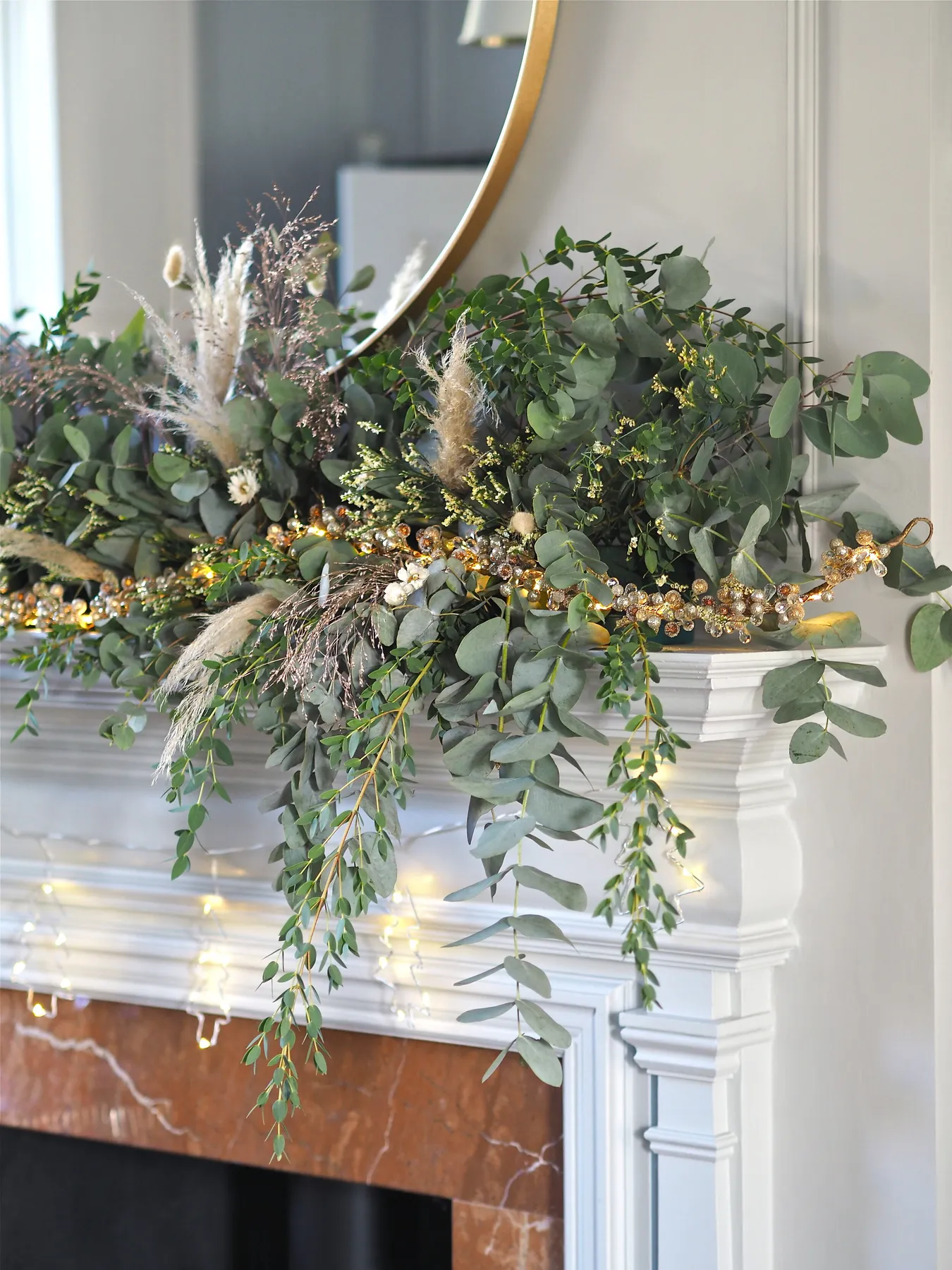
This garland’s charm is that it doesn’t look like Christmas, which means it only works if you’re comfortable with subtle holiday. If you want red and green, this isn’t it. Feathery dried grasses also crush easily — fold them into a box and they never fluff back the same way. Store garlands draped over a hanger instead, and they’ll last a decade.
29. A Pom-Pom Wreath Framing a Gingerbread House
The frame is the idea. Instead of decorating a wreath’s surface, this one has a white fluffy border with an open center — a glass door panel filled with a gingerbread house and two candy-cane striped trees. The border points your eye straight to the middle, and the glass becomes the backdrop. It’s a wreath behaving like a picture frame, which is why it reads as a scene instead of a ring.
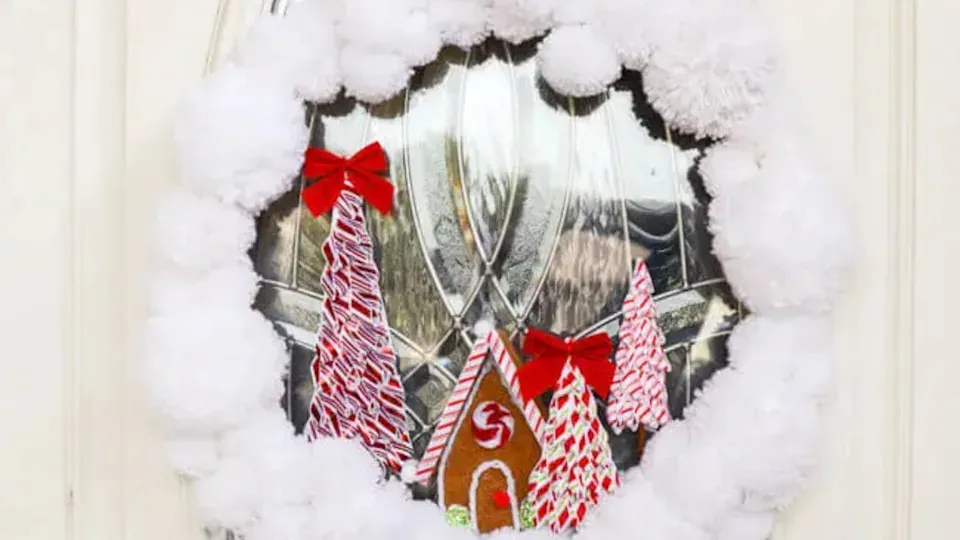
This design needs a door with a glass panel — a storm door or French door with at least a 12-by-16-inch pane. On a solid wood door the center would just be a dark hole. Without glass, mount the same gingerbread arrangement on a small white board inside the wreath ring and hang that instead. It works on doors from 32 to 36 inches.
30. Burgundy Candle with Gold Beaded Berries
- Burgundy pillar candle: $6-$18
- Pine and cedar branches, real or faux: $10-$30
- Pinecones and dark red ornaments: $8-$20
- Matte gold beaded berry sprigs: $6-$16
- Dark wooden stand or cake plate: $12-$35
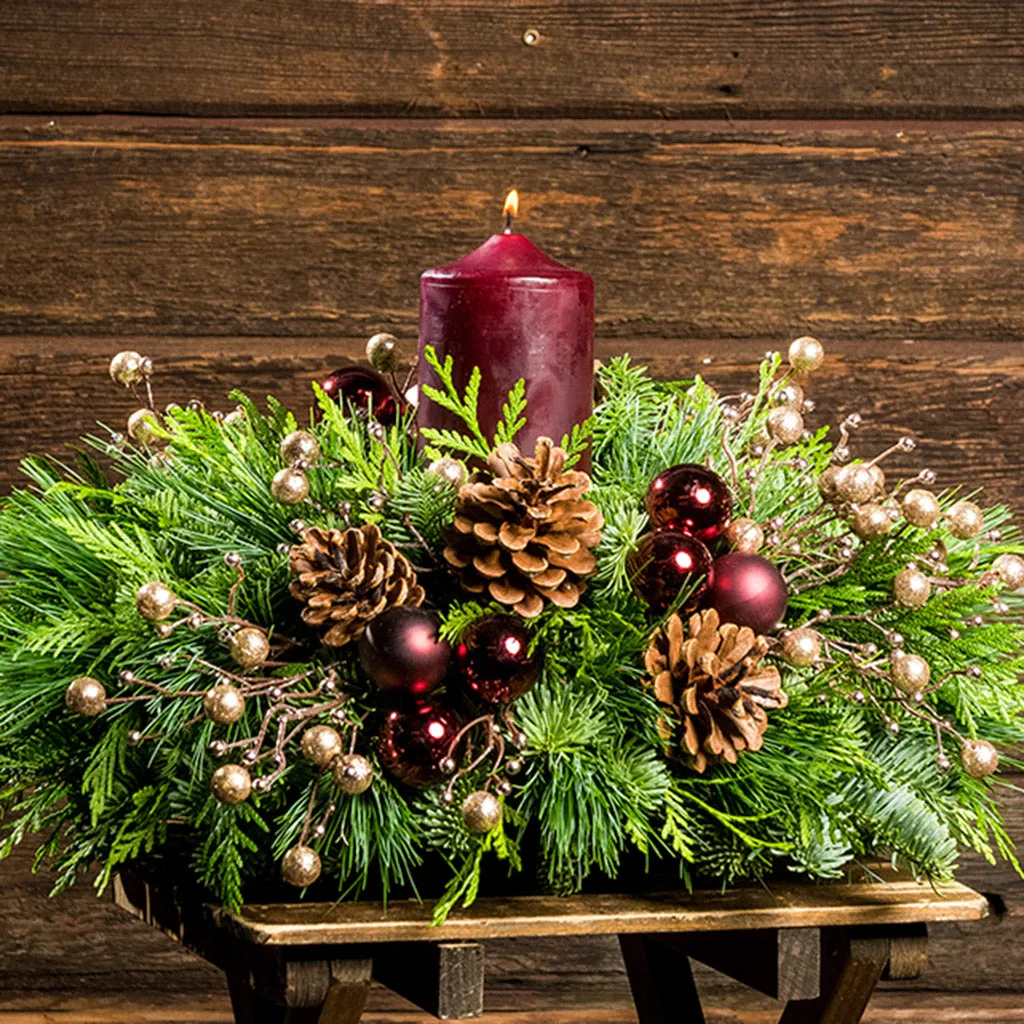
Candle height matters more than candle color. A centerpiece candle should sit so the flame stays below eye level when you’re seated — roughly six to eight inches total including the stand. Any taller and you’re staring at a flame instead of your guests. For beaded berries, choose matte gold over shiny: matte reads as an organic material, shiny reads as plastic.
31. Cranberry Hurricanes on a Red-and-Green Table
The cranberry hurricane:
- Fill a clear glass hurricane two-thirds full with fresh cranberries.
- Nest a smaller glass inside so the candle sits above the fruit line.
- Add water to just below the top layer of berries for a frosted look.
- Repeat with a second hurricane for symmetry along the garland.
Five minutes per holder, about $4 in cranberries. Swap in pomegranate seeds in late December when cranberries disappear.
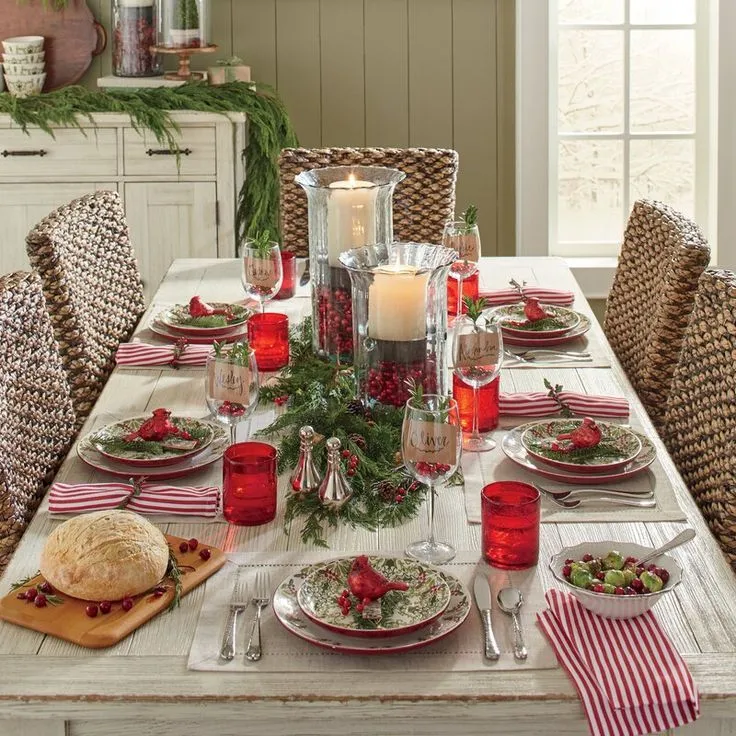
The formula: 40% whitewashed wood and cream + 35% green garland + 25% red. That’s a lot of red for one table, and it works because every red element is small — napkins, tumblers, cardinal figures, berries — rather than one big red object. If your table is dark wood instead of whitewashed, drop red to 15% and let green and cream carry more weight, or the setting turns heavy.
Hang the Wreath, Then Pour the Cocoa
None of these projects need a craft room, a Cricut, or a weekend you don’t have — most come together in under an hour with things you can clip from the yard or pick up on a single Target run. Start with one idea that matches the space you actually have, and let the rest of the house catch up next year.
📌 Pin this guide to your holiday board now, so when December sneaks up on you, the wreath base, the ribbon, and the cranberries are already on your list.