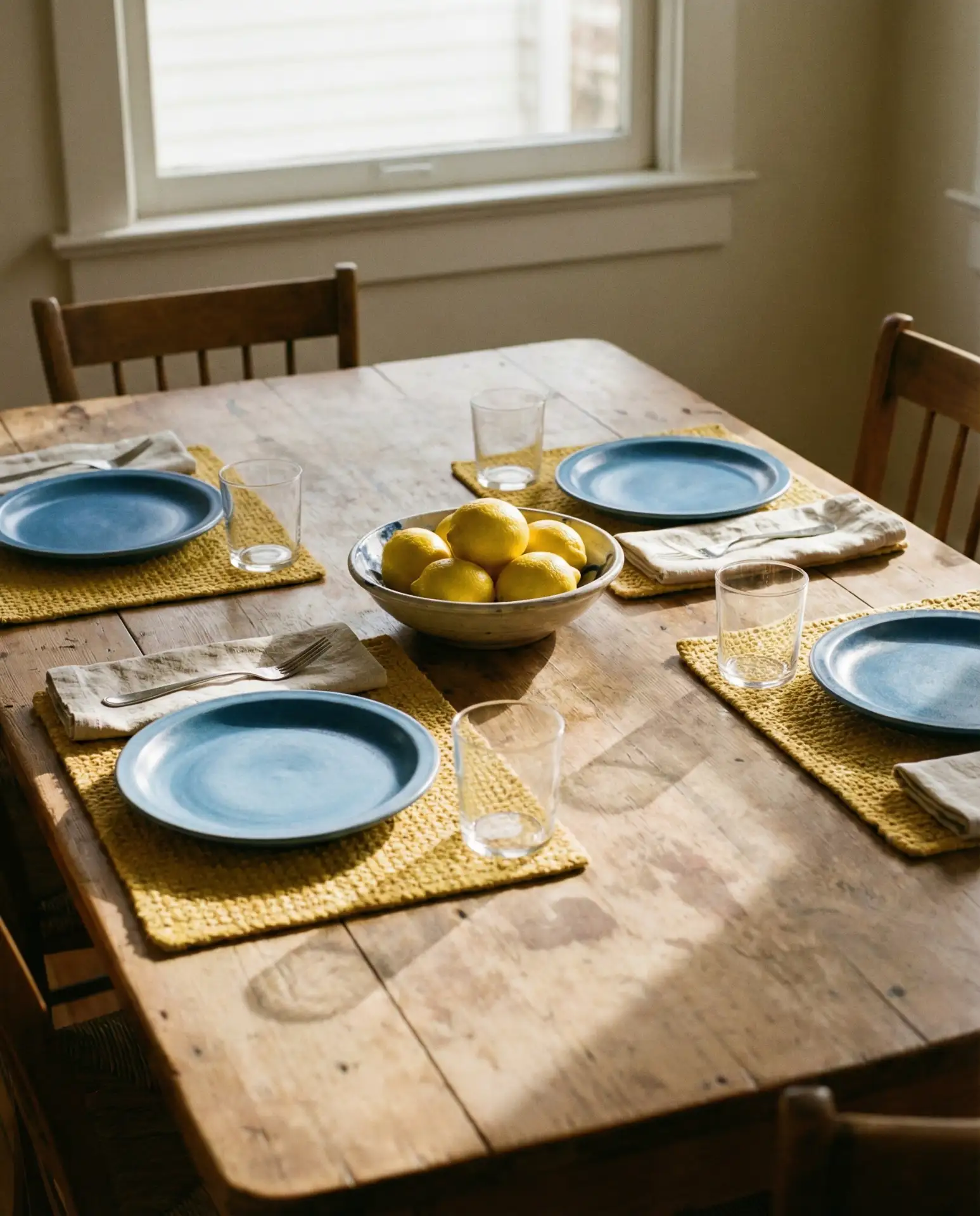
You know the feeling: guests arrive in forty minutes, the table is bare, and the grocery-store floral counter wants $45 for something that will droop by dessert.
So we did the legwork. After filtering through hundreds of options across Dollar Tree, Walmart, Target, and Amazon, we narrowed it down to 35 centerpiece ideas that actually deliver — most landing somewhere between $1 and $60 for the entire arrangement. Some are pure dollar-store builds; others mix in a thrifted vessel or one good candle, and budget and luxury versions are compared side by side so you can see exactly where the money matters.
Expect four moods: rustic fall harvest, fresh garden-party, warm candlelight, and cheerful seasonal color. Every idea is shoppable with direct product links, so you’re never left guessing what to buy.
And 2026 is the year the high-low table took over Pinterest — dollar-store filler, one great vessel, real flowers only where they count. That combination is exactly why these hold up in person, not just in photos. And stay until the end — we break down the most common mistakes that can ruin these looks.
📌 Save this to Pinterest for later — you’ll want to revisit these ideas.
1. Mirrored Tray with Fluted Glass Candles and Scattered Petals
The mirror is doing the heavy lifting — a rectangular beveled tray that catches the flame of two fluted glass candleholders and throws it back at the room. Take the tray away and you have two candles and some petals on a table. Keep it, and the whole arrangement reads twice as big and twice as bright. On dark wood, a mirror effectively doubles your light source for about a dollar’s worth of material.
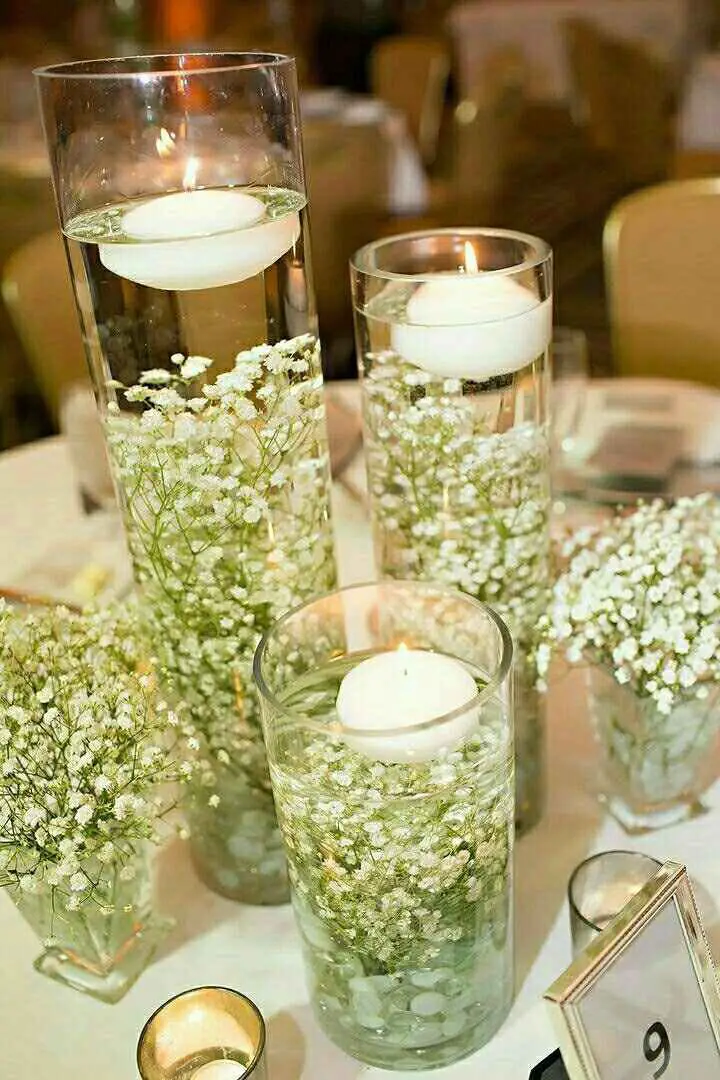
Everything else stays quiet on purpose: white pillar candles, scattered white petals, a coil of warm LED string lights tucked into faux white blooms and soft green foliage. Nothing competes with the reflection.
- Mirrored tray: $1.25–$12
- Two fluted glass candleholders: $2.50–$8
- White pillar candles (2): $2–$10
- Faux white flowers and petals: $3–$12
- Battery LED string lights: $1.25–$6
- Greenery sprigs: $1.25–$5
2. Wooden Plank Table with a Lemon-and-White Floral Box
Two things are doing the work. First, contrast: rough plank wood against crisp white plates and linen is the oldest trick in the rustic playbook, and it never stops reading expensive. Second, echo — lemons appear in the box, at the place settings, and beside the glasses, so your eye keeps circulating instead of parking in the middle. The white pillar candles pick up the plates; the gold-rimmed textured glasses pick up the yellow.
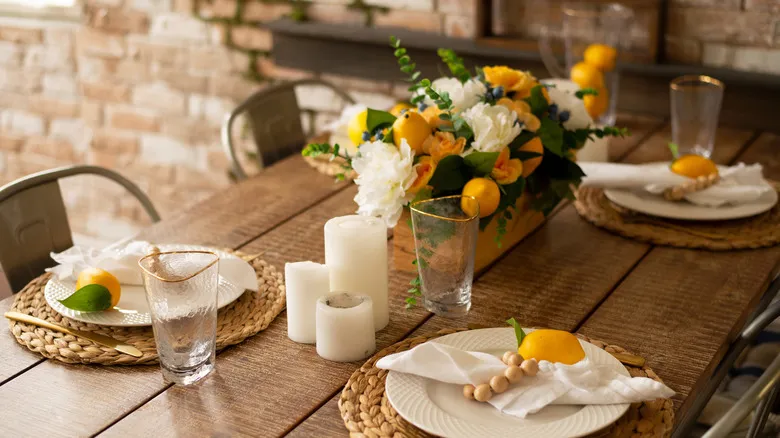
Notice, too, that the florals stay low and wide. On a plank table a wide arrangement fills the visual gap that a tall one would punch straight through.
Keep the box under a third of the table’s length — on a 72-inch table that’s 24 inches of arrangement, max — so every guest keeps a sightline across. Then build a three-touch rule: each color in the centerpiece appears twice more on the table.
- White blooms → white plates and napkins
- Yellow lemons → a lemon at each seat
- Green foliage → green in the glassware
Do that and the table looks planned instead of decorated.
3. Hurricane Vase with a Red Pillar and Foraged Autumn Leaves
The formula runs roughly 60% dark stained wood, 25% autumn foliage, and 15% glass and black hardware. That last sliver is what keeps it from becoming a pile of leaves: the clear hurricane, the black pedestal, the crisp stripes on the runner.
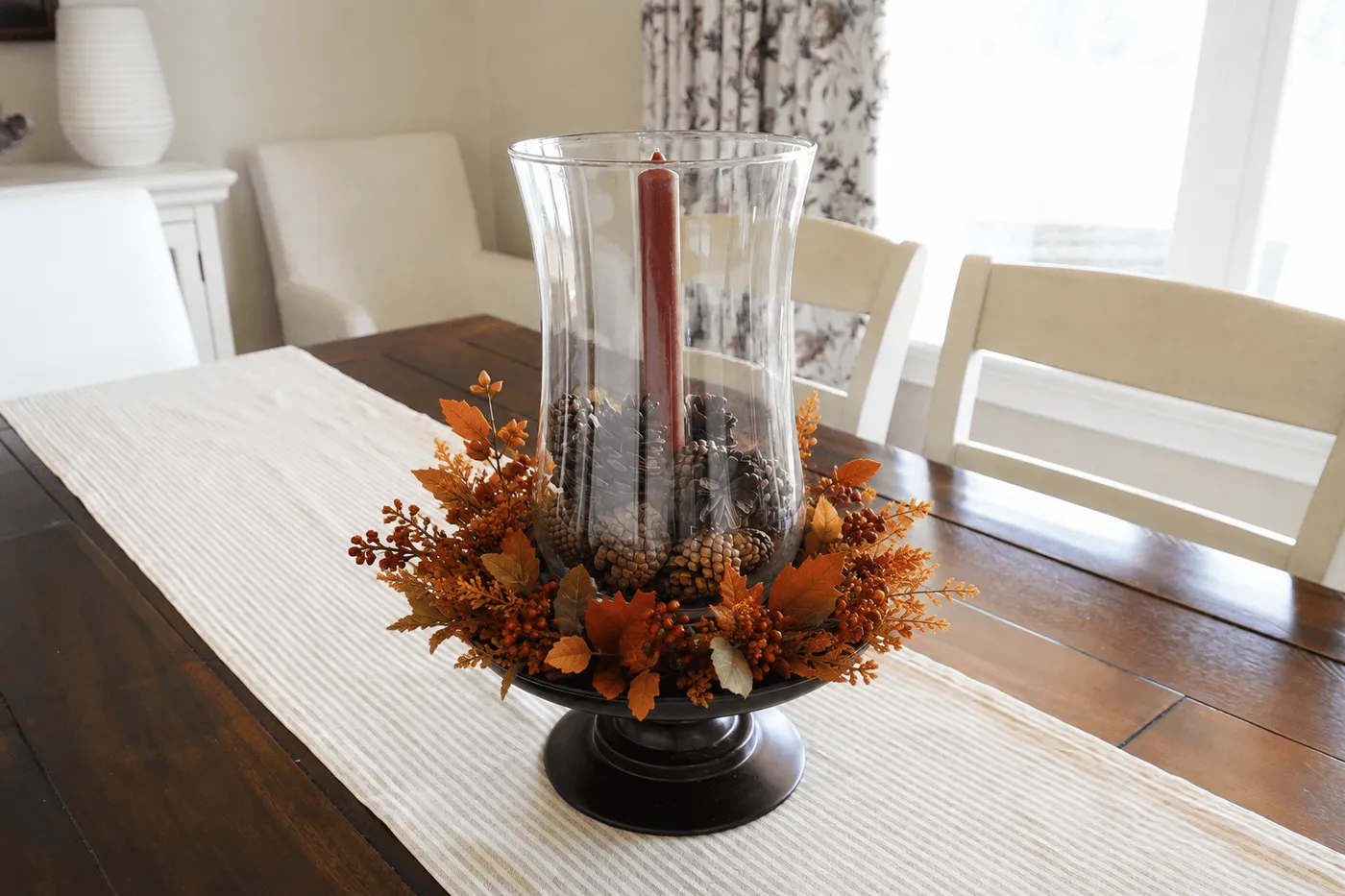
Swap the palette while holding the ratio — 60% whitewashed wood plus 25% dried grasses plus 15% brass gives you the same structure with a late-summer feel. Change the colors, never the proportions.
Here’s the unglamorous part: a real flame inside a glass hurricane, ringed by dried leaves and berries, is a physics experiment you don’t want to run. Faux leaves are plastic and plastic melts; dried ones are basically kindling. Use a convincing flameless pillar, or keep the real candle and push the foliage ring six inches back. Also budget for shedding — berry sprays drop tiny bits every time someone brushes past the table.
4. Terracotta Pot Cluster at Three Different Heights
Pedestal clusters need width. On a table shorter than about 60 inches, three risers plus plants eat the space plates need — aim for a 24-inch footprint on a 72-inch table, and lose the tallest stand if your ceiling is under eight feet, or the room will feel capped. This look also wants daylight: it’s built for a window with sheer blinds, not a dim corner.
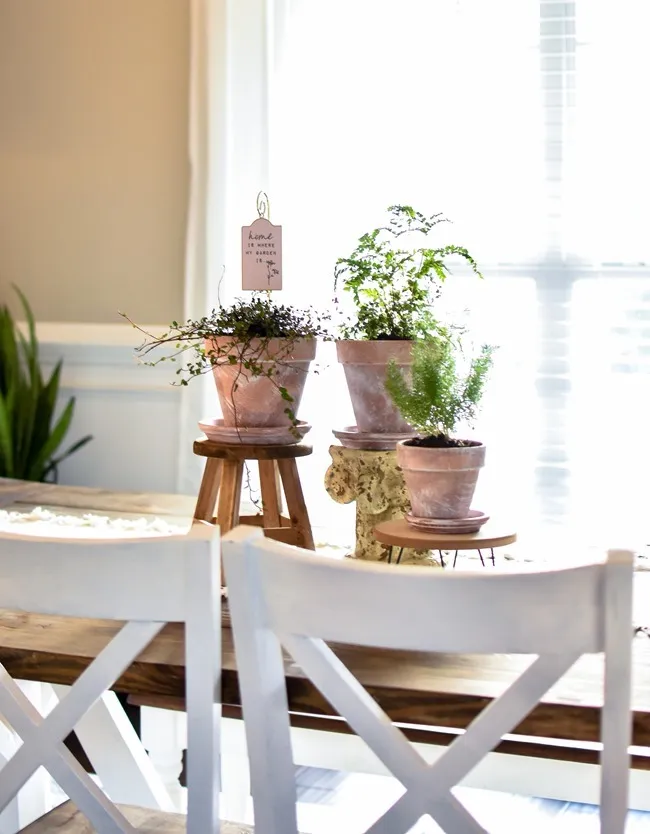
Terracotta is the cheapest good-looking material on earth. Dollar Tree’s small pots run about $1.25 with saucers; IKEA’s hover near a dollar. Skip buying plants entirely and take cuttings from a pothos or spider plant you already own — they root in water within a week. Small wooden stands are $1.25, or stack two thrifted saucers. A five-pot cluster lands under $15, and the white cross-back chairs are the only thing here that might cost real money.
5. Blue-Star Vase Overflowing with Pumpkins and Pampas Grass
Tall narrow vessels need a build order or they collapse into a blob. Work in four passes and don’t skip ahead to the flowers:
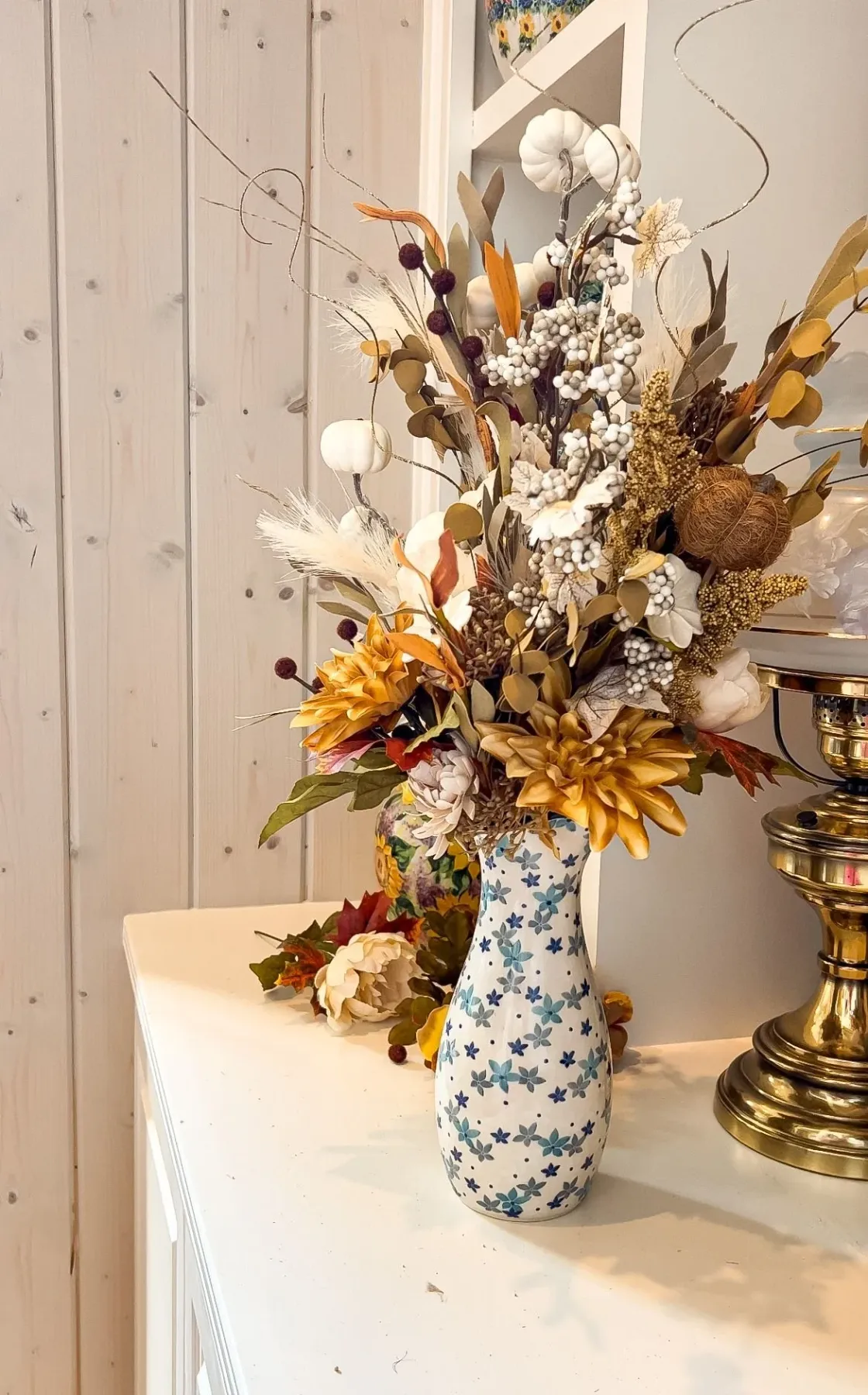
- Greenery first, crisscrossed to create a cage
- Largest blooms at three different heights
- Mini pumpkins and berries tucked into gaps, never on top
- Wispy pampas and branches last, only at the edges
That vase is only a few inches wide at the neck — the cage of stems is the only thing holding the shape.
The pampas grass and twisted glittery branches are the entire personality of this arrangement. Without them you’d have a perfectly nice autumn bouquet in a pretty patterned vase: pleasant, forgettable. The wisps break the silhouette, catch light, and give the eye something soft after all those dense golden blooms. Buy the cheapest dried grass you can find and trim it to twice the vase height.
6. Glass Globe Displays with Faux Cherry Blossom Branches
These globes are a fifteen-minute build and about $6 for the pair.
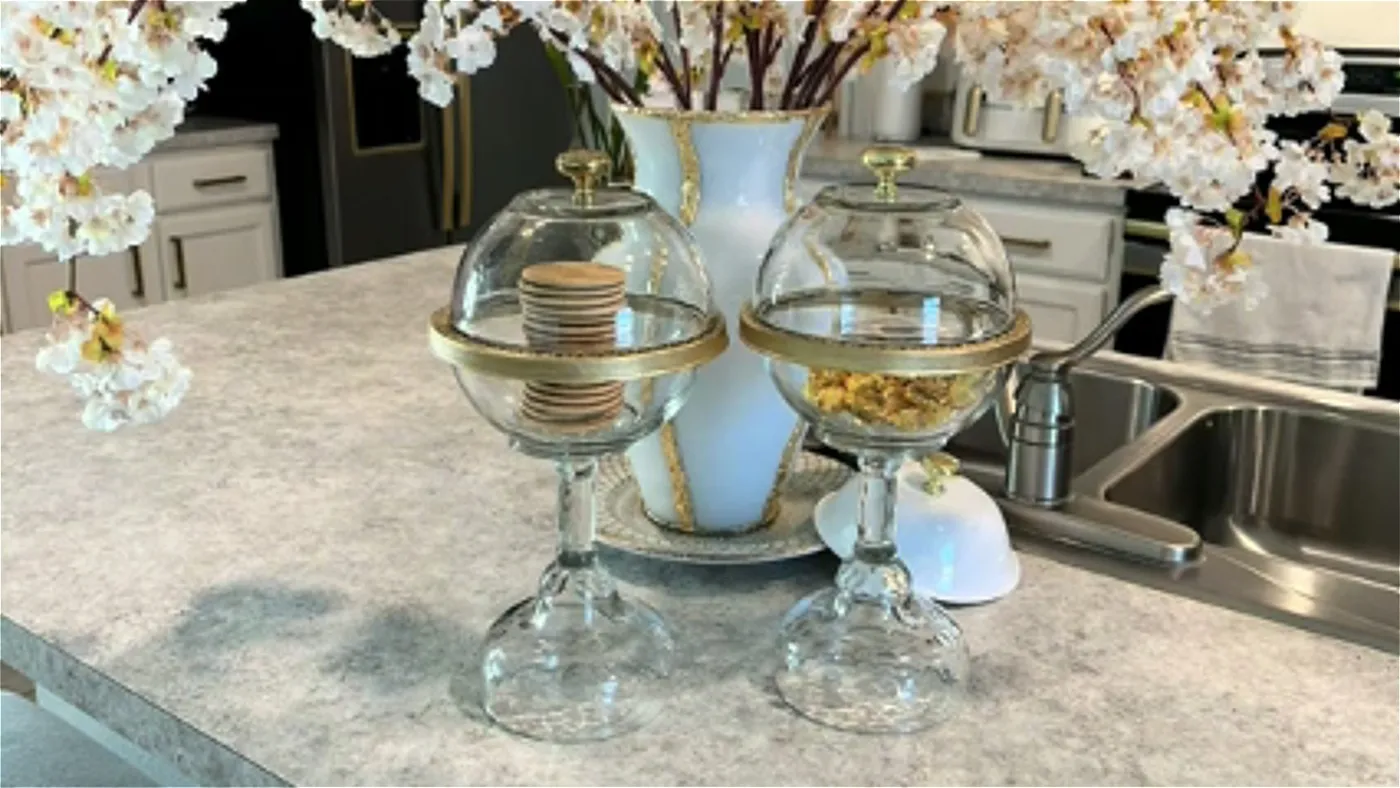
- Glue a small wooden disc inside each globe’s base to anchor it
- Fill one with stacked wood slices, the other with gold filler, leaving an inch of headroom
- Hot-glue a gold ring around the opening and a finial on top
- Invert a glass goblet and glue the globe to its base so it stands
- Set beside a tall vase of faux cherry blossom branches for height
Materials: $2–$4. Time: 15 minutes plus drying.
Clear glass is beautiful and merciless. Every fingerprint outside and every fleck of dust inside shows in daylight, and gold-toned trim dulls with handling. Wipe the exteriors weekly with a dry microfiber cloth — glass cleaner streaks the gold finish. For the insides, don’t unglue anything: a long-handled lint roller or a hairdryer on cool at the opening lifts most of it. Seeded or textured glass hides dust by design.
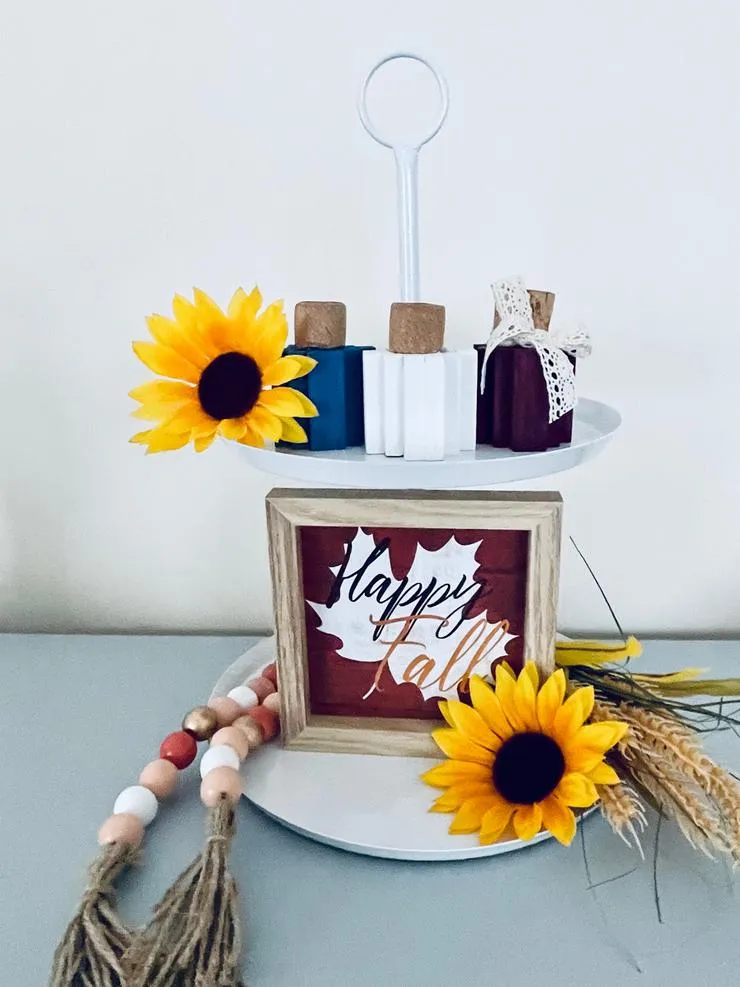
7. Two-Tier White Tray with Sunflowers and a Bead Garland
- Two-tier white tray: $1.25–$5
- Three mini bottle or pumpkin accents: $3.75
- Faux sunflowers (2): $2.50
- Mini seasonal sign: $1.25
- Wood bead garland with jute tassels: $1.25–$6
- Wheat stalks bundle: $1.25–$4
8. Slatted Crate with Sunflowers and a Twine-Wrapped Amber Jar
Fifteen minutes, about $8, no glue gun required.
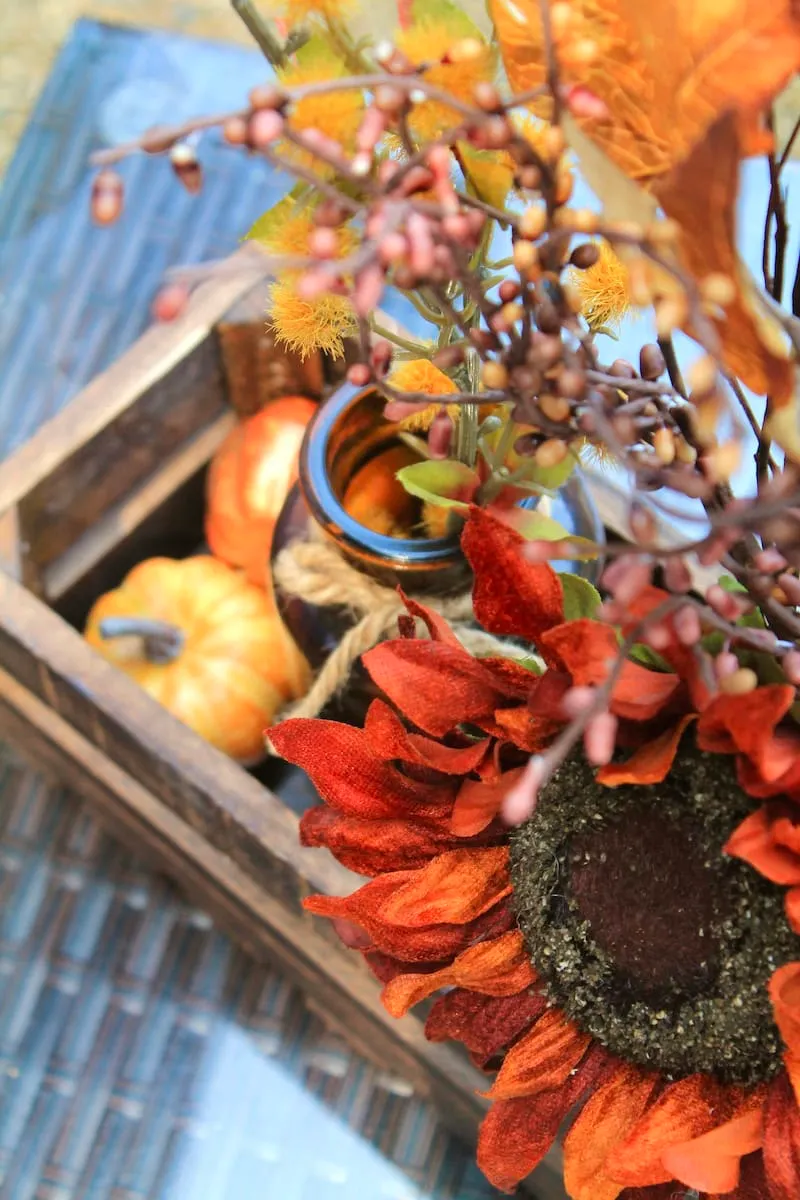
- Set the sunflower and berry stems in the back corner of the crate, angled outward
- Wrap the amber jar with twine three times and knot it
- Nestle the jar center-front and fill around it with mini pumpkins
- Fill the gaps with fluffy yellow filler, keeping it lower than the sunflower
Crates are deeper than they look, and depth is the enemy of a dining table. A slatted crate more than six inches tall will hide everything inside it from anyone seated across the table — you’ll be the only person who ever sees the pumpkins. Measure depth first and set the crate on a low riser so the rim sits below eye level. Also, dollar-store florals arrive flattened; budget ten minutes to pull each stem apart, or the whole thing reads plastic from across the room.
9. Pumpkin Form Dressed in Sunflower, Berries, and a Burlap Bow
Three principles, one pumpkin. Warm colors advance — orange and yellow jump forward while the dark berries recede, which gives a fairly flat object depth from across a room. Odd numbers read as natural: one big sunflower, several small orange blooms, an untidy spray of berries, which is why it looks collected rather than assembled. And the burlap bow works because it’s the only matte, rough texture against shiny faux petals and satin raffia.
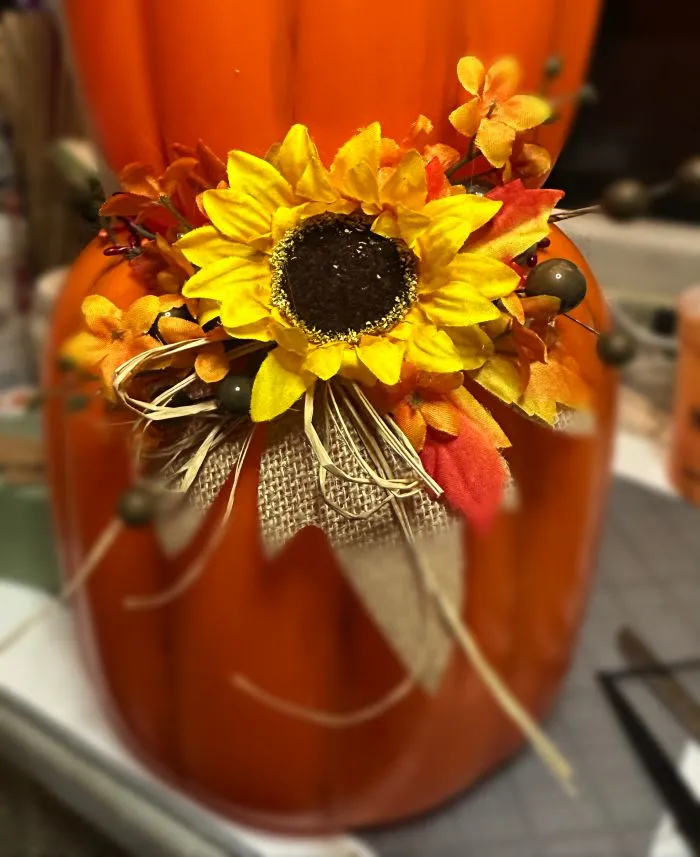
This is the budget cousin of Idea #8 — same autumn palette, tighter footprint. Start with a $1.25 dollar-store pumpkin form, hot-glue a bow from a $1.25 roll of burlap ribbon (enough for five bows), then tuck in four or five stems from a single mixed sunflower bunch. About $7 if you own a glue gun, and you can rebuild it differently every year. Walmart’s floral stems run $1–$3 each if you want bigger blooms.
10. White Ranunculus in a Low Bowl with a Tape Grid
The tape grid is the difference between a bowl of flowers and an arrangement. Run clear floral tape across the rim in parallel lines an inch apart, then cross them at 90 degrees. You get a grid of one-inch squares, and each stem goes in its own square so it stands where you put it instead of sliding into a heap. A roll costs about $3 and lasts years, and it stretches vase life because stems aren’t crushed against each other.
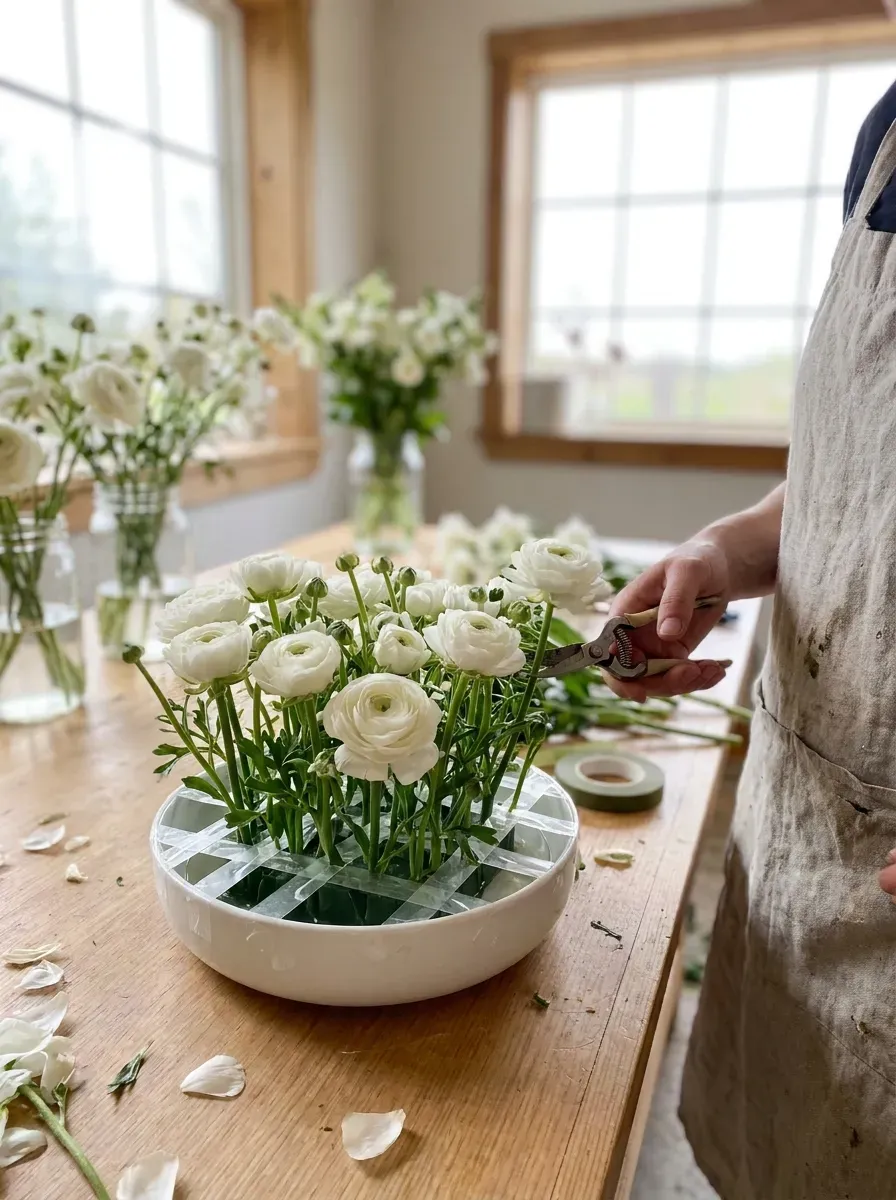
Materials: clear floral tape, a low wide bowl, 12–15 stems. Time: 20 minutes.
- Fill the bowl with cool water and flower food
- Tape the grid across the rim, pressing the ends firmly to the outside
- Cut stems on a sharp angle so blooms sit 1–1.5 inches above the water line
- Place the largest blooms in the outer squares first, working inward
- Fill remaining squares with smaller blooms, then tuck greenery at the edges
- Top up water every other day — the grid hides the level
11. Twine-Wrapped Turkey with a Fanned Feather Tail
The fanned tail is the entire silhouette. Everything else — the twine body, the yellow and orange blooms, the wooden beads, the frayed linen — is support. Take the feathers away and you have a textured cone with flowers stuck in it; add them and it reads instantly as a turkey from across the room, which is the only job a seasonal centerpiece actually has. Fan them wide rather than flat, alternating brown, orange, and white so the outer edges stay lighter than the center.
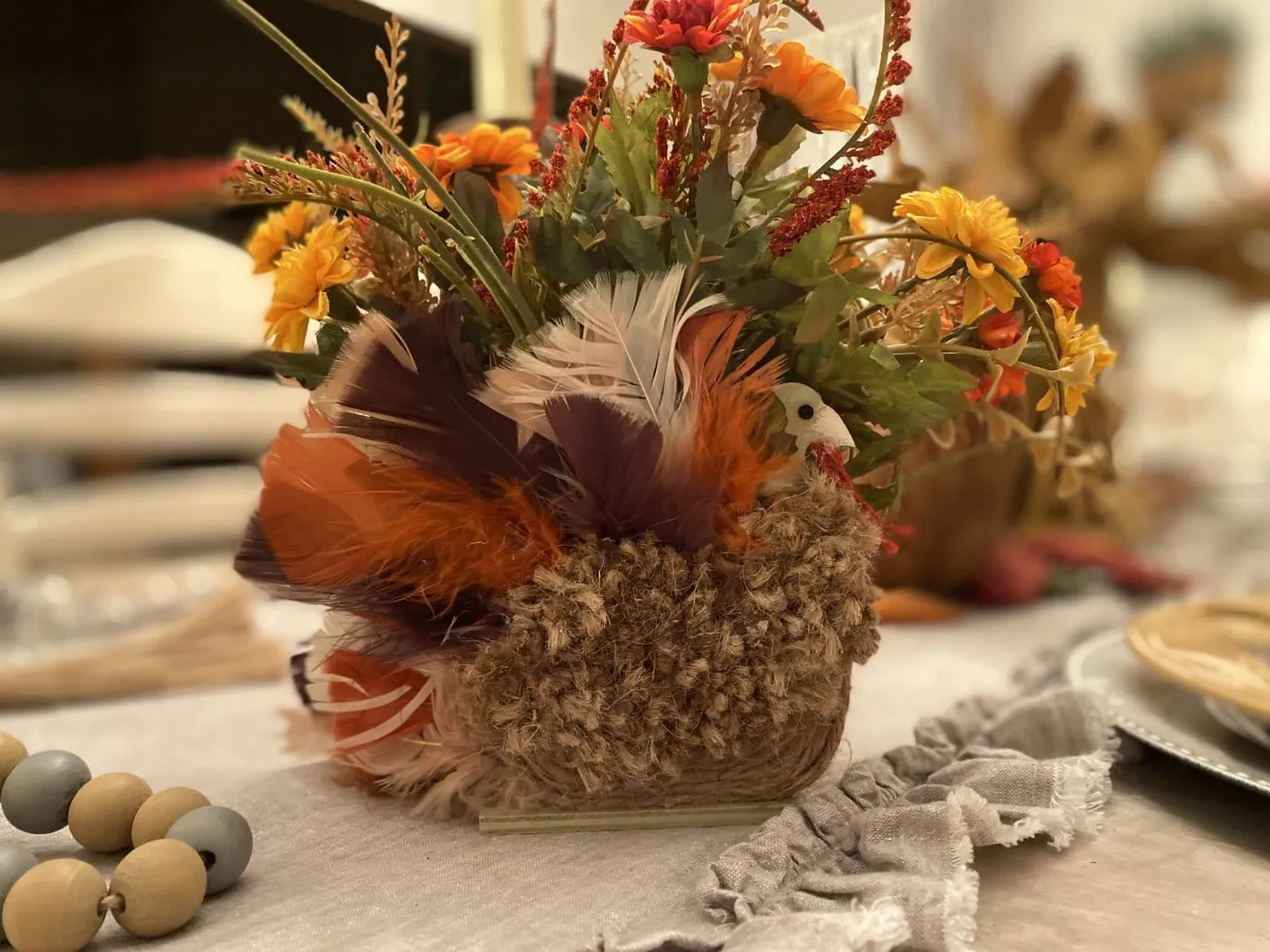
Two materials demand attention here: jute and feathers. Jute sheds fine fibers onto the table for the first week, then collects dust; a weekly lint-roller pass keeps it tidy. Feathers flatten if anything rests against them, so store the piece upright in a box rather than bagged. Keep it out of direct sun — dyed feathers fade to a sad beige by November.
12. White Box Planter with a Lit Votive and Mini Pumpkins
This is a 70/25/5 arrangement: 70% white and cream (planter, pumpkins, votive), 25% orange, 5% green. The green is deliberately the smallest slice — just those fuzzy leaves — because it’s what makes the orange read autumnal instead of Halloween.
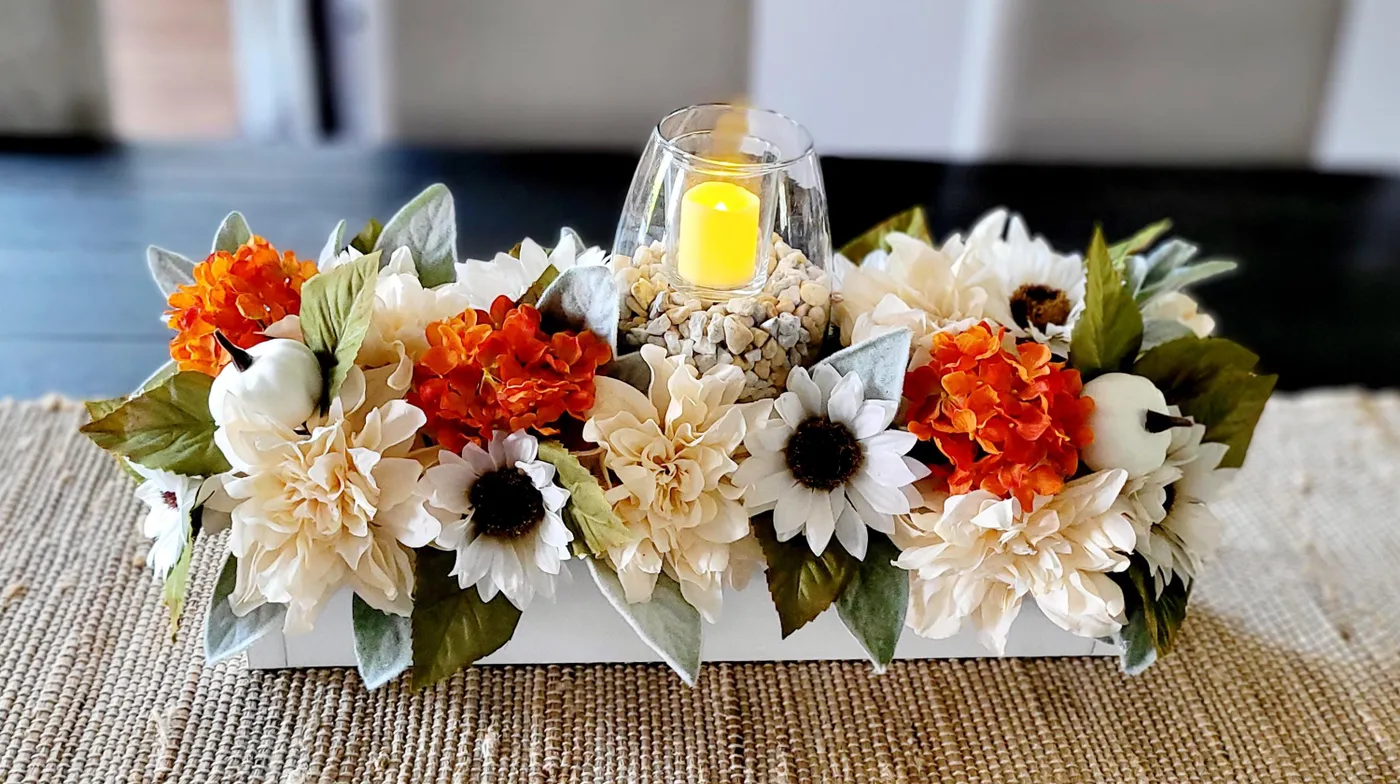
Hold the ratio and you can swap freely: 70% natural wood, 25% burgundy, 5% brass for a moodier table; or 70% cream, 25% sage, 5% copper for something quieter. The smallest color is always the sharpest one.
A rectangular box around 16–18 inches long is the sweet spot for a four- to six-seat table: generous but still leaving a hand’s width between the arrangement and the nearest plate. On an eight-foot table, either go to 24 inches or repeat two smaller boxes with a 12-inch gap. The candle sits low here, so it reads best under nine-foot ceilings where the light stays near the table.
13. Gold Vase of Hot Pink Peonies on Burlap
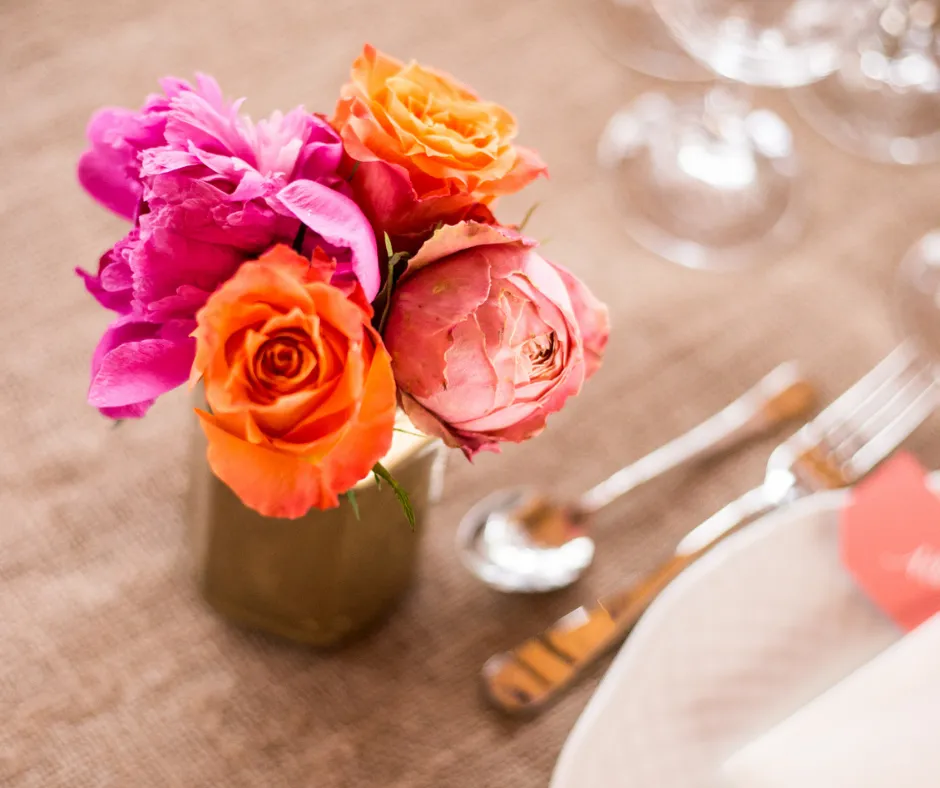
- Metallic gold vase: $1.25–$10
- Peonies and roses, 8–10 stems: $8–$24
- Burlap tablecloth or runner, 2 yards: $6–$18
- Coral paper tags: $1.25
- White plates and silver cutlery (owned): $0–$40
14. Dahlia-and-Zinnia Clusters on a Wood Plank Table
Repetition beats size. Three or four modest bouquets spaced down a long table always look more generous than one enormous arrangement, because the eye reads rhythm as abundance. The sheer peach runner reinforces it — fabric softens hard wood and gives each cluster something to sit on. And the scattered peaches mirror the peach in the napkins and the runner: same trick as the lemons in Idea #2, different fruit.
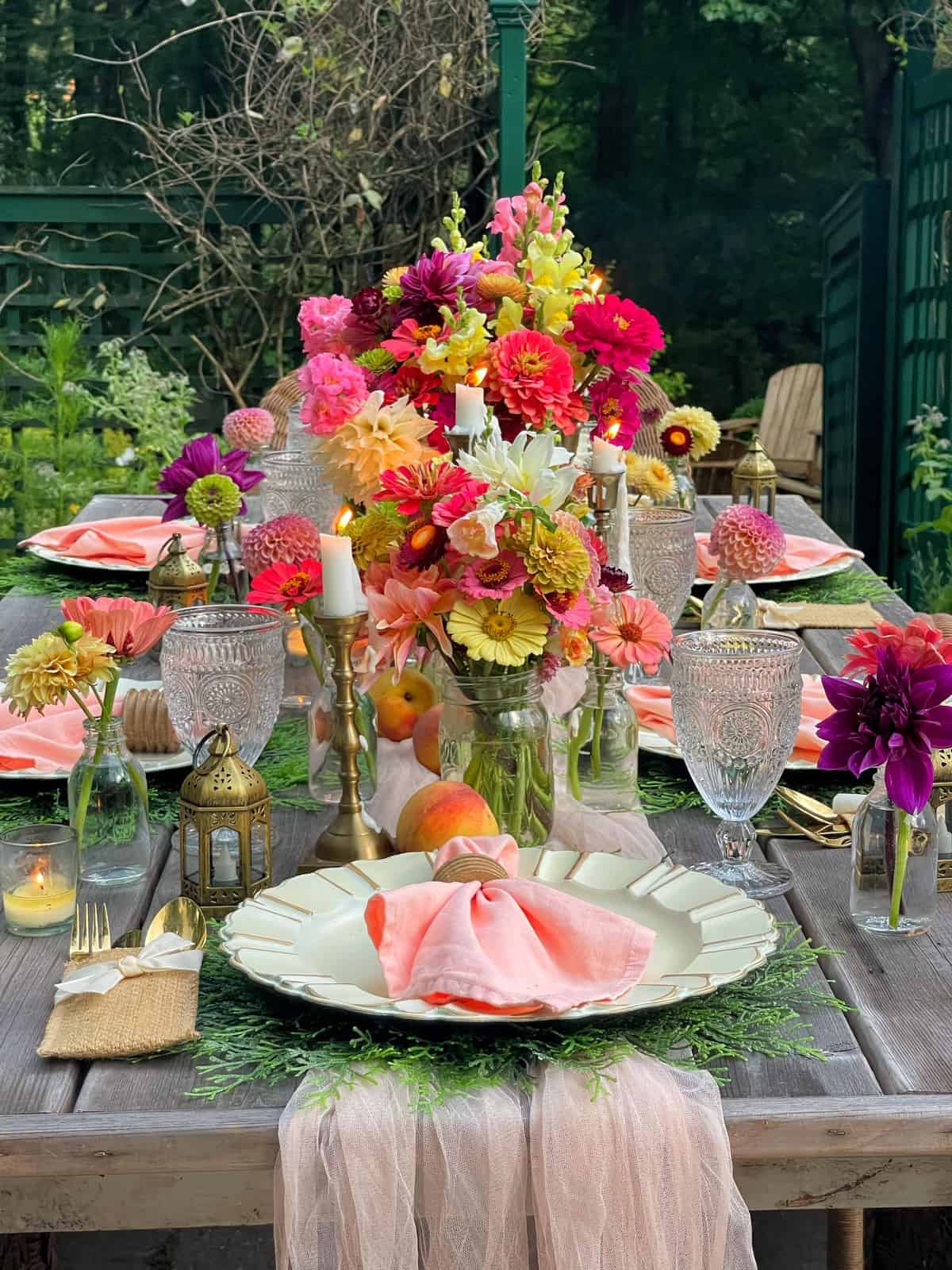
This is long-table geometry. Figure one small arrangement per 24 inches, so an eight-foot table wants three or four and a six-foot table wants two or three. Keep them under 10 inches tall so nobody leans around a bouquet, and leave the outer 18 inches of each end clear for serving. It’s an outdoor-friendly formula too — small clusters survive a breeze better than one tall centerpiece.
15. Lemon-Slice Vase with Tulips and a Raffia Bow
Materials: a clear cylinder vase, one lemon, a knife, raffia. Time: 15 minutes.
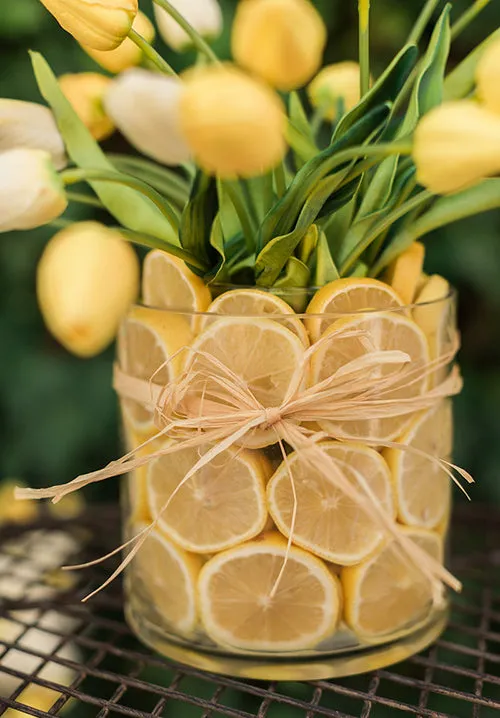
- Slice the lemon thin — about 1/8 inch — and pat the slices dry
- Slide slices down the inside wall, skin facing out
- Set a smaller water-tight glass inside the vase to hold the flowers
- Tie raffia around the outside in a double knot with two tails
- Arrange yellow and white tulips in the inner glass, stems trimmed on an angle
Cost: about $8 with grocery-store tulips. Real lemon slices look incredible for about a day — submerged in water they cloud and soften by hour thirty-six, and citric acid shortens stem life if fruit and flowers share water. Use the double-glass method, or buy faux slices for $1.25 a pack. Compare with Idea #34, which layers pebbles inside the vase instead of fruit, minus the spoilage clock.
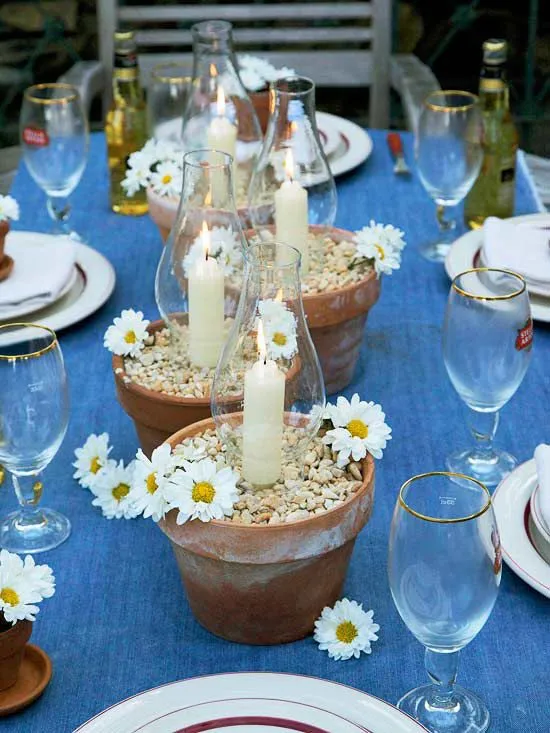
16. Pink Peonies in a Pebble-Filled Glass Bowl
Dollar Tree sells faux peony stems that read convincingly once you separate the petals with your fingers — about $1.25 each, and five or six fill a small bowl. Add a glass bowl from the same aisle and a bag of white craft pebbles from Walmart for $3. Target’s $5 stems are a step up if you want the arrangement to survive being touched. Total: $10–$14, and it never needs water.
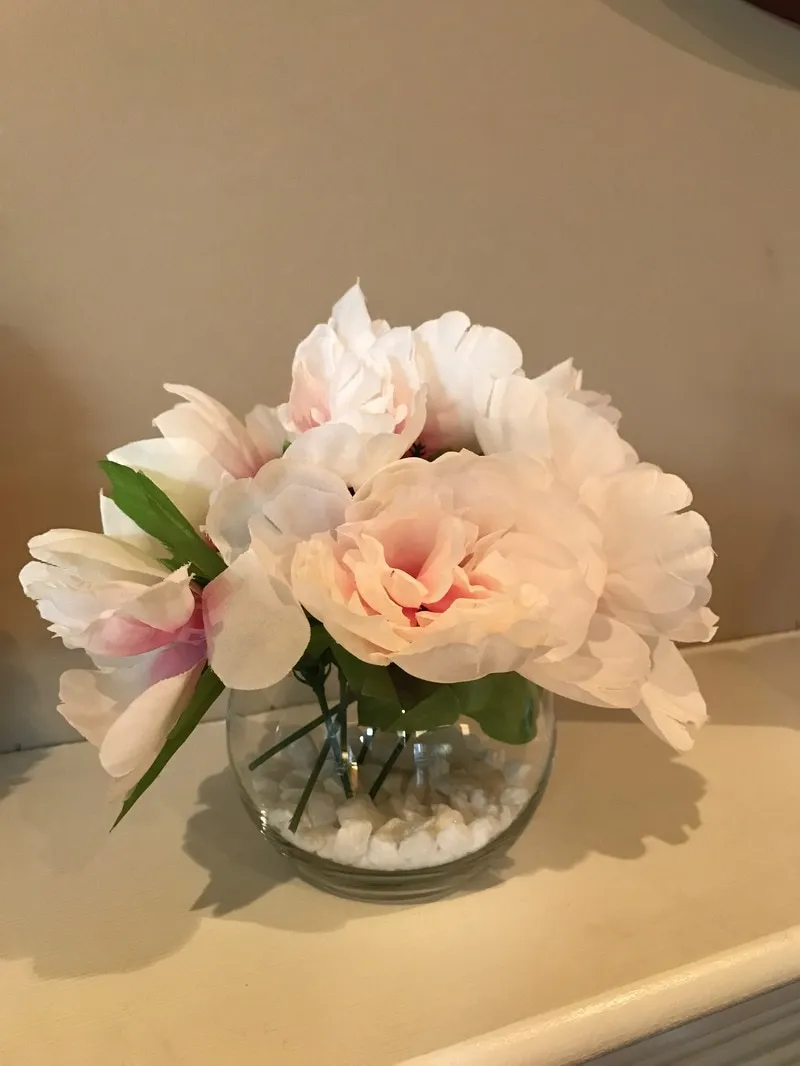
The white pebbles are why this reads as a real arrangement rather than stems dropped in a bowl — they hide every cut end, anchor the stems upright, and bounce light up under the petals so the pinks look brighter. Swap them for sand and it goes beachy, glass marbles and it goes glam, black stones and it goes moody. Cheapest, most swappable element in the piece, and the one people forget.
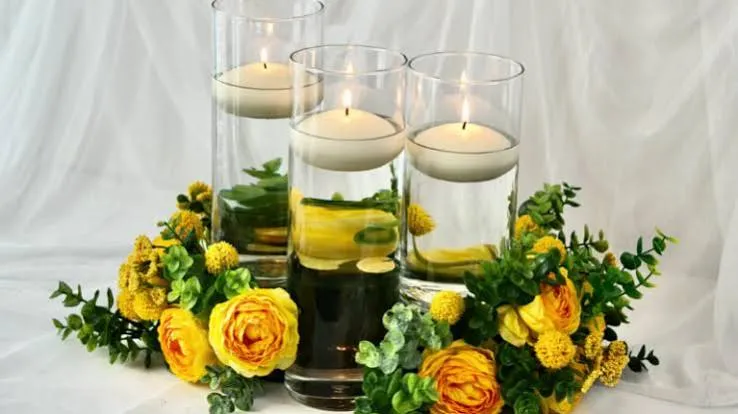
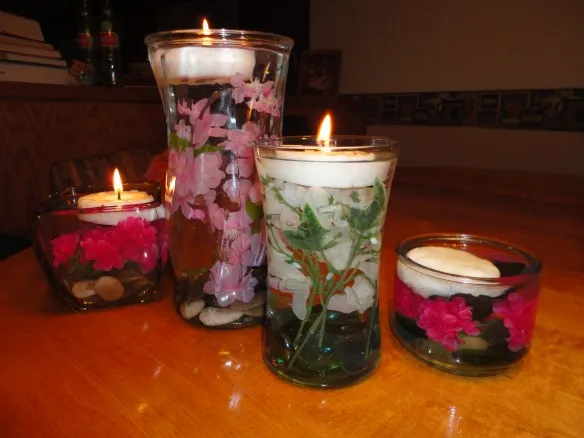
17. Floating Candle Grid with a Lush Urn Behind
Floating candle clusters are a long-surface idea. They need three to five cylinders minimum to read as a group and at least 30 inches of length to spread across. On a dining table, run them down the center at 8-inch intervals and keep the tallest cylinder under 6 inches so sightlines survive dessert; on a buffet or console they can go bigger. Pair with a large urn behind, as here, and the small lights read as foreground instead of the main event.
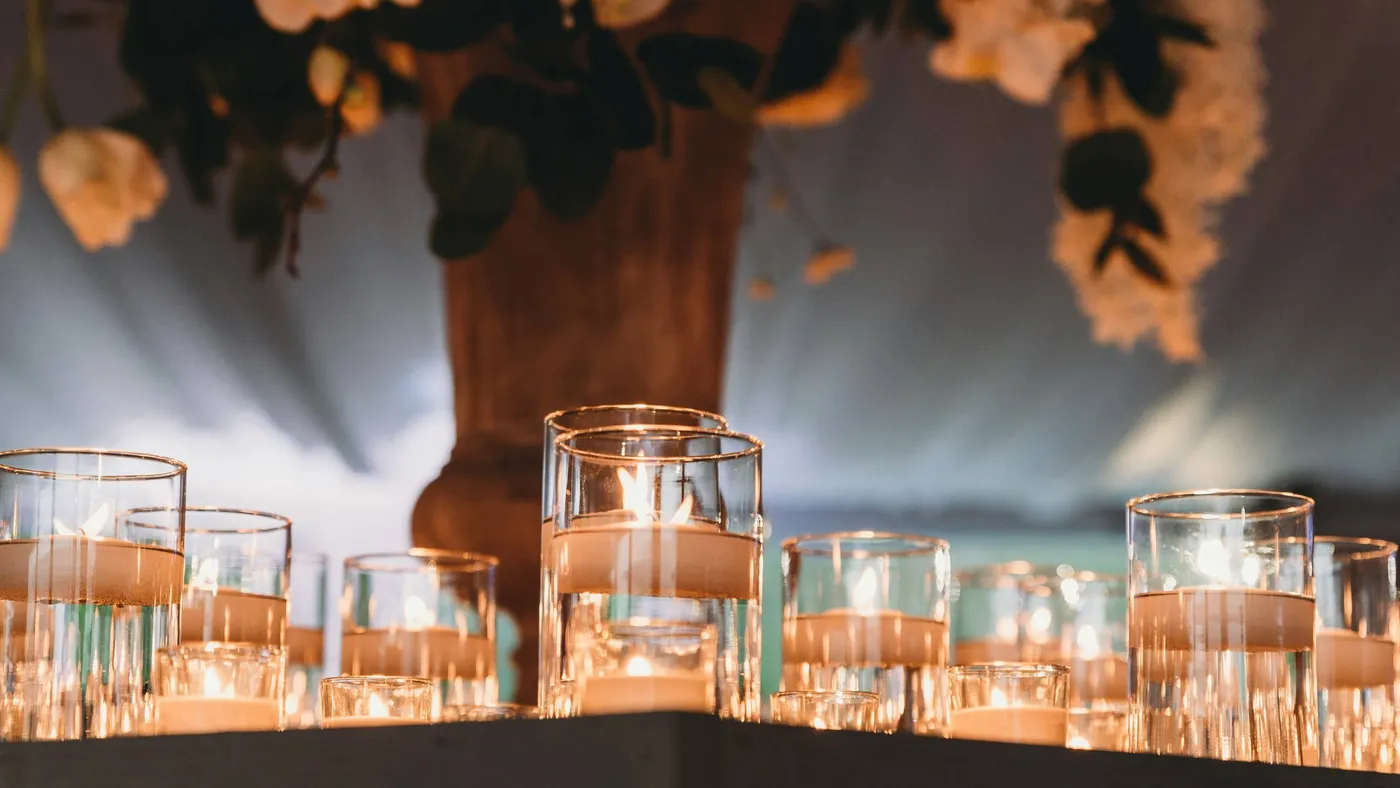
Candlelight-first tables are having a real moment. As dining rooms got smaller and open-plan lighting got brighter, designers started building centerpieces around glow instead of flowers — floating wicks, tea lights, low votives — because a warm pool of light makes a small room feel intentional at night. It’s the most forgiving trend to adopt: a bag of floating candles costs less than a bouquet, and you can add to the cluster over years.
18. Wooden Box of Pink Blooms with Layered Ribbon
Layering two ribbons is the fastest way to make dollar-store florals look bespoke — but the widths have to differ. Think roughly 2:1: a 1.5-inch satin base under a 3/4-inch patterned ribbon. Cut tails about twice as long as the bow is wide and notch the ends on a diagonal so they don’t fray into string. Glue the bow to the box, not the flowers, so it stays put when the arrangement gets moved — and pick a patterned ribbon with yellow in it to echo the flower centers.
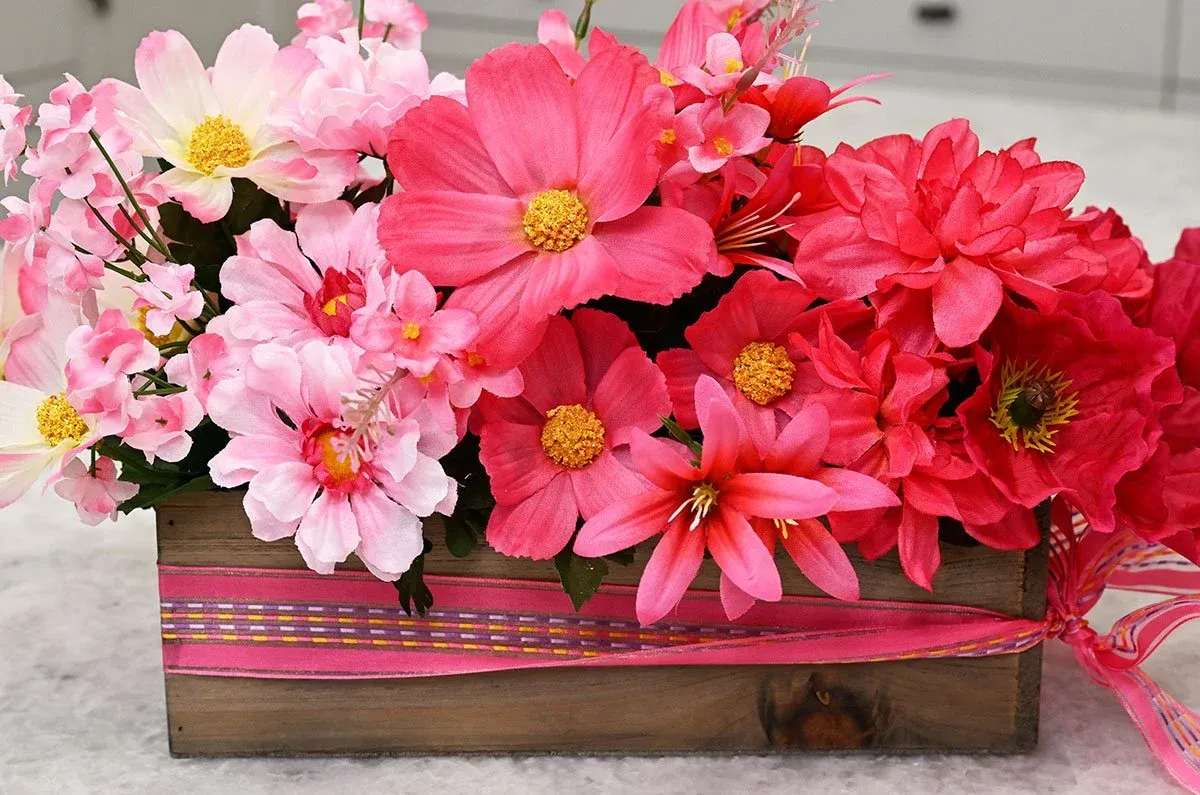
- Wooden box or crate: $1.25–$8
- Assorted pink faux stems, 10–12: $12–$30
- Satin ribbon, 1.5 inch: $1.25–$4
- Patterned ribbon, 3/4 inch: $1.25–$3
- Foam block to hold stems: $1.25–$3
19. The $10 Dollar Tree Base Layer That Reads Custom
Building from scratch at the dollar store, spend money in this order: vessel first, height second, flowers last. A $1.25 glass cylinder, a $1.25 candle, and one $1.25 stem bunch will always beat six cheap items grouped together, because the eye reads the vessel as the expensive part. Facebook Marketplace and thrift stores fill in the vessel gap for $2–$5 — cut glass, milk glass, and brass are everywhere and nobody’s bidding on them.
Check these before you buy a single stem:
- Measure the table’s clear center space — one third of the width, no more
- Count seats; each guest needs a sightline across
- Note which way the window faces — glass and mirror need daylight
- Decide real or flameless candles before buying the holder
- Set a hard budget; $25 is plenty for one centerpiece
20. Sunflower Felt Placemats with Pumpkin-Patterned Plates
The palette runs about 50% rustic brown wood, 30% bright yellow, 15% pumpkin orange, and 5% metallic from the rose gold and glitter. Nothing fights, because the metallics are distributed rather than clustered.
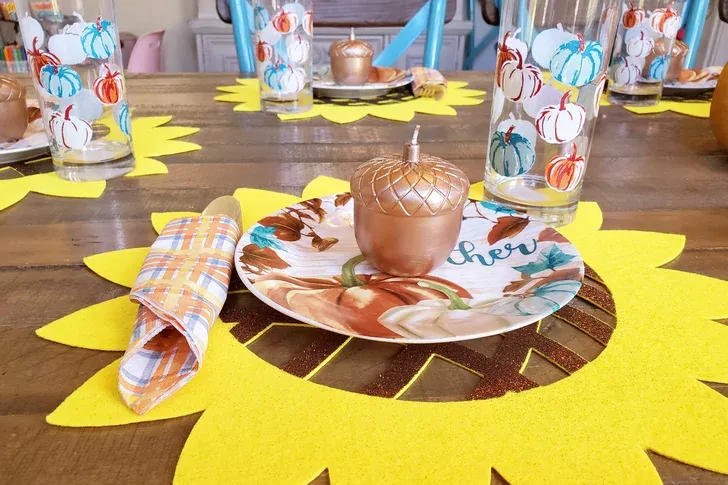
- Swap yellow for sage and it becomes quieter, more modern
- Swap orange for burgundy and it leans dinner-party formal
- Keep the placemat-on-mat layering regardless — two rounds under a plate always look richer than one
Glitter placemats are a commitment. The brown zigzag mats will shed onto your tablecloth, your napkins, and eventually your guests’ laps — shake them outside before the first use and again before storage. Felt sunflower mats don’t love heat, so put a trivet under anything straight from the oven. If kids are at the table, swap the rose gold acorn candles for battery votives.
21. Footed Glass Bowl of Pillar Candles and Cinnamon Sticks
Candle wax and dried botanicals get messy once the season ends. Wax inevitably drips into the leaf filler, and cinnamon sticks lose their scent within a month or two. The good news: a glass footed bowl cleans up in five minutes — freeze it for twenty minutes so the wax hardens, lift it out in one piece, then wipe with warm soapy water. Never chip at soft wax with a knife; that’s how glass bowls get cracked. Expect to replace the leaf filler each October.
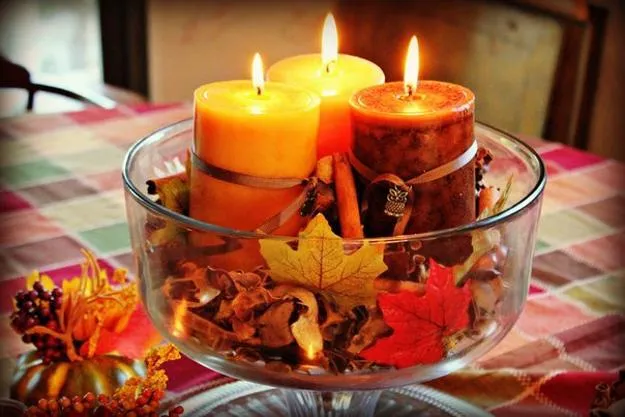
Build it in ten minutes without lighting a match.
- Fill the footed bowl two-thirds with dried leaf potpourri
- Press three pillar candles into the filler so they sit level and firm
- Tuck maple leaves and cinnamon sticks around the bases, not on top
- Add a small owl or charm at the front for a focal point
- Light only once the arrangement is stable — or use LED pillars
22. Twig Lantern with White Roses and Preserved Moss
The moss. Without it, the twig structure is a craft-store birdhouse with flowers glued on. With it, the piece reads as something that grew — moss softens the hard edges where bark meets rose, fills the gaps the eye would otherwise catch, and adds the one texture faux flowers can’t fake. Tuck it in small pinches at the junctions rather than spreading it like frosting, and keep it slightly irregular.
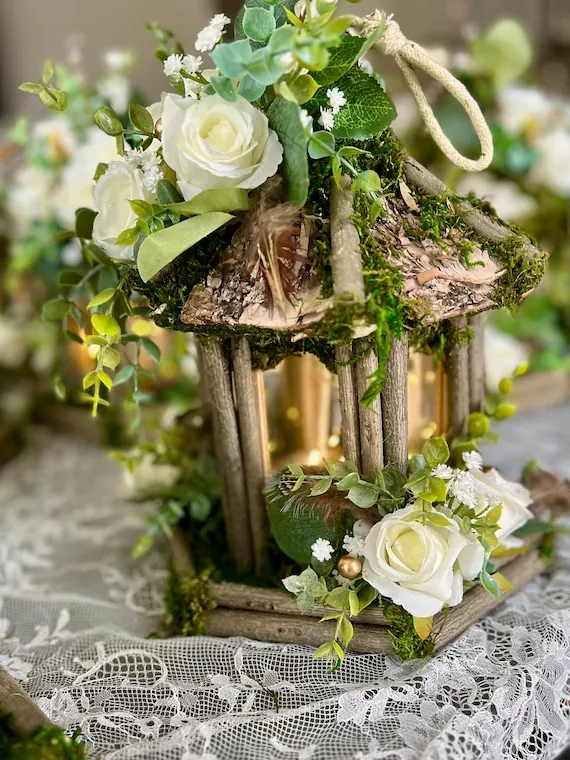
The scale ratio is doing something smart: many small white roses against one large rough form. Your eye gets a big shape first, then a dozen small rewards for looking closer. The warm string lights inside work for the same reason — hidden light makes the structure feel occupied instead of empty, and a house-shaped lantern with a glow in it is nearly impossible not to smile at.
23. Mercury Glass Vases of White Peonies on a Silver Tray
A mercury glass cluster wants a small footprint — three to five vases inside an 18-inch circle is plenty for a dining table, which is why this also works on a distressed console or sideboard. On a sideboard, vary heights more aggressively since nobody needs a sightline. Keep the tray’s edges within the furniture’s depth or the whole thing looks like it’s about to tip, and let the sheer white curtains behind it do the softening.
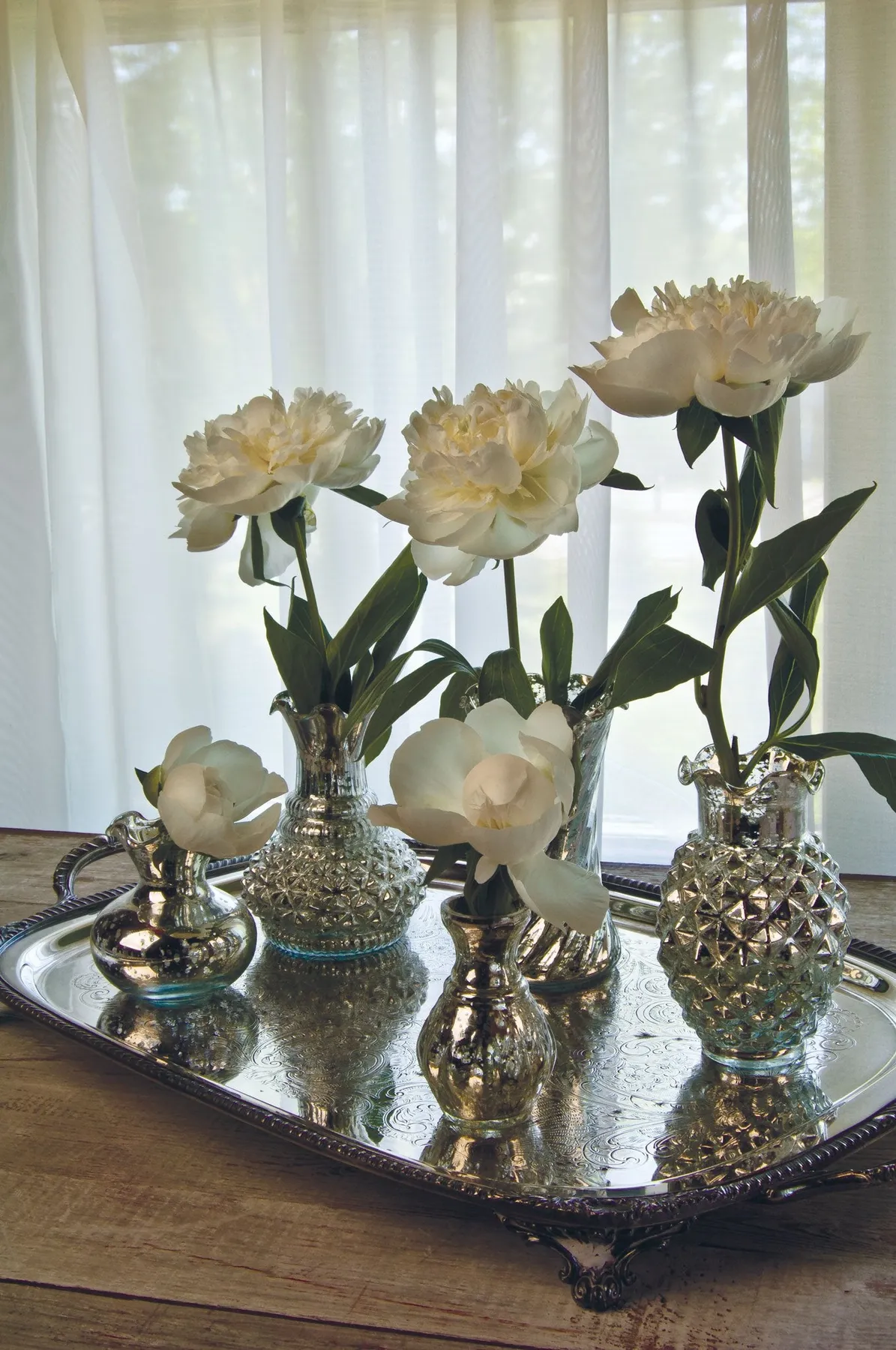
Mercury glass is one of the easiest finishes to fake. Dollar Tree glass vases and goblets, sprayed inside with mirror-effect or silver metallic paint, look startlingly close — about $1.25 per vessel plus one $6 can that covers eight. Spray the inside, not the outside, and cure overnight. Skip the ornate tray and use a thrifted cake stand; the reflection matters more than the pedigree.
24. White Pumpkin Beside a Fluted Jar Candle Arrangement
Height math matters more than color here. The fluted jar is roughly six to seven inches; the pumpkin is about three. That 2:1 ratio is the whole reason the pairing looks composed instead of accidental. If both objects land within an inch of each other, one reads as a mistake. Rule of thumb for any two-object vignette: the shorter piece should be half to two-thirds the height of the taller one, and both should sit on a common base like that woven mat.
Roughly 80% white — jar, candle, pumpkin, mat — 15% soft pink, 5% green. That’s a safe ratio for small surfaces like a console or side table, where a bolder split starts to look cluttered. To shift seasons, keep the 80% white and trade pink for soft orange in fall or light blue in spring. The white majority is what lets a small color change read as a whole new arrangement.
25. Floating Tea Lights on a Bed of Faceted Gems
Ten minutes, no glue, no water.
- Fill a shallow glass bowl two-thirds with clear faceted gems
- Smooth the surface so the lights will sit flat
- Set flameless tea lights on top, spaced roughly two inches apart
- Tuck three small white roses around the outside base
- Switch the lights on and dim the room to check the glow
- Shallow glass bowl: $1.25–$6
- Bag of clear faceted gems: $1.25–$5
- Flameless tea lights, 4–6: $3–$10
- Small white faux roses, 3: $2–$6
26. Wooden Bowl of Pinecones Flanked by Orange Tapers
Taper candles are the least kid-friendly thing you can put on a dining table. They tip, they sit at exactly grabbing height, and these are close enough to a wooden bowl of pinecones to make anyone nervous. If children or a curious cat share the room, move the tapers to a sideboard or swap for flameless tapers — the modern ones look convincing from two feet away. Also check your ceiling fixture: tapers this tall can crowd a low-hanging chandelier.
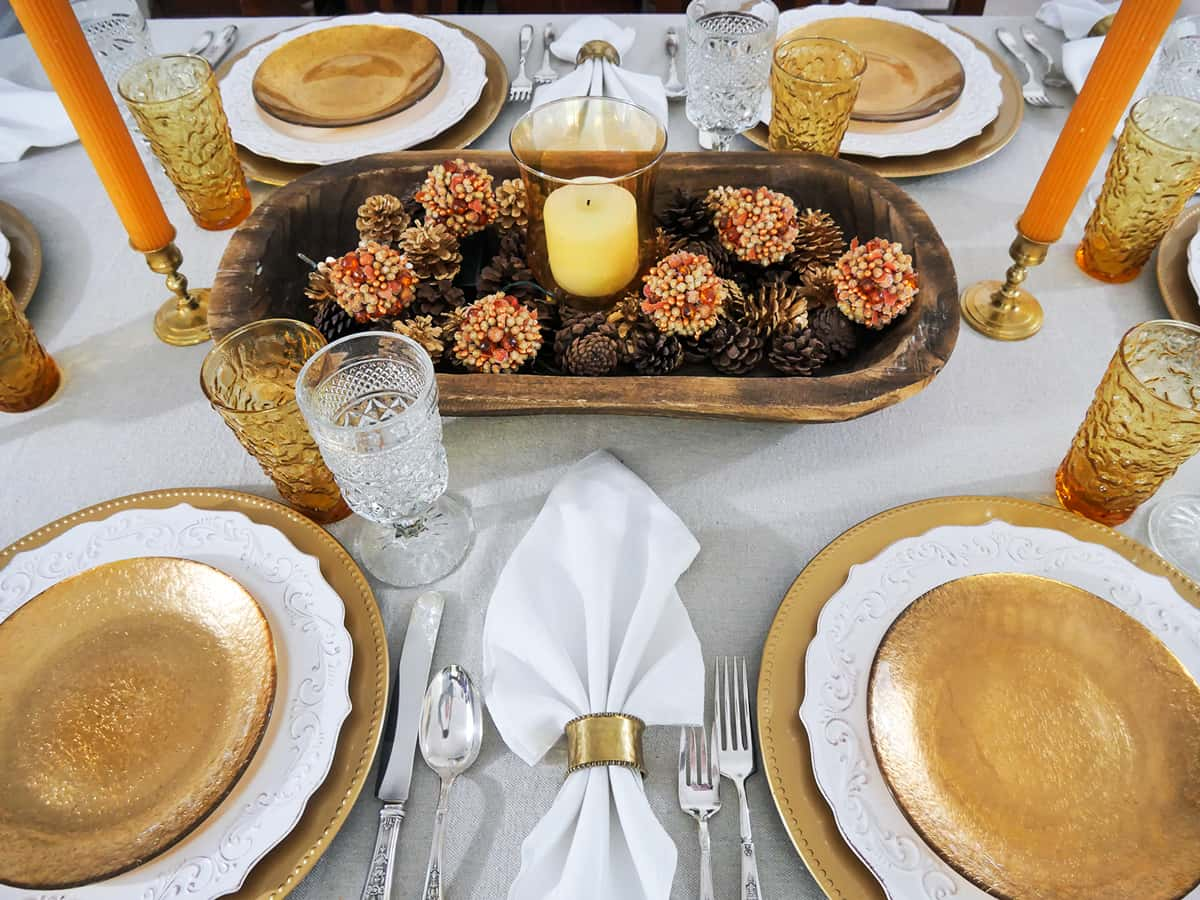
The two tall orange tapers are the point. The wooden bowl is lovely but it’s a low, dark mass — alone, it disappears against a wood table. The tapers give the arrangement vertical drama and lift the orange to eye level, where it can be seen from across the room. They also frame the bowl, making a fairly simple object look composed. Remove them and the centerpiece shrinks by half.
27. Baby’s Breath and Twisted Tapers Against a Vine Trellis
Baby’s breath spent a decade as filler and has quietly become the main event. The 2026 version leans into what it does best — airy, inexpensive, forgiving — and lets volume carry the elegance instead of expensive blooms. It photographs beautifully in daylight, which is probably why it keeps winning on Pinterest, and it’s a trend with staying power because it costs almost nothing to execute. The twisted white tapers and satin ribbon are the only styling it needs.
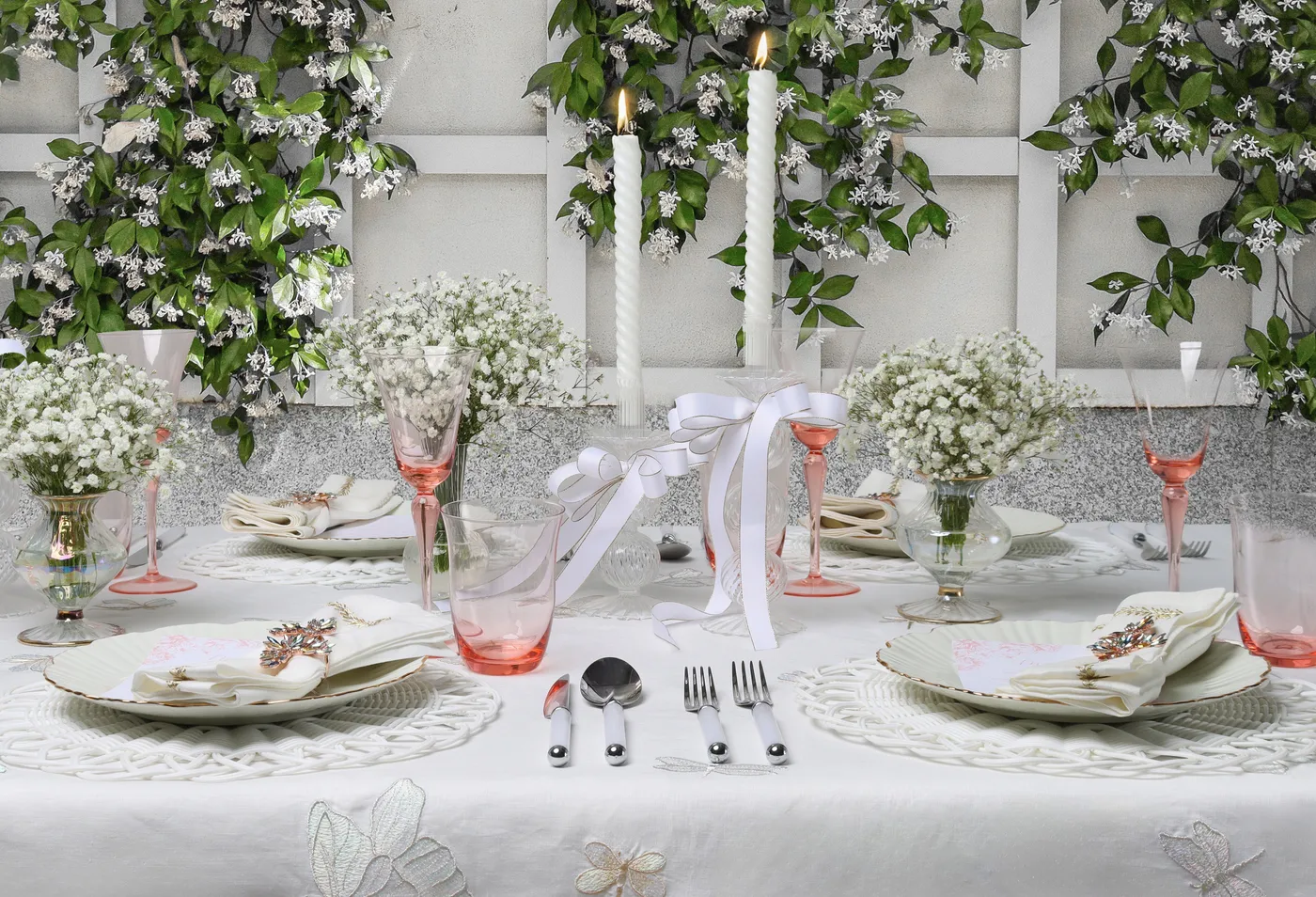
This one has a room requirement, not just a table requirement. A trellis backdrop needs 30 to 36 inches of clearance behind the table so people can walk past, which means a dining room of at least 12 by 12 feet. If your space is tighter, drop the trellis and keep the formula — white cloth, twisted tapers, baby’s breath — and let a plain wall do the work.
28. White Sunflowers and Dried Grass in a Speckled Vase
Two moves make this look expensive for very little. The vase: a $1.25 dollar-store cylinder sprayed with stone-finish paint and flecked with a toothbrush gives you the speckled ceramic look for under $8. The volume: buy one good bunch of white sunflowers and let cheap dried grasses do the rest — dried filler is $1.25 a bundle and never wilts. Total for the whole arrangement, vase included, about $20.
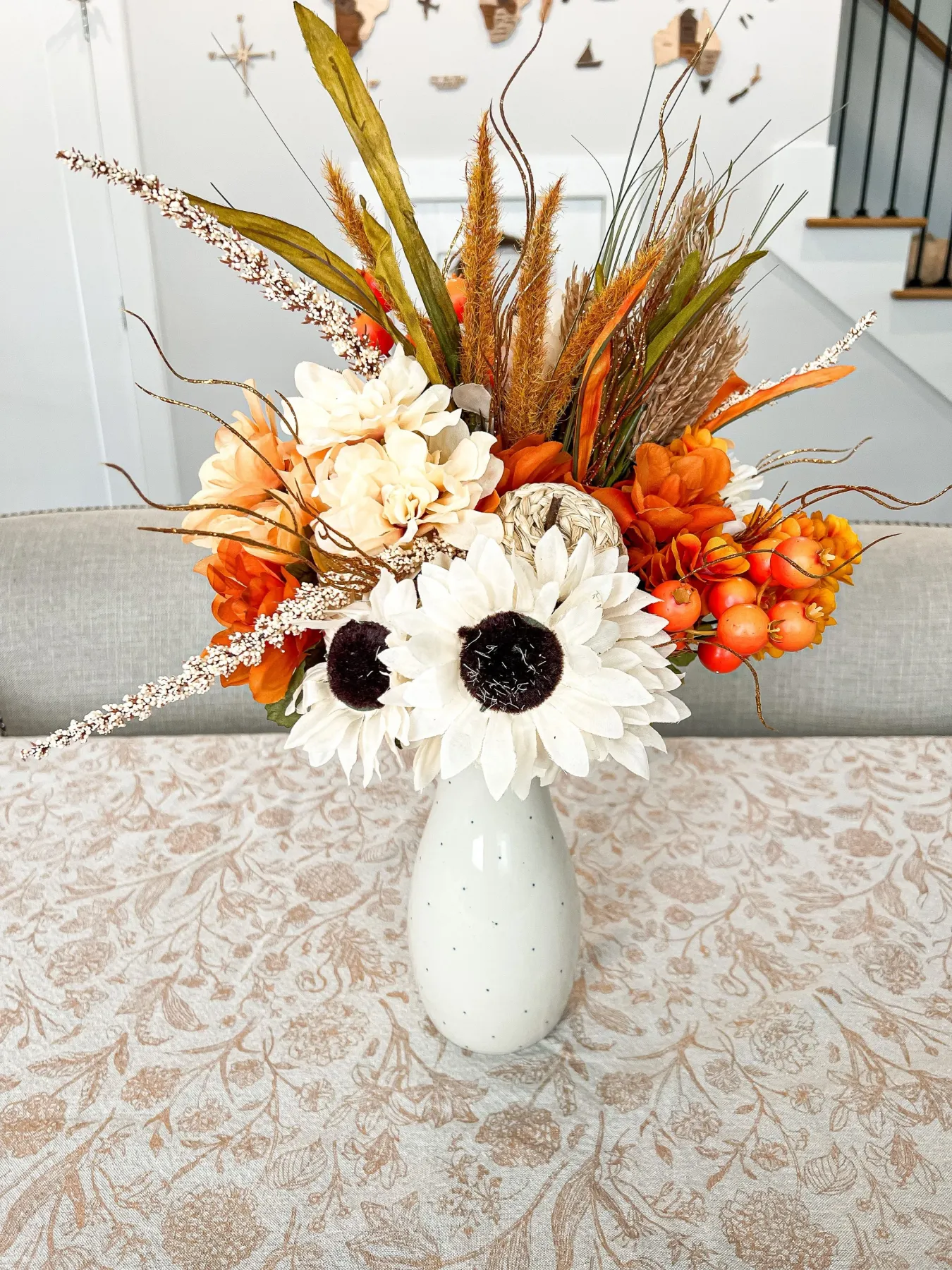
Dried grasses need to be twice the height of the vase or they look like they’re apologizing. Cut them long, place them first to establish the outer silhouette, then set the heavy blooms inside that boundary. A light mist of unscented hairspray holds fluffy grasses together and cuts shedding by half — do it outside, one pass. Compare with Idea #5 — same tall-vase abundance, warmer palette.
29. Pastel Blooms on a Marble-and-Gold Stand
The marble-and-gold stand creates a second plane. Everything else on the table sits low, so lifting the florals six inches makes the centerpiece read as a different category of object rather than just more stuff. The palette does the rest: peach and sage are neighbors on the color wheel, so the whole table stays calm while still being colorful, and the clear glass candlesticks keep the vertical line from feeling heavy.
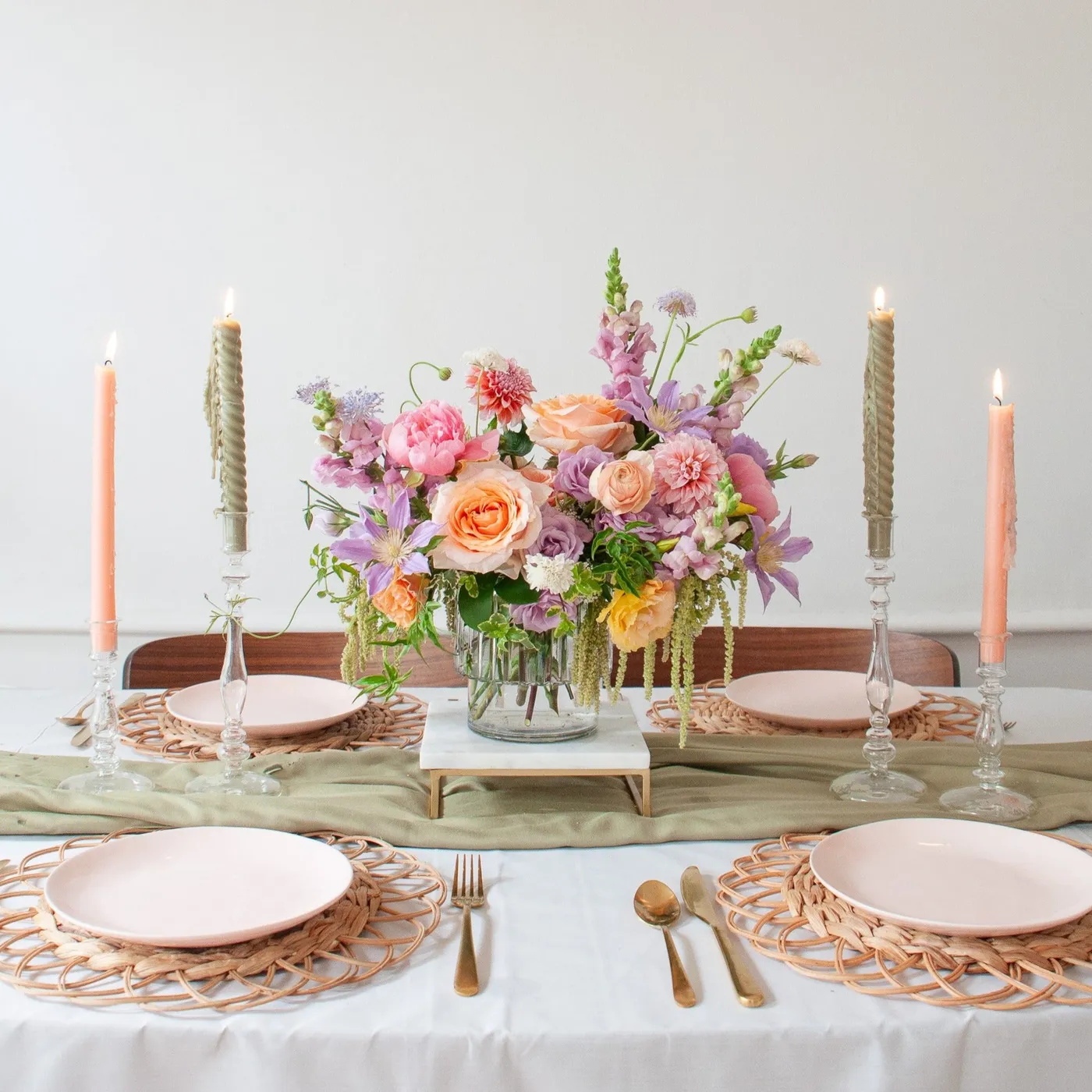
Soft pastel florals are the least forgiving thing on this list. Hydrangeas and garden roses drink heavily, so check water daily — the level drops faster than you’d think. Pastel petals bruise brown at the slightest bump, so arrange once and leave it alone. If you want the look without the vigil, faux pastel stems in a fluted vase with a light water mist read nearly identical from three feet.
30. Blue-and-Teal Accented Table with a Multicolor Bouquet
It’s 60% white cloth and plates, 25% blue and teal, 15% multicolor floral. The blue does the framing — patterned placemats, napkins, those embossed teal goblets — while the flowers get to be loud because nothing competes. Swap the blue for sage and the same bouquet turns garden-party soft; swap it for charcoal and it becomes dinner-party moody. The flowers never change, which is the useful part: buy the multicolor bunch once and let the linens do the season.
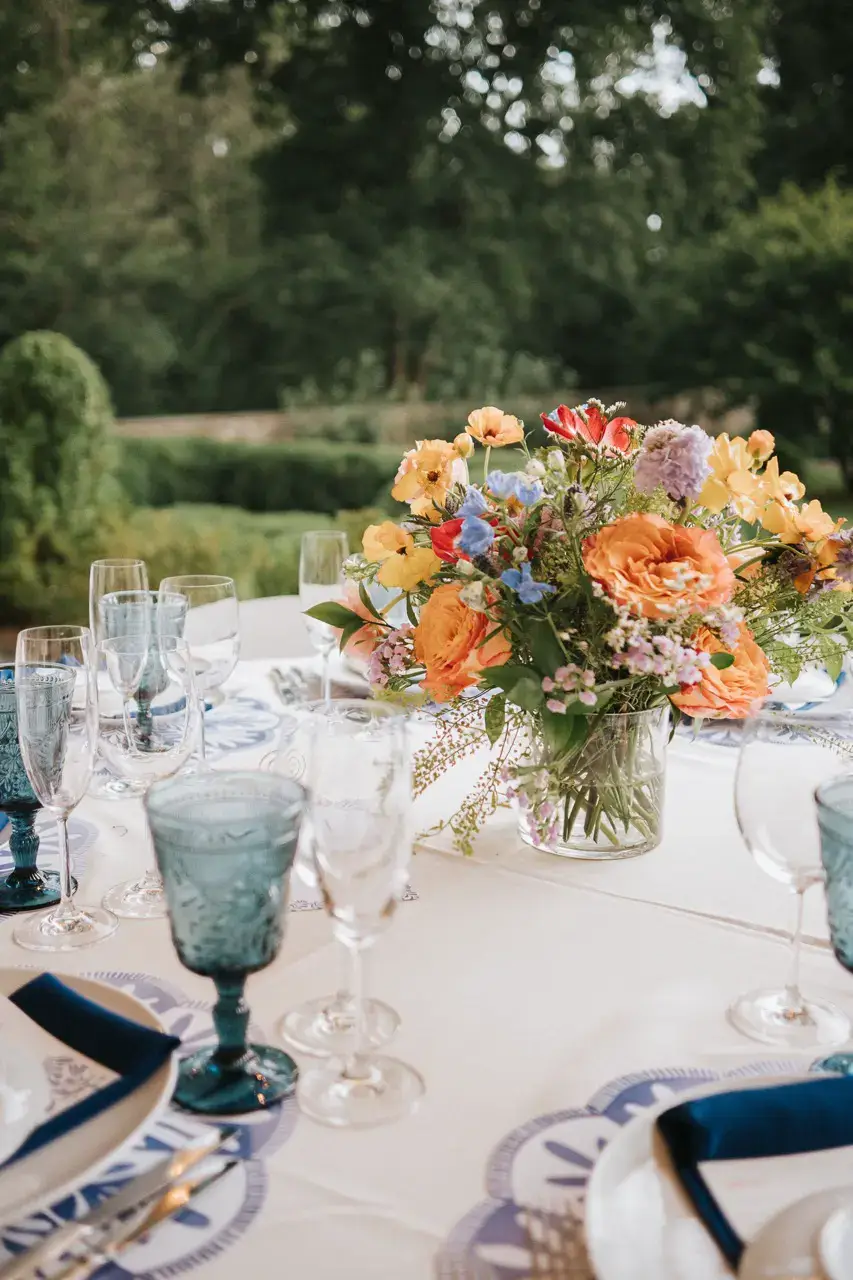
Outdoor tables have extra variables. Check these first:
- Wind direction — tall arrangements and loose paper don’t mix
- Shade at your serving hour; teal glass goes muddy in full sun
- Table length — one arrangement per 24 inches
- Weights or clips for the tablecloth at each corner
31. White Tulips with Green-and-White Striped Lamp Shades
Repeat a pattern exactly twice, never three times. Here the green-and-white stripe shows up on the lampshades and again on the placemats, then stops. That’s enough for the eye to register a scheme; add striped napkins and it tips into costume. Pick your boldest pattern and give it one echo across the table — everything else stays solid. The white planter, white dishes, and silver bunny candle holder are all doing that quieting work.
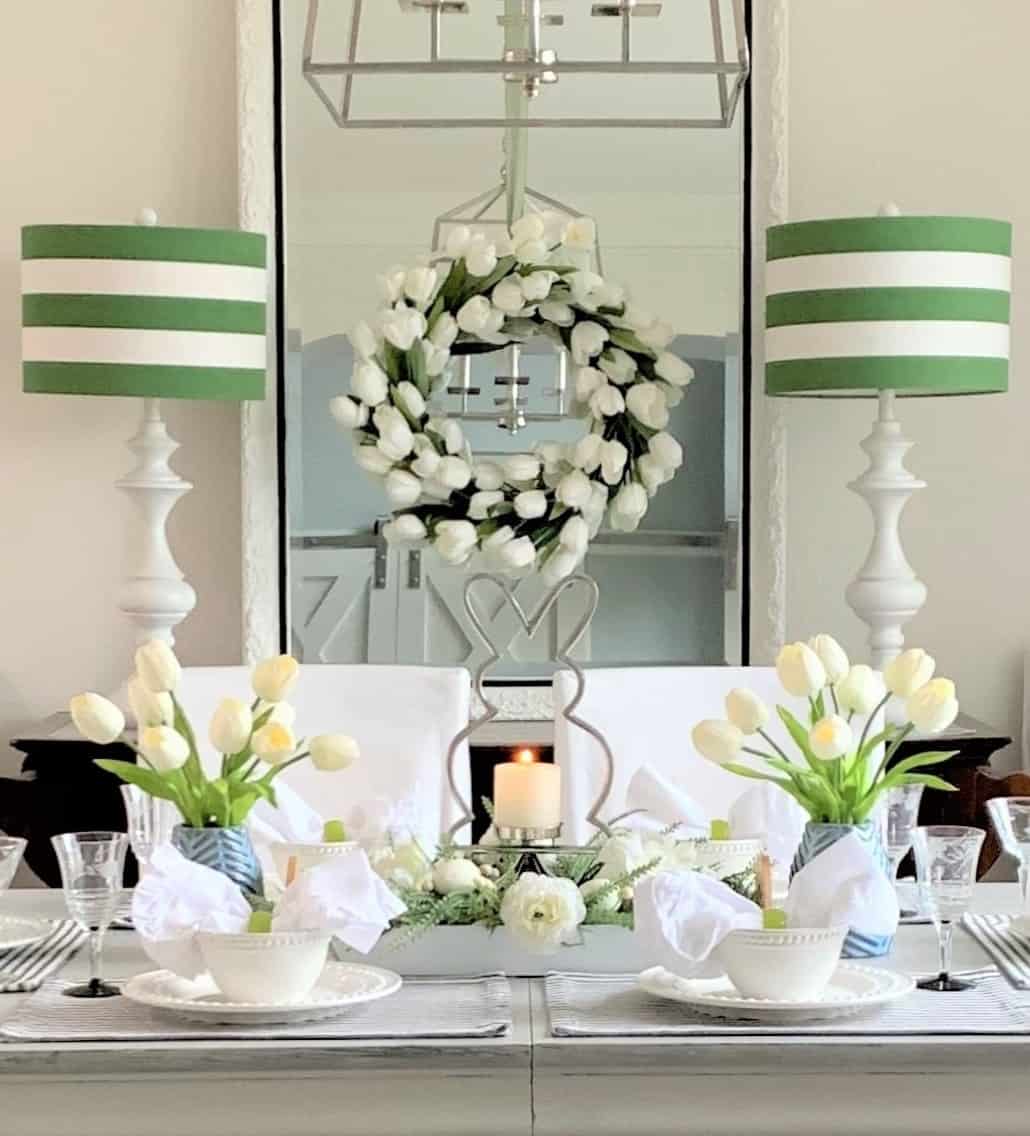
- Rectangular white planter: $1.25–$8
- White faux blooms and greenery: $6–$18
- Silver bunny candle holder: $1.25–$6
- Striped placemats, set of 4: $4–$16
- Small bud vases with white tulips: $3–$12
32. Polka Dot Table with Hydrangeas and a White Teapot
The polka-dot tablecloth is the reason a teapot, a wooden letter, a book, and a handful of hydrangeas look like a party instead of a pile. A pattern on the cloth sets the tone and gives mismatched objects a shared home — exactly what you want when you’re shopping the dollar store for accessories, because you can be eclectic as long as the background is decisive. The paper doilies under each item finish the charm.
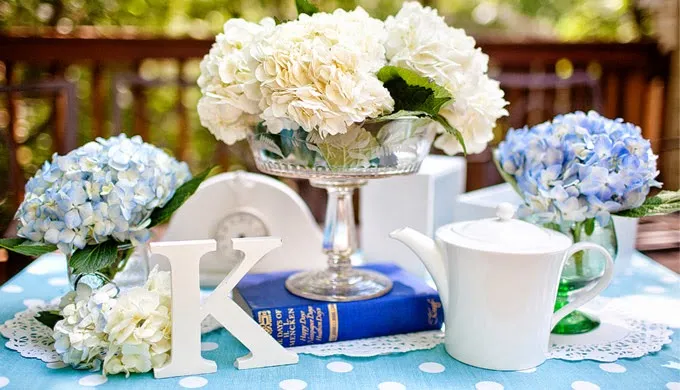
Here’s what the setup doesn’t tell you: hydrangeas drop petals constantly, and paper doilies outside become confetti the second a breeze picks up. Tape the doilies down at the corners with double-sided tape. On a windy day, weight the cloth, skip the loose paper, and swap fresh hydrangeas for faux — they hold shape and don’t wilt in the sun.
33. Purple Foliage in a Distressed Gold Footed Bowl
A foliage-only arrangement takes twelve minutes and never wilts.
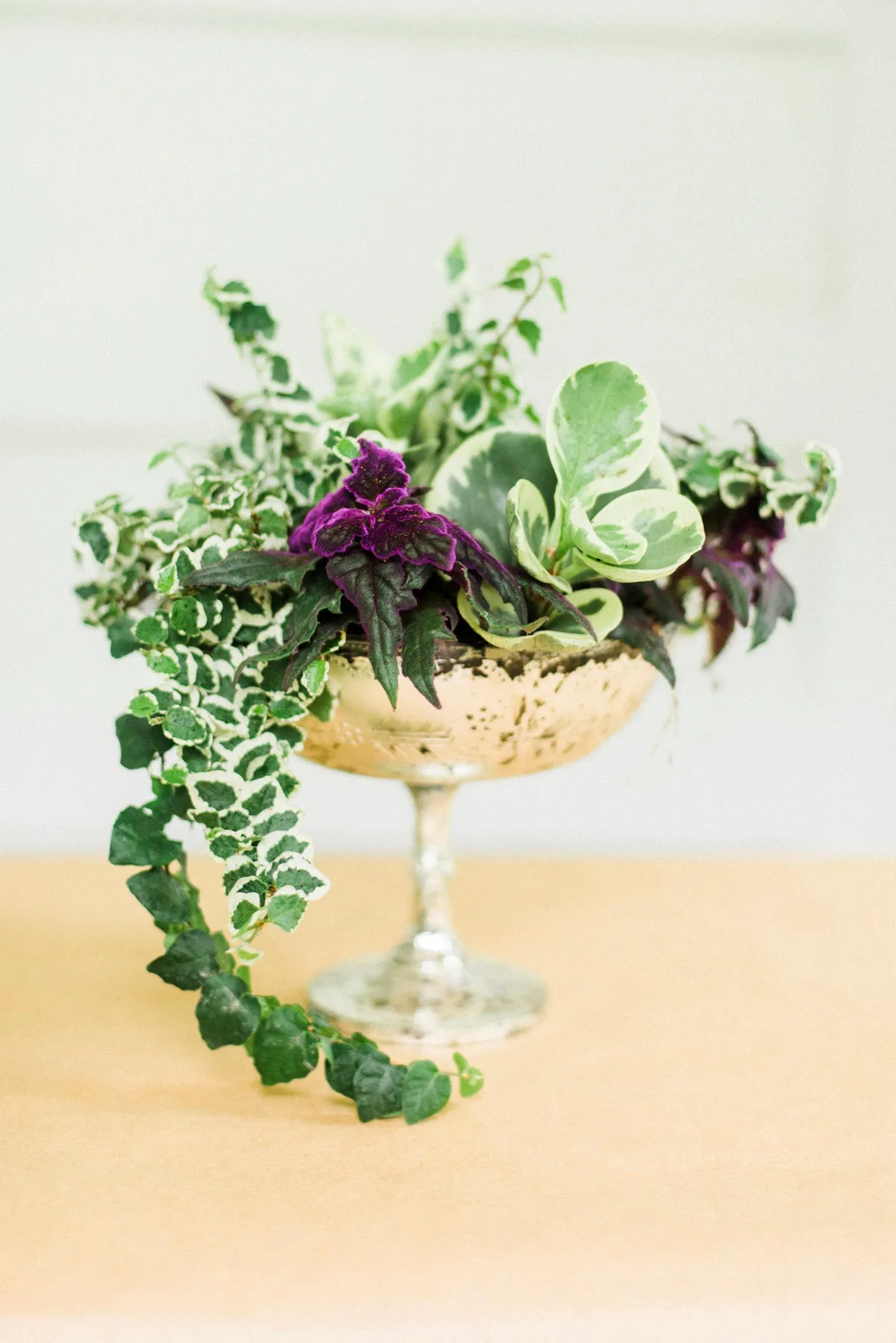
- Set a foam block in the footed bowl, trimmed just below the rim
- Insert the darkest purple foliage first, low and off-center
- Add variegated ivy so it spills over one edge only
- Fill the top with light green leaves, keeping a dome shape
- Step back three feet — if any stems cross oddly, recut and reset
Footed bowls work best on round and oval tables, especially smaller ones: a 48-inch round handles a 12-inch bowl without crowding plates, while a rectangular table usually wants something longer and lower. They’re also the answer for narrow rooms, since the arrangement lives in a cylinder of space rather than spreading sideways. For a table with more visual room, see Idea #14.
34. Pink Peonies in a Gold-Dipped Vase on a Pebble Tray
The gold-dipped vase is the easiest DIY on this list. Tape off the lower half of a $1.25 glass cylinder, spray that section matte gold, peel the tape while the paint is still tacky, and cure overnight. Faux peonies are $1.25 a stem; the white tray and pebbles come from the same aisle.
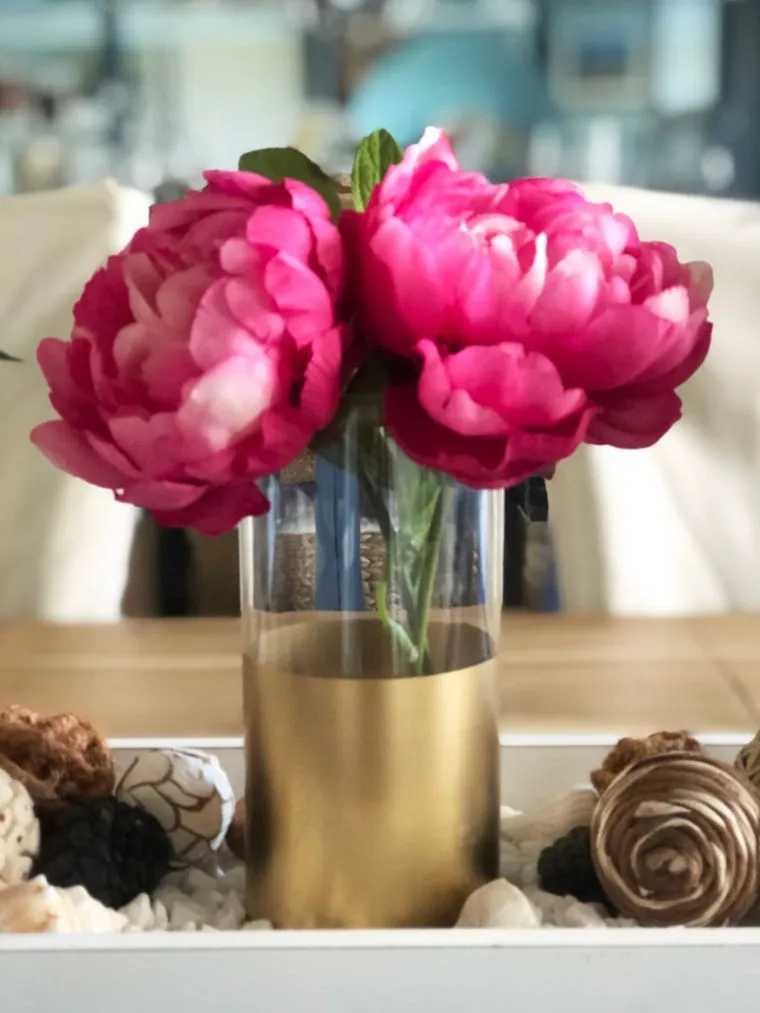
- Glass cylinder: $1.25
- Matte gold spray (shared can): ~$2
- Two faux peony stems: $2.50
- White tray and pebbles: $2.50
Restraint, mostly. Two blooms in a small vase is a choice, not a shortage — it reads as confidence and makes everything around it look curated. The white tray acts as a frame, containing the pebbles, pods, and coiled wood so a scattering of natural bits becomes a composition instead of clutter.
35. Yellow Pom-Pom Placemats with a Crinkled Blue Runner
Yellow and blue is the sleeper palette of the season — it’s showing up everywhere from kitchen textiles to wedding tables because it’s cheerful without being childish, and it photographs like a summer day even in November. Pom-pom placemats belong to the same mood: texture as decoration, cheap to produce, impossible to ignore. The crinkled runner is the trick that keeps it from looking precious, and the mix of an ornate white urn with a matte gray vase keeps the flowers from matching.
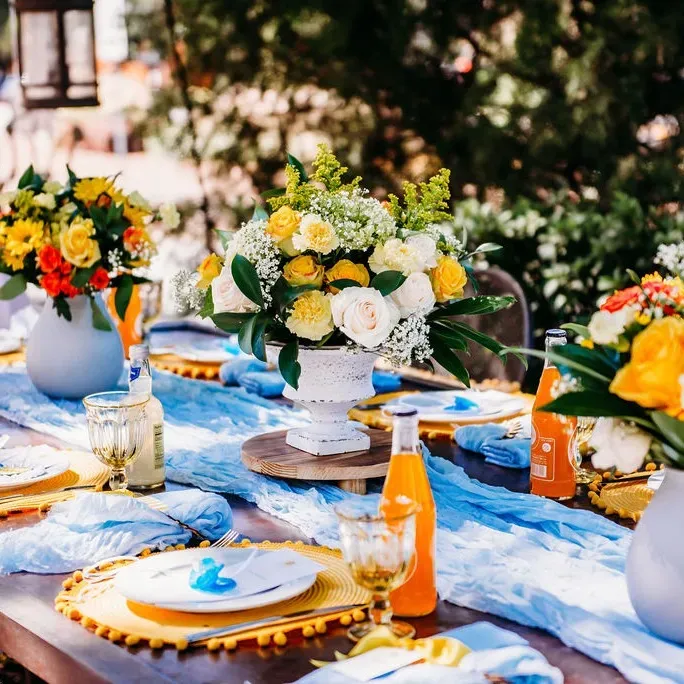
A few practical checks before you commit to a color-forward outdoor table:
- Confirm your plates read white in shade — yellow placemats tint them
- Measure the runner; it should overhang 6–8 inches per end
- Count vases before flowers — three small beats one big
- Have a wind plan for the pom-pom mats
Three Vases, One Candle, Zero Excuses
None of this requires a designer, a florist, or a hundred-dollar trip — just a vessel you actually like, one thing that glows, and a height difference you can see from across the room. Start with the tray or the vase, build outward, and give yourself ten extra minutes to fluff the stems before anyone walks in.
📌 Pin your favorite from this list now — when the table is bare and the doorbell is ringing, you’ll be glad you saved it.