
You know that feeling when you finally spot a black-and-white Christmas tree that looks exactly right — crisp, a little dramatic, and somehow still warm — and then you can’t stop scrolling? Same. That’s why we rounded up 18 real trees from real homes instead of another batch of renders.
After filtering through hundreds of options across Etsy, Target, Wayfair, and Walmart, we narrowed it down to the 18 ideas that actually deliver — monochrome modern, cozy Scandinavian, glam metallic, and earthy natural. Prices here run from about $12 for a single bauble set to $899 for a full tree-and-decor setup, and we compare budget and luxury versions side by side so you can see where the money actually matters.
2026 is the year black-and-white trees stopped being a trend and became a default — matte black baubles and striped ribbon have been climbing on Pinterest all fall, and the palette plays nicely with any room you already have. And stay until the end — we break down the most common mistakes that can ruin these looks.
Pin this guide for later — your future self will thank you when it’s time to actually do this.
1. Bold Striped Gift Wrap Under a Trimmed Tree
Two things are doing the heavy lifting in this corner. First, repetition — the bold black-and-white vertical stripes on the stacked presents echo the ribbons already hanging in the tree, so your eye reads the whole vignette as one composition instead of three separate props. Second, palette discipline: black, white, and warm wood, with green appearing only in the tree itself, which turns the greenery into the accent color rather than the base. The round marble-topped table and the woven basket add two different surface temperatures without adding a third color.
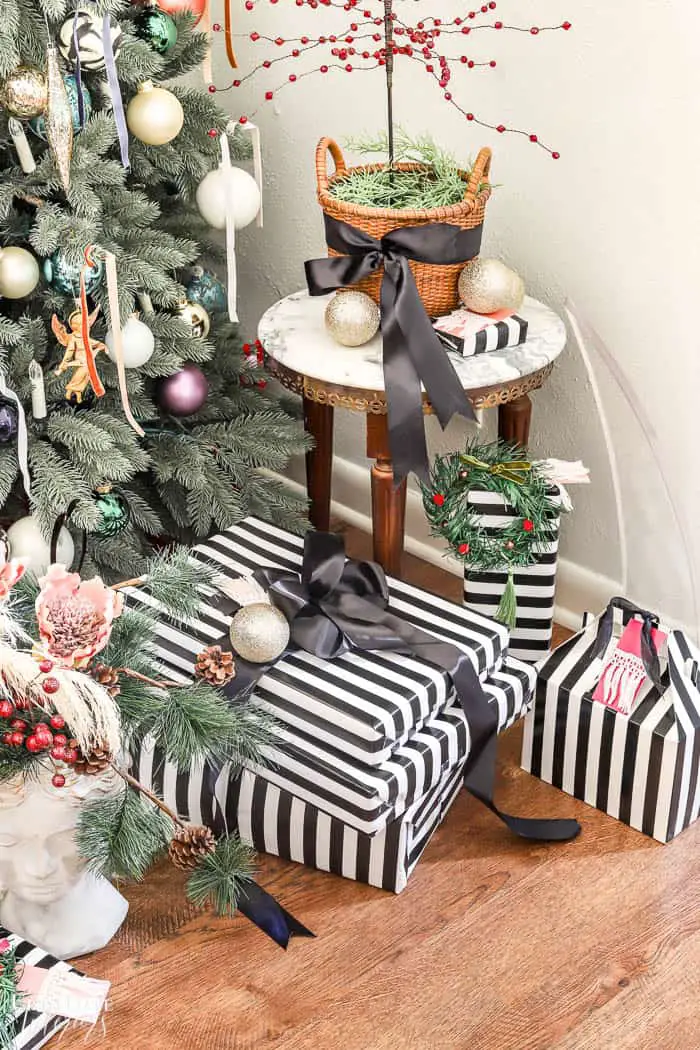
You do not need boutique wrapping to pull this off. A roll of black-and-white striped paper at Target or Walmart runs $6 to $9, and a spool of wide black satin ribbon is about $5 to $8 at Michaels. The marble-top table is where people overspend — a Facebook Marketplace side table with a $20 marble-look contact-paper top gets you most of the effect. For the basket, try thrift-store wicker ($8 to $15) plus a $4 bunch of faux red berries, and stack three wrapped boxes at different heights instead of buying a display stand.
2. A Black Tree That Glows Against a Pale Room
On a black tree, light temperature matters more than light count. Warm 2700K string lights make the branches read as deep charcoal, while cool white or daylight LEDs turn them ash-grey and faintly grubby. Aim for roughly 100 bulbs per vertical foot of tree — about 750 for a 7.5-footer — and wrap them around the trunk first, then out along the branch tops, so the glow comes from inside the silhouette instead of sitting on top of it.
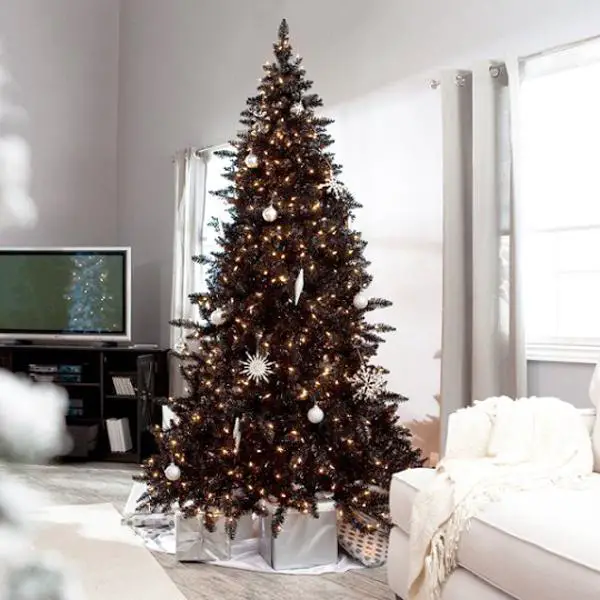
Black artificial trees are dust magnets, and there is no hiding it — every strand of pet hair and every fleck of stray tinsel shows up like a highlighter. A quick pass with a lint roller before guests arrive handles most of it. Also worth knowing: a black tree in a small room with dark walls reads as a black hole. It needs a light-toned wall behind it and at least one warm lamp nearby, which is exactly what the pale armchair, the white skirt, and those silver wrapped gifts are doing.
3. White Tree, Black Star, and a Red Velvet Sofa
Here is the formula: 55% white (the tree, the glossy coffee table, the window trim), 25% black (sphere baubles, the star topper, the rug stripes, that little toy piano), 15% red tufted velvet, and 5% multicolor character ornaments. Because black and white do all the structural work, you can swap the red for emerald velvet, cobalt, or even hot pink without touching anything else. Keep the 5% wildcard small — it is the detail that makes the tree feel like an actual family lives here.
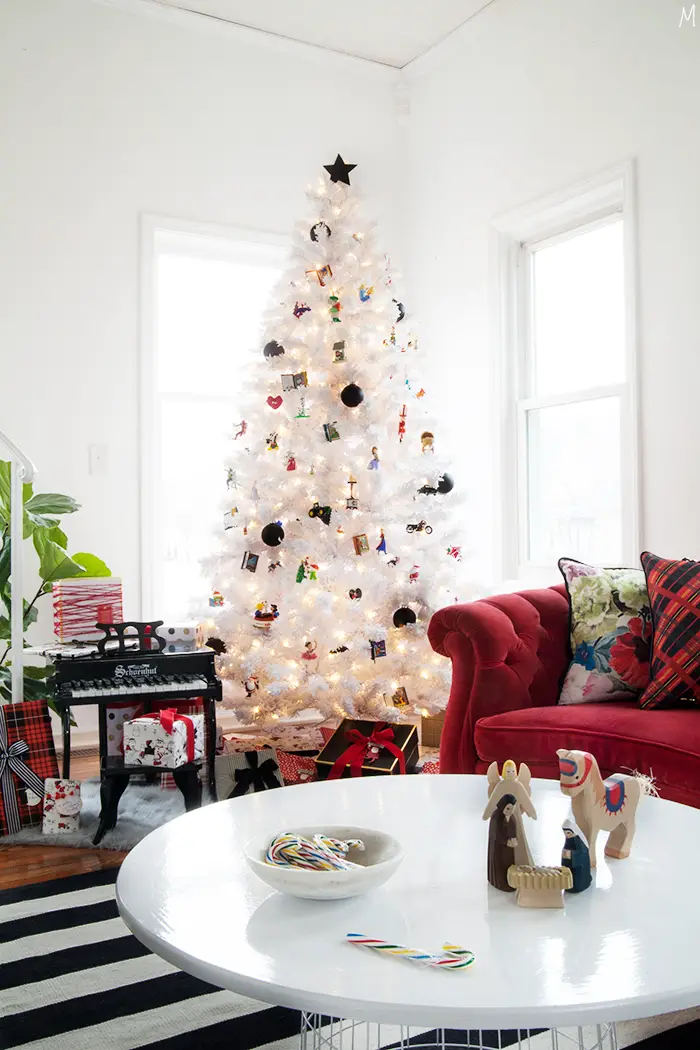
Character ornaments and memory trees have been quietly taking over Pinterest for two seasons, and 2026 is the year they collided with the monochrome look — people want the clean black-and-white silhouette but refuse to give up the goofy little collectibles. The black star topper belongs to the same shift: toppers went matte and graphic instead of glittery. This one has staying power because it is a compromise, not a trend. And the striped rug ties straight back to the wrapping paper in Idea #1.
4. White Blooms Against Matte Black Branches
It is the oversized white florals. Take them off and you still have a perfectly nice black tree with silver baubles — and it reads flat, like a shadow. The blooms punch actual holes of light through that dark mass and give the eye somewhere to land, which is what makes the black feel intentional rather than accidental. Everything else here, from the matte black and silver globes to the four fur-and-knit stockings on the beige wall to the faux fur throw, is support staff for that one move.
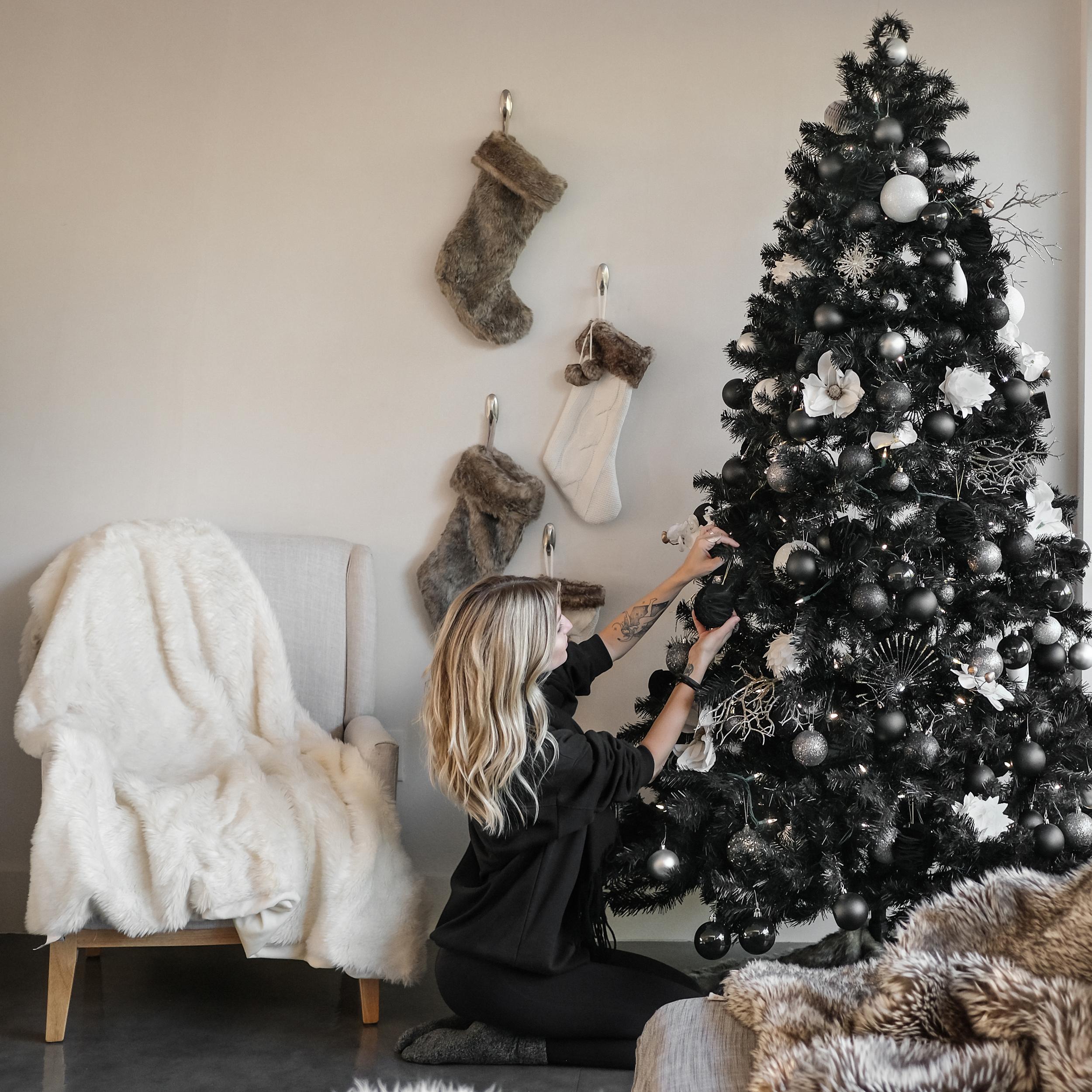
- Buy 6 to 10 large faux blooms on wire stems, 6 to 9 inches across — magnolias and peonies read best.
- Bend each stem into a shallow hook so it grips a branch instead of sliding off.
- Place them in a loose spiral, about 14 to 18 inches apart, starting a third of the way up the tree.
- Angle every flower slightly downward and outward so it faces the room, not the ceiling.
- Fill gaps with baubles last — florals first, ornaments second, always.
Roughly 25 to 40 minutes, and $30 to $70 for the stems if you buy them in a bundle rather than one at a time.
5. Sparse Branches, Silver Tinsel, and Ornate Molding
- Sparse or live tree: $60–$120
- Silver tinsel strands: $15–$40
- Warm white fairy lights: $25–$60
- Plain white boxes and paper: $20–$45
- Woven tree collar or basket: $30–$90
- Extension cord and timer: $12–$25
- Total: $162–$380
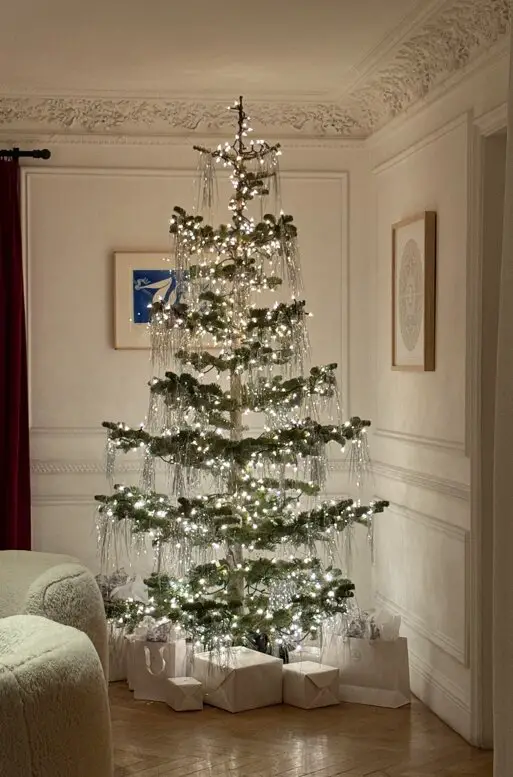
Budget route: a secondhand sparse tree from Facebook Marketplace ($25–$50) plus dollar-store tinsel still lands near $100, and the sparse silhouette is the point anyway.
Tinsel is the high-maintenance part here. It tangles if you look at it wrong, sheds tiny metallic threads into the rug, and never re-fluffs into the same shape next year — plan on replacing it every couple of seasons, which is exactly why the cheap version is the smart version. Fairy lights on a live tree mean daily water checks, and on the bright side, sparse branch structure makes both dusting and un-decorating dramatically faster than a dense tree. The ornate ceiling molding is free, and it does half the styling.
6. Silver Baubles, Warm String Lights, and a Fur Throw
A dense black tree only works if you build it on a value scale rather than a color scale. The matte black ornaments disappear into the branches on purpose — they are texture, not contrast. The metallic silver baubles read as mid-tones, and the white florals act as highlights. Then a furry textured throw at the base and a knit stocking on the plain wall add two soft matte surfaces so the whole thing never turns into a shiny ornament catalog. Warm string lights sitting deep inside the branches finish the illusion of depth.
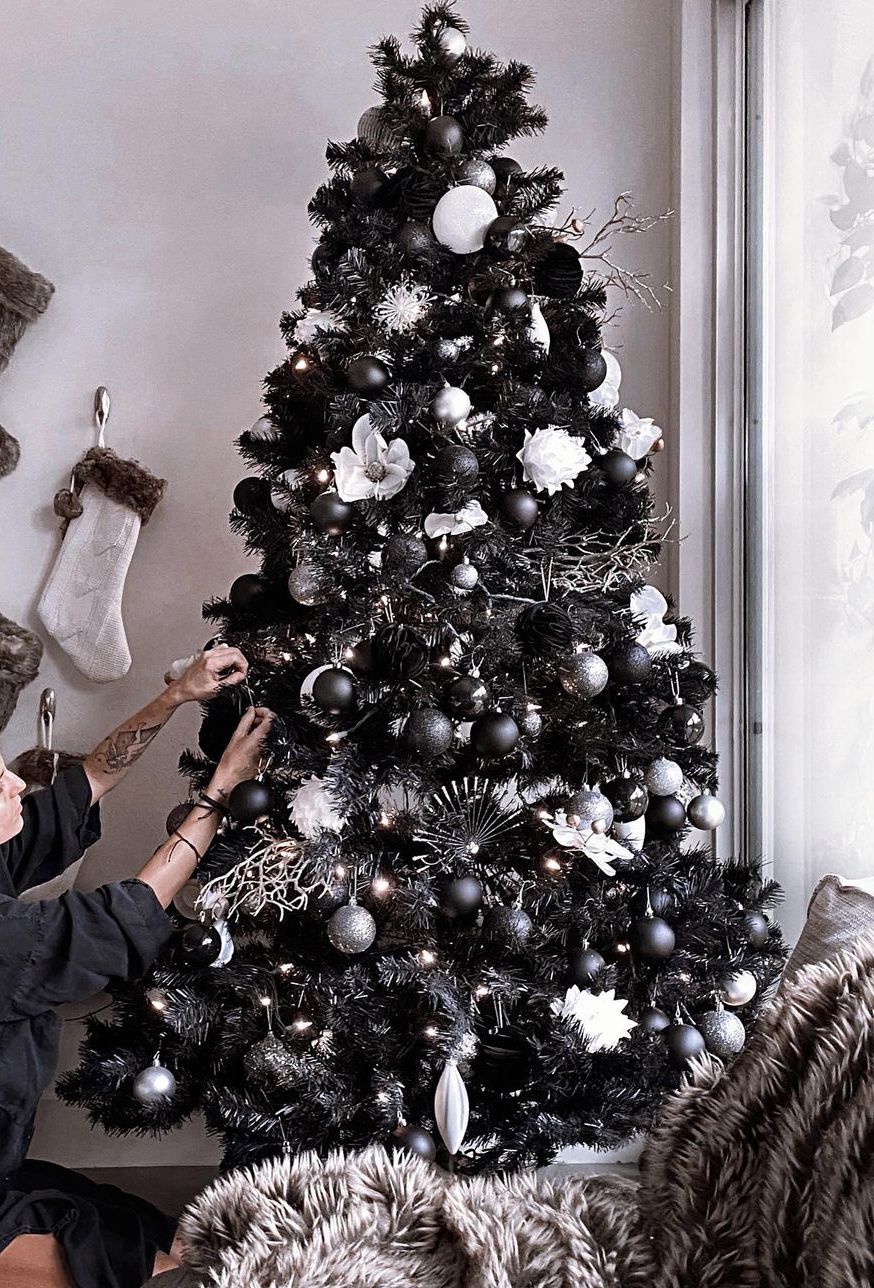
This look wants room to breathe. A 7.5 to 9 foot dense black tree needs a wall at least 6 feet wide and about 24 inches of clearance on each side so the mass reads as deliberate rather than cramped — think a 12×14 living room with 9-foot ceilings or taller. Below that, the tree starts eating the room. In tighter entryways or apartments under 700 square feet, the slim silhouette in Idea #11 does the same job without the visual weight.
7. A Mini Flocked Tree on the Windowsill
A 24-inch flocked mini tree runs $15 to $35 at Walmart or Target, and that is the biggest line item here. The white wooden house lantern with star cutouts is a Target or HomeGoods find at $12 to $25. A thrifted ceramic vase is $3 to $8, and a bunch of frosted pine sprigs plus red berries is about $8 to $14 at a craft store. Total for the whole vignette: under $60. Small-scale styling is where budget decorating genuinely wins, because nobody is pricing a marble tabletop into a windowsill arrangement.
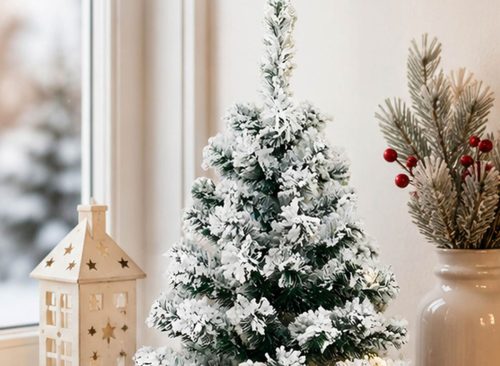
- Check which way the window faces — soft light keeps flocking cool white, while direct south sun yellows faux snow within a season.
- Confirm there is an outlet within reach, or plan on battery fairy lights.
- Measure sill depth and vase height together; the lantern should sit just below the lowest branches.
- If you have cats, skip the red berries or anchor the vase with museum putty — they look exactly like toys.
- Set a $60 ceiling before you walk into the store, because minis multiply.
8. Alphabet Ornaments on a Tall Black Tree
Letter ornaments are identical in size and shape, which means they read as a pattern — so place them on a spiral, never a grid. Wrap four even spirals from the top third of the tree down to the bottom, and space the letters 8 to 10 inches apart along each one. Hang them all at the same depth on the branch, roughly 4 inches back from the tip, so they sit at one consistent distance from the viewer. That is the entire difference between designed and scattered.
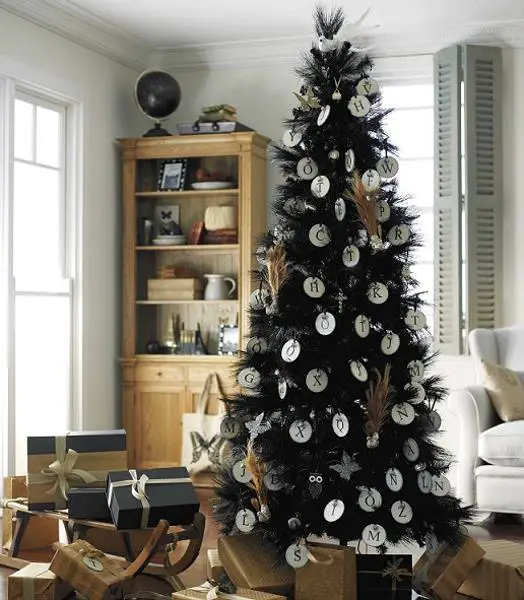
The brown feather accents are what make this tree singular. Without them, white letters on black branches are pure graphic contrast — clever, but cold, and a little like a typography poster. The feathers are warm, organic, and from the same family as the wooden bookshelf behind the tree, so they tie the whole thing to the room instead of letting it stand apart. If you swap anything here, swap everything except the feathers.
9. Oversized Gold Jingle Bells and Striped Bows
Think 50% deep evergreen, 20% shiny red, 20% white, and 10% gold — with the black-and-white striped ribbon acting as the neutral that holds it all together rather than a separate color. The trick here is scale, not hue: the jingle bells are oversized and the ornaments are high-shine, so the tree reads traditional without tipping into department-store territory. Want it cooler? Swap red for burgundy and the ribbon stays. Want it brassier? Swap gold for brass and change nothing else.
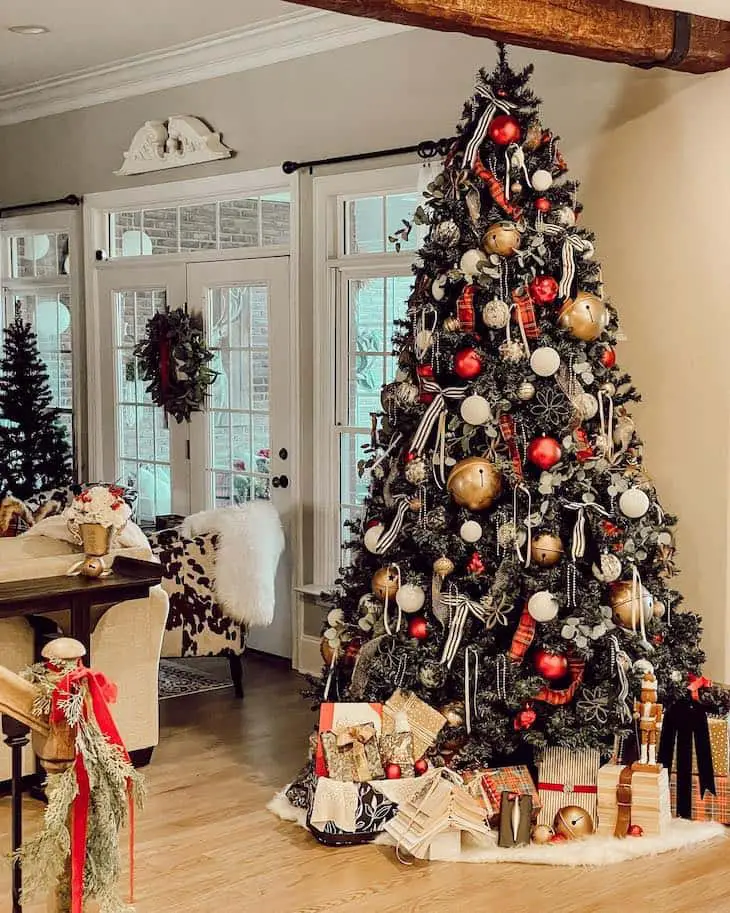
- Cut black-and-white striped ribbon into 18-inch lengths — wired ribbon holds shape, plain satin droops.
- Fold each length into a figure-eight, then pinch the center flat between your fingers.
- Wrap a 4-inch piece of the same ribbon around the pinch and knot it at the back.
- Fan the four loops outward and trim the tails at a 45-degree angle.
- Push floral wire through the back knot and twist it onto a branch so the bow sits upright.
About 20 minutes for a dozen bows, and $12 to $20 in ribbon if you buy a 10-yard roll.
10. Dried Oranges, Pinecones, and Copper on a Rustic Tree
Foraged trees are the counter-move to a decade of glitter, and in 2026 they have gone mainstream enough that craft stores stock dried citrus slices year-round. What makes this one work is the copper: it bridges the rustic elements and the living room’s actual palette of cream and rust, so the tree feels integrated rather than installed. Wicker baskets at the base and those rust pillows on the cream sofa close the loop under those big multi-pane windows. Foraged looks stick around because they photograph beautifully and cost almost nothing.
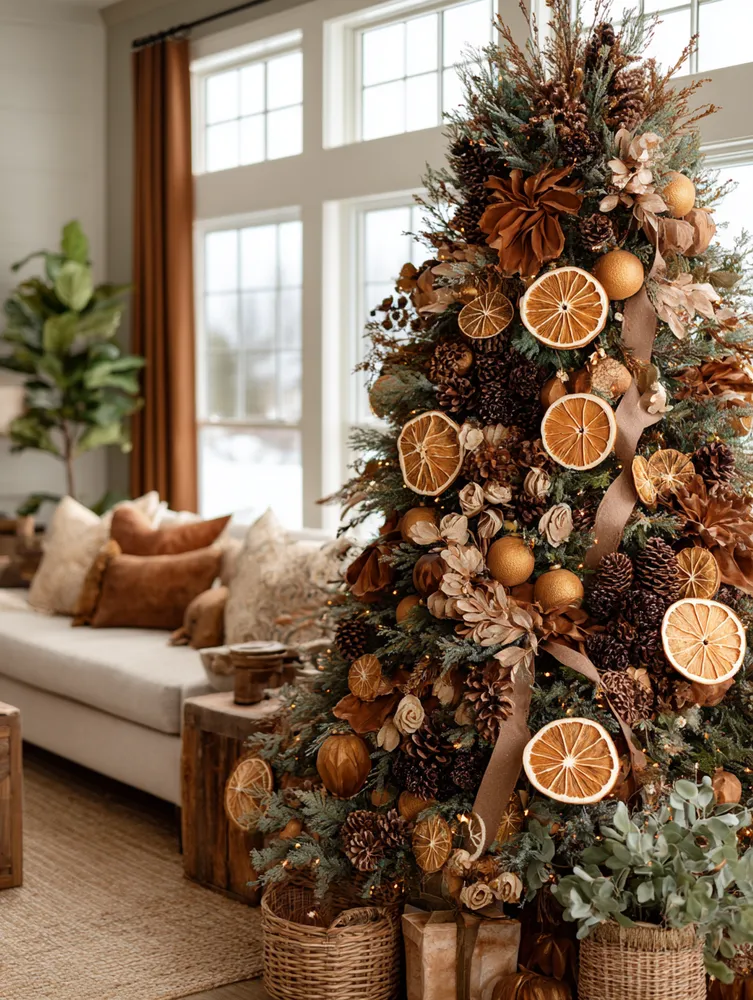
Home-dried citrus can mold if it was not dried fully — slices should snap, not bend, before they go on the tree. Pinecones gathered outdoors need 20 minutes in a 200°F oven to deal with anything living inside them, a step almost everyone skips. Dried orange slices are brittle, so expect a few casualties every time you move the tree; store them in a rigid box rather than a bag. And keep the lower branches out of reach of dogs, because dried citrus is mildly toxic to them.
11. Pencil Tree, Striped Ribbon, and a Woven Basket Base
Pencil trees run 7 to 9 feet tall but only 18 to 24 inches wide, which makes them the answer for entryways, narrow corners, and apartments where the living room already has a sofa in it. You need roughly 3 to 4 feet of floor width, 8-foot ceilings minimum, and about 6 inches of clearance from the door swing. The white wainscoting wall here gives that slim silhouette something pale to read against. Compare with Idea #6 — that dense black tree needs roughly double the footprint.
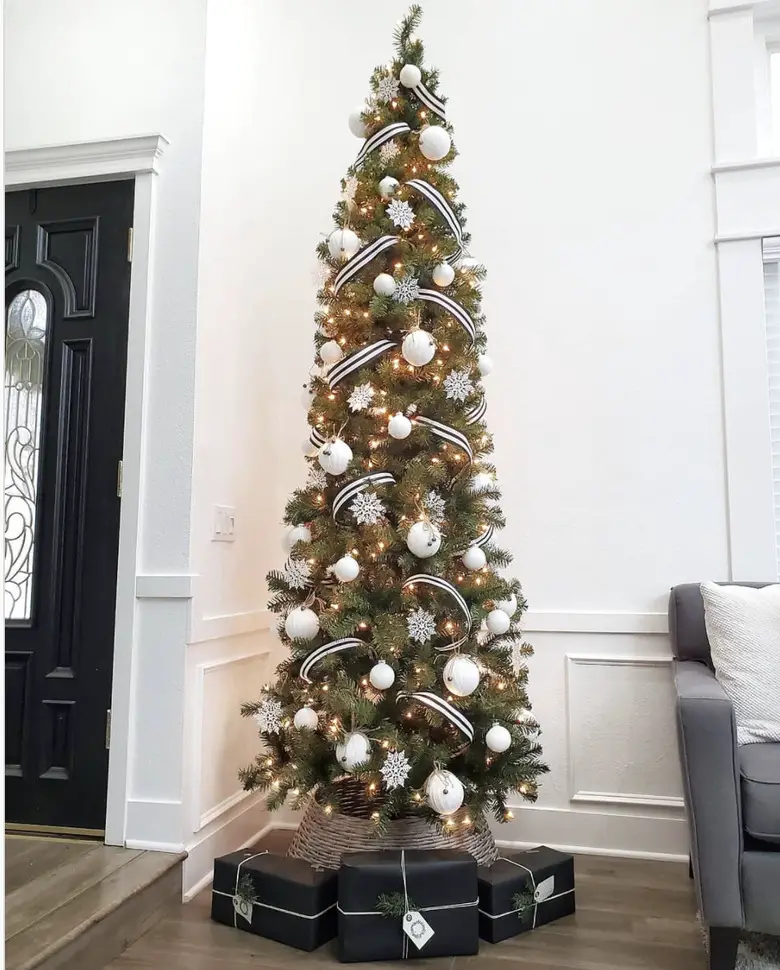
Two upkeep costs to know about before you commit. First, black wrapping paper: every fingerprint and every crooked strip of tape shows, which is why the white twine here is doing so much work. Second, a wound ribbon garland creases in storage — roll it around a cardboard tube instead of folding it, or you will be ironing satin on low heat next December. The woven basket base collects dust in its weave, so hit it with a vacuum brush attachment once a month and it stays crisp.
12. Charcoal Branches Over a Jute Rug
This tree skips contrast entirely and wins on texture instead. Charcoal branches, matte black baubles, speckled and ribbed finishes, a black fringed skirt, and a natural jute rug underneath — five textures, two tones. The single white ribbed ornament is the only real highlight, which is exactly why it reads as a deliberate accent rather than a mistake. The natural jute warms up the black in a way a grey wall never could, and the woven wicker basket at the base repeats the rug’s weave one more time.
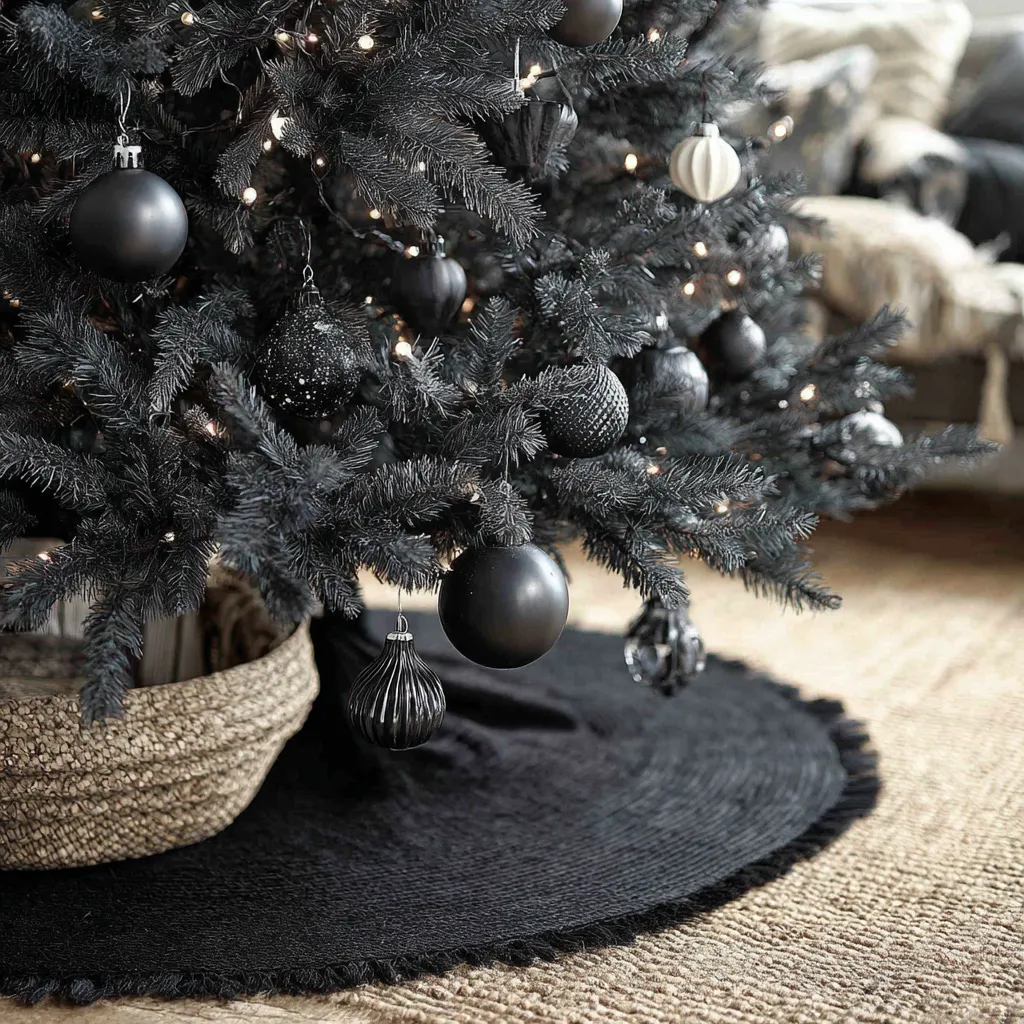
If black feels too severe for your space, this is the workaround: choose a charcoal or dark-grey tree with a textured, slightly flocked branch, then light it warm. The speckled finish scatters light so the tree reads soft instead of graphic. As a rule, run one light ornament for every eight to ten dark ones — any more and you lose the moody effect, any fewer and the tree becomes a solid mass. Keep the skirt natural or black; a red one breaks the spell instantly.
13. A Minimalist Black-and-White Tree With Nothing Extra
The restraint is the whole design. No ribbon, no florals, no layered skirt — just simple ornaments on a plain tree in a clean-lined room. What you would lose by adding one more element is the negative space: those deliberately empty branches are what make each ornament feel placed instead of piled. If you are tempted to add a statement garland or a theme sign, do not. This look survives only on the discipline of stopping early. If you want more atmosphere than this, the charcoal tree in Idea #12 is the version with a mood.
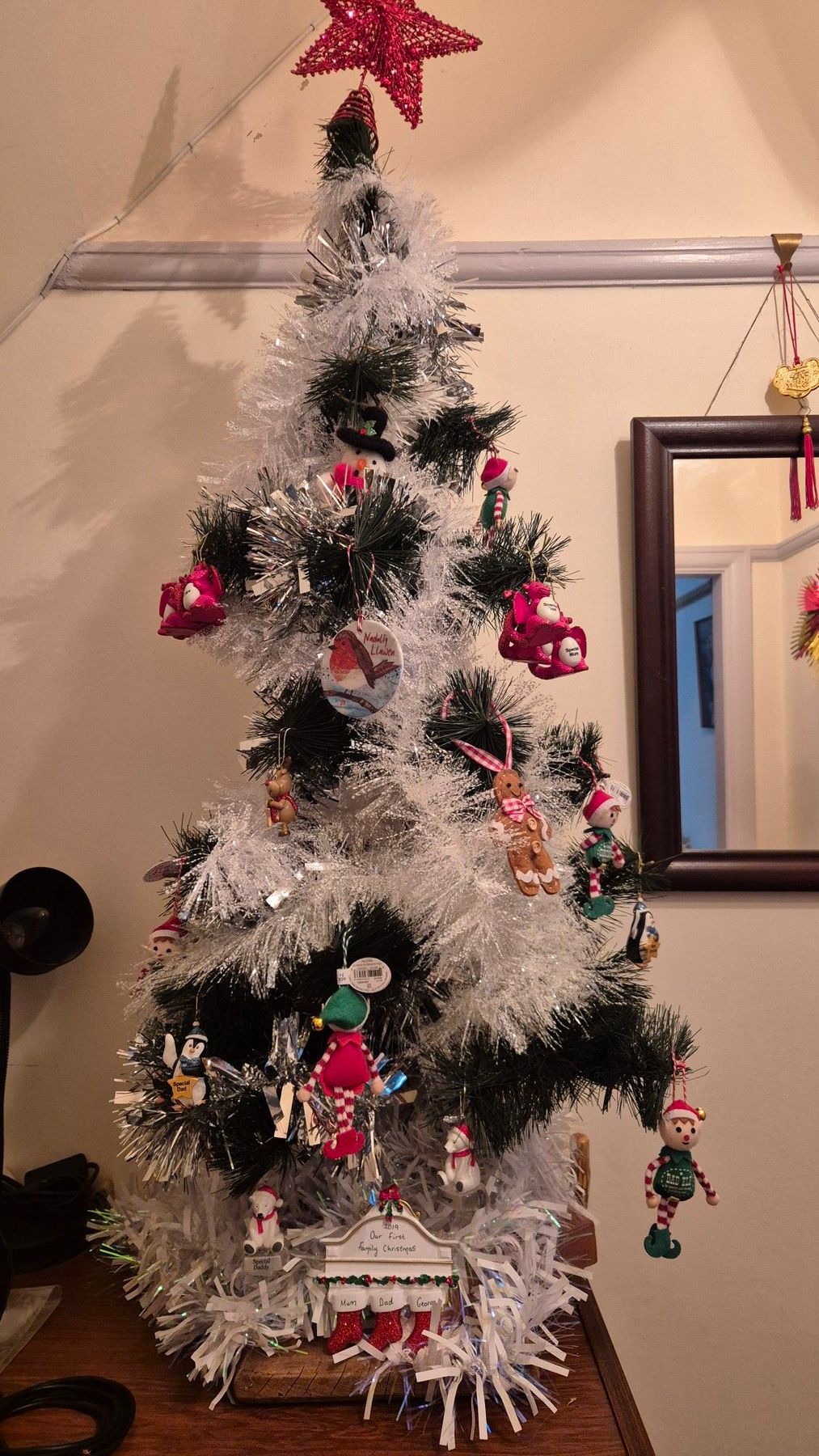
Minimalism is the cheapest holiday look there is, which is the secret nobody mentions. IKEA’s seasonal ornament sets run $6 to $12, Target’s Threshold baubles are $5 to $10 a pack, and Walmart’s plain black and white spheres are usually under $8. A used artificial tree from Facebook Marketplace is $20 to $60 and looks identical once it is fluffed. Skip the matching ornament collection — buy three packs in the same two colors and mix them. Total for the whole tree: $70 to $120.
14. Cascading Gold Ribbon and Dark Blue Ornaments
- 7.5 to 9 foot tree: $150–$600
- Wide gold ribbon, 3 to 4 rolls: $40–$90
- Oversized silver and gold baubles: $50–$160
- Dark blue ornaments, 12 to 20: $30–$90
- Warm white string lights: $30–$60
- Tree collar or skirt: $40–$120
- Total: $340–$1,120
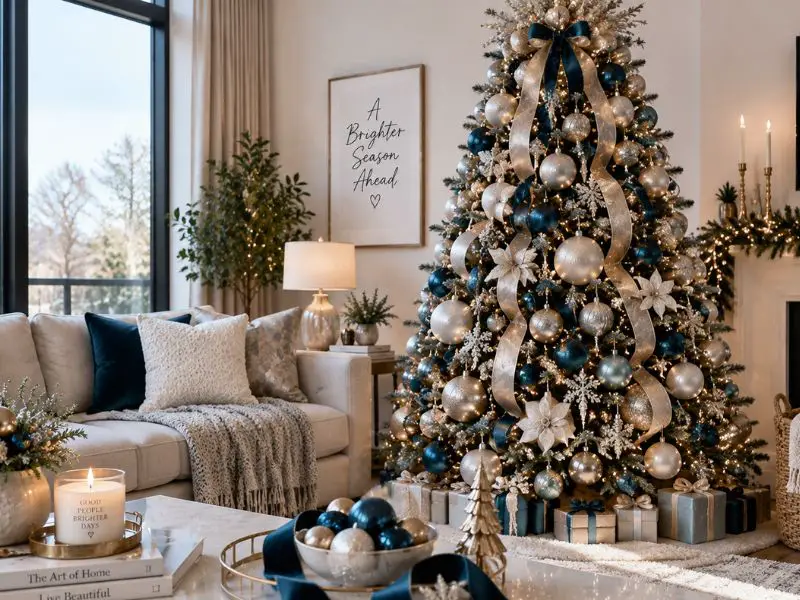
Budget version: a $60 marketplace tree, one gold ribbon roll wound top to bottom, and navy ornaments from Walmart gets you the same cascading effect for around $150.
Gold and navy is a cool palette, and cool palettes need warm light to feel livable — which is exactly what the lit candle and the lamp are doing next to that neutral sofa. A tree this full wants a 9-foot ceiling or higher once the topper is on, and at least 30 inches of clearance from the sofa so the ribbon is not crushed every time someone sits down. Rooms 14×16 and larger can carry oversized baubles; in anything smaller, drop to 3-inch ornaments and keep the ribbon.
15. Black-and-Teal Baubles at a Silver Dining Table
Call it 55% white (tree, chandelier glow, mirrored folding screen), 20% silver metallic (table, round-backed chairs, crystal), 15% black (baubles, candelabra, dark drapery), and 10% teal. The teal is doing something clever: it is the one color that keeps so much black from reading funereal in a dining room, and it repeats between the large baubles and the darker ones so it looks intentional. Swap teal for emerald and the room goes more traditional. Swap it for cobalt and it goes colder.
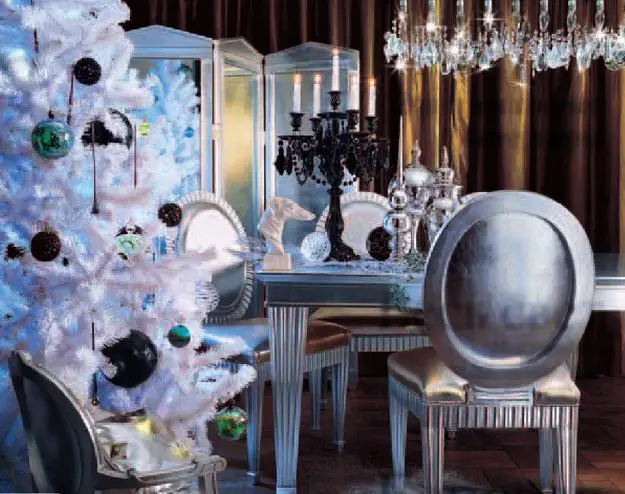
Two practical notes. Metallic silver tables and mirrored screens show every fingerprint and every smear from a wine glass, so keep a microfiber cloth in a nearby drawer, not back in the kitchen. And a white tree in a dining room is a magnet for red wine, gravy, and curious pets. Put the tree on the side of the table away from the serving path, or go with a black tree if your family eats like mine. Flocking on white trees also yellows over time near heat vents.
16. Flocked Branches With Gold Stars and Matte White
- Wear gloves and open the tree in a garage or over a sheet — flocking sheds everywhere on the first fluff.
- Work section by section, separating each branch tip away from the trunk before moving up.
- Bend inner branches downward and outer tips slightly upward so the silhouette looks natural rather than combed.
- Hang lights first, ornaments second, and set the matte white baubles deepest into the branches.
- Save the oversized gold snowflakes and stars for the outer tips — those are the ones that catch light.
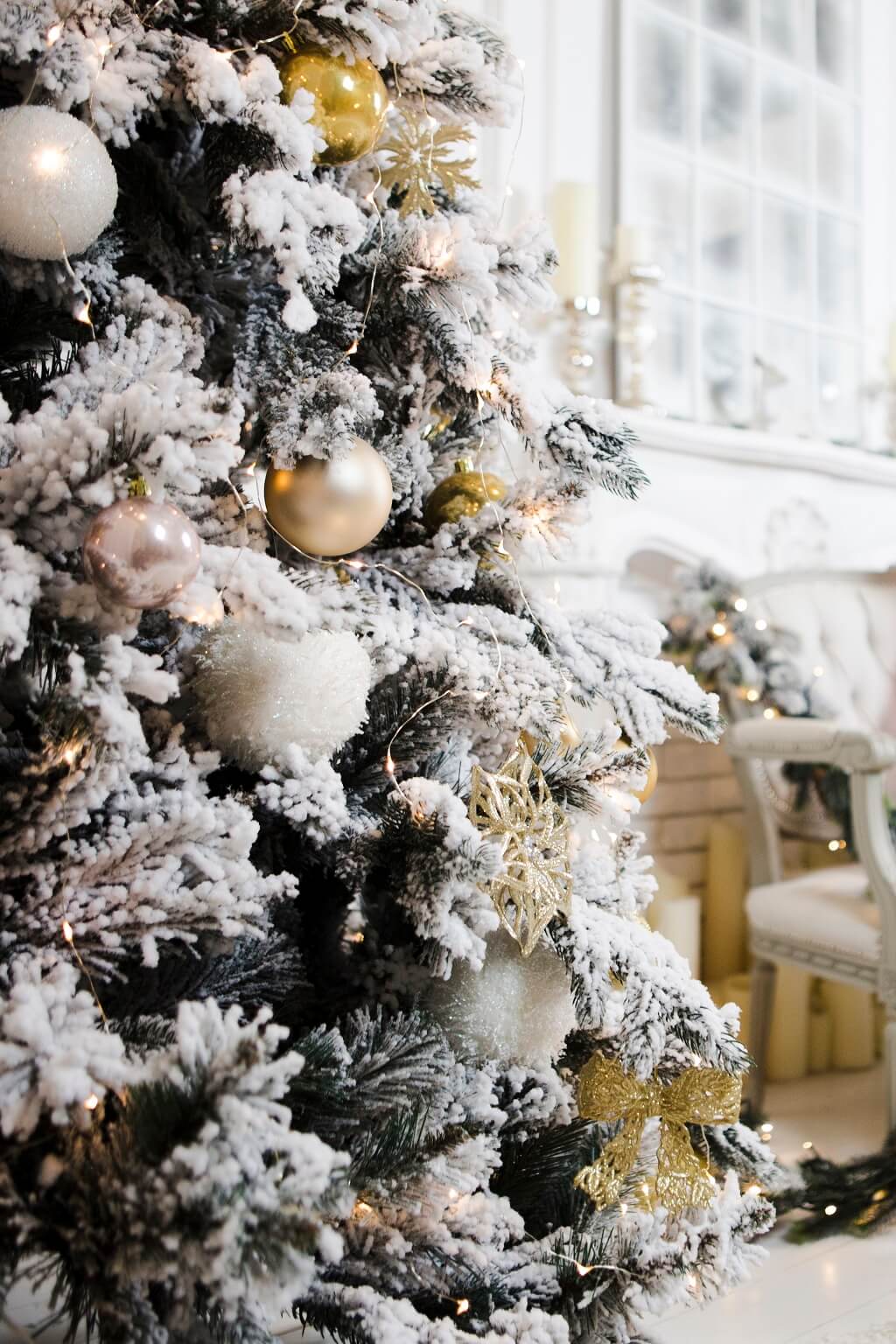
Plan on 45 minutes for a 7.5-footer, plus about $10 for gloves and a lint roller.
Flocking is essentially decorative snow that wants to be dust. Expect a light drift on the floor during setup, a smaller one during take-down, and stray white specks on the rug through January — a handheld vacuum handles all of it. Never spray water or cleaner on a flocked tree, and never store it in a hot attic, because heat turns the flocking yellow and it will not come back. A zippered tree bag ($20 to $35) is worth it. The matching mantel garland in Idea #17 sheds the same way, so store them together.
17. Frosted Tree With a Matching Mantel Garland
Repetition does all the work here: the same frosted branches, the same oversized gold and white spheres, the same snowflakes appear on the tree and then again along the white mantel. Your eye completes the loop without noticing it, which is why this room feels finished rather than decorated. The second principle is scale — almost nothing here is smaller than 4 inches, so both elements read clearly from across the room. And the beige sofa stays deliberately quiet so the white and gold can carry everything.
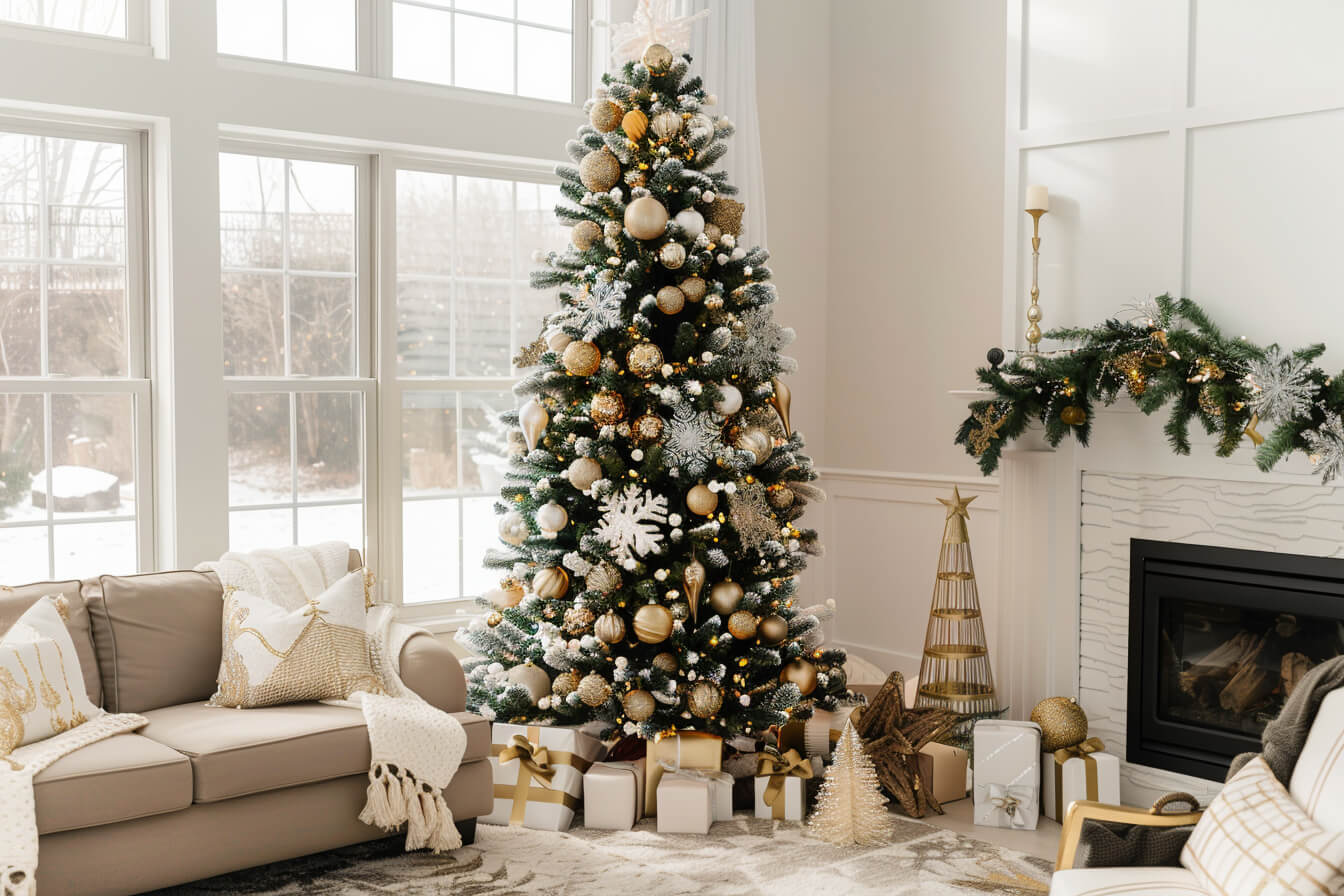
Keep the tree at least 24 to 30 inches from the hearth, and measure your mantel before you buy garland — you want roughly 1.5 times the mantel width if you are letting it cascade down both ends. Ornament scale should match across both elements: 4 to 6 inch spheres on the tree mean 4 to 6 inch spheres in the garland, not miniatures. In a room under 12 feet wide, skip the garland entirely and let the frosted tree be the only white-and-gold moment, or it starts feeling like a display window.
18. Cool Blue Lighting on a Silver-and-Blue Tree
Blue and silver is the one palette where cool light actually helps — 4000K white LEDs or blue LEDs make the silver read icy instead of grey, which is the entire point. But keep a warm lamp on in the same room or the space goes clinical. Aim for about 70% silver and white against 30% blue, and cluster the glittery butterflies and bird figurines near the top third of the tree where the light hits them, rather than scattering them evenly across the frosted branches.
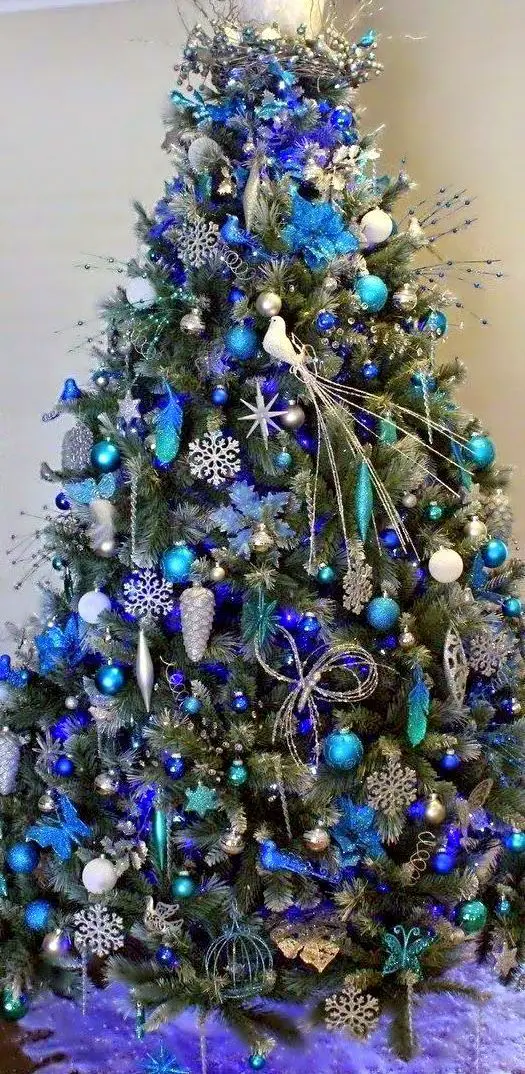
Blue-lit trees photograph beautifully and can read slightly hospital-corridor in person if the room is small or the walls are cool grey. Turn the lights on for one full evening before committing — if it feels chilly, add a warm bulb in the corner and a cream throw somewhere in frame. Glittery bird and butterfly ornaments have clips that loosen season to season, so expect to re-secure a few each year, and that frosted dusting sheds onto whatever sits beneath the tree. If blue-and-silver ends up too cold for your space, the navy-and-gold version in Idea #14 is the same idea with a heartbeat.
Your Tree Doesn’t Need Permission
Pick the one detail from these 18 ideas you cannot stop thinking about — a black-and-white striped ribbon, a single teal bauble, a tiny flocked tree on the windowsill — and build outward from there. Black and white is not a rule, it is a starting point, and the trees that look best always have one slightly odd, personal thing hanging on them. Snap a photo when yours is finished, and save this guide to Pinterest for next December, because you will absolutely want it.