
You know the feeling: you’ve saved 42 photos of elegant Christmas trees and still can’t decide between frost and gold. We did the scrolling for you, sifting through hundreds of options at Pottery Barn, Wayfair, Target, Amazon, and a dozen small makers to pull the 29 ideas that actually hold up in a real living room.
Inside you’ll find woodland owls, champagne ribbon cascades, navy velvet, paper accordion trees that fold flat, and modern rooms lit by nothing but bulbs — with budget and luxury versions compared side by side, from about $12 for a bundle of dried-orange ornaments up to roughly $2,400 for a full double-height tree moment. Every idea is shoppable, so you can go from saved to styled without a dead end.
The 2026 shift is toward trees that feel collected rather than purchased — layered metals, natural textures, and one strong silhouette instead of six competing themes. And stay until the end — we break down the most common mistakes that can ruin these looks.
📌 Save this to Pinterest for later — you’ll want to revisit these ideas.
Some links in this post are affiliate links — if you buy through them, we may earn a small commission at no extra cost to you.
1. A Glowing Colonnade of Golden and White Trees
Symmetry is doing the heavy lifting. When trees repeat down a hallway at even intervals, the eye stops reading them as individual decorations and starts reading them as architecture — a glowing colonnade. The polished floor doubles every light source, so you get twice the warmth from half the fixtures, and the crystal chandeliers add sparkle without introducing a new color.

Match the tree height, match the light color, and space the trunks evenly — center to center, roughly 6 to 7 feet apart for 7.5-foot trees, so the canopies almost touch without merging into one mass. Use warm white LEDs around 2700K at about 100 bulbs per vertical foot for that dense glow, then repeat a single ornament family everywhere: gold leaves, pinecones, faux snow at the base. Nothing else.
2. Wreaths Stacked Up Tall Hotel Windows
The stacked wreaths do more for this room than the tree does. Three lit wreaths running vertically up each tall window echo the tree’s silhouette, add a second layer of light at eye level, and fill wall space that would otherwise be dark glass after sunset. Remove them and you have a lovely tree sitting in a big, dim dining room. Keep them and the whole room glows.
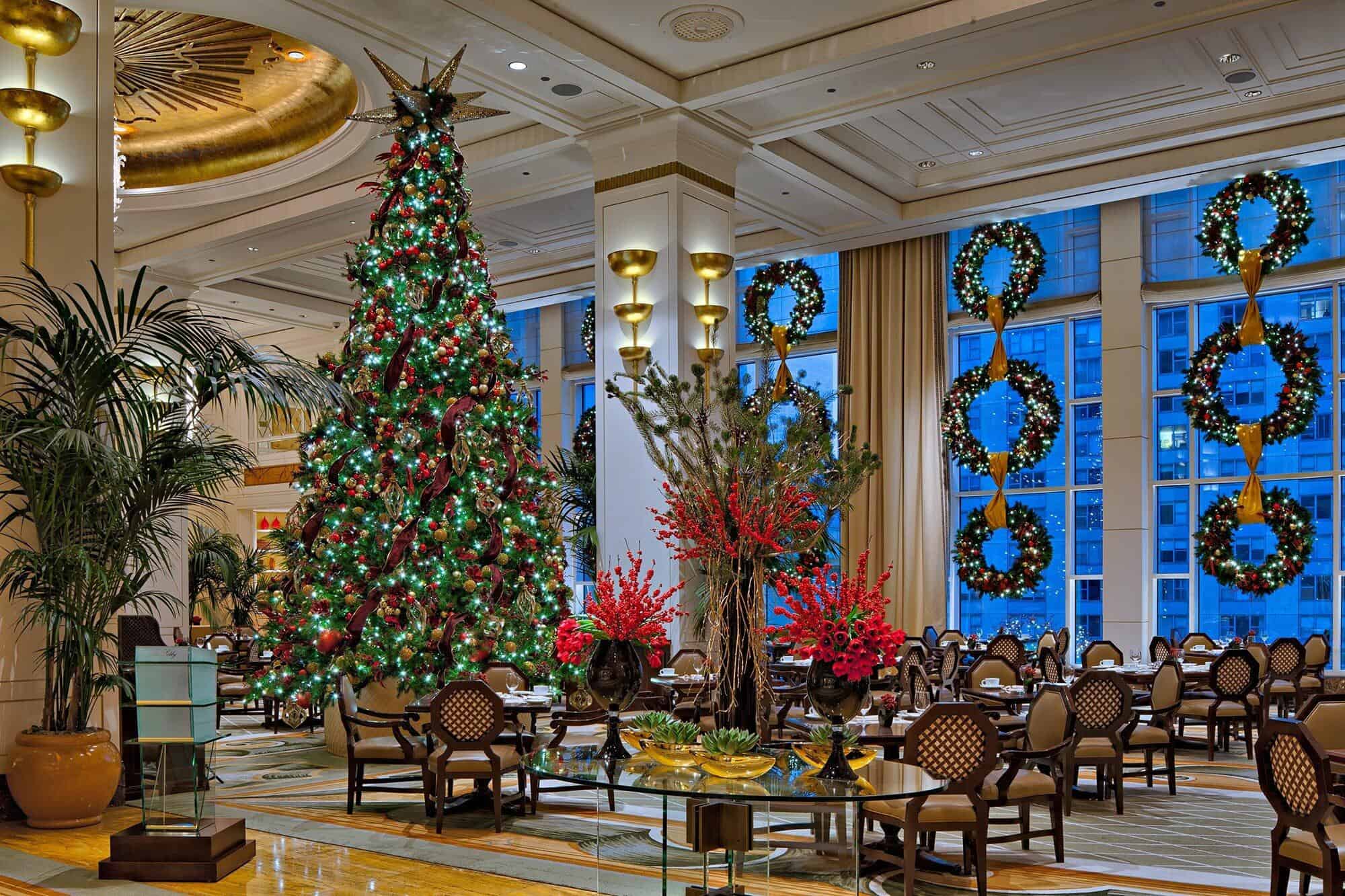
This look needs height to work: 11 to 13-foot ceilings, windows at least 8 feet tall, and a dining room of 300 square feet or more so the 12-foot tree doesn’t crowd the table. In a standard 8-foot dining room, borrow the wreath-stacking trick and skip the oversized tree — Idea #12 shows how a slim tree handles low ceilings beautifully.
3. Flocked Tree With Red, White, and Pinecone Warmth
- 7.5-ft heavily flocked tree: $180-$450
- Red and white ornaments, pinecones, berry picks: $90-$200
- Gold mesh ribbon, 2 rolls: $25-$60
- Warm white LED strings, 800-1,200 bulbs: $40-$90
- Woven basket or collar: $45-$120
- Total: about $380 to $920
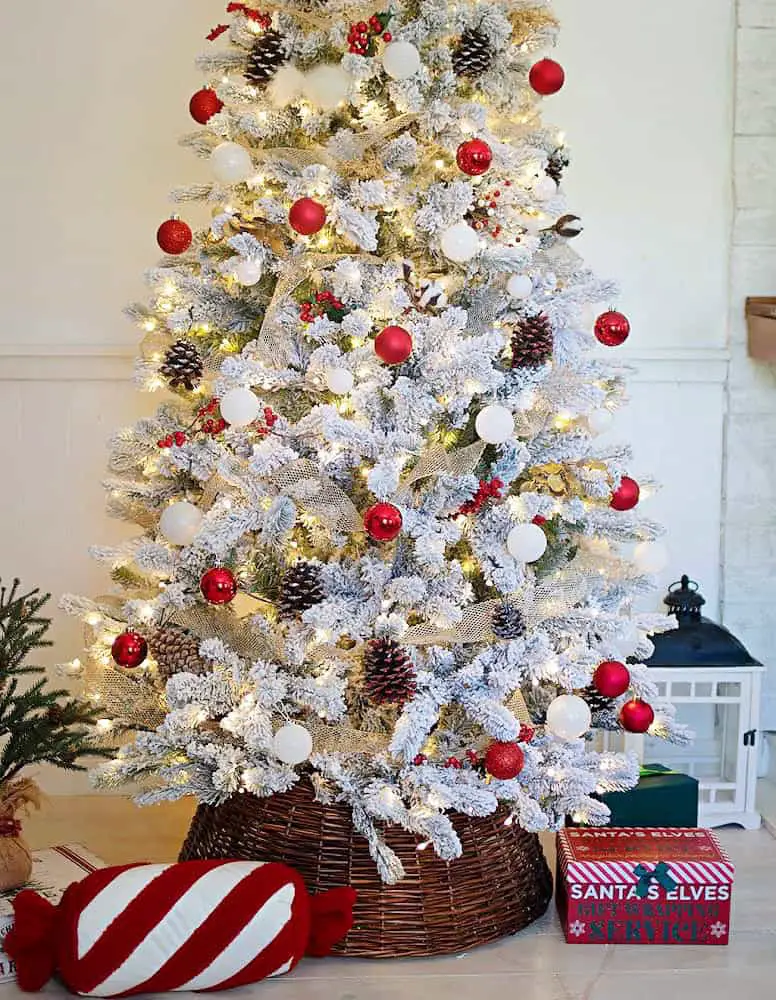
Budget alternative: a 6.5-ft flocked tree from a big-box store with ornaments in only two shapes and two colors lands the same feel for $180 to $260.
Flocking is gorgeous and slightly needy. It sheds on everything for the first season, so put a cloth under the base before you decorate, and never set a flocked tree near a heat vent or radiator — warm air makes the fake snow yellow and flake faster. If you have a toddler or a cat who climbs, a heavily flocked tree is also the hardest kind to anchor. Weighted base, always.
4. A Feathered Owl Topper Against Forest Wallpaper
Two scale rules make this whole setup work. First, the topper should be roughly one-eighth the tree’s height — a 16-inch owl on a 7.5-foot tree — and it needs a wired perch, not a clip, because outstretched wings catch every draft. Second, if you’re putting a tree in front of patterned wallpaper, keep the tree solid dark green; a flocked tree disappears into a busy forest print.
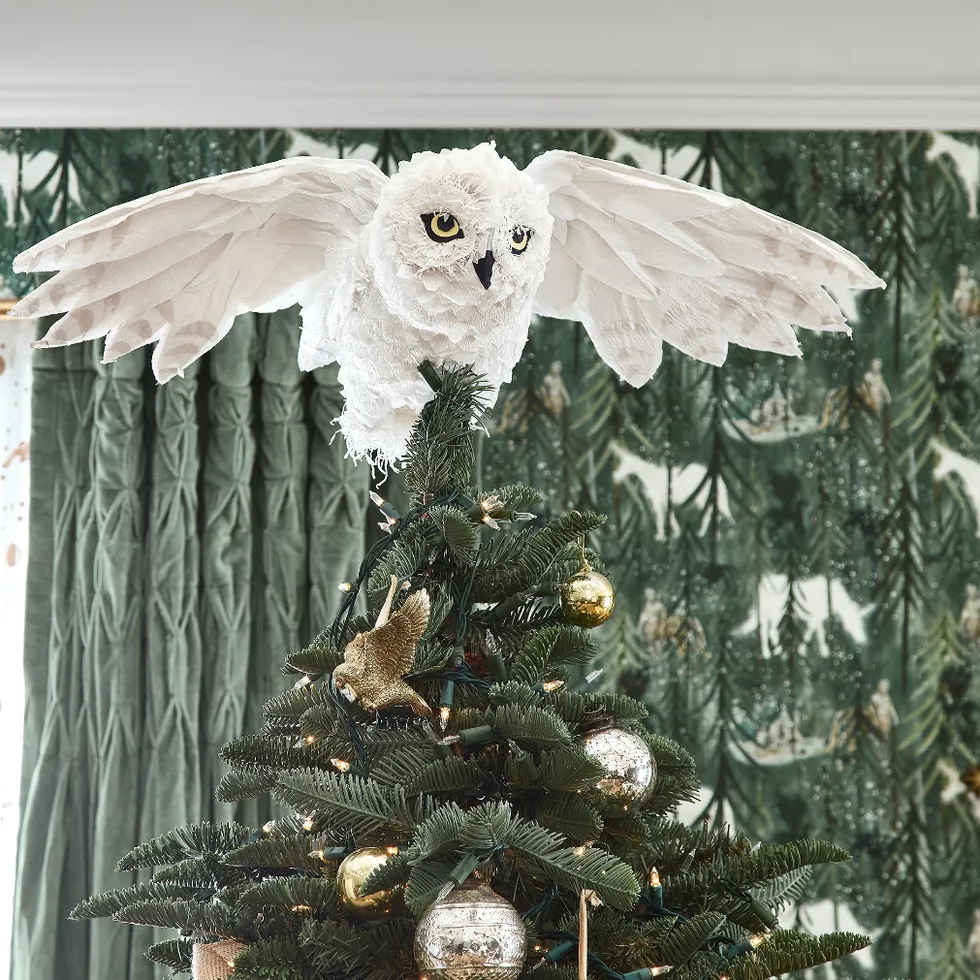
Woodland-topped trees keep surging because biophilic design finally reached the holidays — people want December decor that feels like a walk in the woods, not a trip to the mall. Dark green wallpaper, pleated velvet, feathers, and mercury glass all read as collected rather than purchased. It’s the rare trend with staying power: owls and pine trees have been Christmas since long before we were.
5. Urns, Illuminated Branches, and a Formal Foyer Tree
Formal entryways like this one usually run 12 to 16-foot ceilings with a 5 to 6-foot-wide arch, and the tree wants to sit at least 4 feet back from the doorway so the arch frames it instead of clipping it. In a standard 8-foot foyer, a 7-foot tree placed off-center reads grander than a 9-foot tree jammed into a corner. The flanking urns want to be 30 to 36 inches tall to hold their own.

Read this room as a formula: 60 percent evergreen and warm white light, 25 percent gold — ornate urns, branch lights, accents — 10 percent architectural neutrals, and 5 percent dark contrast from the reflective floor. Swap the gold for silver and the same bones become a frosty winter foyer. Keep the ratio and you can change every object in the space.
6. Gold Poinsettias and Champagne Ribbon on Stone
It’s the distressed white architectural fragment above the mantel. Everything around it is polished gold, pearlized berries, and glittered poinsettias — beautiful, but relentless. That one chipped, matte, off-white piece gives the gold something to glow against, and it’s the difference between a hotel lobby and a collection built over decades. Without it, the room turns into a jewelry box.
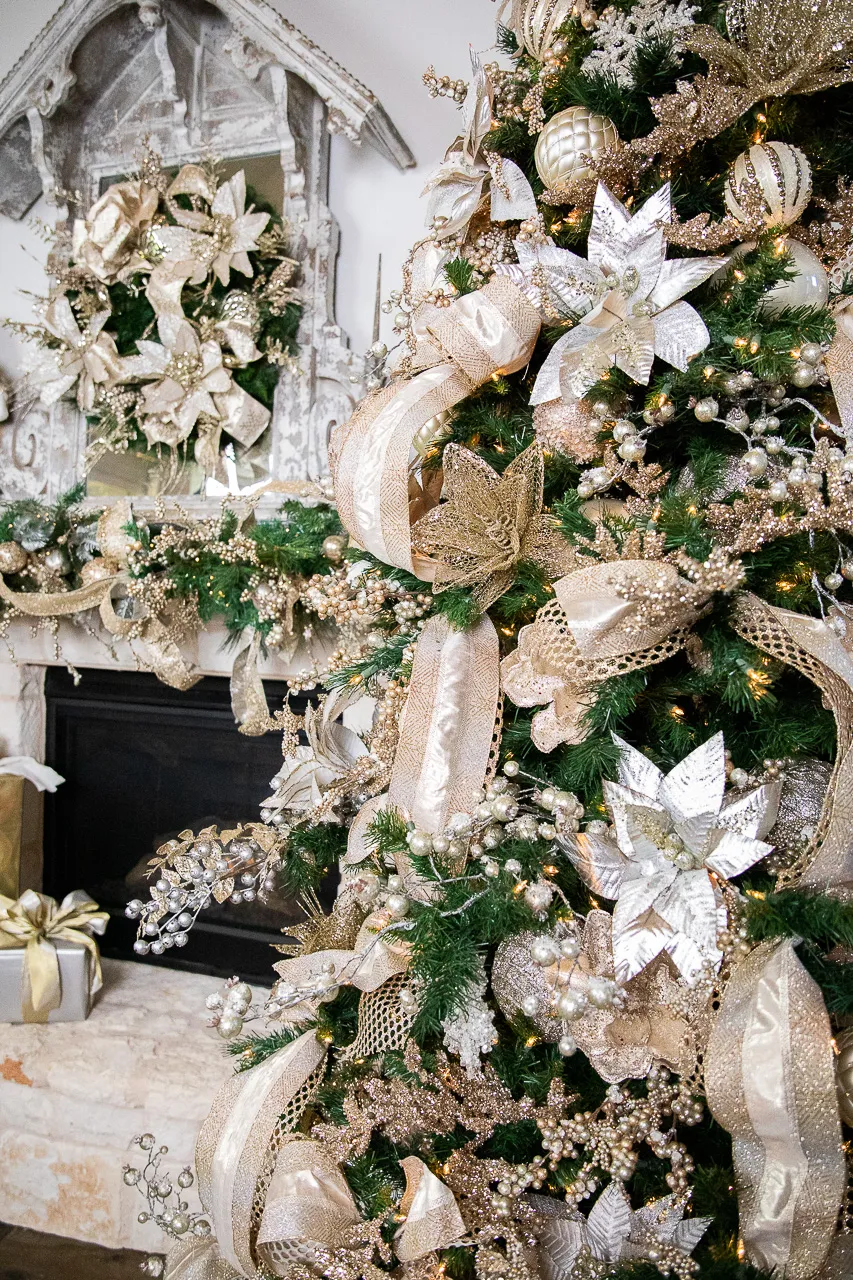
Building a champagne ribbon cascade takes about an hour and $40 in materials.
- Wrap the tree in warm white lights first — ribbons hide lights, not the other way around.
- Cut wired champagne ribbon into 3-yard lengths and fold each into a loose 6-inch loop.
- Tuck loops into branches at 18-inch intervals, working top to bottom.
- Vary the depth: push some loops deep, leave others proud, so the ribbon looks poured, not pinned.
- Pause every five loops and step back six feet.
7. Silver Tinsel and Oversized Orbs on the Floor
The formula here is 50 percent silver tinsel, 30 percent warm light, 15 percent pale gold, and 5 percent that faded blue-grey plaster — which matters, because tinsel needs a dull wall behind it to read as shine instead of glare. Trade silver for rose gold and the palette turns warm and vintage. Trade the plaster for white and you’d need to cut the tinsel in half.
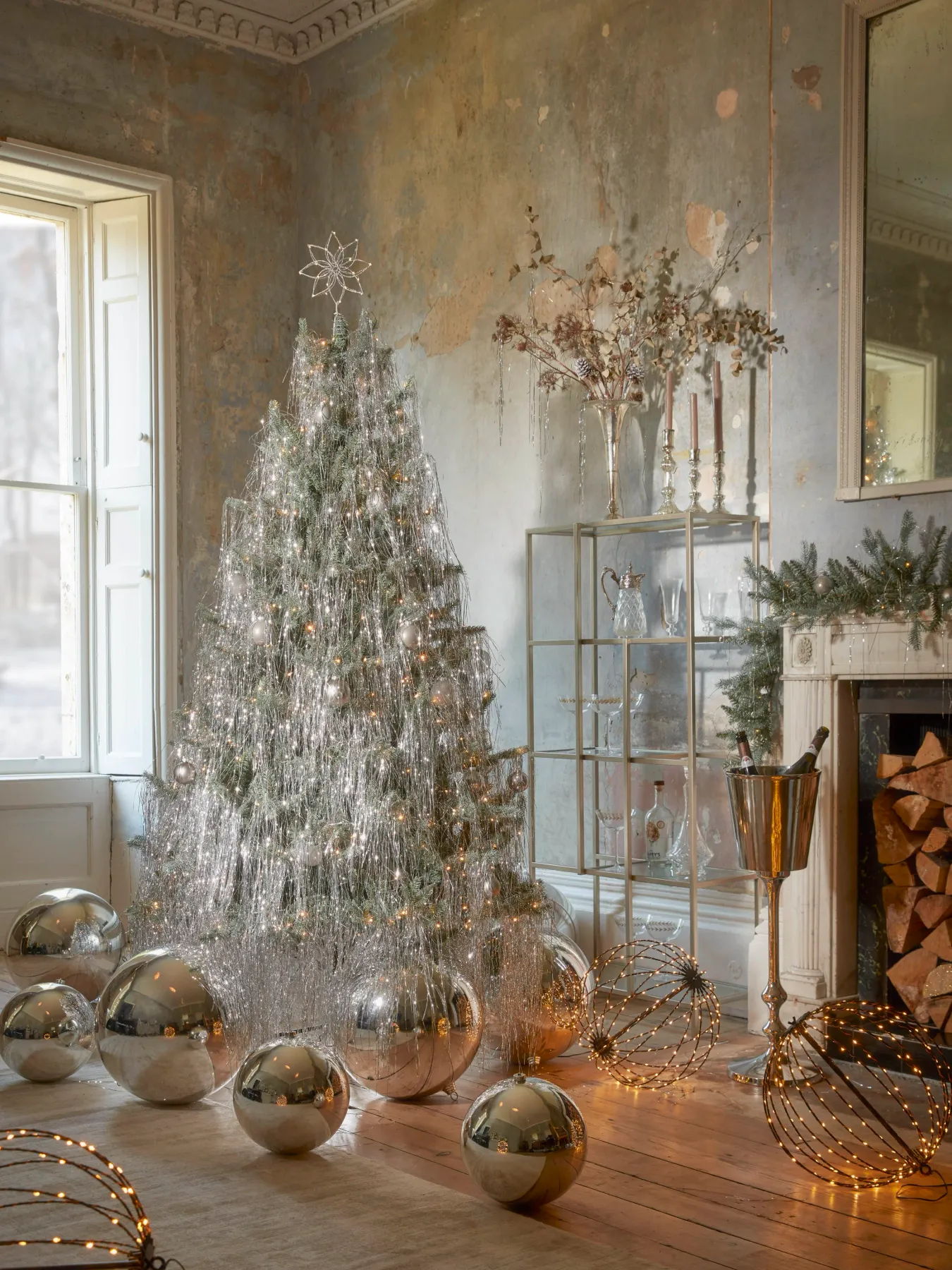
about tinsel: it is a dust magnet, it sheds, and it takes forever to strip off in January. Oversized metallic spheres sitting loose on the floor look incredible in photos and roll underfoot in real life — if you have dogs, kids, or hardwood stairs nearby, corral them in a tray or basket instead. Also check the age of any vintage tinsel; pre-1970s metallic strands often contain lead.
8. White Lanterns Beside a Softly Flocked Tree
Nothing here is precious. A 7.5-foot flocked tree from Target or Walmart runs $120-$200 in early November, white wooden lanterns in three graduated sizes are $15-$30 each at HomeGoods, and plain white ball ornaments in bulk cost about $20 for 100. Facebook Marketplace is full of flocked trees every January. Same serene white story as Idea #3, roughly $250 total instead of $900.
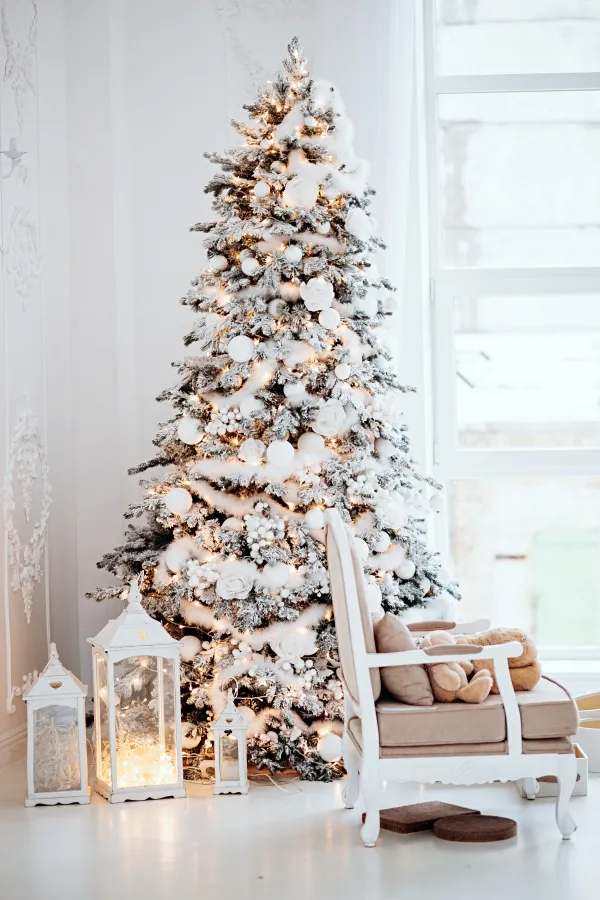
It’s a light ladder. The strings on the tree carry your eye upward, the three glowing lanterns pick that light back up at knee height, and the white wall molding continues it toward the ceiling. Monochrome doesn’t read flat when the light itself supplies the variation. Set against the beige armchair and the window, the whites stay distinct instead of merging.
9. A Sun-Flooded Sunroom Dressed in White and Cream
In a sun-drenched room, white-on-white only works if the contrast is texture, not color — matte flocking against clear glass ornaments, knit against wicker, shag against slipcover. And skip warm white lights in here. In strong daylight they vanish completely; save the glow for after 4pm, or use a cool white strand so the tree still has definition at noon.
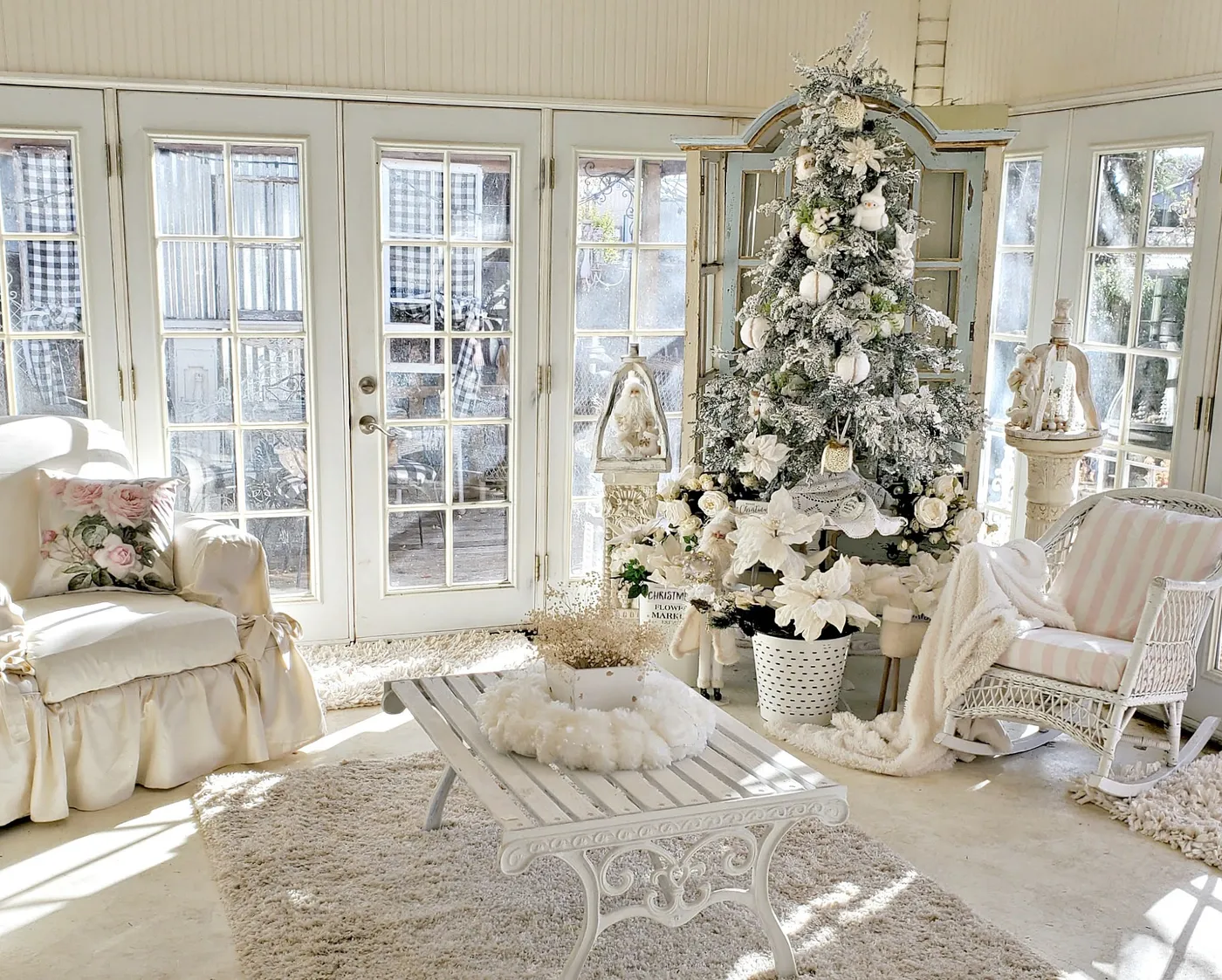
White slipcovered armchairs are the easiest thing to fake — a $250 IKEA Ektorp or a $40 thrift-store chair with a $90 stretch slipcover gets you there. Wicker rockers turn up at estate sales constantly in spring; paint them white yourself. The Santa figurines are the fun part: thrift stores, flea markets, and your grandmother’s attic, one at a time, is exactly how the best collections get built.
10. Three Frosted Trees and One Reflective Table
Three trees, three heights, one palette. Odd numbers feel casual and collected; staggering the heights keeps it from looking like a display window, and the reflective coffee table quietly doubles all that light back into the room. The dark sofa is the anchor — without something dark underneath, an all-white trio floats. It also means you can decorate one tree heavily and leave the other two mostly lights.
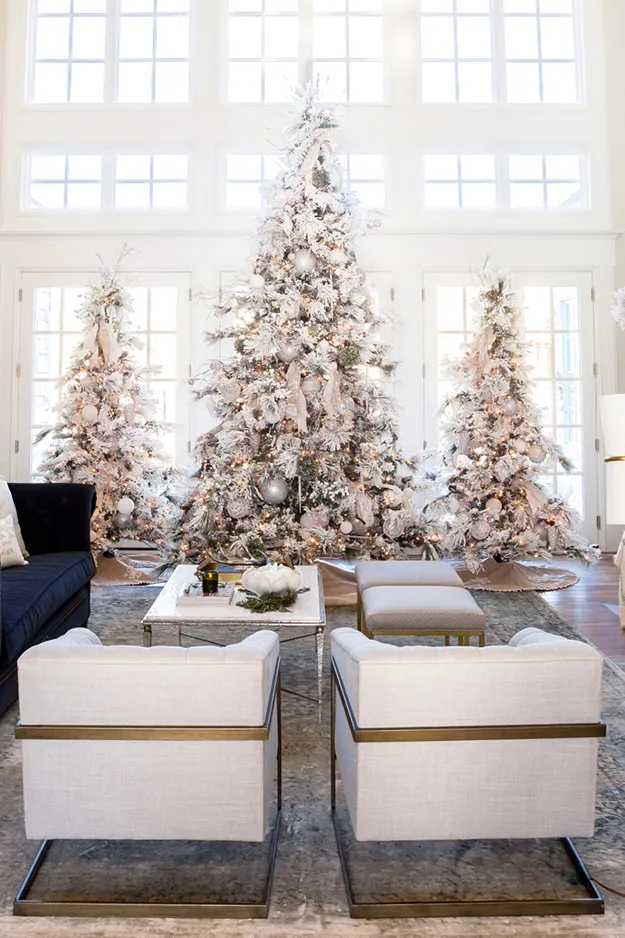
Three flocked trees need real estate: think 18 by 20 feet minimum, 10-foot ceilings, and one long uninterrupted wall. In a smaller living room, keep the trio but shrink it — 7.5, 6, and 4.5 feet work in about 12 by 14 feet. If you’re working with something tighter, the single-tree version in Idea #12 gives you the same frost without the footprint.
11. Frosted Garland That Travels From Tree to Shelving
Running a frosted garland from tree to shelving takes about 45 minutes and $35-$60 in materials.
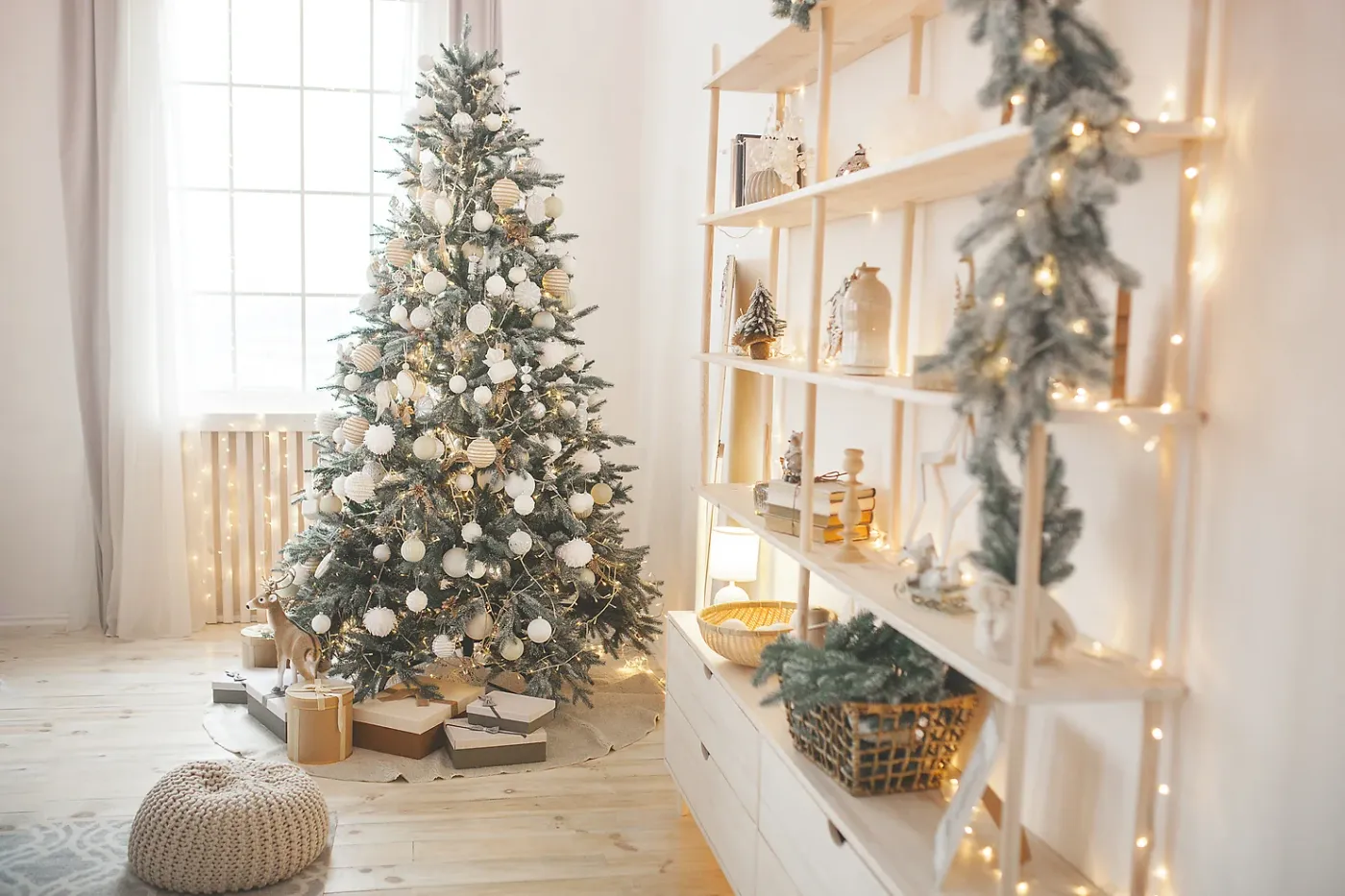
- Anchor a cup hook inside the shelf’s top rail — no nails in the wall.
- Start the garland at the tree, at roughly two-thirds height, so the eye follows a rising line.
- Loop it over the shelf edge and back down once, letting it sag.
- Weave warm white string lights along the same path, hiding the wire inside the garland.
- Finish with three neutral objects on the shelf: one wood, one glass, one textile.
Light wood open shelving is everywhere secondhand — IKEA’s IVAR or a marketplace find for $60-$120. Frosted garland is the one thing worth buying new, because cheap garland looks cheap: budget $40-$70 for a good 9-footer. Neutral wrapping in kraft and cream, a $35 knitted pouf, and ornaments kept to white and gold only. Same quiet look as Idea #21, roughly half the spend.
12. The Slim Tree That Fits Narrow Hallways
Slim trees exist for the rooms nothing else fits: entryways 36 inches wide, apartments under 700 square feet, ceilings at 8 feet with 12 inches of clearance above. A 6.5 to 7-foot slim tree with a 30-inch base is the sweet spot, and a 14 to 16-inch diameter skirt or a dark round base keeps it from looking like it’s balancing on nothing.
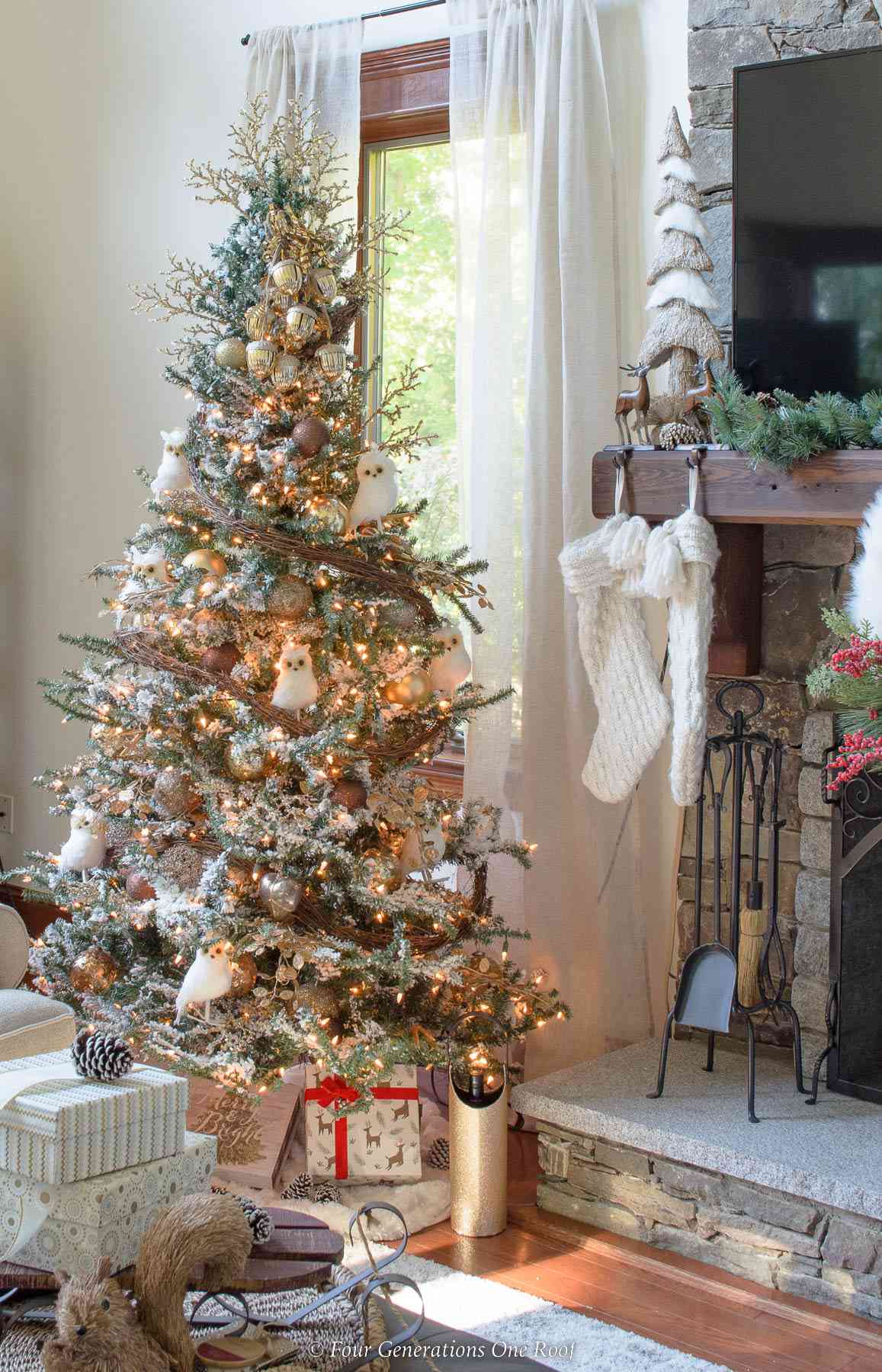
A slim tree looks sparse unless you give it vertical movement. Run translucent ribbon in long, near-vertical sweeps rather than a tight spiral — a spiral on a narrow tree reads like a barber pole. Ornaments no bigger than 3 inches, no more than 40 of them, hung in pairs at alternating depths. And keep the star proportionate: 8 to 10 inches on a slim 7-footer, nothing wider.
13. Santa Figurines Gathered in a Bay Window
Traditional setups like this one collect dust by the pound. Figurines need a soft brush and five minutes each in early December, the patterned rug wants a professional clean every 18 months ($150-$300), and heavy drapes should be vacuumed on low with a brush attachment twice a season. Skip the plush reindeer if anyone in the house has allergies — they’re basically felted dust bunnies.
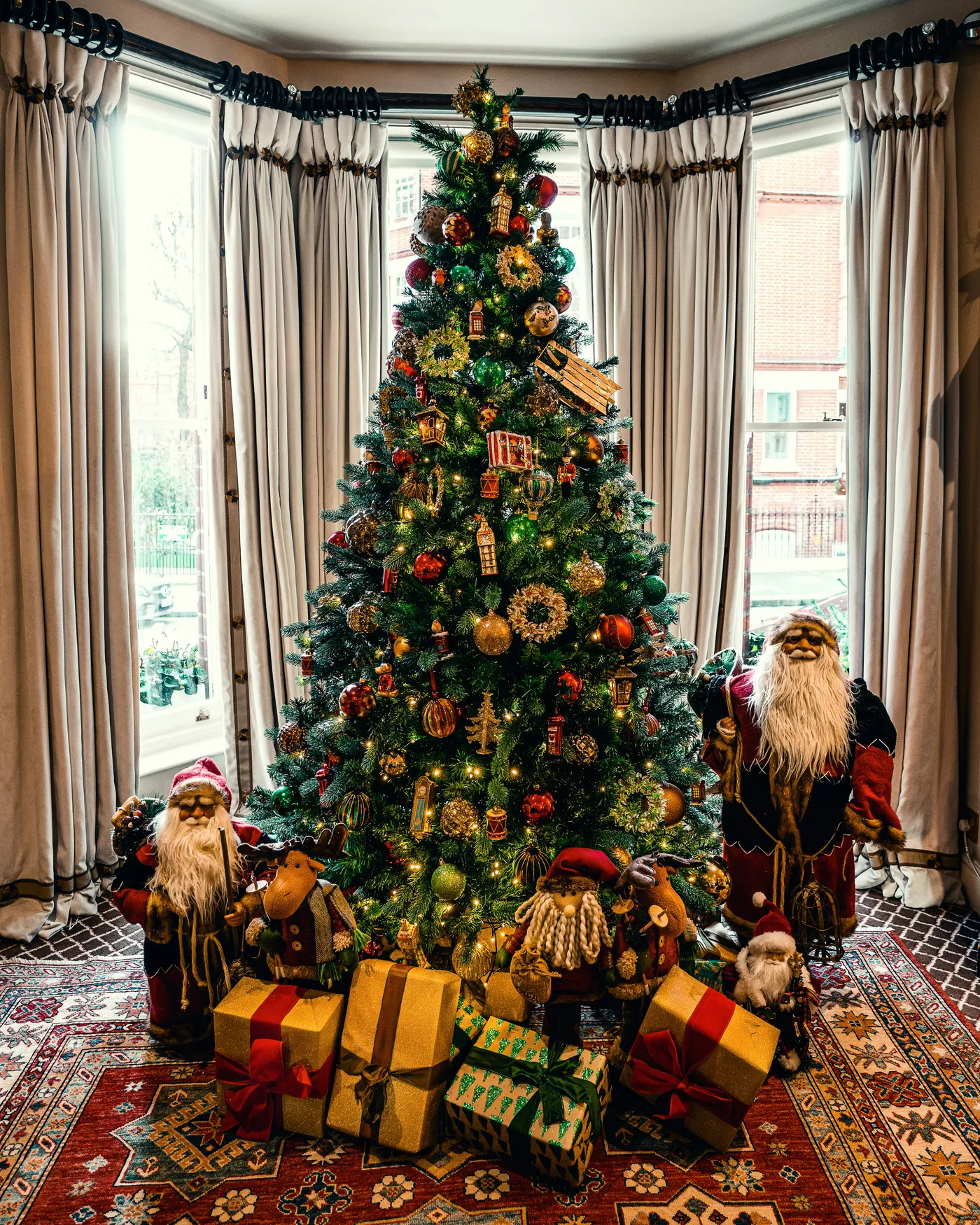
It’s the Santa collection at the base. Strip the figurines away and you still have a big, well-lit tree — but you lose the story, and story is what makes a tree feel like a family’s rather than a store’s. Everything else in the room can be swapped out. The gathered characters are the part guests walk over to look at.
14. Frosted Branches Against Dark Teal Paneling
55 percent dark teal panel, 30 percent warm white light, 10 percent cream, 5 percent brass. The teal is the whole trick: frosted branches read brighter against a deep wall than against white, and warm bulbs flatter teal in a way cool bulbs never do. Change the wall to navy and keep everything else and it still works — just add a touch more brass for warmth.
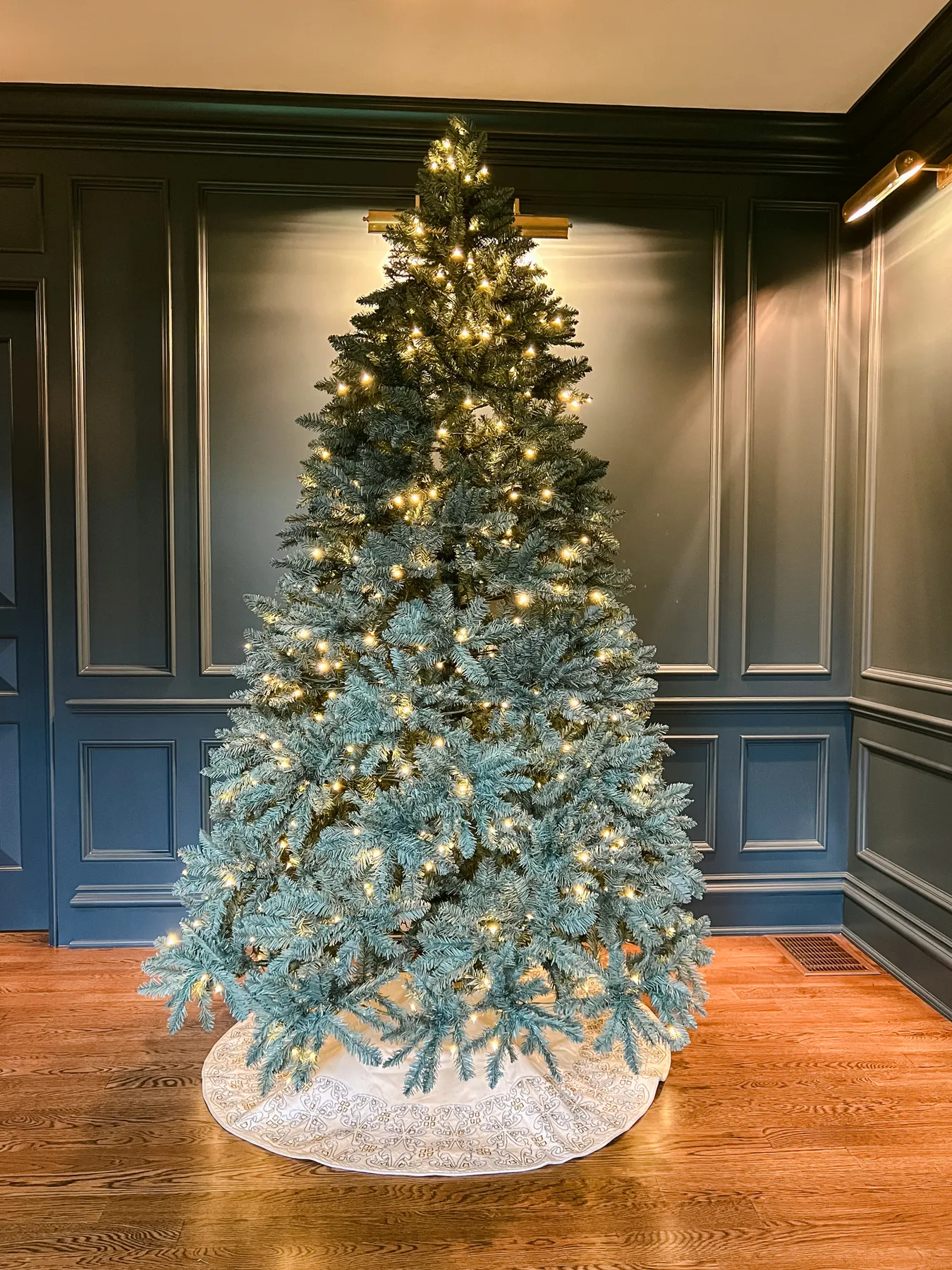
Your tree skirt is doing more work than you think, and cream with metallic embroidery is the right call against dark paneling and reddish-brown floors. Size it 48 to 60 inches across for a 7.5-foot tree so the fabric pools instead of peeking. Tuck the embroidered seam to the back, and if you have pets, use a collar over a skirt — nothing collects fur quite like a skirt.
15. A Pink Pre-Lit Tree Next to a Curved Rose Sofa
Colored trees stopped being a joke somewhere around 2023 and went fully mainstream by 2025 — Pinterest searches for pink and pastel trees keep climbing, and it’s part of the same dopamine-decor wave that gave us colored sofas and checkerboard floors. Pink trees may have shorter staying power than green, but the broader lesson sticks: an unexpected tree color turns the whole room into a scene.
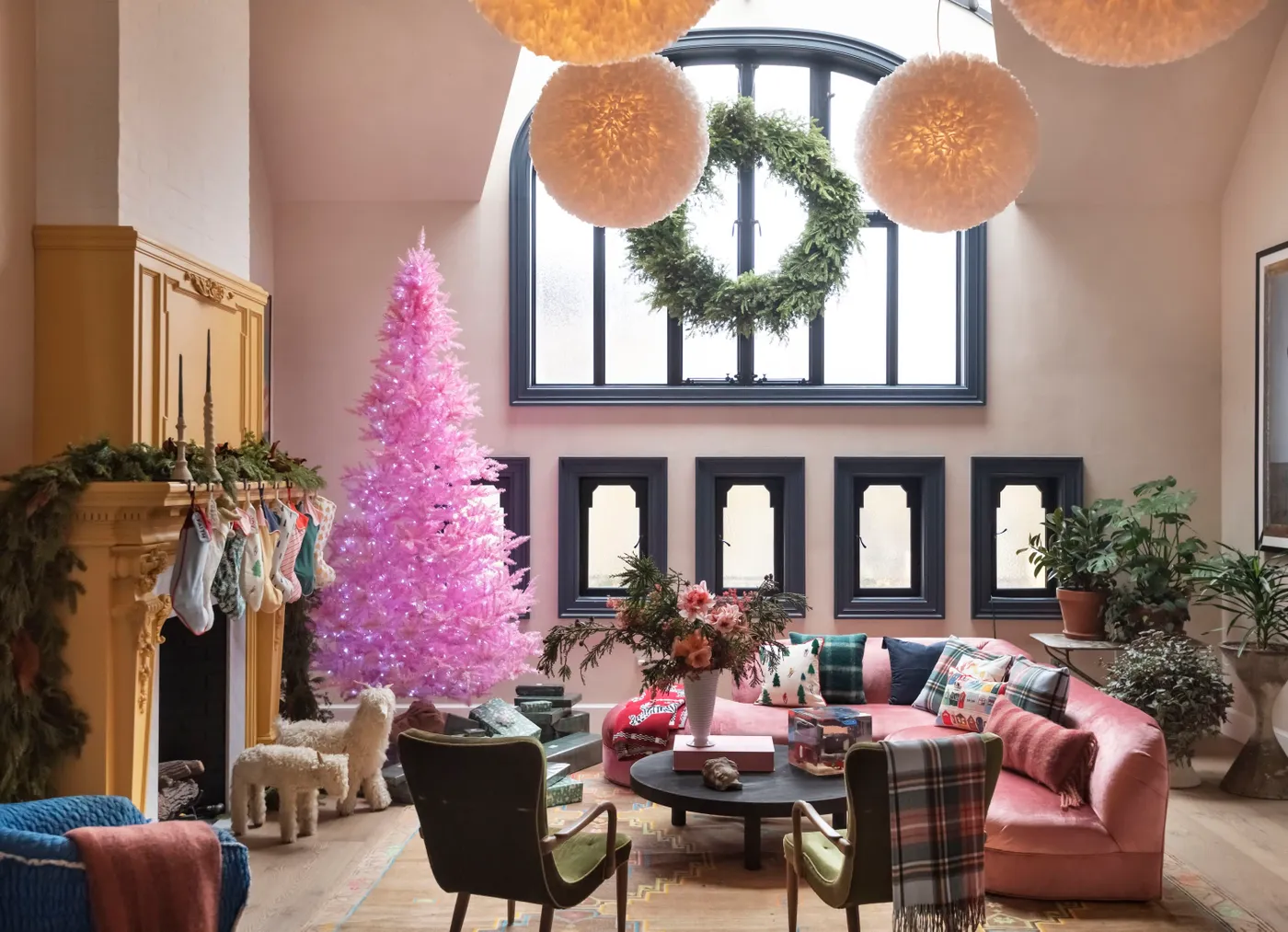
Pink looks magical in low, warm light and distinctly bubblegum at 2pm in a bright room. Test yours with the lamps on before you commit to a whole palette, and notice how the pink bounces a rosy cast onto white walls and pale sofas — sometimes flattering, sometimes not. Also check that your pre-lit tree’s bulbs are warm white; cool white bulbs turn pastel trees faintly grey.
16. Garland Winding Up a Curved Grand Staircase
The staircase is the second tree. Garland on a curving banister draws one continuous line from the newel post up to the landing, so the eye travels up and around instead of stopping at the tree. The red runner underneath ties tree, stairs, and poinsettias into one gesture. Take the garland away and the tree looks stranded in a very large room.
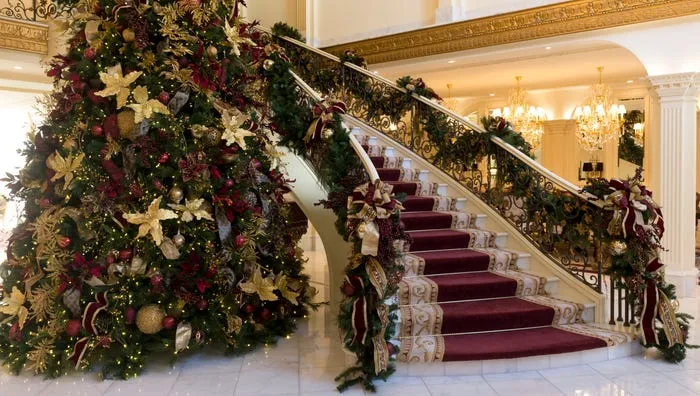
Securing garland to a banister safely takes about 90 minutes and $80-$150 in materials.
- Measure the banister top to bottom; buy 1.5 times that length in garland.
- Attach with clear zip ties or florist wire — never tape, never staples.
- Wrap the banister’s underside first, then fluff the top so the rail still feels solid.
- Add lights and ribbon last, weaving them into the underside so the handrail stays clear.
- Trim zip tie tails and check every attachment with a firm tug.
17. A Lit Tree and Candlelit Table for Real Dinner Parties
The lit floral centerpiece is the one thing. A decorated tree makes a dining room festive; a low arrangement of white roses and pink tulips with real candlelight makes people want to sit down. It also solves the practical problem every holiday host has — the tree is over there glowing, but the table is where the evening actually happens, so put the warmth where the people are.
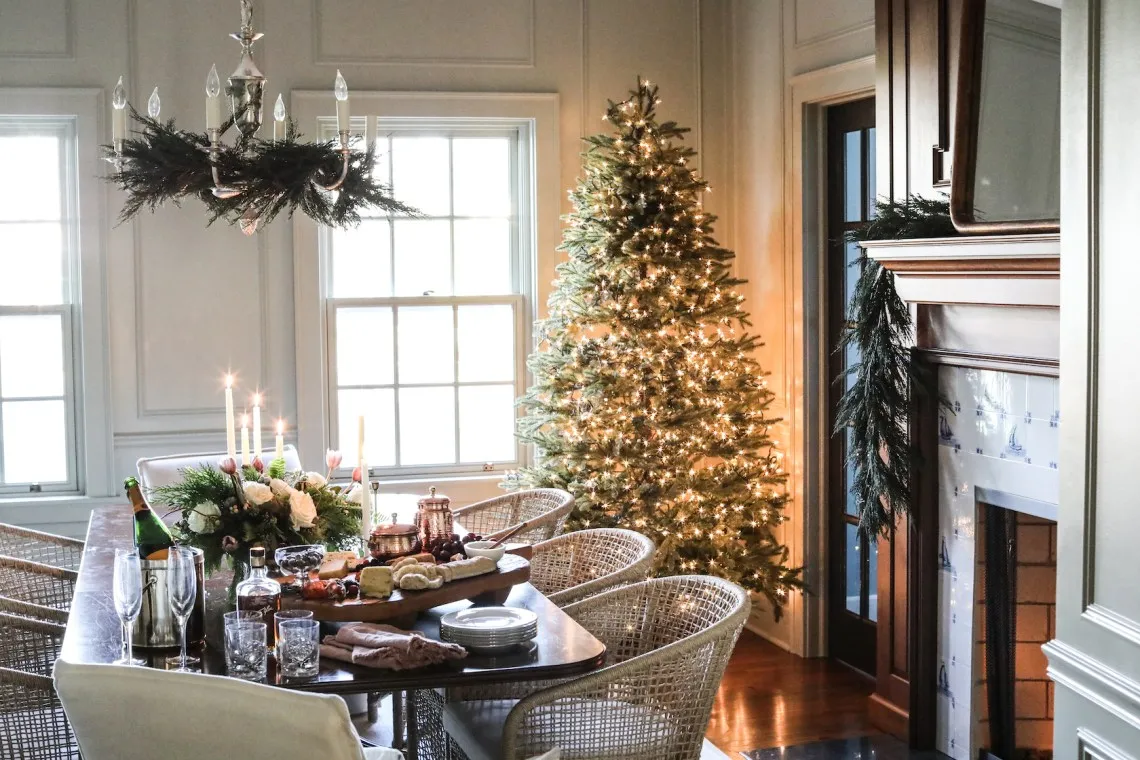
This works in a dining room of roughly 180 to 300 square feet with a table seating six to eight. Keep 36 to 42 inches of clearance behind each chair, and let the tree top out about a foot below the ceiling so it doesn’t compete with the chandelier. In a small dining nook, skip the tree and dress the chandelier instead — Idea #27 shows how the same idea spans a whole open floor plan.
18. Champagne Gold in a Double-Height Marble Loft
In a double-height room, everything small disappears. A 20-foot ceiling wants a 12 to 14-foot tree, and ornaments should scale up to 4-6 inches — a 2-inch ball at that height is invisible from the sofa. Same with ribbon: go 4 inches wide instead of 2.5. If you can’t commit to a giant tree, put a 9-footer on a 24-inch plinth and add height with a tall arrangement beside it.
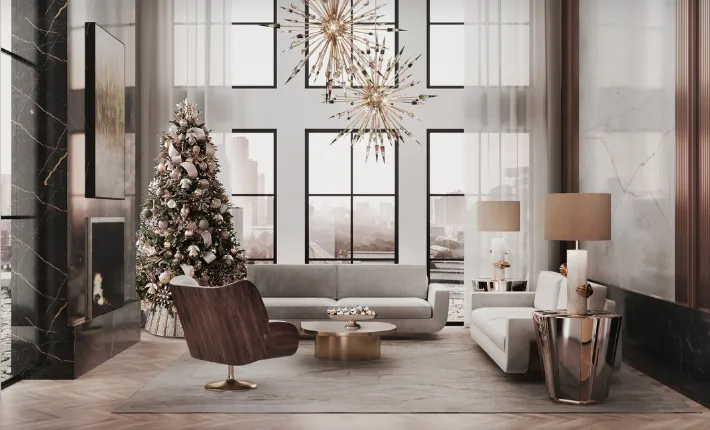
Count it out: 45 percent champagne and gold, 25 percent black marble with gold veining, 20 percent light grey upholstery, 10 percent rose-gold and copper accents. The metals are layered, not matched — champagne ribbon, gold spiky chandelier, copper fluting — and that’s why it feels collected at this scale. Swap rose gold for brushed nickel and the room gets noticeably cooler and more corporate.
19. Harlequin Ornaments, Gold Sprays, and Icicles Up Close
Layering ornaments so a tree looks styled rather than loaded takes about two hours.
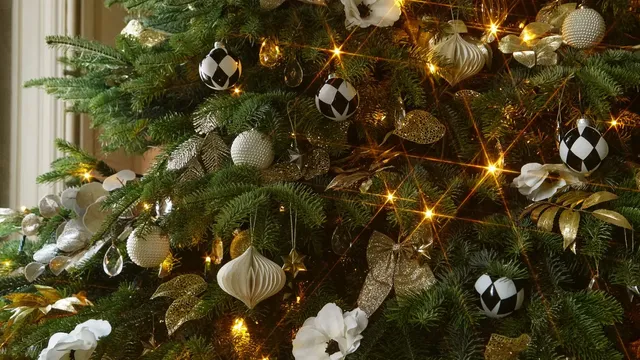
- Hang lights first, branch by branch, working from the trunk outward.
- Place your largest elements — faux flowers and leaf sprays — tucked into the deepest layer.
- Add mid-size balls in twos, one slightly inside the other, never single file.
- Fill gaps with icicles and small gold sprays at the outer tips.
- Step back ten feet and hunt for bare patches before adding anything else.
Glitter is permanent. It will be in the carpet in March, so buy lint rollers in bulk and use a vacuum with a bare-floor setting, not a beater bar, near the tree. Glass and mercury ornaments need individual tissue wraps — a $30 storage box with divided trays pays for itself the first January. And never leave icicle ornaments tangled; unclip them one at a time.
20. A Spiral Light-Only Tree on a Glowing Base
Before you order a spiral light tree, verify these five things:
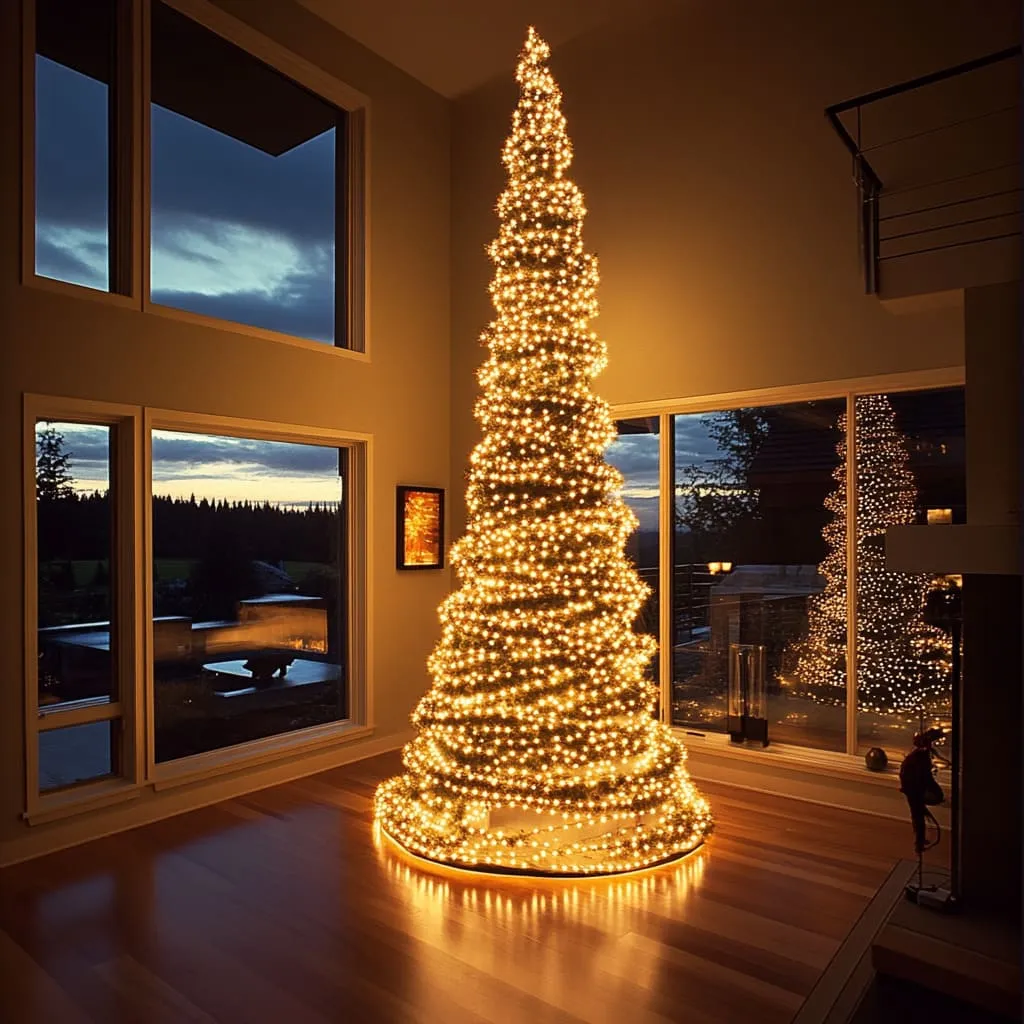
- Ceiling height minus 18 inches equals your maximum tree height.
- A grounded outlet within 6 feet of the base, ideally on a switch.
- Floor protection: felt pads under an illuminated base on hardwood.
- Weight — some spiral trees need a 30-pound base or a sandbag.
- Replacement bulbs, because a light-only tree shows every dead bulb.
No ornaments, no ribbon, no topper — and it still stops you in the doorway. When a tree is nothing but warm white light, the silhouette does all the talking, and the illuminated base plus the polished floor turn it into a soft column of glow. It’s the cleanest possible answer to a modern room that genuinely doesn’t want more stuff in it.
21. White and Gold Flocked Tree Doubled by an Arched Mirror
- Flocked 7.5-ft tree: $180-$450
- White and gold ornaments, 80-120 pieces: $80-$200
- Warm LED strings: $40-$80
- Flocked garland for the staircase: $45-$90
- Mirror or nesting tables: $120-$400
- Total: roughly $465 to $1,220
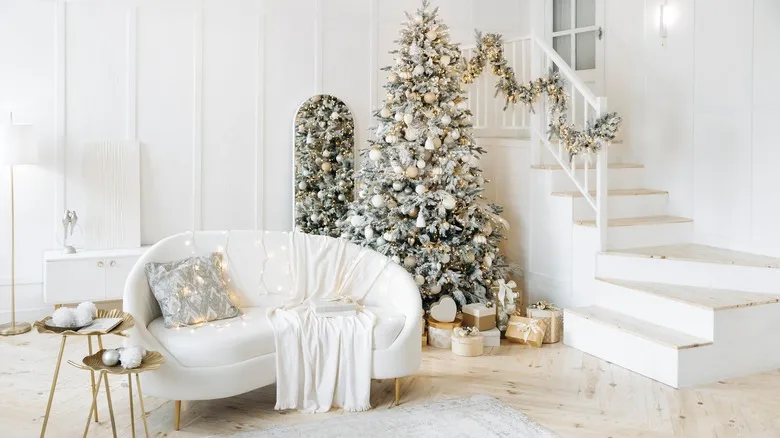
Budget alternative: skip the staircase garland and let the arched mirror do the doubling instead — it bounces the tree’s light for free.
Put the tree where a mirror can see it. In this room, the arched full-length mirror nearly doubles the tree’s glow for zero dollars, and the trick works in almost any narrow space — hallway, landing, small living room. Angle the mirror so it catches the tree on a slight diagonal; straight-on reflections look like a duplicate, angled ones look like depth.
22. White Flocked Tree, Black Oval Table, Gold Art
Sixty percent white — flocked tree, sofa, walls — 20 percent gold, 15 percent black from the coffee table and linear chandelier, 5 percent grey rug. The black is what keeps the white from going saccharine; remove it and the room turns bridal. Swap black for warm walnut and bronze and you get the same structure with a softer, mid-century mood.
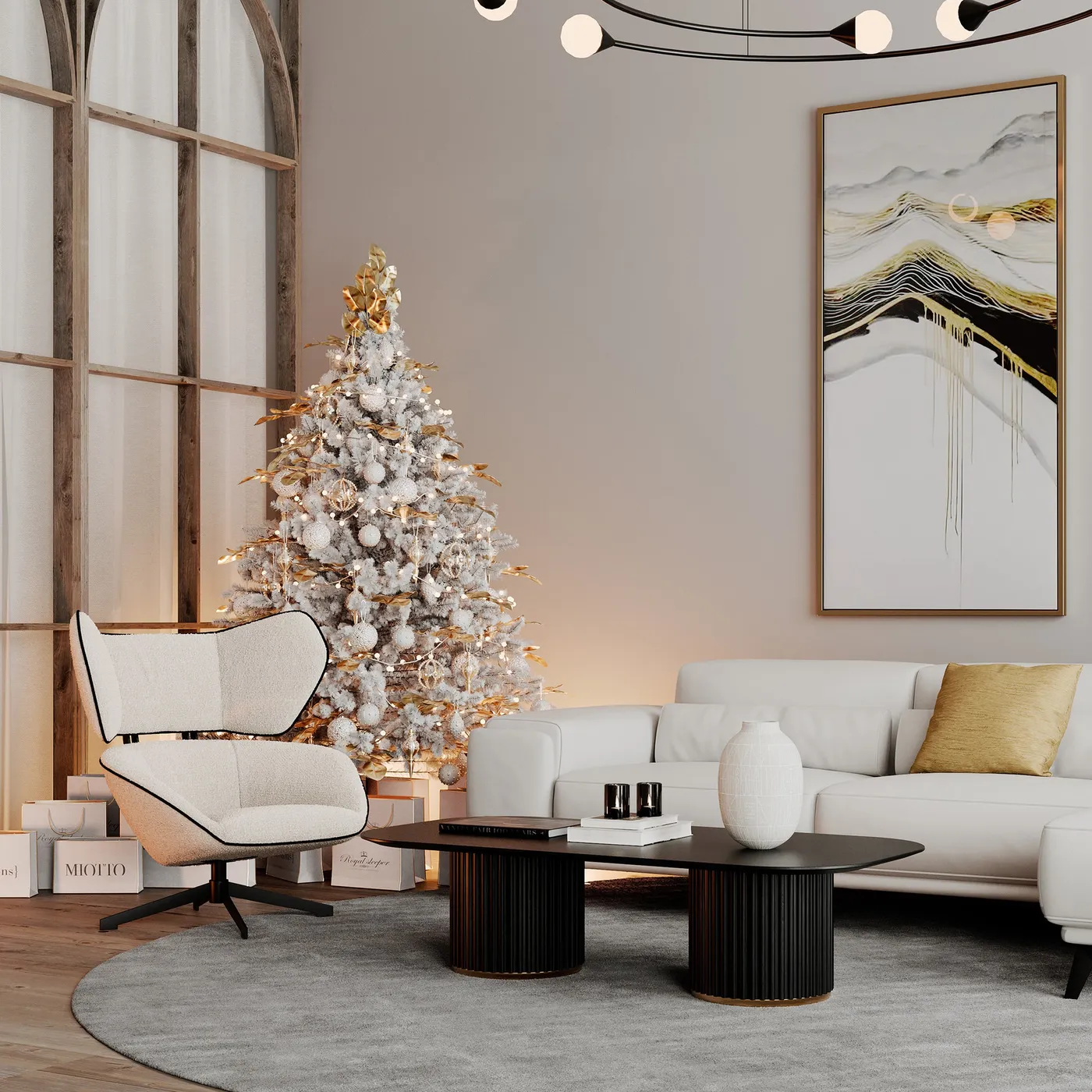
White flocked trees with gold ornaments are the easiest look to fake: a 6.5-footer from Walmart plus gold balls from Dollar Tree and one roll of ribbon comes in under $200. A black oval coffee table is $90-$150 at Wayfair or Target; a cream bouclé armchair dupe runs about $300 instead of $1,200. And that abstract art is a very doable DIY with a canvas and two paint colors.
23. Accordion Paper Trees in a Cream and Green Lounge
Paper trees are quietly having a moment, and it makes sense: they fold flat, cost a fraction of a flocked tree, and suit the way people decorate now — seasonal, compact, easy to store in a closet. Accordion folds also photograph beautifully, which is how they spread from Scandinavian design shops to Pinterest boards in a single season. This one has staying power; paper has been a holiday material for centuries.
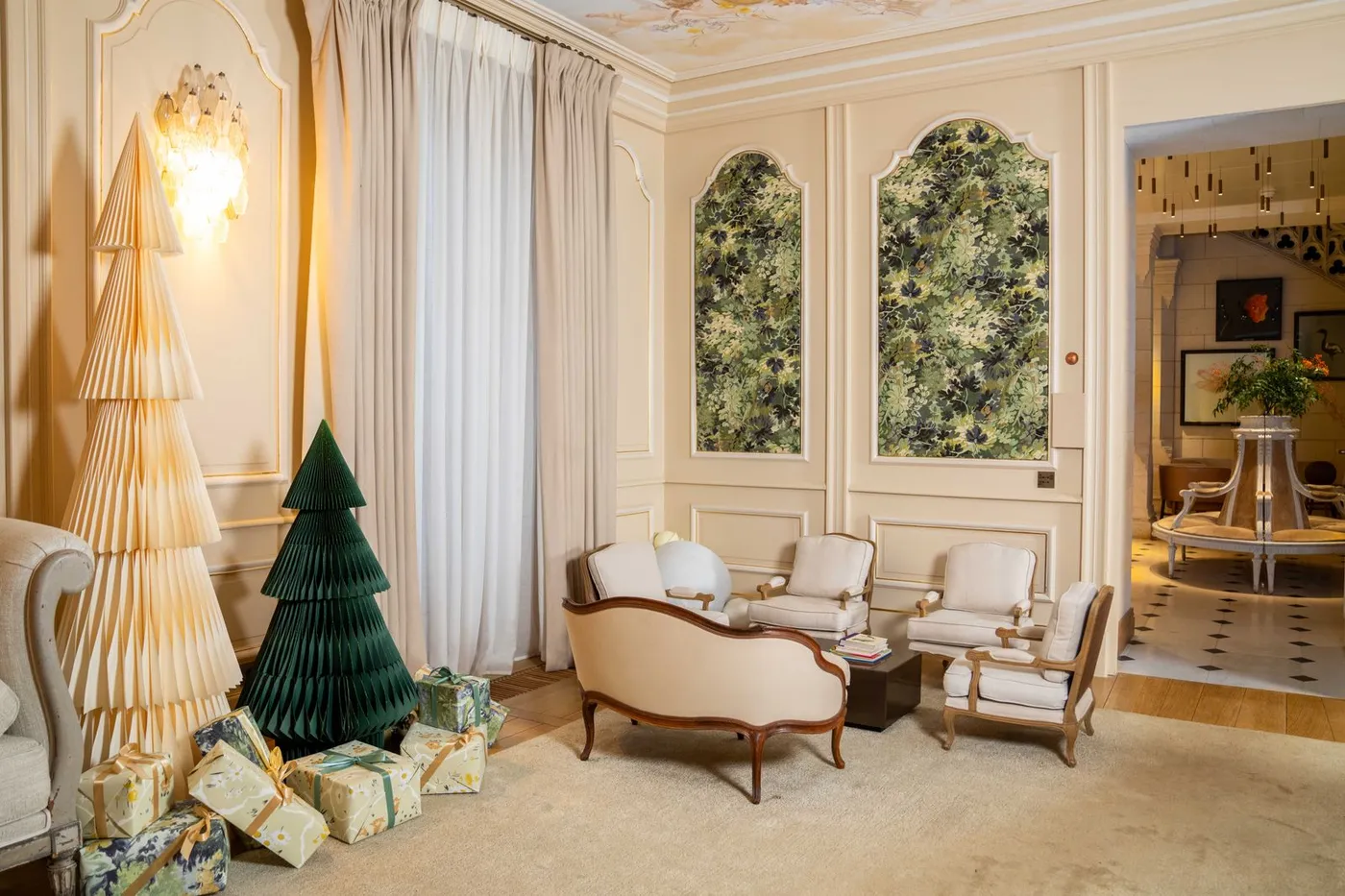
Paper trees are delicate in ways a flocked tree is not. Keep them away from radiators, open flames, and damp basements, and store them flat with tissue between the folds or the creases get lumpy. They also can’t hold much weight, so heavy ornaments and garland are out. The upside: when they’re creased, they’re recyclable, unlike the tree Idea #19 describes.
24. Dried Orange Slices Tied With White Twine
Dried orange ornaments take about 3 hours of oven time, plus cooling, and cost under $15 for a whole tree’s worth.
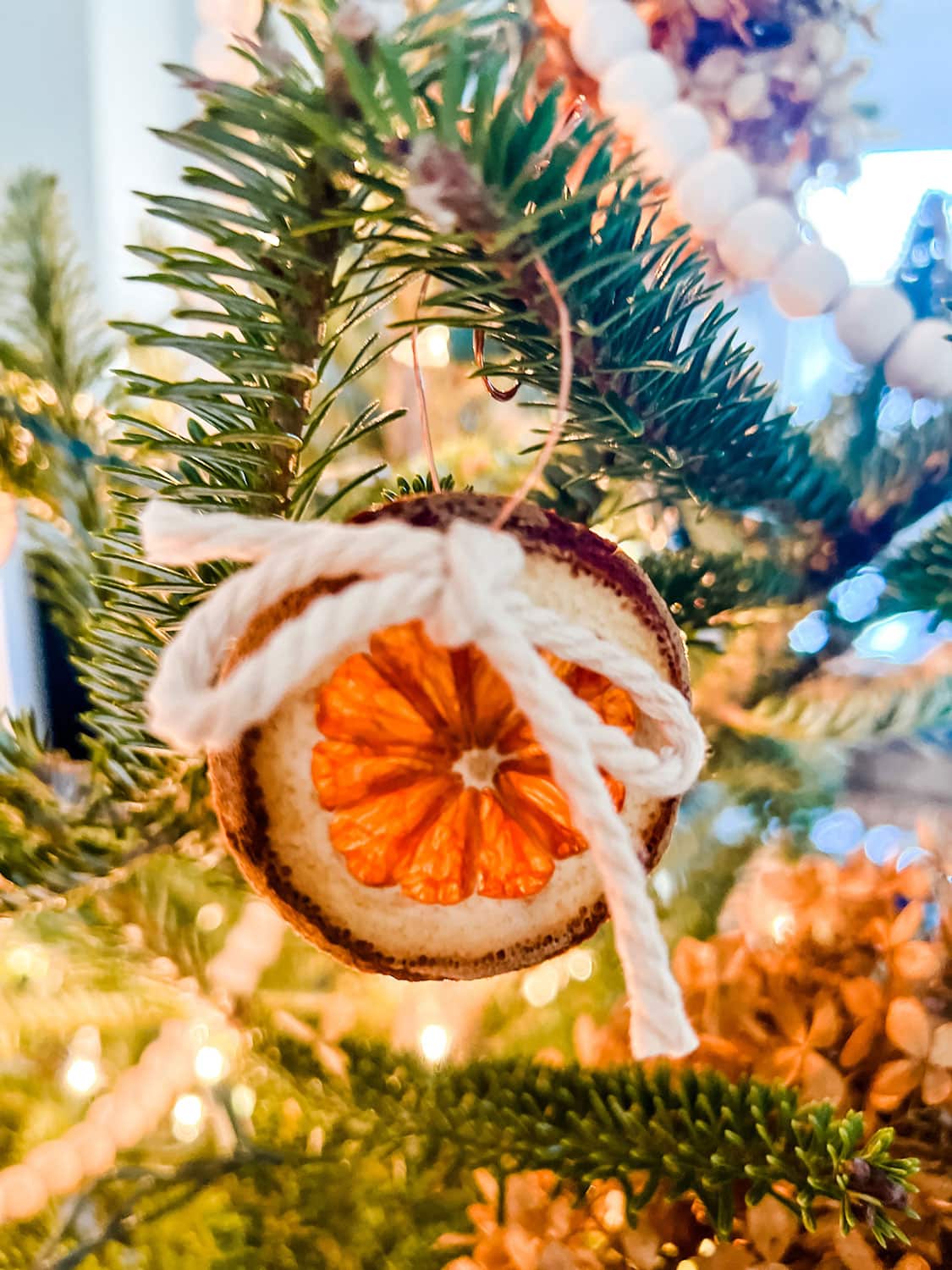
- Slice oranges 1/8 to 1/4 inch thick; thicker slices stay sticky.
- Blot both sides with paper towel, then lay on a rack over a sheet pan.
- Bake at 200°F for 2.5 to 3 hours, flipping once at the halfway mark.
- Cool completely — they should feel like stiff cardboard, not leather.
- Thread twine through the rind and tie a small bow at the top.
Natural ornaments are a one-season commitment, and that’s the charm. Orange slices fade to a lovely amber and last about two years if stored in an airtight box with a silica packet, but they’ll go soft in a humid basement. Wooden bead garlands are practically indestructible — wipe with a dry cloth. The dried flowers, though, will shed. Handle them once and leave them alone.
25. Frosted Tree With Deep Navy Velvet Ribbon
50 percent frosted white, 25 percent deep navy, 20 percent silver, 5 percent pure white florals. Navy does the work red usually does — it gives the white something dramatic to sit against — and silver keeps it wintery instead of nautical. Trade navy velvet for burgundy and the same formula turns traditional; trade silver for brass and it turns warm.
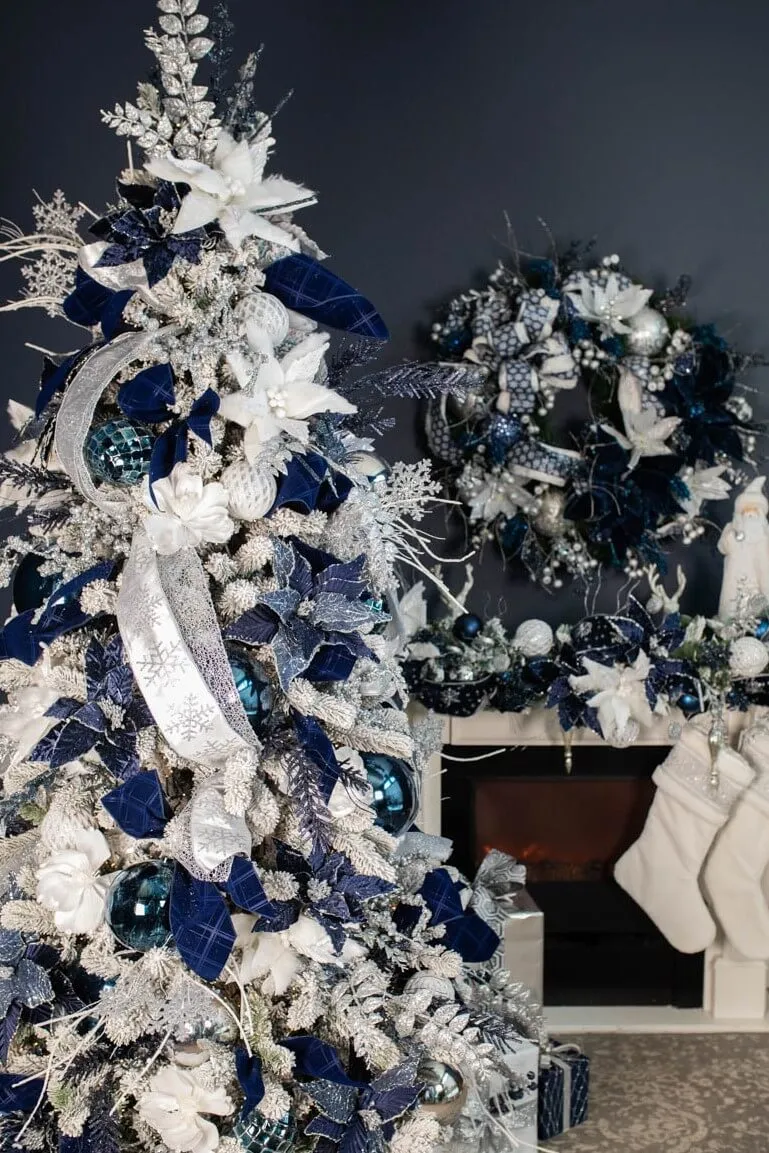
It’s the navy velvet ribbon. Every ornament, spray, and garland strand has a job, but the wide velvet ribbon is what makes this tree look intentional instead of merely full — it gives the eye one deep, matte, un-glittered line to follow through all that sparkle. Take it off and the tree goes from designed to decorated. The wreath on the dark wall depends on the same trick.
26. Warm Lights and Candy Canes Over a Console Garland
Traditional trees with candy canes, mixed ornaments, and warm bulbs are the safest bet with children and pets, but they are not low-maintenance. Candy canes attract ants if left up past New Year’s, colored lights fade unevenly, and a box of mixed ornaments takes real time to hang well. Also: a real pine garland on a console table sheds needles daily. A faux pine garland with lights looks nearly as good and sheds nothing.
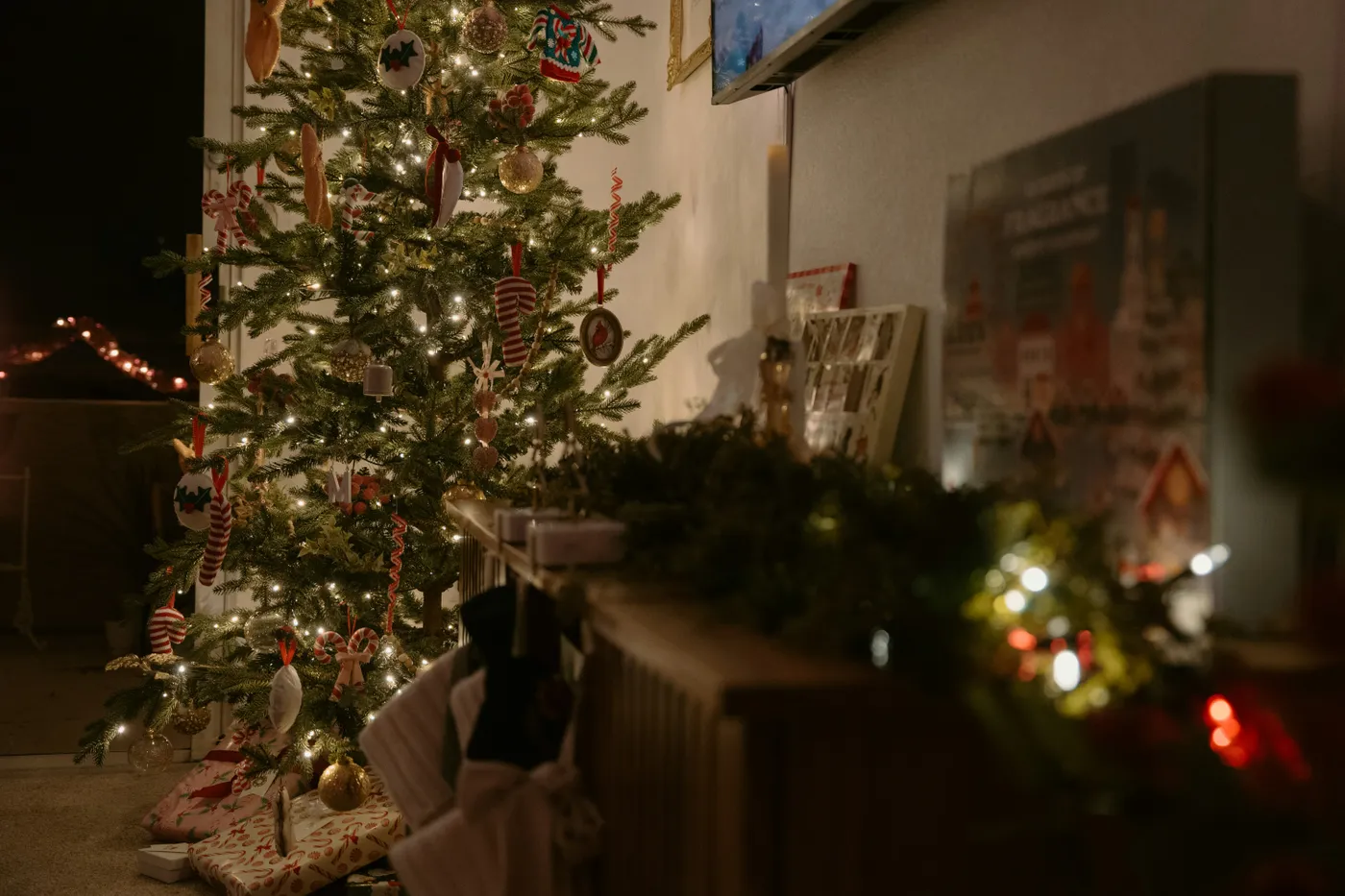
Nostalgia is a design principle, not a compromise. Here the tree, the lit garland on the console, and the framed art all sit at different heights and different distances from the wall, which gives a small room three layers of depth instead of one flat plane. Warm bulbs — around 2700K — keep the arrangement cohesive and cozy.
27. Open-Concept Kitchen and Living Room Sharing One Garland Story
Open-concept rooms need scale checks that single rooms don’t. The tree here sits in a living zone of roughly 200 square feet but is visible from the kitchen 25 feet away, so it tops 9 feet to hold its own. Garlands run on three separate planes — island, hood, mantel — which is what makes the whole space feel decorated rather than just the corner where the tree stands.
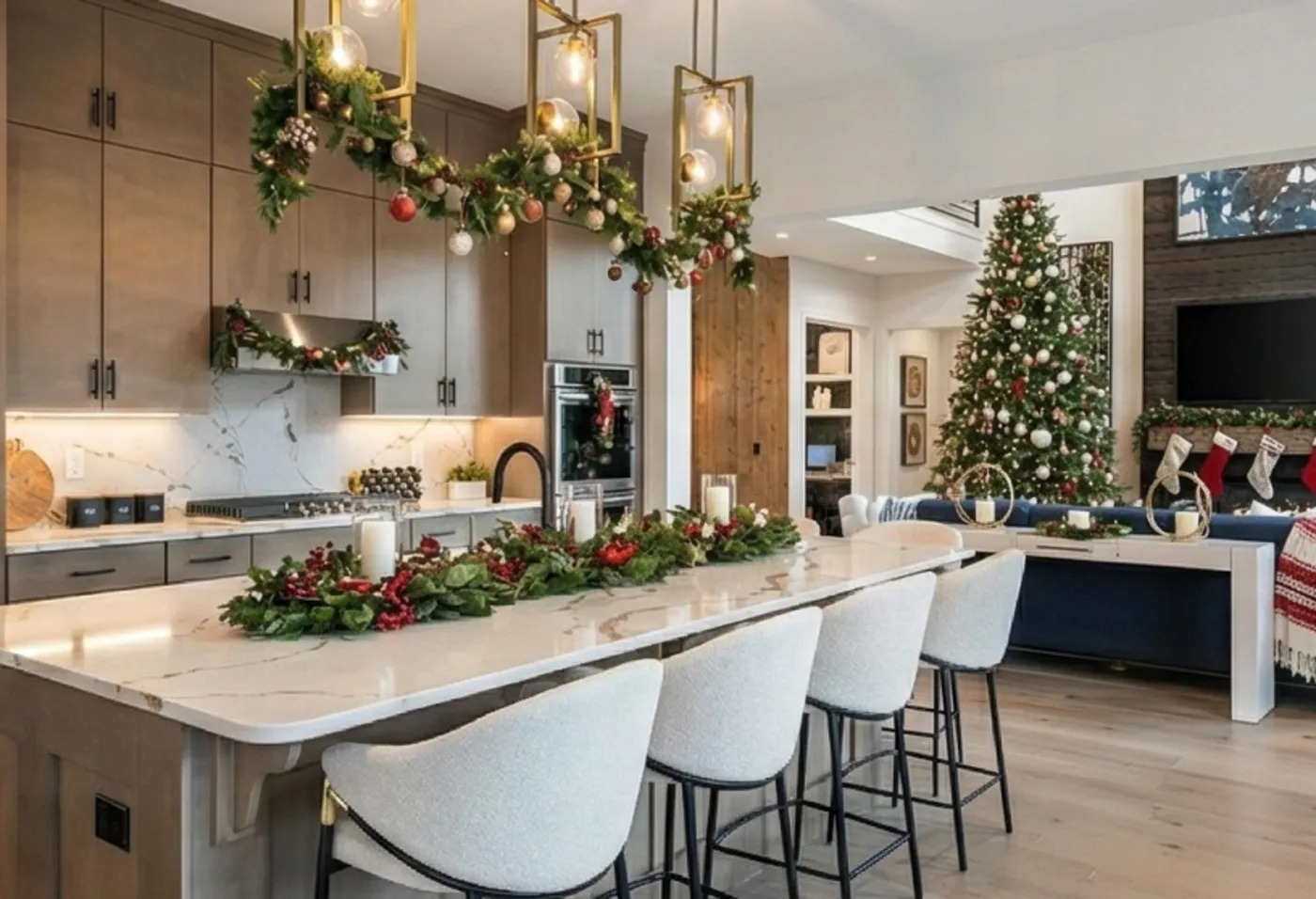
- 9-ft tree with white, gold, and red ornaments: $250-$600
- Three 9-ft garlands with berries and baubles: $150-$350
- Warm LED strings for all three: $60-$120
- Gold pendant or hardware accents: $100-$400
- Ribbon, picks, and filler: $50-$120
- Total: roughly $610 to $1,590
Budget alternative: keep the tree full and thin the garlands — one on the mantel, one on the island, none on the hood.
28. Blue Ribbons, Silver Ornaments, and Blue Velvet Stockings
Blue and silver shouldn’t work as well as it does, and the reason is value contrast. The tree stays mid-tone green, the ornaments flip between bright silver and deep royal blue, and the room’s taupe chairs and light patterned curtains stay quiet behind it. Nothing in the room competes at the same volume, so the tree wins without a fight.
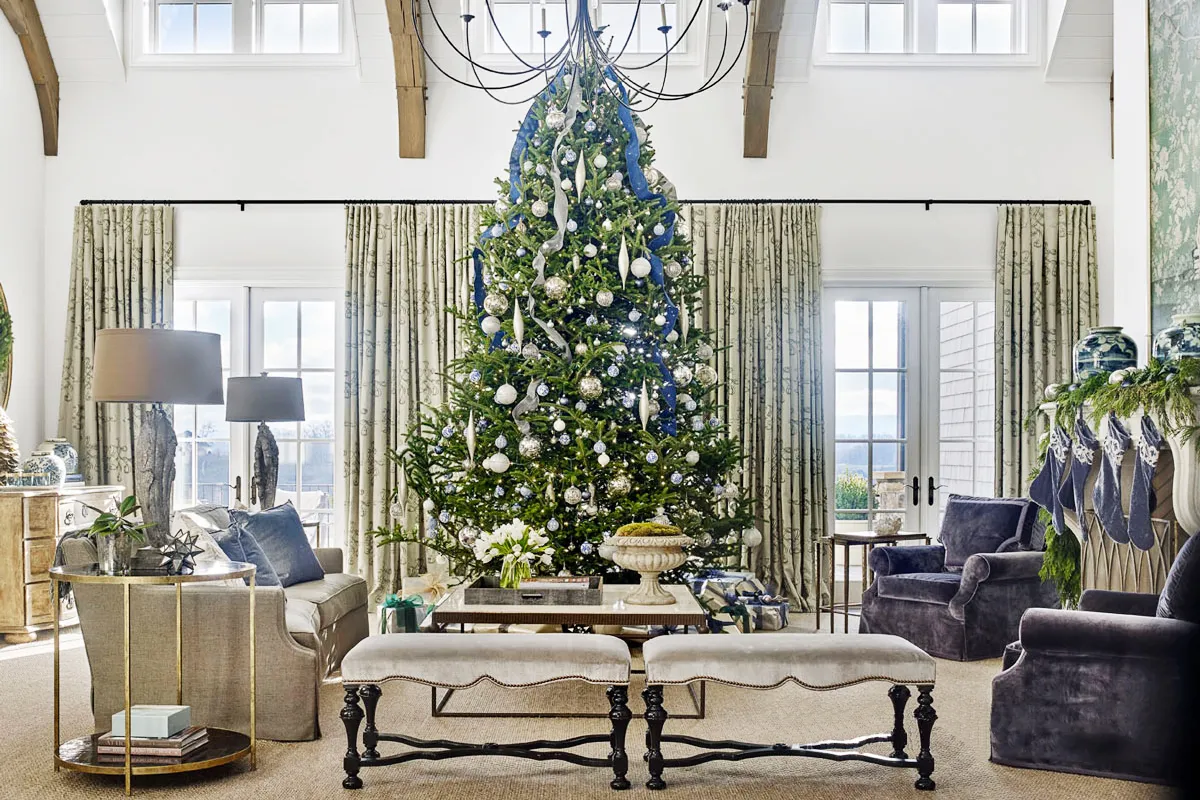
Pick two blues, not five. Navy velvet ribbon plus one lighter blue ornament gives depth that a matching set never does, and keep silver to about a third of the ornaments so the tree doesn’t turn into a mirror ball. If your floors are warm wood, add a few cream or champagne pieces — push the blue slightly toward grey rather than candy blue and it will still look right in five years.
29. Red and Green Plaid, Golden Trees, and White Deer
Classic red and green never left, but it’s being re-sold to a new generation as nostalgia maximalism — plaid tablecloths, deer figurines, glass ornaments in patterned boxes. It’s a reaction to years of all-white minimalism, and it’s the easiest style to source secondhand, since every thrift store in America has a box of red glass balls in the back. Expect it to outlast the trends that spawned it.
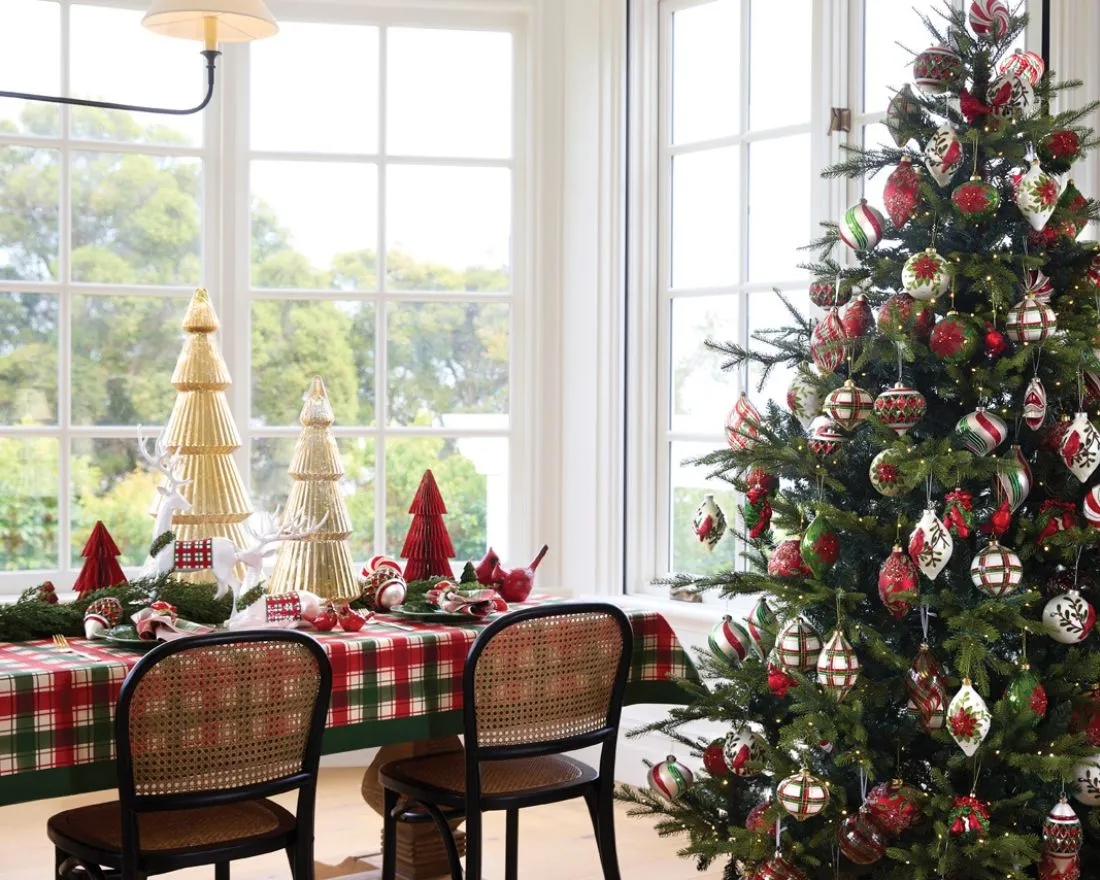
Thrift stores are the whole strategy here. Red and green glass ornaments run $2-$5 per box, plaid tablecloths $8-$15, and gold fluted decorative trees $12-$25 at discount stores. Rattan-back chairs show up at marketplace prices of $40-$90 each. Use a fresh eucalyptus or pine garland from a grocery store florist for $20-$30 and the table looks curated for under $150 total.
Go Forth and Fluff — Your Most Elegant Tree Yet
Pick one idea from this list and commit to it fully — an elegant tree is almost never about how much you hang on it, but about the one detail you repeat with confidence. Start with the silhouette, get the light temperature right, and let the ornaments follow.
📌 Pin your favorite from the 29 above so it’s waiting for you next November — and tag us when the tree goes up.