
You’ve probably seen it by now — a window with a string of glowing amber discs hanging in front of it, and you stopped scrolling a half-second longer than you meant to. That’s the dried orange slice garland: the rare holiday project that costs almost nothing and looks like it came from a shop in Copenhagen.
We dug through Target, Etsy, IKEA, Walmart, and Amazon, plus a whole lot of real kitchens and mantels, to pull 22 versions worth copying — from a $4 ball of twine to a $295 mantel that looks like it’s been in the family for decades. Budget and luxury takes sit side by side, with honest notes on which one is worth the money.
Inside you’ll find natural rustic trees, old-world candlelit styling, moody mantels, and table centerpieces that use citrus as the only color in the room.
Plastic-free holiday decorating stopped being a niche this year — dried citrus, cotton ribbon, and reusable garlands are what people are searching for now, and this is the cheapest way into that look. And stay with us to the end — we break down the most common mistakes that can ruin these looks.
📌 Save this to Pinterest for later — you’ll want to revisit these ideas.
1. Twine-Strung Dried Orange Garland for the Kitchen
Three things are doing the work here: repetition, translucency, and roughness. The slices repeat at even intervals, which reads as rhythm instead of clutter. Because the fruit is dried rather than fresh, each slice goes translucent and soaks up whatever light passes through it — in a kitchen, that’s almost always a window. And the twine matters more than people expect. It’s matte, fibrous, and slightly uneven, which softens what could otherwise look like a row of perfect circles. Swap in satin ribbon and the whole thing goes stiff and a little precious.
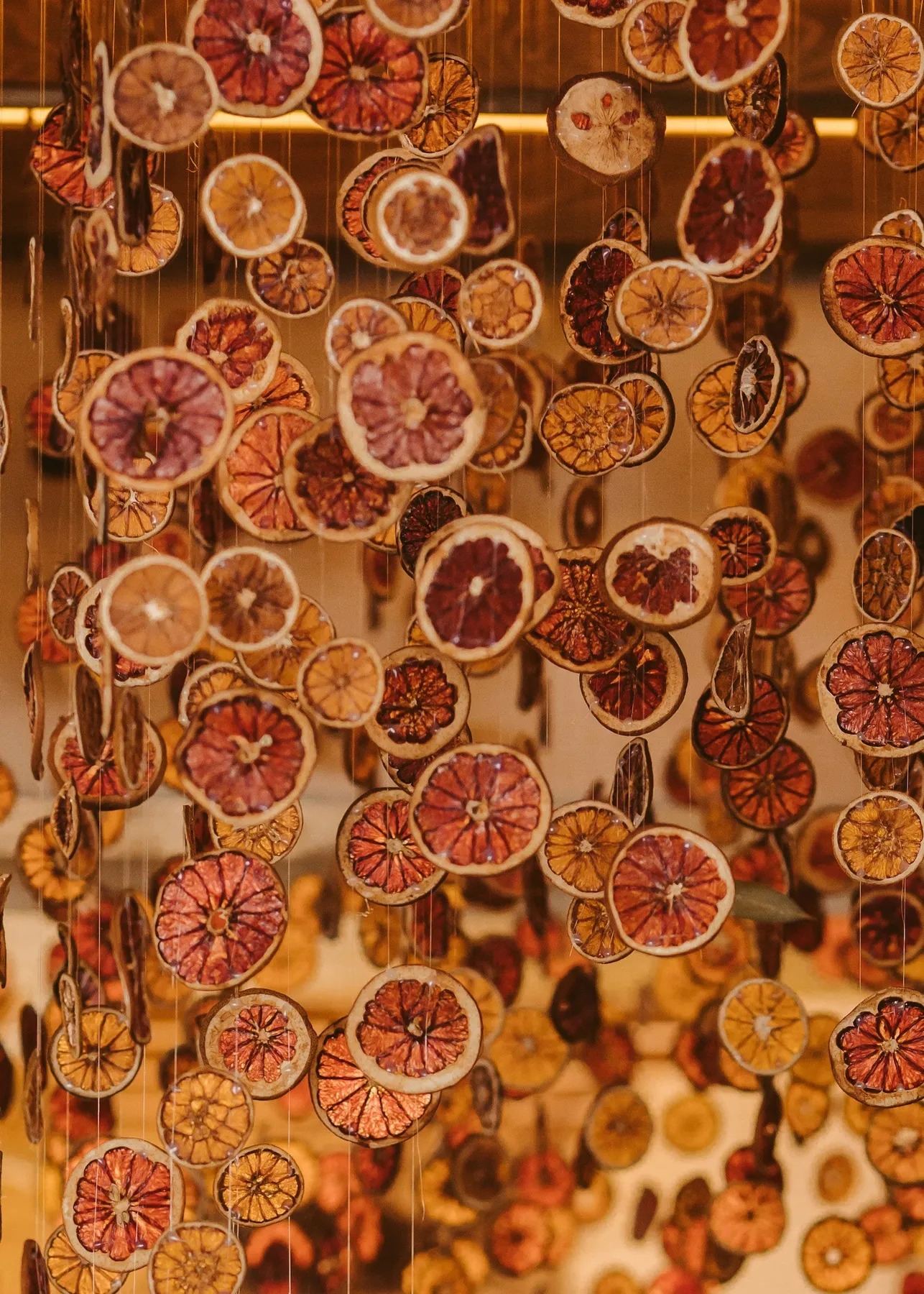
- Slice navel oranges 3–4 mm thick. Thinner slices scorch at the edges; thicker ones stay gummy in the middle.
- Blot both sides on a clean towel, then dry at 200°F for 3–4 hours, flipping once at the halfway mark.
- Cool completely on a rack. A finished slice should feel like stiff leather, never tacky.
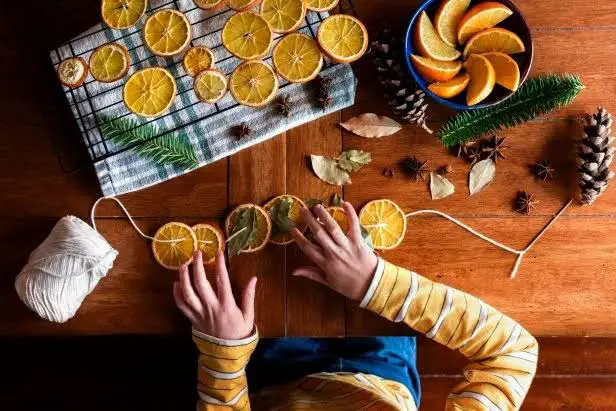
- Pierce each slice 1 cm in from the rind with a needle and thread them onto cotton twine, leaving about 2 inches between slices.
- Hang it and let it settle overnight before adjusting spacing — the twine relaxes as it takes weight.
Time: half a day, most of it unattended. Cost: about $6 in oranges and $3 for twine.
2. Hand-Tied Citrus Ornaments with Pinecones and Cinnamon
The cinnamon bundles are the element you’d miss most if they vanished. Round slice, round slice, round slice — that’s the pattern, and it gets monotonous fast. The tied cinnamon sticks interrupt it with a vertical, deep-brown shape and a scent that does more for the room than any candle. They also cost almost nothing: two sticks and an eight-inch length of twine per bundle, tucked between the larger branches where the ornament density thins out and the tree starts looking bare.
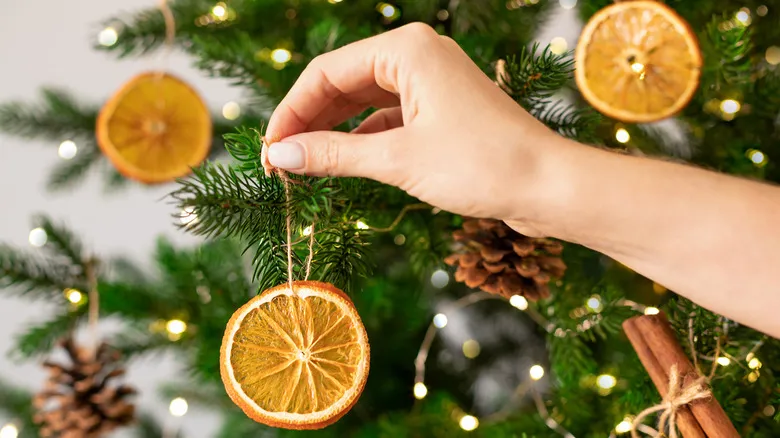
Dried citrus is heavier than a glass bauble of the same size, so hang it 6–8 inches in from the branch tips rather than on the outer edge — the needles will frame each slice and the branch won’t droop. Tie every loop at 5 inches so the ornaments sit at a consistent drop height, and skip the wire hooks entirely. Wire scratches the rind and catches light in photos; twine disappears into the branches where you want it to.
3. Mixed Evergreen Wreath with Fanned Citrus Slices
70% mixed evergreen + 20% dried citrus + 10% dark brown. The trick is running two evergreen textures — one scale-like, one needle-like — so the green reads as depth rather than a solid mass. From there you can swap freely: juniper for cedar, fanned dried sections for whole slices, pinecones in or out. Just keep the brown under a tenth of the total, or the wreath starts to look dusty instead of natural.
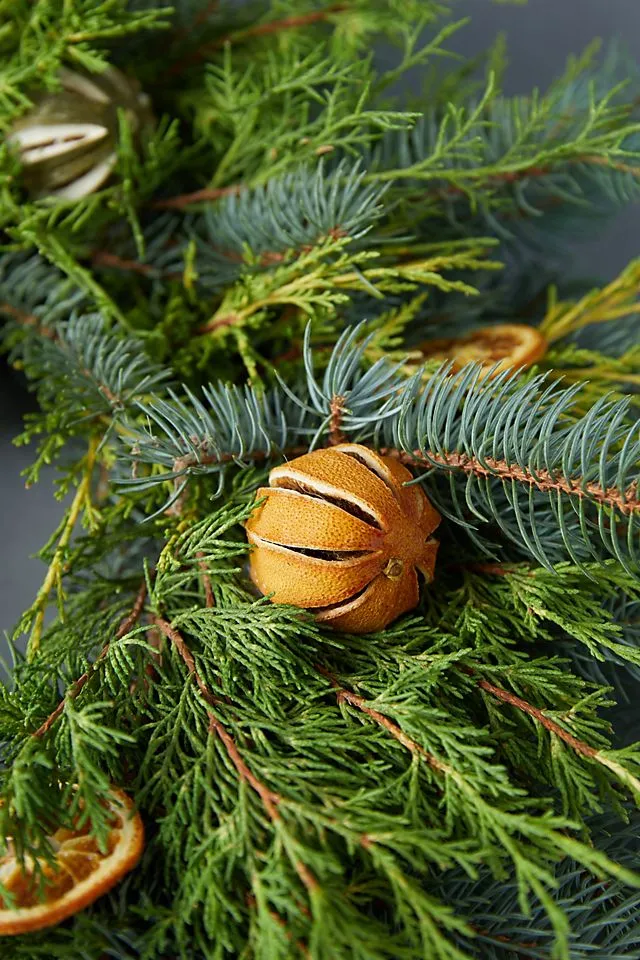
Fresh evergreen is not a long-term material. In a heated house, a cut wreath starts dropping needles in about 10 to 14 days, and a spot near a radiator cuts that in half. The citrus has the opposite problem: it lasts for years but fades to a dull brown within a season or two in direct sun. If you want this look on a sunny front door, go faux evergreen and keep the real slices indoors where they’ll hold their color.
4. Sunlit Vertical Citrus Garland on Clear Line
Vertical garlands need vertical space, and most rooms simply don’t have it. You want at least 8 feet of ceiling height and a window at least 30 inches wide; the sweet spot is a tall narrow bay or a stairwell where a 6- to 7-foot drop has room to breathe. In a standard room with an 8-foot ceiling and a 36-inch window, the horizontal run in Idea #5 will always look better than forcing a long vertical line into a short wall.
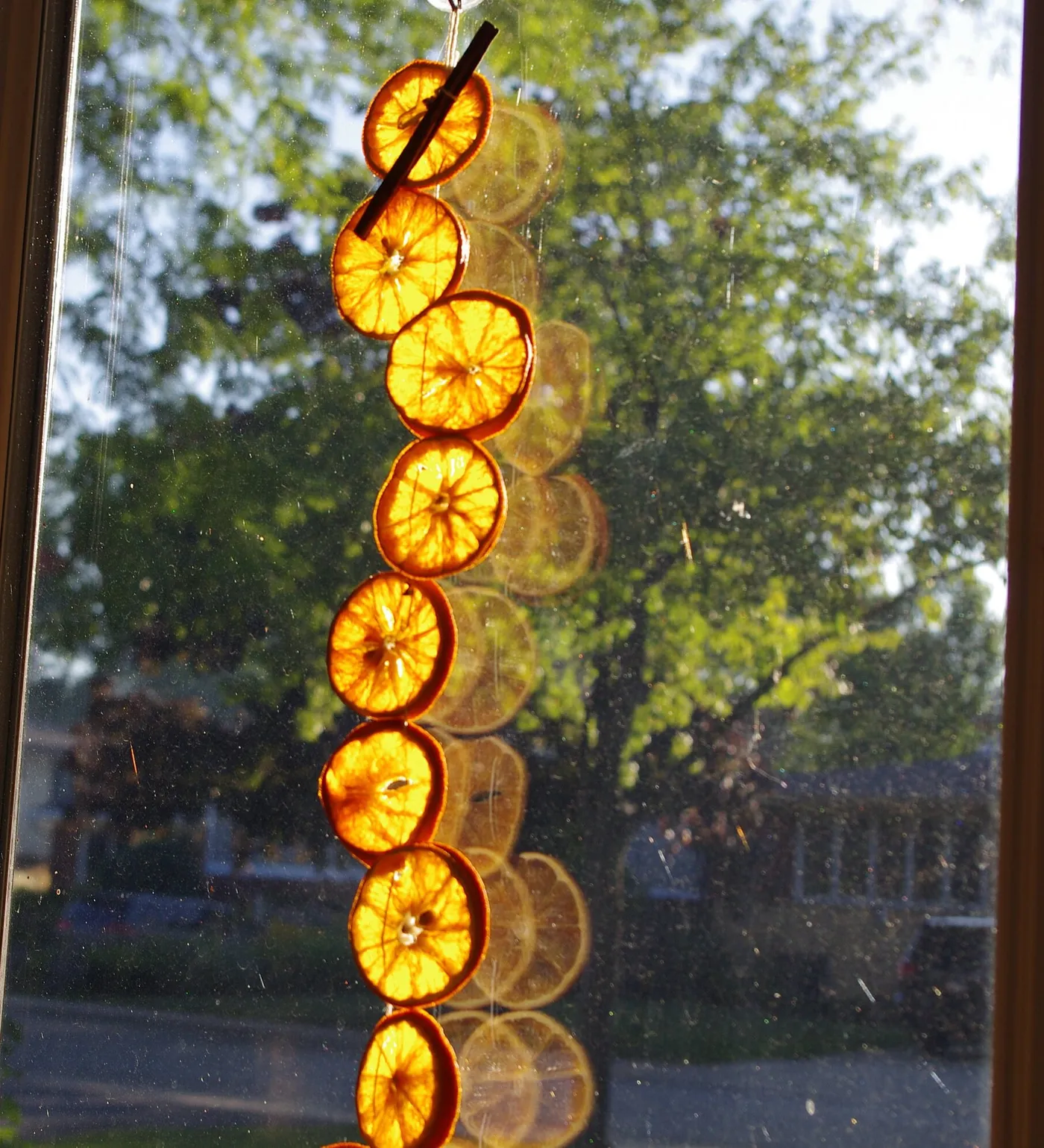
Fishing line makes slices look like they’re floating, but it has two quirks worth knowing: it stretches under weight and it’s nearly invisible against itself, so knots are hard to inspect later. Pre-stretch a length overnight with a weight on the end, then use a triple overhand knot behind each slice. Space slices 3–4 inches apart — closer and the line looks crowded, further and the garland loses the rhythm that makes it read as intentional.
5. Feathery Greenery and Citrus Across a Bright Window
You don’t need a specialty shop or a dehydrator. A four-pound bag of oranges from the grocery store runs about $5 and yields 40 slices. Cotton twine is $3 at any dollar store, and if you want that feathery greenery without watering anything, IKEA’s artificial eucalyptus runs around $6 a stem. Total for the whole window look: under $20. Buy your oranges off the markdown rack — you’re drying them anyway, so a few soft spots genuinely don’t matter.
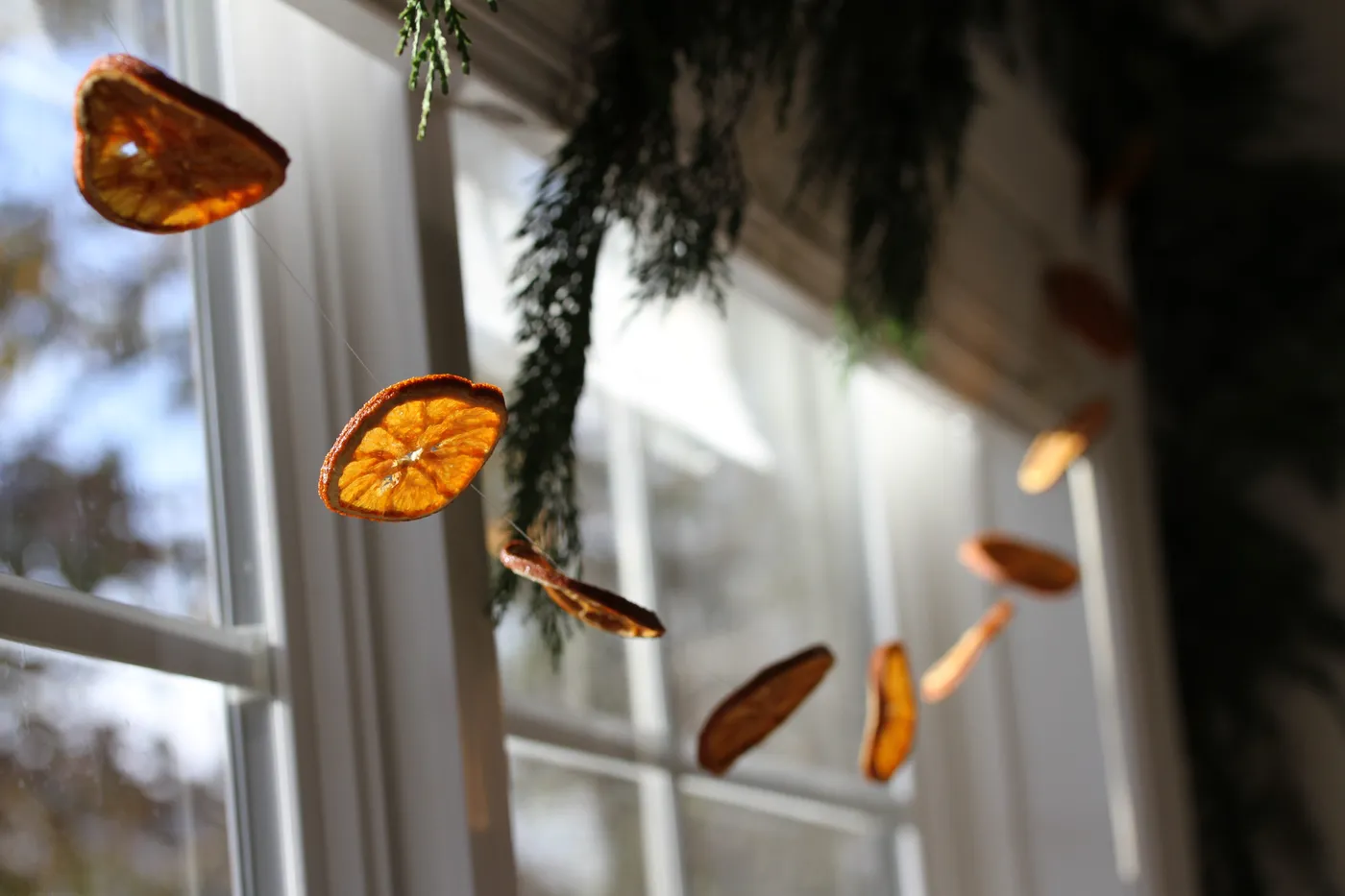
Backlit slices are the prettiest version of this garland and also the fastest to fade. In a window with direct afternoon sun, expect that amber glow to shift toward tan in a single season. Dust it with a hair dryer on the cool setting or a soft pastry brush — never a damp cloth, which softens the rind back up. And if you live somewhere humid, take it down for summer and store it flat between sheets of tissue in a rigid box.
6. Taper Candles and Citrus on a Real Christmas Tree
- Measure ceiling height minus tree height — an open-flame taper needs 6 inches of clearance above the top branch.
- Confirm the tree is fresh-cut and staying hydrated. Dry needles plus open flame is the one combination that isn’t worth the photo.
- Keep every lit taper at least 12 inches from curtains, the tree skirt, and paper ornaments.
- Decide now whether you’re actually lighting them. Plenty of people style the candles and never strike a match — the look survives either way.
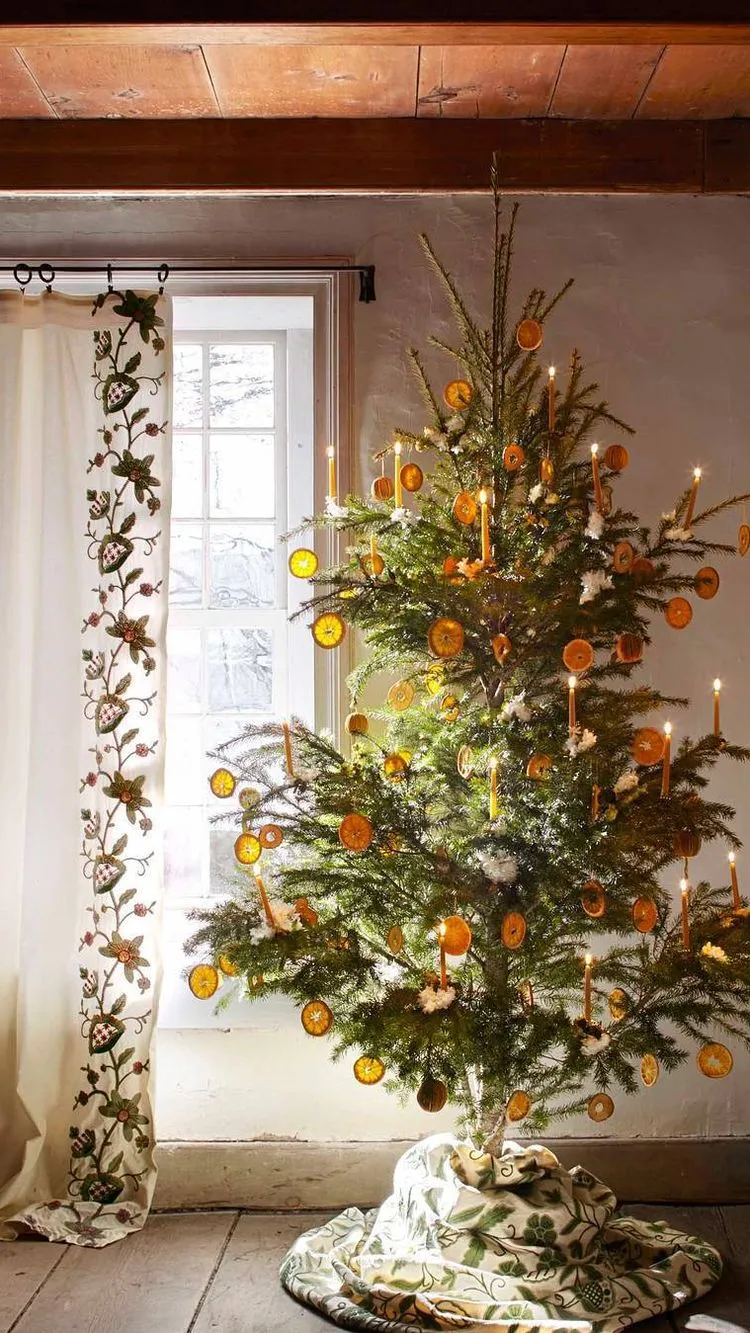
The candlelit tree is the loudest version of a bigger shift: natural, plastic-free holiday decorating. Dried citrus, pinecones, cinnamon, and cotton ribbon have replaced tinsel and glitter on a lot of trees, partly for looks and partly because people are tired of throwing ornaments away every January. The unlit-candle version has real staying power — reusable, cheap, and it photographs beautifully. The lit version is a moment, not a tradition.
7. Bottle Brush Trees and Citrus on a White Mantel
- Evergreen garland with dried citrus and eucalyptus: $45–$120
- Warm white fairy lights: $12–$30
- Bottle brush trees, 8–12 in mixed sizes: $30–$90
- Candleholders and small brass accents: $15–$40
- Hooks, twine, and hanging hardware: $8–$15
Total: $110–$295
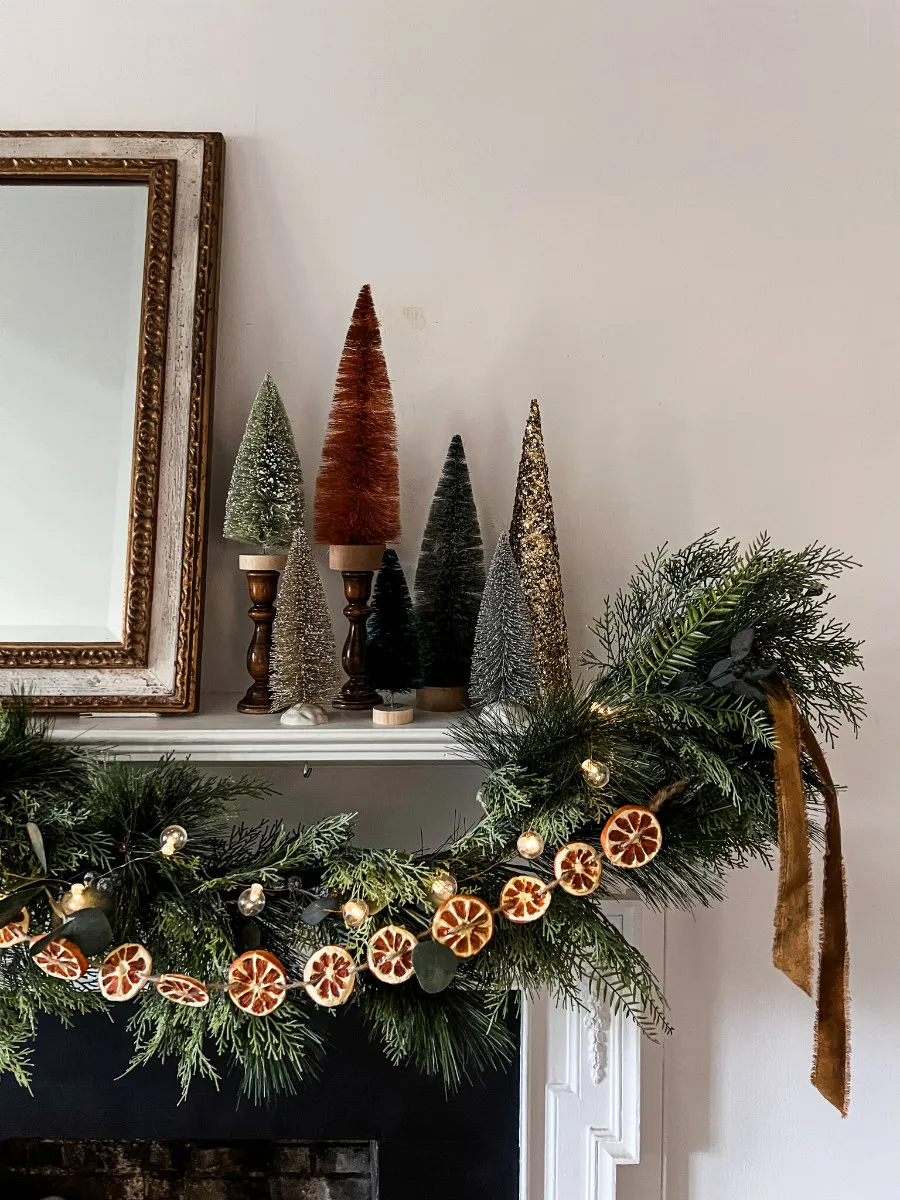
The bottle brush trees are the whole personality of this mantel. A garland alone is pleasant; a collection of small cone-shaped trees in graduated heights and mismatched colors gives the eye somewhere to travel. It’s the difference between a decorated mantel and a styled one. Take them away and you still have holiday, but you lose the charm completely.
Three principles are stacked here. First, contrast: a white mantel and a gold-framed mirror are pale and reflective, so deep green and orange pop hard against them. Second, repetition with variation — a dozen trees, all the same silhouette, no two the same size. Third, height layering, which keeps the mirror behind them from reading as a flat slab instead of part of the composition.
8. Citrus, Stars, and Crystal Beads Above the Window
When a garland hangs above a window, mount the rod 3–4 inches above the trim and let the swag drop 10–14 inches at the center. That keeps the whole decoration inside the visual frame of the window instead of floating in the middle of a blank wall. The dark star ornaments and clear beads are doing an important job too — they break up all that warm orange with something dark and something glassy, which is why this version reads more polished than rustic.
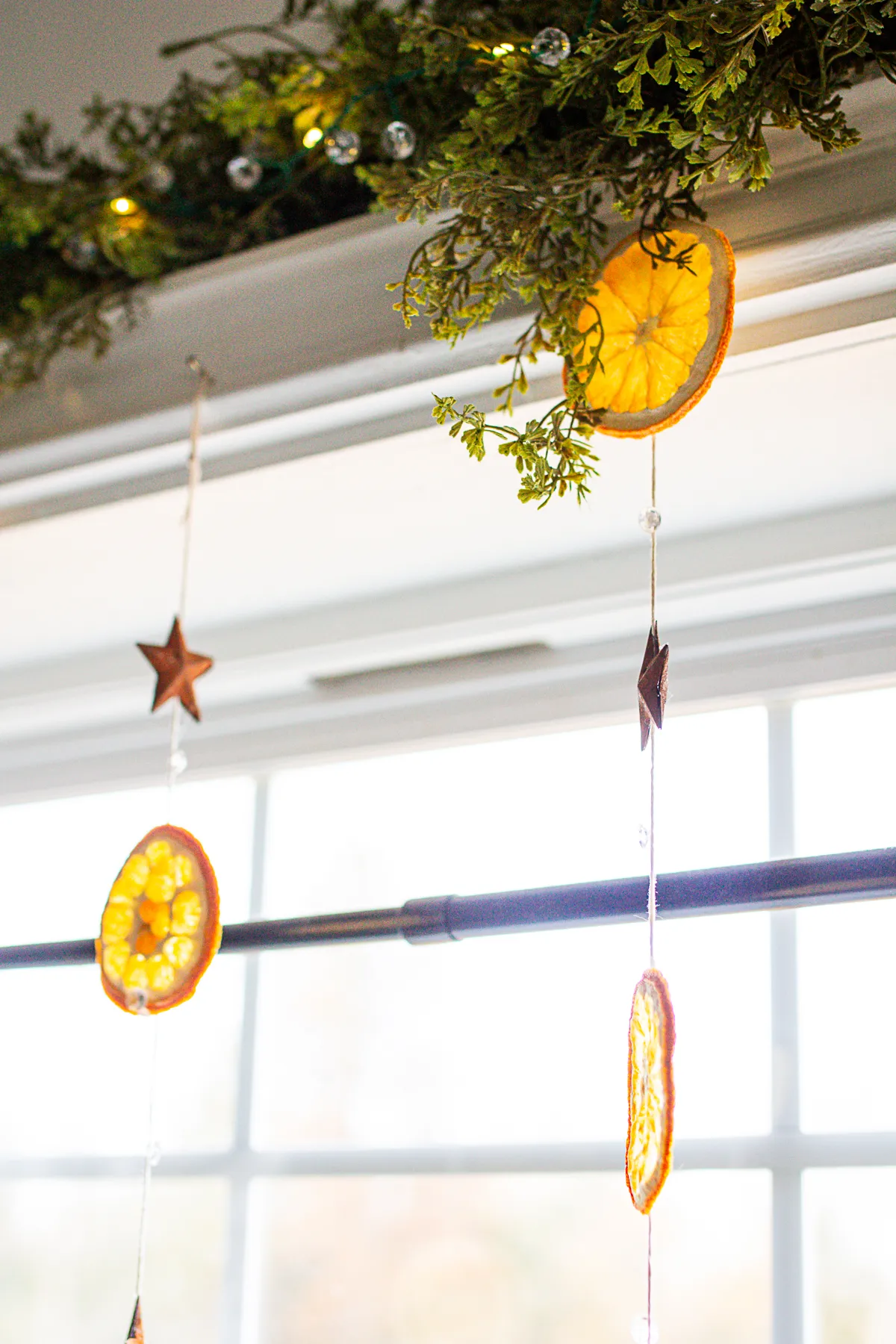
A 36- to 48-inch window wants a swag with a 10- to 12-inch center drop. A 60- to 72-inch window can carry 14 to 18 inches. Go wider than that and you should add a second swag point rather than one long sag, which always looks tired by the third day. Hang it high enough that someone seated at the table still sees the whole drop and not just the bottom third of it.
9. Dried Orange Centerpiece for a Holiday Table
A runner garland is gorgeous in photos and mildly annoying in real life. Keep the greenery under 4 inches tall through the middle so people can actually see each other, and give candles at least 8 inches of clearance from any dried fruit — those slices catch light beautifully and catch fire just as well. Fresh greenery near hot tapers wilts by the second course, so keep your candles tall and your centerpiece low.
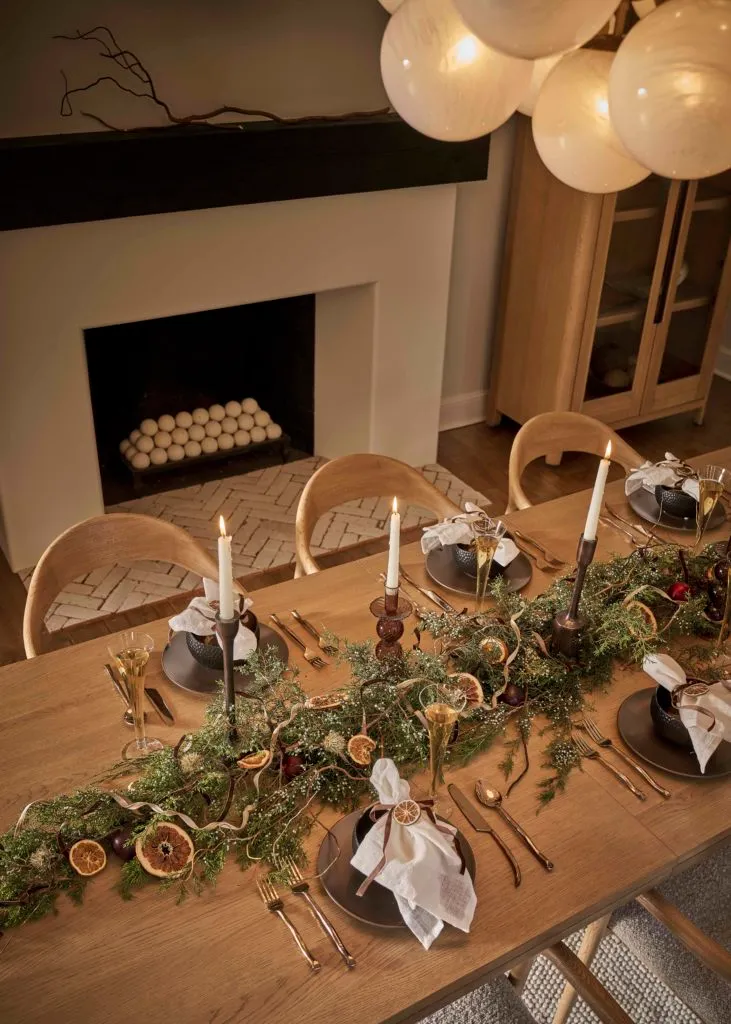
Nothing here needs to be expensive. A supermarket eucalyptus bunch is $4–$6, oranges run about $1 each, and a multi-pack of IKEA tapers costs a few dollars. Mix in pale linen napkins you already own and the $40 version reads almost identically to the $150 one — especially once the candles are lit and nobody can inspect the difference.
50% greenery + 30% neutral tableware + 15% dried citrus + 5% metal. The neutrals matter more than the oranges — dark grey plates and white linen give the citrus something quiet to sit against. Change the whole mood by keeping the ratios and swapping one neutral: charcoal and cream for December, oat and sand for an autumn table.
10. White-String Citrus Garland with Juniper and Clove Oranges
- Buy oranges a day ahead and let the peels firm up at room temperature.
- Push whole cloves into the peel in a tight spiral, working from the top down — a whole orange takes 30 to 50 cloves.
- Thread cooled orange slices onto cotton string with a needle, leaving 3 inches between each one.
- Lay the finished garland on a table with the clove oranges, juniper, cinnamon sticks, and star anise so you can see the whole composition before hanging anything.
- Store the studded oranges in a paper bag for a week to deepen the scent before you style them.
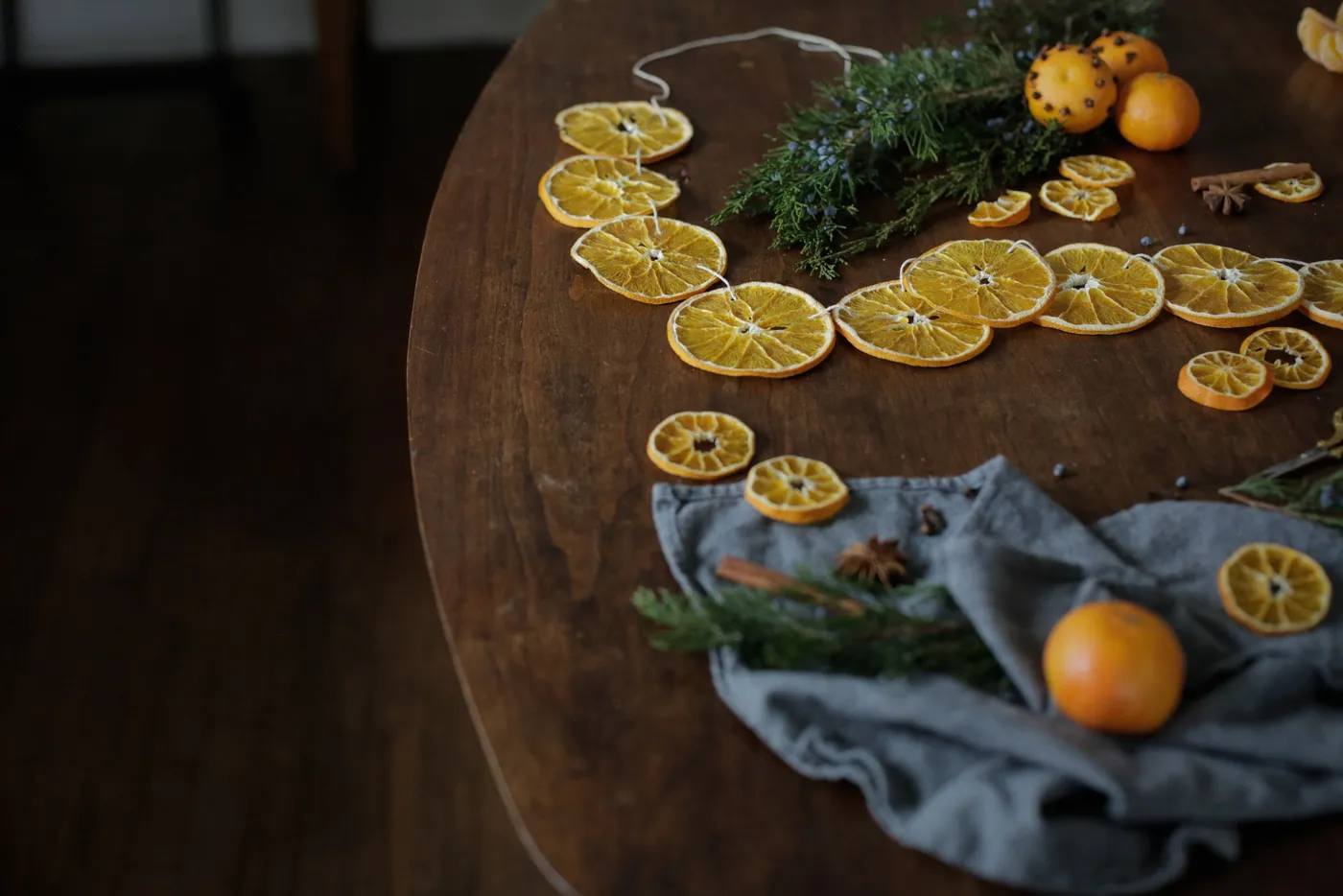
Time: about 90 minutes of hands-on work. Cost: $12–$18.
The white string is doing more work here than the garland itself. It sounds like a throwaway detail, but on a dark wood table surrounded by deep green juniper and brown spice, a white cord turns the slices into a chain of lights. Cotton twine would push the same arrangement toward country craft. Same fruit, same spacing, completely different register — that’s how much weight the string carries.
11. Citrus, Pinecones, and Brass on a Table Runner
- Evergreen garland base, fresh or faux: $30–$80
- Two dozen dried orange slices: $12–$25
- Pinecones and large dried leaves: $0–$20 (foraged absolutely counts)
- Textured table runner: $18–$45
- Vintage brass candlestick: $10–$60
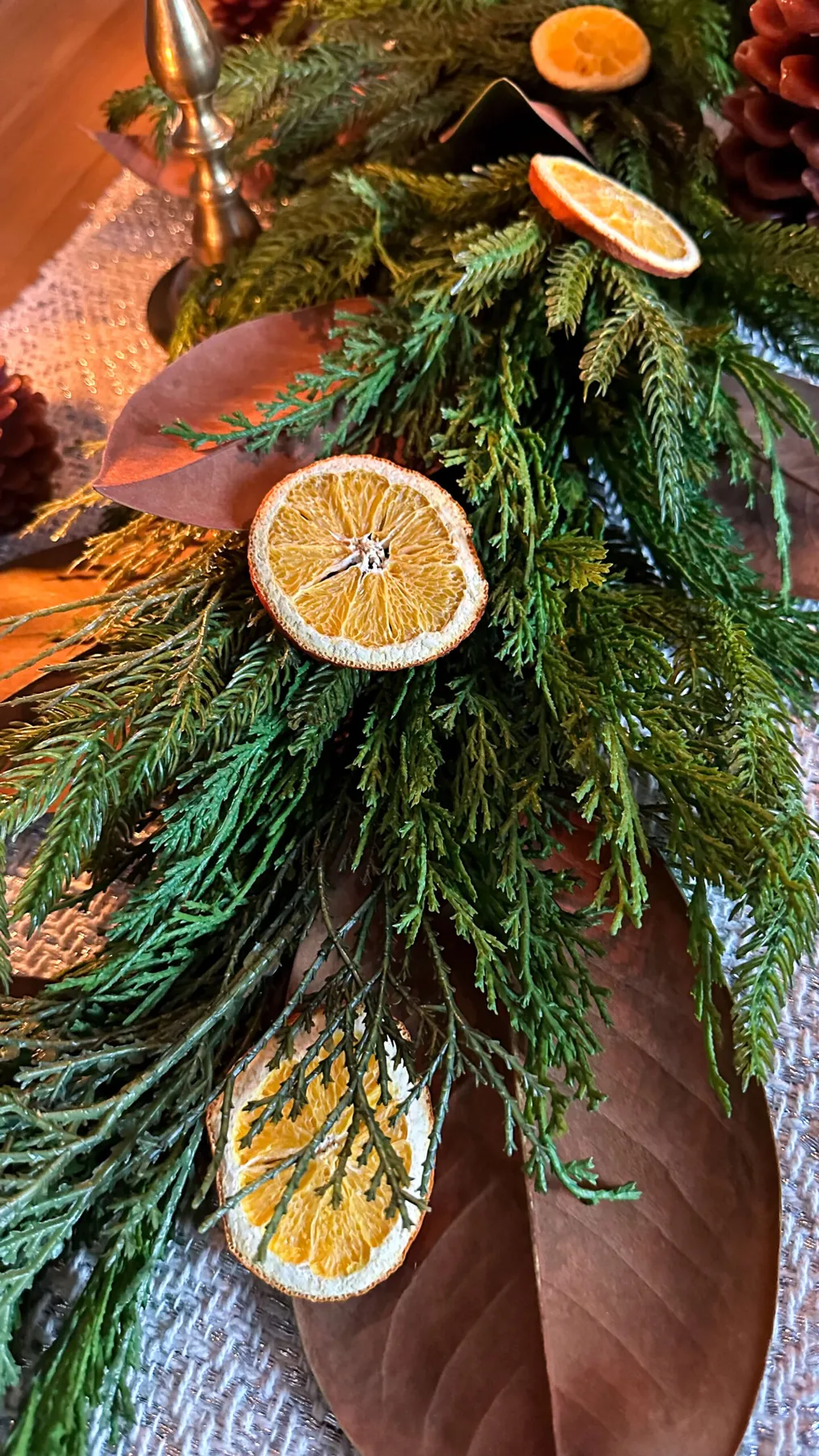
Total: $70–$230
Budget alternative: supermarket greenery, citrus you dry yourself in the oven, and a thrifted brass candlestick lands around $35.
Scale contrast is the engine here. Big leathery leaves next to small citrus discs next to tiny pinecone scales gives the eye three sizes to read at once, which is exactly why the arrangement feels collected rather than purchased. Add warm brass against cool green and a deliberately low profile — everything sits under 6 inches tall — and you’ve got a centerpiece that never blocks anyone’s view across the table.
12. Console Table Citrus Garland with Red Tassels
- Measure your console’s depth. You need 12–14 inches if candles, books, and a vase are sharing the top.
- Note where the outlets are, or plan on battery pillar candles so you’re not running a cord across the floor.
- Watch where daylight falls across the console — slices need some light hitting them or they read brown.
- Clear the lower shelf before you style, so the basket and dried stems have somewhere to go.
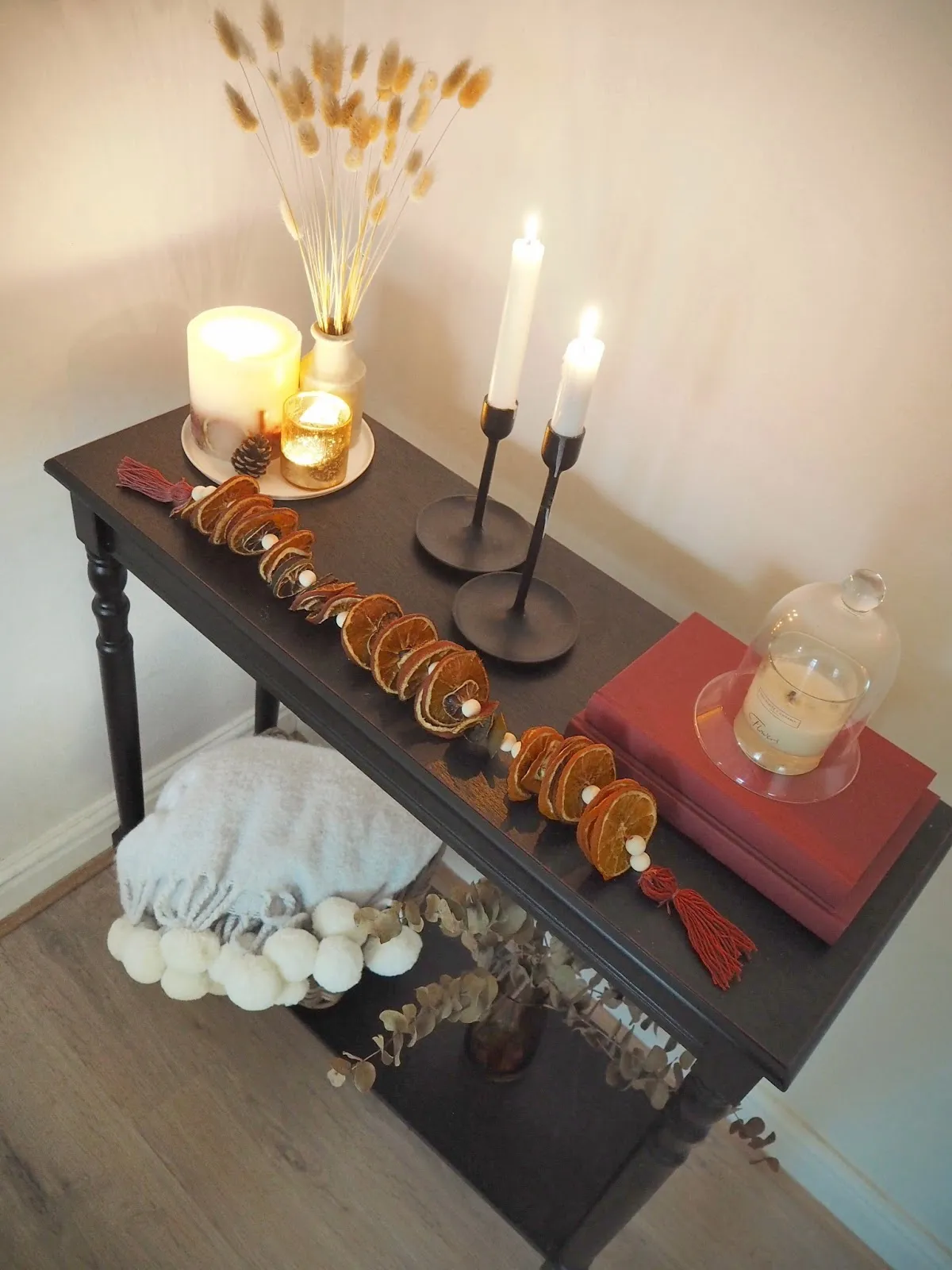
When you drape a garland over a console, keep the lowest point above one-third of the table’s height. On a standard 30-inch console that means an 8- to 10-inch drop, maximum. Any deeper and the swag crowds the shelf below and cuts the table in half visually. Also: let the red tassels hang free. Pinning them flat against the front edge flattens the whole display and wastes the one real accent color you’ve got.
13. Citrus Slices, Peels, and Spices on a Craft Table
- Slice citrus 3 mm thick on a mandoline. Hand-slicing gives you a tray where some burn and some stay soft.
- Lay the slices on parchment in a single layer with no overlap — overlapping traps steam and causes browning.
- Dry at 200°F for 3 hours, flipping everything at the 90-minute mark.
- Cool on a wire rack for 2 hours. Slices firm up as they cool, so don’t judge them while they’re warm.
- Store in an airtight jar with a silica packet if you’re not stringing them the same day.
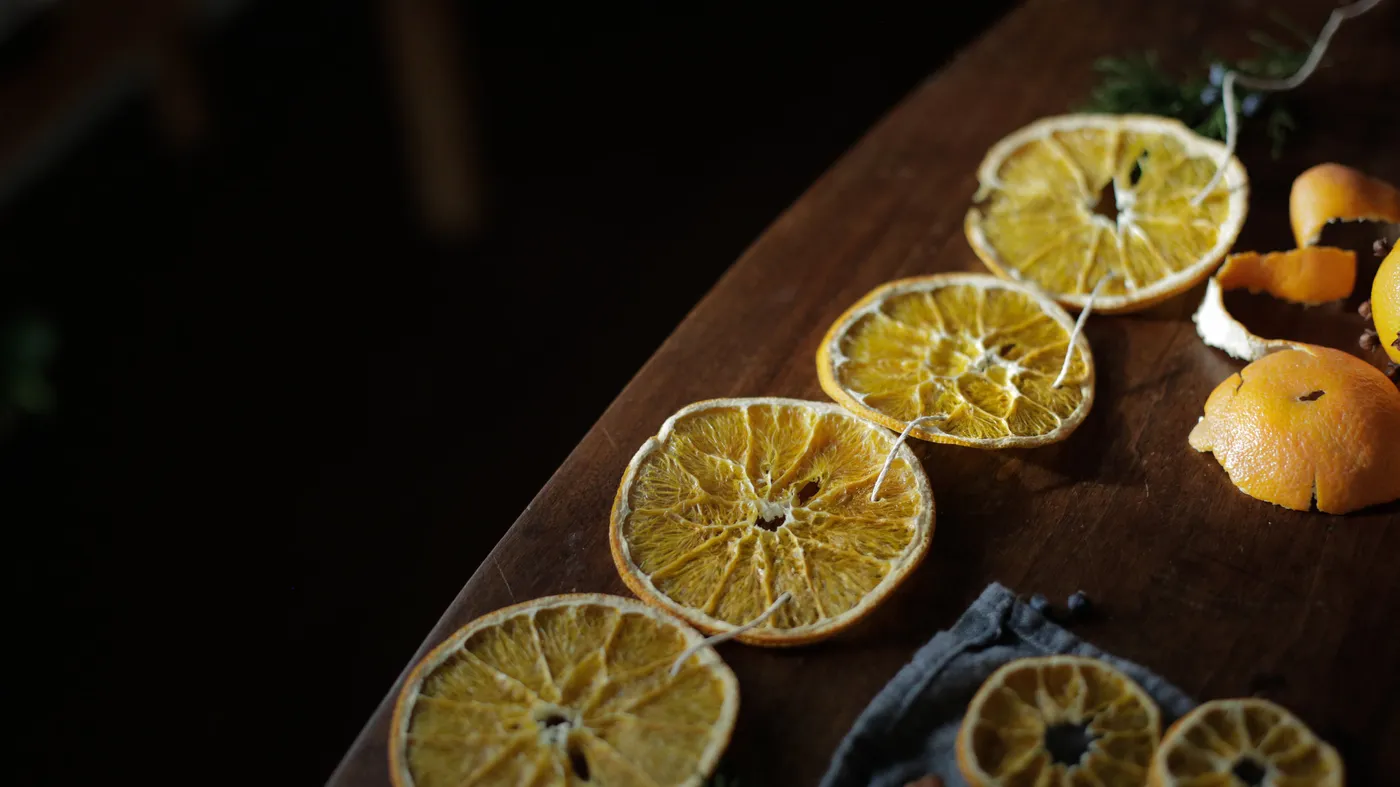
Time: 5–6 hours, nearly all of it unattended. Cost: one 4-pound bag of oranges, about $5, makes 40 slices.
Two things nobody mentions. First, if you live somewhere humid, slices that feel bone-dry can still grow mold in storage — add a silica packet and check them after two weeks. Second, citrus peel oils are mildly toxic to cats and dogs. If your garland will hang low enough for a tail to brush against, keep it above 4 feet or skip the fresh-peel accents entirely.
14. Beaded Citrus Garland at the Window
The plain twine string has mostly been replaced by the beaded version — wood beads, sometimes glass, spaced between citrus slices. Same idea, a little more structure, and it’s become the default for people who want natural decor that doesn’t read as a craft fair. It’s the budget cousin of Idea #5, and expect it to stick around: it packs flat, costs under $20 to make, and works from November through February without committing to a specific holiday.
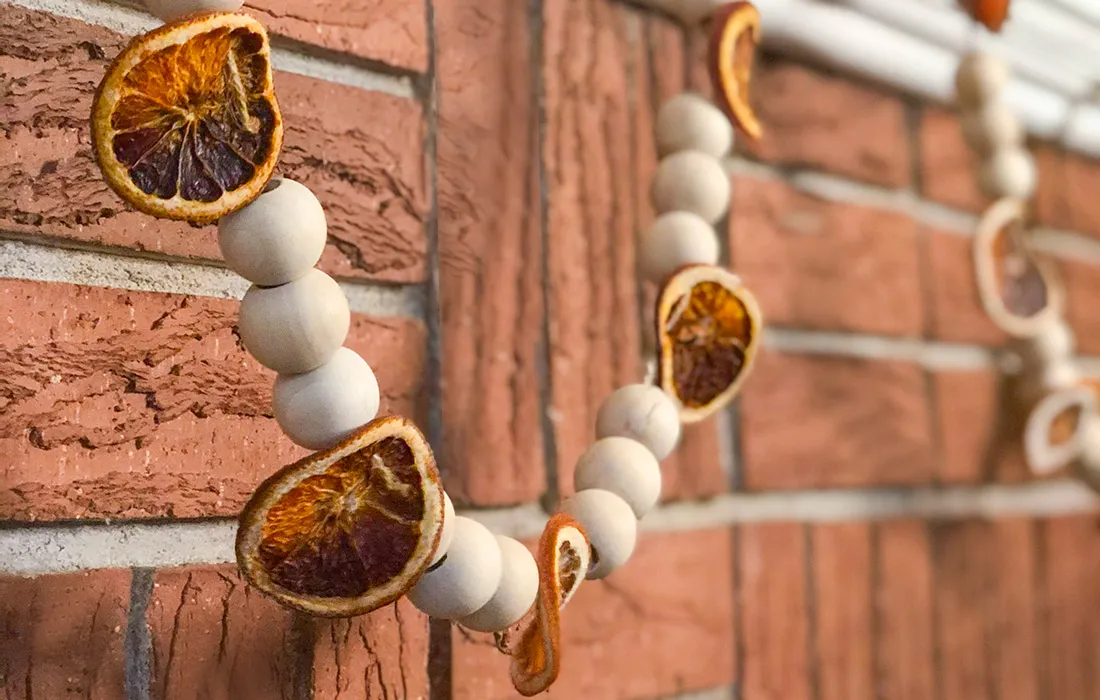
Wood bead strands run $3–$5 for 300 pieces at dollar stores, and a 3-pound bag of clearance oranges is about $1.50. That’s a full window garland for well under $20, which leaves room for a second one. If you’d rather not dry anything at all, Target and Walmart both sell pre-strung wood bead garlands for $12–$18, and Etsy sellers will ship a dried citrus strand for $25–$35 when you want the shortcut.
15. A Single Citrus Ornament Catching Tree Light
A single dried slice hung in front of a warm bulb looks like stained glass, but it’s a surprisingly fragile piece of housekeeping. Slices curl at the edges over a season in a heated room, and they’re brittle — dropping one on a hard floor usually breaks it. Store them in a rigid box with tissue between layers and you’ll get three or four seasons out of a batch. Toss them in a bag with the rest of the ornaments and you’ll get one.
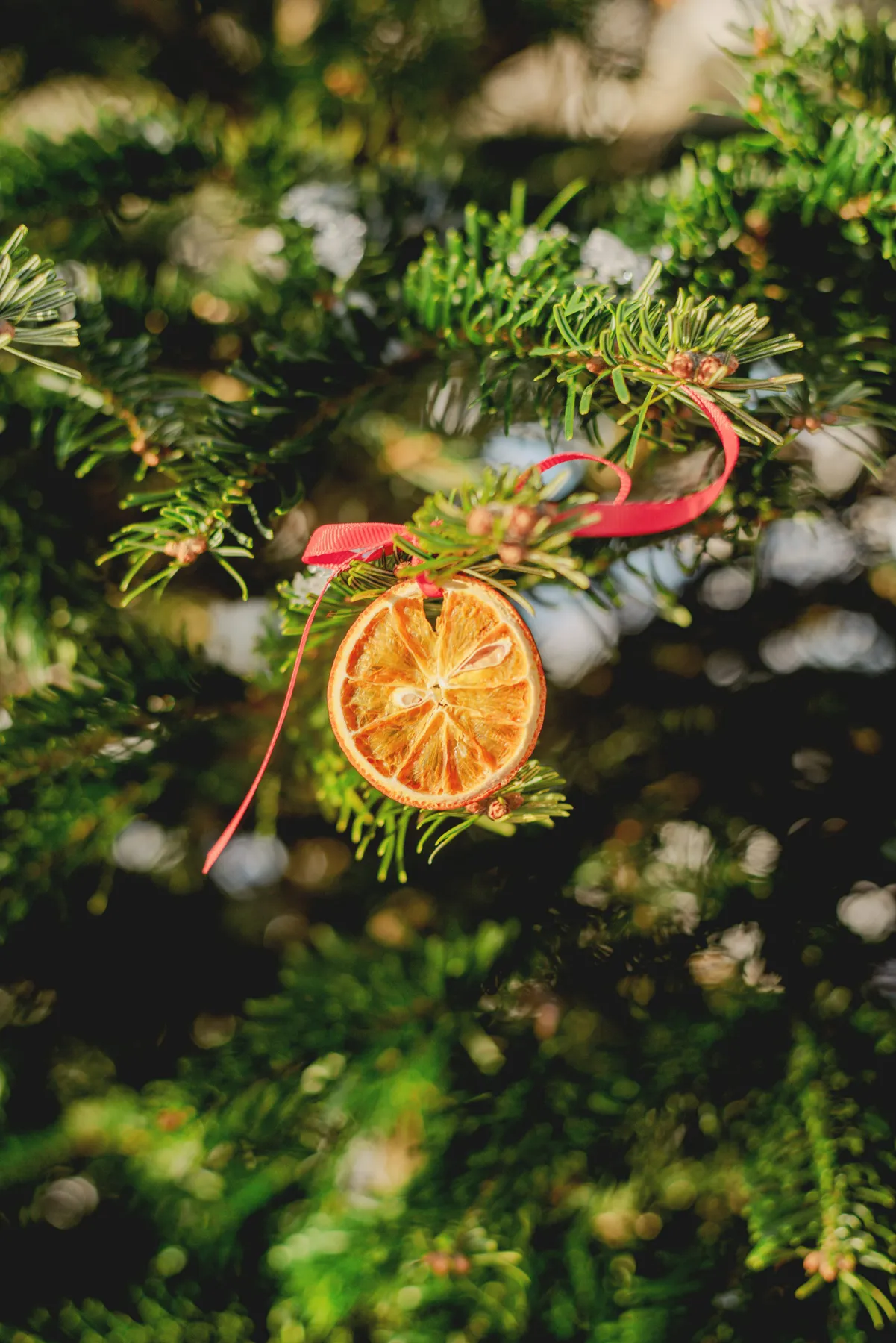
Backlighting is what makes an individual slice read as orange instead of brown. Position the ornament so a bulb sits 1–2 inches directly behind it, and keep the slice between 1.5 and 2.5 inches across. Smaller reads as a fleck from six feet away; larger competes with the tree’s proportions. Hang your standout piece at eye level, too — ornaments below knee height almost never get noticed by anyone, including you.
16. Citrus Garland Wound Through Tree Branches
Garland math is simple and ruthlessly consistent: plan on 6 to 9 feet of garland for every foot of tree height. A 7-foot tree wants roughly 50 to 60 feet to wrap properly. On a 4- to 5-foot tabletop tree, 12 to 15 feet is plenty, and you’ll want smaller slices — 1.5-inch discs — or the citrus overwhelms the branches. Pair this with the ornament-scale approach in Idea #2 if your tree is on the small side.
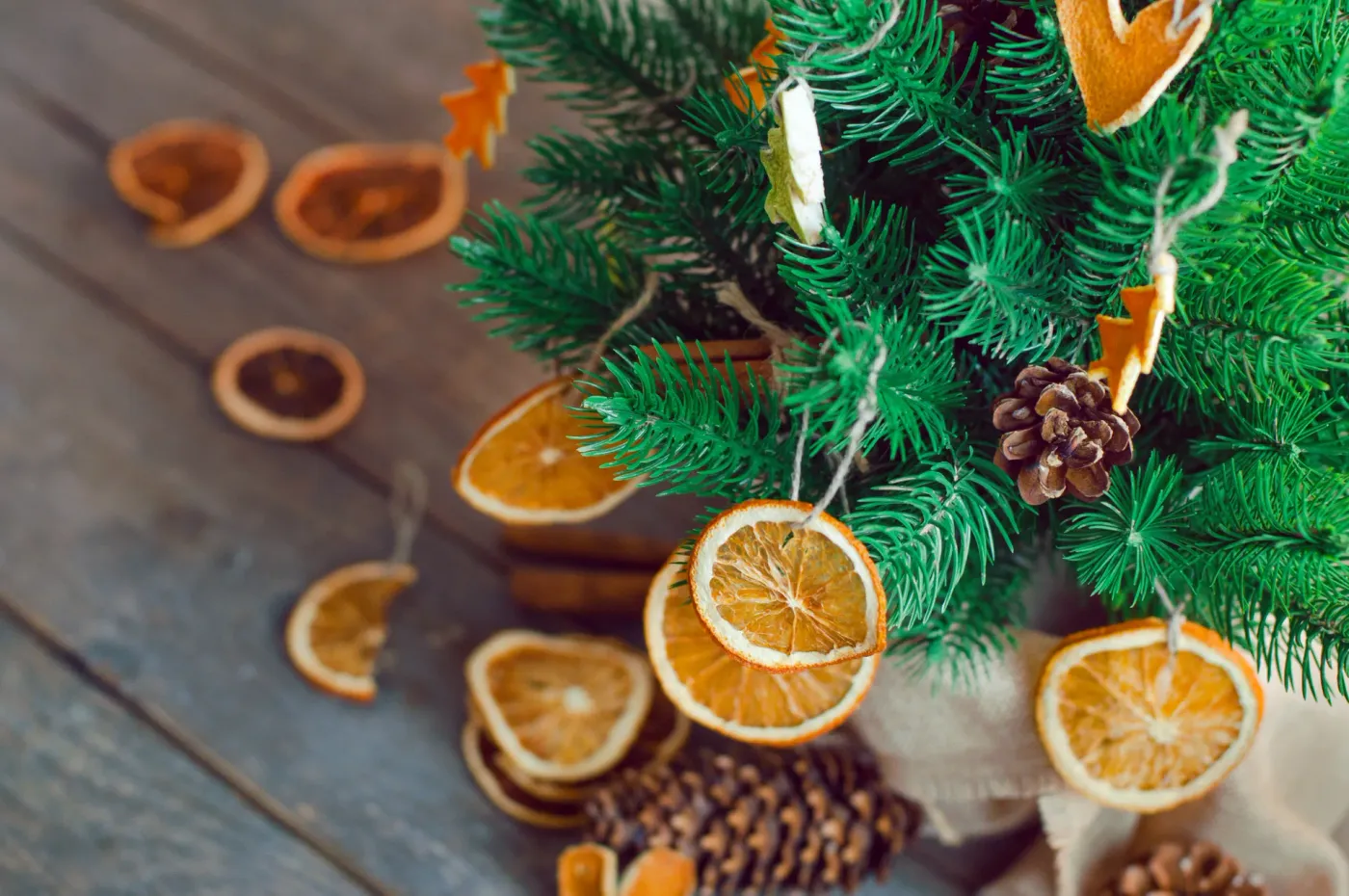
- Dried orange slices, 100 pieces: $25–$50 (or about $8 in oranges if you dry them yourself)
- Cotton cord, 60 feet: $5–$10
- Floral wire or small hooks: $5–$12
- Tree, if you’re buying new: $0–$250
Total: $35–$320
Repetition does the heavy lifting. A spiral garland repeats at a steady rhythm around the tree, and dried citrus is the perfect unit for it — identical enough to read as a pattern, varied enough in translucency that the eye keeps moving. Then there’s the color: orange sits almost directly opposite green on the color wheel, so those slices hum against pine needles without a single other ornament.
17. Citrus Garland and Pumpkins on a Rustic Mantel
50% rustic wood and neutral + 25% dried orange + 15% deep green foliage + 10% black and gold. The orange is the headline, but it only works because more than half the composition stays quiet. Translate the same mantel to winter by swapping the pumpkins for pinecones or clipped evergreens and keeping every other ratio identical. Change the percentages and it stops feeling collected and starts feeling themed.
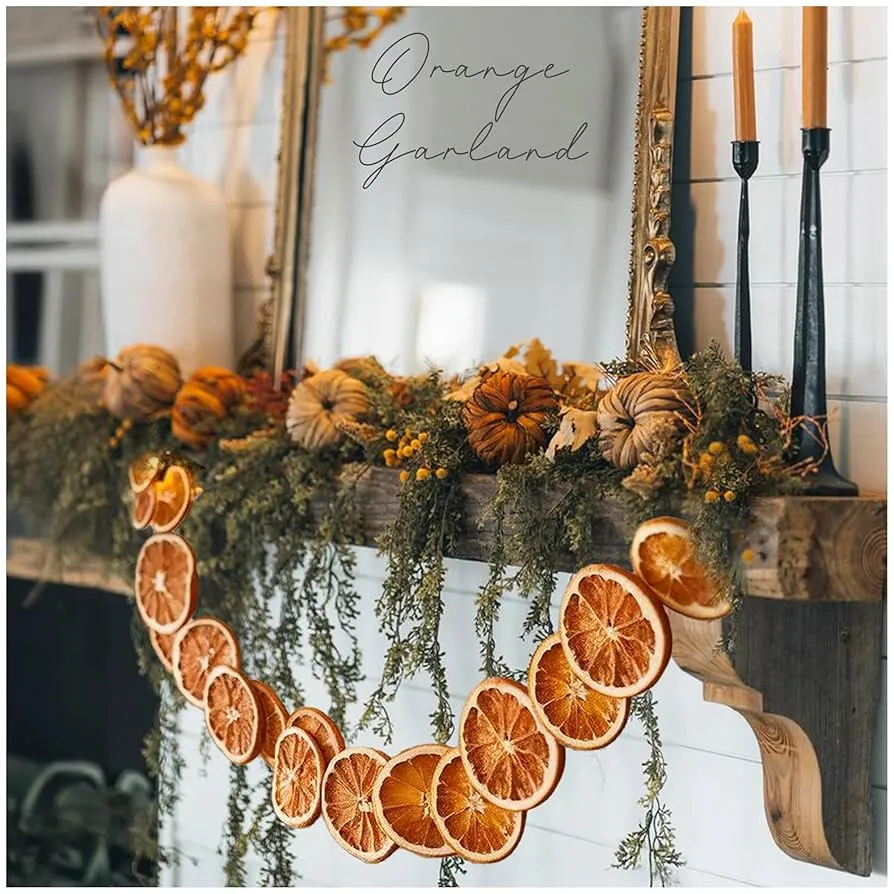
Fresh pumpkins and dried citrus are both organic materials, and both will betray you eventually. A cut pumpkin starts weeping within days; even intact ones go soft in three or four weeks indoors. The citrus garland has a sneakier problem — hanging it from an adhesive hook on a waxed or oiled mantel can lift the finish when you take it down. Drape it over the top edge or use the trim, never the finished surface.
18. Pine and Citrus Garland with Six Cream Candles
Six candles need to look like three. Group them in pairs at three different heights with 3 to 4 inches of variation between groups, and keep the tallest taper below the bottom edge of the mirror so nothing collides visually. Then match the color: six cream candles in mixed brass holders reads as a collection. Six candles in six different colors reads as a clearance sale. This is the same mantel formula as Idea #7, just warmer and with more glow.
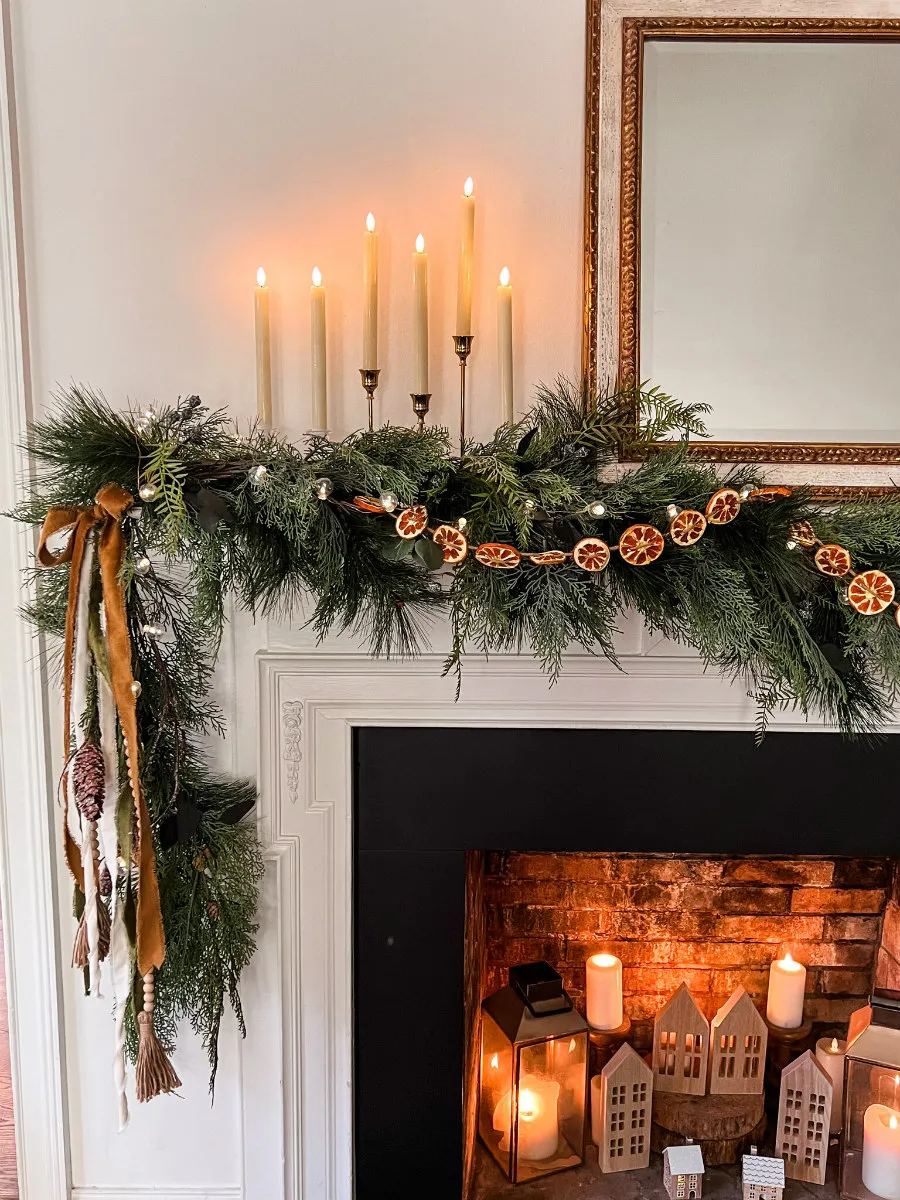
- Faux pine garland, 9 feet: $35–$90
- Dried orange garland, 6 feet: $20–$45
- Fairy lights, warm white: $10–$20
- Cream taper candles, 6–8: $12–$24
- Assorted brass candleholders: $24–$80
Total: $101–$259
Budget alternative: a $12 faux pine garland from Walmart, slices you dried yourself, and thrifted brass lands closer to $45.
19. Mixed Citrus Slices on Rustic Twine
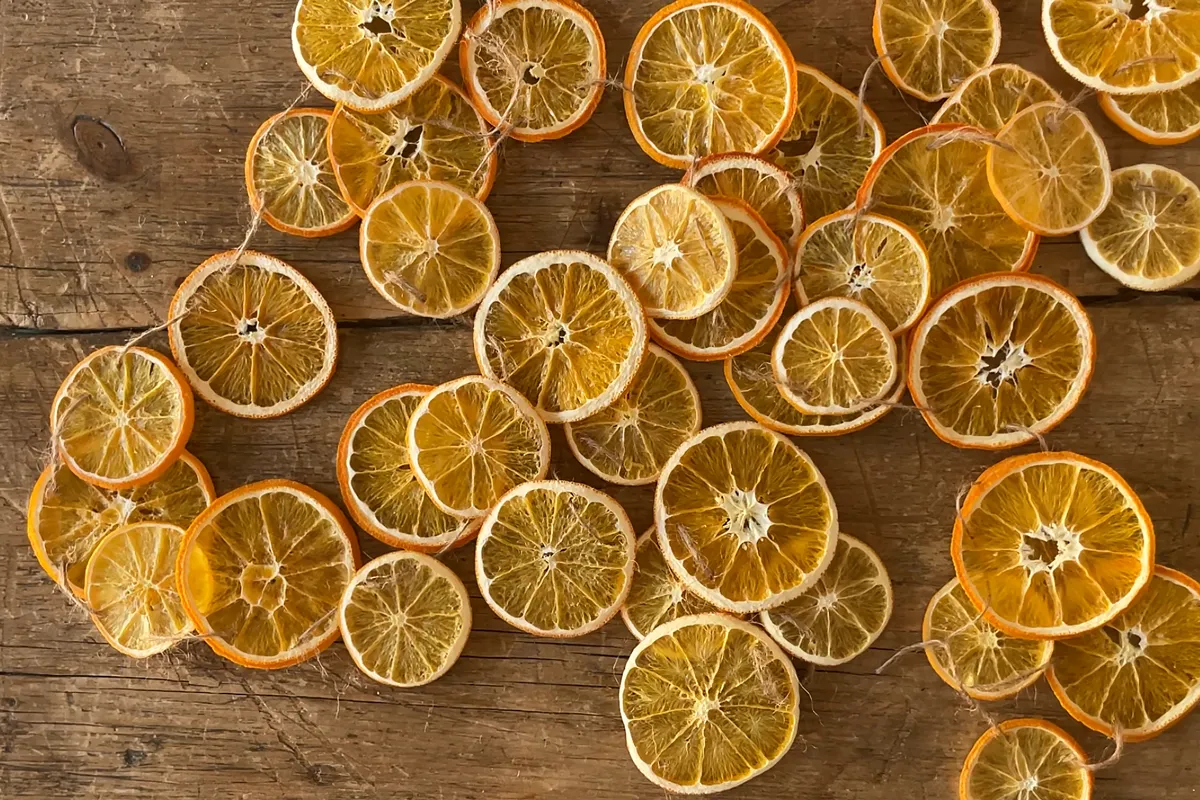
- Choose thin-skinned citrus — blood orange, mandarin, Meyer lemon — which dry far more evenly than thick-skinned navels.
- Slice 3 mm thick and flick out any seeds with the tip of a knife.
- Dry at 200°F for 3 hours for thin slices, 4 to 5 hours for grapefruit.
- Hold a finished slice up to a lamp. If light passes through the flesh, it’s done; if it’s opaque, give it another 30 minutes.
- String on waxed twine for a stiff line that holds its shape, or cotton twine for a softer drape.
Time: half a day, mostly hands-off. Cost: $8–$12 in citrus makes 50–60 slices.
Mixing citrus is the update to a very old idea. Instead of forty identical orange slices, people are stringing whatever’s in season — grapefruit, lemon, blood orange — and letting the sizes and tones vary on purpose. It fits the wider shift away from symmetrical, perfectly matched holiday decor and toward things that look foraged. The mixed version also hides imperfect slices, which is genuinely handy when you’re drying your own.
20. Dehydrated Orange Garland for Real Kitchen Life
Kitchen garlands get greasy, so don’t spend much on them. Dollar store twine is $1.25 a ball, grocery store markdown oranges run a couple of dollars a bag, and Walmart’s battery fairy lights are about $5. A whole garland for under $20, which is exactly the right budget for something that hangs four feet from a stove and will need replacing eventually. Think of it as the everyday version of the window garland in Idea #5.
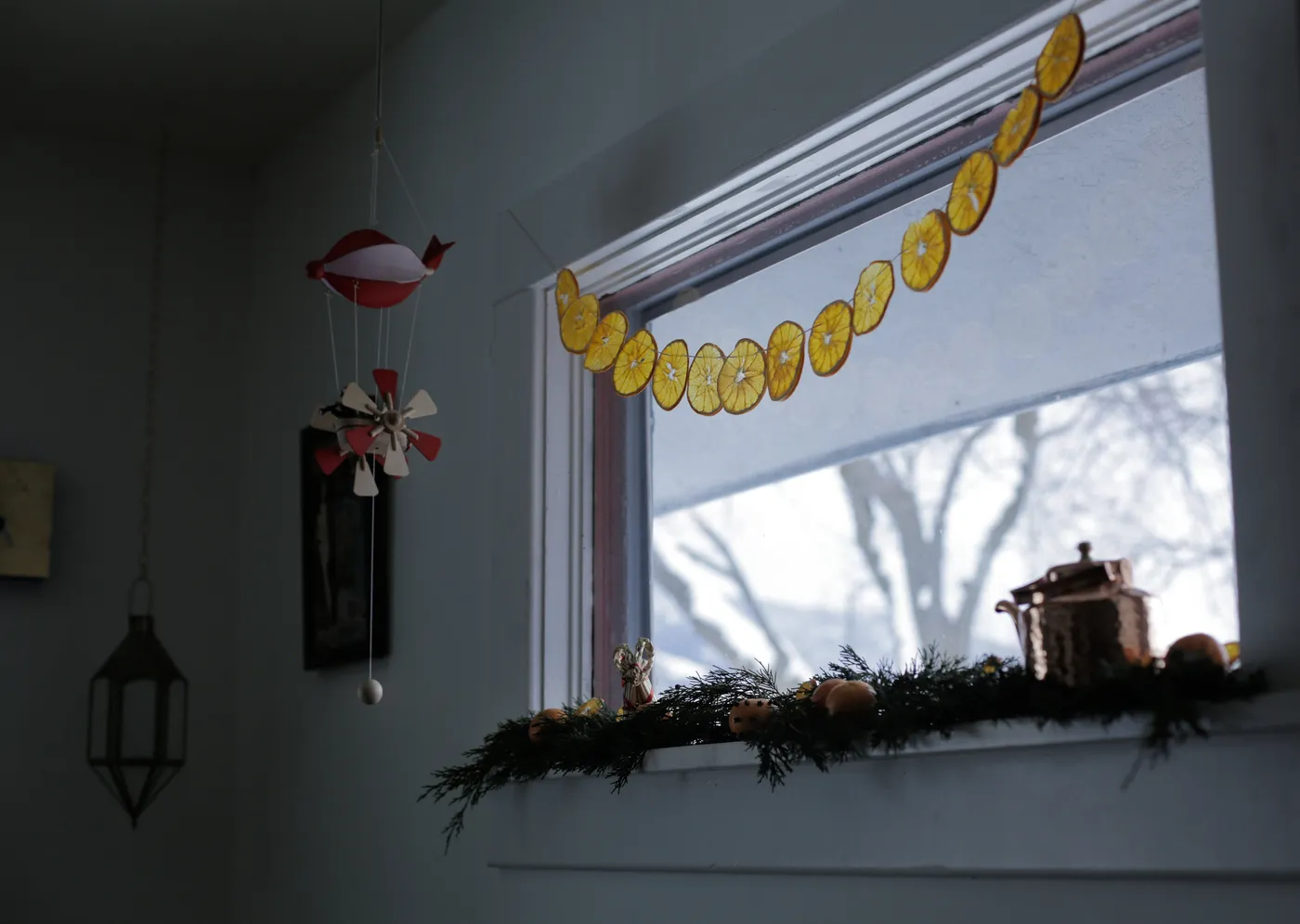
Kitchens are the hardest room in the house for anything porous. Steam softens dried slices until they curl, and airborne cooking grease leaves a tacky film on the rind within a few months. Hang your garland on the far side of the room from the range — at least six feet — and dust it with a dry microfiber cloth every few weeks. Wiping with anything damp undoes the drying you worked for.
21. Winter Solstice Mantel Dressed in Dehydrated Orange
- Measure the mantel end to end. You want roughly 1.5 times that length in garland for a proper drape.
- Look at what hangs above it — a mirror or artwork sets the ceiling for how high you can stack candles and foliage.
- Decide how you’re hanging it. Nails in the trim are fine; adhesive hooks on finished wood are not.
- Test your tapers ahead of time. Candles that have sat in a warm room drip far more than fresh, cold ones.
60% dark and black + 25% dried orange + 10% candlelight cream + 5% metallic. It’s an intentionally moody ratio — more dark than most holiday styling, which is exactly what makes it read as solstice instead of Christmas. Swap the orange for deep red and the same proportions carry you through December. Push the cream up to 20% and it turns into a different holiday entirely. Treat it as the darker cousin of Idea #18, which runs the same citrus against a bright white mantel.
Dark palettes eat light, which means dried orange slices on a charcoal wall go muddy unless something is actively lighting them. If your mantel has no lamp and no nearby window, add warm bulbs or move the garland. And if you burn real fires, go faux on the greenery — fresh branches dry out fast above a working fireplace, and citrus near a flue is a bad combination.
22. Homemade Citrus Ornaments on a Nature-First Tree
The inconsistency is the point. Some slices come out deep amber, some stay pale, and the segment lines and pith show through differently on every single one. Machine-perfect ornaments would kill the charm here — what makes a citrus tree feel like a home project is that no two slices match. If yours are all emerging identical, you’re probably overbaking them and losing the variation that makes the whole thing worth doing.
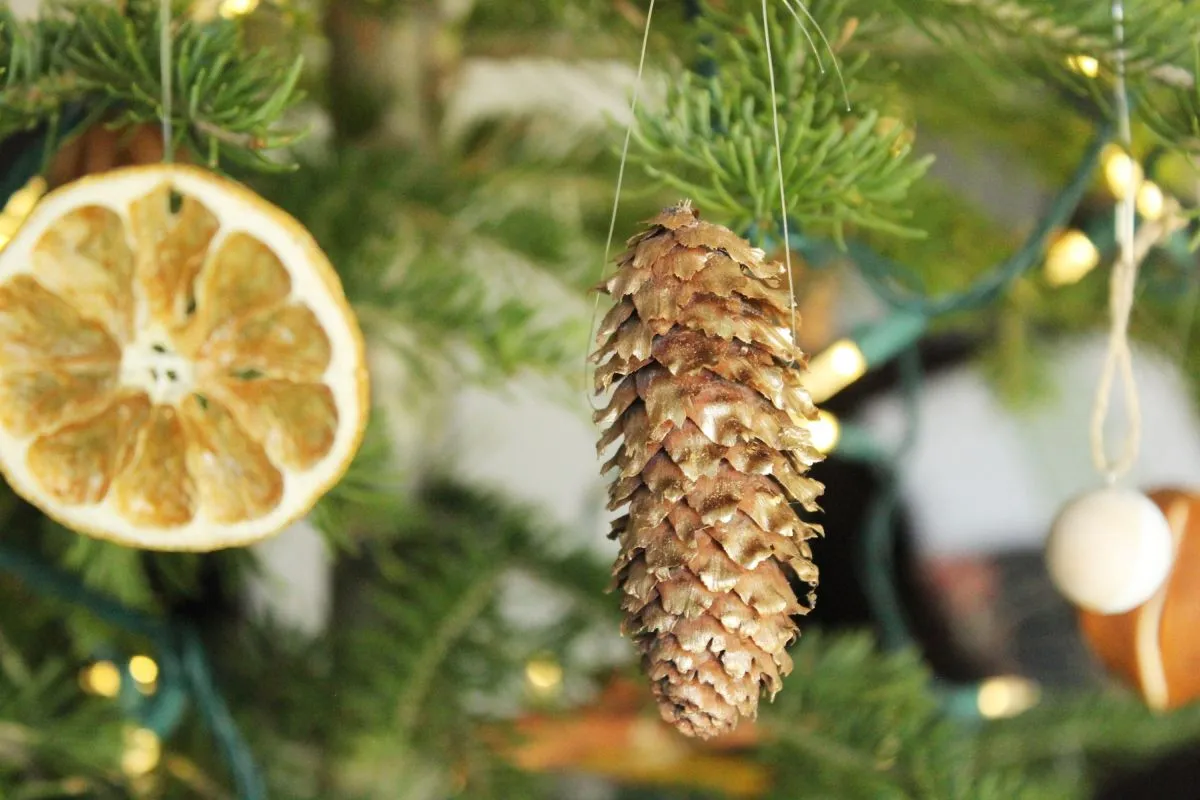
Citrus-only trees need more volume than you’d guess, because every ornament is small. On a 7-foot tree, plan on 60 to 80 slices minimum or the branches look bare between them. A 4-foot tabletop tree takes 25 to 35. Mix three sizes — roughly 2, 3, and 4 inches across — and repeat the sizes irregularly rather than grading them from top to bottom, which always reads as manufactured rather than collected.
One Bag of Oranges, Twenty-Two Ways to Glow
Dried citrus is a rare thing: cheap, forgiving, and better looking than almost anything you can buy pre-made. Start with one garland and one bag of oranges this weekend — the second one always follows on its own. If you try one of these, take the photo in daylight with the slices backlit, because that’s the version everyone falls for. Pin your favorite to your holiday board now so you can find it again in November.