
You know that feeling when you finally find the Christmas tree photo that looks exactly like your living room — and then realize you have absolutely no idea how to get there? Same. So we spent weeks sorting through real trees in real homes instead of scrolling renders, and the good news is most of these looks are built from things you can actually buy or borrow.
After filtering through hundreds of options across Target, Crate & Barrel, Etsy, Wayfair, and IKEA, we narrowed it down to 24 ideas that actually deliver — from an $18 kraft-paper wrapping setup to a $1,200 mixed-pine showpiece. That’s a real range of $18 to $1,200, and every single one earns its spot.
Inside: rustic-natural evergreens in galvanized tubs, elegant minimal trees dressed only in white and silver, traditional red-and-gold classics, and cozy cottage corners wrapped in faux fur. Budget and luxury versions are compared side by side, and every idea is shoppable with direct product links. And stay until the end — we break down the most common mistakes that can ruin these looks.
Bare, undecorated trees are having a serious moment in 2026 — Pinterest saves for unadorned evergreens in baskets are climbing fast as people trade ornament overload for quiet, natural styling. Save this post now — you’ll want it when you’re ready to shop. 📌 Save this to Pinterest for later — you’ll want to revisit these ideas.
1. Warm Glow, Chocolate Faux Fur, and Beige Drapes
Light density is the whole ballgame. A six-foot tree needs roughly 600 warm white mini lights to look like the one here — that’s about 100 per foot of height. If your tree reads flat or patchy, you don’t need more ornaments; you need more light, pushed deep into the branches rather than draped on the outer tips. Wrap the trunk and inner branches first, then work outward.
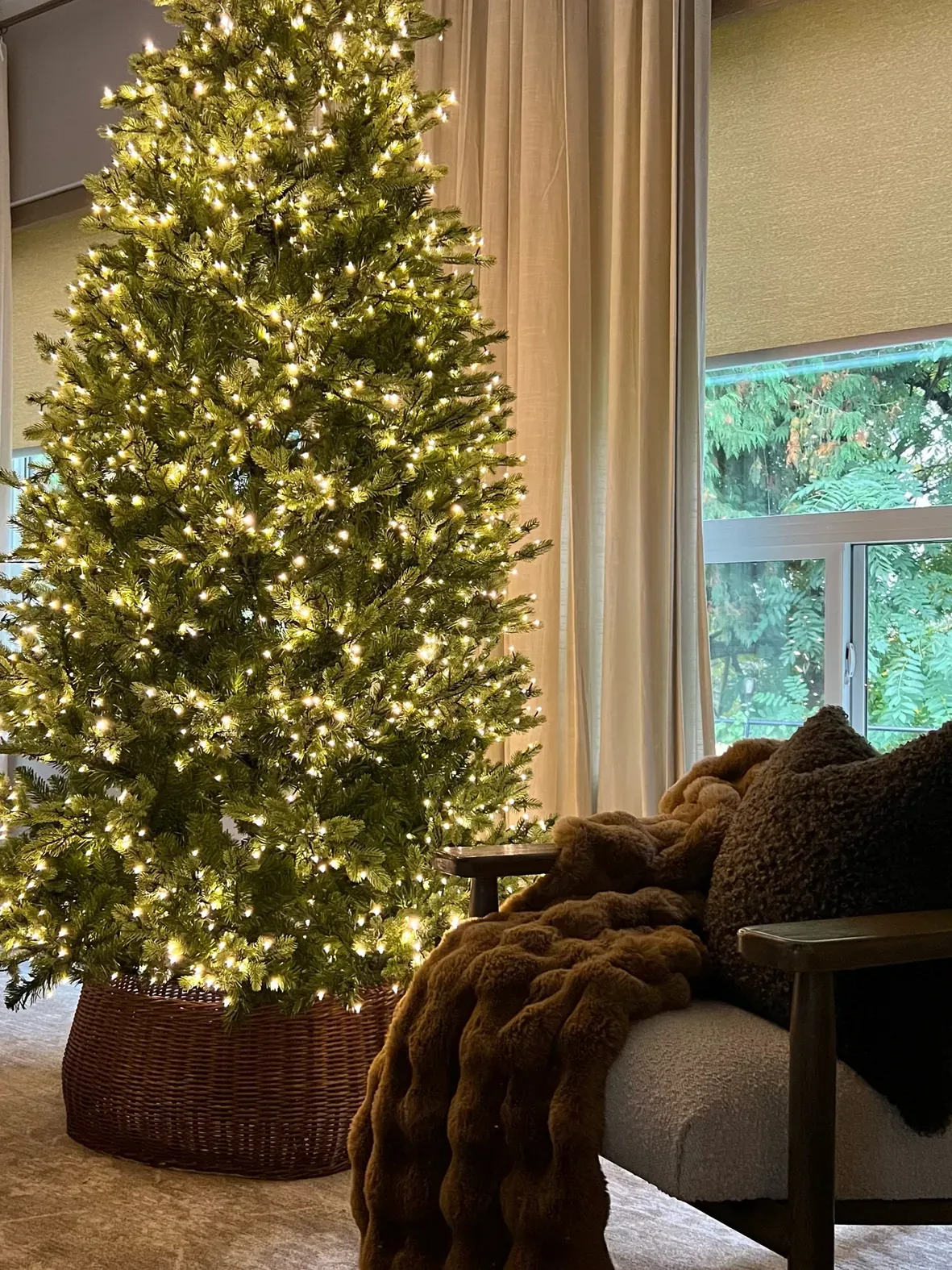
Three things carry this corner: warm white light at a low color temperature, a dark brown woven collar that visually plants the tree, and one rich texture — the faux fur throw — placed directly beside it. The beige pleated drapes stay quiet so the glow wins. Without that brown anchor the tree floats; without the fur the whole room reads flat and catalog-like.
2. Blue Chinoiserie and a Gold Starburst Topper
- Unlit 7.5 ft tree: $180–$450
- 600 warm white string lights: $30–$60
- Blue and white chinoiserie ornaments, set of 12: $45–$120
- Glittery gold starburst topper: $25–$70
- Large woven baskets for the base: $40–$90
- Total: $320–$790
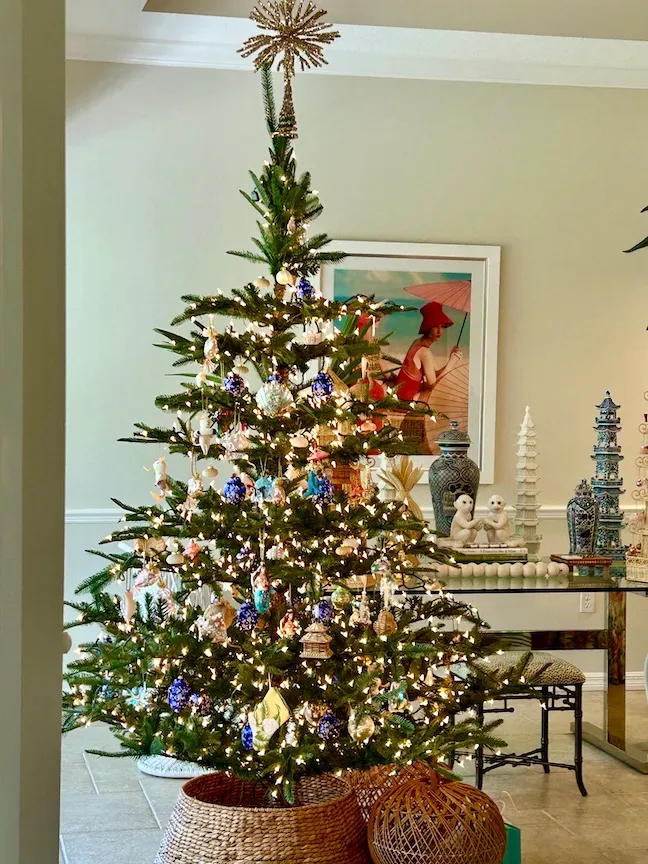
Budget alternative: hunt estate sales for vintage blue-and-white ginger jars, add screw-in ornament caps for $2 apiece, and the whole collection costs under $40.
The blue-and-white chinoiserie ornaments are the entire personality of this tree. Swap them for standard red baubles and you still have a pretty Christmas tree — just not this one. Chinoiserie reads collected rather than purchased, and against forest green with gold, blue cools the arrangement so the warm lights feel intentional instead of orange.
3. Velvet Ribbon Bows and Clear Glass Baubles
Here’s what nobody tells you about velvet ribbon: it crushes. Store your bows flat in a box with tissue between layers, or you’ll pull out a creased mess next December. Clear glass baubles are the other liability — they show every fingerprint and every strand of pet hair in the room. Keep them above the four-foot mark if you have a wagging tail or a cat with opinions.
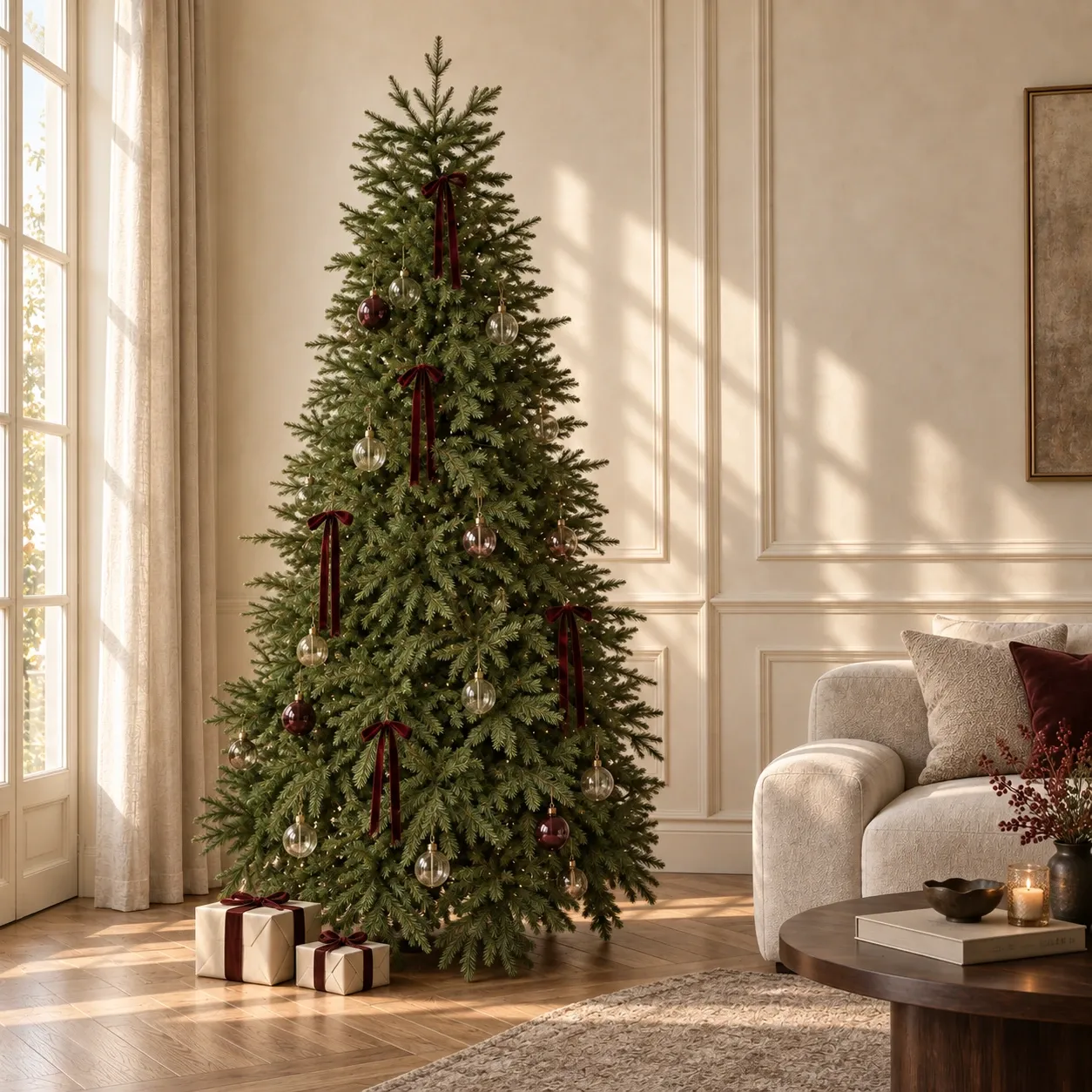
The formula runs roughly 55% green foliage, 25% deep burgundy, 15% clear glass and light, 5% warm wood. Want to shift it? Swap burgundy for charcoal and the tree goes modern. Swap it for emerald and you get something moody and almost monochrome. Keep the clear glass constant — it’s what keeps the whole thing from feeling heavy.
4. Red and Gold Classics with Matching Wrapped Gifts
Traditional red and gold has quietly become the contrarian choice. While everyone chases quiet-luxury beige, deep red is showing up again in 2026 holiday roundups because it photographs beautifully in low light and reads instantly as Christmas. It has staying power precisely because it never left. Compare with Idea #13 — same warm red energy, dressed up for a formal room.
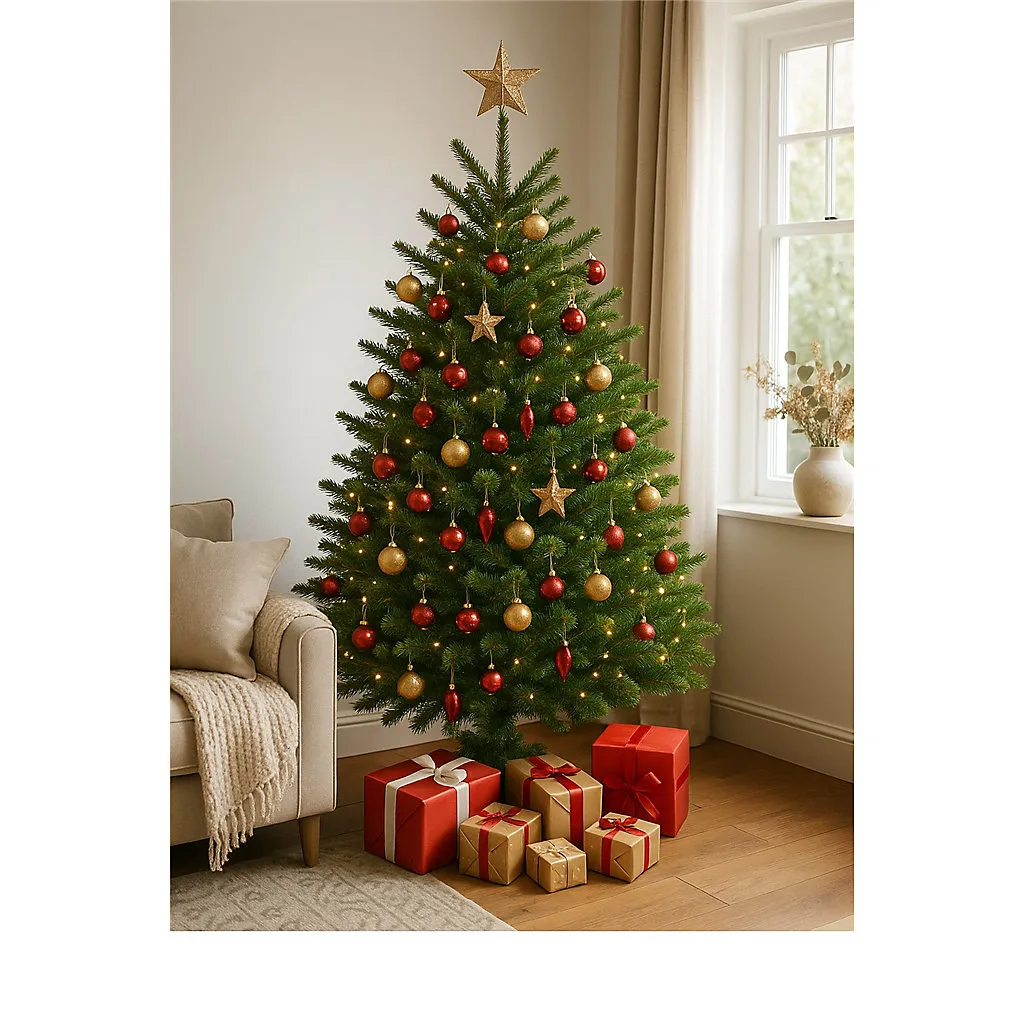
Skip the designer ornament sets. Walmart and Target sell red and gold shatterproof spheres by the tube for $5–$12, and a bag of gold filler hides the gaps at the base. Grab a knitted throw for around $25 and check Facebook Marketplace for a used pre-lit tree — $40 to $80 is realistic between October and Thanksgiving.
5. A Wicker Collar Tree Against Botanical Wallpaper
This look needs a corner about four feet wide and seven feet of clear wall height to breathe, because the wallpaper behind it means the tree needs visual air. Ceilings under eight feet? Stay at 6.5 to 7 feet tall with a 40-inch base. For tighter rooms, see Idea #15, a slender tree that fits a 30-inch footprint without looking cramped.
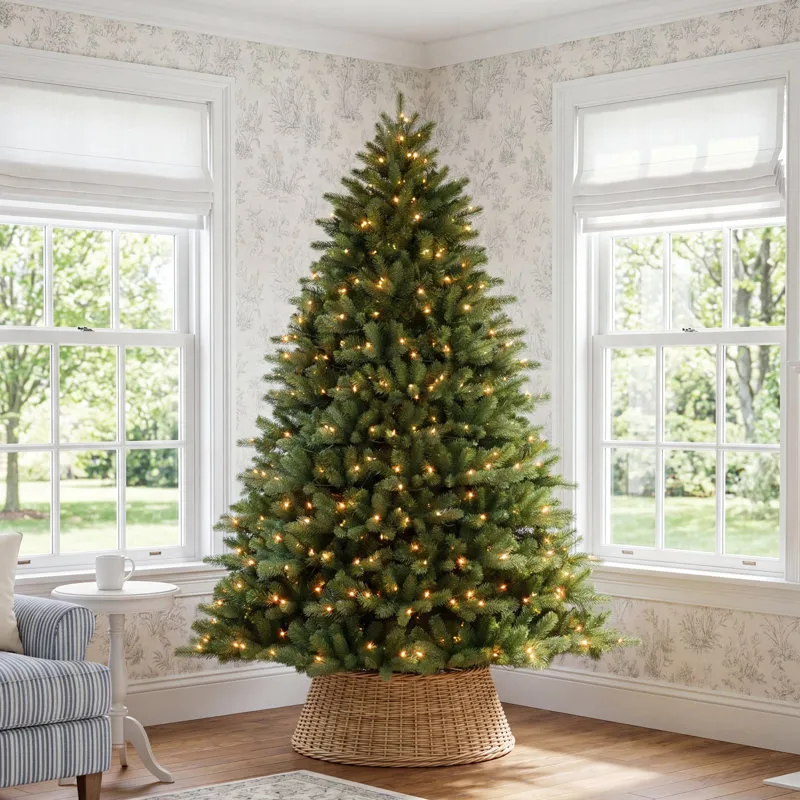
Wicker collars collect dust in the weave — vacuum with a brush attachment monthly through the season and wipe with a barely damp cloth. Wallpaper behind a tree is the real risk: sap, water drips, and heat from the lights. Add a felt pad under the collar, keep the tree six inches off the wall, and skip live trees entirely if that paper is precious grasscloth.
6. The Bare Tree as Sculpture in a Paneled Room
- Choose a full, even tree — asymmetry is charming outdoors and awkward indoors.
- Fluff every branch from the inside out; budget 30 to 45 minutes on a seven-footer.
- Set the tree on a level floor against the molding, then step back ten feet and check the silhouette.
- Add one quiet base — a linen-wrapped box or a low basket, nothing shiny.
- Leave it. Resist. Time: about an hour. Cost: nothing.
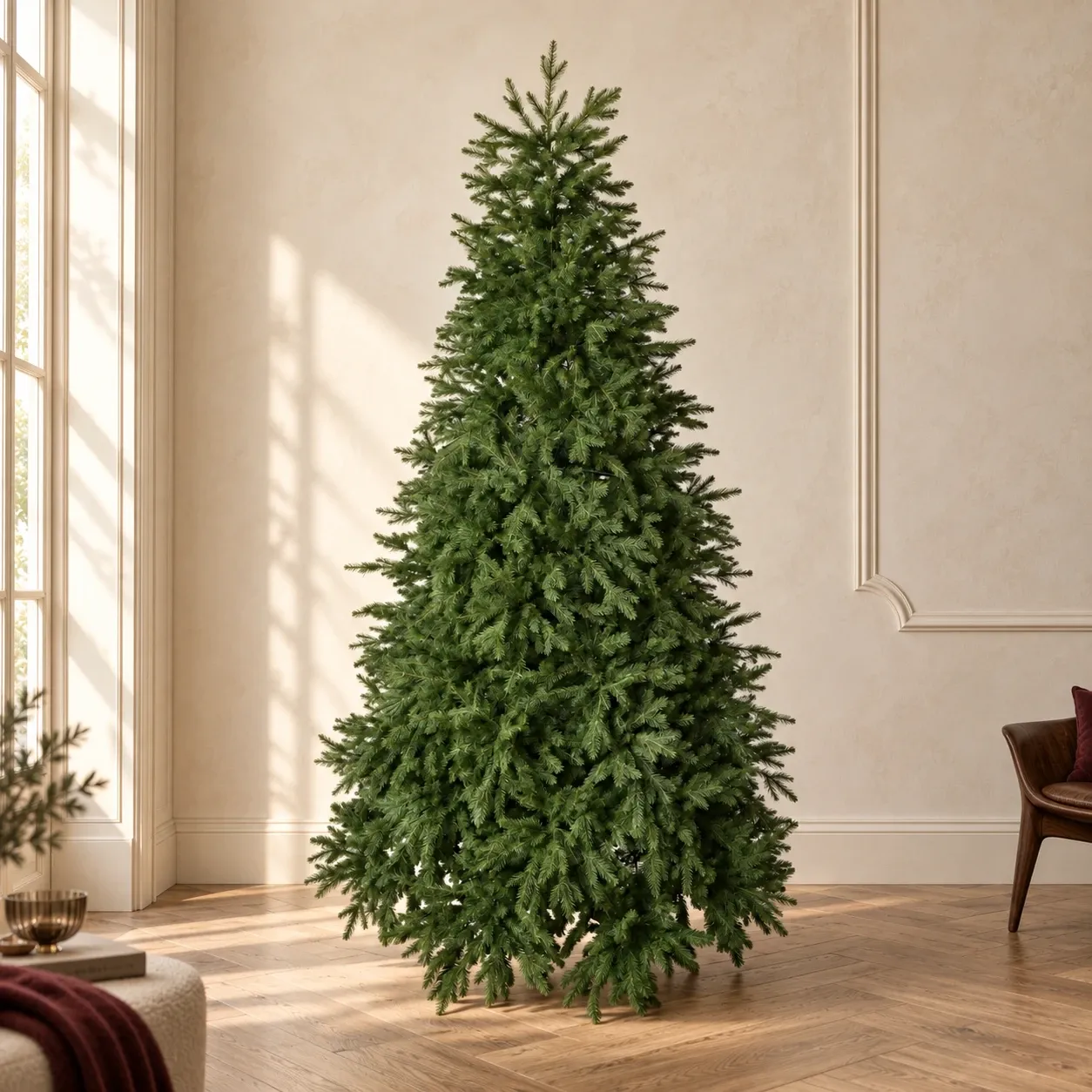
The emptiness is the design. In a room with textured beige walls, classic panel molding, and hard afternoon light, a bare evergreen reads as sculpture — it holds the corner without competing with anything. Add ornaments and you lose the shadow play on the wall behind it, which is genuinely the most beautiful thing happening in that space.
7. Rustic Wooden Crate Base with Reindeer Figurines
Build a crate collar instead of buying one. A 16-inch square wooden crate, flipped upside down with the bottom removed, fits most seven-foot tree stands and costs $15 to $25 at a craft store. Stain it walnut and seal with matte polyurethane so sap and water rings wipe right off. Line the inside with a plastic tray — you’ll thank yourself in January.
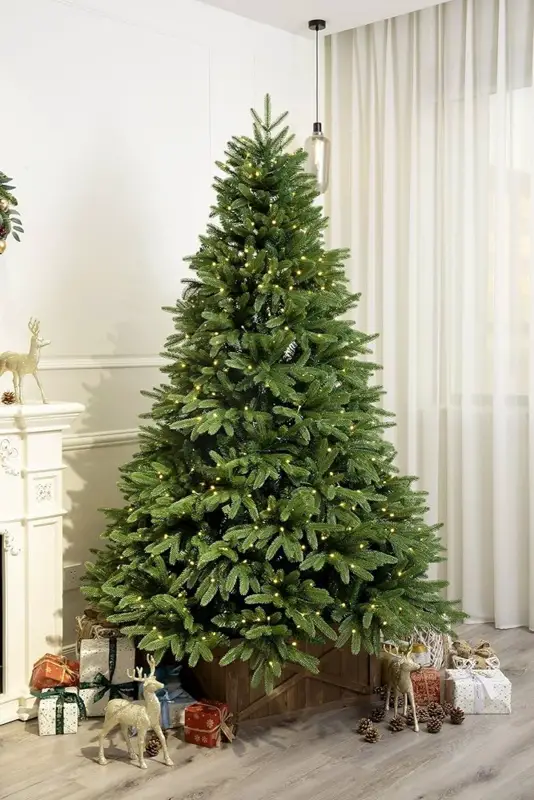
The crate does two jobs at once: it hides the stand and it repeats the warm brown of the gifts and figurines around it. Three reindeer in graduated sizes give the eye a small, medium, large rhythm, which is why the vignette reads styled rather than cluttered. The sheer white curtains behind keep the background light so the dark green needles stay crisp.
8. Kraft Paper Gifts Under a Mini Evergreen in Grey
A three-to-four-foot potted evergreen runs $25 to $45 at a garden center or Trader Joe’s in early December. A grey woven basket is about $18 at Target, kraft paper is $6 a roll, and ribbon from a thrift-store jar is $3. Total: under $90. Keep the tree watered and it lives on your porch through spring. Pinecones from the park behind your building cost nothing at all.
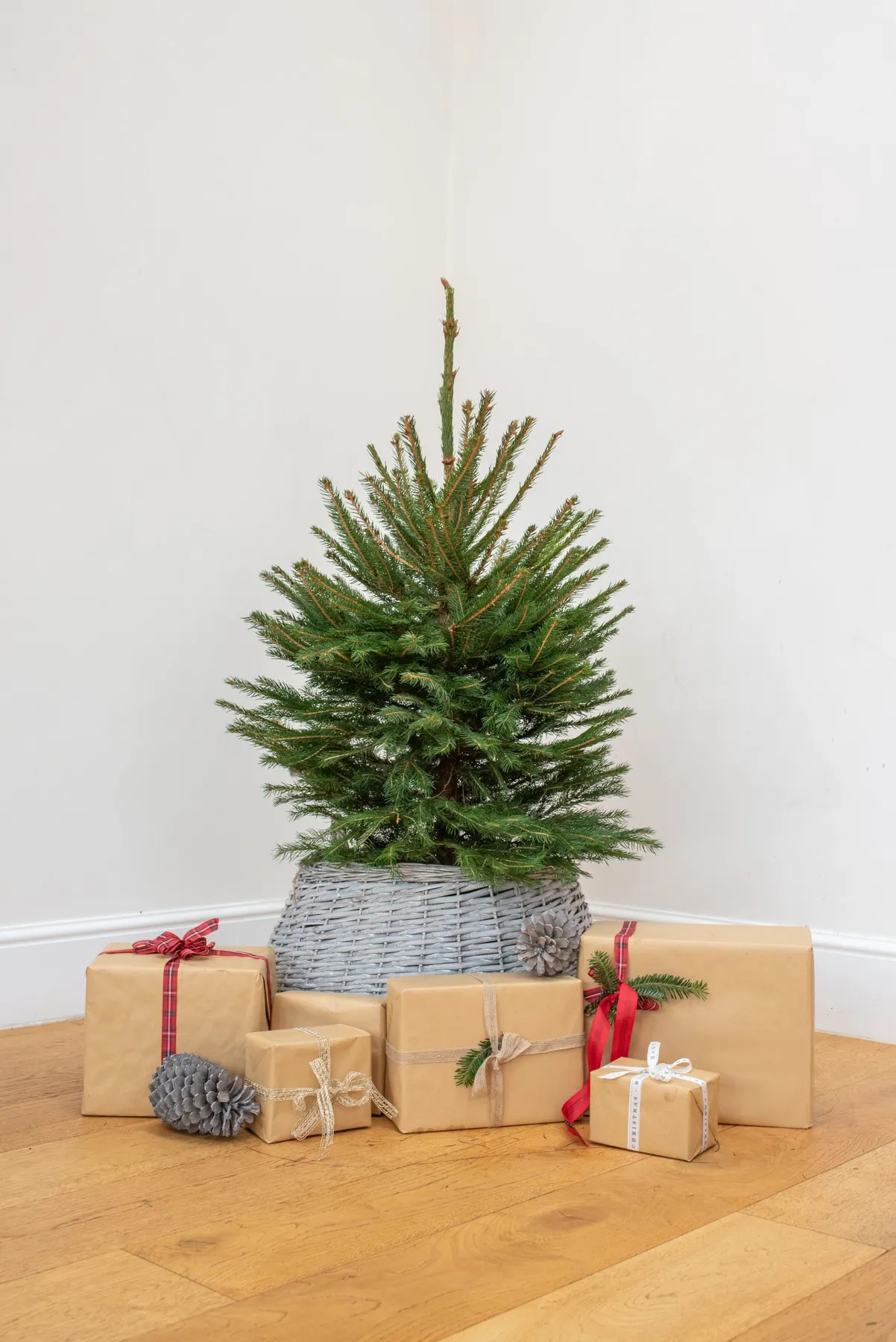
- Measure the floor space — this vignette needs about three feet of clear width.
- Check for heat vents and direct sun; a live tree dries out fast near both.
- Confirm you have a waterproof liner that actually fits inside your basket.
- Count your gifts ahead of time so the wrapping stays consistent.
9. An Undecorated Evergreen in a Galvanized Tub
The galvanized tub. It’s dented, matte grey, and completely unglamorous, and that’s exactly why the tree reads as a plant instead of a decoration. Swap it for a red skirt and the whole thing collapses into generic. Any vessel that looks borrowed from a hardware store does the same job — a bucket, a bushel basket, a stoneware crock from a flea market.
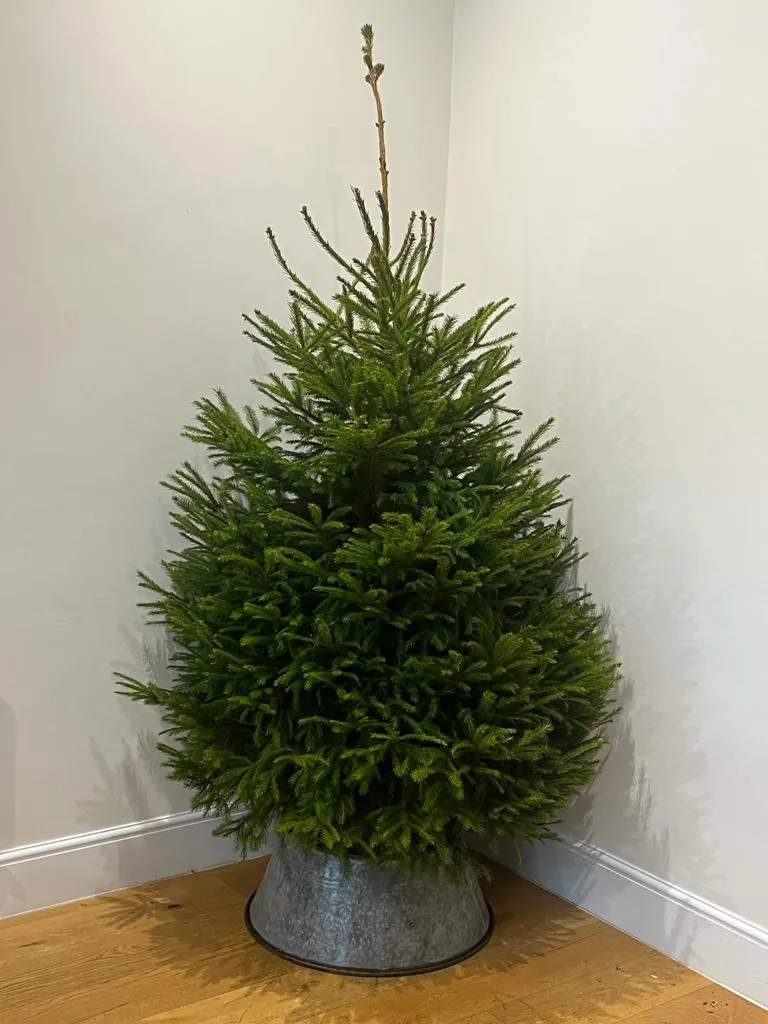
Best in corners between three and five feet wide with ceilings at least eight feet high, because the tub adds about 15 inches below the branches. In a small apartment, drop to a five-foot tree in a 14-inch tub and it still works beautifully. If your room is narrow, look at Idea #21 for a bare tree that suits tighter, cleaner layouts.
10. Mixed Pine and Eucalyptus with Silver and White
- 7.5 ft mixed-pine tree: $350–$900
- Eucalyptus stems, 12 to 18: $60–$120
- White and silver ornaments, 60 to 80: $90–$200
- White faux fur tree skirt: $45–$120
- Neutral wrap and ribbon: $40–$80
- Total: $585–$1,420
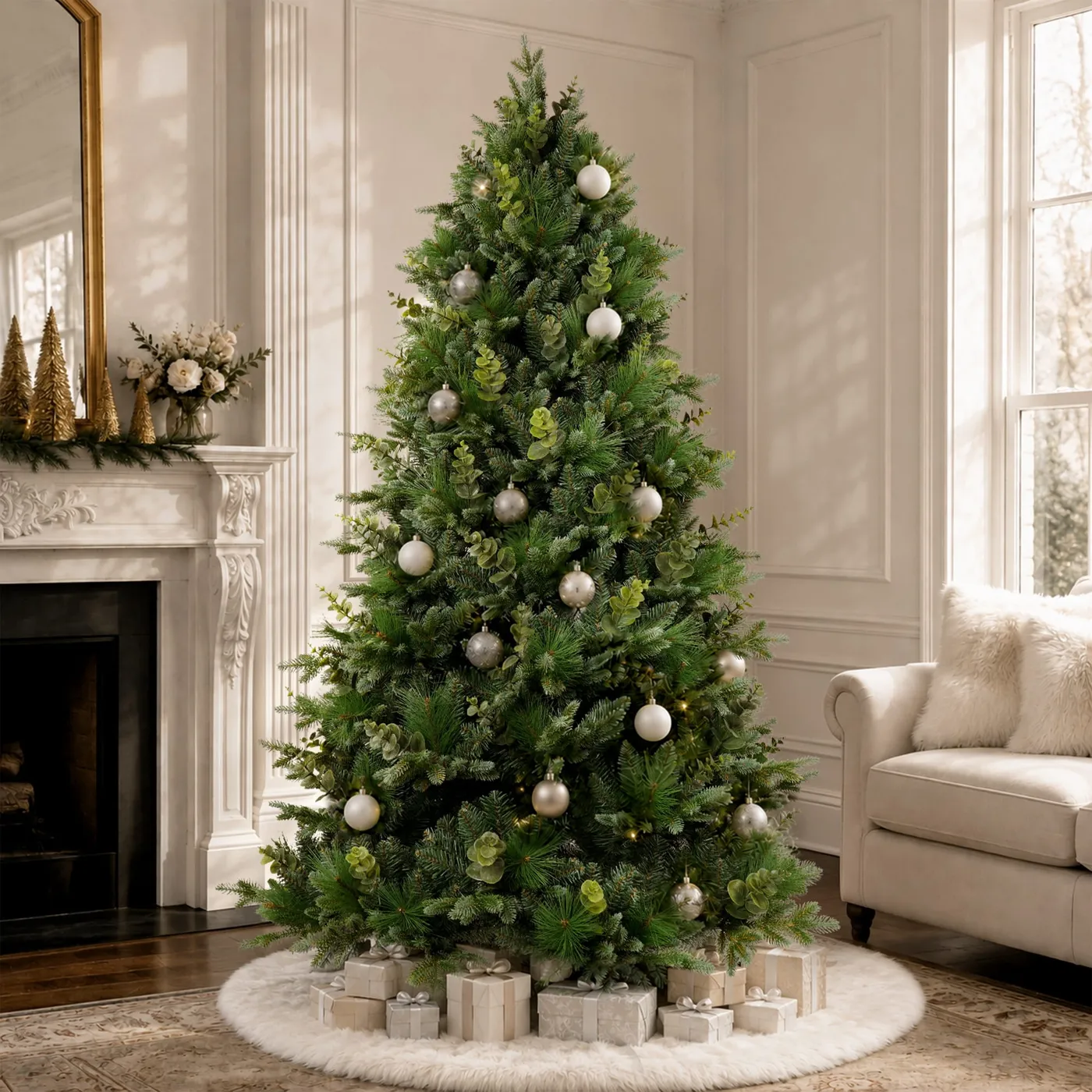
Budget alternative: a plain green tree plus ten faux eucalyptus stems from IKEA sneaks in under $200.
Roughly 60% green foliage, 25% white, 10% silver, 5% cream. The mixed needles matter — pine alone reads flat, but eucalyptus and long-needle stems break up the silhouette so ornaments sit at different depths instead of one plane. To shift the mood entirely, swap silver for brushed brass and change nothing else.
11. A Softly Flocked Pre-Lit Tree That Glows Snowy
Flocked trees shed. Expect a fine white dust on the floor for the first week and again every time you pack it away. Vacuum with a hose attachment, never a beater bar, and never wipe it down with a damp cloth — moisture turns flocking into paste. If anyone in the house has asthma or dust sensitivity, a lightly frosted tree is a much better call than a heavily flocked one.
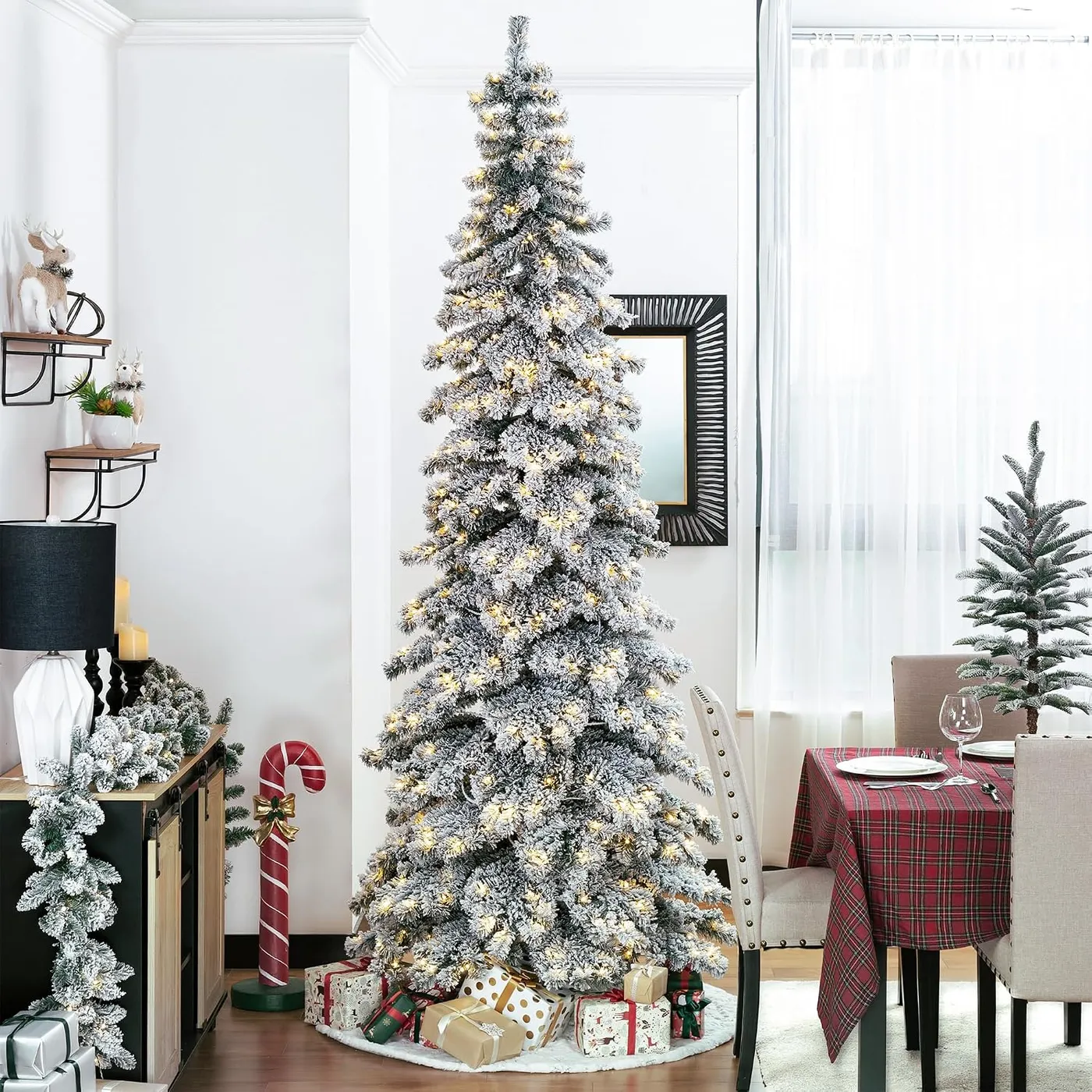
On a pre-lit tree, check the bulb count before anything else. Seven hundred lights or more on a 7.5-footer is what makes flocking read as glowing snow instead of grey cotton. Flocked trees also swallow light, so weave one extra six-foot strand of warm white through the front third. And skip cool-white LEDs — they turn flocking blue.
12. Wooden Houses, Pinecones, and a Beaded Garland
- Wrap a nine-foot light-wood bead garland loosely, three times around the tree, letting it sag.
- Hang wooden house ornaments in clusters of two or three, never evenly spaced.
- Tuck white star ornaments deep against the branches so they catch light from behind.
- Fill the gaps with pinecones, largest near the bottom, smallest at the top.
- Time: about 45 minutes. Cost: $40–$90 if you already own the lights.
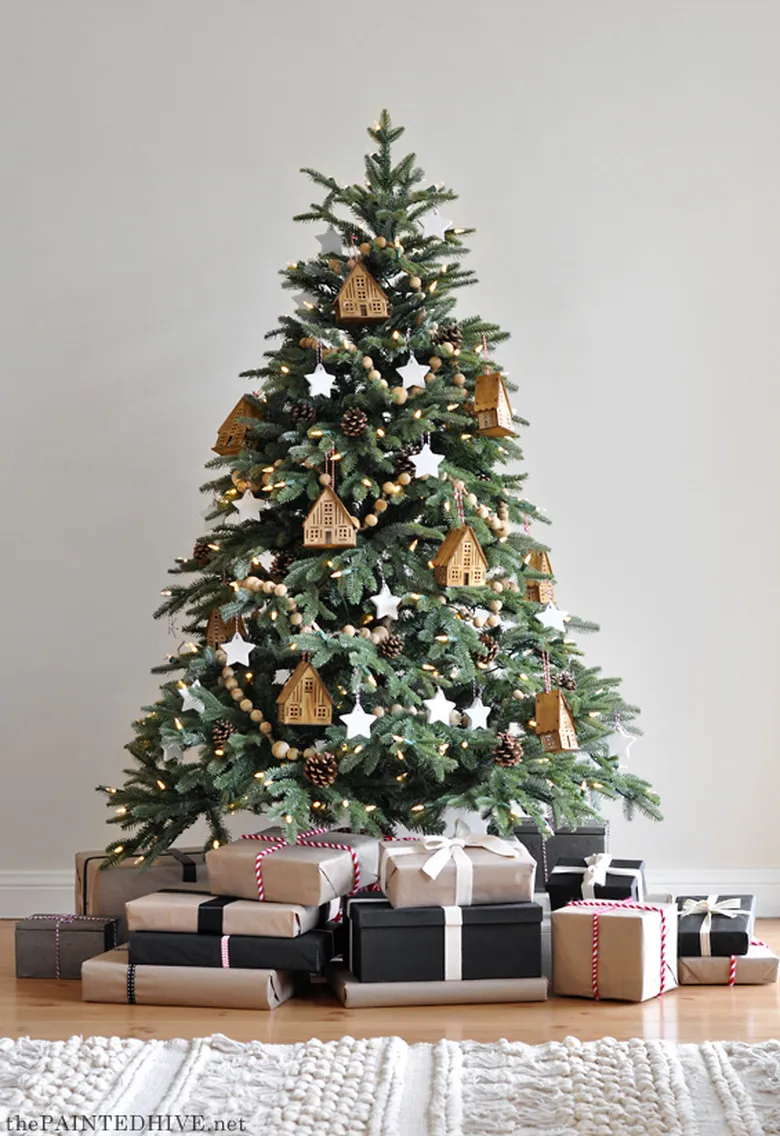
Rustic-natural styling keeps growing because it’s the one holiday look that works in a modern farmhouse, a rental apartment, and a 1920s bungalow without a single change. Wooden house ornaments have quietly become collectibles — people add one or two a year, the way others collect travel ornaments. That slow accumulation is why it still looks good years from now.
13. Candlelight, Arched Windows, and Burgundy Bows
Repetition of one shape does the work here: velvet bows at the same scale, again and again, so the tree reads as a pattern from across the room. Matte red ornaments sit close to the branches, gold reflective ones push light outward, and the candles on the mantel and coffee table repeat the tree’s warmth on the far side of the room. Nothing competes. Everything echoes.
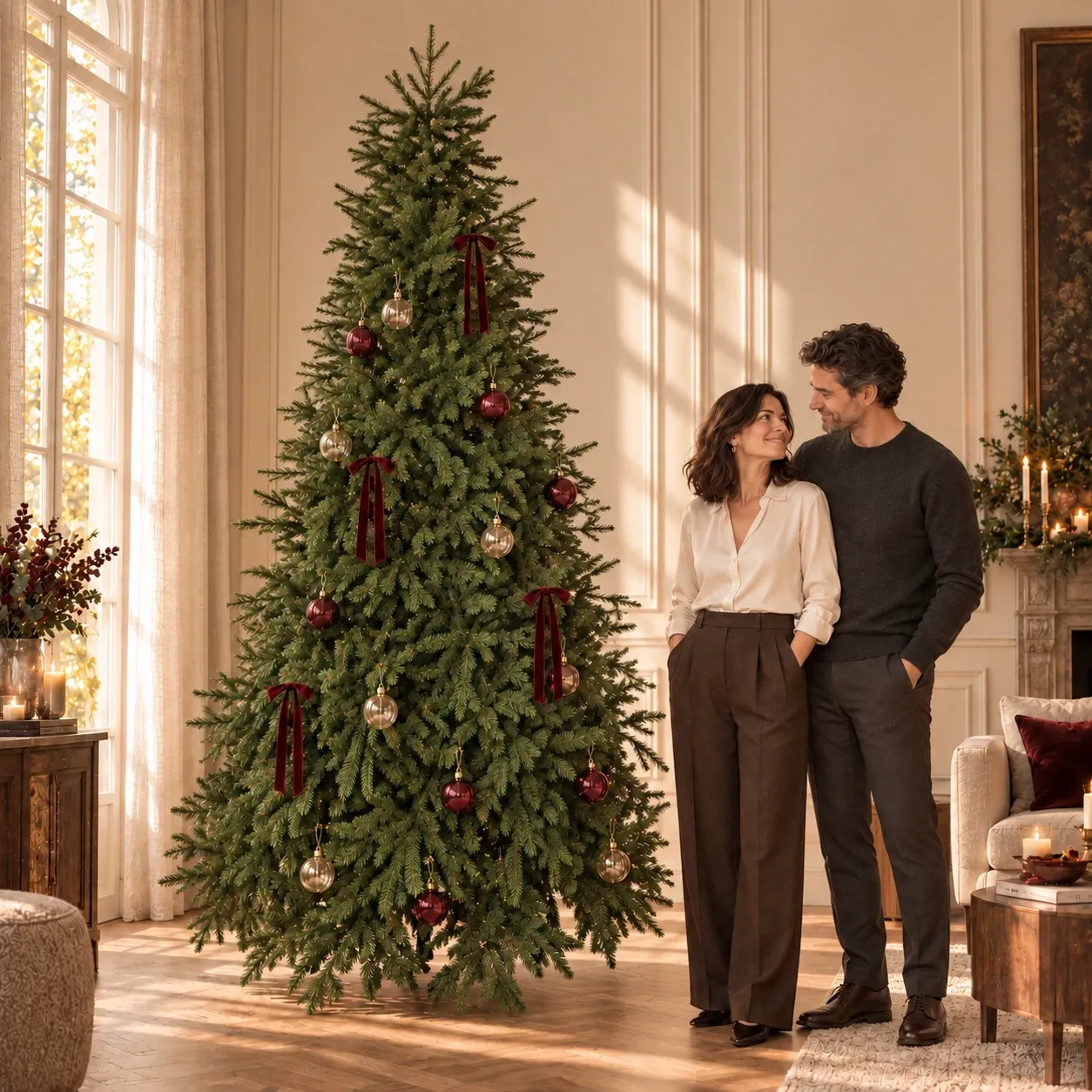
Buy velvet by the yard instead of premade bows — three yards of burgundy ribbon runs $12 to $25 and makes 12 to 15 bows. Matte red shatterproof balls are about $8 a tube at Walmart; gold ones run $10 at Target. Thrift stores in early January are gold mines for velvet ribbon, glass ornaments, and candlesticks at $1 to $3 each.
14. Dense Pre-Lit Glow Above a Fluffy White Skirt
Faux fur tree skirts are magnets for pine needles, glitter, and pet hair. Shake them out weekly, spot clean with a damp cloth, and wash on cold at the end of the season — then air-dry, because a dryer ruins the pile permanently. Hand-wash-only versions are common, so read the tag before you buy. A flat white cotton skirt photographs almost as well with far less fuss.
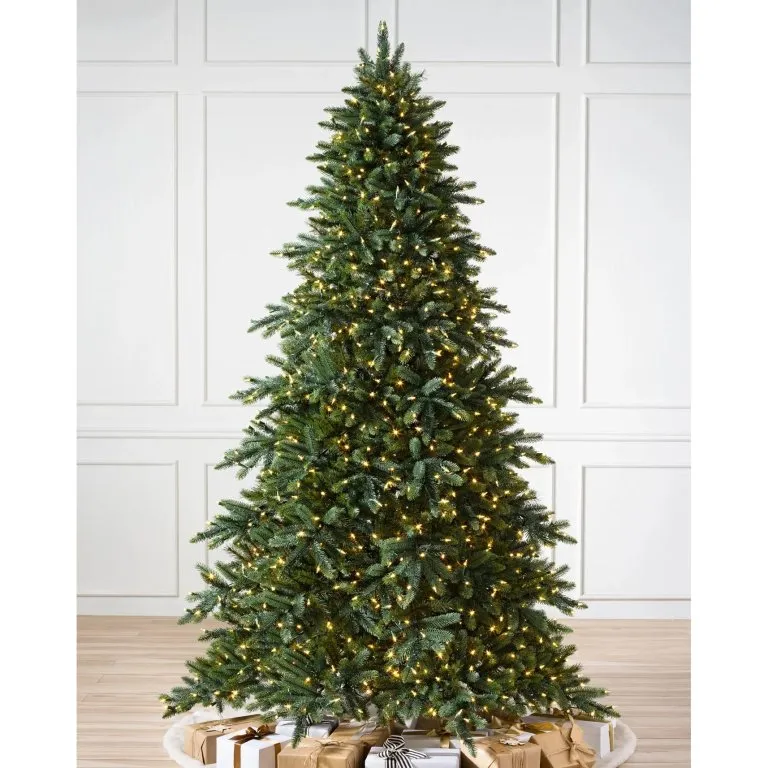
The skirt is the difference between a pre-lit tree and a pre-lit tree that looks finished. White, fluffy, and wide enough to fully cover the stand, it brightens the floor around the base so the dark green needles and warm lights have something soft to sit against. Without it, the black stand and tangled cords undo everything happening above.
15. A Slender Pre-Lit Tree with Cream Textiles
Slender trees — 28 to 36 inches wide — need less decoration per foot, not more. Fifteen to twenty ornaments is plenty on a 7.5-foot pencil tree, hung on the outer third of the branches only. Anything set deeper just disappears. And skip the topper star: a narrow tree almost always looks better with a simple ribbon, or nothing at all.
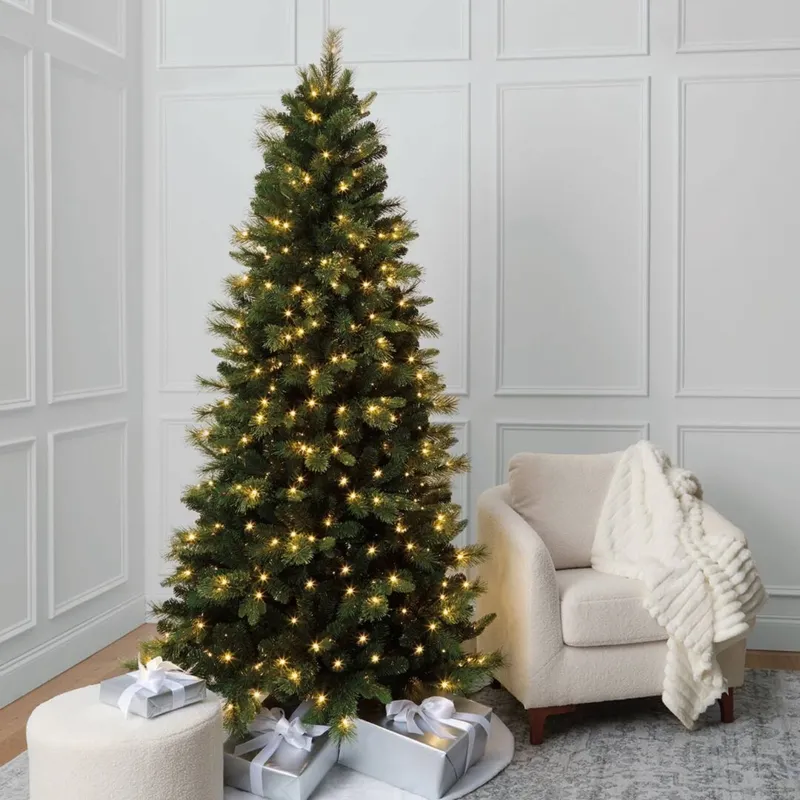
Ideal for rooms under 200 square feet, the end of a hallway, or anywhere you’re working with 30 inches or less of floor width. Ceiling height matters more than floor area here — a nine-foot pencil tree in a ten-foot room is dramatic, but the same tree under a standard eight-foot ceiling feels pinched. Compare with Idea #5 if you have a wide corner to fill.
16. A Sparse Tree Framing a Snowy Window
Roughly 70% negative space, 20% evergreen, 10% warm light. Sparse trees work because the gaps are as designed as the branches — the window, the snow, and the mantel garland all show through. To swap the mood without changing anything else, change what’s behind the tree: a dark wall makes it graphic, a pale wall makes it soft and almost ghostly.
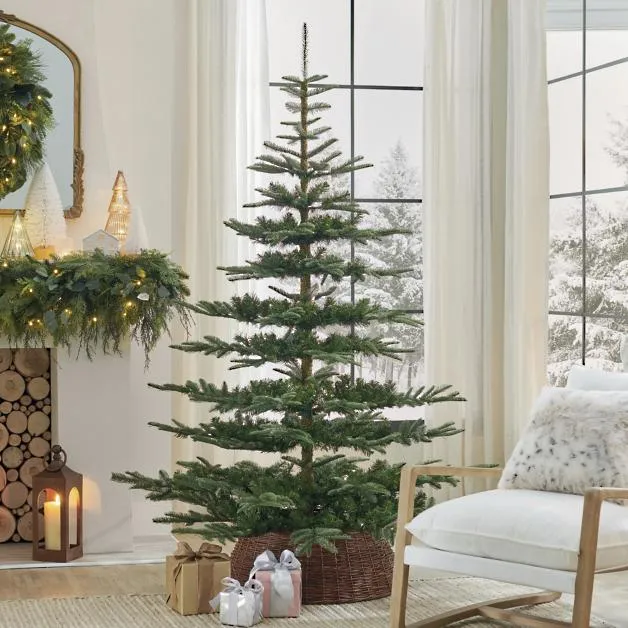
Sparse trees are unforgiving. Every gap is visible, so bent branches and uneven light strings stand out immediately. They also need a bigger footprint than you’d guess to look intentional — this one only works in front of a tall window, where the glass becomes part of the composition. Against a blank wall, a sparse tree just looks half-finished.
17. All-Gold Ornaments Layered One Bauble at a Time
- Start with lights only, then add a beaded gold garland in three loose loops.
- Hang the largest gold balls deepest into the branches, not on the tips.
- Layer mid-size ornaments next, alternating matte and glitter finishes.
- Place the odd pieces last — snowflake, pinecone, ballerina — near eye level.
- Step back every ten ornaments to check the balance.
- Time: 60 to 90 minutes. Cost: $60–$150.

One color, many finishes. Matte, glitter, brushed, and pearl gold all reflect light differently, so the tree shimmers without a single contrasting ornament. Gold also warms the cool dark green needles, which is why this palette has survived every decorating decade since the seventies. The rule is simple: if it’s gold-adjacent it stays, and if it isn’t, it goes back in the box.
18. Pre-Lit Tree Against Weathered Planks and Tin
Rustic rooms are showing up in holiday inspiration more than they have in years — partly because reclaimed wood and tin ceilings photograph with real depth, and partly because people are leaning toward decor that looks lived-in instead of staged. A plain pre-lit tree in that setting reads as restraint, not laziness. It’s the least seasonal the tree can look and the most classic at the same time.
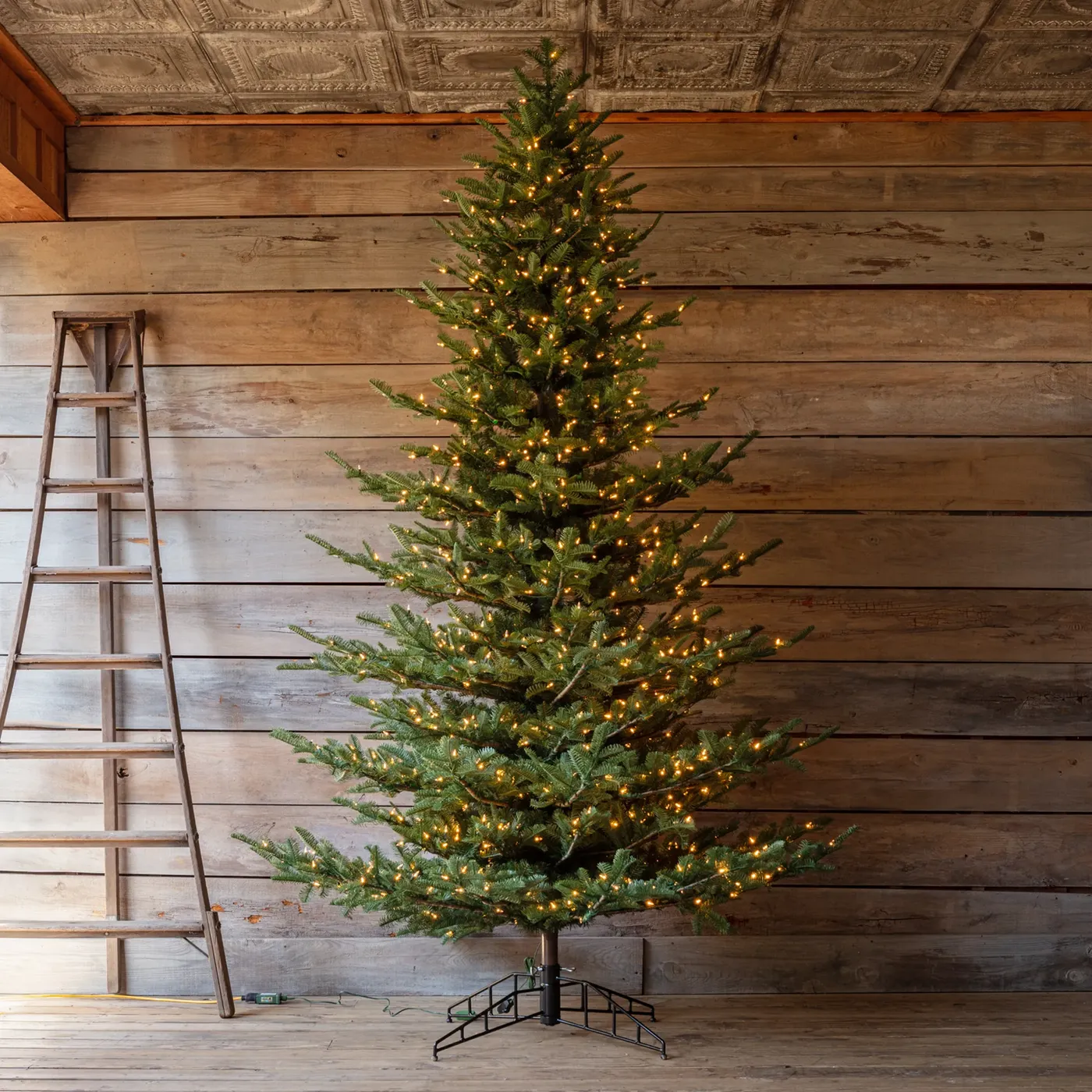
Dark rooms eat light. If your walls are weathered wood or your ceiling is pressed tin, add 25% more lights than you think you need and choose warm white bulbs between 2200K and 2700K. Also test the tree against the wall before you decorate — a black metal stand disappears against dark planks, so you can skip a skirt entirely.
19. Frosted Globe Lights in Candy Colors
- Four-to-six-foot evergreen: $30–$120
- Frosted globe string lights, two strands: $24–$60
- Extension cord and timer: $15–$30
- Felt pads or a simple base mat: $10–$20
- Total: $79–$230
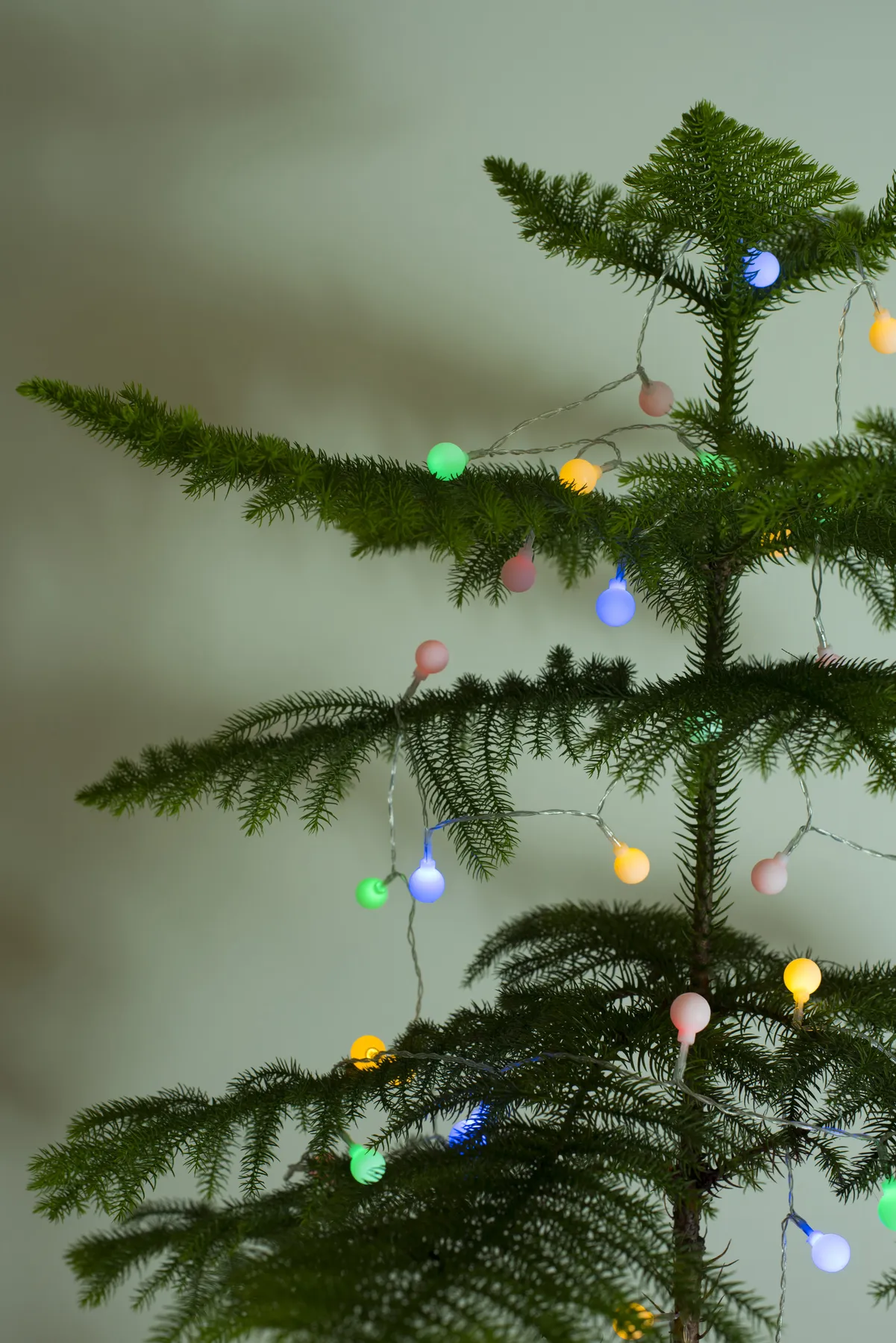
Budget alternative: Target and Walmart both carry frosted multicolor globe strands for under $15 each through November.
The frosted finish on the bulbs is the whole thing. Clear multicolor lights can look like a dorm room; frosted ones look like a holiday card, because the coating softens each bulb into a small glow instead of a sharp dot of color. That one detail changes how the entire tree reads — and it’s the cheapest thing in this article to get right.
20. Undecorated Tree, Kraft Gifts, and a Shaggy Rug
- Measure the basket footprint — a three-foot tree needs a 16-inch base minimum.
- Check that your rug is machine-washable if gifts are being layered on it.
- Decide your ribbon color before wrapping anything, and stick to two.
- Confirm the tree is anchored so pets and toddlers can’t tip it.
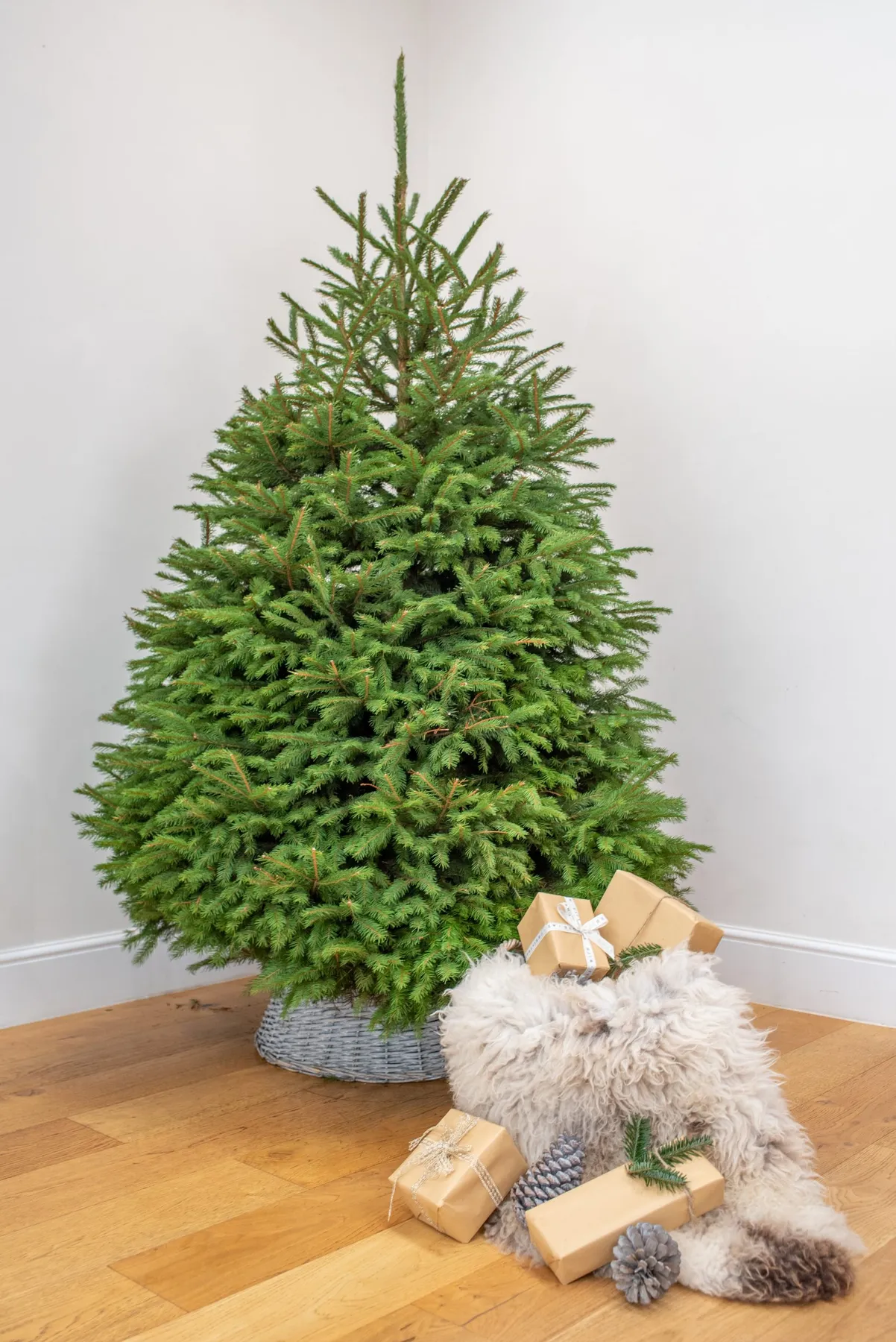
Grey woven baskets run $20 to $35 at HomeGoods and often $10 at thrift stores. Kraft paper is $6 a roll at Walmart and covers about 15 gifts. Skip store-bought bows — white string and a pine sprig from the yard cost nothing. A shaggy off-white rug from IKEA is $79 for a 5×7, or check Facebook Marketplace for around $25.
21. A Quiet Undecorated Tree in a Neutral Room
An undecorated tree in an empty-feeling room can read as unfinished rather than minimal. The fix is intention: a clean base, a straight trunk, and cleared floor space around it. If the room already feels sparse — no artwork, thin furniture, blank walls — this look will emphasize that. It works best where the architecture is doing something, like a paneled door or a wood floor worth looking at.
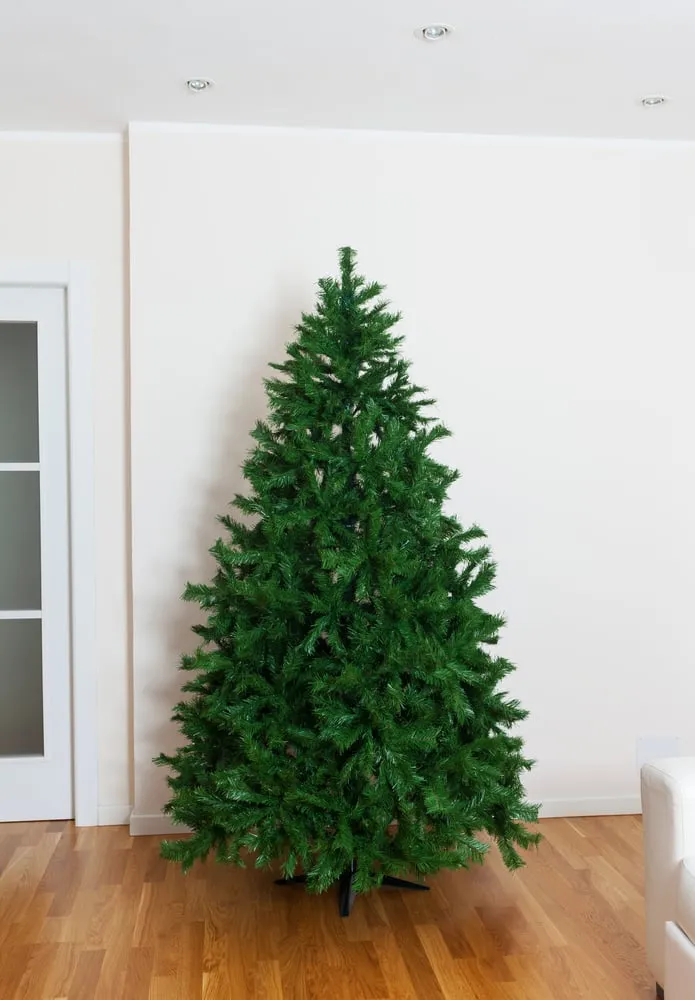
This tree suits rooms from about 120 to 300 square feet with eight-foot ceilings, and it needs roughly six inches of clearance on all sides so the silhouette stays clean. Below 120 square feet, size down to a six-foot tree or go tabletop. If your space is larger, see Idea #24, where a fireplace mantel gives the bare tree something to answer to.
22. Bare Tree by a Multi-Pane Window with Gold Accents
Let the window do the work. Place the tree roughly one-third of the way across the window frame rather than dead center — the asymmetry reads intentional and lets light fall on both the tree and the floor beside it. Keep the base white and round so it echoes the window’s proportions, and stop decorating at the floor line.
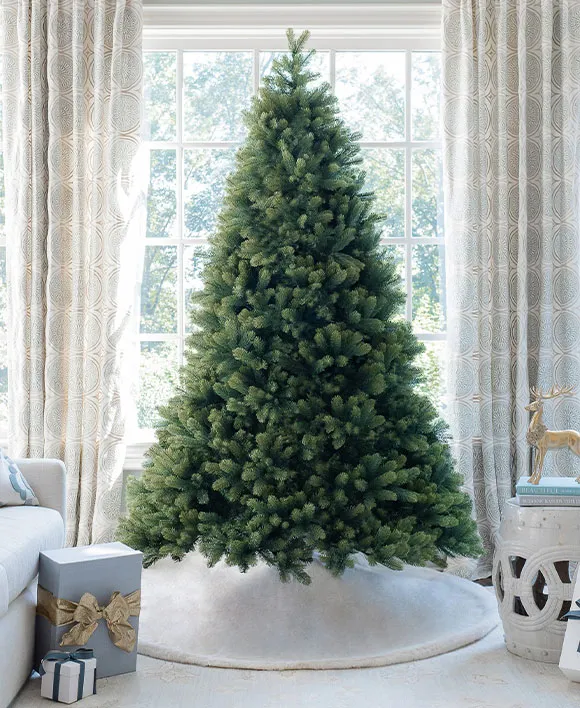
About 50% green, 30% white and cream, 15% filtered daylight, 5% gold. The patterned curtains are the only busy element in the room, so everything else stays plain: white plush skirt, light sofa, one gold deer figurine. Swap the curtains for solid linen and you can afford more pattern elsewhere — a second throw, a printed pillow.
23. Snowy View, Undressed Tree, and Red Ribbon Gifts
A tree in front of a floor-to-ceiling window takes real sun and real temperature swings. If it’s live, water it daily — window-adjacent trees dry out about twice as fast and are a leading cause of holiday fires. Keep the lights off any time you leave the house. If it’s faux, expect the green to fade after two or three seasons in direct sun, which is worth knowing before you spend on a premium one.
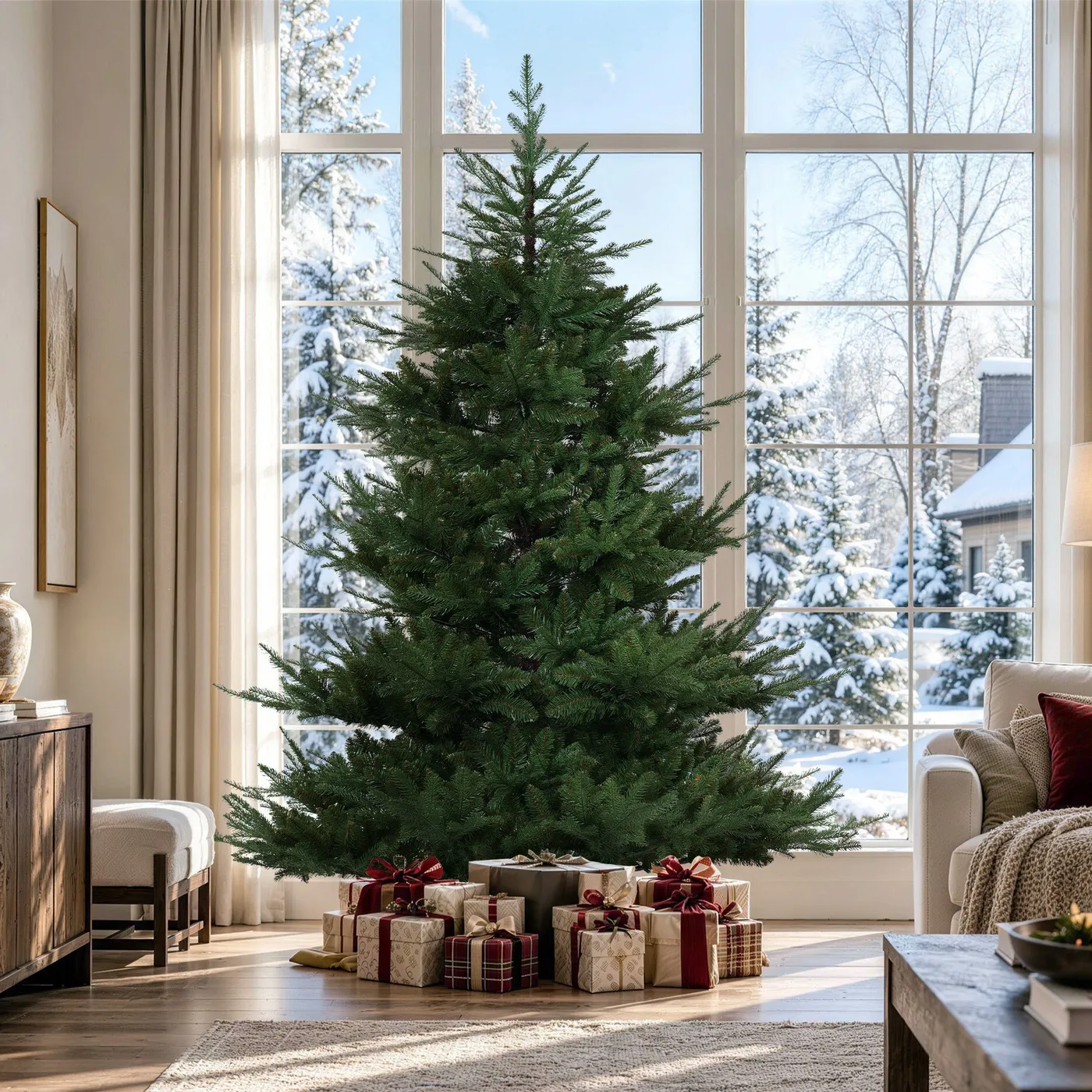
The composition is almost entirely green, white, and light wood — and then the red and gold ribbons on the gifts supply the only saturated color in the room. That’s the rule of thirds at work; the eye needs one place to land. Strip those ribbons away and the scene turns cold and a little sad.
24. A Bare Tree Anchored by a Classic White Mantel
You don’t need a designer tree for this. Bare trees are the cheapest kind — $60 to $150 for a 7.5-footer, less on Marketplace after Thanksgiving. Wrap gifts in mixed papers from Dollar Tree at $1.25 a roll, buy a green garland for about $18, and hunt thrift stores for the gold-framed mirror. Under $250 total if you already own the mantel. Compare with Idea #21 — same undecorated tree, completely different room.
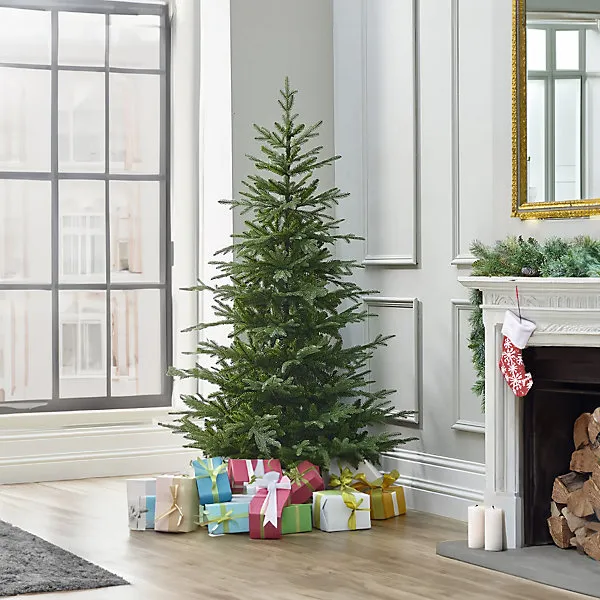
The mantel, not the tree, is doing the heavy lifting. A bare evergreen only looks deliberate when something across the room matches its visual weight — here, the white fireplace with its garland, red stocking, and gold frame. That mirror doubles the green without adding a single object to the tree.
Your Tree, Your Room, Your December
Twenty-four ideas later, the through-line is simple: the trees that look best are the ones that match the room they’re standing in, not the trend that was loudest that year. Start with your floor space, your wall color, and your light temperature — then pick the tree that fits, decorate it slowly, and leave a little empty space. And if you save one thing from this article, save the lighting tip. It’s free and it changes everything.
📌 Pin this guide to your Christmas board now — next December you’ll open it, pick an idea, and actually enjoy the process. Happy decorating.