
Christmas tree themes and colors for 2026 are having a major moment on Pinterest — and the palettes people are actually saving look nothing like the red-and-green default. Half the fun is choosing; the other half is committing, and that’s where most of us stall for three weeks.
We spent serious time browsing Target, Etsy, Anthropologie, and Walmart to bring you only what’s worth your attention this year — from $12 ornaments to full $2,400 setups. After filtering through hundreds of options across Target, Etsy, and Anthropologie, we narrowed it down to 32 ideas that actually deliver.
Inside you’ll find warm gold-and-green naturalism, heavy flocked minimalism, jewel-toned traditionals, and loud vintage retro — with budget and luxury versions sitting side by side so you can see exactly what the extra spend buys. Every idea is shoppable, with direct links to the pieces.
In 2026 the shift is toward trees that read as part of the room instead of a decoration dropped into it, which means ribbon, textiles, and light temperature are doing as much work as the ornaments. And stay until the end — we break down the most common mistakes that can ruin these looks. 📌 Save this to Pinterest for later — you’ll want to revisit these ideas.
1. Warm Gold and Green with Scattered Berry Clusters
- Full or pre-lit tree, 7.5 ft: $180–$650
- Warm white string lights, 700 count: $20–$45
- Gold baubles, mixed sizes, 60–80 pieces: $60–$180
- Reddish berry clusters, 12–15 stems: $30–$70
- Basket collar or simple tree skirt: $25–$60
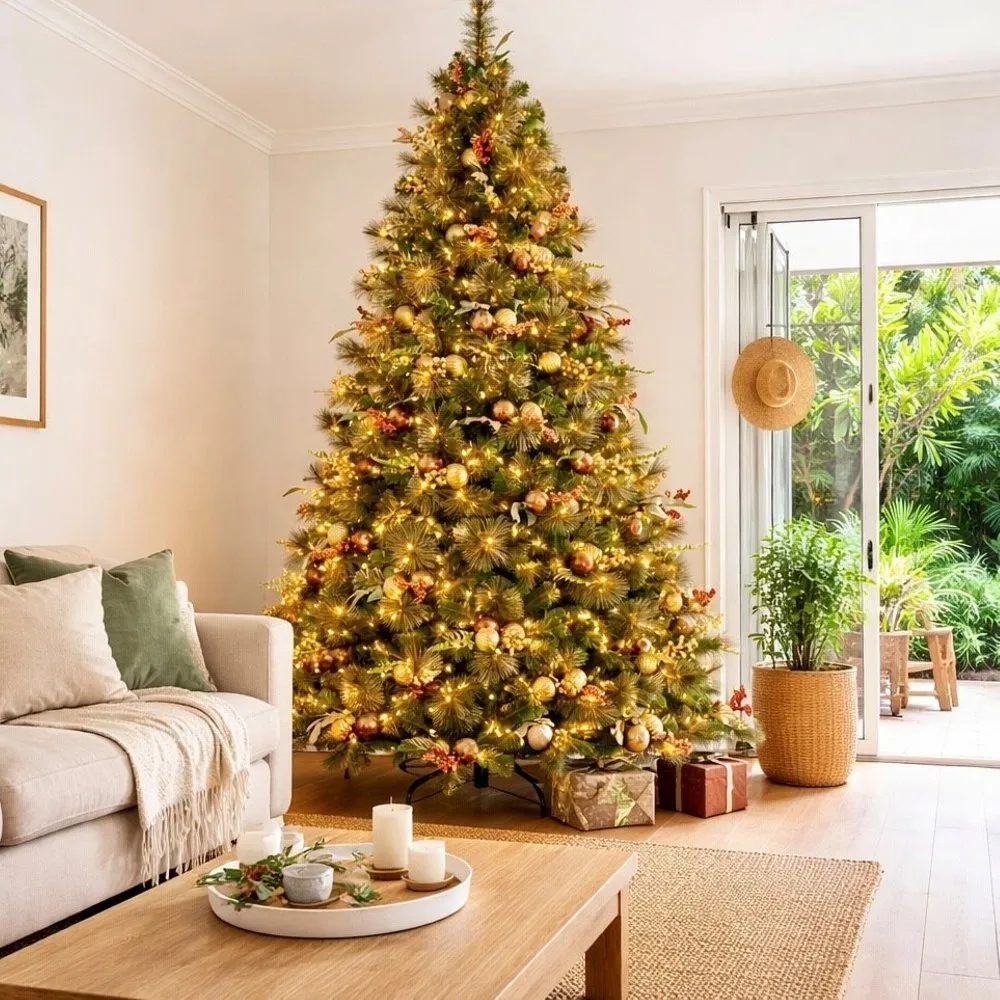
Three decisions carry this tree and none of them cost much. The ornament palette is deliberately narrow: gold spheres in a few sizes, plus berry clusters for texture, and nothing else. The string lights sit at a low warm temperature, so the gold reads as antique brass rather than shiny new. And the greenery stays greenery, which is what lets a full tree live beside cream walls, a neutral sofa, and light wood floors without turning the room into an argument.
2. Deep Blue and Gold, Planned on a Marble Counter
Roughly 70% deep blue, 20% gold and silver, 10% cream. The blue carries the volume in velvet and gloss, the metallics catch and scatter light so nothing goes flat, and the cream shows up in the sofa, the ribbon edge, and the fabric swatches laid out on the marble. Swap blue for aubergine and gold for antique brass and the formula still holds. Adding a fourth color is where these trees fall apart.
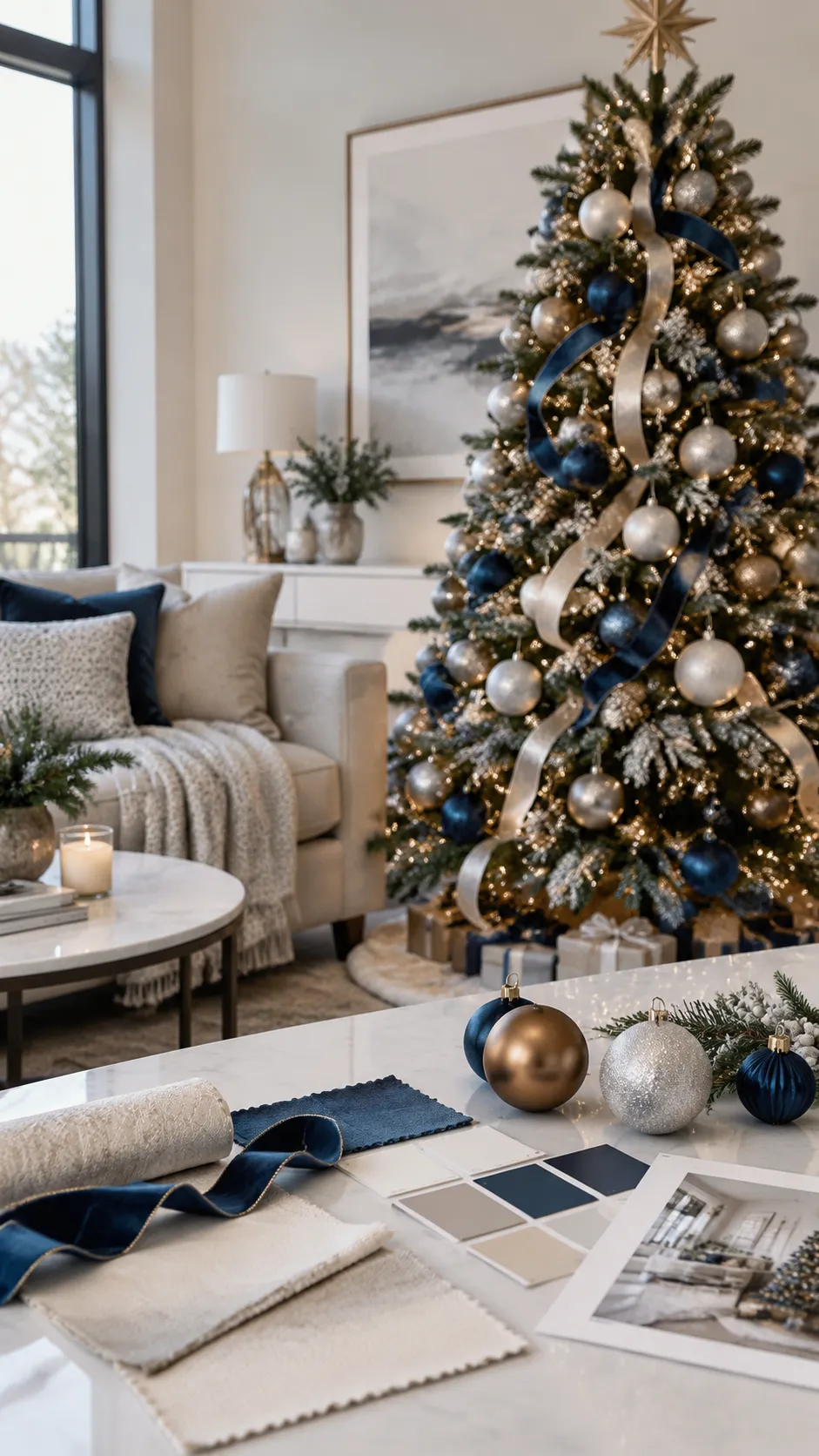
Buy ribbon 2.5 to 3 inches wide and cut each strand about three times the height of your tree. On a 7-footer, anything narrower reads like a shoelace and anything wider swallows the branches. Pin the top and bottom of every loop with floral wire before ornaments go on — otherwise gravity wins by the second week of December and your ribbon quietly becomes a garland.
3. Silver Aluminum Tree with Full-Blast Multicolor
Aluminum trees are genuine 1950s artifacts — the Evergleam and its cousins — and resale prices have climbed every year since mid-century content took over Pinterest. What’s different in 2026 is the ornament layer: bright, saturated, unapologetic multicolor baubles. After a decade of white-on-white holidays, people want their tree to look like a party. This one has staying power because it’s nostalgic rather than fashionable.
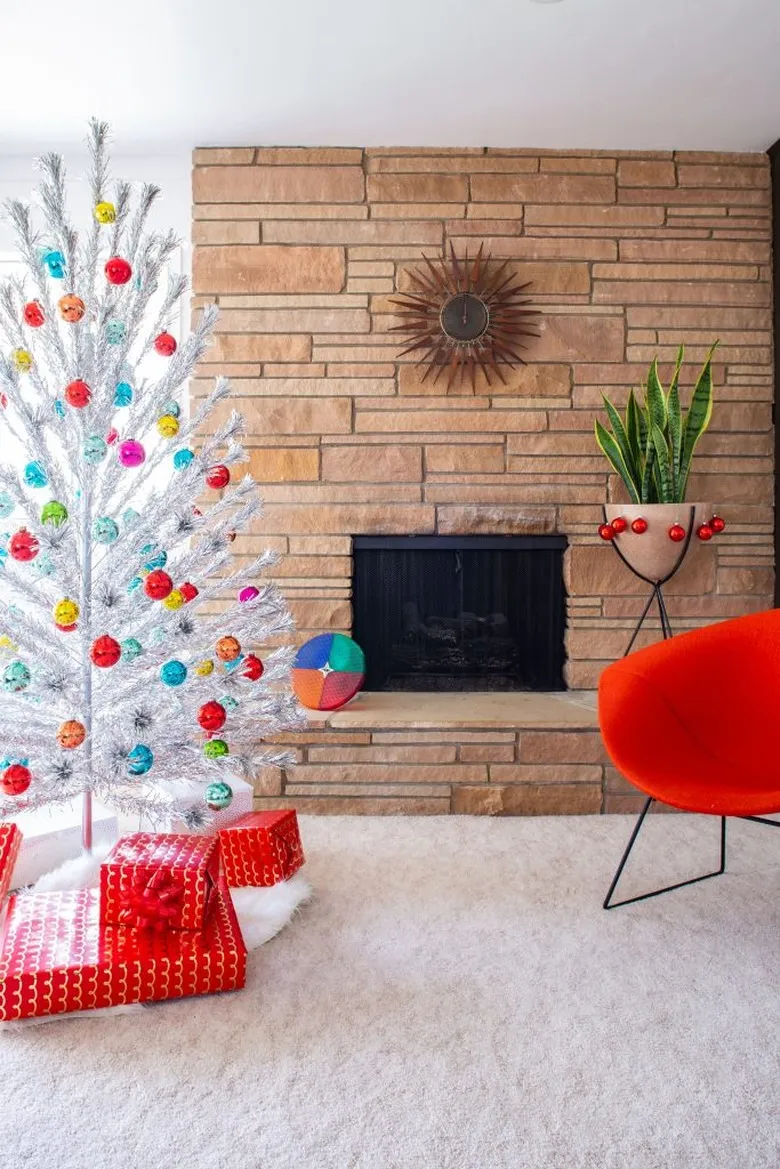
A true vintage aluminum tree runs $150–$400 on Etsy and keeps climbing. Two cheaper routes: a new aluminum-look tree from Target or Walmart at $60–$120 that gives the silhouette without the provenance, or a plain green tree where you commit hard to bright ornaments at $15–$25 a tube. And the orange chair beside it? Typically a Facebook Marketplace find at $40–$90, doing at least as much work as the tree.
Take the chair away and this room goes from a story to a showroom. The orange mid-century armchair is the only object in the frame with real saturation outside the tree, so it pulls your eye across the space and makes the multicolor ornaments feel like a decision instead of a mess.
4. Heavily Flocked Tree in White and Silver Only
Flocking is not low-maintenance, and anyone who says otherwise owns a vacuum they resent. It sheds, sometimes for the first two seasons, and the white can yellow near a radiator or a south-facing window. Lay a sheet under the tree before setup, keep a hand vac within reach, and if there’s a cat in the house, know that flocked branches are essentially a lint brush with a tail. Skip it entirely if you have a dog that chews.
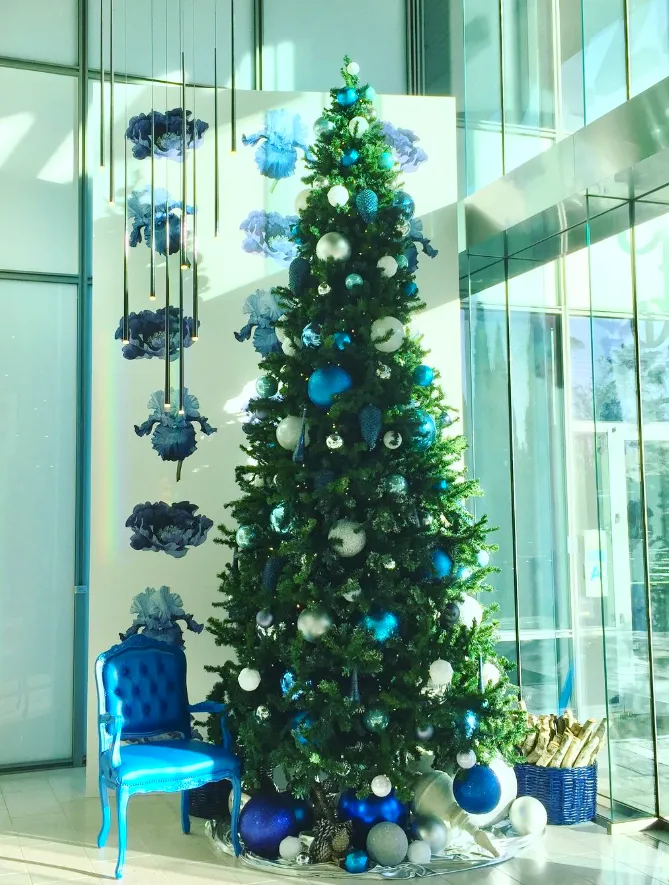
This look depends on the room’s own brightness. A medium flocked tree wants at least a 10 by 10-foot living room with a light floor — put flocking on dark hardwood and the snow effect vanishes. It also wants height: plan on 8-foot ceilings minimum for a 6.5-foot tree plus a star topper, and leave 18 inches between the tree and the sofa so all that white doesn’t crowd you.
5. A Mini Flocked Tree in a Concrete Bowl
The scale contrast is the whole story: a small flocked tree dropped into a bowl sized for a shrub, framed by concrete walls and grey tile. Oversizing the planter makes the tree look intentional rather than apologetic. Then there’s the surface mix — matte concrete, glossy white pebbles, brushed champagne ornaments, one warm flame in a votive. Four materials, three textures, no competition. You can copy the ratio anywhere: small tree, oversized matte vessel, pebble fill.
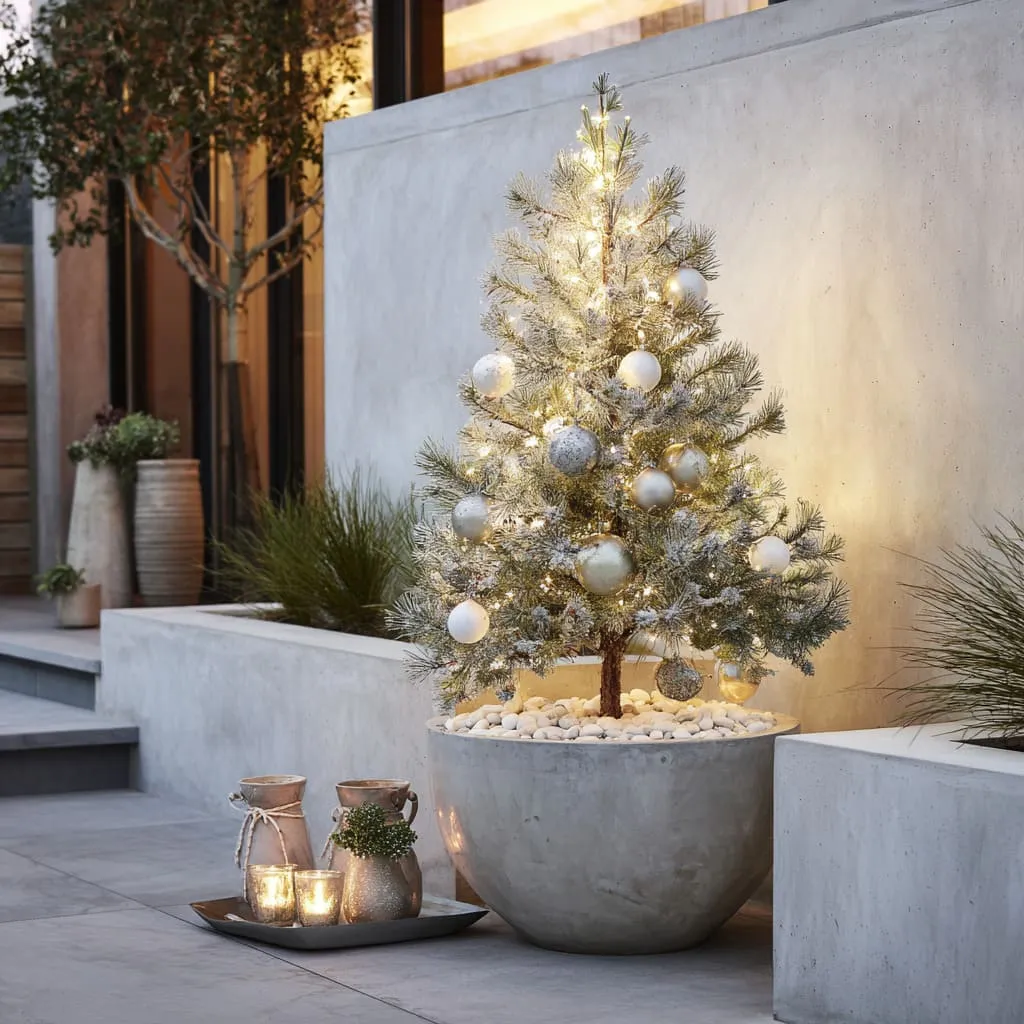
Semi-sheltered trees take a beating. Flocking dulls under UV within a season or two, and ornaments slowly lose their finish unless they’re glass or powder-coated metal. Plan on replacing the string lights every other year, about $18–$30, and skip real candles anywhere wind or a swinging door can reach them. Battery votives in glass holders give you 90% of the mood with none of the worry.
6. Dense Multicolor Lights in a Firelit Traditional Room
Multicolor pre-lits live and die by bulb count. You want roughly 100 lights per foot of tree, so a 7.5-footer needs 750 minimum — budget versions ship with 300 to 400 and you’ll see dark holes the moment daylight hits. Buy one with replaceable bulbs, and order a spare strand of the identical model the same day. Hunting down matching multicolor bulbs in February is a special kind of misery.
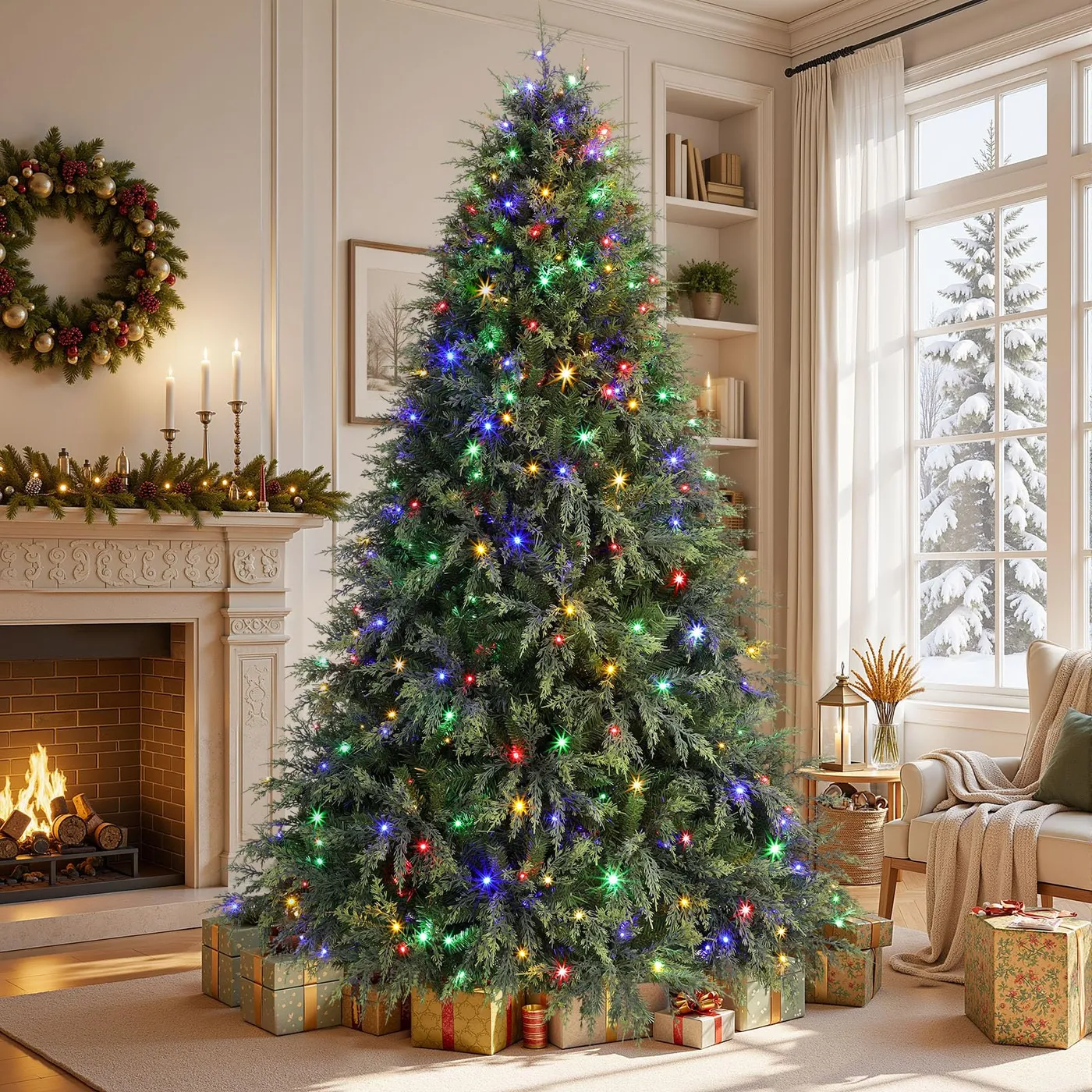
Multicolor lights spent twenty years as the thing design people apologized for. That flipped around 2024 and it’s fully back for 2026 — call it dopamine decorating, call it the nostalgia economy, but searches for vintage-style colored bulbs keep climbing and Gen Z is buying old strings at estate sales. Unlike most micro-trends, this one has a fifty-year track record, which is about as safe as holiday decorating gets.
7. Magenta, Lime, and Gold with Red Bead Garland
Here’s the math: about 60% is the tree’s own green, 25% is magenta and lime together, and 15% is gold. Magenta and lime sit close in value, so they read as one loud gesture instead of two competing ones, and the gold gives your eye somewhere to land. Swap magenta for cobalt and lime for mint and you get a cooler version of the identical structure — the proportions matter far more than the specific colors.
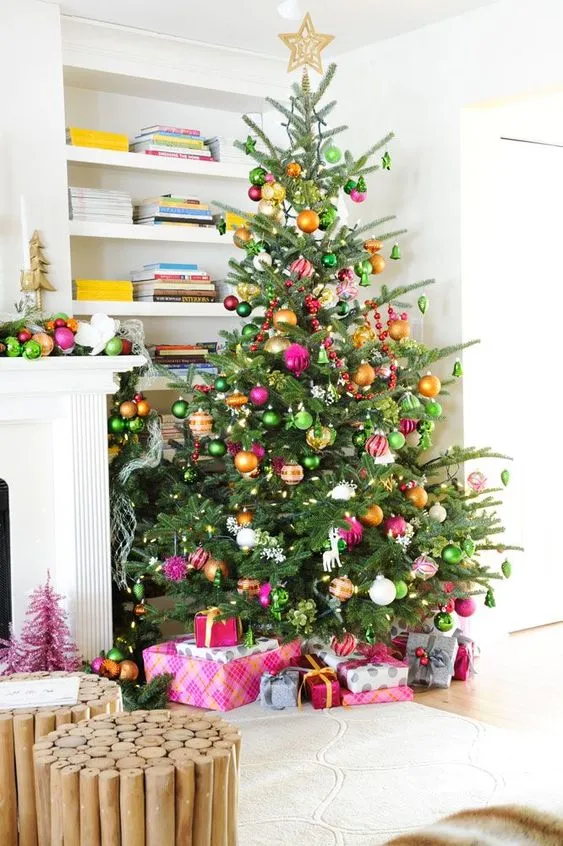
Odd colors are where thrift stores quietly win. Magenta and lime are exactly the ornaments people donate in January, so a mid-November run can net you 40 pieces for $12–$18. Add $10 of red bead garland from Walmart and a $6 gold star from Target and the whole scheme lands under $40. The one thing worth buying new is the lights — a $20 strand of warm white is not where you save.
8. Flocked Branches with Wooden Angels and Gold Spheres
It’s the white cutout angels. Without them you have a pretty flocked tree with some gold balls on it — pleasant, forgettable. With them, the tree suddenly has a subject. Those flat white silhouettes read at a distance like little windowpanes, and they’re the reason your eye keeps traveling up the branches instead of stopping at the lights. If you invest in only one ornament style this year, make it a shape, not another sphere.
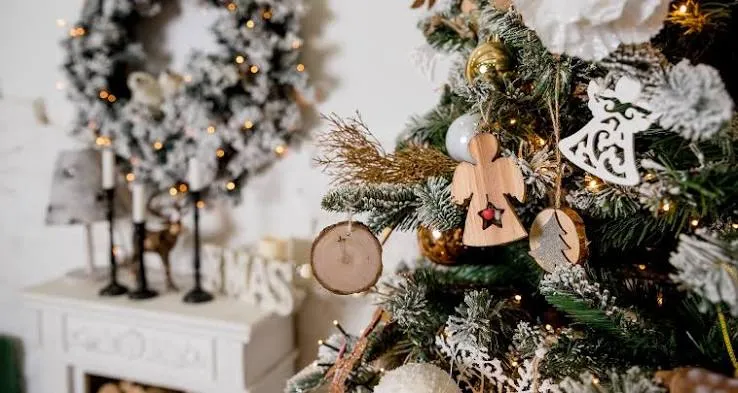
Make your own flat angel ornaments:
- Print a simple angel silhouette at about 4 inches tall on cardstock.
- Trace it onto 1/8-inch birch plywood or heavy chipboard.
- Cut with a scroll saw or sharp craft knife — expect two or three rough ones first.
- Sand the edges, then drill a 1/16-inch hole near the top.
- Leave natural, or brush with thinned white paint and wipe back for a washed finish.
- Thread with twine and hang near branch tips so light passes through.
Time: about 90 minutes for six. Materials: $12–$20.
9. Clipped Candle Flames Against Dark Wood Paneling
Real candles on a tree are genuinely beautiful and genuinely a fire. If you go this route: never leave the room while they’re lit, never light them late in the season when needles are dry, keep an extinguisher within reach, and trim every wick to a quarter inch. If you have kids, pets, or a radiator nearby, buy the LED clip-ons instead — the flicker is convincing and you’ll actually sleep through December.
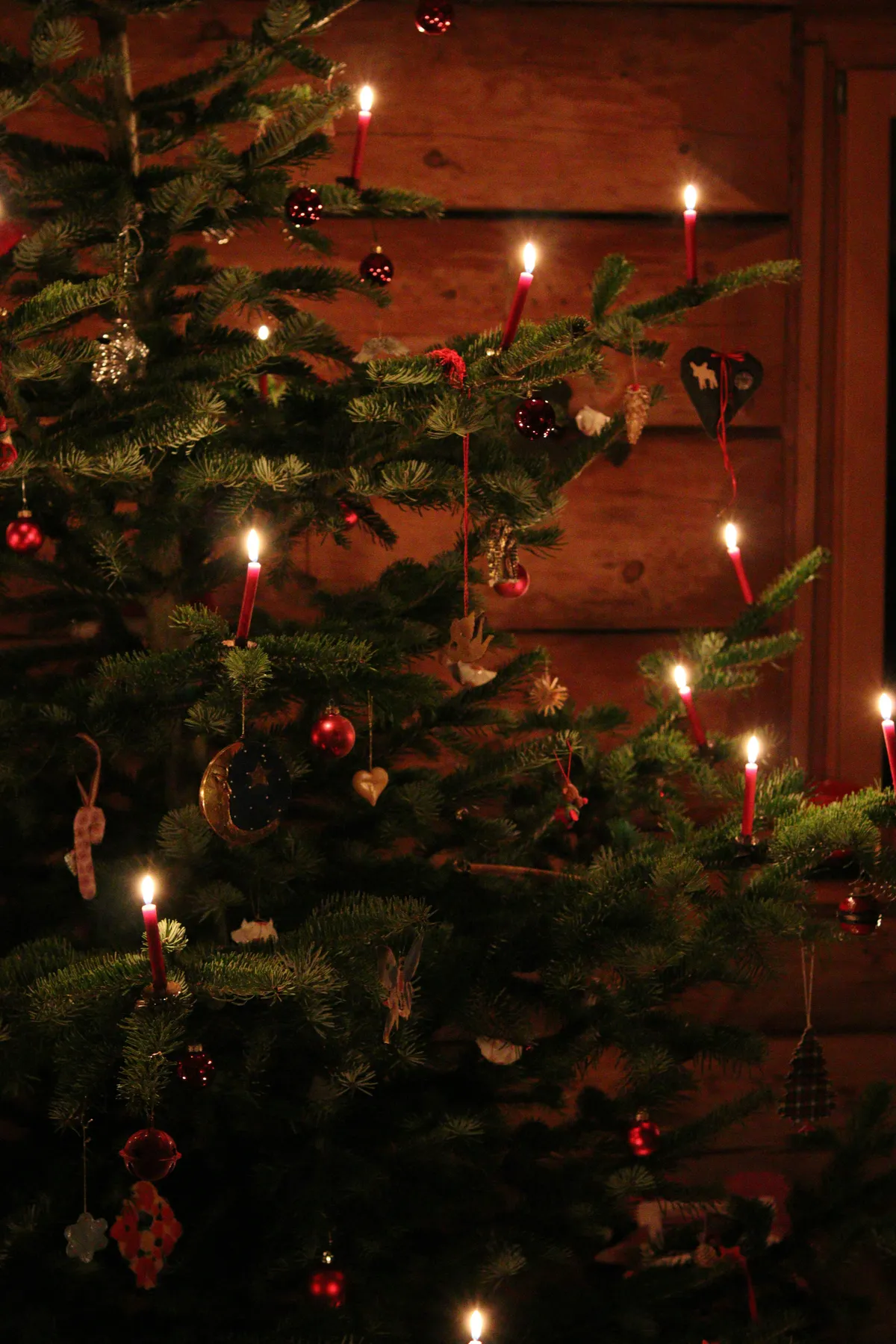
Space the clips so no two flames sit closer than 8 inches apart, and always clip them on the outer third of the branch, angled about 20 degrees upward. That angle sends any wax drip away from the needles and toward the floor instead of pooling on dry wood. Weigh the base too — a tree with real candles needs a stand rated 20 pounds heavier than the tree itself, or the whole thing tilts.
10. Dried Citrus, Berries, and a Green Velvet Skirt
- Tall tree, 8–9 ft: $250–$900
- Warm white lights, 900+ count: $30–$60
- Assorted glass ornaments, 80–100: $120–$350
- Ribbon in three tones, 30 yards: $25–$60
- Dried citrus or faux fruit picks: $15–$35
- Deep green velvet tree skirt: $40–$120
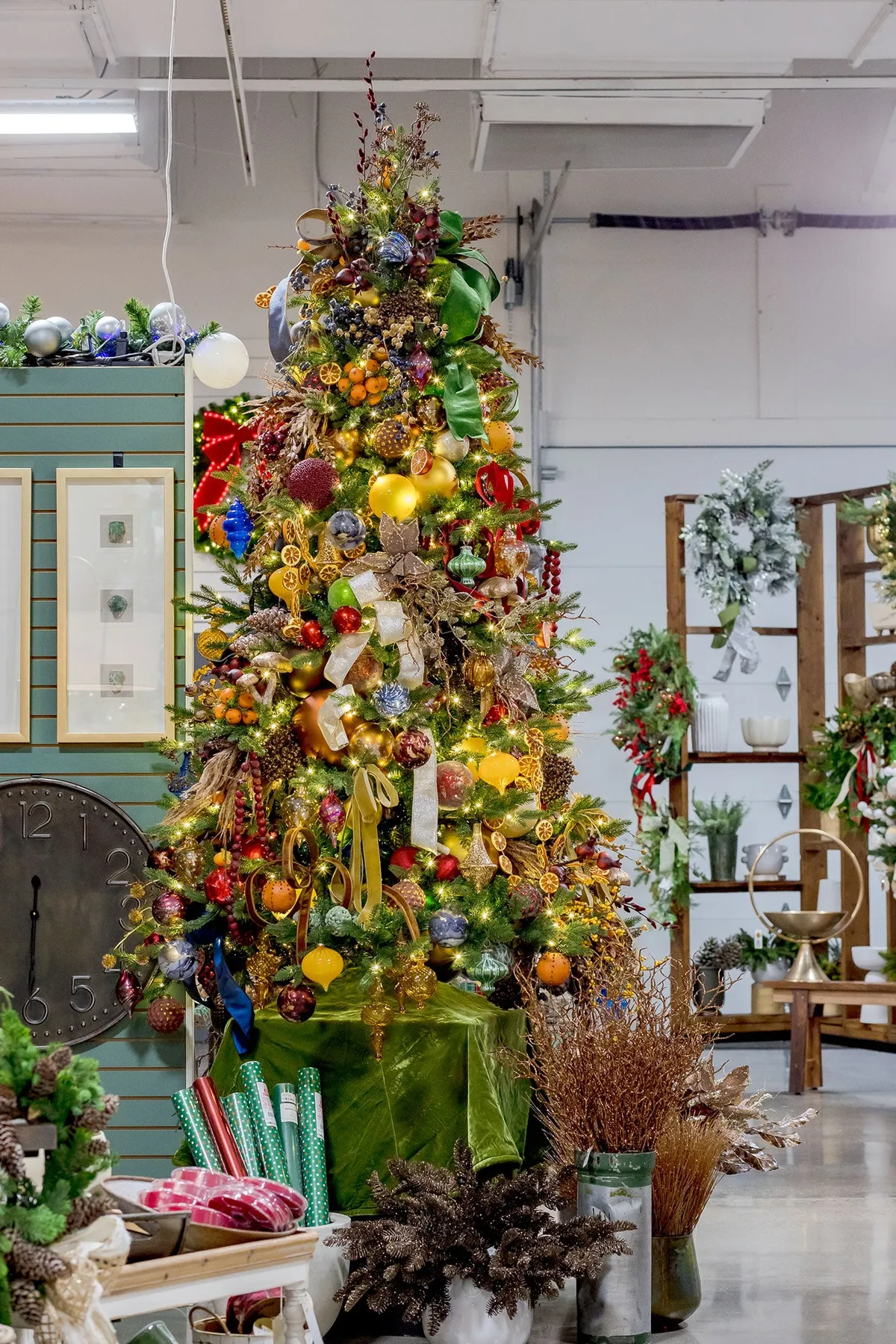
The abundance reads as generous because it’s structured, not random. Warm white lights are packed densely enough to make the tree glow from the inside out. The ornaments alternate scale — big glass spheres, tiny dried citrus, mid-size berries — so your eye never settles. And every natural element repeats a color already on the tree: citrus echoes gold, berries echo cranberry. Nothing new gets introduced once the palette is set.
11. Warm Lights Glowing on Glittered Spheres
Get the glow-from-inside look:
- Start with the lights unplugged and work in 12-inch vertical sections.
- Push the strand toward the trunk first, then weave outward — never spiral around the outside.
- Keep the wire snug against the branch so it disappears.
- Plug in every two sections and step back to check for dark pockets.
- Hang glitter ornaments last, tucked an inch behind the outer needles.
Time: 45–60 minutes. Cost: $20–$40 for lights.
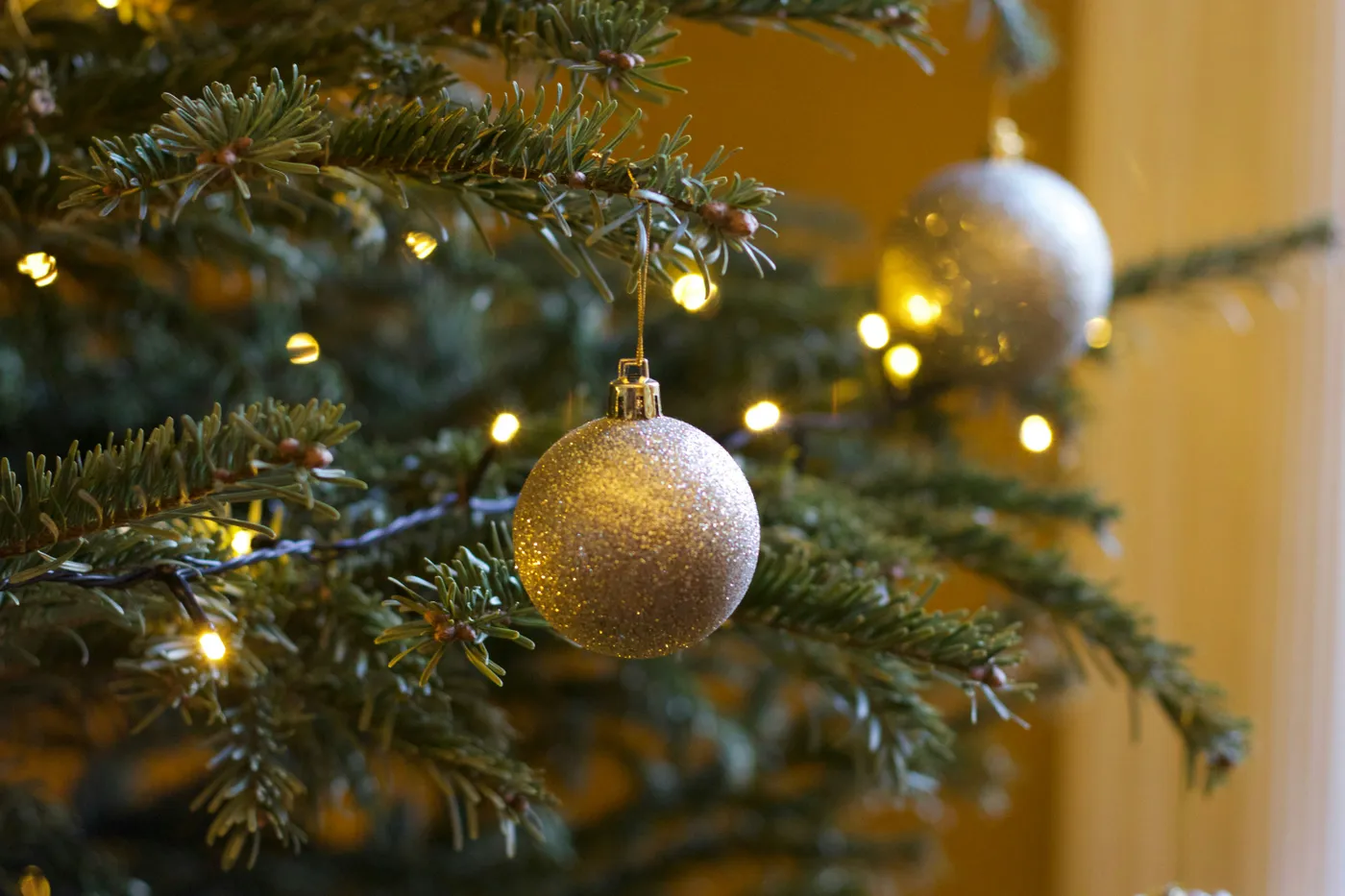
Glitter is a commitment. It sheds onto floors, sofa cushions, and every hand that touches it, and once it’s in your rug it stays until spring. Wipe ornaments with a dry microfiber cloth only — water and glass glitter don’t mix. Store them in tissue or paper, never loose in a bin, or next December you’ll open a box of bald spheres and a small indoor blizzard.
12. Oversized Burgundy and Olive on Frosted Branches
Flocked white at about 35%, deep green at 30%, and the ornament trio — burgundy, dark olive, muted gold — splitting the last 35%. Notice there’s no bright metallic anywhere: every finish is satin, matte, or brushed. That’s what keeps a frosted tree from looking like a car dealership in December. Shift the mood by keeping the matte rule and swapping burgundy for aubergine or olive for slate.
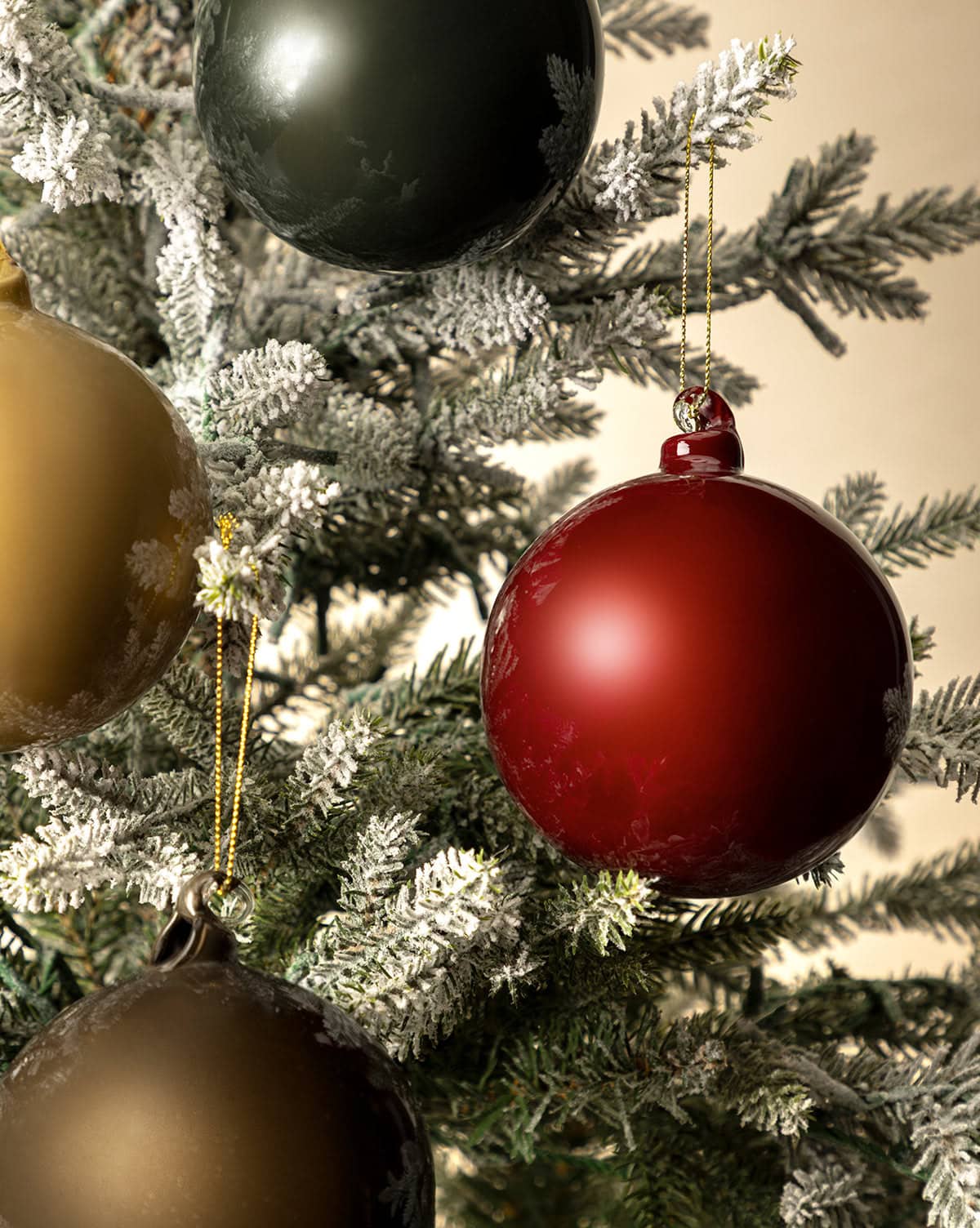
The gold chain hangers. Swapping plain hooks for delicate gold chain does something no ornament can do on its own — it makes the space between ornaments part of the design. On a frosted tree where the branches are already busy, that bit of jewelry at the top of each bauble is what signals ‘considered’ rather than ‘decorated.’ A spool costs about $8 and upgrades every ornament you already own.
13. Multicolor Lights Against White Paneling and Stone
If you’re layering multicolor lights against white paneling, drop the light count slightly and raise the ornament count. White walls bounce colored light right back at you, so a 750-light tree can read as blurry rather than festive — 600 is plenty. Then spend the difference on ornaments with body: wood, felt, ceramic, punched tin. Matte surfaces hold their shape under colored light; high gloss just smears into the glow.
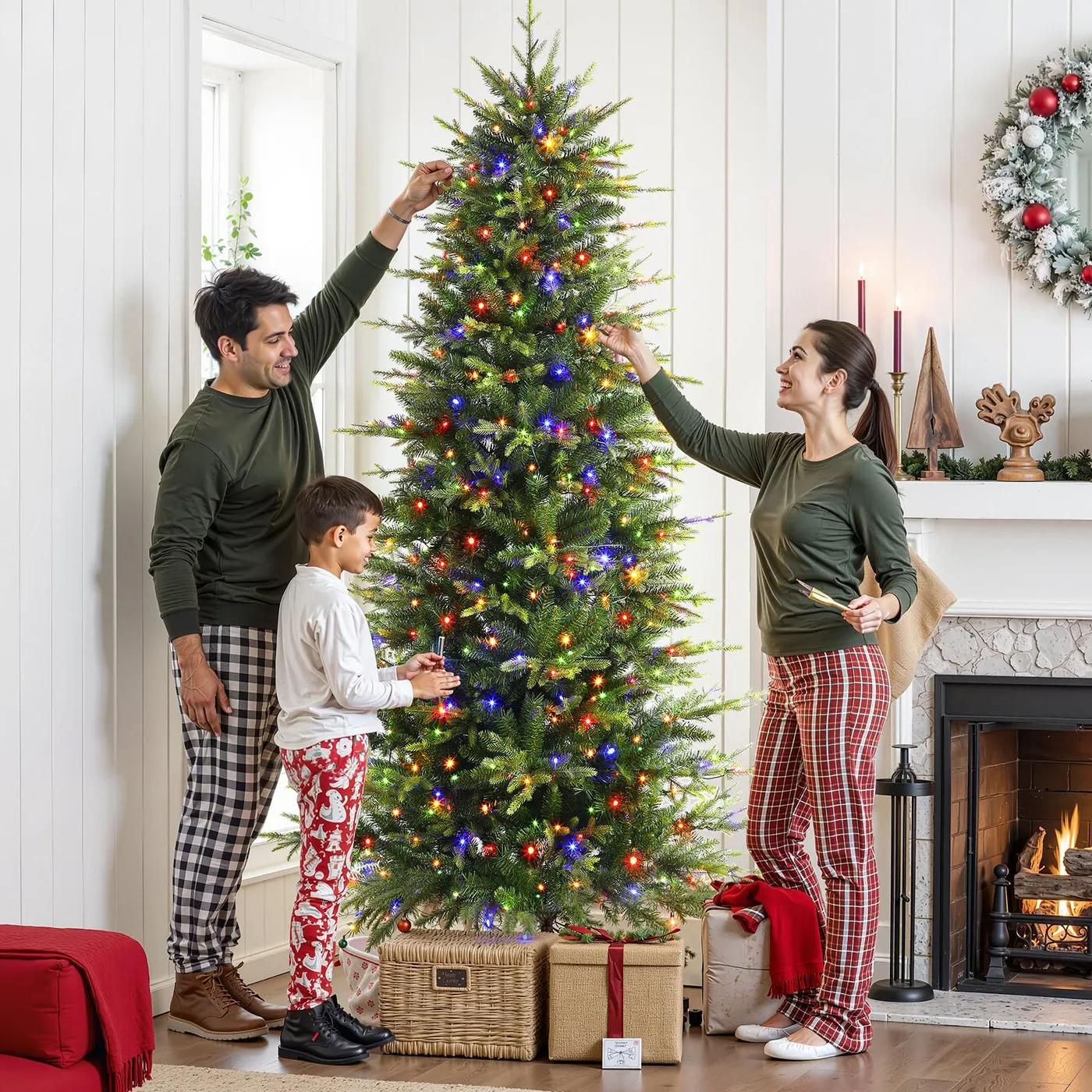
This is a tall-room look. Multicolor lights against white paneling want a 9-foot ceiling minimum and preferably 12 feet of wall so the color has somewhere to go. Rooms under 12 by 14 feet will feel like the tree is shouting at them. Compare with Idea #6 — same multicolor lights, warmer surroundings, and a much more forgiving footprint for smaller rooms.
14. A Single Glass Sphere Full of Tree Lights
The ornament-as-mirror trick has quietly become one of the most saved holiday images on Pinterest, and it makes sense: it turns the tree you already have into something worth photographing without buying anything new. Big glass spheres — 4 to 6 inches, clear or lightly smoked — act like a lens, catching the whole tree in a fish-eye. In 2026 the look rides alongside the wider return of glass over plastic, and glass is exactly what people are hunting at estate sales.
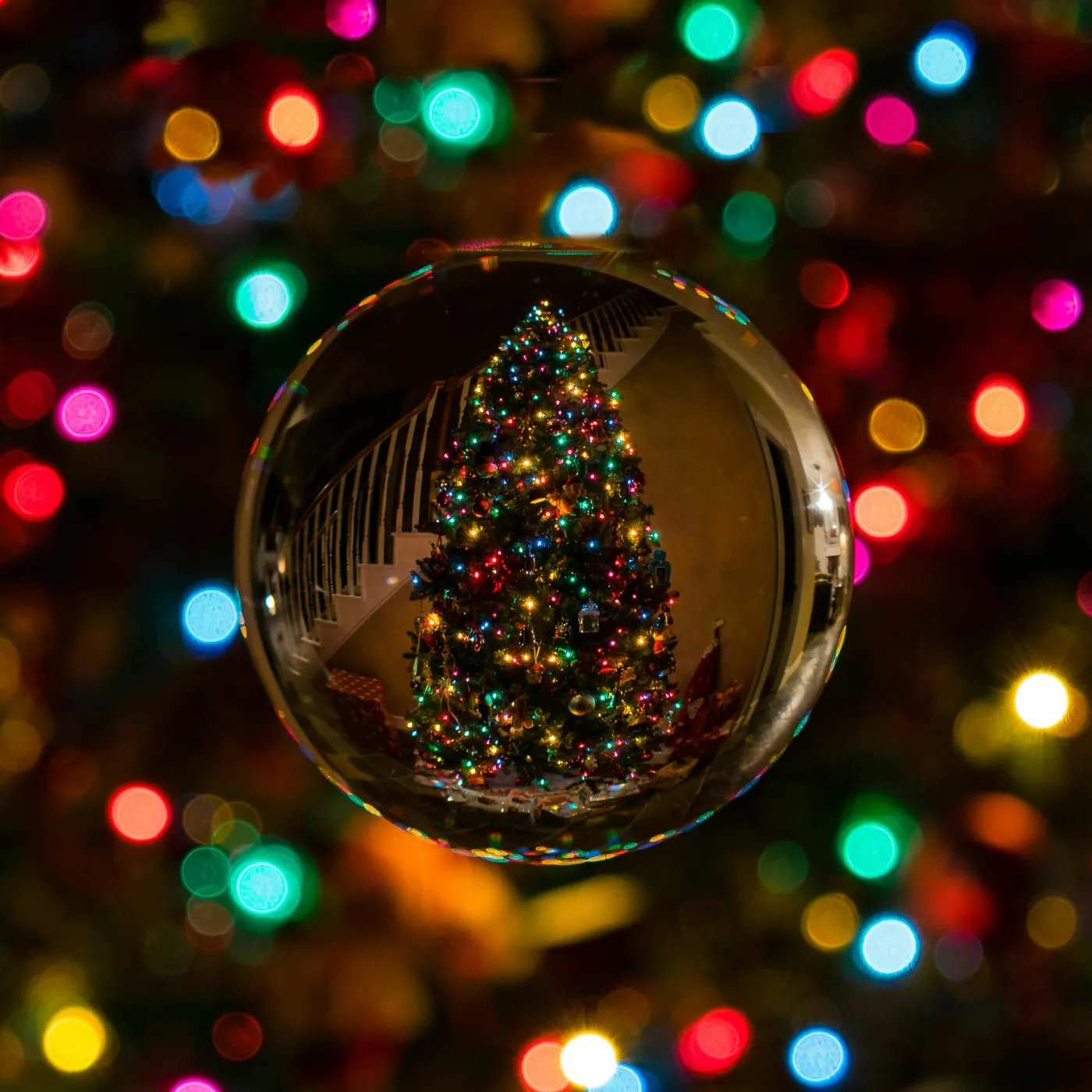
One oversized clear sphere costs $4–$12 depending on where you look; craft stores mark them up while dollar stores sometimes have them. Hit Walmart’s floral aisle for 3-inch fillable ornaments at roughly $2 each and cluster three or four near the front of the tree. The bokeh in the background is just a cheap phone lens and warm lights — no editing, no ring light, no photographer.
15. Striped Bows, Paper Lanterns, and Dark Walls
Dark walls are the secret weapon here. Brown-painted walls give the black-and-white striped bows and the pink, teal, and green lanterns something to pop against that white never could. The lantern colors repeat in the sofa cushions and the pastel canvas, so the room feels collected rather than decorated. And that vertical column of lanterns does the job your eye needs — it stops the tree from being the only tall thing in the frame.
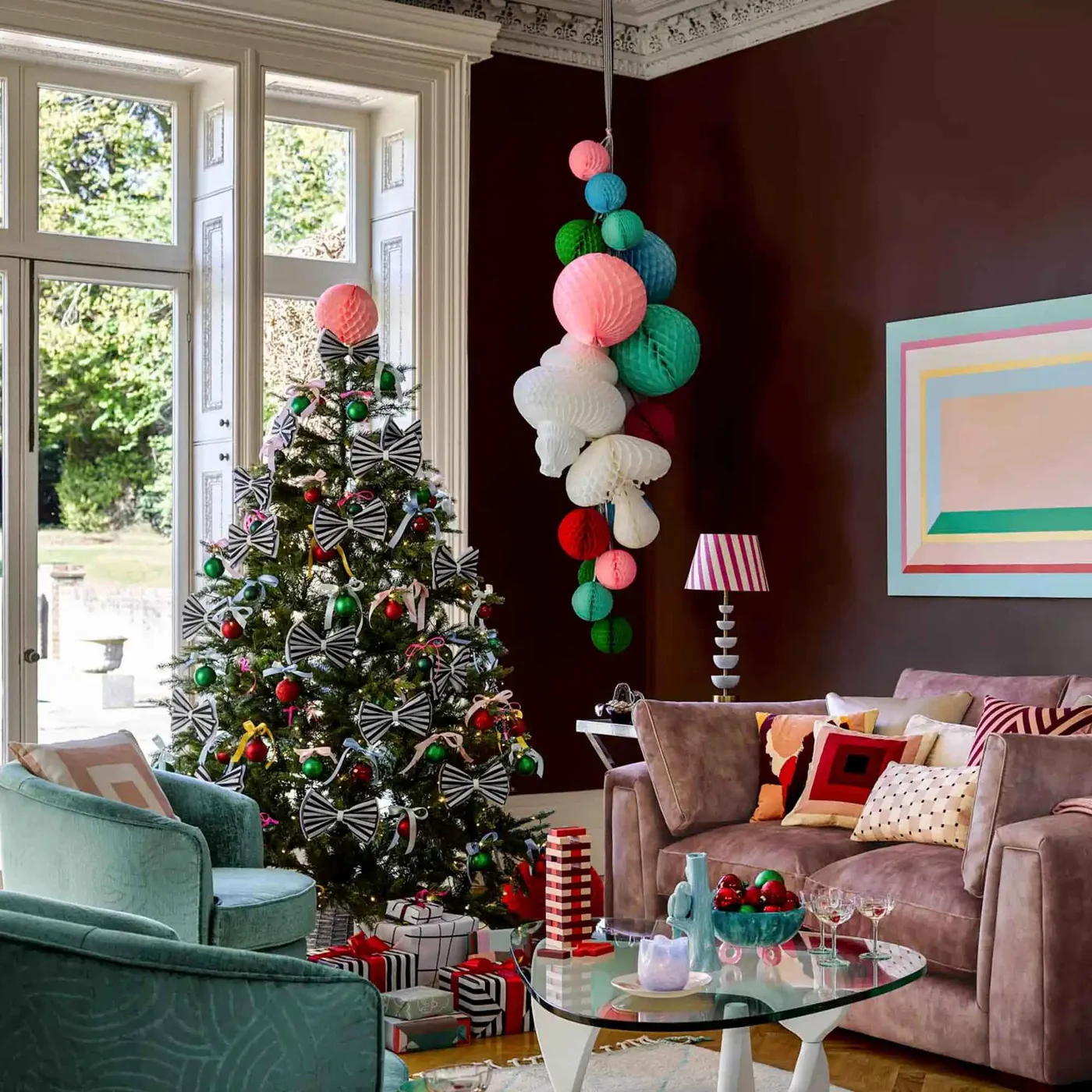
Dark painted walls show every fingerprint, scuff, and fleck of ornament glitter, and they drink light. If your living room only gets two hours of afternoon sun, this palette can turn gloomy by 4pm. Test a swatch first, add one more lamp than you think you need, and hang something light-colored at eye level. Also, paper lanterns crush — store them flat, never stacked.
16. Classic Red and White with Wooden Snowflakes
- Tree, 7 ft: $150–$550
- Warm white lights: $20–$40
- Red and white ornaments, 60 count: $50–$140
- Wide striped fabric bow or ribbon: $12–$35
- Berry clusters, 10–12 stems: $20–$45
- Wooden snowflakes, set of 6: $15–$30
Red and white is the easiest palette to ruin with the wrong red. Keep it to two: a true blue-based red for the spheres and a warmer brick red for the berries and the fabric bow. Mixing three or four reds makes a tree look assembled from leftovers. And put your biggest red ornament at the base of the front face — visual weight belongs low.
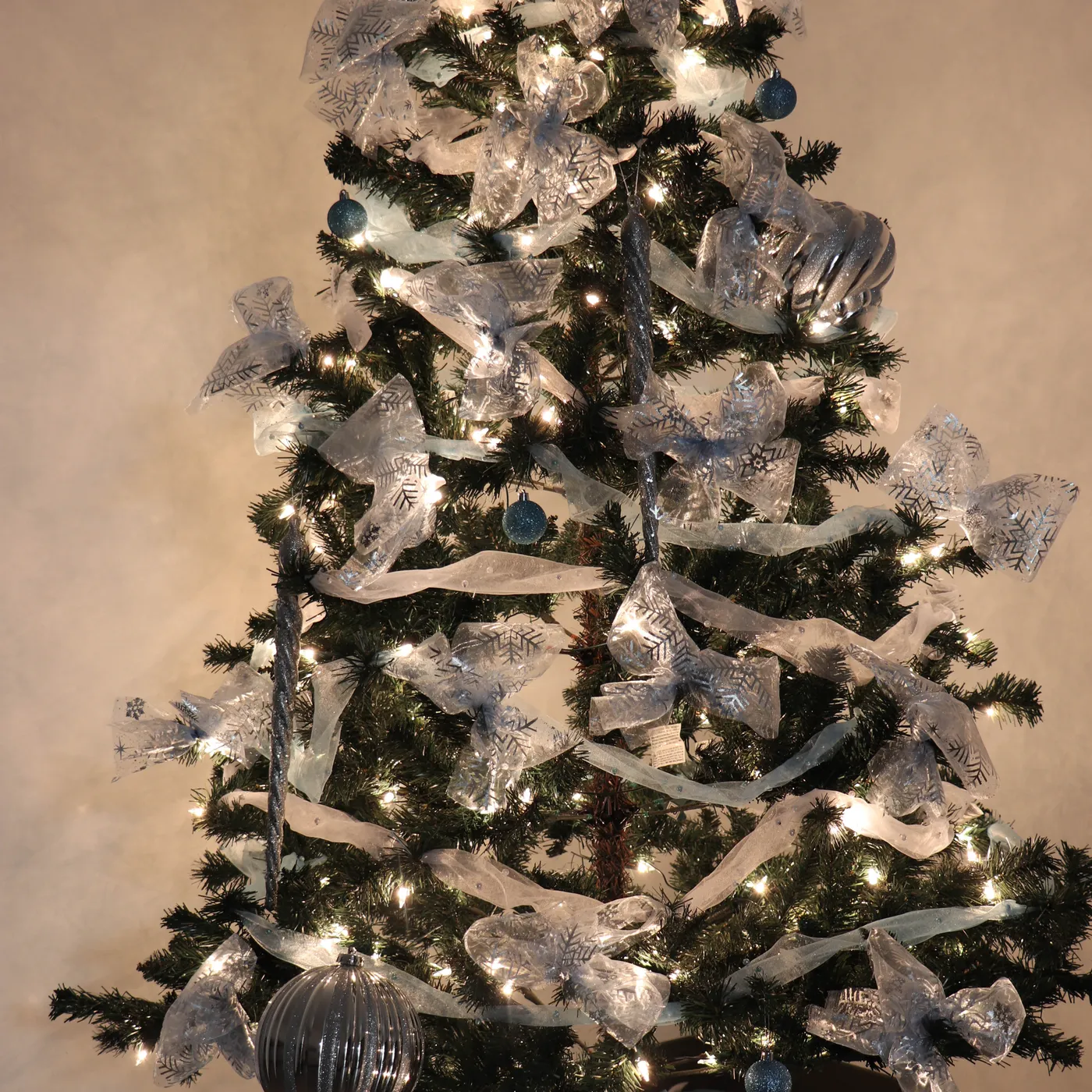
17. Silver Snowflake Ribbon with Pale Blue Baubles
Sheer snowflake ribbon needs room to be seen. On a slim 6-foot tree, a 4-inch sheer ribbon swallows the branches — stay at 2.5 inches. This look wants a 10 by 12-foot room with 8-foot ceilings and a cool-toned wall that won’t fight the silver. Pale gray, soft white, and light blue all work; warm beige turns the silver muddy by evening, which is a disappointment you’ll only notice after dark.

About 55% dark green foliage, 25% silver and sheer white, 15% icy blue, 5% warm light. The blue is the ingredient people get wrong — it should be cool and slightly gray, not baby blue, or the tree goes nursery school. Keep the ribbon flat and the ornaments round, and let the icicle shapes carry all of the sparkle.
18. Champagne Ribbon, Big Bows, and White Gifts
The oversized champagne bows. Ribbon wound around a tree is wallpaper; ribbon tied into big deliberate bows is punctuation. Those bows create a repeating rhythm down the tree that your eye follows all the way to the gifts, and they’re the reason a neutral palette doesn’t put anyone to sleep. Tie four or five large bows and leave the rest of the ribbon loose — mixing the two is what makes it read as styled.
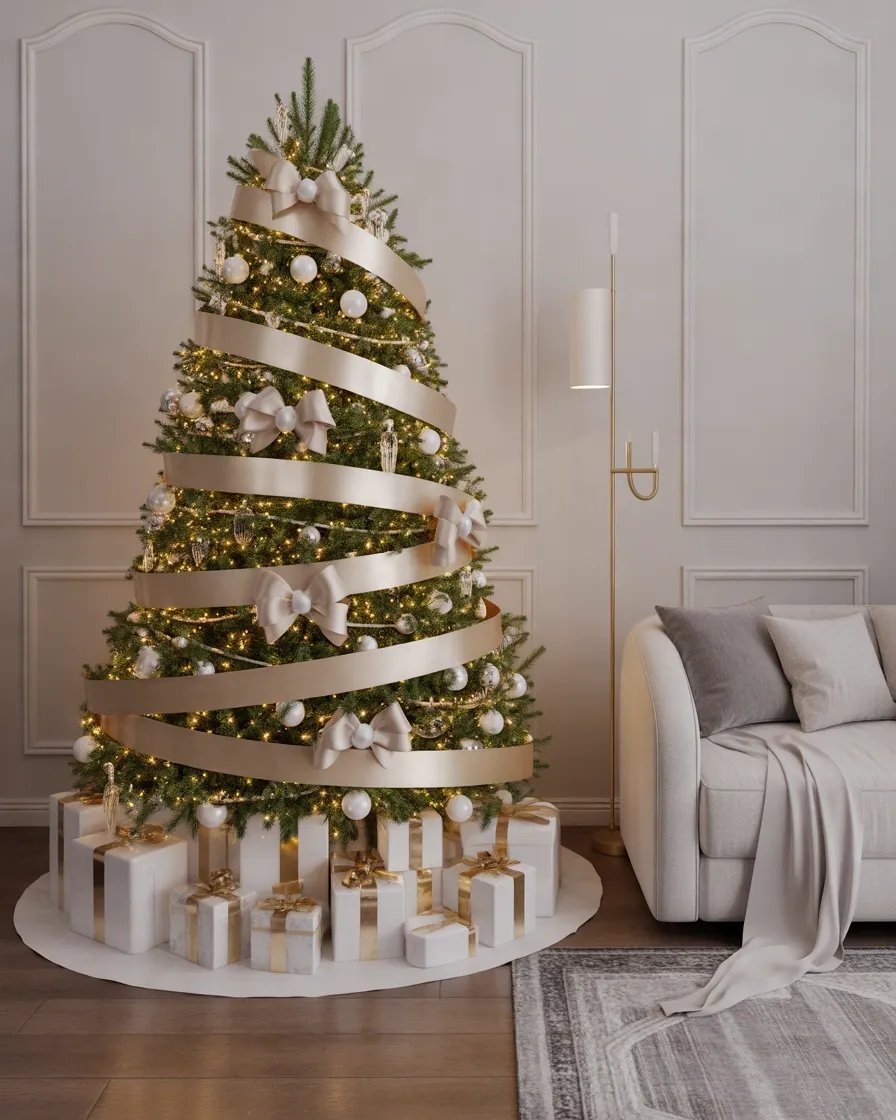
Tie a tree bow that holds its shape:
- Cut 24 inches of wired ribbon — wire is non-negotiable here.
- Form a loop, pinch the center, twist once, then form the second loop.
- Keep pinching as you add four more loops, slightly smaller each time.
- Wrap floral wire tightly around the center and twist the tail off.
- Fluff the loops outward and shape the tails into a soft V.
Time: 5 minutes per bow. Cost: $12–$35 for a 10-yard roll.
19. Sage Green and Cream, Half-Painted Baubles
- Measure your tree’s visible height — the top third is what people actually see, so style there first.
- Confirm your wall color. Sage goes muddy against warm beige and clean against cool white.
- Count your ornaments before buying more. This look needs 60 to 80 pieces, not 200.
- Decide hook color now: gold or white string, never visible black wire.
- Set a $60–$120 ornament budget and stick to it.
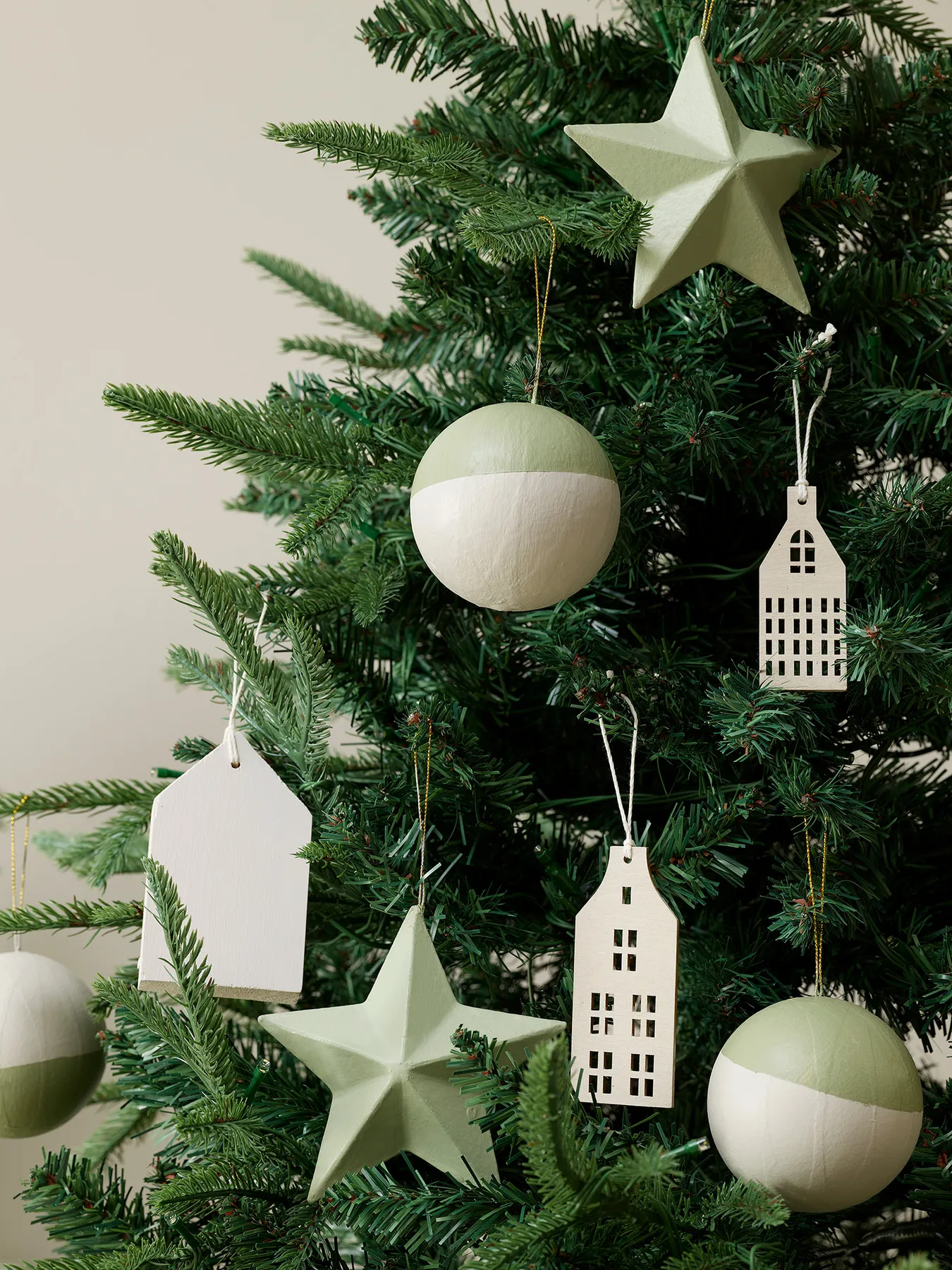
This look only works with generous spacing. Leave 4 to 6 inches of bare branch between ornaments — roughly half the density of a traditional tree. Crowd it and the two-tone paint job disappears into noise. Hang the house-shaped pieces slightly recessed, about an inch behind the branch tips, so they read as objects sitting inside the tree rather than stickers pressed onto the outside.
20. Matte Gold Everywhere and a Gold Rocking Horse
- Tree, 7.5 ft: $180–$650
- Warm white lights: $20–$45
- Matte gold ornaments, 70 count: $70–$200
- Gold ribbed planter: $25–$80
- Marble-look side table: $90–$400
- Glass candle holders and pillars: $20–$50
- Mantel garland, 9 ft: $35–$90
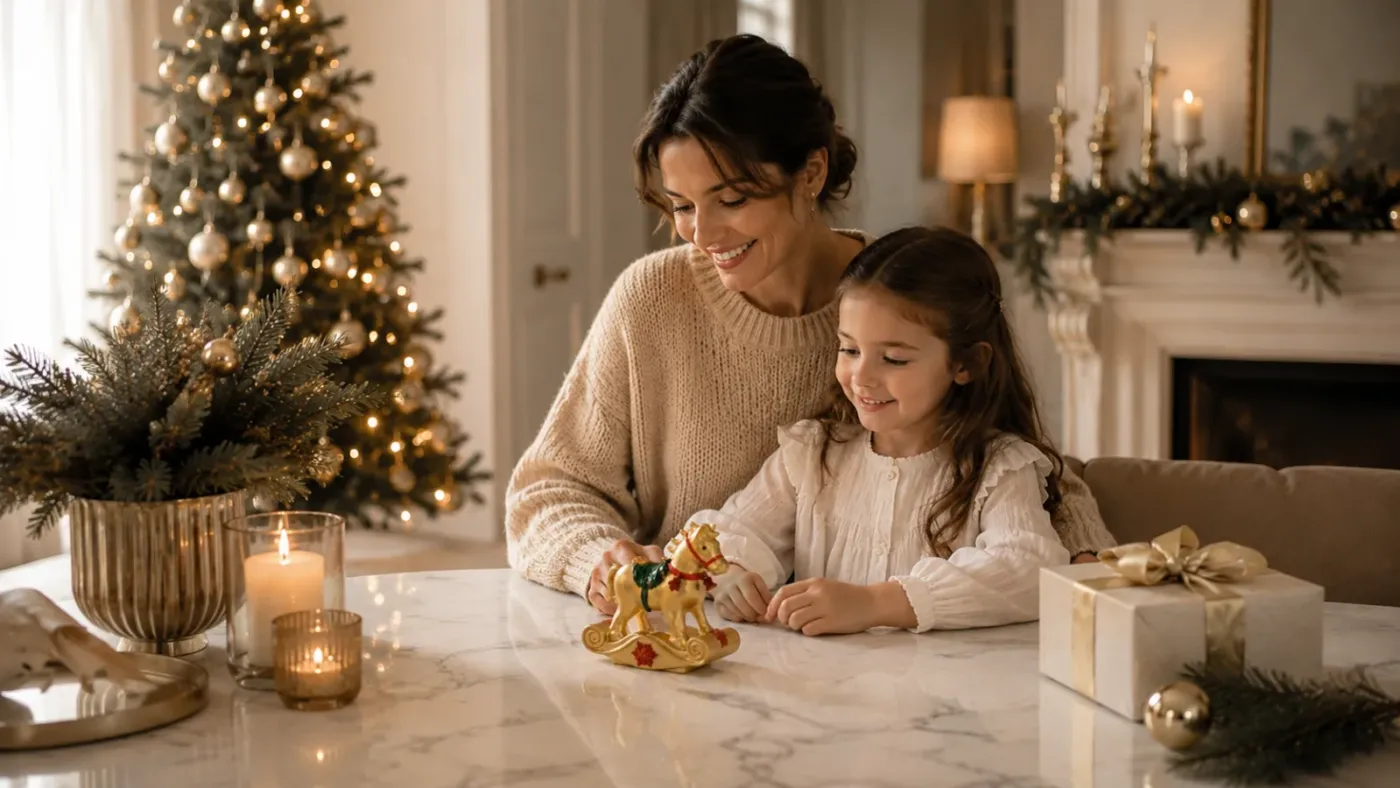
Everything here is matte except the marble. That single rule does enormous work — the gold stays soft rather than brassy, the greenery stays calm, and the polished stone gives the eye one place to slide. It’s the same palette as Idea #1, pushed a notch dressier with the marble slab and the mantel garland.
21. Mice, Miniature Houses, and an Ochre Wall
Figurative ornaments are charming and slightly fragile. Little mice and miniature houses mean small glued parts, and small glued parts mean a tail here and a chimney there by New Year’s. Hang them above toddler reach and cat tail height, and photograph your arrangement in early December so you can rebuild it next year. Also worth knowing: on an ochre wall, red ornaments go orange under warm lamplight. Check them at night before you commit.
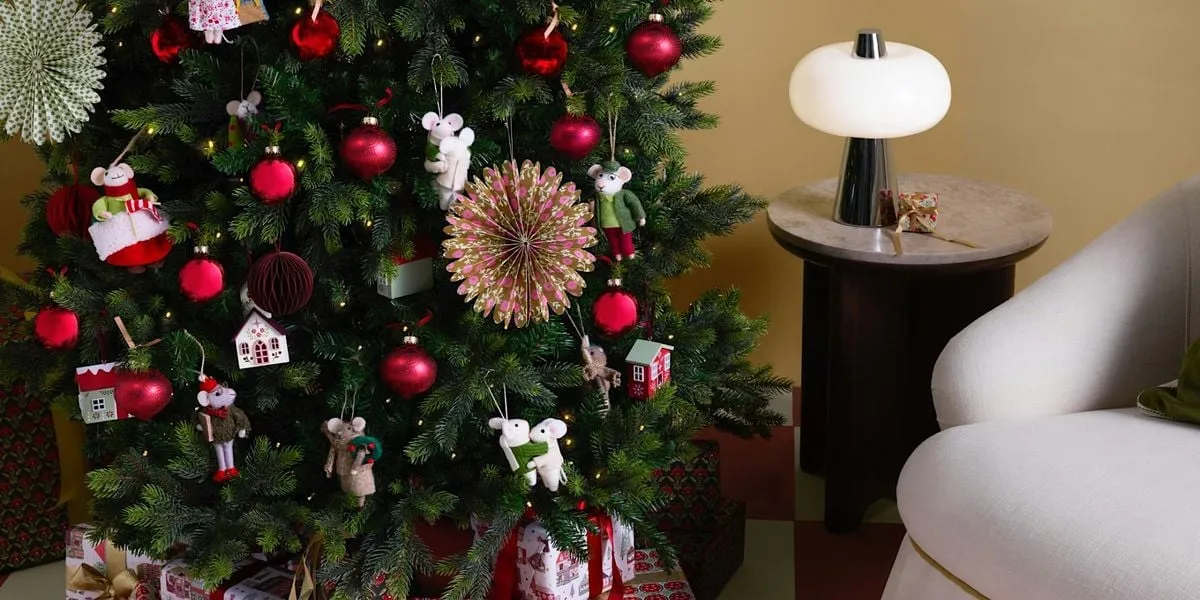
Collectible mouse ornaments run $18–$30 each, which adds up fast. Two workarounds: buy a set of six figurine ornaments from Etsy for $35–$50 total, or thrift wooden dollhouse furniture and drill a hole in the roof — a $3 miniature chair reads identically from three feet away. The mushroom lamp is the other splurge here, and a $15 ceramic version from Target gets you most of that glow.
22. Metallic Red and Green Under Bright Blue Lights
Metallic finishes are the first thing to go. That textured red and the woven green will dull after two or three seasons in storage, especially in a hot garage or attic. Keep them in a climate-controlled closet, wrap each one in tissue, and never nest them — the finish transfers. Blue LED string lights are the other note here: blue is the first color to fail on a cheap strand, so buy a spare tube while they’re still in stock.
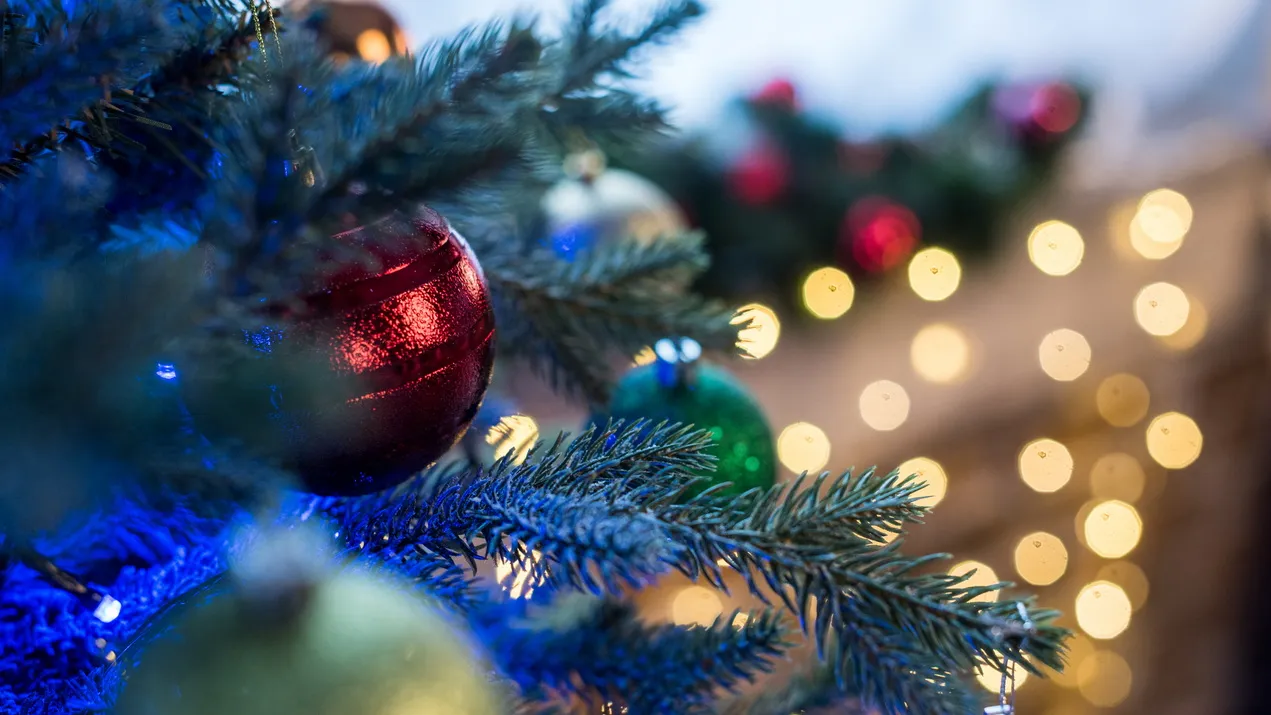
About 70% of this tree is the deep green of the needles, which is why the ornaments can be so saturated without tipping into chaos. Metallic red and green split 20% between them, and the last 10% is the blue light — a deliberately jarring note that keeps the palette from becoming predictable. Swap blue for warm white and the tree gets calmer, sweeter, and noticeably less interesting.
23. Vintage Camera and Radio Ornaments in Warm Bokeh
Retro novelty ornaments — cameras, radios, typewriters — are one of the fastest-growing categories on Etsy, and they’re squarely a 2026 thing. The appeal isn’t nostalgia for the objects themselves; most buyers never owned a bakelite anything. It’s the handmade feel in a season that’s gotten aggressively polished. Vintage shapes, new manufacture, about $12–$22 apiece, and they photograph beautifully against warm string lights.
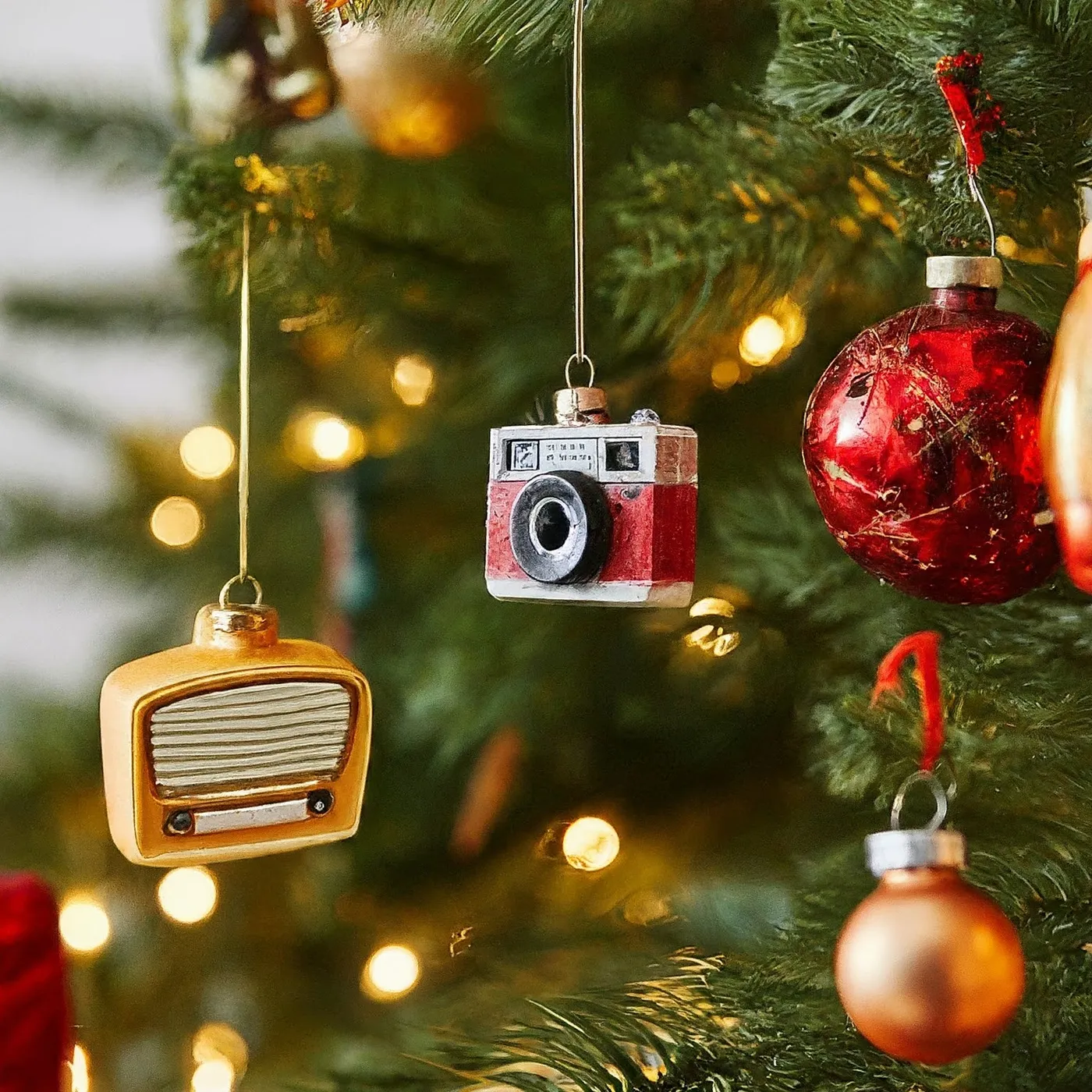
The camera. It’s a tiny piece of storytelling on a branch — the one ornament that makes a guest lean in and ask a question. Trees made entirely of matched spheres are beautiful and completely silent. One odd, specific object gives the whole thing a voice, and you only need one. Pick the ornament that says something about you, hang it at eye level, and leave the rest traditional.
24. Metallic Gold and Matte Silver with Pearl Beads
Mix metallics by finish, not by color. One shiny gold, one matte gold, one matte silver, one glitter — that’s four surfaces that all read as ‘gold and silver’ from across the room. If everything is high gloss, the tree becomes a mirror and you lose all depth. Add a strand of faux pearl beads woven flat against the branches; the soft white breaks up the metal and costs about $6. Glitter pinecones are the cheapest way to add texture between the spheres.
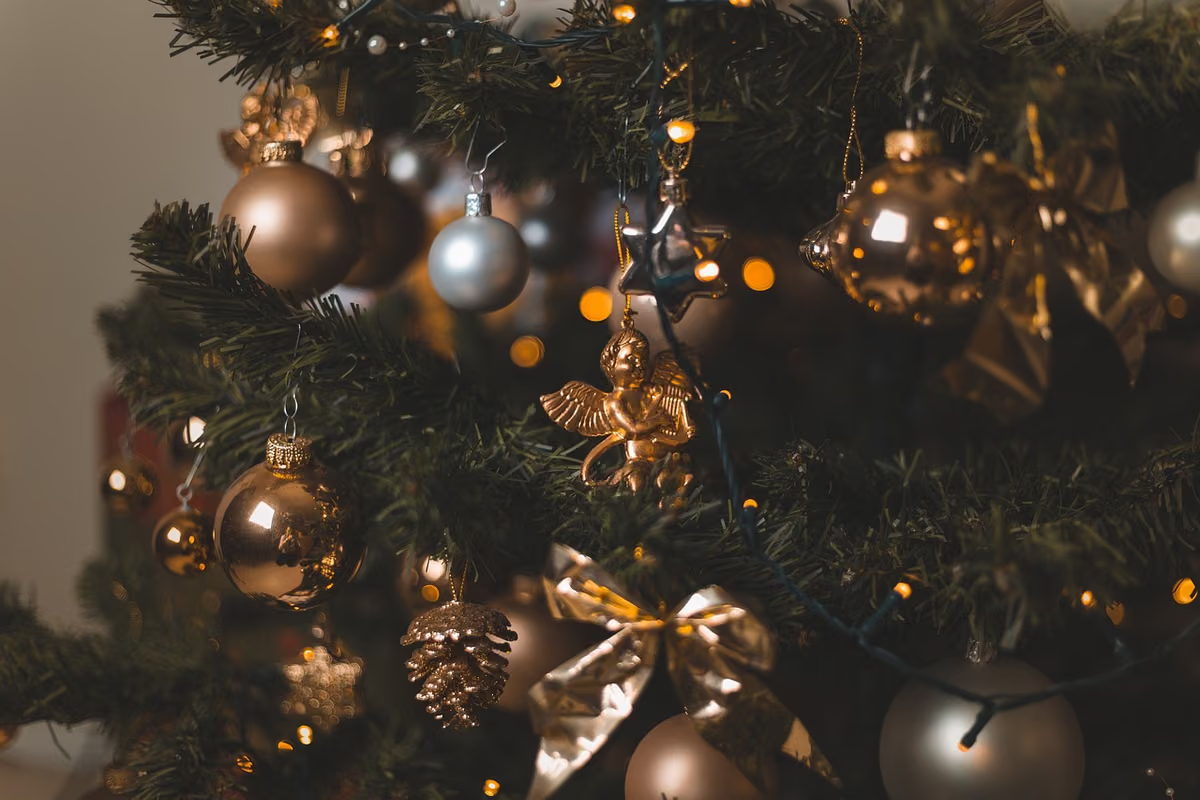
Gold and silver works on almost any tree size because the palette is neutral, but the proportions shift. On a 6-foot tree, keep ornaments at 2.5 to 3 inches; on a 9-footer, go to 4 inches and add a second tier of small ones. Above 10 feet, double the light count and drop the ornament count by a third — big trees need air, not density.
25. Matte Red, Velvet, and Gold Tinsel Garland
- Tree, 7.5 ft: $180–$650
- Multicolor LED lights, 700 count: $25–$55
- Matte red spheres, 40 count: $40–$110
- Velvet red ornaments with gold beading, 12: $45–$120
- Shiny gold spheres, 30 count: $30–$80
- Gold tinsel garland, 30 ft: $8–$20
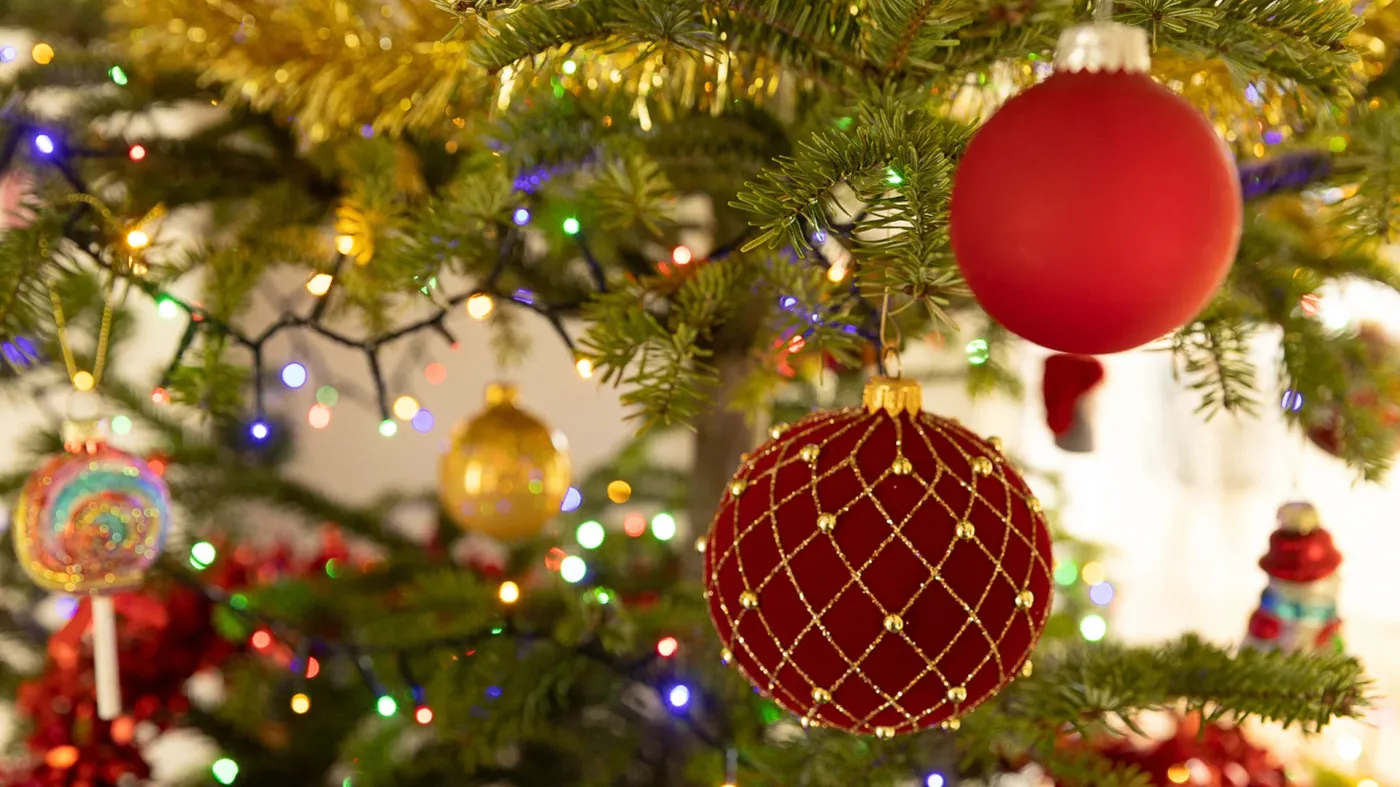
Make tinsel look expensive:
- Unspool the garland and let it relax on the floor for an hour so it hangs straight.
- Start at the top and drape in loose swags, not tight spirals.
- Pin every 18 inches with a small hook so it doesn’t slide.
- Push the middle of each swag slightly into the branches.
- Layer ornaments over the tinsel, never under it.
Time: 25 minutes. Compare with Idea #16 — same red, no tinsel, much calmer.
26. Faceted Crystal Snowflakes on Dark Evergreen
Clear crystal on dark green is a study in contrast without a single color. The ornaments add zero hue, so what you actually see is light — every facet throws a different reflection depending on where the bulbs sit, and no two pieces look alike. The silver ribbons disappear into the branches, which makes the snowflakes appear suspended rather than hung. If you want a tree that reads as elegant instead of decorated, removing color entirely is the fastest route there.
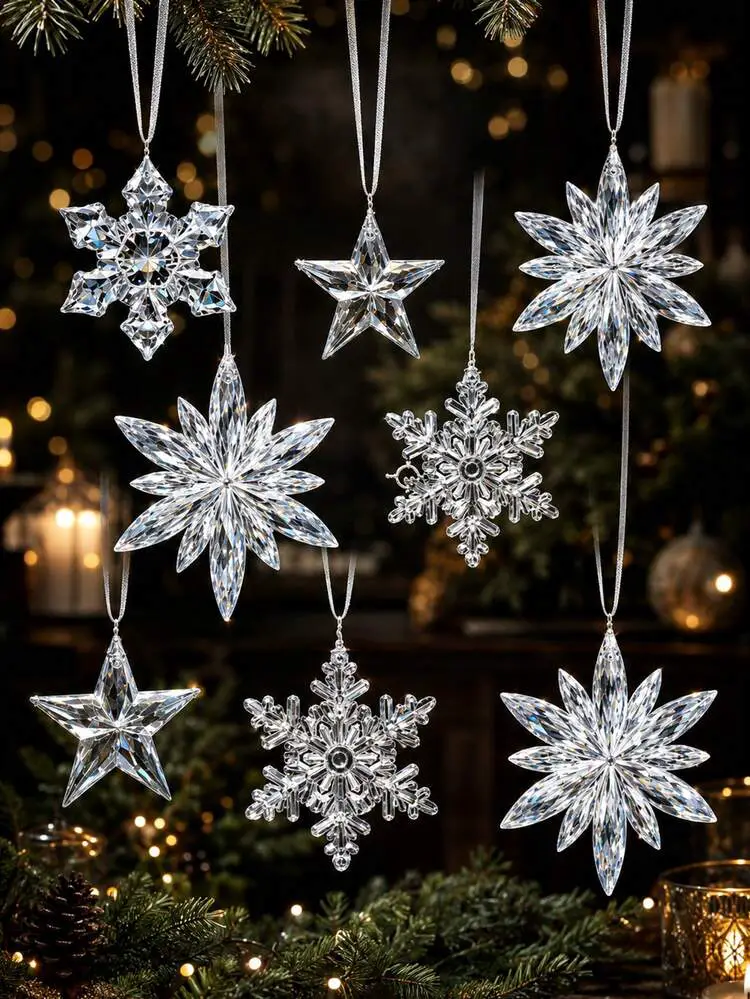
Clear glass shows everything: dusty facets, smudged fingerprints, and the wire hanger you were sure nobody would notice. It also disappears in daylight — this is a tree designed for evening. If your living room is bright all afternoon, add a few frosted or pearlized pieces so the tree has something to say before sunset. Store crystal in its own box; one tumble and you’re sweeping.
27. A Woven Basket Instead of a Tree Skirt
- Measure your basket’s interior diameter — it needs to be 2 to 3 inches wider than the stand.
- Check basket height: 12 to 16 inches reads best against a 6 to 7-foot tree.
- Confirm the stand is stable on its own; a basket won’t hold a leaning tree upright.
- Weigh your tree. Anything over 40 pounds needs a proper stand, not a basket.
- Choose a flat-bottomed basket, or add a plywood disc inside for stability.
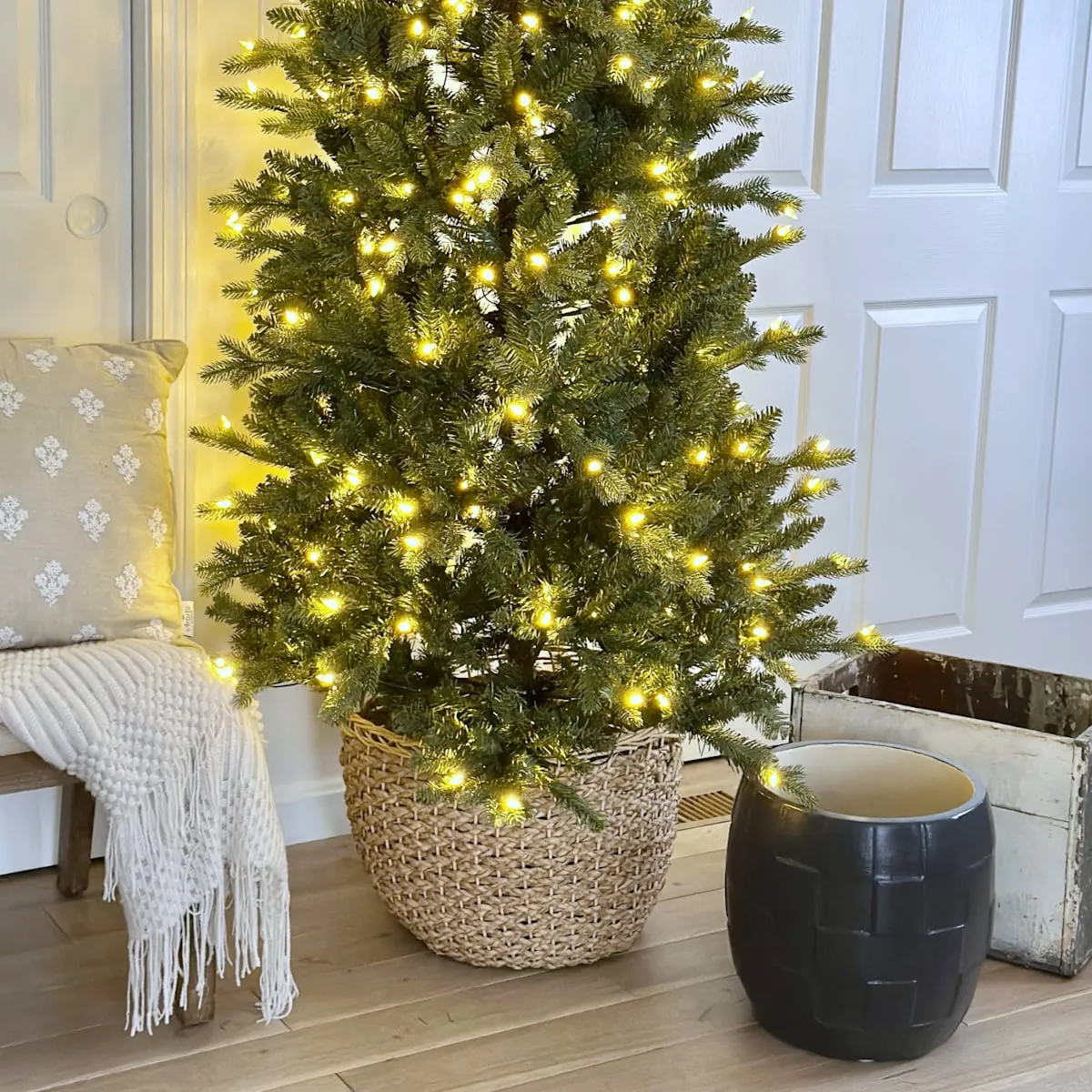
Woven baskets are the cheapest upgrade in holiday decorating. Thrift stores and Facebook Marketplace regularly have 18-inch natural fiber baskets for $10–$25, and a large IKEA or Target basket runs $25–$45. Line the inside with burlap or a dark cloth so the stand and cord vanish, then tuck a cream throw alongside. Total spend for the whole grounded effect: under $50.
28. Full Silver Tinsel in Front of an Arched Window
Tinsel amplifies light, so it needs a wall that can handle the glow. Light beige and soft gray are ideal; deep navy or charcoal turns the silver into a hard, cold line. An arched window behind the tree is a bonus — the curve softens the tree’s cone shape and keeps the whole thing from looking like a cone of foil. Give it at least 3 feet of clearance on each side, or the shine feels cramped.
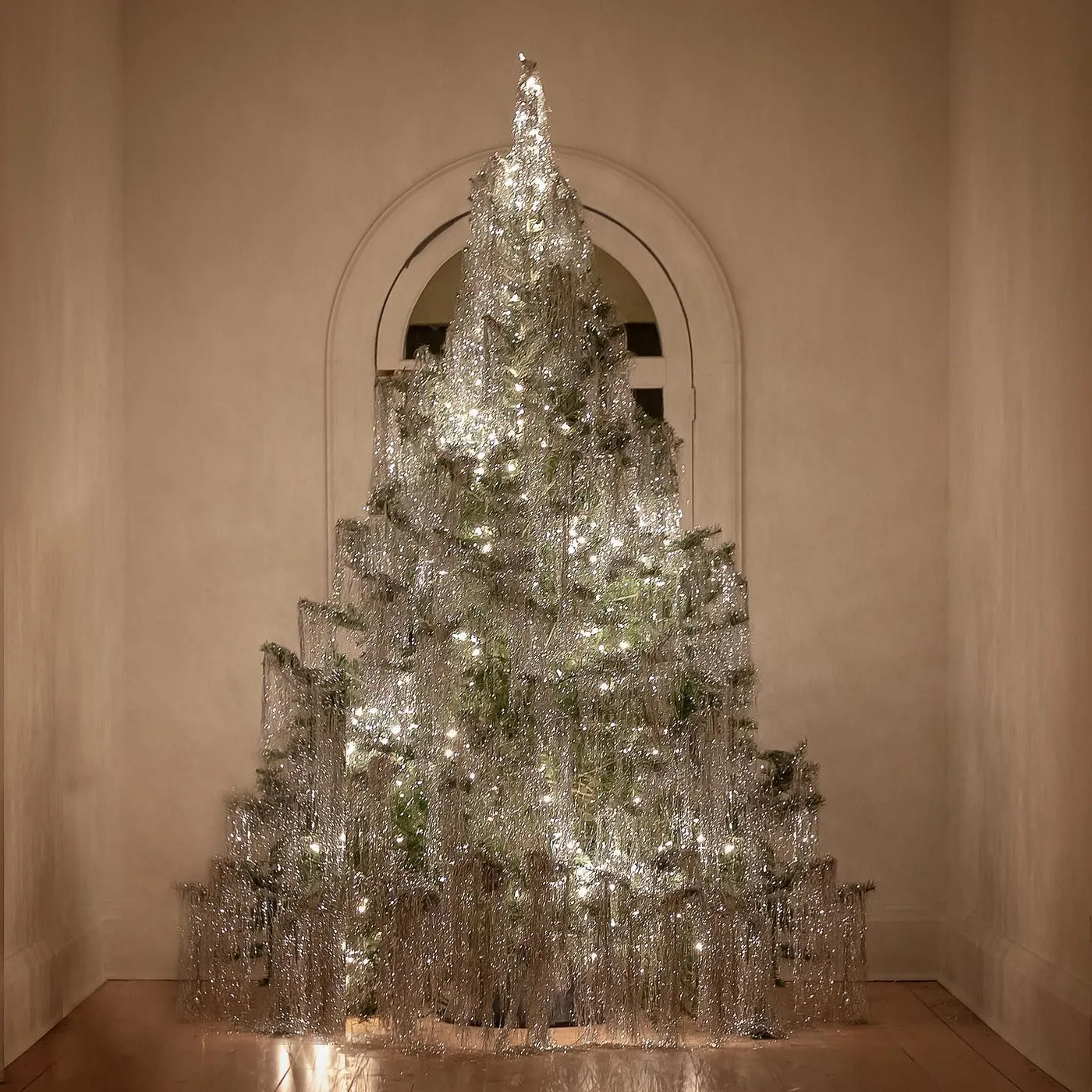
Tinsel density is everything. Aim for a strand every 4 to 6 inches of vertical height, which on a 7-footer means about 60 feet of garland — most people use a third of that and then wonder why it looks sparse. Drape it in loose vertical streams rather than wrapping the tree like a maypole, and always finish with the lights on so you can spot the gaps in real time.
29. Garland on the Archway, Terracotta Chairs, Wood Beams
Dress an archway with garland:
- Measure the arch and add 20% for swag and overlap.
- Attach adhesive hooks at each end and one at the apex.
- Start at one end, draping in an S-curve rather than a straight line.
- Weave the string lights through before hanging — never after.
- Add eucalyptus or magnolia picks on top of the lights, not underneath.
- Finish with three taper candles on the table below.
Time: 40 minutes. Cost: $45–$110.
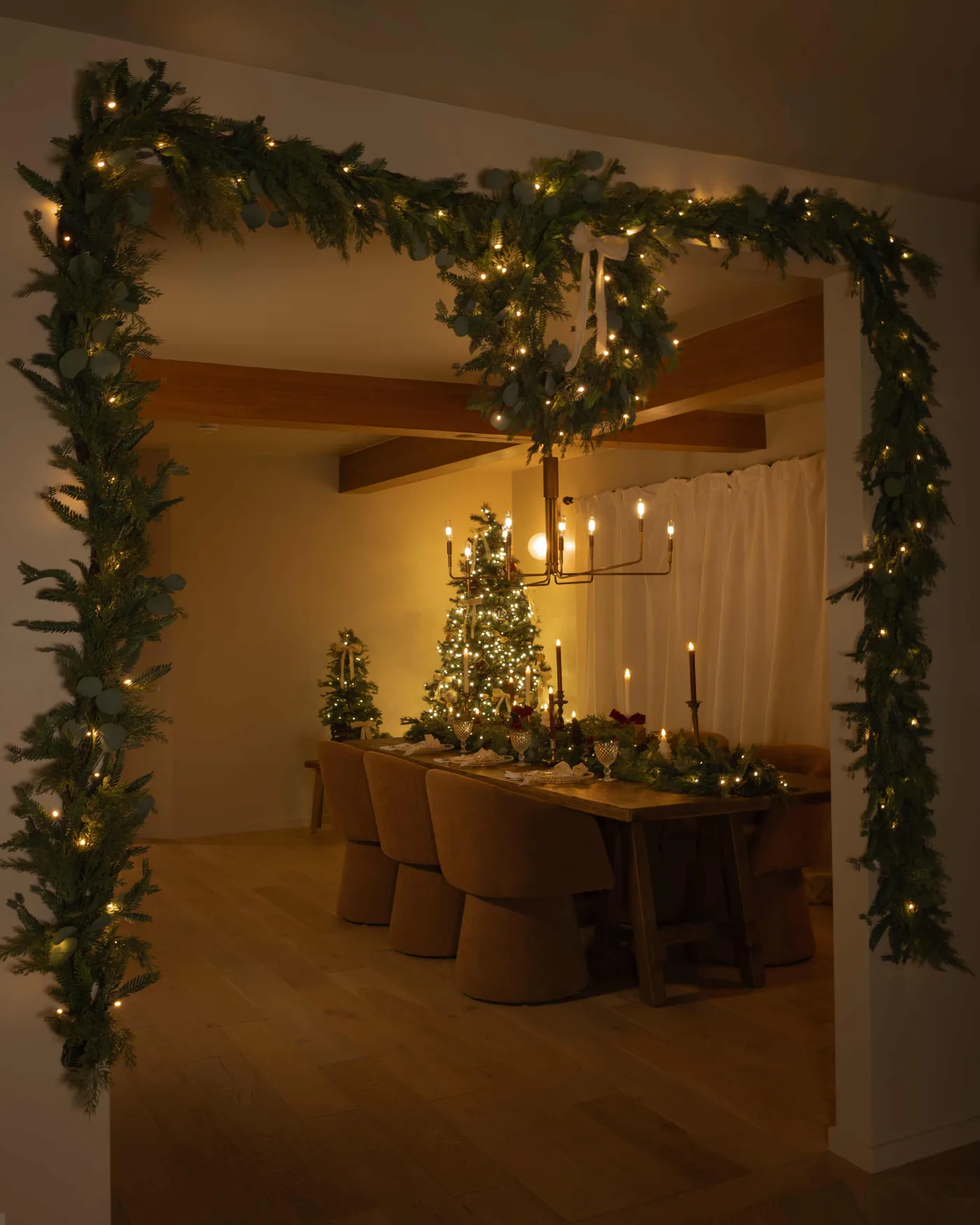
The room is doing something clever: it repeats deep green in three places — tree, archway, table — at three different scales. That repetition reads as one idea instead of three separate decorations. The terracotta chairs and the brass chandelier warm up all that green, and the exposed beams give the whole thing a cabin frame. Compare with Idea #31 — same green garland, tighter and more graphic.
30. A Slender Flocked Tree Between Cream Armchairs
The symmetry. Two matching cream armchairs flanking a slim tree turn a corner decoration into an architectural moment. Take the chairs away and you have a pleasant flocked tree in a big room; put them back and the tree becomes the center of a designed vignette. Slim trees need that framing — they can’t fill a room on their own, so the furniture has to do it for them.
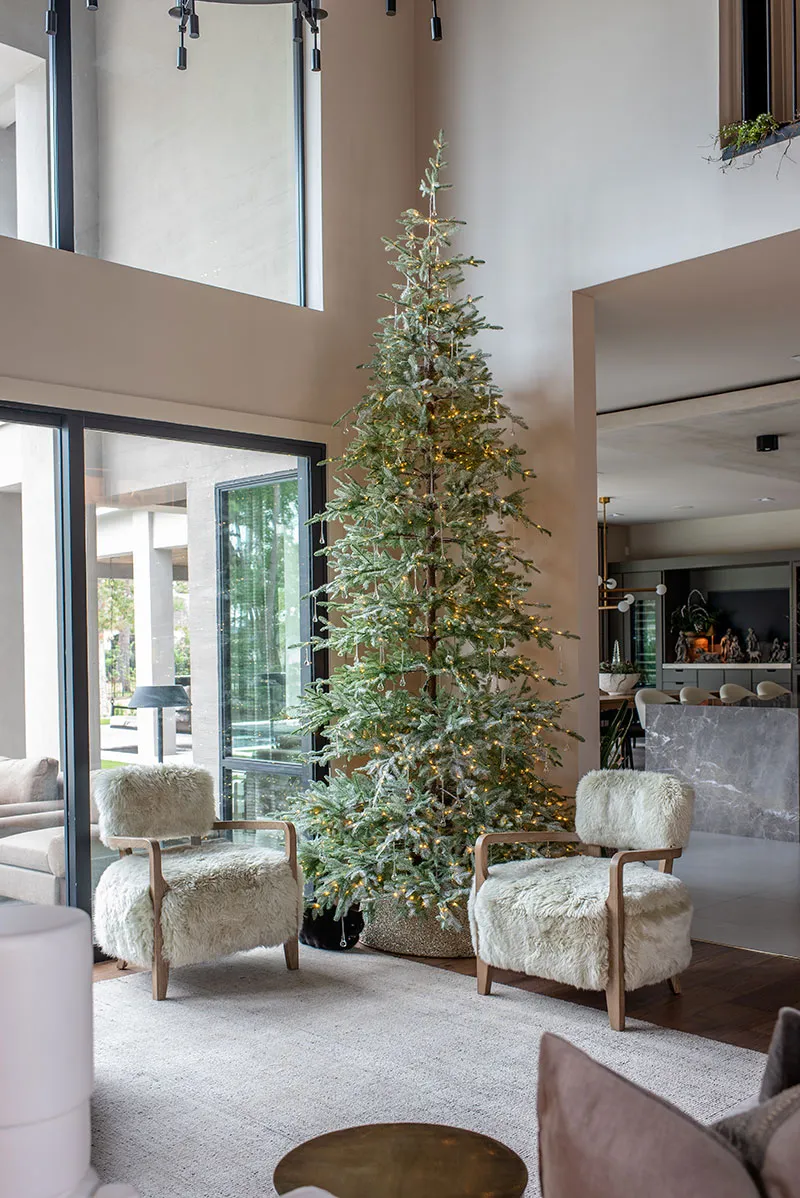
Heavy flocking on a tall, narrow tree is a lot of surface area to keep clean. Expect to vacuum twice a week in December, and be gentle — brushing flocking only loosens it faster. Store the tree upright if you have the ceiling height, or in a breathable bag rather than a vacuum-sealed one that crushes the branch tips. Clear glass icicles should be wrapped individually; they chip.
31. Paper Trees, Black Chain, and White Cone Pendants
About 45% forest green, 30% deep cranberry, 20% warm wood, 5% matte black. That small black percentage is why this table looks modern instead of country — the chains and pendant fixtures give the red and green something hard to push against. Remove the black and everything goes soft and slightly dated. Swap the cranberry for mustard and the mood shifts from holiday to harvest without changing anything else.
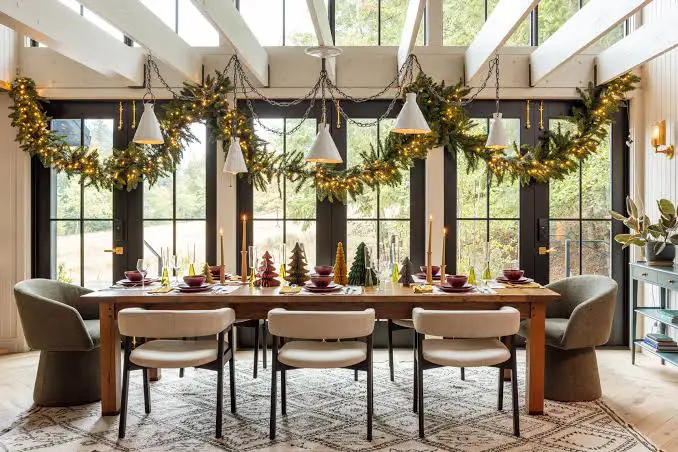
- Measure your table length — the garland or centerpiece should cover about two-thirds of it.
- Test pendant height: 30 to 36 inches above the tabletop, never lower.
- Count your chairs. Odd-numbered seating looks better with a symmetric centerpiece.
- Check that garland won’t block your entry path — keep 36 inches of walking clearance.
- Use only faux greenery near candles indoors, and keep flames 12 inches from paper trees.
32. A Layered Wooden Angel Against Glittery Red
Layered cutout ornaments — the kind with three or four stacked shapes inside a circular frame — photograph beautifully but disappear on a busy tree. Give them breathing room: at least 8 inches of clear branch around them, and hang them at face height where the layers actually cast shadows. A single clip-on LED or small spotlight below will do more for a $20 wooden ornament than a hundred more baubles ever could.
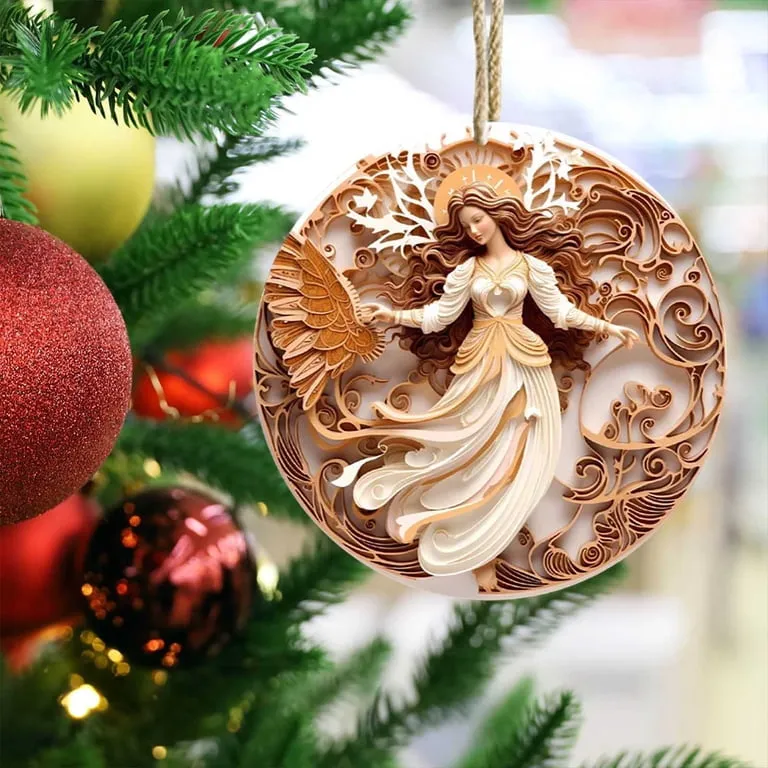
The contrast object. That one glittery red ball hanging near the wooden angel is doing something specific — it pulls the warm cream and wood tones forward by introducing a single loud, cheap, shiny note. Without it, the layered ornament reads as tasteful but sleepy. It’s the $2 ornament that makes the $20 ornament look intentional.
Your Palette Comes First — The Tree Follows
Start with two colors and one rule about finishes, and most of the tree decorates itself. The difference between a good tree and a great one is almost never the budget — it’s restraint, spacing, and warm light. 📌 Pin your favorite palette now, and tag us when it’s up — we genuinely want to see which one you picked.