
You know that feeling when you’ve saved four hundred tabletop Christmas tree photos since August and still can’t commit to one? Same. We spent real time scrolling Target, Etsy, Anthropologie, Amazon, and Pottery Barn to narrow it down to 32 ideas that genuinely earn their square footage, from an $8 bottle-brush trio to a $180 flocked showstopper.
Inside you’ll find rustic-natural cone trees lined up on bark slabs, rose-gold flocked minis, vintage glass-ornament silhouettes, and a few delightfully chaotic maximalist moments — with budget and luxury versions compared side by side. In 2026 the small tree stopped being a dorm-room compromise and became an actual design decision: console and countertop styling has finally caught up, so dressing a 24-inch evergreen is now a legitimate flex.
And stay until the end — we break down the most common mistakes that can ruin these looks. 📌 Save this to Pinterest for later — you’ll want to revisit these ideas.
1. Flat Wooden Tree Ornaments Turned Dinner-Table Centerpiece
Flat, wooden gingerbread-style tree ornaments are the most underrated tabletop decor on the market right now, because they do everything a mini tree does without blocking sightlines across the table. Group them in threes — three clusters, staggered by an inch or two, with the tallest cluster set slightly off-center instead of dead middle.
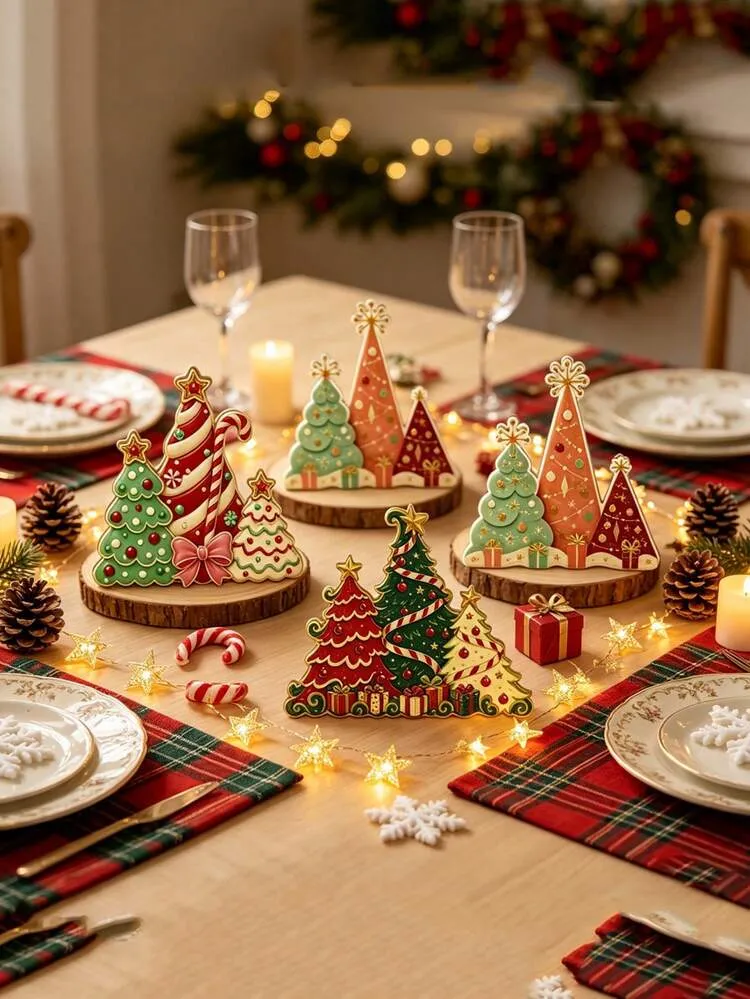
Rest each cluster on a wooden slice coaster so the pieces read as intentional objects rather than scattered ornaments, then thread the star-shaped string lights underneath the pinecones and let them warm the whole arrangement. Nine times out of ten the difference between craft project and styled table is just the base.
The red and green plaid placemats are doing more work here than anything else. Plaid is the reason the flat trees and the star lights feel traditional instead of random — it hands the eye a pattern to anchor all that warm yellow glow. Pull the plaid and the same ornaments read as clutter on white linen. If you only copy one thing from this table, copy the textile layer.
2. Matte Black Santa Candle Holders Glowing on a Draped Runner
- Two matte black cut-out candle holders: $24–$48
- Gold-wire battery fairy lights: $12–$25
- Evergreen garland with pinecones, 6 ft: $18–$40
- Gold and silver ball ornaments, 12 count: $10–$22
- Draped fabric runner: $15–$35
- Total: $79–$170

Budget alternative: thrifted brass or wooden candle holders plus a can of matte black spray paint gets you the same silhouette for about $35 — the glow is doing the heavy lifting, not the finish.
These holders work by glowing through cut-outs, which means they need a real light source inside, and that is where people get into trouble. Real tea lights will eventually scorch the interior paint and leave a smoke film you cannot scrub off, so go battery-operated if you want them past one season. The flat black finish also shows dust instantly, and a single wax drip reads as a permanent gray smudge. Keep them at least a foot from the garland and pinecones, and don’t tuck them behind the gift boxes where the light gets blocked.
3. A Flocked Mini Tree Dressed in Rose Gold and Muted Pink
Count it out: about 60 percent flocked green-white tree, 25 percent rose gold and muted pink, 15 percent natural pinecone and pale wood base. That ratio is the whole formula — the flocking acts as your neutral, so the pink never tips into candy territory.
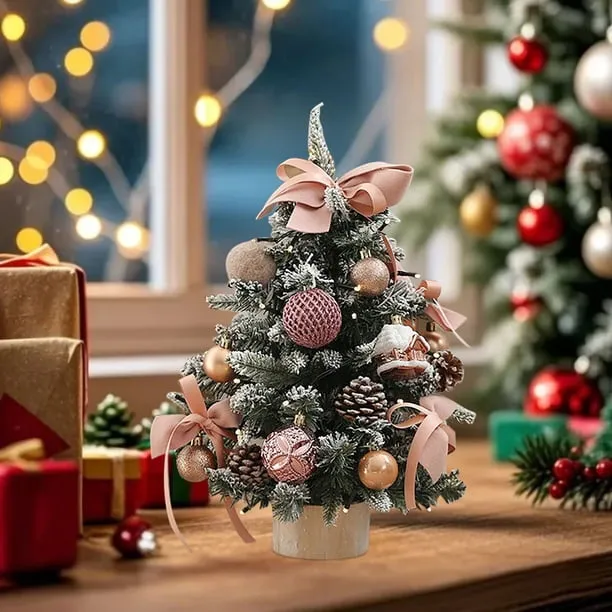
Swap rose gold for champagne and the muted pink for sage and you get identical proportions in a completely different mood. Keep the pinecones either way; that one natural texture is what stops an all-metallic tree from looking like a jewelry display case.
On a flocked tree, ornament size matters more than ornament count. Anything over two inches gets swallowed by the white texture, so stay in the 1.5-to-2-inch range and cluster in threes instead of spacing evenly. Pin the satin bows at four points only — top, bottom, and two opposite sides — so the ribbon reads as punctuation. Compare with Idea #13, where the same flocked formula goes red and silver instead.
4. A Green Wooden Tree with a Working Music Box Base
The crank. The whole piece works because that red and gold base is not a base — it’s a music box with a little handle, and the wooden tree sits on a natural wood slice so the whole thing reads as one heirloom object rather than a craft. Turn the crank and the tree rotates. That motion is what makes guests pick it up off the table.

You can build this for around $25. Buy an unfinished wooden tiered tree cutout at a craft store for about $8, paint it dark green, and glue a small wind-up music box movement — roughly $6 online — into a painted cardboard tube base. The wood slice is a $3 coaster and the miniature ornaments come from a pack of tiny charms. Nobody examines the crank; they just hear it.
5. A Candy-Colored Bottle Brush Forest on Brown Linen
- Start with plain cream bottle brush trees — bleached, not dyed.
- Dilute craft paint or fabric dye in warm water, about 1 part color to 6 parts water.
- Dip the bottom two-thirds of each tree, then stand on wax paper for two hours.
- Dip just the tips in a white paint-and-glue mix for the snow effect.
- Glue each tree to a 1-inch wood disc so they stand without tipping.
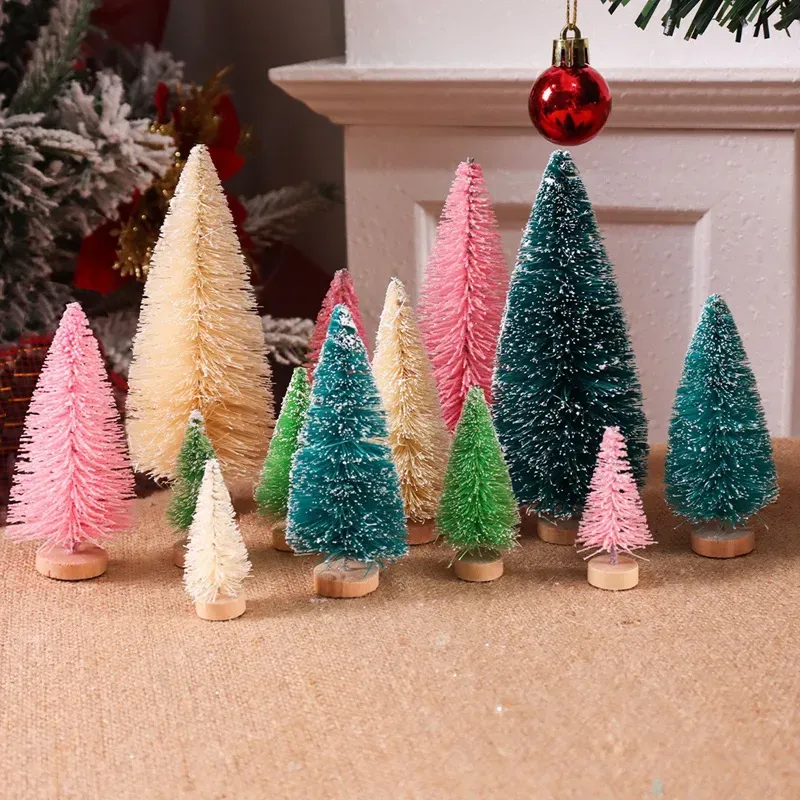
Roughly 30 minutes of hands-on time and $15 for a set of nine.
Bottle brush trees have been quietly climbing since the grandmillennial wave pushed vintage Christmas back into the mainstream, and 2026 is the year they went pastel. The reason is practical: they are the only tabletop tree that looks intentional in a cluster of nine, they need zero lights, and they cost less than a candle. This one has staying power too — it’s a texture trend, not a color trend.
6. Tiered Wood Trees with Hand-Painted Polka Dots
Three identical silhouettes, three different finishes. That’s the trick. Dark green with white dots, dark brown with white dots, raw light wood with nothing — your brain reads them as a family because the shape repeats, but the eye keeps moving because the surfaces don’t. Grouping them at graduated heights on a light gray surface gives the pale wood tree something to separate against.
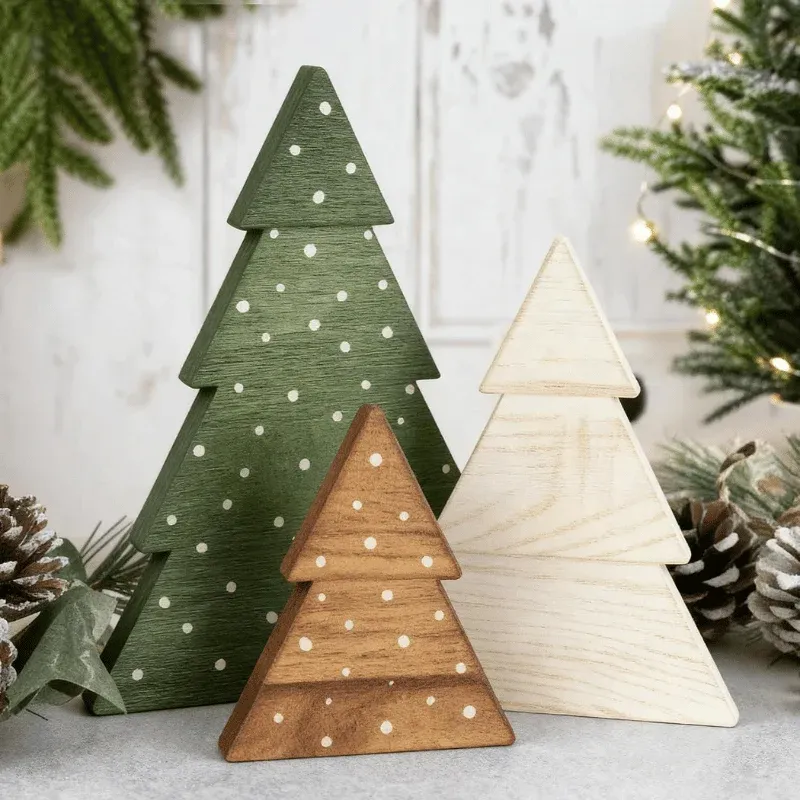
Scatter real pinecones around the base so the arrangement spills past the objects and stops looking like a shelf display.
For crisp polka dots, use a half-inch foam pouncer rather than a brush — dip, tap off the excess, press straight down, lift straight up. Space them three-quarters of an inch apart in a staggered grid so they look hand-done but not sloppy, then seal with matte polyurethane. Gloss topcoat will yellow the white dots within a season, especially anywhere near a window.
7. Four Frosted Cone Trees Lined Up on a Bark Slab
- Set four cones on newspaper and mist lightly with spray adhesive.
- Sift powdered fake snow or fine white glitter over the tips while tacky.
- Dry 20 minutes, then shake off the excess outside.
- Arrange in a line on a bark slab with the tallest at one end.
- Drape silver-wire fairy lights loosely across the front — never wrapped tight.
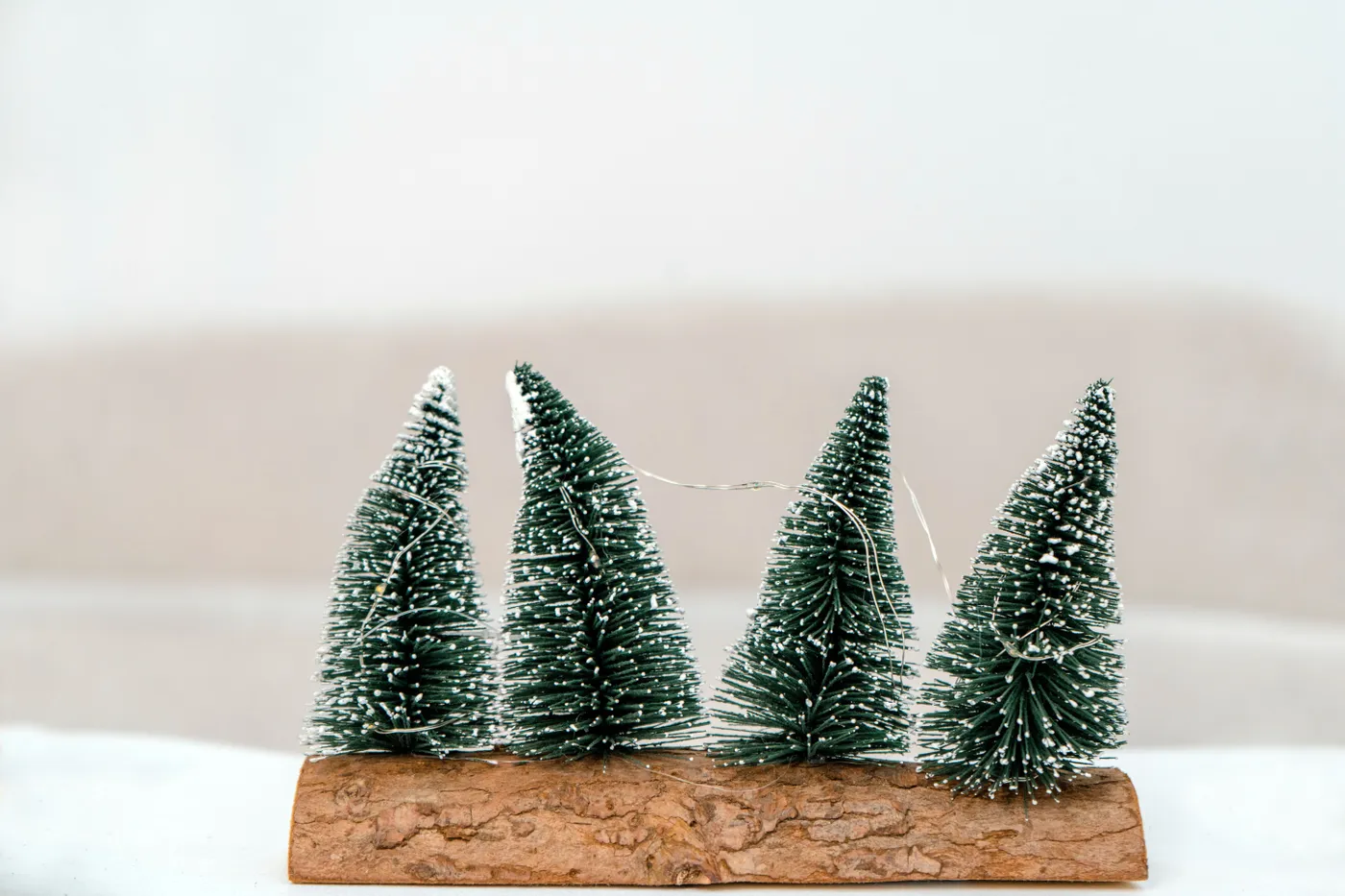
Twenty minutes, about $12 if you already own the lights, and it photographs better than anything pre-decorated.
This lineup needs a surface at least 36 inches wide to breathe — narrower and the bark slab crowds against the edges. It’s ideal on a console, dresser, or sideboard where the wall behind is plain, because frosted tips read best against a soft neutral. For a table that actually has food on it, skip the slab and go low and long instead.
8. A Bedside Mini Tree with Brass Candlesticks
- Measure nightstand depth — you need 14 inches minimum or the tree crowds the lamp.
- Confirm an outlet within cord reach, or commit to battery lights.
- Check that any real candle sits at least 8 inches from the branches.
- Note the wall color behind it — cream and white make green and brass pop; dark walls swallow them.
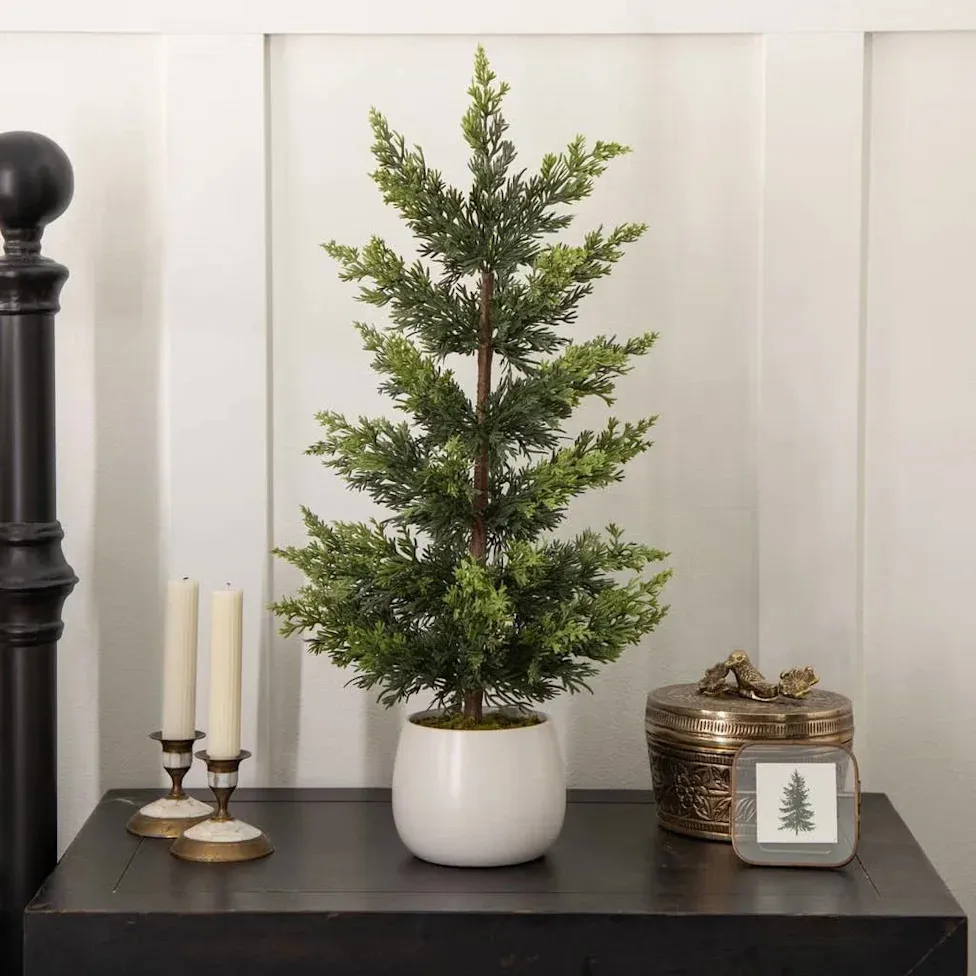
Stagger your heights deliberately: an 18-inch tree, a 9-inch candlestick, and a 7-inch candlestick create a descending line the eye can follow. Matching heights on a nightstand is exactly what makes small-space styling look flat and showroom-ish. Keep the whole grouping within about 30 inches so there’s still room for your phone, a book, and the glass of water you’ll knock over at 2 a.m.
9. A Pre-Lit Mini Tree in a Woven Basket on Glossy White
Seventy percent forest green and warm white, 20 percent black-and-gold striped ribbon, 10 percent light wicker. That tiny black accent is the entire reason this looks expensive — a green-and-white tree on a white console is pretty but soft, and the black stripe gives it an edge.
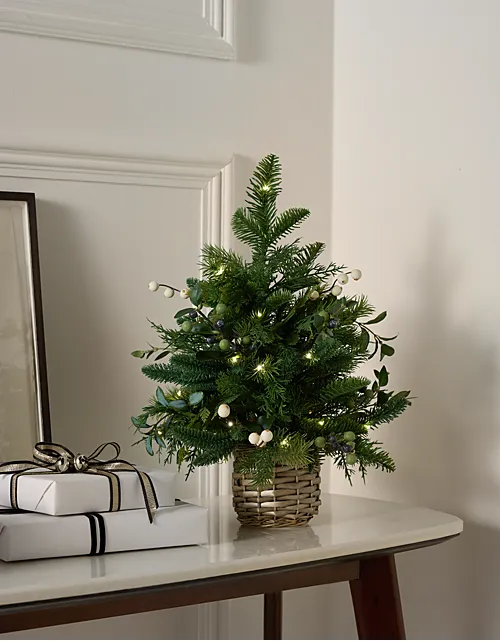
To shift the mood, swap the striped ribbon for solid velvet in deep burgundy and keep everything else identical. Same proportions, holiday-formal instead of clean-modern.
Two things to know before you copy this. A woven basket on a glossy surface will scratch it, so put a felt pad or a scrap of leather underneath, no exceptions. And white and navy berries are held on with wire, which means they shed — you’ll be picking them off the console for a month. Tap the tree gently over a trash bag before styling and you skip most of that.
10. Burlap-Wrapped Tree on a Half-Moon Console
- 24-inch artificial tree: $22–$45
- Half-moon console, solid wood: $120–$320
- Burlap for the base wrap: $6–$12
- Red gift box with gold ribbon: $8–$16
- Ribbed ceramic diffuser vase: $18–$40
- Total: $174–$433
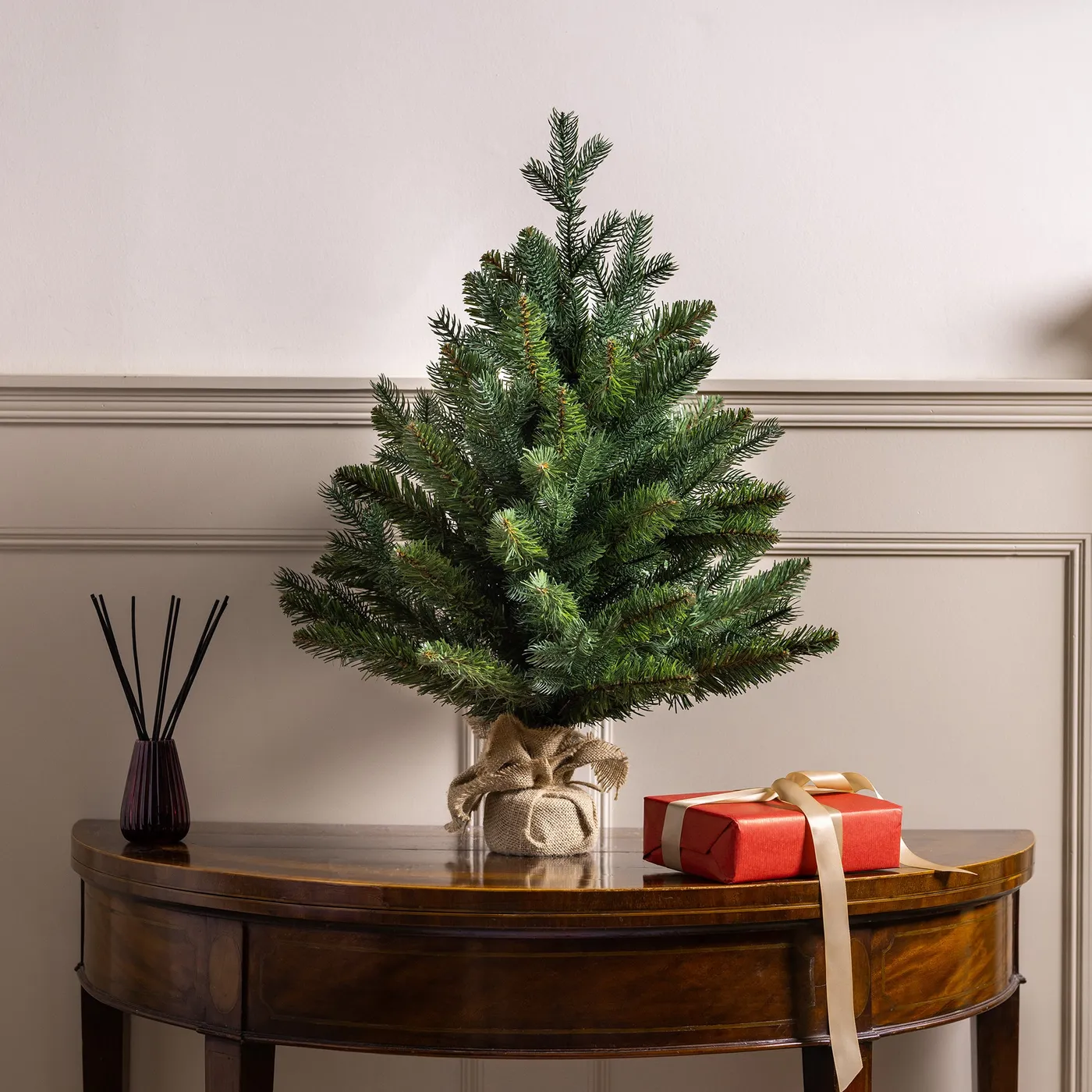
Budget alternative: a $30 half-moon bracket set plus a stained board gets the console for under $60, and burlap is cheaper by the yard at any fabric store than pre-wrapped online.
Half-moon consoles live in the 30-to-36-inch width range, which is exactly enough for one 24-inch tree plus two flanking objects. Go bigger and the tree eats the curve and the whole thing looks jammed. This shape is built for entryways and narrow hallways where you only have inches to work with — the wainscoting behind it here gives the green something architectural to sit against instead of a blank wall.
11. An Evergreen in a Woven Basket Beside a Plaster Bust
The white plaster bust. Everything else here — the evergreen, the gold balls, the woven basket, the candelabra — is standard holiday styling. The bust is what makes you stop and look, because a classical sculpture has no business next to a Christmas tree. It signals that whoever styled this dresser thinks about art year-round, not just in December.
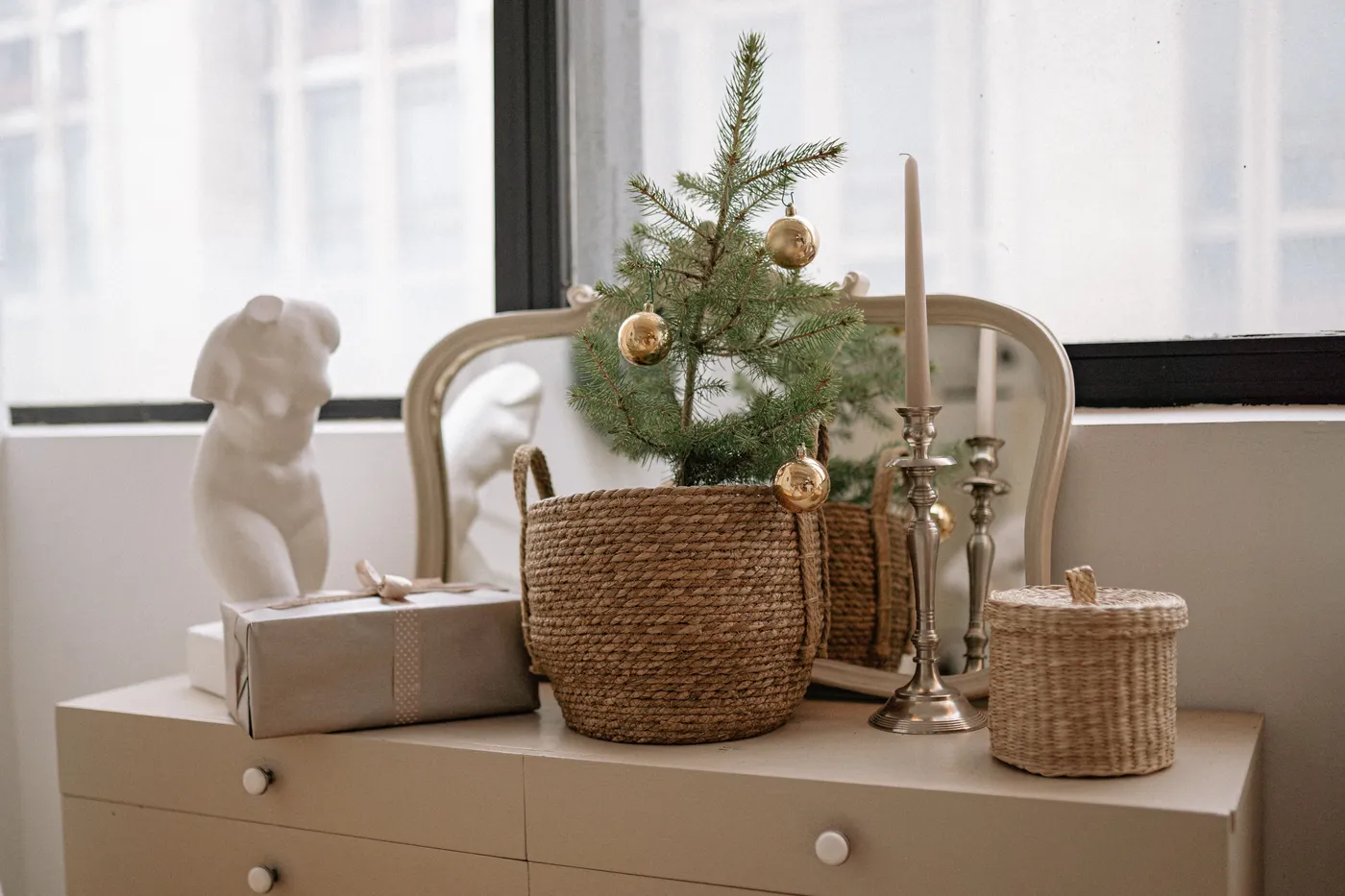
Resin busts run $22–$40 at big-box home stores and much less at estate sales, where they’re often priced as statue and nobody’s bidding. The basket is a $15 farmers-market find, the candelabra is thrifted brass, and the tree itself is an 18-inch artificial you can grab for $20. The gold-framed mirror behind is what sells it — anything ornate and reflective works.
12. A Garland Runner with Ceramic Trees and Checkered Napkins
A garland runner is smarter than a centerpiece because it spreads across the table instead of stacking up in the middle, so nobody has to move it to pass the potatoes. The ceramic trees repeat at three heights, giving the eye a rhythm, and the red-and-black check napkins pick up the same red as the candles without matching them exactly.
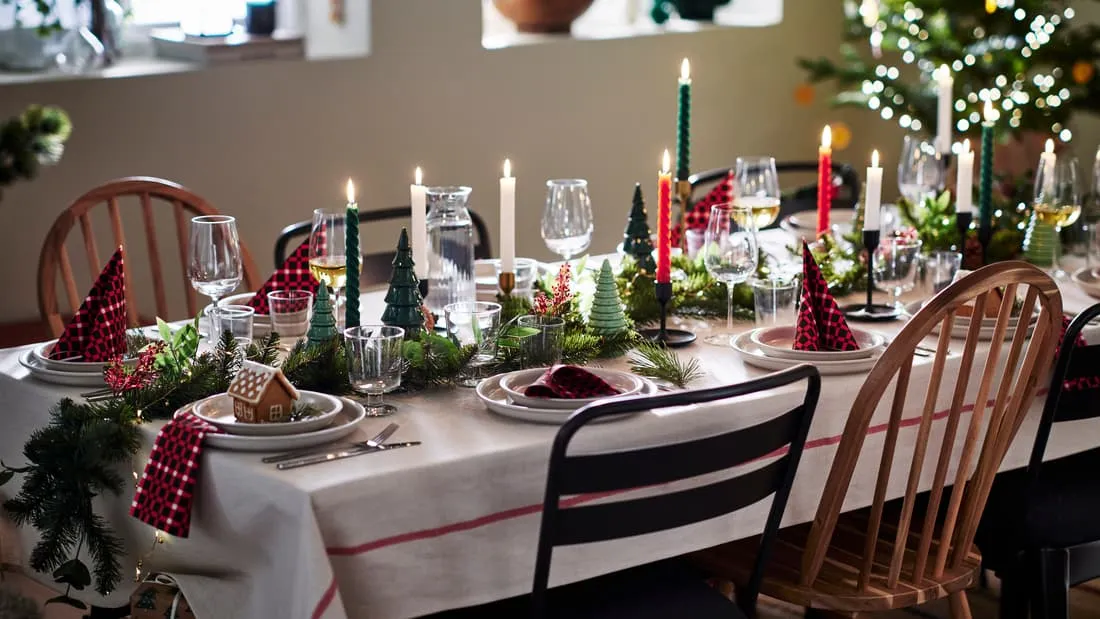
The white cloth with its single red stripe does one more thing: it draws a line down the table that the garland sits on top of.
- Lay a 6-foot evergreen garland down the center, not at the very edge.
- Weave a battery fairy-light strand through the top third so bulbs peek out.
- Place three ceramic trees at uneven intervals — 8, 14, and 20 inches apart.
- Tuck candles between them at alternating heights.
- Leave two 10-inch gaps so serving dishes have a home.
Twenty minutes, roughly $40 from scratch.
13. Flocked Mini with Red and Silver Balls in a Grey Cylinder Pot
Flocking is glue and plastic snow, and it sheds — every time you move the tree, a little more ends up on the table. Don’t dust it with a cloth; use a can of compressed air from a foot away so you blow the loose bits off without dragging the rest. Store it upright in a bag rather than lying flat, and expect the white to go slightly yellow after three or four seasons in a bright room.
Roughly 55 percent white flock, 30 percent red, 15 percent silver. The red does the festive work, the silver keeps it from going candy-cane, and the flocking provides all the neutral you need — which is why the grey metallic pot works instead of fighting it. Trade the red for cobalt and the silver for brushed brass and you have an entirely different tree with the same bones.
14. A Flocked Tree on the Hearth of a Lit Stone Fireplace
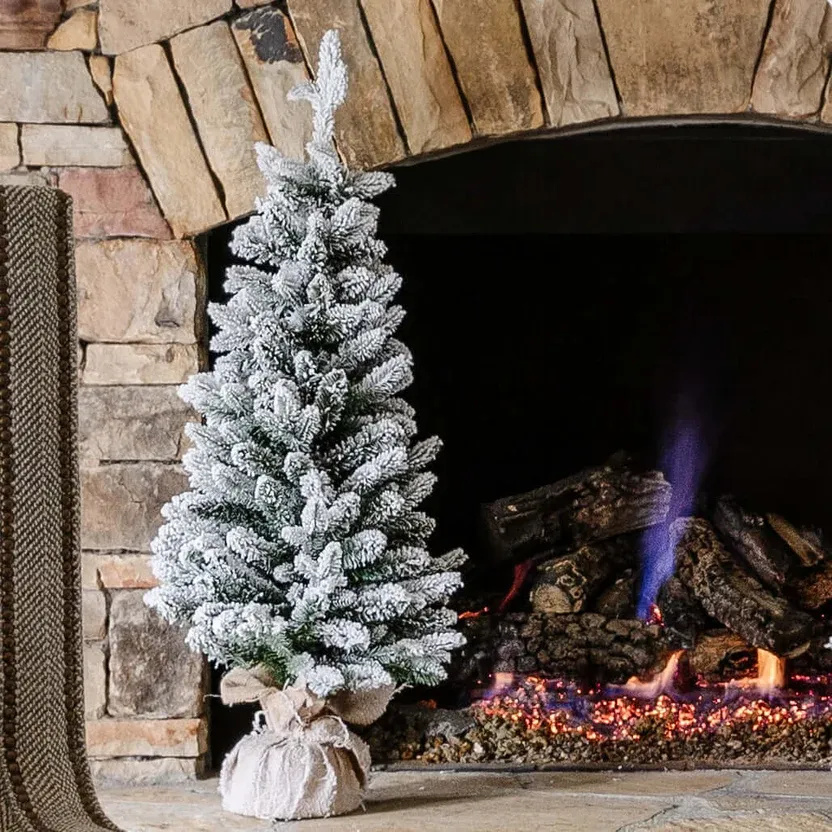
A flocked tree beside a live gas fire is a genuine fire-safety conversation, not a styling one. Flocking is plastic-based and will soften, discolour, and eventually melt if it sits within a few feet of heat. Keep at least three feet of clearance, and never place it where the stone gets hot to the touch. If your fireplace actually runs all evening, the tree belongs on the other side of the room.
Hearth styling has become its own genre on Pinterest — people treat the fireplace surround like a mantel-less shelf, which is exactly what’s happening here. A small tree on the stone lets the fire stay the focal point instead of competing with a seven-foot evergreen. It’s a trend built on something real: smaller homes, gas and electric inserts, and absolutely no desire to block the heat.
15. A Snowman Climbing a Red Ladder Up the Tree
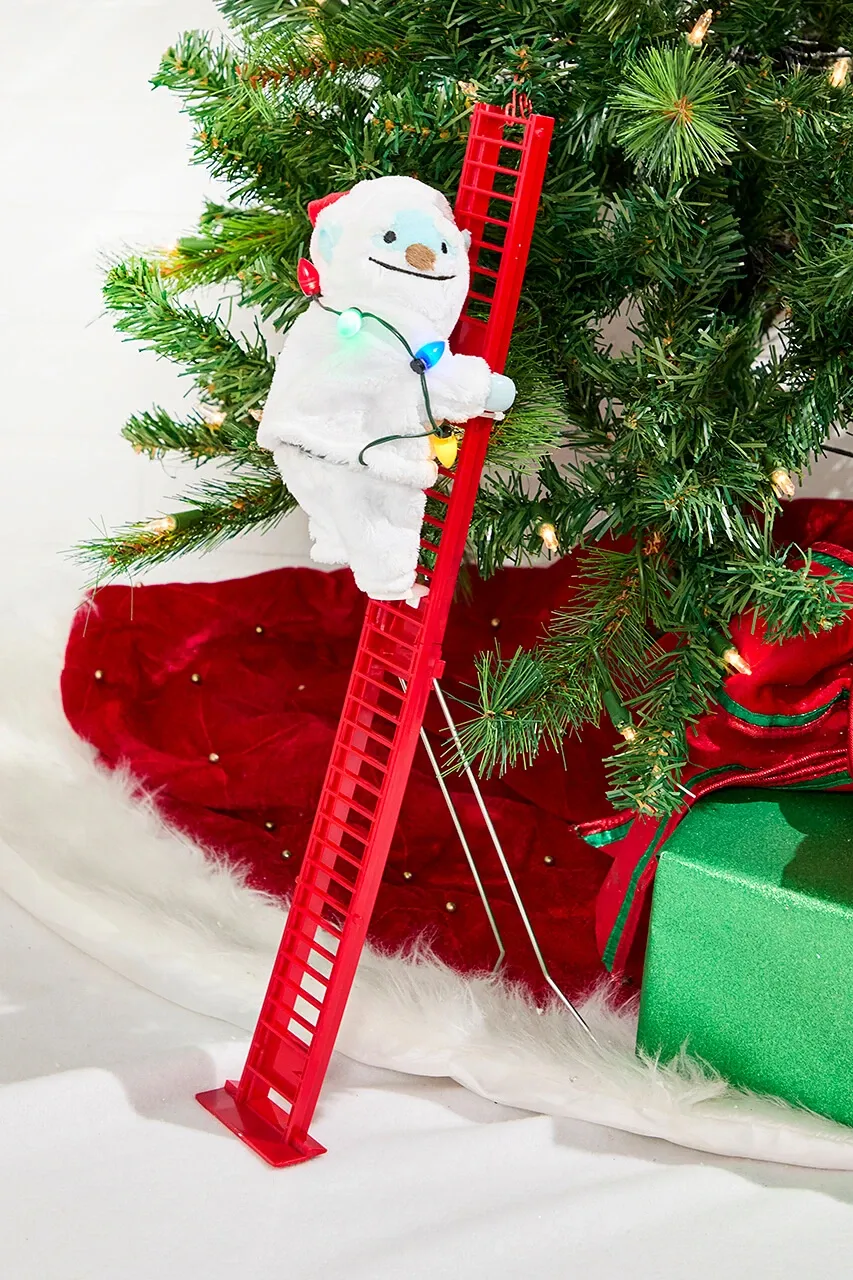
The ladder. Without it you have a nice green tree with a velvet skirt and a wrapped gift — lovely, forgettable. The red plastic ladder with a fluffy snowman halfway up turns the whole thing into a scene, and a scene is what makes people smile when they walk past it in February. It also fills vertical space on a tree too short to fill with ornaments.
Dollar-store craft ladders, or a stack of painted popsicle sticks glued into a ladder shape, cost under $5. The snowman is a $4 felt ornament body from a craft chain, and the skirt is a quarter-yard of red velvet from the remnant bin with a strip of faux fur hot-glued along the edge. The whole vignette lands under $30 and reads like a window display.
16. Distressed Gold Tiered Metal Tree Topped with a Rustic Star
Metal trees photograph flat unless you give them a backdrop with contrast. Aged paper with script does two jobs here: it lightens the surface under the gold, and the handwriting gives the eye a fine texture to compare against the ruffled metal. Add a row of dark green book spines behind it and the gold suddenly reads warm instead of brassy. Cheap, fast, and it looks collected rather than purchased.
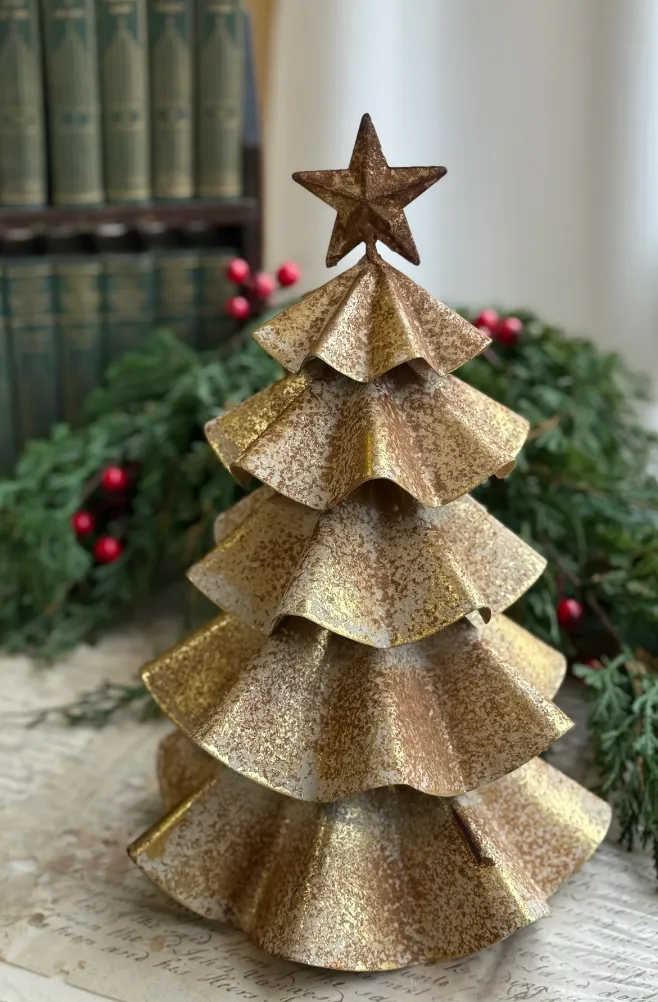
- Distressed gold tiered metal tree: $28–$55
- Rustic metal star topper: $6–$14
- Faux greenery with red berries: $10–$22
- Vintage book stack, 4–6 volumes: $12–$30
- Aged script paper or sheet music: $4–$10
- Total: $60–$131
Budget alternative: print sheet music free and tea-stain it with a used teabag for the aged look.
17. A Glittering Cut-Out Tree Loaded with Tiny Colorful Ornaments
Cut-out trees top out around 18 to 24 inches, and they need roughly a foot of clearance on each side because the ornament load makes them visually wide. That makes them perfect for narrow shelves and terrible for crowded side tables. If your surface is deeper than 12 inches you can layer it — push the tree slightly forward with a stack of books or a frame behind.
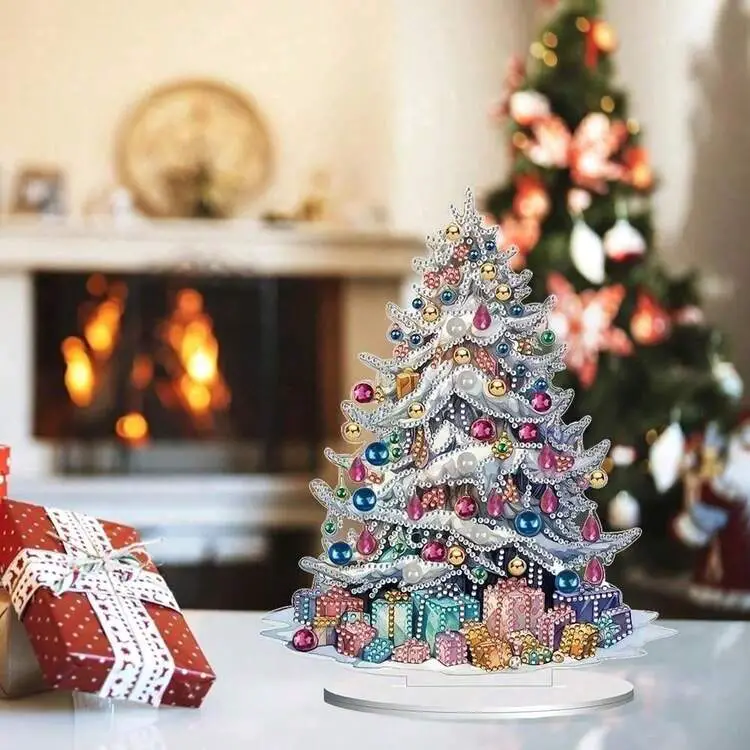
Density is the principle here. The ornaments are packed so tightly that the tree shape nearly disappears, which is what creates that glittering mass instead of a recognizable silhouette. The white base gives all that color somewhere to sit, and the single red polka-dot gift beside it repeats the red without matching anything exactly. More is more — but only when the background stays plain white.
18. Pink Bottle Brush Trees on Round Wood Bases
Dye your own. A bag of Rit in fuchsia, a bucket of hot water, and a set of plain cream bottle brush trees gives you this exact ombre for about $12 total. Dip the whole tree for the deepest pink, dip only the bottom third for the pale ones, and let them dry on wax paper overnight. Round wood bases come in craft packs of ten for a few dollars.
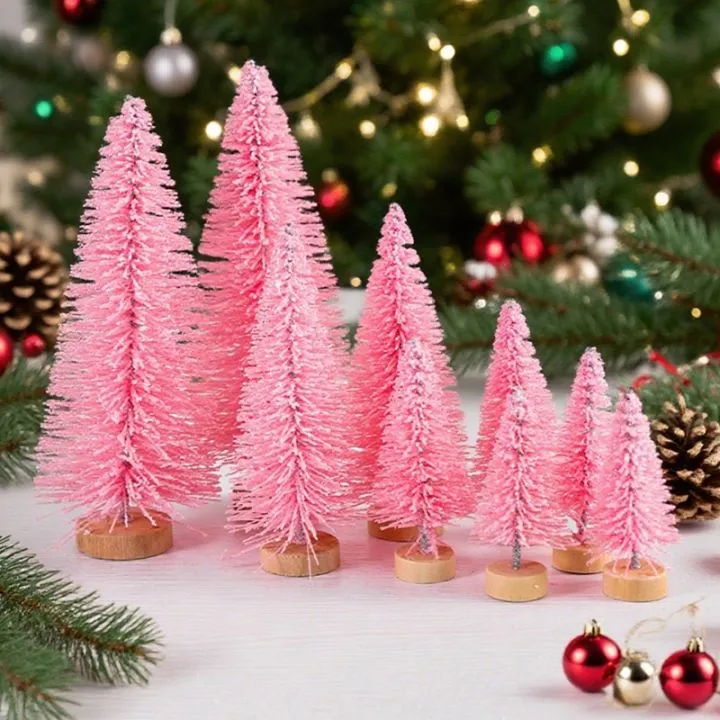
Sixty percent white surface and pinecones, 30 percent pink in three different depths, 10 percent forest green from the branches behind. The green matters — without it, pink bottle brush trees read as Easter decor. That single hit of deep green tells your brain this is Christmas. Swap the pink for dusty blue and the formula holds perfectly. This is the collector’s version of the cluster in Idea #5.
19. A Hand-Felted Tree Ornament with Little Red Mushrooms
Small ornaments drown on a big tree and disappear on a small one if you hang them low. On a tabletop tree, keep everything under two inches in the top two-thirds and let the bottom third stay relatively bare — it mimics how a real fir fills out and stops the tree looking bottom-heavy. Clip-on ornaments also beat loops on mini trees, because the branches are too short to thread ribbon through without bending them.
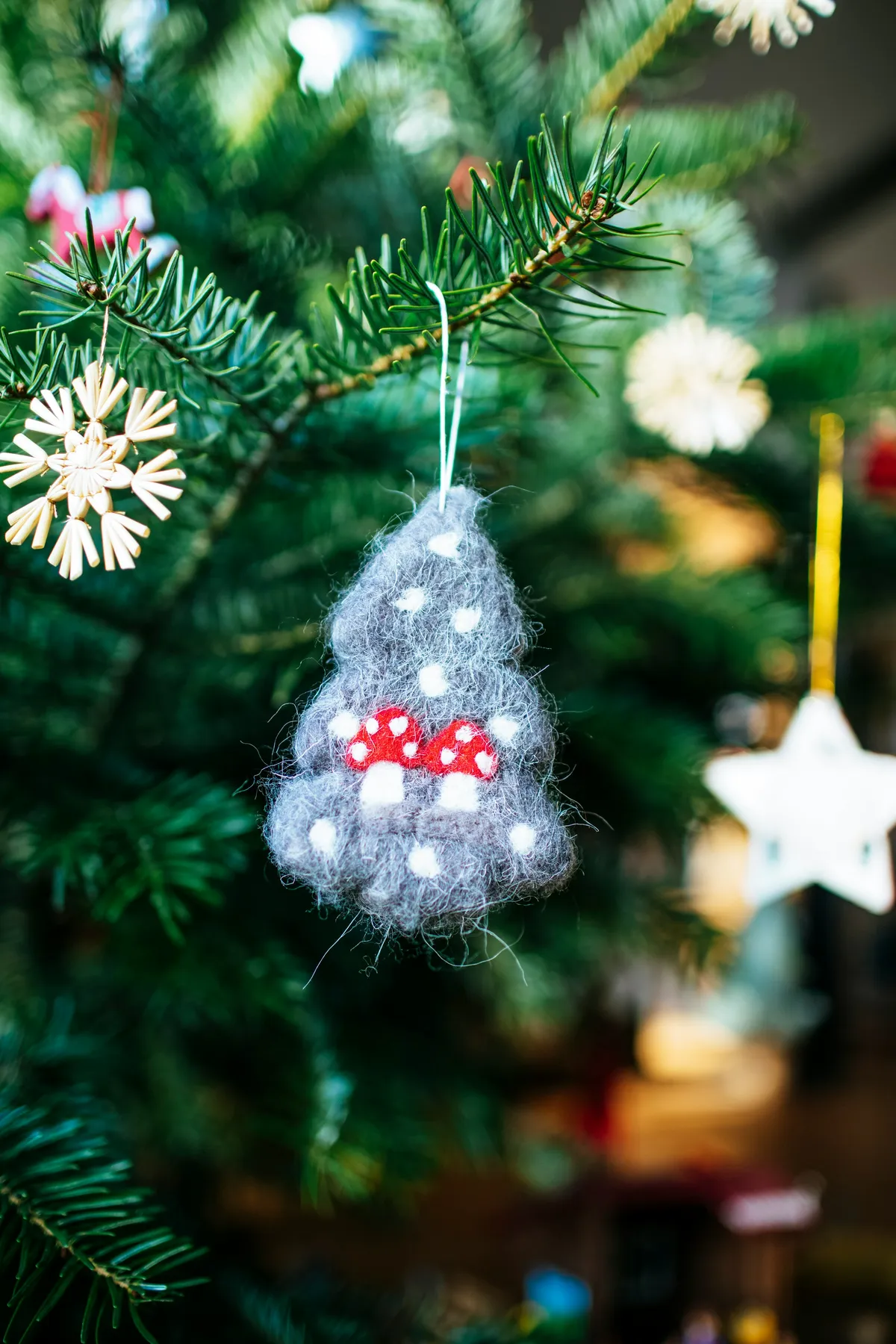
Wool felt is a magnet for lint, pet hair, and pine needles, and once it’s in the fibers it does not come out with a dusting. Keep a lint roller in the drawer and hit each ornament once when you put it up and once when you pack it away. Felt also fades in direct sun, so a windowsill tree will look washed out by the second season.
20. A Pinecone Cone Tree with Woodland Figurines
- Start with a 12-inch styrofoam cone from a craft store.
- Snap pinecones into smaller pieces so they nest tightly.
- Hot glue from the bottom up, overlapping each row by a third.
- Fill gaps with moss or frosted sprigs before the glue sets.
- Dust fake snow on the upper half only, never the whole thing.
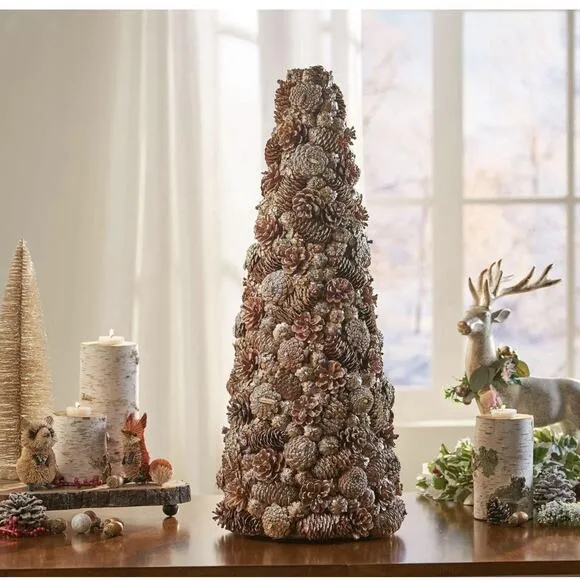
Forty-five minutes, roughly $20, and it weighs almost nothing — which matters if it’s going on a high shelf.
Texture contrast does the work here. Pinecone scales, birch bark, matte ceramic, fuzzy faux fur — four completely different surfaces in warm neutrals, so nothing competes. The white deer is the only bright value in the arrangement, which is why your eye lands there first and then travels left across the candles to the tree. That’s deliberate sequencing: bright object, mid-tone candles, textured centerpiece.
21. A Slotted Green Wooden Tree Dotted with Tiny Baubles
- Slotted wooden tree, unfinished: $14–$28
- Miniature multicolor baubles, 40 count: $8–$16
- Gold lattice star topper: $10–$18
- Christmas crackers, set of six: $12–$25
- Gift boxes and patterned village cards: $8–$18
- Total: $52–$105
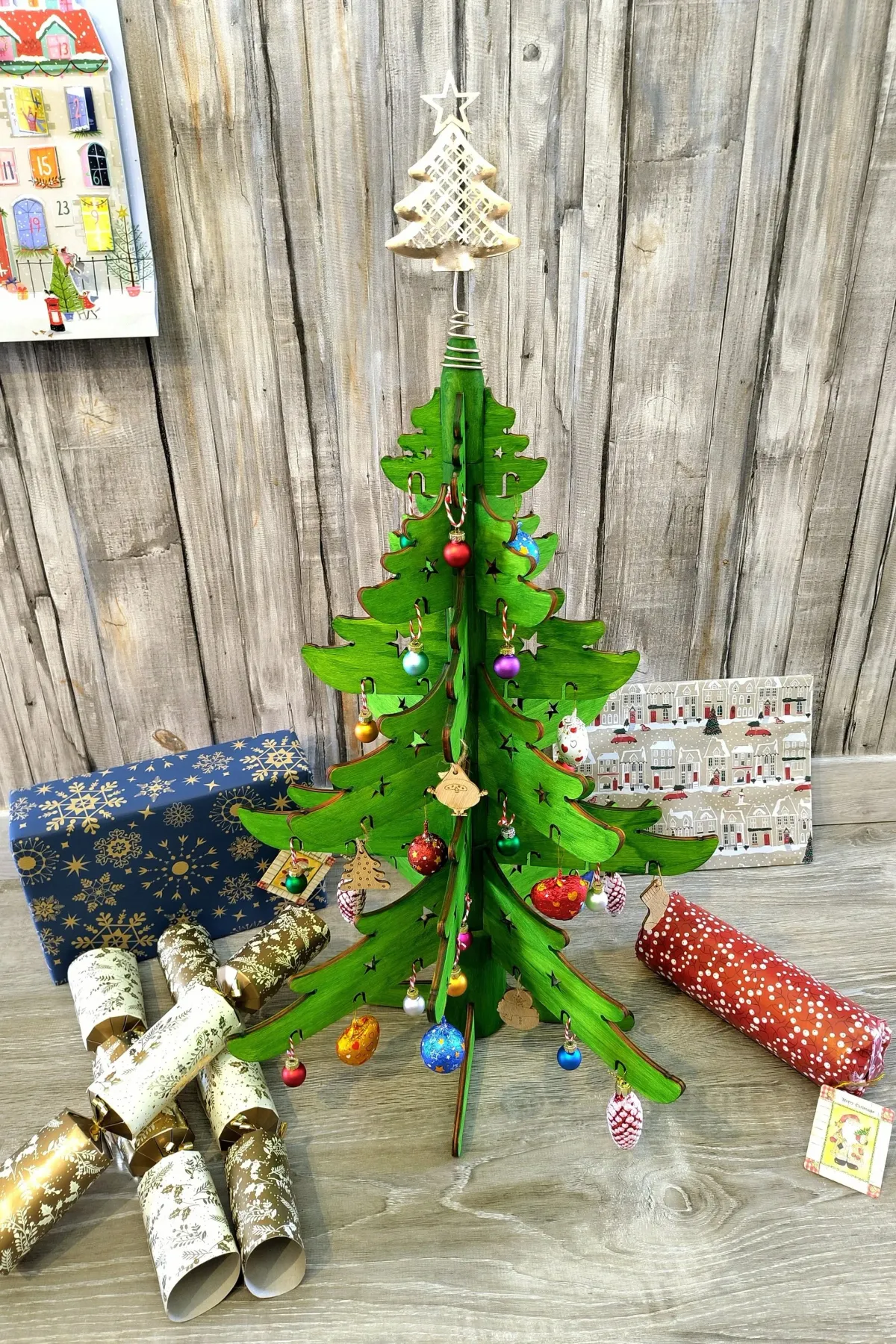
Budget alternative: buy the bare tree and paint it yourself with craft acrylic in bright kelly green — the ornaments cover most of it anyway, so nobody inspects your brushwork.
The gold lattice star on top is the one thing you cannot swap out. It’s the only gold in an otherwise fully multicolored arrangement, and that single metallic note keeps the tree from reading as a pile of ornaments on a stick. Gold also bounces the room’s light back at you, which gives a bright green wooden tree a warmth it absolutely does not have on its own.
22. A Golden Wire Coil Tree That Catches Every Light
Ninety percent negative space, 10 percent gold. That’s the ratio a wire tree lives or dies by — the entire appeal is that you can see through it, so whatever sits behind the tree matters as much as the tree does. Gold base, gold star, nothing else. Hanging ornaments on a wire tree destroys the geometry that makes it work in the first place.
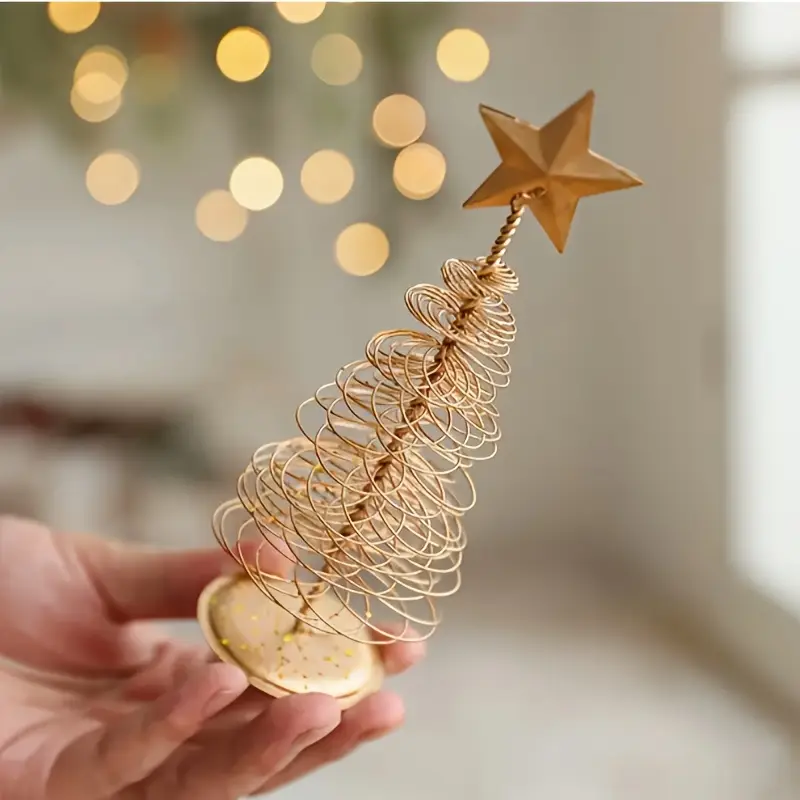
If you want to warm it up, put it in front of a darker wall so the coils read as bright lines rather than vanishing into cream paint.
Wire trees need backlighting or they look like a tangle. Place one warm-toned bulb within two feet behind or beside the tree and the coils will catch a continuous highlight — that’s the sparkle you see in photos, and it has nothing to do with the tree itself. A $6 rechargeable puck light tucked behind the base does it without a cord.
23. A Potted Evergreen Mix Tied with a Single Red Bow
Fresh evergreen in a pot looks wonderful for about ten days, then indoor heat wins. Water the pot every other day — those small containers dry out fast — and keep it away from radiators and vents. Accept up front that you are buying a two-to-three-week display, not a season-long one. If that bothers you, buy artificial branches and skip the heartbreak entirely.
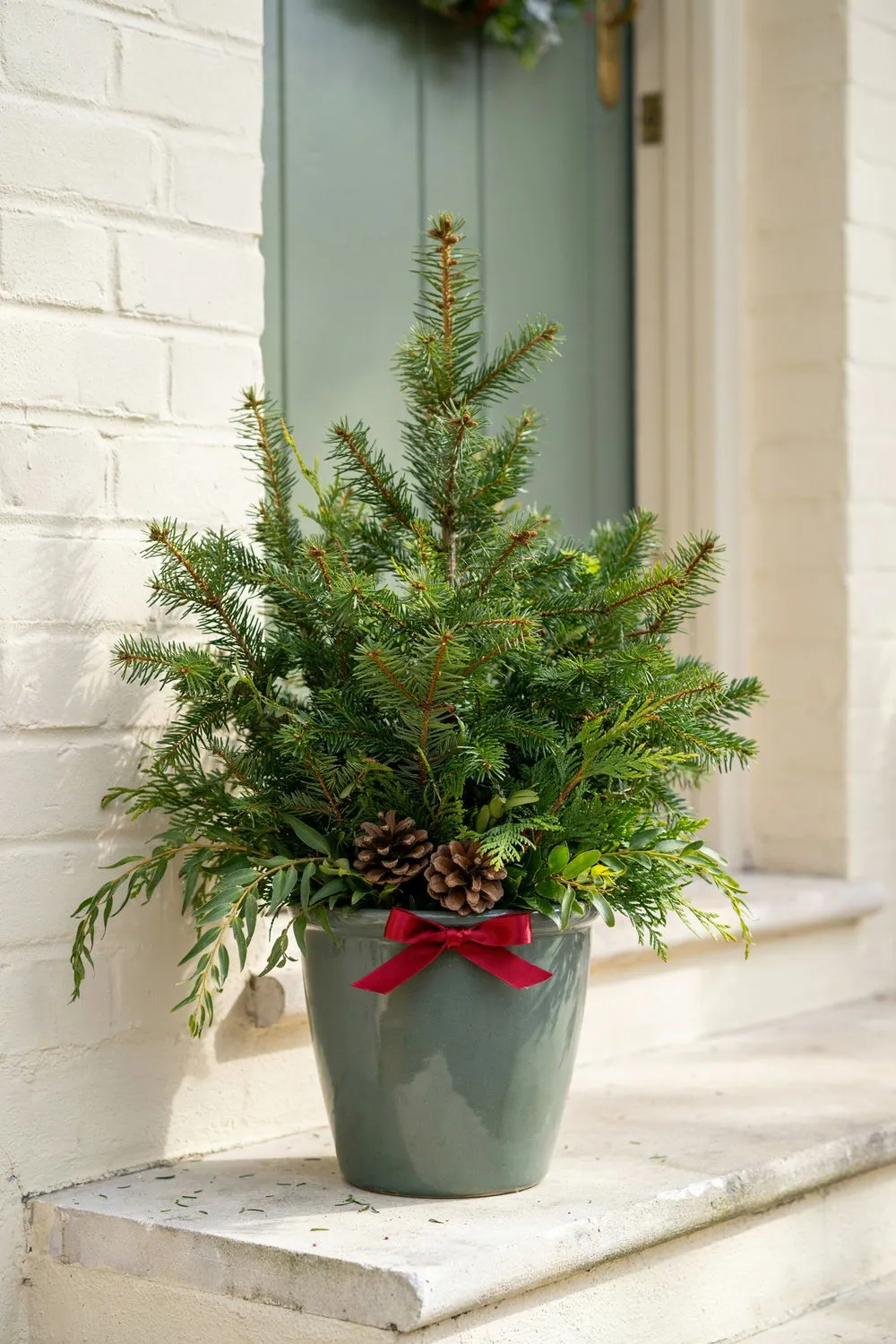
A $12 bundle of mixed evergreen from any grocery store or garden center, a $6 pot, and a yard of red satin ribbon gets you this entire look for under $25 — less than one pre-made arrangement. The pinecones are free if you know anyone with a spruce tree, and the glossy sage pot can come from a thrift store with a coat of spray paint. Compare with Idea #24, which uses the same branch logic in terracotta.
24. Star-Painted Terracotta Pots on a Wooden Windowsill
- Paint small stars on plain terracotta pots with white acrylic and a stencil.
- Tie twine in a small bow around each rim while the paint dries.
- Cut evergreen and bare branch stems to twice the pot height.
- Push stems into floral foam set an inch below the rim.
- Add pinecones and white berries to the front only, so the back stays clean.
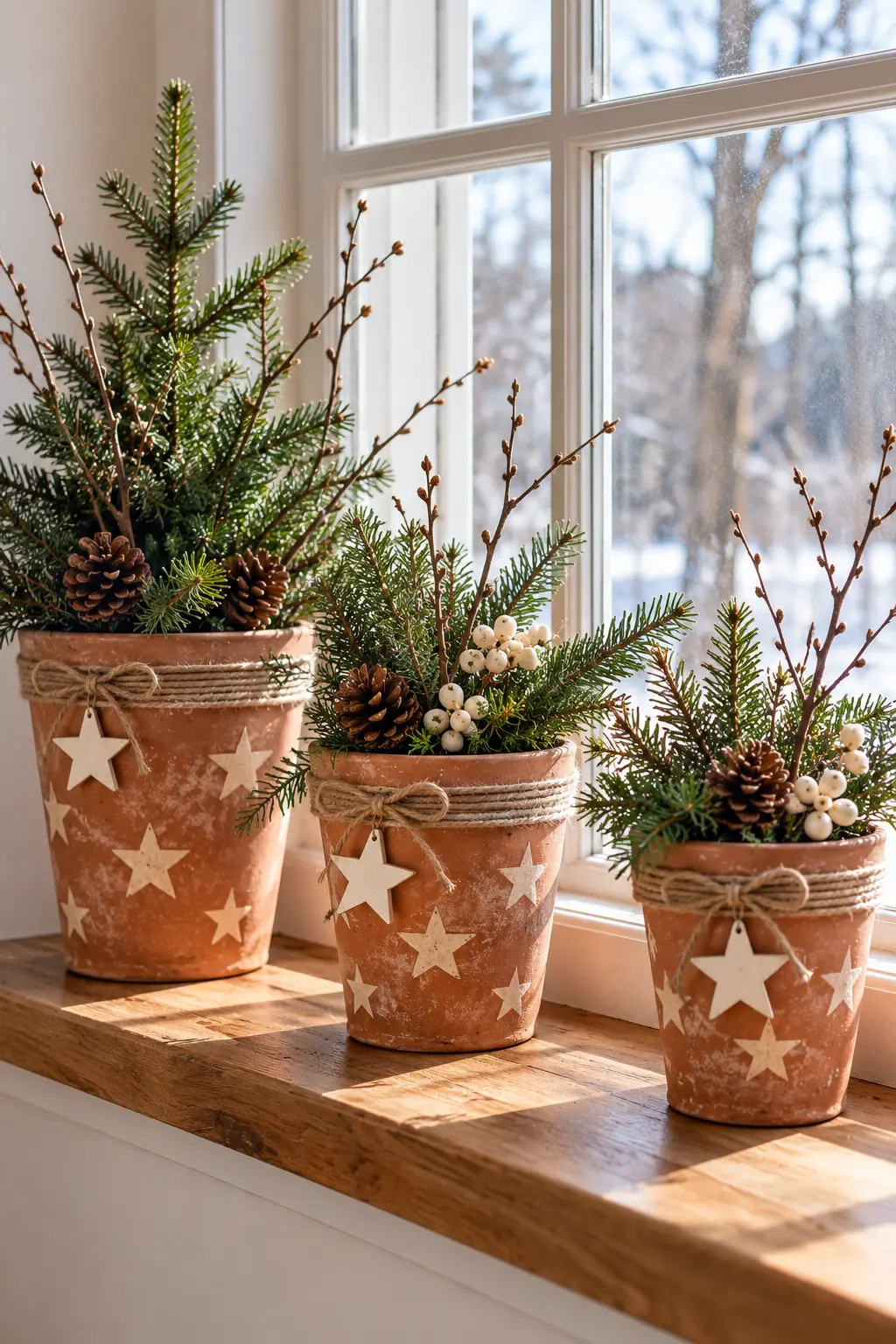
About 25 minutes and $18 for all three pots.
Terracotta is porous, which is normally a virtue and here it’s a problem — unglazed clay pulls water straight out of your floral foam, so fresh stems need re-soaking every third day. Bare branches with buds will drop those buds onto the sill within a week, and evergreen needles follow. Line the sill with parchment before you style it and you save yourself ten minutes of picking.
25. Trees Built Entirely from Vintage Glass Ornaments
Vintage glass ornaments have become a genuine collecting category, and 2026 is peak thrift-flip season — people buy box lots at estate sales and build things with the pieces that don’t match. A tree formed entirely from mismatched glass is the natural endpoint of that hobby. It’s also the anti-minimalist statement of the year: no palette, no plan, just decades of color stacked into a cone.
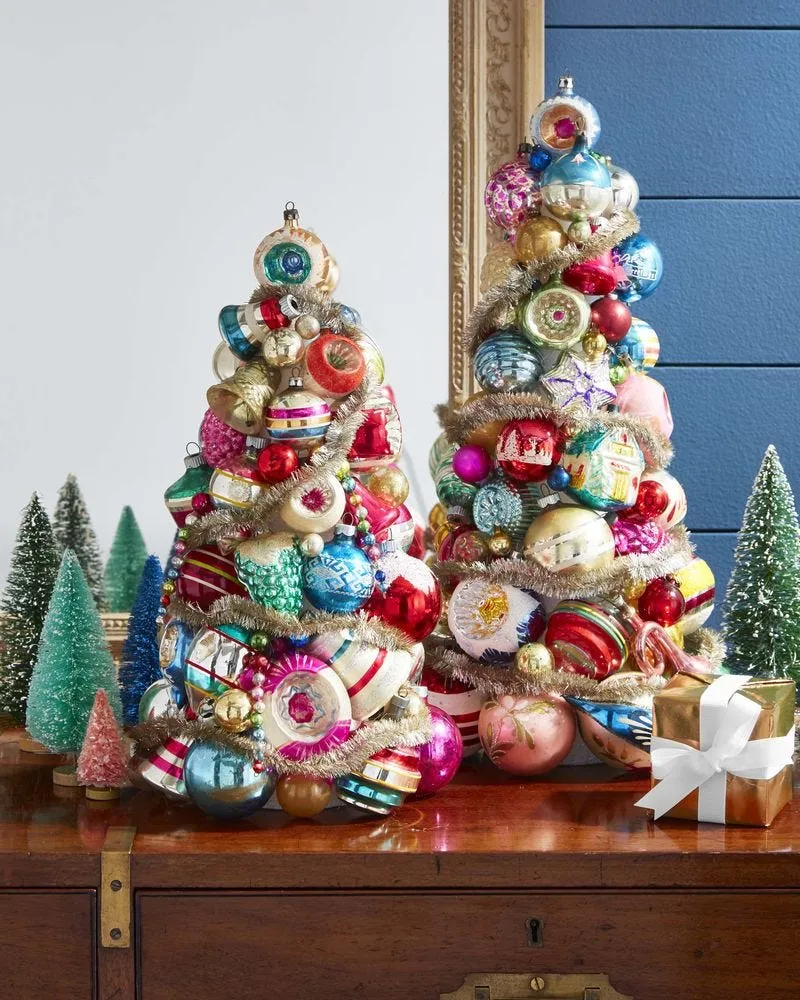
The gold tinsel is what holds the whole thing together. Without it, a hundred mismatched glass ornaments read as noise; with it they read as a collection. Tinsel also catches light in a way glass alone doesn’t, which is precisely why these photograph so well. If you strip everything else back, keep the tinsel.
26. A Twine-Wrapped Mini Tree Between Lit Tapers
Table centerpieces fail on height, not style. Anything over about 14 inches sits in the eyeline of whoever’s across from you and suddenly dinner is a game of peekaboo. This tree works precisely because the candles are the tall elements and they’re thin. Also: use dripless tapers, and never leave a lit taper on a table with a fabric runner and a tree nearby at the end of the night.

Two candle heights, one tree, glassware — that’s the recipe. Set the tapers so the flames sit either well above eye level when seated, over 20 inches, or well below, under 10. It’s the in-between heights that block conversation. Brass candlesticks in two different profiles read collected rather than matching, and a thumb-width of twine wrapped twice around the trunk pulls the metals together.
27. A Flocked Tree Planted in a Whimsical Nutcracker Planter
Forty percent white flock, 40 percent multicolor shine, 10 percent black-and-white check, 10 percent gold. The check is the valve that keeps this from becoming chaos — a rigid geometric pattern gives all those shiny balls something structured to sit against, which is the same reason a striped rug calms a busy sofa.
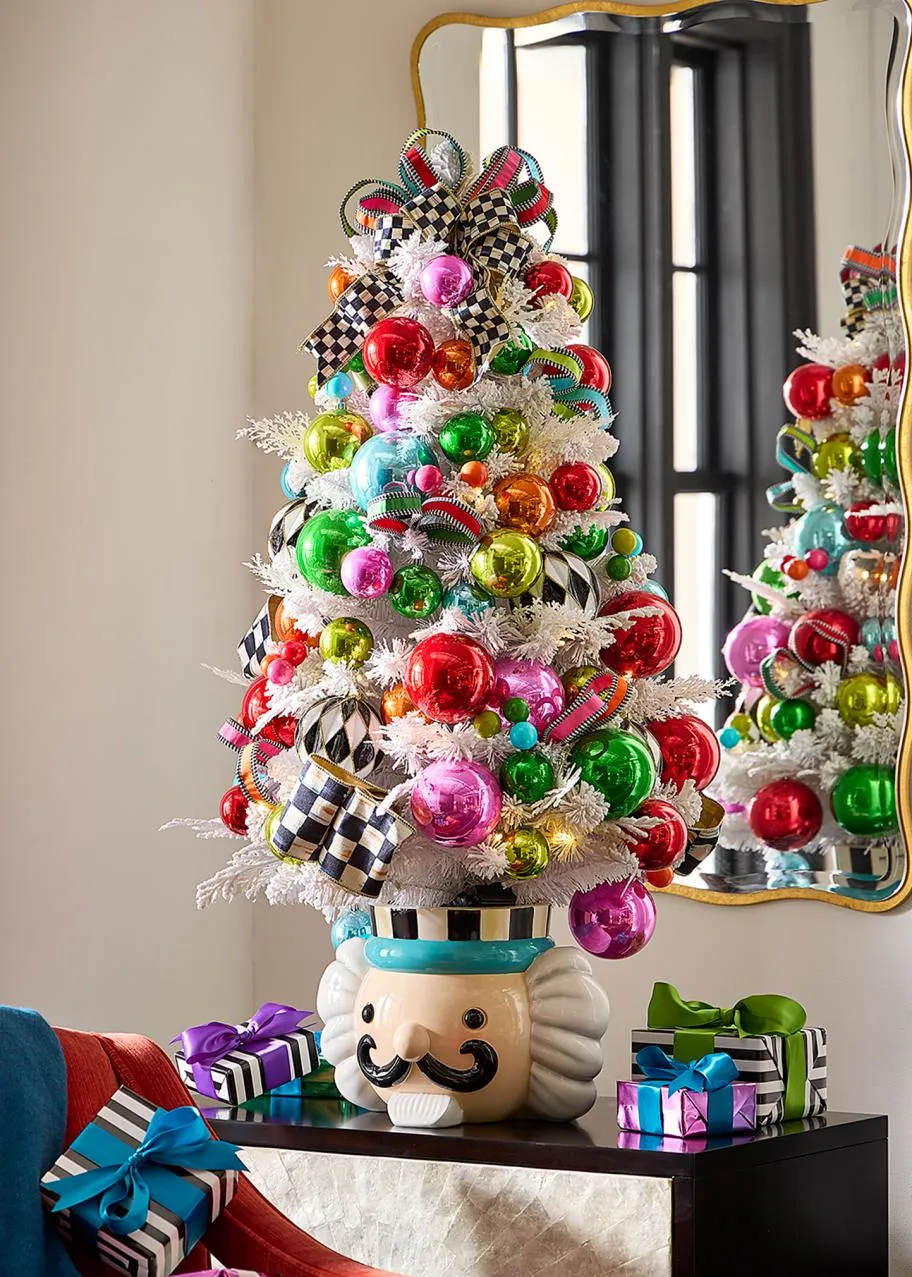
Swap the check for thin gold ribbon and the tree goes much softer. Swap it for solid red and you are in full candy shop territory.
The nutcracker planter is doing double duty as personality and proportion. A standard pot would make this tree look like a novelty; a tall, narrow nutcracker body gives it a pedestal and a joke at once. The wavy gold mirror behind reflects all that color back into the room, which is why a dense, colorful tree on a dark console never feels heavy.
28. Stacked Branch and Pinecone Candle Centerpieces
- Stack three or four flat birch or driftwood branches into a low pyramid.
- Hot glue the joints so the bundle holds together.
- Tuck frosted pine sprigs into the gaps, front-facing only.
- Nestle a glass votive into the top so the candle sits level.
- Repeat every two feet down the runner, alternating sprig direction.
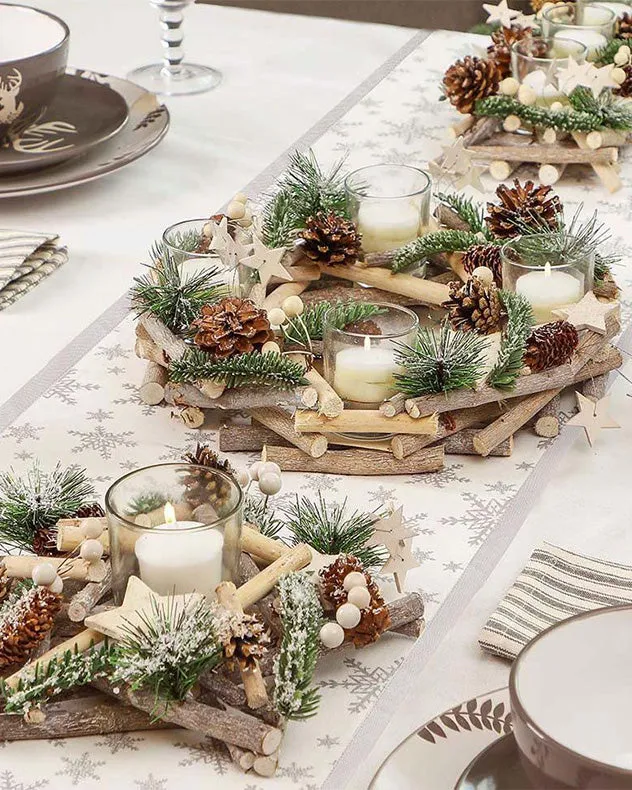
Fifteen minutes per piece and about $10 each if you buy branches in a bundle.
Each centerpiece occupies roughly 12 inches of table, so plan on one every 24 inches — three for a six-foot table, five for an eight-foot. The snowflake cloth and grey runner read best in a room with cooler light; in a warm, south-facing dining room the grey can go muddy by late afternoon. Keep the candle tops below 10 inches off the table.
29. A Flocked Tree in a Ribbed White Planter on Glass
- Flocked 24-inch artificial tree: $28–$60
- White ribbed ceramic planter: $18–$45
- Glass-and-metal accent table: $70–$180
- Faux fur or snow filler for the pot: $8–$15
- Battery fairy lights: $10–$20
- Total: $134–$320
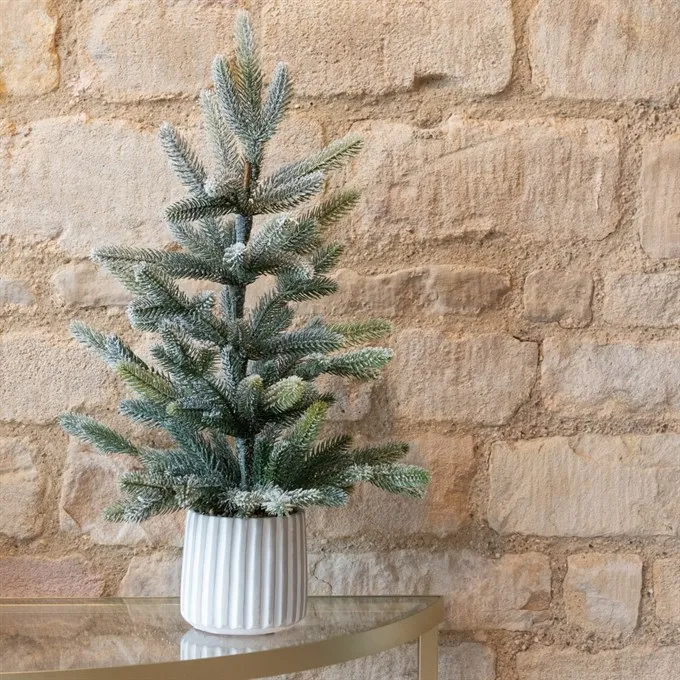
Budget alternative: a plain white nursery pot inside a $6 ribbed plastic liner reads almost identically at this scale — nobody is inspecting the underside at eye level.
On a glass table, weight has to go low or the whole thing looks unstable. Set the planter dead center, not off to one side, and let the flocking be the only pattern — a flocked tree in a ribbed pot is already two textures, and a patterned table under it would be a third. One-to-three proportion is the safe ratio: a 24-inch tree wants an 8-inch pot.
30. A Tiny Berried Tree in a Textured White Pot
Miniature light strands are the first thing to fail on a tabletop tree — usually one dead section, three weeks in. Buy a spare strand when you buy the tree so you’re not hunting for the exact match in December. Berry picks are also wire-based, and the paint chips off red berries in storage. Keep them in a small box rather than a bin, and expect two seasons at best before they need replacing.

This is a $22 look, and I mean that literally. Textured white pot from a discount store, an 18-inch artificial tree, one battery strand of warm lights, and a handful of berry picks from the dollar aisle. The wooden Home Sweet Home tag is the kind of thing sold in packs of twelve for $5. See the basket version in Idea #9 for the next step up.
31. A Bare Lit Tree on the Windowsill with Kraft-Paper Gifts
There are no ornaments on this tree, and that is exactly why it works. Internal fairy lights inside bare branches create a soft, diffuse glow rather than a hard sparkle, and the silhouette of the branches becomes the decoration. Everything around it — kraft paper, ribbon, stacked books — is matte and quiet, so nothing competes with the one lit object on the sill.
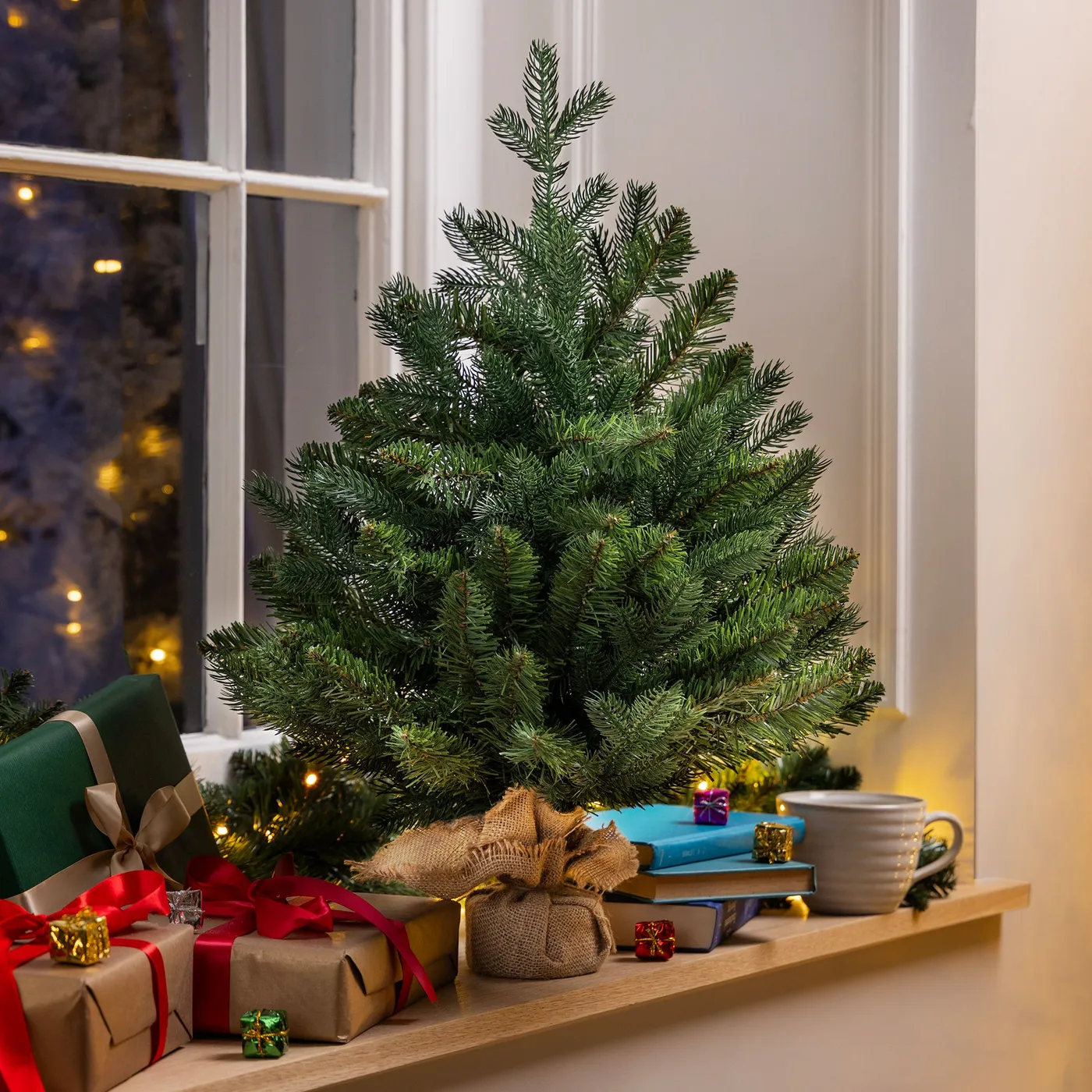
Negative space on a small tree is a design choice, not an unfinished project.
- Measure sill depth — you need 8 inches minimum for the tree plus gifts.
- Check for a nearby outlet, or commit to an internal battery strand.
- Note which way the window faces; south-facing glass fades burlap and kraft paper.
- Verify the tree isn’t blocking a curtain pull or a window that opens.
- Set a $40 ceiling — this look gets expensive if you start buying new books.
32. A Flocked Tree Planted in an Open Red Umbrella
The umbrella. It’s an open red umbrella flipped upside down and filled with artificial snow, which means the base is doing something no tree skirt can — holding a scene instead of hiding a stand. It also solves a real problem, since flocked trees are notoriously unstable on their own little legs. Take the umbrella away and you have a nice tree in a pot.
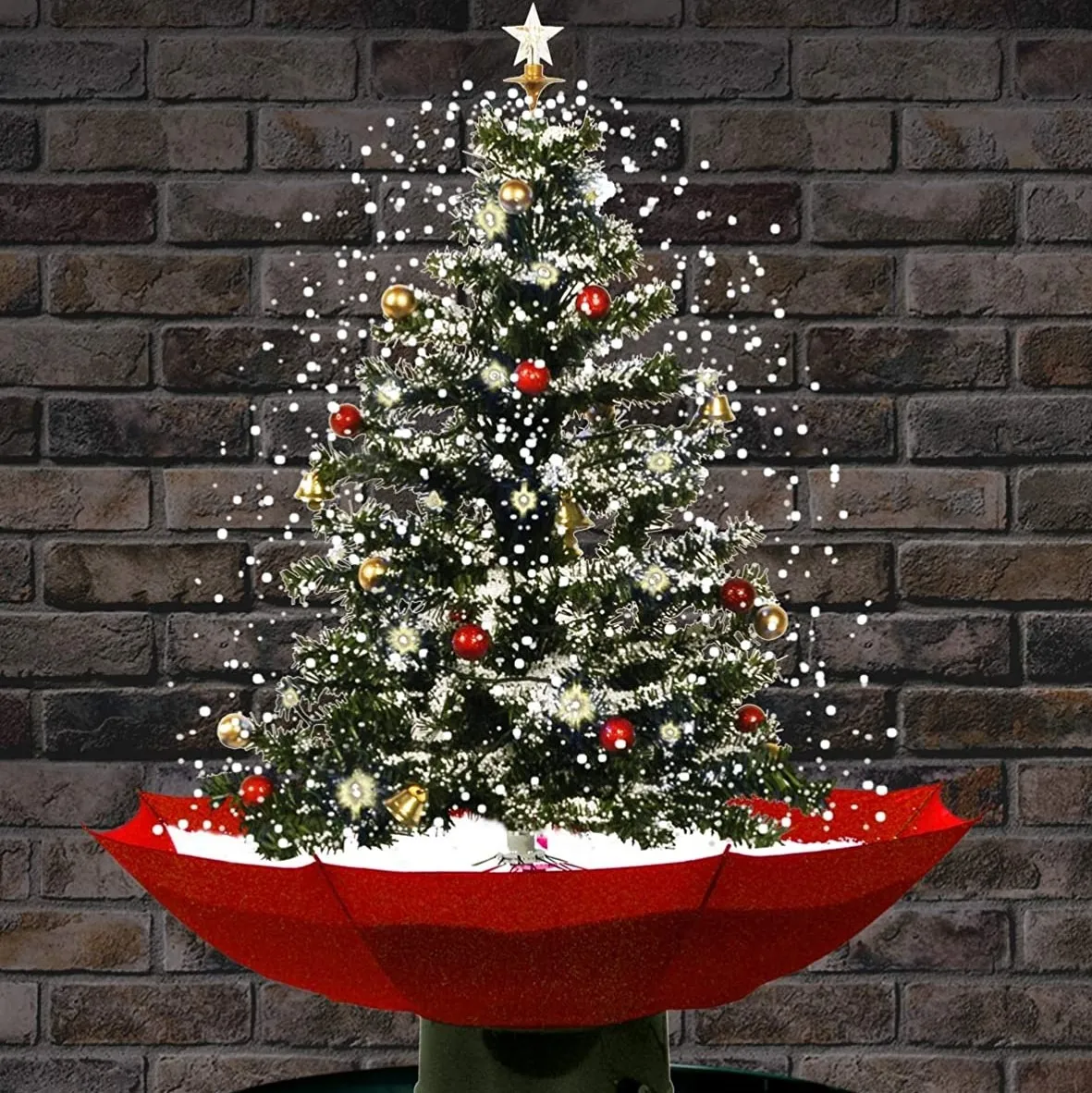
Two practical notes. An open umbrella on a floor base is a tipping hazard with kids and dogs, so weigh the pole or tuck it into a corner. Artificial snow is statically charged and will migrate across the room and cling to brick — vacuum it with a hose attachment rather than sweeping, which just launches it. And keep the whole thing away from real flame; flocking and polyester snow both burn.
Thirty-Two Tiny Trees and One Console That Finally Feels Finished
The best tabletop tree isn’t the most expensive one on the shelf — it’s the one that matches the surface it’s sitting on, the light in the room, and how much chaos your household can realistically handle in December. Pick one idea here, copy three details from it, and let the rest go.
📌 Save this to Pinterest now so you can find it again when the decorating bins come down from the attic — and tag us when your console finally looks like the photo you’ve been saving since August.