Still shuffling the same three ornaments around the same shelf every December? You’re not alone — and honestly, the fix is less about buying more and more about placing better. We spent real time digging through Target, Etsy, HomeGoods, Amazon, and Anthropologie to find shelf moments that actually hold up in a real house, from $12 thrift-store finds to $480 statement pieces.
Inside you’ll find 26 curated ideas spanning rustic farmhouse, quiet Scandinavian minimalism, vintage traditional, and modern glam — with budget and luxury versions compared side by side, plus a shoppable product pick on nearly every idea. In 2026, the collected-over-bought shift has made shelf styling the season’s most-saved holiday project on Pinterest, with miniature village scenes and neutral ceramics leading the way. And stay until the end — we break down the most common mistakes that can ruin these looks. 📌 Save this to Pinterest for later — you’ll want to revisit these ideas.
Some links in this post are affiliate links. If you buy through them, we may earn a small commission at no extra cost to you.
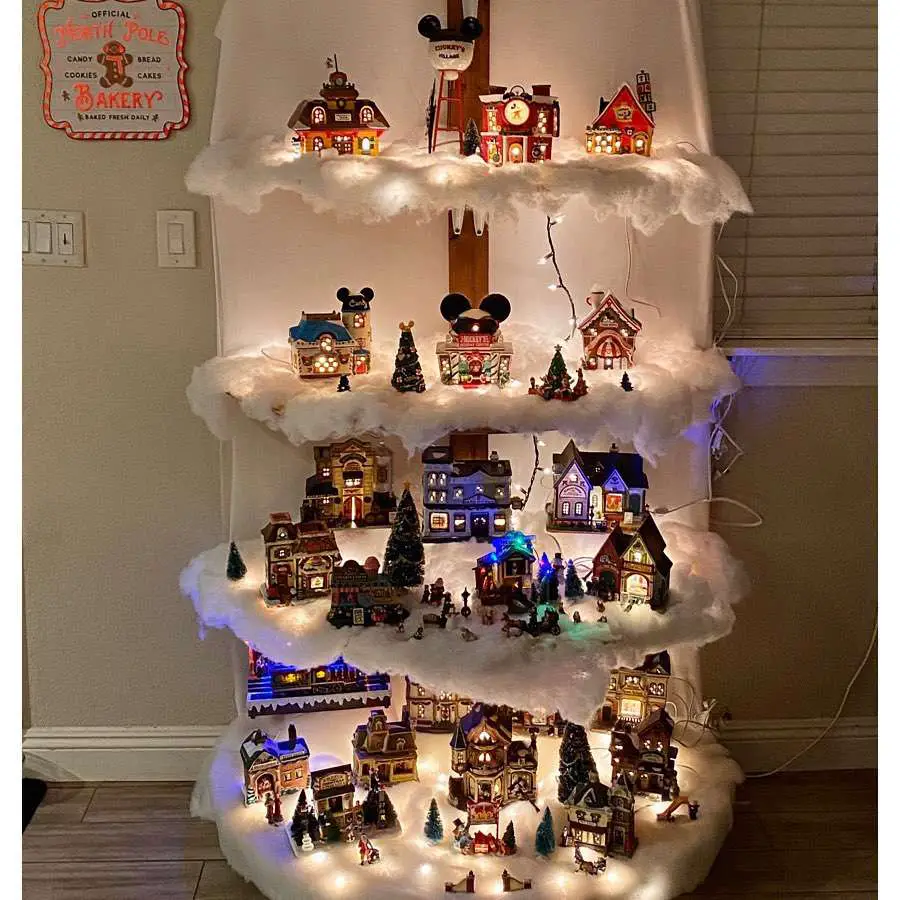
1. A Vintage Stepladder Turned Into a Tiered Christmas Village
Three things are doing the lifting here. The ladder’s built-in steps create vertical rhythm, so your eye climbs instead of landing in one place. The fluffy white batting reads as snow from across the room, and that’s what turns a pile of ceramic houses into an actual scene. Then there’s the warm yellow light spilling out of those miniature windows — it fights the natural brown of the wood, and that cool-warm tension is exactly why it feels cozy instead of muddy. A setup this narrow works in a corner no wider than 20 inches.
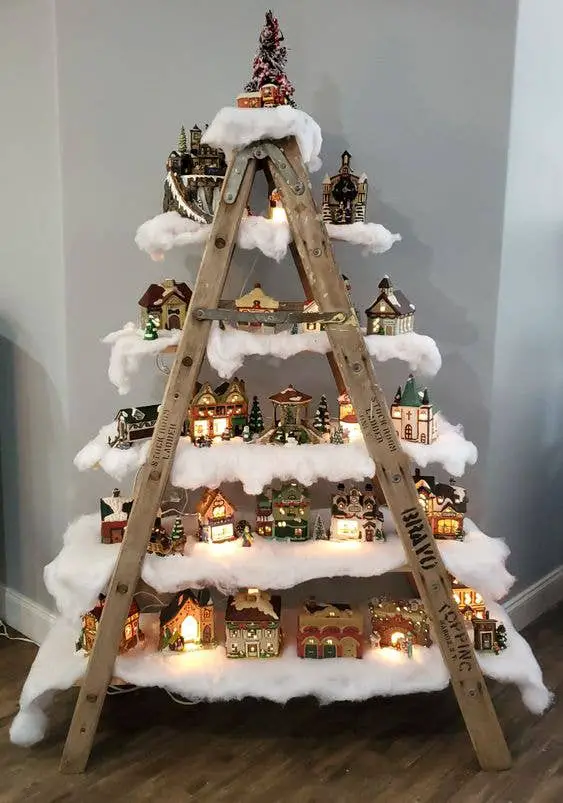
- Vintage wooden stepladder: $25-$70 (Facebook Marketplace, estate sales, or the one in your garage)
- Planks cut to fit the steps: $15-$30
- Fake snow batting, 2 yards: $10-$18
- Illuminated miniature houses, start with 5-7: $30-$90
- A small tree topper for the top step: $12-$25
Budget alternative: a $20 flea-market ladder, putz houses from Goodwill at $3 each, and a bag of cotton batting from the craft aisle gets you the same silhouette for around $55.
2. Metallic Disc Foliage Tree Against an Overgrown Green Mantel
55% antique gold and cream, 35% muted green, 10% warm brown. The gold lives in the sculptural disc-leaf tree and the sunburst mirror, the green in that gloriously overgrown mantel garland, and the brown in the wood tones underneath. Swap the green for deep burgundy and the whole thing goes moodier and more traditional. Swap the gold for brushed pewter and it turns quiet and wintry. Either way, keep two-thirds of the surface light and reflective so the foliage never tips into heavy.
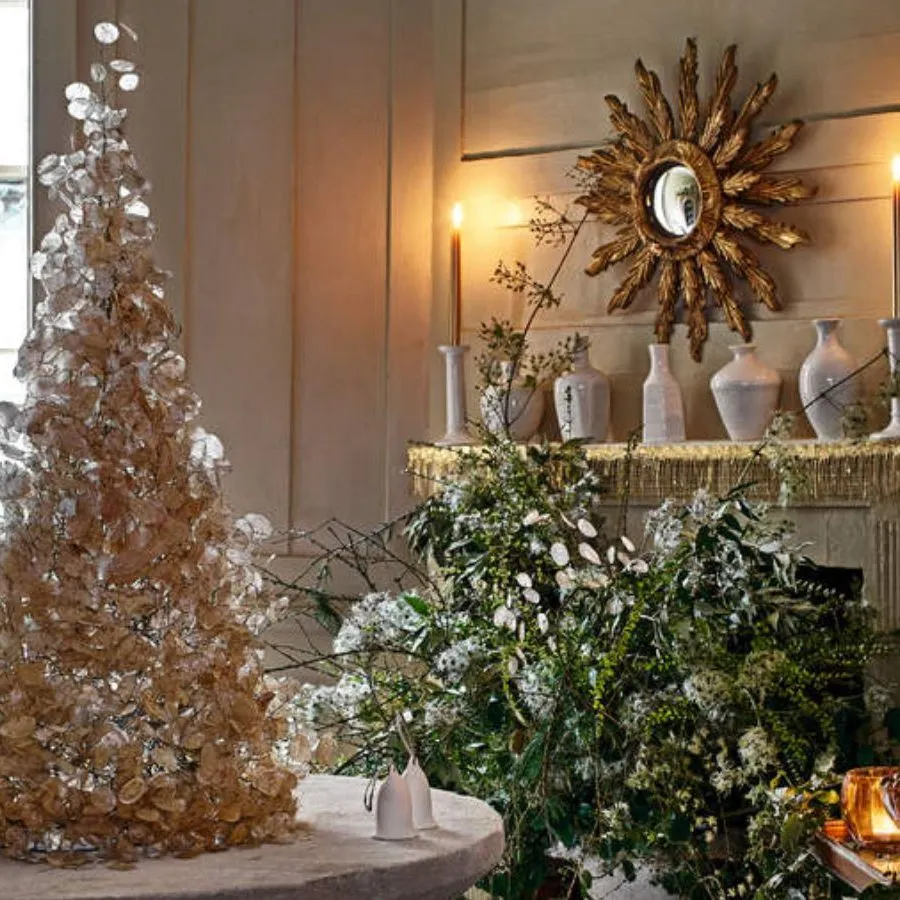
Hang the mirror first and build outward. Center it 60 to 66 inches from the floor, then let the garland cross the bottom third of the frame instead of sitting politely below it — that overlap is what makes greenery plus a mirror look intentional rather than stacked. One more number: taper candles should clear the garland by 4 inches of vertical air, or they read as buried. Thin tapers, never pillars, which eat the negative space this vignette depends on.
3. A Miniature Village With Snow Blankets and Paved Roads
The paved roads. Take them away and you have a nice collection of ceramic houses sitting on snow. Keep them and you suddenly have a town — with traffic, direction, and a reason for those tiny figurines to be standing where they’re standing. Most people skip this because it feels fussy, but it’s the cheapest upgrade in the whole display: a sheet of gray felt or textured paper, cut into one gently curving path. Do it once and your shelf stops being a collection and starts being a place.
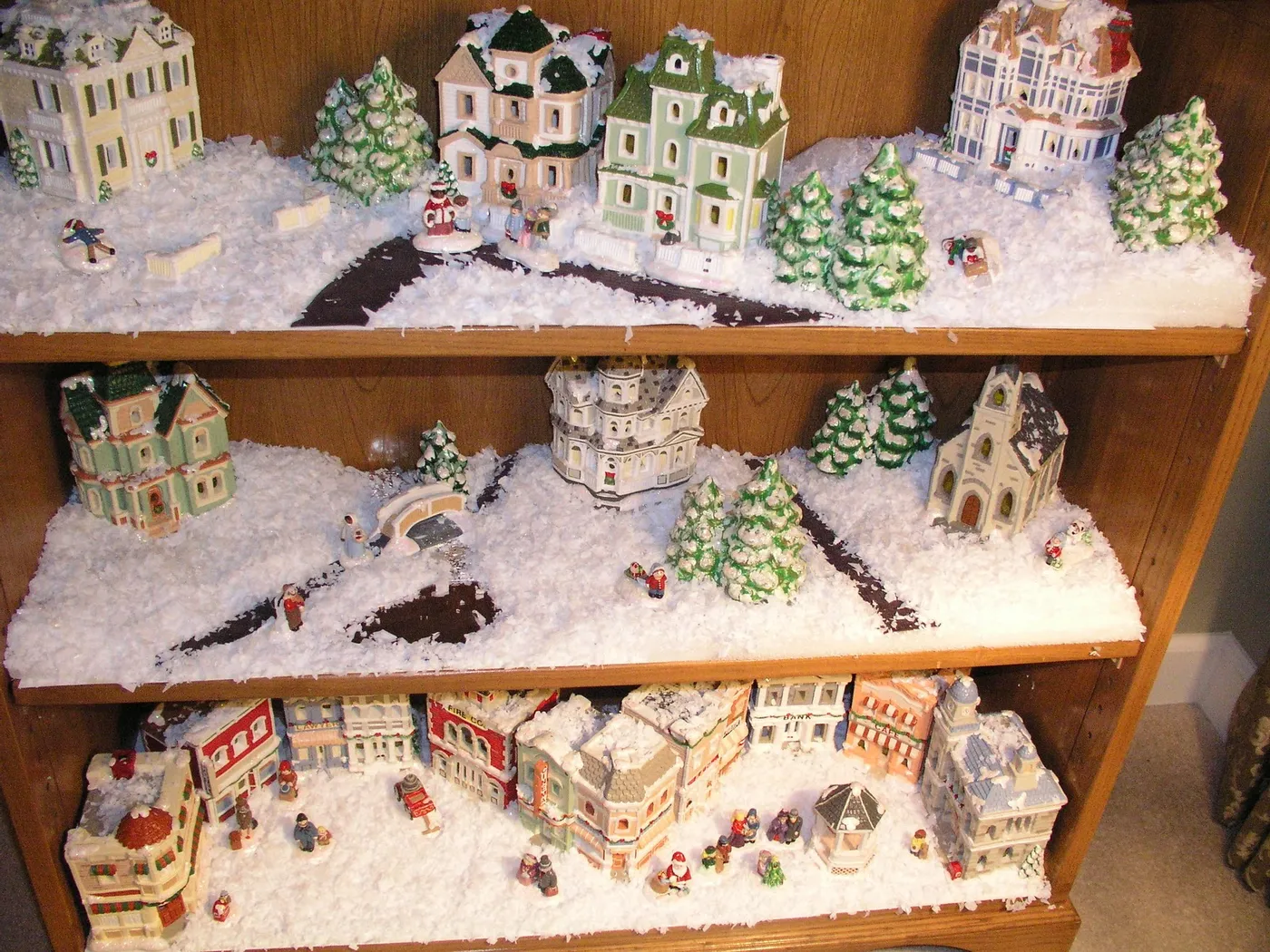
Villages are dust magnets, and faux snow batting loses its loft after about two seasons of packing and unpacking. Keep a soft makeup brush nearby for ceramic roofs, and store the batting loose in a cotton bag rather than vacuum-sealed. If you have a cat or a toddler, put the small figurines on the top tier only — the lower shelves will get swatted. Compare with Idea #18, which solves the same problem on a triangular tower that keeps small pieces up high.
4. White Mantel, Knit Stockings, and Quiet Ceramic Trees
- Measure the mantel and mark the center with painter’s tape.
- Hang the round mirror first, centered, with its middle sitting 60 to 66 inches off the floor.
- Space stocking hooks 8 to 10 inches apart — knit stockings sag when they’re crowded.
- Cluster the miniature ceramic trees on one side and leave the other side airy.
- Flank the hearth with two frosted tabletop trees at different heights to frame the firebox.
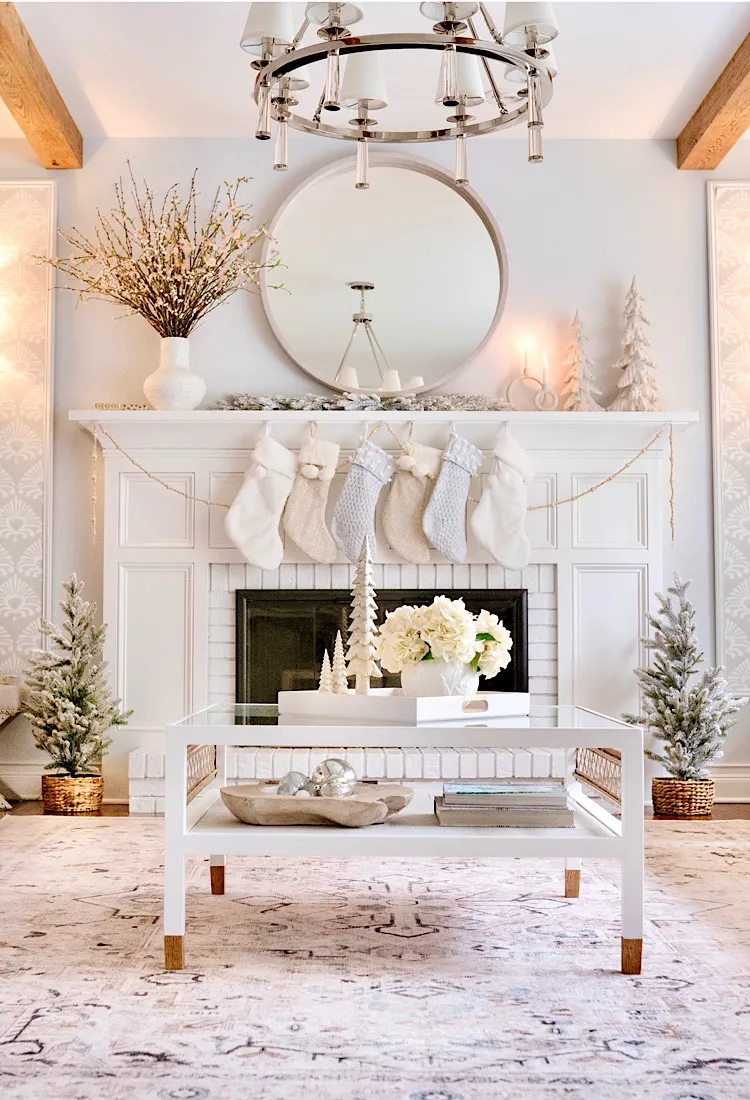
Time: about 90 minutes. Materials: hooks, tape, and greenery you already own — under $25 if you’re just repositioning what’s there.
You don’t need a custom mantel for this. Target’s Threshold ceramic trees run $5 to $15 each, knit stockings are $12 to $20, and IKEA sells a round mirror for around $40. Watch Facebook Marketplace the week after Thanksgiving — families offload whole neutral mantel lots for $30 to $50. The look depends on palette, not provenance: if every tree is white, cream, or pale green and nothing else sits on that surface, it reads expensive at $75.
5. Live-Edge Shelves Turned Into a Holiday Bar Wall
Shelves as a bar cart has been climbing on Pinterest for three seasons, and the red snowflake wallpaper is the 2026 twist. What’s driving it: people are entertaining at home more often and want holiday decor that does an actual job. A shelf of lit garland, wine bottles, and wrapped gifts is decor you use — which is why it survives past December 26 instead of getting boxed up on the 27th. It photographs beautifully, too, which is half the reason it keeps getting saved.
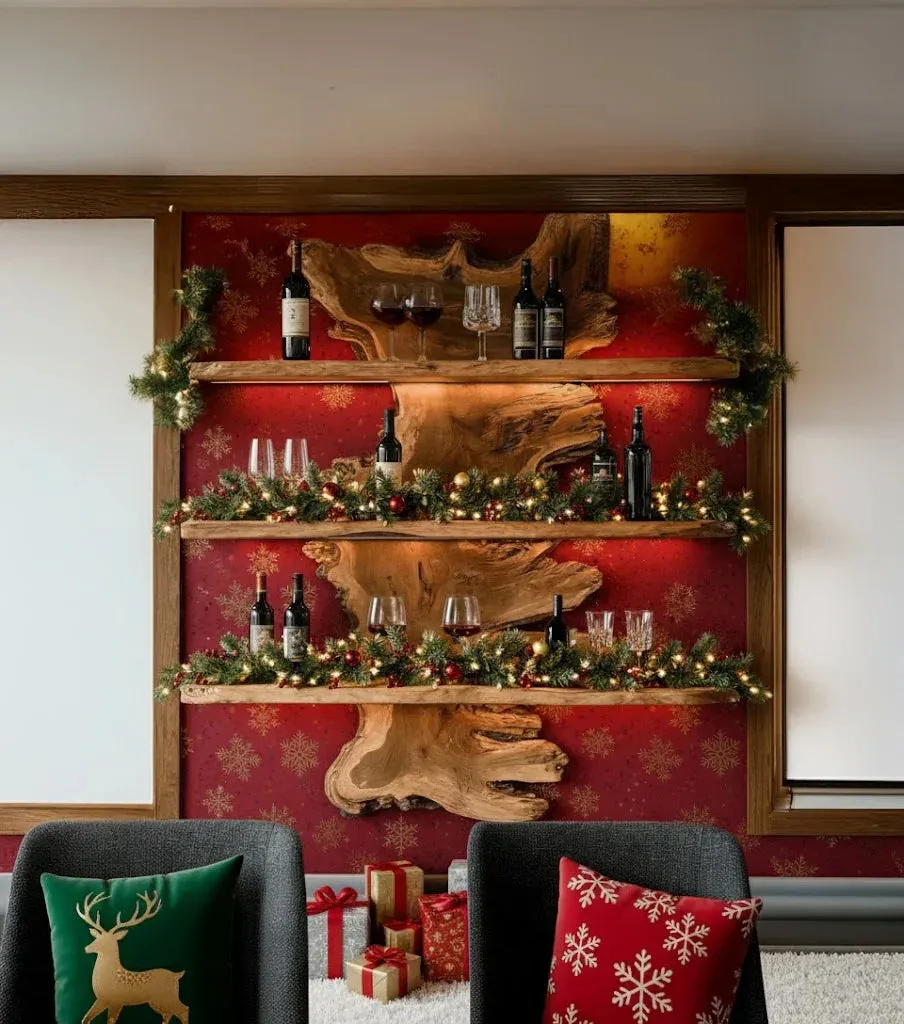
Budget 5 feet of wall width and 3 feet of open floor in front. Three shelves work with ceilings from 8 feet up; below that, drop to two or the top one crowds the ceiling line. If you’re short on width, Idea #13 uses the same three-tier idea tucked into a wall corner with a fraction of the footprint. For a full wall of holiday shelving, plan on 8 to 10 feet and treat it like a built-in.
The wallpaper. The shelves are good and the garland is good, but the gold snowflakes on red are what make this feel like the bar at a nice hotel rather than a shelf in a dining room. It’s the only element tying wood, green, and red together with pattern. Peel-and-stick versions run about $40 a roll and come off clean, which matters if you rent. Without that backdrop, this is just bottles on boards.
6. Sparse Pine Branches and Brass Tapers on a Floating Shelf
Use three objects, not five, and give each one roughly 4 inches of empty shelf. Lay the pine branches horizontally so they drape just past the front edge instead of jamming them upright into a vase. Tapers belong in weighted brass holders and should be the tallest thing on the shelf by at least 3 inches. If a flame sits level with the top of your tallest vessel, the whole arrangement flattens out and stops reading as intentional.
Restraint is a design decision, and this shelf proves it. The pine does the seasonal work, the brass adds a warm metal note, and off-white ceramics keep the whole thing from looking like a craft-store aisle. The proportions are the trick: one tall element, one low cluster, one horizontal line. There’s also a temperature play happening — cool green against warm brass — and that small conflict is why five objects can still feel alive.
7. White Velvet Santa and a Silver Sleigh in a Glam Vignette
- White-and-gold Santa figurine, 18-24 inches: $60-$180
- Metallic silver sleigh: $35-$120
- Bottlebrush trees with gold ornaments, set of 6: $25-$60
- Frosted lit tabletop tree: $40-$110
- Champagne runner or mirrored tray: $15-$45
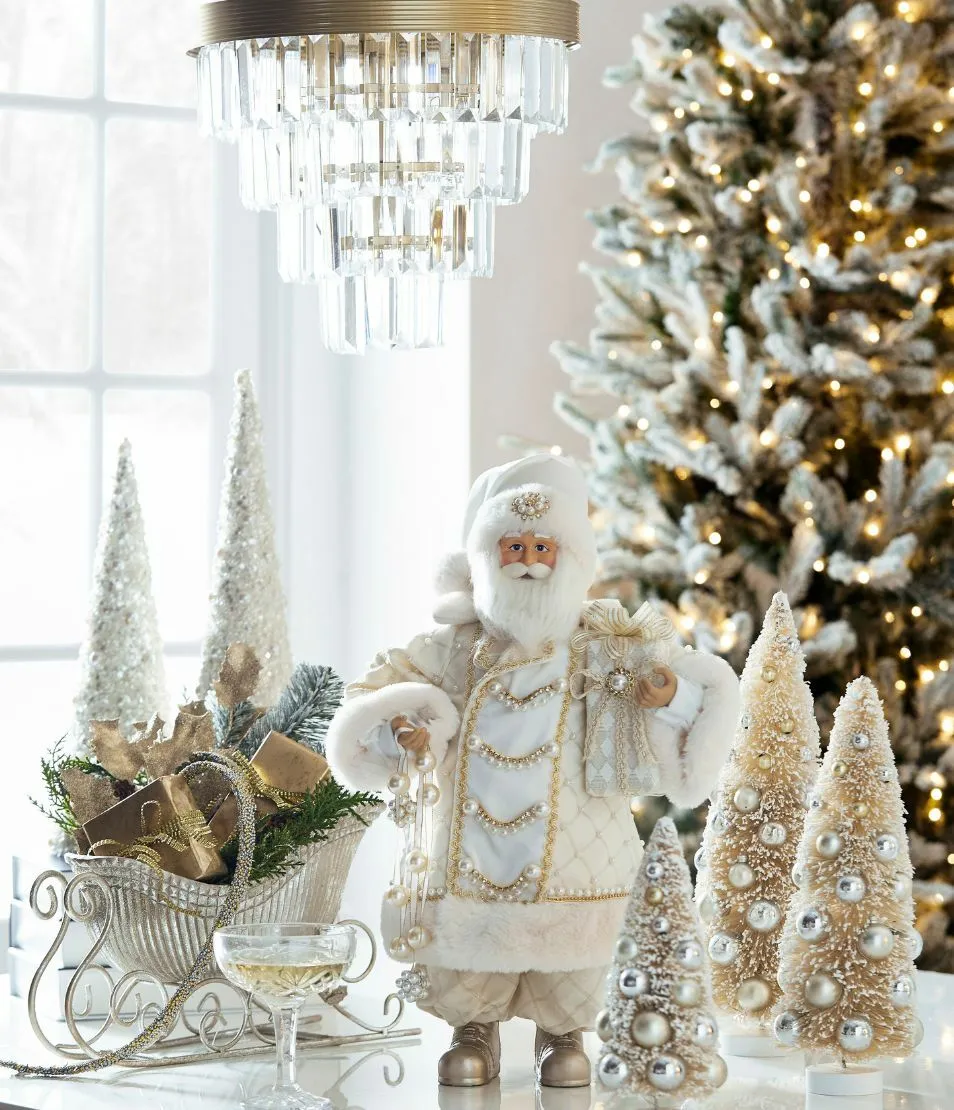
Budget alternative: skip the sleigh, spray-paint a dollar-store basket silver ($8), and fill it with small wrapped gifts — same sparkle, about $60 all in.
Metallic finishes show every fingerprint, and white velvet is a dust magnet. If this lands on a low console kids can reach, expect the Santa to lose his shine before New Year’s. Keep a microfiber cloth in a drawer and wipe the sleigh weekly. Also worth knowing: bottlebrush trees shed fine glitter for the first couple of seasons, so set them on a tray or a felt pad unless you want sparkle in the rug until March.
8. A Dark Wooden Runner With Glass, Felt, and Candlelight
60% dark base, 25% warm amber light, 15% clear glass. The dark runner anchors everything, the votive holders and the little metal house luminary pour in the amber, and the faceted glass tree handles the sparkle. Want to change the mood? White light instead of amber turns it crisp and wintry. Swap in a smoked glass tree and it goes moody. Keep the felt tree in a camel tone — it’s the only matte texture here, and it needs to stay soft.
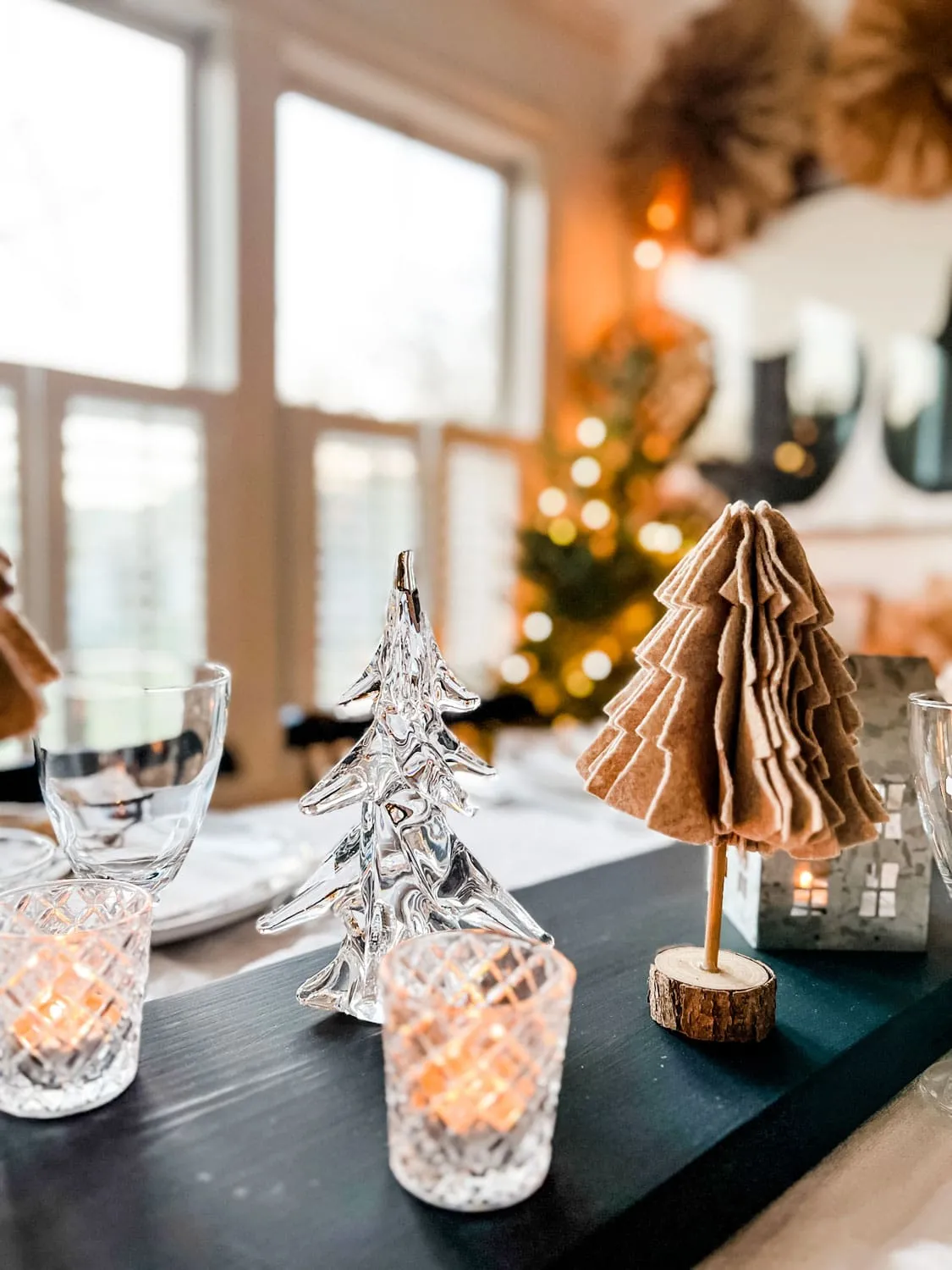
The faceted clear glass tree. Everything else on this runner is warm and opaque, so the glass is what gives the arrangement depth — you can see through it to the light behind. Remove it and you have a pleasant cluster of candles and felt with nowhere for the eye to travel. If you buy one thing this season, buy the glass. It catches candlelight at night in a way ceramic simply doesn’t, and that’s the entire mood of this setup.
9. A Tree-Shaped Wooden Shelf Built Into the Kitchen
Plan for 3.5 to 4 feet of width and 6 feet of height, with 18 inches of clearance on the hinge side if it sits near a doorway. It reads best against a flat, light backdrop like subway tile — on a busy wall it disappears entirely. Eight-foot ceilings or higher keep the pointed top from feeling cramped. Short on width? Idea #26 takes the same house silhouette and shrinks it to a single narrow wall shelf.
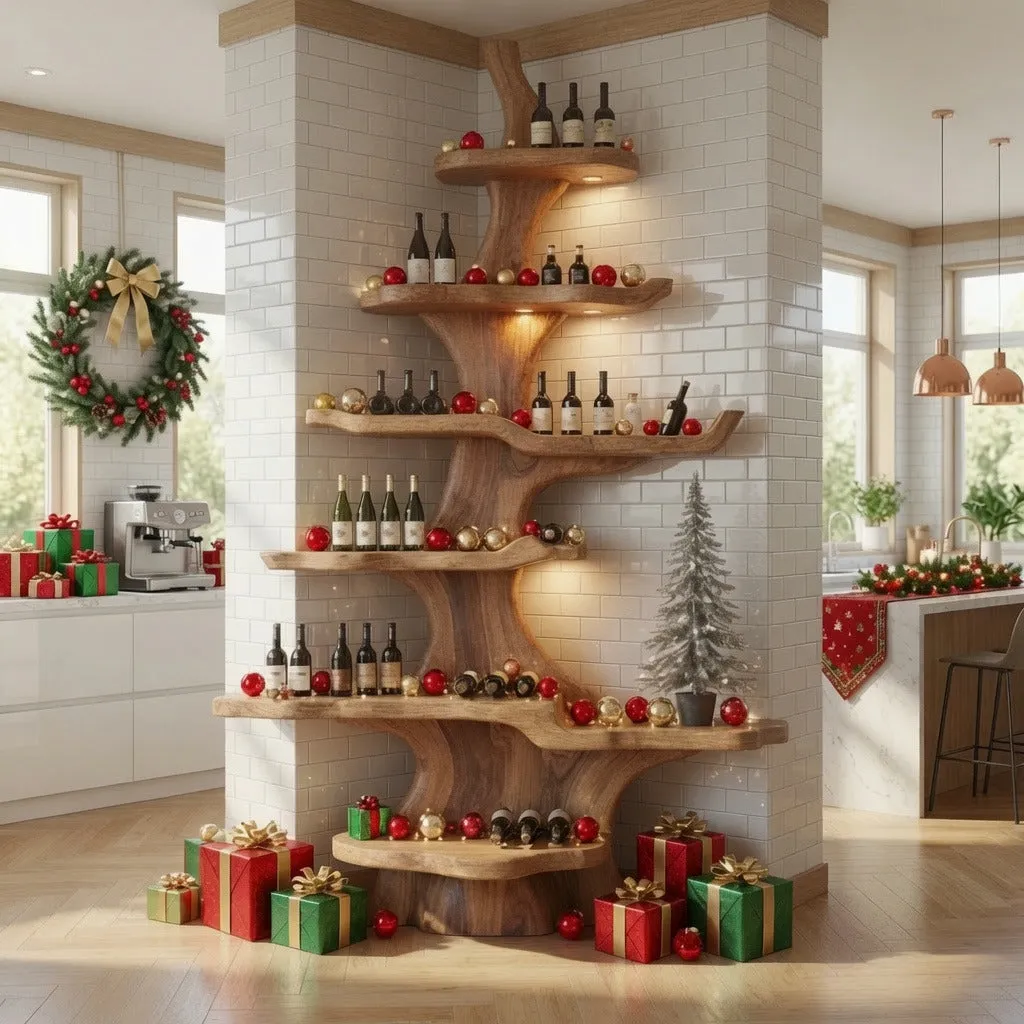
Custom carpentry for a tree shelf runs $400 to $900 installed. The IKEA version: two $30 LACK shelves cut and stacked in a pyramid, painted to match your tile, gets you 80% of the look for under $100. Or watch Facebook Marketplace in January, when people offload oversized holiday pieces for a third of retail. Keep the props cheap — thrifted wine bottles, dollar-store ornaments, and a $12 frosted mini tree do all the work.
10. An Advent Shelf Built From Numbered Wrapped Packages
- Number the packages before you wrap anything — 1-6, 7-12, 13-24 — so the count works out visually.
- Wrap everything in the same two papers and label with a gold paint pen.
- Load the weight low: biggest boxes on the bottom tier, smallest on top.
- Tuck fresh greenery and one floral stem per tier between the packages, not behind them.
- Fill the gaps with framed art and glassware so the unit never looks like an unopened delivery.
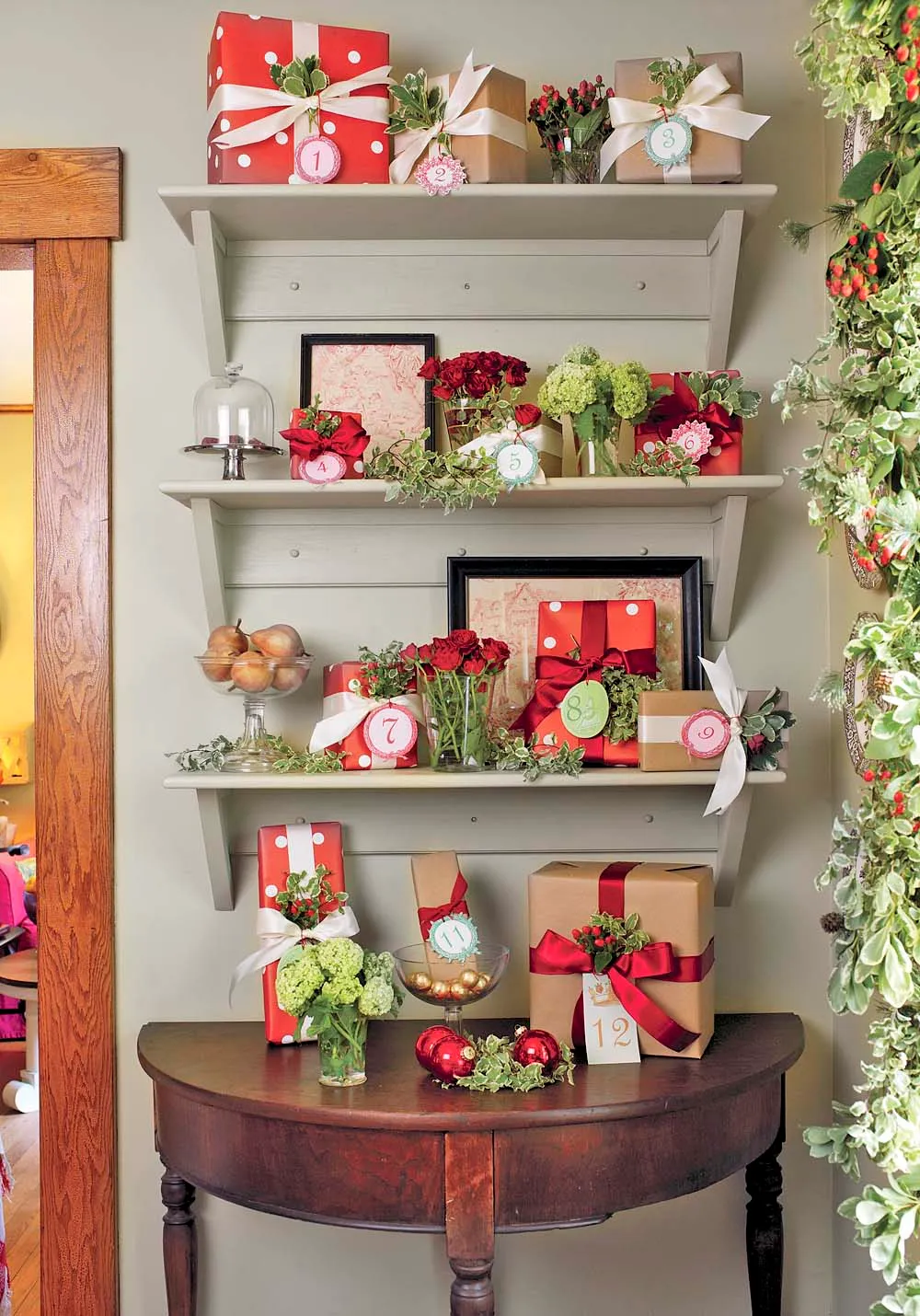
Time: 2 to 3 hours including wrapping. Materials: paper, ribbon, labels, and about $25 of fresh stems — good for 7 to 10 days.
50% kraft and white packaging, 30% red, 15% pale green, 5% dark wood. The split matters more than the specific items — keep the wrapping neutral and let the roses and the green shelf carry the color. Swap red for burgundy and it goes more grown-up. Swap kraft for matte black paper and it turns graphic and modern. That pale green unit is doing real work, too: it reads festive without a single Santa on it.
11. Gold Stockings and a Wood-Slice Mirror on Stacked Stone
Stone surrounds are gorgeous and merciless — dust settles into every crevice, and garland dragged against rough stone snags constantly. Plan on a vacuum brush attachment every two weeks and a soft brush for the mantel itself. Burlap bows shed fibers for the first month; a lint roller handles it. Real garland dries out in about three weeks indoors, so if you want this from Thanksgiving through January, buy faux evergreen. If you’d rather skip burlap altogether, Idea #1 gets the same rustic vocabulary with zero shedding.
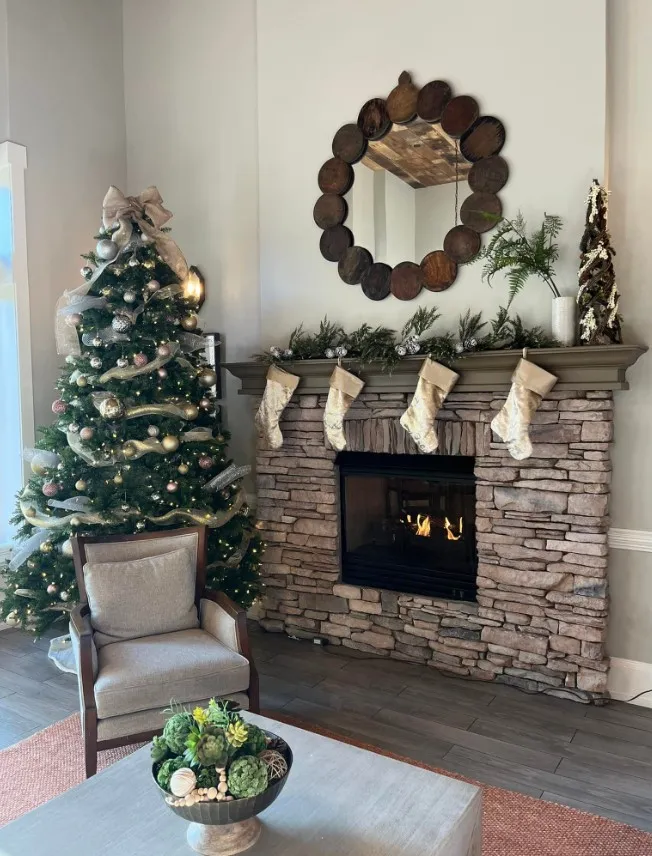
Screw small cup hooks into the underside of the mantel and wire the garland to them instead of draping it over the top — it sits tighter and won’t slide when the stockings get heavy. Hang stockings 9 to 11 inches apart and let the middle one sit directly under the mirror’s centerline; symmetry reads calmer against irregular stone. The wood-slice frame is doing the warming here. Without it, this fireplace skews cold.
12. The Red-Flag Rule: When a Shelf Is Already Full
Think of that bold red exclamation mark as the alarm going off in your own hallway. The most common way a Christmas shelf fails isn’t bad taste — it’s overcrowding. Once every inch is covered, the eye has nowhere to rest and the whole display flattens into a red-and-green blur. If you can’t name the three objects you’d rescue in a fire, there are too many. Take one tier, place three things on it, and leave the rest of the surface empty on purpose.
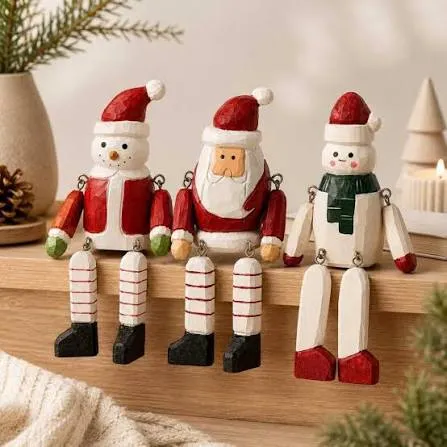
- Clear the shelf completely and start from bare wood.
- Put back only the pieces you genuinely love, one at a time.
- After each addition, step 6 feet back and check whether the earlier pieces still read.
- Leave at least 30% of the shelf surface empty — yes, really.
- Photograph it on your phone; the camera catches clutter your eye forgives.
Time: 20 minutes. Cost: nothing.
13. Three Corner Shelves, Streaming Sunlight, and Sheer Curtains
Live-edge corner shelves run $80 to $200 each from a maker, or about $35 if you buy plain pine brackets and sand the front edge yourself. The rest is thrift math: mini bottlebrush trees at $2 each, small wrapped boxes using paper you already own, and greenery cut from a $6 grocery-store bundle. Facebook Marketplace in early December is full of people offloading whole holiday lots for $40. Total for this corner: roughly $95 if you’re patient.
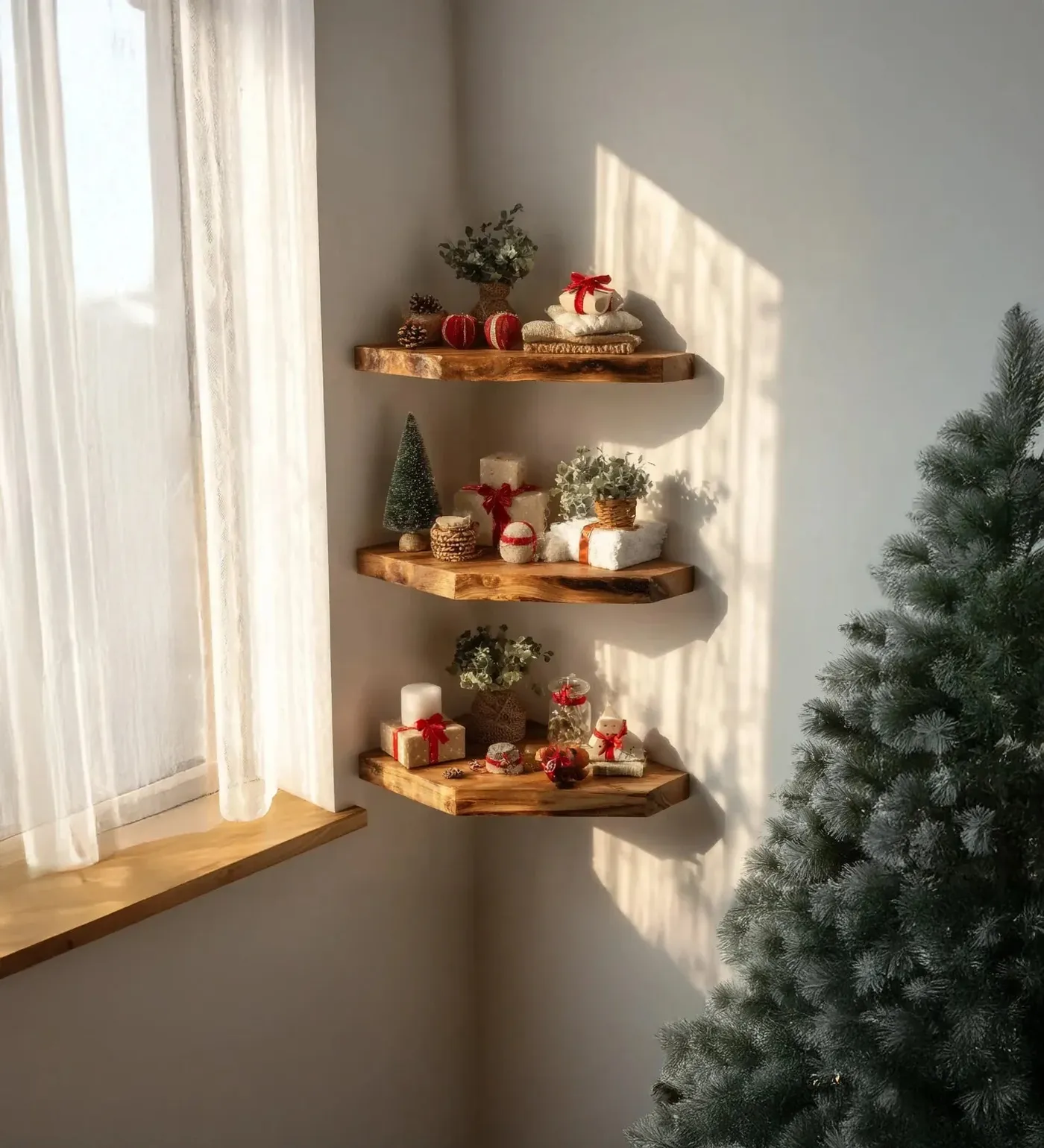
Two things are working together. The shelves are staggered at three different heights, so your eye moves diagonally instead of stepping straight up — that’s what keeps a corner from looking like a ladder. And the light is doing half the decorating. Sheer curtains soften the incoming sun, turning the white wall into a reflector and letting the greens and reds pop without a single spotlight. In a dark corner, this exact look falls flat.
14. A Pastel Cardboard Village Above Stacked Books
The cake stand risers. They lift the pastel houses off the shelf plane so the village climbs in two directions — up and back — instead of sitting in a flat row. It’s a $10 fix that changes everything, and it’s the reason this reads as a scene rather than a lineup. Cake stands, inverted bowls, or stacked books all work. Keep the risers white or bare wood so they disappear into the snow batting.
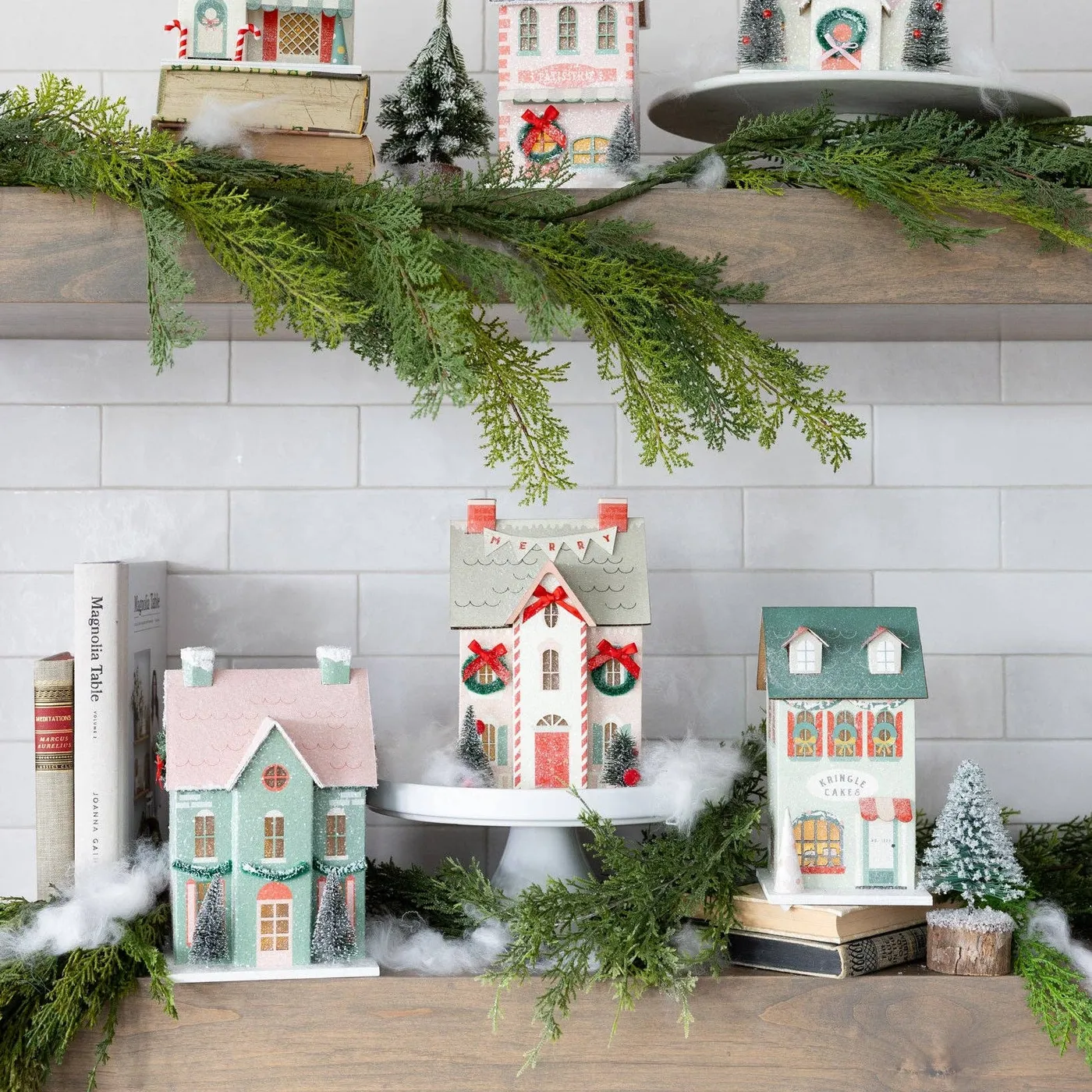
This wants a shelf at least 30 inches wide with 14 to 16 inches of clearance between tiers, so the taller houses and the flocked bottlebrush trees don’t collide. It’s forgiving in small rooms because the pastel palette keeps the visual mass low. Working with a 20-inch shelf? Lose the risers and use two houses instead. Bigger wall, bigger scene — the palette is what scales, not the props.
15. An Olive Credenza With a Honeycomb Paper Tree
Honeycomb paper decor is one of the quieter comebacks of the last two years — it’s inexpensive, it folds flat, and it stores in a folder. Pairing it with an olive credenza against a matching green wall is very much of the moment, too: tone-on-tone paint has been the dominant styling move in 2026, and holiday decor is following the rooms it lives in. The bonus is that this vignette still looks good in January, which is more than most red-and-green setups can claim.
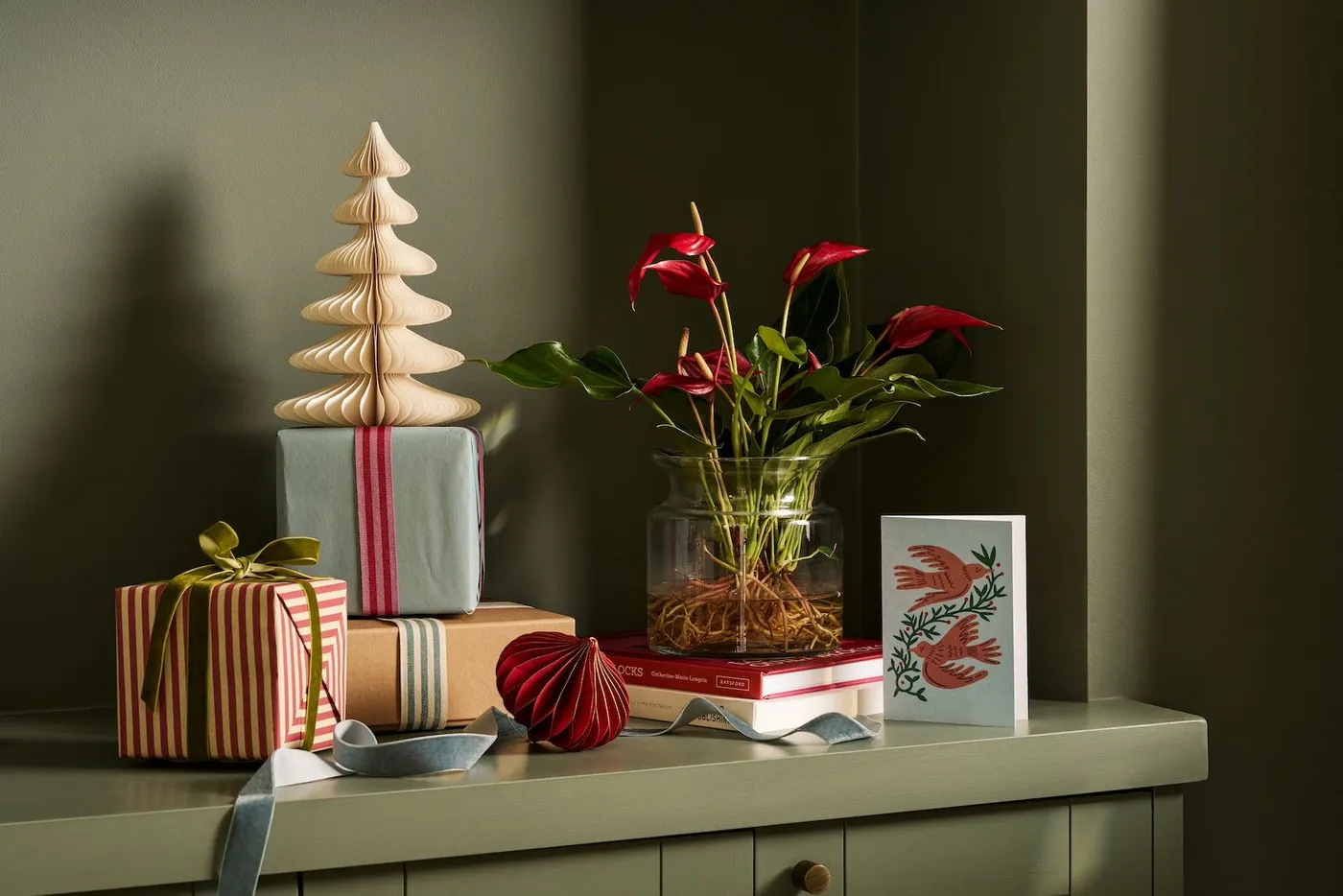
Tone-on-tone styling is unforgiving in low light. Green on green goes muddy in a north-facing room with one overhead fixture, so plan on a lamp warming the surface from each side. Honeycomb paper crushes permanently if you store it under anything heavy — keep it in a box by itself, unfolded. And if you’re styling a plant with visible roots in a glass vase, water it away from the shelf edge; one tip-over and the credenza finish is finished.
16. A Dense Garland Loaded With Velvet and Vintage Figures
- Start with a faux evergreen base and fluff every branch outward — a half-fluffed garland reads thin no matter what you pile on.
- Wire in the pinecones first; they’re the heaviest and they define the shape.
- Layer in deep red velvet ribbon in loose 8-inch loops that dip below the greenery.
- Cluster gold glass ornaments in threes instead of spacing them evenly — odd groupings look collected.
- Add the small figural pieces last, near the front edge where they’ll actually be seen.
- Weave the lights through the front third only, so the glow hits the ornaments and not the wall.
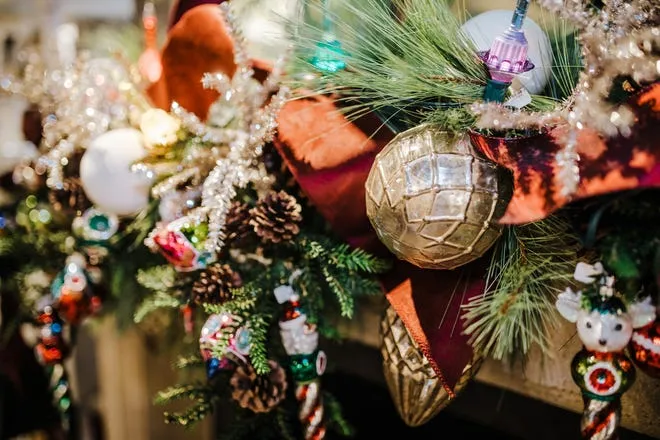
Time: about 2 hours. Materials: $60-$120 depending on how much vintage you already own.
Real pinecones drop sap and debris — bake foraged ones at 200°F for an hour first, or buy cleaned ones from a craft store. Velvet ribbon holds whatever crease it dried in, so store it loosely rolled around a cardboard tube. Glass ornaments chip when they knock together, and they will, so wrap each one. Expect this density of garland to collect dust fast, too. A hairdryer on cool, aimed from 6 inches away, is the fastest fix.
17. Nutcracker Candle Holders Standing in Artificial Snow
Two figures maximum, at least 6 inches apart, and stand them on a wood log slice rather than directly on the shelf — the slice gives them a stage and catches the snow dusting. Choose twisted or ribbed tapers over smooth ones; texture catches the fairy-light glow behind them. Keep that background light source 2 to 3 feet back and slightly out of focus. At 12 inches it reads as a lamp. At 3 feet, it reads as magic.
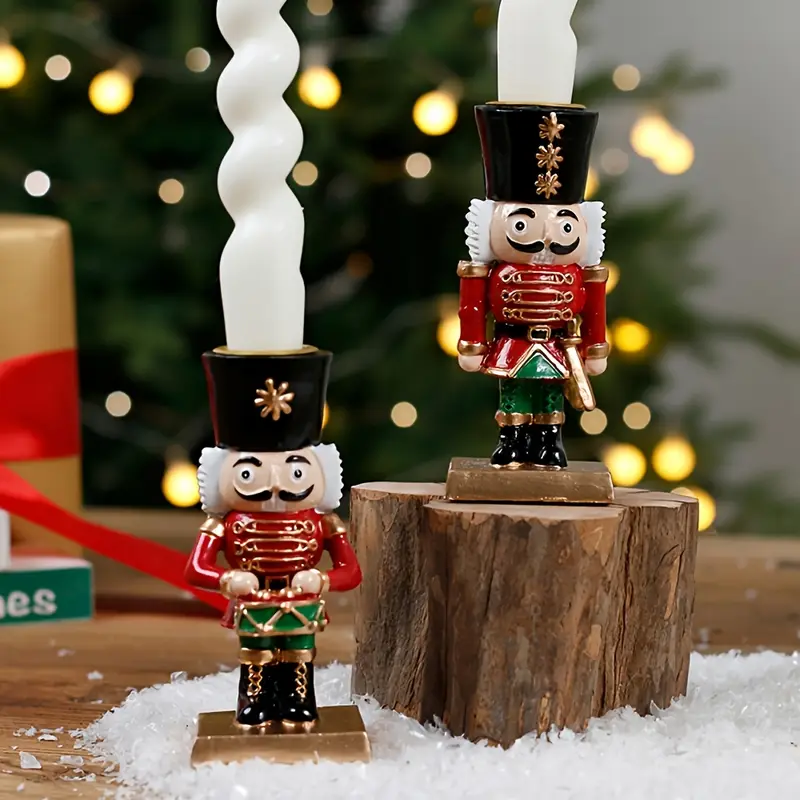
Open flame next to dried branches deserves a second thought. If your greenery is real, swap in flameless tapers with a warm-white flicker — the good ones are convincing at 3 feet. Artificial snow drifts everywhere, and it’s essentially plastic flocking, so keep it off surfaces where kids eat. Vacuum the shelf with a hose attachment rather than wiping it; a cloth just smears the stuff into the wood grain.
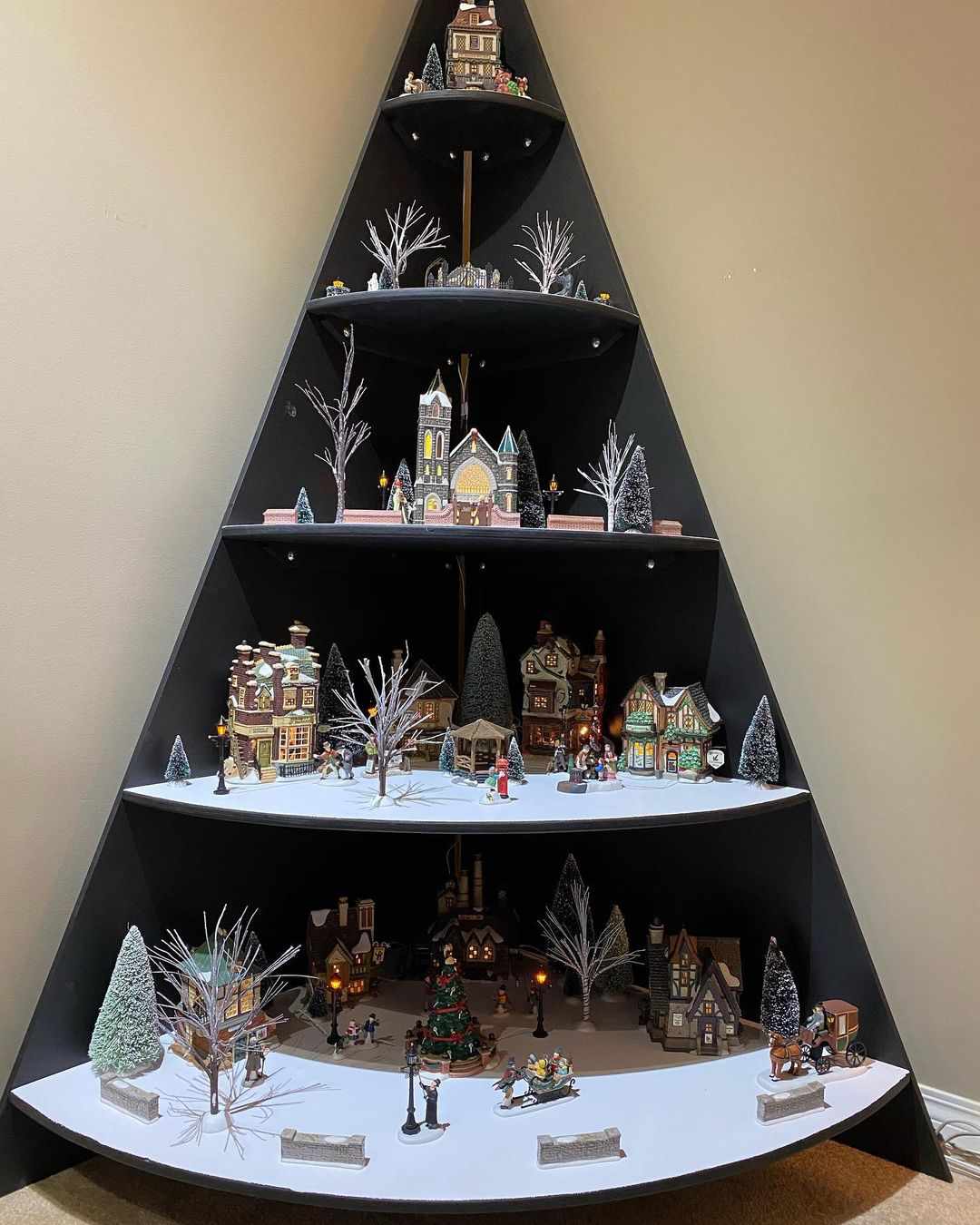
18. A Triangular Tiered Stand for the Family Nativity Set
This unit earns its square footage: 30 to 36 inches wide at the base, roughly 4 feet tall, with dense figures at every level. It needs a plain wall behind it — a busy backsplash or gallery wall competes with the miniature architecture and both lose. Make sure the table or floor can take the weight, since a fully loaded set runs 20 to 30 pounds.
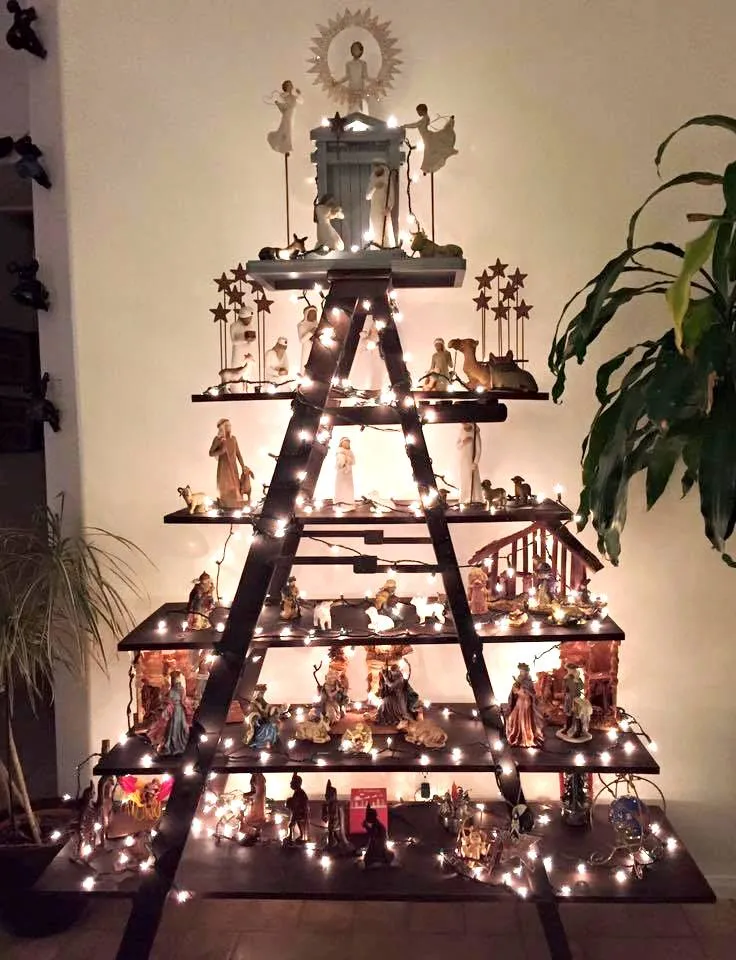
Multi-tier wooden display stands run $90 to $250 new. A three-tier plant stand or a painted step stool from Walmart does the same job for $30 to $45, and honestly reads just as well once it’s covered. Most people already own the hard part — the figurines. Starting from scratch? Thrift stores and estate sales are goldmines in January, when full sets go for under $40. An $8 strand of warm string lights finishes it.
19. A Glowing Laser-Cut House With a Small Dog at the Door
The dog silhouette by the front door. It’s a dollar detail that turns a wooden model into a story — someone lives here, someone’s waiting, and the light in the windows suddenly means something. Take it away and you have a nice laser-cut object. Keep it and people stop and look. If you can’t find a house with an animal cutout, buy a separate wooden dog shape and lean it against the base.
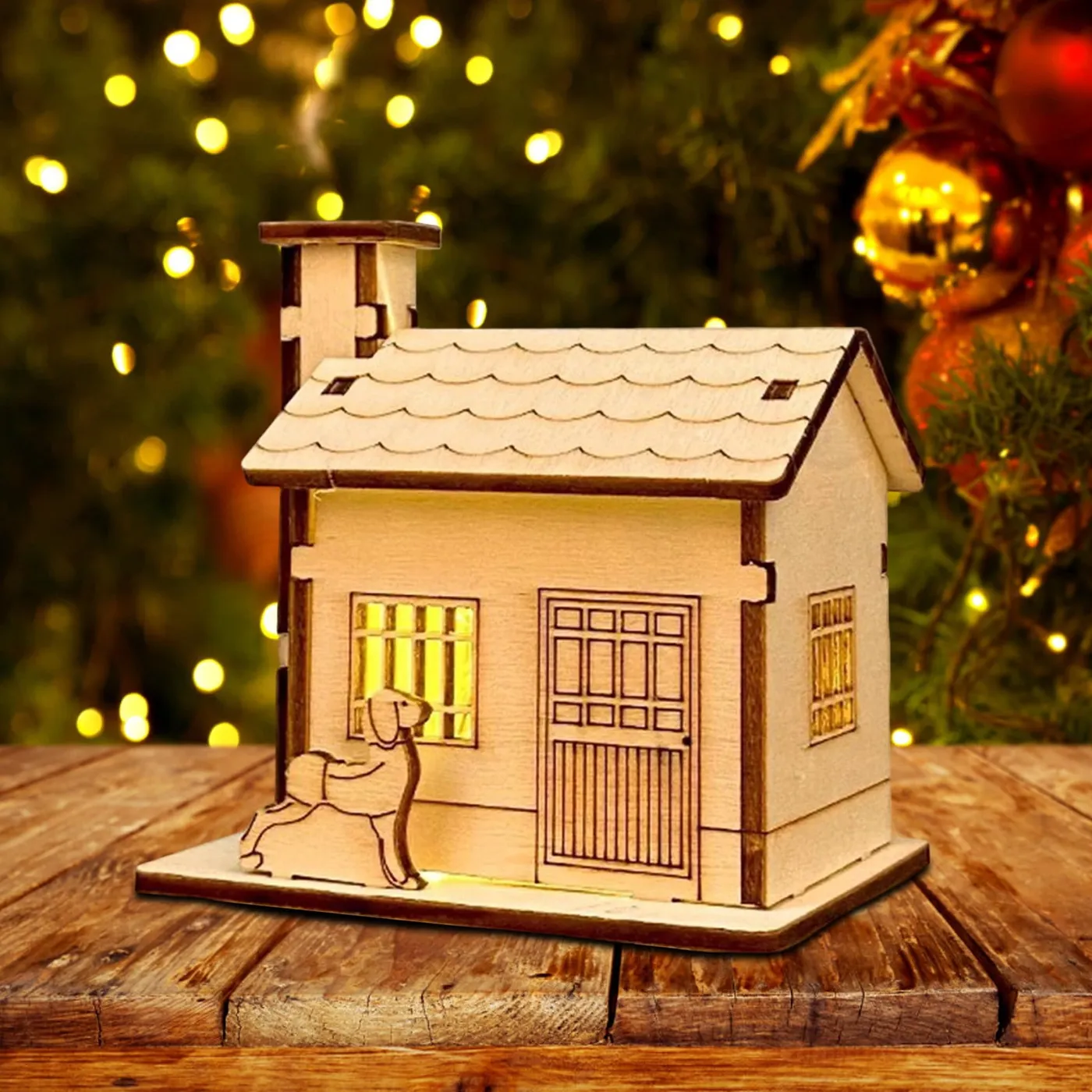
70% natural wood, 20% warm interior glow, 10% shadow. That’s the entire recipe, and it works because nothing competes with it: one material, one light source, one silhouette. Change the wood and you change the mood — walnut goes moody, raw birch goes Scandinavian, whitewash turns it into a snowy cottage. Keep the surface underneath plain, too. A raw plank or a linen runner works; patterned fabric breaks the spell instantly.
20. Ceramic Houses and Slim Tapers on a Bare Floating Shelf
Scale is the whole story. The houses are small, the trees are small, the candles are slim, and the shelf is long — so the empty space around each object is doing the decorating. There’s deliberate repetition, too: three ceramic houses in slightly different sizes create a rhythm, tied together by a matte white finish that doesn’t match exactly. Warm beige candles add the only soft edge in an otherwise hard-lined arrangement.
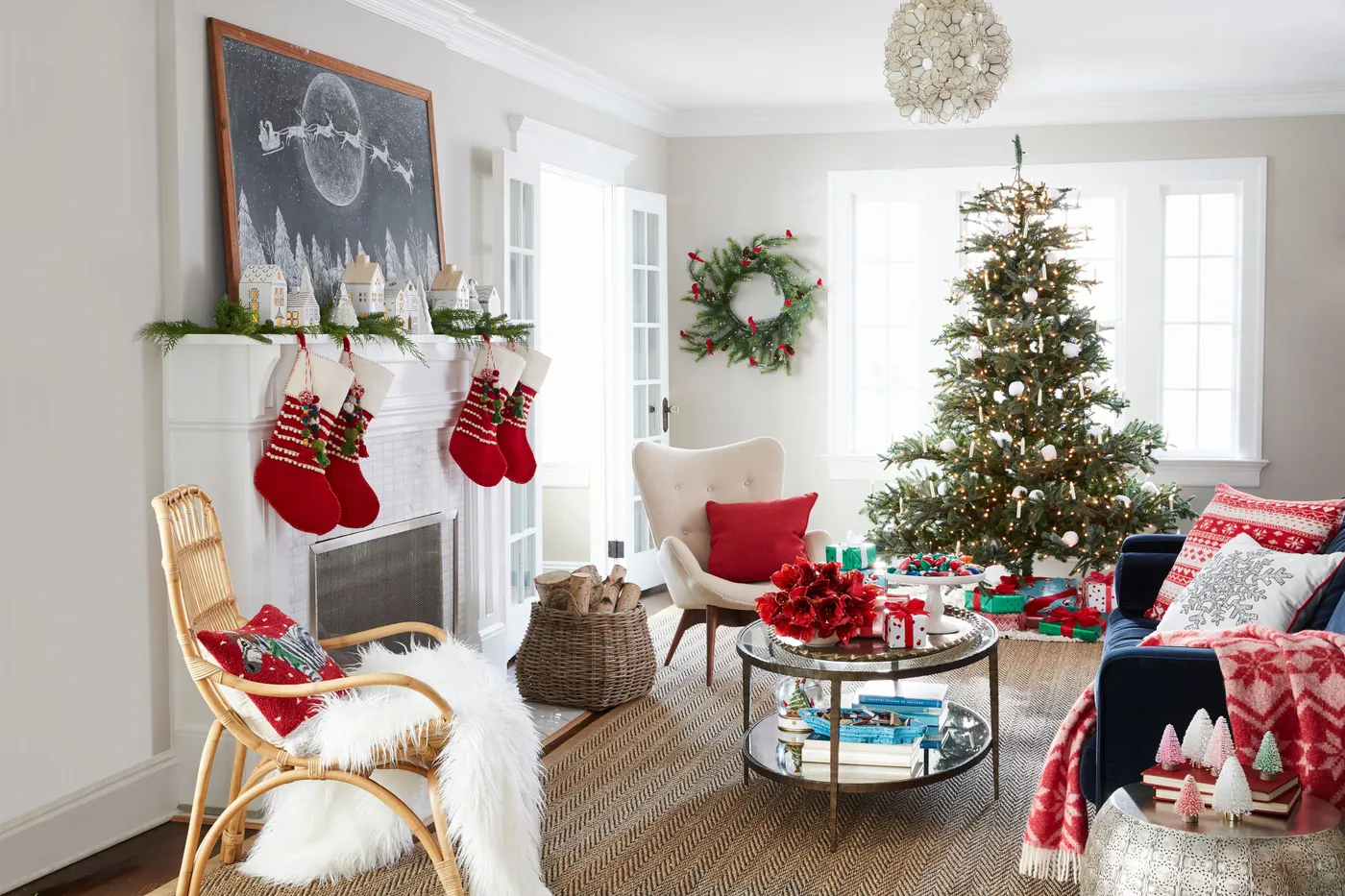
Pick one candle height and stay with it — mismatched tapers are the single most common reason a minimal shelf looks accidental. Then do the math: your tallest object should be roughly two-thirds the height of the gap between the shelf and whatever sits above it. Place the smallest house on the outside edge so the eye enters low and exits low. For a warmer spin on the same restraint, see Idea #6, which swaps ceramics for pine.
21. Shiplap Shelves With Potted Evergreens and Tiny Houses
55% white shiplap, 30% natural wood, 15% muted green, with a single charcoal note for weight. Shiplap gives you texture for free, so what sits on top should stay quiet — that’s why three or four objects per shelf is plenty and nothing here is shiny. Swap the evergreens for olive and it warms up. Paint the shelves white and they vanish into the wall, which is a perfectly valid move in an already busy room.
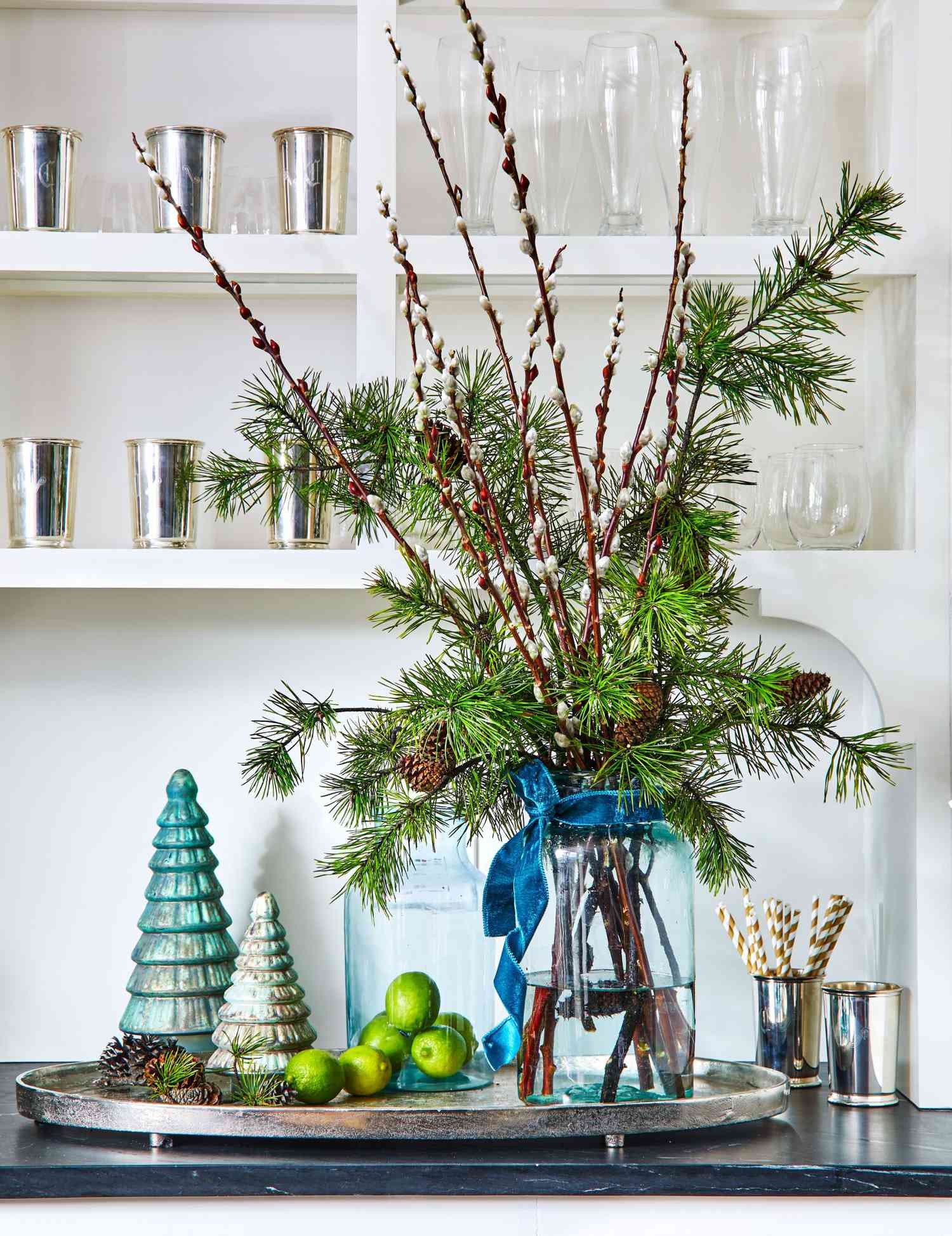
Shiplap plus floating shelves is a lot of horizontal line. Under a low ceiling or a slanted roofline, it can make a wall feel wider than it is tall — not a problem, just keep the shelves short and stagger them. Also: small potted evergreens want water twice a week indoors, where forced-air heat dries them out fast. Put a plastic liner inside any container that isn’t sealed, and check your shelf hardware rating before you load books onto it.
22. A Bookcase Packed With Vintage Santas and Red Books
Vintage figurines are usually painted plaster, resin, or chalkware, and all three chip when they knock together. Leave an inch of air between pieces and put museum putty under anything near a walkway. Red vintage book spines fade in direct sun within a year, so keep this bookcase off a southern window wall. Dusting is a two-tool job: a soft brush for the figures, a microfiber cloth for the wood.
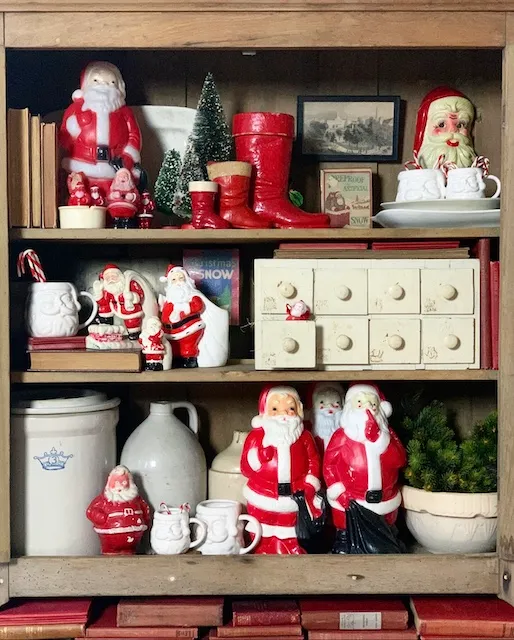
Collected displays are having a real moment, and it isn’t purely nostalgia — it’s a reaction against the matching-set look that ruled holiday decor for a decade. People want shelves that look assembled over time, because they were. Vintage Santa figurines from the 1950s through the 1970s are still affordable at estate sales and flea markets, usually $5 to $25 each, and that mid-century red-white-and-black palette slides easily into modern rooms. Which is exactly why this keeps resurfacing.
23. Blue-and-White Vases Holding Pine and a Big Red Bow
- Pick vases with wide mouths — narrow openings crush branches and stop you from getting any spread.
- Fill the large vase with water and add a floral preservative to slow needle drop.
- Cut branches at a 45-degree angle and strip the bottom 4 inches so nothing sits below the waterline.
- Set the tall arrangement slightly off-center on a wooden board, then tuck the smaller vase in front.
- Tie the velvet bow with a 6-inch tail so it drapes past the rim instead of sitting on it.
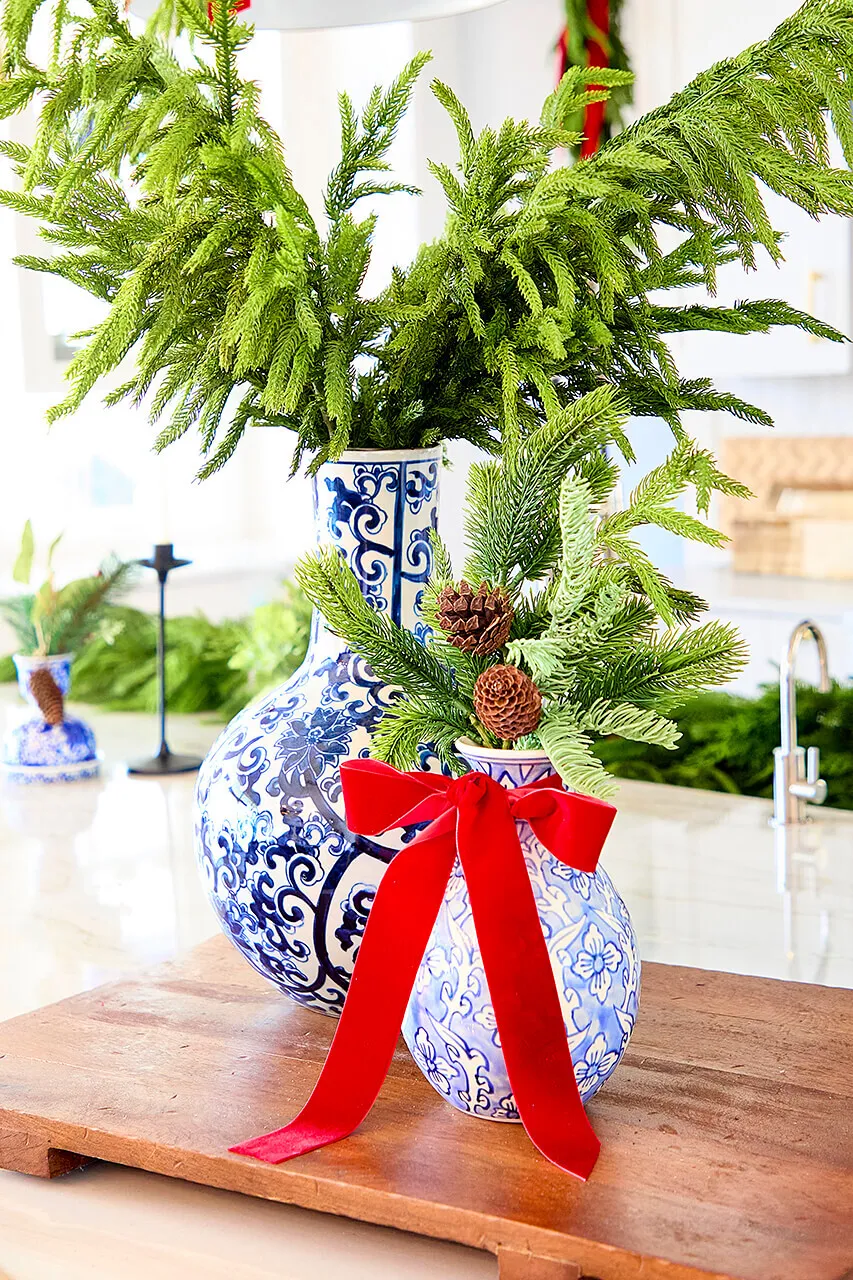
Time: 30 minutes. Materials: $20-$45 in greenery and ribbon — the vases are a lifetime purchase.
- Large blue-and-white ceramic vase: $30-$120
- Small companion vase: $15-$45
- Fresh pine branches: $12-$25
- Pinecones, foraged or bought: $0-$8
- Wide red velvet ribbon, 2 yards: $8-$18
- Wooden riser board: $12-$30
Budget alternative: thrift the vases ($6-$15 each is normal at Goodwill), forage the pine, and buy ribbon on sale the weekend after Thanksgiving — the same look lands around $35.
24. A Chunky White Yarn Garland With Sage and Gold Jingle Bells
Yarn garlands sink. Loop one over the mantel, let the weight of the strands pull it flat, then push the yarn back into shape by hand every few days. Keep it 6 inches from any flame — acrylic melts and even cotton scorches. Most importantly, pair white with a dark anchor, like the gray ceramic vase here. All-white styling with nothing to push against doesn’t photograph well, and it doesn’t look much better in person.
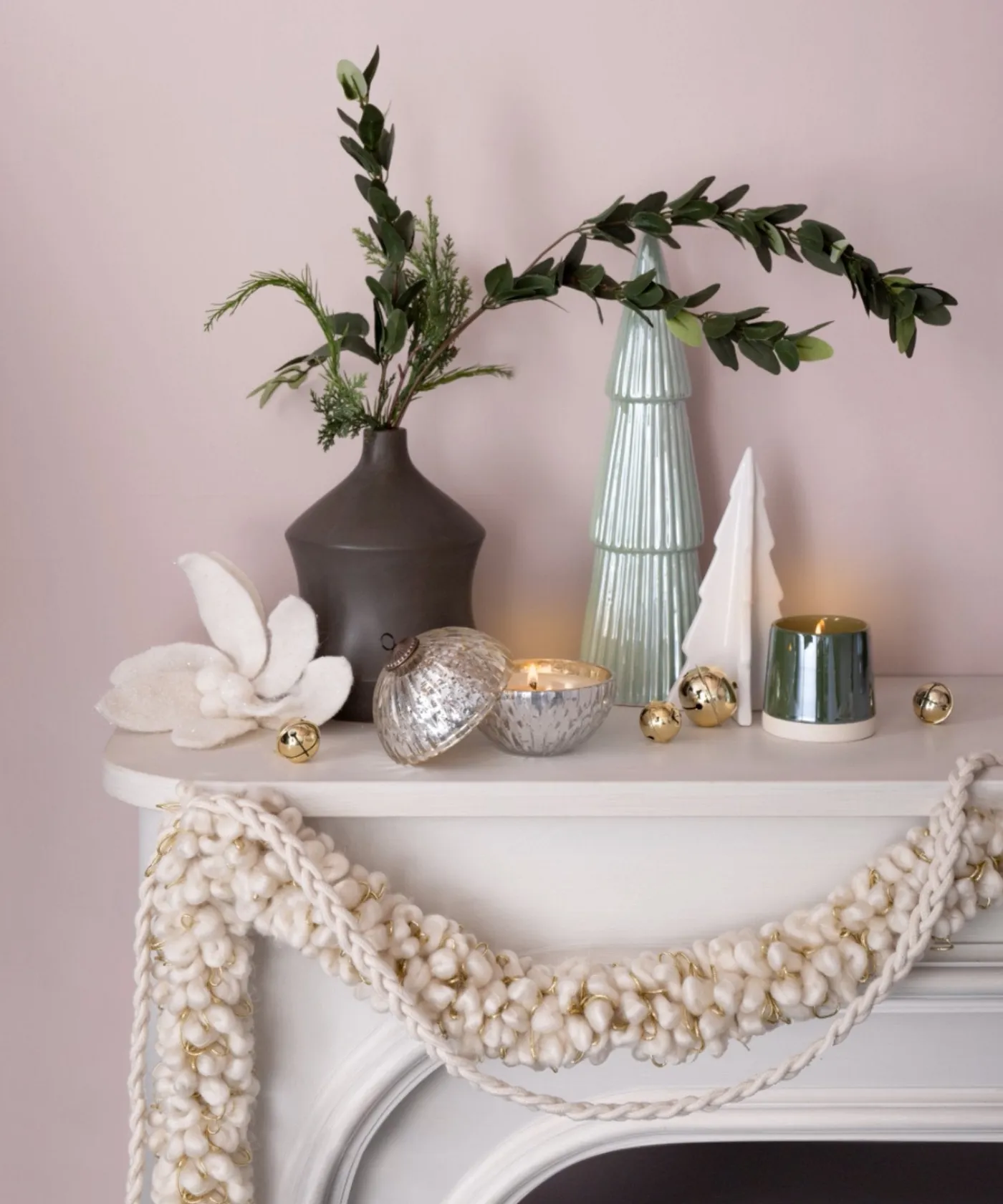
The sage green ribbed ceramic tree. It’s the only real color in the arrangement, and it’s what keeps a white-on-white mantel from dissolving. Without it, the yarn, the candles, the bells, and the white tree figures all blur together. With it, the eye finally has somewhere to land. Sage is also the safest accent to build around — it plays nicely with gold, silver, brass, and green, so you can redeploy it in a completely different scheme next year.
25. A Long White Shelf With a Muted Bottle-Brush Forest
Long and low is the rule here: at least 4 feet of shelf, mounted 14 to 18 inches above whatever sits beneath it, so the objects never feel trapped. It’s built for wall space rather than floor space, which makes it a good fit for apartments and narrow rooms. With 9-foot ceilings, mount higher and add a second shelf 12 inches above. Low ceilings should stick to one shelf and let the width do the work.
Bottlebrush trees are the affordable part — Target sells sets of five for $10 to $15, and IKEA’s winter collection usually lands under $10 per piece. White ceramic houses run $5 to $20 at HomeGoods, and string lights are $8 at Walmart. For the shelf itself, a $25 IKEA LACK works fine as long as you keep the load light. Under $90 gets you the entire scene, and most of it comes back out next December.
26. A House-Shaped Shelf Styled With a Gray Knitted Gnome
60% light natural wood, 25% white ceramic, 10% gray, 5% dark green. It’s a tight palette, and that’s exactly why it holds. Choose one accent — the gray knitted gnome here — and keep everything else in the wood-and-white lane. Swap gray for deep red and it turns classic Christmas. Swap the ceramics for matte black and it goes modern Nordic. The rules don’t change: wood tone first, accent second, greenery last.
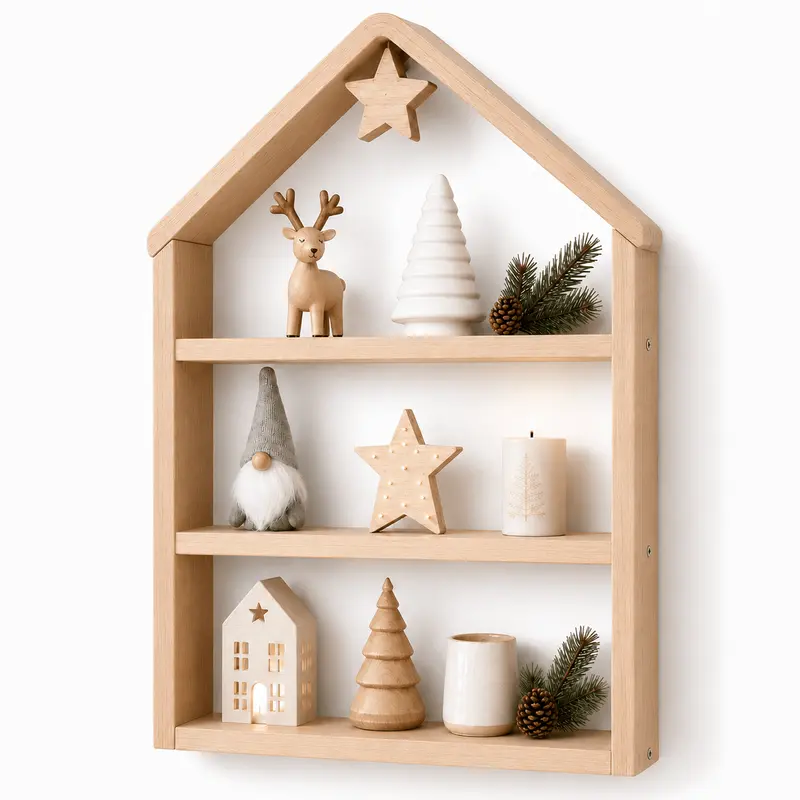
The shape does the heavy lifting. A house-shaped shelf frames its contents the way a shadow box does, so even sparse styling looks deliberate. Inside that frame, the mix matters: wood figurines, ceramic houses, a knitted gnome, and pine sprigs give you four textures in a space the size of a shoebox. That variety, held inside a strict palette, is why the whole thing reads as designed rather than decorated. One last thing — before you mount anything, skim the common mistakes below. Load ratings quietly ruin more shelves than bad taste does.
Pick One Shelf, One Saturday, One Good Light
Start with the shelf you actually see every day — the one by the coffee maker, or the one you pass on the stairs — and give it the three-object treatment before you buy anything new. Most of these looks come down to light, height variation, and the discipline to leave 30% of the surface empty. 📌 Pin the one you love most so it’s waiting for you next November.