
There is a particular kind of December panic that hits when the house two doors down starts glowing and your yard is still, technically, a yard. You have saved about forty photos of outdoor Christmas decorations on Pinterest and now you need to figure out which ones you can actually pull off before the first hard freeze.
We spent serious time digging through Home Depot, At Home, Walmart, Target, and Lowe’s to bring you only what is worth hauling out of the garage this year, across price points from roughly $18 to $1,200.
Inside you will find 32 curated ideas, from warm-white traditional displays and nostalgic character cutouts to inflatable maximalism, winter planter styling, and porch-and-patio glow. Budget and luxury versions sit side by side so you can pick your lane without guessing.
In 2026 the shift is toward layered warm-white lighting with one loud, personality-driven focal moment, plus a big appetite for containers and greenery that carry through February instead of getting boxed up on the 26th. And stay until the end, because we break down the most common mistakes that can ruin these looks. 📌 Save this to Pinterest for later, you will want to revisit these ideas.
1. Solar Snowman and Snowflake Path Lights in Fresh Snow
Solar stakes live or die by winter sun. Set them 6 to 8 feet apart and about 15 inches off the walk edge so the panels clear the shovel path, then angle every panel due south. In December expect 4 to 6 hours of glow, not the 8 to 10 you get in July. Put the snowmen where guests actually walk and let the snowflakes carry the shaded back half of the bed.
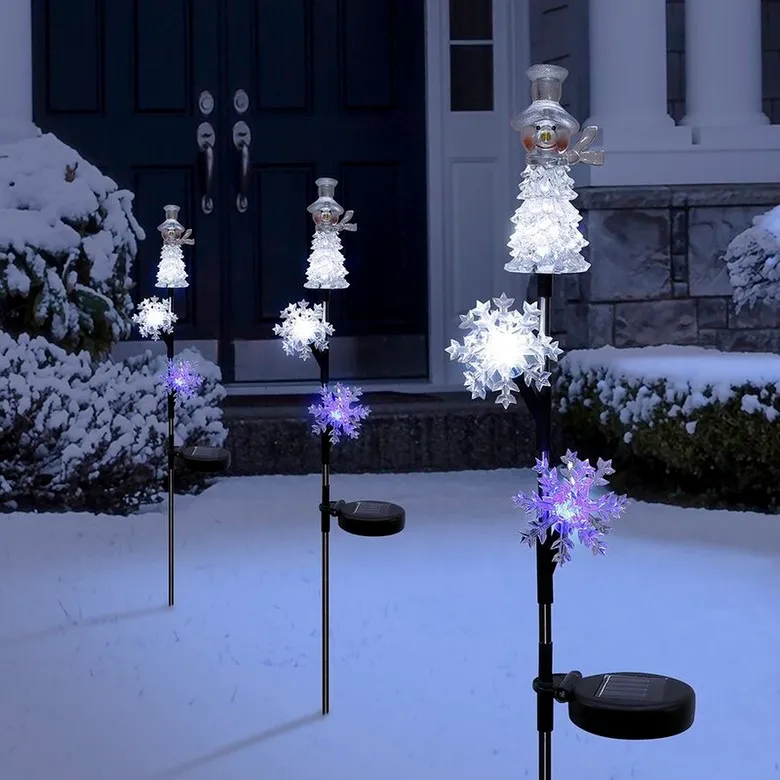
Here is the part nobody mentions at the store: a hard freeze can crack cheap plastic toppers, and a plow pile can snap a stake in half. Pop the figures off before a heavy snow event, leave the stake in the ground, and reattach in ten seconds. Also check whether your street gets a leaf or trash route. That is how most people lose a decorative light in January.
2. Tree-Wrapped Warm White Canopy on a Red Brick House
Wrapping a mature tree is not decoration, it is architecture. Going up the trunk and out along the main limbs puts light at eye level, so the whole yard reads as one continuous glow instead of a scatter of separate objects. The other smart move is color restraint. Everything here is warm white and red, which lets the brick do the talking. Add three more hues and that canopy stops looking elegant and starts looking like a carnival.
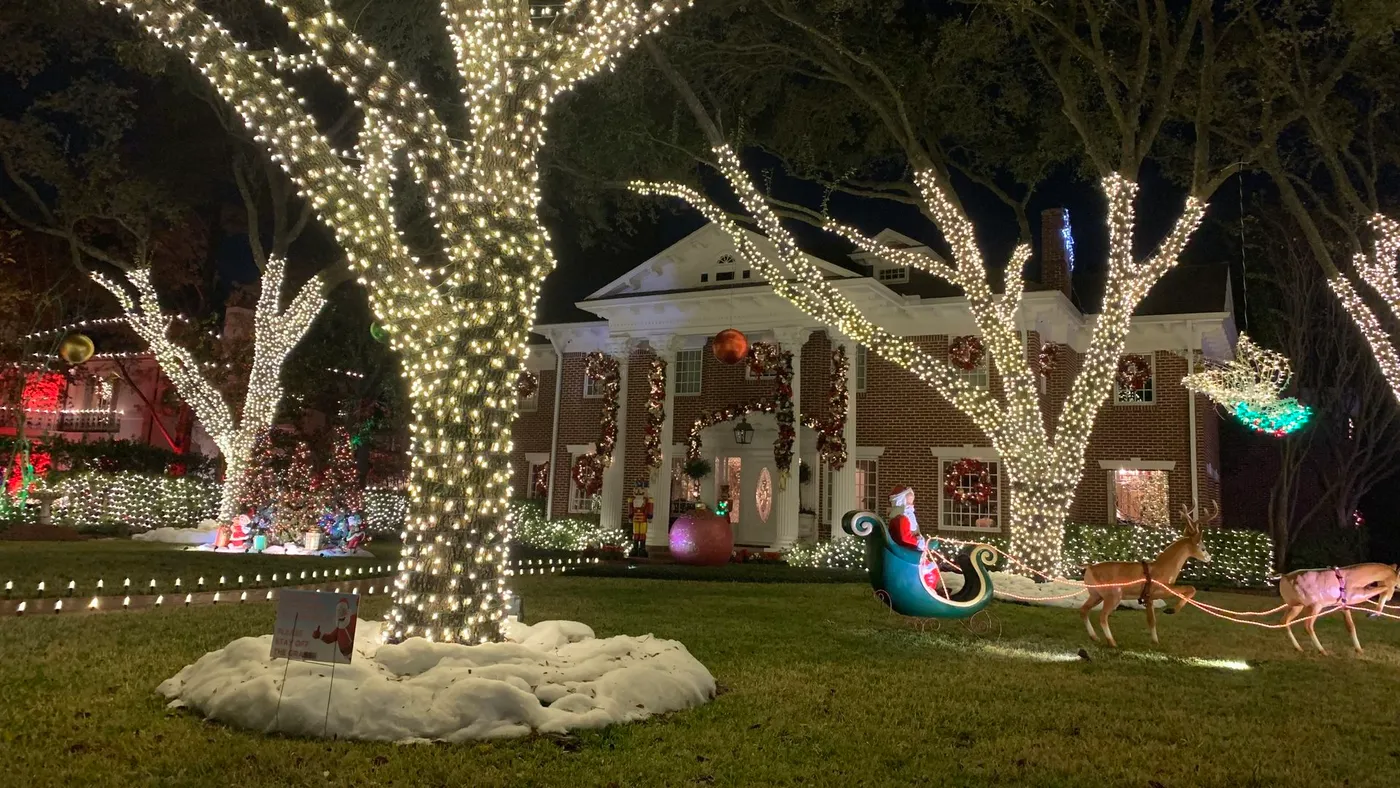
- Warm white string lights, 500 to 800 feet: $60 to $150
- Faux snow batting for the tree bases: $20 to $45
- Garland with red ornaments for the facade: $80 to $250
- Nativity or large lawn figures: $150 to $600
- Clips, stakes, cords, and timers: $40 to $90
Total: roughly $350 to $1,135
Budget alternative: skip the figures this year and put that money into lights. A densely wrapped tree reads more expensive than three inflatables, every time.
3. A Herd of Light-Up Deer in Mixed White and Gold
Read the yard as a formula: roughly 70 percent cool white deer, 25 percent warm gold deer, and 5 percent multicolor punctuation from the lit tree and the snowman. That ratio is why it looks collected rather than chaotic. The mixed temperatures do the visual work while the multicolor buys your eye a place to land. Swap gold for copper-toned lights and you get a moodier version. Go 50/50 white and gold for something dressier.
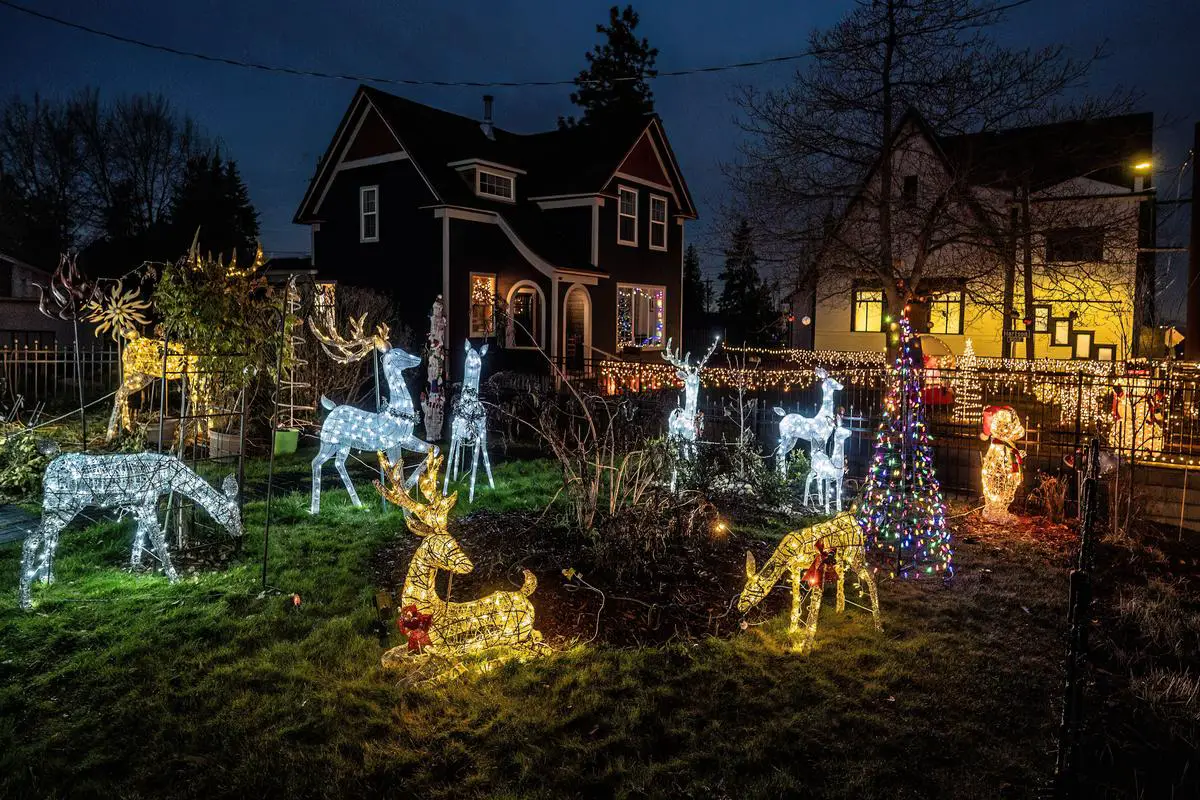
The oversized moose is the anchor. Without it you have a nice herd of matching deer, pleasant and forgettable. With it you get a scale jump that makes the smaller figures look intentional, the way one big object gives a gallery wall a spine. If a moose is not your thing, any single figure roughly twice the size of the rest will do the same job.
Deer run $40 to $90 each new, which adds up fast when you want six. Facebook Marketplace and estate sales are goldmines in early January, when people sell whole herds for $15 to $30 a head because they are tired of storing them. Buy two new figures for the front row where everyone actually looks and let the thrifted ones carry the sides.
4. Symmetrical Nutcracker Entry with Lit Flanking Trees
Building the flanked-tree entrance:
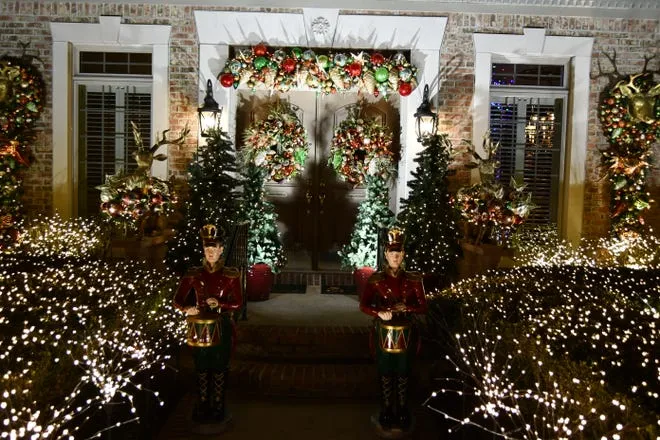
- Measure your doorway width and mark 18 to 24 inches out on each side.
- Set two pre-lit potted trees, 5 to 6 feet tall, on weighted bases so wind cannot tip them.
- Wrap each trunk with a 100-light strand in the same color temperature as the tree.
- Place the nutcrackers just inside the tree line so they overlap slightly instead of floating.
- Run one extension cord to a smart plug so both sides switch on together.
About two hours of work and $250 to $600 for trees, bases, and figures.
This is a wide-entry look. It wants at least 6 feet between the door frame and the corner of the facade, plus a 12-inch-deep dry landing for the tree bases. A narrow townhouse stoop will feel crowded fast, so compare with Idea #17, which goes vertical and works in half the footprint.
5. Reindeer Line-Up with a Blue Light Cone and White Orb
- White light-up reindeer, 3 to 5: $120 to $400
- Red rope or ribbon to link them: $12 to $30
- White light sphere, 24 inch: $60 to $180
- Blue conical light tree, 6 foot: $90 to $250
- Cords, stakes, smart timer: $35 to $70
Total: about $315 to $930
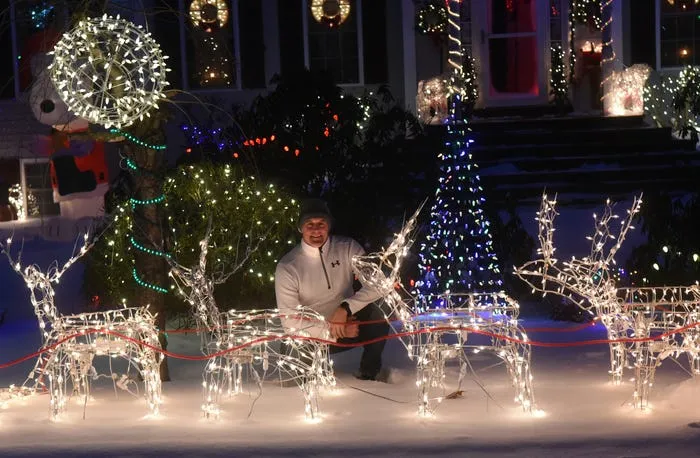
Budget alternative: build the orb yourself with chicken wire and 200 lights for about $25, and bend a tomato cage into the cone shape. Same silhouette, a third of the price.
Give the reindeer 30 to 36 inches of space and set them on a slight diagonal rather than a straight line, because a perfectly straight row reads as a fence, not a herd. Run one continuous piece of rope through their collars so they move as a unit and nobody drifts in the wind. Keep everything on one smart plug, and put the blue cone on a separate outlet so you can kill it at 10pm when you want the yard to go quiet.
6. Multicolor Maximalist Yard with Lighted Arch Tunnels
This much light is a real electrical load. A 20-amp outdoor circuit tops out around 1,800 watts, and ten strands of 100 incandescent mini lights can hit 400 watts on their own. Switching to LED cuts the draw by about 90 percent, which lets you run three times as much on the same breaker. Everything here also has to live somewhere. Measure your garage shelving before you buy, and never daisy-chain past the manufacturer’s stated maximum.
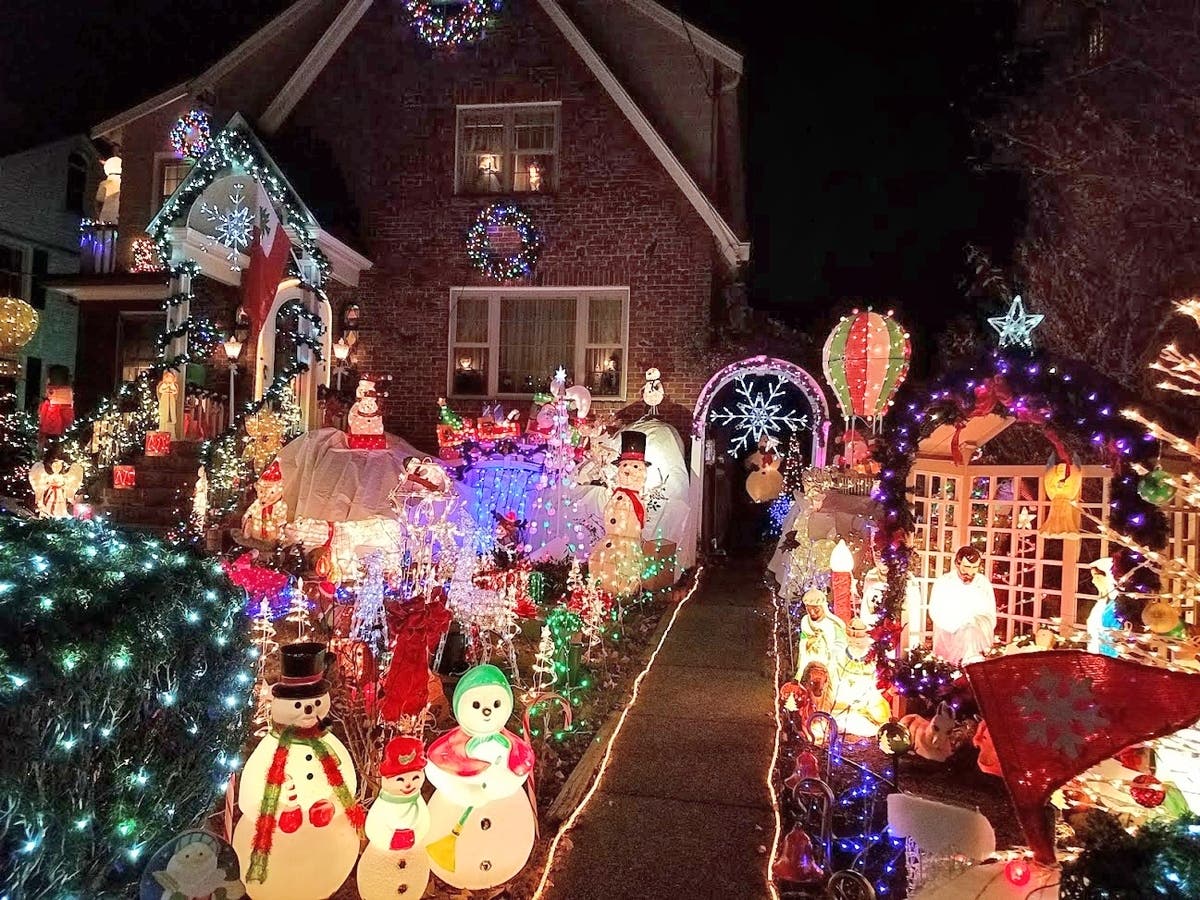
Rent the arches instead of buying them. Party and event rental shops carry lighted walkway arches for $30 to $60 for the season, which beats $200 to $400 to own something that lives in your rafters eleven months a year. For snowmen and nativity pieces, watch Walmart and At Home clearance the week after Christmas. That is when the same items drop 50 to 70 percent.
The formula underneath the chaos is simple: 55 percent multicolor string lights, 25 percent warm white structural light for rooflines and wreaths, 15 percent large figures, 5 percent arches that lead the eye. Keep the ratios and you can swap blue for pink or figures for light sculptures without losing the wow. Drop the warm white layer entirely and the whole thing goes flat and buzzy.
7. Blue Ground Lights with Penguins and a Big Snowman
Colored ground wash is the biggest shift in 2026 outdoor decorating. People are lighting the snow itself instead of only the objects sitting in it. It is cheap, since one $40 flood or a few $20 stake lights cover an entire bed, it photographs absurdly well, and it makes a modest collection of figures look like a full scene. This one has staying power. It reads less like a trend and more like the new default, the same way uplighting became standard for landscaping.
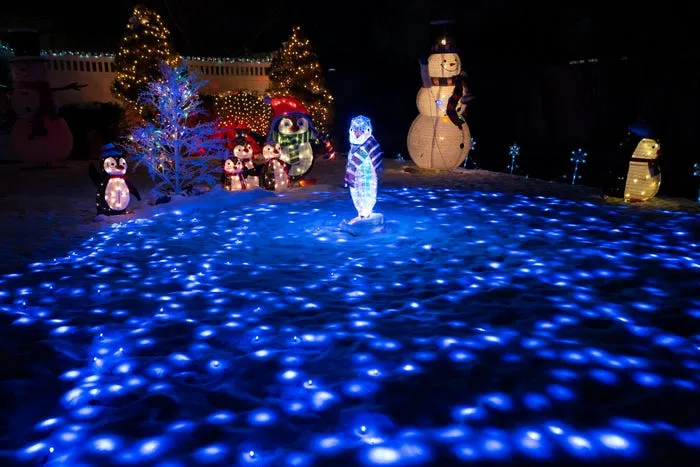
Getting the blue ground glow right:
- Set floods or stakes 8 to 10 feet back from the bed, aimed low and wide, never up.
- Keep them at least 12 inches clear of snow piles so a drift cannot block the lens.
- Use cool blue rather than teal, or the snow turns cyan in photos.
- Put them on a separate dimmer channel from the warm white tree lights.
- Angle every fixture the same direction so shadows do not crisscross.
Roughly 45 minutes and $60 to $180 in fixtures.
8. Crisscross String Lights Over a Covered Patio Sofa
The formula here is 70 percent warm glow, 20 percent neutral upholstery, 10 percent living green. That is it. The dark grey cushions and white plank ceiling keep the space calm so the lights can be the event, and the potted ferns are what stop it from looking like a wedding tent. Swap the greenery for dried branches in winter and the ratio holds. Swap warm bulbs for cool white and the patio goes from cozy to clinical.
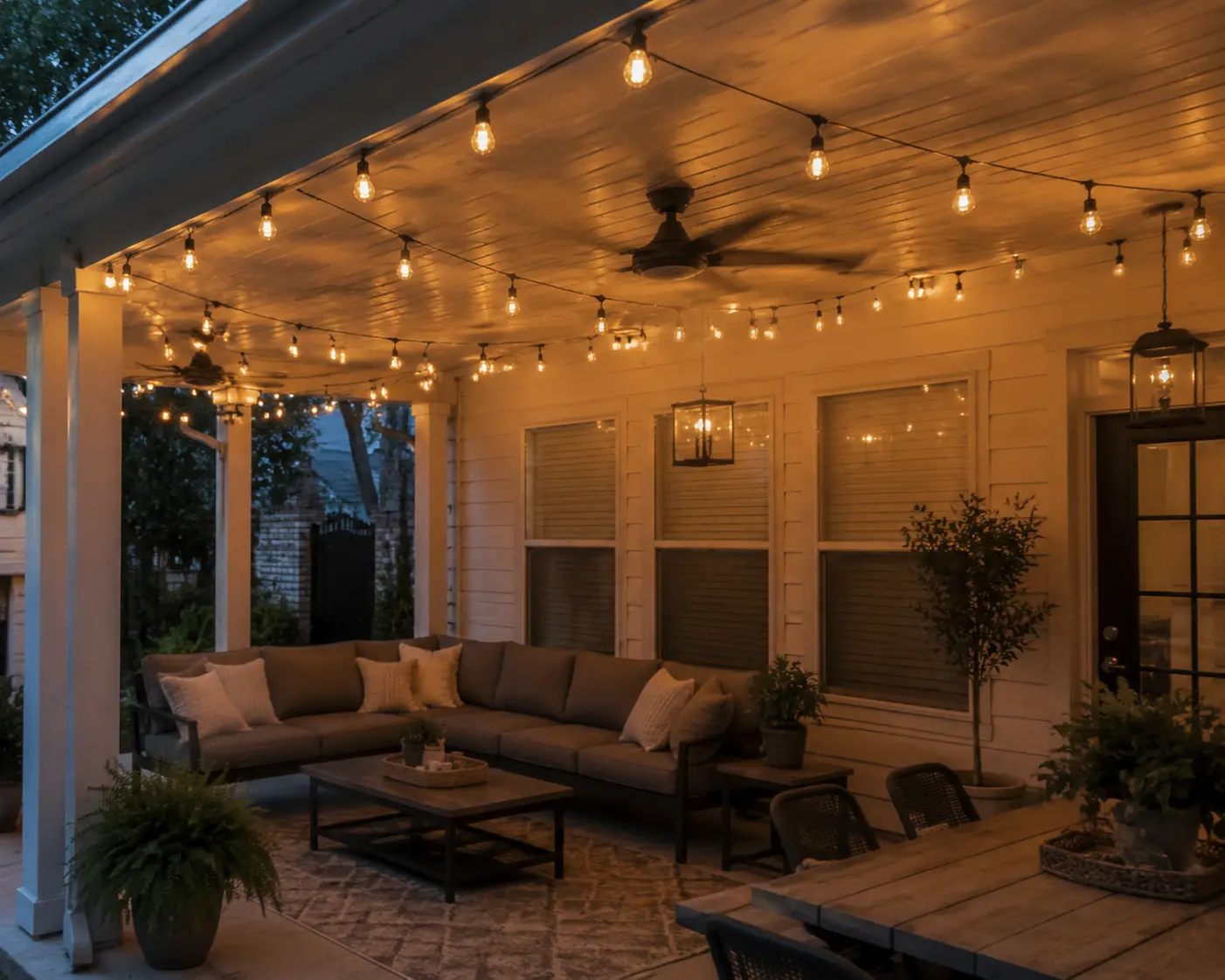
Exposed-bulb strands on an outdoor ceiling collect spiderwebs, pollen, and grit, and the glass gets brittle after a couple of seasons. Plan on a wipe-down with a damp microfiber cloth each fall and expect to replace three to five bulbs a year. Keep the strands 3 inches off the plank so heat and moisture can escape, and use outdoor-rated S14 bulbs with rubber gaskets. Cheap indoor strands corrode at the socket within one wet winter.
It is the crisscross pattern, not the lights. Parallel strands over a patio look like a parking garage, while an X pattern that pulls your eye to a center point makes the ceiling feel like a room. Anchor into joists at the perimeter and use a single center hook so the strands share tension instead of fighting each other. If your space is tight, the small-source trick in Idea #30 gets you most of this warmth with almost no footprint.
9. Pop-Culture Yard with Light-Up Droids and an Archway
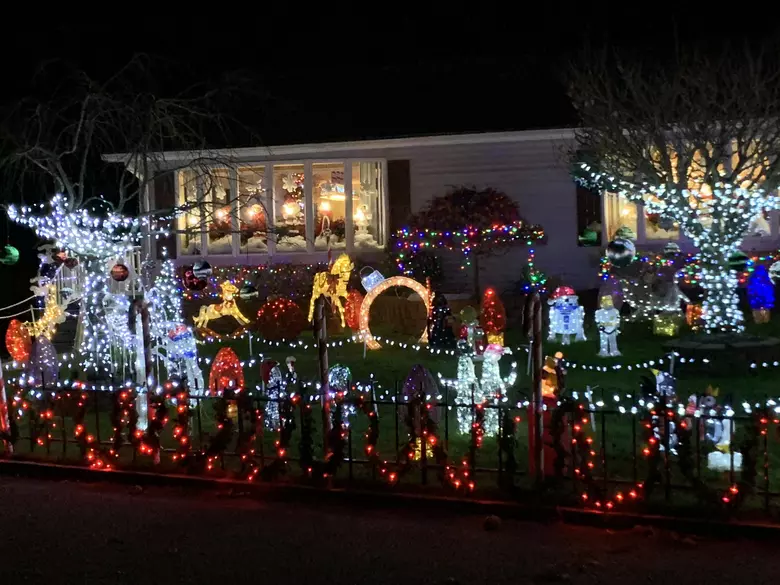
Novelty figures only read if the rest of the yard goes quiet. Drop your string lights to a single color, warm white or amber, and cut the count by a third in the two beds nearest them. Crowd them and the joke disappears. Also put the archway at the midpoint of the walk rather than the entrance. People need three or four steps of normal yard before the lights take over, or they walk straight past the best part without noticing.
- Measure your frontage. Most figures need 4 to 6 feet of clearance each.
- Count your outdoor outlets and note how many amps each circuit can carry.
- Check HOA rules and any local wattage or noise ordinance before you buy.
- Confirm where everything will live from January to November.
- Walk the yard at night first and note what streetlights already illuminate.
10. Icicle Rooflines with a Lighted Train and Candy Canes
- Warm white icicle lights, 60 to 100 feet of roofline: $60 to $180
- Lighted train with presents: $120 to $350
- Reindeer figures, 2 to 3: $80 to $260
- Lit candy cane path, 12 to 20 canes: $40 to $120
- Roofline clips, ladders, cords, timer: $50 to $110
Total: roughly $350 to $1,020
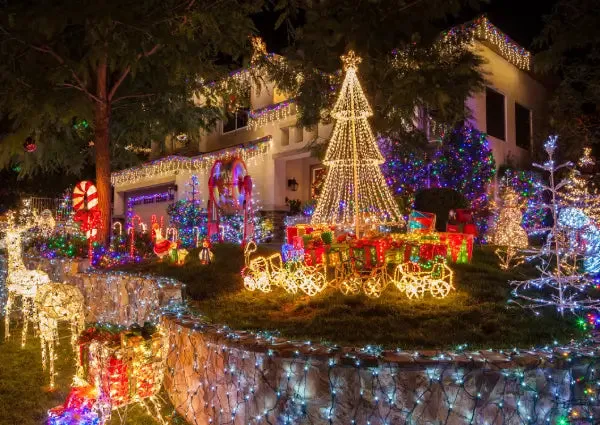
Budget alternative: skip the train and put that money into a second color of icicle lights for the lower roof. Or build the candy cane path with $2 driveway stakes and zip ties instead of store-bought ground stakes.
It is the icicle lights along the roofline. They trace the architecture, which is what tells your eye this is a house that has been decorated, rather than a pile of stuff on a lawn. Everything below, the tree, the train, the reindeer, reads as activity happening inside a frame. Lose the roofline and the same objects turn into clutter.
11. Whole-Front-Yard Glow That Reads From the Street
What separates a display that photographs beautifully from one that looks like a tangle is depth. Build in three planes: something lit at the sidewalk, like a path or low figures; something at mid-yard, like trees or an arch; and something on the house itself, like a roofline or window candles. Your eye reads the gaps between planes as space, so the yard seems bigger and the light seems warmer than it actually is.
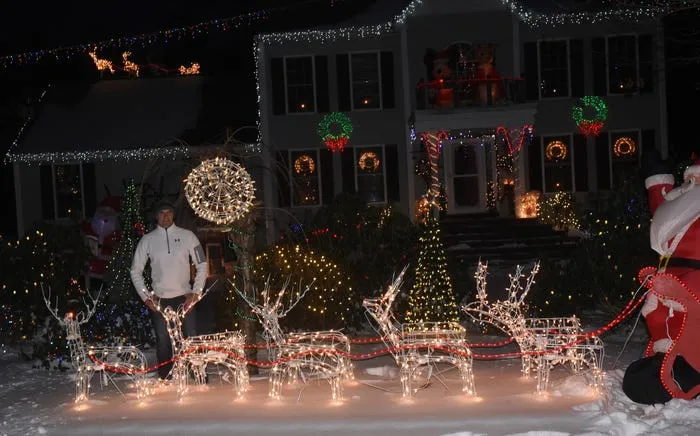
Two honest cautions. First, once you commit to whole-yard coverage you have committed to about $15 to $30 a month in electricity if you are running incandescent. LEDs cut that to roughly $3. Second, anything covering your walkway has to survive strangers and delivery drivers navigating it in the dark. Keep every cord on the house side of the path and never tape anything across a walking surface.
12. A Mini Santa’s Workshop Shed with Caroling Cutouts
Build a workshop vignette:
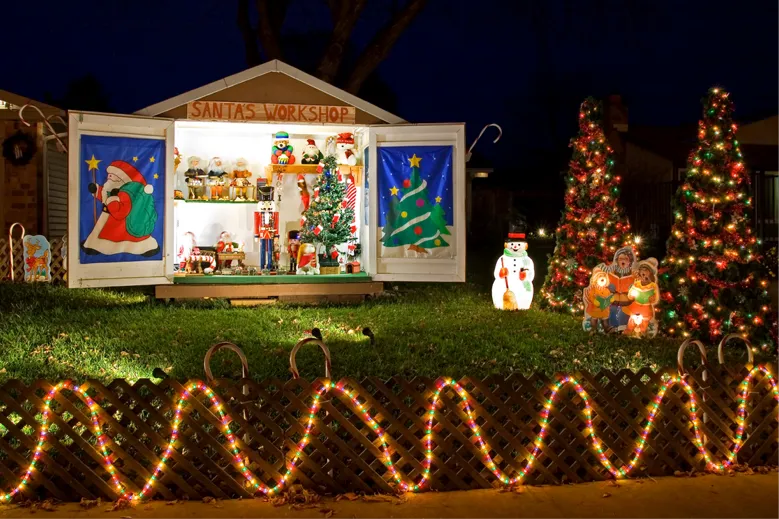
- Start with the shed, either a small resin garden shed or a plywood box painted red and green.
- Line three shallow shelves with mini figurines, small wrapped boxes, and one 2-foot tree.
- Hang a battery puck light inside the roof so the interior reads at night.
- Set a snowman and caroling cutouts 3 to 4 feet in front so they never block the doors.
- Run multicolor rope light along the fence top as a stage edge.
About a weekend of work and $150 to $450 depending on the shed.
The open doors are everything. A closed shed is a prop; an open one is a scene. You are giving passersby something to look inside, which is why the shelves matter more than the size of the structure. Even a $60 plastic garden cabinet works if the interior is lit and staged. Prop the doors so a December gust does not slam them.
This one needs real estate, roughly 8 feet of frontage and 4 feet of depth for the shed plus the cutouts. It also wants a driveway or wide sidewalk so people can stop without blocking the street. On a tight lot, shrink it to a porch corner and keep the staging idea, like the container version in Idea #19.
13. Ground-Spotlit Character Cutouts in a Snowy Yard
Flat cutouts are the best dollar-per-square-foot value in outdoor decorating. A 4×8 sheet of exterior plywood runs $35 to $60 and one holiday stencil set costs $12. Paint, seal, and stake them and you have five characters for under $100. Splurge where it counts on the ground spotlights, $20 to $45 each, which do more for a cutout than any paint job. Skip the $90 life-size Santa and paint your own instead.
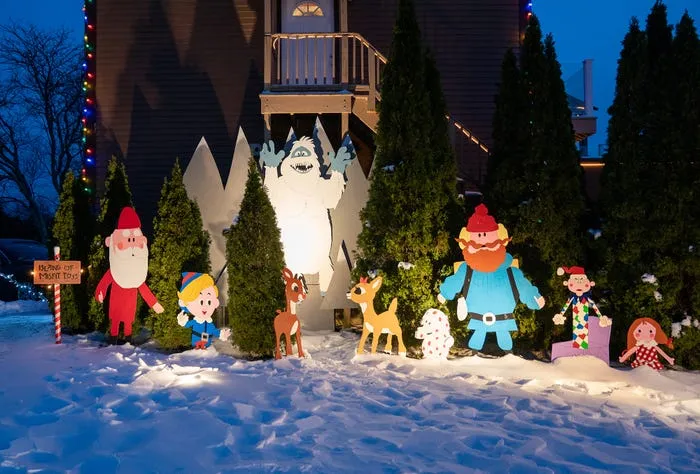
Two things are doing the heavy lifting. First, the spotlights hit the cutouts from below and in front, so the painted characters glow like they are on a stage instead of disappearing into the dark. Second, the arrangement goes tall-back and short-front, evergreens behind, characters stepped forward. That reads as a scene with depth, while flat rows placed the same distance from the house always look like a yard sale.
14. Inflatable Grinch Cluster with Light Projections
Inflatables are bulkier than they look. Budget about 3 feet of clearance on every side so nothing rubs or blocks a fan intake, and plan for a yard at least 30 feet wide if you are stacking five figures. They also need real vertical room, since a 10-foot Grinch plus a matching Santa will dominate a 15-foot facade. For a smaller yard, see Idea #31, which gets the same playful energy out of a single figure.
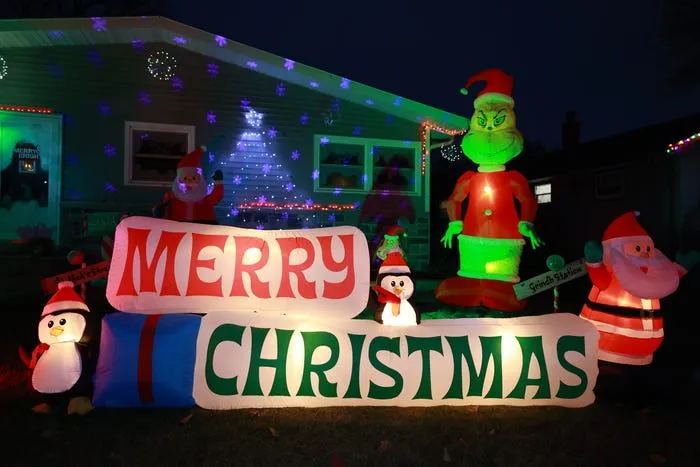
Inflatables are the highest-maintenance decoration you can buy. They run a blower around the clock, which adds roughly $8 to $20 in electricity for the season, they deflate in wind over 20 mph, and they take on water in freezing rain. Set them on a tarp or mulch bed, stake every loop rather than just the corners, and bring them in for storms instead of testing the seams. Most last two to three seasons outdoors.
15. Inflatable Snowman Family with a Blue-Wrapped Tree
The palette is doing more work than the objects: 60 percent white and green from the snowmen, lawn lights, and projections; 30 percent blue from the wrapped bare tree, which is the anchor; and 10 percent red and gold accents from the gift boxes and tree toppers. Blue is what makes the group read as winter rather than strictly Christmas. If you prefer classic, swap blue for warm white and the formula still holds. Same ratios, different temperature.
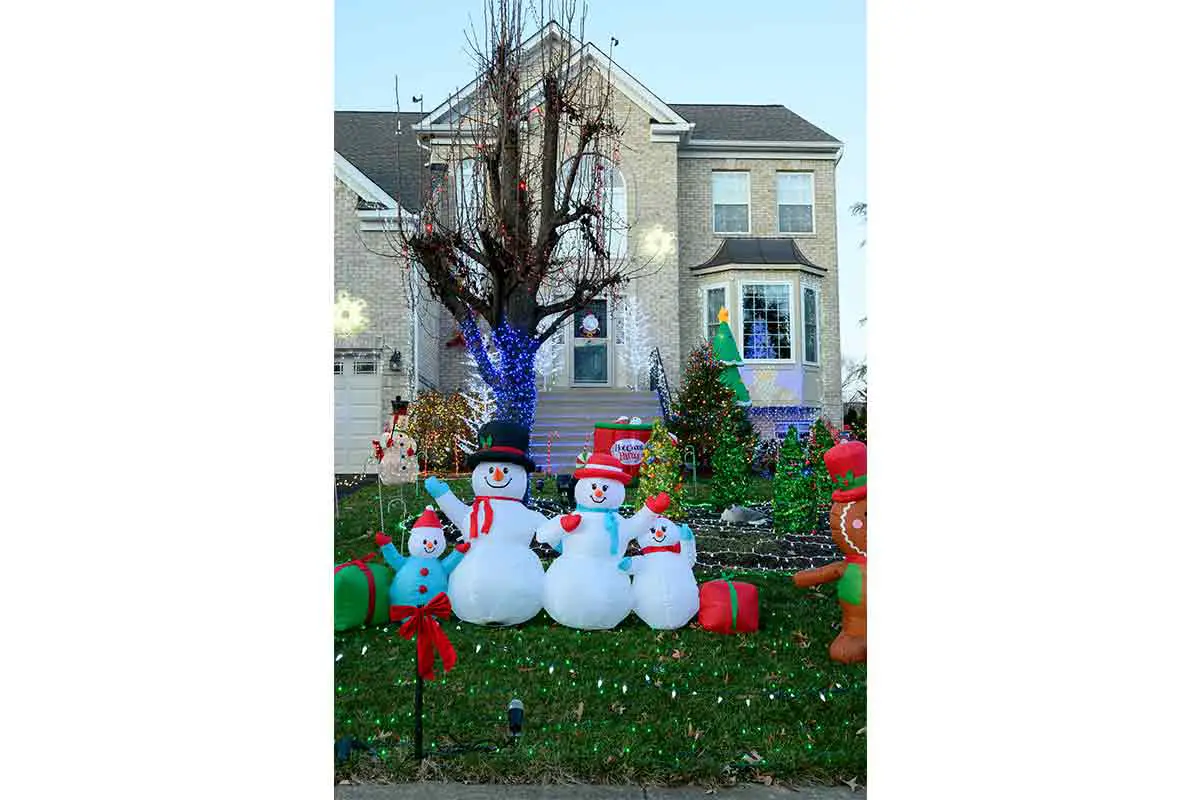
A big blue-wrapped bare tree is gorgeous and slightly risky. Blue LEDs photograph as a pure, cold color that can look severe up close, so check it in person before you buy 300 feet of it. This look also wants a snowy backdrop. Against dry brown grass in a mild year, blue reads harsh. In warm climates, warm white or amber wrapped trees hold up better.
Anchor wrapped tree lights at the base of the trunk and spiral upward, not down. Working up lets you tuck the strand into branch crotches as you go, which keeps it from sliding to the ground by New Year’s. For a 12-foot bare tree, expect 400 to 600 lights with spacing around 8 inches apart, closer near the trunk where the eye lands first.
16. Nostalgic Cartoon Cutouts Under Warm White Ground Lights
The directional signpost. It is the smallest object in the yard and the one that gives the whole display a story. Suddenly the characters are not decorations, they are residents. You can make one for about $25 with a 4-foot post and painted arrow boards. Point them at things people will recognize: the North Pole, your street, the coffee shop two blocks over.
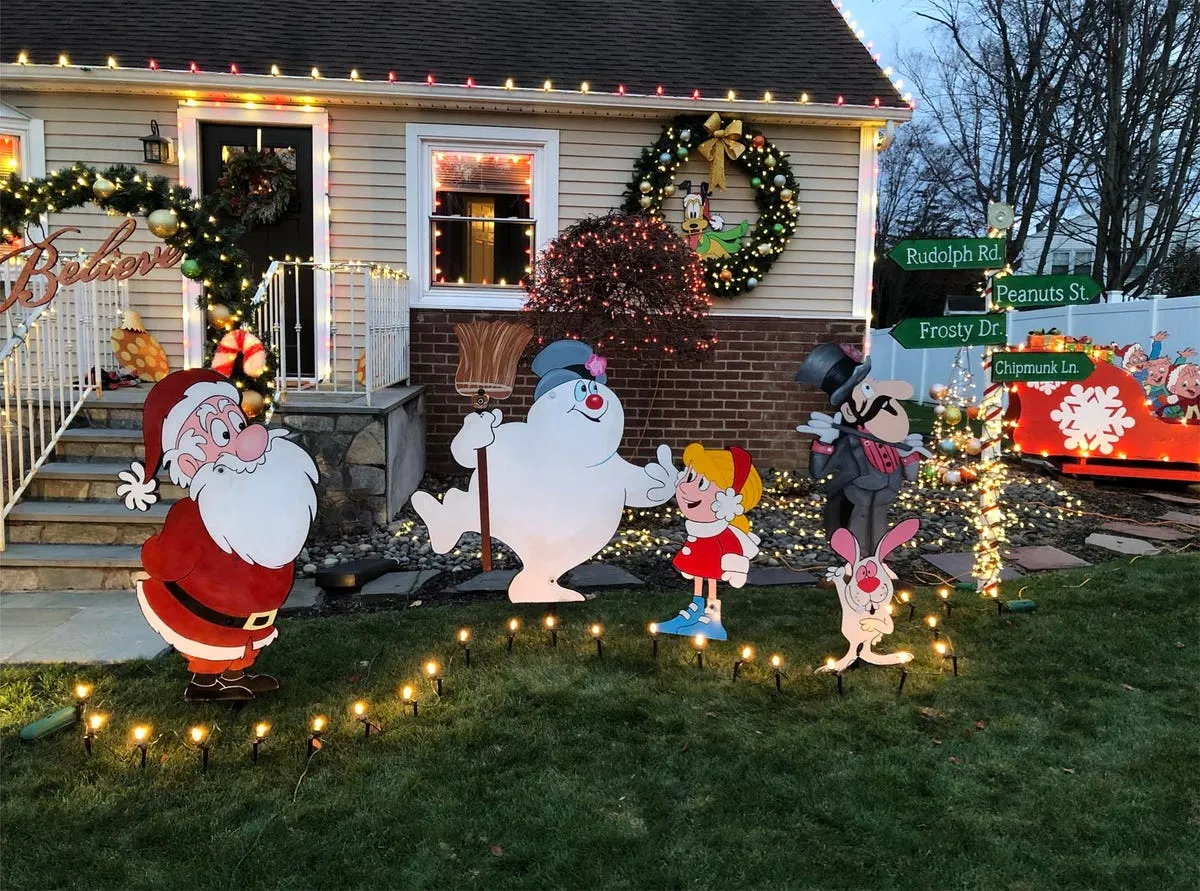
- Paint-your-own plywood character cutouts: $60 to $150
- Warm white ground stakes, 20 to 30: $50 to $140
- Multicolor roofline lights: $60 to $160
- Red C9 lights for the shrubs: $30 to $70
- Garland, ornament kit, character wreaths: $90 to $250
Total: roughly $290 to $770
Budget alternative: buy plain green garland at dollar stores for $5 to $8 per 9 feet and add your own ornaments scrounged from the after-Christmas bin.
17. Layered Garland and a Lit Window Box on Brick
Layer garland in three passes: a plain green base, a lit strand woven through on the same diagonal, then accents. Weave the lights so the cord sits behind the needles, then push accents toward the front. Use floral wire instead of the built-in loops, because wire lets you place a pinecone exactly where it hides the cord’s connector. Measure twice, too. A garland should overhang a window box by 4 to 6 inches at each end, no more.
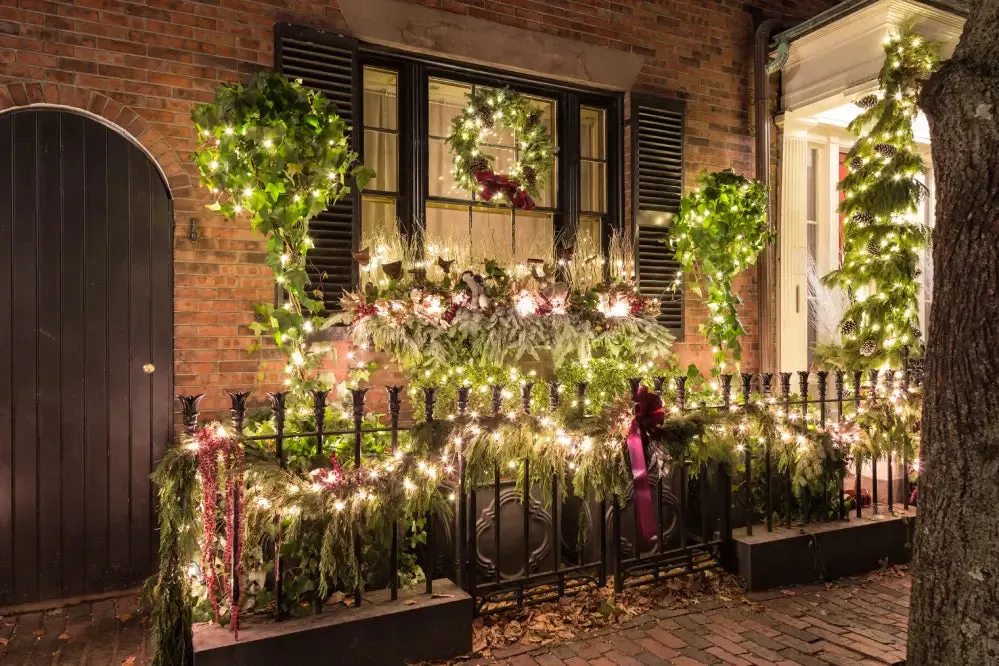
Staging the window box:
- Line the box with a plastic tray so wet greenery does not rot the wood.
- Soak a block of floral foam, then wedge it in as the base.
- Push the longest evergreens in at the ends first, angling them outward.
- Fill the center with cedar or magnolia for a broad, matte texture.
- Add berries and pinecones last, in odd-numbered clusters of three.
About 90 minutes and $60 to $140 in materials per box.
18. Illuminated Twig Topiaries in Tall Dark Planters
Two identical topiaries turn a doorway into a threshold. The repetition is the point, since your eye registers symmetry before it registers detail, so the entrance feels deliberate even though the planters themselves are simple. The dark planters also give the warm white lights something to contrast against, which is why this reads elegant instead of fussy. Matching height and spacing matter far more than matching the contents.
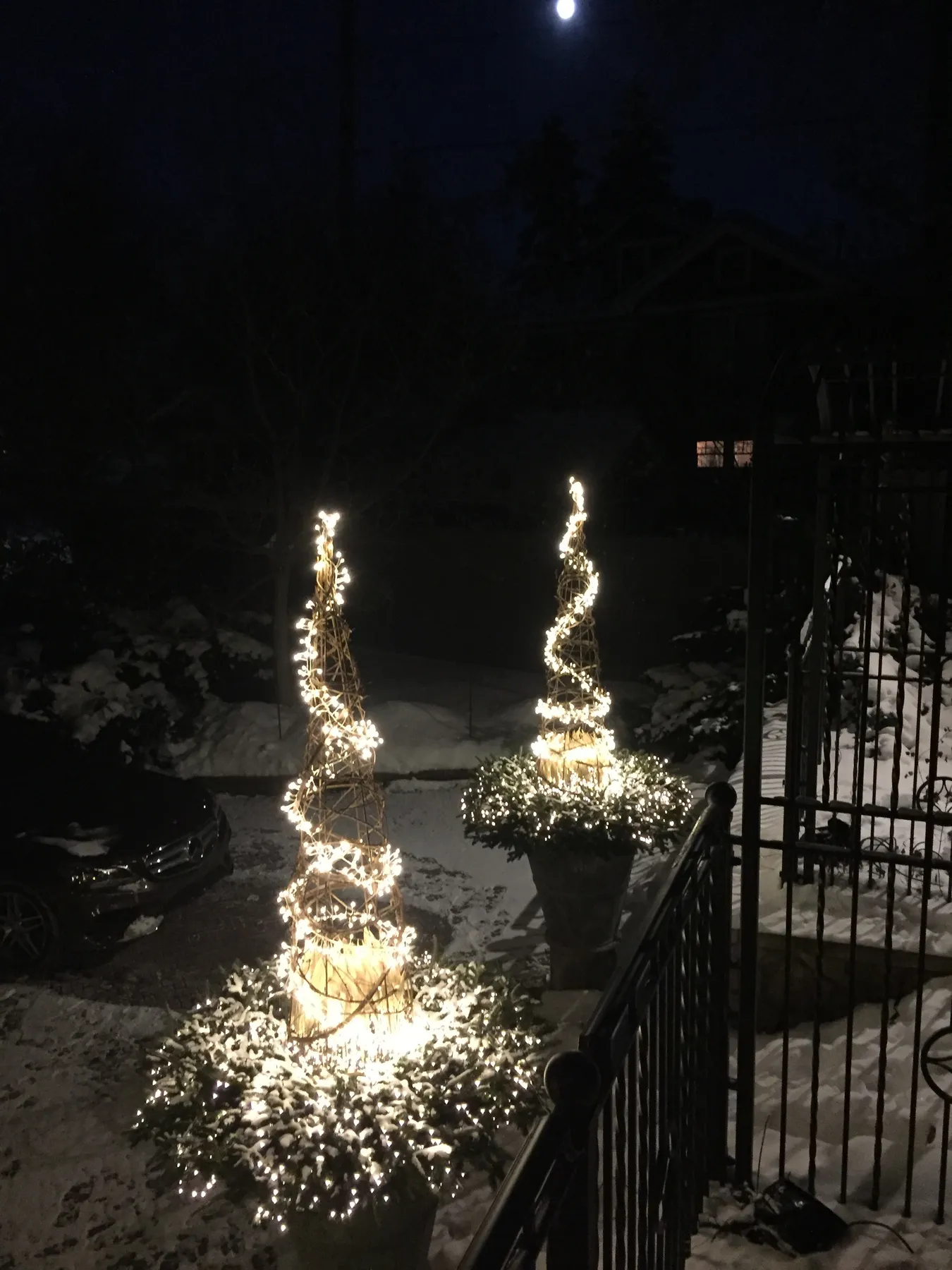
This look wants a step, stoop, or landing at least 4 feet wide so the planters can flank the door with 12 to 18 inches of breathing room. On a narrow stoop, go with one topiary on the corner instead. Apartment dwellers can scale down to two smaller topiaries, 24 to 30 inches, on a balcony rail. Compare with Idea #30 for the small-space version of this same glow.
Twig-and-light topiaries are the quiet hit of the 2026 season. They read as winter rather than strictly Christmas, so people leave them up through February, which is exactly why they keep selling out. It is part of a broader shift toward decorations that carry through the whole cold season instead of getting boxed up on December 26.
19. Birch Logs, Lotus Pods, and Magnolia in a Dark Planter
The recipe is 50 percent evergreen volume, 25 percent vertical structure from the birch logs, 15 percent textural accents like the woven spheres and dried lotus pods, and 10 percent flowers. The verticals are what keep it from looking like a shrub in a bucket. Trade the birch for dried pampas, or the lotus pods for seedpods and cinnamon sticks, and the arrangement still works. You are balancing mass, height, and detail, in that order.
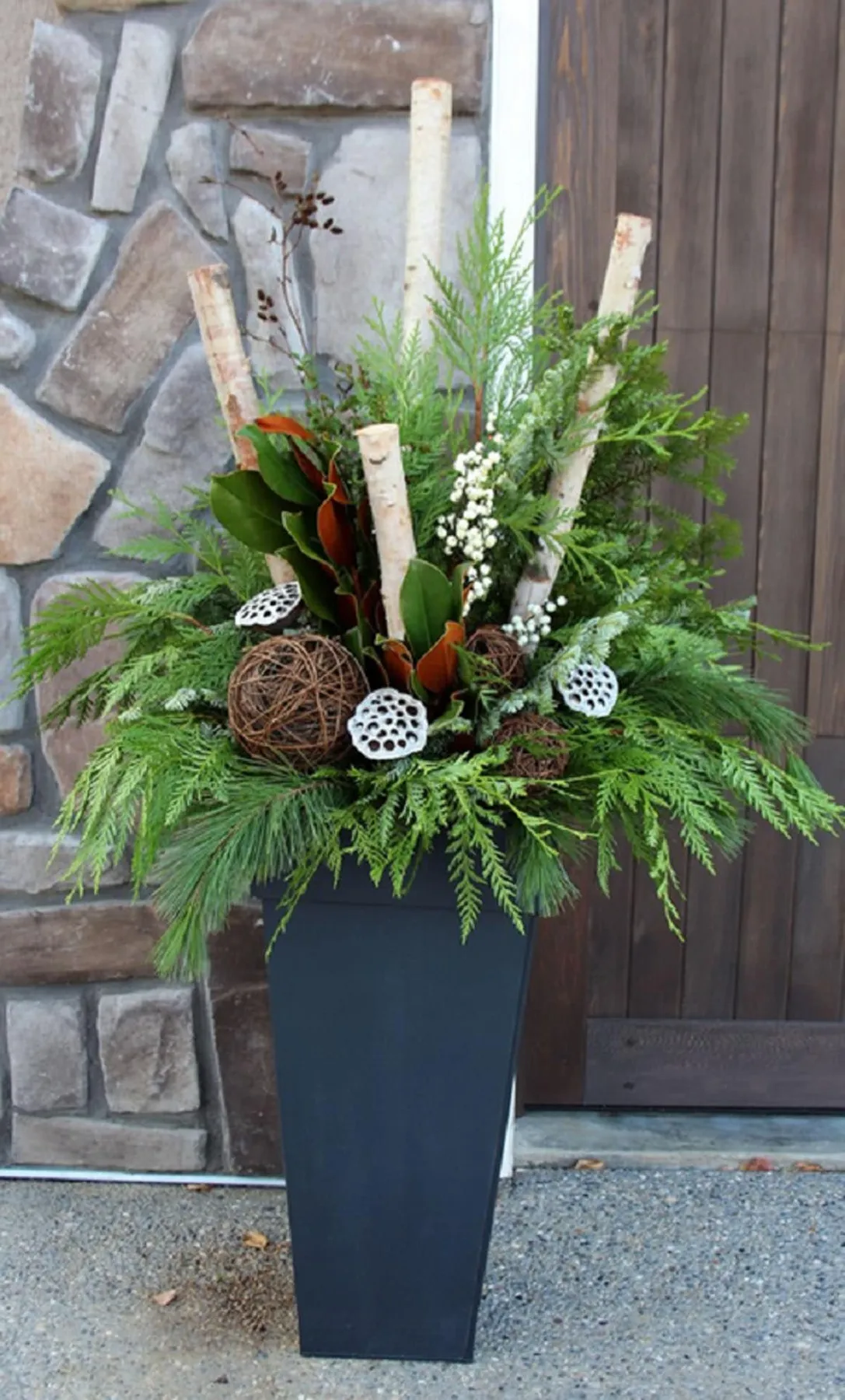
The birch logs. Anyone can stuff a planter with greens. Those two vertical sticks are what make it look styled rather than stuffed, and they do a practical job too. They hold the softer branches in place and give you something to wire the accents to. Birch runs about $3 a bundle at craft stores and lasts for years if you store it dry between seasons.
20. Frosted Magnolia Blooms with Light Blue Baubles
- Tall fluted planter: $60 to $200
- Mixed faux evergreen bundle: $35 to $90
- Red berry sprigs: $10 to $25
- Frosted pinecones: $8 to $20
- Magnolia blooms and light blue baubles: $25 to $60
Total: about $140 to $395 per planter
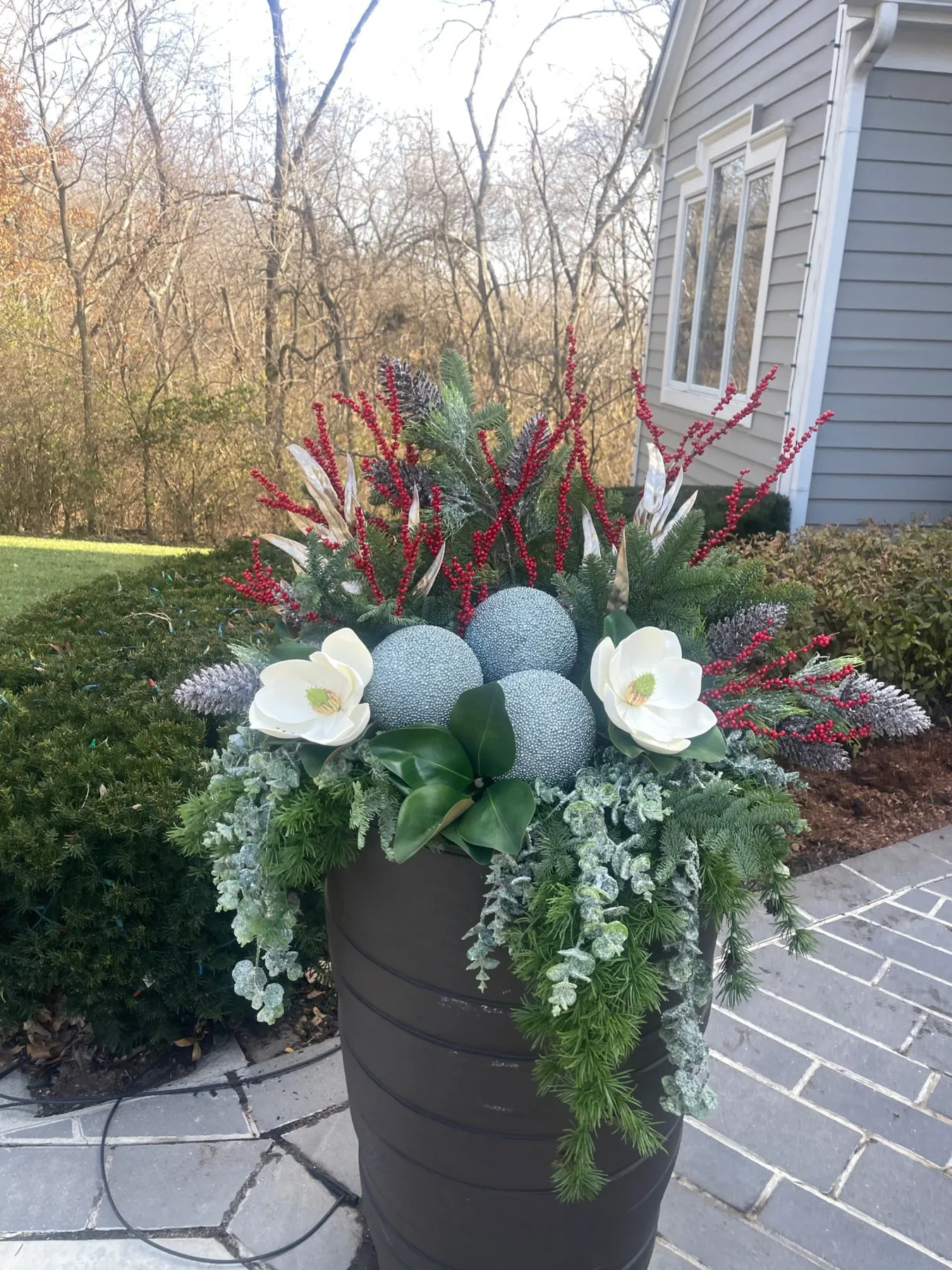
Budget alternative: skip the magnolias and grab a single oversize faux bloom set online for $12 to $20. Or shop Walmart’s post-holiday aisles for the blue spheres at 70 percent off.
Light blue ornaments in a green-and-red planter feel like a mistake until you understand the job they do. They are the cool counterweight. Without them, every element is green, red, or brown and the arrangement goes muddy at dusk. Keep them to three, all roughly the same size, clustered low and left so they catch light from the porch fixture. Three reads as intentional. Five reads as leftover ornaments.
21. Curly White Branches and Berry Clusters in Matching Planters
- Measure planter width against your door. Each should be no more than a third of the door’s width.
- Check the weight empty versus full. Wet soil plus greens can hit 60 pounds.
- Confirm you have an outlet within cord distance, or buy battery lights.
- Decide your base: soil, foam, or a zip-tied foam cone for easy teardown.
- Test one arrangement in daylight and again after dark before committing to both.
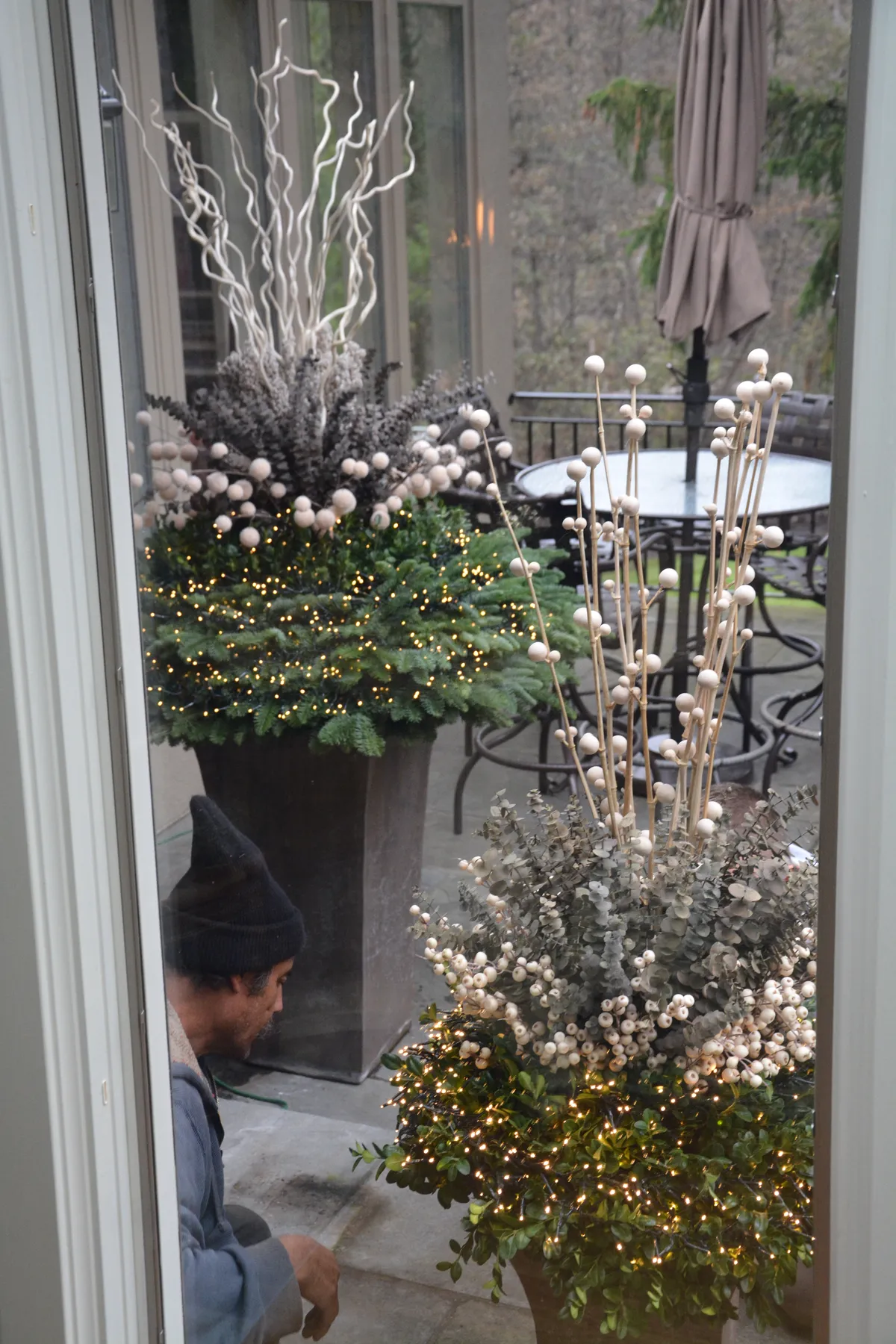
Curly white branches look expensive and are not. A bundle runs $8 to $14 at craft stores, or about $6 from a floral wholesaler, and they are reusable for years. The white berries are the same story at $5 a stem, or DIY them by spray-painting dried sprigs from your yard in matte white. The whole pair can come in under $120 if you use foam instead of soil and shop the fake-greenery aisle after Christmas. If you want the taller, more sculptural version of this, look at Idea #19.
White branches are beautiful and slightly fragile. They snap if you jam them into hard soil, and they yellow in direct sun. Push them into foam, not packed dirt, and keep the planters out of all-day exposure. Budget for wind too, because tall top-heavy arrangements tip. Use a weighted base or set them where the wall breaks the gusts. In freezing rain, expect the berries to shed.
22. A Lit Grinch and Santa Facing Off in the Snow
Grinch decorations went from novelty to a full category over the last three seasons, and 2026 is the year they outsell the classics in some markets. Part of it is licensing getting cheaper and easier for manufacturers. Part of it is plain humor fatigue, because people want a display that makes the neighbors laugh rather than just nod. A green figure against a red Santa is also objectively great color theory, which never hurts.
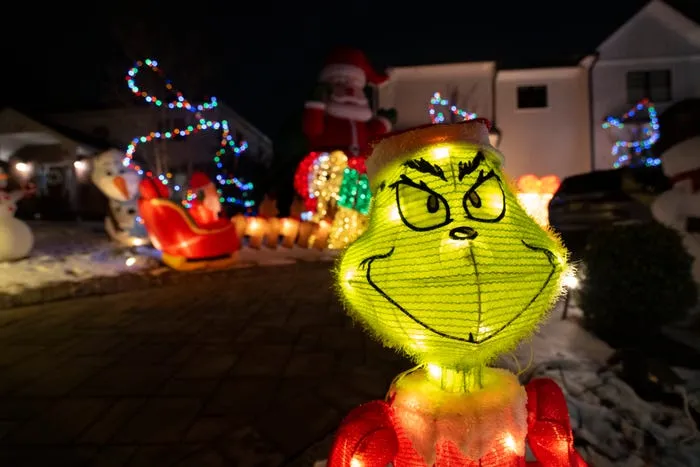
Two characters at odds give the yard a narrative, and a narrative holds attention longer than pretty lights. The staging matters as much as the figures. The Grinch sits closer to the street and the Santa sits deeper in the yard, so there is a clear front-to-back relationship instead of two objects side by side. Snow underneath reflects both and knits them into one scene rather than two separate purchases.
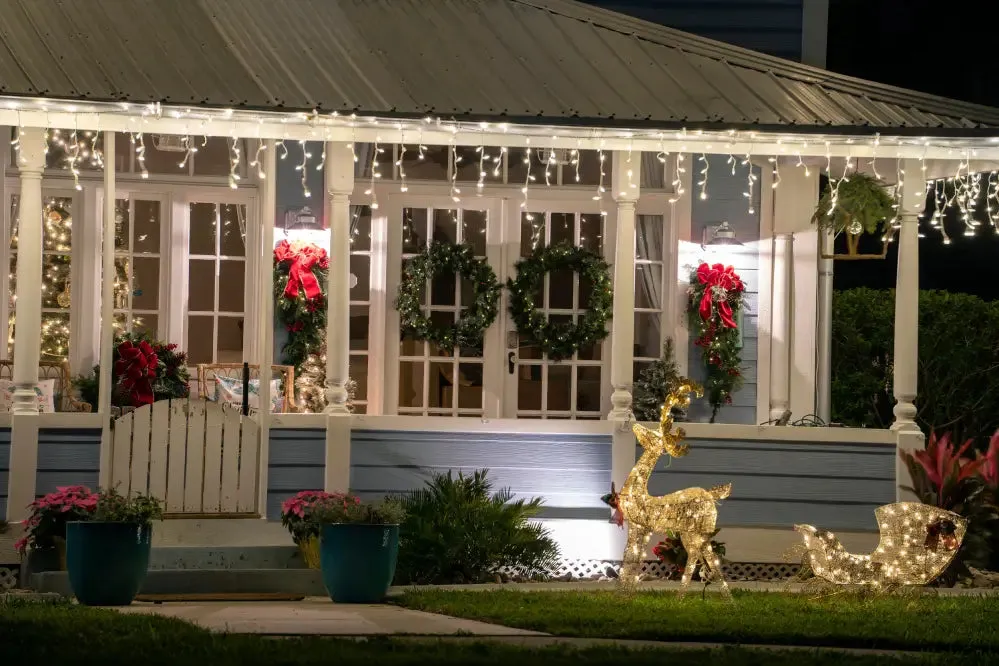
23. Warm White Reindeer and Double Wreaths on the Porch
Reindeer figures are sized for average suburban frontage. Three to five of them want about 25 to 30 feet of yard width to look like a herd rather than a traffic jam. If your frontage is under 20 feet, drop to two and put the saved money into roofline lights, which do more for curb appeal per dollar. Columned or double-door porches should always get two wreaths, hung at matching heights measured from the door’s top edge, never from the ground.
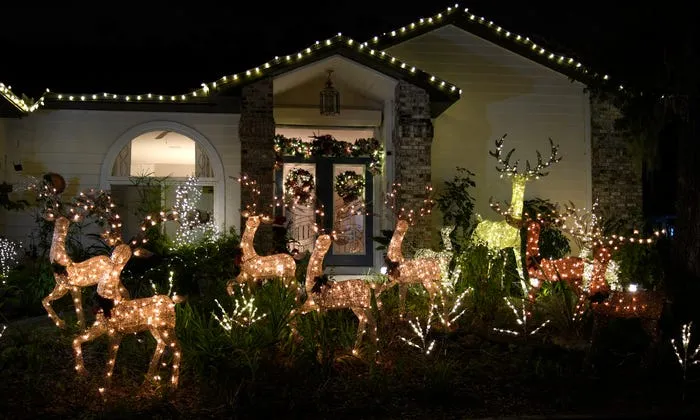
Roofline lights are the most requested and most regretted part of holiday decorating, because getting up there safely is the entire job. Never work from an aluminum ladder near power lines, and never lean a ladder against a gutter without a standoff. Clip the lights rather than nailing or stapling. Staples pierce the insulation and create a real shock and fire risk. If your roofline is steep or over two stories, hire it out. It runs $200 to $500 and it is worth every penny.
24. Inflatable and Wireframe Grinches Side by Side
Mixing an inflatable and a wireframe means two different failure modes. The inflatable needs continuous power and deflates the second the blower stops. The wireframe only needs bulbs, but its paint chips and rusts at the joints. Expect to touch up wireframe frames with outdoor spray paint every other year, about $10 a can, and to replace the inflatable’s blower fuse at least once a season. Keep a spare set of bulbs on hand for the wireframe.
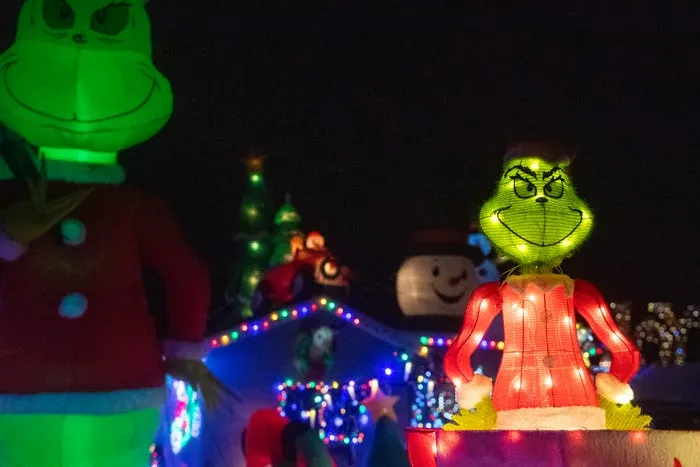
The formula is 55 percent multicolor lights on the house, 25 percent large-scale green objects from the two Grinches, 15 percent white anchors from the snowman and snow, and 5 percent inflatable architecture. The white pieces matter more than they look. Without them, green and multicolor together turn into a jungle. Two green focal figures is also the ceiling. A third makes it a theme park.
If the roof sleigh is going up, position it about two-thirds of the way up the slope. At the ridge it is out of sight from the street, and at the gutter it competes with whatever is on the porch. Two-thirds is the sweet spot where your eye catches it against the sky. Anchor it with sandbags rated for wind, never bricks.
25. Icicle Lights and Bow-Tied Garlands on a Blue House
Hanging icicle lights so they look intentional:
- Measure the roofline and buy 15 percent extra for sag and corners.
- Attach plastic clips to the gutter or shingle edge every 12 to 18 inches.
- Hang one continuous run rather than joining short strands mid-wall.
- Stagger a second row if you use one, so the icicles do not overlap into a solid sheet.
- Zip-tie the extension cord down the corner trim so it reads as part of the house.
About three hours for a single-story front and $60 to $180 in lights and clips.
The garlands on the French doors, not the icicles. Icicle lights frame a house, while a bow-tied garland frames the people walking into it. It is the difference between a decorated building and a welcome. That is also why this works so well on a light blue house. Red bows against pale siding create the highest contrast in the entire scene, so your eye goes straight there.
26. A Golden Reindeer and Red Glitter Sleigh at Dusk
The glitter sleigh is the piece people overspend on, $200 to $400 new for something that only reads well at night. Try this instead: buy a plain resin or wooden sleigh for $50 to $90 at a farm store, coat it in two cans of red glitter spray, about $20, and seal it with matte clear coat. Under string lights it looks nearly identical. Buy the reindeer new at $90 to $180, since light quality matters more than the frame.
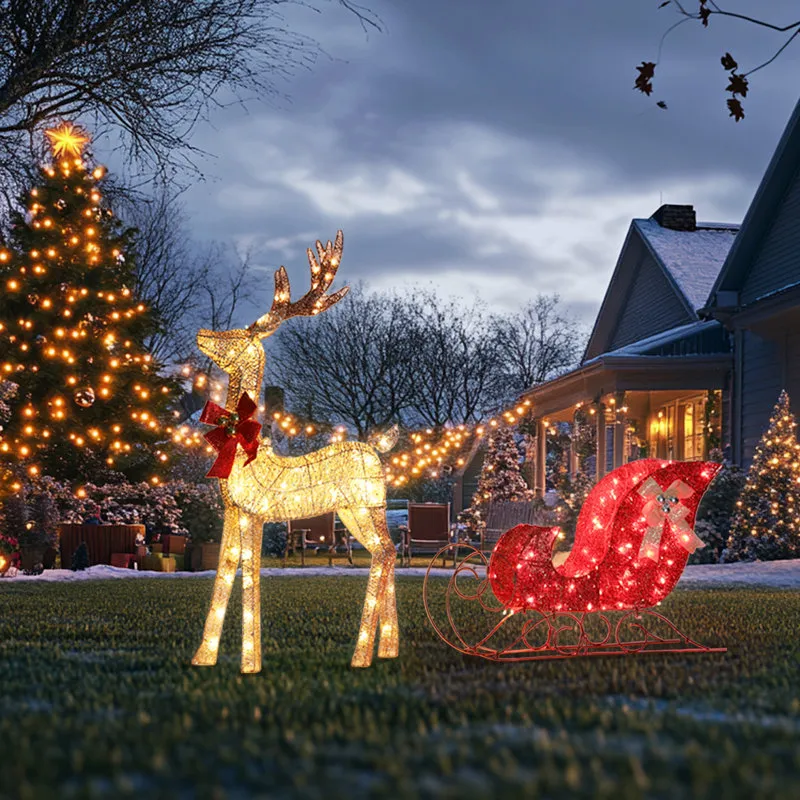
Connect the reindeer and sleigh with a length of warm white string lights laid along the ground rather than hung in the air. Ground-level light creates a visual path from one object to the other, which is what makes them read as one vignette instead of two yard items. Leave about a 10-inch gap between the figures. Touching looks accidental and a full 3 feet looks divorced.
27. Red Door, White Pilasters, and Urns Full of Light
This works because the decoration follows the architecture. The garland goes up the columns, not across the wall. The urns sit at the base of the pilasters, echoing their line. When your greenery traces the structural lines of your house, the house looks bigger and better designed, the same trick painters use with trim. Randomly placed wreaths on blank siding never have that effect.
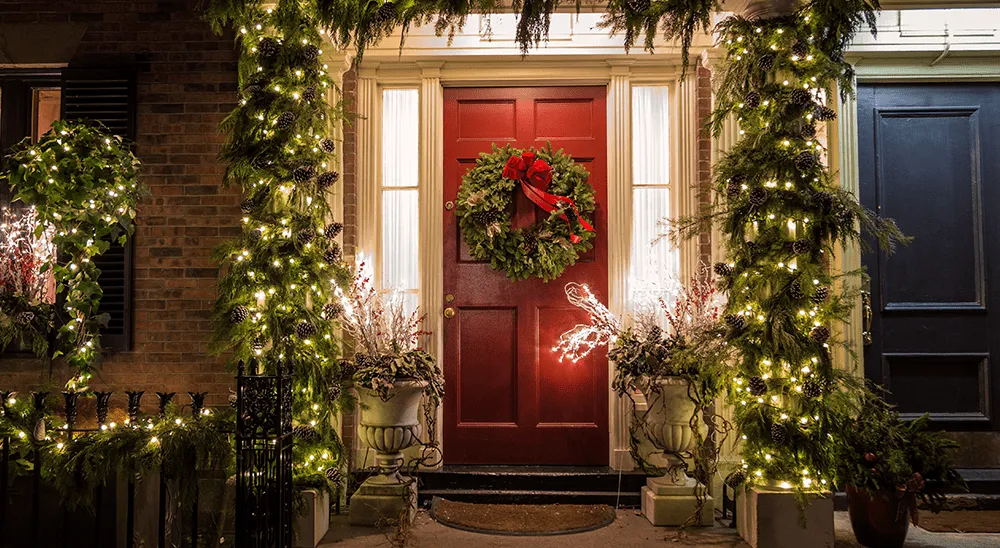
Filling out the urns:
- Fill halfway with foam or packed soil so branches stay put.
- Push the tallest white branches in first, slightly toward the back and off-center.
- Add evergreens in a fan pattern, angling them over the rim to soften the edge.
- Wire in berry picks and pinecones in clusters of three.
- Drape a short warm white strand over the top and tuck the cord out of sight.
About 45 minutes and $50 to $110 per urn.
- Confirm wreath size, roughly a third to half the door’s width.
- Hang so the bottom sits at or just above eye level for most adults.
- Check that your hook will not damage the door finish or a storm door swing.
- Count outlets for the urns before you buy lights.
- Make sure the garland will not block your porch light or house numbers.
28. Blue and Green Light Trees with a Candy Cane Path
The candy cane path is what makes this display walkable rather than just watchable, and it needs a walkway at least 3 feet wide with canes every 4 to 5 feet. Two light trees, one blue and one green, read as a matched pair at about 6 to 8 feet tall and 4 feet apart. Closer than that and they merge into one blob. Total footprint is roughly 40 feet of frontage. Working with less? See Idea #18, where two lit topiaries get a similar matched-pair effect in about six square feet.
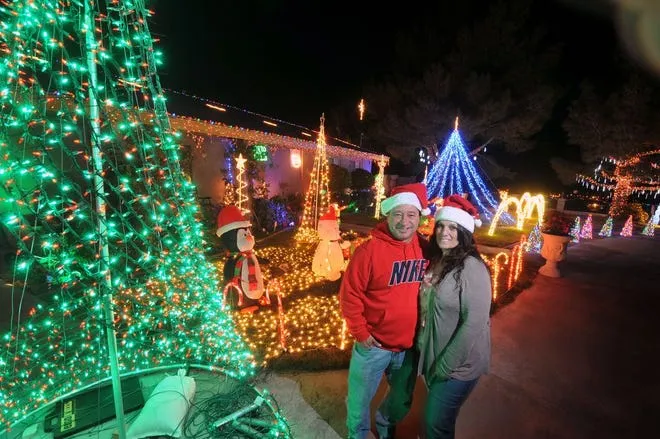
- Light trees, 6 to 8 feet, blue and green: $180 to $450
- Candy cane path lights, 16 to 20: $60 to $160
- Snowman figures, 2 to 3: $80 to $250
- Warm white roofline outline: $70 to $180
- Cords, stakes, smart plugs: $45 to $95
Total: about $435 to $1,135
Budget alternative: build both light trees from two tomato cages and 300 lights each, roughly $70 total.
29. Oversized JOY Letters Behind Multicolored Pathway Lights
Big letters are the most photographed and most often regretted purchase in this category. They are top-heavy, they are a pain to stake into frozen ground, and they look cheap once bulbs start dying mid-season. Buy one where individual bulbs are replaceable, drive rebar into the ground first and slide the frame over it, and reinforce the J and the O, the two shapes with the least structural support. Store letters flat, never leaning.
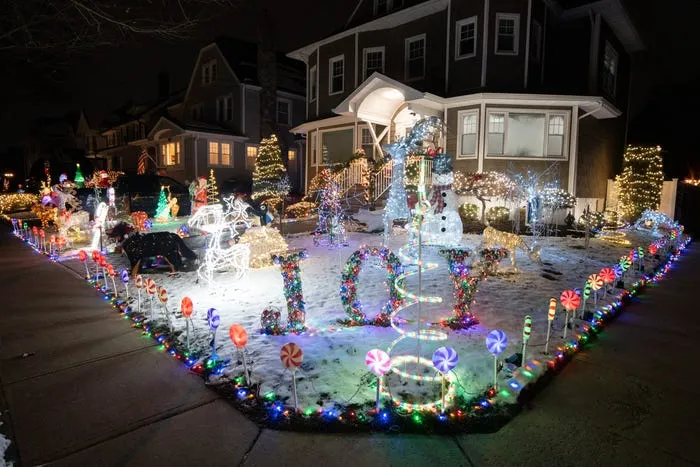
Multicolored lighting is having a genuine comeback after a decade of everything warm white. Part of it is nostalgia, people recreating their childhood streets. Part of it is practical, since multicolor bulbs make a display feel bigger without adding a single piece. The 2026 version is smarter about it, keeping the house itself in two or three colors and letting the yard carry the rainbow.
30. A Fairy-Light Wine Bottle on a Screened Porch
A glass bottle full of fairy lights is the easiest decoration you will ever own. No power, no weather, no storage headache. Use a battery pack with a timer and swap in fresh AA batteries every three weeks if you run it nightly. Keep it out of direct rain, even on a covered porch, because condensation inside the bottle will fog the glass and eventually kill the strand. Clean the bottle once a season with a bottle brush and warm water.
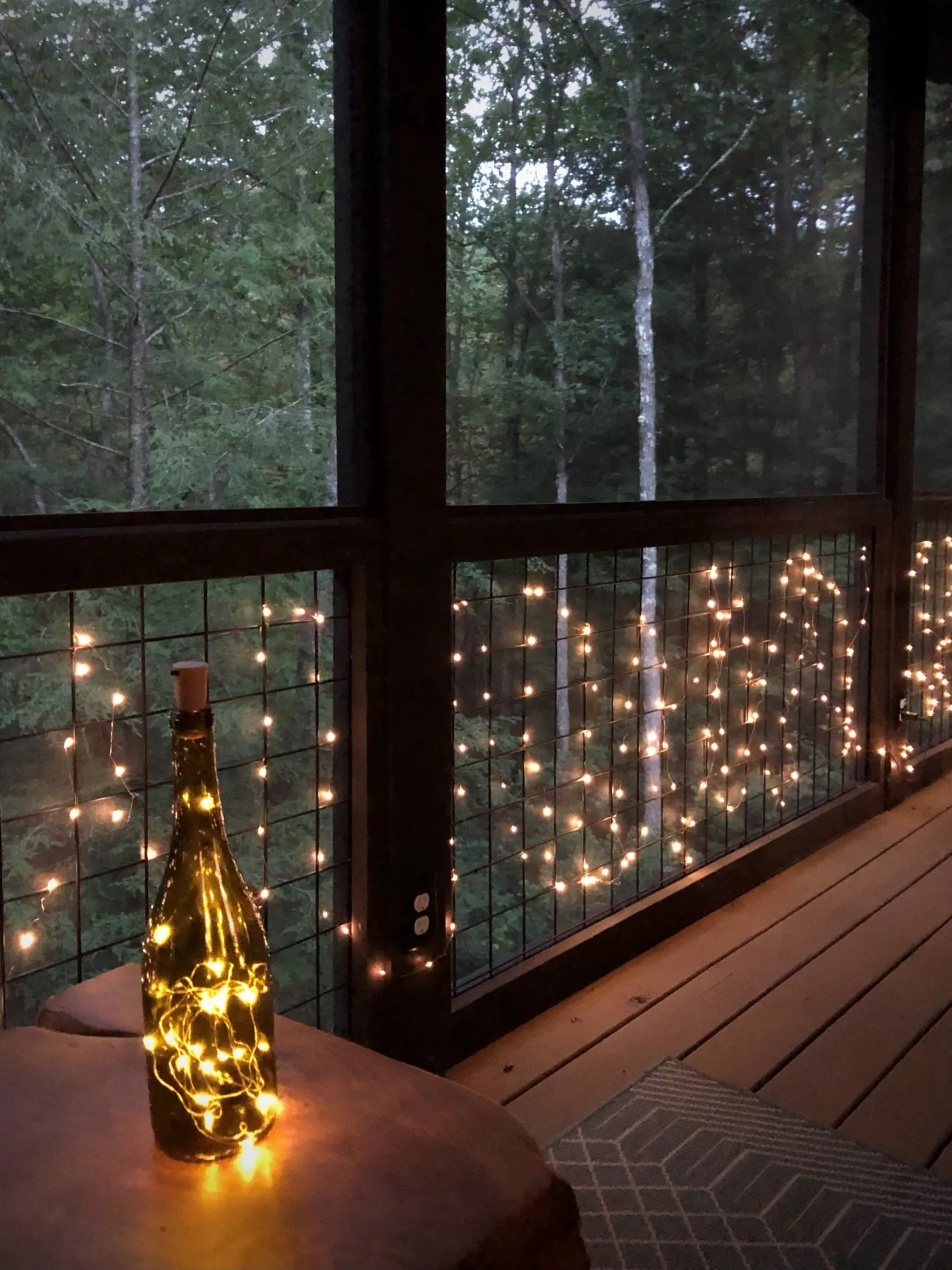
The formula is 60 percent warm light from the railing strand and the bottle, 25 percent dark structure from the metal railing, deck boards, and table, and 15 percent soft texture from the patterned rug and cushions. The dark elements are what make warm light feel cozy instead of merely bright. Swap the bottle for a lantern or a cloche and the ratio still holds. One small concentrated source always beats a big even one.
The single bottle, not the railing strand. Twenty feet of string lights is ambience; one glowing object is a focal point. It gives the eye somewhere to land and it makes the porch feel furnished rather than just lit. Put it on the table where you actually sit, because the whole point of small light sources is that you can see them up close.
31. Sunglasses Santa Riding a Giant Yellow Duck
If you are going for a joke inflatable, give it its own lighting and nothing else nearby. Put one warm floodlight on the ground aimed up at about 30 degrees. It lights the underside and keeps the face readable, which flat overhead spill never does. Then clear a 6-foot radius around it. The humor lands when it is the only absurd thing in frame. Add a second goofy figure and you have a yard sale.
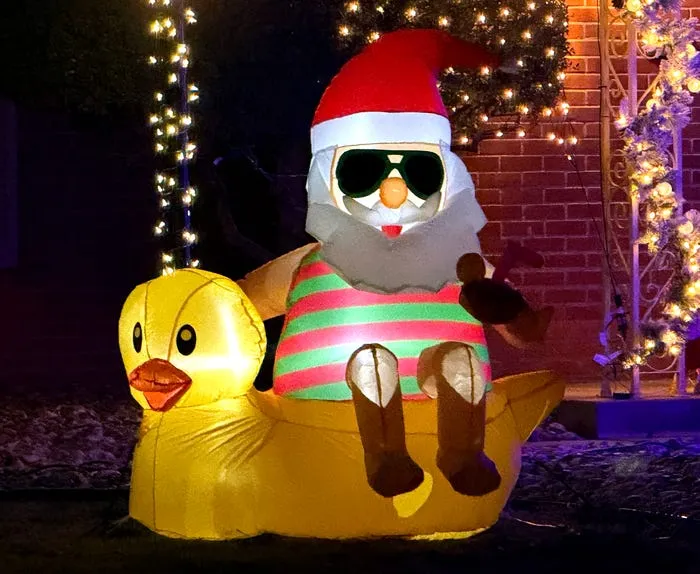
- Measure inflated height. Most novelty inflatables run 6 to 8 feet tall.
- Check outlet distance and use a waterproof cord cover past 10 feet.
- Confirm wind exposure, since anything over 20 mph will lay it flat.
- Pick a spot visible from the street but clear of your walkway.
- Store it dry. Wet-packed inflatables grow mold in the off-season.
32. Evergreen Wreath with a Red Plaid Ribbon Bow
The red plaid ribbon. Swap it for a solid red bow and this becomes a perfectly nice wreath you would walk right past. Plaid adds pattern, a hint of rustic nostalgia, and most usefully, a little visual noise that makes the wreath look handmade instead of purchased. On a wreath 24 inches across, aim for a ribbon about 2.5 inches wide.
Bundling a wreath ribbon bow:
- Cut two lengths of 2.5-inch wired ribbon, about 30 inches each.
- Loop each into a 6-inch bow, pinching the center with floral wire.
- Stack the two bows at a slight angle so the tails fan out.
- Wire the pair to the wreath’s top-left, not dead center.
- Trim the tails on a diagonal and seal the cut ends with a lighter to stop fraying.
About 20 minutes and $12 to $25 in ribbon.
- 24-inch evergreen wreath, real or faux: $30 to $90
- Wired plaid ribbon: $12 to $25
- Red berry picks and pinecones: $12 to $30
- Battery fairy lights with timer: $10 to $22
- Door hook rated for the wreath’s weight: $6 to $15
Total: about $70 to $182
Your Yard, Your Glow, Your December
You do not need a warehouse of lights to make the front of your house feel like something. One strong idea, executed with a little patience and the right color temperature, beats a cart full of random decorations every single December. Start with the piece that anchors your display, whether that is a wrapped tree, a pair of urns, or one ridiculous inflatable duck, and build outward from there. 📌 Save this to Pinterest for later, and tag us when your yard starts glowing.