
You know that feeling when you finally find the retro Christmas photo that looks exactly right for your space — and then realize you have no idea where any of it came from? That is the entire reason this guide exists.
We spent serious time browsing Etsy, eBay, Facebook Marketplace, and Target to bring you only what is worth your attention this year — 28 ideas ranging from about $12 for a set of vintage-look baubles to $475 for a full silver tinsel tree on a vintage stand. Everything here falls into four loose camps: mid-century tinsel glam, vintage maximalism, retro alpine lodge, and full-on nostalgic kitsch. Budget and luxury versions sit side by side throughout, so you can see exactly what your money buys. Some links in this post are affiliate links — if you buy through them, we may earn a small commission at no extra cost to you. And stay until the end — we break down the most common mistakes that can ruin these looks.
Tinsel trees, aluminum trees, and rotating color wheels are having their biggest year since collectors started hauling them out of basements, and 2026 is when that revival finally crossed into mainstream decorating.
📌 Save this to Pinterest for later — you’ll want to revisit these ideas.
1. White Tinsel Tree Against Textured Orange Walls
Orange wallpaper and a white tinsel tree should cancel each other out — they are both loud, just in opposite directions. What rescues the pairing is temperature: the textured wall leans warm amber, the tree reads cold silver-white, and the blue garland tied through the branches stitches those two temperatures together. The mustard armchair with its knit throw does the same work at eye level, and the wooden display cabinet full of small figurines keeps the room from dissolving into pure color. The novelty animal lamp is the wink that makes it charming instead of chaotic.
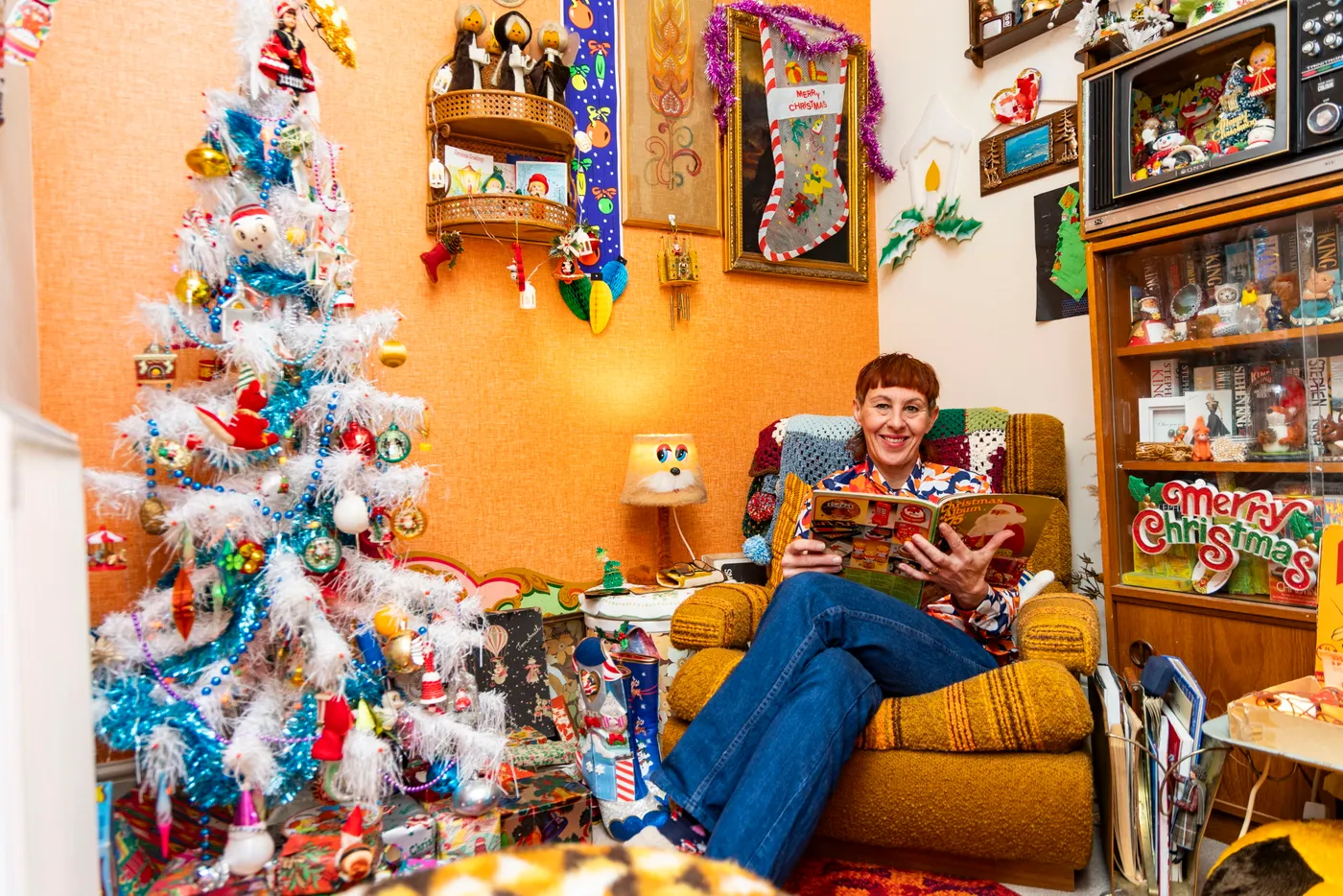
- White tinsel or vintage-style tree, 6–7 ft: $85–$320
- Blue garland and mixed vintage ornaments: $40–$150
- Mustard armchair plus knit throw: $150–$900
- Textured orange wallpaper, one wall, DIY: $90–$260
- Framed retro art, figurines, novelty lamp: $60–$300
Total: roughly $425 to $1,930, depending on whether the chair is a flea-market find or a new upholstered piece. Budget alternative: skip the wallpaper, paint that one wall a flat terracotta for about $35 in paint, and put the savings into a better tree — the tinsel is what people actually notice.
2. Rainbow-Gradient Vintage Glass Ornaments in a Wooden Crate
Sorting a collection into a gradient takes an evening and costs nothing.
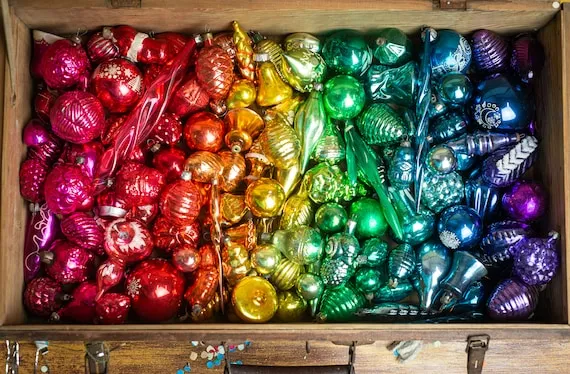
- Lay a white sheet on the floor and empty every ornament onto it — you need the full range visible before you sort.
- Make seven piles: magenta-red, orange, yellow, green, turquoise, blue, purple.
- Set the wooden chest in place and work left to right, starting with the deepest reds.
- Keep shapes mixed inside each color band so the eye reads color first, then form.
- Photograph the finished gradient — the arrangement itself is the decoration.
Roughly 90 minutes of work. Cost is $0 if the ornaments are already yours; a sturdy wooden chest runs $30–$80 at a flea market.
Tinsel and glass start to look like a mess when every ornament has the same silhouette, so count shapes instead of colors: about one elongated teardrop or icicle for every four round baubles, plus one figural piece — a pinecone, a bird, a tiny Santa — per color band. Ribbed and patterned reflectors catch light differently than smooth glass, which is exactly what gives a gradient display its shimmer from across the room. Nudge the figural pieces slightly forward so they do not get swallowed.
3. Color Wheel Spotlight on a Silver Tinsel Tree
Take away the motorized color wheel in its red plastic housing and you are left with a perfectly nice silver tree sitting in a dim corner. The wheel is the whole trick. It throws magenta, then green, then amber across the tinsel, and because the branches are reflective the entire tree changes color every few seconds without a single ornament moving. That red table skirt with the poinsettia border matters for the same reason — it is the warm, static ground underneath all that shifting light.
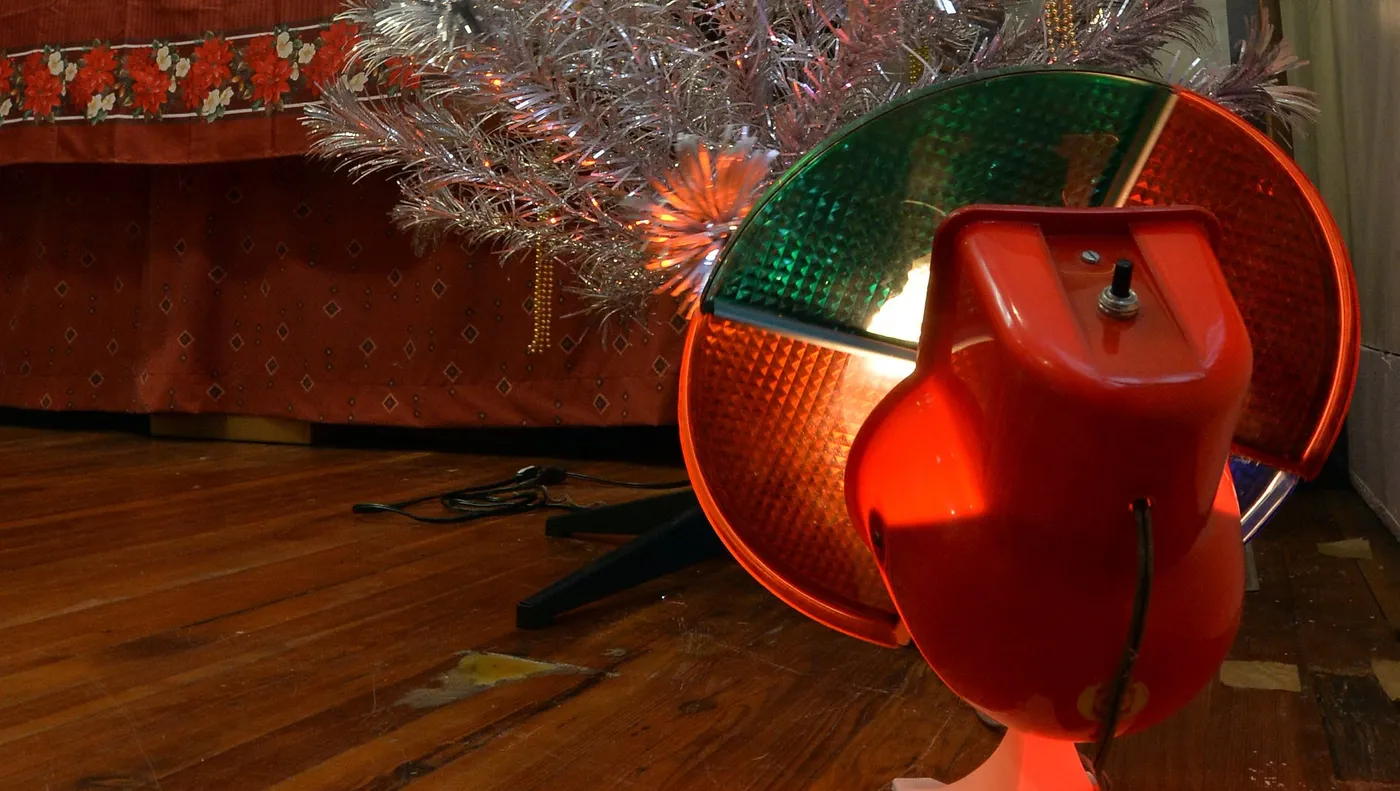
The formula runs about 40% silver tinsel, 30% saturated red in the table skirt and poinsettia border, 20% rotating color from the wheel, and 10% warm gold in the bead garland. Swap the red for deep teal and you get something cooler and more 1950s; swap the gold beads for matte white and it turns Scandinavian. Keep the ratio and the wheel still works — silver has to stay dominant.
4. A Striped Red Runner and a 1970s Holiday Table
Tablescaping came back hard, and the version people save on Pinterest in 2026 is not minimalist — it is layered. A white patterned tablecloth with a striped red runner over the top, woven placemats, one lit candle in the middle. That is a direct lift from 1970s holiday entertaining, when the table got dressed as carefully as the tree. It has staying power because it is textiles, not trends: linens store flat, wash clean, and never date the way a specific ornament shape does.
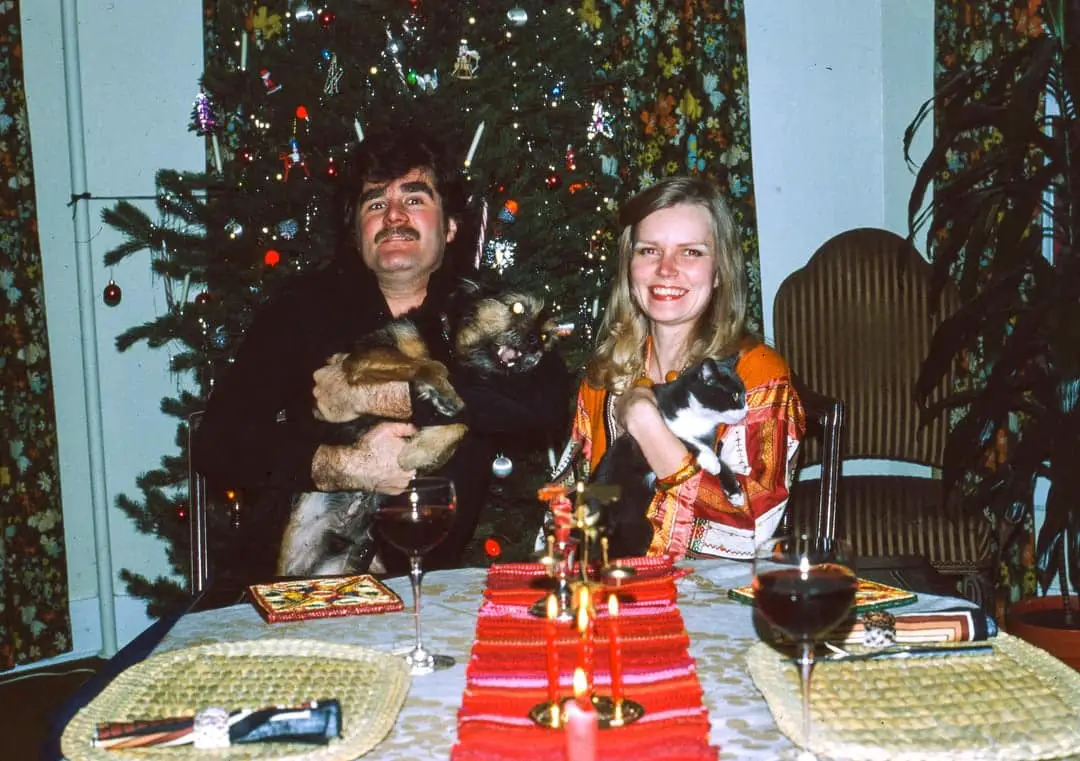
This setup wants a table at least 60 inches long and a room around 10 x 12 ft or larger, since the tree behind the table needs 30–36 inches of walking clearance. Ceilings under 8 ft are fine as long as the tree stays near 6 ft. If your dining space is tighter than that, the miniature tabletop trees in Idea #11 deliver the same festive density in about a square foot.
5. Silver Tinsel Beside a Stacked Stone Fireplace
Two things to know before you copy this. First, tinsel reflects everything, so in a room with floor-to-ceiling glass the tree doubles itself after dark — beautiful, but leave a lamp on so the reflection does not read as a shadow. Second, keep the tree at least three feet from the hearth, and never run a color wheel cord across the fireplace opening. Aluminum and tinsel trees are flame-resistant; cheap rotating wheels and extension cords are not.
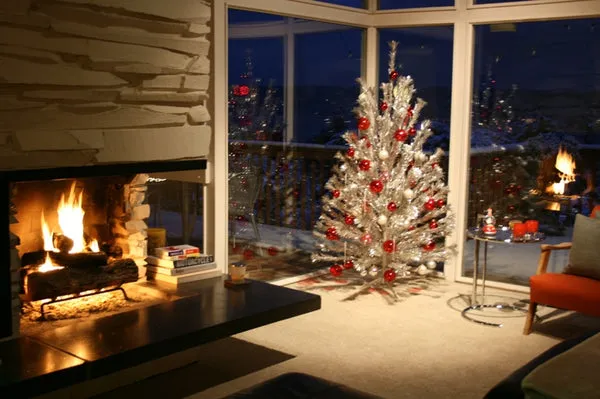
The composition is warm versus cool, balanced almost mathematically. Silver tinsel and white ornaments supply the cold side; stacked stone, burning logs, and the orange armchair supply the warm. The chrome side table is the bridge — metal like the tree, but reflecting firelight like everything else in the warm camp. Even the red ornaments echo the embers instead of fighting them. Compare with Idea #20 to see those same ornaments up close.
6. Felt Pennant Garland Across White Built-Ins
Pennant garlands fail when they get hung like bunting at a county fair. Space the flags 2–3 inches apart so the eye can read each one, and give the line a slight droop — about two inches of sag across eight feet. Run warm string lights behind the cord, not in front, or the pennants get backlit into silhouettes. Keep the garland line at least 12 inches below the shelf above it, otherwise the whole thing reads as clutter instead of a collection.
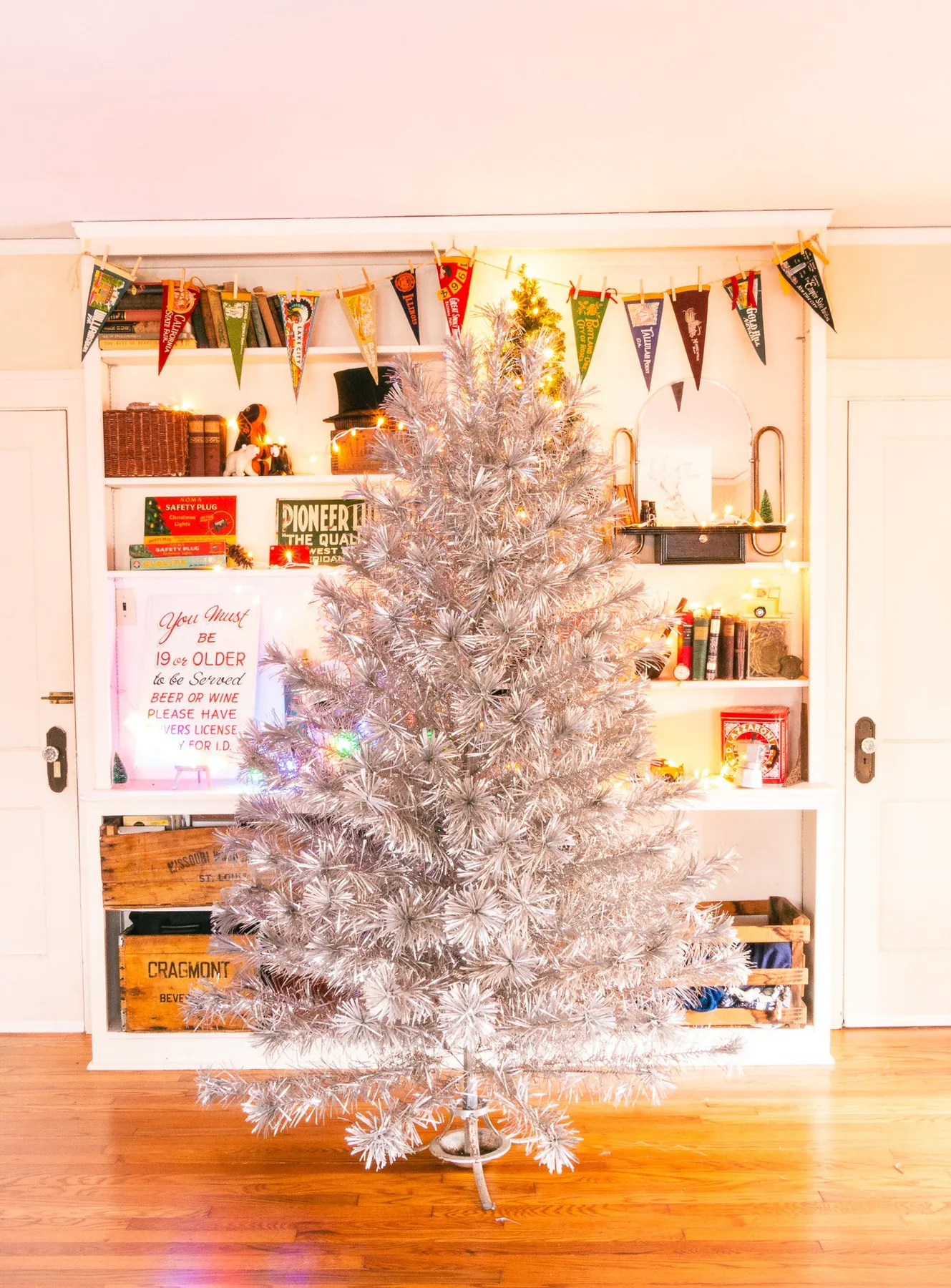
Real vintage felt pennants sell for $8–$35 each online, which adds up fast across a wall of shelves. Flea markets and estate sales are where they still turn up for $2–$6. If you cannot find enough, felt squares plus iron-on letters run about $12 for eight flags, and the hand-cut edges read as vintage from three feet away. Wooden crates are $12–$18 at a craft store; a 20-foot strand of warm string lights is $8–$15 at Target or IKEA.
7. A Hand-Painted Yellow Star Topper on Silver Tinsel
Every other object on this tree is reflective — silver tinsel, glossy vintage glass in blue, green, and red, warm bulbs bouncing off all of it. The painted yellow star is the only matte surface in the arrangement, and that is exactly why your eye lands there first. Remove the star and you have a beautiful, shimmering, completely unanchored tree. It does not need to be expensive. It needs to be flat, and it needs to be the warmest color in the room.
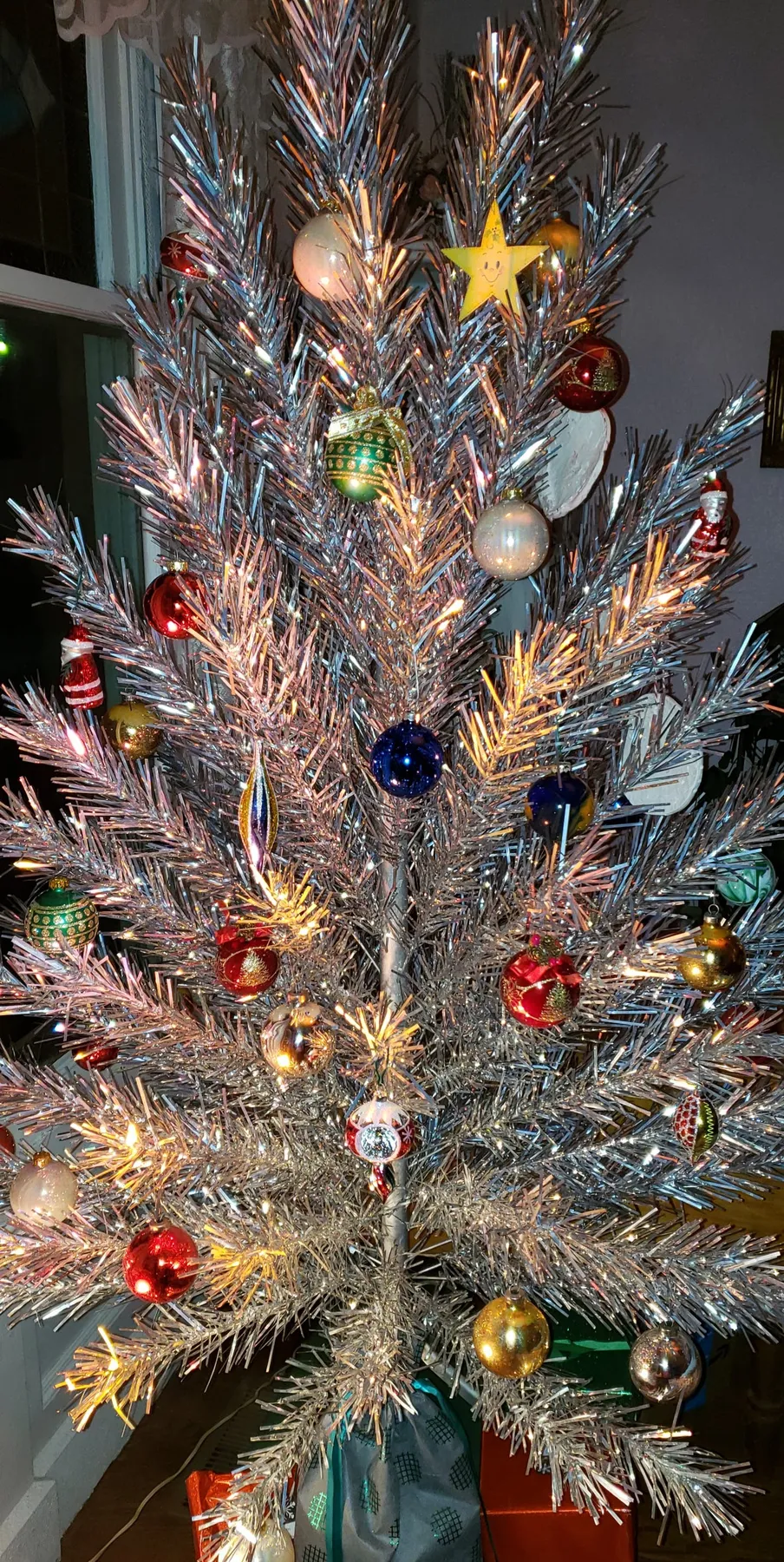
A 6.5–7 ft tinsel tree is the sweet spot here, and it wants an 8–9 ft ceiling. Unlike a wide evergreen, tinsel trees have a narrow silhouette — roughly 36–40 inches across at the base — so they read as a tall column and need a wall behind them with about 18 inches of breathing room on each side. In a room under 120 sq ft, size down to 4 ft and take the approach in Idea #18.
8. Mid-Century Console Stereo and a Tinsel-Draped Tree
Why does a wooden console stereo belong in a Christmas photo in 2026? Because the same collectors who revived aluminum trees also revived mid-century hi-fi furniture, and the two kept getting photographed together until they became one look. Restored consoles are being used as credenzas, and a miniature nativity scene or an old console television sitting beside a tinsel-draped tree reads as a period room rather than a pile of stuff. It is nostalgia with an actual shelf life.
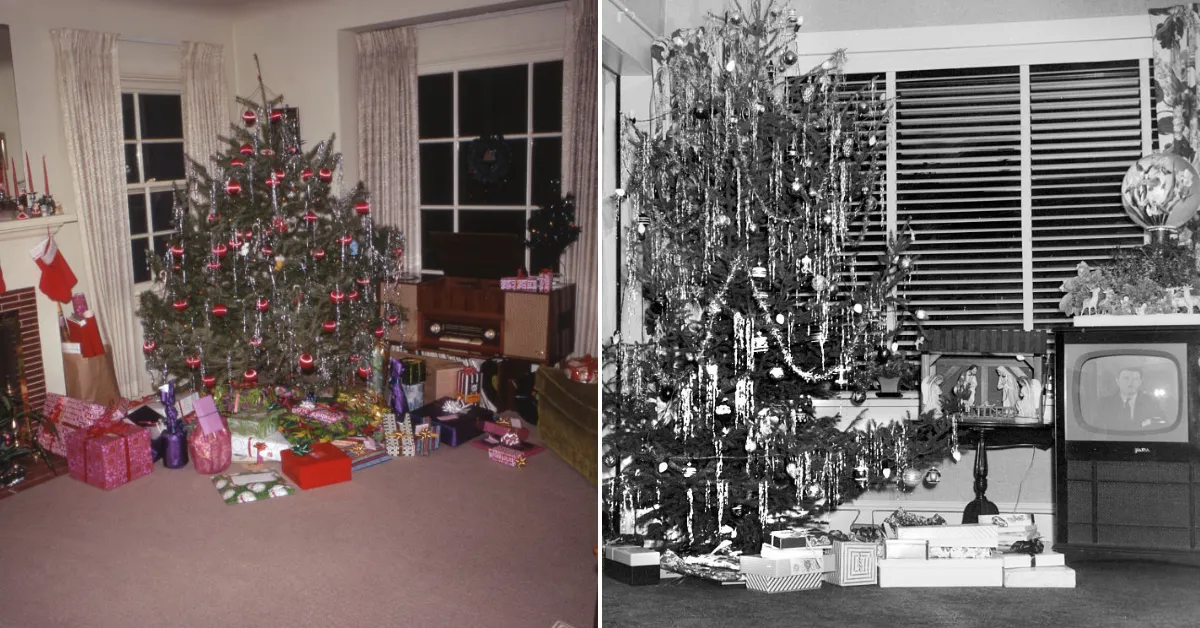
Heavy tinsel looks cheap when it is bunched. Cut strands into 18-inch lengths, then hang three or four per branch tip starting at the top and working down, letting each strand drape over the one below it. Aim for one strand roughly every two inches of branch so the green still shows through. Set the wrapped gifts slightly off-center under the tree rather than perfectly centered — a symmetrical pile reads as a store display.
9. A Rainbow Fleet of Tinsel Trees on Faux Snow
The formula is about 50% white and silver as the base, 30% split between two hero colors — here, gold and turquoise — and 20% pure wildcard, the pink and blue trees that make the group feel collected rather than coordinated. Swap gold and turquoise for copper and deep green and it turns traditional; swap them for pink and silver and you are fully in the 1980s. One rule: never let the wildcard take more than a fifth of the group, or it stops looking curated.

Faux snow is wonderful for about three weeks and then it is everywhere — tracked onto wood floors, clinging to socks, embedded in anything it touches. With pets or a crawling baby, skip loose snow and use a white cotton batting mat you can shake out and store flat. Also keep colored tinsel out of direct sun: the metallic coating fades to a dull pastel after a season or two by a bright window, and there is no fixing it.
10. Dense Colorful Baubles Layered With Shimmering Tinsel
Tinsel sheds. Not dramatically, but every time you walk past it, a few metallic fibers end up on the floor, the rug, and eventually the vacuum filter. Plan on a quick pass with a handheld vacuum every few days in December, and do not send a robot vacuum under a tinsel tree unless you enjoy untangling metallic strands from a brush roll. Stored tinsel also crushes, so keep strands loose in a garment bag rather than a sealed bin and they will fluff back out next year.
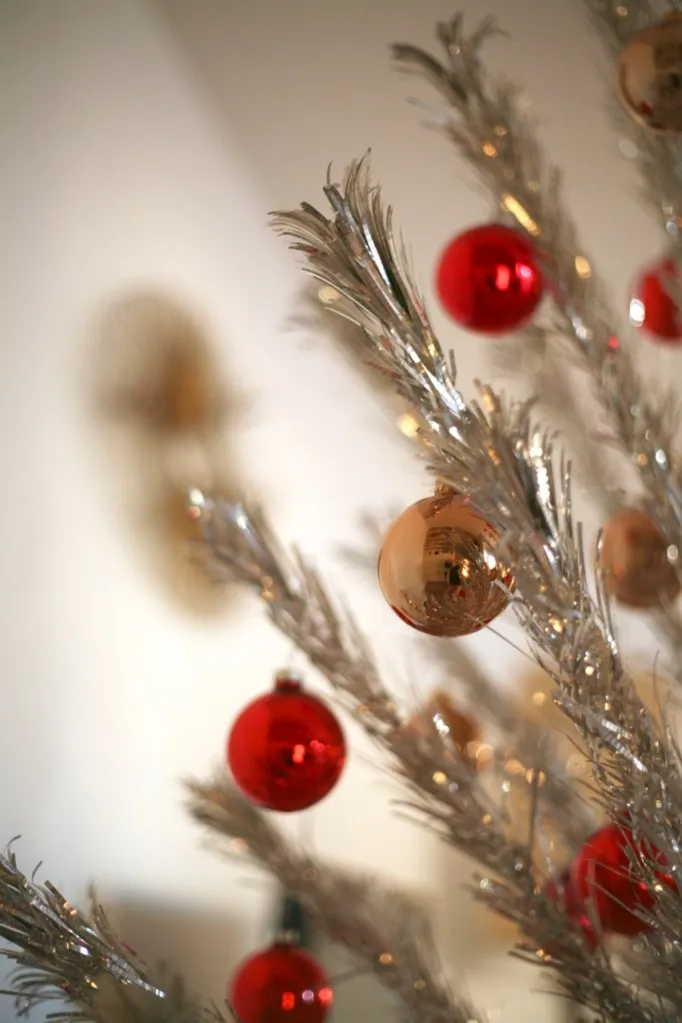
- Vintage-look glass baubles, set of 24–40: $30–$120
- Tinsel strands, six packs: $24–$60
- Warm-white string lights, two strands: $16–$40
- Hooks, storage box, spare bulbs: $15–$40
Total: roughly $85 to $260 for a fully dressed tree if you already own one. Budget alternative: buy tinsel and baubles in January, when big-box stores mark holiday inventory down 60–75%, and you can dress the same tree next year for under $40.
11. Miniature Pom-Pom Tinsel Trees on Batting Snow
Making the snow base is the easy part.
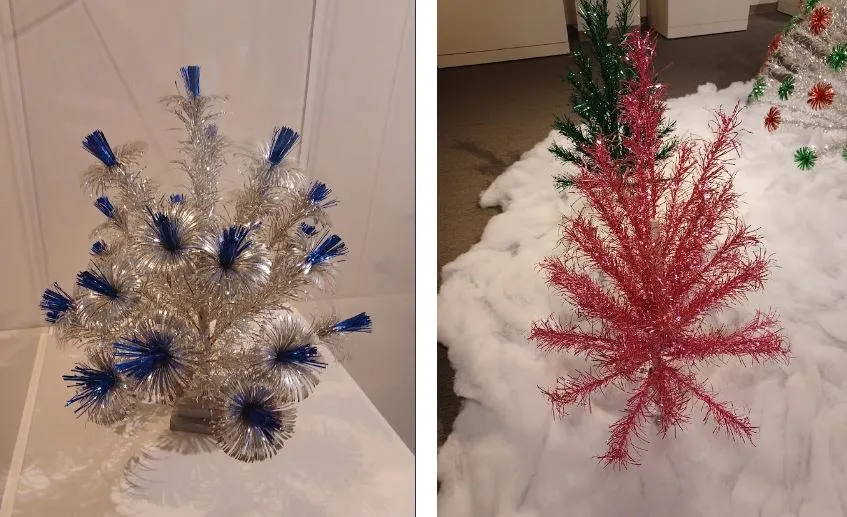
- Cut a rectangle of quilt batting about two inches wider than your shelf on every side.
- Pull the edges apart with your fingers so they look ragged, not scissor-straight.
- Set the batting down first, then nestle each tree into it so the stand disappears.
- Group in odd numbers — three or five — with the tallest at the back left.
- Fluff the pom-pom tips by hand; they arrive flattened from the box.
About 20 minutes and $8–$15 in batting. No glue, no tools beyond scissors.
- Measure your shelf depth — the smallest trees need 8 inches front to back.
- Confirm an outlet is within reach, or buy battery fairy lights.
- Check whether the shelf sits at eye level; up high, the snow base vanishes.
- Decide now where these live in January — a shoebox with tissue beats a tangled bin.
12. A Flocked Tree and a Mannequin in the Basement
Flocked trees shed white powder for the first week, so put a sheet down before you assemble one and skip vacuuming until the decorating is done. More importantly: flocking traps moisture. If your basement smells musty in July, it will smell musty in the tree by mid-December. Grab a $10 hygrometer, keep the room under 50% humidity, and you can display and store flocked or fabric decor down there without regrets.
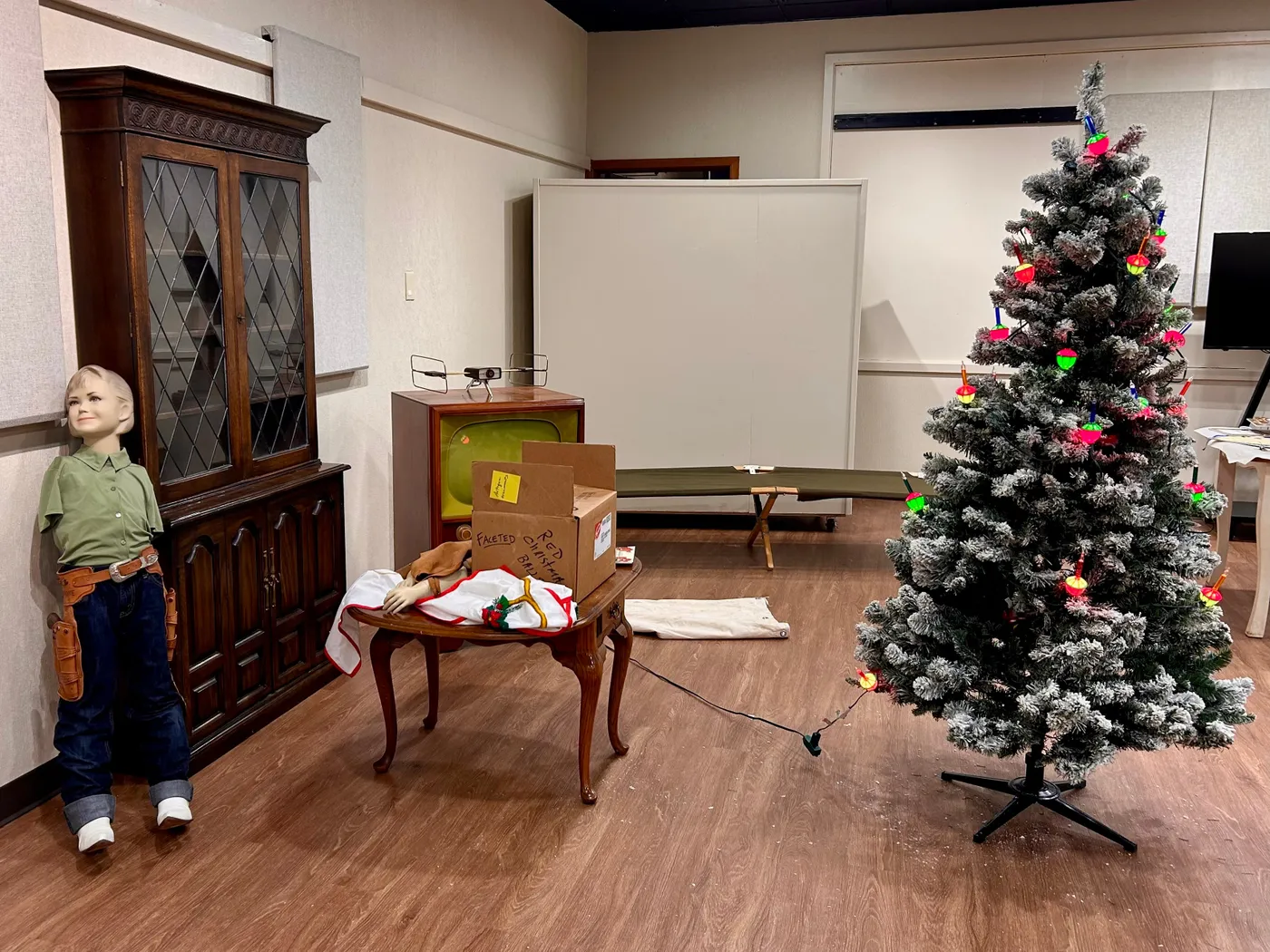
The mannequin. Everything else in this room is period-correct and expected — the dark wood glass-front cabinet, the console television, the colorful lights on the tree. The life-sized mannequin in a plain shirt and jeans is what makes it feel like a set somebody built rather than a basement somebody decorated. That is the difference between a themed room and a room with a point of view, and it costs nothing but nerve.
13. Vintage Pennants Strung Above the Tinsel Tree
Hanging a pennant line above a tree instead of across it solves a real problem: tinsel trees are tall and narrow, so anything hung at branch level fights the silhouette. Put two small screw hooks in the wall and run the line at least 14 inches above the treetop. On an 8-foot ceiling with a 6-foot tree, that puts the line around 80 inches — high enough to read as a banner, low enough to see each pennant without craning. Keep the tree lights warm so the pennants stay the brightest thing up there. Compare with Idea #6, where the same pennants dress the shelves instead.
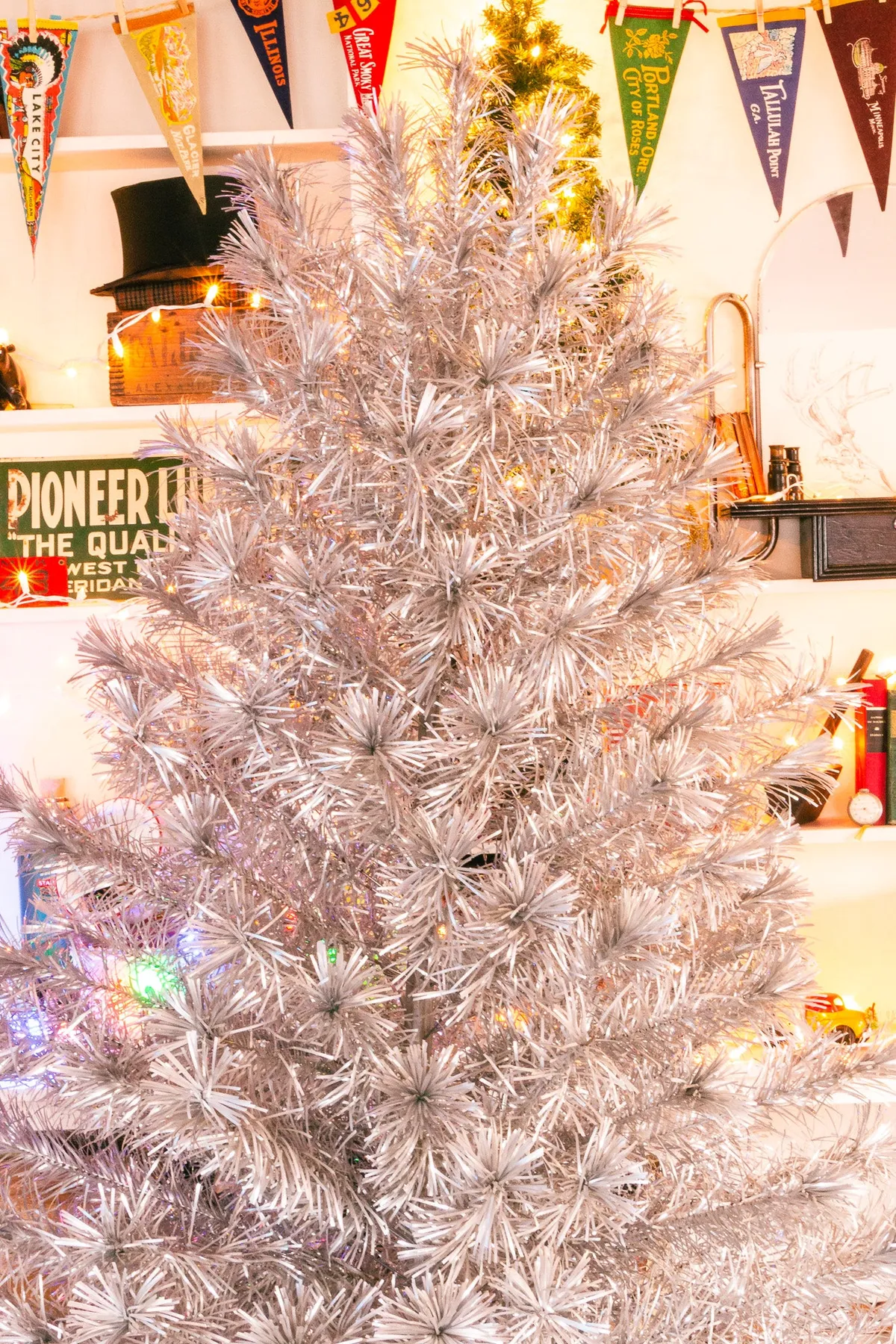
Vintage pennants at $8–$35 each turn a garland into a $150 project fast. Felt squares plus iron-on letters get you eight flags for about $12, and nobody studies the stitching from across a room. Clothesline cord is $5. The tree is the one place not to skimp — a $40 tabletop version reads thin next to the real thing, while a solid 6-foot tinsel tree runs $90–$150 and lasts a decade if you store it loose.
14. Vintage Ski Signs and a Tripod-Base Tinsel Tree
This is entryway or hallway scale. A 6-foot tinsel tree on a tripod stand needs a footprint of about 30 x 30 inches and roughly 14 inches of clearance from any door swing. A 42–48 inch hallway handles it comfortably; anything narrower and you will be sidestepping it all season. Nine-foot ceilings are ideal, since the tripod base adds 8–10 inches of height on its own. For a larger room, the multi-tree collection in Idea #15 scales up without eating more floor space than one wide evergreen.
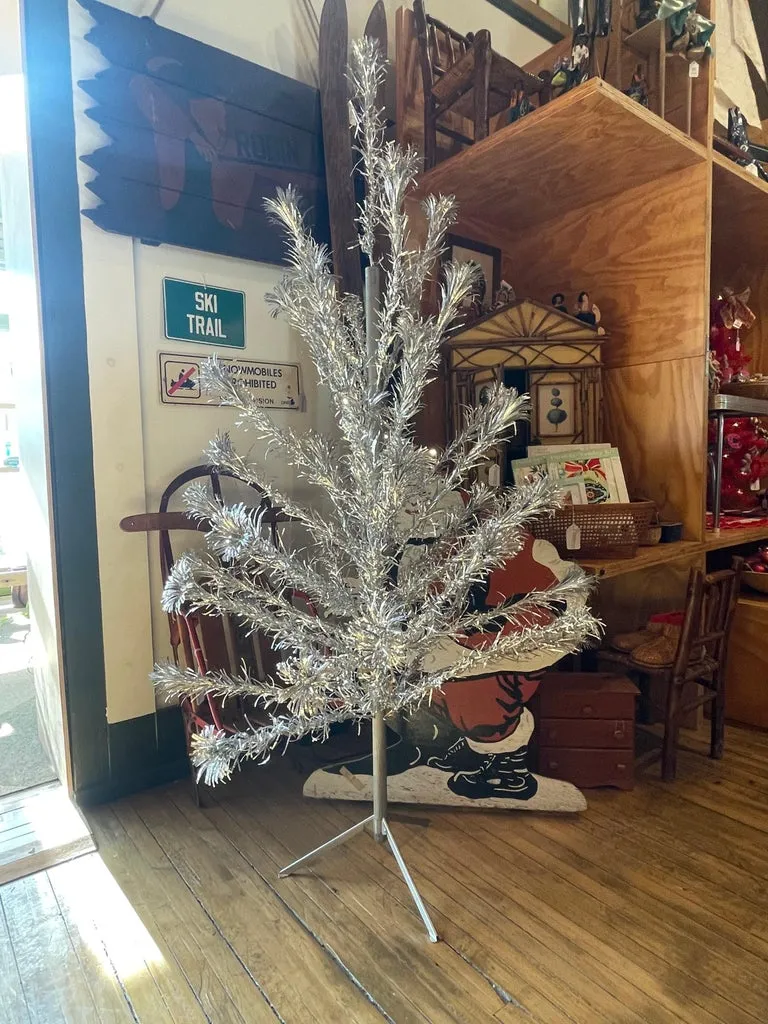
Retro alpine — vintage ski trail signs, wooden shelving, plaid, a Santa cutout leaning in the corner — has quietly become one of the most-saved Christmas looks for people who do not want red and green in every direction. It works because it borrows from lodge nostalgia rather than department-store nostalgia, and because that metal tripod stand is both authentic and far sturdier than the wobbly plastic bases most modern trees ship with.
15. A Forest of Aluminum Trees With Vinyl Records at the Base
Building a cluster instead of a single tree:
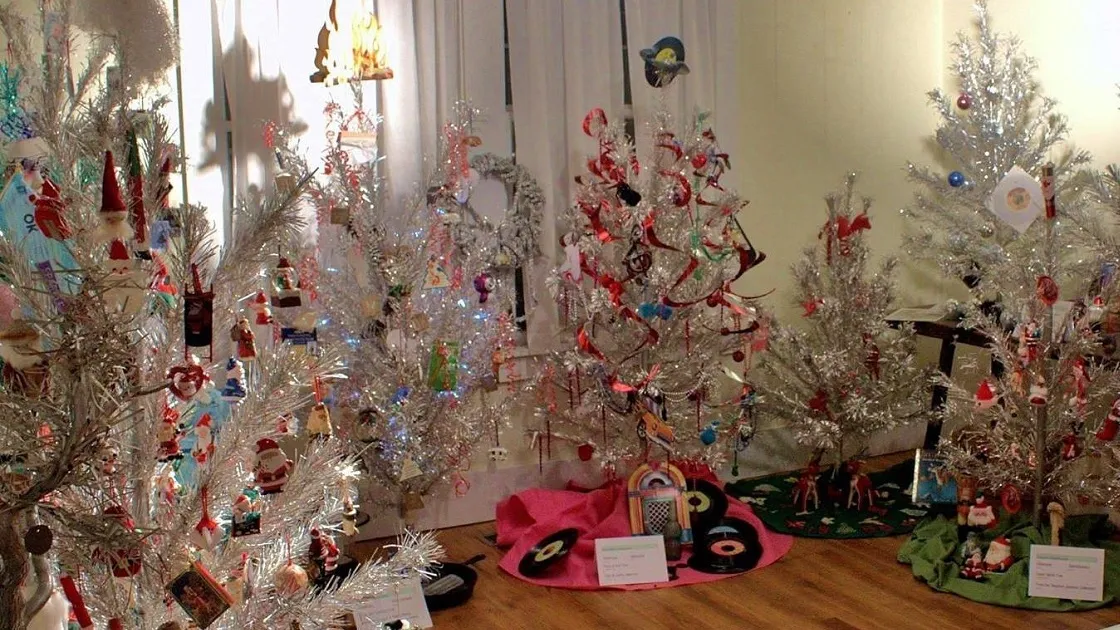
- Pick three heights that differ by at least 18 inches — 7 ft, 5 ft, and 4 ft works well.
- Set the tallest at the back, roughly 18 inches off the wall.
- Place the mid-size tree to its left, forward about a foot.
- Tuck the smallest at the front right, angled slightly inward.
- Drape red ribbon in loose swirls rather than spirals, stopping about a third of the way up each tree.
About 40 minutes to arrange. Colored tree skirts run $15–$45 each, and they are what visually separates the three trees.
Three silver trees at different heights do something one tree cannot: they create rhythm. Your eye moves up the tallest, down to the middle one, and finishes on the small one, which is why the group feels bigger than the sum of its parts. The vintage ornaments, small toys, records, and jukebox decor at the base keep it from reading as a retail display. Repetition with variation — same material, three sizes, three skirt colors.
16. Cherry Red on Charcoal: The Boldest Retro Pairing
Strip a retro Christmas palette down to its loudest possible version and you get this: roughly 80% deep charcoal and near-black, 20% one saturated cherry red that glows because of what surrounds it. Nothing in between — no gold, no green, no white. The red only reads as glowing against the dark ground; put the same red on a cream wall and it goes flat. Want it warmer? Swap in a burnt orange at the same 20%. Want it colder? Deep emerald does the job.
What makes this palette work is not the red — it is the restraint. One color, one shape, one point of emphasis. That is the hardest thing to do at Christmas, because the instinct is always to add. If you build a room around this idea, give yourself a strict allowance: one red element per surface. A single red velvet cushion on a charcoal sofa. One red glass ornament on a black tray. The moment you add a second red to that shelf, the effect collapses.
17. Warm Bulbs Only: Building the 1962 Glow
Warm-white LED strands in the 2200K–2700K range cost $12–$25 and run roughly 15,000 hours, which is about a decade of Decembers. The catch: cheap strands fail at the plug end first, so buy two spares and store them with the tree. If you run true vintage C7 bulbs, expect to replace 10–15% of them every season, and check the cord jacket for cracking before you plug anything in — old wiring near a dry tree is a genuine hazard, not a hypothetical one.
Color temperature does more work in a retro Christmas room than any ornament you can buy. A 2700K bulb makes silver tinsel look like candlelight and turns red glass deep and warm; a 5000K bulb makes the same tree look like a display case in a pharmacy. If you change one thing this year, change the bulbs. Retro does not actually mean old — it means the light is amber, the shadows are soft, and nothing in the room outshines the fire.
18. One Silver Tinsel Tree, One White Paneled Door
There is one tree, one door, one round silver doorknob, and a lot of empty white wall. The emptiness is the design. Against a plain paneled door and a bare baseboard, a sparse silver tinsel tree looks intentional rather than unfinished — negative space is what makes it read as minimal instead of cheap. Fill that corner with a wreath, a sign, and a basket, and you lose the entire point. Sometimes the decorating decision is what you refuse to add.
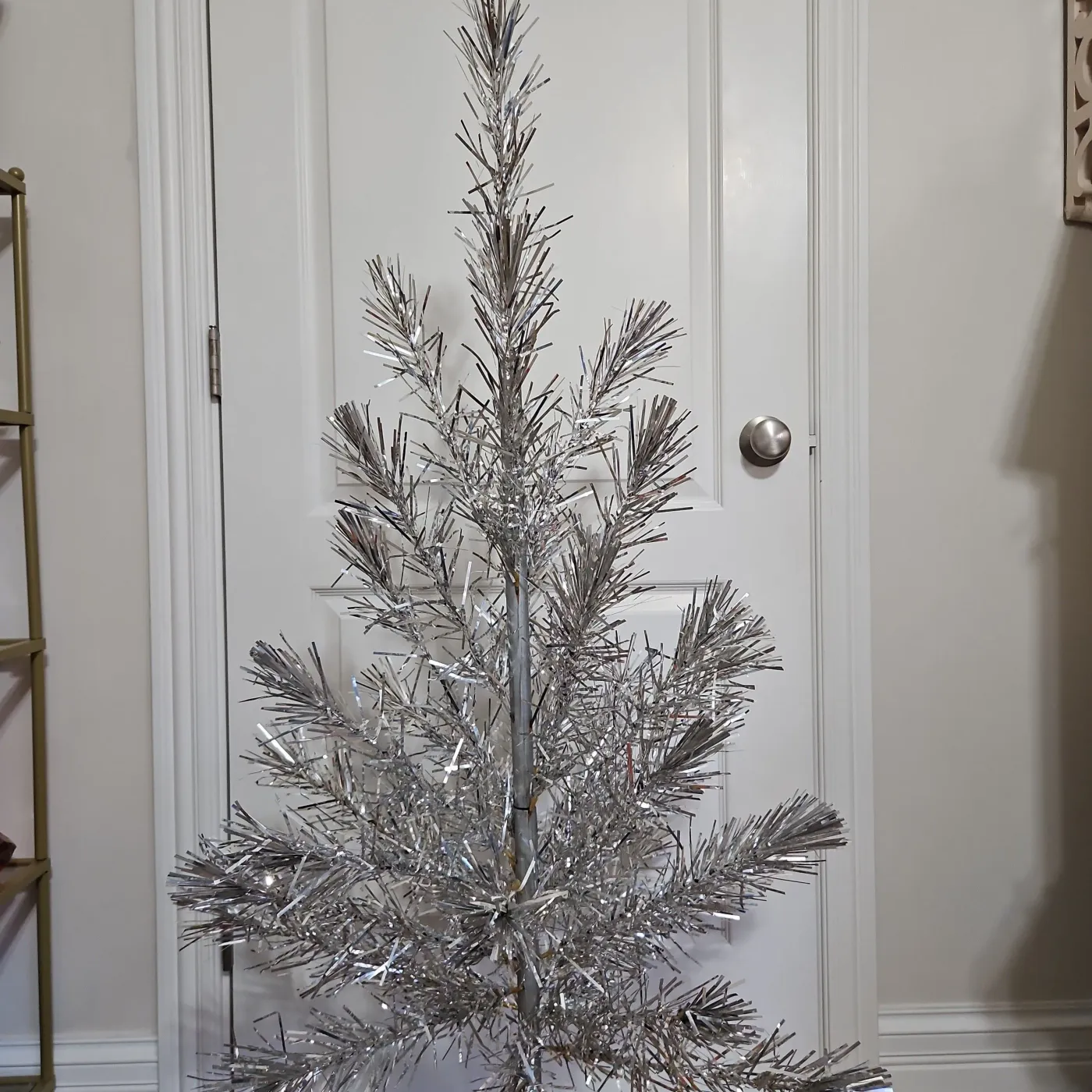
This is a small-space solution. A 4–5 ft tinsel tree on a slim stand fits a hallway 36–42 inches wide with about 8 inches of clearance on each side, and it is fine under an 8-foot ceiling. Measure from the door casing, not the wall — you want at least 10 inches between tree and frame so the door opens fully. It is the opposite approach to the multi-tree collection in Idea #15; both work, but one is abundance and one is restraint.
19. Red and Gold Baubles on Silver Tinsel, One at a Time
Decorating a tinsel tree is a different job than decorating an evergreen.
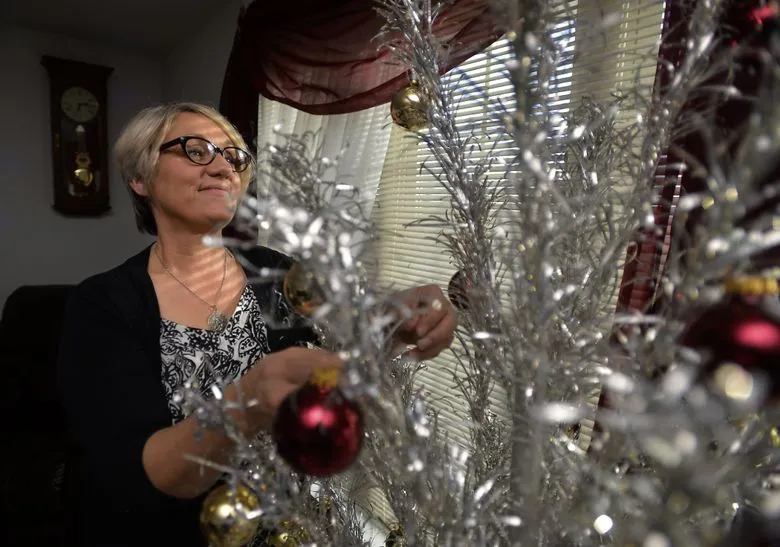
- Fluff the branches first, bottom up, so you are not crushing what you just fixed.
- Use small wire hooks, not clip-ons — tinsel branches lack the stiffness clips need.
- Space baubles 6–8 inches apart and keep anything over four ounces near the trunk.
- Work in a spiral rather than tier by tier so you do not end up with a bald side.
- Step back every dozen ornaments; tinsel trees look fuller from six feet away.
About two hours for a 6-foot tree, plus $35–$90 for new hooks and ornaments.
Red ornaments against a dark red window valance is a lot of red in one sightline. It can work, but only if something silver or white sits between them. If your window treatments are already burgundy or crimson, lean the tree toward gold, glass, and white and let the drapes be the only red in that corner. Also worth knowing: tinsel branches sag under weight and do not spring back, so heavy ornaments hung near the tips leave permanent dips.
20. Red Baubles With Gold Linework on Silver Tinsel
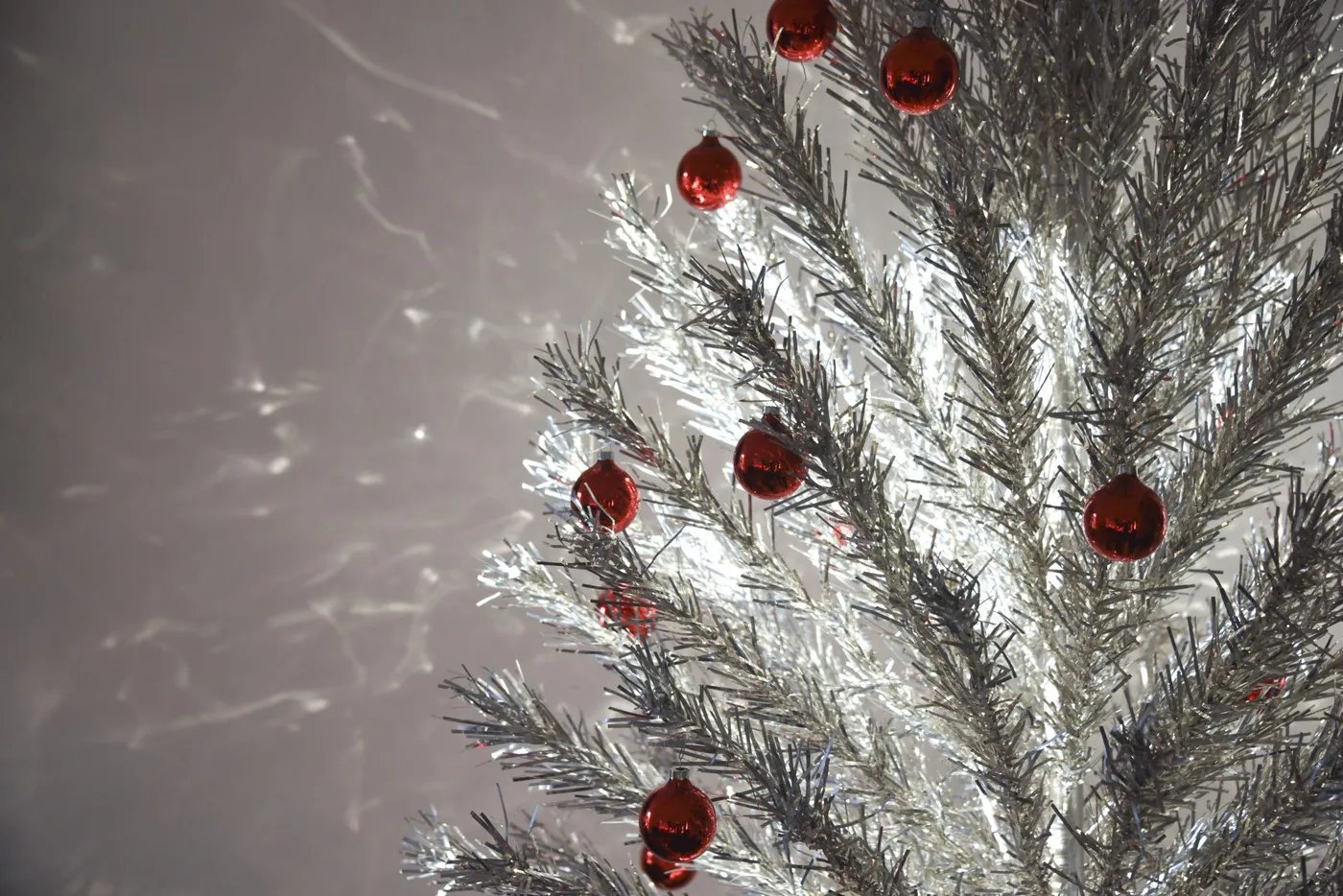
The detail that makes this close-up work is finish mixing: for every three glossy ornaments, add one matte piece or one with gold linework, plus a textured shape like a pinecone. Three finishes, one color story. The gold caps matter more than you would think — they repeat the warmth of the bulbs and keep red glass from looking like plastic. Hang the heavier pieces low, where the branches are densest and the light reaches them from below.

Glass ornaments chip, and they chip faster when stored loose with tinsel. Wrap each one in tissue and store them upright in a divided box — a $12 storage box pays for itself the first time it saves a $20 vintage bauble. Gold caps tarnish after a few seasons of handling, which you can slow by keeping boxes out of humid basements. If a piece does chip, sand the edge with fine paper and move it to a wreath.
21. Pom-Pom Tinsel Needles in a Distressed White Stand
Vintage metal tree stands with a chipped white finish turn up at estate sales for $5–$15, and they are the fastest way to make a modern tinsel tree look old. No luck thrifting? A $9 can of matte white spray paint and a $6 plastic stand from a discount store get you 90% of the look — scuff the plastic with fine sandpaper first so the paint grips. Pom-pom style tinsel, the kind with clustered tips, is usually cheaper than flat strands and reflects more light per branch.
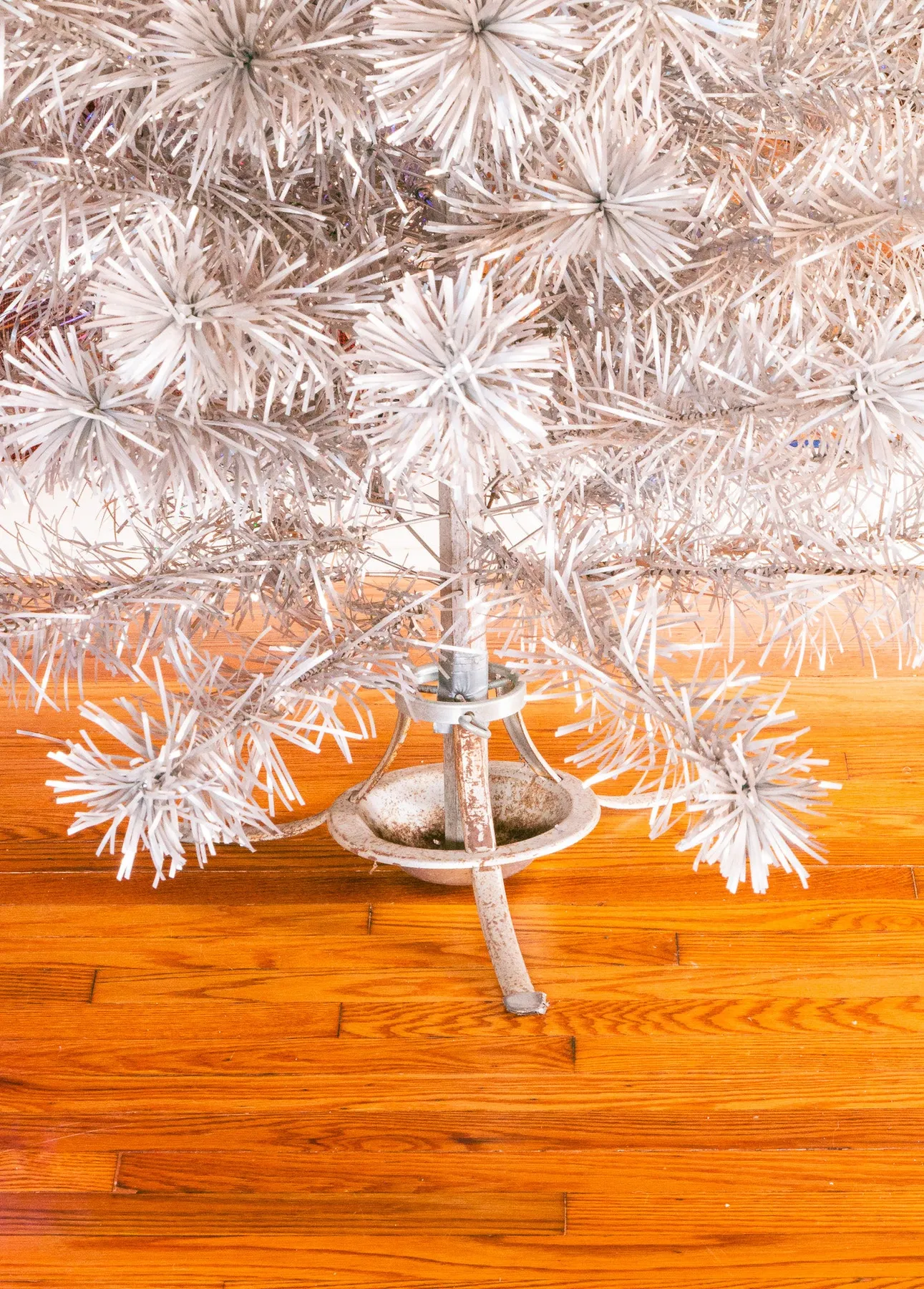
- Check the floor finish — metal stands scratch polished hardwood; felt pads cost about $4.
- Confirm the stand pole diameter matches your tree trunk sleeve before buying.
- Choose the tree final corner first; tinsel dents permanently if dragged assembled.
- Locate the nearest outlet, or commit to battery lights.
22. A Red Rug and a Tinsel-Draped Tree by the Brick
Red rug, silver tinsel, brick, and one black tufted leather chair. That chair is doing the quiet work — everything else is either warm (brick, wood shelves, firelight) or metallic (tinsel, ornaments), and the black leather gives your eye somewhere to rest. Without it, the room is all sparkle and no punctuation. Notice too that the tinsel is draped rather than spiraled, so the tree reads as heavily dressed but not wound up. Presents stack straight on the rug, which softens both the sound and the hard edges.
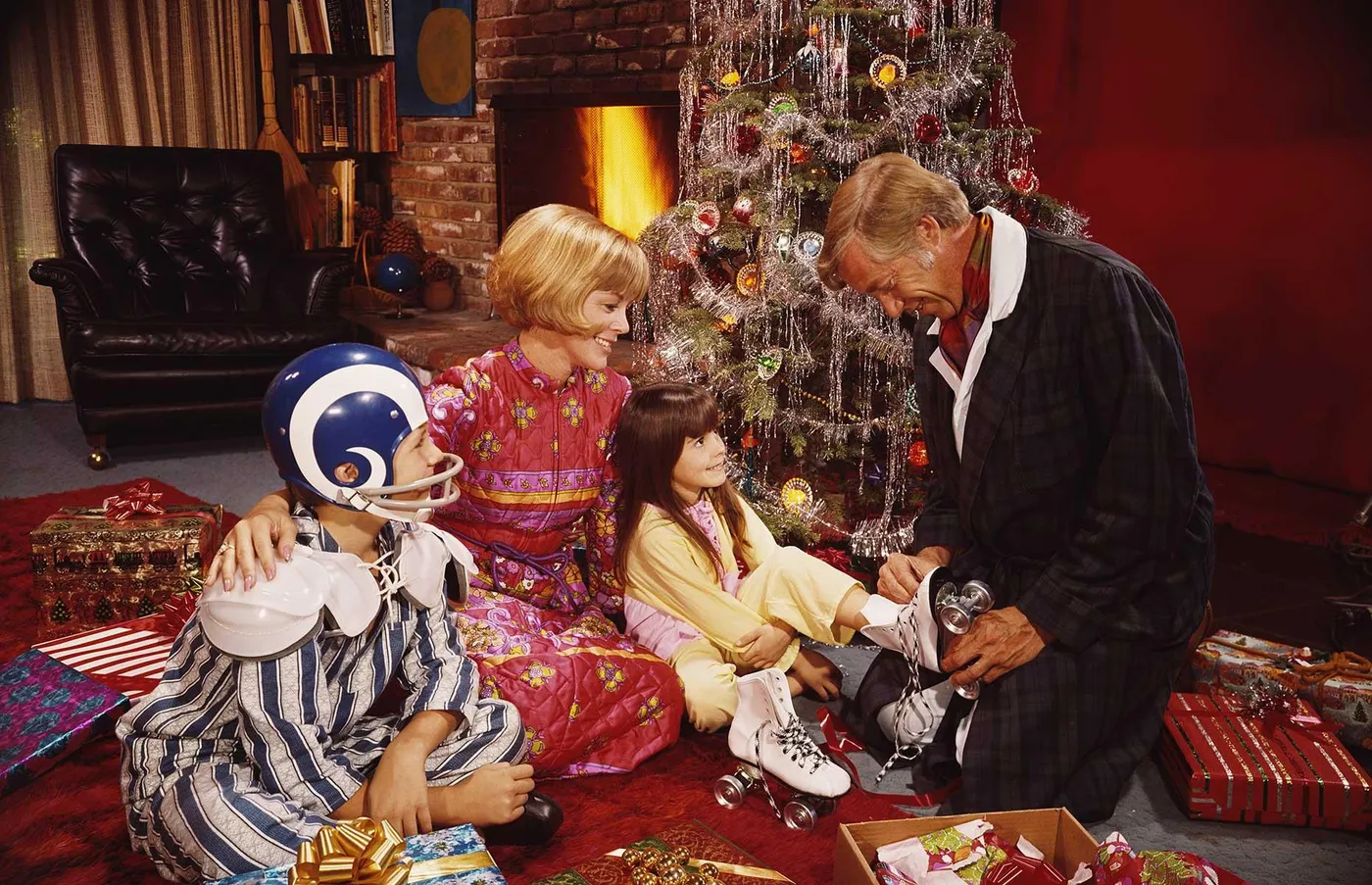
A room roughly 14 x 18 ft handles this comfortably: an 8 x 10 area rug, a 7-foot tree tucked into the fireplace corner, and 36 inches of walking space between seating and hearth. Under 150 sq ft, drop to a 6-foot tree and a 5 x 8 rug — the proportions still work, you just lose the generosity. Vaulted ceilings above 12 ft will swallow a standard tree, so add a tall bookshelf or a second tree to fill the vertical space.
23. Poinsettias and Garland on a Brick Mantel
Real poinsettias are back in a way they were not five years ago — part of the broader shift away from plastic-looking decor and toward things that are alive, even if they only last six weeks. On a brick mantel, red poinsettias beside a quality garland and a single hanging stocking read as collected rather than purchased. The catch is upkeep: real poinsettias want bright indirect light, water only when the soil is dry, and absolutely no draft from a fireplace that is actually in use.
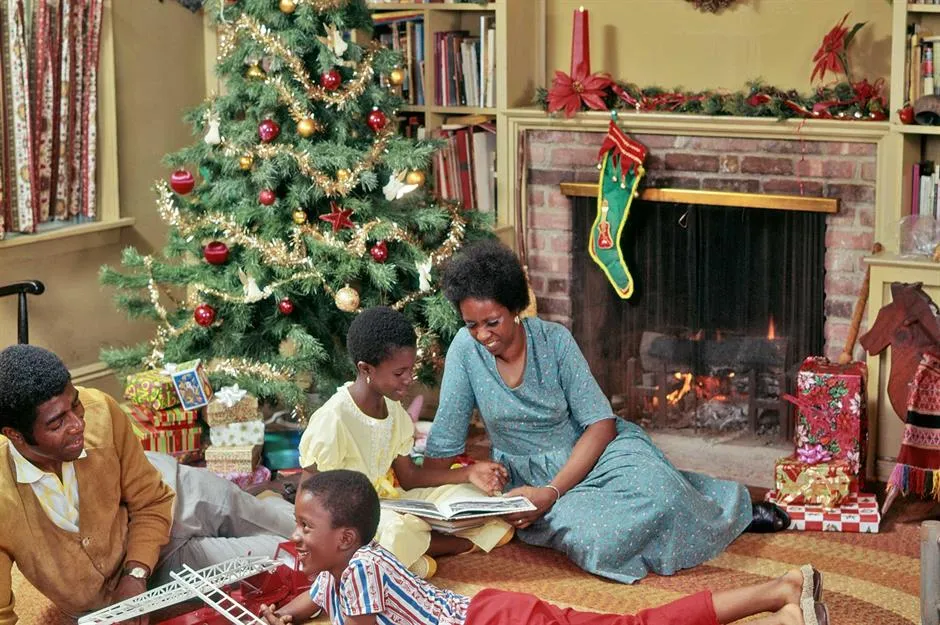
- Garland, 9 ft quality faux: $35–$120
- Two to three poinsettias in plain pots: $18–$45
- Stocking and holder: $20–$60
- Warm fairy lights for the garland: $12–$25
- Mantel clips and one extension cord: $10–$20
Total: about $95 to $270 for a mantel that carries the entire room. Budget alternative: buy a plain green faux garland and wire in real cedar clippings from a tree lot — many lots give them away — for a $40 look that smells like the real thing.
24. White Tree, Blue Walls, Multicolor Bulbs After Dark
White artificial trees show everything: dust, fingerprints, and the yellow cast that sets in after a few years in a sunny room or a hot attic. Store yours in a breathable bag rather than a sealed vacuum bag, and keep it out of direct light. Multicolored bulbs on a white tree also reflect hard off blue-tinted walls, which can make the whole corner feel colder than you planned — leave one warm lamp on in the room so the tree is not carrying all the light by itself.
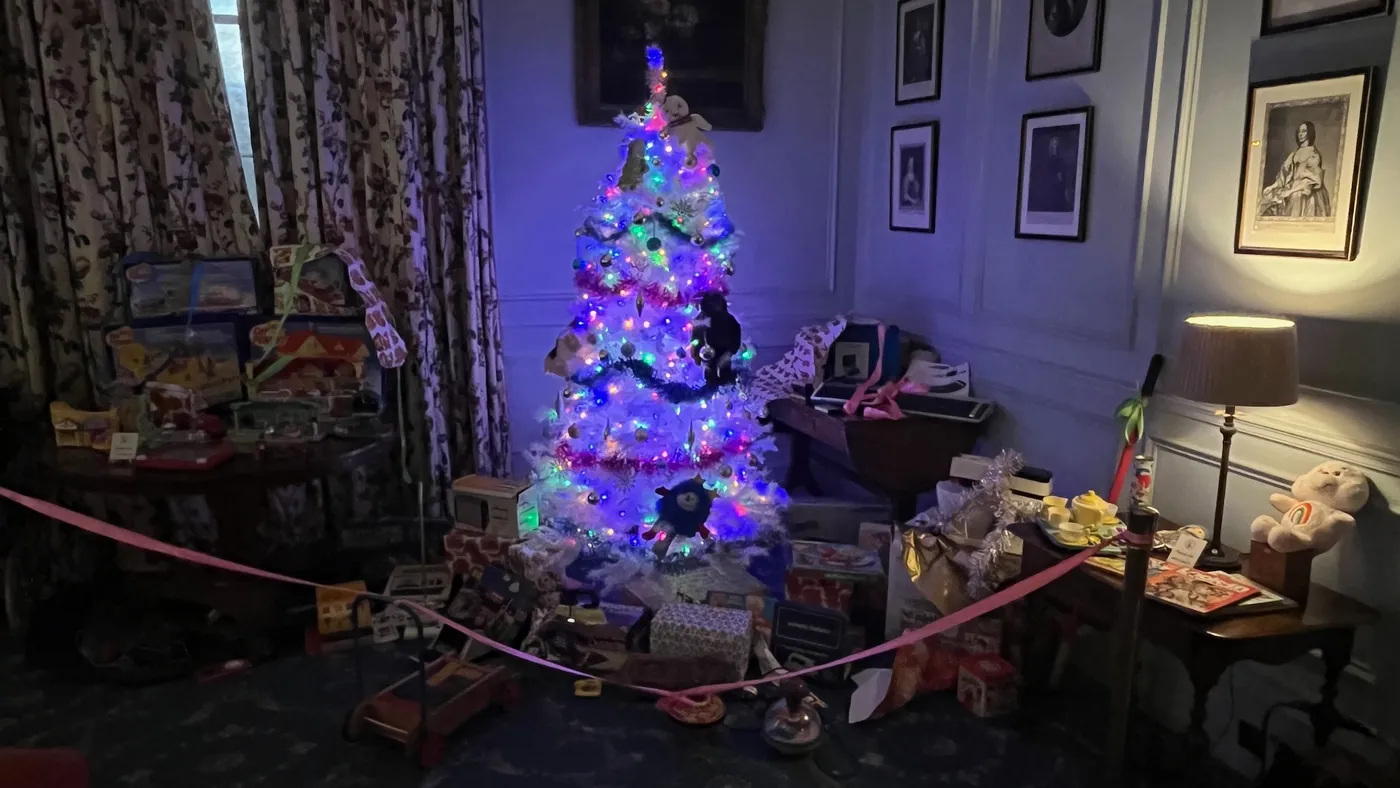
Roughly 50% white (tree, gifts, frames), 25% cool blue from the paneled walls and curtains, 15% multicolor bulbs, and 10% dark wood in the frames and floor. The blue walls are what keep the white tree looking bright instead of dingy — white against warm beige turns cream, white against blue stays crisp. Swap the blue for deep green and the room turns classic. Compare with the white tree in Idea #1, where the walls are orange instead.
25. Overhead Gold: A Pom-Pom Tinsel Tree on Dark Planks
The dark wood plank floor. Gold tinsel only reads as gold because of what sits next to it — set this same tree on pale oak or light tile and it turns brassy and thin. On near-black, walnut-toned planks the metallic tips catch the light and the whole tree gains depth. If you cannot change your floors, a dark wool runner or a deep charcoal tree skirt underneath does most of the same job for $30–$60. It is the cheapest way to make gold look expensive.
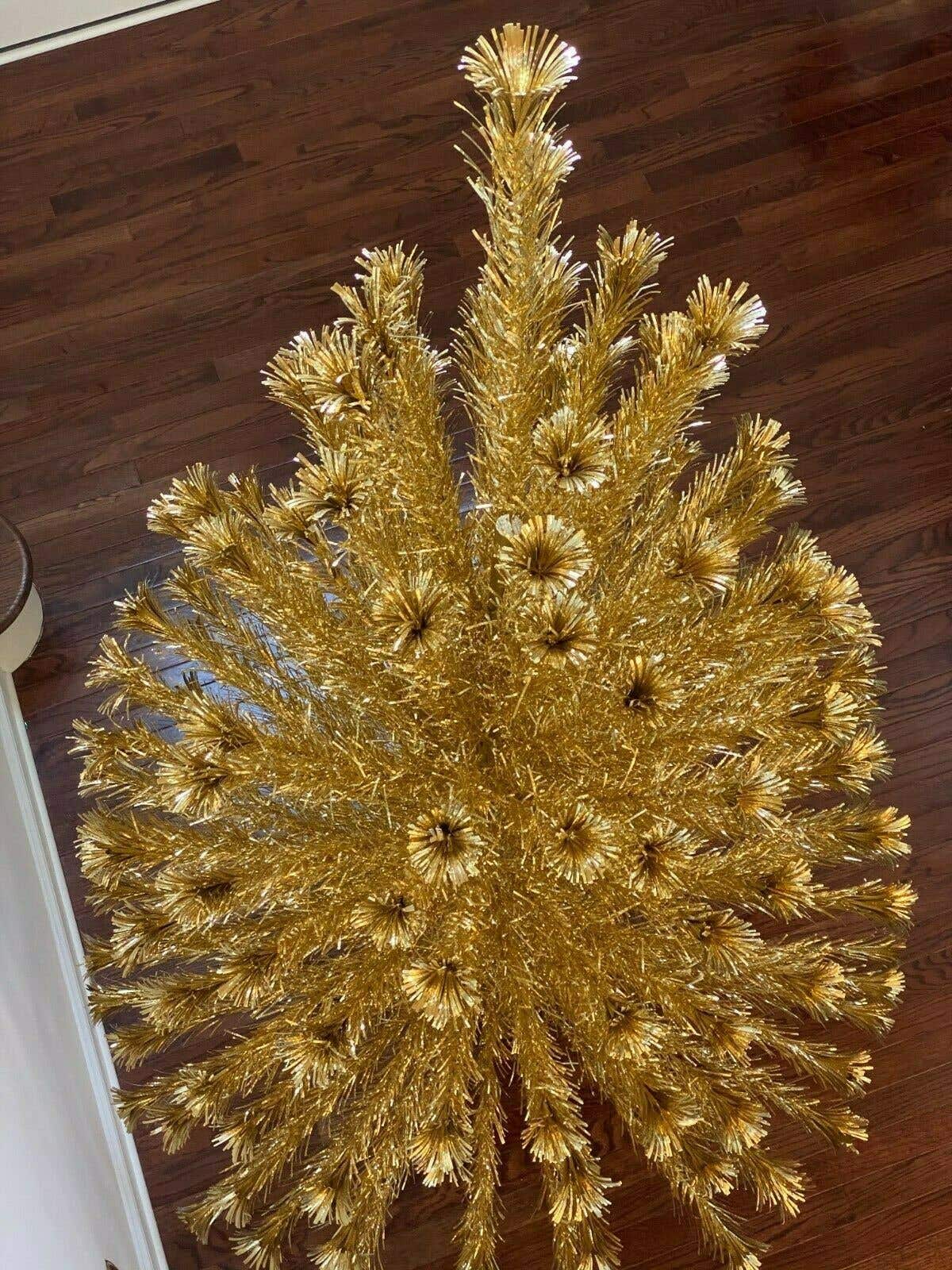
Metallic gold tinsel trees in the pom-pom style run $60–$180 at 6 feet, and the price jumps hard for anything labeled vintage. A $25–$45 modern tinsel tree from a discount store, fluffed well and lit with warm bulbs, photographs almost identically — the tell is usually the stand and the trunk pole, both of which vanish under a skirt. Facebook Marketplace in early January is where these surface for $15–$30 from people who do not want to store them.
26. Gold Tinsel and Warm Fairy Lights in a Dim Room
- Gold tinsel tree, 6 ft: $70–$190
- Warm fairy lights, two strands: $15–$35
- Red and gold round ornaments, set of 24: $25–$70
- Framed vintage wall art, thrifted: $20–$80
- Tree skirt or collar: $20–$55
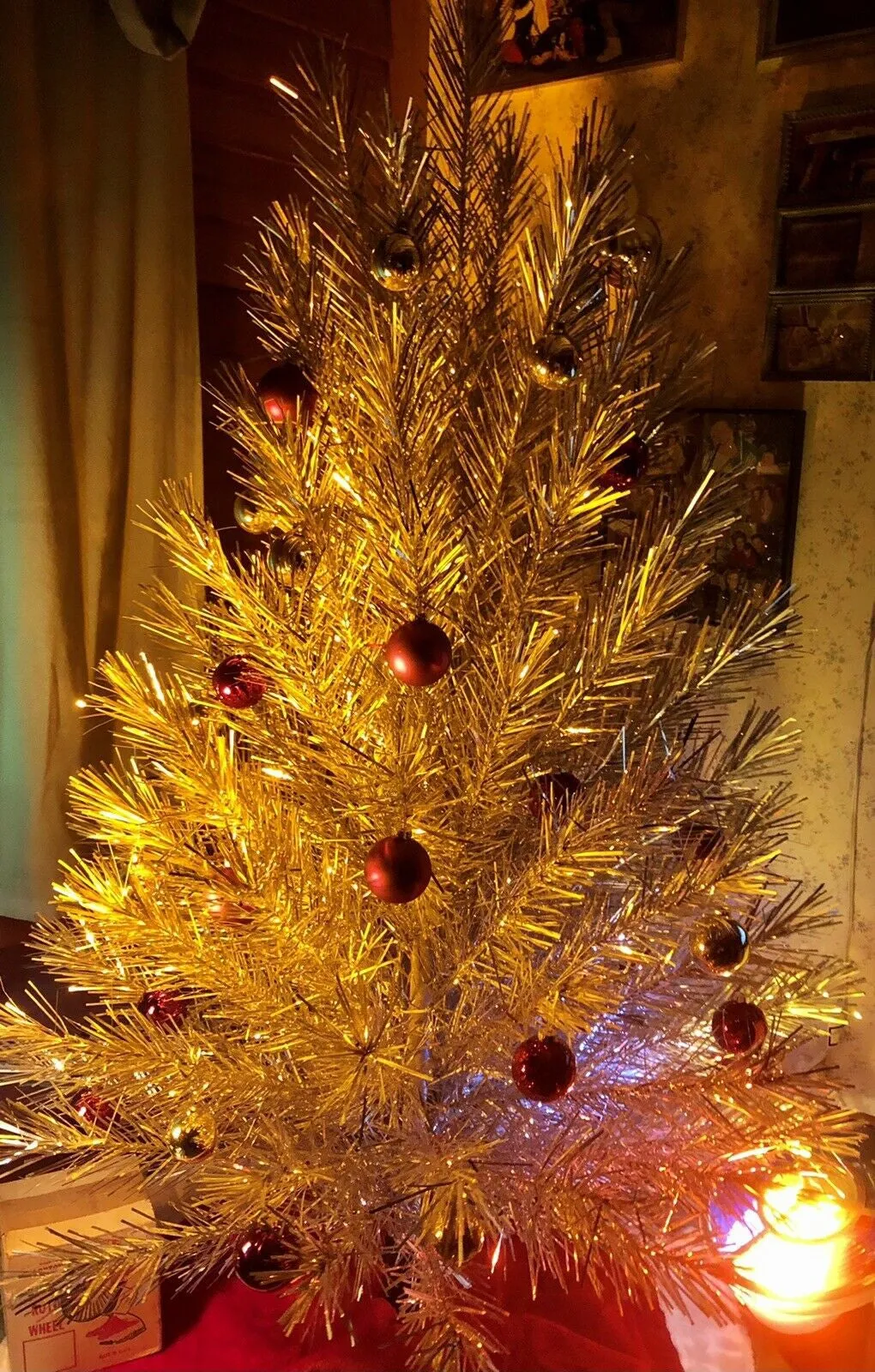
Total: roughly $150 to $430. Budget alternative: skip the ornaments entirely and double the fairy lights — a lit gold tinsel tree with nothing on it is a legitimate look, and you save $25–$70 that can go toward a better tree.
Everything here is lit from inside. Because the tinsel is metallic, the fairy lights bounce between branches instead of casting outward, which is why the tree glows rather than shines. The dim room is not a limitation, it is the point. Red ornaments pick up that warm light and turn deeper, gold baubles disappear into the branches and reappear as glints, and the framed art on the wall stays in shadow so nothing competes. Less light in the room equals more light in the tree.
27. Silver Tinsel in a Storefront Window, Lit From Inside
The reason a shop window always looks better than your living room is placement and one light source, not money. You can rebuild this at home for under $120: a 5–6 ft tinsel tree ($70–$110), a tripod stand ($18–$35, or a painted thrifted one), and two warm LED uplights from a hardware store (about $24 for a pair on sale). Put the tree in your brightest window, kill the overhead light, and let the glass do the rest. No ornaments required.
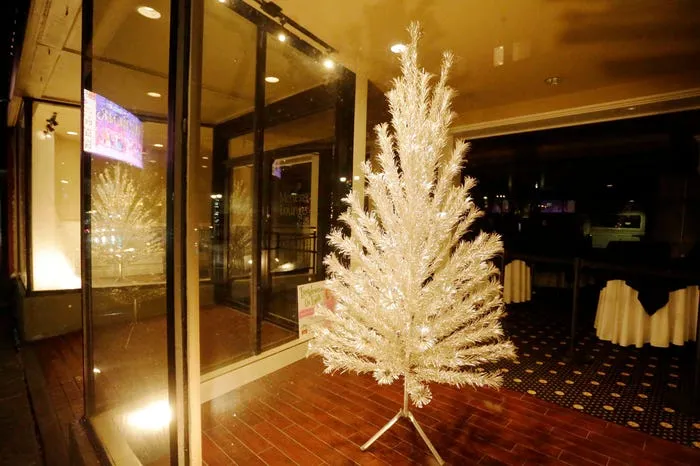
Lighting tinsel from inside a window means thinking about what the glass does after dark. Set the uplight on the floor about 12 inches behind the tree, angled up and slightly forward, so the tree is lit but the source stays invisible. Use 2700K bulbs only — cool white floods make tinsel look like foil and glare across the street. Keep three feet between the tree and the glass so you do not get a double reflection that reads as a blurry second tree.
28. Packing Tinsel So It Survives Until Next December
Tinsel trees die in storage, not in December. Crushed pom-pom tips never fully recover, and strands packed tight come out looking like used foil. Store the tree loosely in a large breathable bag or a wardrobe box, standing if you have the ceiling height, and keep it out of attics that swing between 20°F and 110°F — that temperature cycling is what dulls metallic finishes. Ornament boxes belong in a cool closet, never a damp garage.
- Vacuum the tree thoroughly before boxing it; dust etches metallic coating.
- Label the box with the tree height and where its stand went.
- Photograph your arrangement now — you will not remember which strand went where.
- Store the stand ballast weights in the same box as the stand.
One Strand of Tinsel at a Time
The best retro Christmas rooms are not the ones with the most ornaments — they are the ones where the light is warm, the silver has something to reflect, and nobody worried about matching. Start with one idea from this list that fits the space you actually have, and measure before you buy anything. 📌 Pin this guide to your Christmas board now, so it is waiting for you when the boxes come down from the attic.