
Most candy land Christmas guides get it wrong — they show you a $2,000 styled scene and call it a DIY. So we went looking for the real thing: glowing peppermint path stakes, pastel flocked trees, gingerbread trains with lights inside the wheels, and wreaths that look handmade because they actually are.
After filtering through hundreds of options across Etsy, Target, and Walmart, we narrowed it down to 29 ideas that actually deliver — from $1.25 candy props up to an $800 full candy tree. Budget and luxury versions sit side by side, and every idea comes with real numbers so you know what you’re getting into.
The 2026 angle: pastel maximalism and the nostalgia economy have pushed candy decorating to the top of holiday Pinterest boards, and multi-sensory pieces — houses that smoke, ornaments that look edible — are driving it. And stay until the end — we break down the most common mistakes that can ruin these looks.
📌 Save this to Pinterest for later — you’ll want to revisit these ideas.
1. Glowing Peppermint Path Lights in a Snowy Garden Bed
Strip away the garland, the porch railing lights, even the snow — the peppermint stake is doing all the heavy lifting here. A row of identical red-and-white discs, spaced evenly and lit from within, turns a plain garden bed into something that reads as a pathway even when the ground is buried. Repetition is the trick: one glowing candy looks like a lawn ornament, six look like an invitation. If you’re choosing where to spend, spend here.
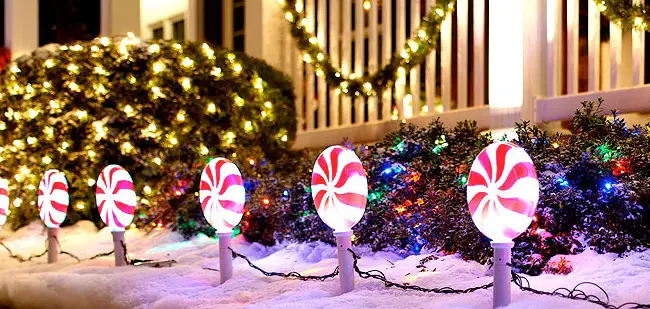
- Peppermint pathway stakes (set of 6–8): $60–$180
- Warm white string lights for bushes and railing: $25–$60
- Green garland with built-in lights for the porch railing: $30–$75
- Stakes, clips, and outdoor extension cords: $15–$40
- Replacement bulbs and spare fuses: $8–$20
Total: roughly $140–$375 for a full front-bed glow-up. Budget alternative: skip the light-up stakes, paint plain wooden rounds with red and white swirls, and tuck a $20 solar path light behind each one.
2. Pastel Pink and Mint Flocked Tree Against a Mint Wall
The formula is 60% pastel pink, 30% mint green, 10% sparkling white — and it only works because the tree itself, the wall, and the pink rattan hanging chair all sit inside the pink family instead of fighting it. Swap pink for butter yellow and mint for sage and the math still holds; the ratio is what keeps a candy palette from turning into a birthday party. Just keep one color clearly in charge.
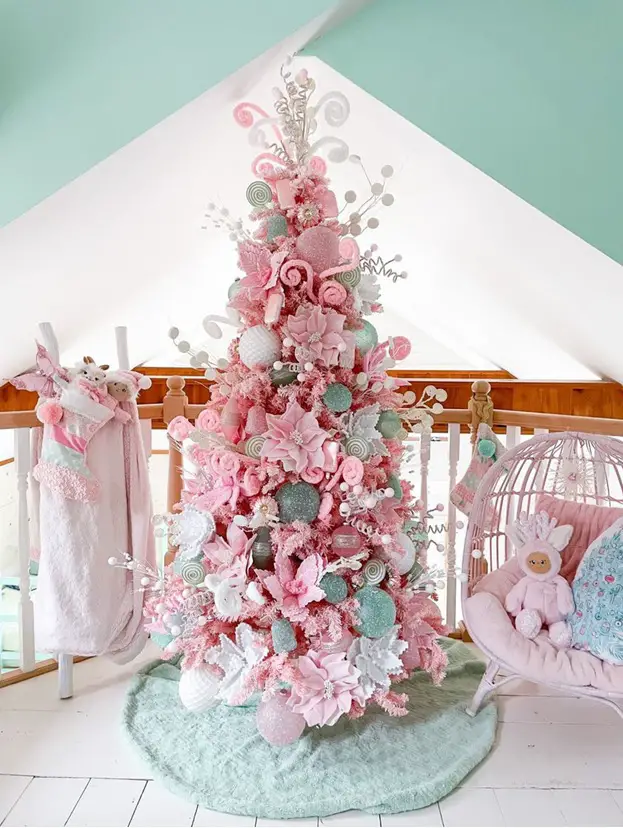
On a flocked tree, ornament size matters more than ornament count. Stay between 2.5 and 4 inches for a 7-foot tree — the swirl lollipop picks and mint baubles here are right at that ceiling. Anything larger hides the flocking you paid extra for. Hang the biggest pieces first, fill gaps last, and cluster in odd numbers (three, five, seven) so the eye keeps moving.
3. A Tabletop Candy Land Scene With Oversized Canes
Two things are doing the work: extreme scale contrast and a tight color rule. The oversized candy canes and lollipops are cartoon-big, while the Santa, elf, and nutcracker figurines are small enough to sit in your palm — that gap is what makes the scene feel storybook rather than cluttered. Everything stays in red, white, silver, and gingerbread brown, so even a busy surface reads calm.
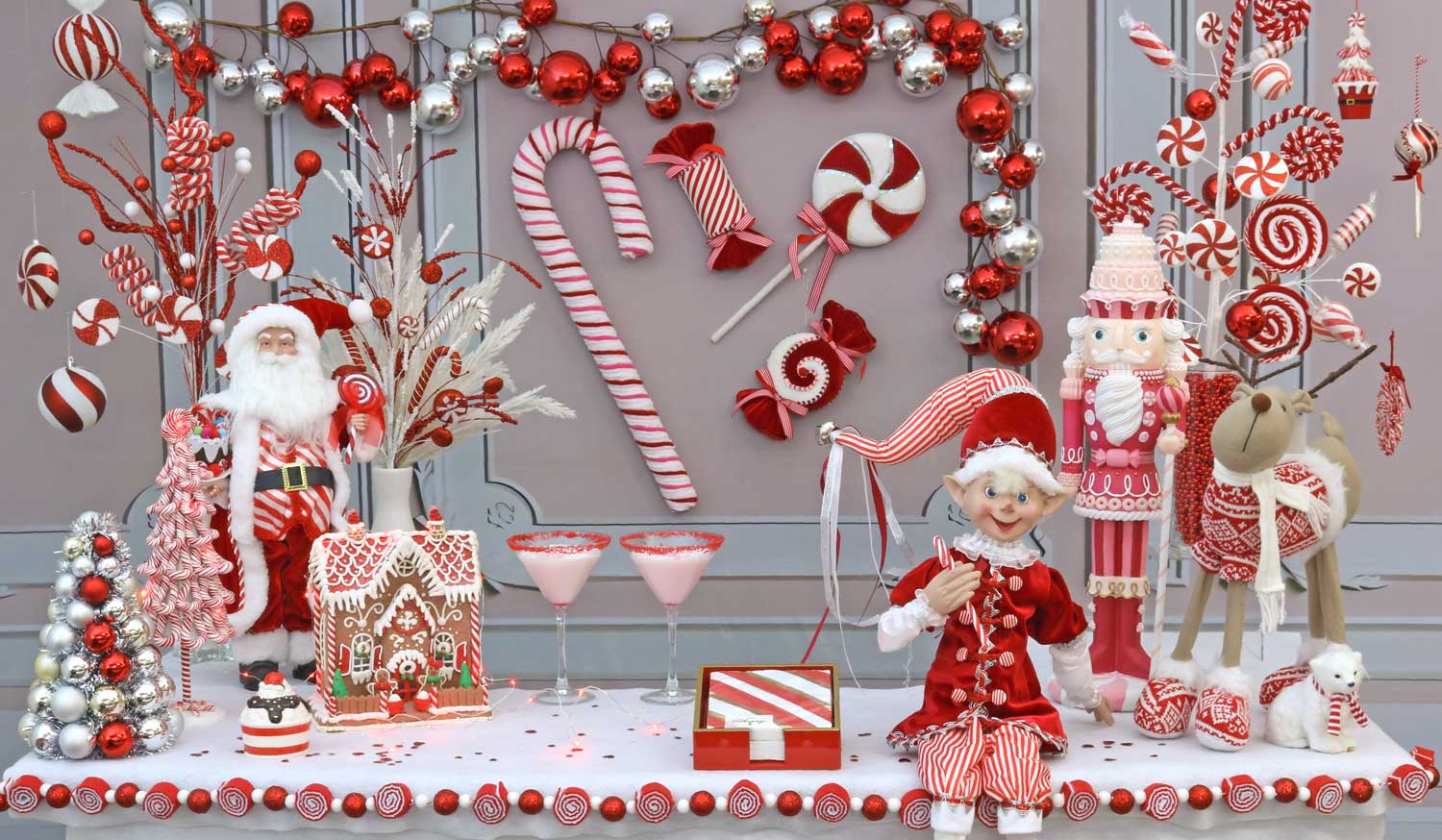
Build the display in six moves, about 90 minutes total:
- Clear the surface and lay a white runner or bare linen cloth.
- Set the tallest pieces at the back — canes and the gingerbread house — slightly off-center.
- Place the nutcracker as a vertical anchor on the opposite third.
- Tuck Santa and elf figurines toward the front corners, not the middle.
- Drape the red and silver ornament garland along the paneled wall line above the table.
- Finish with glassware whose red rims echo the candy. Under $120.
4. Rust and Gold Living Room With a Pink-Ribbon Tree
This one wants a real living room: 14 by 18 feet or larger, with 9-foot ceilings so the rust-painted ceiling doesn’t press down on you. Below 12 by 14 feet, keep the palette and lose the ceiling color — paint it warm white like the trim and let the red patterned rug and rust and gold velvet pillows carry it instead. The tree also needs 3 feet of clearance on at least two sides.
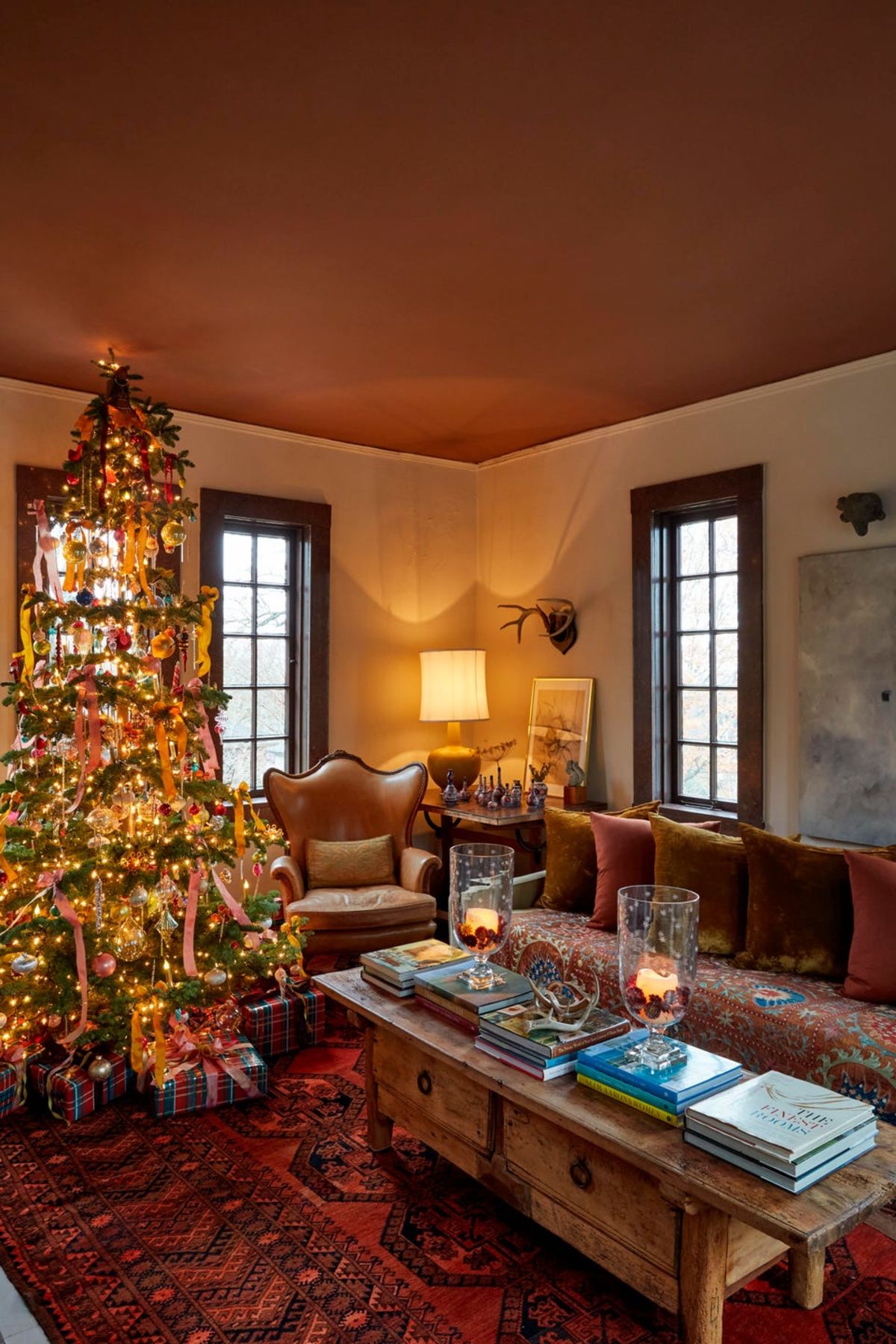
A rust ceiling is a commitment, not a mood board gamble. It eats light, so if your living room faces north or has small dark-trimmed windows, expect to run lamps all day from November through February. It also makes repainting a two-coat, furniture-moving weekend. If you rent, do the rust in pillows, a throw, and one lampshade — you’ll get most of the warmth for a fraction of the commitment.
5. A Glowing Peppermint Walkway With a Light-Up Carousel
Outdoor decor has shifted from one statement tree to a walkable scene, and that’s exactly what’s happening here — peppermint stakes guiding you past lit reindeer, an illuminated carousel, and garland-draped wooden storefronts. It’s the same instinct that made immersive holiday markets and drive-through light shows explode on Pinterest. The stakes are the affordable entry point; the carousel is the souvenir photo. It has staying power because it’s built from repeatable pieces, not one giant prop.
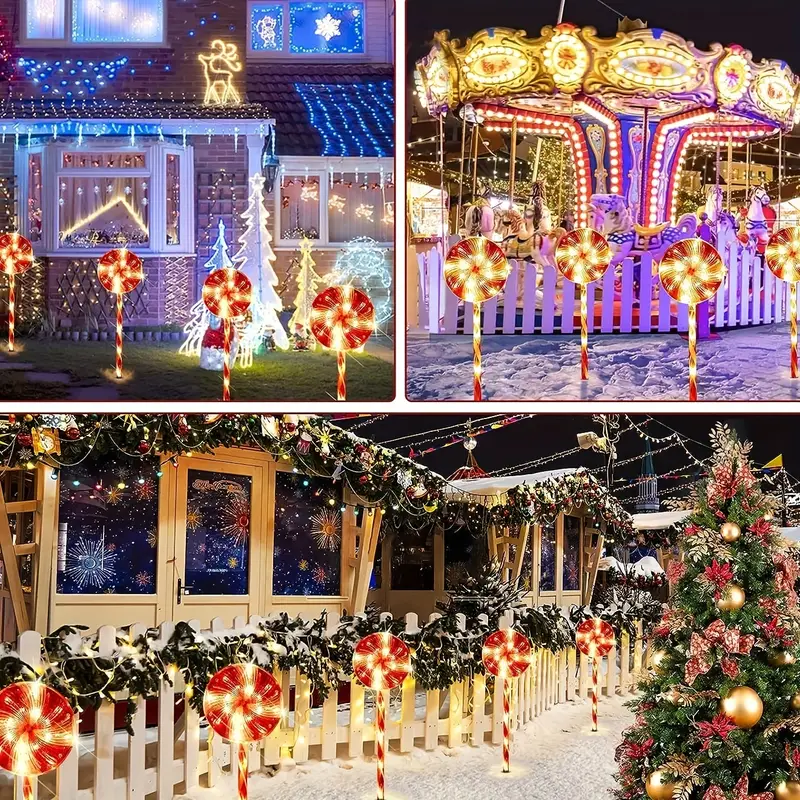
You don’t need a carousel budget to get the vibe. Walmart and Target carry light-up peppermint stakes in 3-packs for around $20–$30, and Dollar Tree icicle lights run about $5 a strand — three strands along a picket fence line reads surprisingly full. Skip the reindeer for year one and borrow the look with a $15 light-up tree from Facebook Marketplace. The whole scene lands under $150.
6. A Candy-Cane Shaped Wreath in Buffalo Plaid
Shape beats size on a door wreath. A candy-cane form is asymmetric, so hang it with the crook pointing away from the hinges — that draws the eye toward the handle side and makes the door look wider. Center the wreath at 60 inches from the floor, about 8 inches below the top of the glass panels. Put the buffalo plaid bows at the bend and the tip, never at the middle, or the cane reads as a blob.
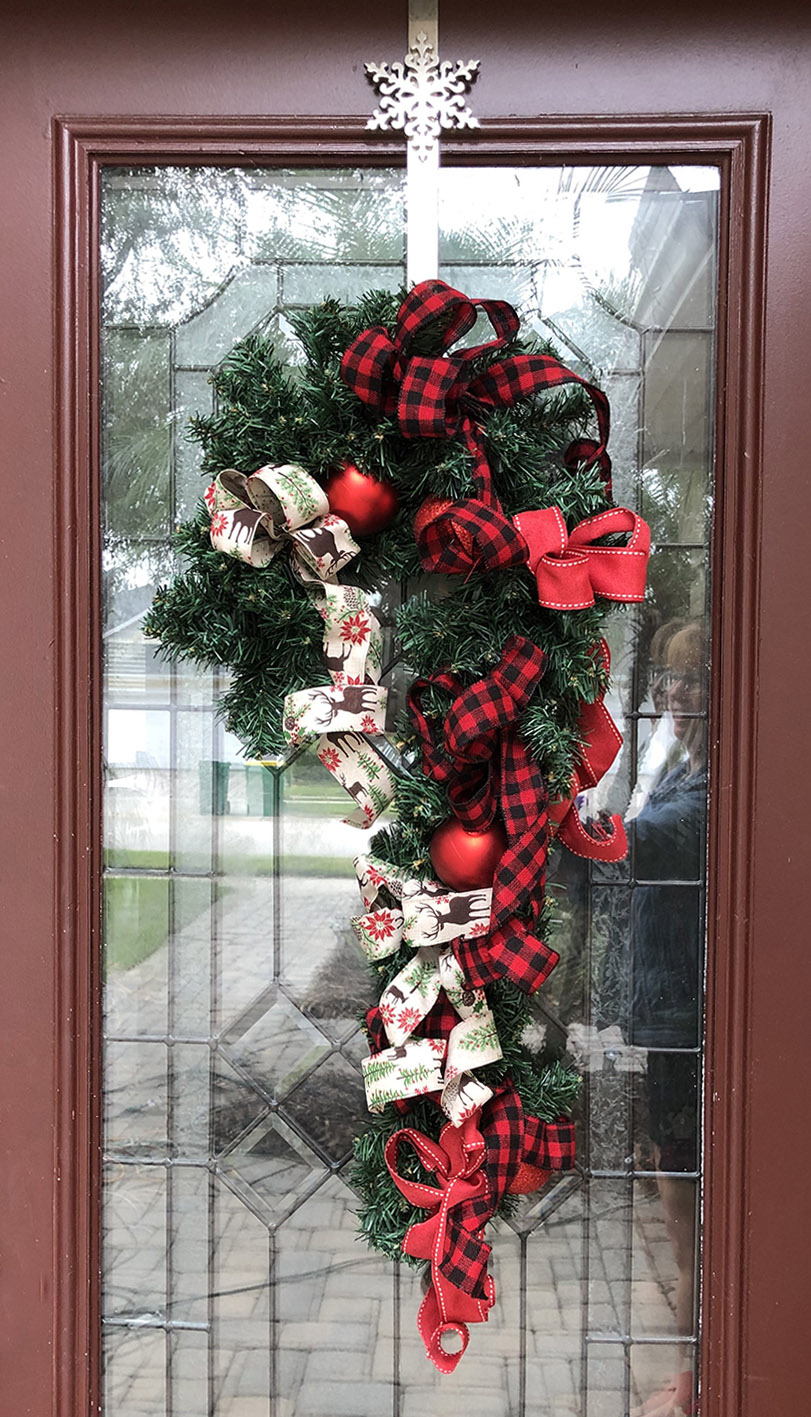
If you go fresh evergreen, plan on needles dropping from day ten and a sweep of the entry every few days — door wreaths get sun on one side and dry unevenly. Faux holds its shape for years but collects dust and fades after two or three seasons of afternoon light. Store it in a breathable bag, not a sealed bin. Realistic annual cost either way: $0 on faux, $35–$60 if you rebuy fresh.
This reads best on a standard 36-inch entry door — the cane shape wants vertical room, so it’s a tight fit at 32 inches and looks lost on a 30-inch interior door. On a double door, hang one cane per panel and mirror them so the crooks point outward. Narrow entries with sidelights should keep the ribbon count low.
7. Gingerbread Couple Figurines on a Burlap Display
Read the palette as 60% gingerbread brown, 30% crimson and candy red, 10% snowy white with a whisper of mint. The browns are what keep this from looking like a candy store shelf — the burlap, the figurines, and the house all sit in that warm range. Swap crimson for forest green and you get a cooler, more traditional version of the same formula. Swap mint for soft blue and it goes frosty instead of sweet.

Gingerbread villages get expensive fast, so build yours in layers. Dollar Tree has small gingerbread house figurines seasonally for $1.25–$5, and thrift stores quietly stock ceramic Santa and nutcracker pieces under $8. Use one nice gingerbread couple as the hero — about $20–$40 — and surround them with budget fillers. A tiered stand you already own plus cupcake picks gets you the look for under $60.
It’s the holding-hands pose. Two gingerbread figures standing side by side would be cute; two clasping hands makes you stop and smile, and that’s the whole job of a holiday vignette. Everything else — the house, the cupcake stand, the candy props — is supporting cast.
8. Plan the Candy Land Shelf Before You Buy Anything
- Measure the surface: length, depth, and the height between surface and shelf or art above.
- Note which direction light comes from — window, lamp, or overhead — and where shadows fall.
- Count what you already own: jars, cake stands, trays, ribbon spools.
- Set a hard budget ceiling before you open a single browser tab.
- Check that your surface can take weight if you’re using ceramic figurines or glass jars.
Roughly 45 minutes with a tape measure and a phone camera:
- Photograph the empty surface straight on and from where you’ll actually stand.
- Sketch three heights — tall, medium, low — and assign one hero piece to each.
- Pick your palette limit: three colors, no more.
- Shop your house first, then buy only the gaps.
- Mock it up with books and boxes before anything gets unwrapped.
- Photograph the mock-up; that photo is your shopping list.
9. An Evergreen Wreath With Candy Canes and a Bottom Bow
The red glitter bow sits at the bottom center, and that’s the move. Most wreaths put the bow at the top, where it fights the doorframe and gets lost against the header. Anchoring low gives the wreath a hanging-garden feel and lets the candy canes arc upward on their own. The dark paneled door does the rest — deep green and bright red against near-black wood is about as high-contrast as holiday decorating gets.
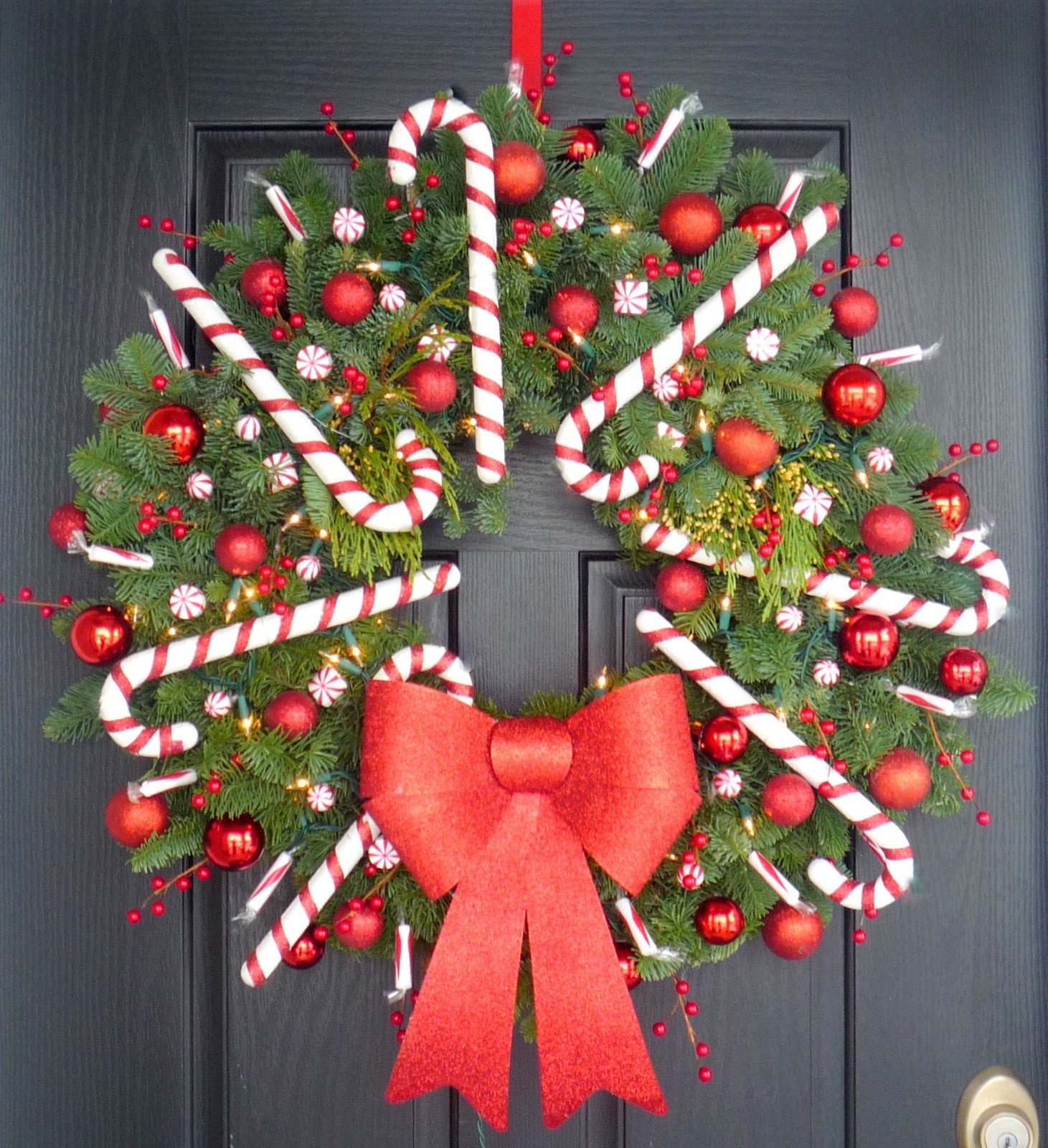
Wreaths like this one need breathing room. On a 36-inch door, keep the finished wreath between 24 and 30 inches across so at least 4 inches of door stays visible on either side. If your entry is narrow, compare with Idea #6, where a shaped wreath stretches vertically instead of outward. On a wide double door, this round style actually works better hung as a pair than as one oversized circle.
10. DIY Peppermint Lollipop Stake in a Twine-Wrapped Base
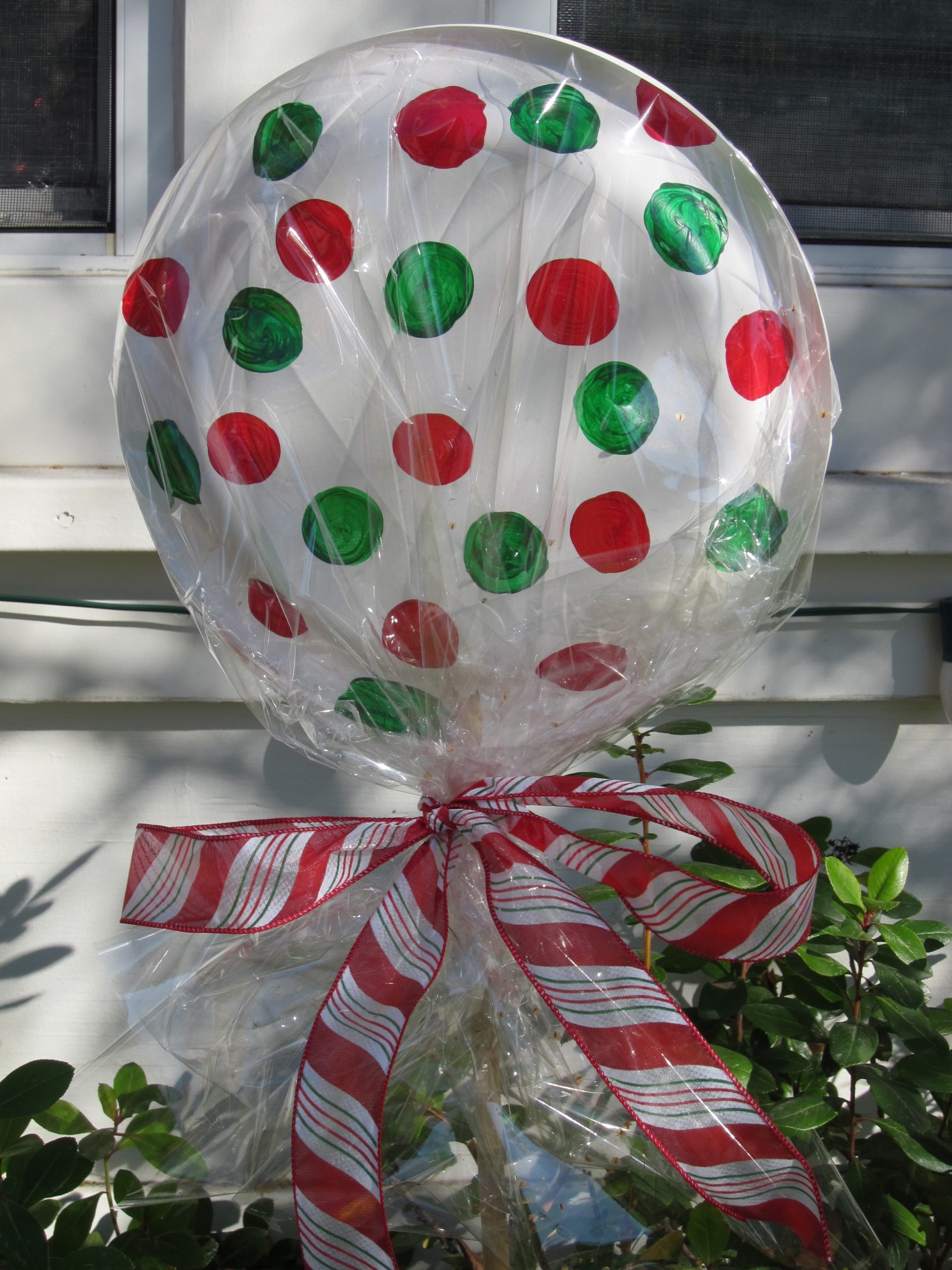
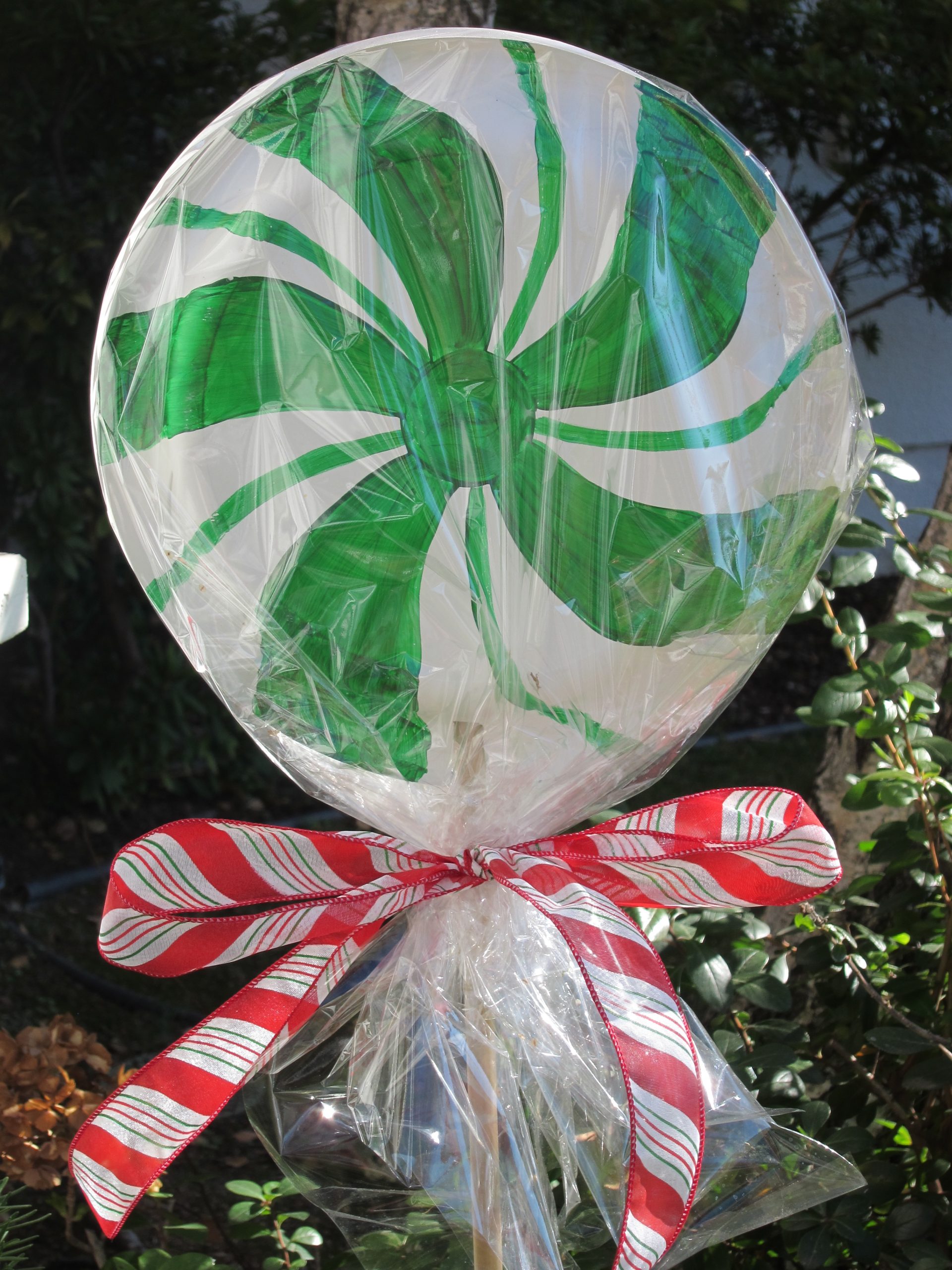
About 45 minutes and $12–$18 per stake:
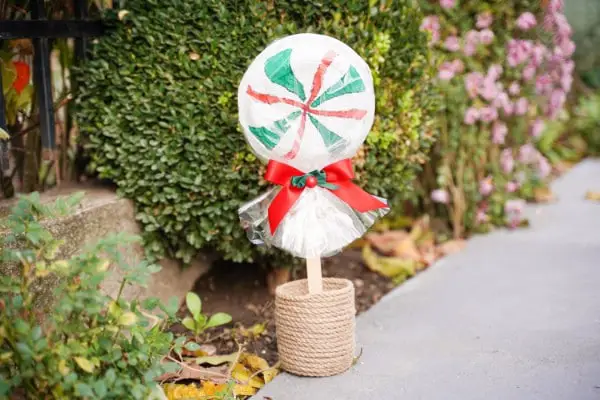
- Paint a large flat white disc with red and green swirls, letting each color dry before the next arc.
- Seal it with two coats of outdoor poly so rain doesn’t lift the paint.
- Wrap the disc in clear cellophane, pulling it taut around the back.
- Tie a red satin bow at the base of the candy, adding one green accent ribbon.
- Attach a wooden dowel with outdoor adhesive and let it cure overnight.
- Wrap a cylindrical container in twine, fill with sand, and set the dowel inside.
That twine-wrapped container isn’t decoration — it’s ballast. A candy disc this size catches wind like a sail, so fill the cylinder two-thirds with play sand and sink the dowel at least 8 inches. Skip the cellophane if you live somewhere humid; a wrapped disc traps condensation and the paint clouds by February. Keep stakes about 24 inches apart so the row reads as a path instead of a cluster.
11. Keeping a Candy Palette Out of Toy Store Territory
Here’s the honest part: red-and-white candy decorating tips into toy-store chaos faster than any other holiday style. The usual culprit isn’t the color, it’s the finish — everything gloss. Mix in matte surfaces: felt, painted wood, matte ribbon, cotton batting snow. The second culprit is quantity of small pieces. Ten tiny props read as clutter; four medium ones read as a vignette. If you’re unsure, build the scene, then remove one thing.
A ratio that survives real living rooms: 60% white and cream, 30% red or pink, 10% accent (mint, gold, or turquoise). Keep the largest surface — tree, mantel, tablecloth — in the 60% group so the eye has somewhere to rest. Then rotate your accents each year without rebuying anything: mint one season, turquoise the next. The base stays, the candy changes.
12. Stacked Peppermint Discs Glowing on a Stone Patio
- Light-up peppermint disc decorations (set of 3): $70–$160
- Ground stakes or weighted patio bases: $15–$35
- Warm white string lights for the exterior wall: $20–$45
- Outdoor extension cord with weatherproof cover: $12–$25
- Red ribbon or craft bows for accents: $6–$15
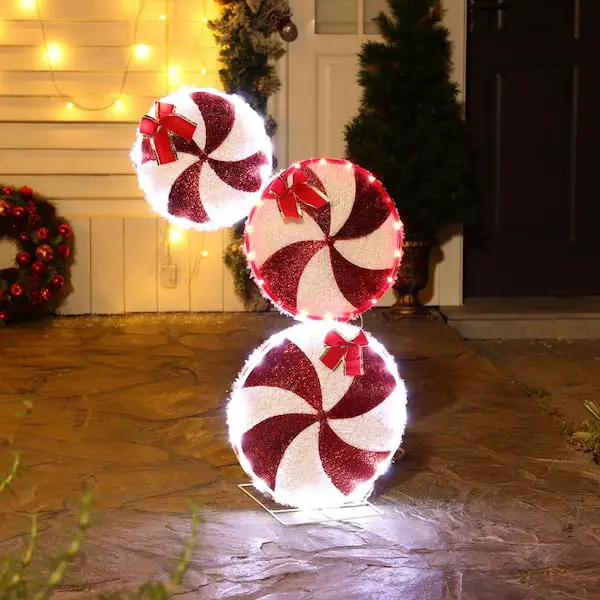
Total: roughly $125–$280. Budget alternative: buy one light-up disc and pair it with two plain painted wooden rounds from a craft store at $8 each — stacked together they read as a set from the street.
Three discs, one on top of another, and that’s the entire idea — no reindeer, no inflatable, no music. Stacking turns a flat candy prop into a snowman-scale column that glows at eye level from the sidewalk. The small red bows at each disc’s edge are the quiet second move, repeating the swirl color. Remove the stacking and you just have three round lawn ornaments lying around separately.
13. Giant Pastel Swirl Lollipops on White Pedestals
Giant lollipop props retail for $120 and up each — or you can make two for about $45. A 36-inch foam disc from a craft store runs $12–$18; paint pastel swirls with craft acrylic, seal it, and mount it on a 1-inch PVC pipe cut to your height. Weight the base with a bucket of sand or a thrifted ceramic planter from Goodwill for $6. Target sells pre-lit lollipop stakes under $25 if you’d rather skip the painting.
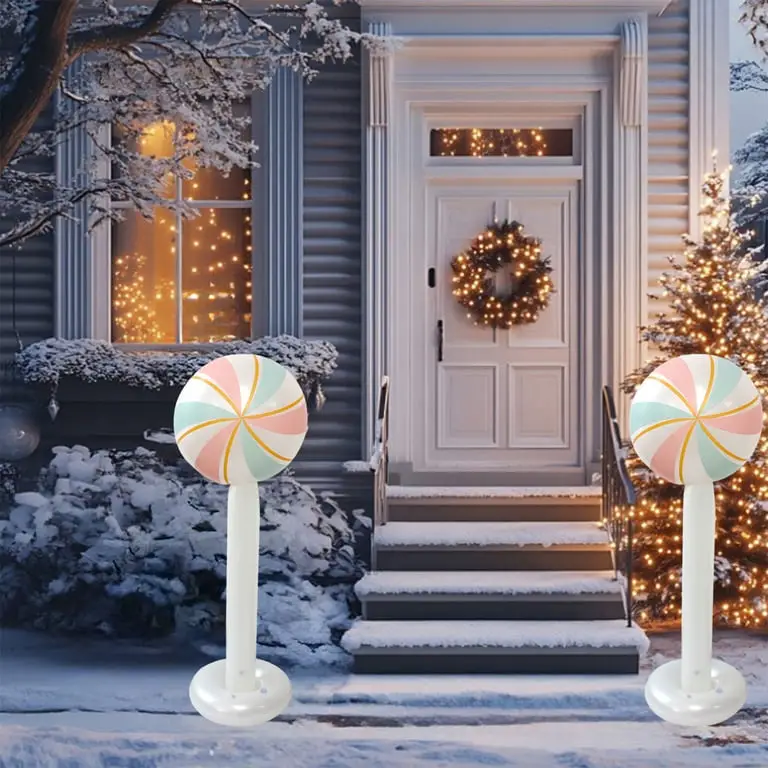
Height is what makes oversized props look intentional instead of dumped. Set your pedestals so the lollipop centers land around 40 to 48 inches — chest height on an adult, roughly the plane of the door handle. Keep the pedestal at least 24 inches tall so the candy lifts out of the snow line, and give them 3 feet of clearance from the walkway.
- Measure your porch depth — oversized props need 3 feet of walking clearance.
- Check that outdoor outlets are GFCI protected before adding string lights.
- Confirm HOA or lease rules on freestanding yard props.
- Test the pedestal base on snow or ice; wind tips light props fast.
- Decide how pastel candy reads against your siding — pastels on white need warm lighting.
14. Miniature Wooden House Garland on a White Mantel
Ten identical little houses on a single cord is a masterclass in repetition. Because they’re the same size and shape, your eye reads them as one continuous line rather than ten separate objects — which is why a crowded mantel still feels calm. The styling follows the same rule: pine, red berries, one lantern, one small lit tree. Nothing competes. Repaint the houses each year and the garland never gets old.
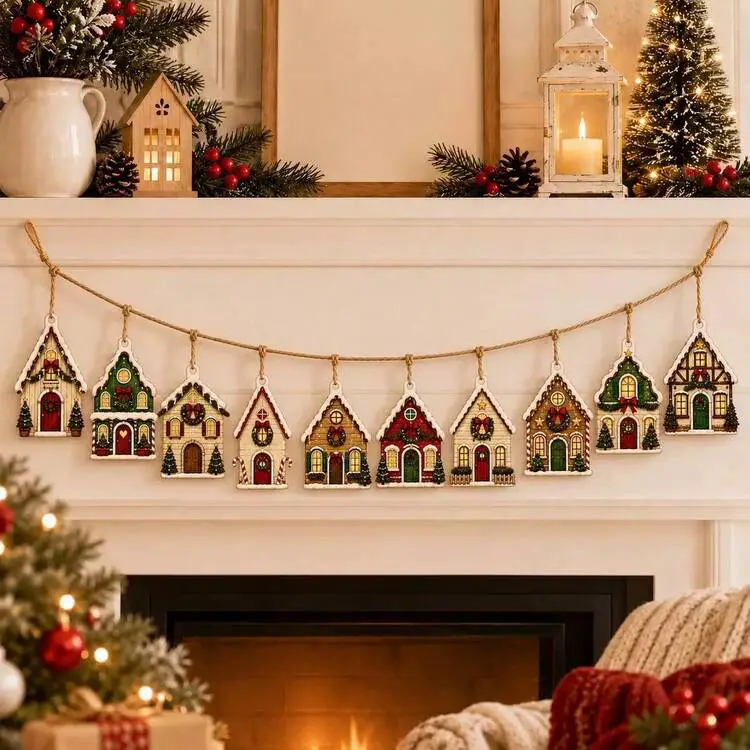
Around two hours, plus dry time, for roughly $30–$50:
- Buy unfinished wooden house blanks in one size — 3 to 4 inches tall keeps the line even.
- Paint each house a simple base color and add one detail: a roof stripe, a tiny wreath, a gold star.
- Drill a small hole through each roof peak.
- Thread a length of jute through, knotting between houses to hold spacing.
- Tape the cord ends behind the mantel edge and let the houses rest against the wall.
- Finish with a lantern you already own and a small pre-lit tree at one end.
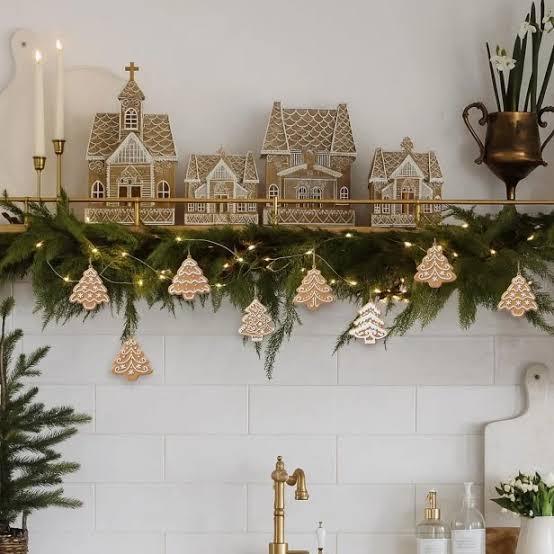
15. Lit Gingerbread Houses on a White Fireplace Mantel
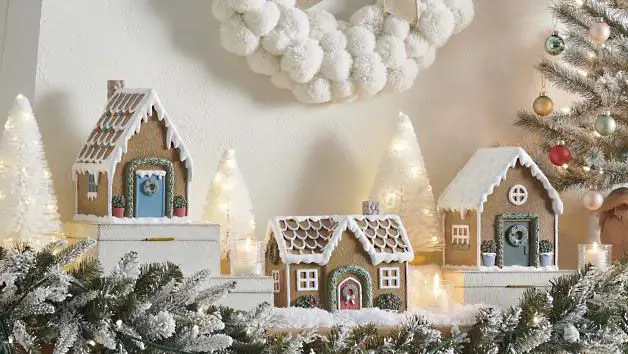
Illuminated mantel villages come with two chores most people don’t plan for. First, heat: keep lit houses a few inches in front of the firebox and never directly above an active fire, because that soft plastic can warp in a single season. Second, cords — count your outlets before you commit to six lit houses. Dust settles into the little window cutouts; a soft makeup brush handles it in five minutes every few weeks.
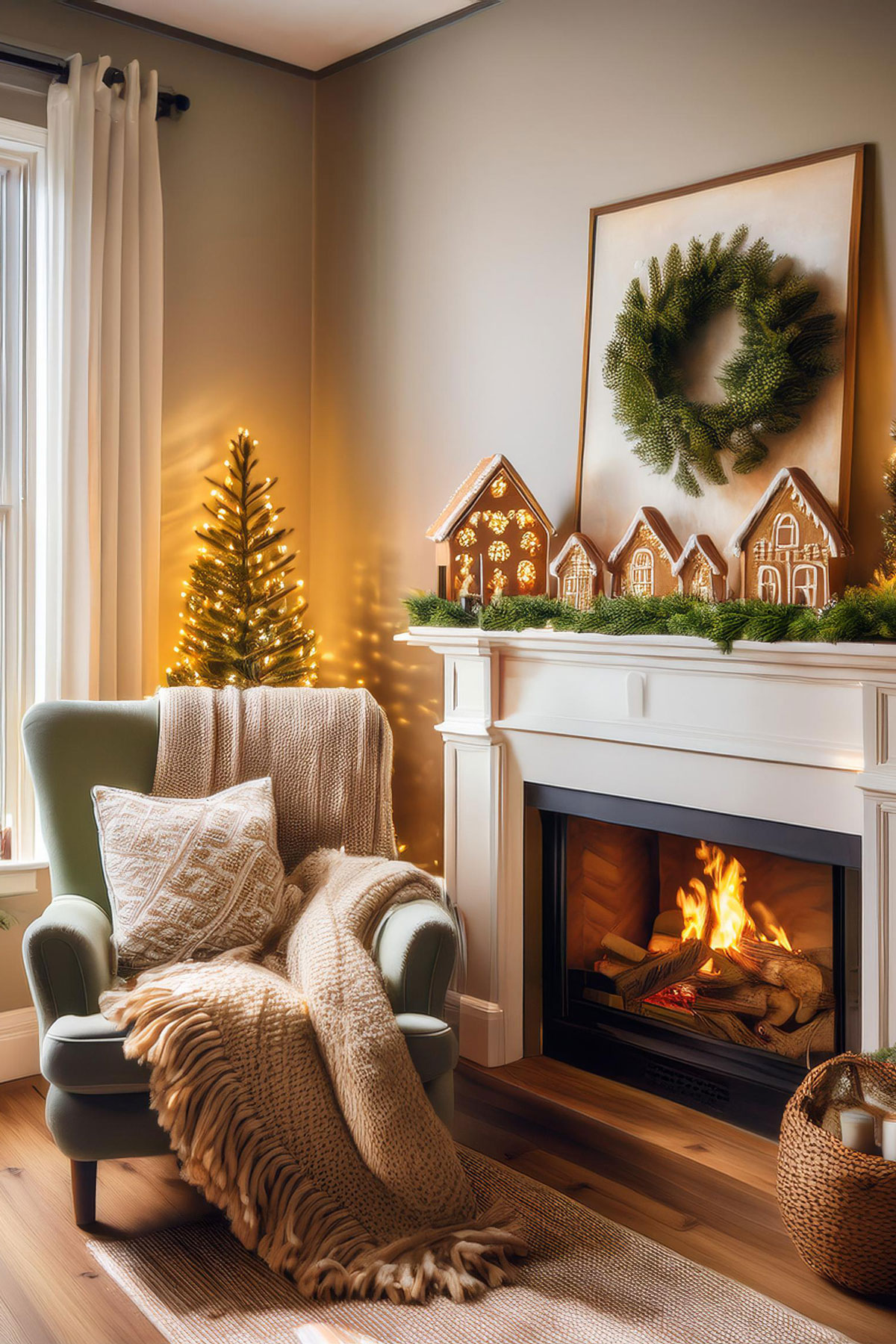
A 60-inch mantel comfortably holds three to five lit houses plus greenery. Under 48 inches, go with three and skip garland on one end so it doesn’t feel packed. This is the friendliest idea in the whole list for small rooms — compare with Idea #4, which needs a serious footprint. Here, a single armchair, a throw, and mantel light do the entire job.
Two details make this vignette. First, the framed wreath artwork above the mantel — it echoes the greenery below at a larger scale and keeps the wall from feeling blank. Second, the sage armchair pulled close under chunky knit blankets: it tells you where to sit. The gingerbread houses supply the glow; the chair supplies the reason.
16. Why Candy Land Decor Took Over Holiday Pinterest
Candy Land decorating is having its biggest year since the 1990s because two trends collided: the nostalgia economy and pastel maximalism. Search interest in pink and mint Christmas trees keeps climbing, and peppermint motifs photograph beautifully for short-form video — the swirl pattern reads even on a small phone screen. The traditional red-and-white version has real staying power; neon versions probably don’t. If you’re investing, invest in peppermint, gingerbread, and pastel pink.
- Flocked tree (7 ft, pink or white): $120–$400
- Candy-themed ornament set, 40–60 pieces: $60–$180
- Ribbon, mesh, and garland for fill: $25–$60
- Tree skirt or collar: $25–$70
- Lit candy props and lollipop picks: $30–$90
Total: roughly $260–$800 for a full candy tree. Budget alternative: thrift a plain green tree for $25, flock it yourself with a $20 spray kit, and buy ornaments in 50-piece bulk lots at Walmart for about $30.
Flocking spray is a great budget tool, but only if you work outside and in thin passes. Hold the can 12 inches away and mist lightly; a heavy coat flakes off within a month. Two thin passes with 20 minutes between them hold all season. Buy one extra can — touch-ups around the top are what keep a DIY flocked tree looking store-bought in February.
17. Flocked Tree Loaded With Oversized Peppermint Balls
The oversized peppermint balls are the entire personality of this tree. At that scale they don’t read as ornaments — they read as candy, which is the whole point. Beaded garland, candy canes, and striped mesh bows are there to keep the eye traveling between them without adding a competing focal point. Swap the peppermints for standard red baubles and you’d have a perfectly nice flocked tree with absolutely no story.

Here it’s 60% red, 30% white, and 10% silver-green shimmer. The flocked branches technically count inside that white 30, which is why the red can be so loud without overwhelming — the tree itself is the neutral. Want a cooler version? Swap silver-green for ice blue and keep the same ratio. Want a softer one? Trade half the red for blush pink and leave everything else alone.
- Measure your ceiling height; oversized ornaments need a 7-foot tree minimum to look balanced.
- Weigh your heaviest ornaments and check branch gauge — peppermints over 5 inches need sturdy wire.
- Decide how much red your wall color can take.
- Buy beaded garland by tree height, not branch count: 9 feet of garland per 6 feet of tree.
- Have a lint roller ready — flocking sheds during setup.
18. Pastel Candy Tree Beside a Painted Spiral Staircase
The staircase is doing something sneaky: its colors repeat the tree’s palette at architectural scale. That’s why the whole corner feels designed rather than decorated. The turquoise arched bookcase does the same job on the other side, framing the tree in a doorway of color. If you’re building this look, find one big surface — a stair rail, a painted arch, a bold wall — that can carry your tree’s palette. Scale is what separates candy chic from candy clutter.
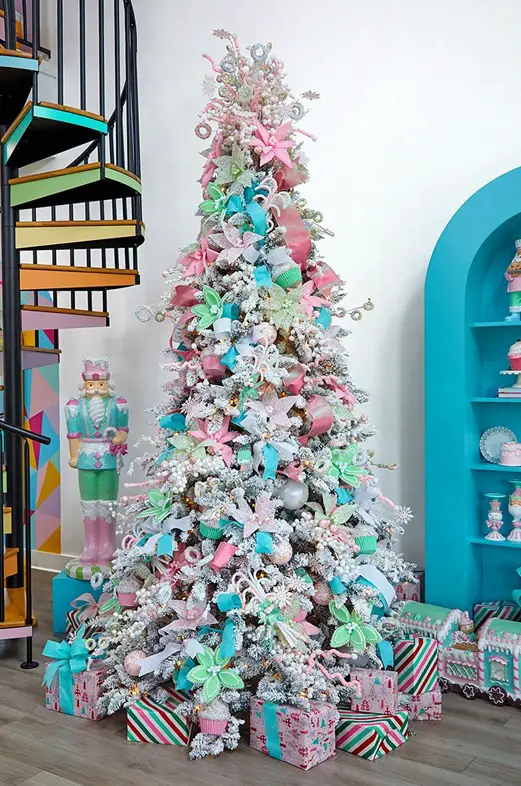
You don’t need to repaint anything. Removable peel-and-stick arched decals run $15–$30 on Etsy and give you the same turquoise arch shape. For the staircase, wrap the handrail in ribbon in your tree’s palette — about $10 for two rolls at Target — and let it spiral upward. Flocked pastel trees show up used on Facebook Marketplace every January for $60–$120, and gift wrap in pink, mint, and turquoise runs about $12 for three rolls.
19. Pastel Tree With Frosted Donut Ornaments
Cascading ribbon looks effortless and is not. Use 4-inch-wide wire-edge ribbon and cut three lengths at roughly 1.5 times your tree’s height. Anchor each at the top by tucking the end behind a branch, then let it fall in a soft S rather than a straight drop — pinch and twist every 18 inches as you go. Three streams is plenty for a 7-foot tree; more than that and the ribbon hides the ornaments you just bought.
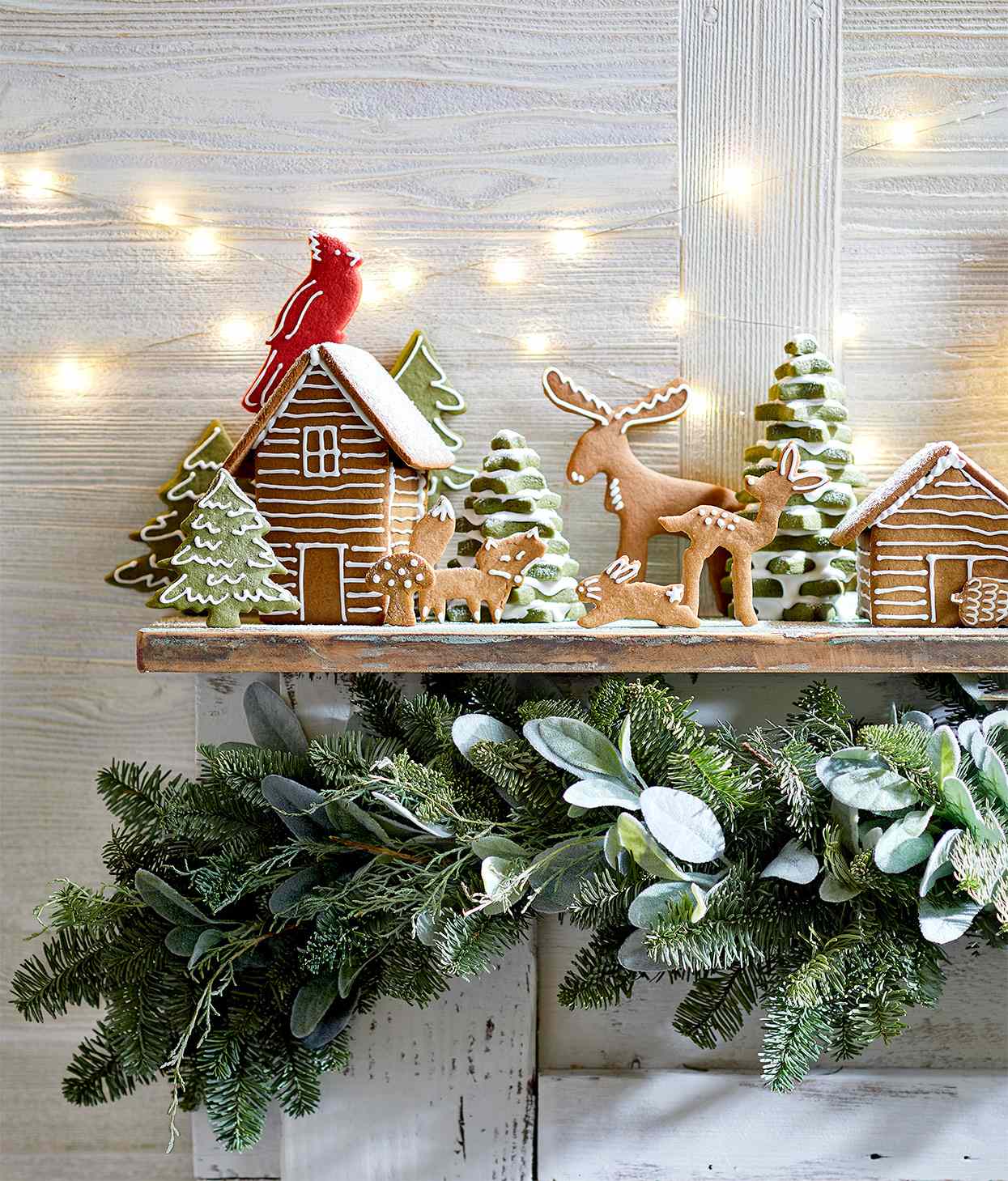
Two warnings. Frosted donut ornaments are usually resin or foam — cute, but they chip, and a kid or a cat will absolutely test them. Hang anything fragile above 4 feet. Second, pastel trees need warm light or they go gray. If your room has cool white bulbs or north-facing windows, switch the tree lights to warm white and add one lamp with a warm shade nearby. Same palette, completely different mood, zero extra decorating.
20. Glitter Snowflake Ornaments With Sprinkled Petals
About 40 minutes per ornament once you have supplies, roughly $15 for a batch of six:
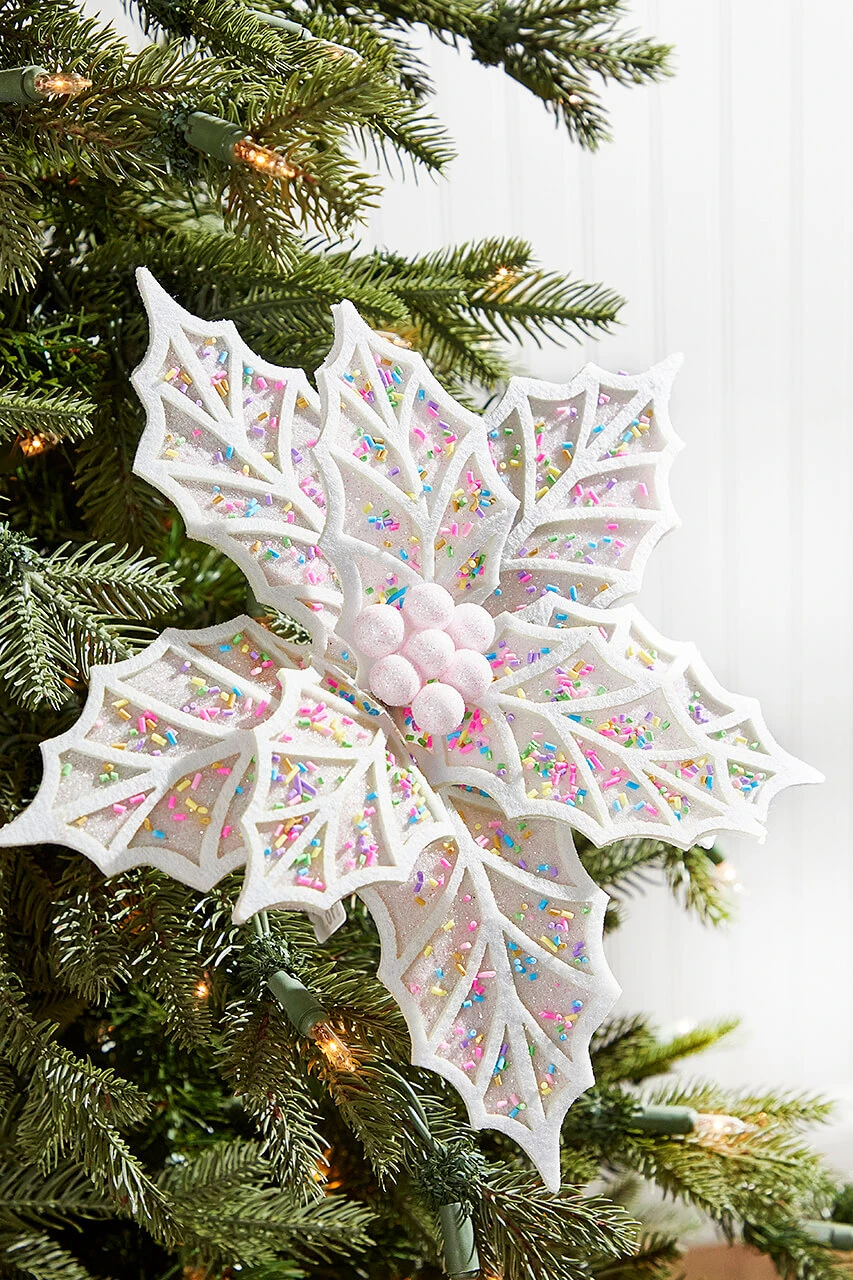
- Cut four to five white chipboard petals in graduating sizes.
- Coat each petal edge with fine white glitter and let it dry flat.
- Fill the petal centers with a thin layer of clear craft glue.
- Shake multicolored sprinkles over the glue while it’s still wet.
- Glue a small cluster of pale pink beads at the very center.
- Attach a wire loop to the back and seal everything with matte spray.
It’s the sprinkles. Without them, this is a perfectly pretty white glitter snowflake you’ve seen a hundred times. The scattered specks make it read as dessert, not decoration, and the pale pink bead cluster gives your eye a stopping point inside all that white. Compare with Idea #17 — same candy logic, much bolder scale.
- White glittered layered ornaments (set of 6): $25–$60
- Craft chipboard, glitter, and glue if DIY: $15–$25
- Faux sprinkle mix or sealed candy sprinkles: $5–$10
- Pale pink bead assortment: $4–$9
- Matte sealing spray: $8–$14
Total: about $30–$60 for a set of six. Budget alternative: wooden snowflake blanks from Dollar Tree at $1.25 each, plus glitter you already own.
21. Where Candy Land Decor Goes Wrong in Real Homes
- Check whether your tree lights are warm or cool — candy colors shift dramatically between them.
- Measure walkways; candy props on the floor get kicked.
- Confirm storage space before buying oversized props.
- Decide who cleans up: glitter and flocking are a February chore.
- Note which surfaces get direct sun, because painted and printed props fade.
Glitter is the price of admission for candy decorating, and it never fully leaves. Expect to vacuum twice as often through December, and to find specks in the carpet in June. Painted wooden props need a fresh coat of outdoor sealer every other year if they live outside. Foam and resin pieces crack in freezing temperatures, so bring anything hollow indoors when the forecast drops below 20 degrees. Ten minutes of winterizing saves a whole prop.
22. Flocked Wreath With Felt Gingerbread Men in Santa Hats
Roughly 50% frosted white, 30% crimson red, 20% green and gingerbread brown. That white half is doing more work than it looks like — the flocked base is the neutral that lets peppermint swirls, red roses, and berries coexist without chaos. Swap the red roses for white ones and the whole wreath turns frosty and elegant. Swap them for pink and you’ve got the pastel version of the exact same formula.
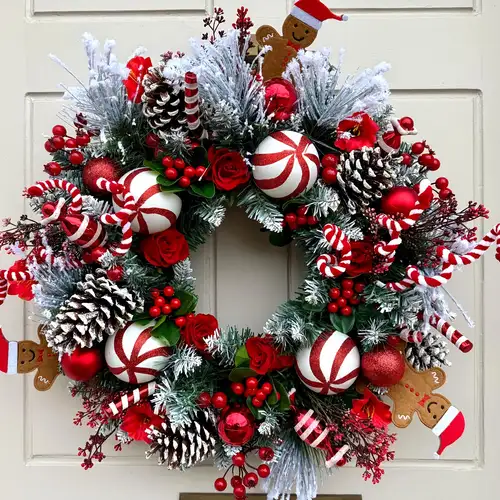
Texture is the secret here. Glossy peppermint balls, fuzzy felt gingerbread men, dry frosted pinecones, and roses all sit in the same red-and-white palette but feel completely different to the eye and the hand. That mix is what keeps a themed wreath from looking like it came out of one plastic bag. The felt figures in Santa hats add a soft, slightly silly note that balances all the shine.
23. A Nutcracker Wreath With Pampas Grass and Copper
A wooden nutcracker is heavier than anything else on a wreath, so don’t hang it from a ribbon loop and hope. Anchor it with 20-gauge floral wire through two points — base and shoulders — and wire those back to the wreath’s inner ring, not to a branch. Hang the whole thing from a nail or a metal over-door hook, because adhesive strips fail around 2 pounds. If your nutcracker is over 10 inches tall, size the wreath up to 24 inches so it doesn’t look perched.
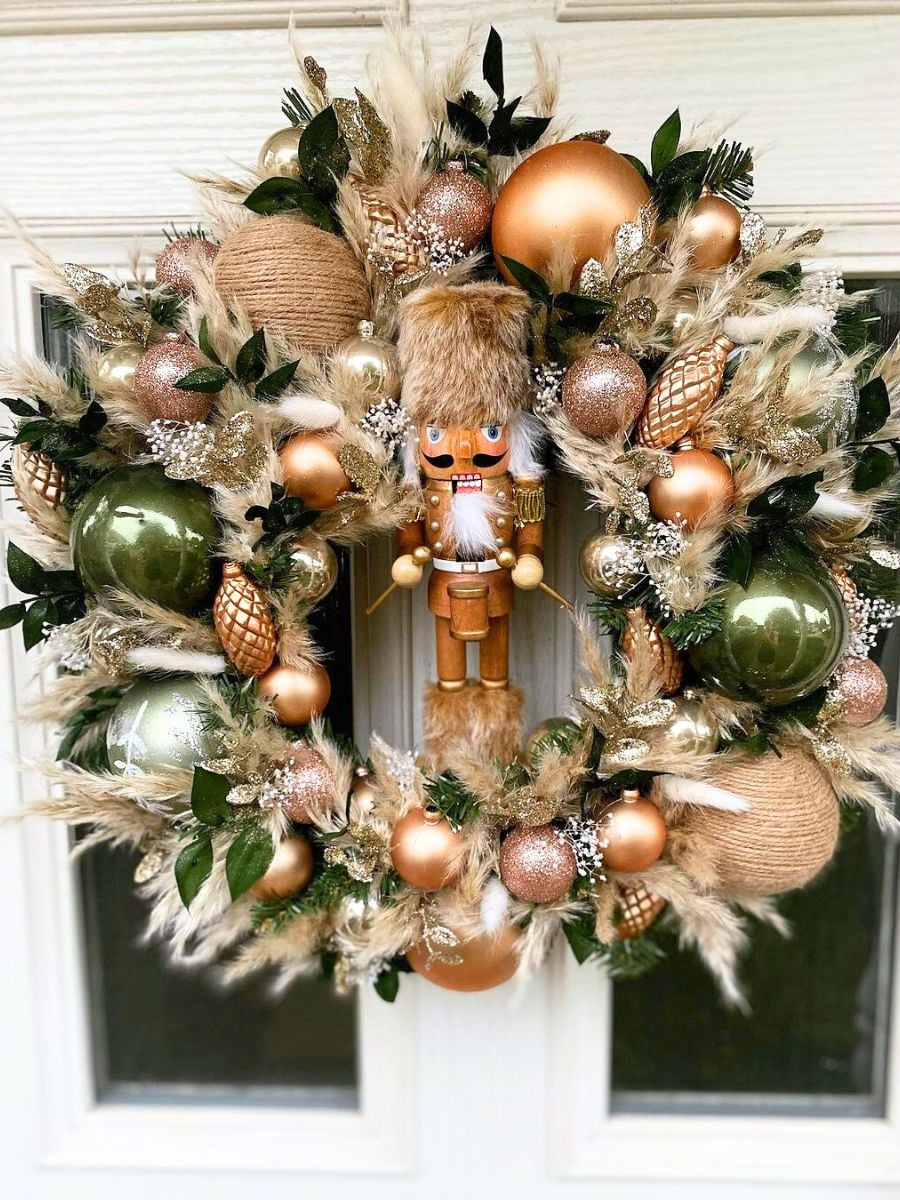
Take the nutcracker away and you have a lovely, entirely forgettable wreath. The copper ornaments, twine spheres, rose gold baubles, and pampas grass are beautiful but they’re a formula anyone can copy. A figure dead center turns the wreath into a portrait — it’s the one element with a face, and faces pull attention. Compare with Idea #9 for the all-red traditional version of the same shape.
24. Pastel Candy Living Room With Lollipop Tree Picks
This setup is genuinely apartment-friendly. It works from about 10 by 10 feet up, because everything vertical hugs the corner and the footprint stays inside the tree’s reach. Keep 30 inches between the tree and the sofa so the wrapped gifts underneath don’t get trampled. With 8-foot ceilings, stay at a 6.5-foot tree and let the lollipop picks add height. Compare with Idea #2 — same pastel palette, but that one leans on a wall color and a hanging chair.

- Flocked or plain tree (6.5–7 ft): $80–$300
- Oversized pastel ornaments, 12–20 pieces: $40–$120
- Lollipop and candy cane tree picks: $15–$45
- Pastel wrapping paper and ribbon: $20–$40
- Textured neutral rug (5×7): $90–$250
Total: roughly $245–$755. Budget alternative: keep your existing tree, add six oversized pastel balls from Walmart at $3 each, and wrap gifts in kraft paper with pink and mint ribbon for about $15.
Pastel candy rooms photograph beautifully and can feel washed out in person if the lighting is wrong. Warm white only — cool white turns blush pink into gray-beige and mint into hospital green. Keep foam props out of reach if you have toddlers, because they look exactly like candy and get chewed on. And don’t park the tree in front of a heat vent; flocking yellows faster than you’d think.
25. Hand-Tied Velvet Bows on a Candy Cane Pine Wreath
About 30 minutes for a full wreath, roughly $18–$35:

- Cut 2-inch-wide velvet ribbon into 10-inch lengths — one per bow.
- Form a simple loop bow and pinch the center hard with your fingers.
- Secure the pinch with 24-gauge floral wire, leaving 4-inch tails.
- Wire each bow into the wreath at an angle, following the circular flow.
- Space bows every 5 to 6 inches so candy canes and baubles still show.
- Tuck berry clusters between bows rather than on top of them.
Velvet ribbon runs $8–$14 for 10 yards, which is real money for something that fades. Felt ribbon gives you the same matte look for about $4 a roll at Walmart or Hobby Lobby, and it holds a bow shape better in damp weather. Secondhand velvet scarves from thrift stores are another trick — cut one into strips for roughly $3 and you get genuine velvet texture.
26. A Pink Velvet Bow With Candy Cane Piping
It’s the piping. A big pink velvet bow is pretty; a big pink velvet bow edged in red-and-white candy cane stripe is a design decision, and it’s the thing everyone photographs. That single stripe ties the bow to the glittering candy cane, the plaid ribbon, and the gingerbread man cookie ornament without adding one extra piece. Remove the piping and this becomes a generic pink tree with a nice bow on it.

Oversized bows need proportion rules or they swallow the tree. For a 7-foot tree, keep the finished bow between 14 and 18 inches across — roughly twice the width of your widest ornament cluster. Attach it with two wire points through the back loops so it can’t sag overnight, and place it in the upper third rather than the very top, where it competes with your topper.
27. A Hand-Painted Blue Wooden Holiday Train for the Lawn
Painted plywood lawn props survive about three seasons before they need attention — and the failure point is always the edges. Water wicks into the cut grain, the paint lifts, and the piece delaminates from the outside in. Seal the edges twice with exterior-grade primer before you ever paint the front. Expect to touch up chips each spring, and store it flat, not leaning, so the wood doesn’t warp.
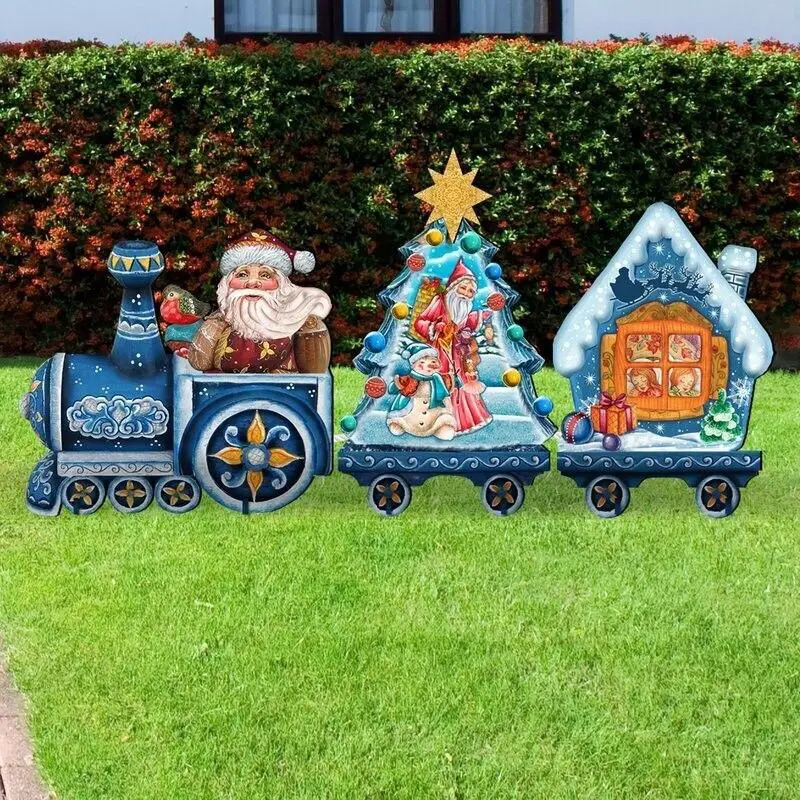
Hobby Lobby and Etsy sell hand-painted wooden train sets for $80–$200 a car. A DIY version runs about $35 total: one half sheet of exterior plywood at $22, a jigsaw you probably own, and acrylic craft paint in navy, sky blue, gold, red, and green. Cut three simple shapes — engine, tree car, cottage car — and lean them against stakes rather than bolting them down. Facebook Marketplace also turns up used wooden yard sets every November for under $50.
28. A Light-Up Gingerbread Train With Peppermint Wheels
- Illuminated gingerbread train centerpiece: $45–$120
- Small frosted green tree accent: $12–$30
- Snow blanket or batting for the base: $8–$18
- Battery pack and rechargeable batteries: $12–$25
- Wrapped gift boxes with ribbon: $15–$35
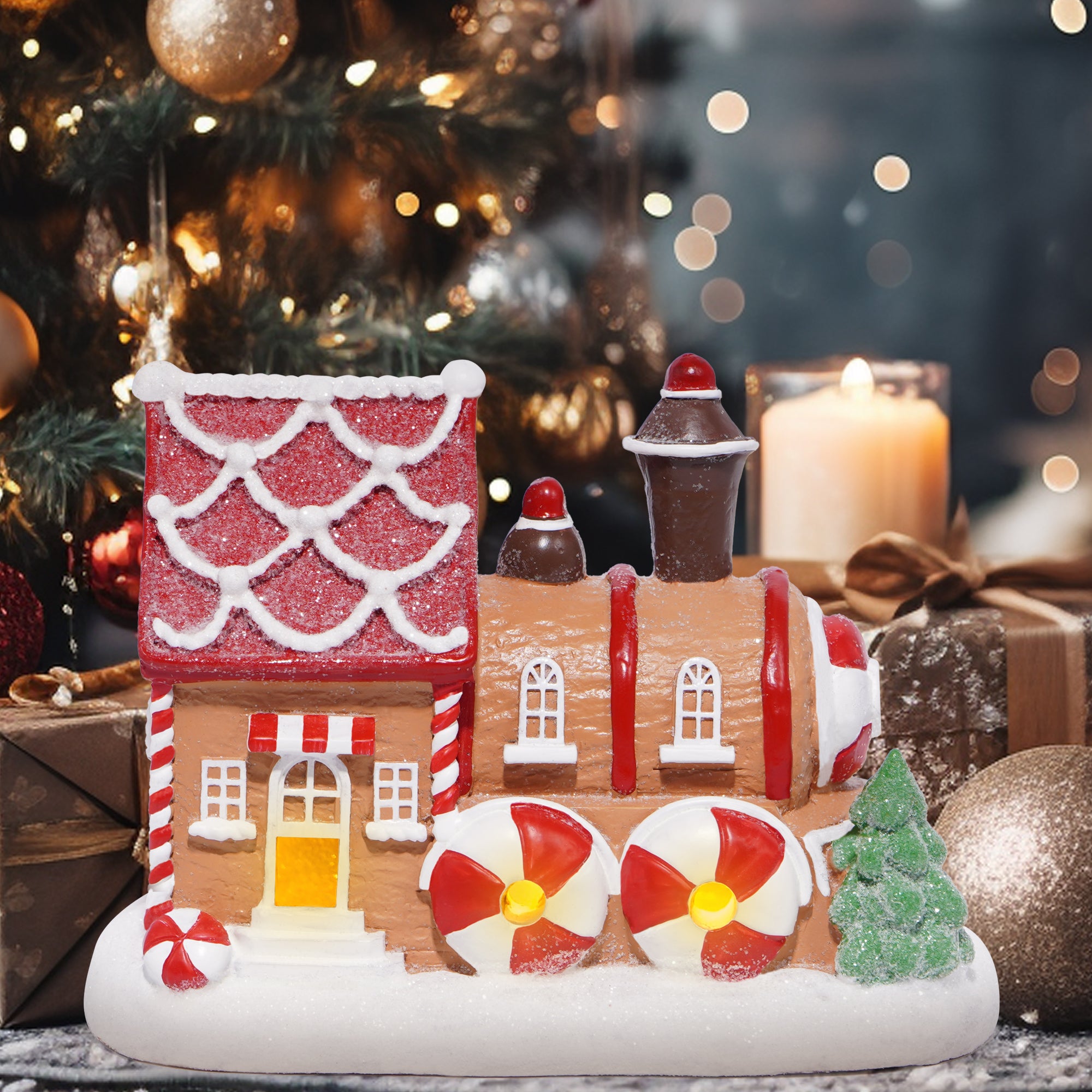
Total: roughly $92–$228 for the finished vignette. Budget alternative: use a plain brown ceramic train and a dollar-store gingerbread house, add a $6 strand of fairy lights inside, and set it on cotton batting for about $25 — or see Idea #3 for the full tabletop scene.
Light-up tabletop pieces are almost all battery-powered, which means two things nobody mentions: they eat AA batteries, and they turn themselves off at the worst moment. Buy rechargeables — you’ll save about $30 a season. Check that the battery compartment is accessible without disassembling the roof, because you’ll be changing them in the dark. And if this sits near a real candle, move it.
29. A Gingerbread House Incense Burner That Smokes
Decor that engages smell is one of 2026’s quietest shifts — incense burners shaped like houses, wax warmers disguised as cottages, candles that look like baked goods. Designers call it multi-sensory styling; you’d call it “the house smells incredible when guests walk in.” The gingerbread version works because smoke rising from the chimney is literally the shape telling its own story. Small, cheap piece, outsized effect.
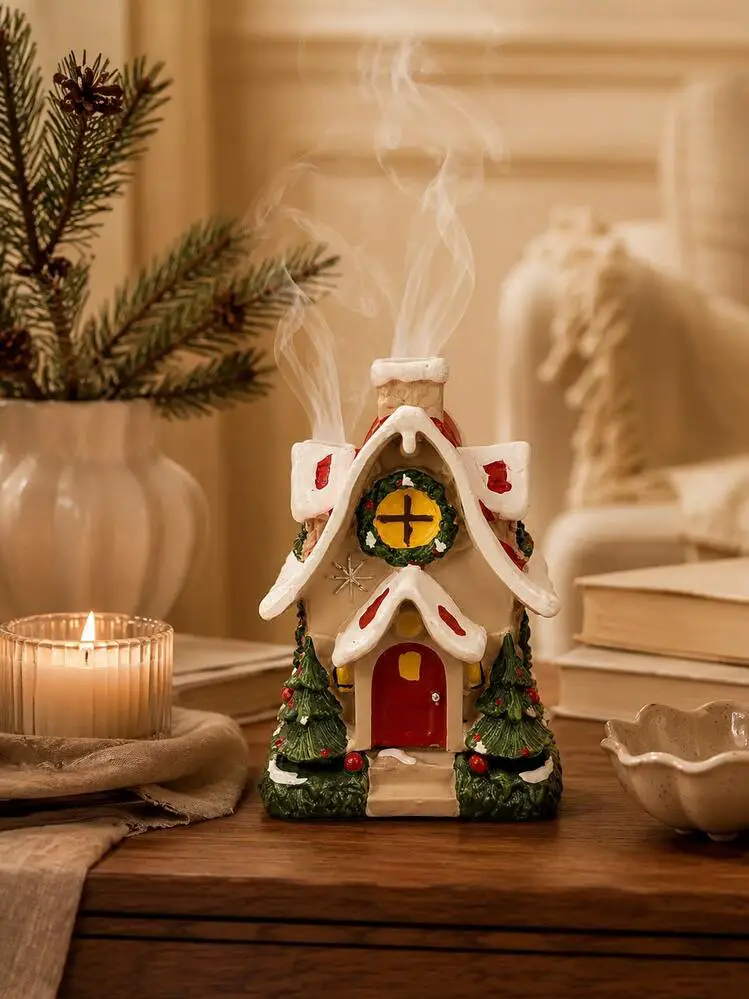
Everything here is about restraint and movement. The vignette is four things: house, candle, vase with pine, stacked books — nothing more, so each object gets attention. The smoke provides motion, which static decor almost never has, and the lit candle mirrors that flicker at a different height. Even the wood table and textile runner are doing a job, warming the beige-and-brown palette so the red on the house pops.
Build Your Candy Land One Glowing Disc at a Time
You don’t have to recreate all 29 of these — pick two, do them well, and let the rest wait until next December. The peppermint path lights and the gingerbread mantel village are the two that give the most per dollar, and both start under $150.
📌 Pin your favorites now so when the holiday bins come out next year, you already know exactly what you’re building.