
Most black and white Christmas decor guides get it wrong — they hand you a color palette and call it a plan. What actually works in 2026 is specific: a gold reindeer on top of a graphic tree, three paper stars hung at eye level, a bare black tree used like sculpture. We dug through hundreds of photos and product listings across Target, IKEA, Etsy, Walmart, and Amazon, then narrowed it down to 30 ideas that genuinely deliver — with looks ranging from about $8 in kraft paper to $600 statement pieces.
Inside you’ll find 30 curated ideas spanning minimal monochrome, modern glam, cozy Scandinavian, and moody traditional styles, with budget and luxury versions compared side by side for the pieces that matter most. Every idea is shoppable, and every one is pulled from a real room, not a render.
Monochrome holiday decor is peaking right now because the minimalist wave that reshaped our year-round rooms finally reached the tree — black-and-white schemes photograph cleanly, store easily, and last past New Year’s. And stay until the end — we break down the most common mistakes that can ruin these looks.
📌 Save this to Pinterest for later — you’ll want to revisit these ideas.
1. A Black, White, and Gold Tree Anchored by a Reindeer Topper
Pull the gold reindeer off the top of this tree and the whole thing goes cold. That single metallic figure is the reason a black-and-white tree reads festive instead of severe — it’s where your eye lands first, and it sets the temperature for everything below it. Skip the predictable star and choose a figure with a brushed or matte finish: shiny gold fights the striped ribbon, while brushed gold absorbs the fairy lights and glows quietly. Proportion matters too, so pick a topper that clears the top branches by a few inches and check it from across the room.
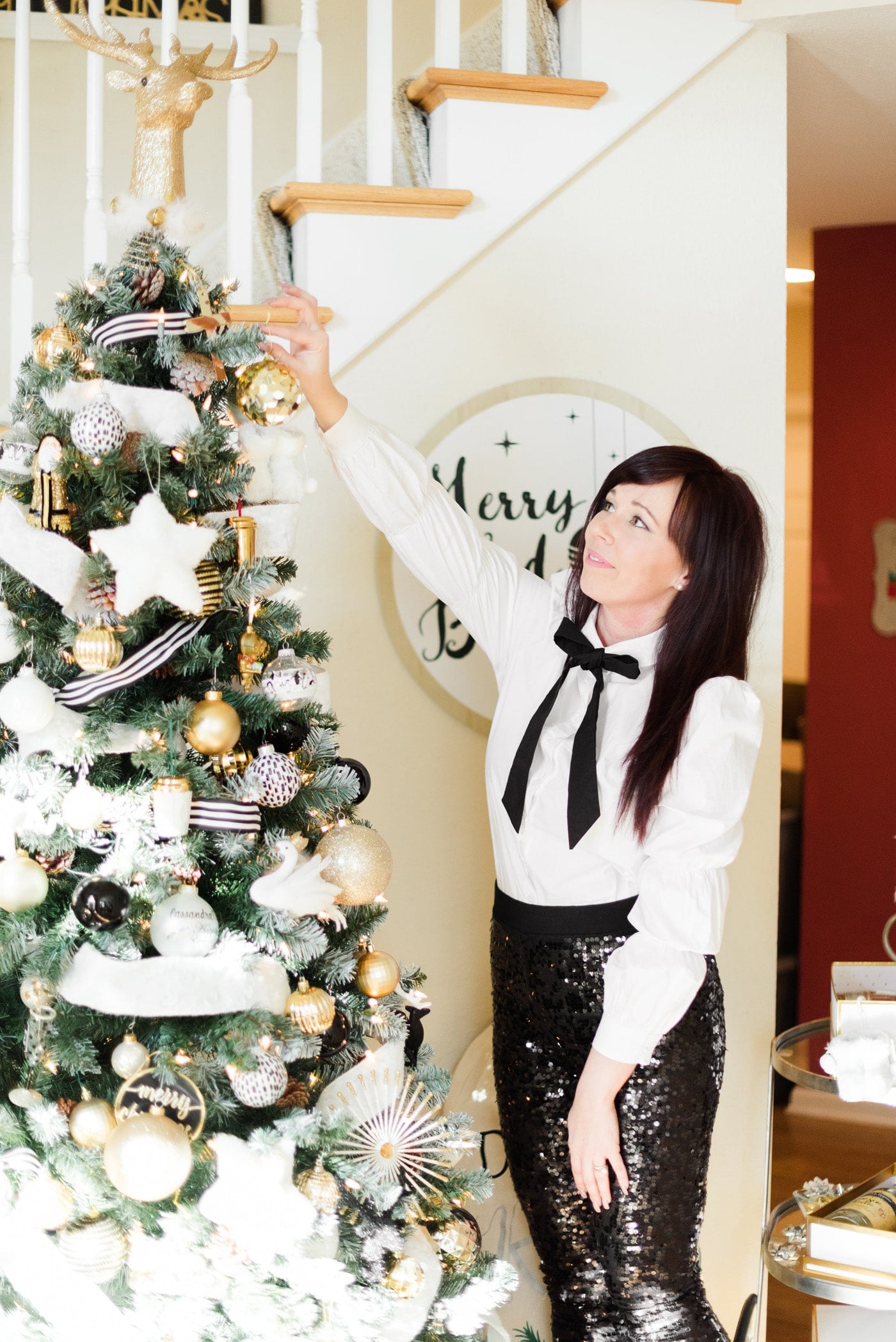
Three things carry this tree. Contrast: black ornaments against white star accents and the white staircase spindles give the eye hard edges, so the scheme reads graphic rather than muddy. Repetition: the black-and-white striped ribbon restates the same two colors in a third texture, which is what makes a two-color palette feel layered instead of flat. Rhythm: ornament sizes step down gradually from the top, so nothing competes with the topper. Take the ribbon away and the tree loses its middle note — the black and white suddenly touch each other with nothing in between.
2. Paper Stars and Grey Dinnerware on a White Linen Table
The formula runs about 70% white — linen cloth, wall, glass vessels — 20% cool grey and charcoal across the plates, folded napkins, and candle holders, and 10% living green from the evergreen sprigs. Hold those ratios and you can swap ingredients freely: grey ceramic becomes matte black stoneware, pinecones become dried citrus, clear glass becomes smoked glass. What you can’t do is let the dark tones creep past roughly a quarter of the table, because the moment they do, the white linen stops behaving like a base and starts behaving like a highlight.
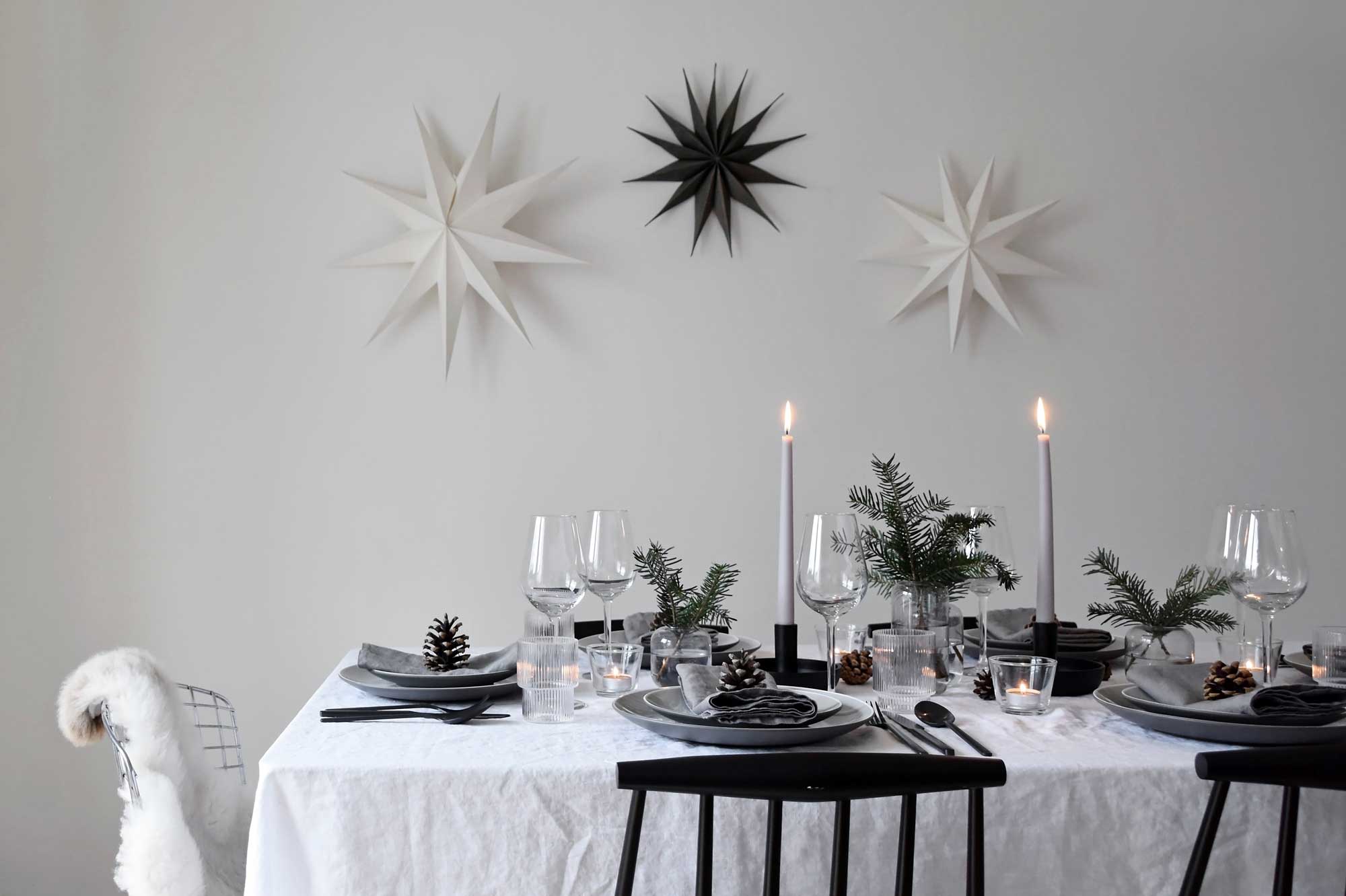
Those three paper stars aren’t sprinkled decor, they’re one composition — hang them like a single object. Keep 8 to 10 inches between stars, center the trio on the width of the table below, and set the cluster so the lowest star hangs 58 to 62 inches off the floor. That lands at standing eye level, which means guests register the arrangement the second they walk in. Use clear fishing line and small white pins rather than ribbon, and resist adding a fourth star — three or five hold a wall, even numbers start to look like a border.
3. Flocked Tree Against Dark Paneling With a Woven Collar
Flocked trees shed, and dark grey paneling shows every fleck of fake snow. Every move, every gift dragged past the branches, every bump while you’re decorating puts white dust on a surface that highlights it. Lay the woven collar down before you decorate, keep a lint roller in the room for the first two weeks, and never park this tree beside a heat vent, because warmth softens the flocking and it drops faster. Also worth knowing: dark walls eat light, so plan on roughly 100 extra warm-white bulbs compared with the same tree in a white room.
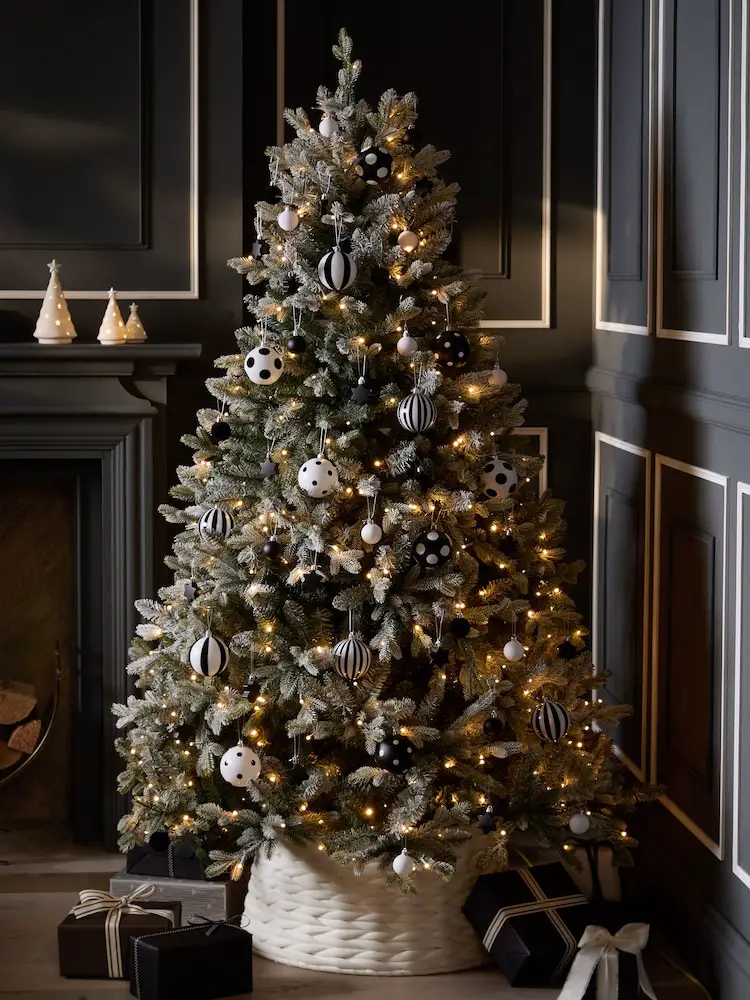
This setup wants a wall of its own. Give it at least 8 feet of uninterrupted dark paneling and a 9-foot ceiling so a 7.5-foot flocked tree never crowds the ceiling line. Under about 120 square feet, the dark surfaces start swallowing the room — in that case, keep the tree and the ornament mix, skip the paneling, and swap the wide woven collar for a slim metal bucket so the base doesn’t bulk out a small corner.
4. An Undecorated Tree Beside a Black Round Coffee Table
Styling an almost-bare tree is a 45-minute job, not an afternoon.
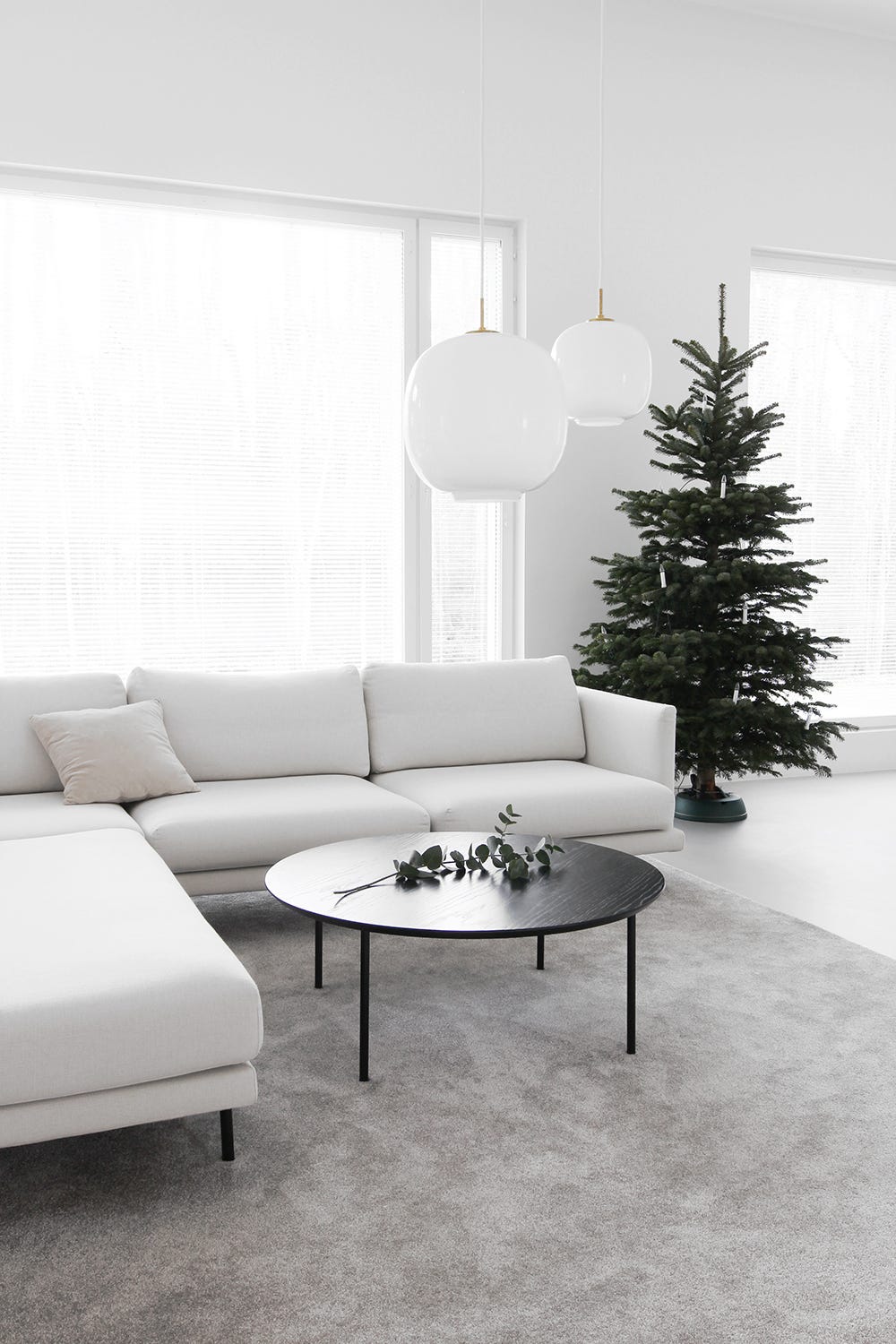
- Let the tree relax for 24 hours, then fluff every branch outward so the silhouette is full before anything goes on it.
- Choose clip-on battery tapers in warm white (2700K) — cool white makes a tree look blue in daylight.
- Clip one light every 10 to 12 inches, always on the outer third of the branch, never directly across from another.
- Group them in odd numbers per branch cluster — threes and fives.
- Tuck battery packs inside the trunk and set every timer to the same 6-hour window.
Budget $25 to $60 for a dozen tapers, and buy one spare pack.
The quiet-tree look is the holiday expression of the minimalist wave that’s dominated Pinterest for three seasons — the same instinct that traded gallery walls for one large print. In 2026 it’s less about owning nothing and more about owning the right three things. A bare dark tree beside a round black coffee table will still look deliberate in 2030, which isn’t true of tinsel-heavy themes. The caveat: restraint only reads as style when the furniture around it is equally considered.
5. Black Tree, Silver Baubles, and a White Faux Fur Base
- Black artificial tree, 6.5–7.5 ft: $90–$260
- Silver and black baubles, 60–80 pieces: $60–$150
- White faux fur rug or tree skirt: $30–$90
- Black wrap + white ribbon + boxes: $25–$60
- Wooden tripod floor lamp: $70–$200
- Black armchair with wood frame: $180–$600
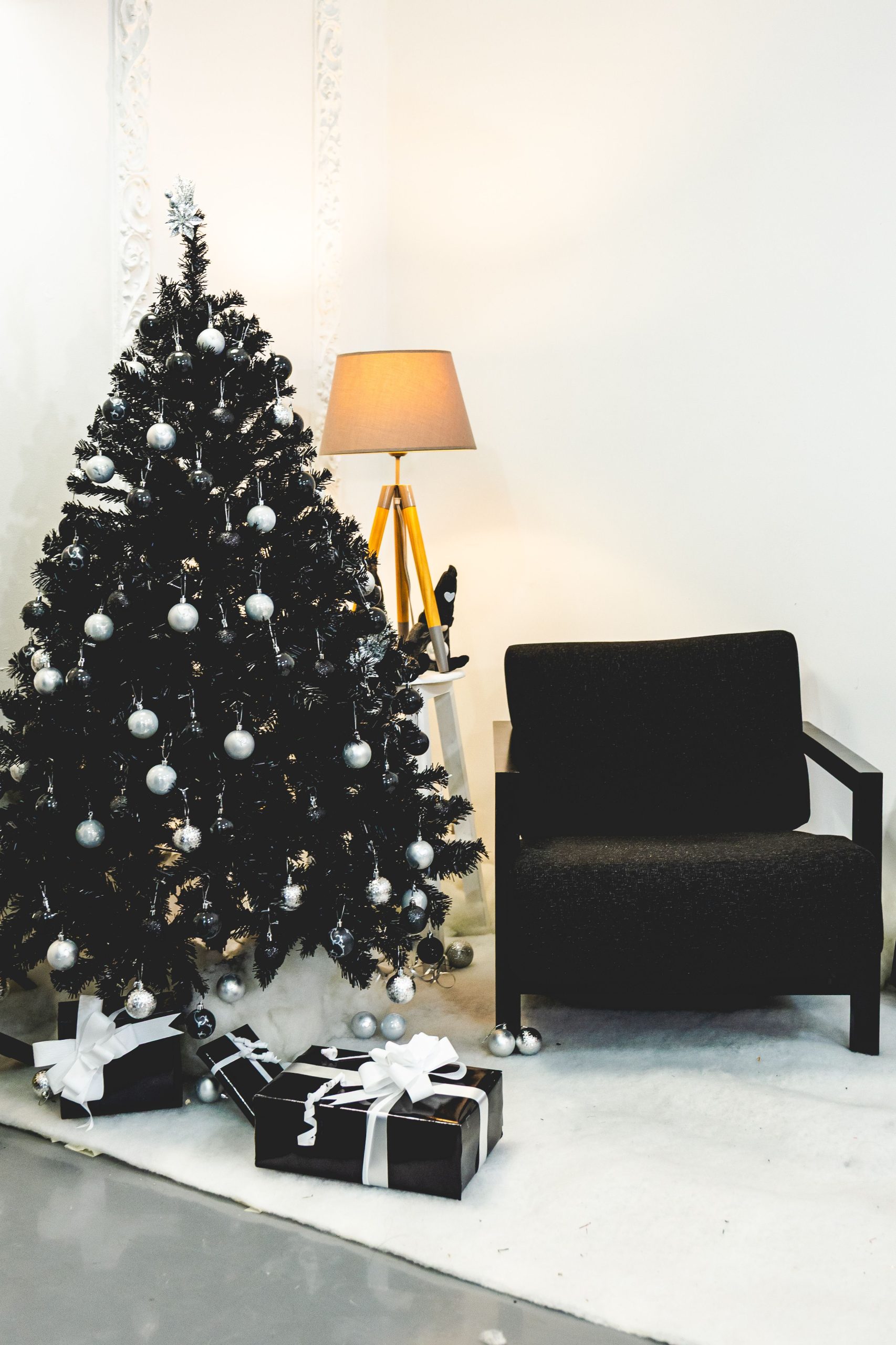
Total: roughly $455 to $1,360.
Budget alternative: hunt Facebook Marketplace for a used black tree ($40–$80), spray-paint dollar-store baubles in matte black and chrome, and use a white sherpa throw as the tree base. That’s about 55% less for the same read.
Three upkeep items come with this look. Faux fur sheds for the first month and needs a weekly shake-out plus a lint roller on the black armchair fabric, which grabs every white fiber. Silver baubles tarnish — the cheap ones within a season — so store them sealed with anti-tarnish strips instead of tossing them in a bin. And black artificial trees are dust magnets, so a pass with a microfiber duster every two weeks keeps them from going grey.
6. A Black Bow Topper and White Poinsettias Over a Linear Fireplace
The oversized matte black bow at the top of the tree is the entire personality of this room. It’s larger than anything else on the tree, it’s matte against warm lights, and it repeats the black ribbons running through the garland below — which is why the two surfaces read as one design rather than two. Remove it and you’re left with a perfectly nice black-and-white tree, pleasant and forgettable. Choose stiff, wired ribbon so it holds shape all season, and size the bow at roughly one-sixth the width of the tree.
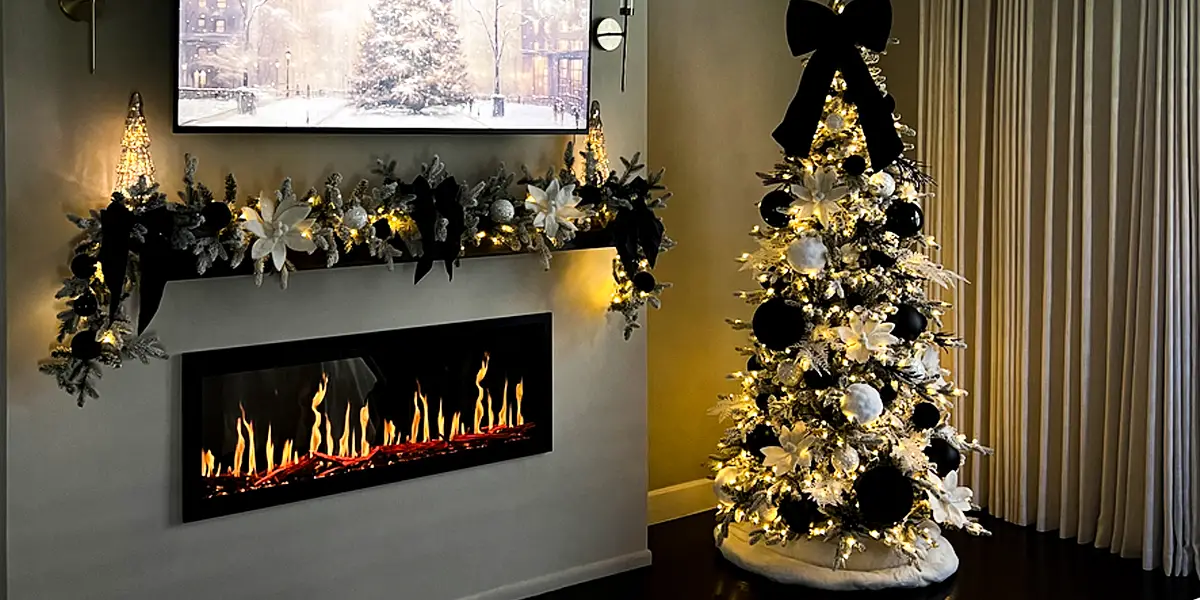
Green is the uncredited hero here. White poinsettias and black baubles could easily look like a chessboard, but the snowy garland puts living color between them, so the contrast softens. Scale does the rest: those spherical ornaments are intentionally oversized, because small baubles would vanish against a wide linear fireplace. Compare with Idea #1 — same palette, different energy. That tree leans traditional and warm; this one leans architectural, because the firebox, the mantel line, and the big black spheres all speak in straight lines and circles.
7. Knit Throws and Window Stars in a White-Walled Living Room
Hanging paper stars in a window is a lighting decision, not a wall decision. Use clear fishing line and tiny clear hooks on the window trim, hang them at three different heights rather than in a straight line, and let the lowest star sit below the midpoint of the glass. Backlit by daylight they go bright and crisp in the afternoon; at night they turn into soft silhouettes against the dark pane. Five stars max per window, and leave the outer 4 inches of glass empty so the composition has a frame.
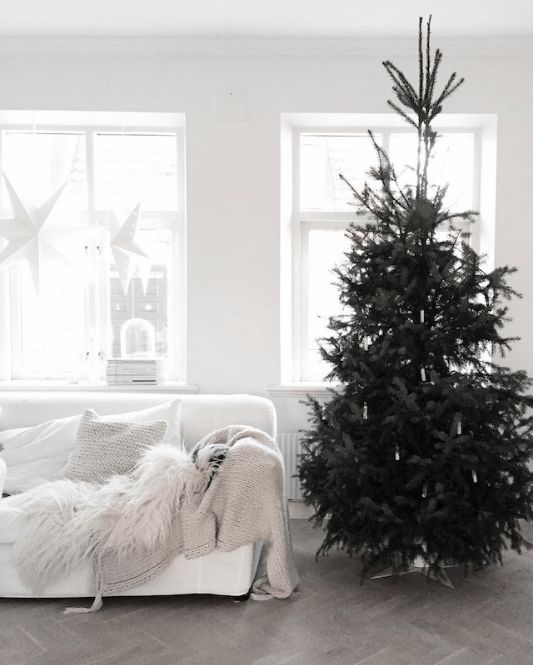
The white-wall version is the friendliest in this whole article for small rooms. It works from about 100 square feet up, needs no special ceiling height, and actually improves in low light because white walls bounce brightness back into the room. Give the tree a corner no wider than 40 inches and keep 12 inches of clearance between the branches and the nearest knit throw. Past 300 square feet, this quiet approach starts reading as underfurnished and you’ll want a more layered scene with garlands and several lit trees.
8. Twin Black Trees and Gold Starbursts on Dark Marble
You can absolutely fake the marble. Peel-and-stick marble vinyl runs $30 to $60 for a 24×48-inch panel and looks convincing behind a console if the seams land in a grout-like line; finish the edge with a $12 roll of gold trim tape. For the trees, a tabletop pair at $30 each plus gold spray paint on dollar-store baubles gets you most of the drama for a fraction of the money. Thrifted brass starbursts show up regularly for $8 to $25, and a plain cone form wrapped in gold tissue stands in for a glitter cone tree.
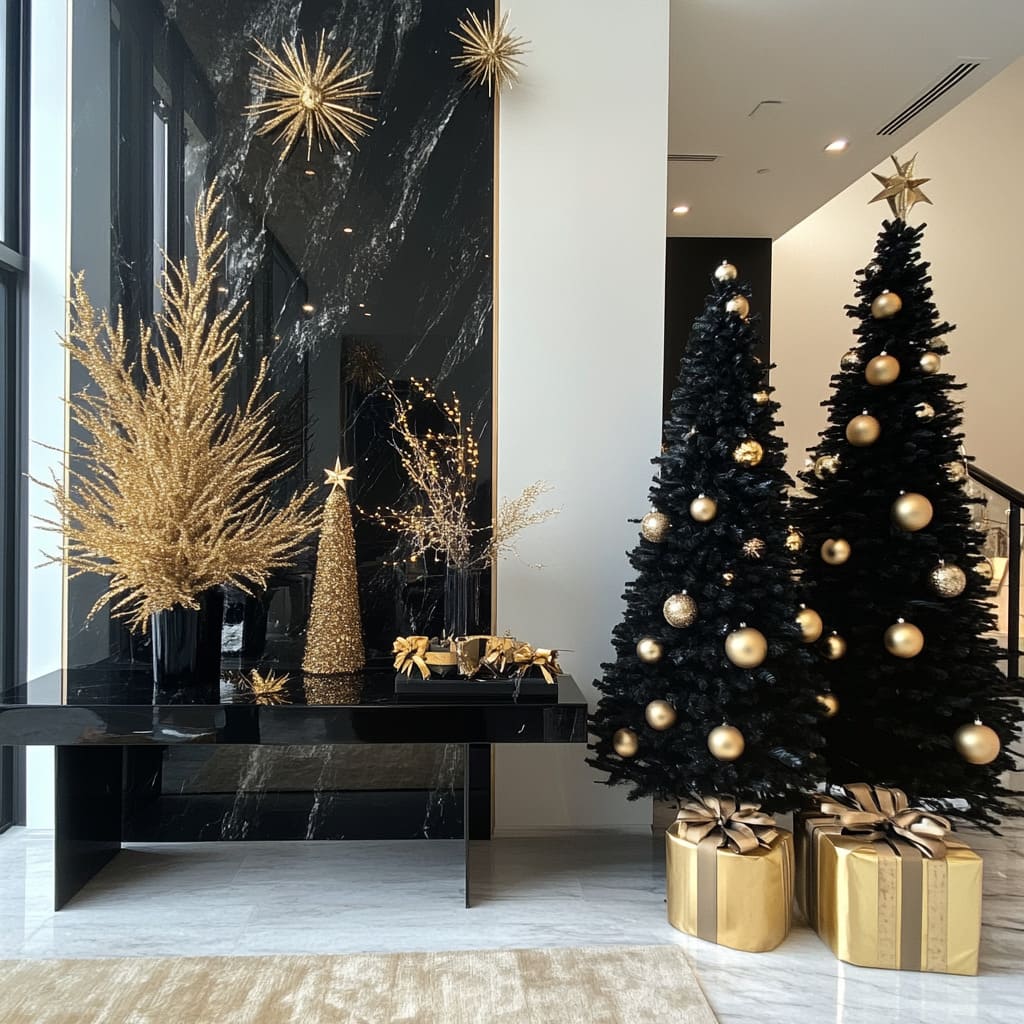
Black-and-gold glam is having a second life in 2026, but for different reasons than the 2019 version. That wave was about shine for its own sake; this one is about contrast — glossy black surfaces and dark stone give the gold something to bounce off, which is why the marble panel matters as much as the ornaments. Twin trees are the newest part of it: two smaller trees flanking a console cost less than one large one and fill a wall more evenly.
9. Matte Black Plates Under a Giant White Globe Pendant
Roughly 75% light neutral — tablecloth, pendant, wall — 20% matte black from plates, cutlery, and chair tones, and 5% green from the potted centerpiece. The trick that keeps it from looking like a wedding: matte black, not glossy. Glossy black plates under a bright white globe pendant throw specular highlights and read cheap up close. Swap the green centerpiece for dried eucalyptus or a single white amaryllis and the formula still holds, but keep that living slice small — it’s punctuation, not a chapter.
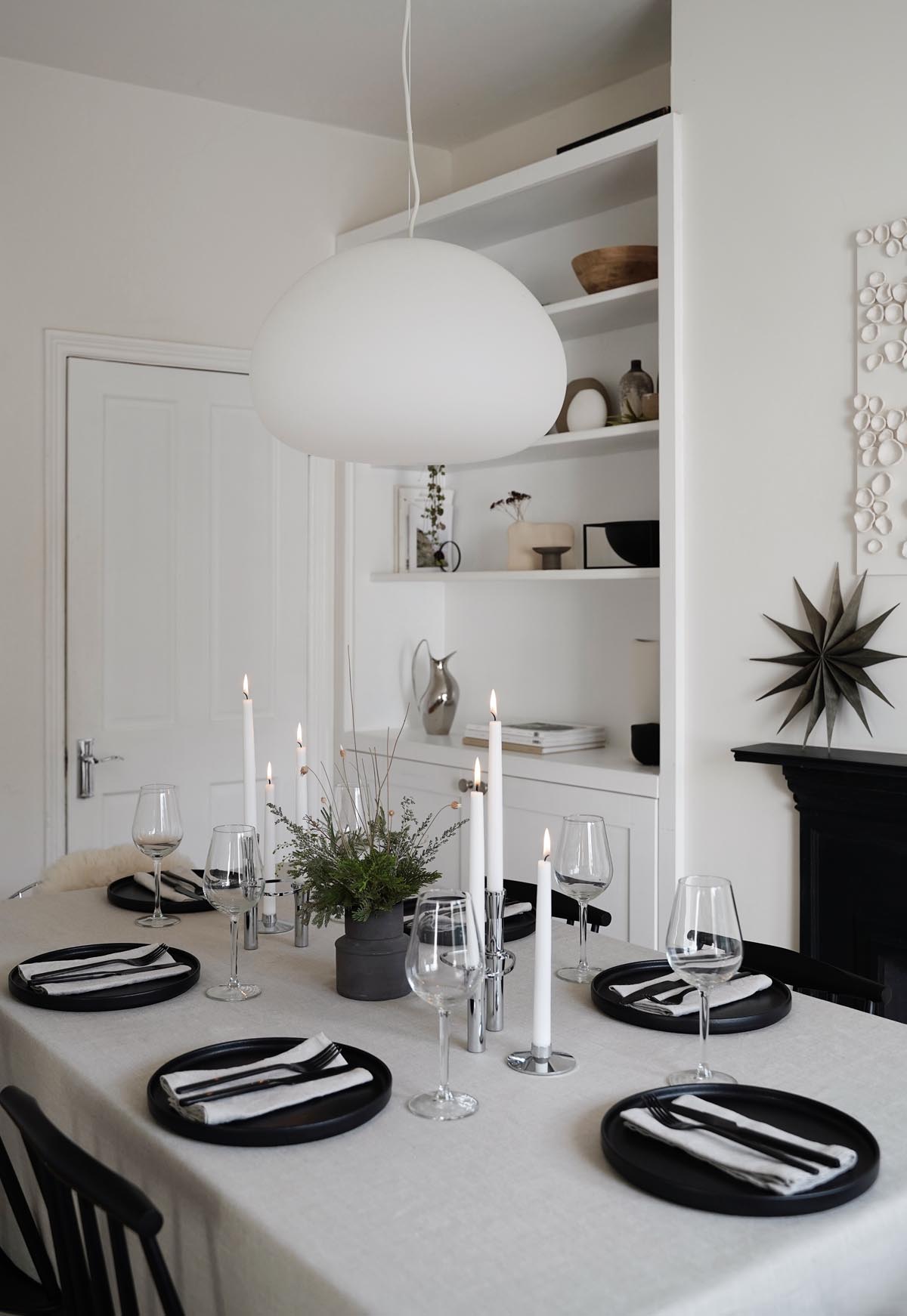
Setting a monochrome table takes about 20 minutes and $0 to $150 depending on what you already own.
- Lay a light neutral cloth and press it flat — creases show badly in white.
- Locate your light source first, then center the potted evergreen directly beneath it.
- Set matte black plates 15 inches from the table edge to plate center.
- Fold white linen napkins into a simple band and lay them on the plate, not beside it.
- Add silver candleholders with white tapers and light them two minutes before guests sit.
10. Bottle Brush Trees and Pillar Candles on an Asymmetrical Mantel
Asymmetrical mantels are harder than symmetrical ones, and this is where most people give up. The instinct when something looks unbalanced is to add more, and the result is clutter on one side and an apologetic bare stretch on the other. Fire is the second issue: white pillar candles look beautiful, but anything above 6 inches tall on a working fireplace belongs in a glass hurricane or down on the hearth ledge. Keep bottle brush trees at least 12 inches from the firebox opening, and never leave lit pillars unattended with stockings hanging nearby.
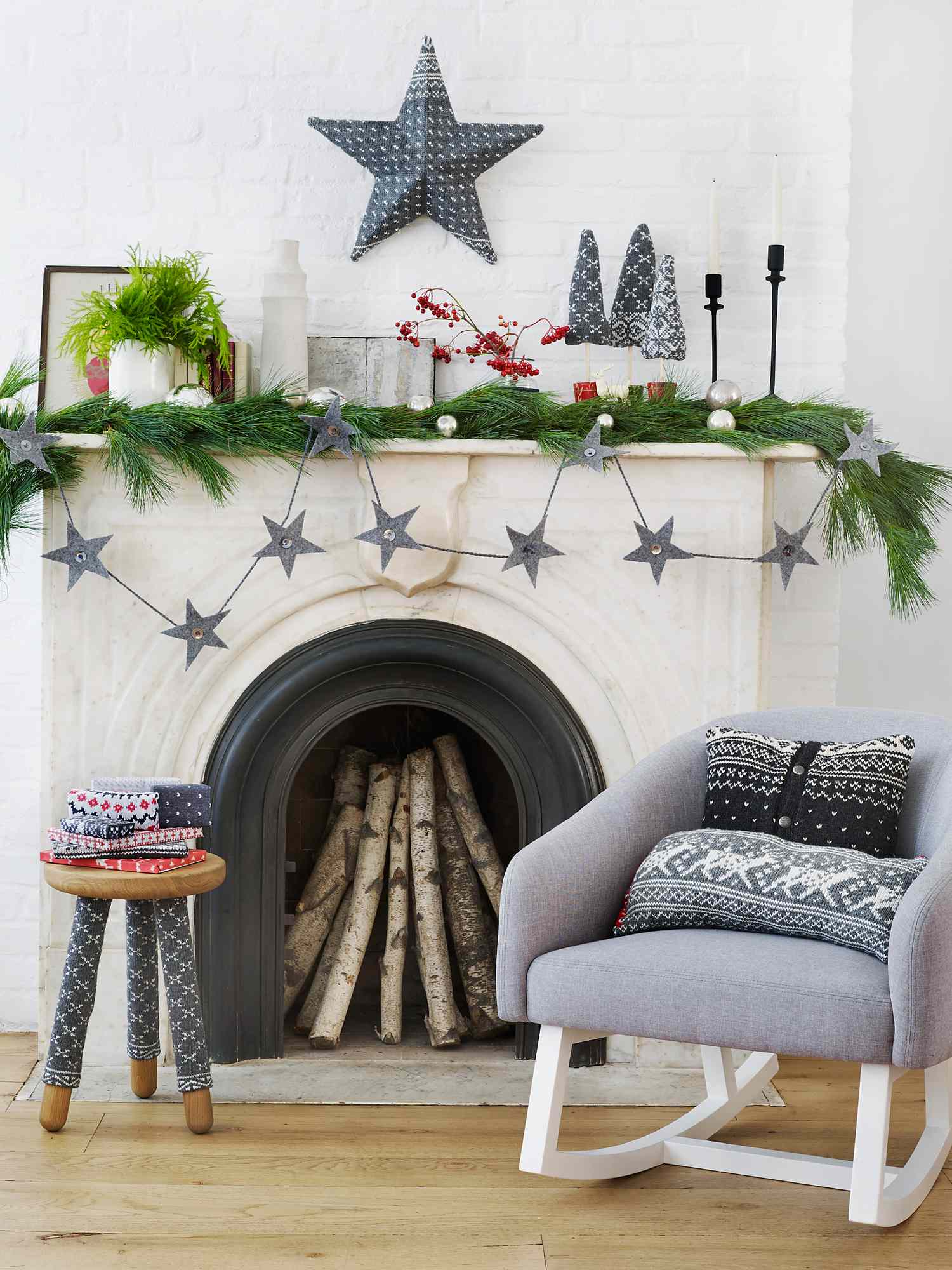
It’s the empty space on the right side of the mantel. Seriously. The weight of this arrangement comes from what’s missing, and the composition only works because roughly a third of the surface is deliberately left bare, giving the candles and trees something to push against. Add one more object to balance it and the whole thing collapses into a tidy row. Place your tallest item about one-third of the way in from the left edge and leave the last 10 to 14 inches empty. Compare with Idea #28 for the candle-forward, symmetrical take on this same white mantel.
11. Glitter Versus Gloss: Two Black Baubles Up Close
Finish mixing is the difference between a tree that looks styled and one that looks like a clearance bin. Work a 2:1:1 ratio — two matte or glossy ornaments for every one glitter — and keep a single cap style throughout. Silver caps on every bauble tie mixed finishes together, and it’s a five-dollar fix: buy a bag of uniform caps and swap them. Keep glitter ornaments in the lower two-thirds where light hits them from below, and use the gloss ones near the top, where they catch the fairy lights and read almost white.

Up close, holiday decor lives or dies on texture, not color. These two baubles are the same black, but the glitter one scatters light in every direction while the gloss one throws a single hard highlight — and that difference is what your eye actually reads as luxury. The dark branch behind them matters too: a green or white branch sets a fussy edge, while a near-black one lets the silver caps and strings do all the defining. That’s why the same ornaments can look flat on a busy tree.
12. Gold Beaded Garland on a Dark Green Tree With a Wood Slice Base
Beaded garland needs a tree tall enough to drape properly. Seven to seven and a half feet is the sweet spot in a standard 8- to 9-foot room; below 6 feet the loops crowd each other and read like a necklace that’s too short. Plan on one 9-foot strand per 2 feet of tree height if you want visible droop, and hang the highest loop about 8 inches down from the top so the fairy lights still register at the crown. A wood slice base needs about 22 inches of floor clearance, so leave room for it.

Wood slices are the easiest DIY on this list: a craft-store round runs $6 to $18, or ask a local arborist for free offcuts and dry them for a month. Beaded garland is where the money sneaks up, since store versions run $20 to $45 per strand. Buy plastic bead garland and hit it with $8 gold spray paint, or thread dollar-store beads onto fishing line yourself for about a third of the price. For baubles, mix two dollar-store gold packs with a clearance bag of black ornaments — the texture mix is what reads, not the price tag.
13. White Pampas Grass Spiraling Through a Green Christmas Tree
A pampas spiral is a one-person, 90-minute job, and the plumes cost $60 to $120 for a 7-foot tree.
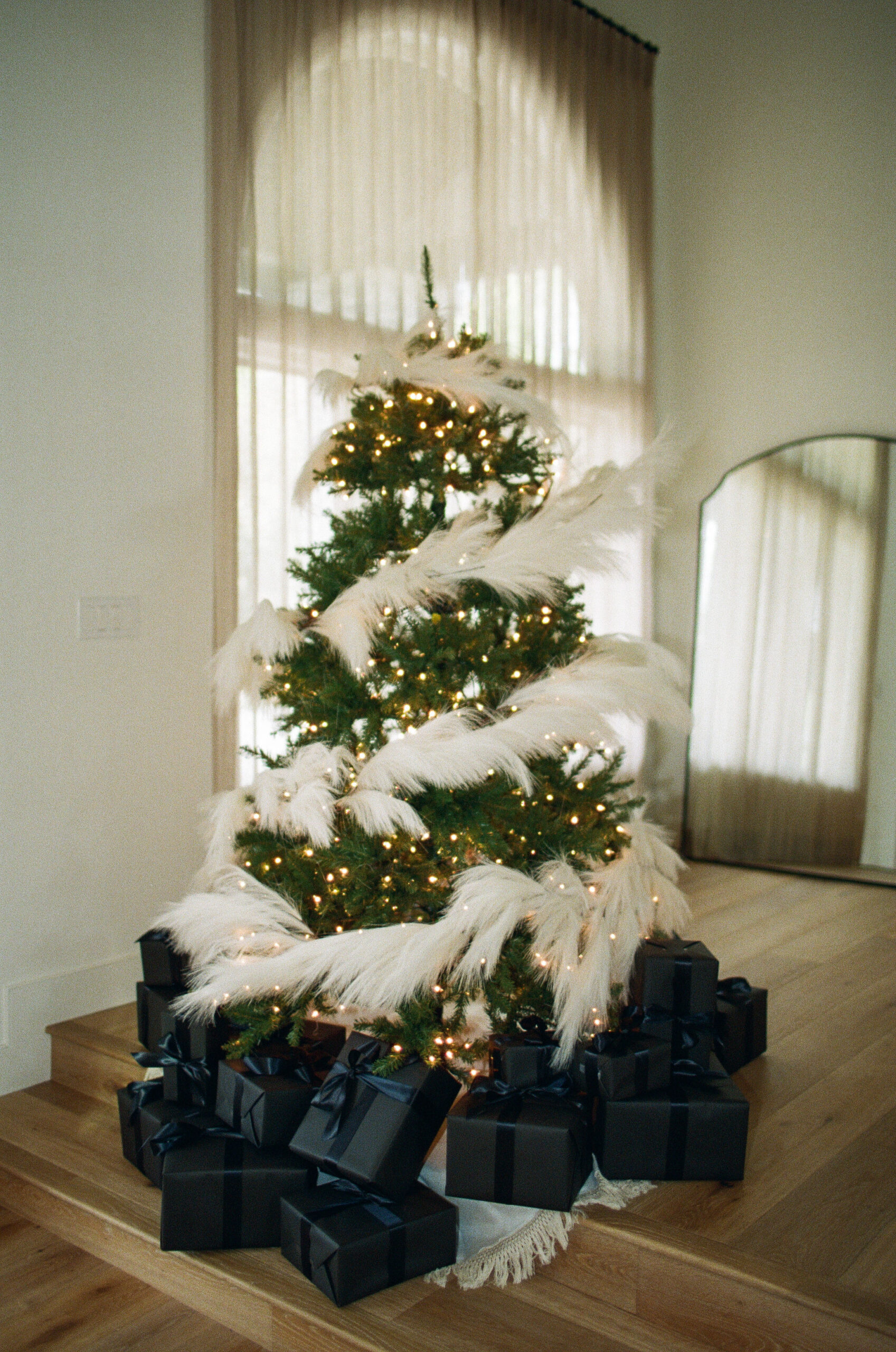
- Zip-tie three plumes together at the stems to make one repeating bundle.
- Start at the bottom, tucking each bundle stem-first so the plumes sweep up and to the right.
- Work upward in a spiral, spacing bundles 14 to 16 inches apart, always in the same direction.
- Angle every bundle at roughly 30 degrees so the plumes echo the branch line.
- Fill gaps with single plumes, then step back 10 feet — that’s how guests will see it.
Pampas sheds almost as much as it flatters. Expect fine feathery dust on wood floors for two weeks, so keep a handheld vacuum nearby and shake the plumes outdoors before they go on the tree. Keep this tree away from open flame — dried grass is basically kindling — and away from cats, who find pampas irresistible. With a toddler or a very playful pet, wide white ribbon loops give the same sweeping effect and shed nothing.
14. A Moss Runner Lit by Tiny House Lights
Think of it as 60% pale neutral from the grey tablecloth and textured white plates, 25% moss green, and 15% warm amber glow from the house lights. The amber is the number people get wrong — treat it as a color, not a lighting effect, and it becomes the thing everyone comments on. Swap moss for dark green velvet ribbon laid flat, swap house lights for amber votives in glass, and you keep the exact same mood with different materials. Push the green past a third of the table and it stops reading as a runner and starts reading as a hedge.
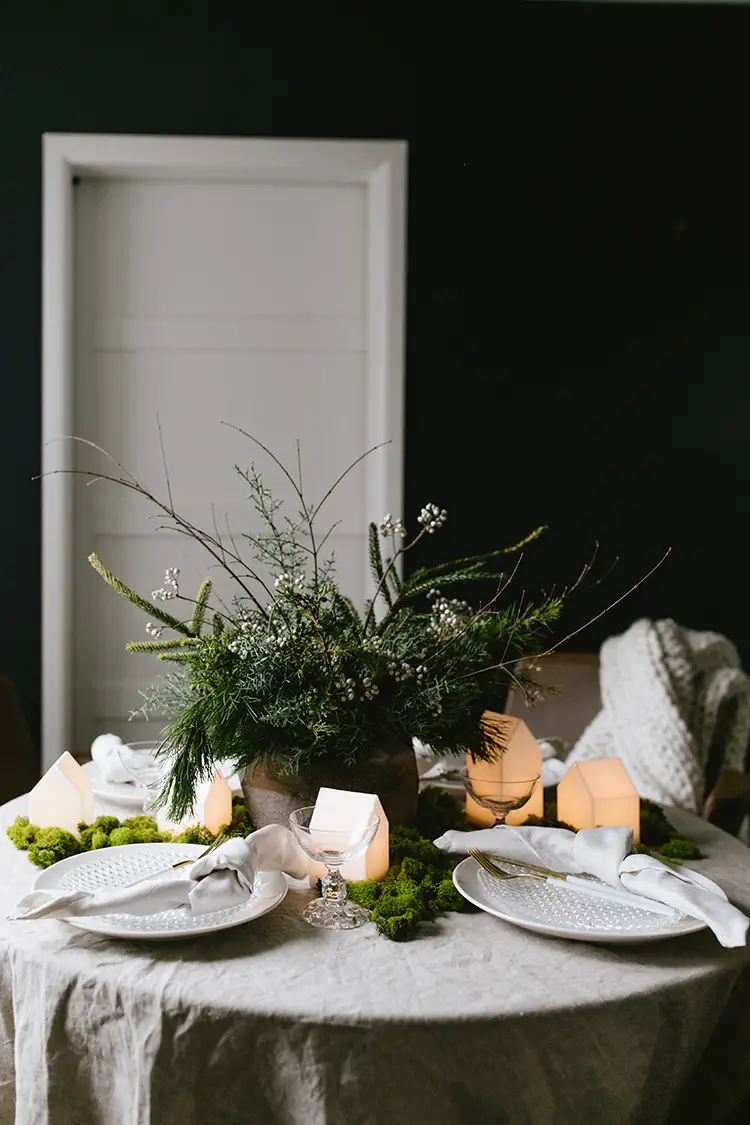
Build the moss runner on felt, not directly on the tablecloth — a 4-inch-wide strip of craft felt keeps it from staining linen and lets you roll the whole thing up for storage. Use preserved moss sheets rather than fresh, since fresh moss browns in about three days in heated rooms. Set the house lights on a timer for a 5-hour evening window, and cluster them in twos and threes instead of spacing them evenly; a straight line of glowing houses reads like a runway, while clusters read like a village.
15. A Monogrammed Stocking on a Tufted Black Armchair
The monogram. Everything else here — the black tree, the white baubles, the warm lights — is beautiful but replaceable. The stocking with the white faux fur cuff and a single embroidered initial is what turns a staged retail display into somebody’s home, and it’s the detail guests pick up and turn over. If you’re making one, go oversized: anything under 18 inches gets lost against a black tufted chair. The white fur trim is what keeps it visible, so don’t skip it in favor of an all-black version.
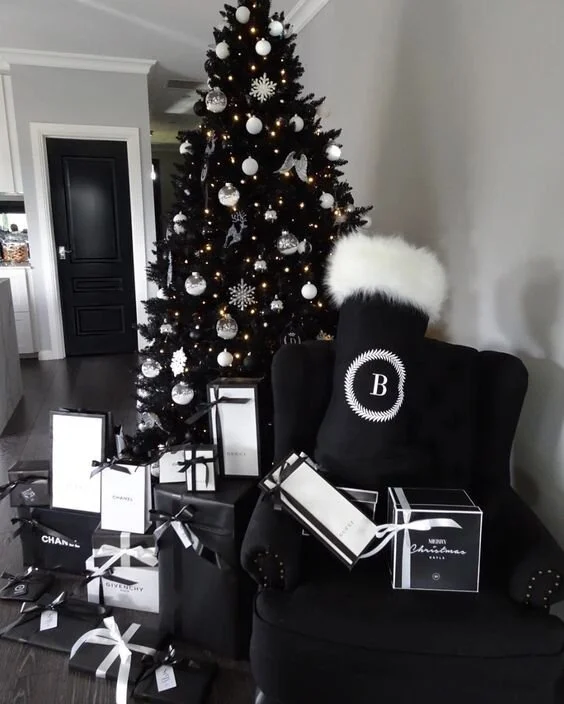
Upkeep is real: white faux fur cuffs need a brush-out and a hand wash every season, and they collect every stray fiber in the room. Black tufted upholstery shows white lint and pet hair instantly — keep a lint roller in the drawer and use it weekly. Black artificial trees and black wrapping paper both show dust and fingerprints, and glossy black paper creases permanently, so store unused rolls upright rather than stacked. Honest cost of ownership: about 20 minutes a week and $15 in supplies per season.
16. Black Ribbon Presents Beneath a Bare-Bones Tree
You don’t need much money for this one, which is exactly the point. Kraft or matte white paper from a dollar store runs $1 to $3 a roll; black satin ribbon is $4 to $8 for 10 yards and you’ll reuse it for years. Shop your own tree instead of buying new — pull the matte black and white pieces and put everything else in a box. Thrift stores regularly have new-in-package black wrapping paper for $2, and big-box after-Christmas clearance drops ribbon under $2 in early January.
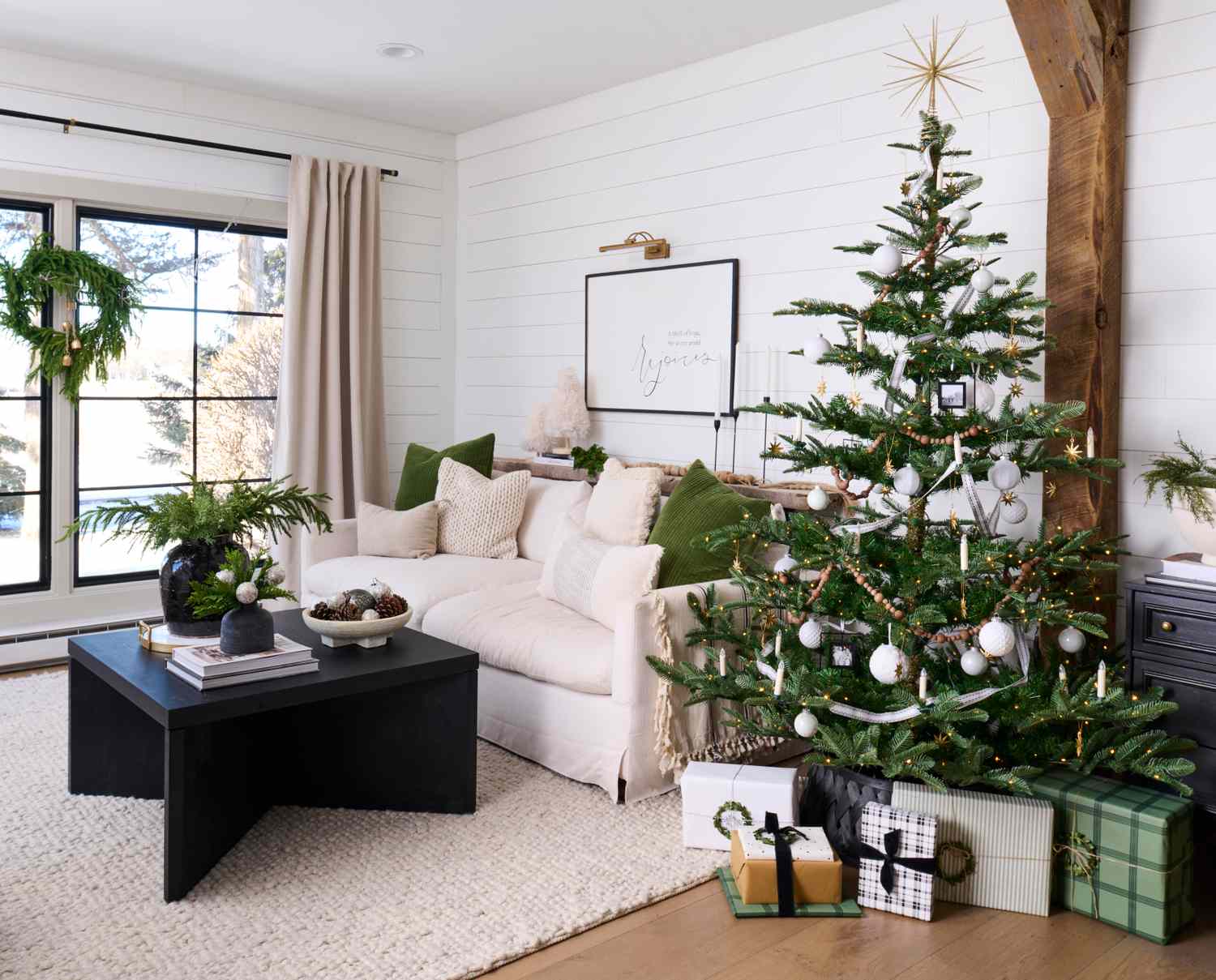
Restraint is the entire design. There’s no garland, no picks, no layered ribbon — just matte and crisp, under a tree that’s barely decorated. That works because negative space does the decorating: undressed branches above the gifts give the eye somewhere to rest, and the single black ribbon reads as a deliberate line rather than an accent. If you add anything, add scale — one wider ribbon repeated on every box beats four different ribbons on four boxes. It’s the budget version of Idea #5, and honestly the more modern of the two.
17. Diagonal Stripes, Gold Cord, and a Good Cheer Tag
This wrapping style costs $12 to $25 for a whole pile of gifts and takes about 15 minutes per box.
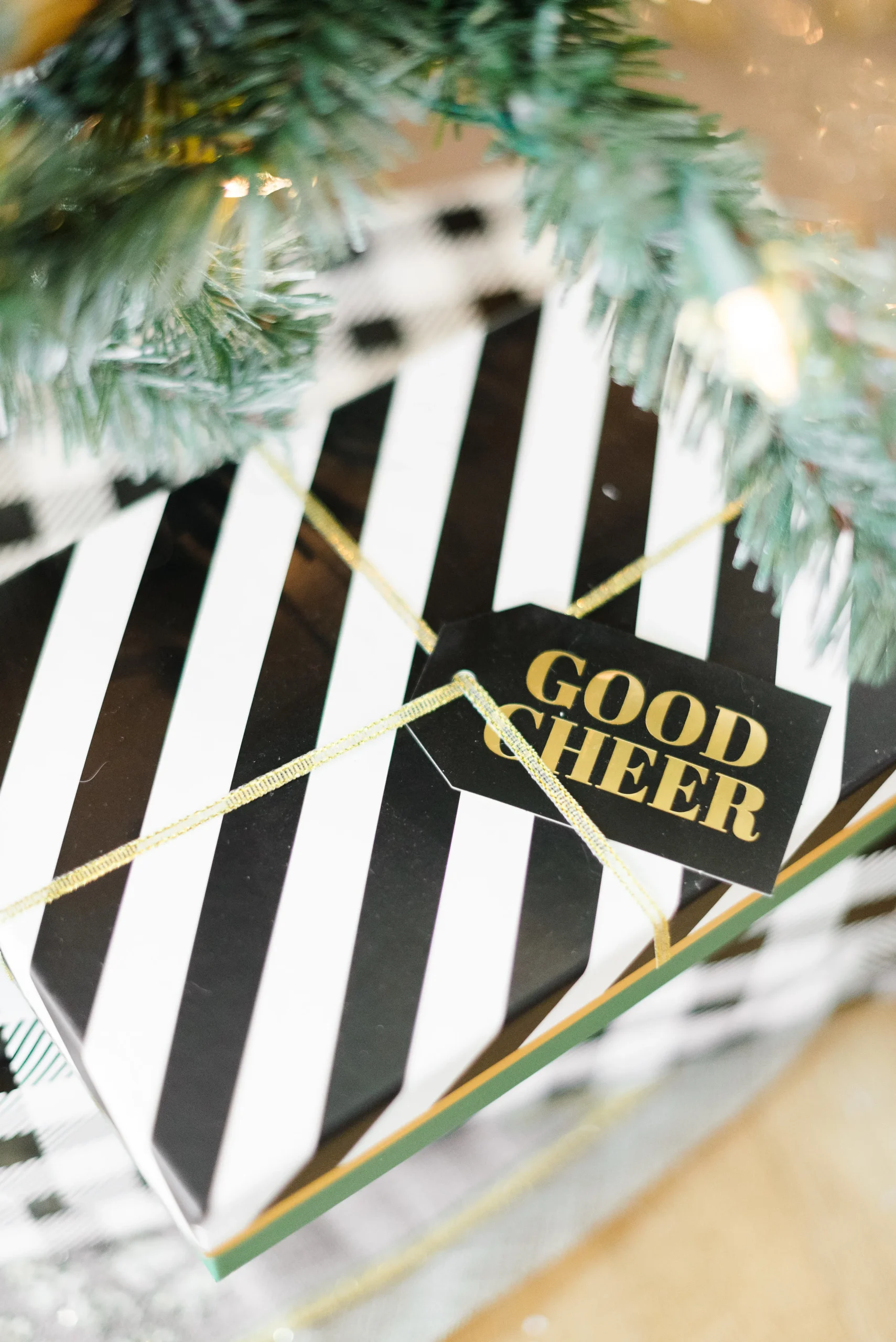
- Roll paper out so the diagonals will run corner to corner, not horizontally — diagonals need the extra length.
- Center the box on the diagonal axis, not the grid, or your stripes go crooked at the seam.
- Wrap, tape the seam at the back, then match stripes at the fold so the pattern continues around the corner.
- Tie thin gold cord twice around, off-center, and knot it instead of making a bow.
- Thread on a black tag and tuck a pine sprig under the cord.
Wrapping paper follows the same ratios as a room: about 70% pattern, 20% contrast, 10% metallic. Here the black-and-white stripes carry the pattern, the black tag holds the dark note, and the gold cord supplies the last 10%. Move those numbers and the look shifts fast — solid black paper with striped ribbon gives you a quieter, more expensive-feeling present, while kraft paper with black cord turns it rustic. The buffalo check peeking out underneath is a third pattern, which is exactly why it’s mostly hidden.
18. Silver Deer and Velvet Sofa in a Monochrome Living Room
Mixing silver into a black-and-white scheme is the 2026 update on the monochrome holiday formula. For a few years the rule was one metal per room, preferably warm gold; this season silver is back specifically because it reads as winter rather than as celebration, and saves for silver-and-black holiday rooms have climbed alongside the broader cozy-minimalist push. Staying power is decent — silver deer, marble, and velvet are classic materials, not trend materials — but expect the frostier, icier end of the palette to cycle out before the black-and-white base does.
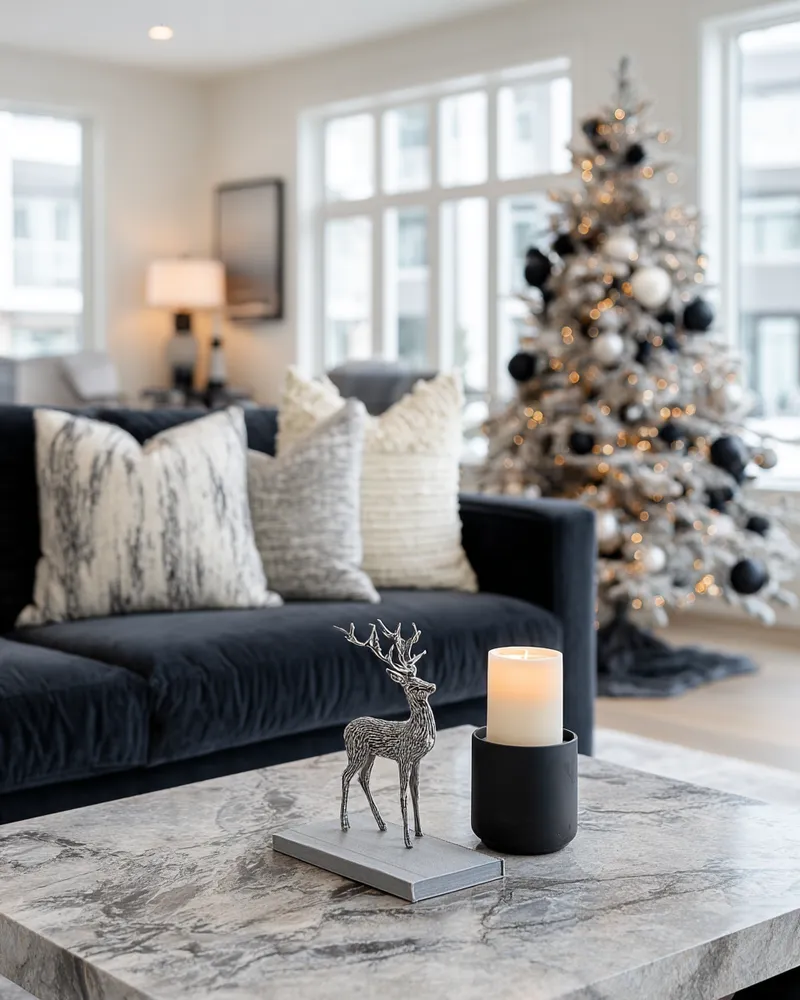
Texture is doing the work that color usually does. Dark velvet already has depth, so patterned, nubby throw pillows add a second layer without introducing a new hue, and the marble table gives you one hard, cool surface to balance all that softness. A frosted tree in the background works as a bright backdrop — it separates the sofa silhouette from the wall without needing paint or a gallery wall. Pair the deer figurine with a lit candle on the same table and you’ve created the small focal point a near-neutral room needs.
19. Polka Dot Baubles and Black Stars on a Flocked Tree
Polka dots and stripes work on a flocked tree only at generous scale. Patterns under about 1.5 inches across vanish into the flocking and read as a texture smudge from three feet away; go with 2.5- to 3-inch repeats instead. Hang patterned ornaments evenly around the tree rather than clustering them, and walk a full circle after every six to check that each side is balanced. Keep the black stars small and matte so they read as punctuation between busier baubles instead of as a competing pattern.
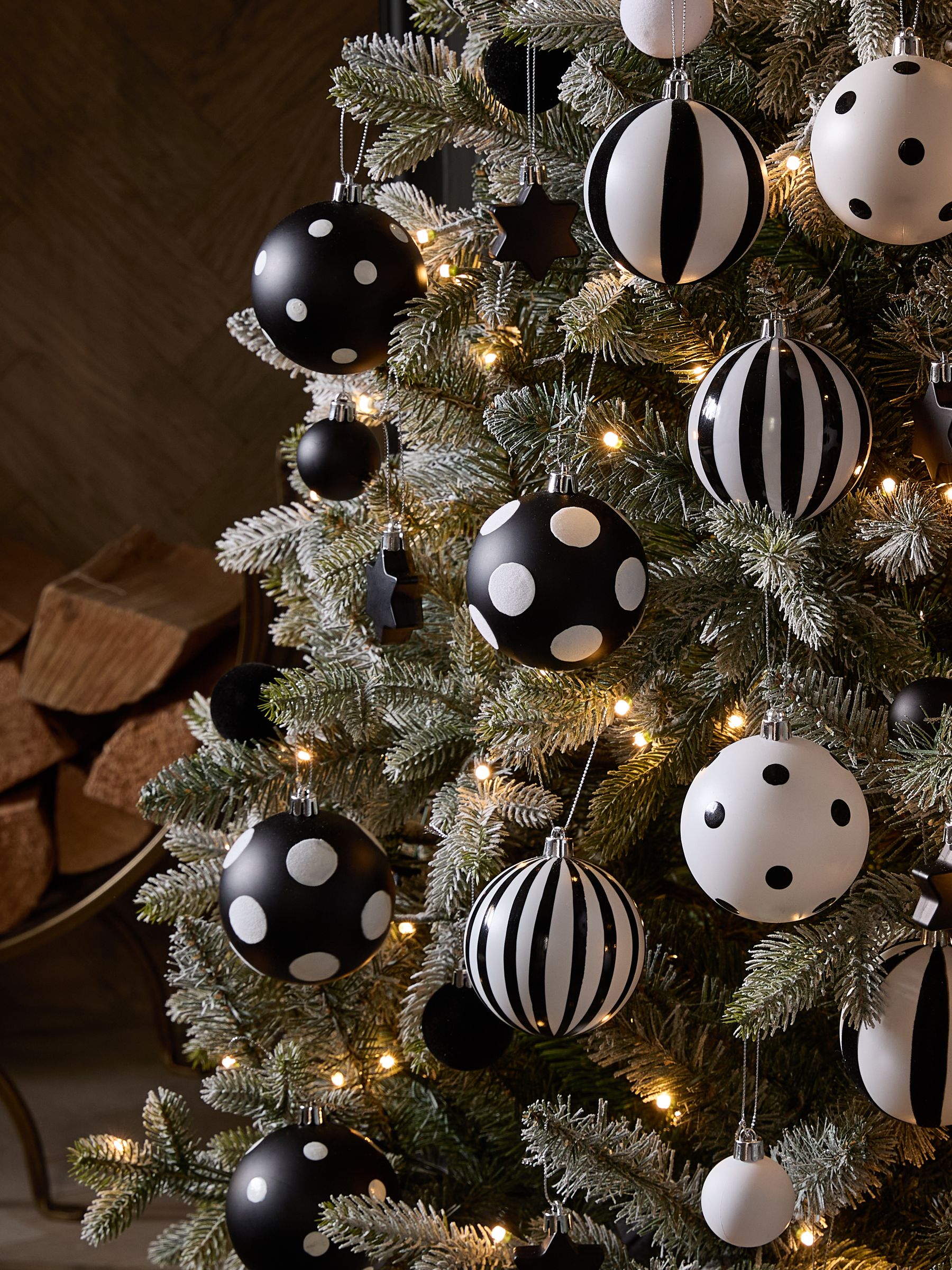
Graphic black-and-white ornaments have one weakness: photographed with a flash they go harsh, and under cool lighting the polka dots can look like a checkerboard. Keep your tree lights warm at 2700K and your overheads on a dimmer. Flocking plus patterns also makes this the least forgiving tree for uneven bulb placement, so if you’re not committed to straightening strings, choose a smaller tree — pattern density reads busier the larger the surface gets. Kids adore the dots, which means the bottom third gets rearranged daily.
20. Frosted Potted Trees Framing a Dark Front Door
The grey ribbon on the frosted wreath is the quiet hero here — it’s the only soft element in a composition built entirely of hard edges and geometric lanterns. Switch it to red or plaid and the entry slides toward traditional; keep it grey, black, or white and the door stays modern. Ribbon width counts too: 2 to 3 inches works on a standard door, anything thinner disappears from the sidewalk. Match the wreath to the potted trees in frost level, because mismatched faux snow is the fastest way to make a coordinated entry look bought at two different stores.
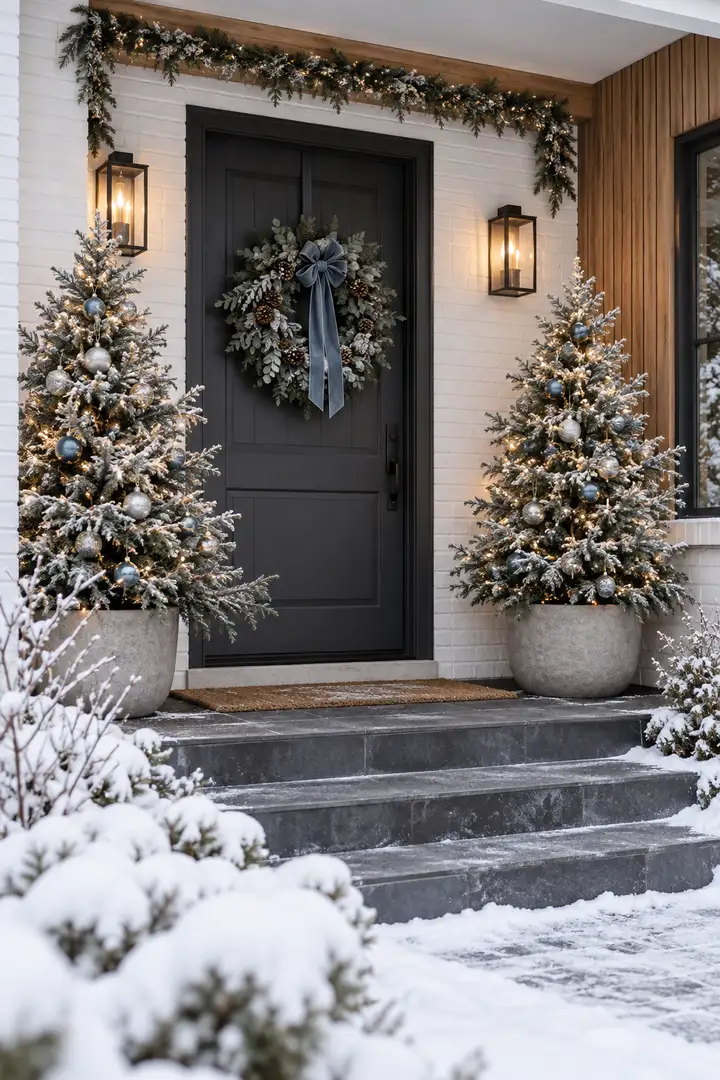
Give the door 6 feet of wall to work with — roughly 3 feet of clearance on each side of the frame — so the potted trees can sit without wedging into a corner. Frosted trees of 3 to 4 feet are the right height to flank a standard 80-inch door; taller ones start competing with the wreath for attention. This works in entries from 5 by 5 feet up as long as the walkway stays clear. Tighter than that, use two 24-inch trees in tall planters and skip the garland overhead.
21. A Wooden Dough Bowl of Ornaments on Buffalo Check
- Flocked 7.5-ft tree: $120–$340
- Ornament mix (white, gold, matte black), 80 pieces: $80–$200
- Buffalo check ribbon, 3 rolls: $18–$45
- Buffalo check table runner: $15–$40
- Wooden dough bowl: $25–$90
- Loose ornaments and pinecones for the bowl: $15–$40
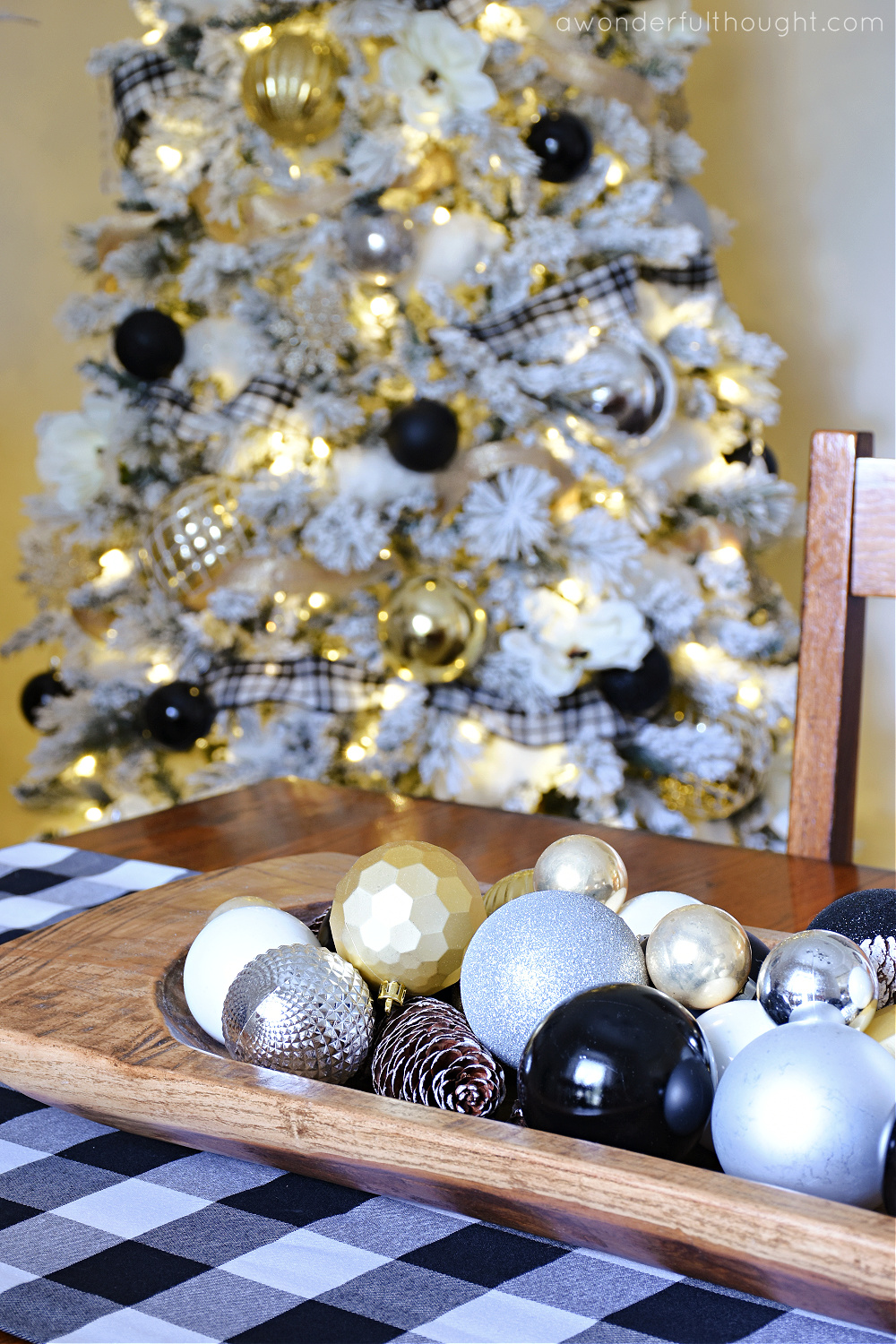
Total: roughly $273 to $755.
For less: thrift the dough bowl — they turn up constantly for $8 to $20 — buy buffalo check ribbon by the yard instead of pre-cut rolls, and mix dollar-store white baubles with two clearance bags of ornaments. The mix is what reads, not the receipt.
Flocked trees and buffalo check have opposite upkeep needs and both take time. Flocking sheds whenever it’s touched, so plan on vacuuming every surface within 6 feet after the holidays. Fabric ribbon wrinkles if it’s stored folded, so roll it around an empty paper tube. Wooden dough bowls need a light coat of food-safe mineral oil once a year or the wood dries and cracks, and flocked trees should be stored upright in a bag rather than squashed into a box, which flattens the snow finish permanently.
22. A Boxwood Garland With Dark Red Tapers on a Wood Table
This centerpiece takes about 30 minutes and $40 to $90 depending on whether you use real or faux greenery.
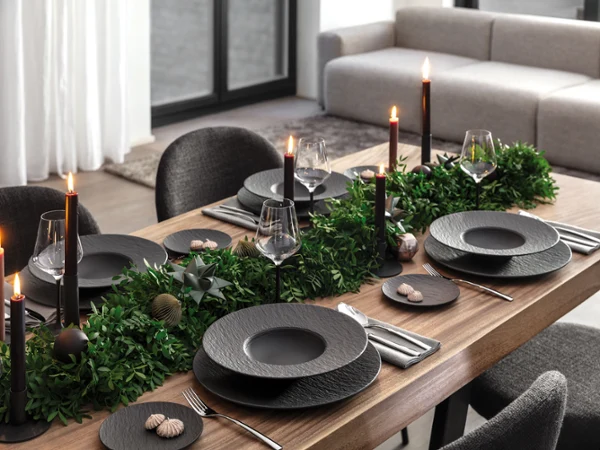
- Lay the garland down the center of the table, looping it loosely rather than pulling it straight.
- Nest three black candle holders into the greenery at uneven spacing — about 14 inches apart, never centered.
- Set dark red tapers in the holders and trim them to different heights with a sharp knife before lighting.
- Slide two small glass vessels of water into the greenery if you’re using fresh boxwood; it holds a week longer.
- Leave the last 8 inches bare at each end so plates have breathing room.
The dark red candles are doing something clever: they introduce one warm, saturated color into a scheme that would otherwise be grey, green, and wood. A single accent hue at roughly 5% of the surface area is enough to make an entire table feel intentional — the same reason a black-and-white room can absorb one terracotta vase. The garland also solves a geometry problem, giving the wooden table a soft centerline so the empty wood on either side reads as framed. Compare with Idea #9 — same discipline, much cooler temperature.
23. A Bare Black Tree Against a Plain White Wall
If you’re leaving a black tree bare, the stand becomes part of the design and the plastic X-base ruins it. Drop the tree into a matte black basket, a galvanized bucket, or a wide woven collar — anything that hides the hardware and gives the trunk a visual base. Then fix the proportions: a bare tree needs 4 to 6 inches of clearance from the wall so it reads as an object in space rather than a flat silhouette, and it needs light. One warm accent lamp aimed at the underside makes the branches look sculptural instead of sad.
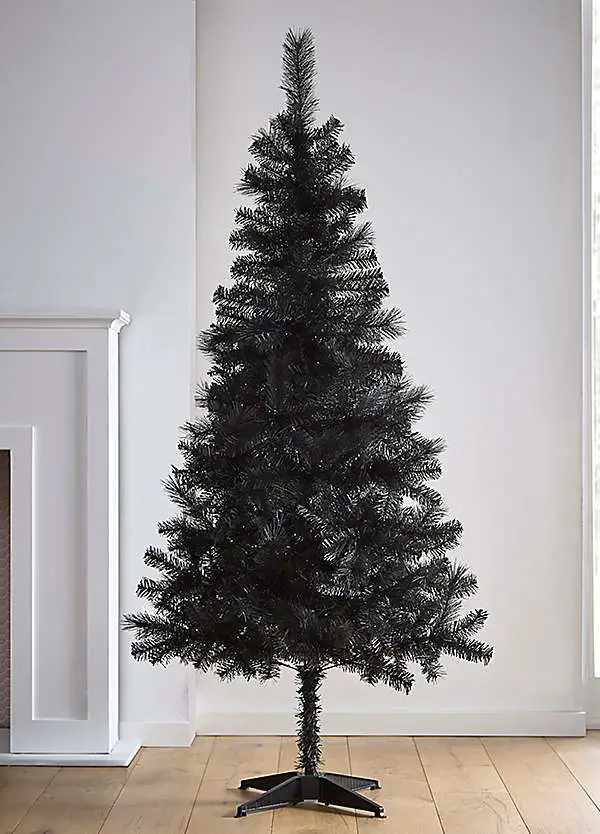
Undecorated trees went from a stylist’s trick to a genuine trend, and 2026 is the year black versions caught on. The appeal is practical as much as aesthetic: nothing to store, nothing to untangle, ten minutes of setup. It’s also the natural endpoint of the monochrome holiday mood that’s been building in minimalist feeds — and a black tree reads as a piece of furniture, a shape you leave up through January without apology. Expect this to stay; matte black isn’t a seasonal color the way red and green are.
24. A Tabletop Tree in a Striped Paper Bag by the Window
Small-space holiday styling runs on tighter ratios: 65% pale grey and white from the armchair, walls, and daylight; 25% black-and-white pattern from the wrapping and bag stripes; and 10% kraft brown from the paper bag and boxes. Kraft is the number that keeps this from looking cold — it’s the only warm neutral in the mix, and swapping it for pure white makes the entire corner feel clinical. Want it cozier? Push kraft to 20% and dial the pattern back. Want it sharper? Reverse those two numbers and lose the throw blanket.
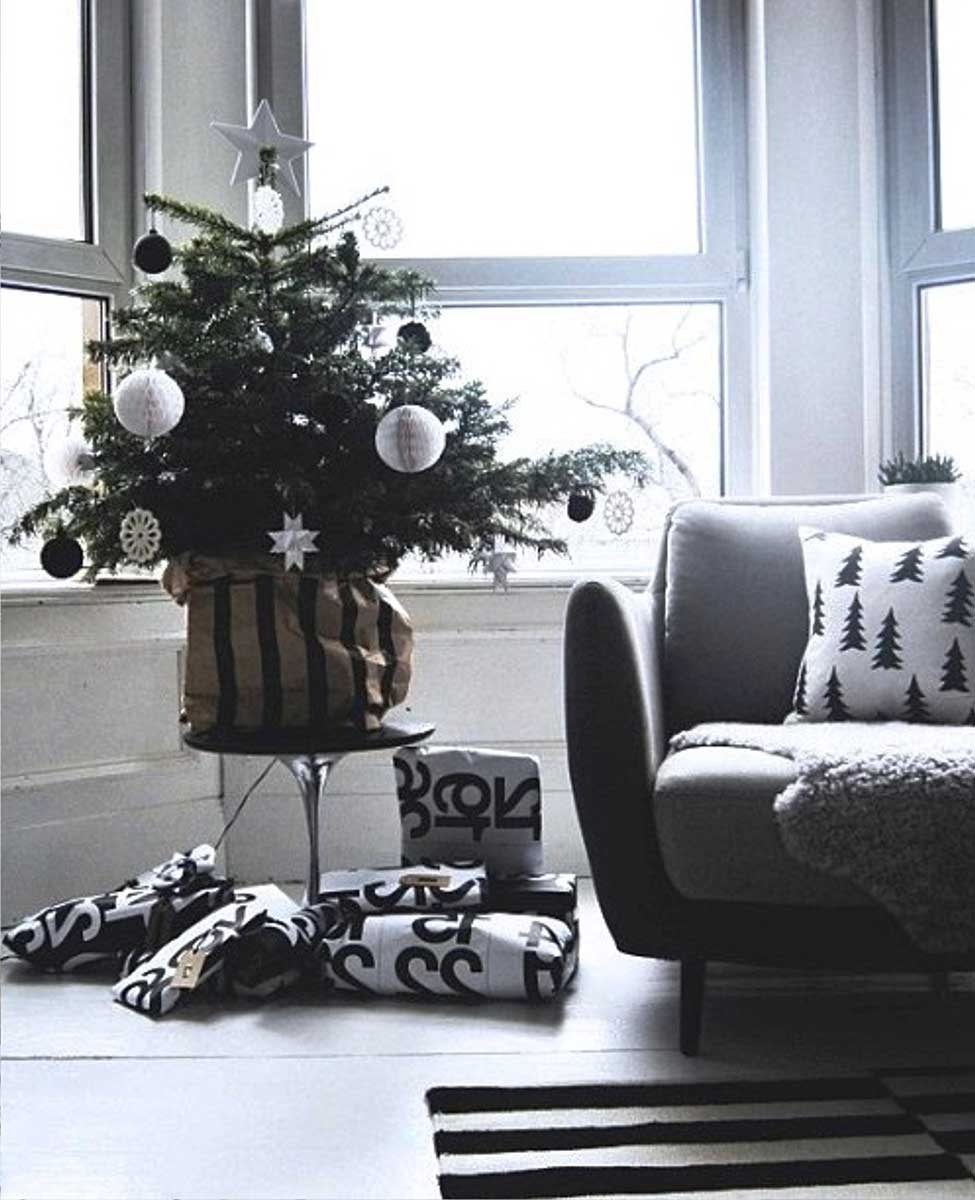
The whole corner is doable for under $100. A 24-inch tabletop tree runs $18 to $35, and a striped gift bag costs $2 to $4 and hides a cheap plastic pot completely. Wrap gifts in dollar-store black-and-white paper and reuse last year’s boxes. The pedestal side table can be a thrifted plant stand, and the pine-print pillow is a $6 cover over an existing insert. Facebook Marketplace and thrift stores are full of grey armchairs this time of year because everyone is making room for a new sofa.
25. Matte Black Tree Figurines and a Feather Tree on a Round Table
Dried pampas in a glass vase is the quiet risk here. It sheds, it collects dust because you can’t really wipe it, and it fades from cream to beige within about 18 months in a sunny spot. Keep the vase out of direct sun and shake the plumes outdoors every few weeks. The candle is the other thing to think about: a black glass vessel looks striking but hides the wax level, so check it before lighting or you’ll end up with soot on a white tabletop. Feather trees shed too, and they’re nearly impossible to reassemble once the quills loosen.
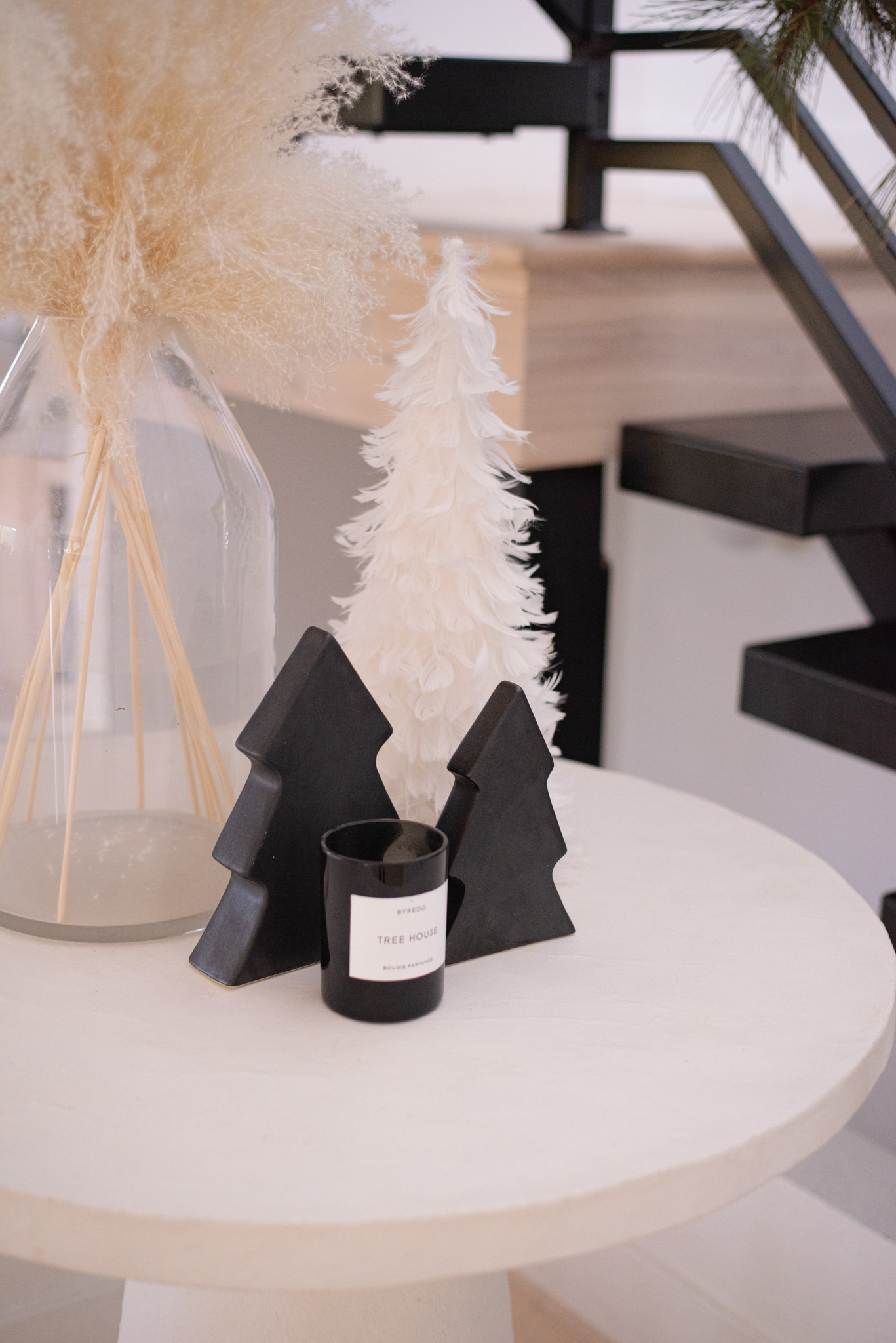
The fluffy white feather tree is what makes this display work, and it’s the piece most people would leave out. Without it, the arrangement is black objects on a white surface — graphic, but a little severe. That single soft, pale, textured element gives the eye somewhere to rest and makes the matte black figurines read as deliberate contrast instead of a theme. It’s also a scale bridge: the figurines are small solid shapes, the pampas is tall and airy, and the feather tree sits between them in both size and texture.
26. Keeping a Black and White Holiday Scheme From Going Flat
Editing an all-monochrome scheme takes an hour and costs nothing.
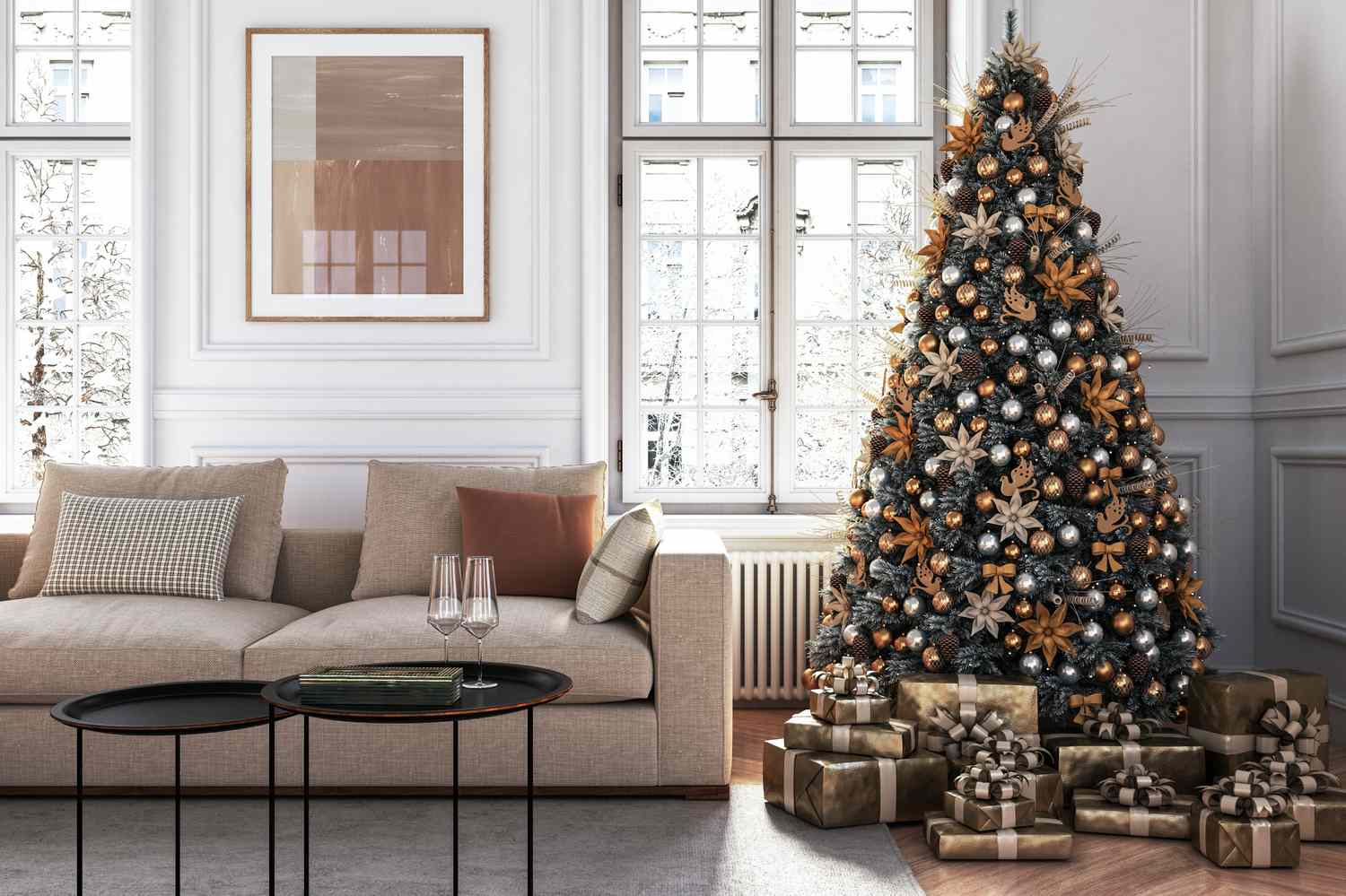
- Photograph the finished room and view it in black and white — anything that collapses into one grey mass needs texture, not color.
- Count materials, not objects. Aim for four distinct surfaces: matte, gloss, soft textile, and one raw natural.
- Pick a single warm element — wood, brass, kraft paper, amber light — and let it be the only warm thing you can see.
- Remove any object you can’t name a reason for. Monochrome schemes punish clutter twice as hard as colorful ones.
- Re-check the room at night with the lights on; flatness always shows up there first.
Monochrome works in almost any footprint, but contrast scale changes with the room. Under 120 square feet, keep black to accents only — ornaments, frames, one throw — because large dark surfaces compress a small space further. Between 150 and 350 square feet you can carry one full black anchor piece, like a tree or a large sofa. Above 400 square feet, single accents disappear; that’s when you need the layered, multi-surface approach with garlands, several lit trees, and dark architectural details to hold the eye.
27. Buffalo Check Plates on Gold Glitter Chargers
Buffalo check is a large-scale pattern, so it fights small plates. Keep the check on a salad or dessert plate rather than the dinner plate — that way it reads as an accent stacked on the gold charger instead of competing with it. Stack order matters too: charger flat, dinner plate, check plate, then a black napkin tied with gold cord resting on top. For the centerpiece, stay with whites and greens only; the moment you add a red flower, the buffalo check stops looking modern.
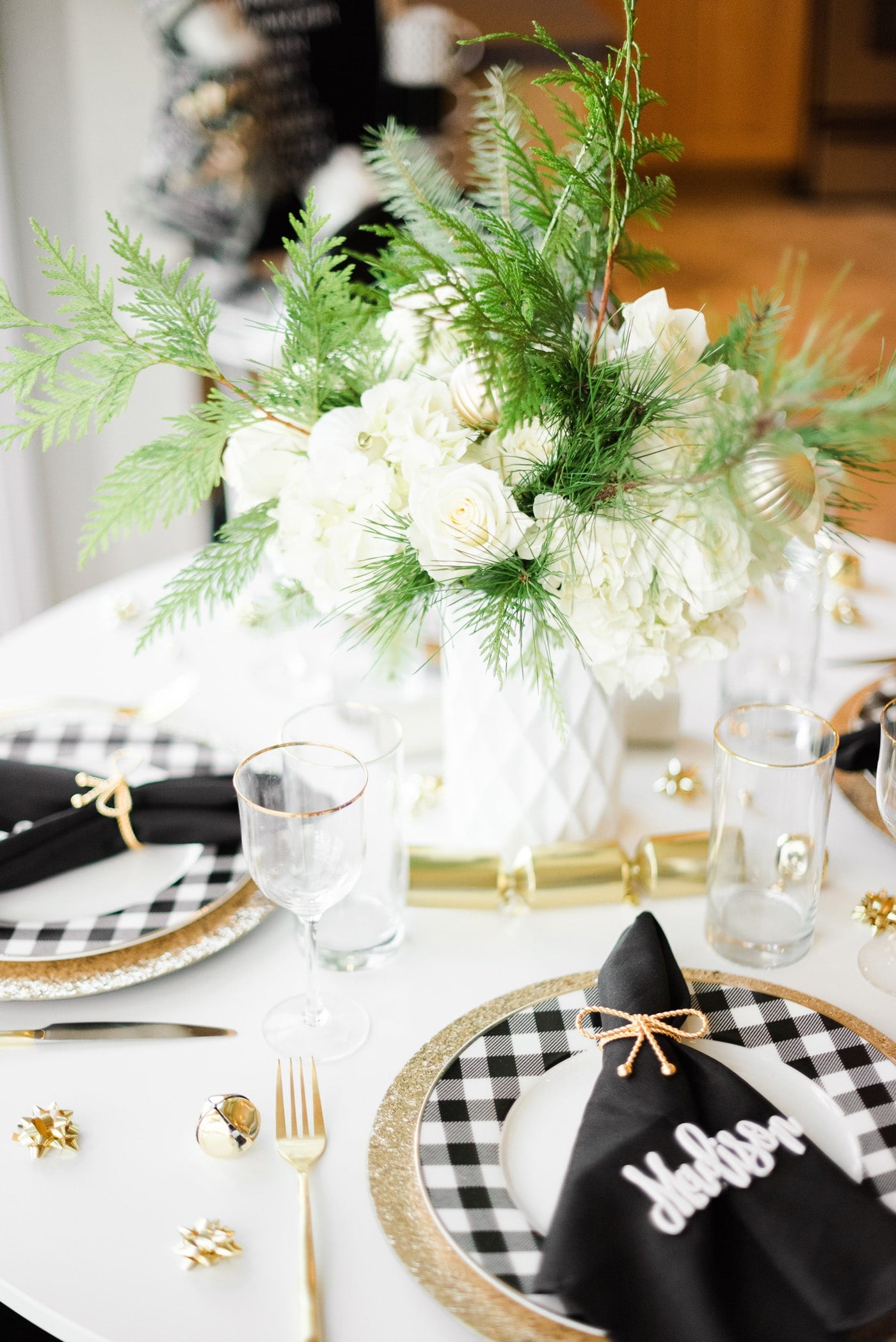
This table runs 55% black-and-white pattern and solid, 30% gold, and 15% green — a much heavier gold ratio than most monochrome tables carry. It works because the gold is matte-to-glitter rather than mirrored: the chargers scatter light instead of reflecting it, which is why the table reads warm rather than flashy. To change the mood, drop gold to 10% with plain white chargers and keep the check; you’ll get a sharper, more Scandinavian table with the same plates. Keep green under 20% or it becomes a garden.
28. Black Taper Candles and Simple Stockings on a White Mantel
- Measure mantel depth — you need at least 8 inches for tapers to sit safely back from the edge.
- Find the nearest outlet if you’re adding lit greenery; cordless battery strands solve most mantels.
- Confirm the fireplace is decorative or unused before styling directly above an active firebox.
- Count your stockings first and space hangers evenly before buying greenery to fill gaps.
- Test candle color against the wall in daylight — matte black tapers read grey on warm white walls.
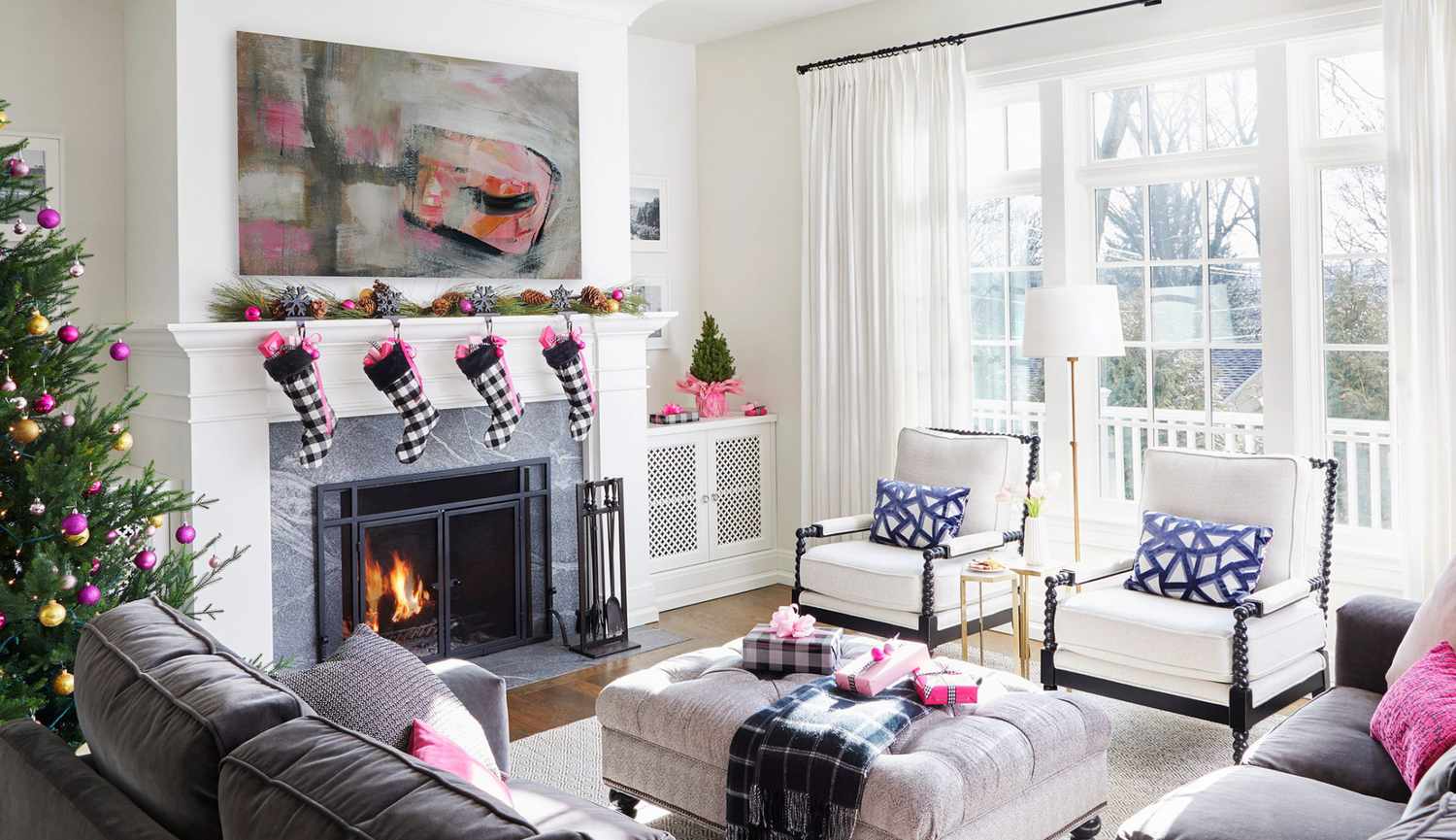
Everything here is subtraction. The white mantel does the visual work that garland and picks usually do, and the black tapers give you two strong vertical lines the eye follows up into the wall. With no color to manage, the only variables left are height and spacing, which is exactly why the composition feels calm. Understated greenery at the ends, rather than a swagged garland across the front, keeps the mantel line crisp and lets the candles stay the star — for the deliberately off-balance version of this, see Idea #10.
29. Matte Black Gift Boxes With Striped Ribbon and Pine Sprigs
Gift styling scales differently than room styling. Work in threes: three sizes, three heights, and no more than two ribbon widths. Boxes under 4 inches look like filler — better to use them as risers under a larger box than to feature them. If you’re styling a hearth or console, group 5 to 9 boxes across about 3 feet; beyond that it starts looking like a stockroom. Tilt two of the boxes slightly off-square at the end of the arrangement so the lineup reads as styled rather than shipped.
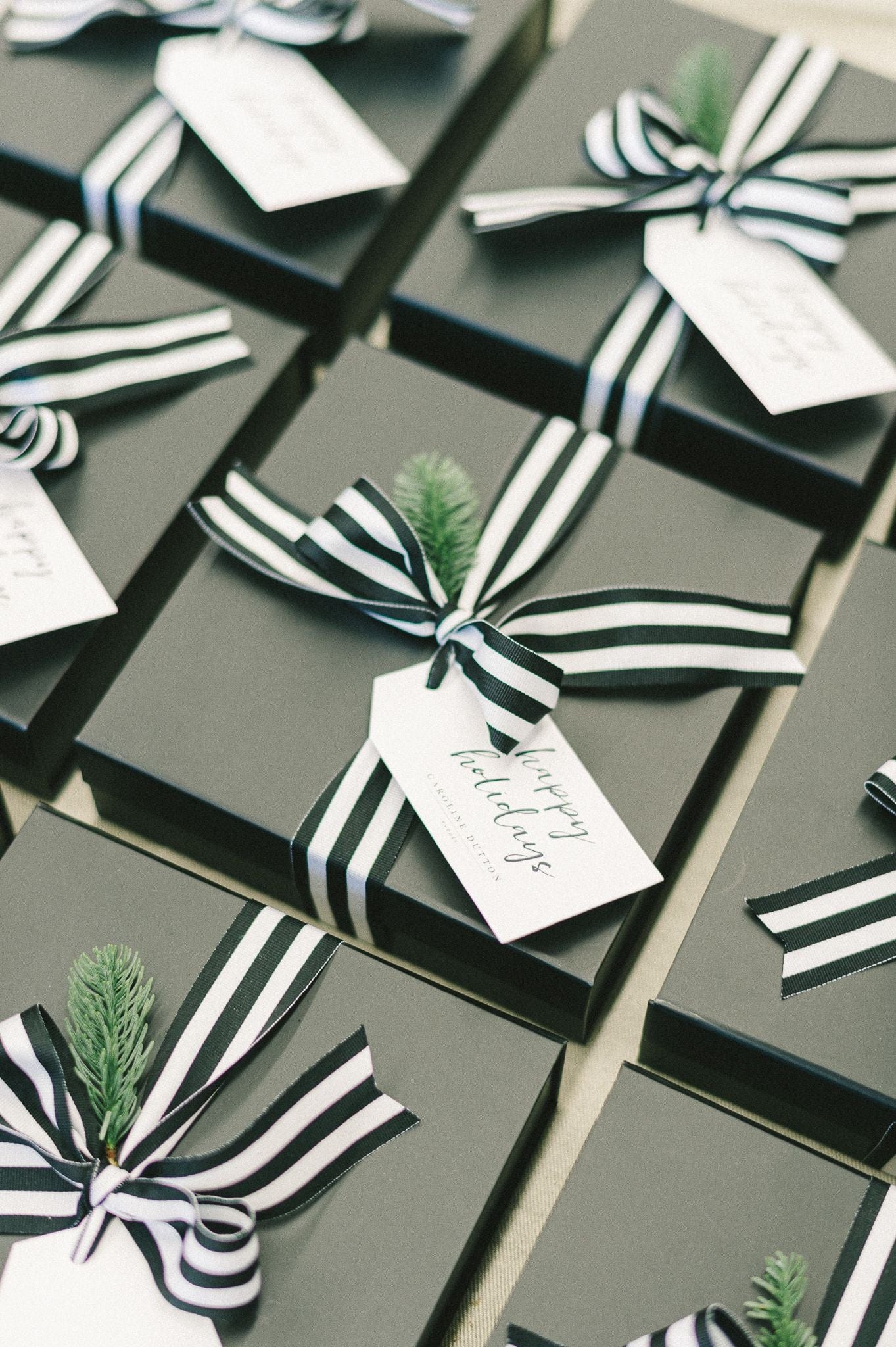
Matte black boxes are the easiest thing to fake: buy plain kraft or white boxes and wrap the lids in matte black paper, or hit the lids with a $6 can of matte black spray paint — it sticks to cardboard fine and dries in 20 minutes. Striped ribbon is a $5 spool at most craft stores, and pine sprigs are free if you trim a few lower branches off your own tree. White tags and a fine-tip marker replace custom calligraphy, and handwriting looks better here anyway. It’s the same idea as Idea #17 at a third of the cost.
30. Lit Trees and Garland Behind a Dark Balustrade
Layered, multi-tree holiday scenes take a full day to install and about two hours to take down — assuming you labeled the boxes last year. The real considerations are heat and dust. Warm string lights run hot enough that garlands pressed against upholstery or drapes become a genuine risk, so keep a finger-width gap and use LED strands only. Tiled floors and dark metal railings show every speck, so plan a mid-season wipe-down. With pets or toddlers, the classical pedestal and the small lit trees in the foreground will be tested daily.
Building the layered look takes about four hours, working bottom-up.
- Start with the largest lit tree at the back, behind the balustrade, so it reads as depth rather than decoration.
- Run the garland along the railing next, securing it every 12 inches with green florist wire rather than hooks.
- Add the small lit trees in the foreground in odd numbers — three or five, in varied heights.
- Style the pedestal and mantel last, and keep both to three objects each.
- Do a walkthrough from the doorway and remove anything blocking sightlines to the back tree.
And if you’d rather have the opposite — one unadorned statement tree instead of a layered scene — start with Idea #23.
Hang Something Black, Then Step Back
You don’t need a theme, a matching set, or a single thing from a holiday aisle — you need one strong black shape, one crisp white surface, and enough nerve to leave the rest alone. Start with whichever idea here matches the room you actually have, and let the rest wait until next year.
📌 Pin your favorite look now so it’s waiting for you when the boxes come down from the attic.