Velvet ornaments are having a major moment on Pinterest right now, and once you see the texture up close against pine and warm bulbs, you will understand exactly why we spent serious time browsing Anthropologie, Target, Etsy, Amazon, and Hobby Lobby to bring you only what is worth your attention this year, across price points from about $12 to $450.
Inside you will find 30 curated velvet tree ideas, spanning traditional burgundy and deep red statements, moody slate blue and black ribbon work, oversized velvet bow toppers, and colorful eclectic trees. Budget and luxury versions sit side by side, with shoppable links for the pieces that matter most.
2026 is the year decorating moved toward warm 2700K light and one big gesture instead of forty small ones, and velvet is the material that shows off both. And stay until the end — we break down the most common mistakes that can ruin these looks.
📌 Save this to Pinterest for later — you’ll want to revisit these ideas.
1. A Burgundy Velvet Ball With Hand-Beaded White Flowers
Take away everything else on the tree and this single ornament still reads as intentional. That is the test. The white seed-bead floral work on the burgundy velvet is what does it, because those beaded rows sit matte and raised while the velvet underneath swallows light instead of bouncing it. Strip the beading off and you have a lovely velvet ball that looks like every other velvet ball at the craft store. The gold cap and the dangling burgundy tassel just finish the sentence.
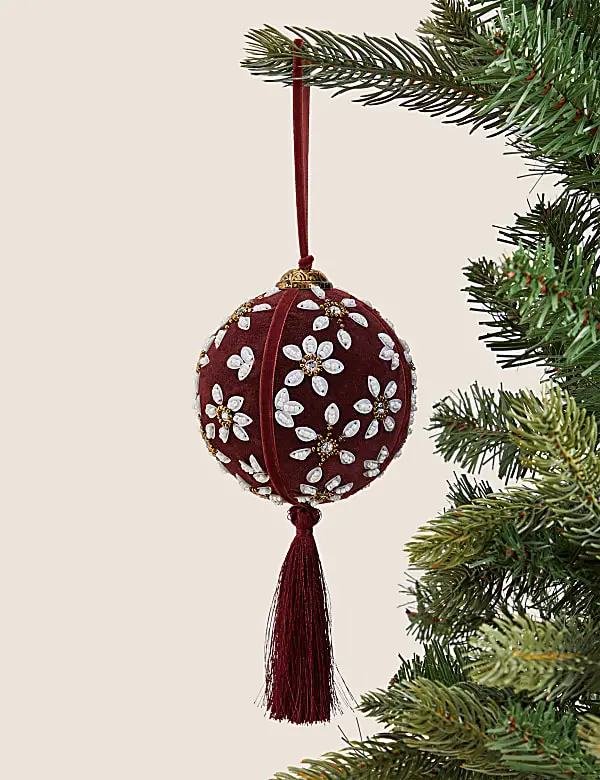
Here is the practical part people forget. A four-inch ornament with beading and a tassel can weigh 60 to 90 grams, while a plain velvet ball of the same size runs about 25. Hang the heavy ones within 8 to 10 inches of the trunk, where the stems are thickest, and save the lighter balls for the outer tips. Otherwise you will find the whole branch drooping toward the floor by December 20th.
2. Ribbed Red Velvet Ornaments on a Flocked Tree
- Find a shallow box 3 to 4 inches deep so ornaments never stack more than two high.
- Line the bottom with acid-free tissue, not paper towels, which shed lint into velvet pile.
- Wrap each ornament loosely and leave the cap exposed so you can see the color at a glance.
- Fill the gaps with crumpled tissue so nothing shifts when the box gets lifted.
- Write the finish on the lid: ribbed, flocked, or smooth. Next November you will thank yourself.
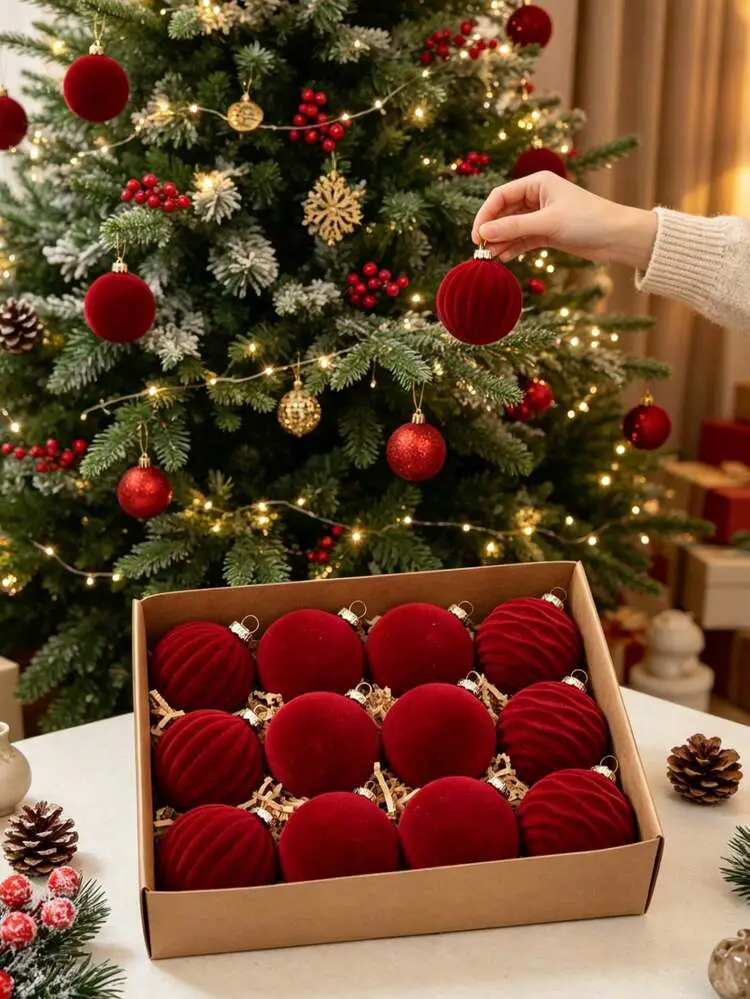
Tissue runs about $6 and a stack of shallow boxes $8 to $12. Skip plastic bins entirely for anything with a tassel, because the weight presses the pile flat and it never comes back.
Flocked trees deserve their own warning here. That snowy coating sheds every time you move a branch, and velvet grabs it, so the ribbed grooves in deep red ornaments collect white fuzz like a sweater collects cat hair. Nothing is ruined, but you will be picking flocking out with tweezers if they share a bin. Keep a lint roller inside the ornament box.
3. Light Blue Velvet Bows Against Dark Paneling
The formula on this tree is roughly 70 percent deep green pine, 20 percent light blue velvet, and 10 percent warm gold light. The bows are tied directly onto branches instead of strung along a ribbon, which keeps the blue from reading as one continuous stripe and lets it break up against the dark wainscoting behind. Swap the light blue for dusty rose and the same math holds. Swap it for black and the tree turns moody instead of serene — identical equation, completely different answer.
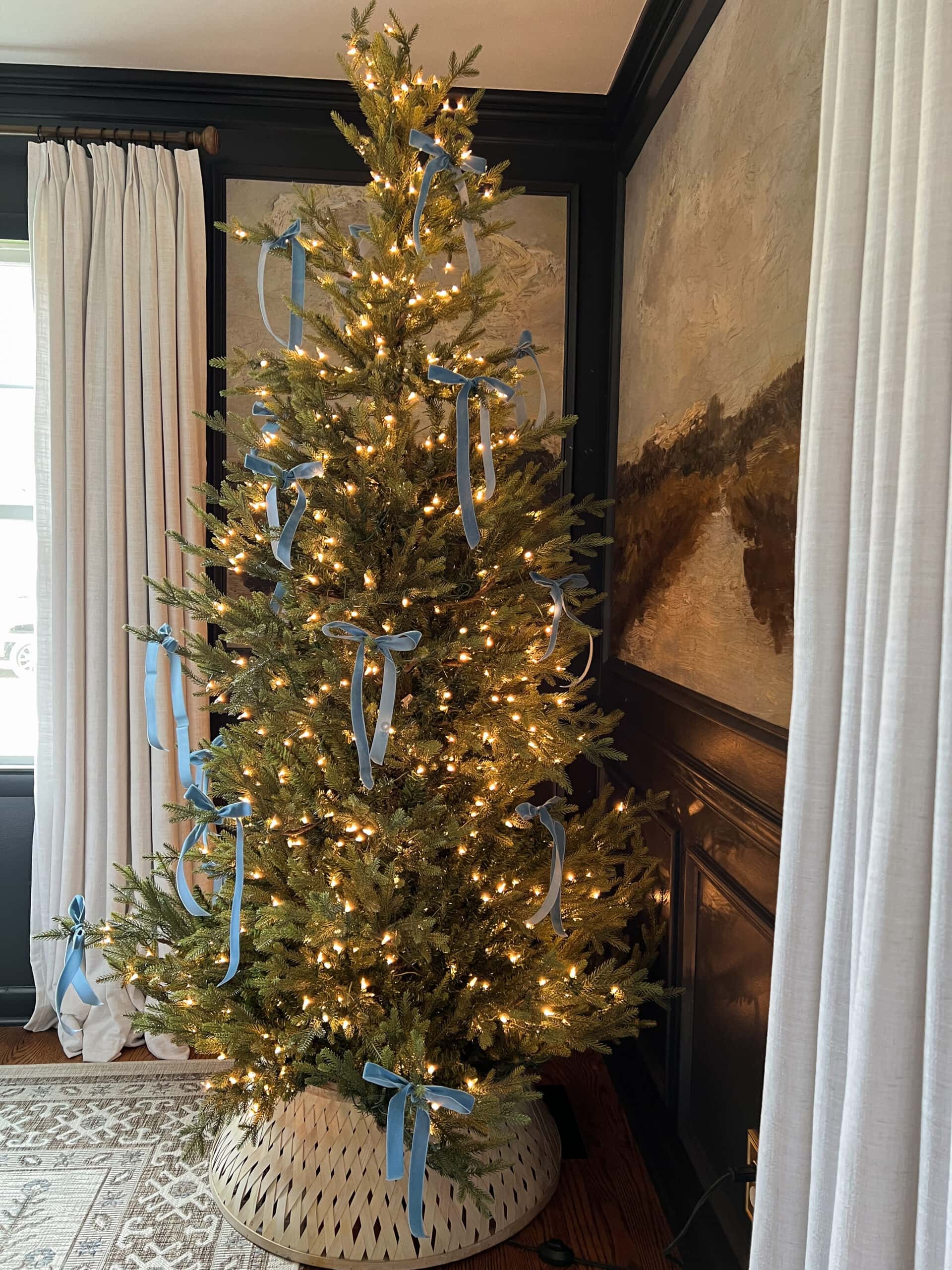
Pale blue velvet is a cool color sitting right next to warm 2700K bulbs, and that friction is the entire reason it works. The tree glows amber while the bows stay icy. Add the woven basket collar at the base and you get a third texture — rough, dry, matte — pressed against all that soft pile. The impressionist painting and off-white curtains are not filler. They are the quiet backdrop that stops the blue from fighting the paneling.
4. Burgundy Velvet Bow Topper With Plum and Pink Baubles
The star topper has been losing ground for a few seasons now, and velvet bows are the reason. A twelve-inch bow made from two yards of velvet costs less than a decent lit star, packs flat in a drawer, and reads as handmade rather than manufactured. This tree pairs it with shiny pink and faceted plum baubles and one striped matte sphere, which is a very 2026 move: one large soft gesture up top, then a scattering of smaller shiny pieces to carry the eye down.
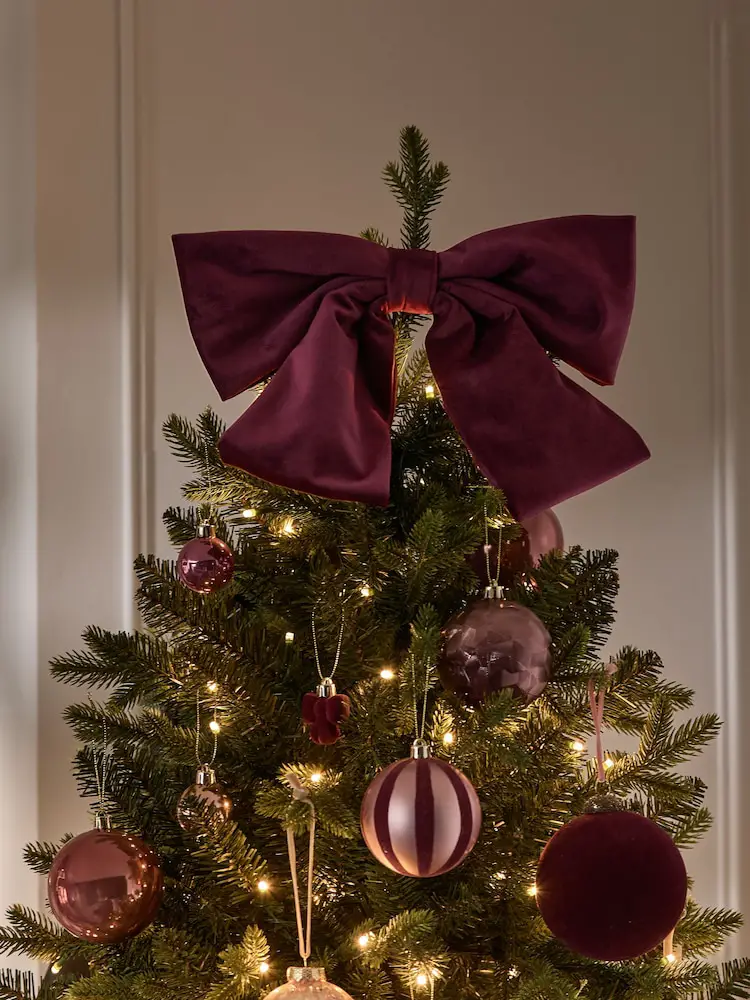
Topper geometry matters more than people expect. A bow needs to span roughly one-eighth to one-sixth of the tree’s height to look deliberate. On a 7.5-foot tree that means loops about 14 to 16 inches across, with tails long enough to brush the top third of the branches. Anything smaller reads like a leftover ornament you stuck up there. Tuck the bow’s chenille stem around the topmost leader branch, not a side branch, and it will stand upright all season.
5. Brown Velvet Ribbon Bows and Gold Bead Garland
Everything on this tree lives somewhere between chocolate and champagne, and that narrow range is doing more work than any individual ornament. Deep brown velvet bows, flocked and matte brown spheres, bronze glass baubles, gold bead garland strands — four completely different surfaces, one color family. Your eye reads it as calm and expensive. The shine levels handle the rest: velvet goes flat, glass goes sharp, beads go sparkly, and the etched ornaments add quiet pattern.
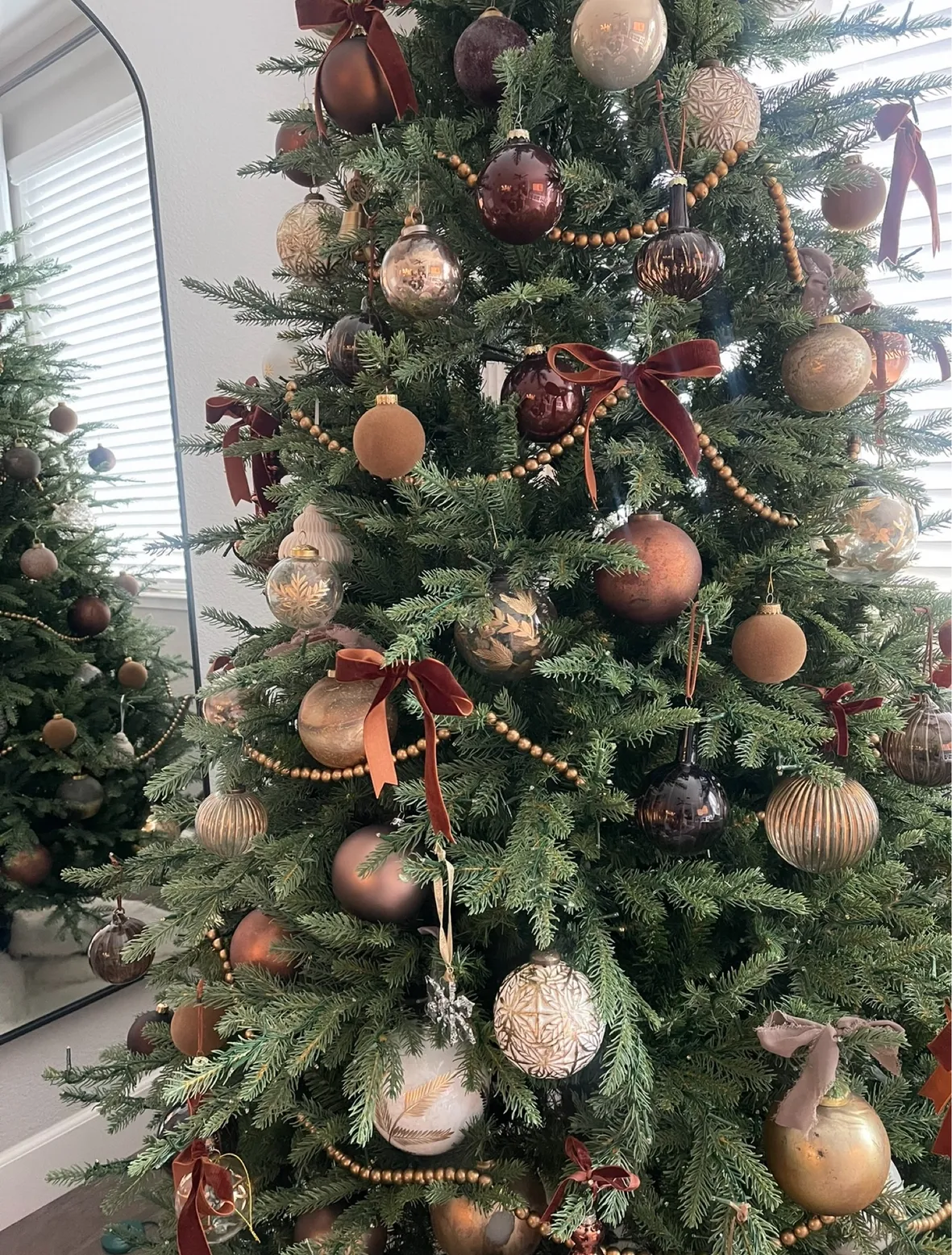
This one wants a light wall behind it and a little ceiling height. A tonal tree like this needs at least nine-foot ceilings and a room around 12 by 14 feet to breathe; in a darker, smaller space the browns go muddy and the whole thing looks like a shadow. In a tighter room, consider Idea #20, where a single slate blue ribbon replaces the entire tonal mix and keeps the visual weight down. Bigger rooms can carry the bead garland. Small ones should skip it.
6. Red Velvet Ornaments Piled on a Cake Stand
- Red velvet ornaments, mixed ribbed and smooth: $25-$60 for twelve
- White cake stand with a black base: $15-$30
- Frosted miniature tree with warm lights: $25-$50
- Extra gold ornament caps and string: $5-$10
- Pinecones, natural or lightly gilded: free to $12
- Total: $70 to $162
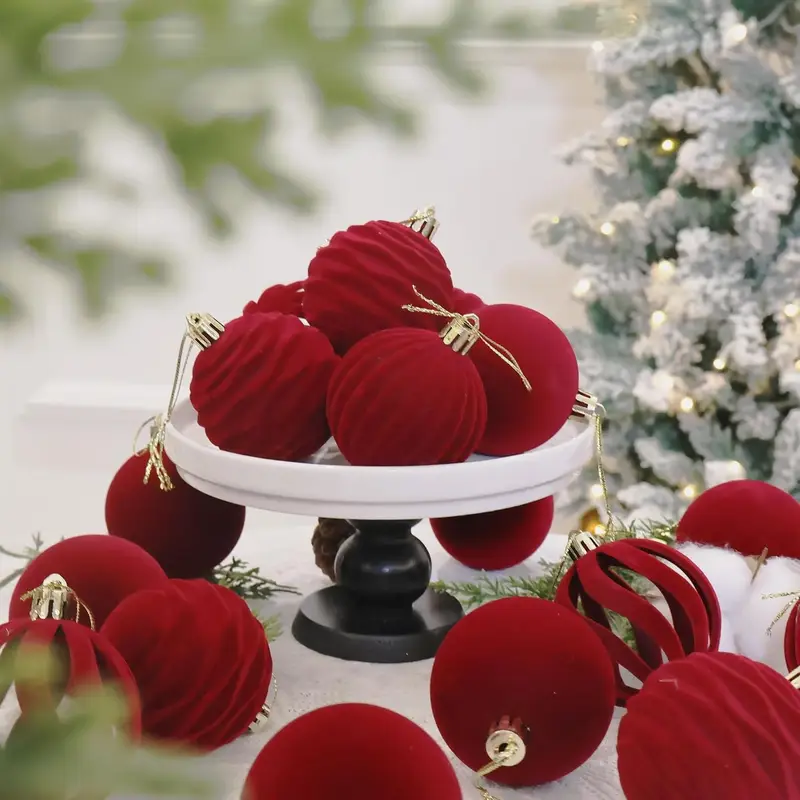
Budget alternative: hit a dollar store for smooth red velvet balls at $1.25 each, thrift the cake stand for $4, and use a tabletop tree you already own. Under $25 gets you the same still-life look on a sideboard.
The cake stand is the quiet hero of this setup. Velvet ornaments piled straight onto a table look like clutter; the same ornaments on a white pedestal with a black base look curated. Raising them five or six inches puts the arrangement at eye level when you walk past, and the pedestal’s height separates all that red from the wood grain underneath. If you already own one pedestal, use it. Do not buy a shelf for this.
7. A Spiral of Muted Blue Ribbon on a Warm-Lit Tree
Ribbon garlands eat far more yardage than anyone estimates. For a 4-inch-wide ribbon spiraled around a 7.5-foot tree with roughly 18 inches between passes, plan on 20 to 24 yards, or about 2.5 to 3 times the tree’s height. Add 10 percent for mistakes and one extra pass at the bottom where everyone can see it. Wire-edged velvet holds a curve. Unwired velvet sags into a sad parabola by week two, which is exactly the problem in half the photos you have saved.
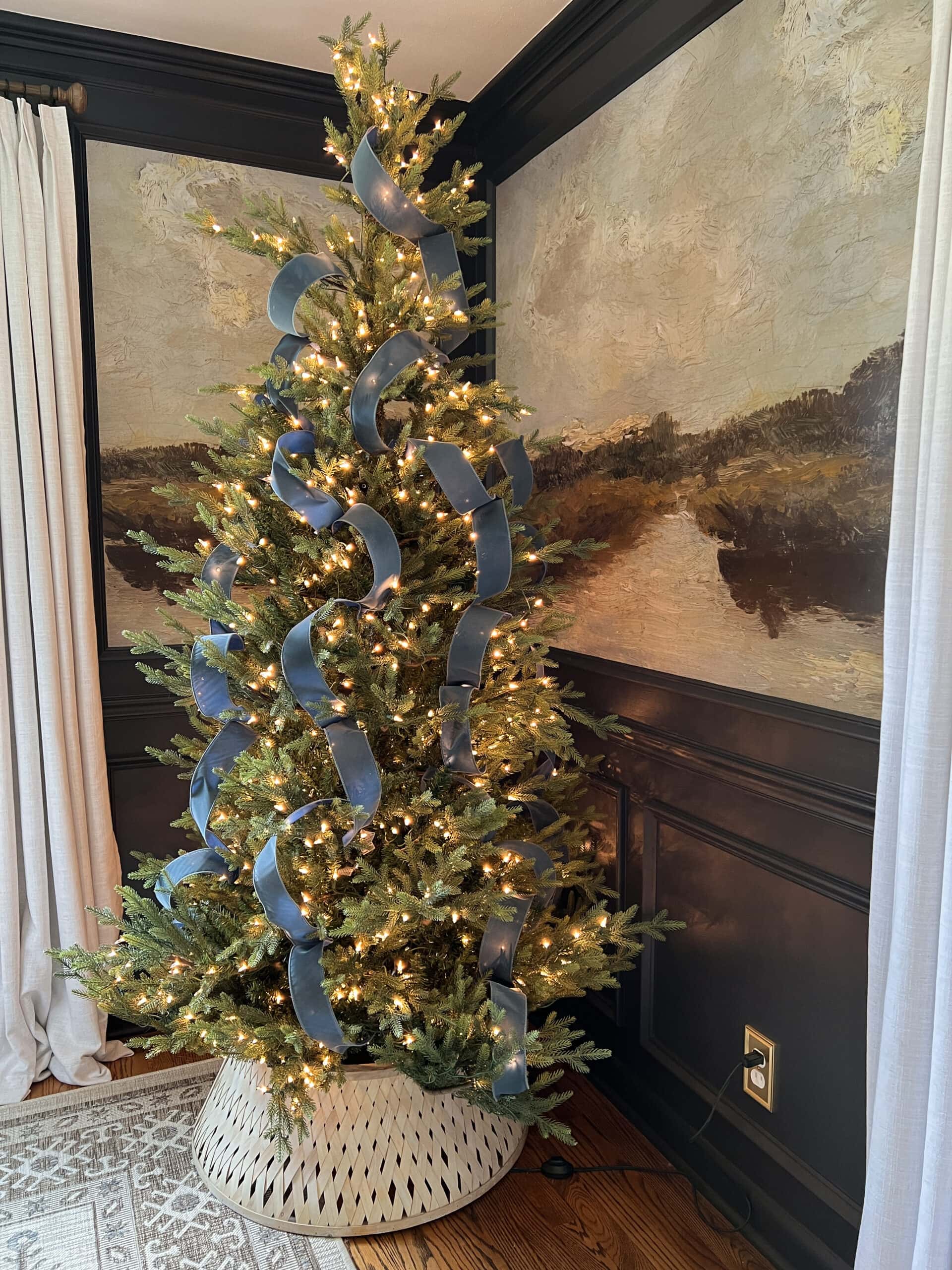
A mural, dark wainscoting, wide ribbon, and warm lights in one frame is a lot of competition for the eye. The muted blue works here only because the wallpaper is a soft, low-contrast landscape rather than a bold print. If your walls are patterned and busy, scale the ribbon down to two inches or skip it entirely and let ornaments carry the tree. The room is the backdrop, not the tree’s rival.
8. One Oversized Brown Velvet Bow, Nothing Else on Top
The math here is almost aggressively simple: 80 percent green pine, 15 percent brown velvet, 5 percent warm white light. That is it. No color story, no metallic, no garland, no ornament theme. The trick is that the brown velvet is enormous relative to everything else, so scale replaces variety. If you want to shift the formula, go to deep rust or forest green velvet and the proportions still work — just keep the bow oversized, or the tree reads bare and unfinished.
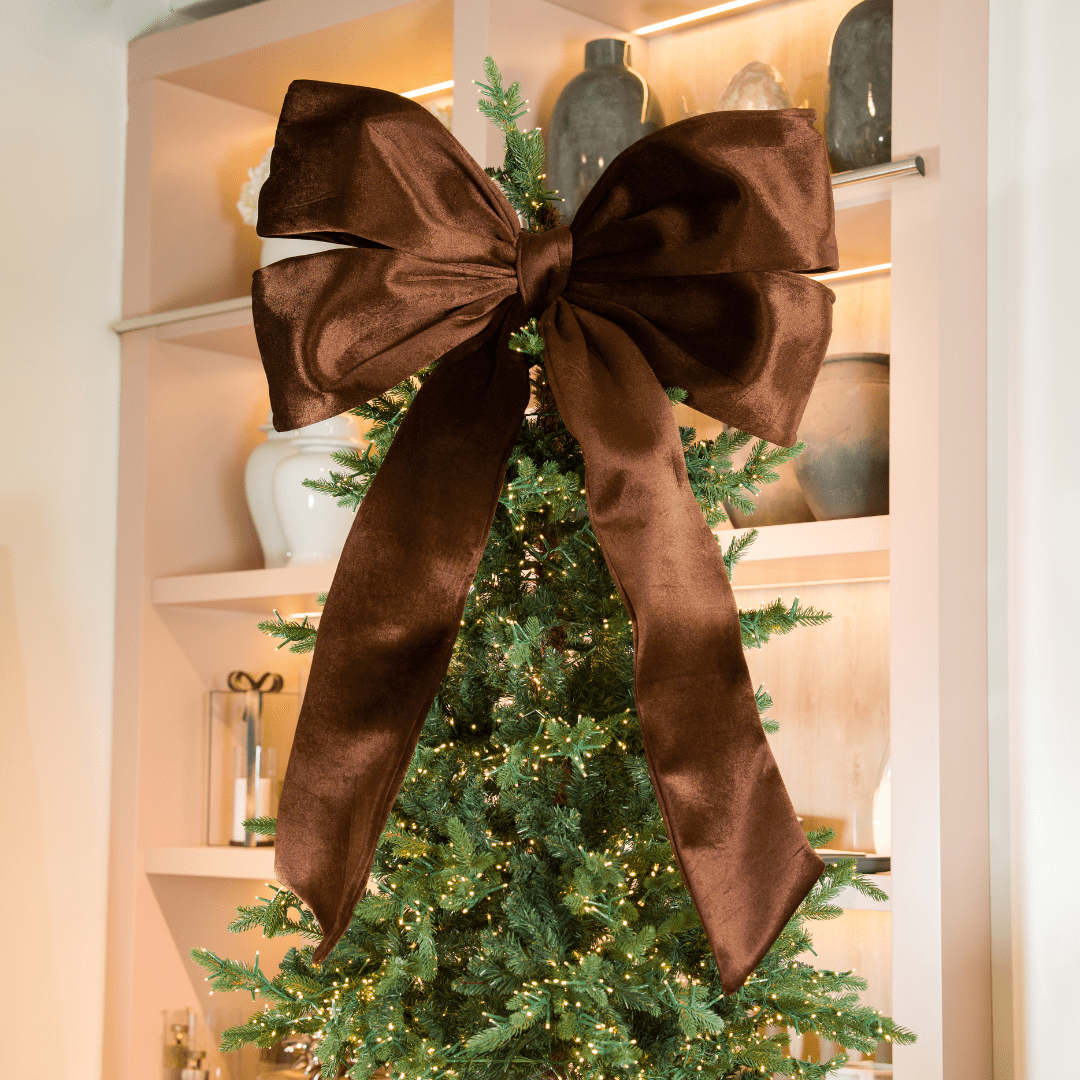
A 16-inch velvet bow from a decor retailer runs $60 to $120. Two yards of velvet from a fabric store or a Marketplace remnant costs $12 to $25, and a bow this size takes about 20 minutes, a hot glue gun, and a little patience with the loops. Facebook Marketplace is worth checking in November, since people sell unopened velvet yardage constantly. For the same big-bow idea with a different silhouette, compare Idea #18, where the bow gets three-foot trailing tails.
9. Eclectic Ribbon-Tied Tree in a Dark Wood Library
Decorating a tree so it belongs to the bookcase instead of fighting it is the 2026 version of maximalism. Rather than a color scheme, this tree borrows the room’s palette — dark wood, neutral ceramics, warm light — and then adds color through loosely hanging velvet and satin ribbons tied to individual ornaments. That is a small technical shift with a big effect: it looks collected over years instead of bought in one afternoon.
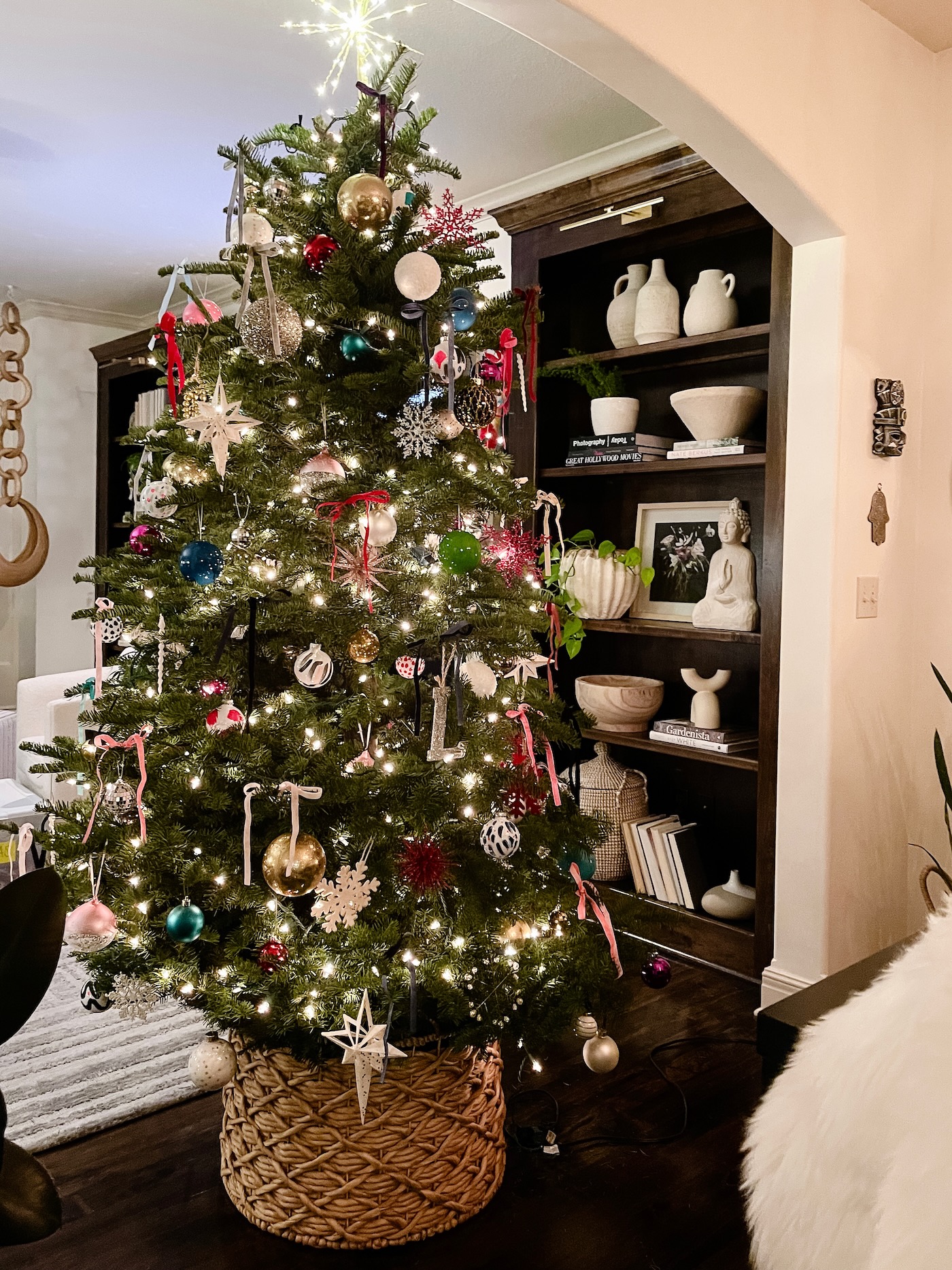
This approach wants a room that can hold a full tree and a wall of built-ins at the same time. Figure a 12-by-16-foot space at minimum, with the tree roughly one-third the height of the shelving unit. If your built-ins top out around 7 feet, keep the tree at 6.5 and let the ribbon tails hang below the top shelf line so the two elements read as a single composition. In a smaller room, look at Idea #3, where a woven basket collar keeps everything contained.
10. Burgundy Velvet and Mercury Glass on a Rustic Table
Look at the surfaces on that wooden table: matte velvet, mercury glass, and a real pinecone. Three finishes, three completely different ways of handling light. Matte absorbs it, mercury glass scatters it, and the pinecone stays flat and dry. That trio is why the arrangement looks expensive even though most of it came from a craft aisle on a Tuesday afternoon. Anything all-glass goes glittery. Anything all-velvet goes heavy and dull.
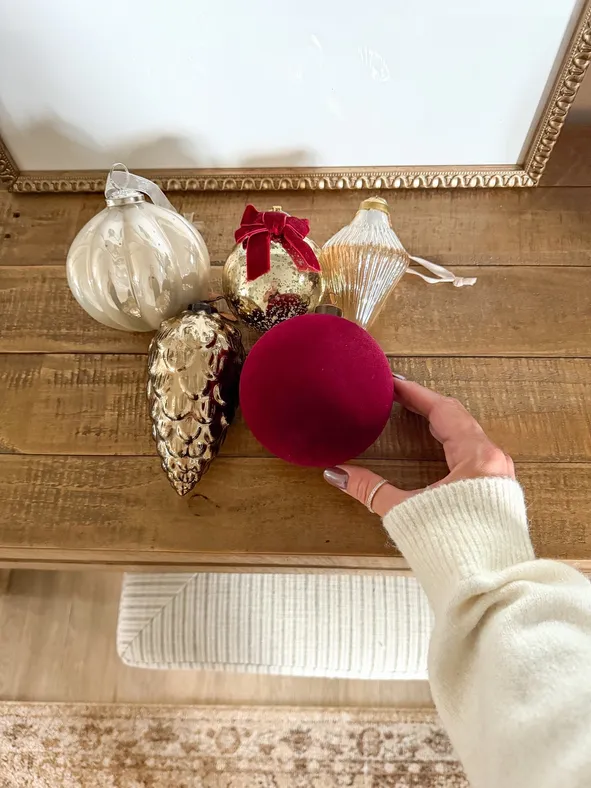
Use a simple ratio when you are pulling ornaments out of storage. For every five ornaments on the tree, aim for three matte (velvet, flocked, painted), one reflective (glass, mercury, mirror), and one natural or textured (pinecone, wood, fabric). That math keeps a tree from turning into a shiny red ball pit, and it works whether your palette is burgundy, brown, or pale blue.
11. Red Velvet Balls With Gold String Grid Stars
- Start with a plain red velvet ball and a spool of 3-millimeter gold cord.
- Tie one end at the cap, then wrap eight vertical passes and eight horizontal passes into a grid.
- Secure each intersection with a small dab of clear-drying craft glue.
- Glue a tiny star or bead at every crossing point.
- Let them dry flat overnight before hanging anywhere near the lights.
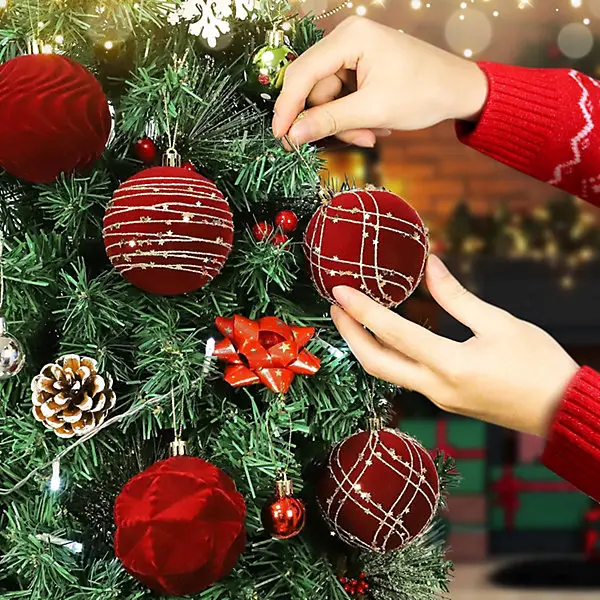
Roughly 15 minutes and $6 of cord per three ornaments. Buy the cord on a spool rather than precut so you can work in one continuous pass without tying off.
Velvet, flocking, and dust make up the maintenance triangle nobody warns you about. Velvet pile holds fine dust, and flocked trees shed. Once a season, run a vacuum hose with a brush attachment on the lowest setting about an inch above each ornament, never touching the fabric. Compressed storage flattens the pile permanently, so use loose tissue. Budget maybe 20 minutes a year for this.
12. Red Velvet and Rhinestone Jewel Ornament
Strip this ornament down and you get 85 percent red velvet, 10 percent gold trim, and 5 percent clear crystal. Those proportions matter more than the individual pieces. Once the metalwork creeps past roughly 15 percent, the velvet stops reading as velvet and you are left with a shiny bauble showing red through the gaps. The same formula in emerald with gold is gorgeous. Swap the gold for silver and the whole ornament goes cooler and more contemporary.
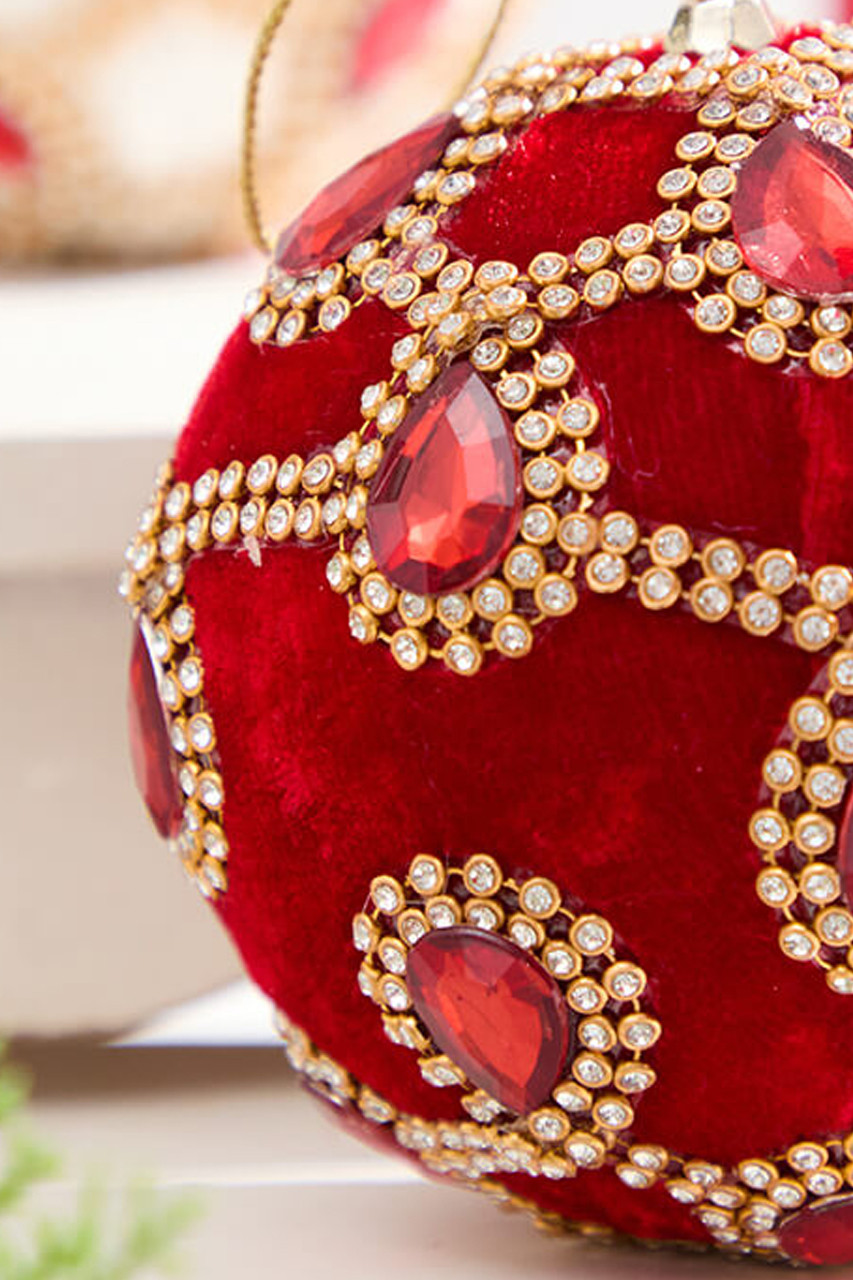
A jeweled ornament like this sells for $35 to $60 each, which is fine for one and painful for twelve. Plain velvet balls run about $10 for twelve at Walmart or Target, a tube of craft rhinestones is $4, and gold cord is $3. Ten minutes of careful gluing gets you a close cousin for around $18 total. Do a handful as statement pieces and leave the rest plain — that is how you get the effect of a fully jeweled tree without the invoice. The beading here does the same job as the floral seed beads in Idea #1: breaking up that matte surface with something that catches light.
13. Black Velvet Ribbons Over a Chunky Knit Tree Skirt
The chunky knit skirt with a white rug underneath is gorgeous and slightly impractical. A 100 percent acrylic knit is machine washable and shrugs off pine needles. A wool blend feels softer but wants hand washing and flat drying, or it stretches into a sad ellipse by January. If you have a dog that treats the skirt as a bed, buy acrylic and save yourself the heartbreak. Black velvet ribbons also show dust and pet hair clearly, so keep them above tail height.
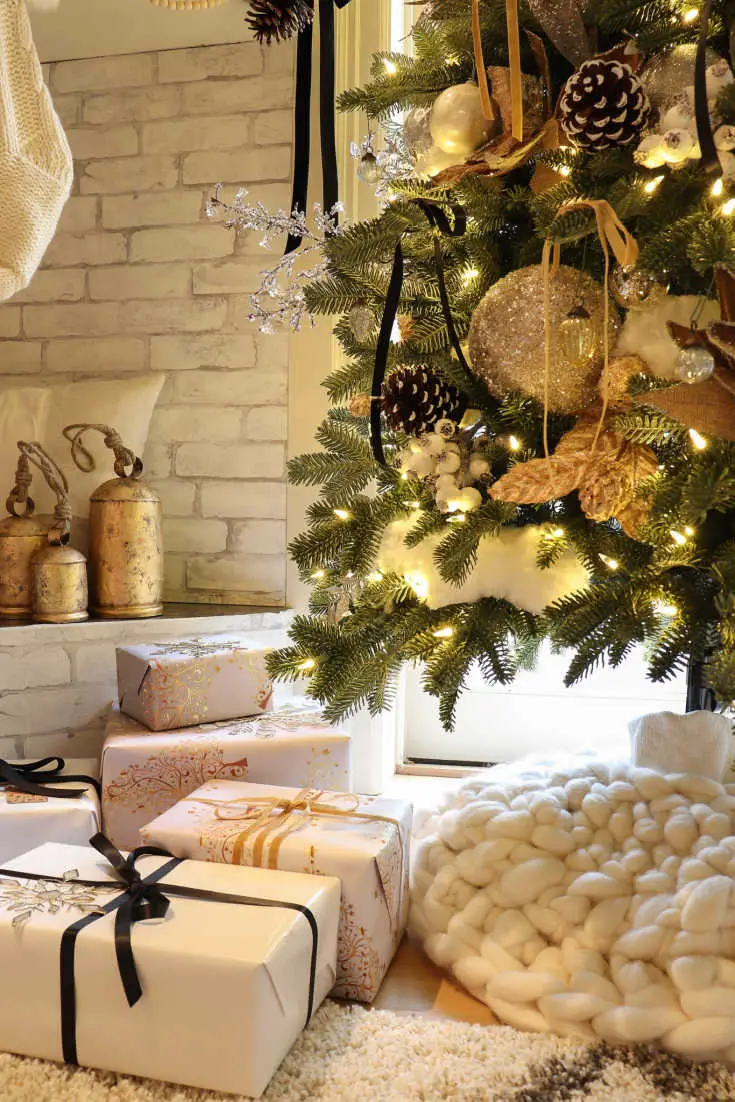
Skirt sizing is simple math: the skirt’s diameter should extend six to eight inches beyond the tree’s widest branch spread. A standard 48-inch skirt suits a 6- to 7.5-foot tree, and anything taller wants a 60-inch. For a flat white rug, leave about 18 inches of floor visible around the skirt so the white-on-white does not turn into one shapeless blob. Tighter floor space does better with the corner setup in Idea #27.
14. Layered Red Bows With Gold Trim and Twine
It is the twine hanger. Anyone can buy a red bow ornament. Showing the twine loop — rough, uneven, visibly knotted against the green — is what tells you a person made this, and that single detail softens the entire tree. Remove it and you get a polished but slightly anonymous decoration. Keep it and the tree feels lived in. If you are shopping rather than making, look for bows with visible natural twine instead of hidden wire loops.
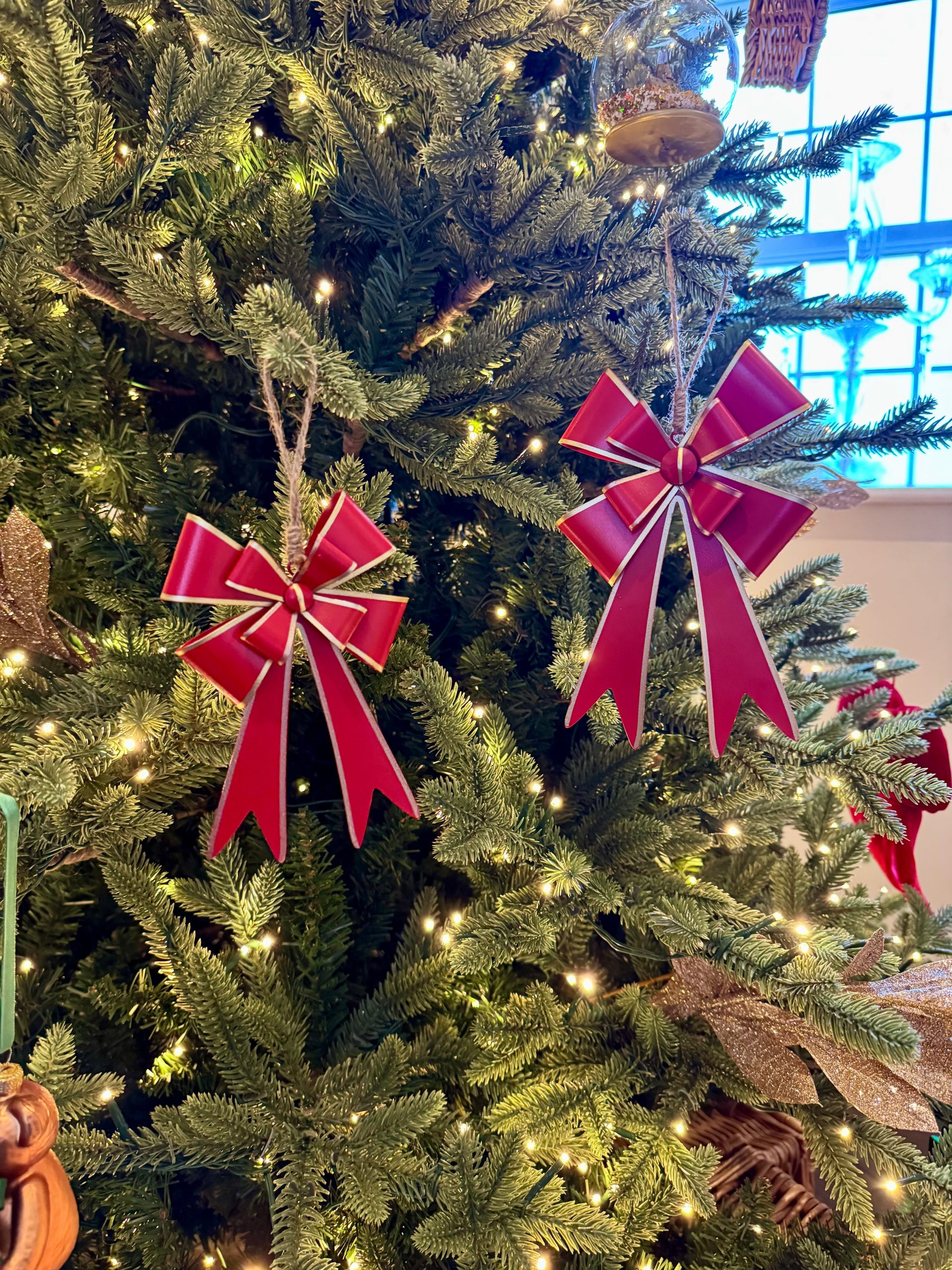
- Cut 2.5-inch-wide red velvet ribbon into a 20-inch length and a 1.5-inch gold-trimmed ribbon into 14 inches.
- Fold the red into two loops with 6-inch tails and pinch the center flat.
- Lay the narrower ribbon over the pinch and wrap it around the back twice.
- Secure with a twist of floral wire, then thread a 4-inch twine loop behind the wire.
- Fluff the loops outward rather than flat so they hold a rounded shape.
Ten minutes each and roughly $1.50 per bow in materials.
15. Ruby Velvet Bows in a Festival of Pink and Blue
Pink, blue, gold, white, red, and green should not work together, and this tree only pulls it off because it repeats shapes instead of colors. Round, round, round, with pastel ribbon ties breaking the pattern at regular intervals and a gold beaded peace sign thrown in for an hour of extra charm. The red velvet bows are the anchor. They give your eye somewhere to land every few feet, and without them the whole thing collapses into confetti.
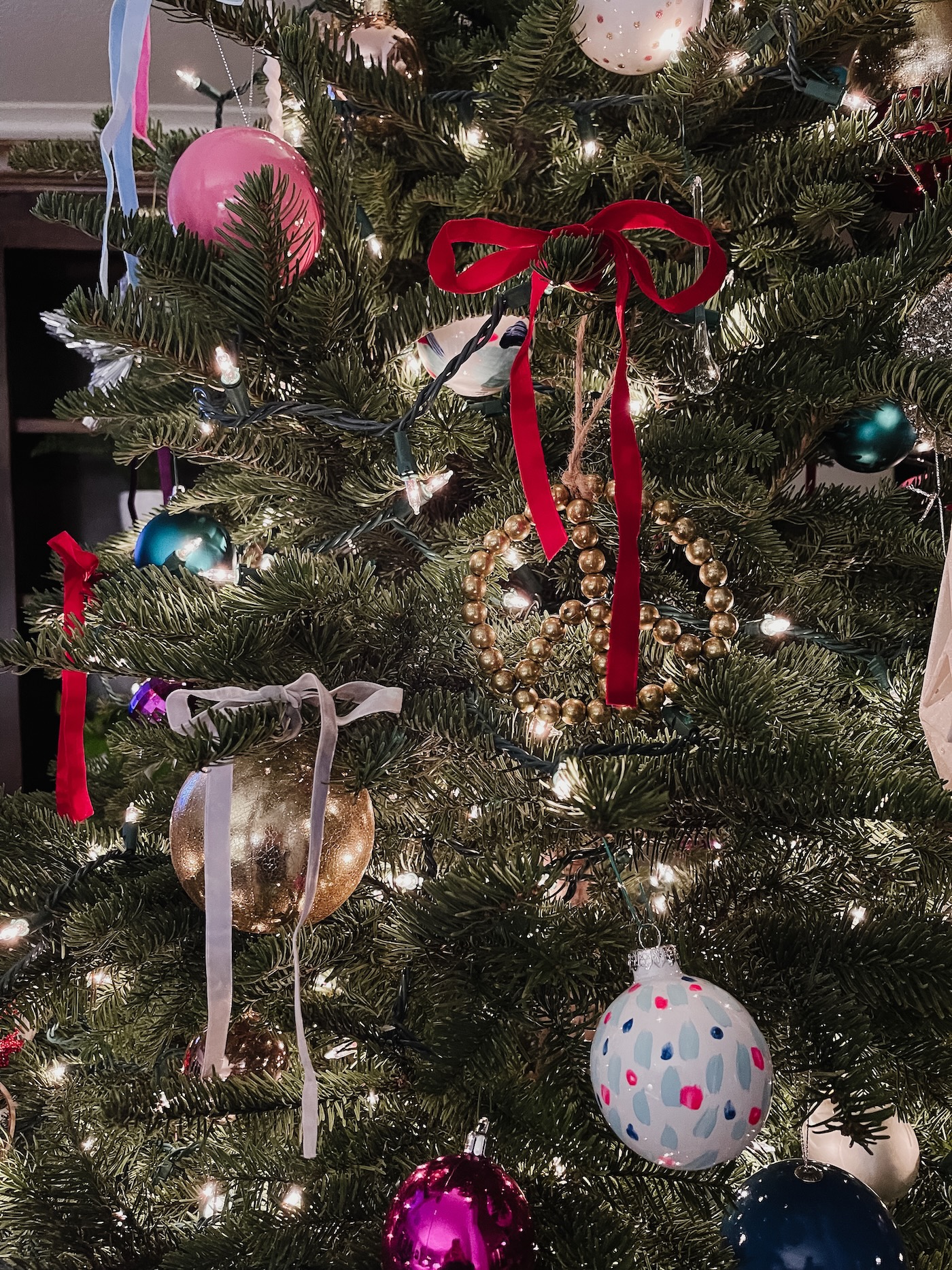
This look was practically made for thrift stores. A box of 30 mixed ornaments at Goodwill runs $5 to $12, and one coat of craft paint plus a glued ribbon turns a dated gold ball into something you would pay $8 for. Dollar Tree sells velvet ribbon spools for $1.25 that read surprisingly rich at arm’s length. Budget total for a full tree here: $40 to $70 instead of $300.
16. Red Velvet With Silver Sequin Chevrons
The breakdown is 70 percent red velvet, 20 percent silver sequin, and 10 percent green from the branches themselves. Cap your metallic at about a fifth of the ornament surface, because past that the sequins start bouncing the tree lights back and the whole ornament turns into a grey blur. Swap the silver for gold and you get a warmer, more traditional read. Swap for gunmetal and it goes modern without losing the chevron graphic.
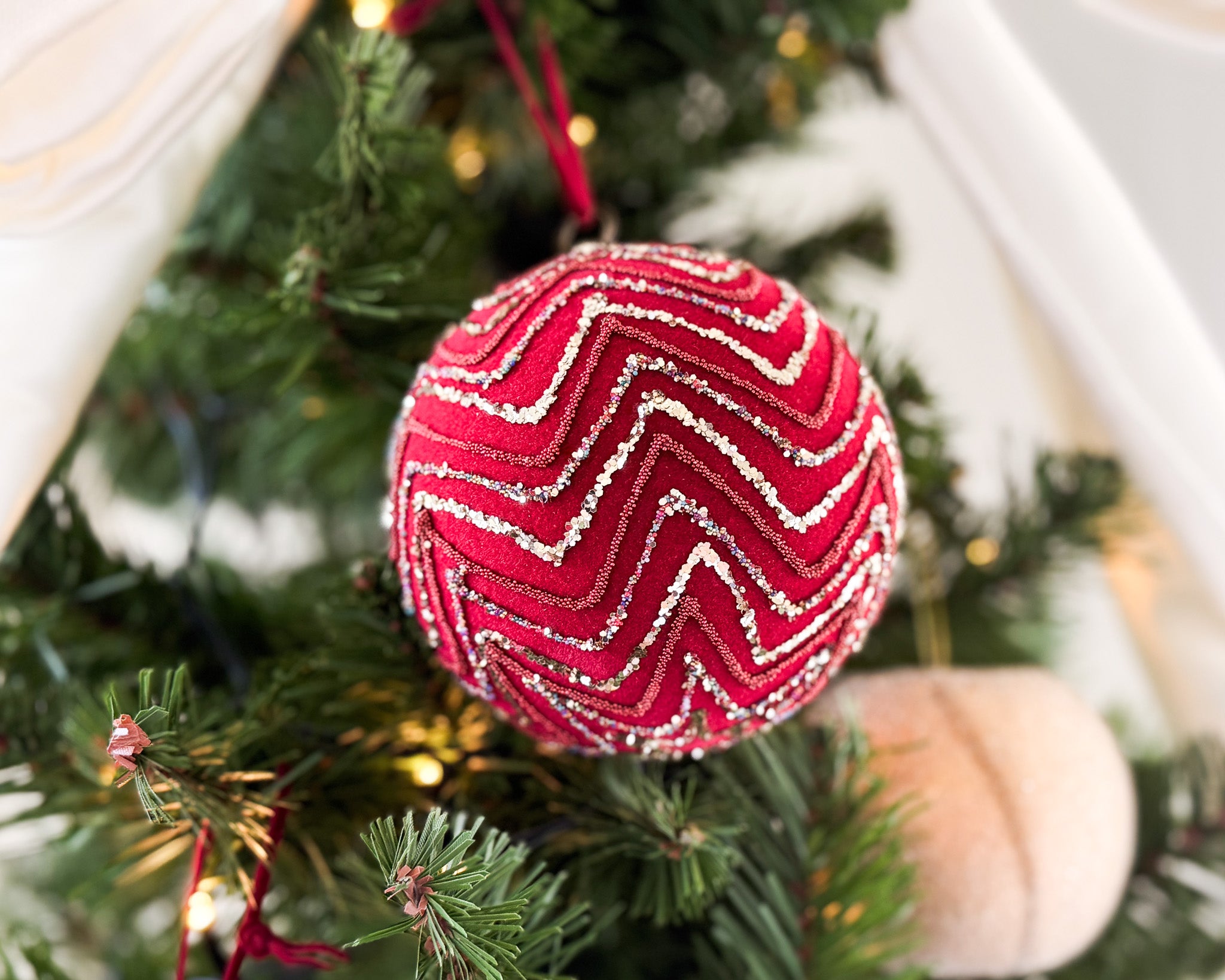
Buy one sequined ornament, take it home, and hang it under your own bulbs before committing to a set. Cheap silver sequins go dull and faintly greenish under warm 2700K lighting, and no store display will ever show you that. Sequins also tarnish over time and catch on velvet pile, so store them in a separate bag. If you want sparkle without the risk, small glass beads hold their finish far longer.
17. Deep Red Velvet Leaf Garland Woven Through Pine
Velvet leaf garland sells for $80 to $150 for a single strand, which is a lot for something that disappears into the branches. Three yards of velvet from a fabric remnant, a roll of floral wire, and a hot glue gun get you close to the same look for $25 to $35. Cut leaves in two sizes, run wire through a fabric channel, and glue each leaf at a slight upward angle so it flares away from the branch and catches light.
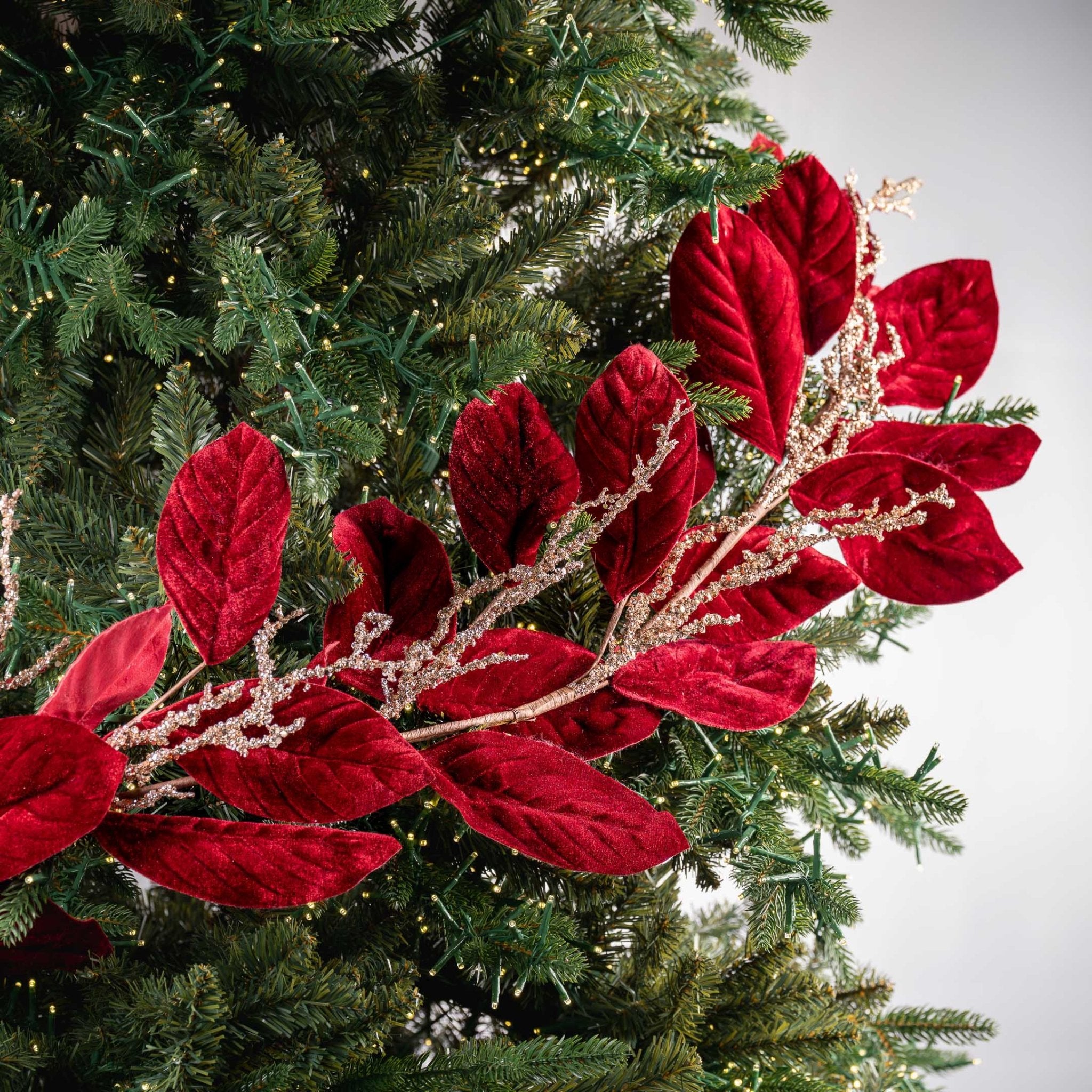
Wrap garland at a downward angle of about 30 to 45 degrees rather than straight across the tree. One hundred feet covers roughly a 7-foot tree if you spiral it with 12 to 15 inches between passes. More than one strand on a small tree and the branches vanish entirely, which defeats the point of having a tree with depth. Work in sections and step back every few feet, because up close everything looks fine.
18. A Massive Dark Brown Velvet Bow With Trailing Tails
Those long trailing ribbons are the whole point. A bow without tails is an exclamation point. A bow with three-foot tails that sway when someone walks past is a story, and it pulls your eye from the top of the tree to the base in one continuous line. The smaller burgundy and gold ornaments and the matching bows tucked into the branches exist to support that single gesture. Shorten the tails to six inches and you still have a nice bow that nobody remembers.
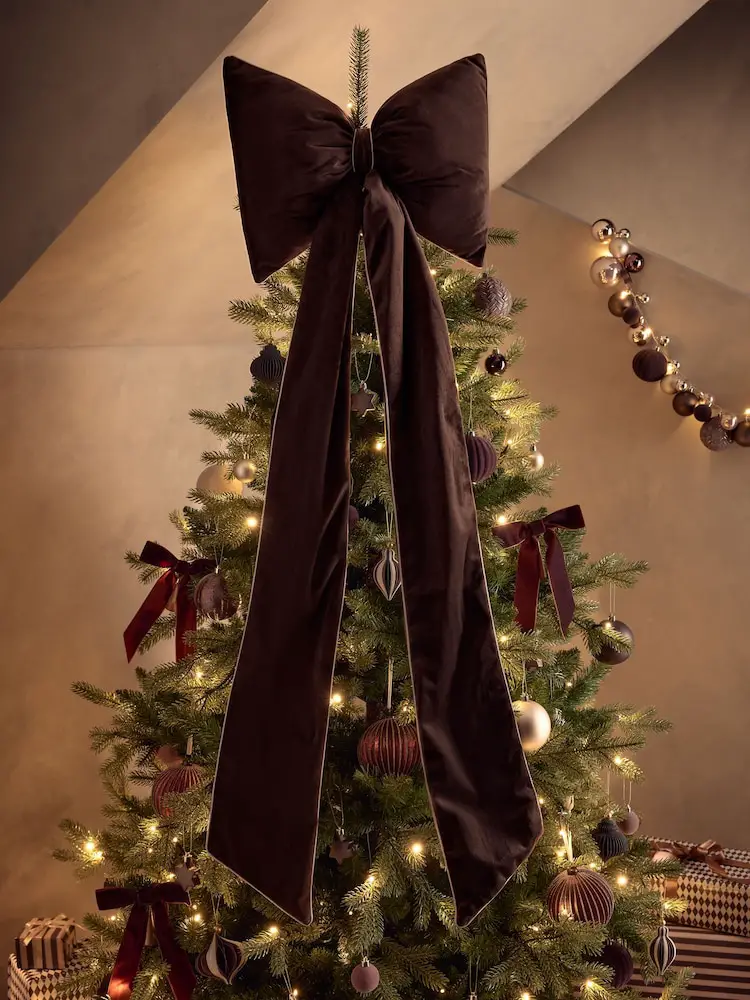
This is the shape of 2026 holiday decorating: one enormous gesture instead of forty small ones. It shows up in floral design as single-stem arrangements, in fashion as oversized tailoring, and now on trees. The upside is that it ages well. A brown velvet bow is not a trend-specific motif the way a monogram or a novelty character ornament is, so in five years it will still read as a deliberate choice rather than a time stamp.
19. Red Velvet Bows Against Dark Blue Paneling
- Dark blue paint for paneling, one gallon: $60-$120
- 7.5-foot tree: $150-$400
- Red velvet bows, set of six: $20-$60
- Red glossy ornaments, box of 40: $40-$100
- Tall gold-framed mirror: $80-$250
- Red velvet round pillow: $25-$60
- Total: $375 to $990
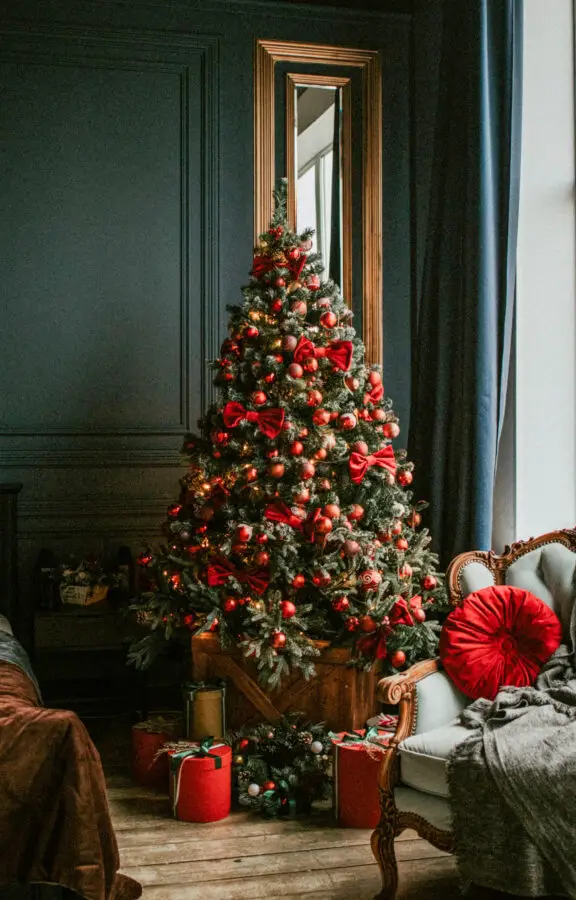
Budget alternative: shop Marketplace in early December for the mirror, use a prelit tree you already own, and make six velvet bows from one $15 remnant. You can land this look around $140 and nobody will know.
Place the tree within four to six feet of a mirror and angle the mirror so its reflection is visible from the doorway, not from the sofa. That one adjustment roughly doubles the amount of light the tree throws into a dark room, and it makes deep navy paneling feel rich instead of heavy. Keep the mirror frame in the same metal as your ornaments so the two read as a set rather than two separate purchases.
20. Slate Blue Velvet Ribbon Cascading in Organic Loops
Nobody tied a bow here. The ribbon is draped in loose, organic loops that follow the branches instead of fighting them, which is a harder look to style and a much calmer one to live with all season. The thick velvet has enough body to hold a curve without wire, so the loops read as liquid rather than crisp. Against a textured neutral wall mural with black crown molding above, slate blue becomes the only cool note in a warm room. Restraint is a decorating decision, not a lack of ideas.
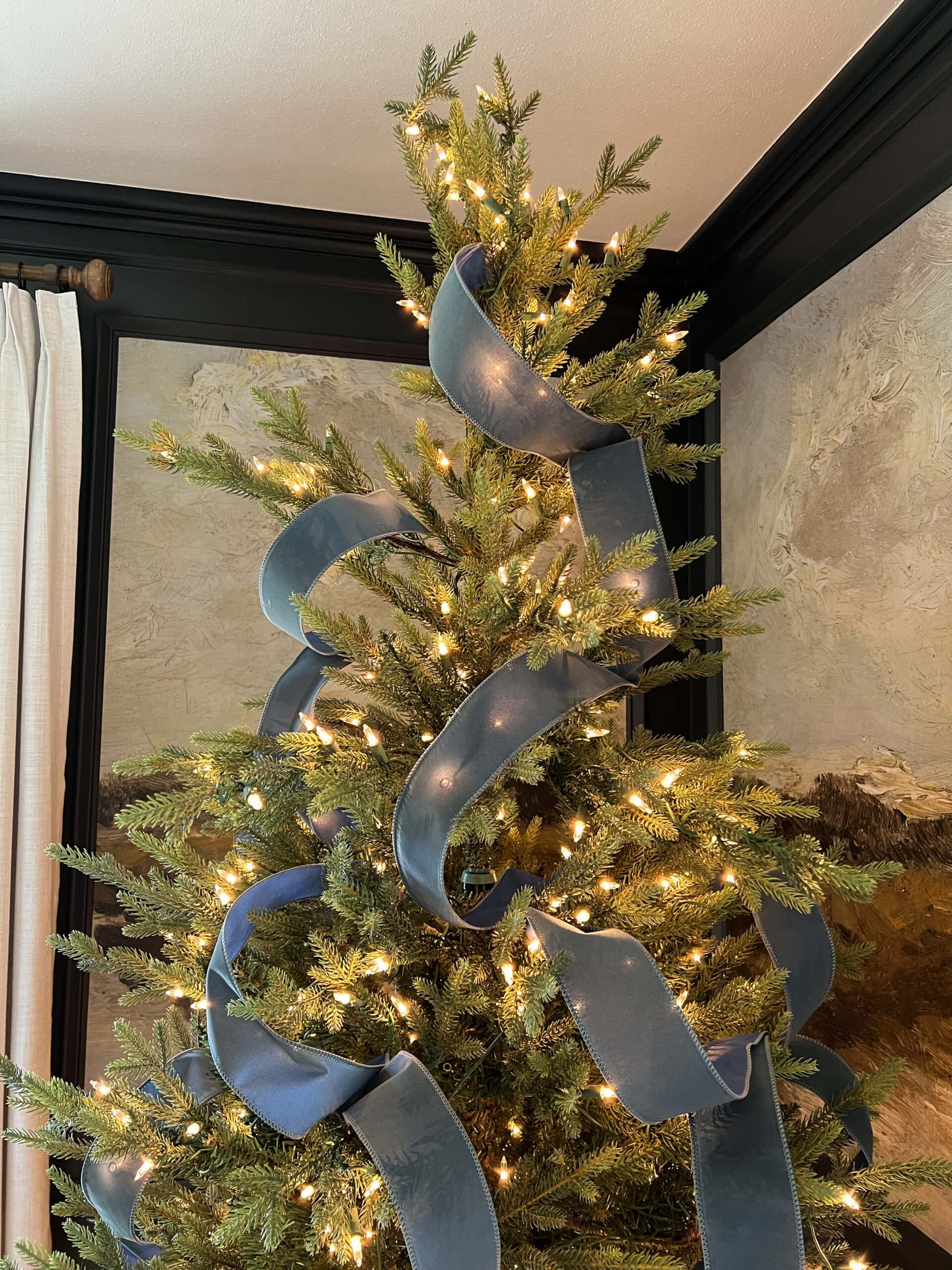
Roughly 65 percent pine green, 25 percent slate blue velvet, 10 percent warm light and black framing. That 25 percent is generous because the ribbon is the only ornament on the tree. In a version with baubles, drop it to 15 percent. Slate swaps beautifully for soft rust, warm olive, or dusty rose. Keep the ribbon width at four inches or more; anything narrower in velvet reads thin and a little sad from across the room.
21. Gold Flower Ornament With Brown Mesh Ribbon
Frosted branches and glitter both shed, and glitter embeds itself in velvet pile permanently. Keep glitter-heavy pieces, like that gold flower and the metallic leaf stems, out on the branch tips where they catch light and drop their fallout onto the floor instead of into fabric. Velvet ornaments belong closer to the trunk. A once-a-month pass with a lint roller along the lower branches keeps the fallout from migrating onto wrapped gifts and the tree skirt.
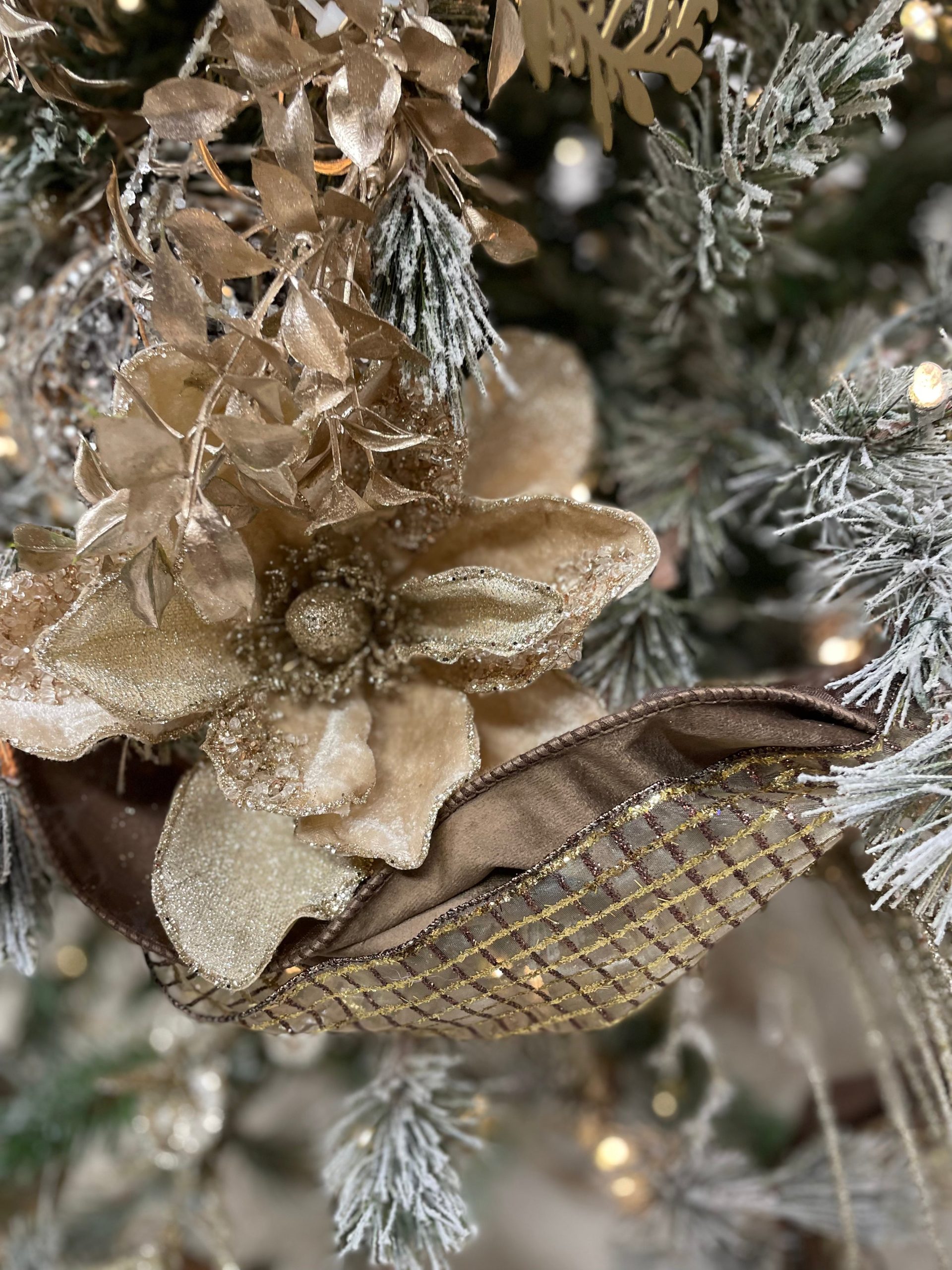
Make mesh ribbon loops hold their shape by forming a loop of 8 to 10 inches, then wrapping floral wire tightly at the base and tucking the wire behind a branch so the opening faces the room. Mesh has no memory of its own, so without the wire the loop collapses into a fold within a day. Two loops per square foot of tree face is plenty; more and the tree starts to look upholstered.
22. Burgundy Velvet Bows With Silver Stars and Blush Baubles
The burgundy velvet bow is why a tree full of silver glitter stars, blush pink baubles, and champagne beadwork still reads as one idea. Everything else is sparkle; the bow is the matte punctuation mark. Take it away and the tree becomes a shimmer with no focal point, pretty but forgettable. If you only add one thing to a neutral tree this year, make it a single deep velvet bow rather than another box of ornaments you will never fully use.
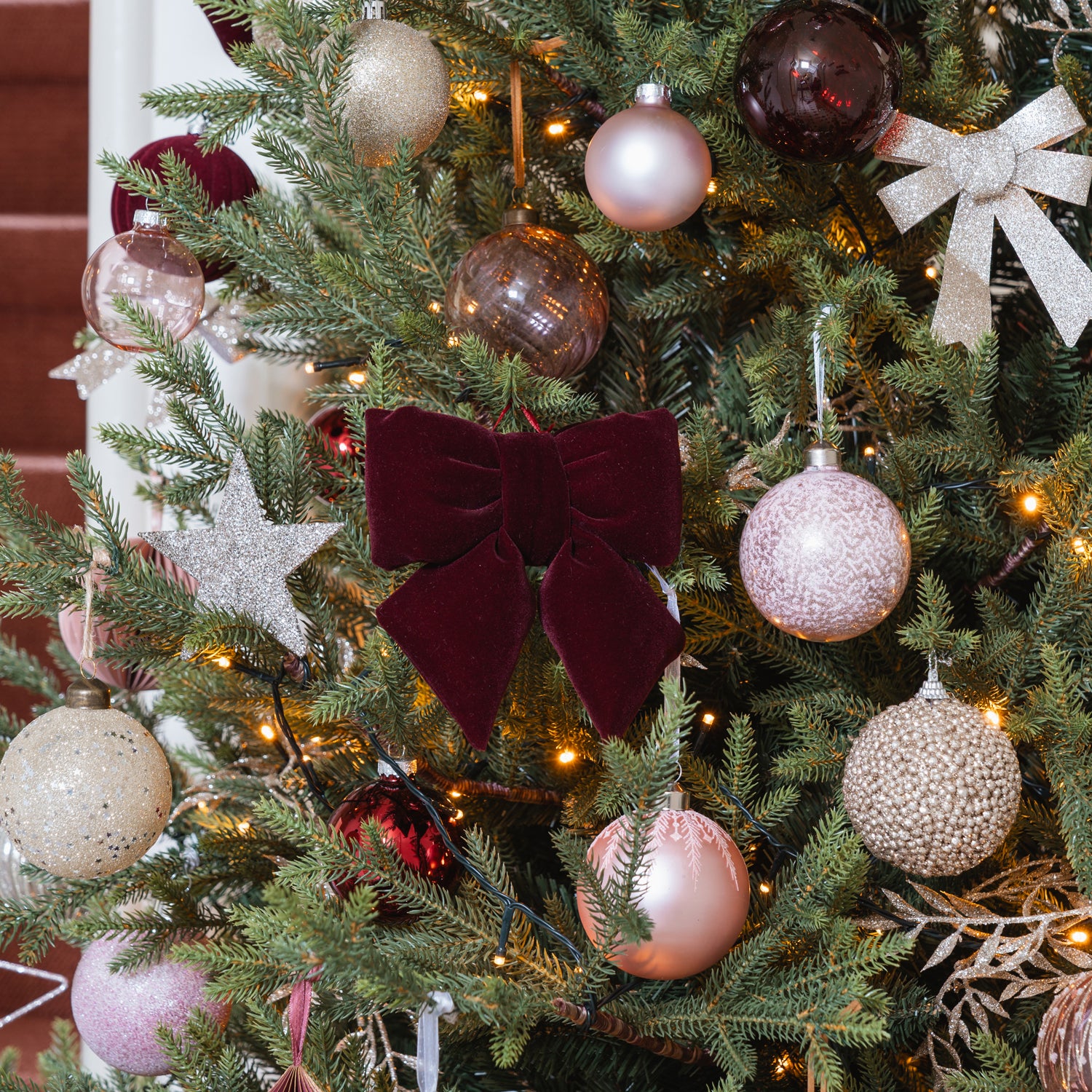
Pretied velvet bows run $12 to $25 each, which adds up fast when you want a dozen across a big tree. Velvet ribbon by the yard costs $8 to $14, and a dozen bows take roughly 10 yards. Learn one simple floppy bow and you cut that cost by 70 percent in an afternoon. Hobby Lobby and Joann both rotate velvet ribbon into sale in November, and Etsy sellers often list remnants by the lot. Want a velvet topper instead of scattered bows? Idea #4 takes the same matte-metallic mix in a different direction.
23. Velvet Bows on Presents — Red, Olive, Champagne
- Measure the box diagonally across the top, then multiply by five for your ribbon length.
- Choose 3- to 4-inch-wide velvet; narrower ribbon looks stingy on a substantial box.
- Run the ribbon under the box, bring both ends up, and cross them at the center.
- Tie one simple bow with loops about as wide as the box’s short side.
- Trim the tails on a diagonal, then pass the cut ends briefly over a candle flame to seal them.

About four minutes per gift and $1 to $2 of ribbon each, which is a fair trade for a package nobody wants to open.
Choose double-faced velvet ribbon for gifts: velvet on one side, smooth satin or grosgrain on the other. Pure velvet on both faces slides across glossy paper and your bow sags before the guests arrive. The satin side grips the box while the velvet side shows. If you are reusing paper, which is completely fine, skip velvet and use a matte ribbon that can take a firm knot.
24. Plush Velvet Ornaments Under Warm Amber Light
Warm light is the trend underneath the trend. Holiday decorating has moved away from cool white LED and toward 2700K amber strings, and velvet is the material that benefits most, because its pile softens and holds that glow instead of bouncing it. That pairing is why plush velvet ornaments show up in so many 2026 tree photos. Velvet looks expensive under warm light and slightly flat under cool light.
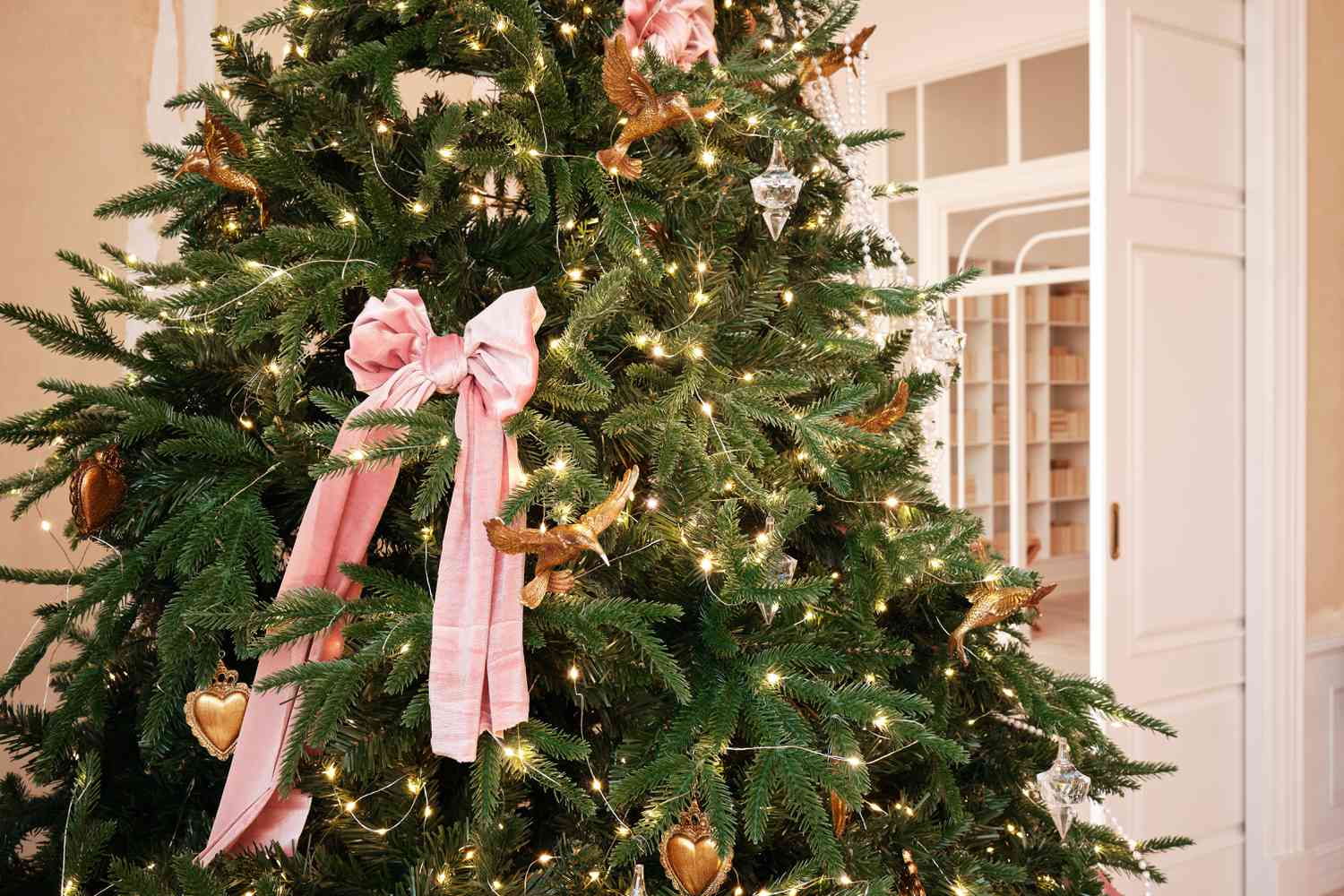
Two things are happening at once. Amber light and velvet are a warm-on-warm pairing, so nothing clashes and the entire tree reads as one glowing object. And the ornament shapes here repeat in varied sizes rather than varied colors, which keeps a densely packed tree from looking busy. Test it yourself before buying anything: swap one string of cool white lights for warm and watch the velvet change character in real time.
25. Buffalo Check Flower Ornament With Black Bead Center
A buffalo check flower ornament this size runs $25 to $35. Fabric quarters in buffalo check, a small foam disc, glue, and a bag of glossy black beads come to about $10 and make two ornaments. Cut six petal shapes per layer, edge each one with a dark fabric strip, and finish with a cluster of black beads at the center. It is a 30-minute project, and the result reads handmade in the good way rather than the craft-fair way.
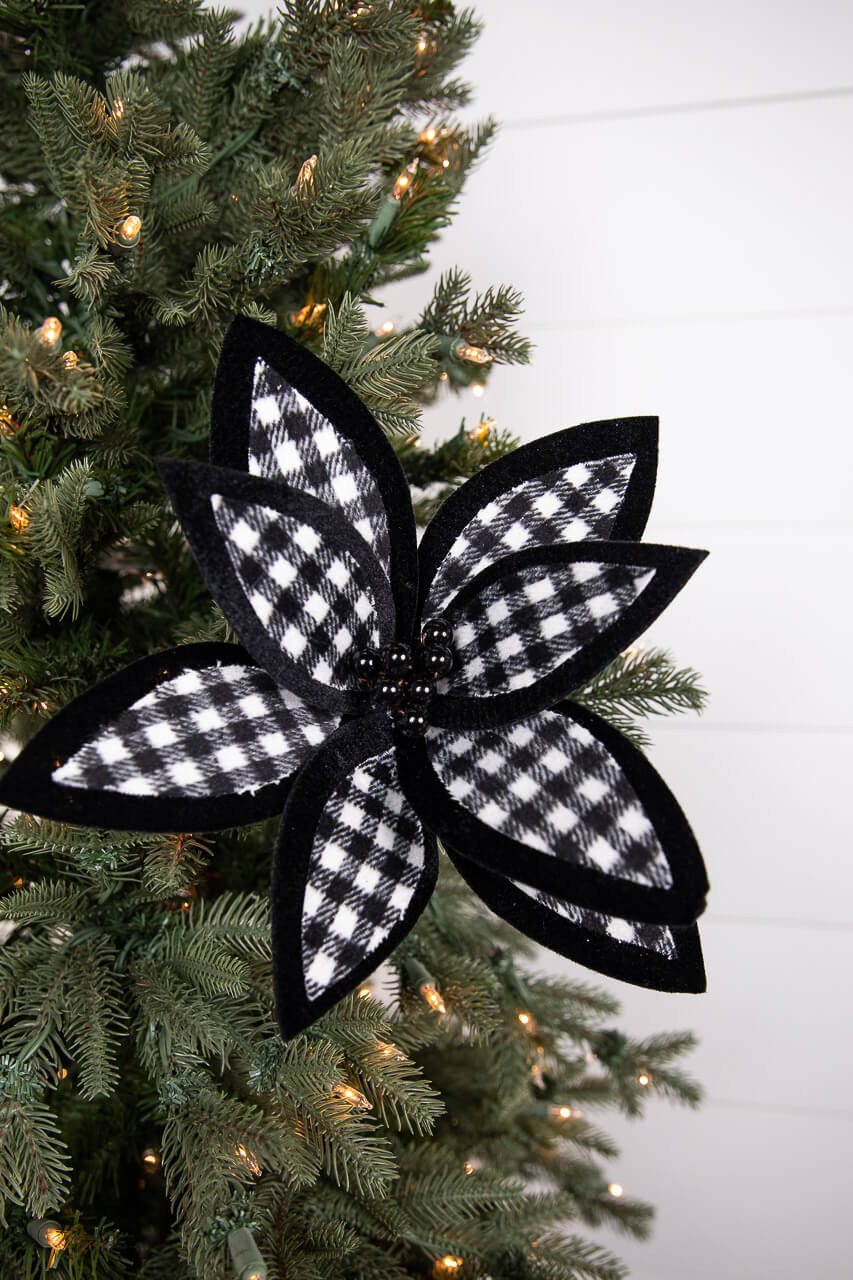
Buffalo check, deep red velvet, and gold on one tree is three patterns and two metals competing for attention, and the eye cannot settle anywhere. Pick two and keep the rest solid. If you keep the check, everything else goes matte and quiet, and vice versa. Worth knowing too: black-and-white check photographs beautifully under warm light but can look harsh in a brightly lit daytime room, so hang one and live with it for a day first.
26. One Deep Burgundy Velvet Sphere, Simple and Perfect
Silver caps and warm bulbs are not automatically friends. Under 2700K lighting, silver reads grey rather than bright, which is fine against burgundy but muddy against cream or blush. If your tree leans warm, match metals to the light: brushed gold, antique brass, or champagne. Save polished silver and chrome for trees lit with 3000K or cooler bulbs, or for daytime rooms with big south-facing windows doing the work for you.
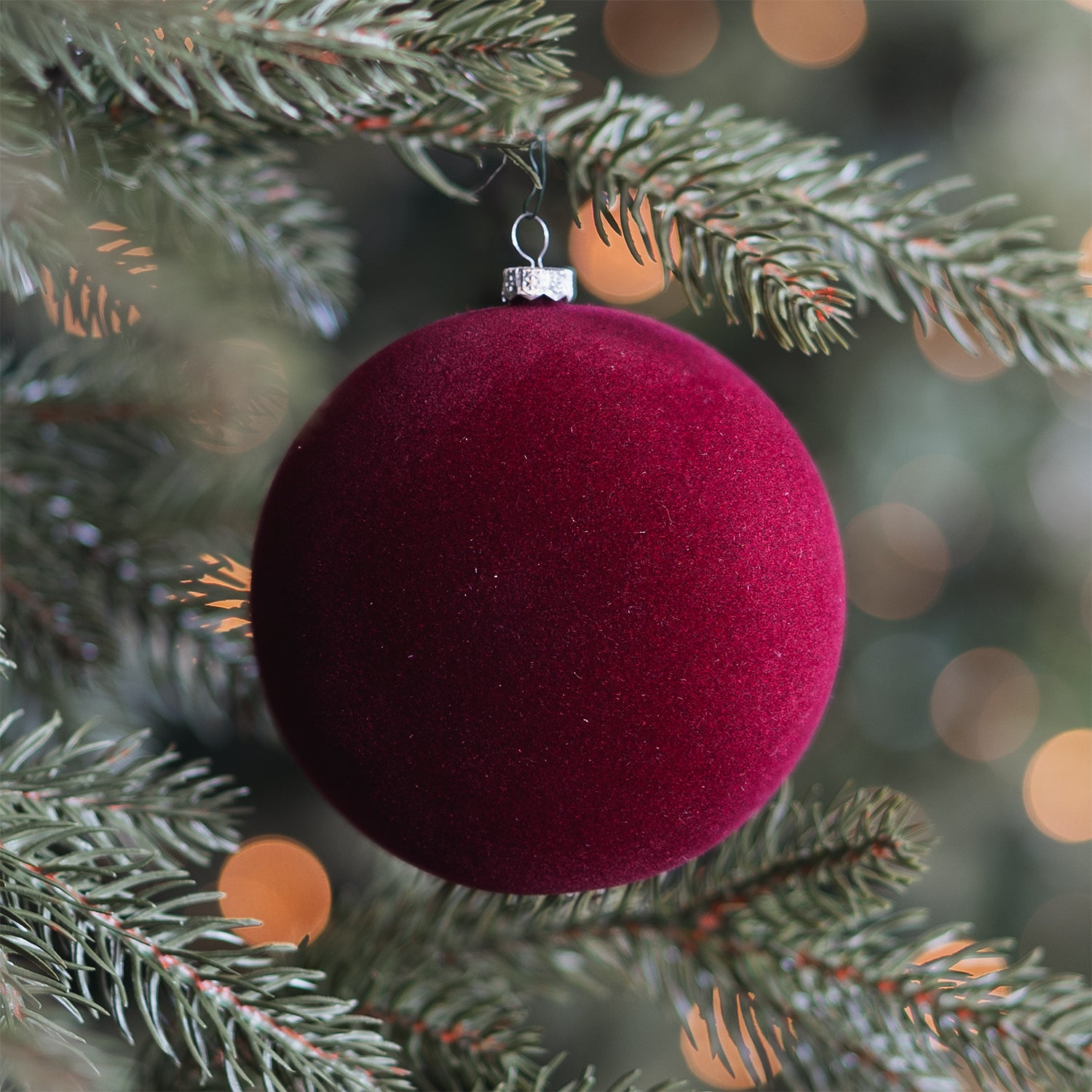
Velvet pile crushes, and that is the one thing it does not recover from. Store ornaments loosely with tissue between them, never in a vacuum bag or a tightly packed bin, or the surface flattens into a shiny patch that no amount of steaming brings back. Dust with a soft dry brush every few weeks during the season and use cool air, never heat, if something needs drying. Replacing four or five crushed ornaments every year is a real cost.
27. Red Velvet Bows and Blue Geometric Ornaments
This tree runs about 60 percent green, 25 percent red, 10 percent blue, and 5 percent gold. The blue geometric ornaments are the wild card, and they work only because they are small and widely spaced between the larger velvet bows. Push blue to 20 percent and the tree starts to feel patriotic rather than festive. Swap the blue for soft green or copper and the same proportions hold, which makes this a genuinely useful formula for using up what you already have in storage.
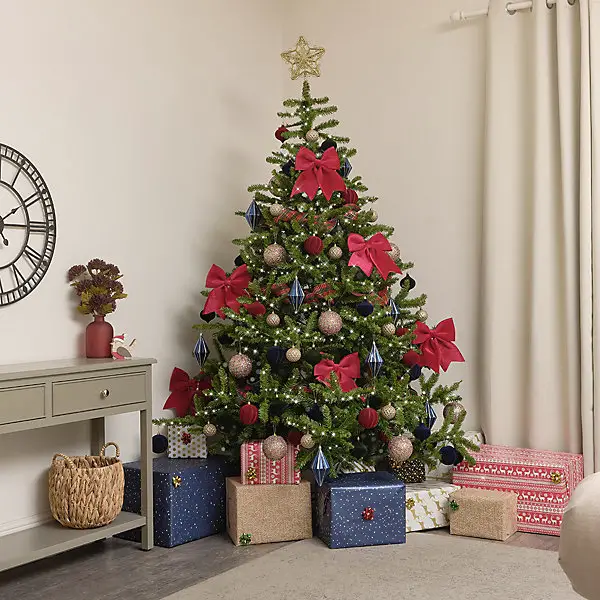
A corner setup like this wants about 18 inches of clearance behind the tree for the branches, plus a console within arm’s reach so gifts stay visible. A 30- to 32-inch-tall console pairs well with a 7-foot tree: the wrapped presents below read clearly, and nothing up top gets blocked. In a room under 100 square feet, drop to a 6-foot tree and a 24-inch console. A fuller, floor-based version of this corner idea is Idea #13.
28. Cream Ribbon With Dark Borders Held to the Branches
- Cream ribbon with dark borders, 10 yards: $15-$30
- Silver and gold baubles, mixed sizes: $30-$70
- Frosted pinecones, set of twelve: $12-$25
- Artificial floral picks: $15-$35
- Warm white string lights, 300 count: $20-$40
- Total: $92 to $200
Budget alternative: dollar store baubles at $1.25 per six, a can of matte spray paint on pinecones you gathered yourself, and ribbon from a Marketplace lot. That brings the whole tree in around $45.
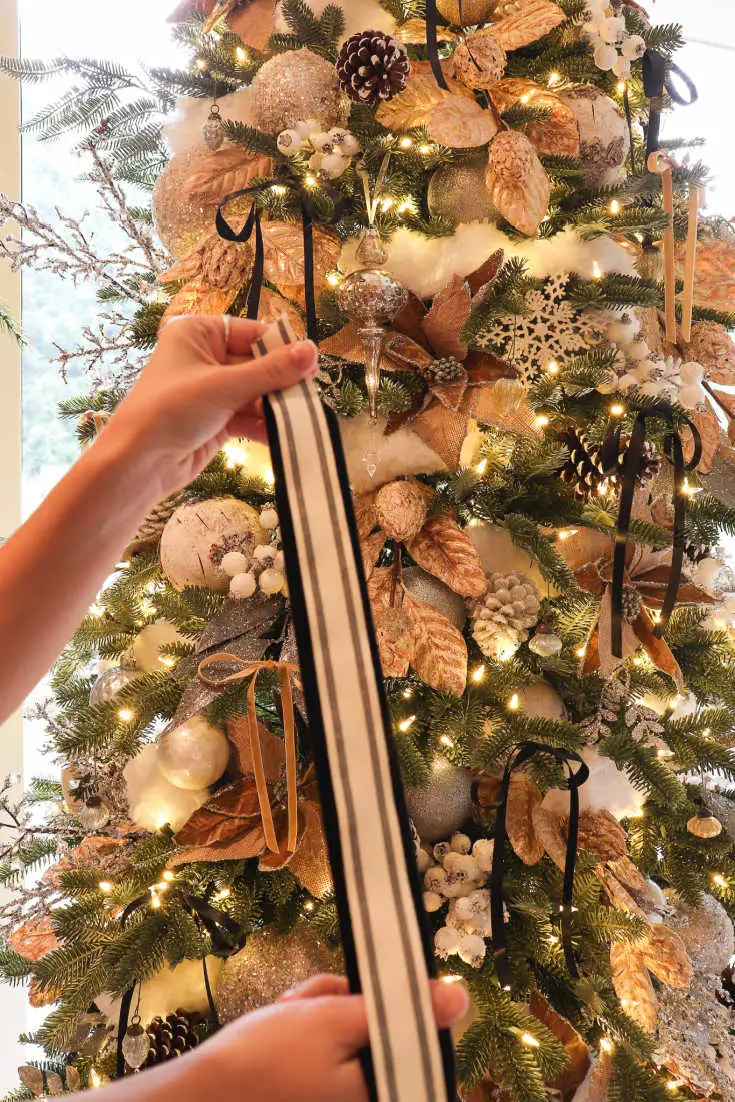
When ribbon has a dark border printed along both edges, keep your loops wide — 7 to 9 inches — so the border traces the outline of each loop instead of crowding it. Nest two loops rather than three, and let the tails hang 12 to 15 inches. Border-striped ribbon tied in tight little loops just looks like a striped knot, which wastes the whole point of paying for the border.
29. Gold Glitter, Pinecones, and Black Velvet Bows
- Cut a 12-inch length of 1.5-inch velvet ribbon.
- Thread it through the ornament’s metal loop and pull both ends even.
- Tie a single knot about an inch below the loop to create a small bow shape.
- Trim the tails to three inches and angle the cuts so they do not fray.
- Hang the ornament with the bow facing the room, not the branch.
Under two minutes per ornament, and a $12 spool of ribbon covers roughly 20 ornaments.
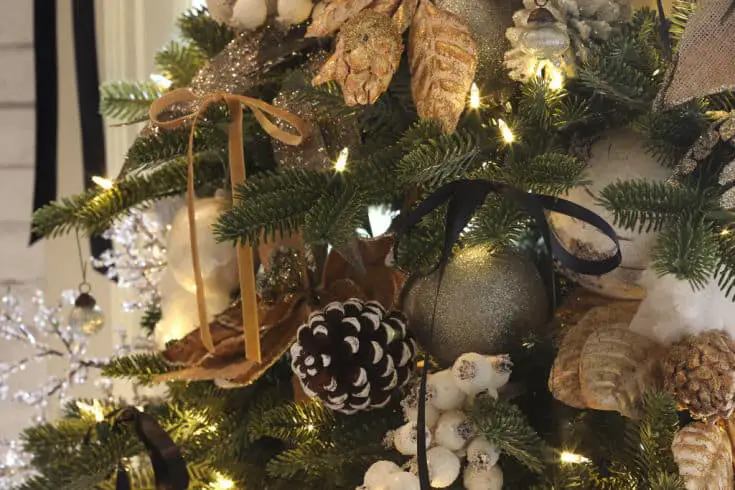
Black velvet collects everything: dust, pet hair, and the fine white fuzz that sheds off frosted berries. It also shows every fingerprint on a metallic cap. The practical fix is placement. Keep black ribbons and dark velvet above the three-foot line, where a dog’s tail and a toddler’s reach cannot get to them, and let the lower third of the tree carry pinecones, gold spheres, and anything that survives being bumped twice a day.
30. A Giant Red Poinsettia Nestled in the Pine
One bloom, roughly the size of a saucer, sitting in a sea of pine. That scale contrast is what makes this ornament memorable: dozens of small balls surrounding it turn the flower into a focal point rather than just another decoration. Swap it for three smaller poinsettias and the effect evaporates completely. Buy one oversized floral ornament and give it the branch space of four regular ones, then let the lights and greenery do the rest.
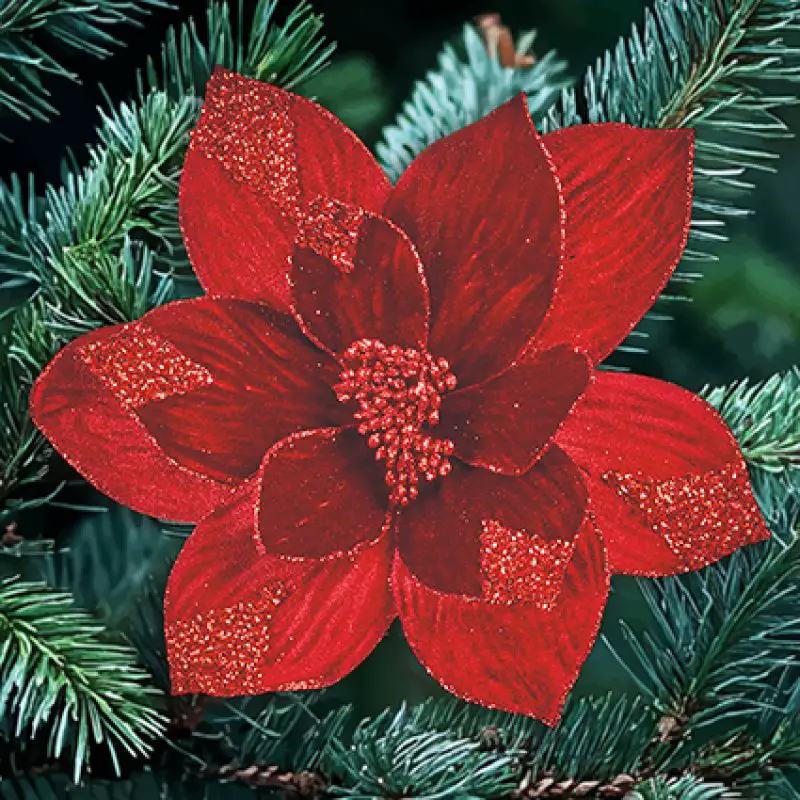
Large layered fabric poinsettias run $22 to $35 at gift shops and nurseries. A craft store sells red fabric petals, a green florist stem, and gold glitter for about $8 total, and assembly is genuinely simple: layer the petals largest to smallest, glue at the center, then add a cluster of beaded stamens. Two ornaments for the price of one, sized however you like. Idea #25 uses the same oversized-flower idea in buffalo check.
Go Tie a Bow, Then Step Back and Actually Look
Velvet is one of the few holiday materials that looks better in person than in a photo, which is exactly why it keeps showing up on trees year after year. Start with one thing — a bow, a ribbon, a handful of burgundy spheres — and build from there, because a tree with one clear idea always beats a tree with twelve.
📌 Save this to Pinterest and pin the ideas you want to try before the season slips past you. Next December, you will be very glad you did.