
You know that feeling when you finally find the Christmas photo that looks exactly right for your house — and then realize you have no idea how to actually build it? That’s the gap this guide closes.
We spent weeks browsing Target, Etsy, Anthropologie, and Wayfair, pulling 32 ideas that range from a $12 twine-and-ornament trick to an $1,850 dining room that looks styled by a magazine prop team.
Inside: rustic traditional mantels, quiet neutral bedrooms, full-on hot pink maximalism, and moody botanical dining rooms — with budget and luxury versions of the same look compared side by side, plus shoppable links under every idea. And stay until the end — we break down the most common mistakes that can ruin these looks.
In 2026 the shift is toward decor that reads beautifully in warm, low light rather than bright noon daylight — which is exactly why candle-heavy tables and 2700K fairy lights are dominating Pinterest right now.
📌 Save this to Pinterest for later — you’ll want to revisit these ideas.
1. A Tufted Headboard Bedroom That Goes Full Holiday
Pick a pencil tree 20 to 24 inches wide at its widest point for a bedroom corner, and leave at least 30 inches between the outermost branch tips and the edge of the bed. Skip the ruffled tree skirt, too — a low woven basket in a tone close to the headboard hides the cord and the light timer, and it blends with the wooden bench instead of fighting it.
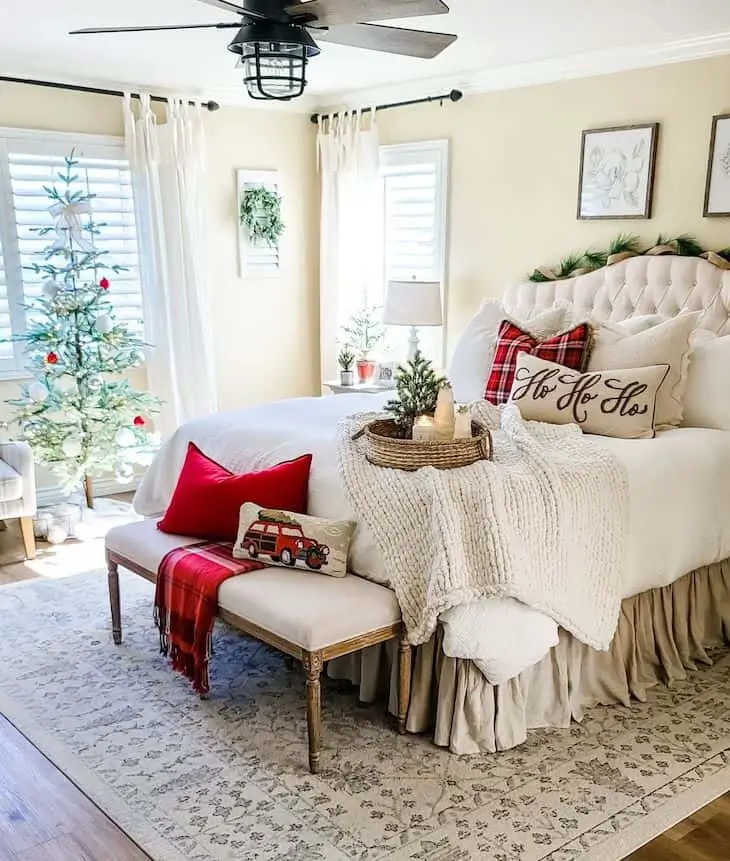
Three principles are doing the work here. First, contrast of scale: a big, soft tufted headboard against a skinny tree makes the tree read as deliberate rather than sparse. Second, pattern discipline — red plaid shows up on pillows and the woven tray and nowhere else, so it stays charming instead of dizzying. Third, temperature mixing: warm cream bedding against dark wood keeps the red from turning candy-bright.
2. Candy Land Kitchen With Peppermint Swirls and Candy Jars
- Lit evergreen garland, four 6-ft runs: $45–$120
- Glass apothecary jars, thrifted or new: $15–$60
- Peppermint swirl discs and candy cane props: $12–$35
- Ceramic gingerbread house and striped canisters: $25–$75
- Wrapped candy to fill the jars: $15–$40
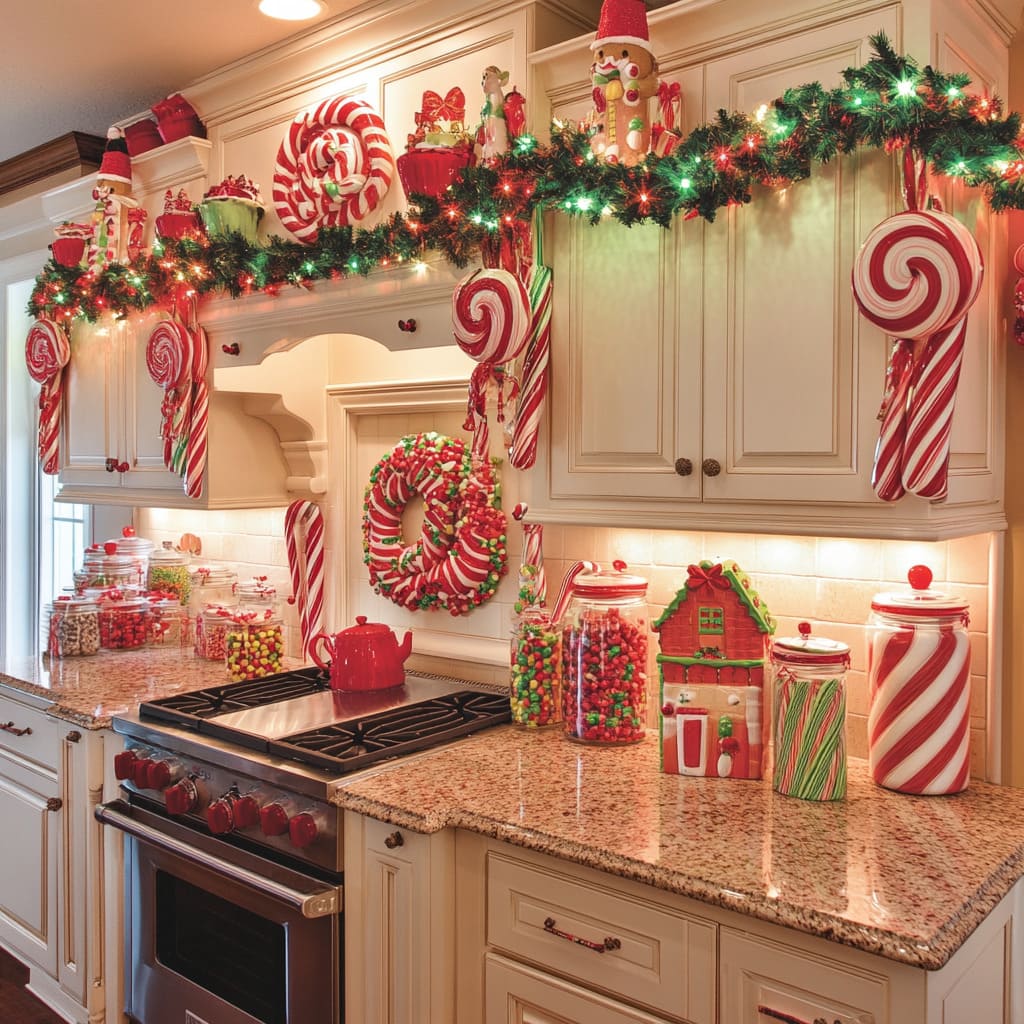
Total: about $110 to $330. Budget alternative: buy plain faux pine, add battery micro-lights yourself, and skip the specialty canisters — you’ll land near $65.
Honest warning before you turn your kitchen into a candy shop: unwrapped sweets and a warm room are enemies. Hard candy goes tacky, chocolate blooms gray, and sugar ants find a jar lid faster than you’d think. Use wrapped candies or faux props in anything near the stove, and if you have a toddler or a determined Labrador, mount the peppermint discs high — those flat, shiny circles are exactly hand-sized.
3. Neutral Dining Room With Chair Wreaths and Gold Reindeer
It’s the tiny wreaths tied to the backs of the chairs. Strip them away and you still have a lovely evergreen runner with gold reindeer — but a lovely table. The wreaths turn each seat into its own small ceremony, which is the whole difference between a decorated dining room and a dining room where dinner actually feels like an occasion.
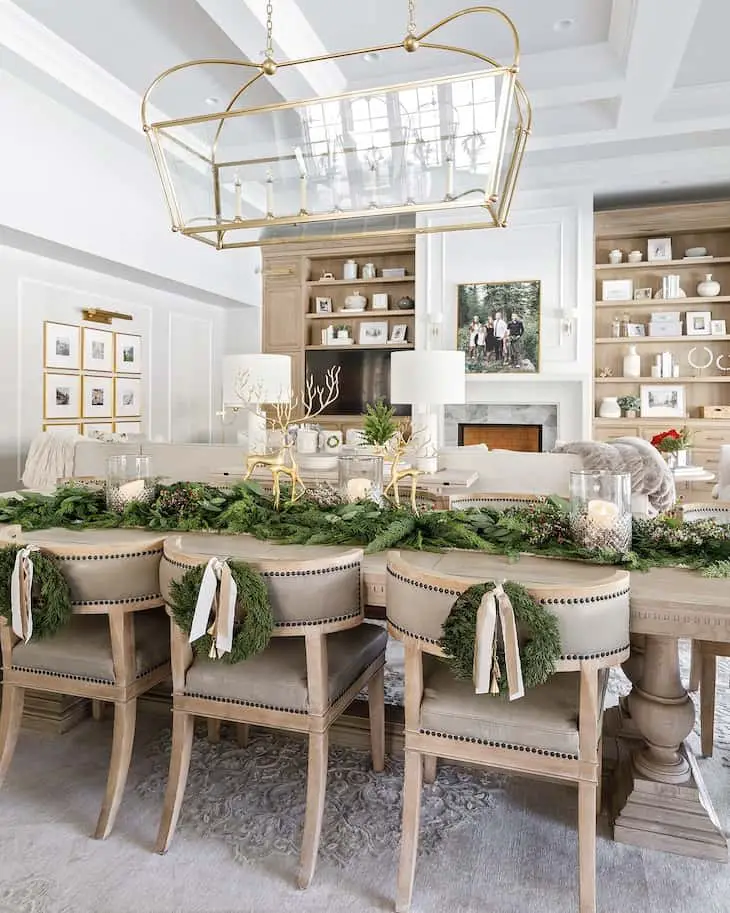
This layout needs a table long enough to earn a runner: 72 inches minimum, with 84 to 96 inches being the sweet spot. Chair wreaths read best at 8 to 10 inches across, and they should sit about two-thirds of the way down the chair back, not at the very top. Ceilings of 9 feet or more can carry a geometric pendant this large without it feeling low.
4. A Minimalist Mantel That Lets the Stockings Talk
The formula is roughly 70% cream and beige, 20% forest green, 8% natural wood, 2% brass or black metal. Keep those ratios and you can swap freely: forest green becomes eucalyptus gray for a cooler room, brass becomes matte black for a modern one, cream becomes oatmeal for anyone with dogs. What you can’t do is let the green creep past a quarter of the visual field — that’s when calm tips into theme.
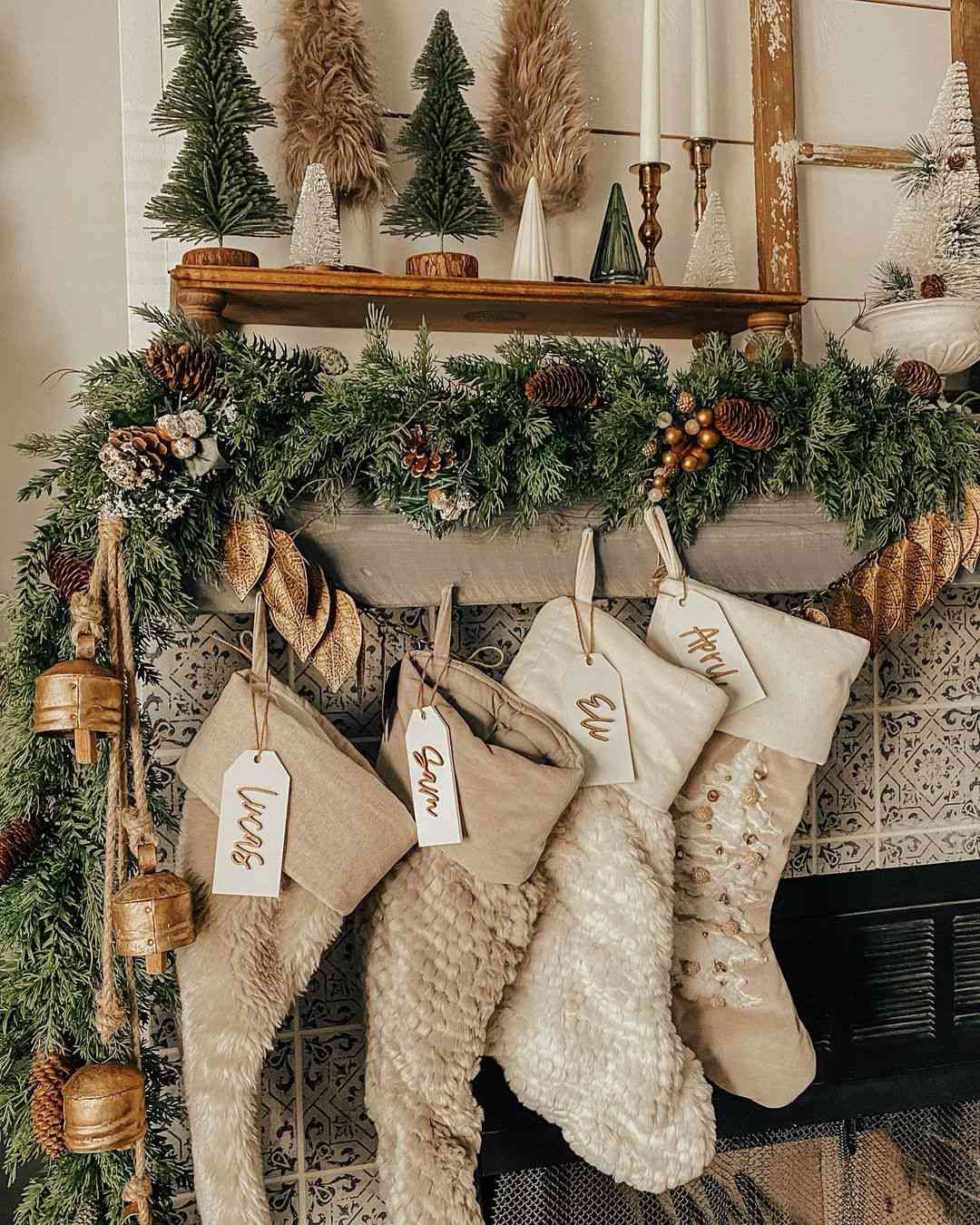
This is the quiet Christmas that’s been building for a few seasons and shows no sign of leaving. After years of maximalist trees and color-drenched mantels, people are pulling back to one garland, one stocking row, and a lot of warm lamplight. It photographs beautifully in low light, it stores in a single bin, and — the real reason it’s sticking — it doesn’t demand a whole weekend to install.
5. White and Blue Living Room With a Herringbone Fireplace
The fireplace surround does the heavy lifting: white herringbone tile inside a surround framed by warm wood gives the fire something crisp to bounce off. Then the lighting layers repeat — tree lights, firelight, two polished metal chandeliers — so the room has three separate glow sources at eye level. The framed winter landscape above the mantel is the quiet closer: it echoes the palette without adding another object to dust.
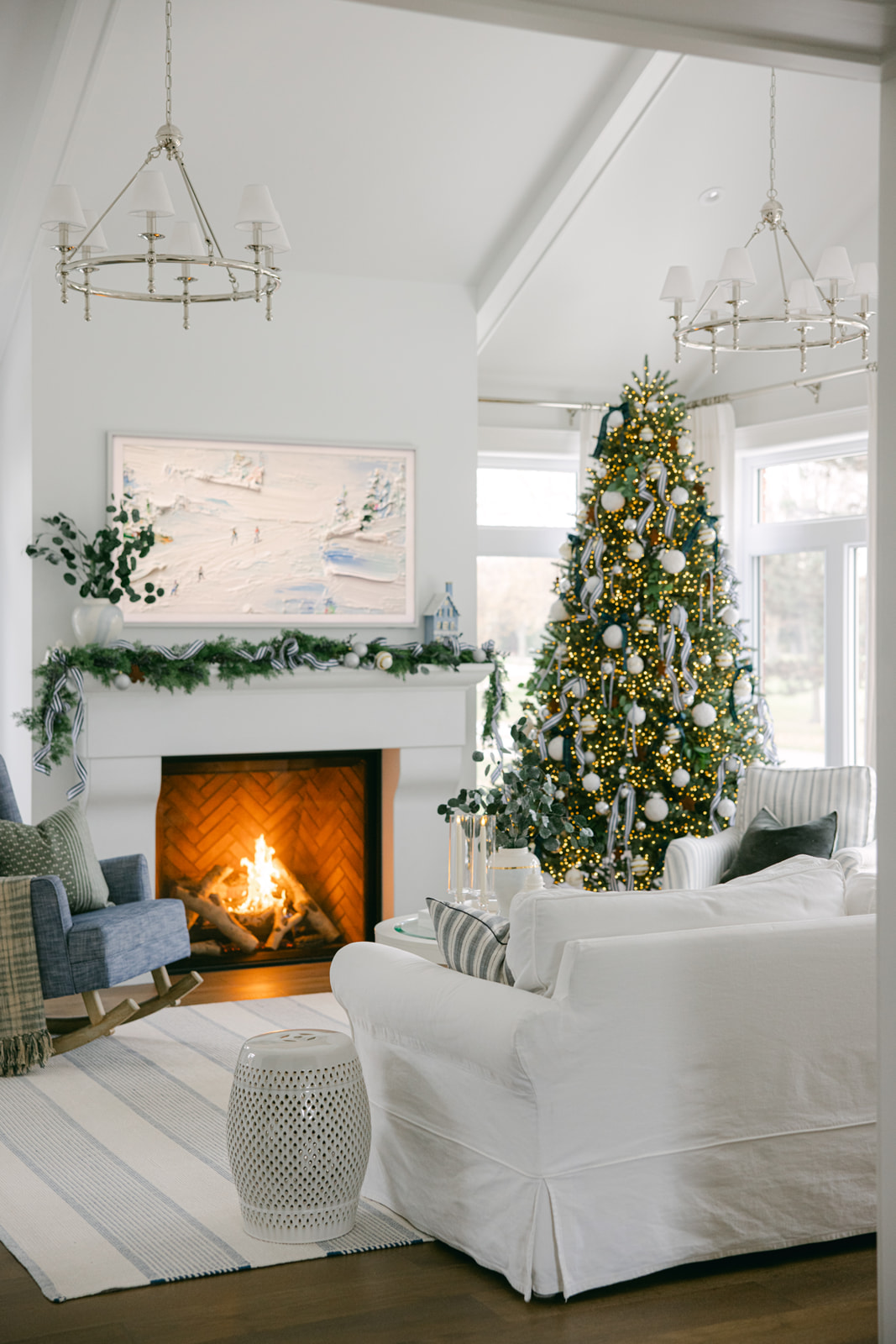
You don’t need a custom slipcovered sectional to get here. An IKEA slipcover sofa runs $400 to $700, a Target accent chair in dusty blue lands around $200, and a pair of small multi-tier pendants from a big-box store costs $80 to $150 instead of $600 each. Compare with Idea #4 — same cream-and-green palette, but the mantel carries the whole room.
6. Buffalo Plaid Bedroom With Garland Across the Headboard
- Measure your headboard’s full width — the garland should span it plus 6 inches on each side, or stop clearly short on purpose.
- Weigh the garland: a 9-foot lit faux pine can run 5 to 8 pounds.
- Buy adhesive hooks rated for at least double that weight.
- Confirm an outlet or battery pack can reach without a cord crossing the bed.
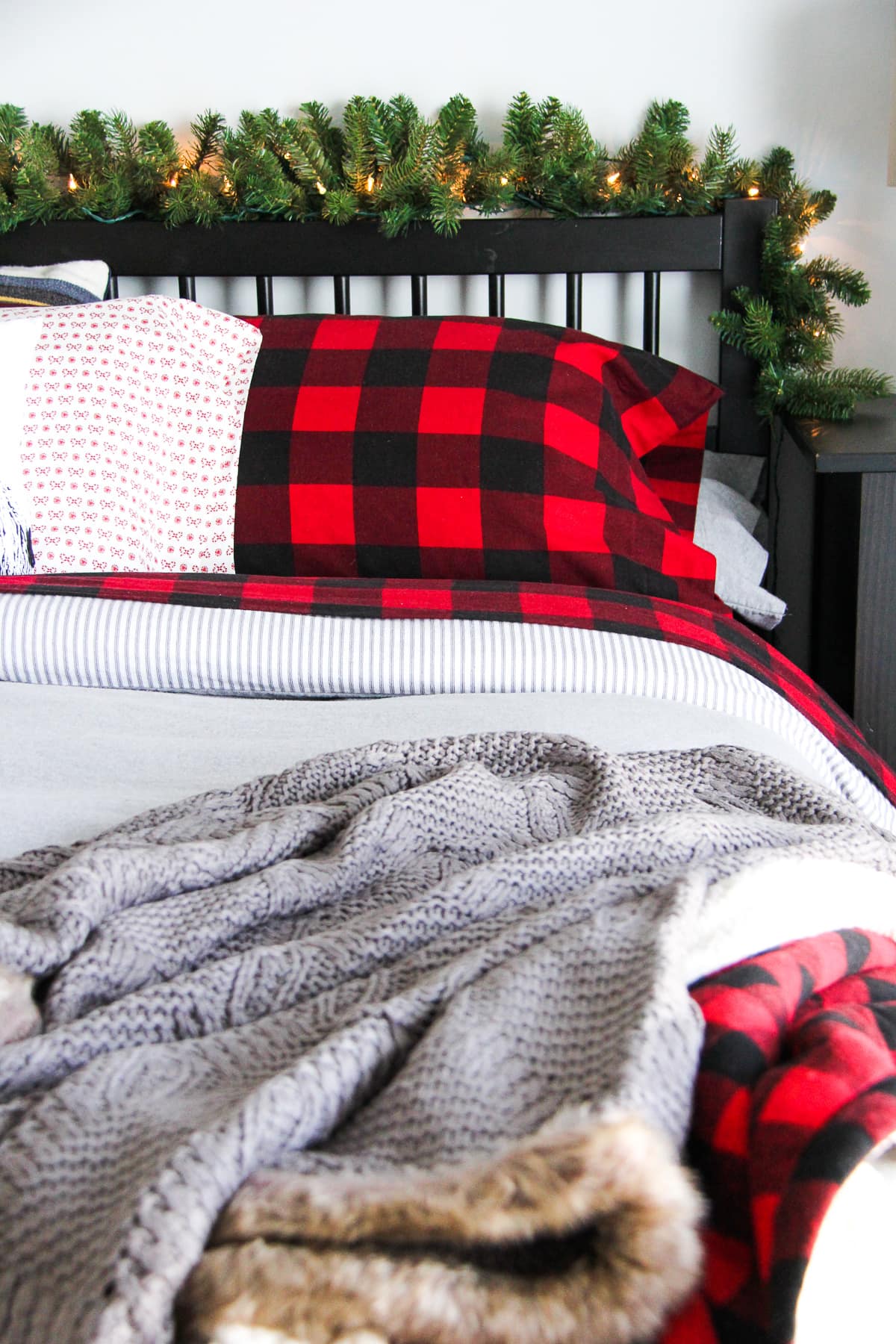
Never clip garland to a wooden headboard with metal hardware. Use velvet-lined clips or clear zip ties looped around the headboard posts, then pinch the greenery into a soft S-curve every 12 inches instead of pulling it straight. That pinch is what makes faux pine read as a loose natural branch rather than a rope of plastic.
7. Rustic Coffee Table, Red Ornaments, and Candlelight
The coffee table vignette — pillar candles at staggered heights, a small bowl of ornaments, a book or two — is what pulls the firelight out into the seating area. Take it away and the room is a nice tree next to a nice fireplace. Keep it, and the glow reaches all the way to the sofa, which is the entire point of a December living room.
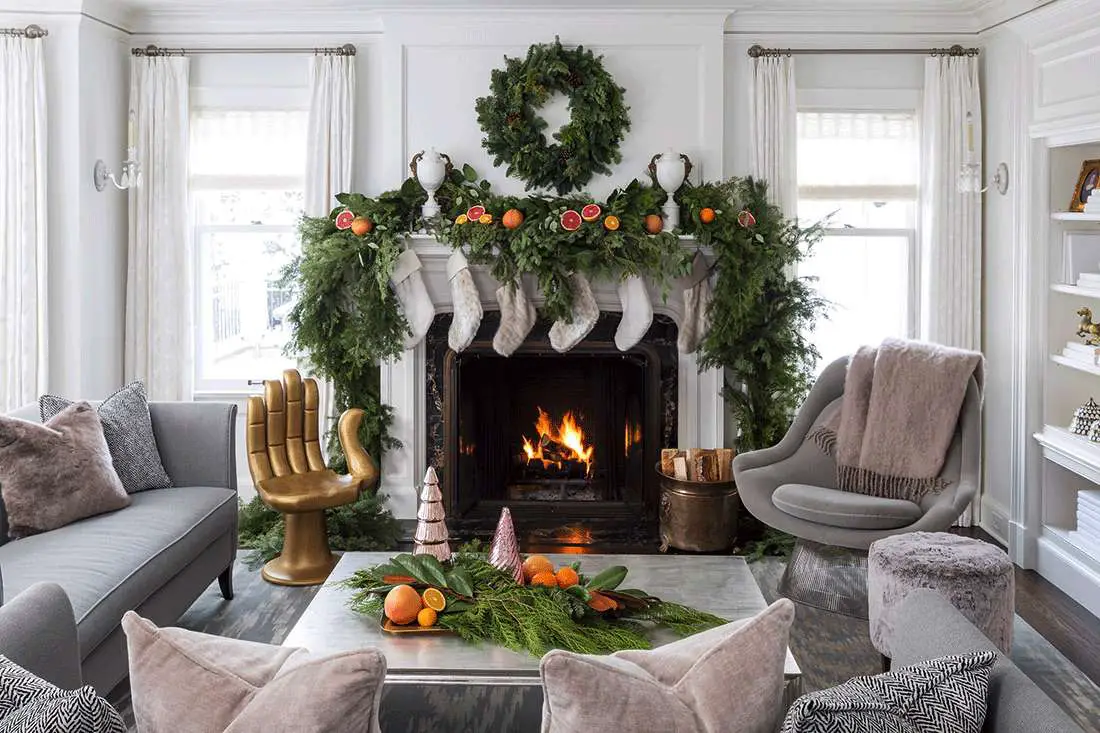
Two things will quietly cost you. Open candle flames leave soot rings on ceilings and shelves within a season, so trim wicks to a quarter inch and keep pillars out from under cabinetry. And if that tree is real, plan on vacuuming needles daily from about week three — a stand with a wide reservoir plus a tree bag at the base cuts cleanup in half.
8. Knit Stockings on a Brick Fireplace With a Eucalyptus Wreath
Hanging stockings so they actually look even:
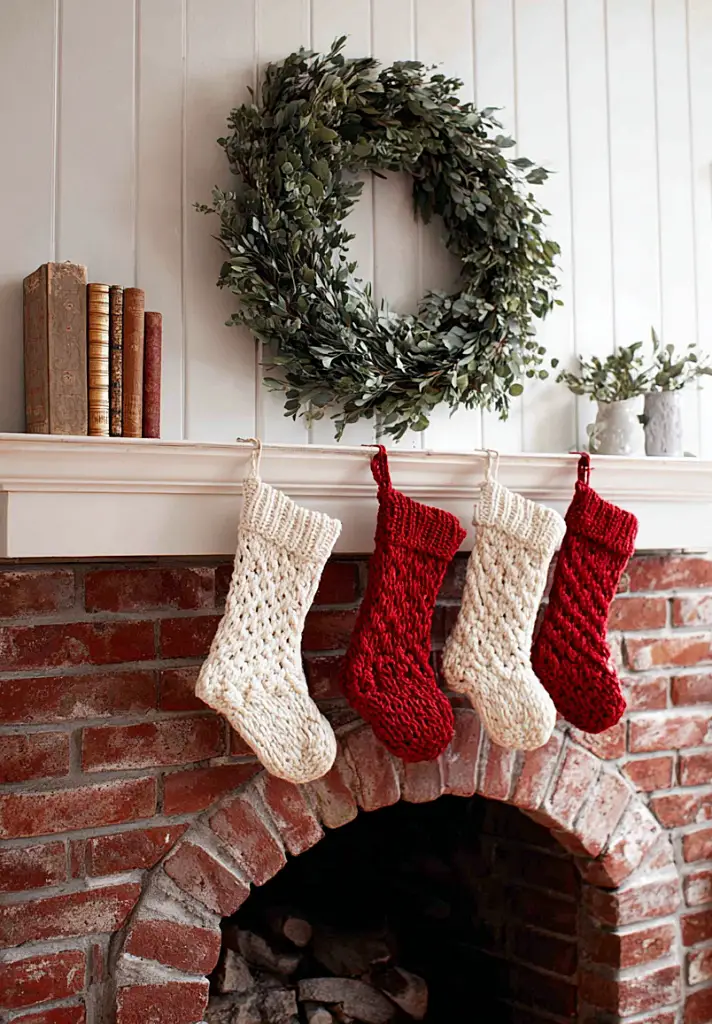
- Measure your mantel edge and divide by the number of stockings, adding 4 inches of air between each.
- Mark the spots with painter’s tape before you commit.
- Set the hooks so the stocking cuff sits just below the mantel lip — about an inch of overlap.
- Hang the heaviest stocking at one end, not the center; the eye likes it slightly off.
- Stuff with tissue so each one holds its shape between fillings.
About 30 minutes and $12 to $60 depending on whether you thrift the stockings.
- Cable-knit stockings, set of four: $30–$90
- Faux eucalyptus wreath, 24 inches: $25–$70
- Vintage books, thrifted stack: $5–$20
- Lit garland for the mantel: $35–$90
Total: roughly $95 to $270. Budget alternative: knit-look stockings at $6 each from a discount chain and a plain green wreath dressed with two stems.
9. Hot Pink and Orange Maximalist Christmas Tree
Roughly 55% hot pink and magenta, 25% orange, 12% white, 8% gold. It sounds unhinged written down, and that’s the point — the white and gold are the pressure valve that keeps it from turning into a color accident. Swap pink for cobalt and orange for turquoise and the formula still holds. Just keep white ornaments to about one in eight so the eye always has somewhere to land.
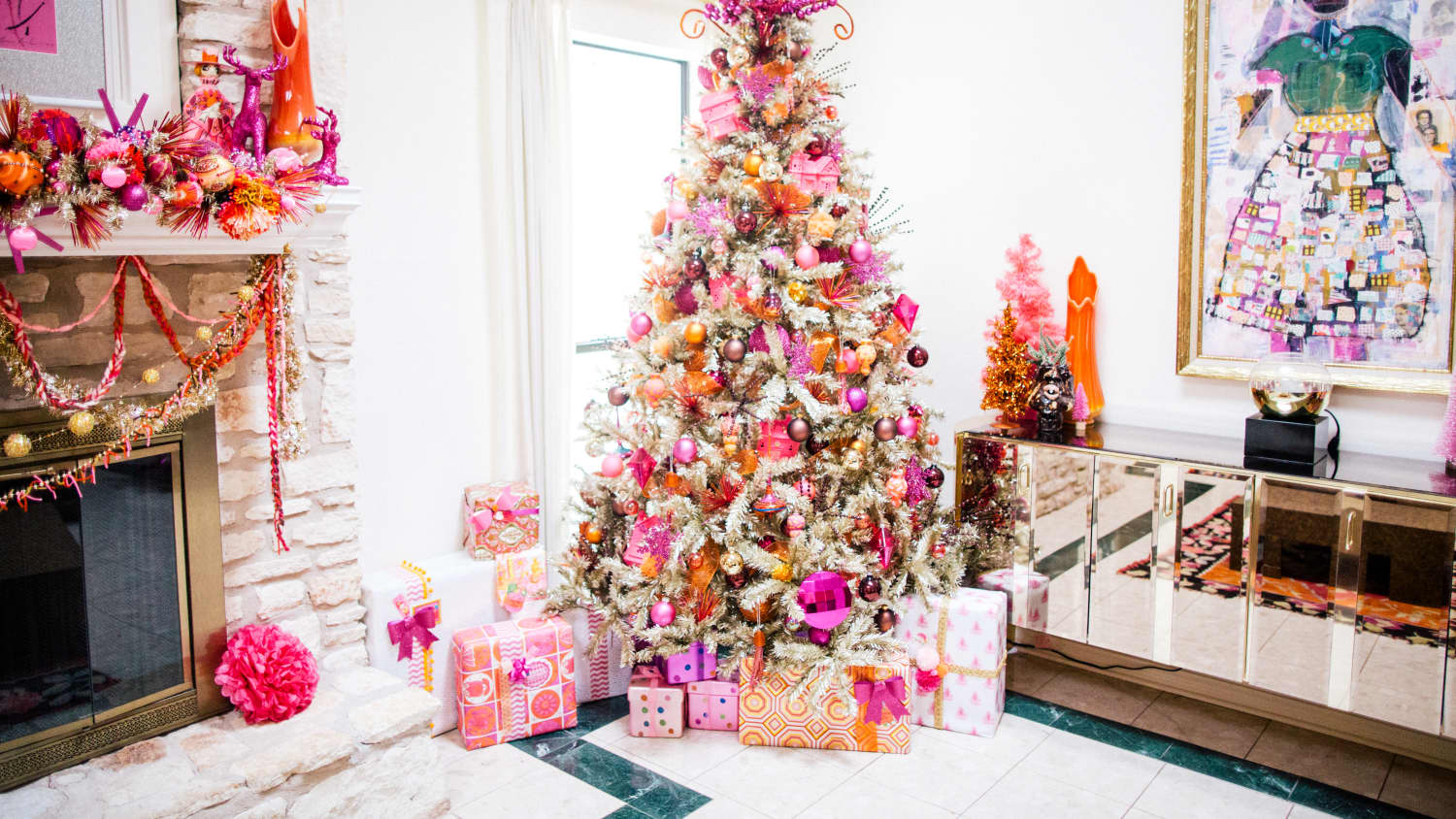
A pink and orange tree is a genuine commitment. It won’t blend with the rest of your house in January, it photographs with a strong color cast, and family members will have opinions. Store the ornaments in a dedicated lidded bin so it’s a choice you make each year rather than a debate you re-litigate. Shoot it in daylight, not evening lamplight, or the whole thing goes muddy.
10. Brick Fireplace Living Room With a Corner Tree
Traditional is back, but the version people actually want in 2026 is warm and slightly imperfect — real brick, mismatched ornaments, a tree that looks collected rather than coordinated. It’s a reaction to the all-white minimal holidays of the late 2010s, and it lines up with a broader pull toward rooms that feel lived-in and unfussy. This one has staying power because it isn’t a color trend; it’s a lighting-and-texture trend.
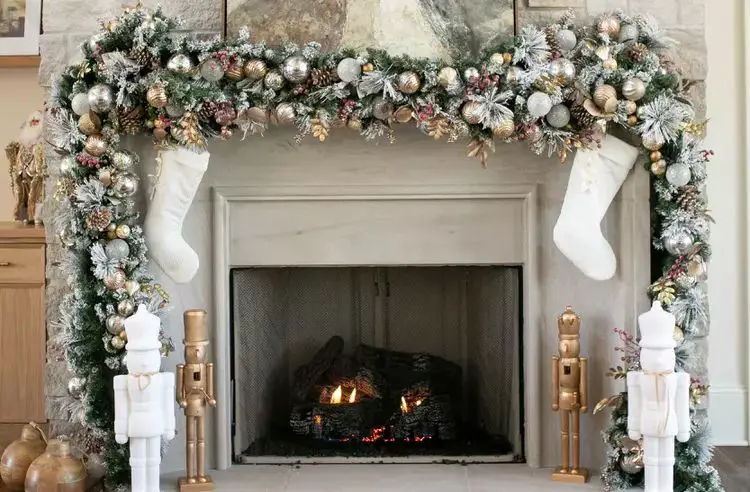
This arrangement wants about 200 square feet of living space, 9-foot ceilings, and a 7.5-foot tree so it doesn’t crowd the mantel line. Under 150 square feet, drop to a 6-foot tree and skip the corner entirely — a low, wide-back sectional helps more than it hurts when you’re tight on floor plan.
11. Frosted Garland and Glowing Cone Trees on a Stone Fireplace
- Frosted lit garland, 9 ft: $45–$120
- Frosted wreath for the mirror: $25–$65
- Set of three glowing cone trees: $40–$130
- Nutcracker and silver deer figurine: $20–$70
- Glass ornament jars: $15–$40
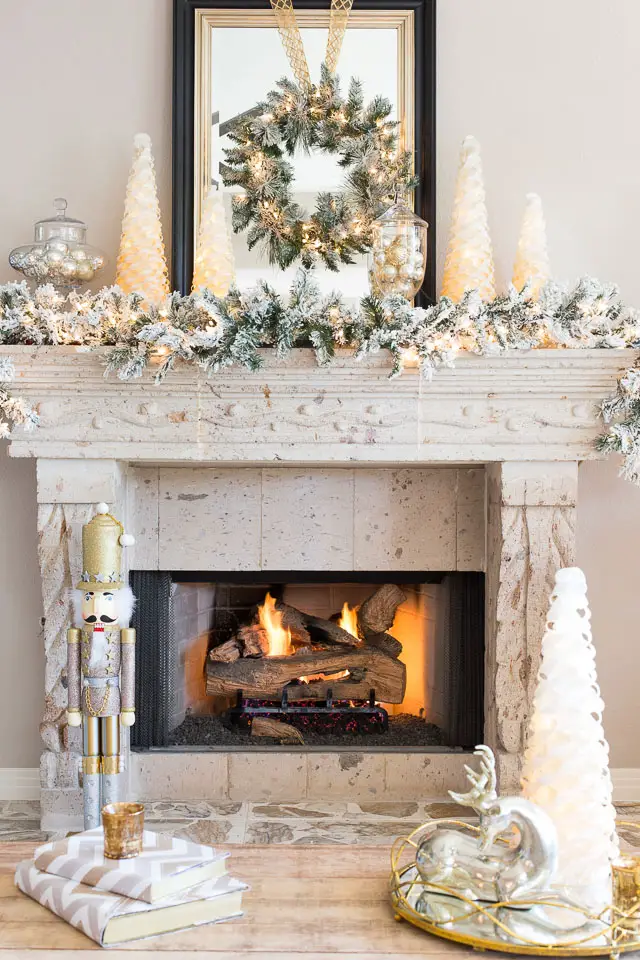
Total: about $145 to $425. Budget alternative: buy plain faux garland, one can of flocking spray, and your own micro-lights — closer to $70.
If you want that frosted look, spray the garland from 10 inches away in two light passes rather than one heavy coat; a single drench turns faux pine into a wet-looking clump. And never try to frost real garland sitting over stone — the moisture wicks into the flocking and you get a chalky drip line down the fireplace by New Year’s.
12. Ornaments Suspended From the Underside of Kitchen Cabinets
Suspending ornaments under your upper cabinets:
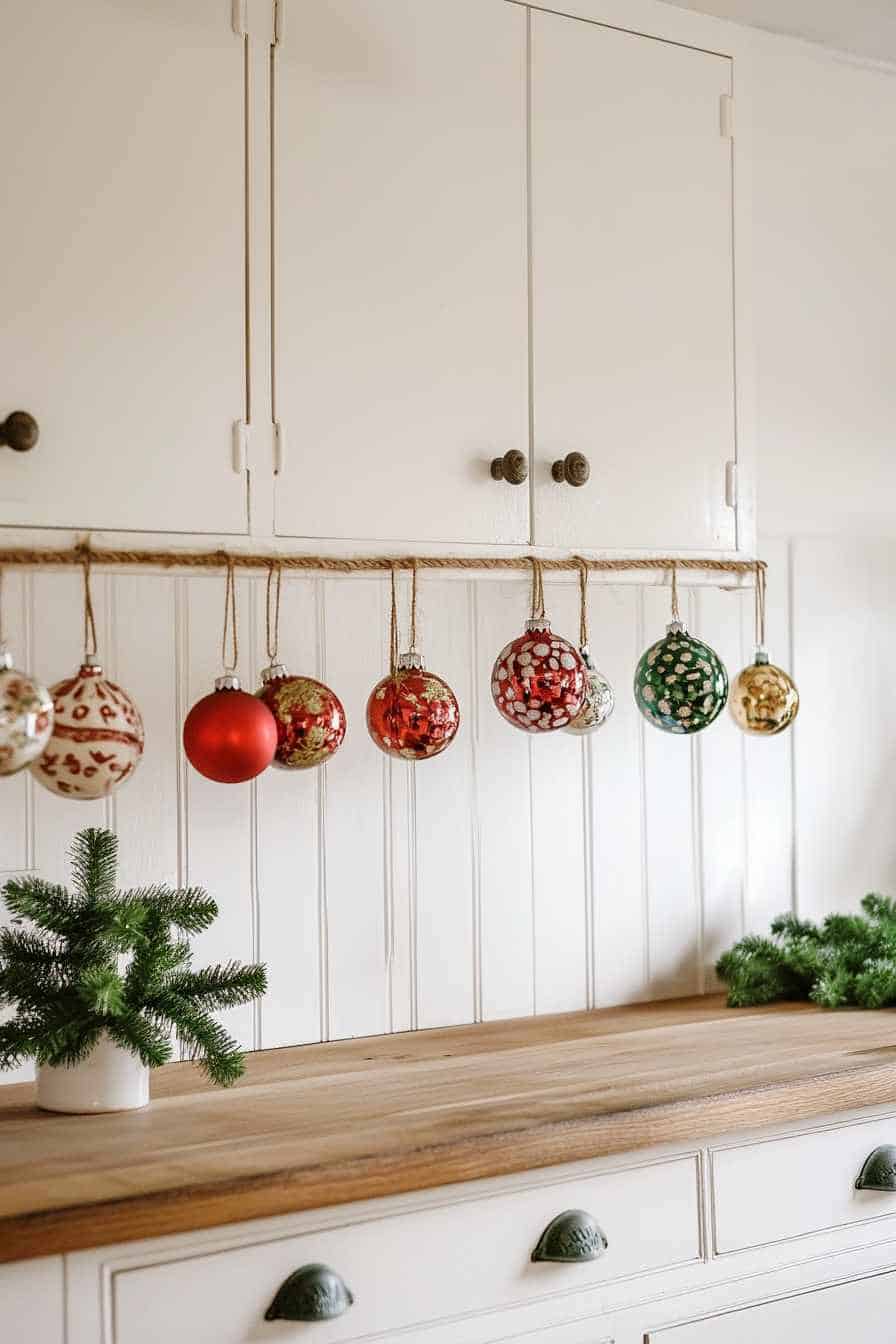
- Run a length of thick jute twine taut between two small cup hooks on the underside of the cabinets.
- Knot the twine at each hook and tug — slack shows immediately in photos.
- Thread ornaments on fishing line so they hang at staggered heights.
- Keep the longest ornament at least 8 inches above the countertop.
About 20 minutes and $10 to $25 if you already own the ornaments.
The twine itself is the trick. Not the ornaments — the rope. It turns a row of hanging baubles into a deliberate installation instead of a decorating accident, and it costs almost nothing. Remove the twine and you’d have ornaments dangling from cabinet hardware, which reads as clutter. With it, you get a line, a rhythm, and a very specific rustic charm.
13. Attic Beams Draped in Lit Garland and Gingham Pillows
Two things are happening. First, the garland runs along the ceiling beams, which draws the eye upward and makes a low attic ceiling feel taller than it is. Second, the brown-and-white gingham pillows pick up the dark wood of those same beams, so the eye gets a second, lower hit of the same warm tone. Every light in here sits at 2700K — no cool blue bursts breaking the mood.
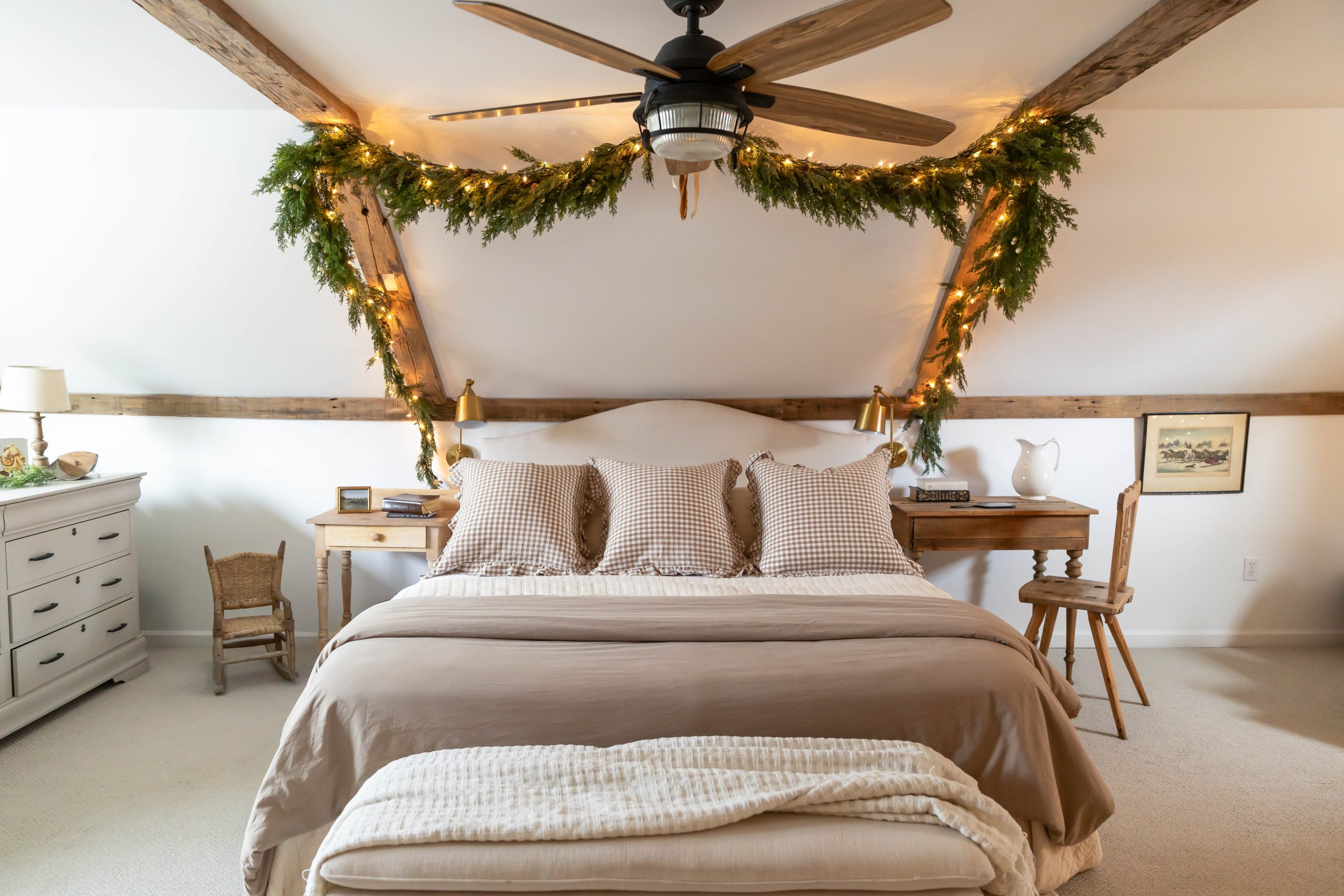
Battery-operated fairy lights from Target run about $8 per strand, and a decent faux garland starts near $15 at IKEA. Add two gingham pillow covers from a discount site at $12 each and you’ve rebuilt this whole holiday layer for under $70 — compare with Idea #1, which runs the same cozy logic in a smaller footprint.
14. Gold-Rimmed China and a Grape-Studded Centerpiece Garland
This is an eight-seat setting — you need 96 inches of table and roughly 3 feet of chair pull-out on every side. Tall taper candles work best under a ceiling of 9 feet or more, and the centerpiece garland should stay 12 to 14 inches wide so guests can still see across. Under 8 feet of table, drop to six place settings and shorten the runner.
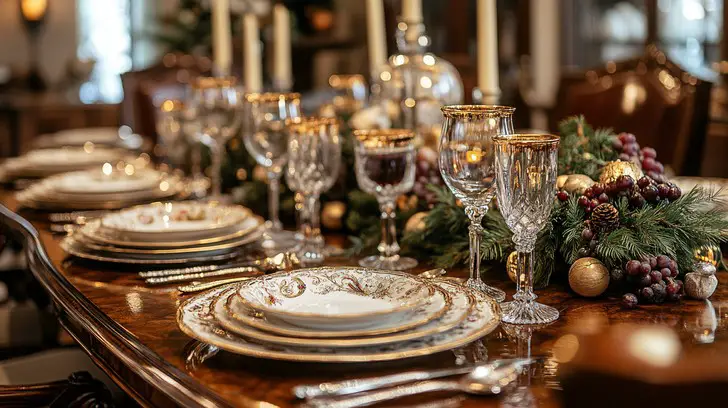
Cut crystal is hand-wash only — the dishwasher clouds it permanently, usually around the third cycle. Silver needs polishing roughly every six months, or a tarnish-resistant storage roll between uses. And if that garland is real, mist it daily and keep water in the liner; fresh evergreen in a warm dining room dries out in about ten days.
15. Bare Trees Wrapped in Warm Fairy Lights Outside the Entry
Wrap the trunk and main limbs only — once you hit the first big branch split, let it go. Plan on 100 to 150 mini lights per foot of trunk height, and buy strands with 4-inch bulb spacing rather than 12-inch; the dense spacing is what makes a wrapped tree look continuous instead of dotted. Put everything on a timer set for 5 p.m. to 11 p.m.
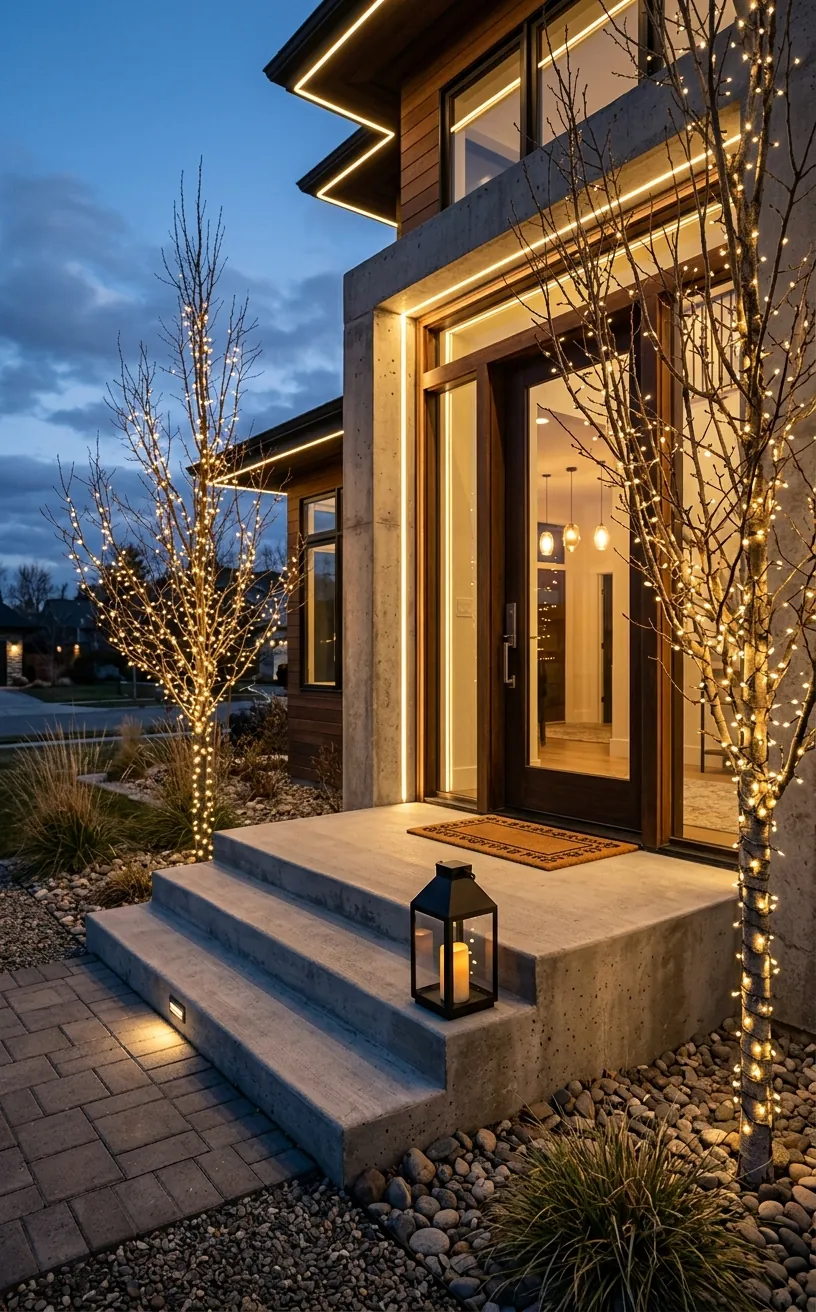
A pro install of two wrapped trees can run well past $1,500. Doing it yourself with five 100-count strands from a home improvement store costs about $60, plus $15 for an outdoor timer and $10 for cord covers. You’ll spend one Saturday on a ladder instead of $1,500, and you’ll reuse every strand next year.
16. Brick Mantel and a Table Lit by Silver Lanterns
- Large silver lantern centerpiece: $35–$90
- Illuminated glass and glitter trees, set of three: $30–$85
- Pine and berry table garland: $25–$70
- Gold-trimmed chargers and dinnerware, four settings: $40–$120
- Taper candles and holders: $15–$45
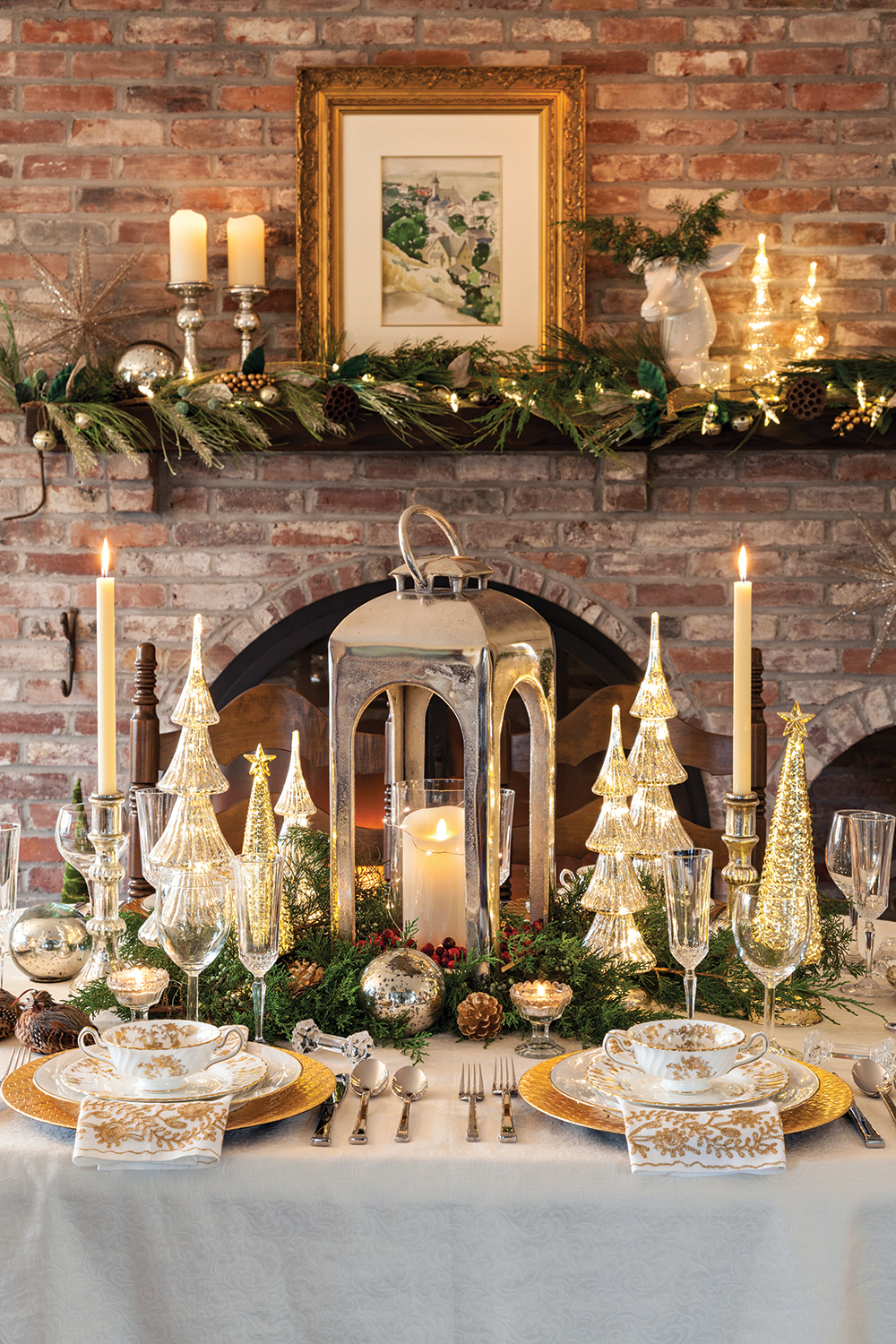
Total: about $145 to $410. Budget alternative: one thrifted brass lantern, dollar-store glass trees, and chargers sprayed gold — roughly $55 for the same glow.
The layering here is almost entirely about light sources. You have fairy lights buried in the garland, a glowing LED tree cluster, tapers at two heights, and the warm red-brown of the exposed brick behind it all. Brick is the unsung hero — its texture and warmth keep the gold and silver from reading cold, which is the classic failure mode of metallic holiday tables.
17. Blue Toile Bows on Tufted Dining Chairs
The palette breaks down to roughly 45% pale blue, 30% beige and gold, 15% navy, and 10% red. That last 10% is what makes it feel like a holiday instead of a spring luncheon — push it past a fifth of the visual field and the whole room turns patriotic. If you love the china-and-silver side of Idea #14, this is its pastel cousin.
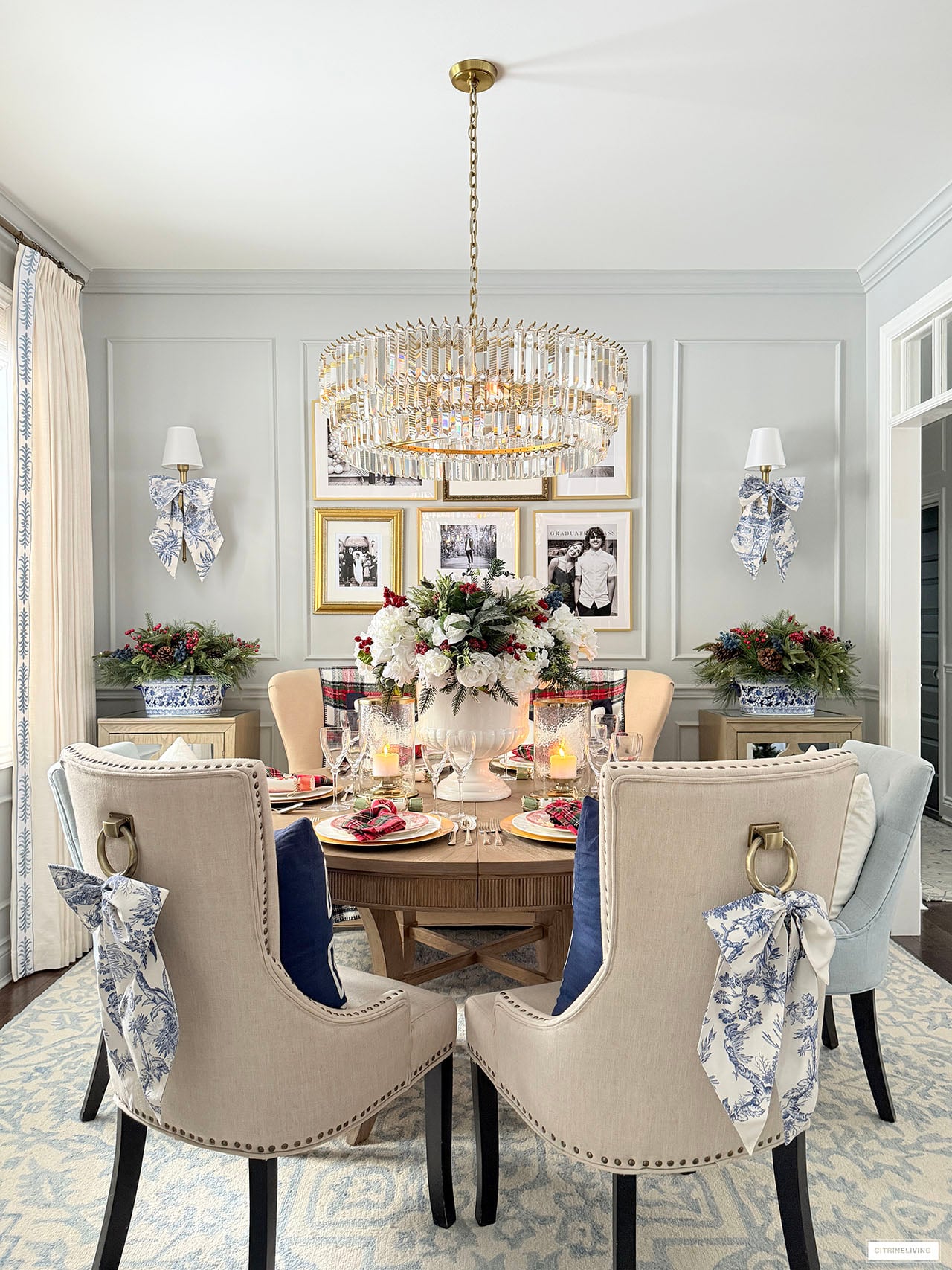
Two pitfalls here. Toile bows tied to chair backs only work if you have at least six chairs with visible backs — on four chairs or a bench, the repetition disappears and it just looks random. And pale blue walls plus a gallery wall plus red accents plus a patterned rug is four competing patterns; if your room already has two of them, cut the rug to solid and let the bows breathe.
18. Painted Brick Fireplace With a Woven Tree Collar
The white woven tree collar. It’s a $25 detail that does more work than the ornaments — it replaces a fabric skirt, echoes the white painted brick behind it, and gives the tree a finished base without adding another pattern to a mostly neutral room. Remove it and the tree looks like it’s just standing on the floor with a cord showing.
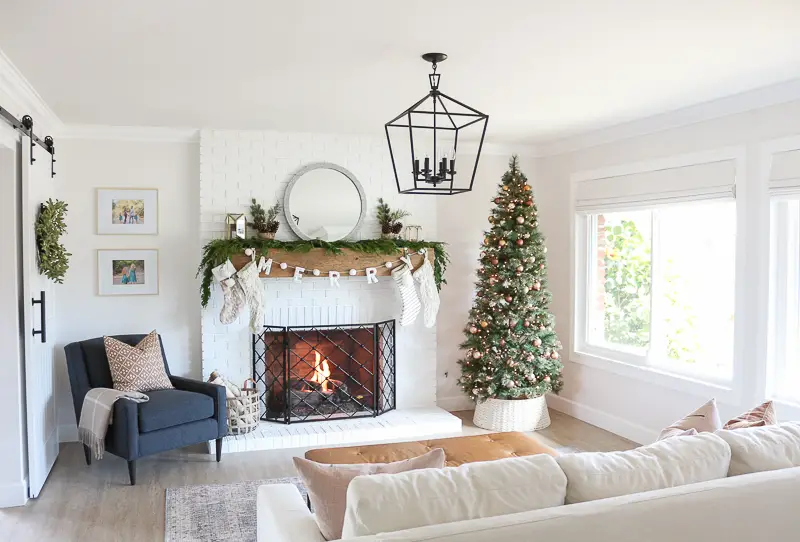
This corner works in a room of about 180 square feet with an 8- to 9-foot ceiling and a 7- to 7.5-foot tree. The window needs roughly 40 inches of clear wall to the left of the tree, or the two crowd each other in photos. Smaller rooms should look at Idea #31 instead — same neutral palette, no floor footprint at all.
19. Pom-Pom Garland in a Softly Lit Neutral Bedroom
For a pom-pom garland that doesn’t look homemade in a bad way, space the poms 4 inches apart on a 9-foot strand — about 27 poms — and thread them on a doubled strand of yarn so they don’t spin. Hang it at roughly two-thirds the height of your headboard. Keep the nightstand tree under 18 inches; anything taller competes with the lamp instead of complementing it.
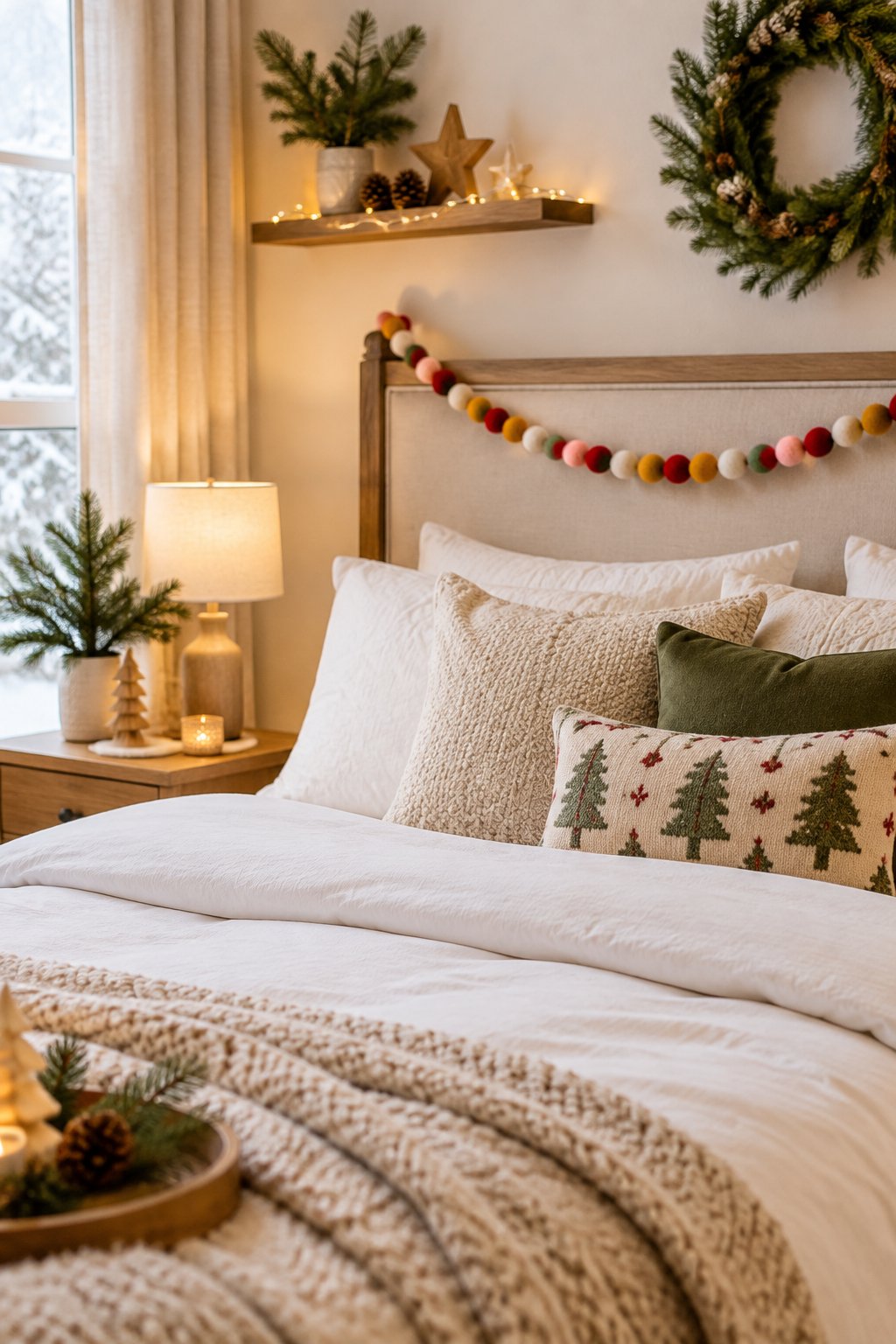
Handmade-looking decor has been climbing for a few years, and pom-poms, felt balls, and paper stars are the current darlings — partly because they’re inexpensive, partly because they photograph as texture rather than shine at a moment when shiny is out. This one has staying power in a way most craft trends don’t, since a pom-pom garland reads as neutral and gets reused for years.
20. Evergreen Garland With Red Bows on the Stair Rail
Draping garland along a stair rail so it stays put:
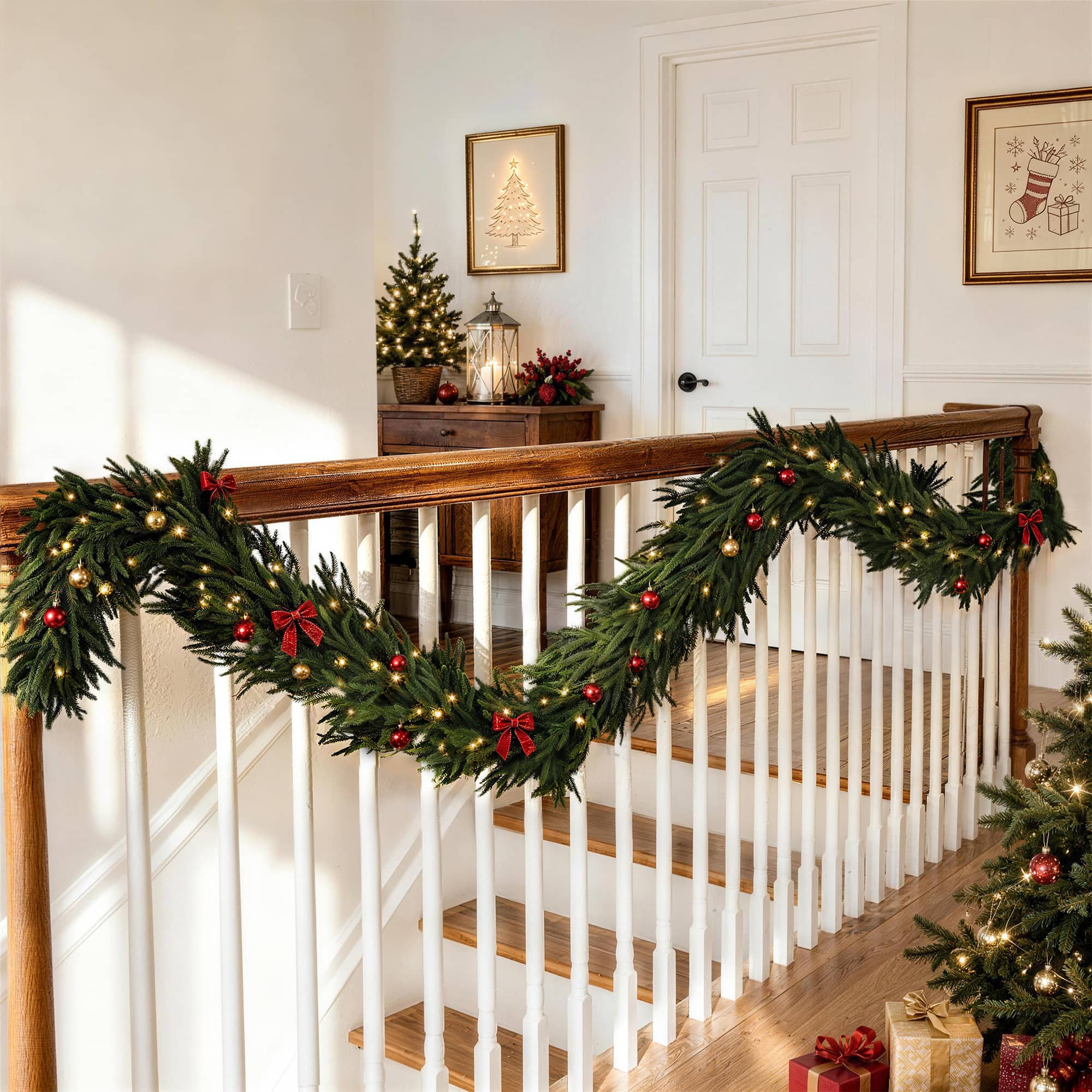
- Zip-tie the first strand to the handrail at the top, middle, and bottom — two points is not enough.
- Let the garland sag 3 to 4 inches between ties rather than stretching it tight.
- Add a second, unlit strand underneath for volume.
- Wire the bows on last, at uneven intervals.
- Run the light cord down the inside of the rail so it’s hidden from the front door.
Roughly 45 minutes and $60 to $130 in materials.
Faux pine stair garland runs $30 to $50 for 9 feet at a big-box store, and a roll of red satin ribbon is about $6. Twine-tie thrifted glass ornaments into the greenery instead of buying a coordinated set and you’ll come in under $60 — the tartan-bow version at your entry gets its own treatment in Idea #30.
21. Green Velvet and Chunky Knit Bedroom With a Lit Corner Tree
Three textures, two of them matte, is the trick: green velvet pillows reflect a little light, blue-striped linens absorb it, and the chunky knit throw swallows it entirely. That mix keeps a small bedroom from turning into a light-bouncing box. The rose-gold reindeer is the only high-shine object in the room, which is exactly why your eye finds it in half a second.
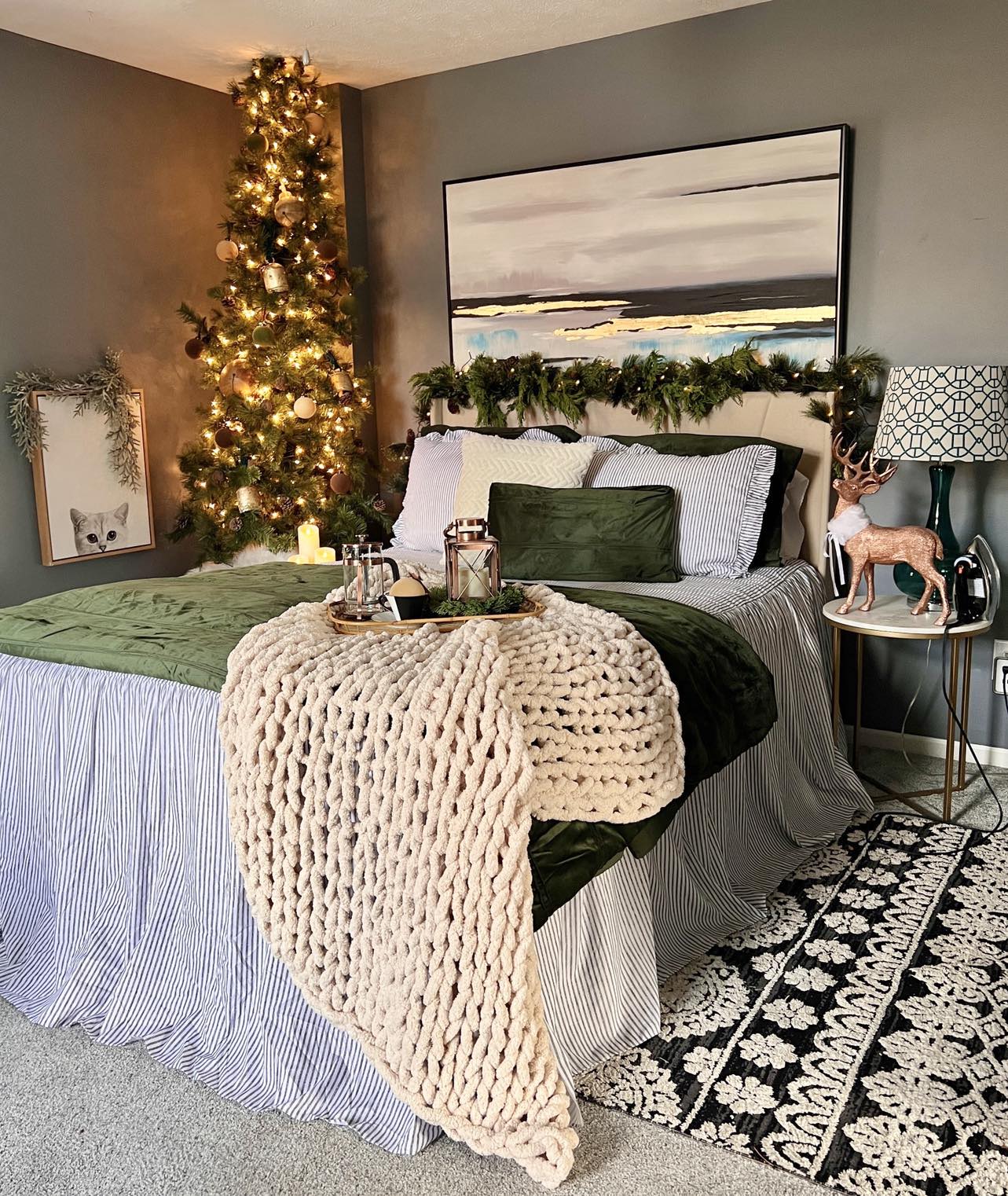
- 6-ft lit tree: $60–$180
- Lit garland for the headboard, 9 ft: $30–$80
- Chunky knit cream throw: $35–$110
- Green velvet pillow covers, pair: $20–$60
- Rose-gold figurine and tray accessories: $15–$50
Total: about $160 to $480. Budget alternative: a 4-foot tabletop tree and covers you already own in another color.
22. A Single Wreath on the Kitchen Window With Beige Ribbon
- Measure the window’s inner frame — the wreath should be about one-third the window’s width.
- Note which direction the window faces; north-facing glass keeps greenery colors truer.
- Check the ribbon’s fade resistance if the window takes direct afternoon sun.
- Confirm your cabinet hardware finish so the ribbon tone doesn’t clash with brass.
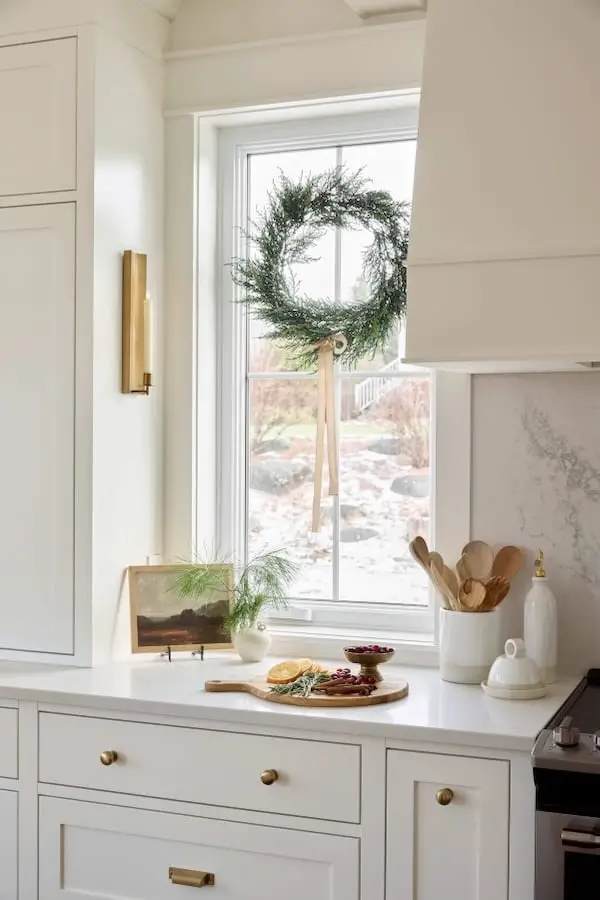
Roughly 80% white, 12% forest green, 6% natural wood, 2% brass. It’s the most restrained formula in this guide, and the reason it works is that the green only appears in three places: the wreath, the citrus, and the herbs on the cutting board. Swap the cream ribbon for black grosgrain and the whole room shifts modern.
23. Frosted Blue Velvet Ribbon Tree With Gold Floral Picks
Frosted trees shed. Expect a fine dusting of fake snow across the floor and the presents every time you brush past, so put a mat or low tray under the tree if you have dark hardwoods. Velvet ribbon also crushes permanently where it bends, and direct sunlight fades teal faster than almost any other tree color. Keep this one away from a south-facing window.
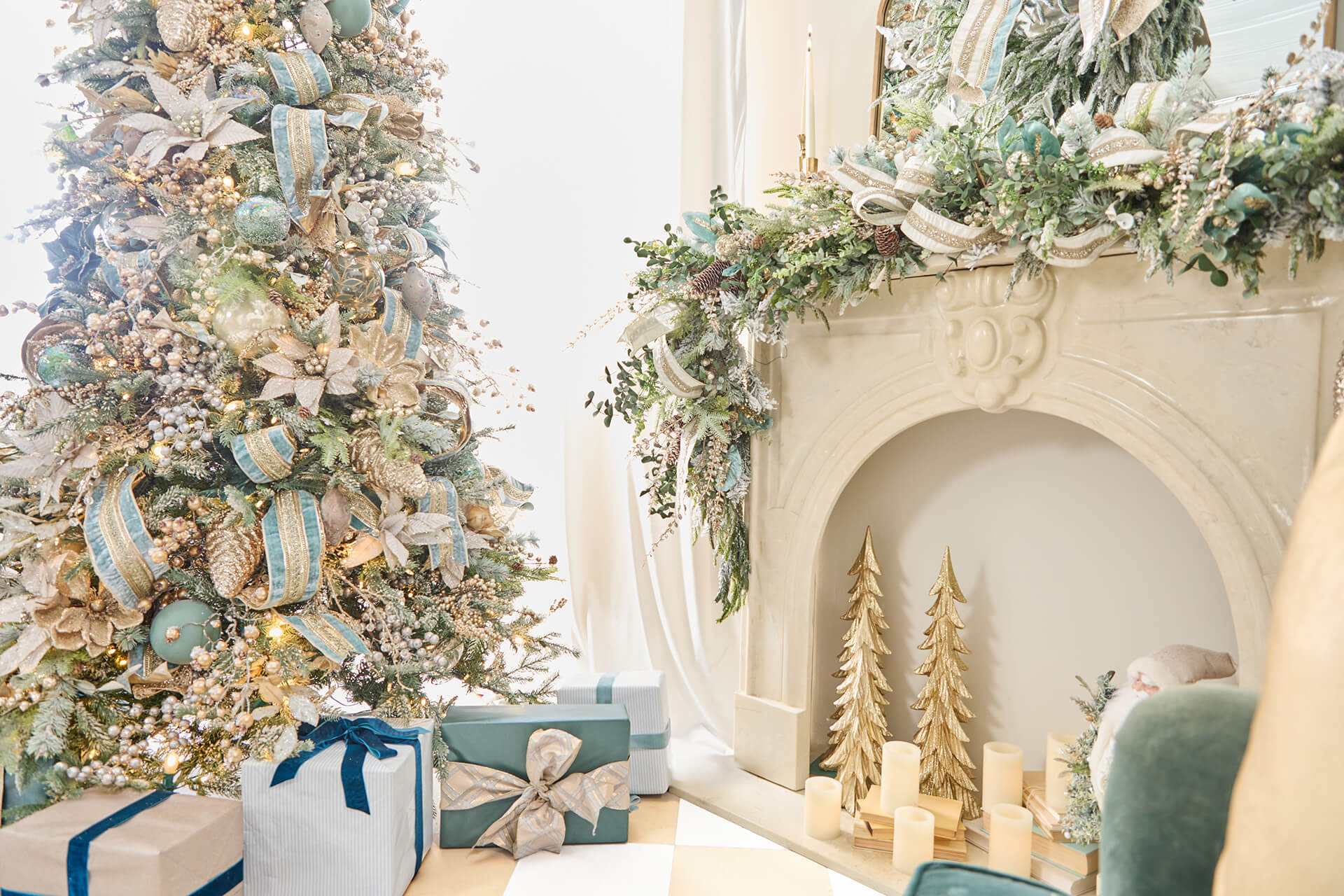
Use 4-inch wired velvet ribbon, not satin. Cut the tails 18 inches long, make a simple two-loop bow with 6-inch loops, and wire it to a branch so the loops sit vertically rather than flat against the tree. Seven to nine bows total on a 7.5-foot tree. Any more and the ribbons start reading as the whole tree instead of an accent.
24. Black and White Plaid Ribbon on a Tall Tree
The black and white plaid ribbon. Everything else on this tree — gold balls, red ornaments, birch bark spheres — could belong to almost any holiday tree. The plaid is what dates it to right now and gives all that warmth a crisp black edge. Pull the ribbon and you’re left with a pleasant but anonymous tree; keep it and the whole thing has a point of view.
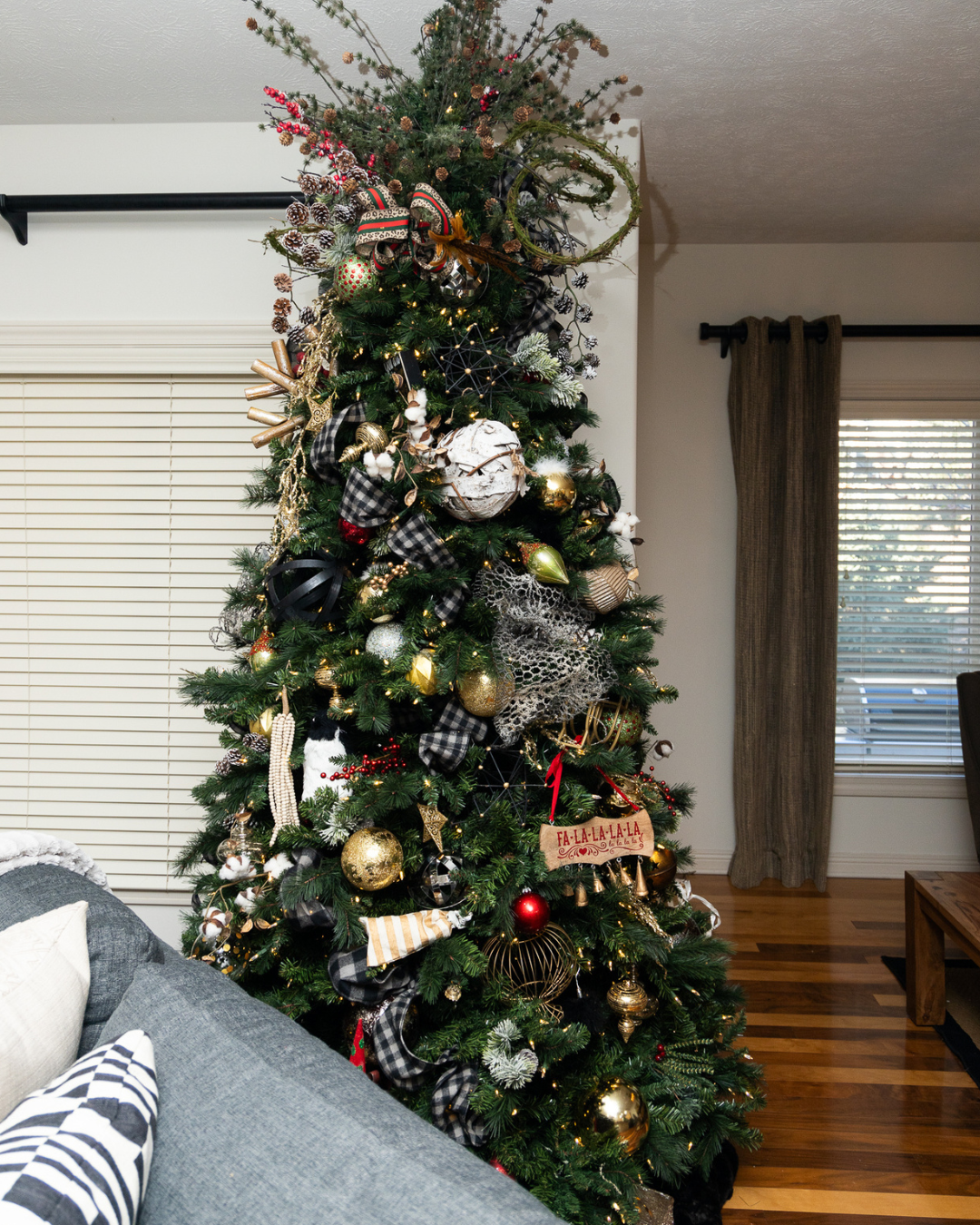
Plaid at this scale needs a 9-foot tree and a 10-foot ceiling, or the pattern gets visually loud in a small room. Use 2.5-inch ribbon on a 7.5-foot tree and 4-inch only on 9 feet and taller. Keep the brown curtains and blinds open during the day here — the scheme needs daylight to stop the black accents from swallowing the gold.
25. Blue Cabinets With a Chalkboard Shiplap Backsplash
Two things converged: dark cabinetry has been the biggest kitchen color story for several years, and chalkboard walls are having a nostalgia moment right alongside it. Put them together and you get a backsplash that’s seasonal without being storage-hungry — the whole thing wipes clean in January. It’s the rare holiday trend that actually costs less than the alternative.
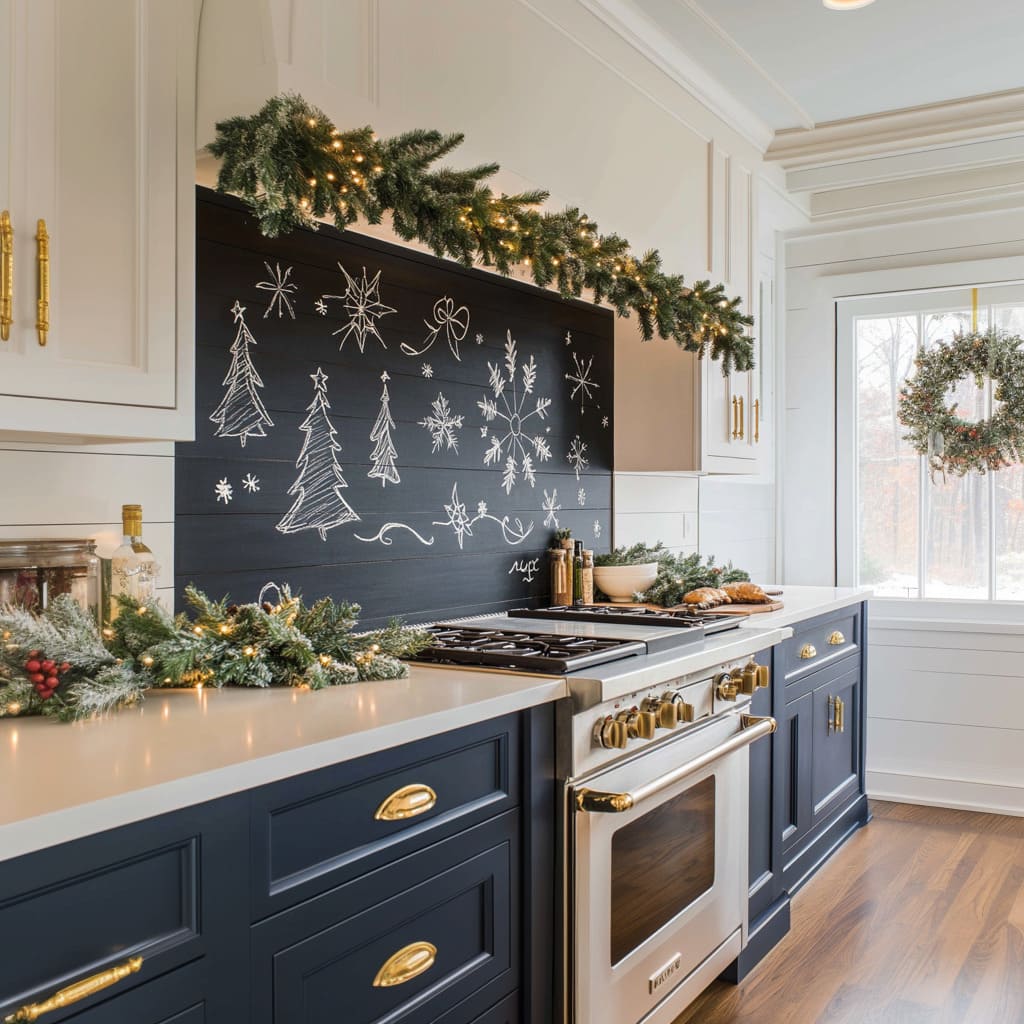
Chalk art on a shiplap backsplash:
- Wipe the black panels with a dry microfiber cloth — cooking oil kills chalk adhesion.
- Condition the surface by rubbing a full stick of chalk sideways, then wiping it back off.
- Sketch the design in plain white chalk first, then go over it with a chalk marker for crisp lines.
- Seal lightly with a mist of hairspray from 12 inches away.
About an hour of work and $15 in supplies.
26. Red Roses and Tall Gold Tapers on a Red Tablecloth
- Red tablecloth, 90 x 132 in: $30–$80
- Deep red napkins with gold rings, set of eight: $35–$90
- Green chargers and patterned plates: $40–$110
- Floral runner with red roses and greenery: $50–$150
- Tall gold taper candles and holders: $20–$60
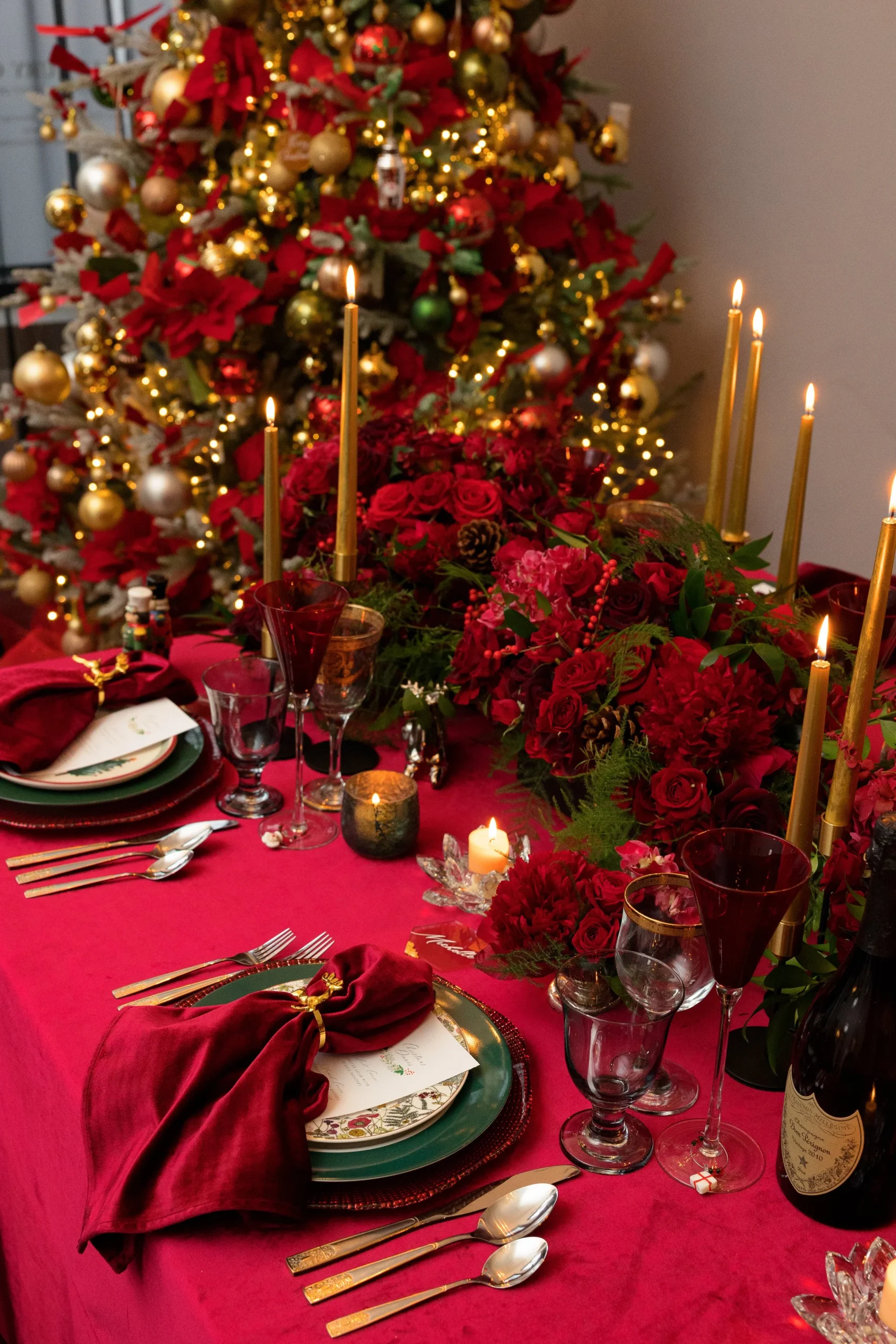
Total: roughly $175 to $490. Budget alternative: an $18 discount-store tablecloth, white plates on painted chargers, and supermarket roses in three low clusters.
Red linen shows every grease spot, so treat the cloth with a fabric protector before the first dinner. Candle wax on fabric comes out with an ice cube and a dull knife, not a hot iron — heat sets the stain permanently. Fresh roses in a warm dining room last about five days, so buy them two days out, not a week, and trim the stems at an angle under running water.
27. A Living Room Organized Around a Lit Hearth
The room is organized around one glowing triangle: hearth, tree, stockings. Your eye moves between three light sources sitting at roughly the same height, which is why the seating arrangement feels inevitable rather than arranged. The wooden coffee table and the rug keep that triangle from floating — they anchor the floor plane so the glow above has something to land on. For the darker, moodier version of this same triangle, see Idea #28.
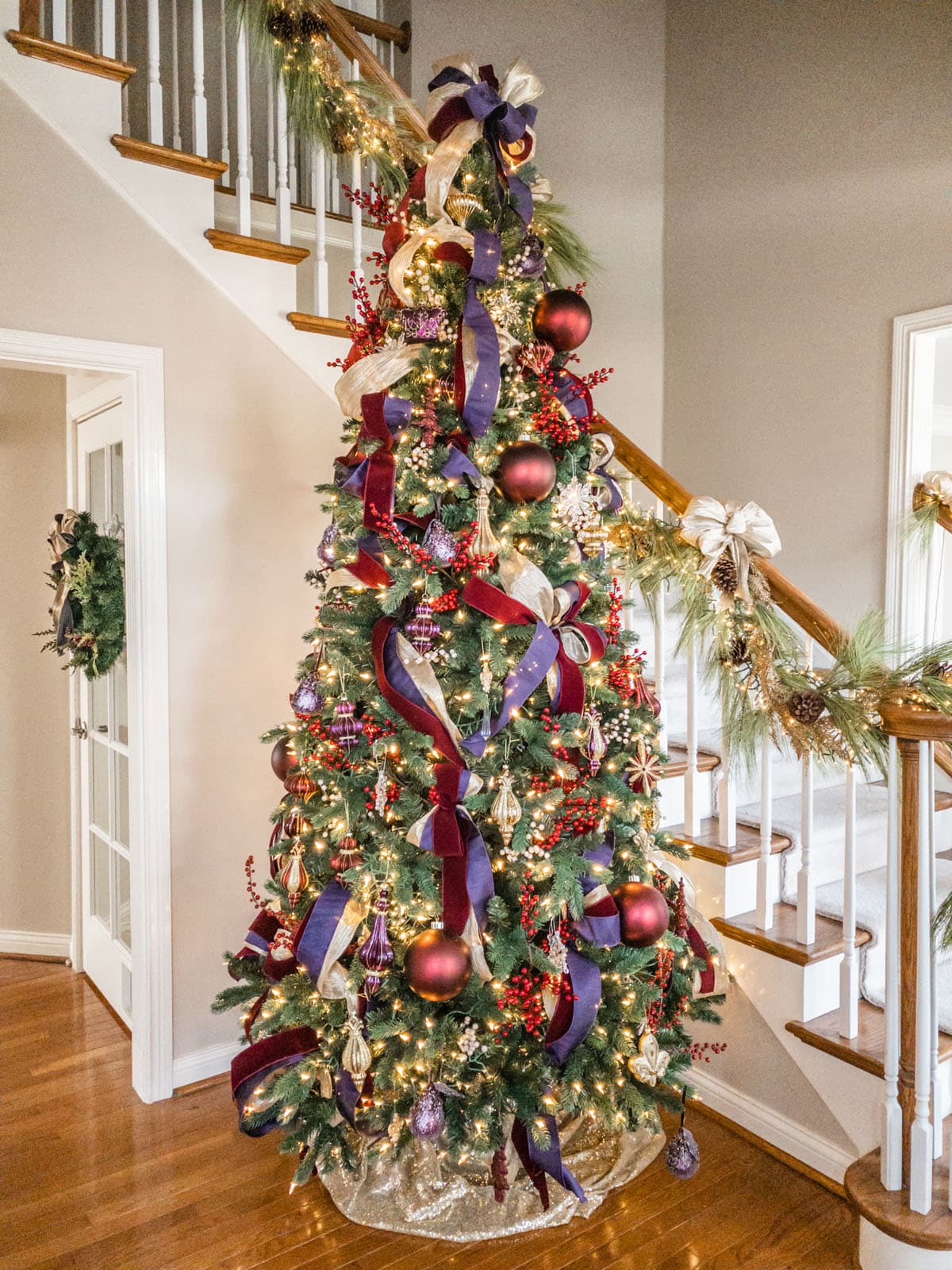
A credible faux 7-foot tree runs $80 to $200 at a big-box store, and a pre-lit mantel garland is about $35. Stockings from a thrift store at $3 to $8 each plus a $20 marketplace rug gets you this exact feeling for under $300 — the fire is the only piece you can’t buy on sale.
28. Botanical Wallpaper Dining Room With a Black Woven Pendant
About 40% forest green, 25% black, 20% white, 10% natural wood, 5% silver. The black is the load-bearing element — it’s what separates moody from muddy. Remove it and you have a pleasant green room with no edge. Swap the black pendant for brass and the scheme warms up and loosens; swap the white candles for amber and it goes full dramatic.
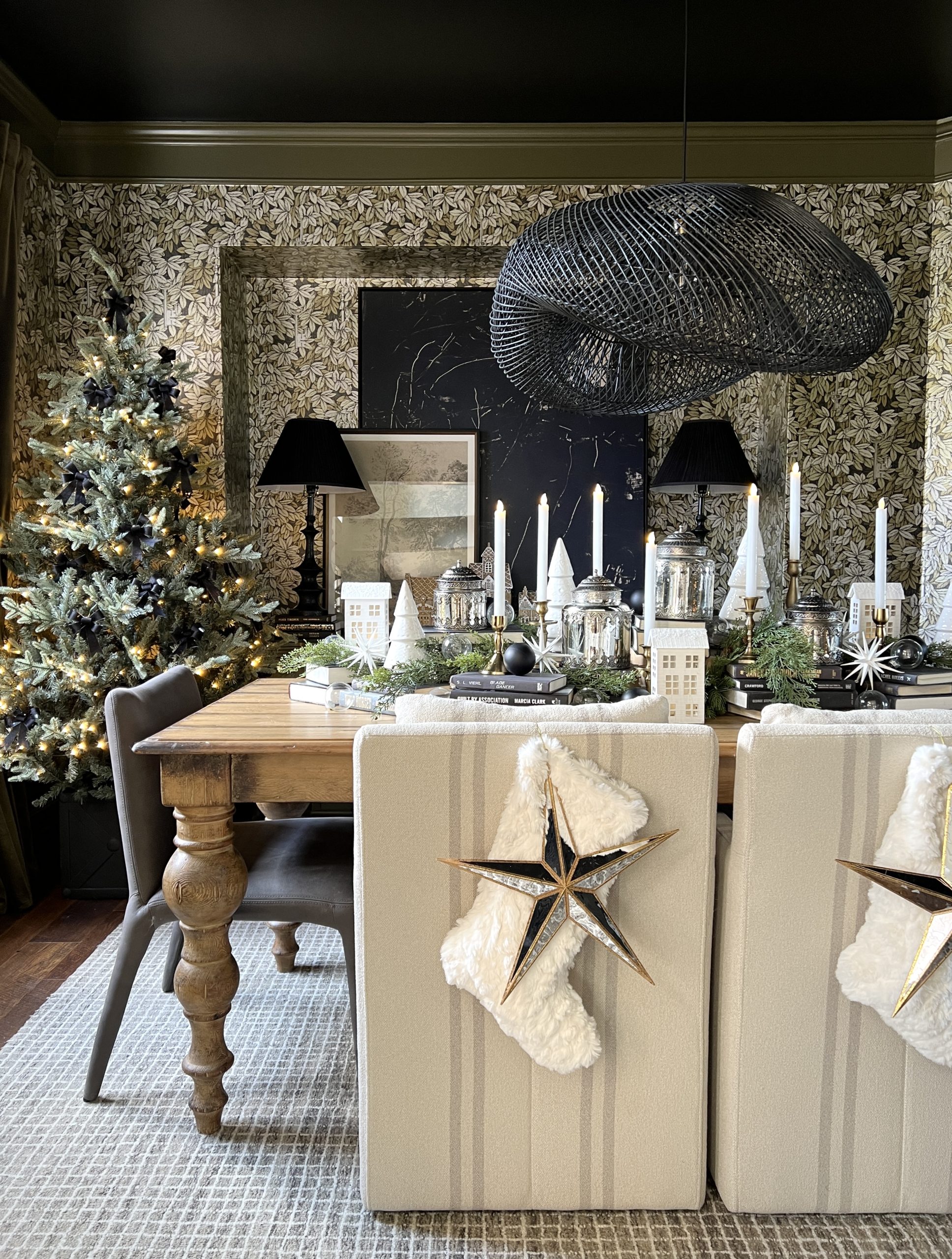
Dark ceilings and botanical wallpaper are gorgeous, and they absolutely shrink a room. This works in a dining room you use at night with the chandelier on; it works less well as a breakfast nook that needs morning light. Open tapers next to wallpaper are also a genuine fire risk, and that sculptural woven pendant collects dust visibly — budget for a long-handled duster.
29. Eucalyptus and Red Berries Cascading Off a Marble Mantel
Place berry clusters in odd numbers — three or five — and put the heaviest one about a third of the way along the garland, never dead center. Symmetry reads store-bought; asymmetry reads gathered. If you’re using fresh eucalyptus, know that it dries beautifully and holds its shape for months, while fresh pine drops needles within two weeks. Choose accordingly.
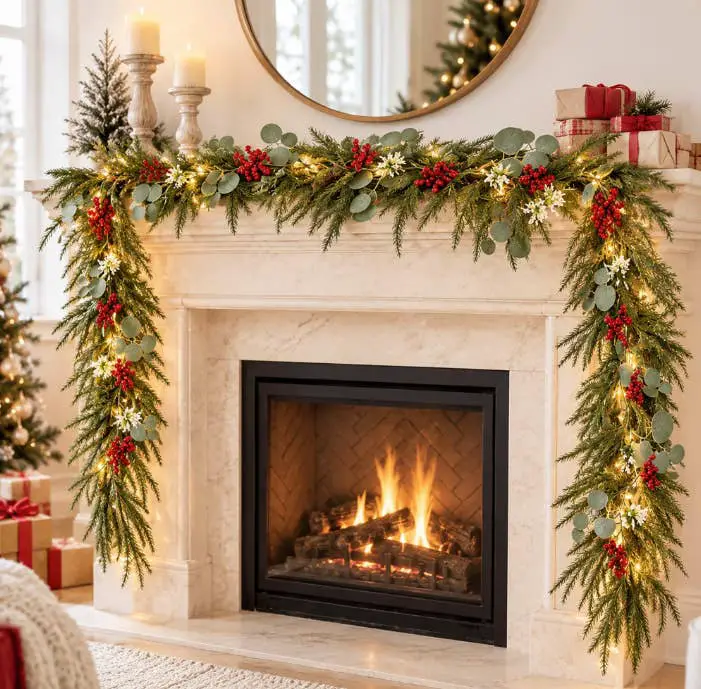
The cascade. The garland doesn’t stop at the mantel corners — it falls down both sides of the marble, and that’s what makes the look expensive. A garland laid flat across the shelf is decoration; a garland spilling over the edges is architecture. The vertical drop also visually widens a narrow fireplace and gives the stockings and gifts a frame to sit inside.
30. Tartan Ribbon Bows and a Poinsettia at the Entry Bench
- Tartan and gold wrapping paper and ribbon: $15–$40
- Evergreen stair garland, 9 ft: $30–$70
- Large tartan bows, set of three: $20–$50
- Bench cushion in red stripe: $25–$70
- Potted poinsettia, 10 in: $15–$35
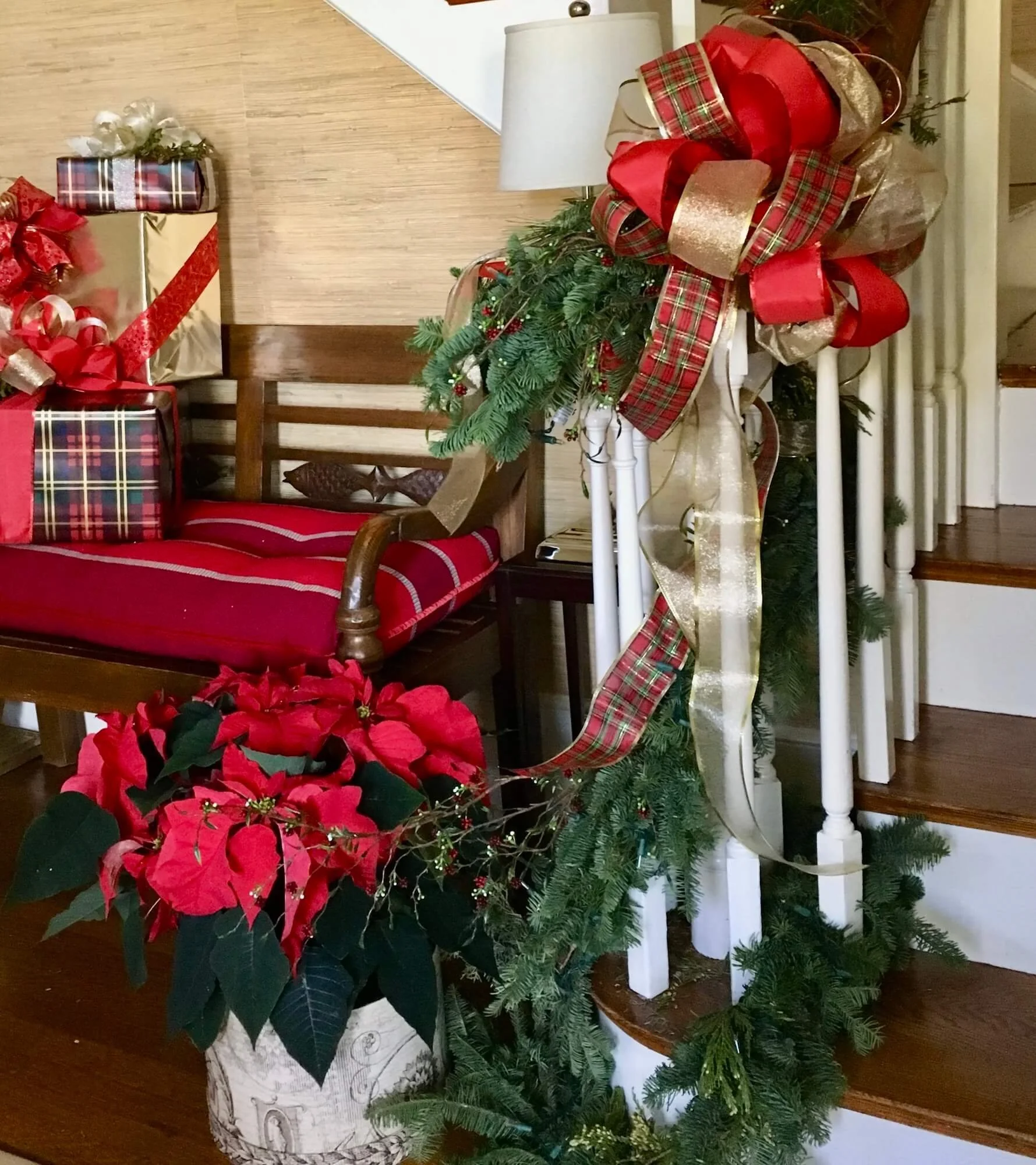
Total: about $105 to $265. Budget alternative: wrap gifts in kraft paper with a tartan ribbon band and use one wide bow at the newel post instead of three.
Stair garlands look best at about 1.5 times the height of the handrail once you include the sag. On a standard 36-inch-wide staircase, use one strand and let it breathe; wider than 42 inches, double up. Bows should be 8 to 10 inches across and spaced so the eye hits one roughly every three steps.
31. Cotton Stems and Taper Candles on a Light Coffee Table
Two honest notes. White taper candles drip, and paraffin drips are miserable to lift off a distressed wood table — use dripless beeswax tapers or add a glass chimney. And dried cotton stems are extremely flammable; they look innocent and they are not. Keep every flame at least 12 inches from the stems, and never leave this vignette burning in an empty room.
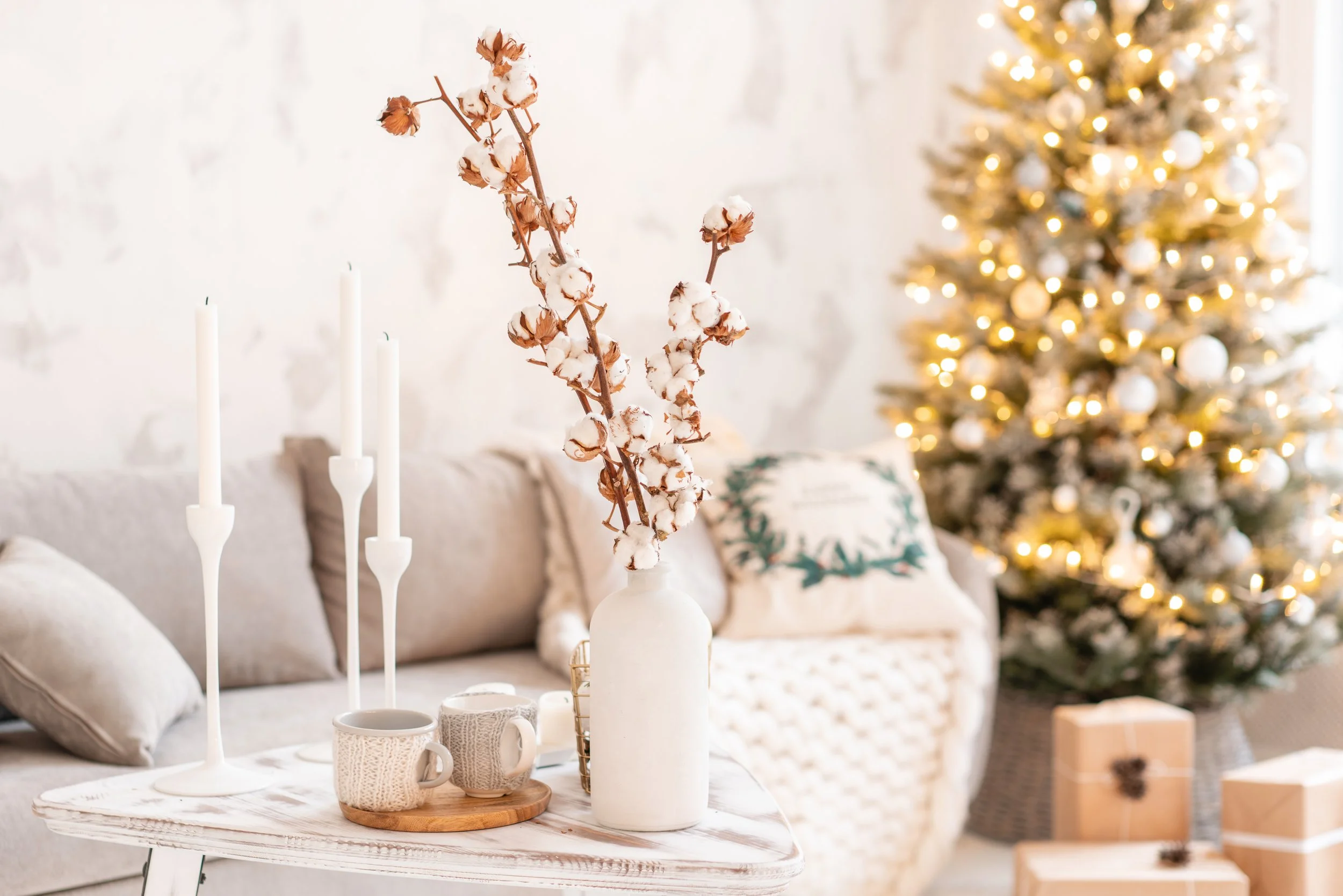
- Measure your coffee table’s usable center — the tray and vase need 18 inches of clear space.
- Keep candle tops below eye level when you’re seated on the sofa.
- Check your vase opening: cotton stems are top-heavy and tip in narrow vessels.
- Confirm the knit mugs are food-safe if you actually plan to use them.
32. A Lace-Draped Table Lit by Pink and Cream Candles
Building a candle-cluster centerpiece:
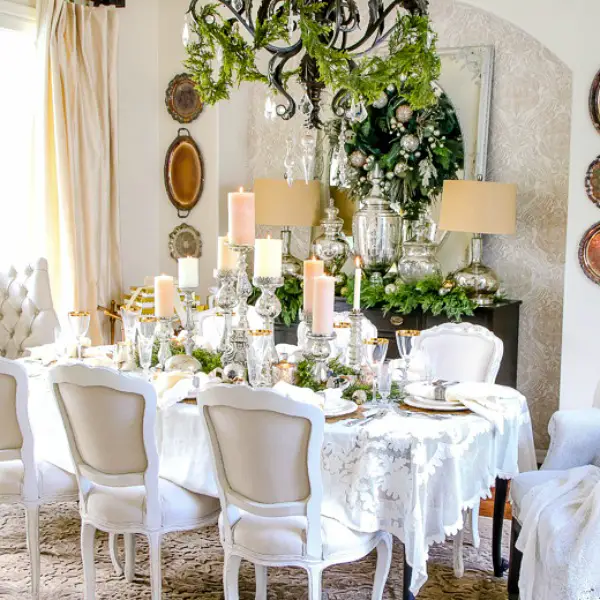
- Lay a 6-foot garland loosely down the center — 10 inches wide, not 20.
- Group candle holders into three clusters of three or five, never evenly spaced.
- Leave a 14-inch gap between clusters so guests can see across the table.
- Set the tallest candle in each cluster at 10 to 12 inches and step down from there.
- Add the lace or linen last, under everything, so drips land on cloth you can wash.
About 30 minutes and $40 to $90.
Candlelight maximalism is one of the clearest shifts of the season: fewer objects, more flames. It grew out of the broader move toward warm, low lighting in interiors, and it stuck because candles are the cheapest way to change the mood of a room. Lace and pink cream tones are riding along with it — a soft romantic counterpoint to the dark-and-moody rooms that dominated a few years back.
Your House, Your Holiday, Your Rules
Pick one idea that made you lean in — not five. A single well-executed garland or a mantel that finally looks finished does more for a room than a dozen half-started projects. Then pin the ones you loved, because next November you’ll be glad you did.