
You know that feeling when you find a vintage Christmas tree photo at 11pm, save it, and then can’t figure out how to make it look anywhere near that good in your own living room? Same. The magic in those photos is almost never the tree itself — it’s the ribbon width, the basket it sits in, the wall behind it.
We dug through Etsy, World Market, Target, Anthropologie, and a genuinely unreasonable number of thrift listings to narrow this down to 30 ideas that actually deliver, from a $12 ornament set to a $450 flocked tree.
Inside you’ll find traditional, maximalist, rustic woodland, and midcentury retro trees, with budget and luxury versions compared side by side so you can decide before you spend.
2026 is the year the pendulum swung back from minimalist Scandi trees toward the “inherited” look — dense, mismatched, and collected over decades instead of bought in one afternoon.
Pin this guide for later — your future self will thank you when it’s time to actually do this. And stay until the end, where we break down the most common mistakes that can ruin these looks.
1. Read This Before You Go Fully Vintage
Here’s the part nobody mentions when they tell you to load your tree with estate-sale glass. Ornament paint made before the 1970s frequently contains lead, and it flakes. Wash your hands after handling, keep the chipped ones above toddler and pet height, and don’t let anyone treat them as toys. Old foil tinsel from the 1950s and 60s is its own problem — the aluminum strands can cut a cat’s intestines if swallowed. Display it high and out of reach, or use modern mylar and get the same sparkle with none of the vet bills.
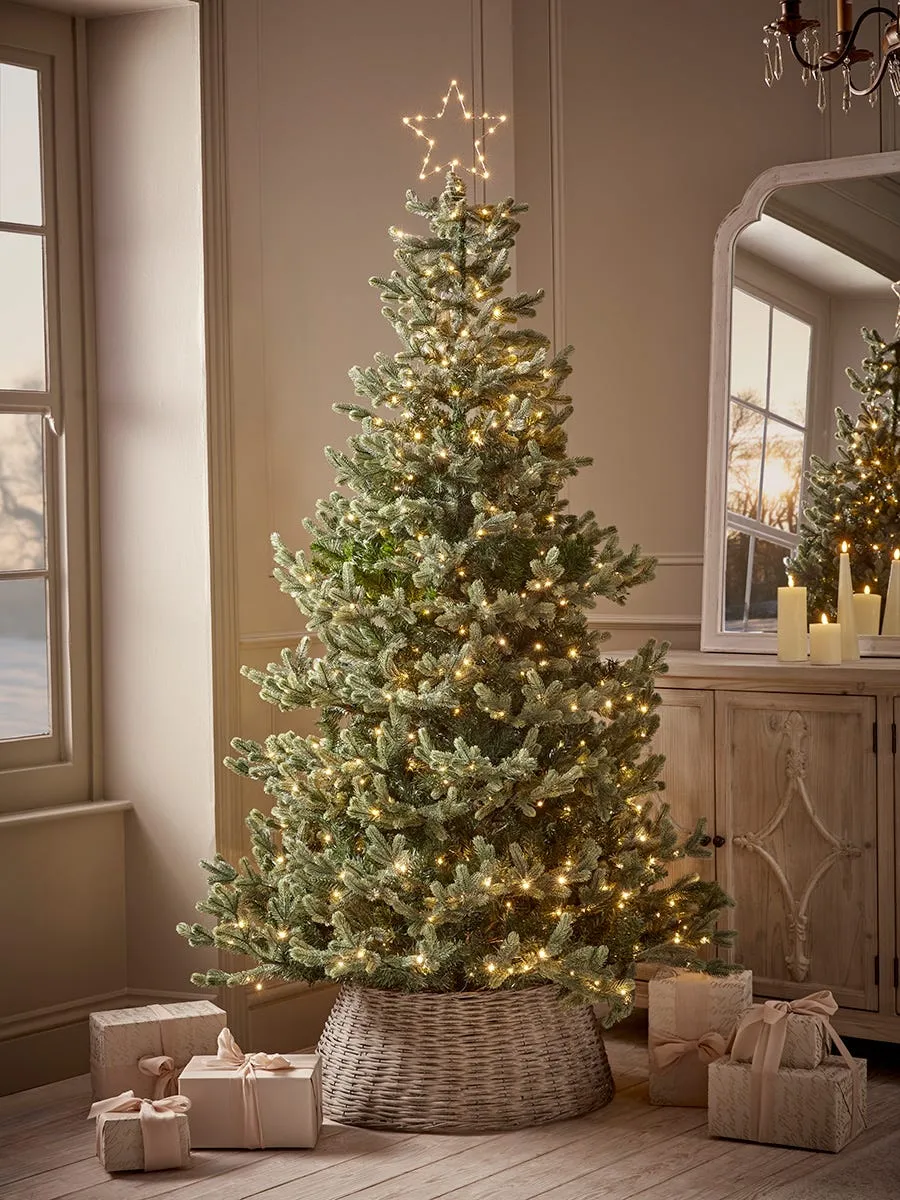
- Measure floor-to-ceiling height before you buy — an 8-foot tree needs a 9-foot room once the topper is on
- Count your light strands and locate the nearest outlet before decorating day, not after
- Weigh your heaviest ornaments; anything over 8 ounces needs florist wire, not a hook
- Set aside $40–$80 for storage bins, because vintage glass does not survive cardboard
- Decide now whether you want a real tree with vintage ornaments or a faux one you can leave up through January
2. A Slender Evergreen in a Woven Wicker Basket
Three decisions are doing the heavy lifting here. The wicker basket replaces a fabric skirt entirely, which grounds the tree with texture instead of pattern and keeps the whole vignette quiet. The narrow silhouette leaves the window sightline open, so a bright room stays bright in December. And the soft blue-gray velvet ribbon echoes the cool tones in the sofa, which is exactly why the cream pillows beside it don’t read as flat or washed out.
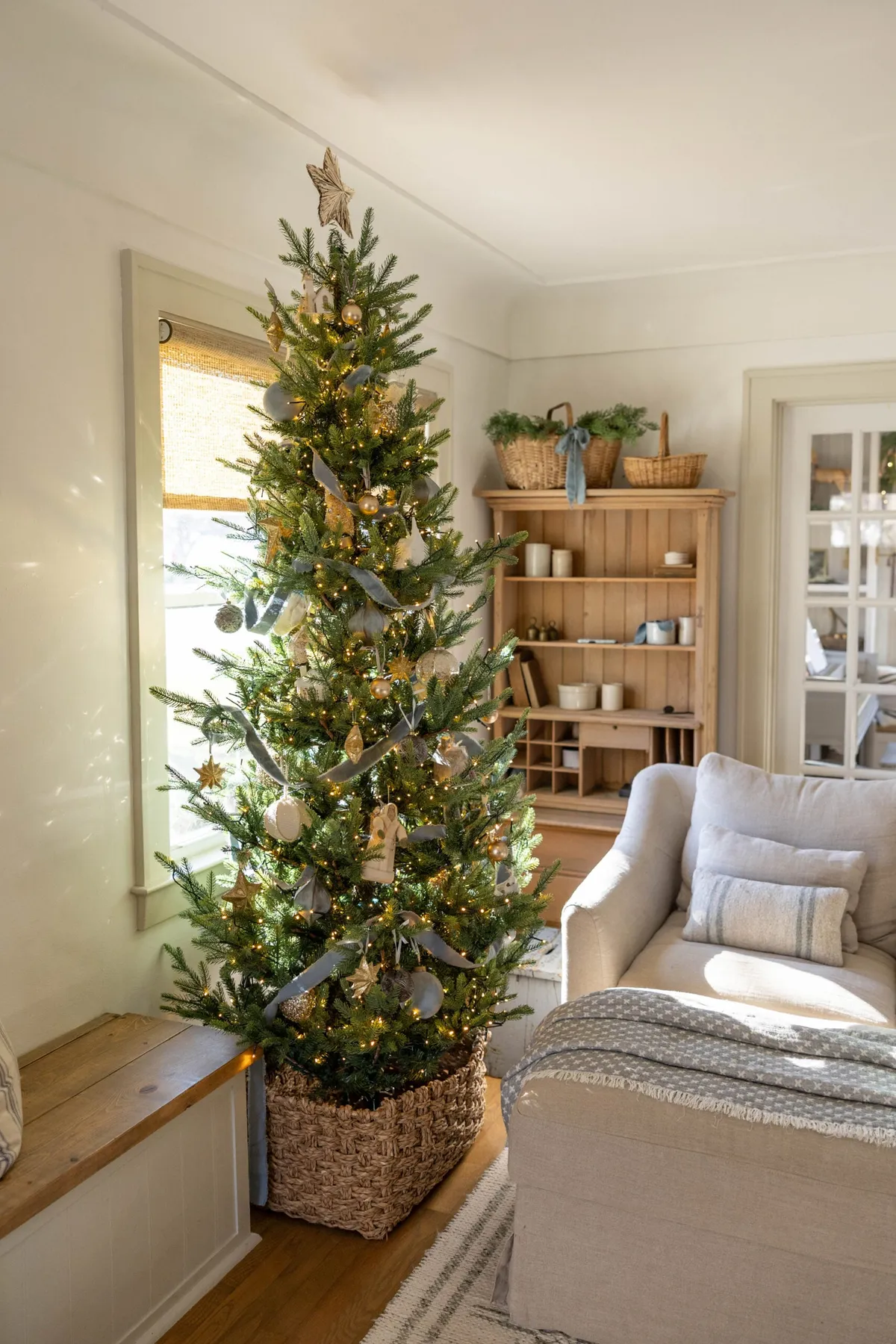
Ribbon width matters more than ribbon color. On a tree 7 feet or taller, use wired velvet or taffeta between 2.5 and 3 inches wide. Cut six-foot lengths, then weave each one in a loose S between branches rather than spiraling — spirals look store-bought from across the room. Anchor both ends to a branch with 24-gauge florist wire. Never hot-glue velvet to pine; it scorches the nap and you will not get that ribbon back.
3. Maximalist Glass Baubles with a Porcelain Plate Wall
The grandmillennial look has been building for years, but 2026 is when it went fully mainstream — Pinterest searches for vintage glass ornaments climb every November, and the appeal is that none of it matches. Trees like this one get assembled over time, never purchased in a single trip. The blue-and-white porcelain plates are the tell: they’re summer wall decor that happens to look spectacular in December, which means you’re not buying anything new for the room.
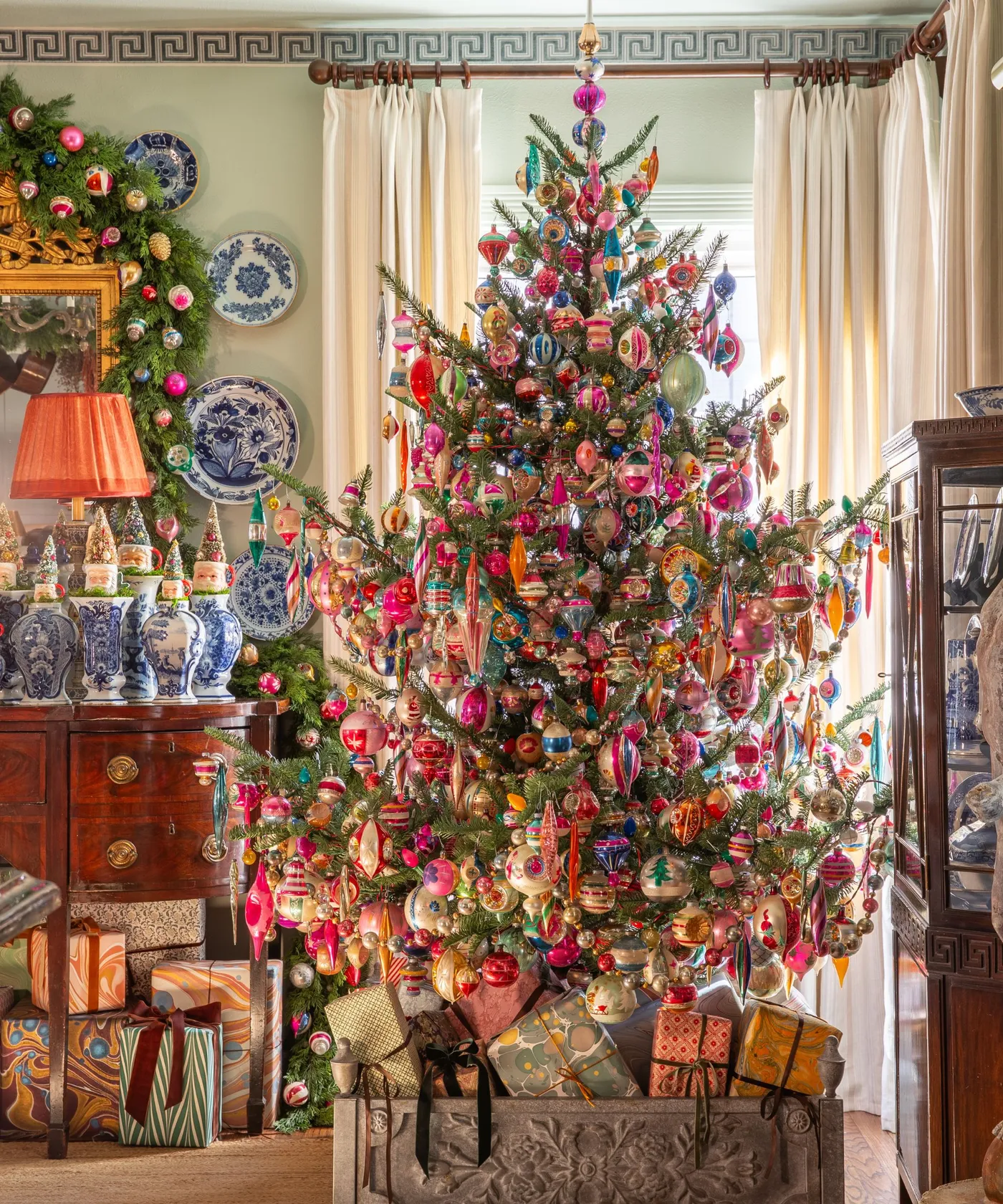
55% evergreen + 25% multicolor glass + 15% blue-and-white porcelain + 5% antique gold. That’s the entire formula. To shift the mood, hold the porcelain constant and change the glass palette completely — all pink and silver reads romantic, all red and gold reads classic. Proportions matter far more than specific colors, so resist adding a fourth element even when you find something you love.
4. A Red-and-Gold Tree Against Wood Plank Walls
- Two warm-toned armchairs: $400–$1,600
- Geometric wall sconces, pair: $80–$260
- Skirt, throw, and textiles: $40–$140
- Ornaments, garland, round wire shelf: $90–$250
- Horizontal plank accent wall, 8×10 ft, DIY: $120–$400
- Total: $730–$2,650
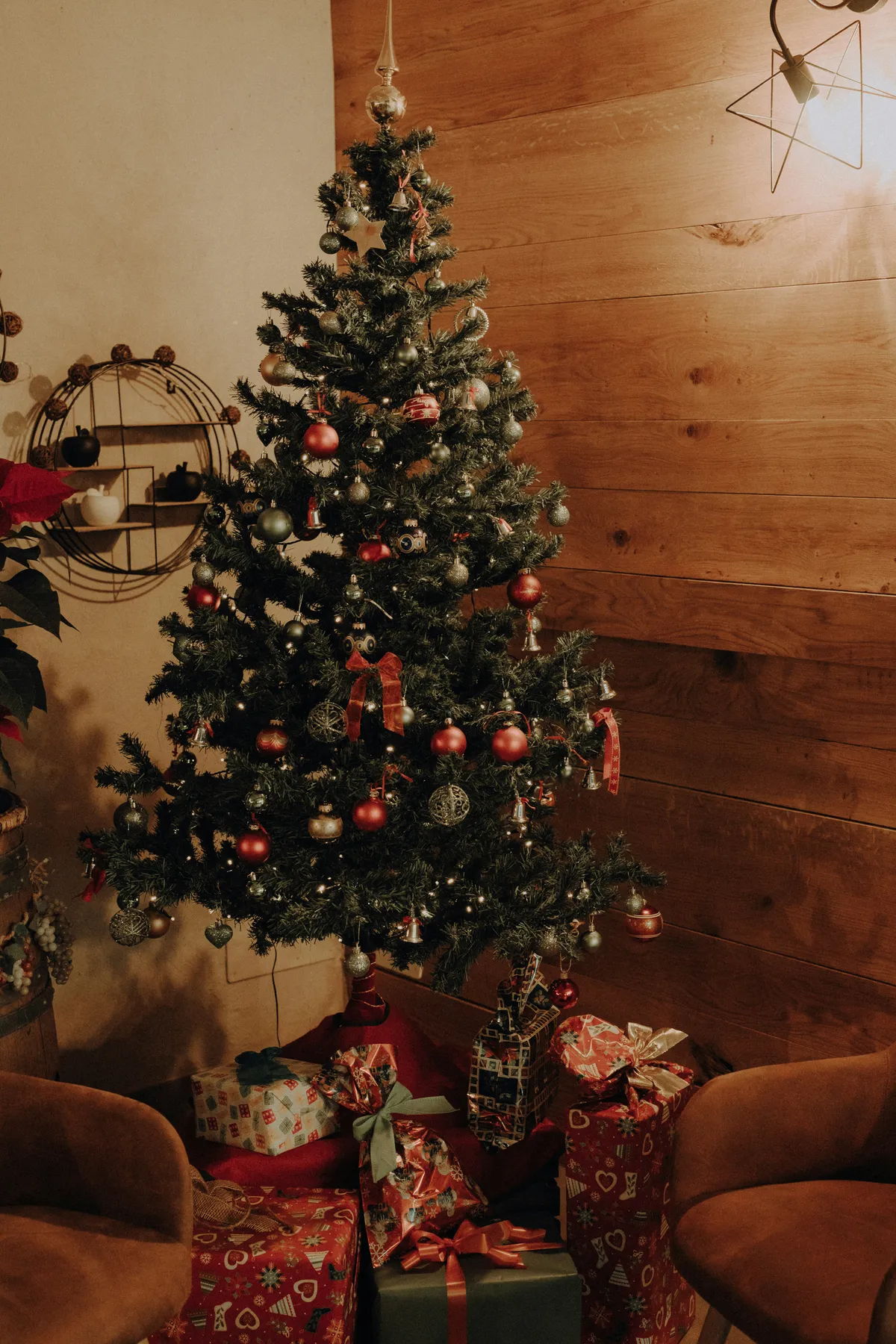
Budget alternative: peel-and-stick wood plank panels cover one wall for $110–$180 and save you close to 60%. You lose the reclaimed grain, but you keep every horizontal line that makes the look work.
The plank wall is the whole idea. Horizontal boards behind a vertical tree create a cross-hatch that makes a fairly ordinary red-and-gold tree look styled and deliberate. Take the wall away and you have a nice tree in a beige room. The sconces, the wire shelf, and the wrapped presents are all supporting cast, which is why you can swap any one of them without losing the effect.
5. Red Velvet Bows Framed by a Gilt Mirror
If you own one large mirror, put the tree in front of it. A 36- to 48-inch mirror hung with its center 60 inches off the floor roughly doubles the perceived light from your string lights — it’s the single cheapest way to make a tree look expensive. Set the tree 12 to 18 inches in front so branches never touch the glass, and if there are kids or dogs in the house, press a little museum putty under the mirror’s bottom corners.
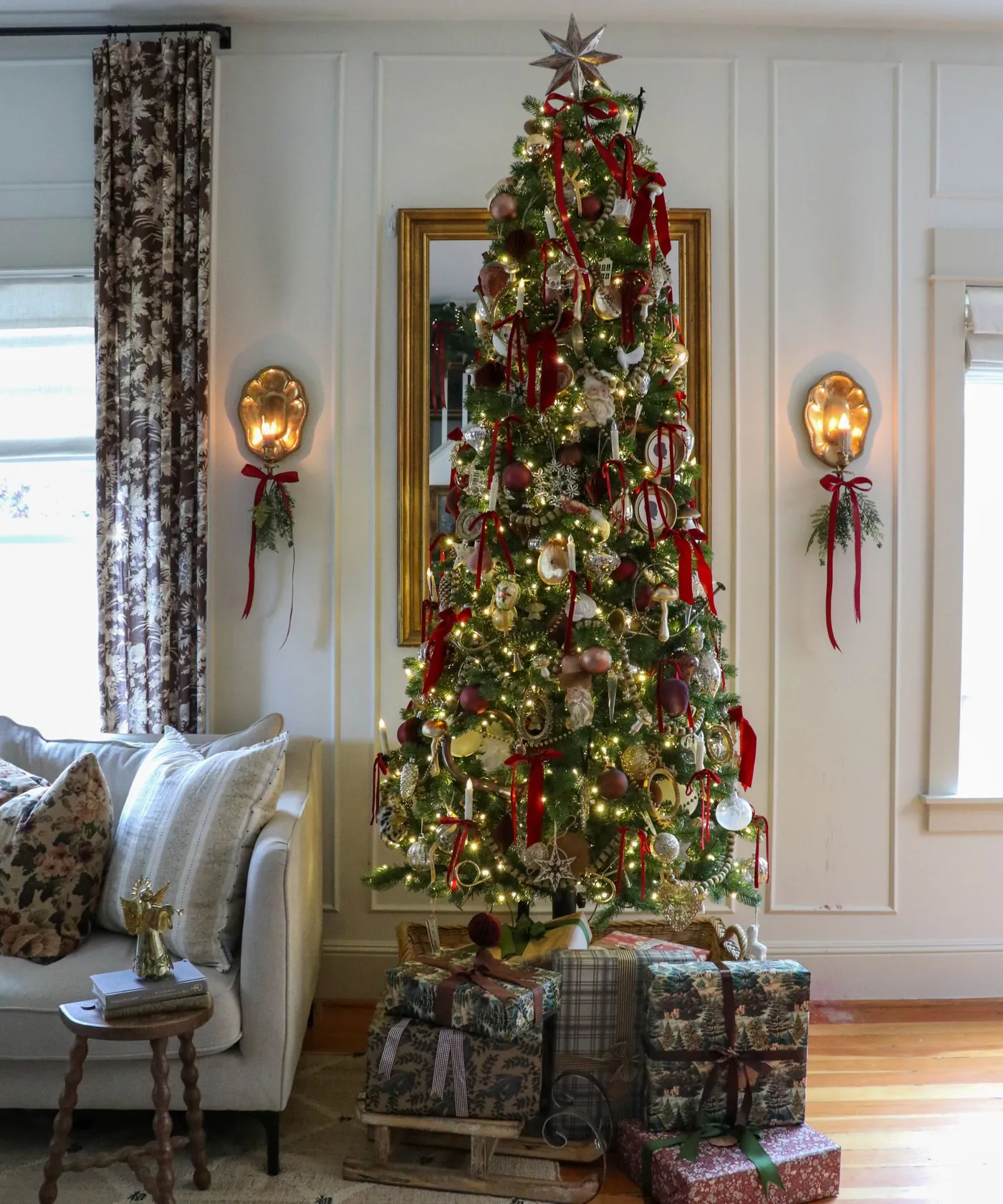
This arrangement wants a room at least 12 by 14 feet with 9-foot ceilings, since an 8-foot tree plus a mirror above it needs vertical room to breathe. In a tighter living room, borrow the palette instead of the layout — Idea #3 uses the same red-and-gold language against a single flat wall and works fine in 10 by 10.
6. Cascading Pearl Garland Over Glossy Baubles
It’s the bead garland, and specifically the way it loops rather than spirals. Three passes of a 12-foot strand, each dipping a few inches lower than the last, create depth a spiral can never reach — the eye reads the tree as layered instead of wrapped. Remove it and you’re left with a perfectly nice but completely flat tree covered in shiny balls. The silver snowflake topper is quiet by comparison, and that restraint is deliberate.
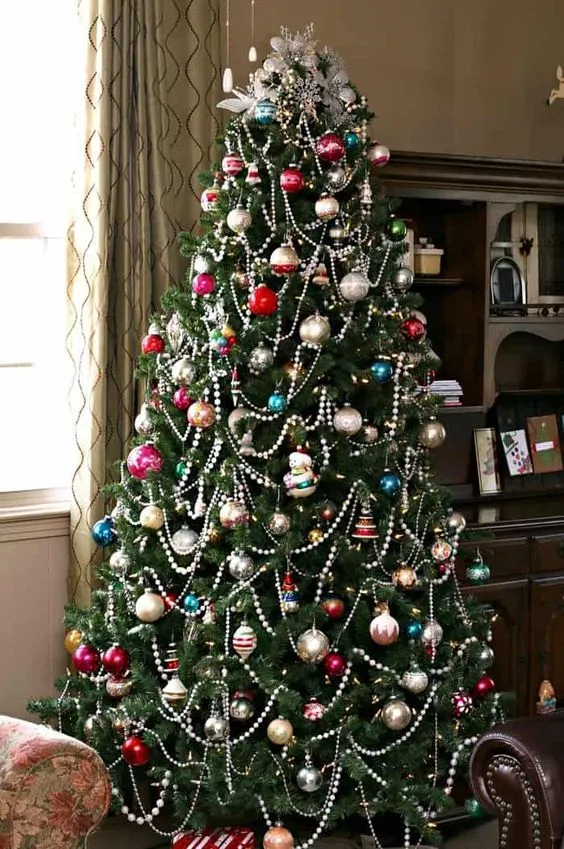
Bead garland is beautiful and slightly annoying. On a live tree, sap grabs every strand you drape, and untangling 36 feet of pearls in January is a genuinely bad afternoon. It’s also heavier than it looks, so keep it off the outermost branch tips where it bends the needles down permanently. Faux tree, no problem. Real tree? Consider a wide ribbon instead and save yourself the wrestling match.
7. Dried Orange Slices and Candle Lights in a Book-Filled Room
- Slice navel oranges about 1/8 inch thick — thicker slices stay damp and mold.
- Blot both sides on paper towel, then lay them on a wire rack over a sheet pan.
- Bake at 200°F for three to four hours, flipping once at the two-hour mark.
- Cool completely; they should feel like stiff leather, not fruit.
- Thread a darning needle with cotton twine and string them with a 1-inch gap between slices.
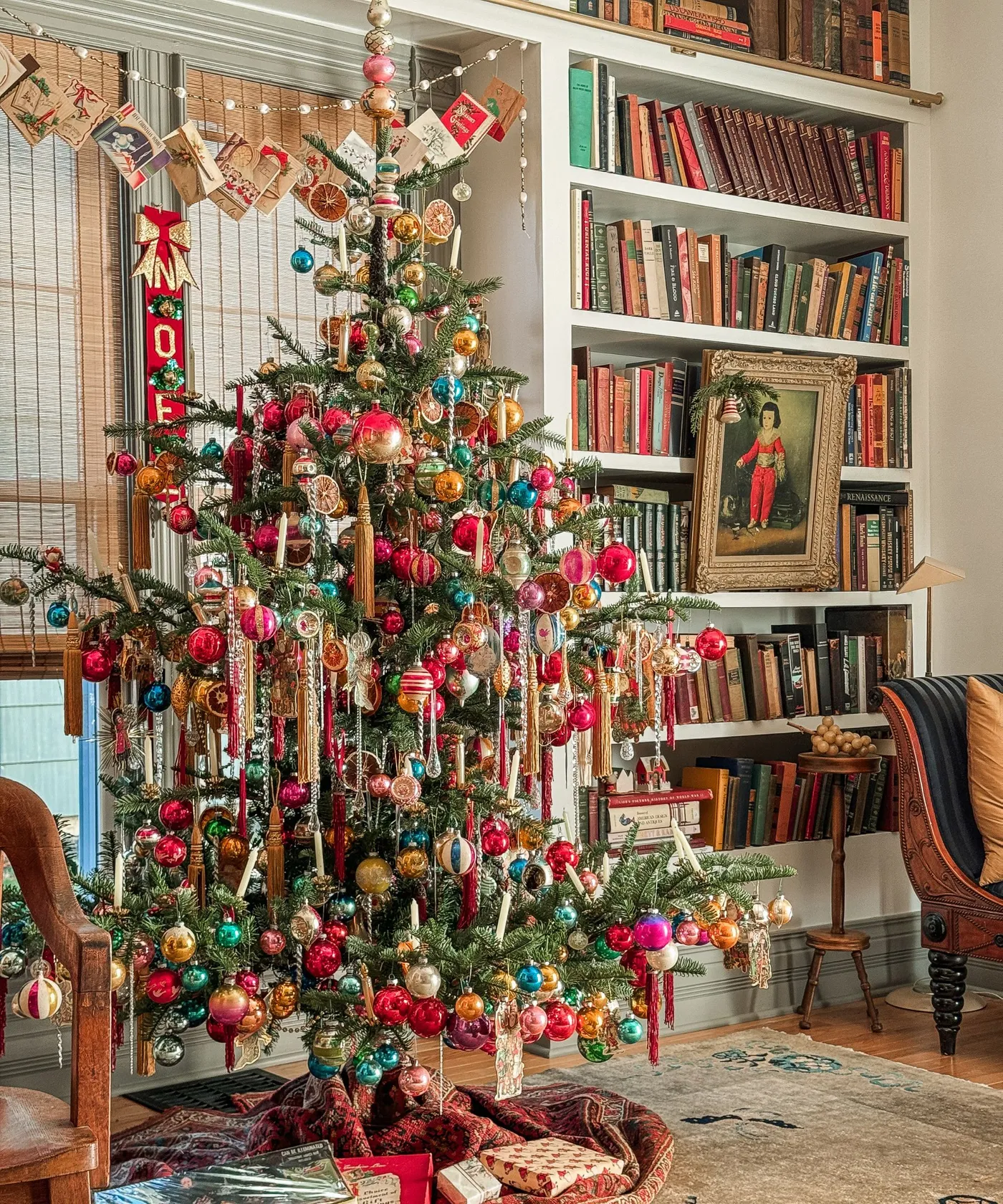
Hands-on time is about 20 minutes. A bag of oranges costs roughly $4 and yields 30 to 40 slices. If you want the same natural, handmade feel on a full-size tree, Idea #28 goes all in with pinecones and birch.
Two decisions make this tree feel collected rather than decorated. The first is light temperature — clip-on candle bulbs are dimmer and warmer than standard string lights, so the ornaments carry the color instead of the bulbs. The second is the oriental rug used in place of a skirt; it sits flat, nothing bunches, and the pattern gives the base as much visual weight as the branches above.
8. Plaid Presents Piled on a Cream Faux-Fur Skirt
You don’t need a $180 designer skirt for this. Target and Walmart both carry cream faux-fur skirts in the $25–$40 range every November, and from three feet away they read identical. Plaid wrapping paper is cheapest in multi-roll packs at Michaels or Dollar Tree, and the gingerbread houses hanging on the tree can be salt-dough ornaments you bake yourself for the price of flour, cinnamon, and an afternoon.
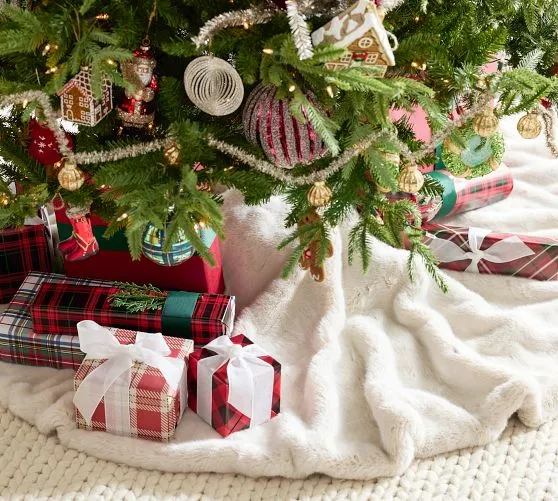
Gift ribbon should run about one-third the width of the box face — 1.5-inch ribbon on a 4-inch box, 2.5-inch on something larger. Now put the scissors down and buy wired ribbon instead of satin. Curl each tail around a pencil, let it relax, and the curl holds for weeks. Unwired satin flattens into limp strings by Christmas Eve, and you’ll spend the morning re-tying everything.
9. A Flocked Tree Beside a Light Blue Brick Fireplace
50% white flocked branches + 30% multicolor vintage glass + 12% brass + 8% pale blue. The blue arrives through the fireplace, the skirt trim, and nowhere else — that restraint is the only reason a multicolor tree doesn’t spiral into chaos. Want to shift the mood? Keep every proportion exactly the same and swap blue for soft green; the tree instantly reads woodland instead of retro.
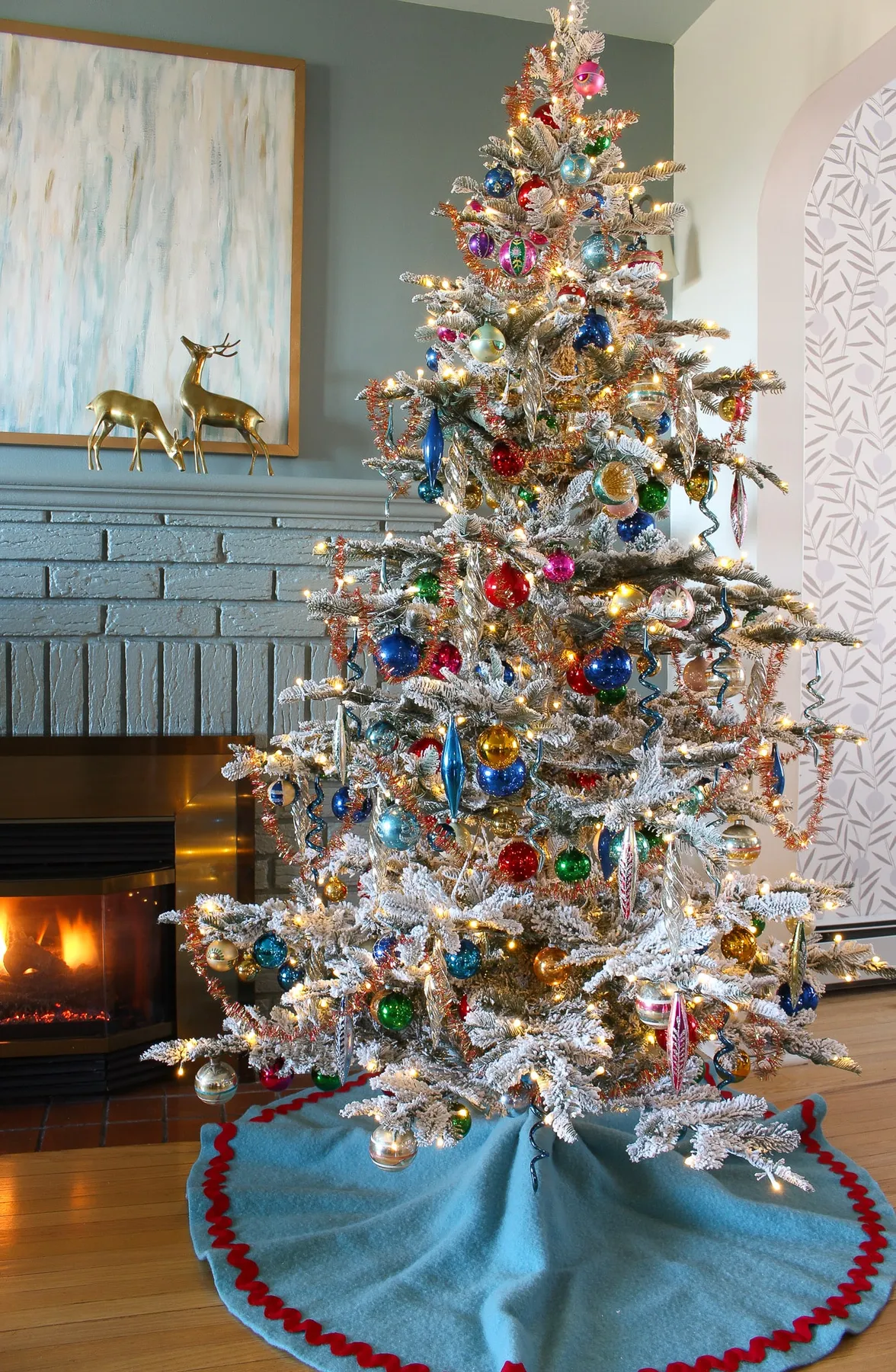
Flocking sheds, and there’s no getting around it. Vacuum around the base weekly with a brush attachment, and never use a beater bar on wood floors. Flocked trees also yellow when stored in a hot attic or garage, so a breathable tree bag in a climate-controlled closet is worth the $25. And skip flocking on a real tree you plan to light — dried needles under a white coating is a fire hazard, not a style choice.
10. Feather Toppers and Stacks of Books in a Log Cabin
Vaulted ceilings and log walls change the math completely. Anything under 9 feet looks like a shrub in a room this tall, so this is where a 10- to 12-foot tree earns its keep. You also want at least 3 feet of clearance on the window side so daylight can pass the branches — wedged tight against the glass and the whole corner goes dark by midafternoon. For an 8-foot ceiling, see Idea #11, which gets a similar warm, dense feel into a much tighter room.
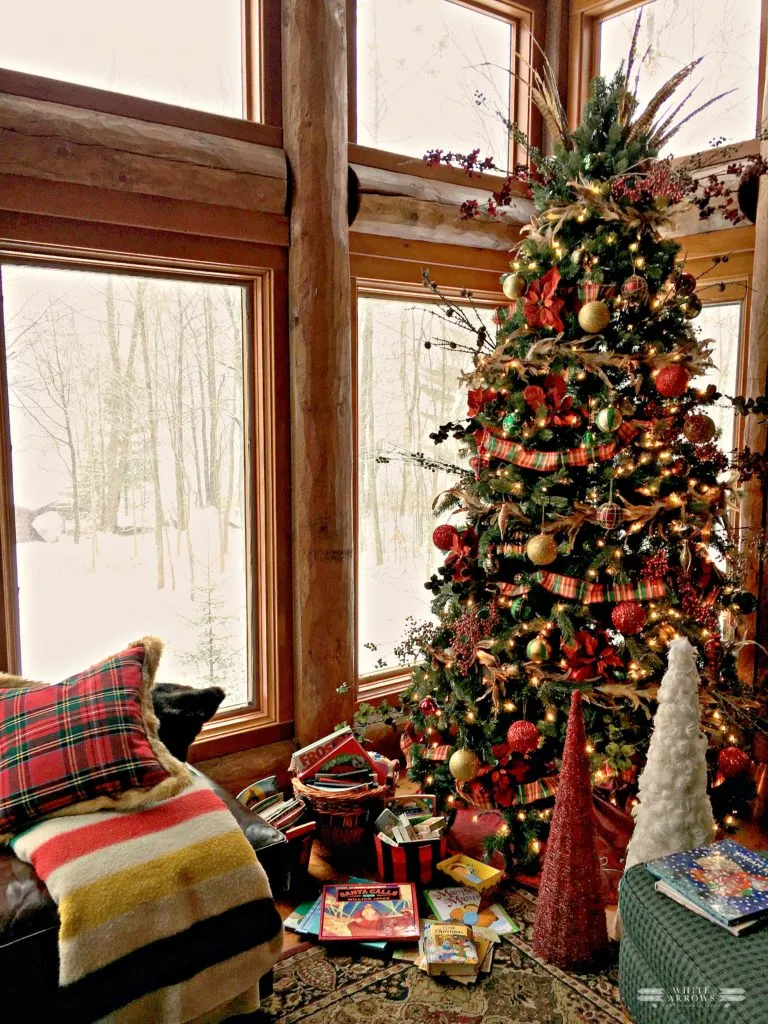
- 9-foot unlit tree: $200–$700
- Plaid ribbon, three rolls: $30–$75
- Warm LED string lights: $20–$60
- Feather picks plus gold and red ornaments: $120–$400
- Plaid pillow and striped throw: $60–$180
- Total: $430–$1,415
Budget alternative: a 7.5-foot tree with the same plaid ribbon and feather picks lands near $230, and nobody in the room counts the missing two feet.
11. Emerald Walls, a Chartreuse Ceiling, and a Zebra Rug
The chartreuse ceiling. Deep green walls alone would make this room feel like a forest at dusk, but flipping the value — dark walls, bright ceiling — pulls your eye upward and makes the space feel taller rather than smaller. It’s the difference between a moody room and a cave, and it costs one gallon of paint. Paint the ceiling white and you lose the entire effect, leaving a green room with a nice tree in it.
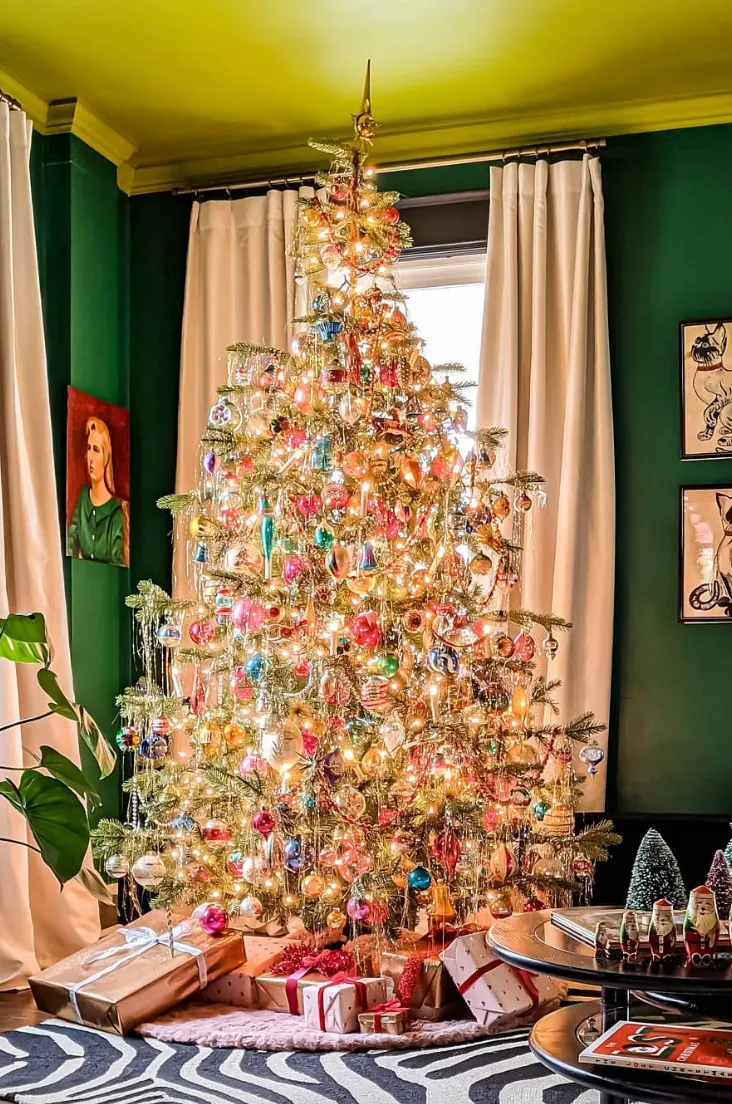
Color-drenching has dominated paint trends for a few seasons, and 2026 is the year designers started treating the ceiling as a fifth wall instead of a default white surface. It photographs beautifully, it’s genuinely cheap to pull off, and it makes a Christmas tree look intentional rather than placed. The zebra-print rug underneath is the wildcard — a 1960s reference that keeps all those saturated greens from turning too serious.
12. The Vintage Tree Traps Nobody Warns You About
Let’s talk about what actually ruins a vintage tree, because none of it is about taste. Overloaded branches snap — cap yourself around 100 ornaments for a 7-foot tree unless the branches are wired. A cheap extension cord behind a tree you water every morning is a genuine hazard; plug into a GFCI outlet and use a cord rated for outdoor use. And don’t mix LED and incandescent strands on the same tree, because the load mismatch will blow fuses right around the time your guests arrive.
Vintage-look ornaments cost a fortune at boutiques and almost nothing at estate sales. A boxed set of 12 mercury glass baubles runs $60–$120 new; the same look at a church rummage sale is $5–$15, and the older glass is usually thicker. Facebook Marketplace in late November is the sweet spot, since people unload entire collections when they downsize. Thrift stores in retirement towns are frankly unfair to everyone else.
13. Mercury Glass with Rust Velvet and Hellebores
Build small vignettes before you build the tree. Three mercury glass ornaments, a stack of three vintage books, and one artificial hellebore stem on a tray takes ten minutes and does more for a room than a dozen more ornaments on branches. Keep each group to an odd number and vary the heights by at least 3 inches — three objects at identical height read as clutter, not a collection.
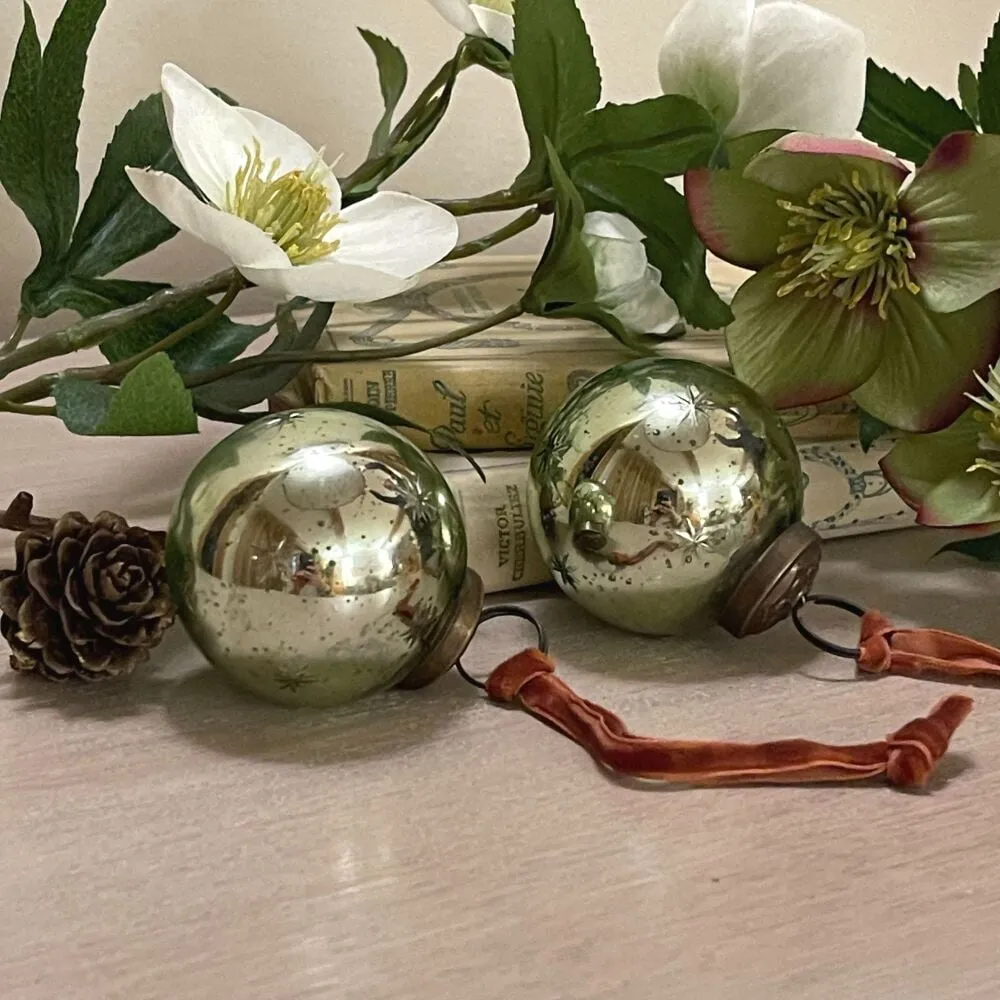
The rust-colored velvet ribbon, tied in a loose knot instead of a bow. It’s the only warm note against sage green and antique gold, and it’s what stops the arrangement from reading cold and museum-like. Swap it for white satin and the vignette turns bridal; swap it for black and it turns gothic. One 1.5-inch ribbon in the right tone is doing more work than everything else on the table combined.
14. Blue Velvet Ribbon and a Ginger Jar Ornament
- Cut a 3-foot length of 2-inch blue velvet ribbon.
- Thread it behind a branch and bring both ends forward, crossing them loosely.
- Hang the porcelain ginger jar ornament from the ribbon’s midpoint so it rests against the needles.
- Clip the candle two branches above and slightly left — never directly over the ornament.
- Repeat the whole sequence every 18 to 24 inches across the visible face of the tree.
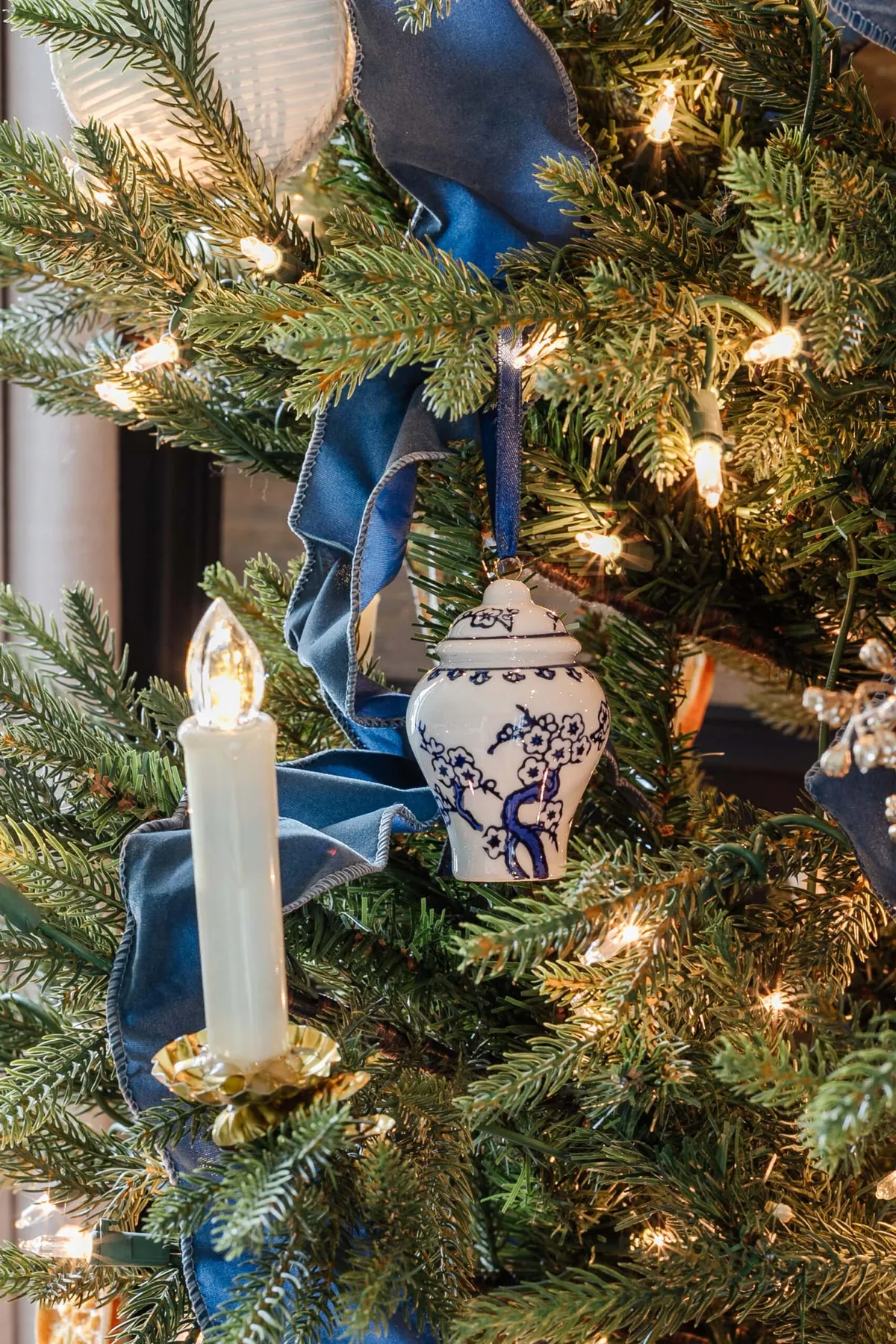
About 20 minutes for the visible half of a 7-foot tree. Ribbon runs roughly $12 for 10 yards, and it’s reusable for years if you store it rolled around a cardboard tube instead of folded.
- Measure your tree’s visible face — you only need to decorate what the room can actually see
- Confirm your clip-on candles are LED, not incandescent, before they go anywhere near dry branches
- Match ribbon width to ornament scale; true vintage ribbons are 2 inches or wider
- Check that porcelain ornaments are wired to their hangers rather than glued
15. Fruit, Florals, and Velvet on an Opulent Tree
40% evergreen + 22% ribbon and beaded garland + 20% fruit and floral picks + 13% glass baubles + 5% light. That’s a lot of elements, and it only works because every one of them sits inside a narrow palette — burgundy, deep blue, gold, peach. Add a lime green or a hot pink and the whole thing collapses into noise. Swap the fruit for dried hydrangeas and you keep the density with a softer, less holiday-specific mood.
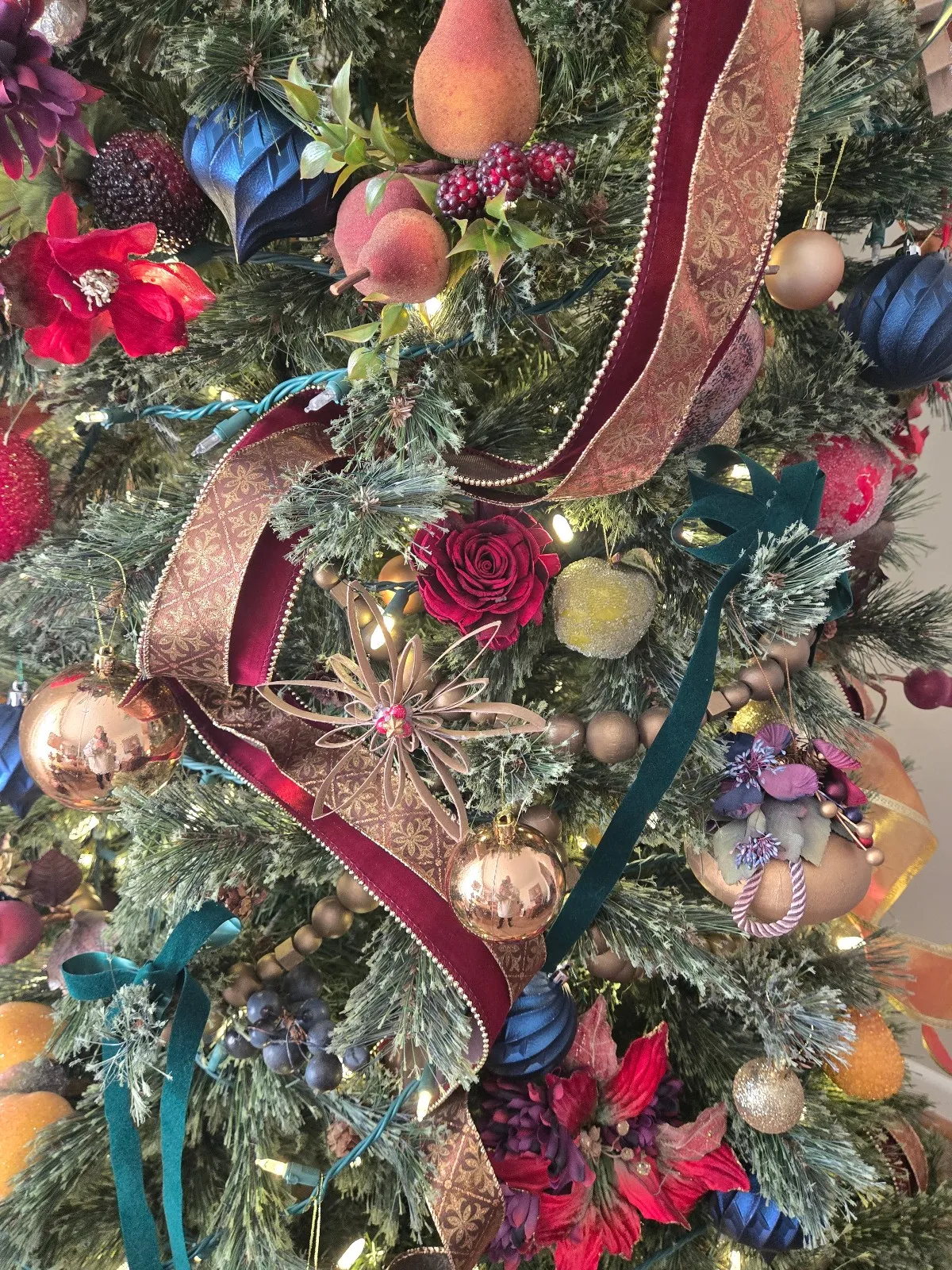
- 7.5-foot flocked tree: $180–$600
- Patterned ribbon with velvet trim, three rolls: $45–$110
- Artificial pears, berries, and floral picks: $90–$280
- Glass baubles and beaded garland: $70–$220
- Warm string lights, three strands: $25–$70
- Total: $410–$1,280
Budget alternative: buy the floral picks during a craft store’s post-Thanksgiving clearance and reuse fruit picks from a fall wreath — that alone trims $100 or more off the tree.
16. A Hunter Green Hutch and a Vintage Postcard Garland
Dark painted furniture shows everything — dust, fingerprints, and the ring a wet glass leaves behind. Wipe a hunter green hutch with a dry microfiber cloth weekly rather than spraying polish, which builds a dull film over chalk-finish paint. If yours is waxed instead of sealed, plan on re-waxing once a year. And keep the lanterns unlit if they’re the decorative kind, because real candle flames next to painted wood is not a risk worth taking for atmosphere.
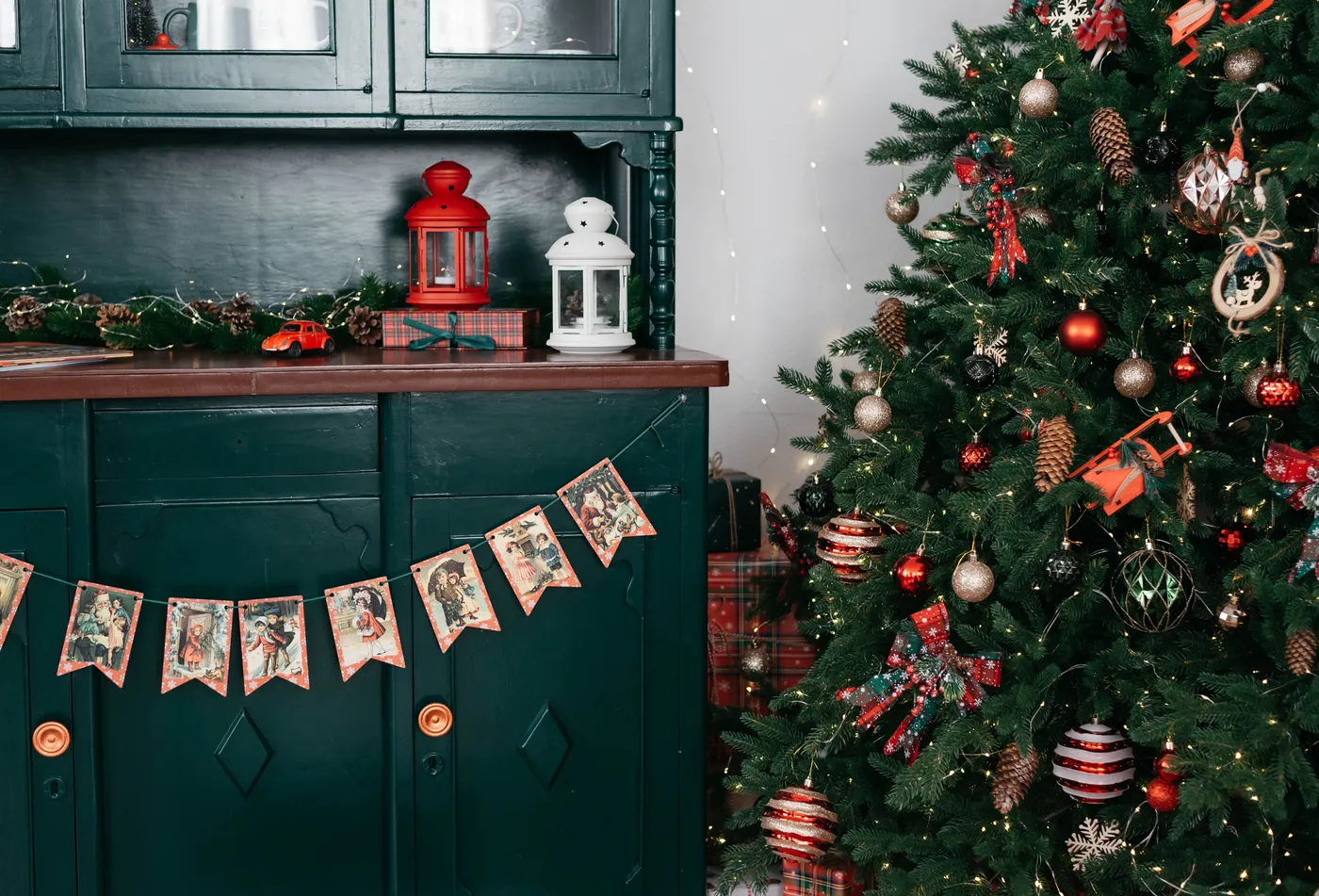
Vintage postcard garlands are the cheapest way to add color to a hutch. Buy a pack of 50 reproduction cards for $8–$15, punch two holes in each with a 1/8-inch punch, and string them on baker’s twine with a 3-inch gap. Measure your hutch first and subtract 6 inches from the total — garlands that touch both sides look cramped and accidental. Swag it in two shallow dips rather than one deep one.
17. A Slender Feather Tree in a Moody Green Corner
Feather trees run 18 to 36 inches tall, which makes them perfect for the awkward zones: the corner beside a window, a wide windowsill, the dead end of a hallway. They need very little room — 18 inches of clearance is plenty — and they look best against a dark wall, where the pale branches read as a silhouette rather than a decoration. This is the opposite approach from the vaulted log cabin in Idea #10, and honestly, it’s the more forgiving of the two.
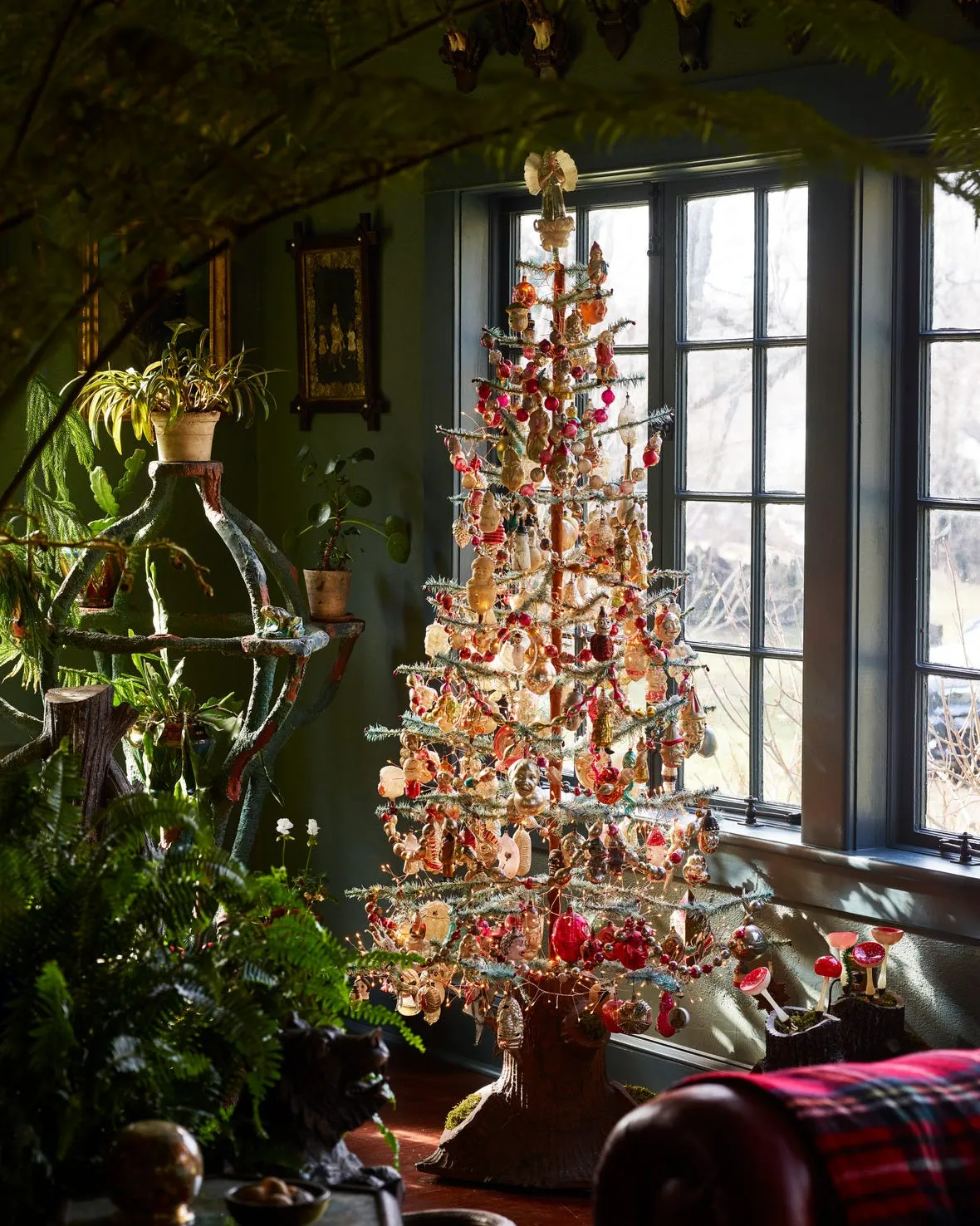
The faux tree stump base. A feather tree on a standard metal stand looks like a craft project; the same tree on a stump looks like an heirloom someone’s grandmother handed down. Because the tree itself is deliberately sparse — feathers show gaps by design — the base has to carry the visual weight. It’s the one element worth spending on, and it transfers to any small tree you own now or later.
18. A Mantel Parade of Miniature Bottle Brush Trees
A single vintage bottle brush tree can run $30–$80 on Etsy. A bag of 20 brand-new ones in mixed sizes and colors costs about $15–$25 at a craft store, and once they’re lined up they’re nearly indistinguishable. Want the frost finish? Dip the tips in watered-down white craft paint. Want them shorter? Clip the base with wire cutters and re-glue it to a small wooden button.
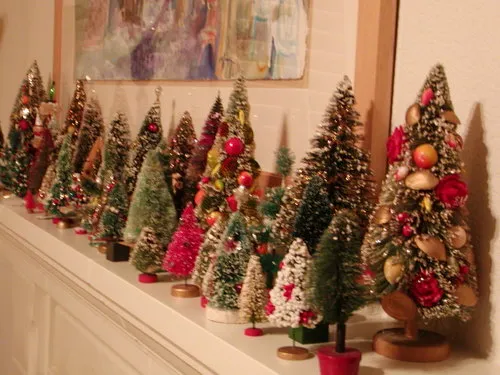
Repetition is doing all the work. Twenty small trees in a row read as a collection, while three large ones just read as three objects — the eye wants rhythm, and even spacing of about 1.5 inches creates it. The color range stays believable because it’s mostly green with a few pink and frosted outliers, which is exactly how a real collection would have grown over decades of gifts and flea market finds.
19. Icicle Tinsel Above a Red Brick Fireplace Arch
Hang tinsel in short vertical clumps rather than long strands. Cut 6- to 8-inch pieces, bunch three strands together, and hook them over a branch so they hang straight down. You get the silver sparkle without the droopy curtain effect that instantly dates a tree. Twelve to fifteen clumps on the front face of a 7-footer is plenty — more than that and it starts looking like a clearance aisle.
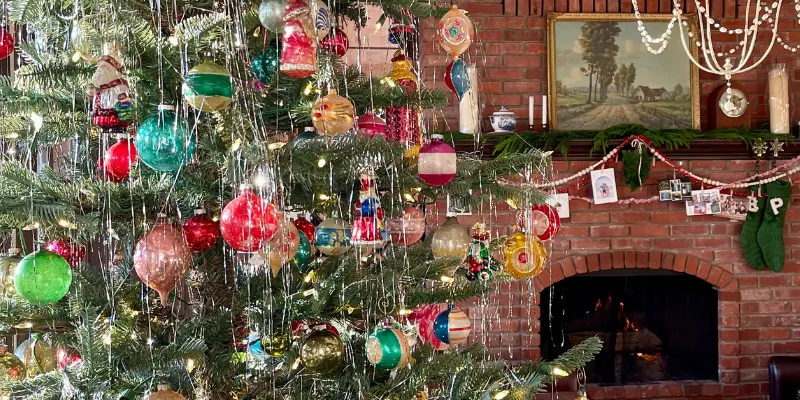
Tinsel and pets are a real problem. Cats in particular will eat foil strands, and a swallowed piece can cause an obstruction that costs four figures at the emergency vet. If you have a cat, keep tinsel above the 4-foot mark or skip it entirely and use silver ribbon loops instead — visually close, zero risk. The same caution applies to any tinsel older than about 1970, which may contain lead.
20. Striped Glass Finial Ornaments in White and Magenta
White base + one thin green stripe + one thin magenta stripe + silver cap. Three colors maximum. That’s the rule that makes a striped ornament look mid-century instead of discount-store: narrow bands, glossy finish, and a metallic cap that ties it back to everything else on the tree. Swap the magenta for orange and you get a 1970s read; swap it for navy and the ornament turns distinctly coastal.
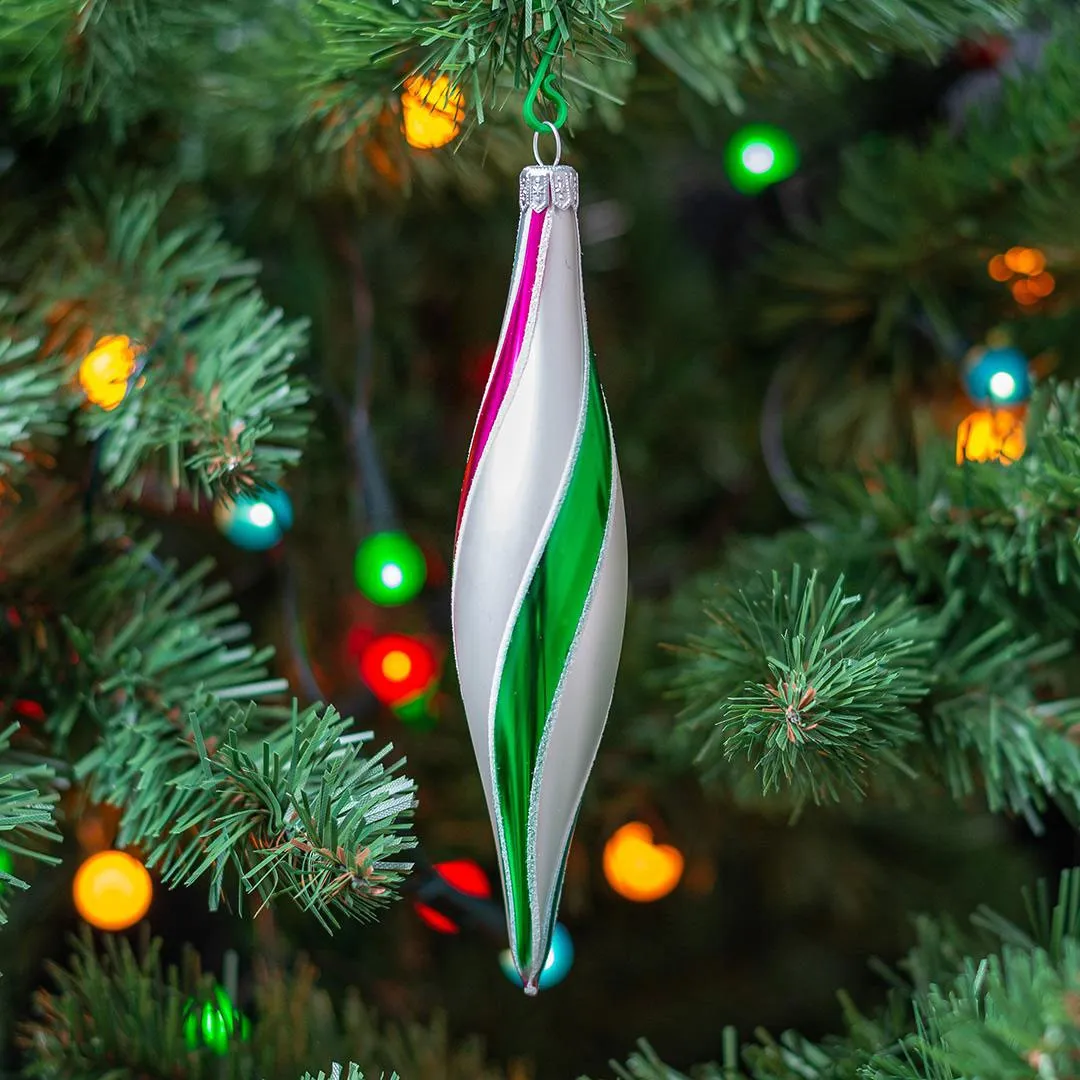
- Wrap a 2-inch strip of painter’s tape around the ornament to mask the top and bottom bands.
- Paint the exposed middle with two thin stripes of craft enamel, letting the first dry 20 minutes.
- Peel the tape while the paint is still slightly tacky — clean edges, no chipping.
- Let it cure 24 hours, then seal with a matte acrylic spray.
- Reattach the original cap and hook.
Roughly 45 minutes for four ornaments. Blank glass finials cost $2–$4 each.
21. Tinsel Garland Across Pink Walls in a Retro Living Room
Pink is having an unapologetic moment — not blush, not millennial pink, but saturated bubblegum and rose paired with purple velvet and cane. It’s the same instinct driving the grandmillennial revival, just turned up louder. The risk with a scheme this saturated is that a standard red-and-green tree disappears against it, so the ornaments here go metallic and bright instead. Tinsel garlands tacked directly to the wall turn the whole room into part of the tree.
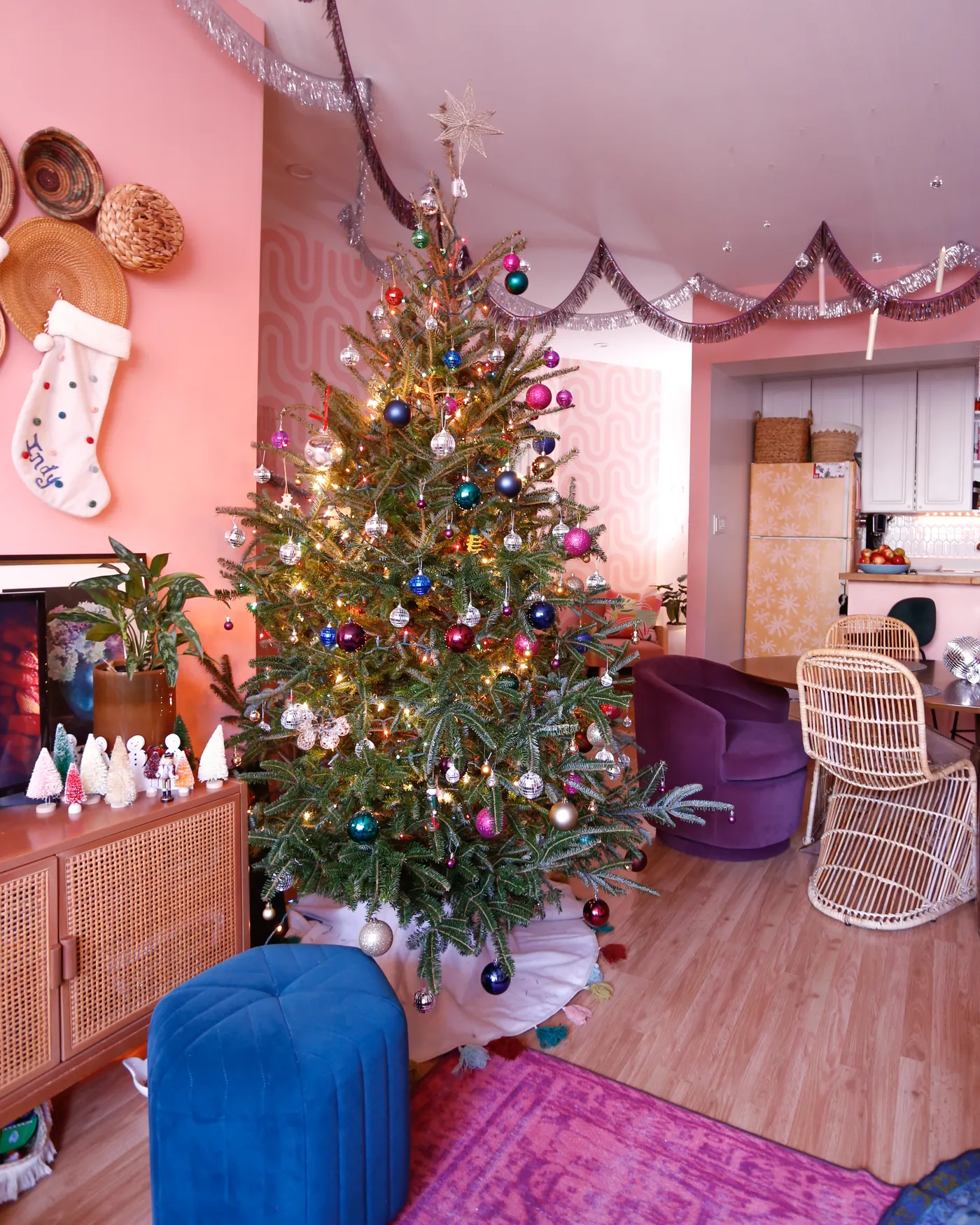
- Woven rattan sideboard: $450–$1,400
- Velvet ottomans in blue and purple: $180–$600
- Cane dining chairs, pair: $240–$700
- Tree, ornaments, and tinsel garland: $150–$450
- Peel-and-stick pink wallpaper, one wall: $60–$200
- Total: $1,080–$3,350
Budget alternative: a removable pink wallpaper panel behind the tree handles 80% of the impact for under $80, and it peels off in January.
22. Red Santa Boots and Flocked Trees on Rustic Shelves
The distressed white drawer unit sitting at the base of the shelving. It lifts the small pieces off the bottom shelf and gives them a stage, which is what stops a collection from looking like a shop display. Without it, the Santas and bottle brush trees sit flat against the wood and vanish into it. A $20–$60 flea market piece is doing the work of a $300 display cabinet here.
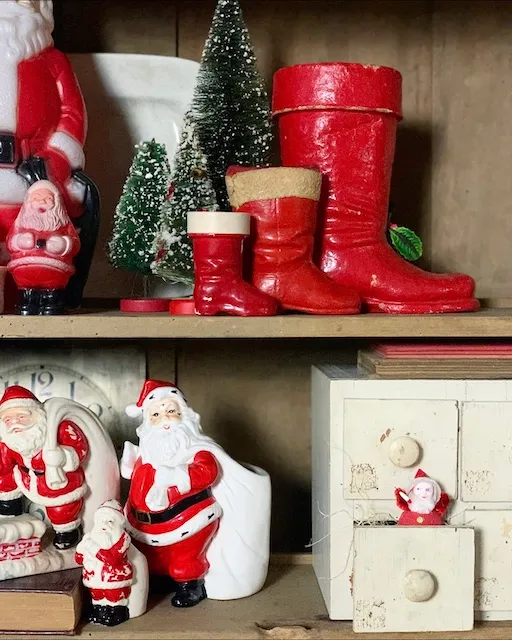
Open shelving like this needs roughly 30 to 36 inches of width and 5 feet of height to make an impact — anything smaller and the collection crowds itself. It works in a hallway as narrow as 4 feet because nothing projects more than 10 inches from the wall. If you’ve got a bigger room to fill, spread the same pieces across a mantel instead; Idea #18 does exactly that with twenty trees in a row.
23. Pearl Bead Garland on a Flocked Tree by White Brick
Everything here sits in the same value range, and that’s the whole point. Flocked branches, pearl beads, mercury glass, textured silver balls — four materials, one tonal family, distinguished only by texture and sheen. The reason it reads elegant instead of busy is that nothing is competing for attention. Swap in one saturated red ornament and the spell breaks instantly, because your eye goes straight to it and all the subtlety collapses.
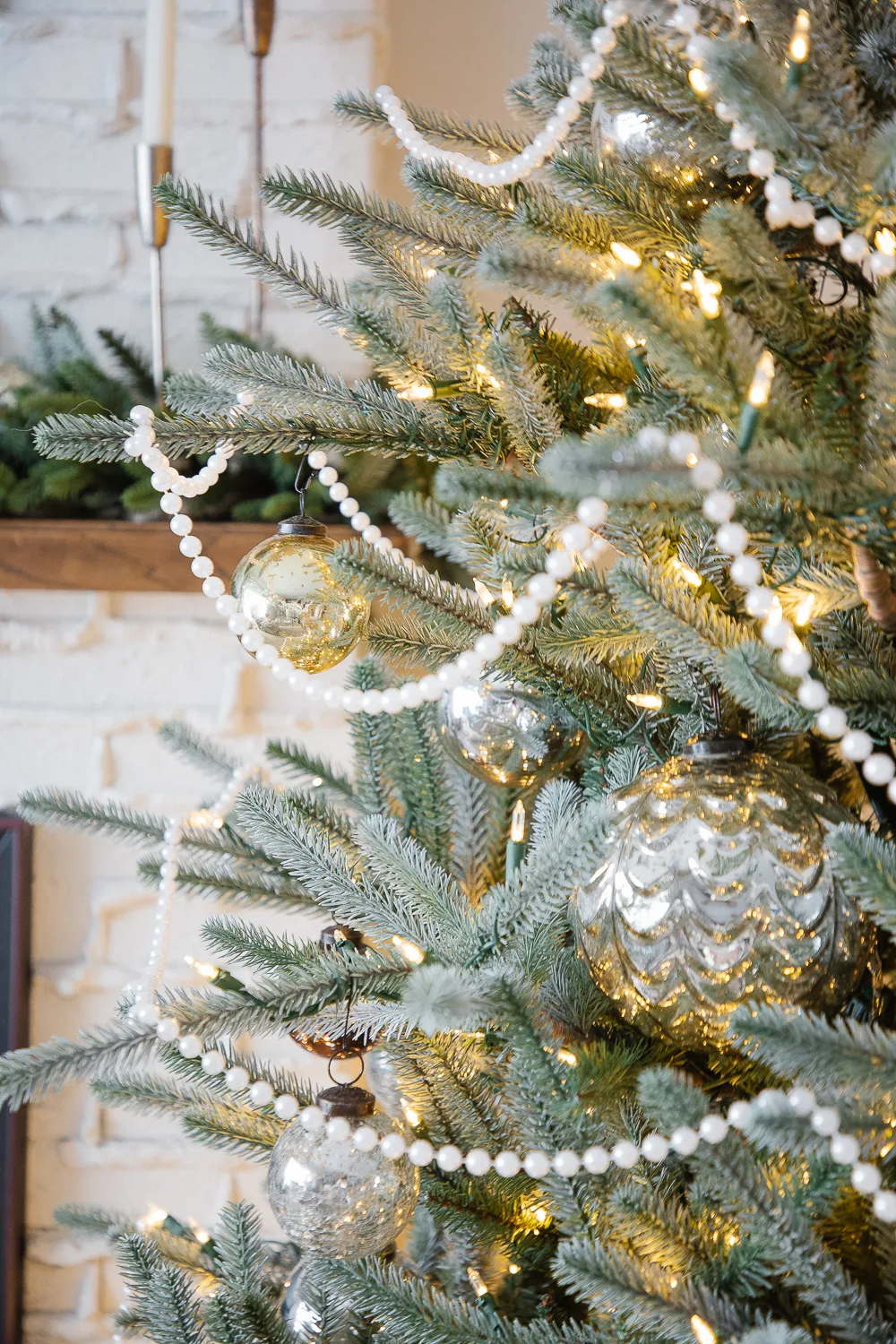
Flocked trees and bead garland are both dust magnets. A quick pass with compressed air every couple of weeks keeps the branches from graying, and storing bead strands in a zip bag with a dryer sheet stops the static cling that turns them into a tangled mess. Flocking will shed for the first two seasons no matter what you do, so put a mat under the tree and plan on vacuuming weekly.
24. A White Tabletop Tree Dripping Turquoise Tinsel
Small trees need oversized ornaments and garland, not scaled-down ones. On a 24-inch tabletop tree, use ornaments at least 2 inches across and a tinsel garland 1.5 inches wide. Scaled-down decorations make a small tree look like a miniature of a real one, which reads as dollhouse rather than decor. Going big collapses the scale and makes the tree feel substantial instead of cute.
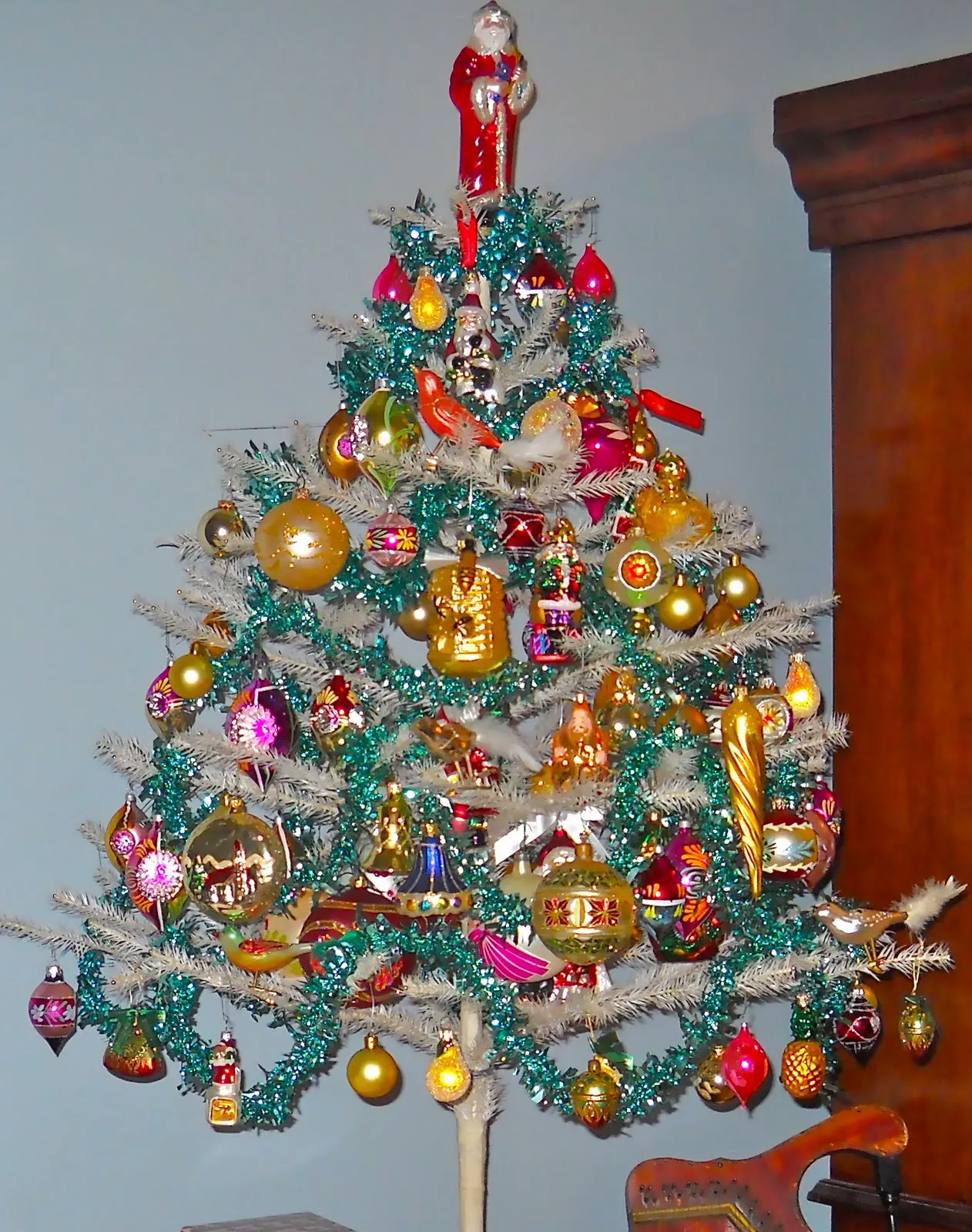
Tabletop trees are the easiest place to save money. Walmart and Target carry white 24-inch artificial trees for $15–$30, and a set of vintage-style blown-glass ornaments runs $12–$25 for 20 pieces. Turquoise tinsel is about $3 a strand at craft stores. The whole vignette lands under $60 and looks like a $200 boutique arrangement.
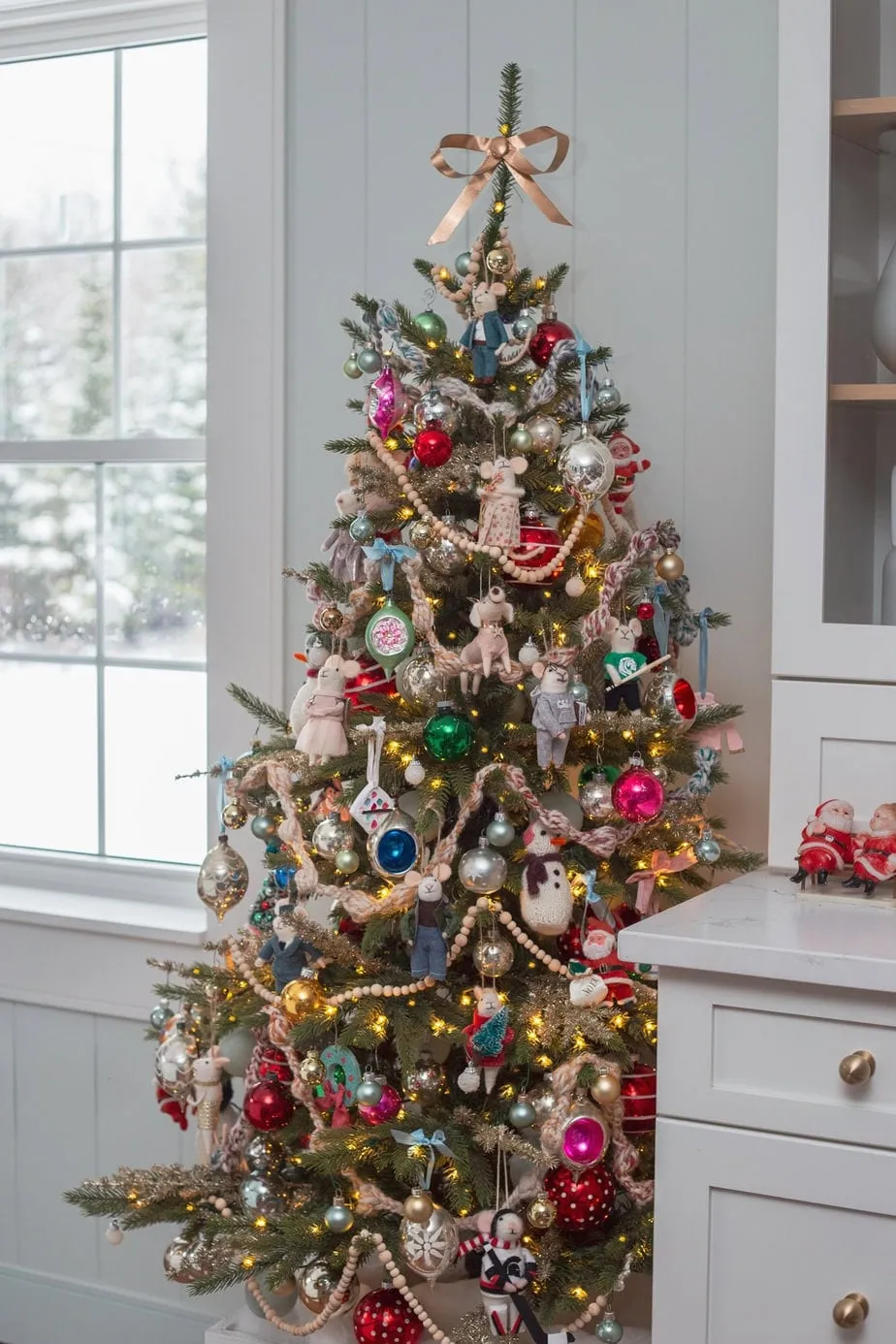
25. Oversized Glass Ornaments Beneath a Grey Ribbon Bow
- Measure the tree’s widest section — oversized ornaments need branches that hold 6- to 8-inch pieces without sagging
- Count your light strands before you start, because you cannot reach the middle once the ornaments are on
- Check that any shelving beside the tree is anchored to the wall
- Budget for replacements; large glass ornaments break, and you’ll want two spares of your favorites
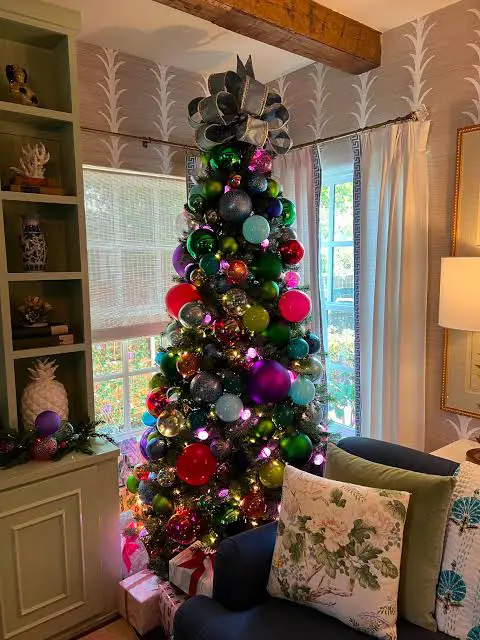
- Choose a ribbon at least 4 inches wide — anything narrower disappears on a large tree.
- Fold it into a loop and pinch the center to form the bow.
- Wrap a 12-inch piece of florist wire around the pinch and twist it tight.
- Leave two 18-inch tails, curl them around a pencil, and let them relax.
- Wire the bow to the top branch, then fluff the loops outward.
About 10 minutes and $15 in ribbon.
26. Red Berries and Plaid Against a Deep Blue Wall
Deep blue walls absorb light, so a tree in this position needs more wattage than you’d guess — plan on 100 lights per foot of tree height instead of the usual 50. Slender trees work in narrow spaces, but they still want 24 inches of clearance behind them so the wall color reads as a backdrop rather than a shadow. Rooms under 10 by 10 do better with a slim silhouette; Idea #17 solves the same problem at 30 inches tall.
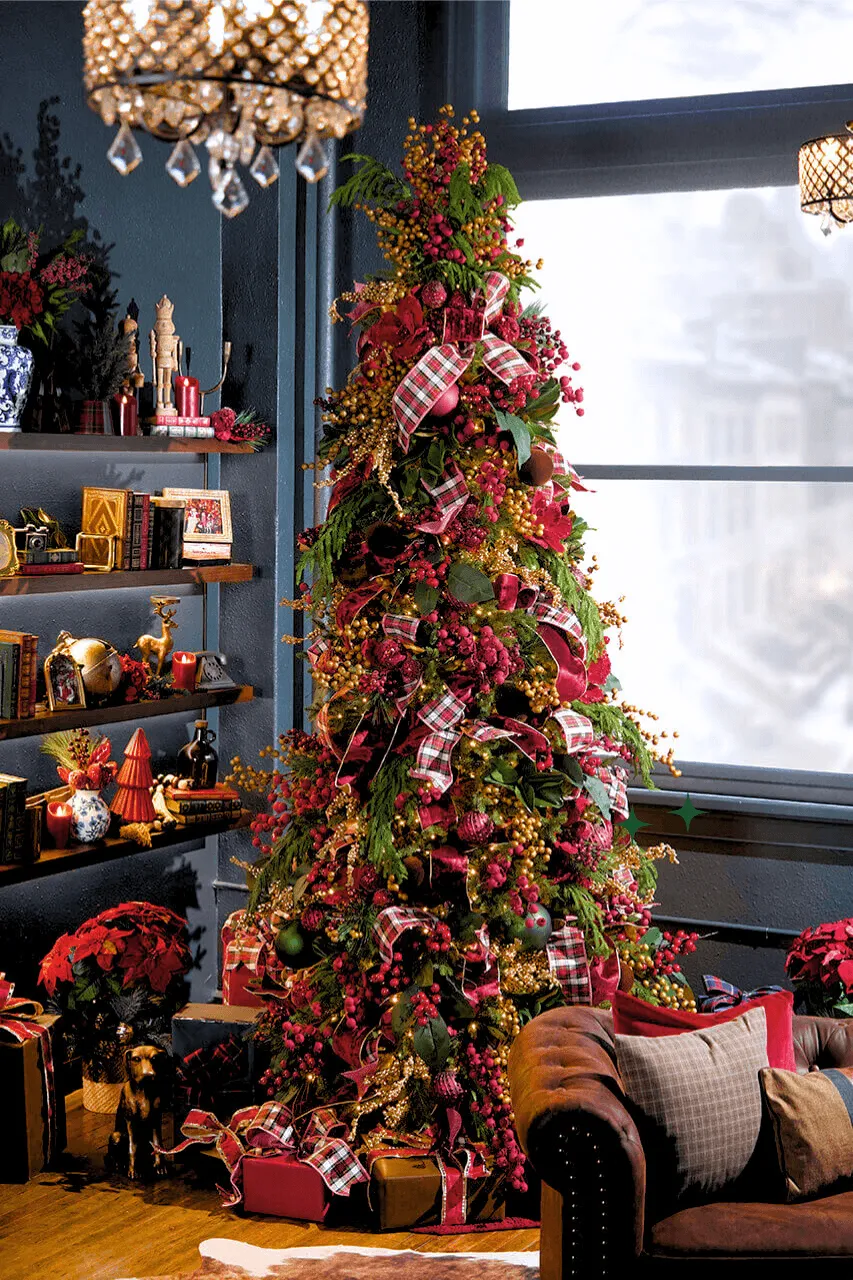
45% dark blue wall + 25% evergreen + 18% red berries and plaid ribbon + 8% gold + 4% leather brown. The gold is the bridge — it’s the only warm metal that reads well against navy without going nautical. Swap the gold for silver and the room turns cold and formal; swap the blue for black and it turns dramatic but loses the cozy entirely.
27. A Full Pine Hung with Classic Red Patterned Baubles
On a full, dense pine, you will lose ornaments. It’s not a matter of if — branches that thick swallow anything under 2 inches and hide it from every angle except one. Hang your largest pieces on the outer third of the branch, save the small ones for gaps near the trunk, and accept that roughly 20% of your collection will be invisible. That isn’t a mistake; it’s what makes the tree look full.
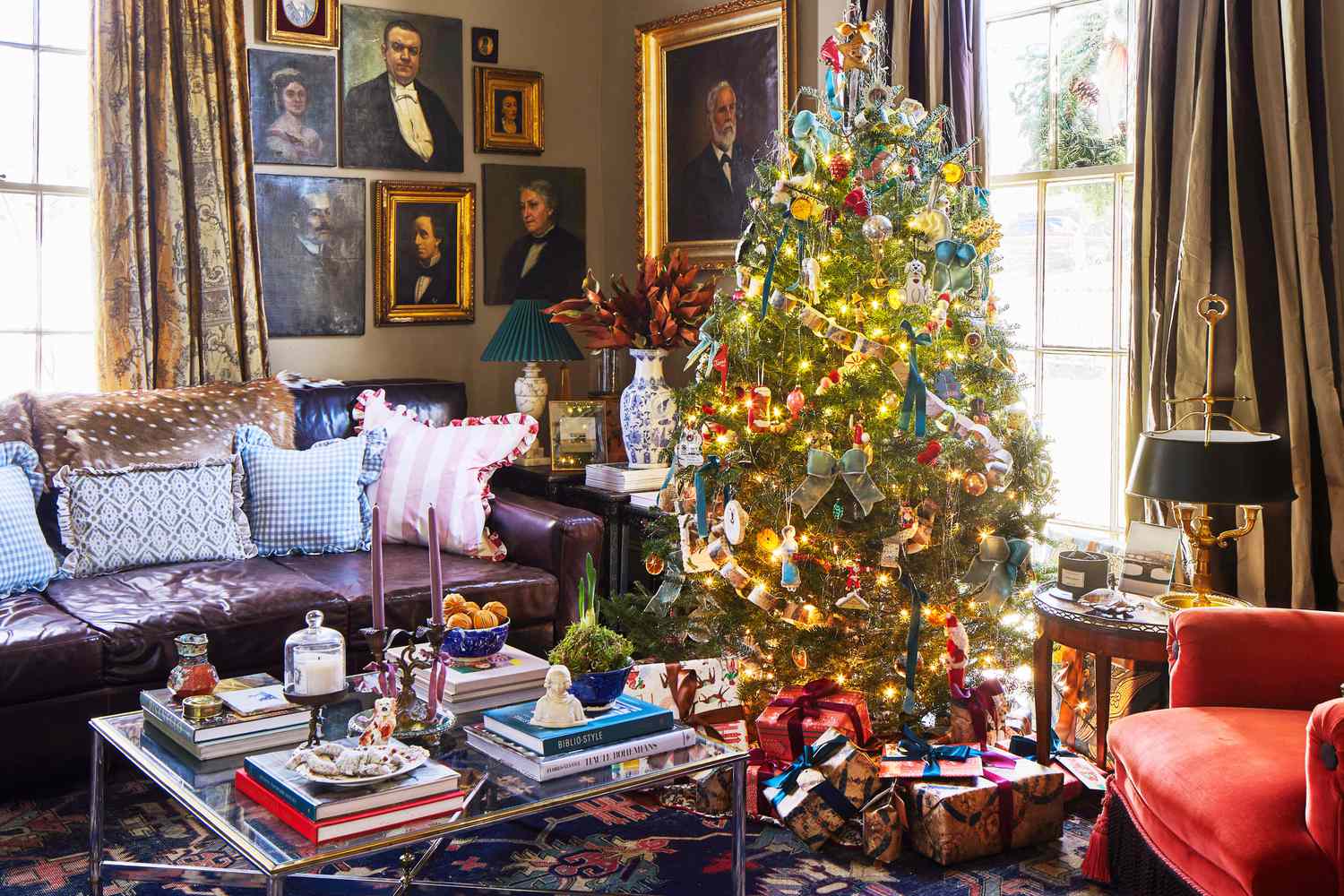
Layer lights inside the tree before a single ornament goes on — one strand wrapped close to the trunk, one out at the branch tips. It’s the difference between a tree that glows from within and one that looks like a string of lights taped to a cone. On a 7-foot tree, that means about 700 lights split across two passes. Do it first, because you won’t want to unwind everything later.
28. Pinecones, Birch Branches, and Burlap Ribbon
Woodland is the cheapest style to fake because the materials are literally outside. Pinecones from a park, birch branches from a fallen limb, and burlap ribbon at $3–$6 a roll cover most of it. Red glitter poinsettia picks run $2–$4 each at craft stores, and berry sprays cost about $5 a bundle. This entire tree’s decoration can come in under $40 if you’re willing to spend one afternoon collecting instead of shopping.
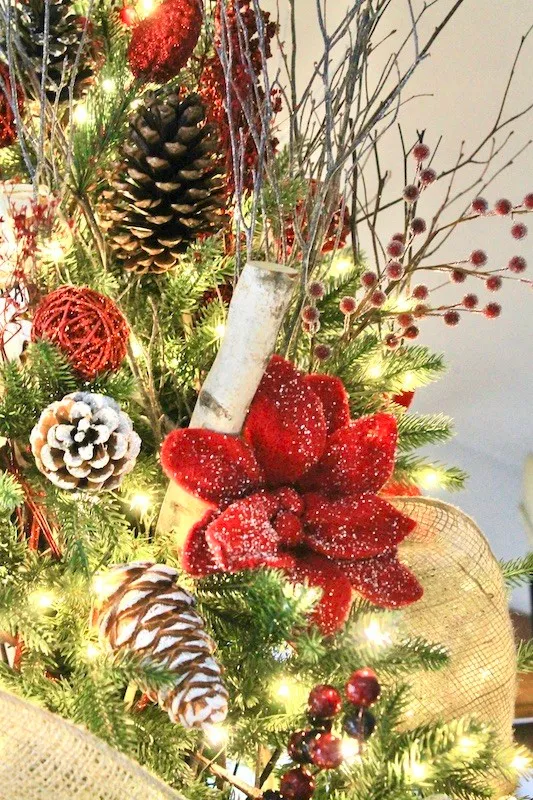
The birch branches. They’re the only element with a hard, pale line against all that soft texture — pinecones, burlap, and needles are every one of them rounded and matte, and without the birch the tree goes slightly mushy. Tuck four to six short lengths upright into the branches near the top and the whole thing instantly gains structure. Swap them for painted twigs and you keep the line but lose the warmth.
29. A Snow-Dusted Bottle Brush Tree on a Pedestal
- Find a small pedestal or an inverted bowl — 4 to 6 inches tall is the sweet spot.
- Set the bottle brush tree slightly off-center on top, never dead center.
- Stack the ceramic molds or a short book stack to the left, matching the tree’s height.
- Place the Santa and reindeer figurine in front, angled toward the tree.
- Prop a vintage card behind everything, leaning against the wall.
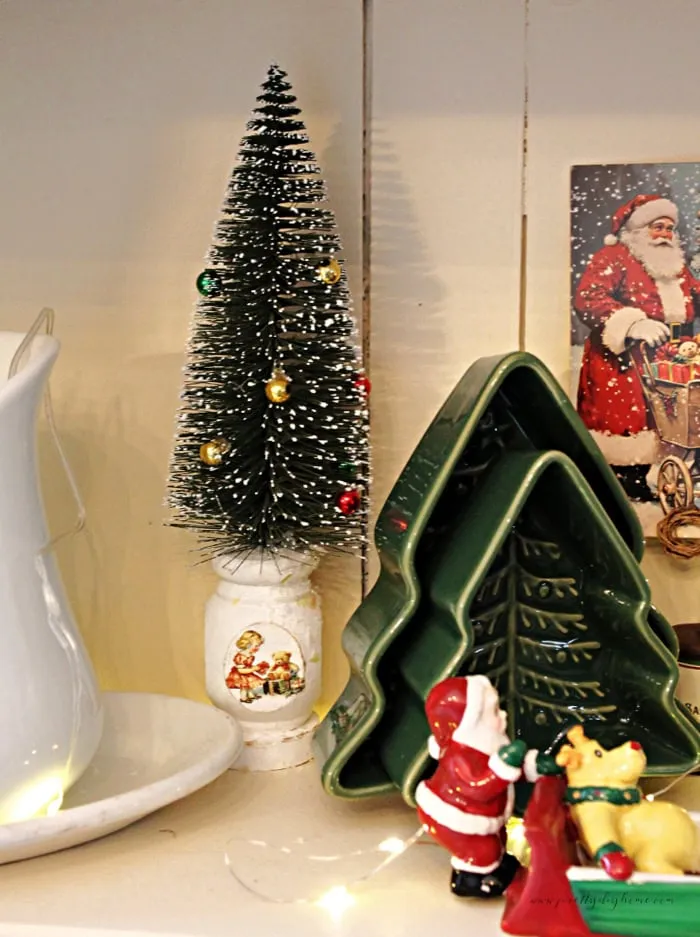
Ten minutes, and free if you already own the pieces. A thrifted pedestal runs $8–$20.
Tiny, deliberate vignettes are what replaced the big decorating weekend. People are styling one shelf, one tray, one corner at a time — it’s cheaper, less overwhelming, and it photographs beautifully for Pinterest. The vintage Christmas card propped in back is the tell that this isn’t a store display. Reproductions cost about $6 for a pack of 20 and look convincing in low light.
30. Hand-Embroidered Linen Ornaments on Real Pine
A single handmade ornament holds its own on a branch because it introduces a texture nothing else has — matte linen against glossy needles and shiny baubles. The twisted cord hanger instead of a metal hook matters too; it reads soft and deliberate. On a tree of forty other handmade pieces it would disappear completely, but as a set of four or five tucked among glass, it becomes the thing guests pick up and turn over.
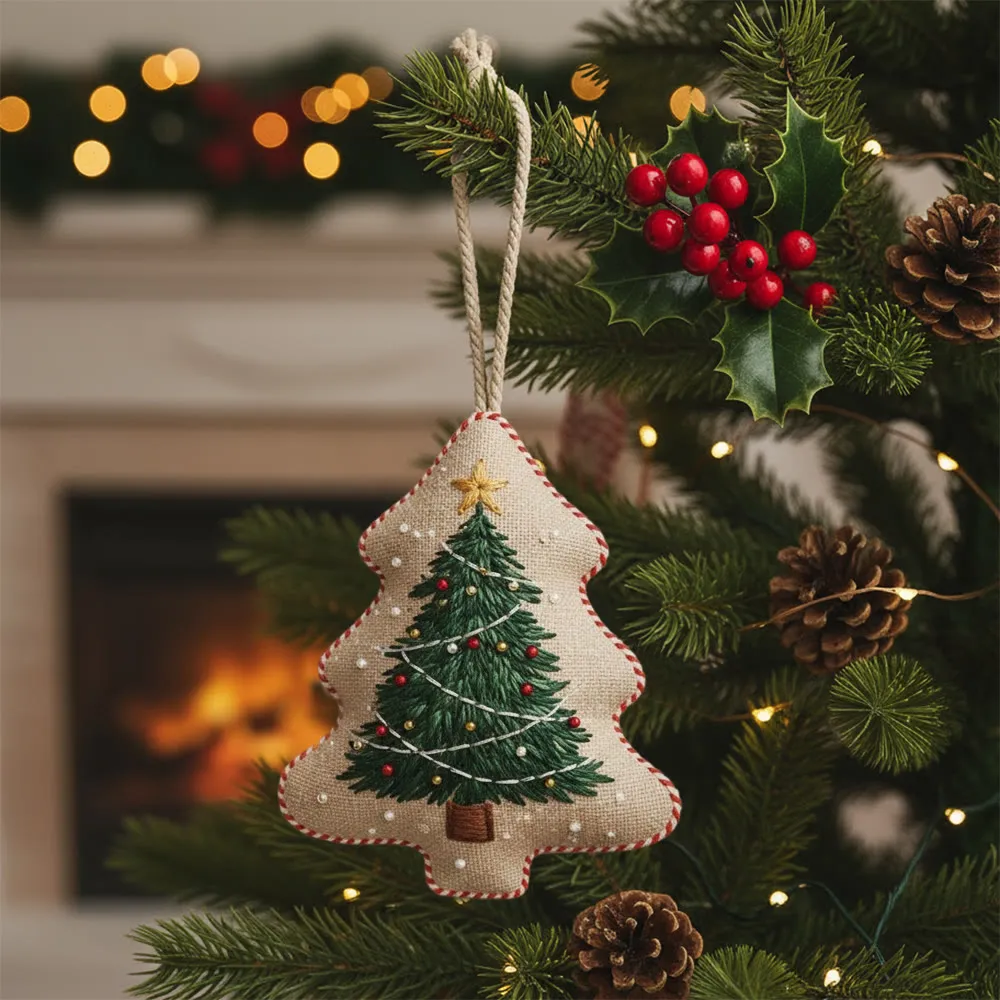
- Natural linen fabric, half yard: $8–$16
- Embroidery floss, four colors: $6–$10
- Cotton batting, small bag: $5–$9
- Twisted cord or baker’s twine: $4–$8
- Embroidery hoop and needles: $8–$18
- Total: $31–$61 for a set of six ornaments
Budget alternative: cut up a thrifted linen shirt or napkin instead of buying new fabric and you’re down to about $20, with the bonus that old linen has a much softer hand.
Go Hang Something With a Story
The best vintage trees aren’t styled in an afternoon — they’re built from a rummage sale find, a grandmother’s bauble, and one roll of ribbon you bought because the color was right. Start with one idea from this list, steal the proportions, and let the rest accumulate. That’s how the rooms you keep saving on Pinterest actually got that way.
📌 Save this to Pinterest so it’s waiting for you next November — and tag us when your tree goes up, because we genuinely want to see it.