
Somewhere between the first cold snap and the moment your neighbor’s inflatable snowman goes up, you start scrolling. Same. There’s a particular kind of Pinterest rabbit hole reserved for Christmas outdoor decor, and 2026 has filled it with layered evergreens, birch logs, and a whole lot of warm white bulbs.
We spent serious time browsing Target, Home Depot, and At Home to bring you only what’s worth your attention this year, plus finds from Walmart and Wayfair — with ideas running from about $12 to $680 depending on how far you want to take it.
Inside you’ll find 33 curated ideas covering rustic natural, classic red-and-green, modern minimalist, and cozy cottage styles. Budget and luxury versions sit side by side, and every idea is shoppable with direct product links.
2026’s outdoor mood has shifted hard toward layered greenery and low, warm 2700K lighting — saves for winter planter arrangements keep climbing, and cypress topiaries have quietly replaced the giant inflatables on the porch. And stay until the end — we break down the most common mistakes that can ruin these looks.
📌 Save this to Pinterest for later — you’ll want to revisit these ideas.
1. A Glowing Tree on the Deck, Framed in String Lights
The trick here isn’t the tree — it’s the matching. The same warm white bulbs run up the tree and then keep going along the white railings and pillars, so your eye travels the whole deck without a break. Because the railings are white, they disappear at night and the light looks like it’s floating. The lanterns on the steps are the anchor: three small pools of glow that pull you down toward the yard without ever getting bright enough to flatten the mood.
Everything reads as one continuous warm source, which is why it feels calm instead of chaotic.
- Pre-lit 6–7 ft outdoor tree: $120–$400
- String lights for railings and pillars (~150 ft): $40–$90
- Step lanterns, battery or solar (3): $30–$120
- Weatherproof extension cords and timers: $20–$45
- Replacement bulbs and clips: $10–$20
Total: roughly $220 to $675 — and the tree is the only piece you’ll rebuy in a decade. Budget alternative: a $45 unlit 6 ft tree plus $30 of lights and a $12 timer gets you 80% of the glow.
2. Snow-Dusted Porch with Galvanized Bucket Evergreens
Practical tip: keep your buckets odd-numbered but not identical. Four small evergreens in galvanized buckets work here because two sit slightly forward and two tuck back against the wall, breaking the lineup. Galvanized metal also reads cooler and greyer than black, which is why it holds up so well against snow and grey stone. Raise the shortest bucket on a flat stone or an upturned pot — it costs nothing and gives you the height variation that makes a row look collected rather than bought.
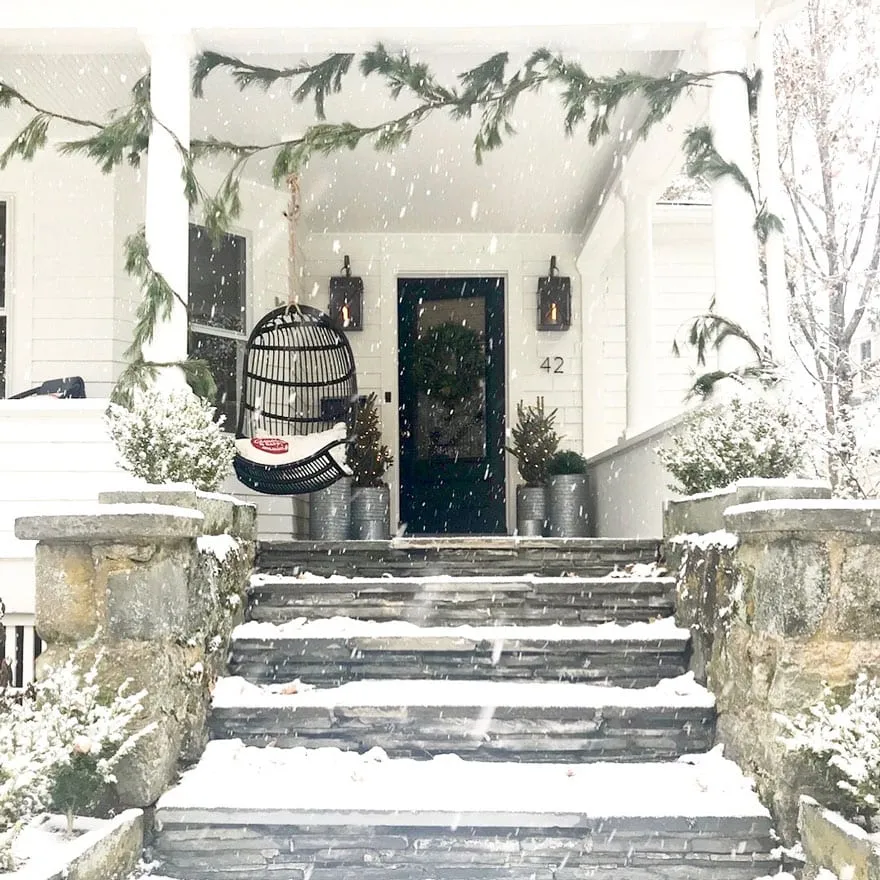
The single element doing the heavy lifting is the evergreen garland draped across the porch ceiling. Remove it and you have a nice door with a wreath and some potted trees — pleasant, forgettable. The garland creates a low ceiling of green that makes the porch feel like a room, and the hanging egg chair underneath suddenly looks intentional instead of stored.
3. Red on Dark: The High-Contrast Signal That Stops the Eye
Think of it as a formula you can actually use: 85% dark base + 10% saturated red + 5% warm white. A red circle against near-black reads instantly because nothing else competes — the same reason a single crimson ribbon on a dark urn stops people at the curb. Swap the red for burgundy and the mood softens. Swap the dark base for white siding and you need far less red for the same pop. Push red past 15% and the whole thing turns into a fire truck.
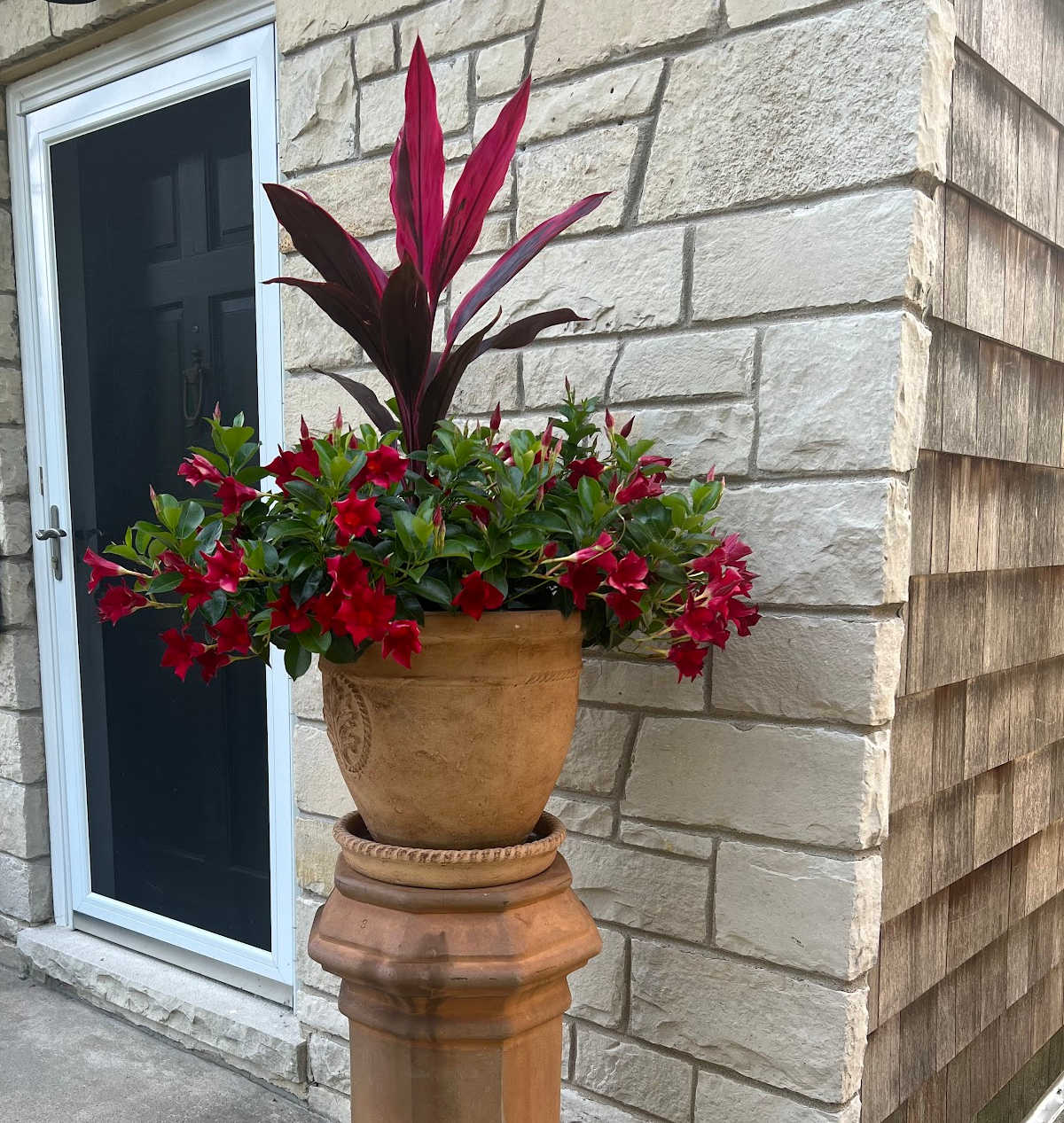
Here’s the honest version: red is the most persuasive color on a Christmas exterior and the easiest to overdo. On a dark house, a red bow, red berries, and a red wreath ribbon is already a complete story. Pick one red performer per surface — one on the door, one in the planter, one on the railing. Let everything else stay green, wood, and warm light.
4. A Foraged Winter Basket in Wicker and Burlap
- Line the basket with burlap and pack in a foam block or a bucket of damp sand. (5 min)
- Start with tall branches at the back and center — pine or cedar first. (10 min)
- Fill the middle with juniper and cypress so no two greens repeat side by side. (15 min)
- Push red dogwood stems in at an angle, letting them lean past the rim. (10 min)
- Finish with dried magnolia leaves near the base and pinecones at the front edge. (10 min)
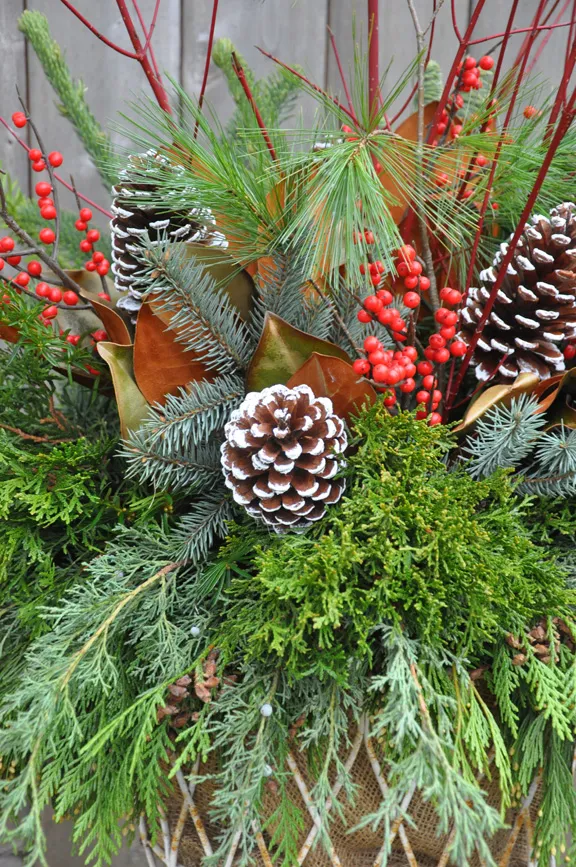
Materials run $35–$70 and you’ll need about an hour, start to finish.
- Wicker basket with burlap liner: $15–$40
- Mixed evergreen bundle (3–4 varieties): $25–$60
- Red berry stems (3): $12–$30
- White-tipped pinecones: $8–$18
- Red twig branches: $10–$24
Total: $70–$172 for something that looks florist-made. Cheaper route: forage cedar and pine from your own yard, buy berries for $10 at Walmart, and reuse last year’s basket.
5. Cypress Topiaries and Layered Doormats on a Shiplap Porch
The formula is easy to copy: 60% warm wood and white siding, 30% forest green, 10% black accents. Change one variable and the porch still works. Swap the light-stained doors for navy and it gets moodier; swap the woven baskets for galvanized buckets and it turns farmhouse.
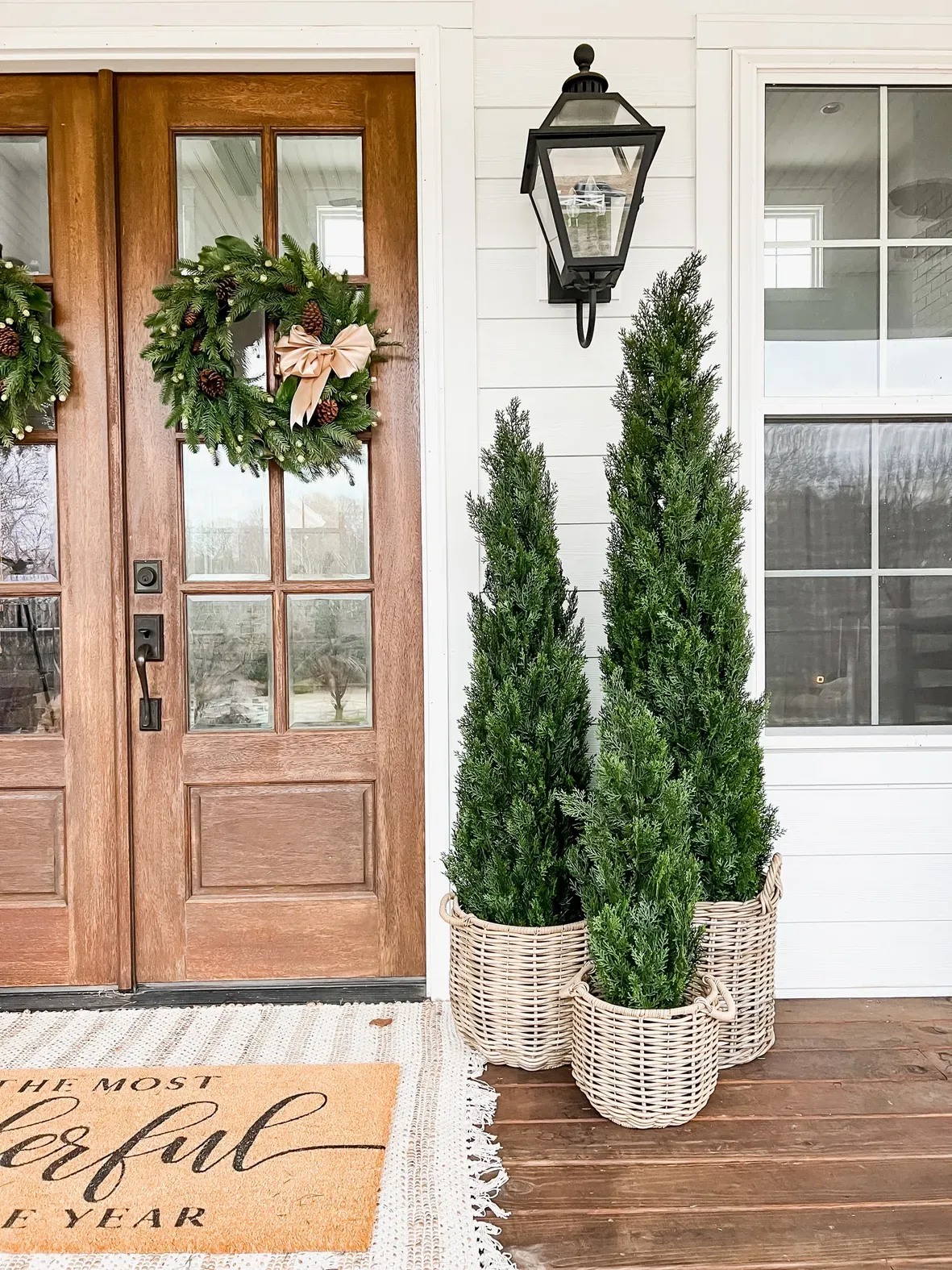
- Wood doors → navy or black for more contrast
- Woven baskets → galvanized buckets for a farmhouse read
- Tan bow → deep red for a classic Christmas note
What makes this entry feel expensive is the layering at the floor. A coir mat with a script greeting sits on top of a white fringed rug, so you get texture, pattern, and a little softness in the same square foot. Then the smallest topiary overlaps the mat’s edge on purpose, tying the planters to the doorway instead of leaving them parked at the sides.
6. Dense Berries and Red Twigs Against a Weathered Fence
You don’t need a florist to get this density. One $12 bundle of mixed evergreen, a $6 bag of pinecones, and a $9 stem of red berries will fill a planter this size. Check Facebook Marketplace in late November — people sell barely-used greenery when they change themes. Thrift stores are gold for wire planters and baskets; a $4 find sprayed white looks exactly like the distressed version here. Realistic total: under $40 for the whole arrangement.
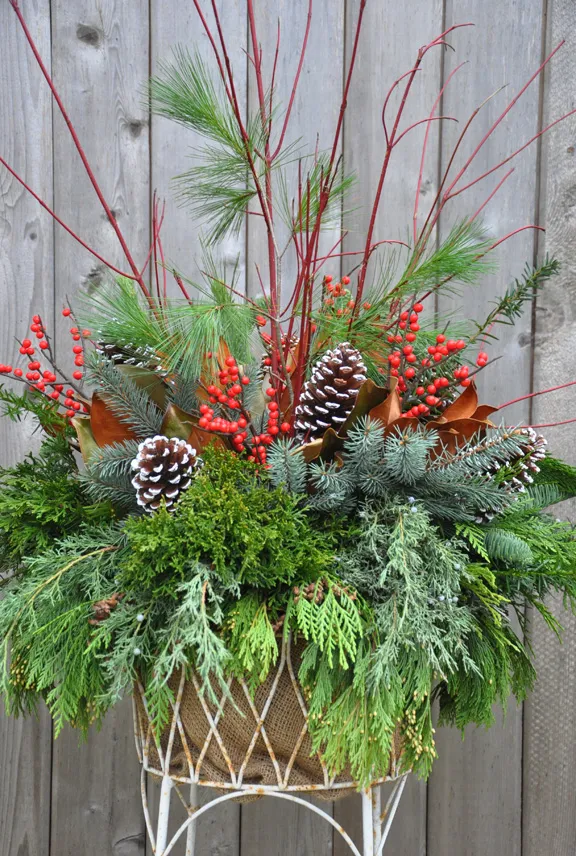
This one wants a planter at least 14 inches across and 16 inches tall, plus roughly 3 feet of clearance from a wall or fence so the branches can splay. It shines on a porch 6 feet wide or more; on a narrow stoop it swallows the walkway. Working with a tighter entry? See Idea #32 for the same rustic feel in half the footprint.
7. Oversized Red Bows on a Classic Green Garland
about garland outdoors: the cheap stuff frays, sheds, and fades to yellow-green by New Year’s. If your porch is in direct sun or takes rain, expect one to two seasons from a $30 strand. Look for garland labeled UV-treated and rated for exterior use, and check that the wire is heavy gauge — thin wire sags the minute it gets wet. Measure before buying, too: a doorway swag needs roughly 9 to 10 feet per side.
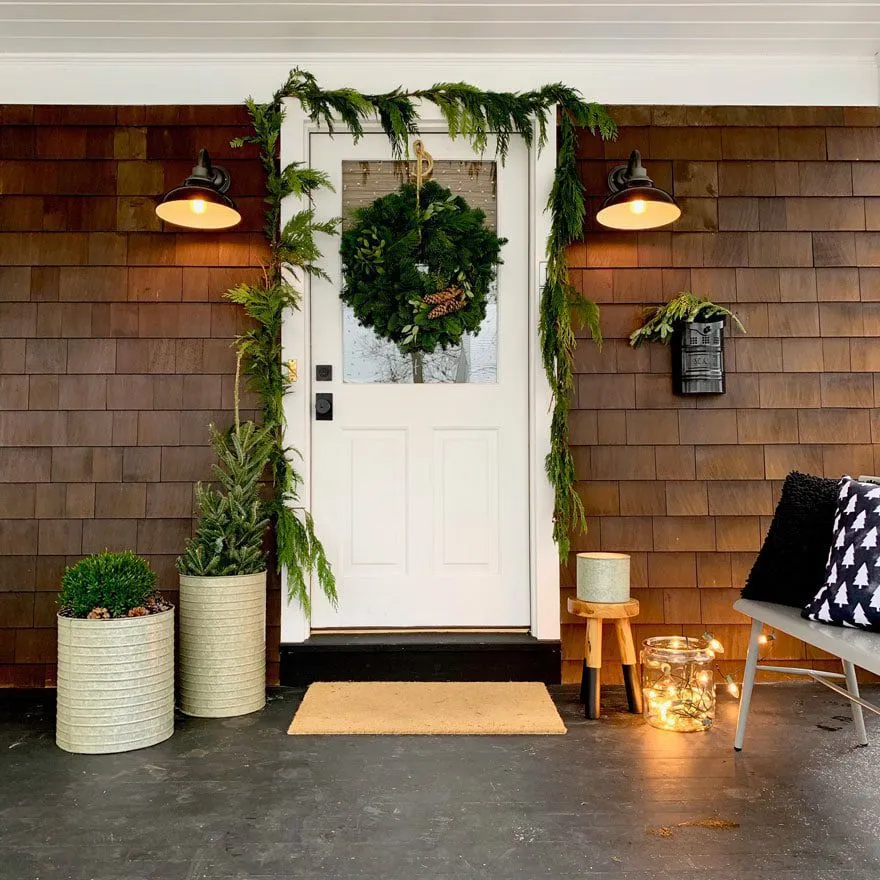
The oversized bows are the entire personality of this porch. Remove them and you have a perfectly nice, completely anonymous garland. They work because they’re deliberately out of scale — each roughly the size of the door’s glass panel — and because the red repeats three times: doorway, planters, door frame. That repetition is what turns a color into a theme.
8. Teal Ceramic Planter with Birch Logs on Gray Pavers
Ceramic planters outdoors are a commitment. In freezing zones, water sitting in an unglazed pot expands and can crack it, so use a plastic liner with drainage holes and empty it after heavy rain. Real evergreens here will drop needles — plan on sweeping the pavers every few days. A quick annual routine: rinse the pot in spring, store it dry and upside down, and it’ll last decades. Faux greenery skips all of that but fades in two to three seasons of full sun.
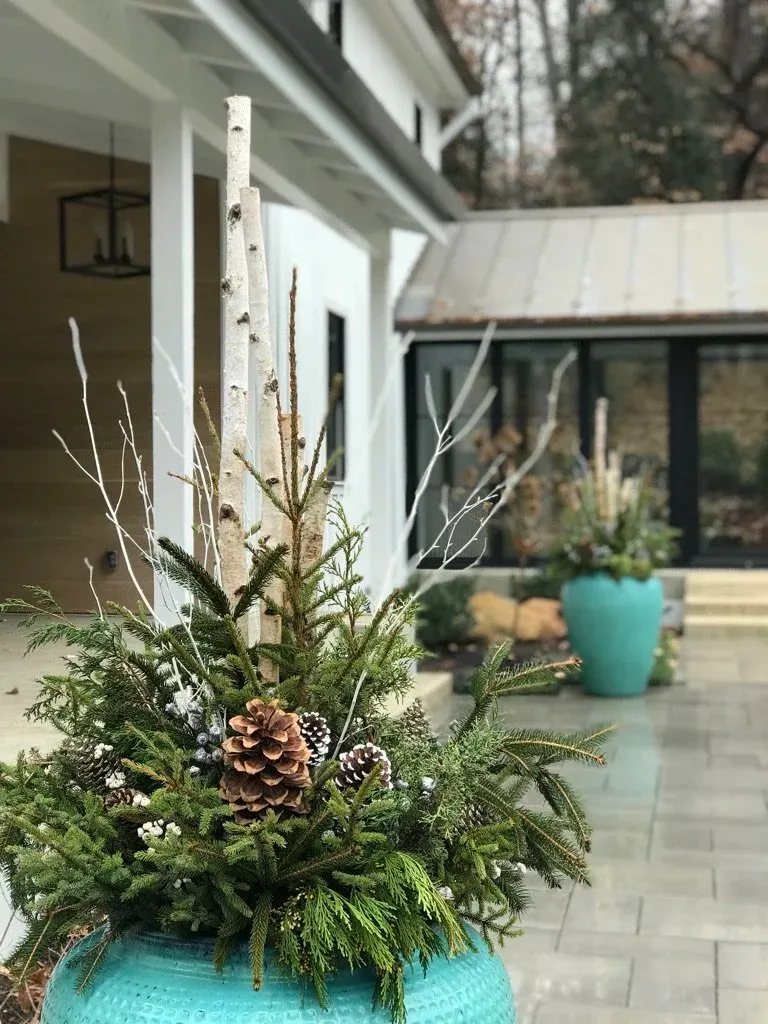
A planter this size — roughly 20 inches wide, 22 tall — suits an entry at least 8 feet across with a walkway of 4 feet or more. Against a white modern house, the teal reads as a deliberate accent. On a small urban stoop, one large planter is plenty and two will feel crowded.
9. A Painted Snowman Beside a Barrel of Winter Greens
The snowman is what makes this corner memorable, but the barrel planter is what makes it work. A painted figure next to a plastic pot looks like a lawn ornament; the same figure next to a weathered wooden barrel looks like a scene. The wood grain and darker tone give the colorful snowman something to stand against, and the deep greens calm down the red berries. Take the barrel away and the whole thing gets cute in the wrong way.
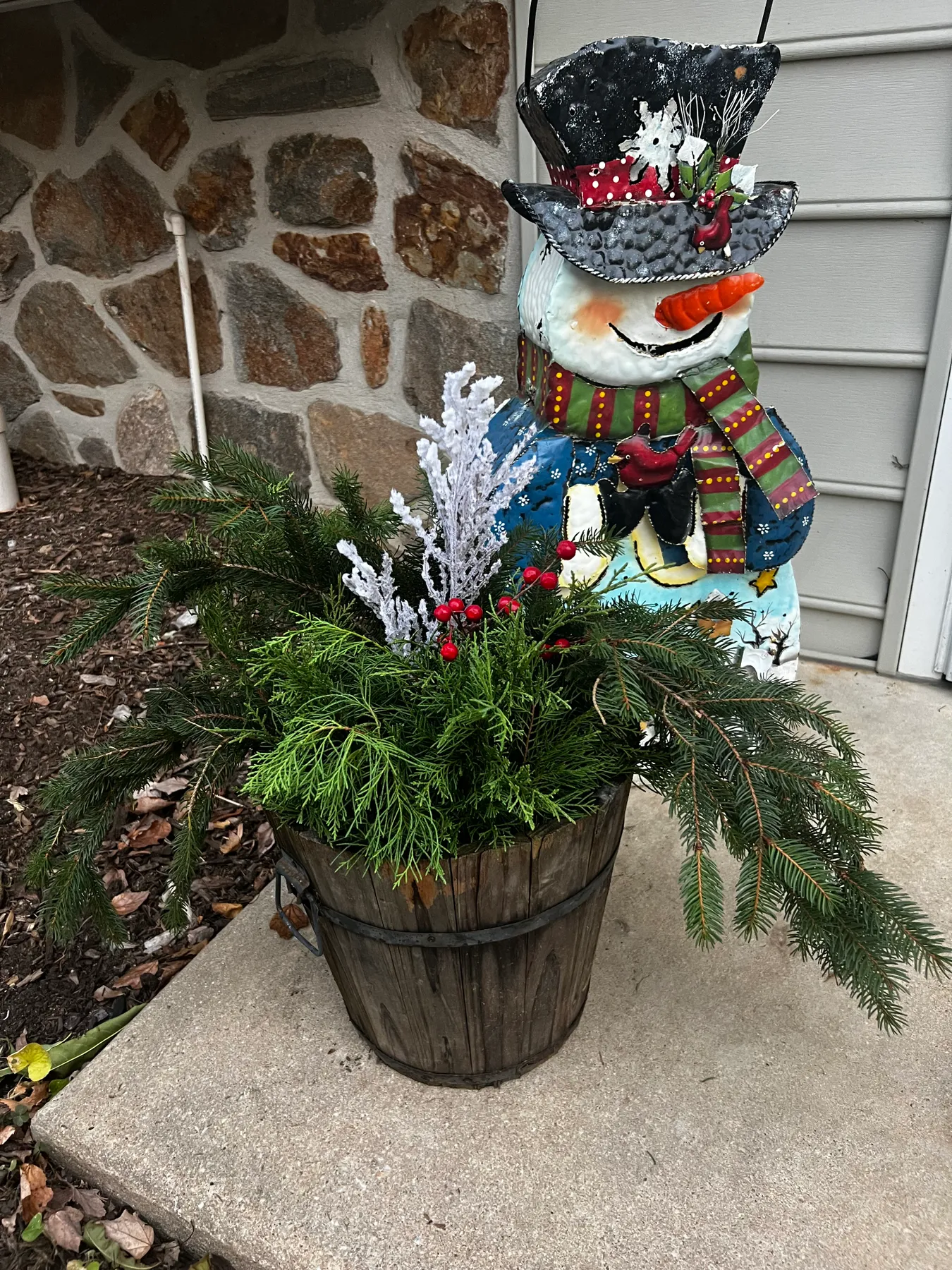
- Set the barrel on a level surface and add a plastic liner with drainage. (5 min)
- Fill with damp sand or a foam block to hold stems at any angle. (5 min)
- Push long evergreen boughs in first, letting them drape past the rim. (10 min)
- Add frosted white branches for height and contrast against the greens. (5 min)
- Cluster red berries in odd numbers — three or five per grouping. (5 min)
Budget $25–$50, time about half an hour.
10. Frosted Wreaths on Every Window with Plaid Throws
This one’s a 70/20/10 build: 70% grey siding and white trim, 20% frosted green, 10% red plaid. It doesn’t feel busy because the green never changes hue — every wreath is the same frost-dusted finish — and the plaid only ever shows up on textiles. To make it yours, keep the structure and swap the plaid for solid charcoal throws, or trade the red for copper. Same formula, completely different house.
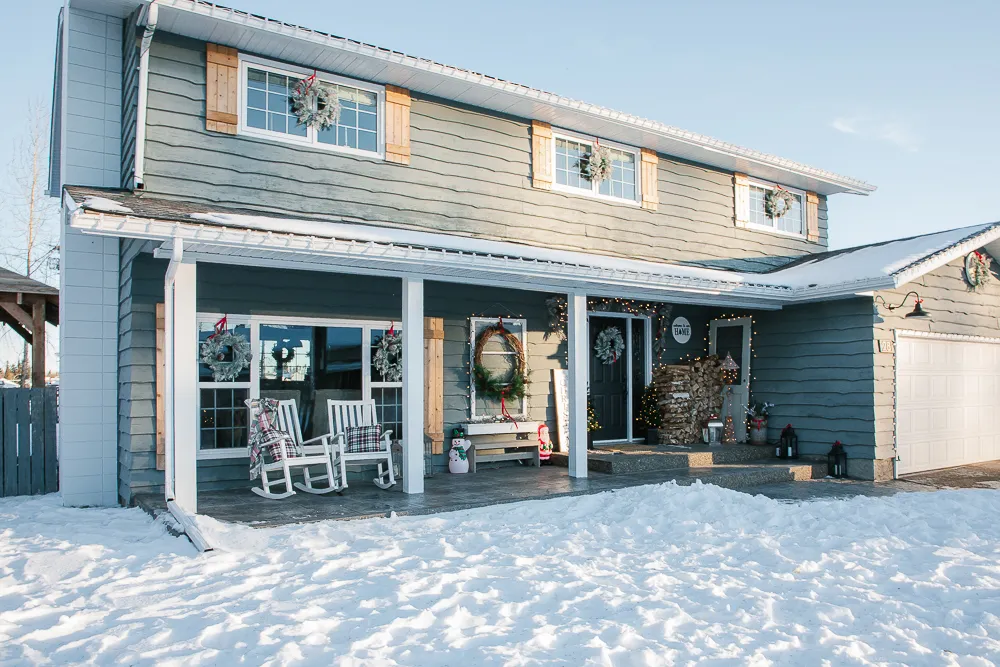
Frosted wreaths are the most forgiving faux greenery you can buy, but they shed. Expect a dusting of white flocking on the porch floor every time the wind picks up, and don’t hang them where roof runoff lands — the coating streaks. Real boxwood avoids the shedding but browns if it dries out, so mist it weekly if you bring it indoors between seasons.
11. Colorful Holiday Planters That Steal the Sidewalk
- Two mid-size planters, 16–18 in.: $40–$160
- Evergreen bundles, 2–3 varieties: $30–$70
- Colored or painted twigs: $15–$40
- Ornaments, berries, and picks: $15–$45
- Fairy lights with a timer: $18–$40
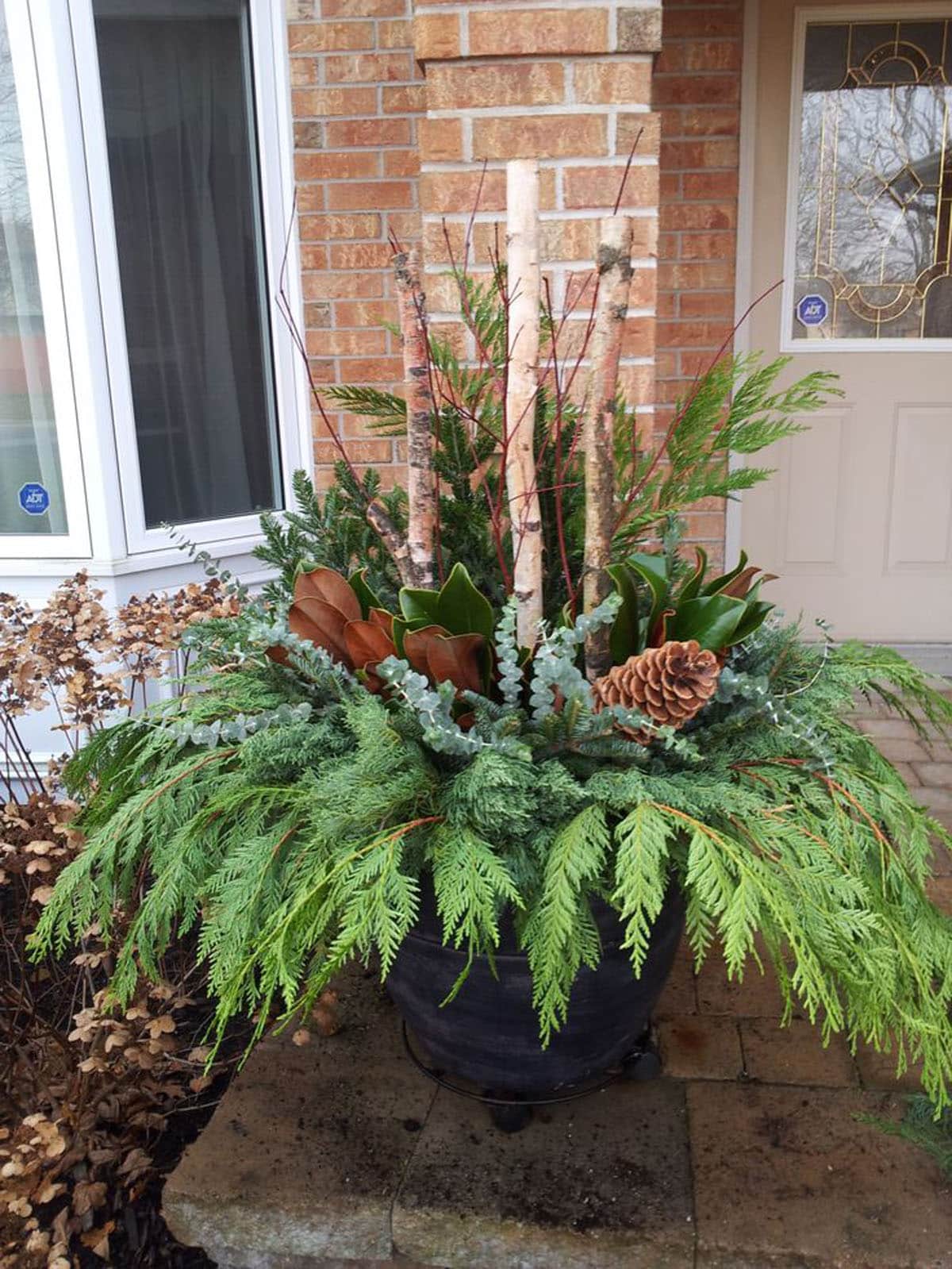
Total: about $118 to $355 to dress two pots that carry you from Thanksgiving through February. A can of outdoor craft paint plus a $10 bundle of branches gets you a custom color for under $20.
Colored planters are where budget builds win, because the wow factor is a paint color, not a price tag. Grab two plain pots on Facebook Marketplace for $10 to $20 each, prime them, then use outdoor enamel in something saturated — rust, pine, deep plum. Thrift stores routinely have baskets and buckets for $3 to $8. This is the budget cousin of Idea #6: same planting method, different shell.
12. A Wreath Hung High on a Navy Door with Black Urns
Hang the wreath so its bottom edge lands at roughly eye level when you’re standing on the porch — about 5 foot 6 to 6 feet up from the door’s bottom, or two-thirds of the way up a standard 80-inch door. A wreath hung dead-center on a tall door floats and looks small. And if you’re using real greenery, soak the wreath’s backing in water for an hour before hanging; it buys an extra week of green before the edges crisp.
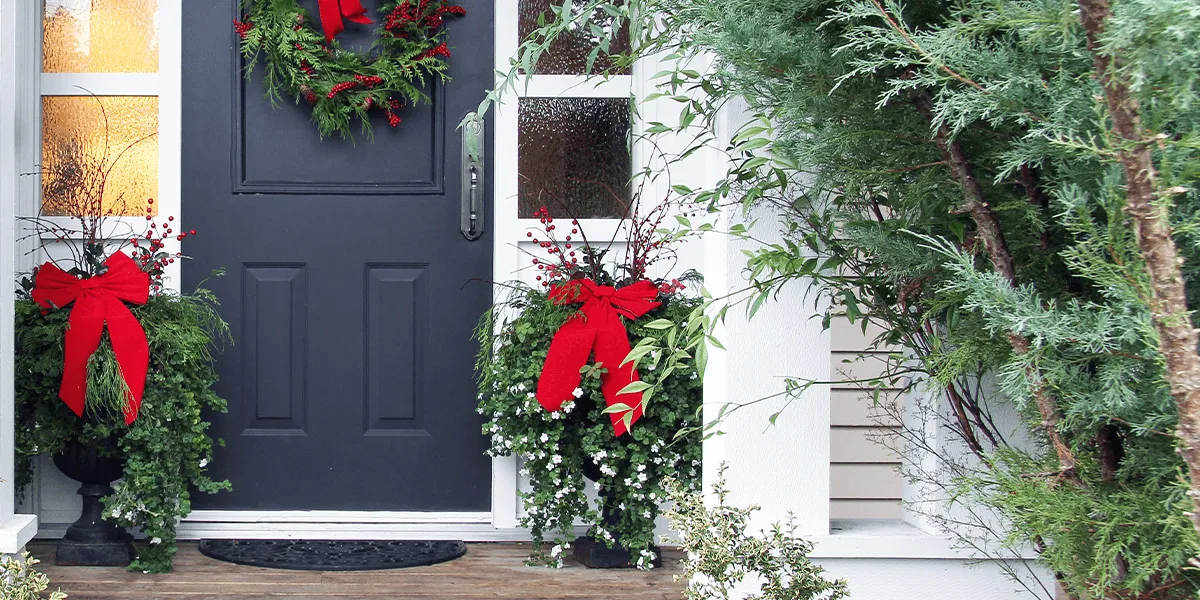
The navy door, red bows, and black urns work together because nothing competes at the same scale — bows are big, berries are small, and the trailing vines bring an entirely different line into the composition. Everything structural is vertical; the vines fall sideways. It reads as styled, not decorated.
13. Orange Curly Twigs Towering Out of Grey Stone Urns
Colored twigs have been one of the quiet breakouts of the last few Pinterest seasons, and it’s easy to see why — they photograph beautifully and cost a fraction of a floral arrangement. Holiday styling is moving away from matching sets entirely: orange and purple here, no red bows anywhere near the door. Call it maximalist botanical. It’ll date a little faster than a classic green-and-red entry, but it’s cheap to swap out in January.
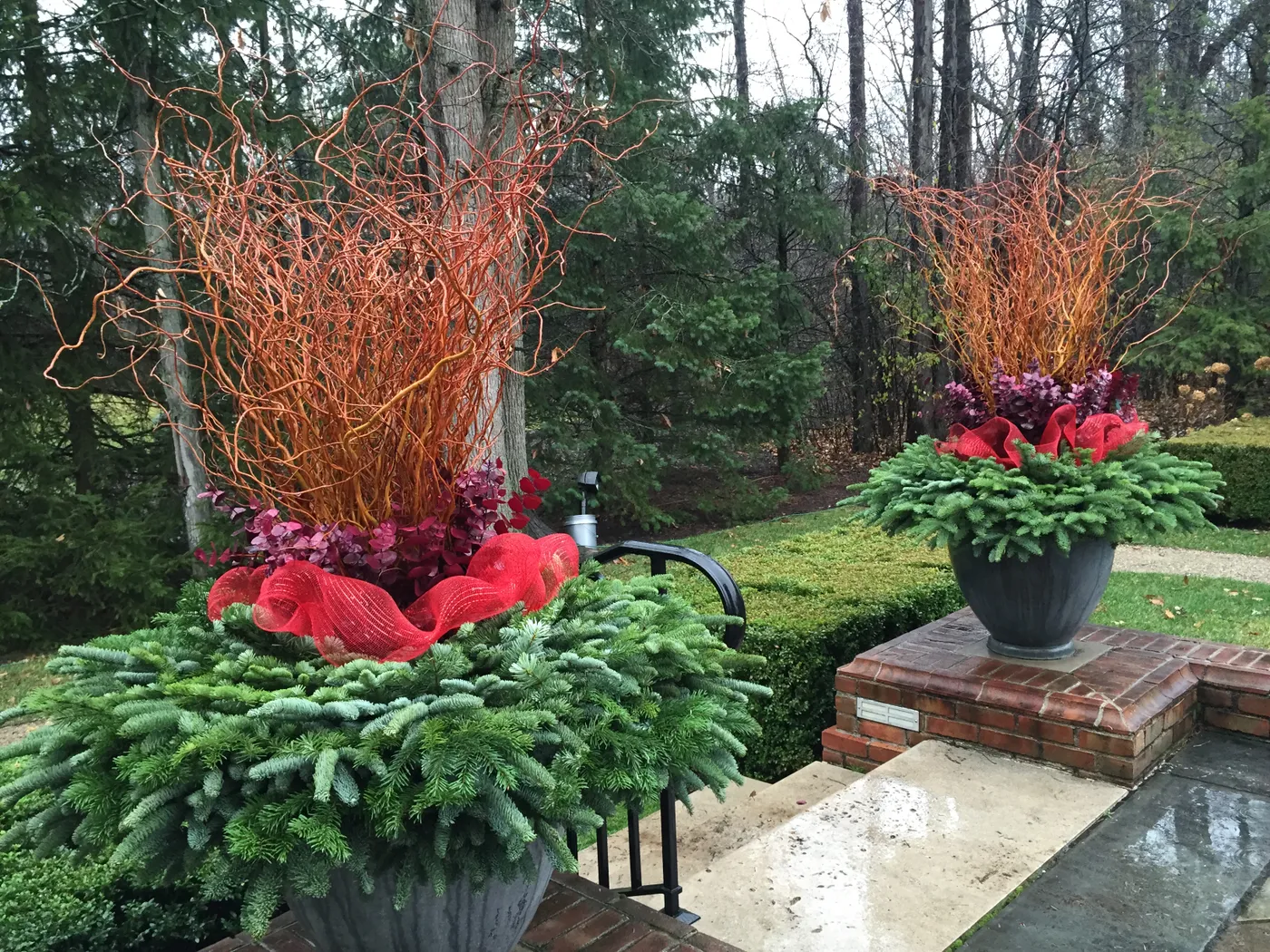
Here’s the math: 55% green, 25% orange, 15% grey stone and urn, 5% purple. The orange twigs work because they’re nearly the same value as the greens — bright, not neon — and the grey urns sit between them and the brick. To tone it down, drop the purple, use burgundy instead of orange, and let greenery carry 80%.
14. A Plaid Bow Against a Dark Green Door Frame
Plaid bows need structure. Wire-edged ribbon holds a shape outdoors; soft ribbon collapses in humidity within a day. Use 2.5-inch wire-edged ribbon, cut tails at an angle with the classic inverted-V notch, and make each tail 1.5 times the width of the bow itself. Secure with florist wire through the back rather than hot glue so you can slide the bow off and store it flat. Fabric ribbon lasts three to four seasons outdoors if you bring it in after Twelfth Night.
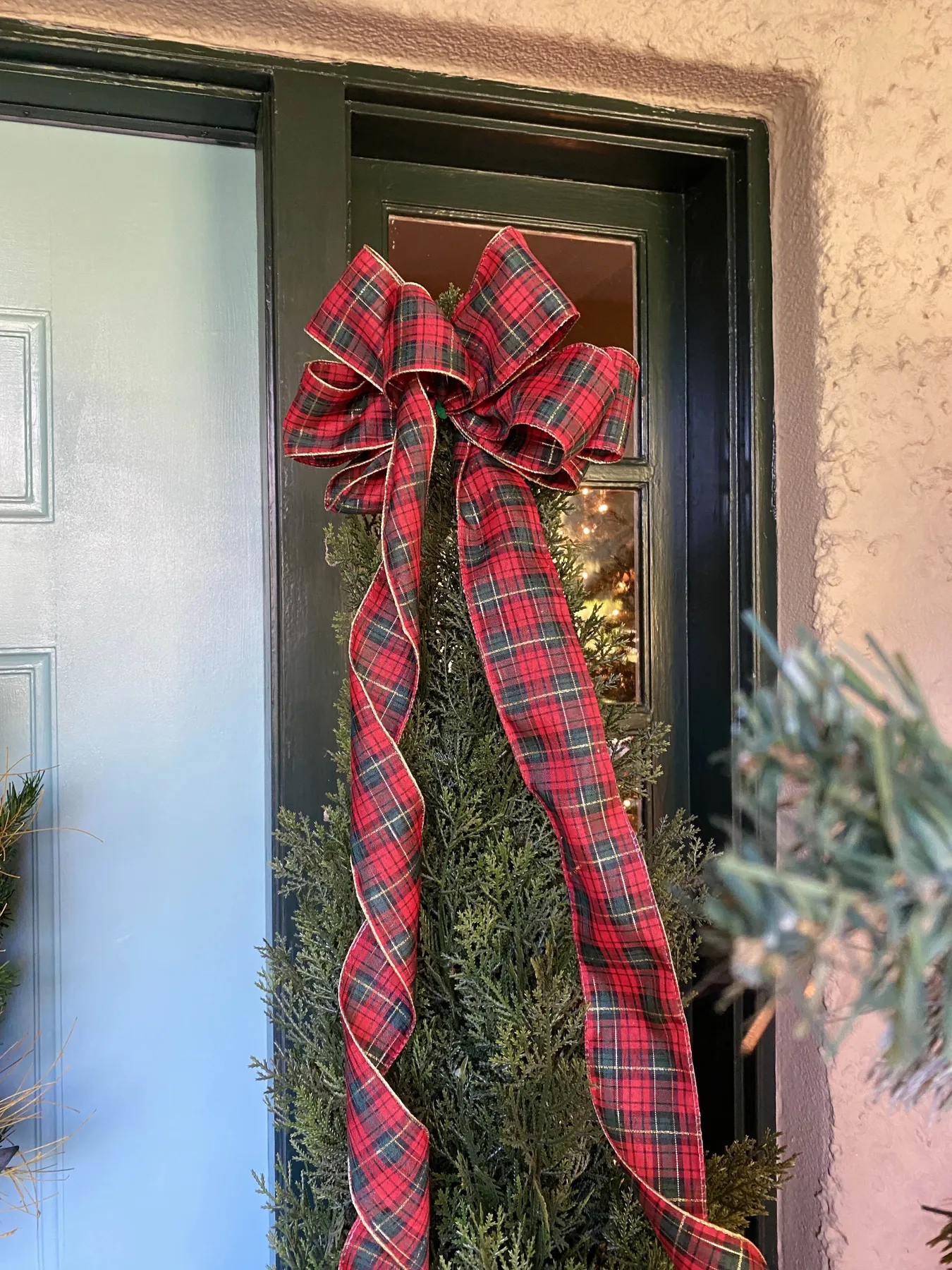
The plaid-and-plaid pairing is the whole idea — the bow on the greenery and that peek of light blue door behind it. One unexpected color note keeps a very traditional red-and-green scheme from feeling dated. On a green or black door, this is your permission slip to bring in something off-script: icy blue, mustard, or pink.
15. Upright Birch Logs with Glossy Red Ornaments
- Anchor three birch logs upright in the center first — they set the height. (5 min)
- Fill around them with mixed evergreen boughs, working front to back. (15 min)
- Wedge pinecones into the gaps so they read as found, not staged. (10 min)
- Wire red ornaments onto hidden stems instead of hanging them. (10 min)
- Top up with red berry clusters at the outer edges for depth. (5 min)
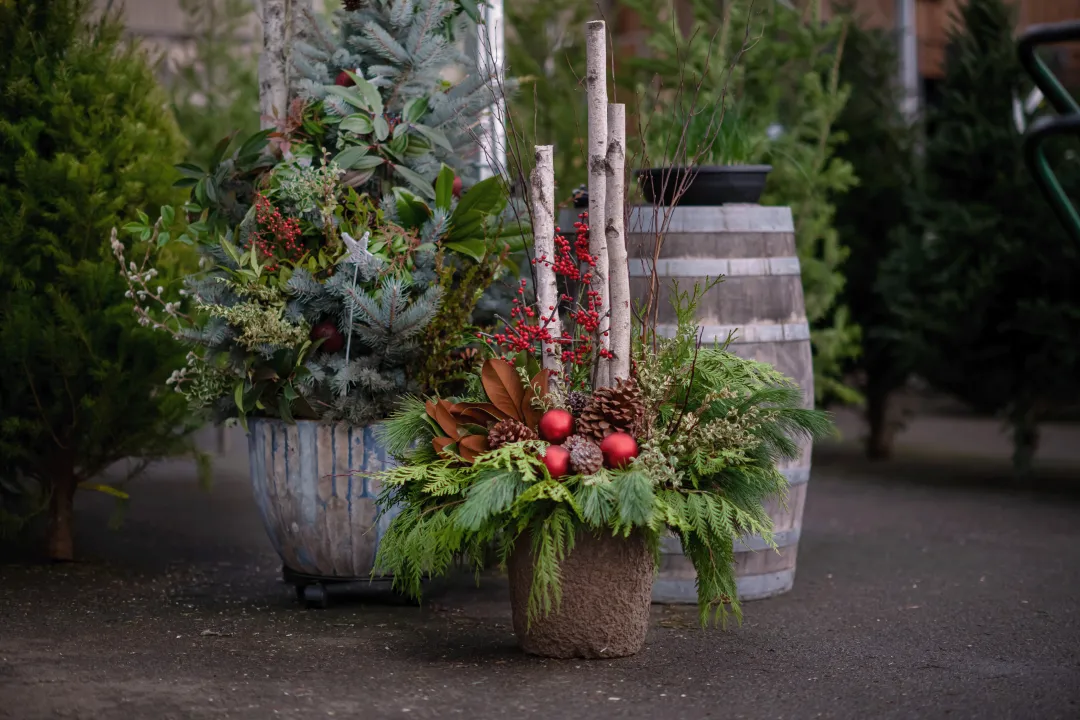
Forty-five minutes and about $40 in materials if you already own the planters.
- Two large planters: $60–$200
- Birch logs or branches: $15–$40
- Mixed evergreen boughs: $30–$70
- Pinecones and berry picks: $15–$35
- Red ornaments (12–15): $12–$30
Total: $132–$375 for the pair. Ornament packs go half off after December 26 — buy a neutral set now and you’ll use it for a decade.
16. Galvanized Buckets, Champagne Ribbon, and a White Brick House
Galvanized planters rust — beautifully or annoyingly, depending on your taste. To keep the bright silver finish, wipe them dry after storms and touch up scratches with clear sealant. Left alone, they’ll develop a patina in one to two winters, which actually suits a rustic house. Glitter ribbon is the other maintenance item: glitter sheds indoors and out, so bag your bows, and skip glitter entirely if your entry is covered and it’ll collect.
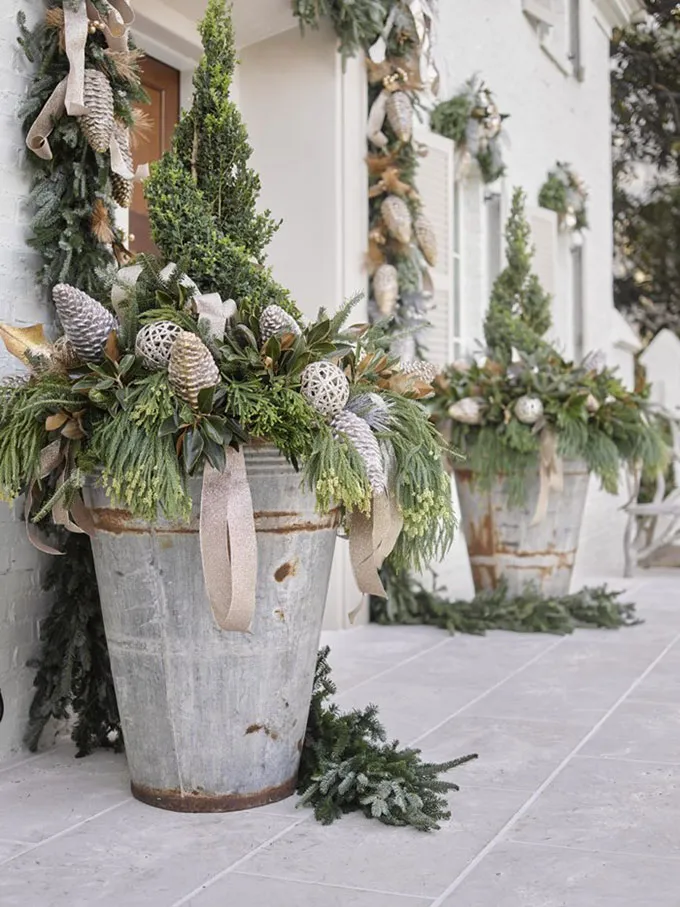
The look is mostly containers and ribbon, both cheap at discount. Check Walmart and Target in early November for galvanized buckets in the $8 to $15 range — they’re usually in the garden section, not the holiday aisle. Champagne ribbon runs $6 to $10 a roll and one roll makes four bows. Pair with $12 evergreen bundles and you’re in around $60 total.
17. Brass Bells, a Big Lantern, and Layered Coir Mats
Add real height to a porch by setting the lantern on a 6-to-8-inch block or a stack of two bricks behind the doormat. Floor lanterns at ground level dissolve into the floorboards; raised even slightly, they read as objects. Also go big with candles — a 6-inch pillar inside a 14-to-18-inch lantern looks intentional, while a 3-inch candle looks like it wandered in from the dining table.
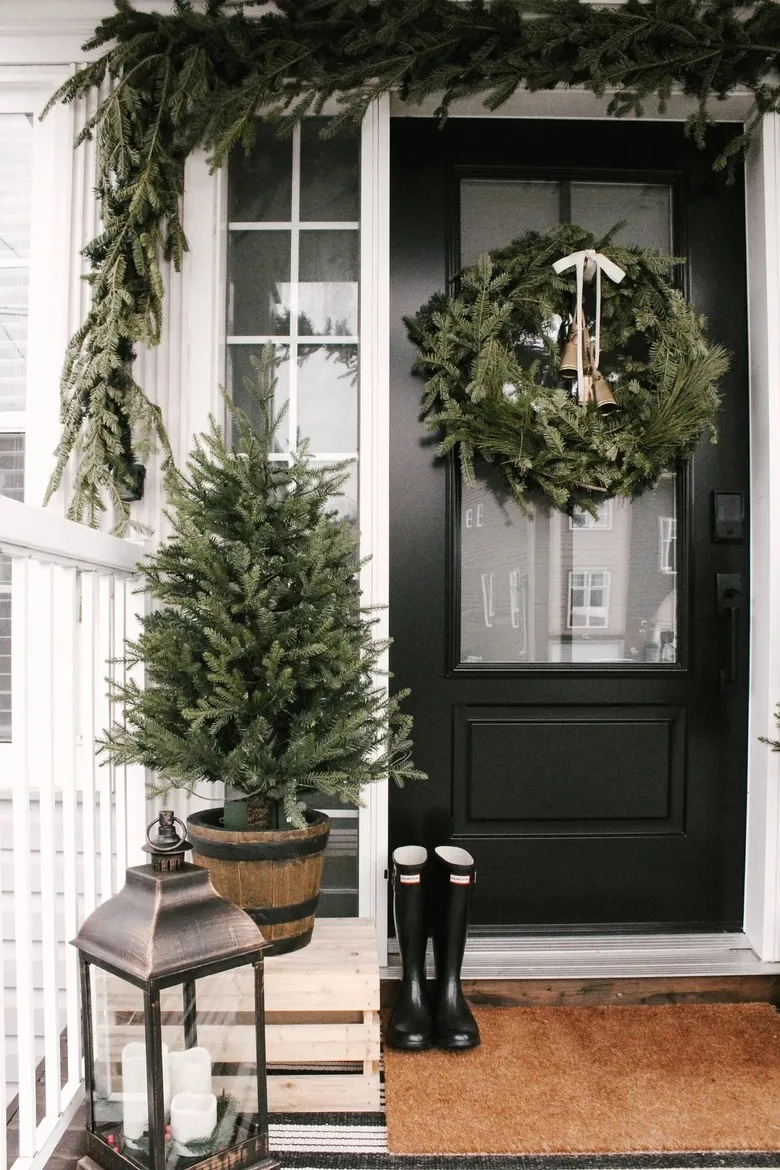
This composition needs a porch at least 5 feet deep and 7 feet wide. Anything less and the barrel, lantern, and layered mats start bumping into each other, and guests end up stepping around the decor. Nine-foot ceilings are ideal for a draped garland; at 8 feet, skip the ceiling swag and keep greenery on the railing instead.
18. Red Poinsettias and Coleus Against Rustic Brick
Poinsettias outdoors are a one-night stand in most of the country. They’re tropical plants that sulk below 50°F and turn to mush at freezing, so treat them as a party decoration for a mild evening or a covered porch, then bring them inside. Coleus has the same problem. If your entry faces frost, swap both for red-tipped kale or painted heuchera, which hold color into the twenties and won’t need rescuing at midnight.
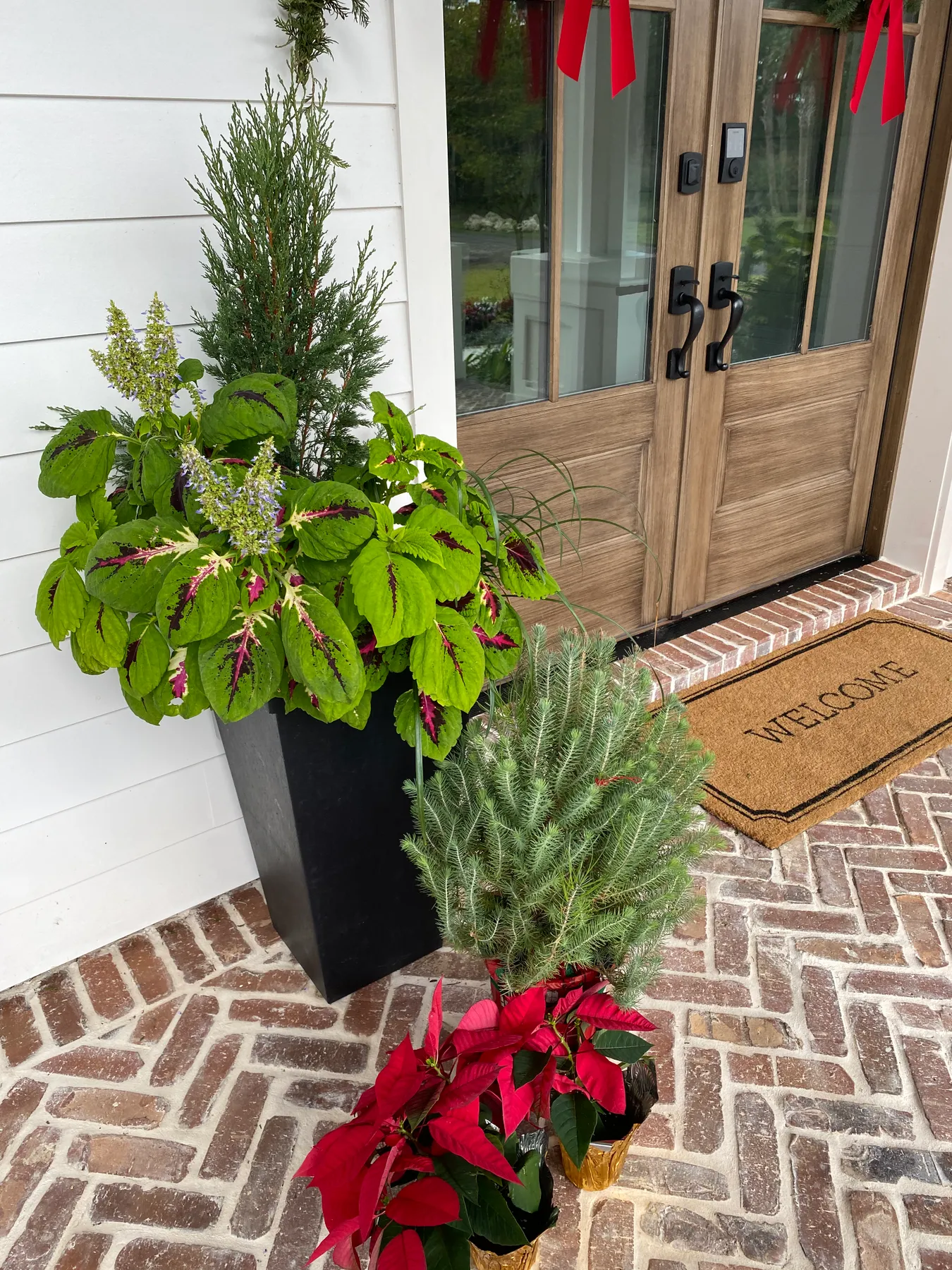
Mixing houseplants into holiday containers is part of a bigger shift: people are styling porches the way they style a coffee table, with layered, living elements instead of a single wreath and a flag. The upside is a longer display life — the coleus and evergreen carry through January. The catch is that you’ll be doing plant care in the cold.
19. Wrapped Garlands Spiraling Up White Columns
Wrapping columns eats lights fast. A 9-foot column with a 3-inch spiral takes roughly 30 to 40 feet of strand, so budget 100 feet for a pair, plus 60 feet for a railing. If your porch is under 8 feet wide, wrap the columns only and leave the railing bare so the space doesn’t feel fenced in. Deep porches over 10 feet handle both, plus a swag over the doors. Buy 20% more than you calculate — you’ll want the slack.
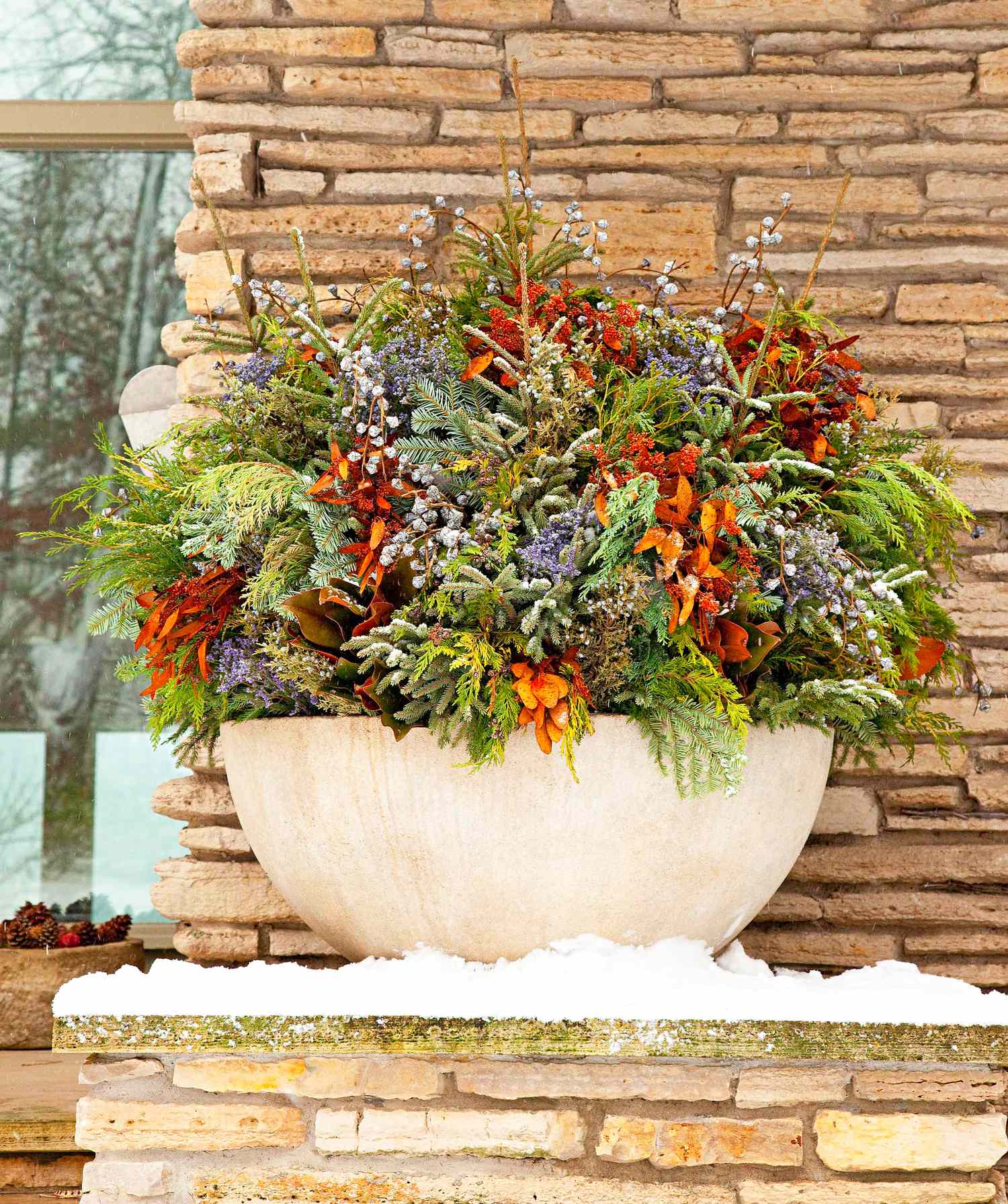
Warm white does the heavy lifting. At 2700K, bulbs read as candlelight and make white columns look creamier rather than clinical; the same strand in cool white would turn this porch into a hotel lobby. Garland, lights, wreaths, and potted greens repeat in four places, which is why the eye reads decorated instead of just lit.
20. Wrapped Gift Boxes Waiting on Arched Stone Steps
The wrapped gift boxes on the steps. They cost almost nothing, they photograph like a magazine spread, and they solve a problem no light strand can — they make the entry look used and lived-in. Empty boxes weighted with bricks and wrapped in weather-resistant paper hold up through rain if you skip fabric ribbon. Remove them and you have a beautiful but slightly formal hotel entrance. Keep them and it’s a house where something is about to happen.
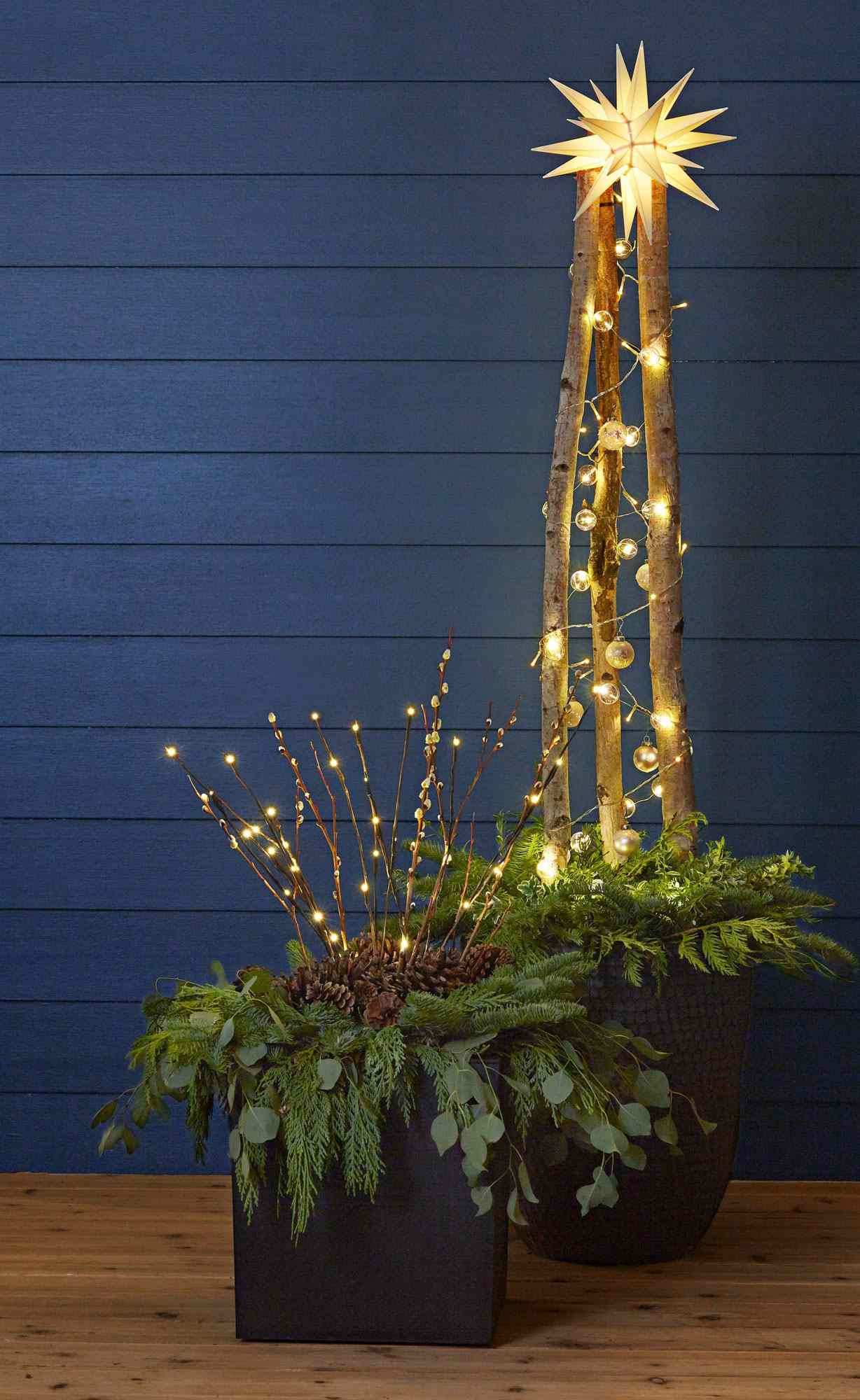
Gift boxes are the single best budget move in outdoor decorating: $12 at a dollar store gets you six boxes, and one roll of weatherproof wrap is $8. Lanterns run $15 to $30 at Walmart, or $6 apiece at a thrift store with a coat of black spray paint. It’s the higher-impact cousin of Idea #2 — same snowy welcome, half the spend.
21. Symmetrical Frosted Wreaths with Brass Wall Lanterns
The proportions here are doing the work: 65% natural wood and stone, 25% deep green, 10% warm brass. Brass is the wildcard. It’s the only warm metal in the scene, so it lifts the greens without adding another color, which is exactly why swapping it for chrome would make the entry feel colder. For a modern version, keep the greens and switch the brass for matte black — you lose warmth but gain graphic punch.
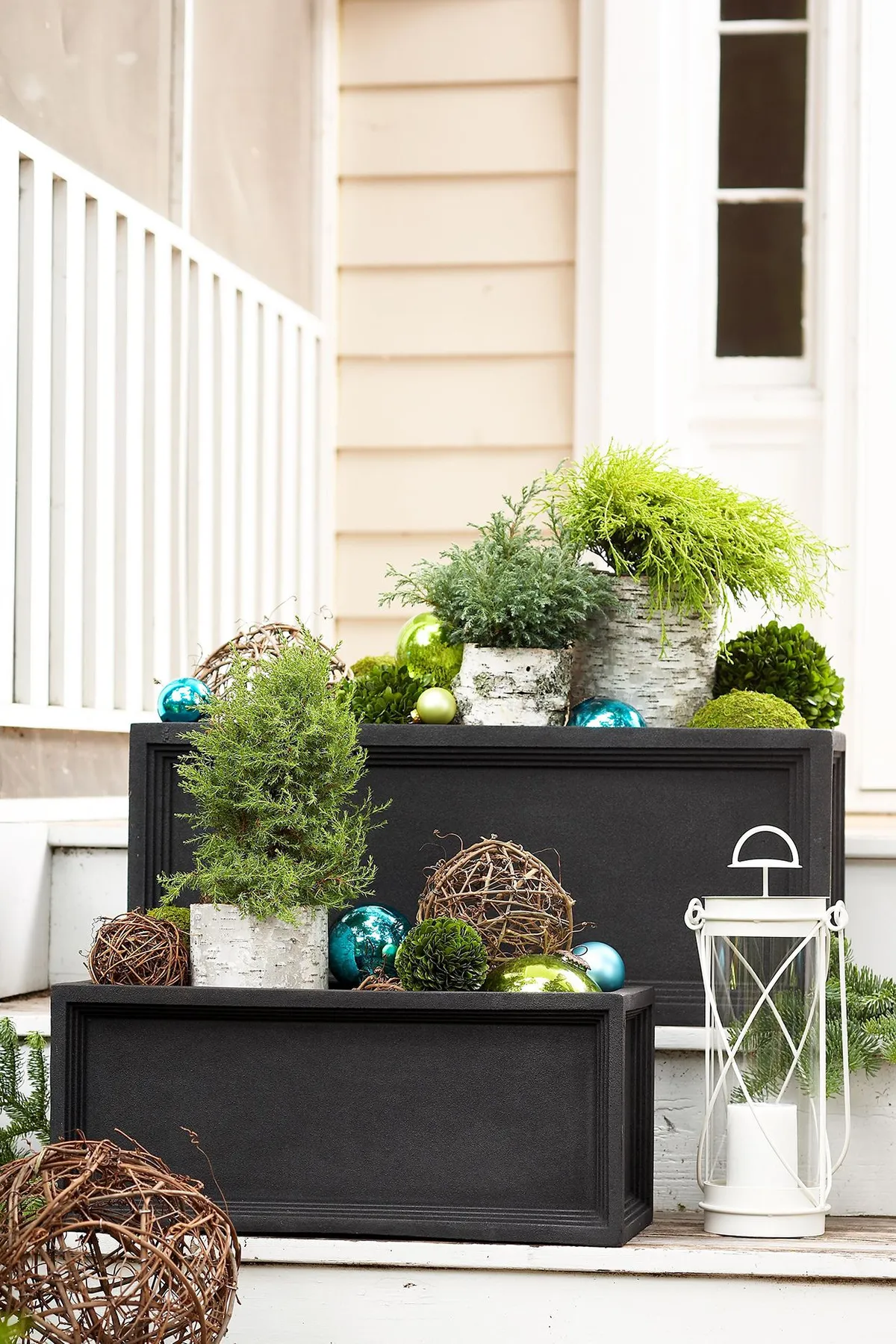
- Measure your door opening and confirm wreath sizes land at 20–24 in.
- Check which direction the porch faces — full sun fades faux greenery.
- Verify outdoor outlets, or buy battery timers for the lights.
- Test your sconce bulbs: warm white 2700K, not cool white.
- Decide whether planters stay through February or come in after New Year.
22. A Black Urn of Birch Logs and Winterberries
- Stand three birch logs in the urn and pack sand around them. (10 min)
- Add evergreen boughs in a ring, working from the back forward. (15 min)
- Thread winterberry stems through the greens near the front edge. (10 min)
- Tie a plaid ribbon to the rocking chair and drape a matching throw. (5 min)
- Mist real berries lightly — they’ll hold about a week outdoors. (2 min)
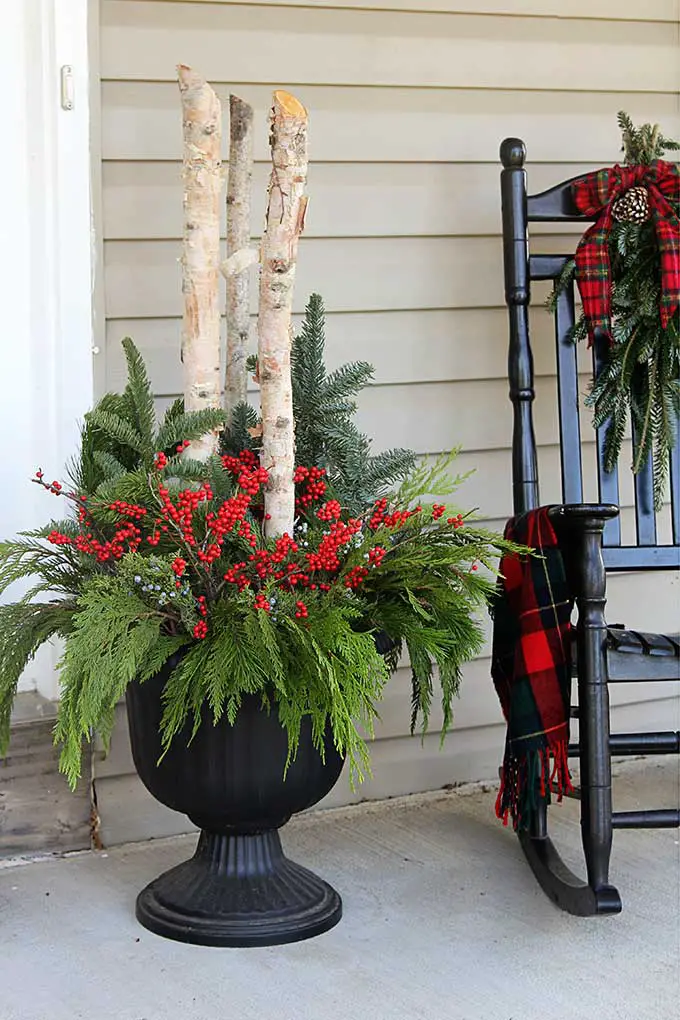
Roughly 45 minutes and $50–$90 in materials, most of it reusable next year.
Winterberry is the prettiest liar at the garden center: the berries look indestructible and then shrivel in a week of wind. Faux berry stems solve that at the same price. Birch logs are the opposite — practically immortal, but they’ll mold if they sit in wet soil, so keep them in sand and store them dry. The plaid throw will need washing when it comes inside.
23. Mini Christmas Trees with Black Floor Lanterns
Match the lantern height to the pot beside it. If your floor lantern is taller than the mini tree next to it, move it behind and slightly to the side — two objects at different heights read as a grouping; two at the same height read as a pair of bookends. A good rule: keep adjacent objects at least a 1:1.5 height ratio, so a 24-inch tree pairs with a 16-inch lantern or a 36-inch one, never another 24.
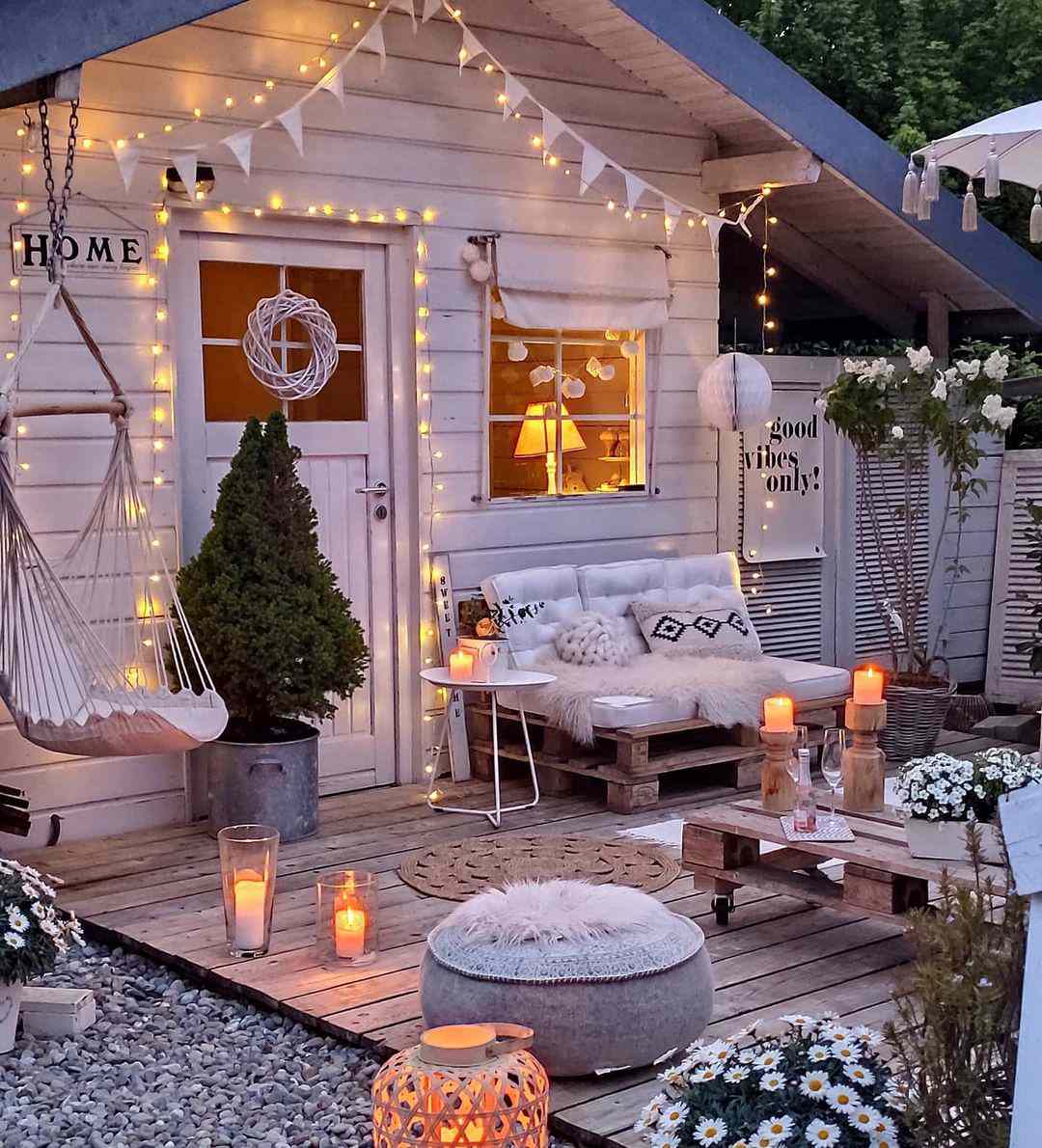
The glow here is low and layered, and that’s deliberate. Lights live on the garland at door level, in the lanterns at ankle level, and on the little trees in between — three separate bands of warm light instead of one bright wall. That’s why the wooden door stays visible rather than silhouetted. One bright fixture above the door would flatten the whole mood.
24. Candlelit Lanterns Flanking a Pair of Glass Doors
- Two wreaths with ribbon: $50–$180
- Two potted cedars, 4 ft: $80–$300
- Floor lanterns (2): $40–$140
- Candles plus LED inserts: $20–$50
- Warm exterior bulbs and timers: $15–$40
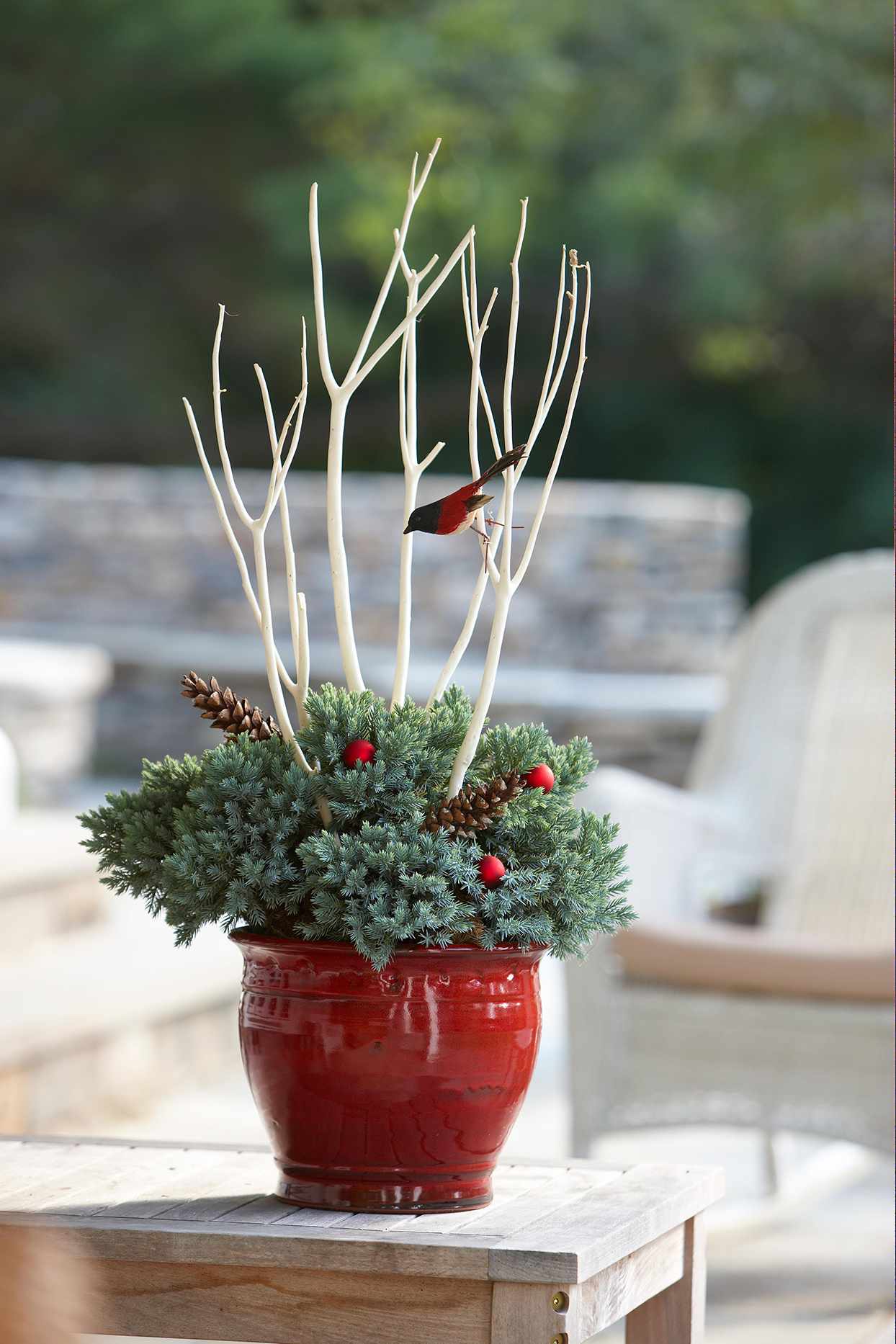
Total: $205–$710 for a full double-door setup at night. Budget alternative: faux cedars run about $35 each at Walmart or Wayfair, and two $18 lanterns with LED pillars get you the same silhouette for under $150.
- Confirm both porch outlets work and can take a timer.
- Measure door width — two 24 in. wreaths need 60 in. of clearance.
- Check pathway lighting so guests can see steps at night.
- Verify lanterns are rated for outdoor use, not just covered patio.
25. A Weathered Wooden Bench Under Hanging Lanterns
The bench. Everyone decorates the door and forgets the place people actually want to sit. A weathered wooden bench with a cushion and a throw under warm lights turns a pass-through porch into a place to linger — that’s what makes this scene feel like a home rather than a display. It also fills the dead zone below the garland, which is the emptiest square footage on most porches.
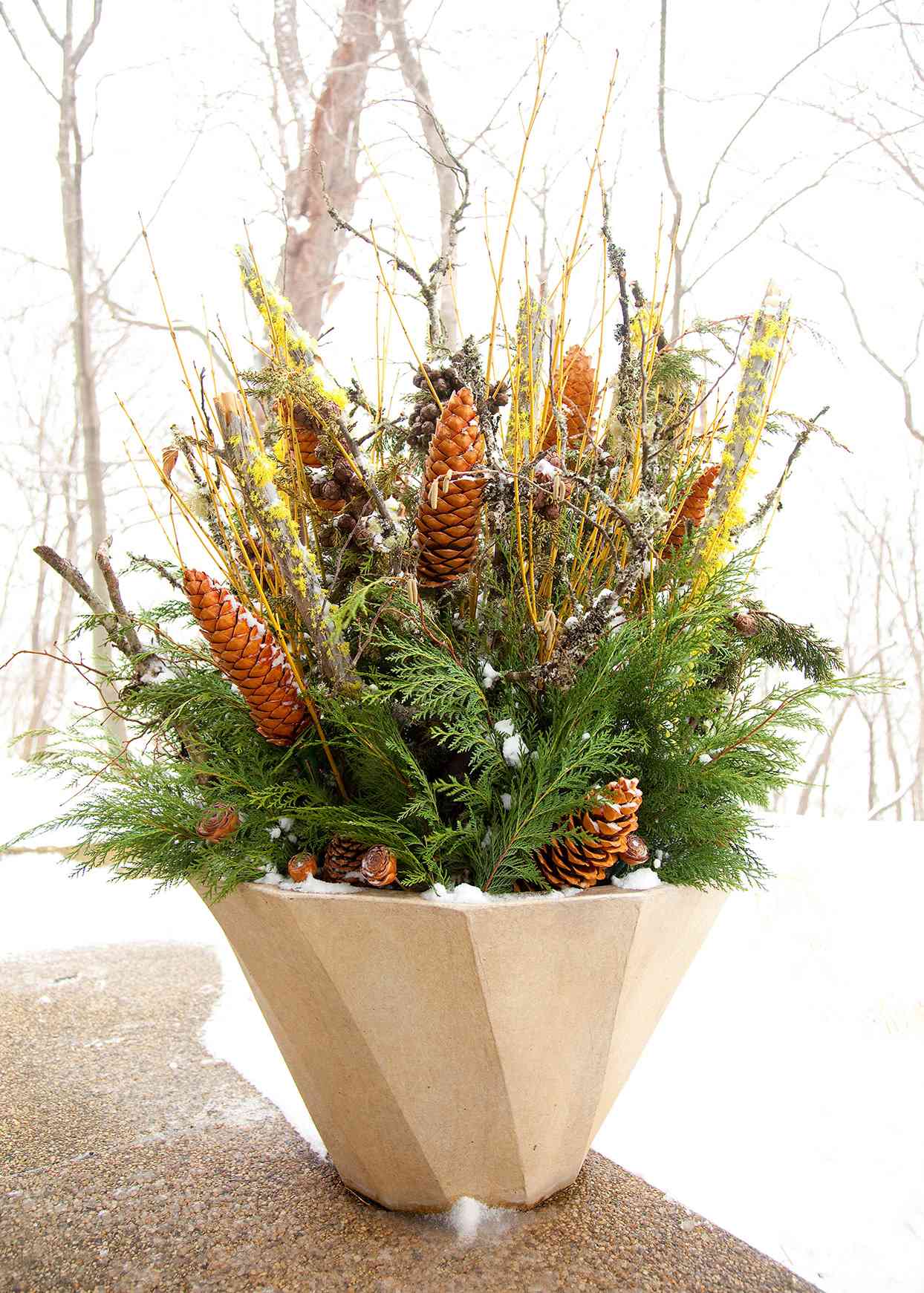
Hanging lanterns are lovely and slightly treacherous. Anything hung from a porch ceiling needs to clear head height for anyone over 5’10”, so keep the bottom of a lantern at least 6 foot 8 from the floor or it becomes a hazard. Candles in hanging lanterns also sway; switch to LED pillars in a windy exposure. Expect condensation inside the glass on unheated porches.
26. Lit Wire Reindeer Next to a Hanging Wicker Chair
Wire reindeer and lit figures photograph poorly from straight on and beautifully from three-quarters. Place them at a 30-to-45-degree angle to the walkway so people see the shape instead of a flat silhouette. Keep the light count low, too: a figure with 60 bulbs reads as a sculpture, the same figure with 200 reads as a car lot. Put them on a timer with your porch lights so the whole scene turns on and off together.
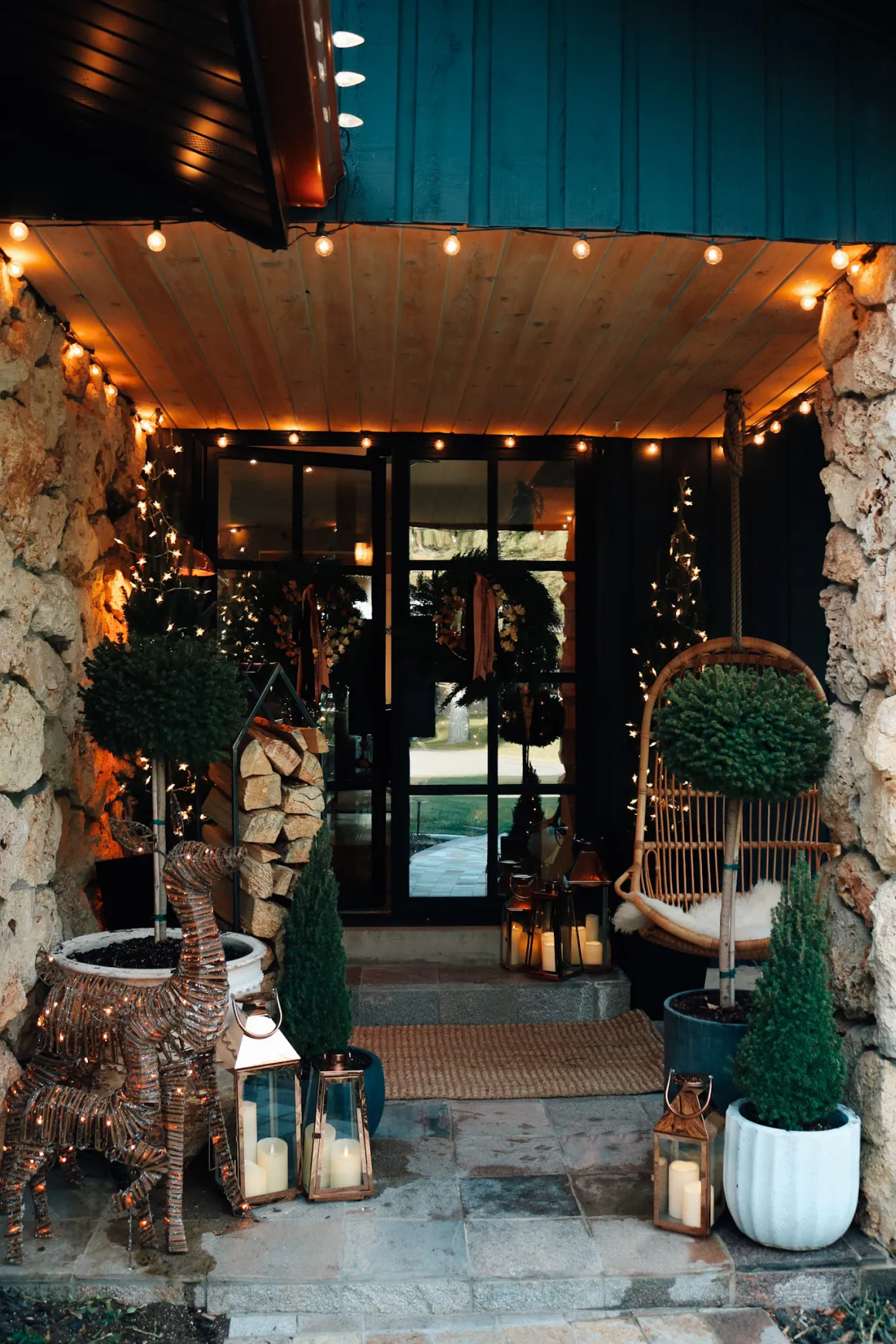
Magical-porch styling — stacked firewood, lanterns, a hanging chair — is a direct descendant of the porch-as-outdoor-living-room trend, which is why searches for covered porch lighting spike every November. It’s less about Christmas and more about surviving winter well. Strip the reindeer and it’s still lovely in February.
27. Three Stacked Wreaths on an Arched Brick Doorway
- Hang a 30-inch wreath first as the base layer. (10 min)
- Center a 20-inch wreath over it and tie both through the same hook. (10 min)
- Add a 12-inch wreath in the middle if your door is 8 ft or taller. (10 min)
- Mirror the wreath count with three potted topiaries per side. (15 min)
- Run the lit garland along the arch, securing every 12 inches. (20 min)
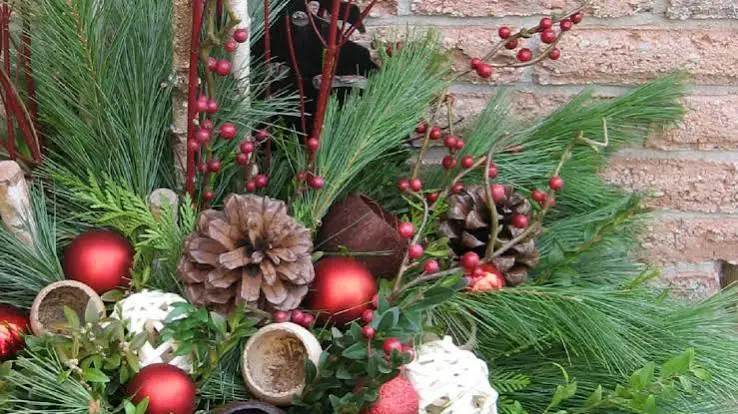
About an hour and $80–$200, depending on whether your wreaths are real.
Stacked wreaths need door height. On an 80-inch door, two layers is the maximum before the bottom wreath starts whacking knees — and it should sit no lower than 24 inches off the floor. Arched brick doorways under 7 feet wide look best with garland alone and a single wreath. If your entry is compact, the single-statement version in Idea #17 fits better.
28. Four Grey Planters Framing a Stone Staircase
- Four grey planters: $120–$400
- Evergreen boughs plus seeded eucalyptus: $60–$140
- Red twig branches (8–10): $25–$60
- Decorative spheres (12): $20–$50
- Red mesh ribbon, 2 rolls: $14–$30
- Battery fairy lights: $25–$60
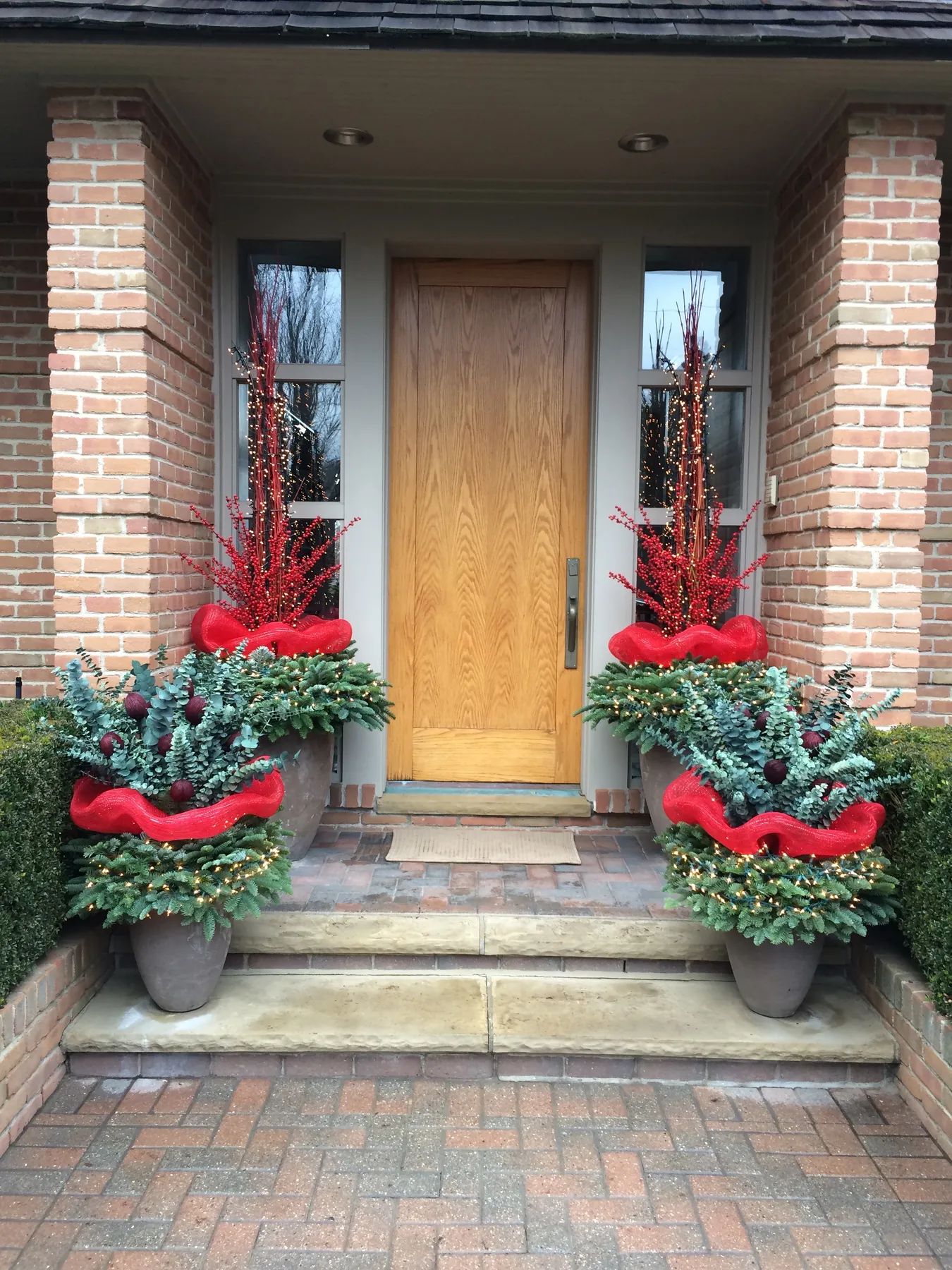
Total: $264–$740 to line a staircase. Budget alternative: dollar-store buckets spray-painted grey, $12 of greenery per pot, and one ribbon roll cut into four bows gets you the whole stairway for around $80.
The formula is symmetry plus restraint: four pots, two sizes, one red. Because the shapes repeat, the eye reads the staircase as a single gesture rather than four separate planters. Swap the red mesh for champagne and it turns elegant; swap grey pots for black and it turns sharp.
29. A Snowflake-Printed Bow on a White Urn
Tie a bow so it reads from the street. A 10-inch-wide bow with two tails looks proportional on a 20-inch urn, and it should sit just below the rim, not in the middle of the greens. Layer two ribbon widths together — a 2.5-inch base with a 1-inch top layer — and the knot disappears into a shape. Snowflake prints are charming up close but vanish at 20 feet; solid ribbon with a printed edge works harder.
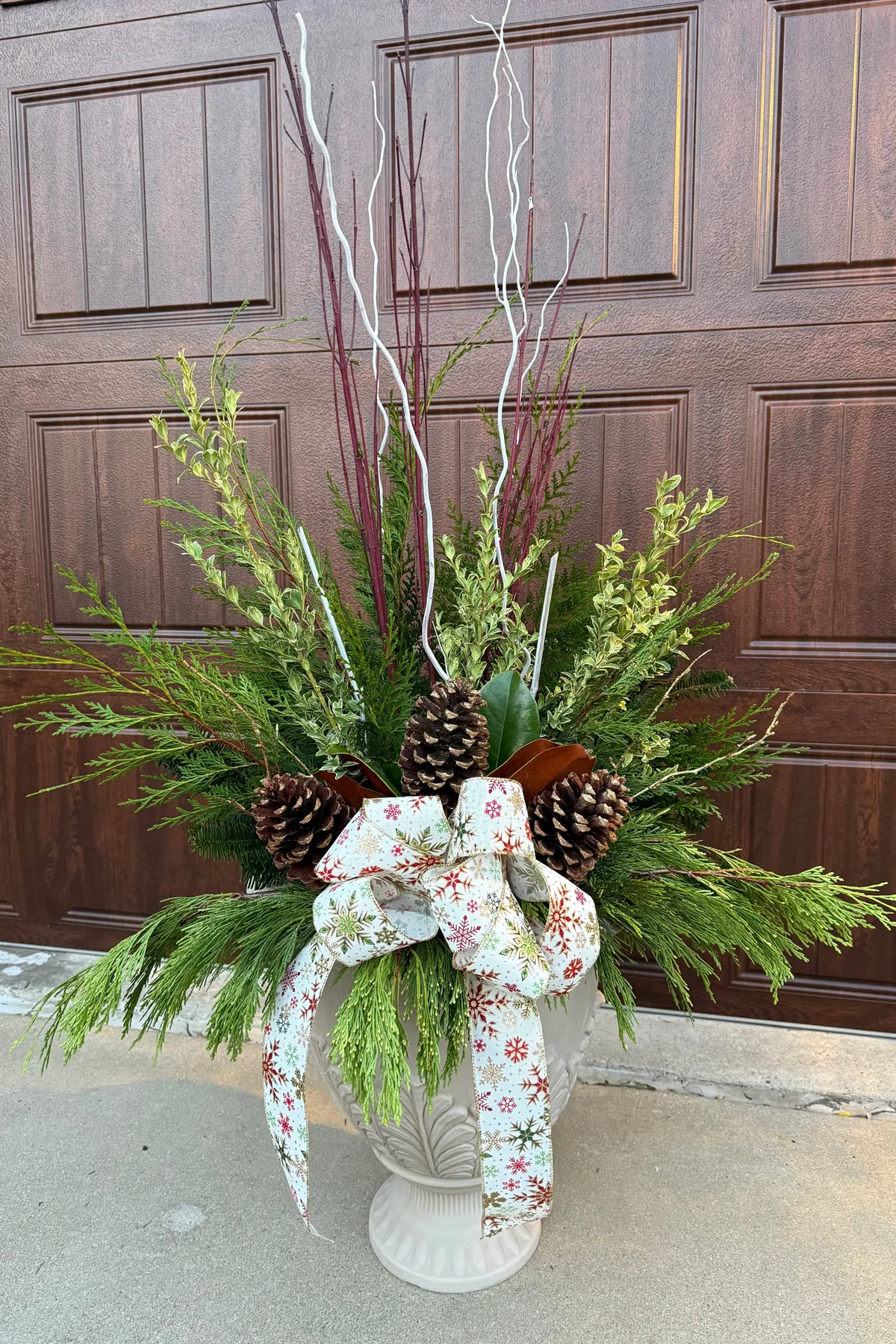
The urn is the investment here; the contents aren’t. Check spring clearance at Walmart and Lowe’s for white planters at 50–70% off — $20 to $30 for a pot that lists at $70. Real pinecones are free if you live near pines; otherwise a $5 craft-store bag covers a whole planter. Under $60 total, and it’s the petite sibling of Idea #28.
30. A Boxwood Topiary Dog with a White Ribbon
The boxwood topiary dog with the white ribbon. It’s the only thing here that isn’t trying to be Christmas, and that’s exactly why it works. Everything else — the fluffy white tabletop tree, the silver lantern, the potted herbs — reads as holiday decor. The dog reads as a family joke. One unexpected, slightly silly object is what keeps a decorated porch from looking like a catalog page, and this one earns its place.
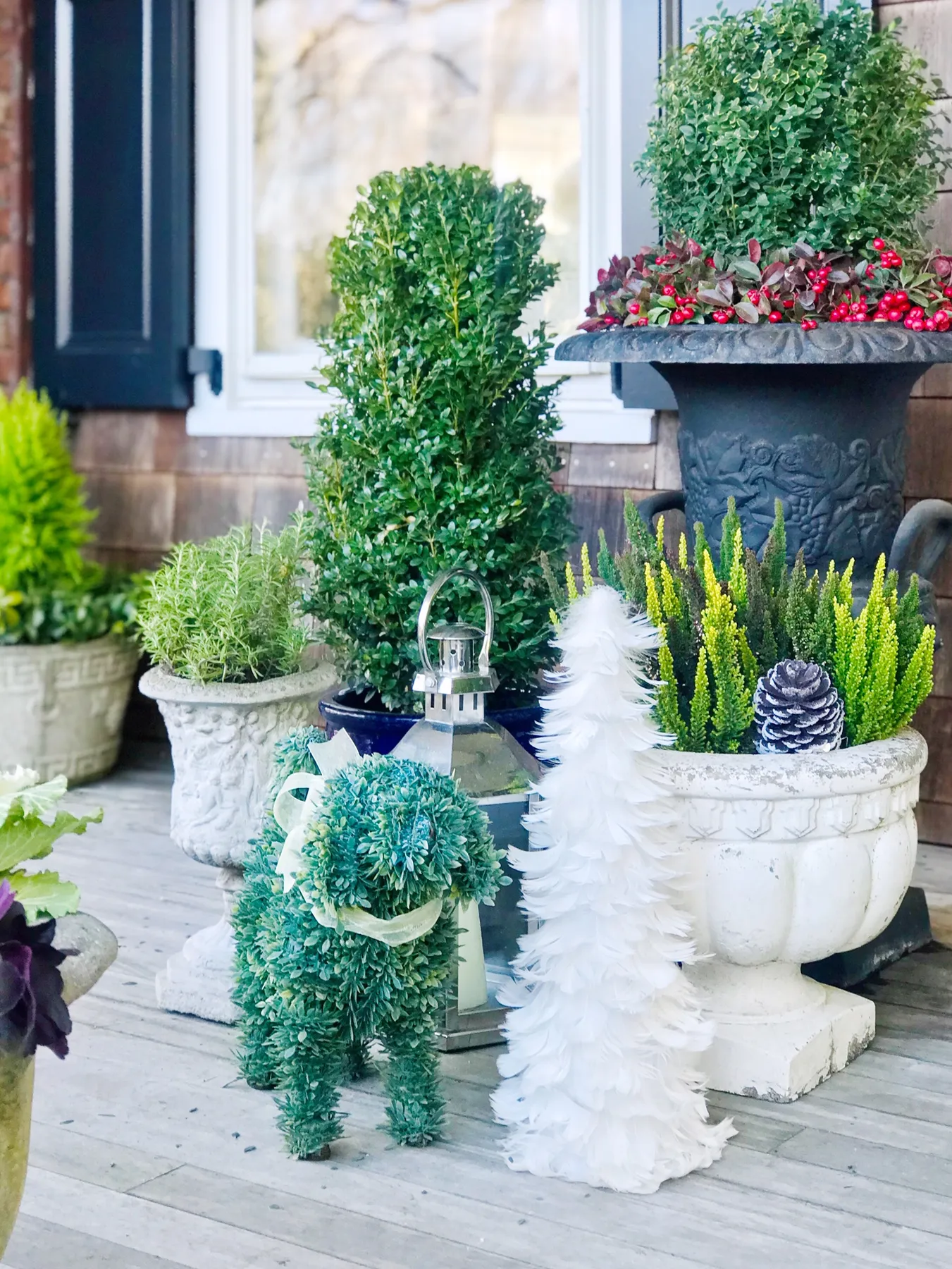
What holds this collection together is a very tight palette: green, white, charcoal, and earthy brown, with no red anywhere. The whiteness of the tabletop tree and the ribbon repeats three times, which is the minimum for a motif to register. It also means the display can quietly graduate from holiday to winter and stay up until March without anyone noticing.
31. A Black Planter Full of Ornaments and Cascading Ivy
Glossy ornaments outdoors are a gamble. Sun bakes the finish and repeated freeze-thaw cycles crack cheap ones within a season, so look for shatterproof plastic with a UV-resistant coating. Store them loosely in a bin rather than a bag, and never leave glass outside overnight in freezing weather. Frosted pinecones are the other item to watch: cheap ones lose their snow in the first rain, so a light coat of matte clear spray keeps them looking dusted.
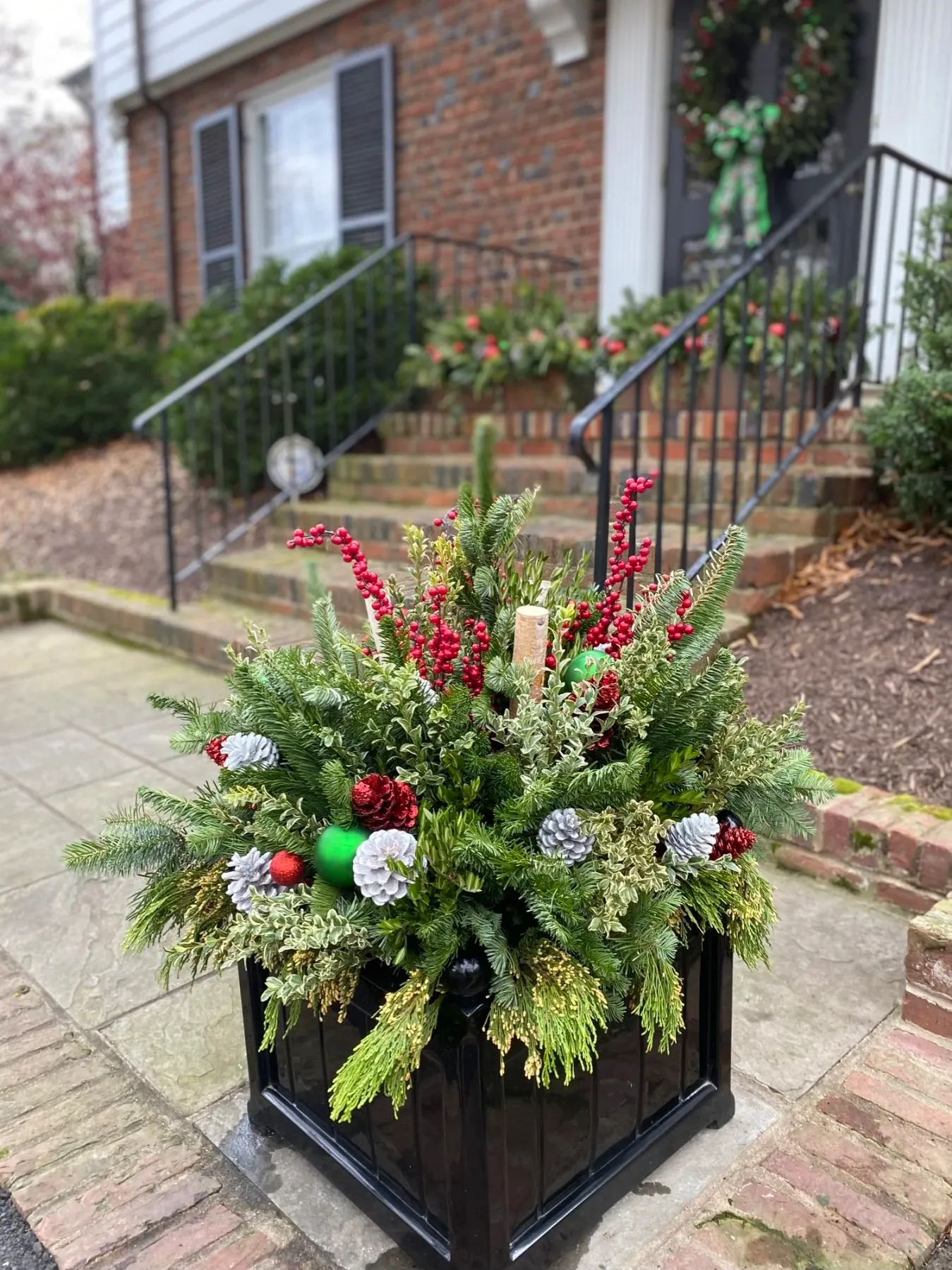
Cascading greenery looks lush in November and leggy by January. Ivy in particular will root into the soil, take over the planter, and need pulling out next fall — some people love that, others don’t. Black planters on a sunny walkway also get hot enough to dry out real plants twice as fast as lighter containers.
32. Birch Sections and Magnolia Leaves in a Matte Black Pot
- Set three short birch log sections upright at the back of the planter. (5 min)
- Fill with evergreen boughs, keeping the tallest at the back. (15 min)
- Tuck magnolia leaves along the front rim for a broad, matte contrast. (10 min)
- Balance three pinecones into the gaps at different heights. (5 min)
- Finish with white berry picks near the outer edges. (5 min)
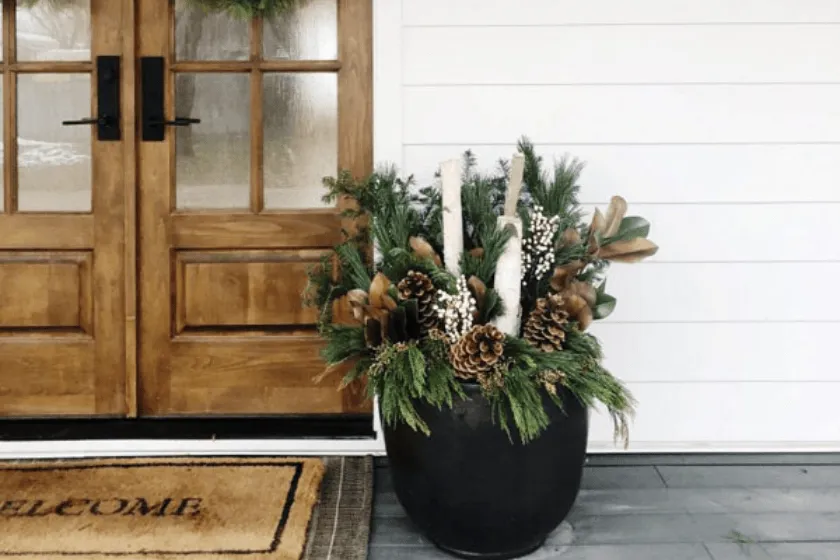
Forty minutes and about $35 if you already own the planter.
This is the classic shopping-the-yard arrangement. Pinecones, magnolia leaves, and birch from a fallen branch cost nothing. Evergreen bundles run $10 to $15 in late November; a dollar-store planter spray-painted matte black is $3. If you don’t have birch, peel-and-stick vinyl over a plain dowel fakes it for about $6.
33. Two Grey Pots, Two Very Different Personalities
Two pots, two ideas, one palette. The front planter stays quiet — seeded eucalyptus and a few red spheres — while the back one goes loud with berries and tall twigs. That’s a 40/60 split of restraint to drama, and it’s the reason the pair doesn’t look redundant. Built the same way, you’d have matching planters; staggered like this, you have a composition. Swap the red spheres for silver and the contrast softens without changing the structure.
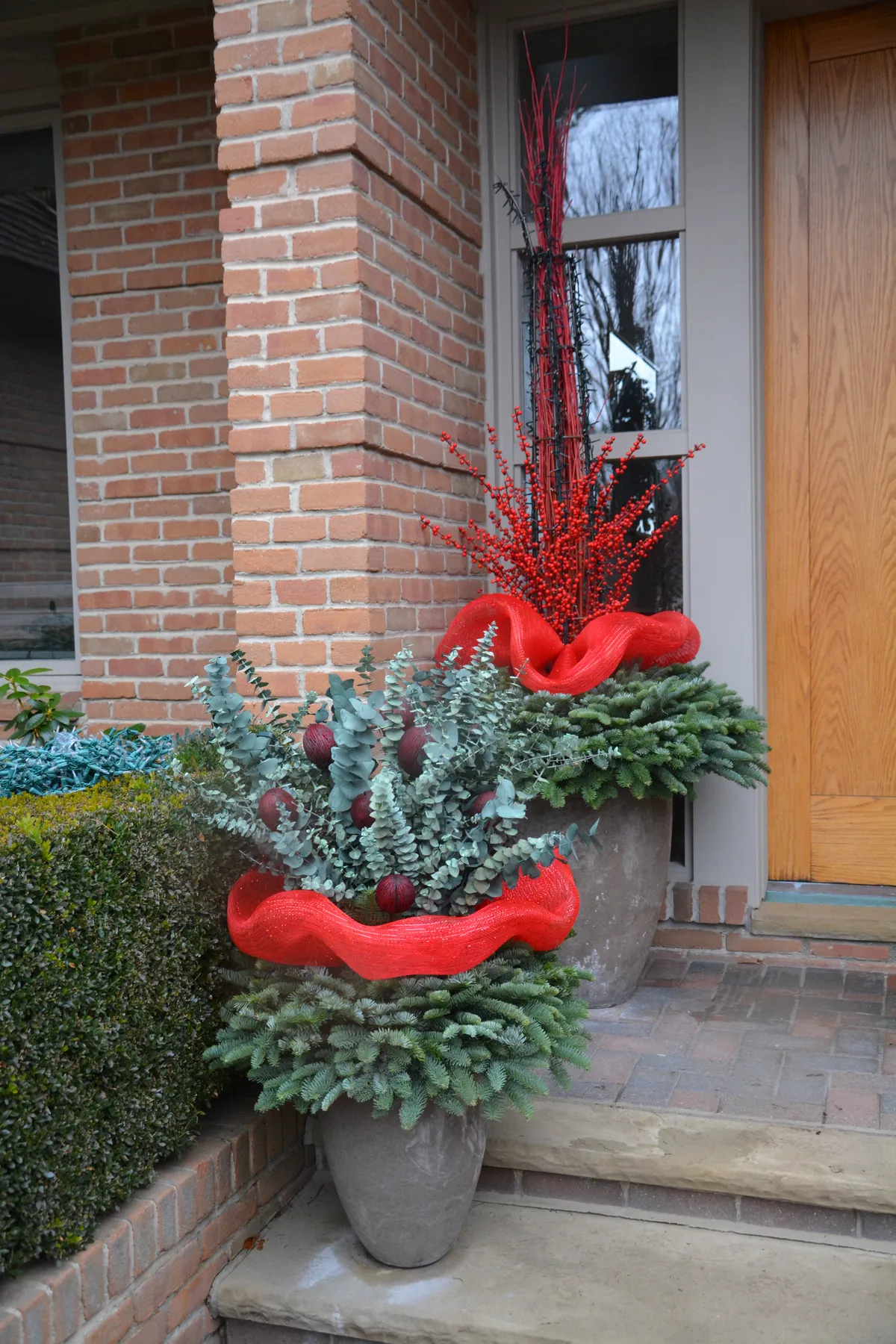
- Measure your step depth — 20 in. pots need at least 24 in. of tread.
- Weight the pots with sand or bricks before adding greenery.
- Check drainage; water pooling on brick stains over winter.
- Stagger heights so the back planter sits 8–12 in. taller.
- Confirm the spot gets under 6 hours of direct sun if you’re using faux greens.
One Weekend, One Porch, One Very Good Winter
Start with the one idea that made you stop scrolling — a planter, a garland, a pair of buckets by the door — and let it lead the rest. Most of these looks come together in a single afternoon with what you already have in the garage plus one trip to the store. Pin the ideas you love now, and when the first cold snap hits, you’ll already know exactly what you’re doing.