
One minute you’re searching for a tree that actually fits on a side table, and the next your camera roll is forty saves deep. That’s the mini Christmas tree rabbit hole, and it’s a good one — a three-foot tree can carry as much personality as a seven-footer without taking over your living room.
We spent serious time browsing Target, Anthropologie, Wayfair, Amazon, and Etsy to bring you only what’s worth your attention this year, covering everything from about $18 to $340. Inside you’ll find 32 curated ideas spanning rustic woodland, flocked white, vintage tinsel, and playful retro candy styling — with budget and luxury versions compared side by side, and every idea shoppable with direct product links.
Why now? 2026 is the year of the second tree: smaller, weirder, more personal, and photographed on a bedside table instead of a grand staircase. And stay until the end — we break down the most common mistakes that can ruin these looks.
📌 Save this to Pinterest for later — you’ll want to revisit these ideas.
1. A Real Potted Mini Tree on a Light Wood Stool
Living potted evergreens need a cool room and honest water discipline indoors. Keep yours within about six feet of a north- or east-facing window, water when the top inch of soil feels dry — usually every three to four days in a heated home — and set the pot on a saucer so moisture never rings the stool. Rotate it a quarter turn weekly, and plan on no more than 10 to 14 days inside before it heads back out. The white fairy lights read brighter here because the wall behind them is dark, so strand count matters less than backdrop contrast.
The dark blue-green wall is doing more work than anything hanging on the tree. That deep, saturated backdrop turns a modest strand of white fairy lights into something that looks professionally lit, and it makes the light wood stool and the brass candle holder pop like jewelry. Paint a single wall — or even a large canvas panel behind the stool — in a moody blue-green and you get the same effect for the price of a gallon. Everything else here is deliberately quiet.
2. Red and Gold Frosted Tree with a Garland Alcove
- Flocked artificial tree, 6-7 ft: $180-$450
- Red and gold ornament sets with bows: $60-$160
- Warm white string lights: $25-$60
- Snowflake lantern and coffee table styling: $40-$120
- Garland, stockings, and alcove trim: $70-$180
- Poinsettia and gift wrap: $30-$70
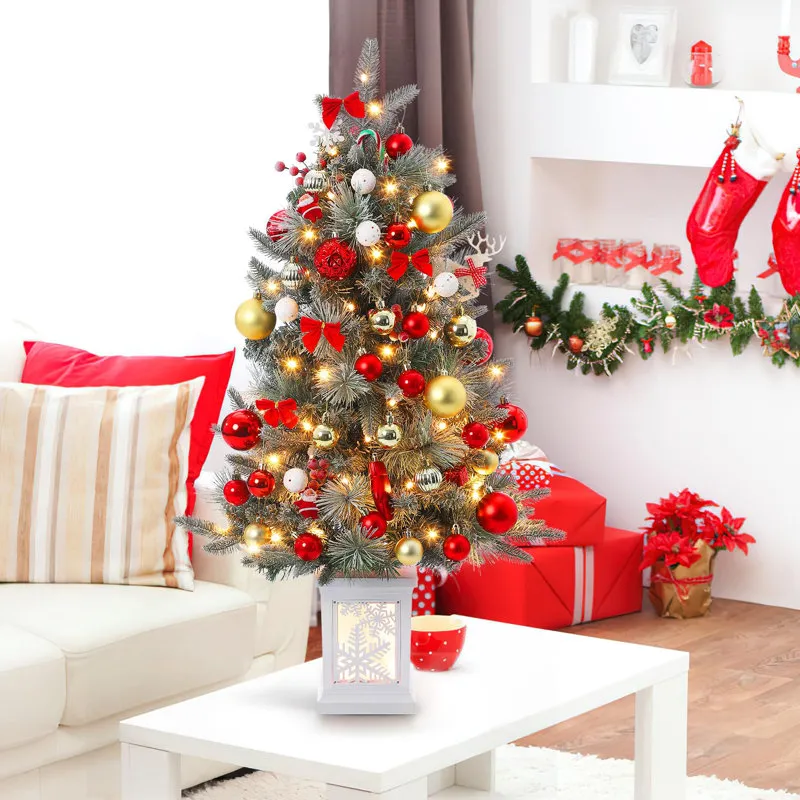
The reason this reads traditional instead of dated is repetition with variation. Red and gold spheres repeat in three sizes, so the eye keeps moving without ever getting bored, and the frosted branches underneath act as a soft white base that keeps the red from turning brassy. Then the alcove borrows the exact same red — garland, stockings — which makes one small living room feel like a single decorated thought instead of three separate shopping trips.
3. Silver and White Flocked Mini Tree with Wrapped Gifts
80% white and silver plus 15% warm light glow plus 5% pale wood. That ratio is why this tabletop vignette feels calm rather than cold. Swap the silver for champagne gold and it turns traditional; swap in pearl and it turns bridal. Keep the wrapped gifts in the same two-paper formula as the ornaments — one matte white, one metallic — and the base of the tree stops looking like wrapping paper storage and starts reading as a plinth.
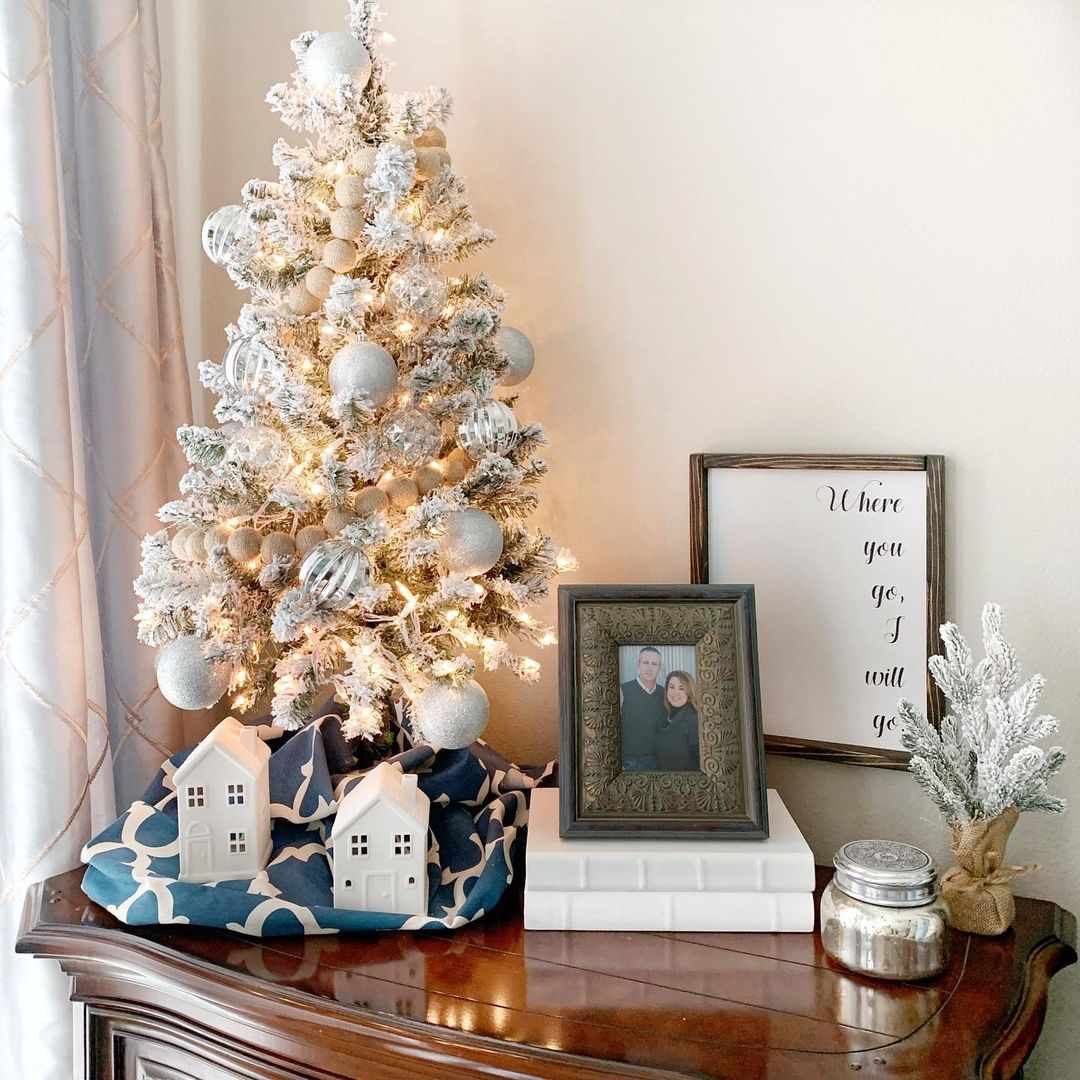
Gifts stacked at the base of a tabletop tree only work if the table can take the weight and the tree isn’t sitting in a walk-by lane. A hall console or entry table is fine; a coffee table people actually use is not. White and silver wrapping also shows every fingerprint and crease, so if the presents will be handled before December 25, choose a textured matte paper over a glossy one.
Mini silver ornaments vanish against a pale wall unless you give them something dark or warm to sit against. Here the light-toned wood table and the warm LED glow do that job. If your tabletop is white, place a piece of dark walnut, a charcoal tray, or a deep green runner under the tree — 18 inches wide is plenty — and the tiny ornaments will suddenly read from ten feet away.
4. Galvanized Bucket Mini Tree on a Faux Fur Window Bench
You can build this entire window bench moment for under $90. Thrift or Marketplace a distressed wooden bench for $30-$60 used, grab a $12-$20 galvanized bucket from a farm store or home improvement aisle, and layer a white faux fur throw from Target or Walmart at $20-$35. The tree itself can be a $25-$40 artificial mini from any big-box store. The window does the rest of the decorating for free — that’s the whole trick.
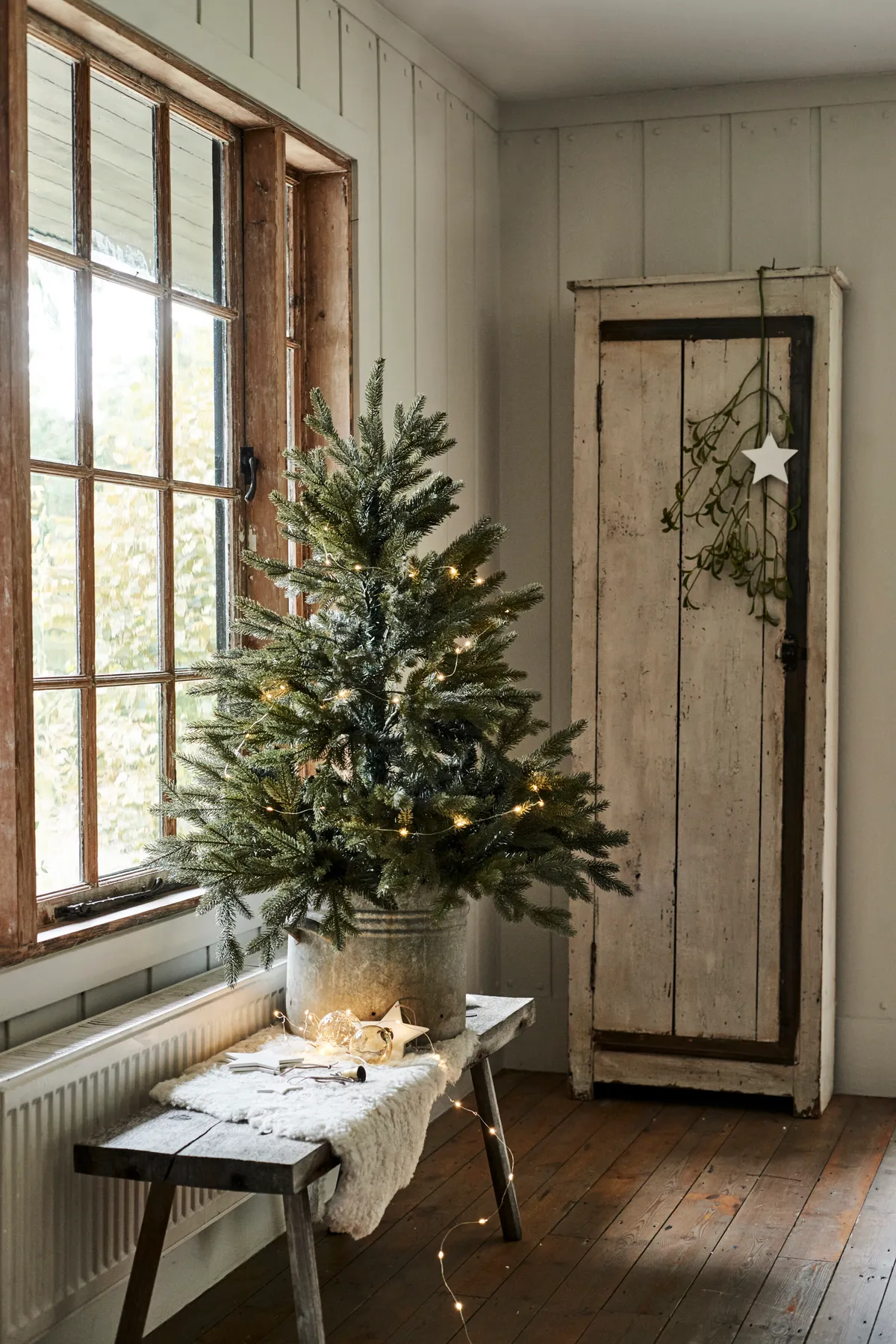
Three textures are stacked deliberately: cold galvanized metal, warm rough wood, and soft white faux fur. That contrast is what keeps a rustic window display from tipping into a farmhouse cliché. The tree also sits slightly off-center on the bench rather than perfectly symmetrical, which lets the multi-pane window frame it like a picture — a small compositional choice that makes the corner feel collected instead of staged. Compare with Idea #30, which uses the same materials on a completely different surface.
5. Dried Citrus and Berry Garland on a Tall Rustic Stand
- Slice oranges a quarter inch thick and blot them dry with a paper towel.
- Bake at 200°F for three to four hours, flipping once, until the slices feel leathery, not brittle.
- Cool completely — warm slices crack when you thread them.
- Thread jute twine through the rind, not the flesh, about half an inch from the edge, alternating orange slices, pinecones, and red berries.
- Drape loosely; a tight garland looks manufactured.
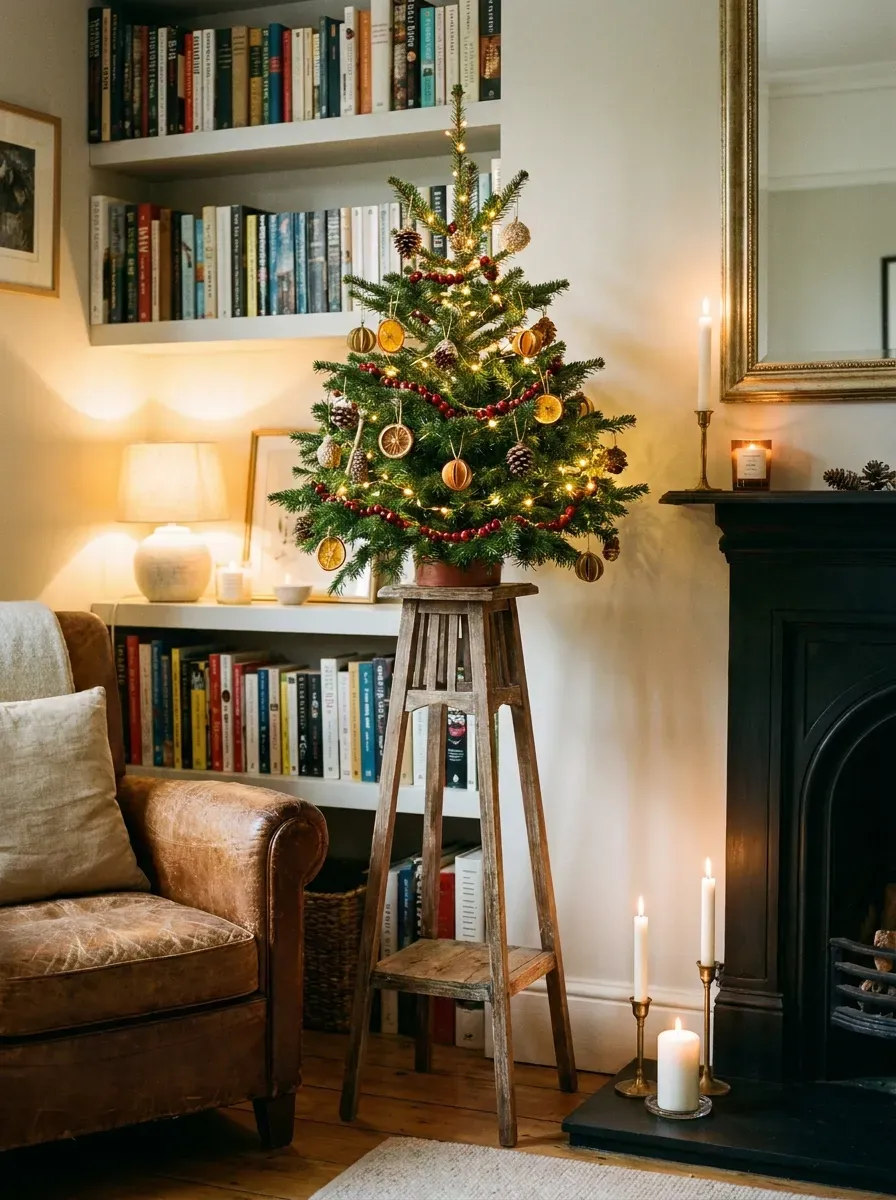
About four hours of mostly hands-off time and roughly $15 in materials.
The tall wooden plant stand is the quiet hero here. Elevating a small tree to roughly eye level — about 30 to 36 inches — makes it read as sculpture rather than as an undersized substitute for a big tree. It also keeps the dried citrus and red berries well away from the leather armchair, and puts the lights at a height where they actually reflect in the mirror above the fireplace.
6. Compact Tabletop Tree with Small Seasonal Ornaments
- Small tabletop tree, 2-3 ft: $25-$70
- Miniature ornament set: $15-$40
- Small string lights: $8-$20
- Simple pot or basket: $10-$30
- Tabletop base and finishing decor: $10-$25
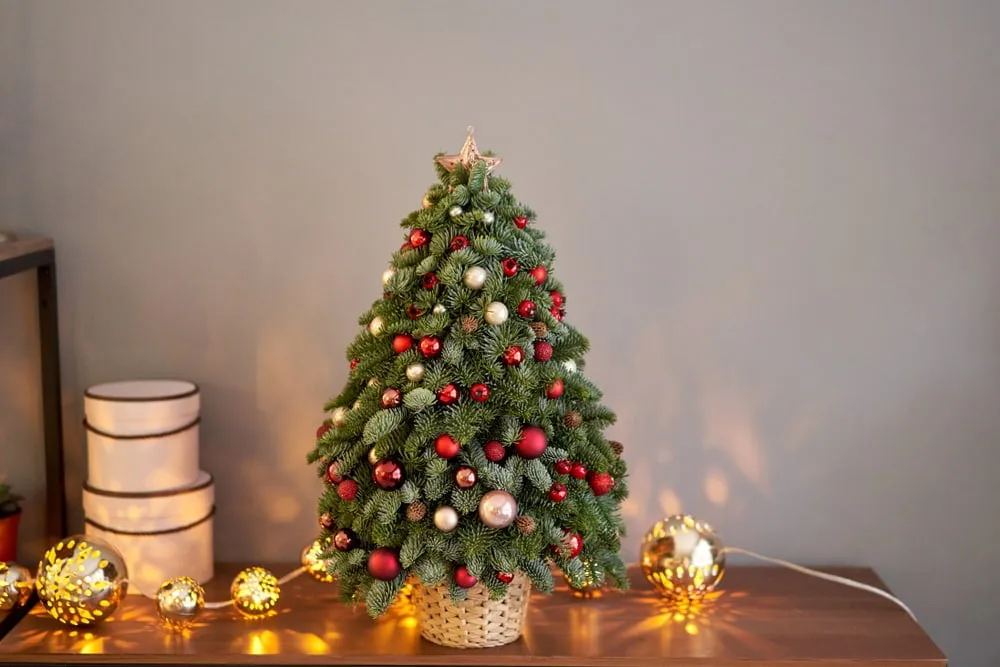
Staying under $100 is entirely realistic if you already own lights and reuse ornaments. Small trees are the cheapest way to refresh a room seasonally, mostly because they need a fraction of the trim.
The catch with tiny ornament sets is scale. Baubles sized for a seven-foot tree overwhelm a two-foot one, so measure before you buy: ornaments should run about half an inch to one inch for every foot of tree height. Also check the branch wire strength. Miniature trees have thin arms, and a single heavy glass ornament will drag a whole branch out of shape by New Year’s.
7. Flocked Mini Tree on a Wood Slice Base with Snow
This tabletop scene is built around a two- to three-foot flocked tree on a wood slice roughly eight to ten inches across — that ratio keeps the base from swallowing the tree. It works on a console table at least 14 inches deep, or a fireplace hearth with three feet of clearance. If your room is smaller, see Idea #27 for the sparest version of this look. For a taller floor-standing version, Idea #17 takes the same flocking up to full height.
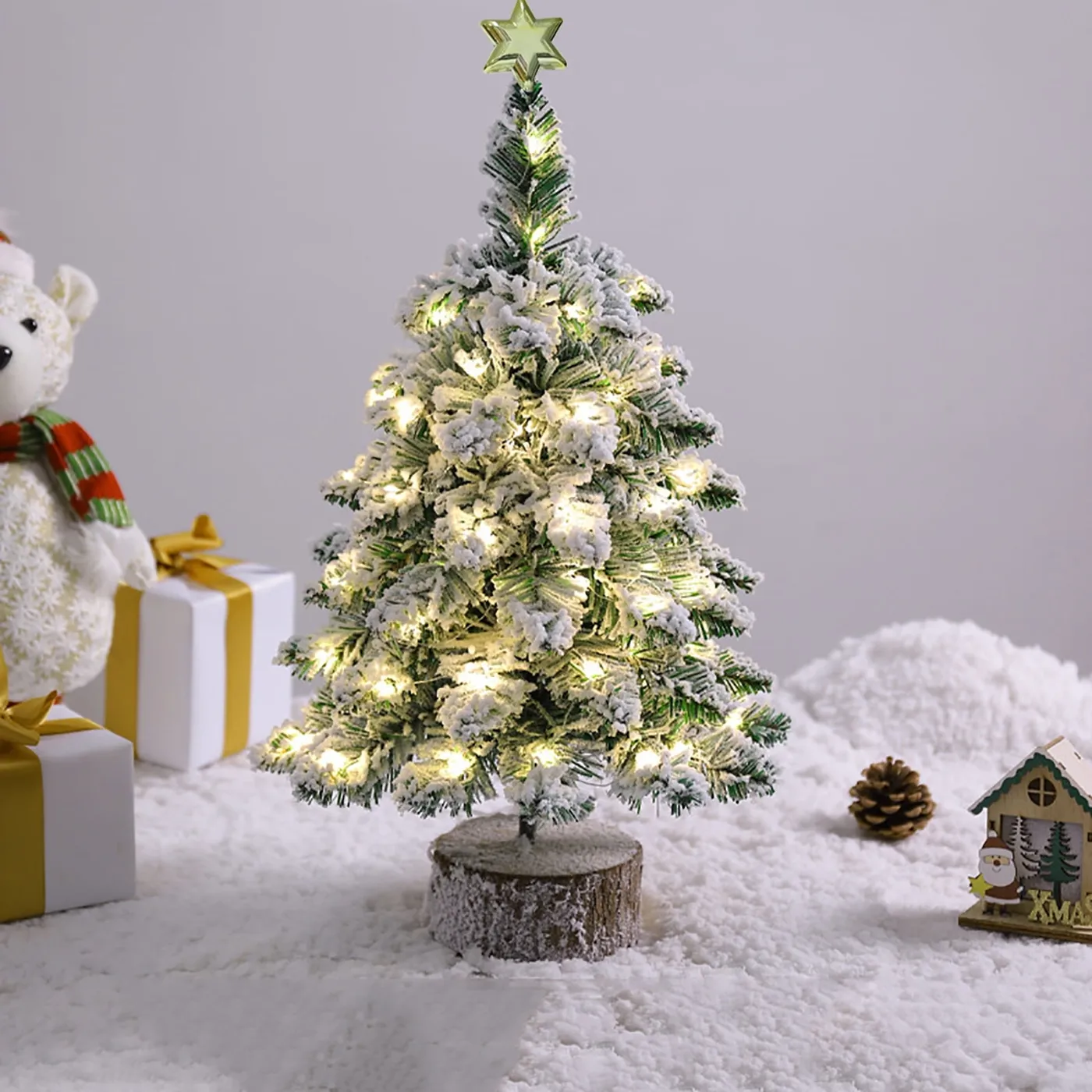
Skip the pre-made snow blanket and use loose artificial snow in a shallow tray instead — you get the same drift without a felt edge cutting across your tabletop. Build the scene in odd numbers: three gift boxes, three pinecones, one plush bear. Odd-numbered groupings read as styled; even ones read as arranged. And keep the tallest object, the tree, at about two-thirds the width of the tray beneath it.
8. Flocked Tree with Glittery Red Pinecones and Burlap Base
Flocking is essentially shredded flame-retardant plastic, and it sheds. Expect a light dusting on your table the first season, so keep a lint roller or a soft brush nearby. Glitter on pinecones is worse — those flakes travel. If you’re setting this on a surface you care about, put a felt or cork pad underneath, and plan on a quick weekly vacuum of the surrounding floor between now and January. Burlap also unravels at cut edges, so check that the wrap is finished properly.
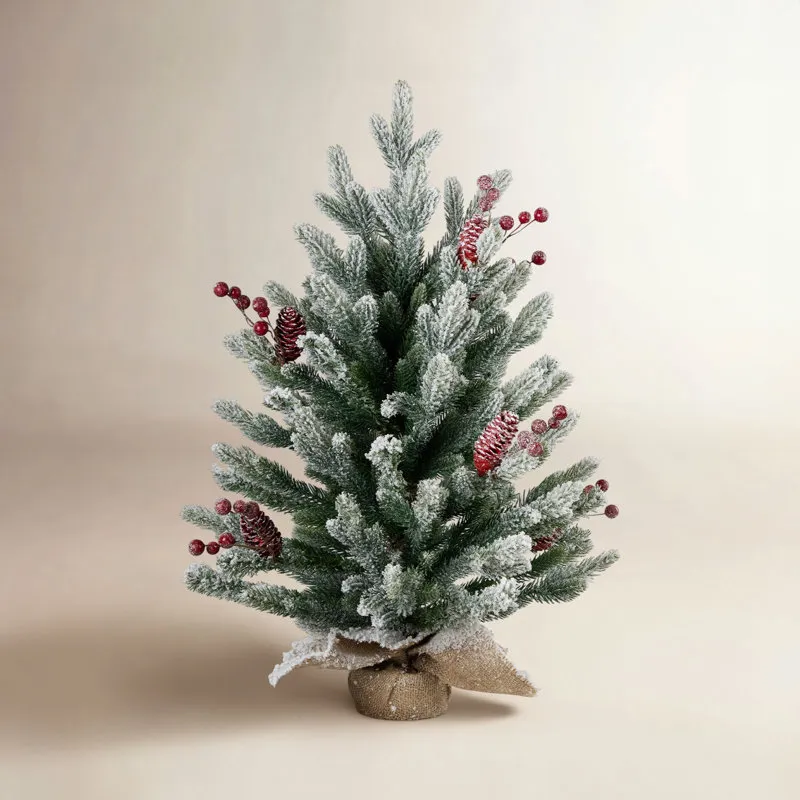
The burlap wrap is what makes this work. Without it, red berries and glitter pinecones on a flocked tree drift toward generic. With it, the base anchors the whole palette in a natural brown that both the berries and the white flocking can play against. It also absorbs visual weight at the bottom of a top-heavy tabletop tree, which is the number one reason small trees end up looking like they’re about to topple.
9. White Ribbed Ceramic Pot with Red Balls and Berry Garland
IKEA and Target both sell small faux evergreens for $15-$30, and a white ribbed ceramic planter runs $12-$25 at HomeGoods or Walmart. Small red ball ornaments are among the cheapest seasonal items you can buy — a 30-pack for around $8. Wrap a $5 red berry garland at the base inside the pot instead of around the tree. That’s an $80 look recreated for roughly $45, and it ages well enough to bring back next year.
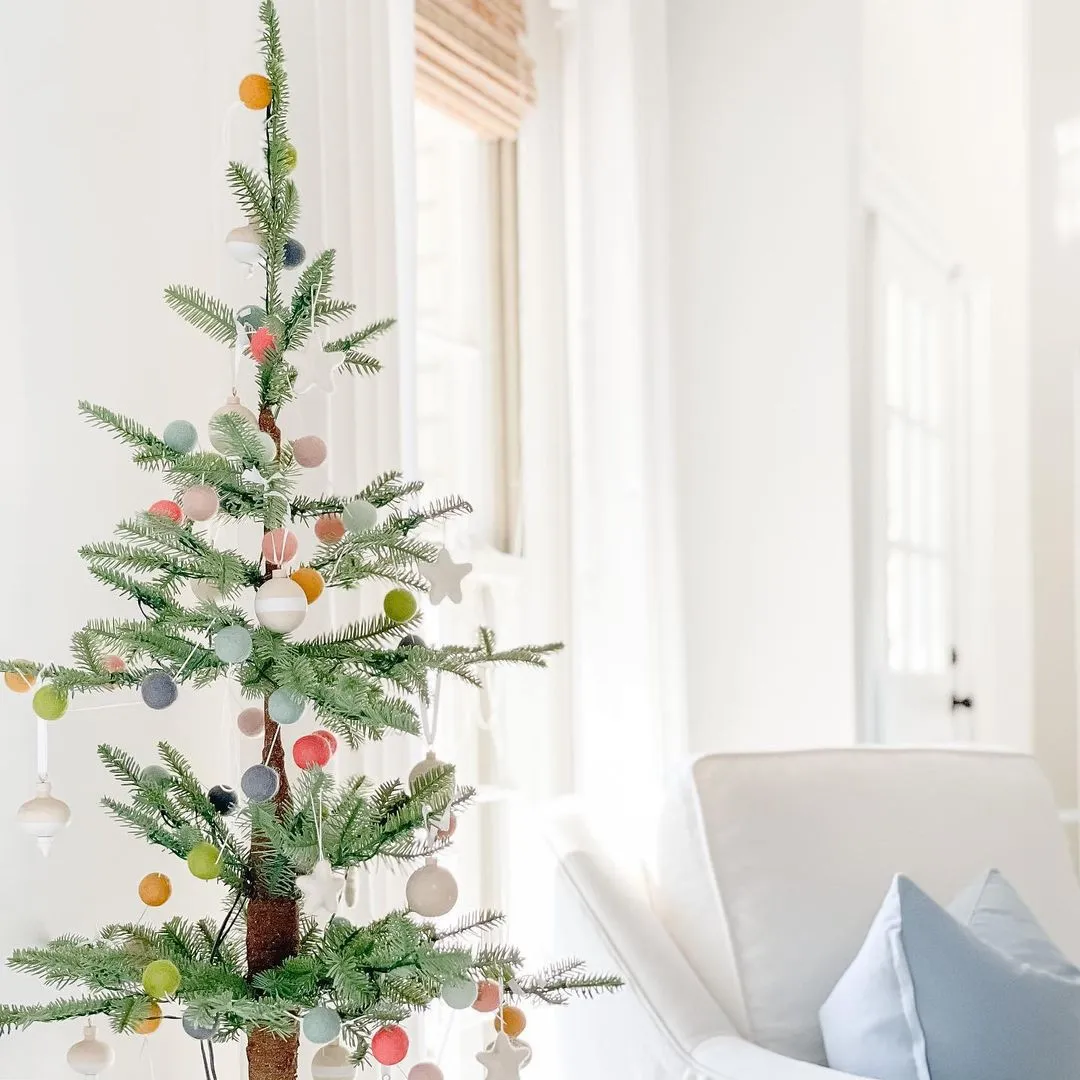
75% green foliage plus 20% red plus 5% white ceramic. It’s a tiny formula, but it’s why this reads classic rather than busy — red appears exactly twice, in the balls and the star, so nothing competes. Want a different mood? Keep the pot and swap red for mustard yellow and it turns vintage-modern; swap red for soft blush and it goes romantic. See Idea #22 for the same disciplined formula pushed toward navy and silver.
10. Woven Basket Mini Tree Between a Mirror and Wall Shelves
- Measure the basket’s outer diameter, not just the pot — you want two inches of clearance on each side.
- Check which way the mirror faces. A gold-framed mirror doubles light, so you can use half the strand count.
- Confirm the branch spacing on your tree. Widely spaced branches look intentional; dense ones look crowded with sparse ornaments.
- Test the basket liner, because unfinished baskets leak soil through the weave.
- Set your ornament count before you shop. This look tops out around 20 pieces.
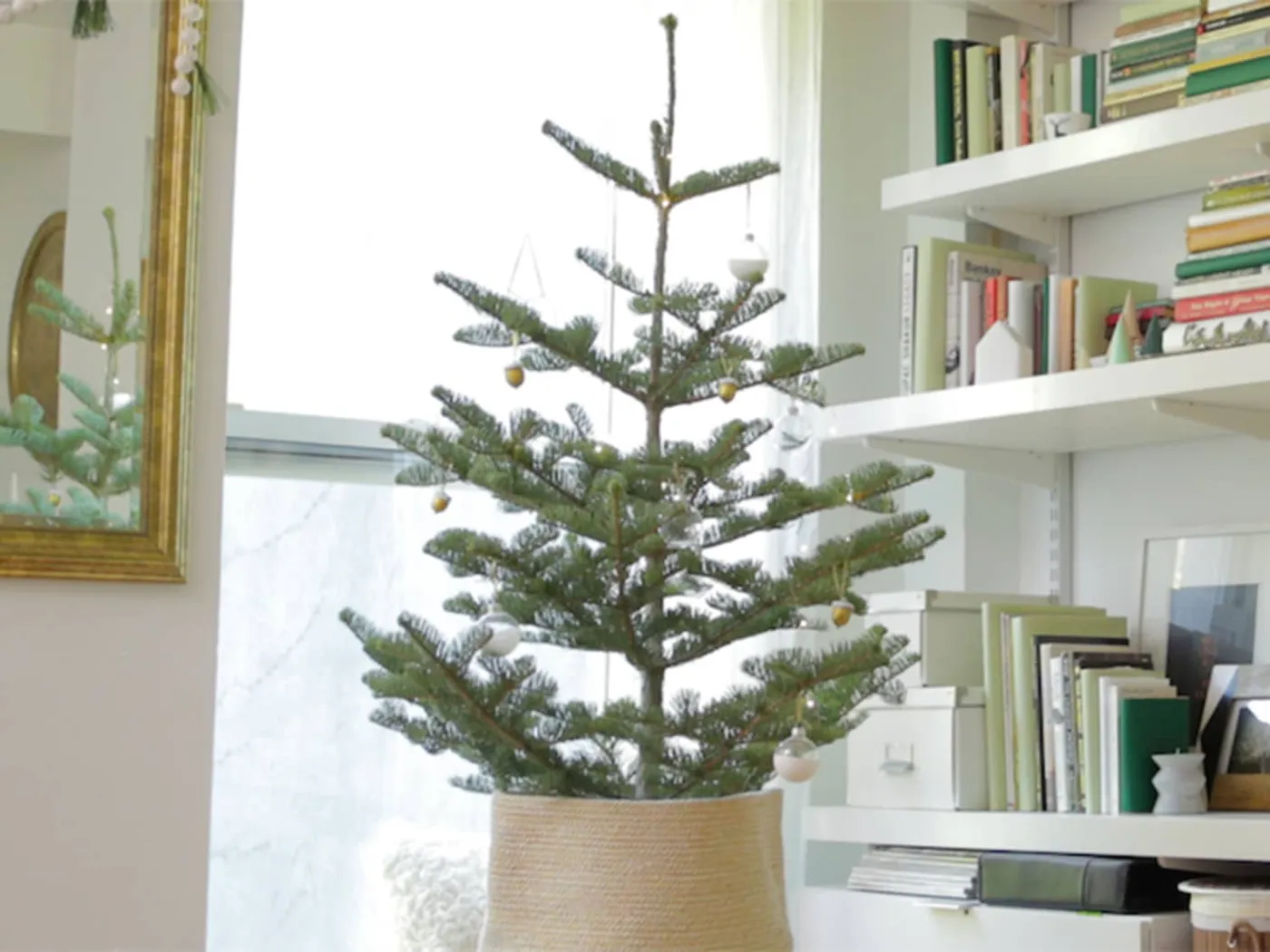
With widely spaced branches, you’re decorating negative space, not coverage. The rule that works: one ornament per branch tip, maximum two, placed at the outer six inches of the branch rather than near the trunk. That’s why this tree looks airy. The gold acorn shapes are also just three or four pieces — a tiny dose of metallic at eye level is enough to tie the gold mirror and the white shelves together.
11. Neutral Woodland Tree with Pillar Candles on a Wood Tray
Neutral woodland styling has been climbing for a few seasons, and it fits 2026’s broader pull toward calm, low-saturation holiday decor — the same reason beige velvet stockings and cream ribbon are outselling bright primary palettes. It photographs beautifully, which matters on Pinterest, but it’s also genuinely practical. Neutrals don’t date, so you can reuse the same ornaments for years while swapping only the ribbon or the pot.
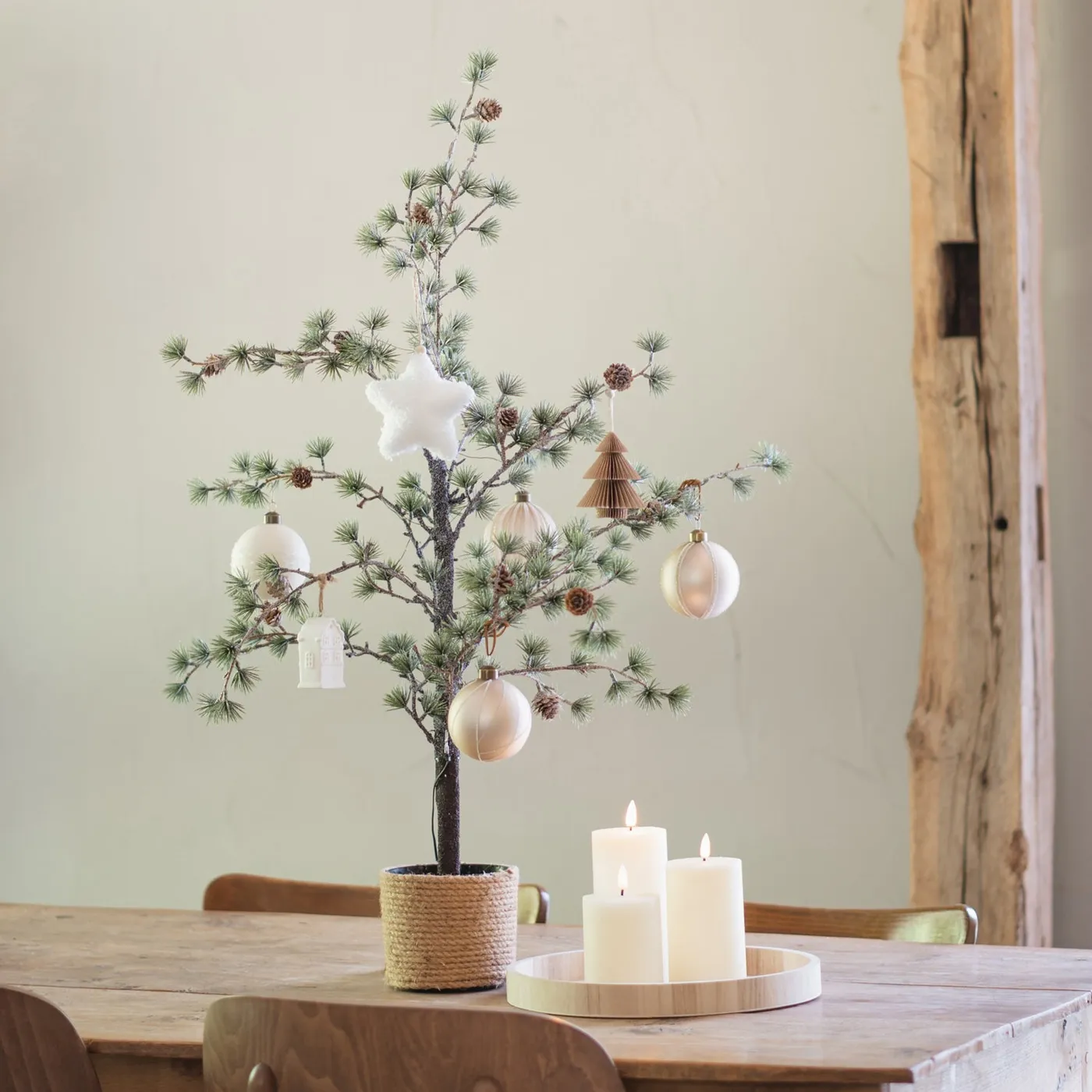
The rope-wrapped pot is the element you can’t remove. A frosted tree with pinecones and white baubles is a common look; the rope and jute wrap is what pulls it into a natural, coastal-adjacent woodland and gives the pillar candles on the wood tray something to rhyme with. Lose the wrap and the display still works, but it stops feeling like a collected scene and starts feeling like default holiday decor.
12. Twine-Wrapped Branch Trees with Mercury Glass Ornaments
- Forage or buy straight branches about 18 to 24 inches long and a quarter inch thick.
- Wrap each branch tightly in jute twine from base to tip, dabbing craft glue every few inches.
- Bundle five to seven branches per tree and bind them at the base with more twine.
- Fan the branches into a rough cone and set the bundle in a weighted base.
- Hang ornaments on clear thread so nothing competes with the twine.
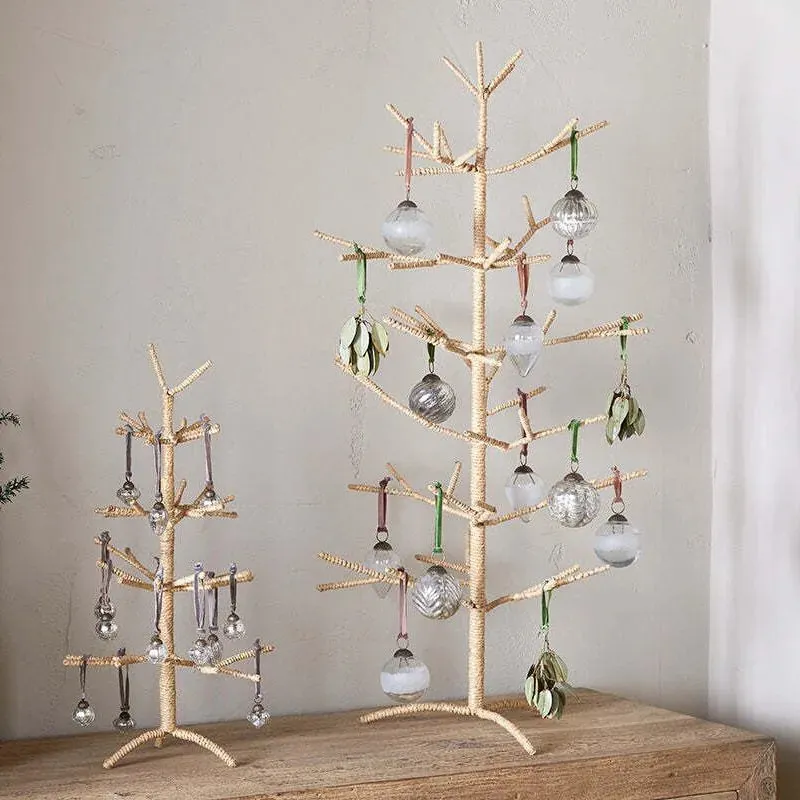
Roughly 90 minutes per tree, about $12 in materials.
Mercury glass is the payoff. Its slightly uneven, reflective surface bounces warm light in a way frosted glass can’t, and because the ornaments here are ribbed and round in mixed sizes, they catch highlights from several angles. Set against twine — which absorbs light instead of reflecting it — you get that quiet sparkle without any tinsel or glitter. The small bundles of green leaves keep it from going too monochrome.
13. Vintage Tinsel Tabletop Tree with Tiny Taper Candles
- Vintage-style tinsel tree, 2-3 ft: $35-$120
- Miniature glass ornament assortment: $25-$70
- Tiny taper candles with clips: $10-$25
- Silver metallic tree base: $8-$20
- Cream ceramic dish: $8-$18
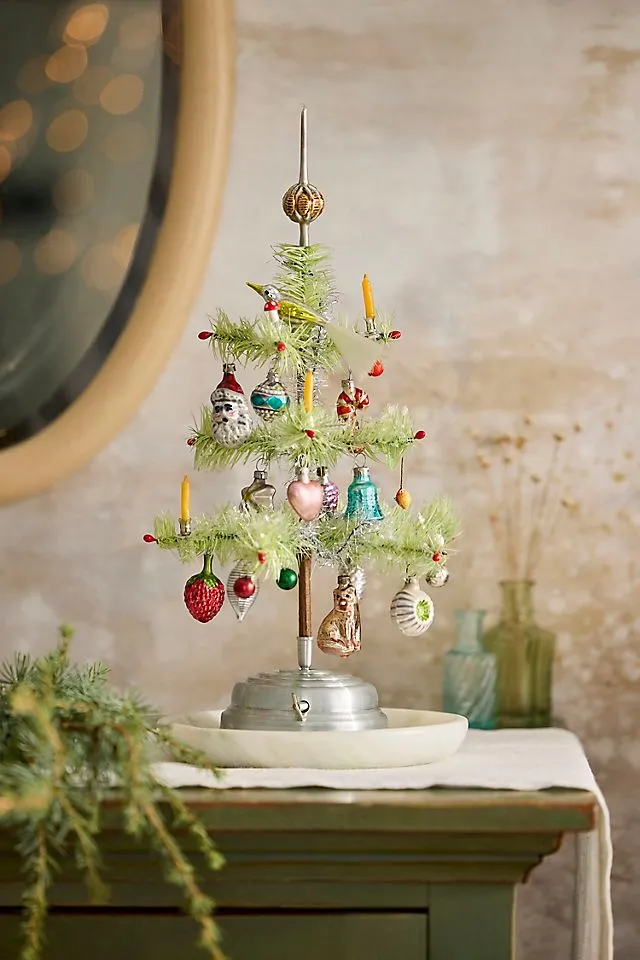
The tinsel tree is the splurge; the ornaments can absolutely be thrifted, and estate sales are full of single glass balls from the 1950s.
This look lives on a table that’s at least 30 inches tall and roughly 20 by 20 inches — you need room for the cream dish to sit fully on the surface with the silver base centered inside it. It’s a small-space classic: a two-foot tinsel tree fits a nightstand, a bar cart top, or a bookshelf. Compare with Idea #24, which uses a similar vintage ornament stash on an open metal frame instead.
14. Coppery Bottle Brush Trees with a Crowned Mouse Figurine
Candle flames and bottle brush trees are a bad combination — bottle brush bristles are essentially plastic, and they lean. Keep real flames at least 12 inches from any bristle tree, or use the flameless votives that flicker convincingly now. Coppery-brown trees are also the hardest bottle brush color to find, so if you see them, buy them. Most sellers stock green, white, and pink year-round and treat everything else as a seasonal one-off.
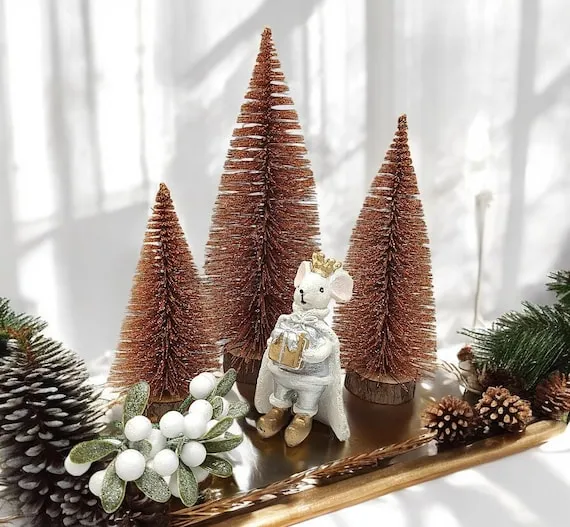
70% coppery brown plus 15% gold plus 10% natural green plus 5% white. The gold tray and the mouse’s tiny crown pull the metallic through the whole scene, while the pinecones and mistletoe keep it grounded. Swap the copper for muted sage and you get a woodland version; swap it for deep burgundy and it turns Victorian. The tray stays either way — it’s the boundary that keeps three trees and a figurine reading as one composition.
15. Yarn-Wrapped Cone Trees with Cedar and Red Berries
Varying heights by roughly two inches each — say 10, 8, and 6 inches — is the fastest way to make a centerpiece trio look designed. Cluster them slightly off-center on the runner and let the cedar branches trail toward one edge. One more thing: yarn-wrapped cones are top-heavy, so add a hidden weight inside the largest cone. A roll of pennies works fine. Without it, a breeze from a doorway will take the whole arrangement down.
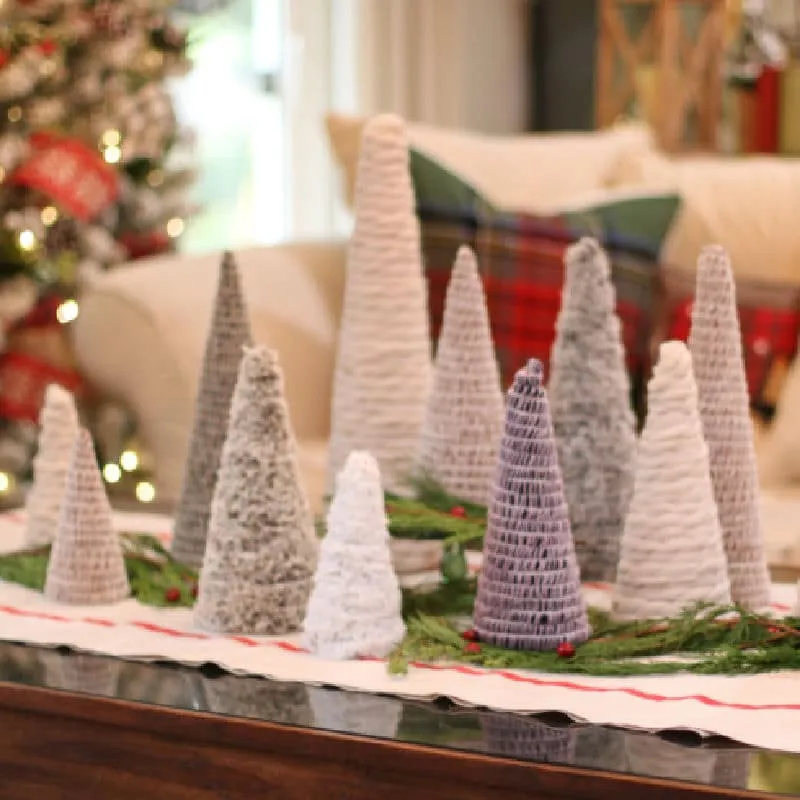
Yarn-wrapped cone trees are the single easiest DIY on this list. Styrofoam or cardboard cones run $3-$6 at a craft store, and a skein of yarn is $4-$8, which wraps about two small cones. Cedar or pine sprigs are free if you have access to a tree, otherwise $8-$15 at a florist. Total for all three trees plus greenery lands around $35 instead of $120 for store-bought versions.
16. Red Striped Pot with Flocked Branches, Berries, and Pinecones
Red berries on a flocked tree are usually plastic, and plastic berries fade to a chalky pink after two or three seasons in direct sun. Store them in a sealed bin away from a window and they’ll hold their color. Flocking, meanwhile, needs to stay out of humid rooms — a bathroom or a kitchen above a kettle will clump it. A quick once-a-month dusting with a dry soft brush keeps the white looking fresh.
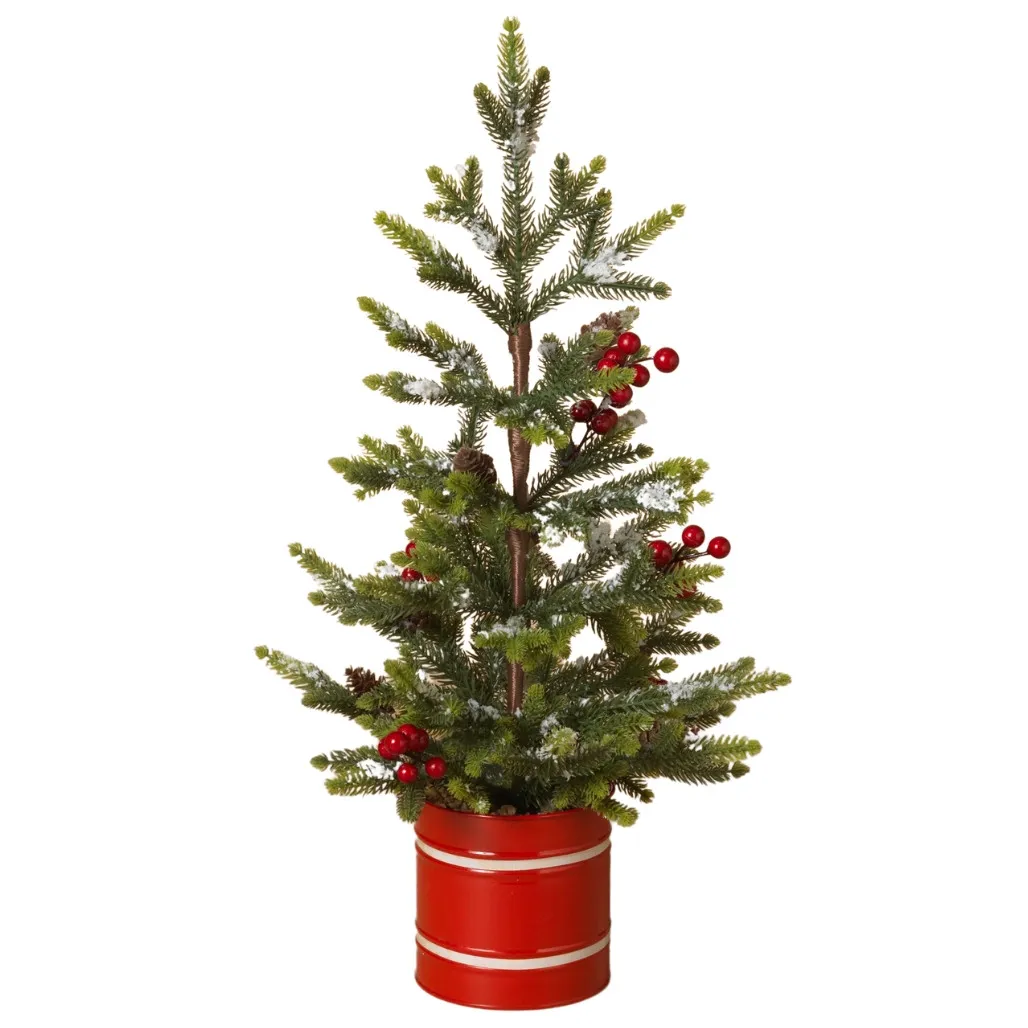
The pot is the whole idea. A flocked tree with berries and pinecones is a perfectly nice holiday object, but the red cylindrical pot with two thin white bands turns it into a matched set — the pot repeats the berries, and the white bands repeat the snow. Remove the pot and you have a decent small tree. Keep it and you have a designed object.
It works because the color repeats three times at three different scales: large in the berries, medium in the pot, and small in the white stripes. Repetition at varied scale is what makes a restrained palette feel rich rather than flat. The brown pinecones are the out — they break the red-and-white rhythm just enough that the whole thing never reads as candy cane. This is exactly the trap we cover in the mistakes section below.
17. Slender Pre-Lit Flocked Tree Against Paneled Walls
A slender six- to seven-foot flocked tree needs surprisingly little floor: about a 24- to 30-inch footprint, with 18 inches of walkway on at least two sides. Ceiling height is the real constraint — you want eight feet minimum, and nine if you’re using a topper. In a small apartment this is often the tallest tree that still works. For narrower spaces, drop to the four-foot version and pair it with the tabletop styling in Idea #20.
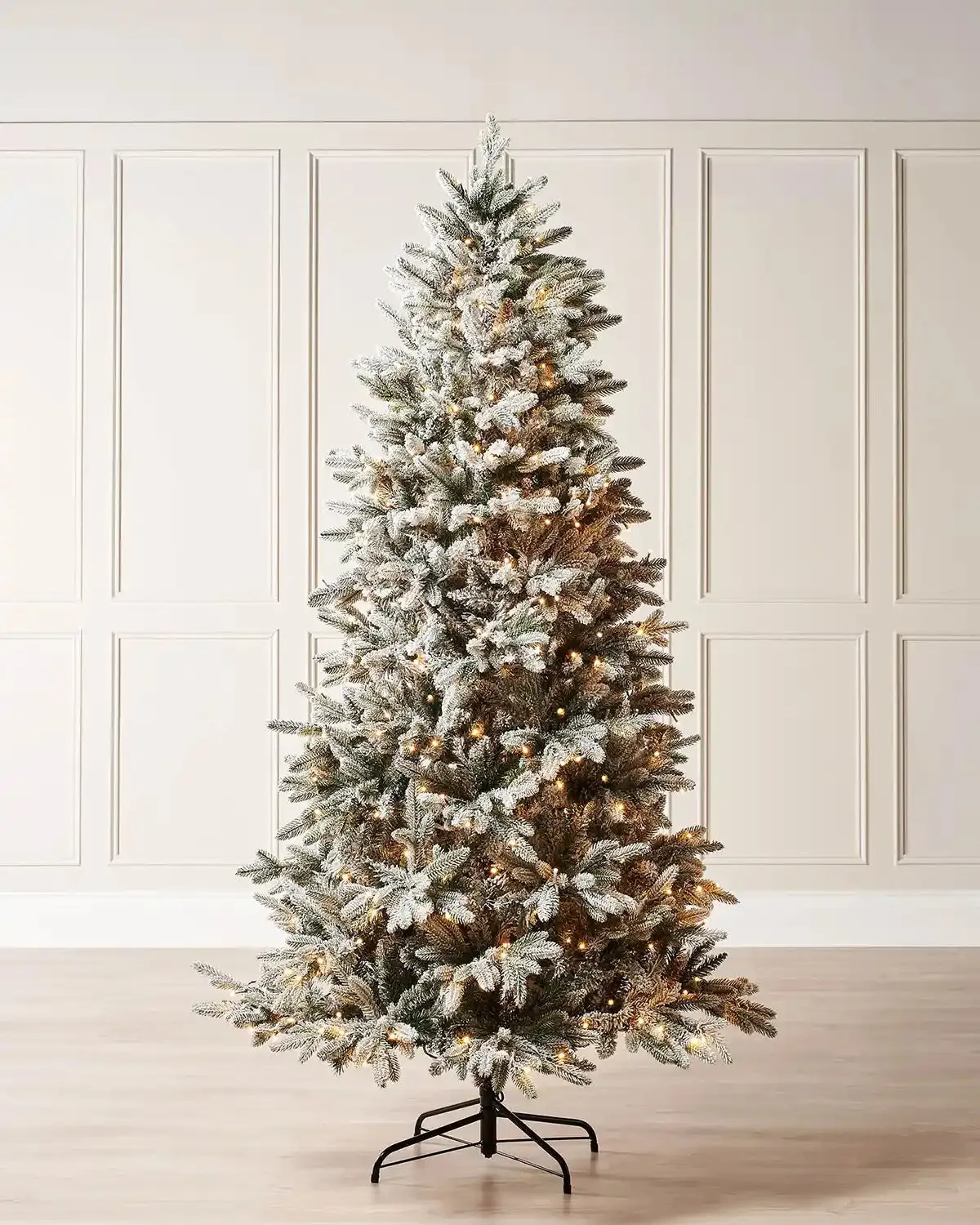
Slender and flocked is the shape dominating holiday listings heading into 2026. Two things are driving it: smaller apartments where a wide tree blocks the whole room, and the fact that a narrow silhouette photographs far better in a vertical phone frame. Flocking also solves the pre-lit problem — the white branches hide the wire, so a $200 tree reads closer to a $600 one.
18. Retro Candy Tree in a Vintage Anise Mints Tin
- Flocked mini tree, 2-3 ft: $30-$70
- Vintage tin as a base, thrifted: $10-$45
- Red, green, and blue ball ornaments: $20-$50
- Candy swirl and button garland: $12-$30
- Supplementary tins and tabletop decor: $15-$40
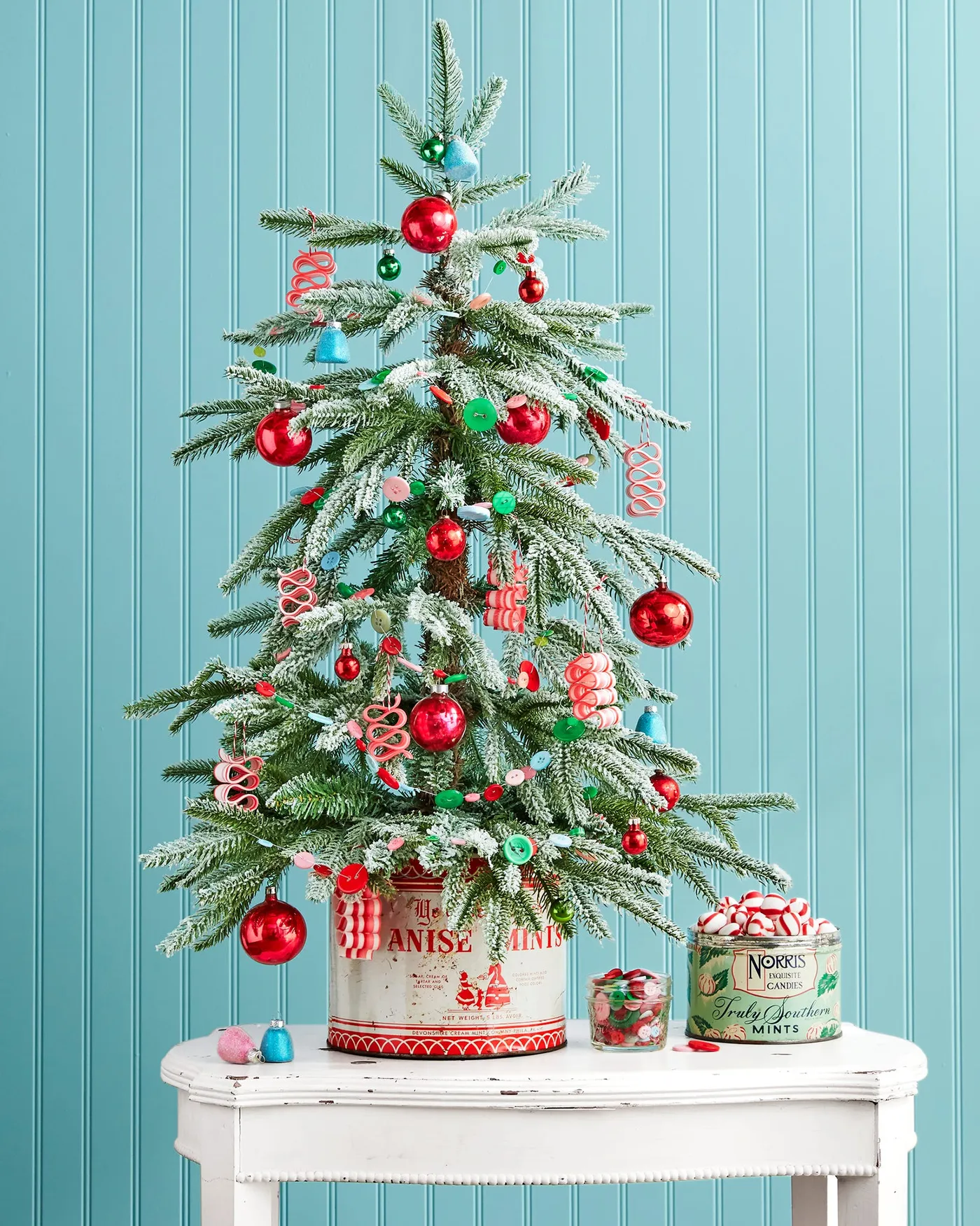
The tin usually costs less than a store-bought tree collar and looks infinitely more collected.
Beadboard walls are reflective and slightly glossier than drywall, so they bounce colored light — which is exactly why the light blue wall here makes the candy pinks and reds sing rather than clash. If your wall is a warm white or beige, add one larger blue element near the display, like a tray or a small tin, to cool the surrounding color. Without a cool anchor, red and pink ornaments can turn muddy fast.
19. Lighted Star Topper Wearing a Tiny Santa Hat
- Choose a topper two to three inches wide for a three-foot tree — anything larger tips the top.
- Wire it to the trunk with a twist tie hidden behind the star, not to a branch tip.
- Run the topper’s cord down the back of the tree alongside the light strand.
- Zip-tie both cords together every eight inches so they read as one line.
- Test the light before you secure it, because a dead bulb means redoing the whole thing.

Fifteen minutes, and no extra cost beyond the topper.
Lit toppers pull a surprising amount of current, and on a small tree that means the last string on the strand may dim or flicker. If you’re stacking a lit topper on a pre-lit three-foot tree, cap it at one topper and one short strand of lights, or run the topper on its own battery pack. Also check that your topper’s clip actually fits the trunk diameter — mini trees often have a thinner trunk than the standard opening.
80% green foliage plus 15% warm light plus 5% red accent. The Santa hat is doing the work of an entire color story in a single object — the red ornament nearby echoes it, and that’s the only other color in the scene. Swap the hat for a black top hat and it turns elegant; swap it for a knit beanie and it turns cozy cabin. The discipline is keeping everything else green and warm.
20. Flocked Tree with a Faux Fur Skirt on Grey Laminate
The faux fur skirt solves a problem most people don’t think about until December 20: what the bottom of the tree looks like. A light brown fur against a white paneled wall and grey flooring gives you a soft, warm anchor at floor level that hides the stand, the cord, and the inevitable fallen needles. It also adds a third texture to a room that’s otherwise flat wall and hard floor, which is why the tree reads taller than it actually is.
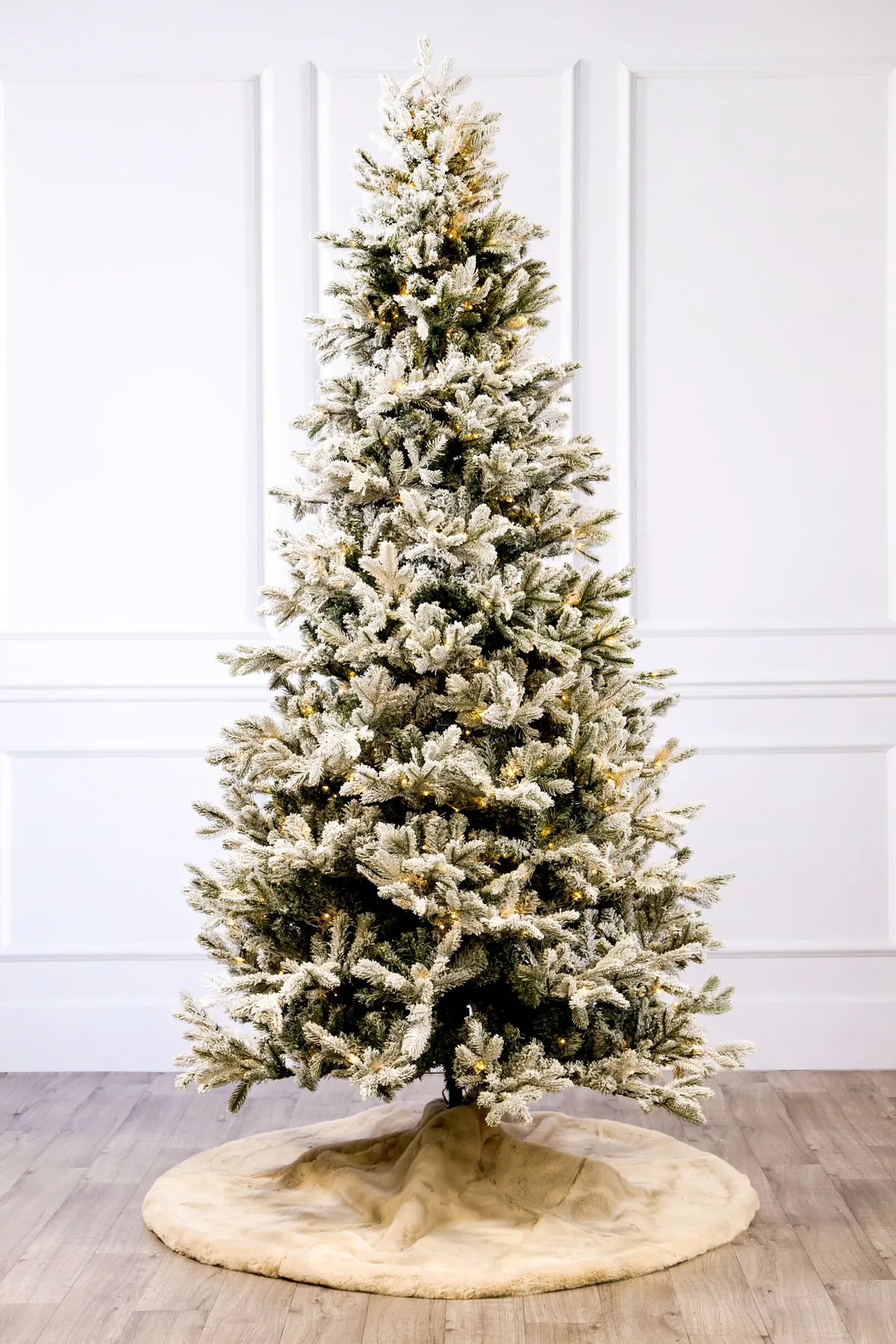
This works in a room roughly 10 by 12 feet with eight-foot ceilings — that’s about the minimum for a six-foot flocked tree to breathe. Keep at least 30 inches between the tree and any seating, and let the skirt’s diameter run at least 12 inches wider than the stand. Light grey laminate is forgiving here; on dark hardwood, use a lighter fur so the base doesn’t disappear into the floor.
21. Evergreen and Red Berry Centerpiece in a Ribbed White Pot
- Measure your table first — this arrangement should occupy no more than a third of the width.
- Check ceiling fixture height. You want at least 14 inches of clearance above the greenery.
- Confirm the pot has no drainage hole, or set a liner inside it.
- Test the berries, because real ones stain wood and linen. Use faux unless the bowl is out of reach.
- Note how many hours of daylight the table gets. Evergreen holds up better out of direct sun.
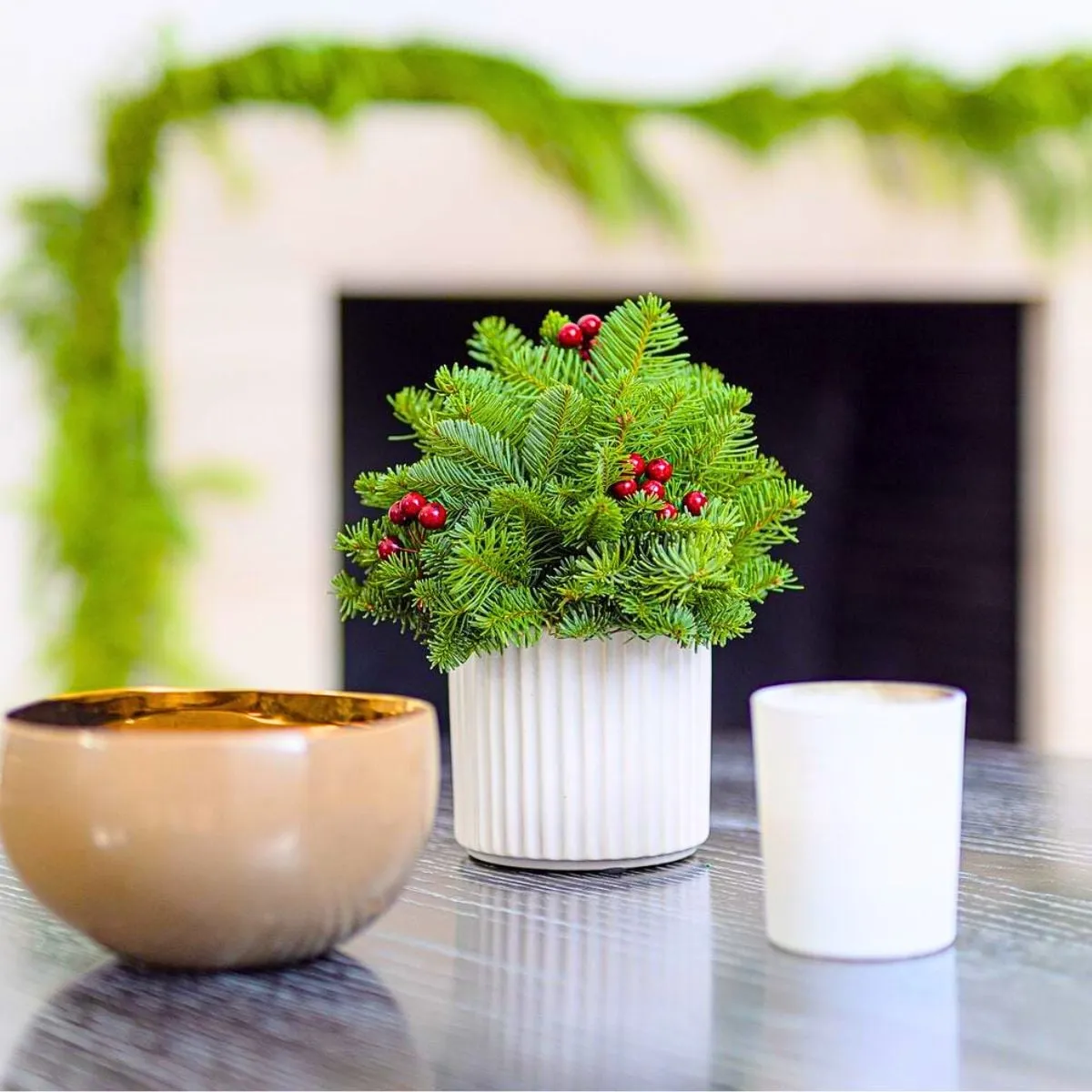
Ribbed ceramic is a sneaky-good choice for a centerpiece because the vertical fluting draws the eye upward toward the greens — it visually stretches an arrangement that’s only about 12 inches tall. Keep the finished arrangement to roughly 1.5 times the height of the pot. If you want it to read taller without adding branches, put the pot on a two-inch riser hidden under the table runner.
22. Three Wicker-Potted Mini Trees with a Navy Satin Bow
Wicker baskets are everywhere at thrift stores for $3-$8, and they read far more expensive than they are. Three two-foot artificial pre-lit trees from Walmart or Amazon land between $25 and $45 each. Add one wide navy satin ribbon for $6-$12, reuse last year’s gift wrap, and shop Facebook Marketplace for the round pedestal table — they turn up constantly for $40-$80. The entire setup comes in well under $200.
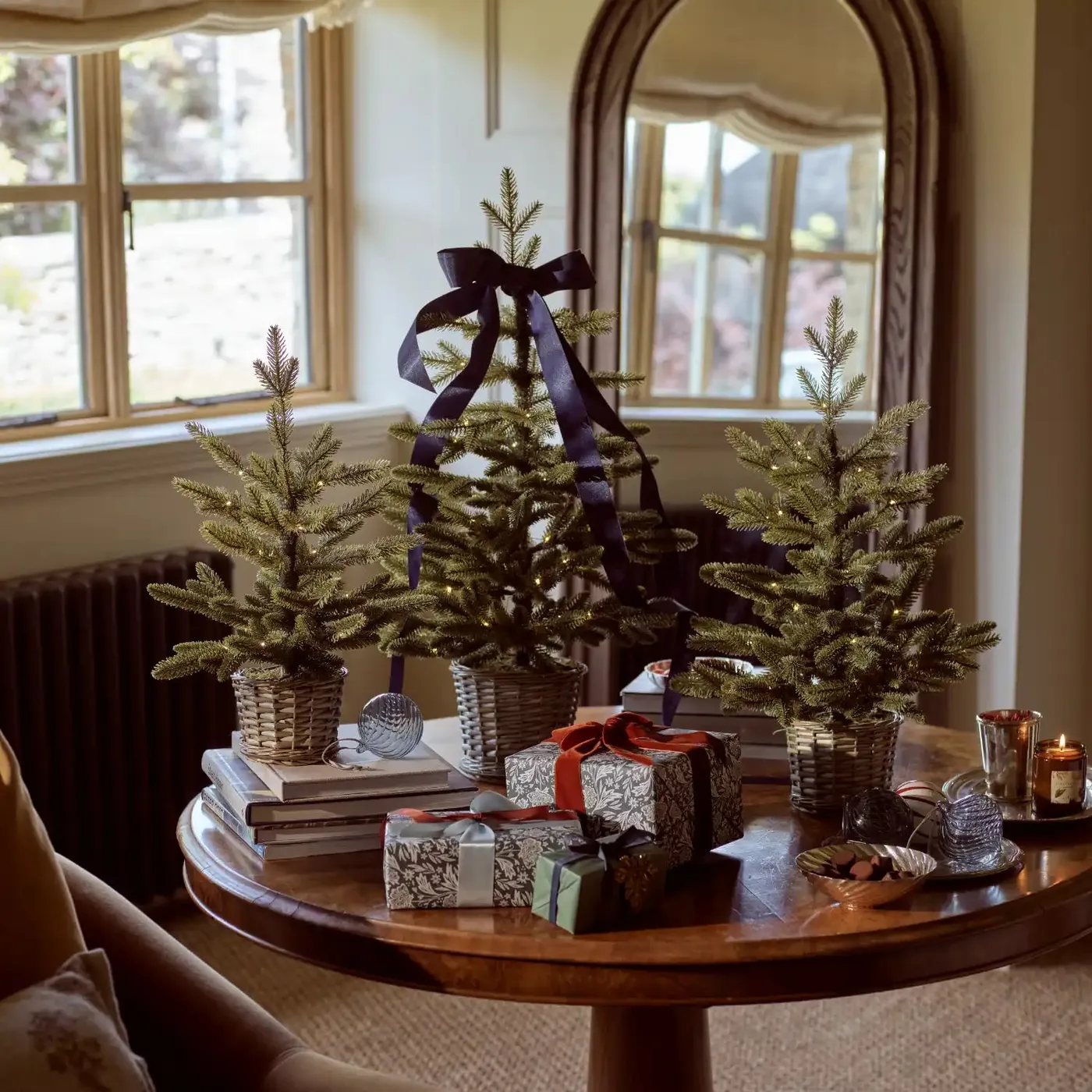
The single wide satin bow is what keeps three small trees from looking like a department store display. It appears once, at the top of one tree, and it introduces both a new color and a new finish: glossy satin against matte wicker. It also breaks the symmetry of three identical trees in three identical baskets. Remove the bow and the arrangement is pleasant. Keep it and it has a focal point.
23. Burlap-Sacked Miniature Evergreen with Printed Ribbon
Burlap and water don’t mix well, and a living tree needs watering. If you’re using a real evergreen in this setup, slip a plastic pot inside the sack and lift it out for watering rather than pouring through the burlap. Otherwise you’ll get mold and a stained floor within a week. Artificial trees don’t have this problem, which is why the burlap-sack look is almost always done with faux greenery, even in photos that imply otherwise.
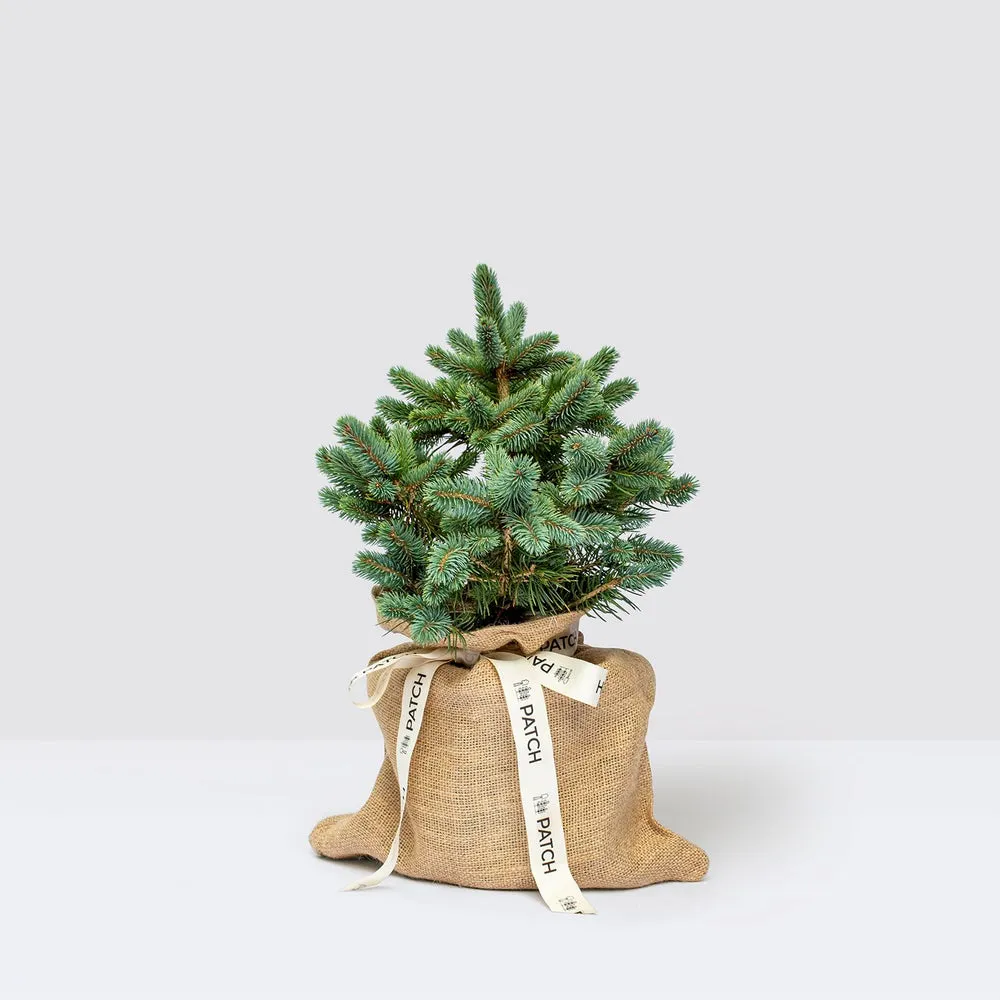
Natural burlap sheds fibers and holds dust, so shake it out outdoors once a month and keep it away from humid rooms. The printed ribbon is usually a cotton or polyester blend that can fade in direct sun, so this is one display that belongs out of a bright south-facing window. Expect to replace the ribbon every year or two if you like the look and want to reuse the sack.
24. Industrial Metal Mini Tree with Distressed Glass Ornaments
- Source a small metal tree frame with a cross-shaped base — 18 to 24 inches tall is the sweet spot.
- Sort your ornaments by size before hanging anything.
- Hang the heaviest pieces closest to the center post to keep the frame from tipping.
- Fill gaps with the smallest ornaments last, working outward from the post.
- Crown it with a wire star and secure it to the top bar, not a branch.
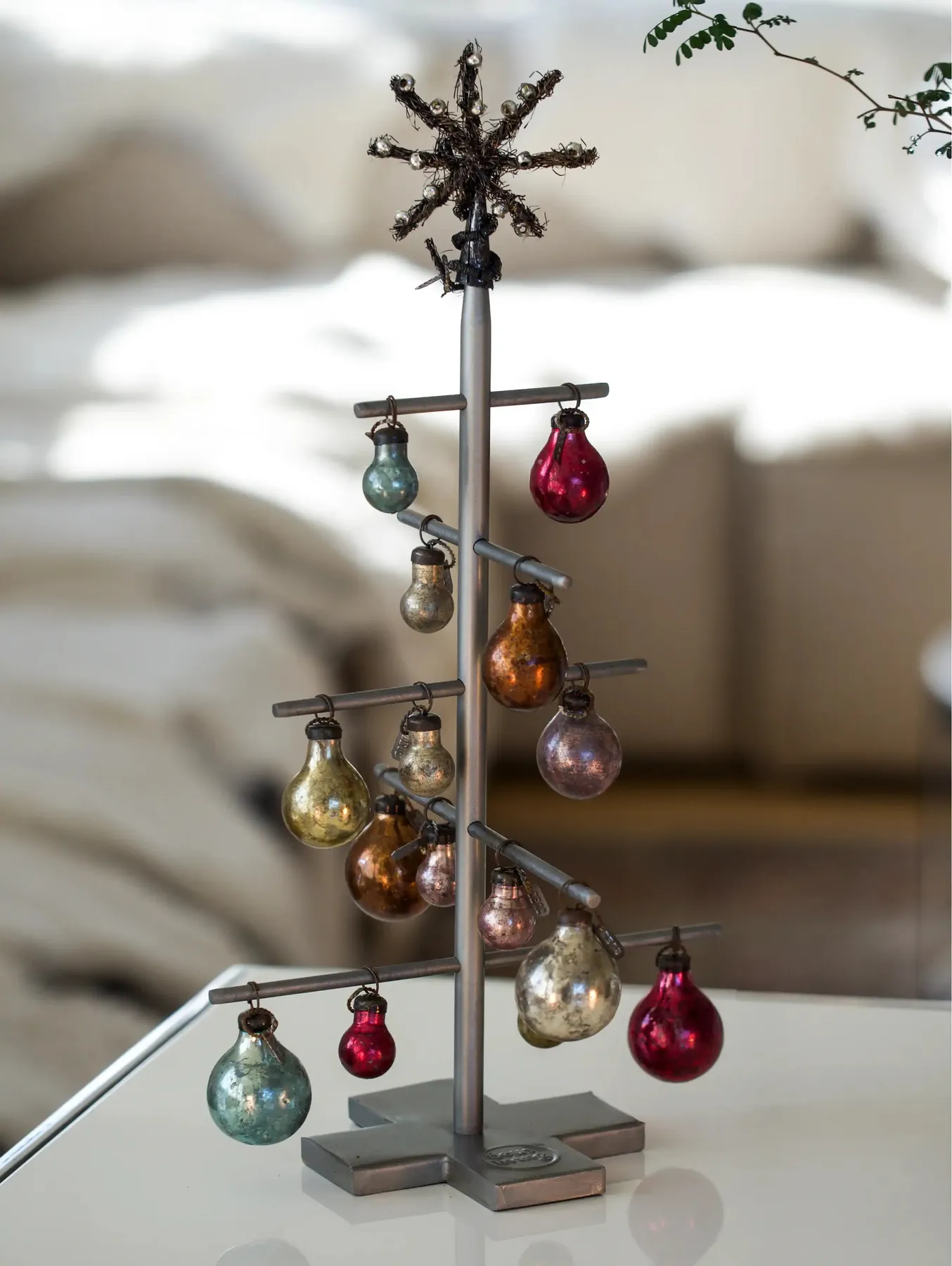
About 45 minutes, and no lights required.
60% silver-grey metal plus 25% mixed mercury glass plus 15% warm accents. Because the frame is bare, the ornaments carry the entire palette — so a dozen pieces in three or four metallic hues is the target, not two dozen. Distressed finishes work better than glossy here, since the matte texture stops an open frame from reading as a wire cage. Add one deep teal piece as the surprise.
25. Flocked Bottle Brush Forest on Wood Slice Bases
- Flocked bottle brush trees, assorted sizes: $40-$120
- Natural wood slice bases: $10-$28
- Red glass candle holders: $15-$40
- Ribbon and gift wrap: $12-$35
- Rustic wooden surface or tray: $20-$60
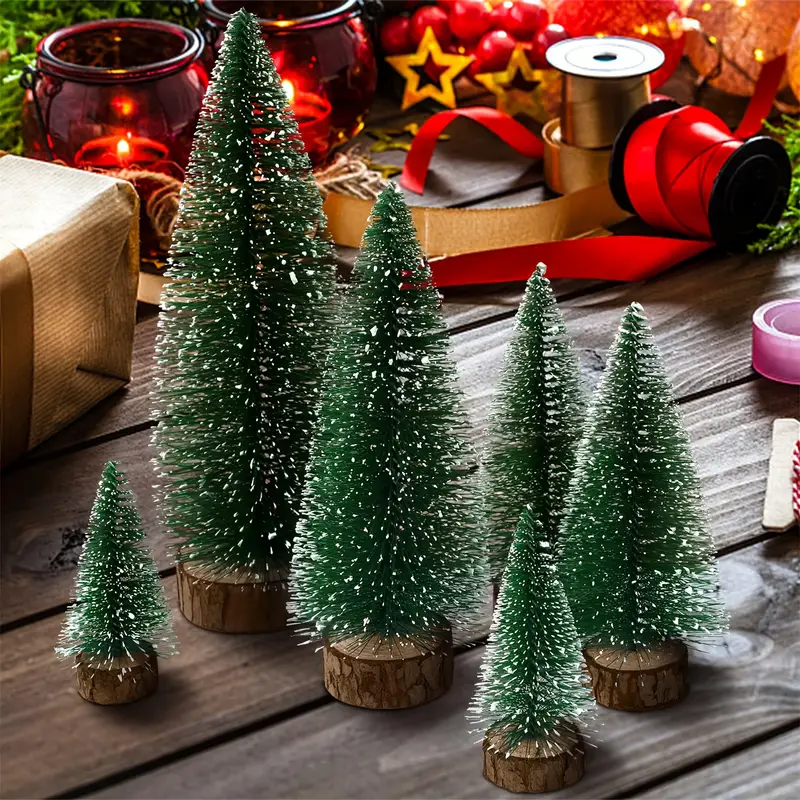
Bottle brush trees are also one of the easiest things to buy after Christmas at 60% off for next year.
Matching every tree to a wood slice base is what turns a loose collection into a village. It also solves the scale problem — bottle brush trees come in wildly different heights, and a shared round base gives them a common ground plane so the eye reads a group instead of a jumble. The deep red candle holders repeat the red ribbons and pull the whole arrangement back toward Christmas.
26. A Pink and Teal Bottle Brush Forest in Faux Snow
Colored bottle brush trees bleed. If you’re setting pink and teal trees on white faux snow, seal them first with two light coats of matte craft sealant and let them cure for 24 hours. Otherwise you’ll get pastel streaks in your snow by week two. Keep the tallest tree slightly off-center and about 1.5 times the height of the next tallest. Perfect stair-steps look like a store display rather than a collection.
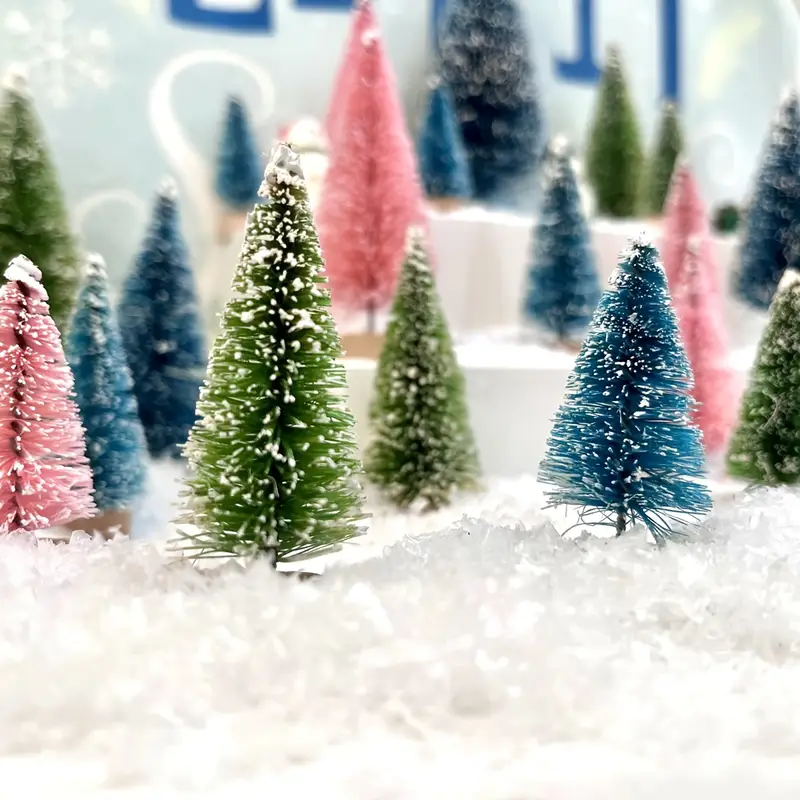
Non-traditional tree colors are the loudest holiday trend going into 2026, driven almost entirely by social sharing — pink and teal trees simply photograph better on a phone than forest green. It’s also a reaction against a decade of all-neutral Christmas decor. The look has real staying power for collectors, though it’s the kind of choice you commit to for three years at least.
27. Sparse Pine in a Simple Off-White Pot
The sparsest possible version of a mini tree, and the most forgiving for small rooms — a two-foot tree in an eight-inch pot fits on a 12-inch-deep shelf or nightstand. It also works under eight-foot ceilings without crowding anything, and it’s the right pick if you have less than six square feet of usable surface. Compare with Idea #7, which uses the same tabletop footprint but with a full, flocked silhouette.
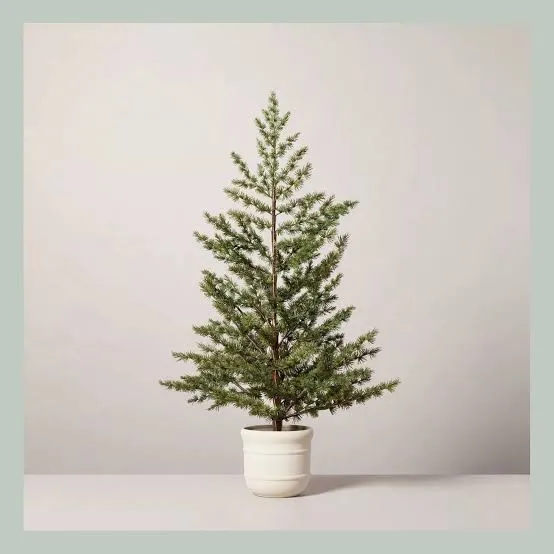
The visible brown trunk is the point. Most artificial mini trees hide their stems, and that’s what makes them look plastic. This one leaves the trunk and branch structure exposed, so the sparse light green needles read as a real sapling instead of a shrunken Christmas tree. Take away the visible wood and the whole thing collapses into generic faux greenery.
28. Birch Bark Pot on a Distressed White Table by a Window
Birch bark pots run $15-$35 at garden centers, but you can wrap any plain ceramic pot in birch-pattern contact paper or thin birch veneer for about $8. Distressed white side tables show up at flea markets for $25-$60. The tree itself, a small conical evergreen, is $20-$35 at a big-box store in late November. The total look lands under $100, and it works with a real or an artificial tree.

- Choose a pot about one to two inches wider than the root ball or existing nursery pot.
- Wipe the birch bark surface with a dry cloth, since moisture dulls the paper layer.
- Place a saucer inside so the pot stays dry if you’re using a live tree.
- Position the table perpendicular to the window so light rakes across the bark.
- Keep the string lights behind the tree rather than around it for the softest glow.
About 20 minutes, and roughly $50 in materials if you already own lights.
29. Mini Evergreen with Envelope String Lights in a Green Pot
Novelty light strings — envelopes, gingerbread, tiny houses — are usually battery-powered with a six- to eight-hour timer, and the batteries are the weak link. Buy rechargeable AAs and expect to swap them weekly if you run the lights every evening. Also check that the covers are firmly seated. On most craft-paper-style strings, the decorative shells slide off the bulb and get lost by mid-December.
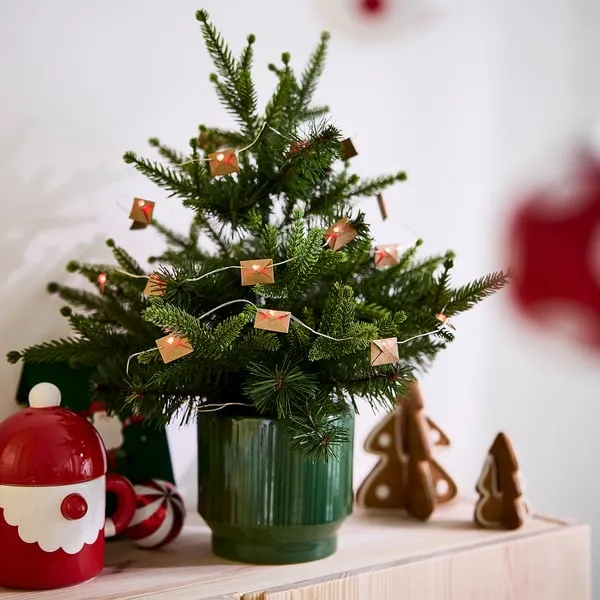
The ribbed dark green pot is doing something clever: it matches the tree, so the tree appears to grow out of it rather than sit on top of it. If you want that same effect with a lighter tree, pick a pot within one shade of the foliage. And keep the novelty lights to a single strand — two competing shapes, envelopes plus gingerbread, and the whole thing tips from charming to chaotic.
30. Moss-Wrapped Mini Trees on a Stone Mantel with a Wire Star
- Measure your mantel depth. You need at least eight inches for two trees plus a candle.
- Check head clearance if the mantel sits beside a walkway.
- Confirm the mantel is level, because moss-wrapped bases are unstable on a slope.
- Keep open flame at least six inches from any moss or twine.
- Decide on the star first — it sets the height of everything else.
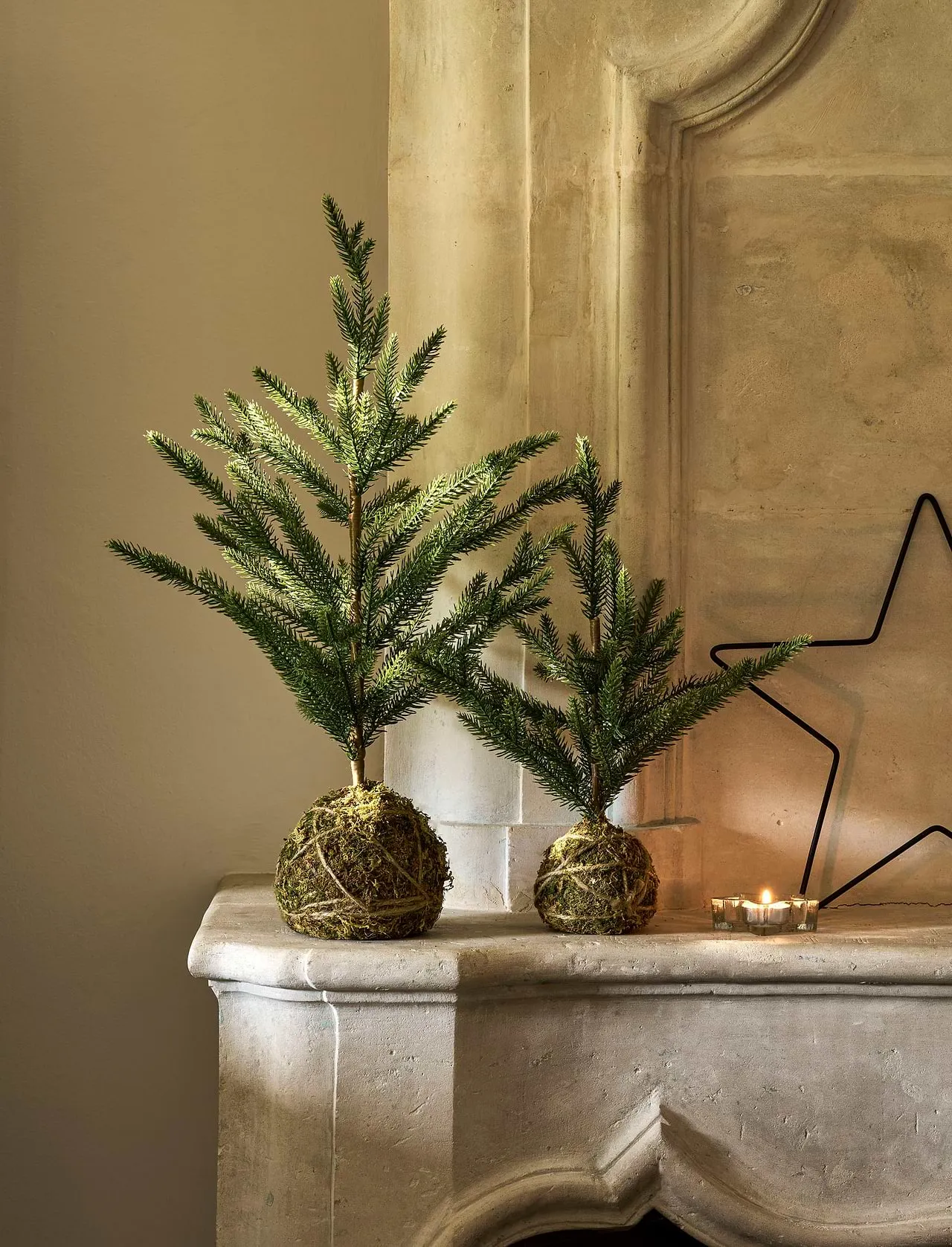
Two trees plus one small object is a classic asymmetric composition, and the black wireframe star is what balances it. Because the trees are nearly identical, the star acts as the visual weight on the lighter side. Remove it and the mantel looks lopsided without anyone knowing why. The single tea light also gives the display a moving glow, which is why the textured stone reads warm instead of cold.
This setting wants a room with at least nine-foot ceilings and a mantel at roughly 54 to 60 inches — otherwise the trees end up below eye level and lose their presence. Two two-foot trees plus a six-inch star need about 30 inches of horizontal run. If you’re working with a shorter mantel, use Idea #21 instead: same greenery, one pot, a third of the footprint.
31. Red Faceted Bowl Centerpiece with Frosted Greenery and Twigs
- Red faceted bowl: $18-$45
- Evergreen branch bunches, faux or fresh: $25-$60
- Red berry sprays: $10-$24
- Pinecones and bare twigs: $8-$20
- Floral foam or a branch grid: $4-$12
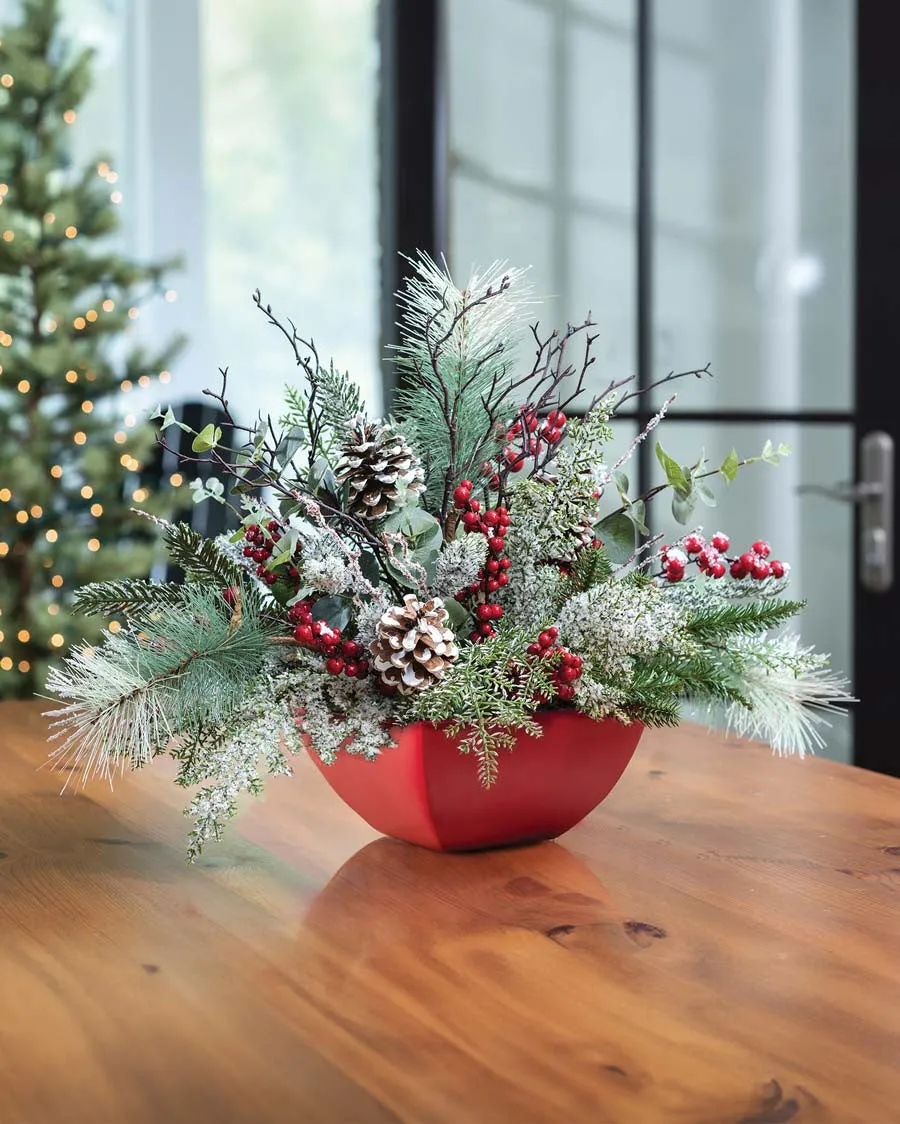
A thrifted red bowl in the right shade can drop the whole thing under $50.
Fresh evergreen dries out fast in heated rooms. Expect 10 to 14 days before the needles start dropping, and mist the arrangement every other day to stretch it a little further. Faux branches last for years but collect dust deep in their structure — a hair dryer on the cool setting from two feet away clears them quickly. The bare twigs are the maintenance-free part and can stay out from November straight through February.
32. Flocked Bottle Brush Trees with Gold Bells and a Mini Drum
When you’re arranging miniature trees against a plank wall, the horizontal gap does the work. Space the tallest and middle tree about two inches apart and leave a wider, four-inch gap before the smallest — the rhythm reads as chosen rather than scattered. Hang the gold bells at slightly different heights so they overlap the plank lines instead of lining up with them, which flattens the whole display.
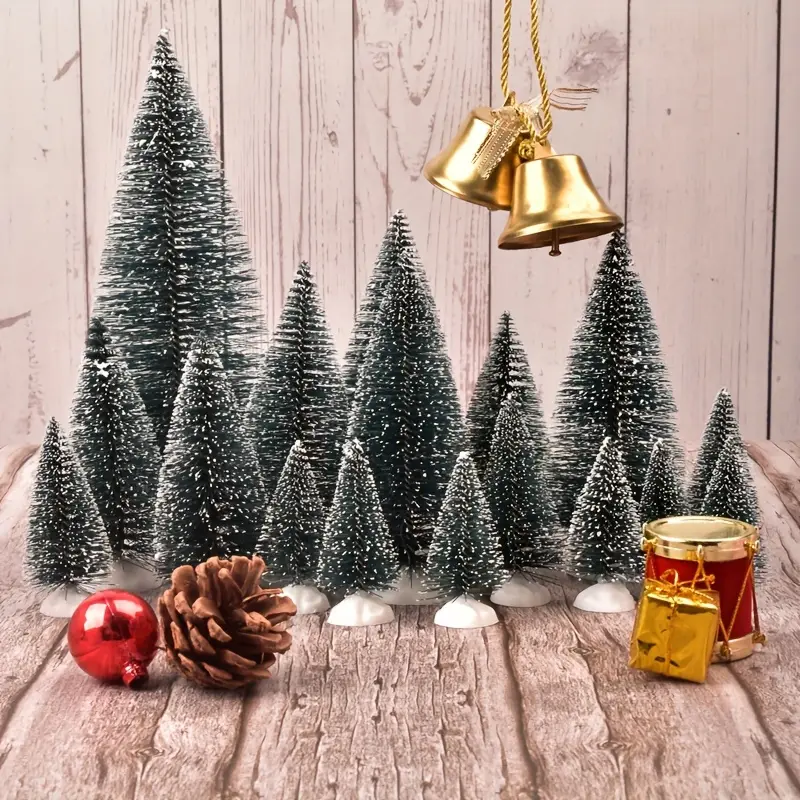
Craft stores sell unflocked bottle brush trees for $2-$6 each, and a can of spray flocking runs around $8 and covers a dozen trees. Gold bells are $5-$10 for a set, and the small drum and pinecone usually turn up at thrift stores for a couple of dollars. Under $40 gets you this entire shelf, versus $150 or more buying the trees pre-flocked.
The light-brown plank wall is what keeps these dark green trees from looking heavy. Against white, flocked trees disappear at the tips; against dark wood, the green goes muddy. A mid-tone wood plank backdrop gives the white flocking contrast and the deep green a warm surface to sit on. It’s the same reason the tiny red drum reads so clearly — it has a soft neutral behind it.
Little Trees, Big Holiday Energy
Go small, go specific, and let contrast and repetition do the heavy lifting — every one of these 32 looks proves you don’t need eight feet of floor space to make a room feel like December. Pick two ideas that fit your surfaces, borrow the formula from a third, and stop scrolling.
📌 Pin your favorites now so they’re waiting for you when the ornaments come out of the box.