
Most guides to a kitchen Christmas tree get it wrong — they treat it like a living-room tree that shrank. It isn’t. A kitchen tree lives next to grease, heat, splatter, and about nine inches of genuinely usable counter. We spent serious time browsing Target, IKEA, Walmart, Etsy, and Wayfair to bring you only what actually holds up in that environment, from a $3 towel swap to a $1,010 garland-and-console setup. Inside you’ll find 32 curated ideas across farmhouse rustic, modern minimalist, traditional red-and-green, and the pastel whimsical looks that are everywhere right now — with budget and luxury versions compared side by side. In 2026 the kitchen tree stopped being a novelty and became the room’s main event, driven by open-concept layouts and a shift toward small, swappable seasonal decor instead of eight bins in the garage. And stay until the end — we break down the most common mistakes that can ruin these looks. 📌 Save this to Pinterest for later — you’ll want to revisit these ideas.
1. Cream Cabinets, Deep Red Bows, and a Countertop Mini Tree
Garland above the cabinets lives or dies on hook placement. Skip the crown molding — the adhesive pulls paint — and set clear removable hooks on the flat top of the cabinet box instead, one every 18 to 24 inches. For a typical 8-foot cabinet run, that’s a 9-foot garland with about six inches of swag between hooks. Push the string lights inward toward the wall so you see glow bouncing off the ceiling instead of a row of bare bulbs.
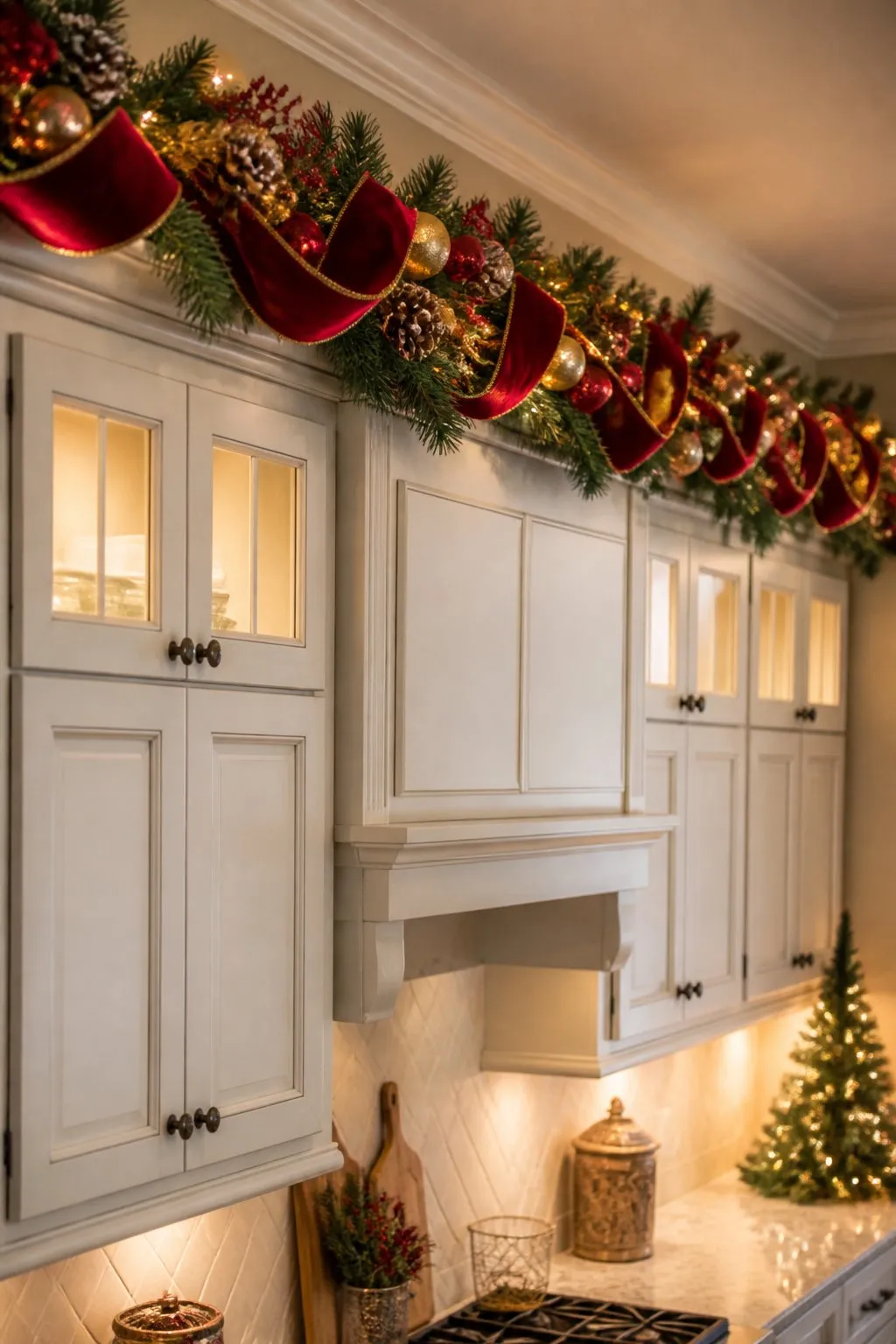
Three things are doing the heavy lifting here. First, contrast: deep red velvet bows against cream cabinetry read as deliberate rather than cluttered. Second, repetition — the gold and red ornaments tie the garland to the mini tree below, so your eye travels down instead of stopping at the ceiling. Third, those lit glass-front cabinets act like built-in display cases, which means the garland isn’t the only thing glowing at eye level.
2. A Wreath Over the Stove and Potted Evergreens Below
Take away the wreath above the range and this becomes just a white kitchen with some plants on the counter. That wreath is doing all the work: it fills the dead space between the hood and the backsplash, it mirrors the round shapes of the potted evergreens below, and its red berries repeat just often enough to feel intentional. Size beats style here — go 24 to 30 inches wide, roughly two-thirds the width of the space above your stove.
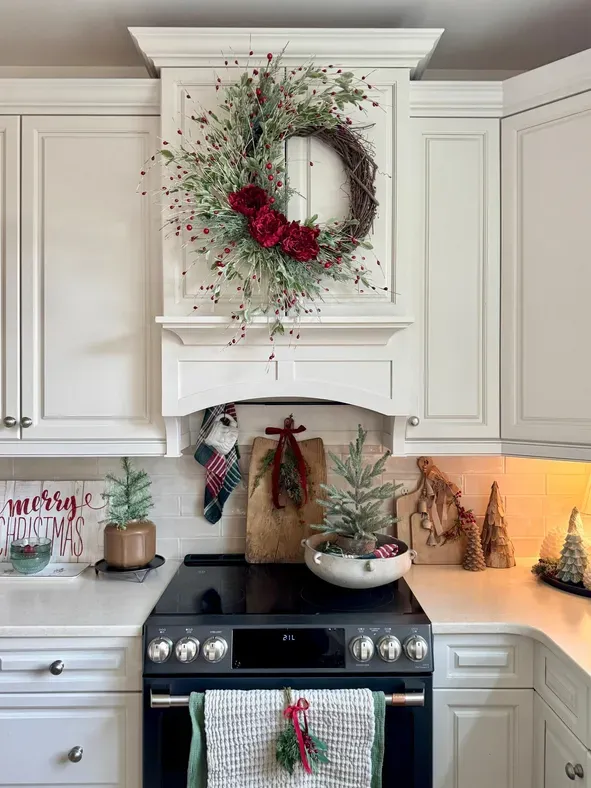
- Wipe the tile with rubbing alcohol and let it dry completely — grout dust is why most adhesive hooks fail.
- Choose a removable hook rated for at least 5 pounds; a real evergreen wreath is heavier than it looks.
- Press and hold for 30 seconds, then wait a full hour before hanging anything.
- Hang it so the lowest point clears the burners by at least 18 inches — closer than that and a flare-up has fuel.
- Recheck the hook every few days; warm kitchen air softens adhesive.
Twenty minutes and about $8 in supplies.
3. Snowmen, a Checkered Runner, and a Counter Full of Cheer
- Snowman figurines, 5-8 pieces, thrifted and new: $25-$60
- Red and white checkered runner: $12-$30
- Fresh or faux greenery sprigs: $15-$40
- Pre-lit tree, 7 ft: $150-$450
- Red and gold ornaments plus ribbon: $40-$90
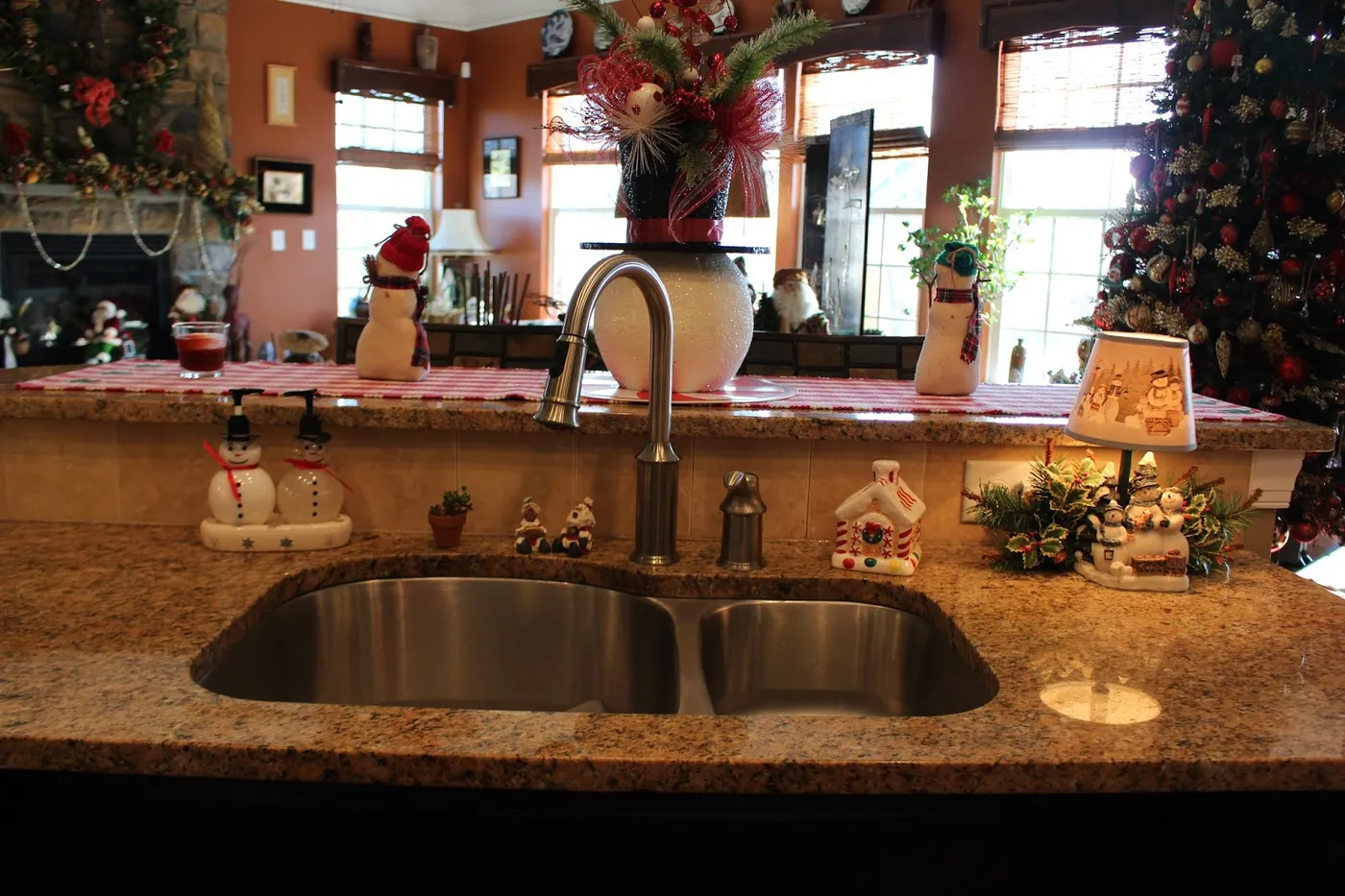
Total: roughly $240-$670, and about half of that is the tree. Check Marketplace in early November — that’s when people upgrade and dump perfectly good pre-lit trees for a fraction of retail.
Granite is busy. Snowmen are busy. A checkered runner is busy. Put all three on the same four feet of counter and the eye has nowhere to rest. The fix: cluster your snowmen in one group of five or seven (odd numbers look styled, even ones look staged), leave at least a foot of bare stone on each side, and let the runner be the only pattern in that zone.
4. Navy Shiplap Island, Teal Ornaments, and One Long Sightline
The kitchen tree isn’t a novelty anymore — it’s a direct result of kitchens becoming the rooms people actually hang out in. Open-concept layouts put the island in the same sightline as the sofa, so a tree beside the sofa reads as part of the kitchen. And this palette is very 2026: cooler blues and teals instead of the usual red and green, which photographs beautifully and never fights light wood floors.
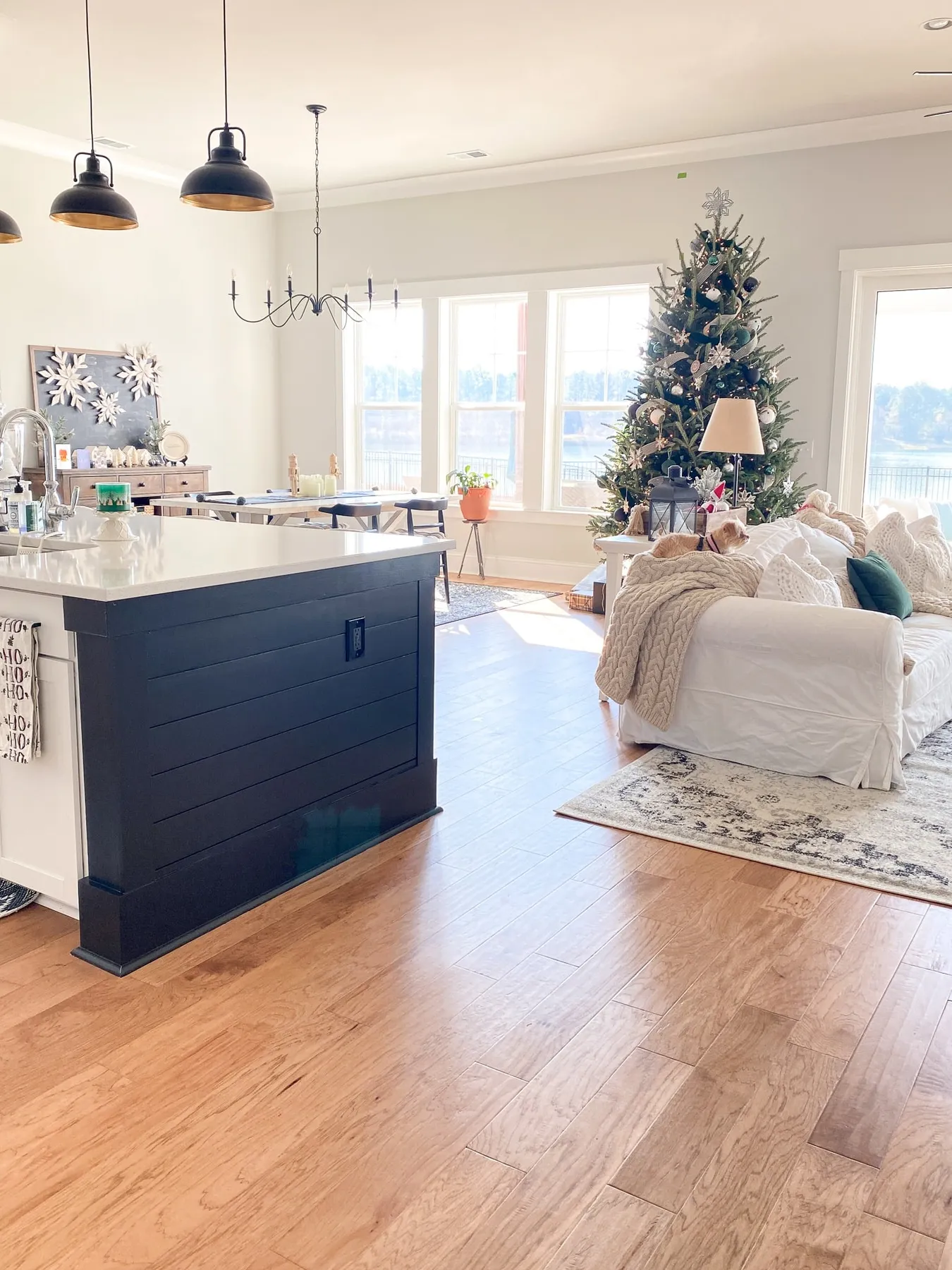
The formula: 60% white and light wood (cabinets, counters, floors, the slipcovered sofa) + 25% deep navy on the island + 10% silver and teal ornaments + 5% black punctuation in the pendant lights. Swap navy for forest green and teal for copper and the same math holds. The rule isn’t the colors — it’s that one saturated color owns a single large surface while the metallics stay small and scattered.
5. A Lit Mini Tree in a Wooden Pot, Copper Everywhere
Dried citrus is the rare holiday decor that gets better as it ages — no water, no wilting, just a slow fade from orange to amber. The copper is the opposite. Unsealed copper dulls in about six weeks in a humid kitchen and needs a polish with lemon and salt to come back. If you’d rather not bother, buy lacquered copper, or lean into the patina and call it character.
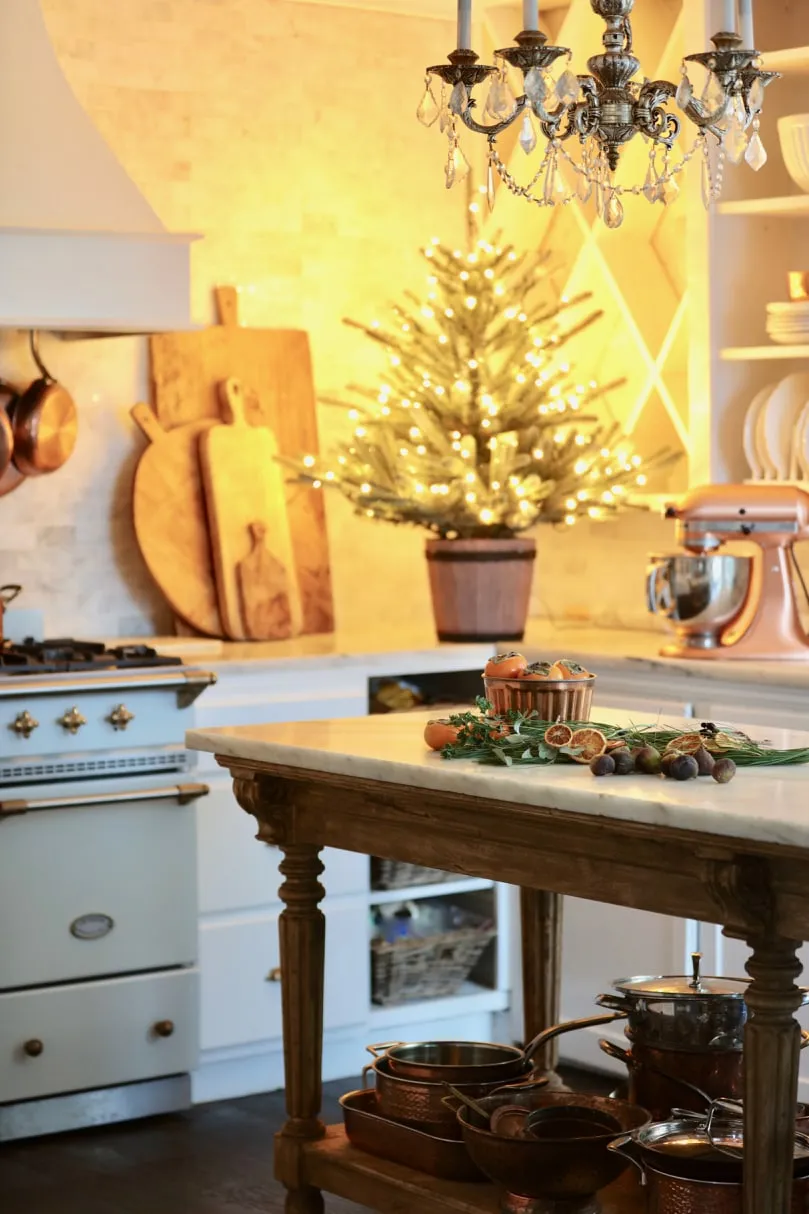
You can build this look almost entirely from thrift stores. Copper pots turn up constantly at Goodwill and estate sales for $5 to $20 each, and a mismatched row genuinely looks better than a matched set. Dry your own citrus slices at 200°F for three hours. As for the wooden pot holding the tree — a $4 IKEA planter or a repurposed utensil crock works fine. Nobody inspects the bottom of a tree.
6. A Gingerbread Wonderland Sealed Under a Glass Cloche
The glass cloche with the miniature house inside is the entire story. Without it you have a pleasant gingerbread-themed counter; with it, you have a snow globe you get to walk past every morning. The cloche does two jobs at once — it protects the tiny scene from kitchen grease and dust, and it visually separates that one moment from the wooden gingerbread trees standing around it. Everything else here is supporting cast.
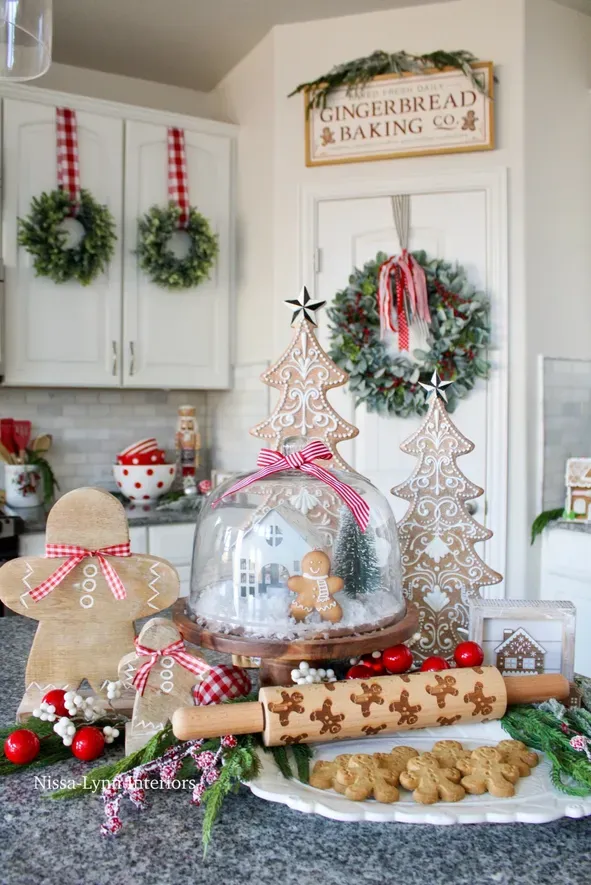
- Start with a shallow wooden or ceramic base at least an inch wider than your cloche.
- Build the ground from a thin layer of faux snow or coarse sugar.
- Place the tallest element — the house — slightly off-center, about a third of the way in.
- Tuck the tree behind and to the side so it overlaps the house edge.
- Add the gingerbread man last, front and slightly right, like he’s walking away.
- Lower the cloche slowly after wiping the inside of the glass.
About 15 minutes and whatever the pieces cost you.
- Measure counter to upper cabinet — you need at least 18 inches of clearance.
- Keep it out of direct sun, which fogs glass.
- Check the cabinet door swing if you’re staging it near uppers.
- Avoid the zone directly beside the stove.
7. Boucle Stools, String Lights, and a Berry Centerpiece
Two things make or break a lit backdrop wall: spacing and color temperature. Run your strands in loose swags about 18 inches apart, and buy 2700K warm white — anything labeled 4000K or ‘daylight’ will look like a hospital corridor against cream and wood tones. Draping across roughly 10 feet? One 100-bulb strand is enough. Two starts to look crowded.
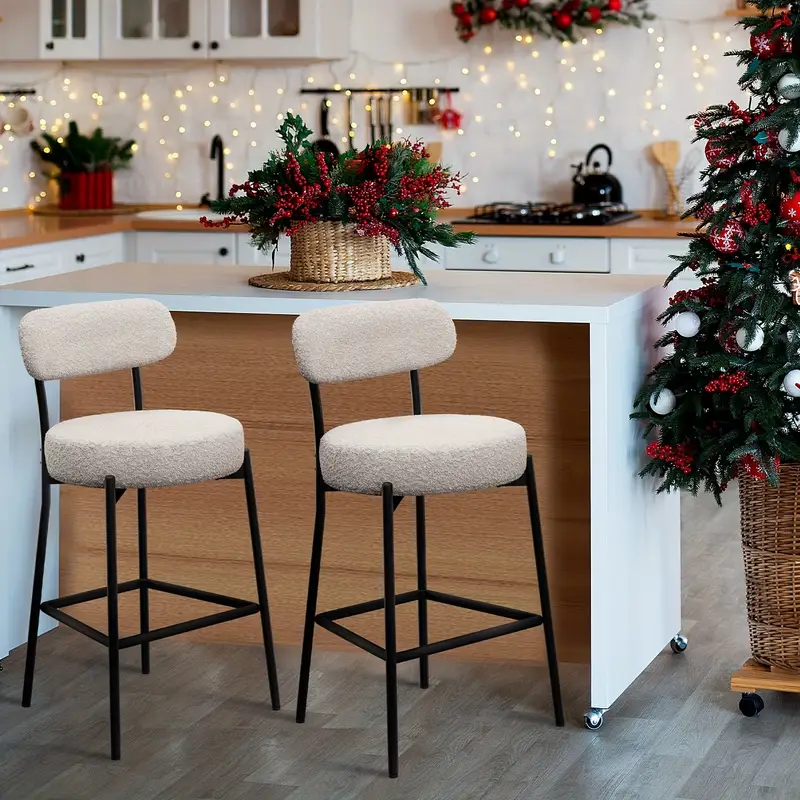
This layout wants an island at least 6 feet long and a clear 42-inch walkway behind the stools — anything tighter and the boucle seats become obstacles. For the tree to read as part of the kitchen rather than shoved in a corner, you need about 12 feet of sightline from the island. In a galley or a kitchen under 120 square feet, skip the full tree and let the centerpiece carry it, the way Idea #24 handles a big open room instead.
8. Paper Trees, Pastel Ornaments, and Pleated Pendant Lights
Here’s the ratio: 55% off-white cabinetry and counters + 25% natural wood + 12% pastel in mint and blush, kept close in value + 8% copper. The pastels only work because they’re a small slice sitting next to warm wood. Push them to 25% and the kitchen starts looking like a nursery. Trade mint for butter yellow and blush for terracotta and the formula still holds.
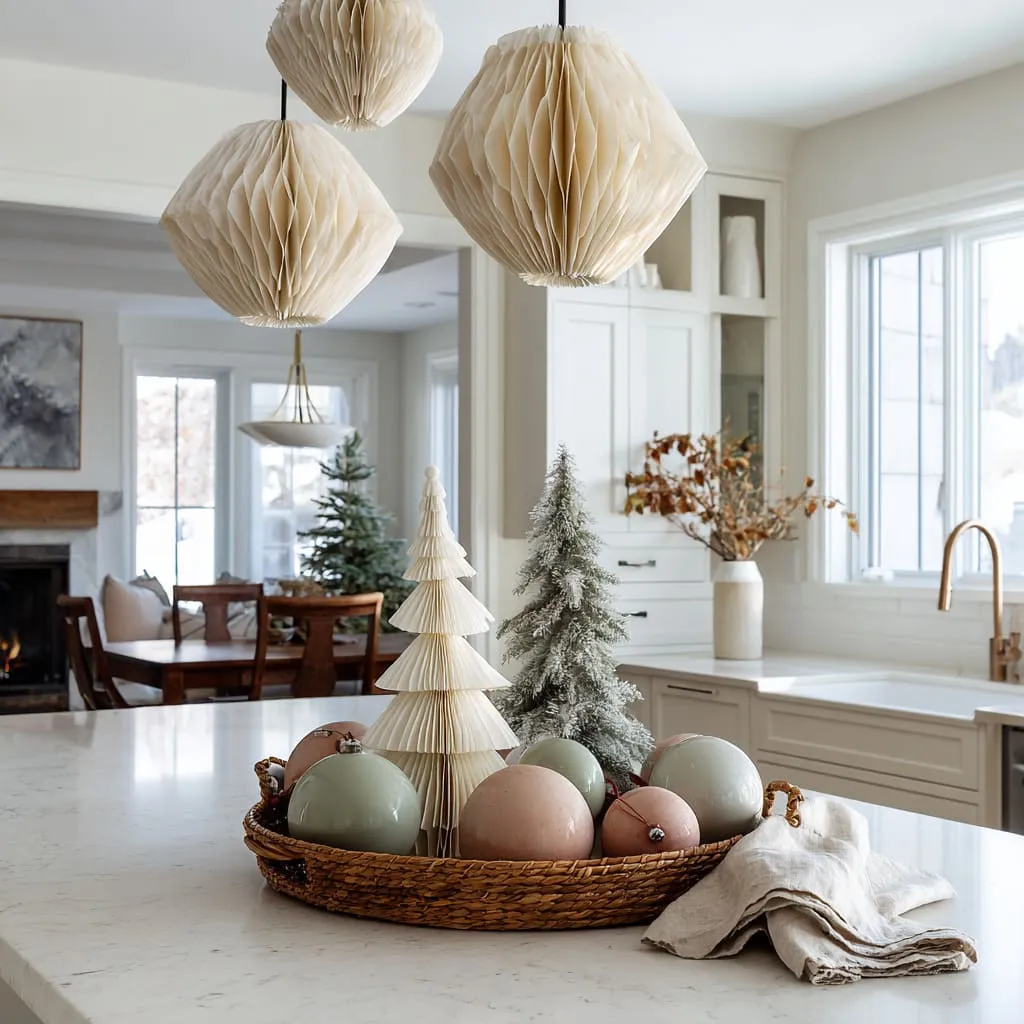
Pleated paper pendants look expensive and mostly aren’t. The originals run a few hundred each, but paper lantern shades at Target and IKEA cost $10 to $25, and folding your own from heavy cardstock takes an evening and about $12 in materials. Wicker trays turn up at thrift stores for $3 to $8. Oversized pastel ornaments are cheapest in late November, when craft stores clear out their seasonal stock.
9. A Frosted Mini Tree with Golden Birds on Burlap
A mini tree this size — 18 to 24 inches — needs a surface at least 12 inches deep and a wall behind it, otherwise it looks stranded. The frosted finish reads best against light wood or cream, and it will vanish against a white wall unless the lights are on. Good spots include a counter corner beside the toaster, a sunny windowsill, or the top of a hutch. Compare with Idea #30 — same frosted finish, completely different mood.
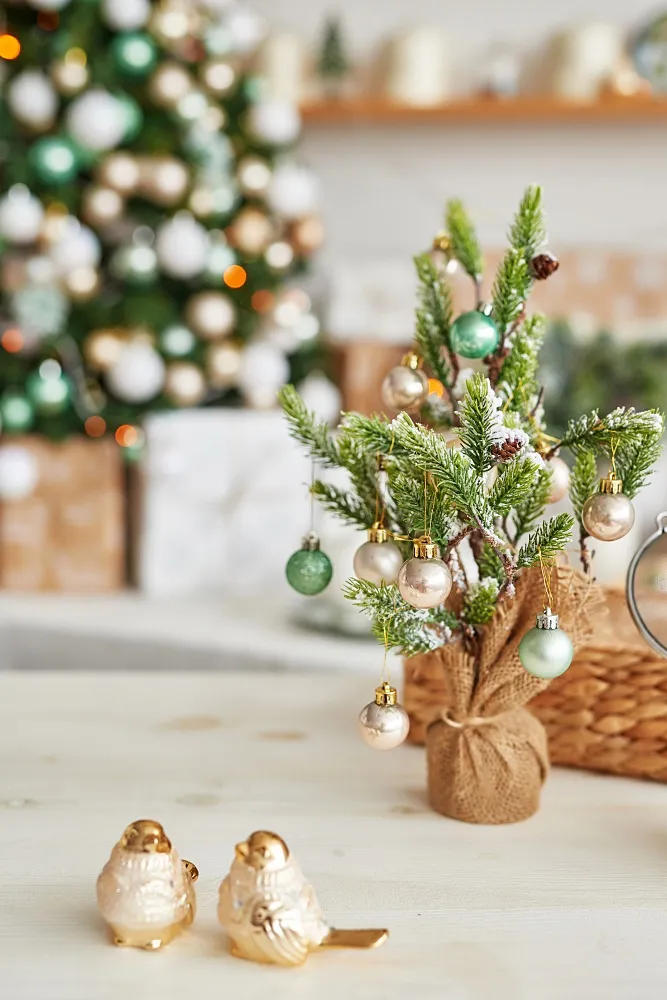
Three ornament rules for small trees, learned the hard way: keep pieces between 1.5 and 2.5 inches so they don’t swallow the branches, cap yourself at 12 to 15 ornaments on a 20-inch tree, and put the heaviest ones low so it doesn’t tip. A burlap wrap hides the plastic stand and gives you a second texture for free.
- Champagne gold first — it’s the connective tissue
- One accent color, never three
- Something organic: pinecones, burlap, or dried orange
10. A Tiny Tree on a Floating Shelf Between White Mugs
- Clear the shelf completely and wipe it down.
- Place the tree at the exact center — symmetry is what makes a small display feel purposeful.
- Balance left and right with objects of similar visual weight, not similar size: two mugs on one side, a leaning cutting board on the other.
- Add one taller item at one end, like the mercury glass cup, to break the flat line.
- Step back six feet and confirm nothing overhangs the shelf edge.
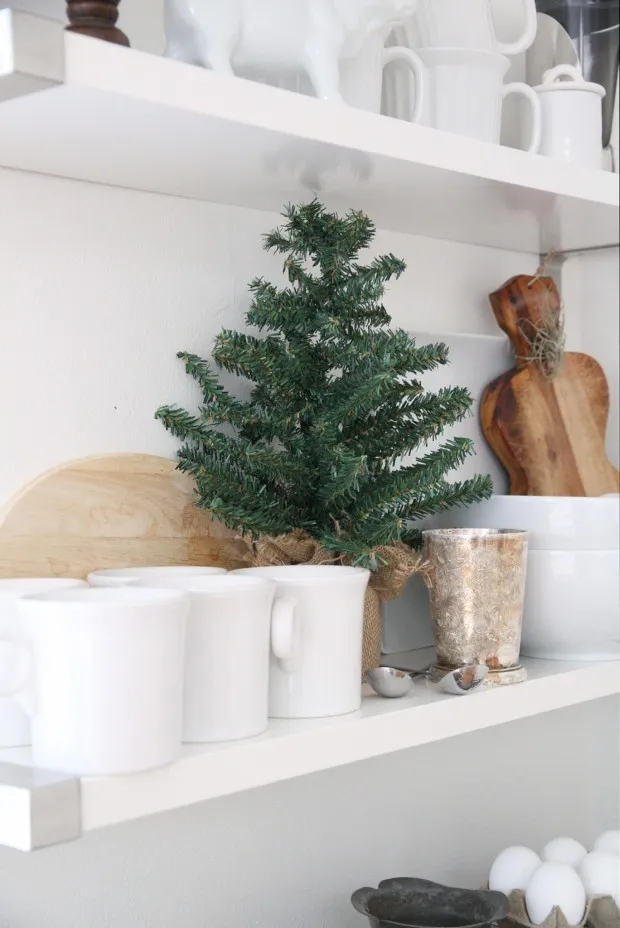
Ten minutes, and zero dollars if you already own the mugs.
- 18-inch artificial tree: $12-$30
- Burlap wrap: $4-$10
- Floating shelf, 24-36 in.: $20-$60
- White ceramic mugs, set of four: $12-$35
- Thrifted wooden cutting boards: $8-$25
- Mercury glass cup: $6-$18
Total: $62-$178. Skip the shelf entirely and stage the same arrangement on a counter you already own to cut it by 40%.
11. A Painted Tree Bowl Full of Apples, Limes, and Avocados
The bowl’s painted tree and the apples, limes, and avocados aren’t random — they’re a color echo. Red apples pick up the tree lights, green limes match the branches, and the cream bowl repeats the counters. That’s why a fruit bowl can carry an entire holiday kitchen: it lets you decorate with things you were going to buy anyway. The black candle on the white scalloped holder gives you one crisp contrast point.
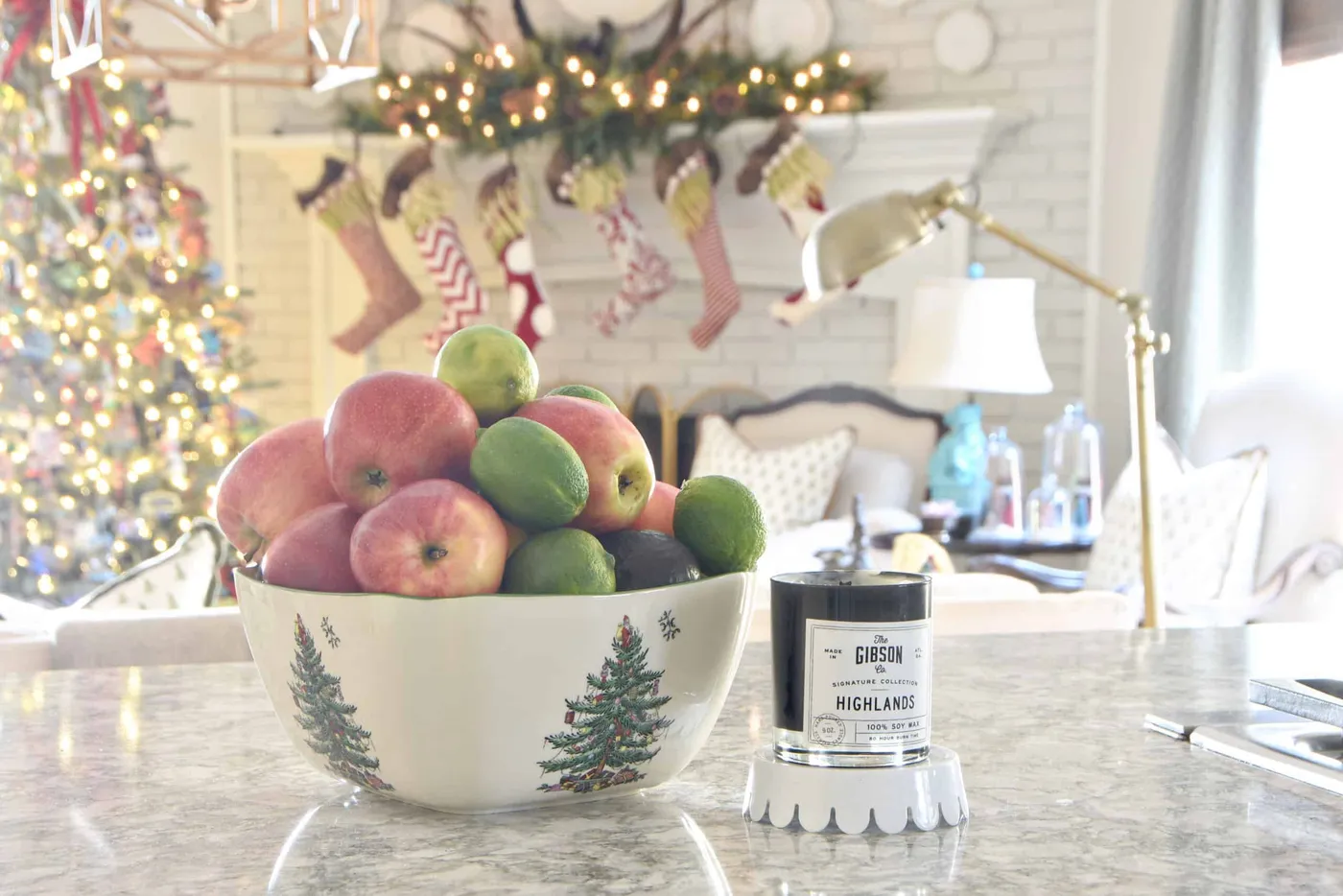
Two honest notes. Cut limes and avocados sitting near a candle will turn faster than you expect — keep that fruit bowl at least two feet from any open flame, and check underneath for moisture rings on the stone. Also, if the kitchen gets afternoon sun, the candle wax softens and leans. Move it back a few inches from the window and you’re fine.
Skip the specialty bowl and use a plain white ceramic one for $12, then lean a small framed tree print behind it. The whole vignette — fruit, greenery, candle, scalloped holder — comes in under $45 if you shop your own cabinets first. Thrift stores are full of scalloped ceramic saucers in January, so buy then and store them.
12. Five Gingerbread Ornaments Held Against the Green
- Measure your branch spacing — ornaments wider than 3 inches need at least 4 inches of gap.
- Set a strict two-color limit before you shop; red, white, blue, and brown is already four.
- Check whether the ornaments are fabric, clay, or plastic — storage and cleaning differ completely.
- Buy a second set of the ones you love; you’ll want them for a small tree next year.

Fabric and felt ornaments collect kitchen dust and grease faster than glass or ceramic, and they aren’t washable — a damp cloth will pill the surface. Plan on a soft brush or lint roller once a month during the season, and store them in a breathable cotton bag rather than a sealed plastic bin, which traps moisture and turns musty. Glazed ceramic ornaments in the same shapes need almost no upkeep.
Scale is where most people go wrong. On a 7-foot tree with roughly 12-inch branch spacing, ornaments should run 2 to 4 inches. Mix three sizes: about 60% medium, 25% small, 15% large. Hang the biggest pieces in the lower third and at branch tips where they catch light, and spread a collection like this across the whole tree instead of clustering all five together.
13. Cowboy Santa, a Rocking Horse, and Red Mesh Ribbon
Western holiday decor has been climbing for a couple of seasons, partly as a counterweight to the flocked-white minimalist look that dominated for years. Cowboy Santas, saddle-wearing rocking horses, and wooden barn toys read as nostalgic and genuinely personal rather than styled. Terracotta floors and warm wood make it easy. This is a trend with staying power because it’s built on objects people inherit.
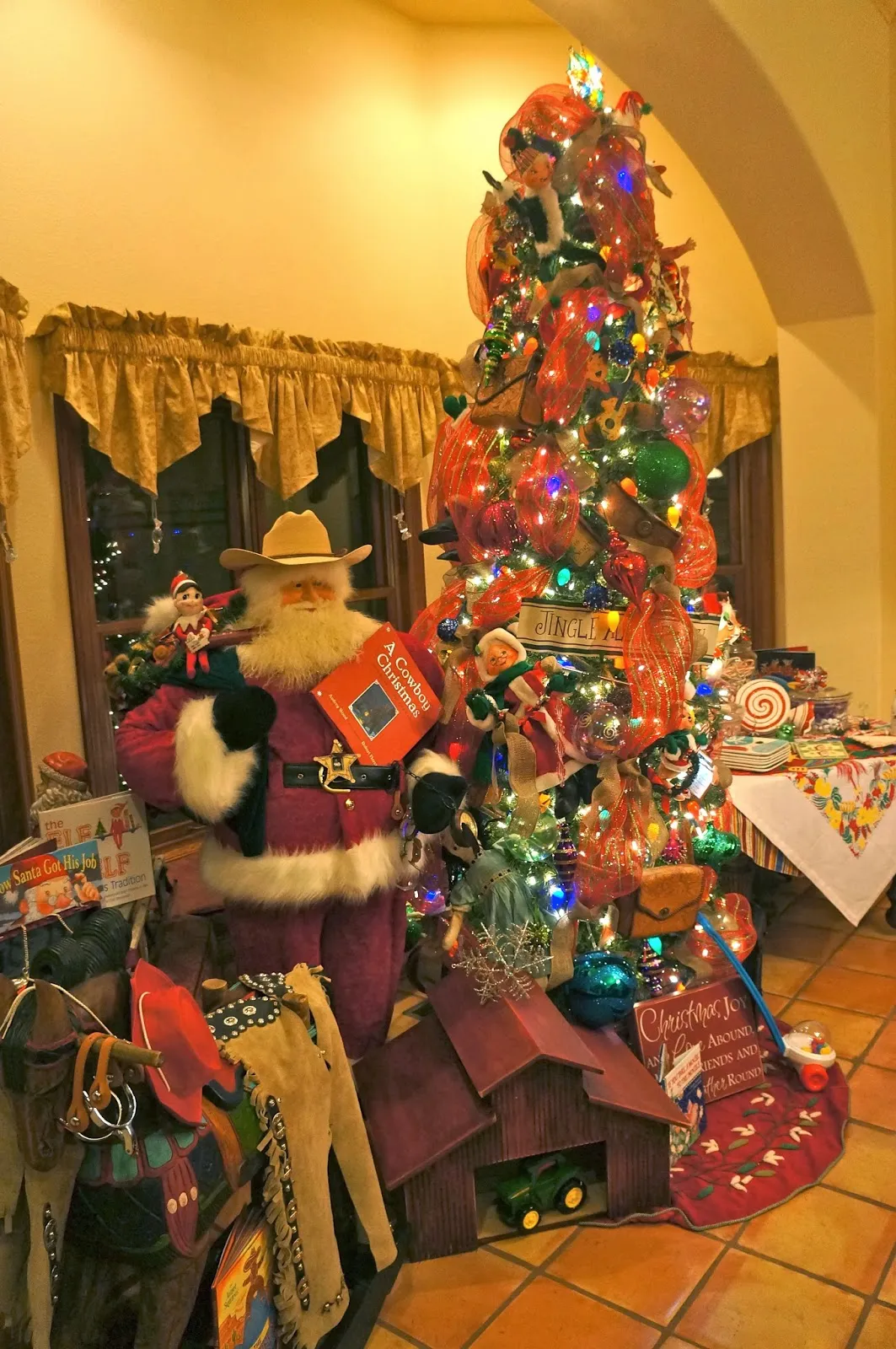
The tree here is dense and tall — plan on 7 to 7.5 feet for a standard 9-foot ceiling, leaving at least a foot between the top and the ceiling so toppers don’t scrape. You want roughly 36 inches of clearance on the sides to walk around it, plus another 12 for the Santa figure. Working with a smaller corner? See Idea #22 for a tabletop-scale approach with the same energy.
14. A Tabletop Tree in a Jar of Candy Canes
The classic formula, dialed in: 50% pine green from the tree and ribbon, 30% candy-cane red and white, 15% gold ornaments and bows, 5% sheer red-and-green ribbon for shine. It’s traditional and it will never look dated. Swap red for burgundy and gold for brass and you get a moodier version. Swap red for blush and gold for champagne and it turns into the pink flocked aesthetic in Idea #16.
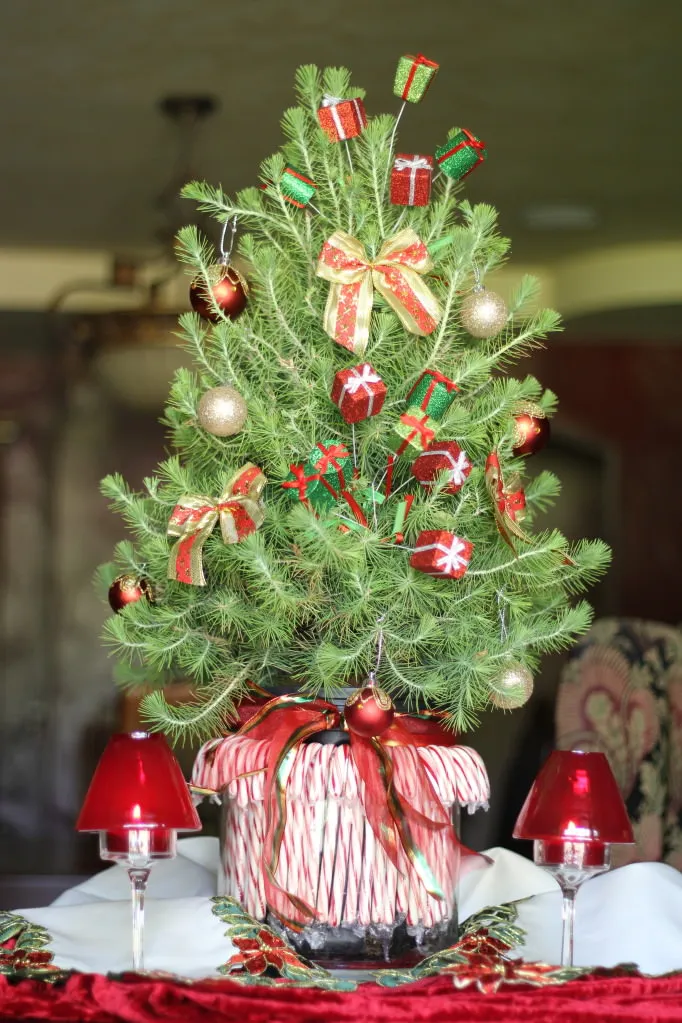
Candy canes in a glass jar are adorable and also a magnet for humidity. In a warm kitchen, unwrapped canes go sticky within a week or two, and once they’re sticky they fuse into one solid lump. Keep the jar away from the stove and dishwasher, or use wrapped canes. And this is an artificial tabletop tree, so don’t water it — a real tree sealed in a glass jar will rot.
15. Two Flocked Trees Flanking a Hot Cocoa Bar
- Two 3-ft flocked trees: $60-$160
- Mugs, cocoa, marshmallows, candy canes: $25-$60
- Tiered tray or cake stand: $18-$45
- Sign or framed printable: $8-$25
- Small baskets or jars for toppings: $12-$35
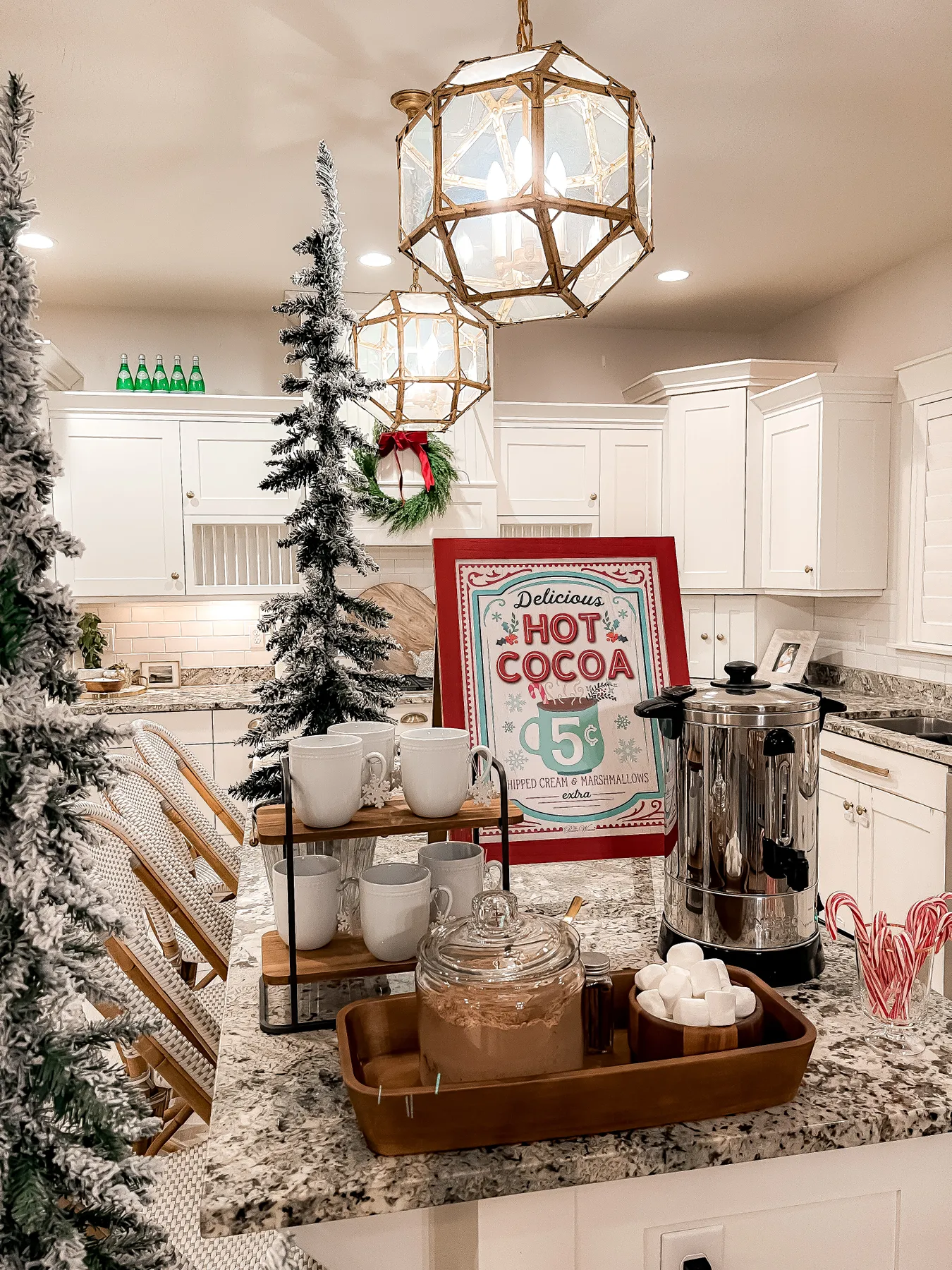
Total: $123-$325. The budget move is to buy the trees after December 26 at half price and build the cocoa bar from what’s already in your cabinets. A plain white plate stacked with cookies does the same job as the tiered stand.
Pendant height is the most common mistake in kitchens like this. Hang fixtures 30 to 36 inches above the countertop, measured to the bottom of the shade, and 30 to 32 inches apart if you have two over an island. Also, flocked trees shed. Give the branches a gentle shake outside before bringing them in, and set them on a tray so the fake snow doesn’t grind into your counters.
16. A Pink Flocked Tree Behind a Buffalo Check Valance
Pink Christmas can be done for almost nothing if you’re willing to work with what you have. Flocked trees are cheapest in January — a small one runs $25 to $40 on clearance. Frost your own ornaments with spray snow and a $6 can, or hunt blush ornaments at Dollar Tree in November. That buffalo check valance? A yard of fabric and iron-on hem tape, roughly $14. The whole corner lands under $90.
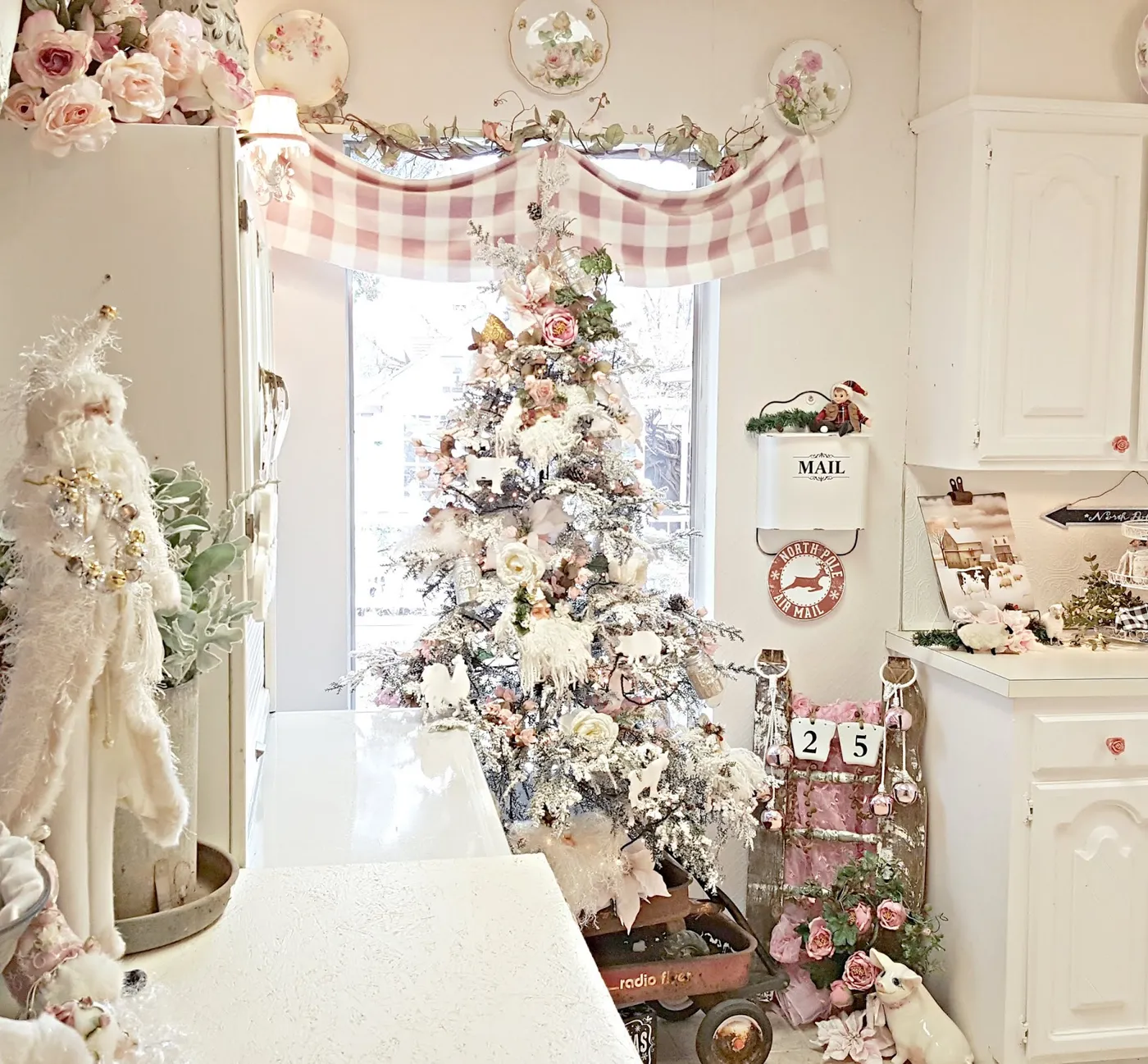
This is a window-adjacent vignette, and it needs about 4 feet of wall to breathe — the tree, the Santa, and the wagon all occupy real floor space. If your window wall is shorter than 3 feet, drop the wagon and keep the tree and Santa. Narrow kitchens can borrow the idea at miniature scale; Idea #8 shows how pastel palettes shrink beautifully.
The pink buffalo check valance is what makes this look intentional rather than accidental. Without it, you have a pink tree near some vintage toys. With it, pink reads as a decision that starts at the window and travels down. It also pulls the oldest designer trick in the book: repeating a motif at a different scale. The checks are tiny, the tree florals are big, and your eye likes the rhythm.
17. White Kitchen, Gray Pendants, One Tree Through the Archway
Roughly 65% white across cabinets, counters, and walls, plus 20% gray in the pendants, veining, and stools, plus 10% light wood on shelves and floors, plus 5% green from the tree. That’s why the tree reads as a jewel instead of a distraction: everything else is neutral, and there’s only one saturated thing in the frame. Swap the green for burgundy and the entire room warms up ten degrees.
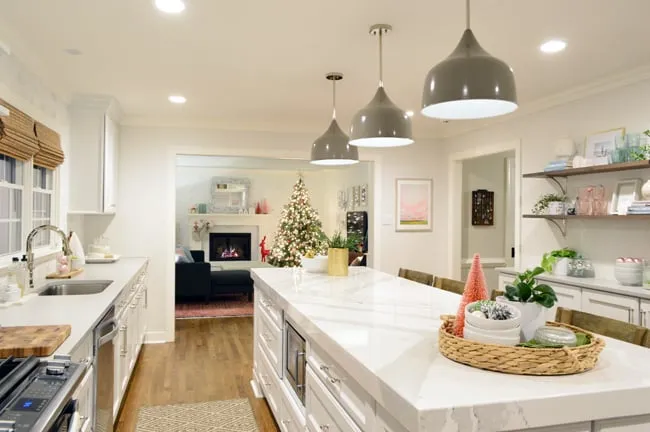
White marble-look counters show everything — red wine, cranberry juice, pomegranate. If yours are real marble, seal them every six months and wipe spills within minutes. Quartz is the low-maintenance match for this exact look: no sealing, no etching. Gray painted pendants are forgiving, but the cords catch kitchen grease, so a wipe-down every few weeks keeps them from dulling.
18. Pastel Candy Land with a Golden Sleigh on the Island
The golden Santa sleigh and reindeer on the island is the piece that turns a decorated kitchen into a scene. It gives the island a story instead of just a centerpiece, and it echoes the gold in the tree ornaments across the room. Remove it and the island goes blank — which is exactly why it’s worth keeping up high, away from grabby hands.
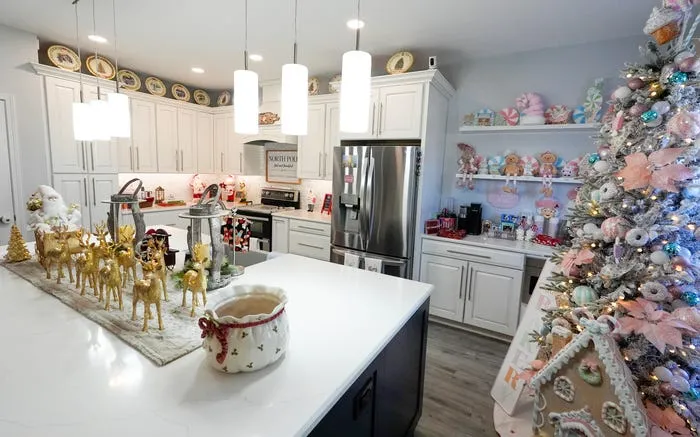
- Clear the island except for a tray or mat that defines the zone.
- Set the sleigh slightly off-center — dead center looks like a store display.
- Face the reindeer toward the tree to create a visual line across the room.
- Add two or three small pastel ornaments around the base as filler.
- Stop. Three objects, not eight.
Fifteen minutes and no tools.
Pastel and candy-themed Christmas keeps growing, largely because of how well it photographs — soft pinks, mints, and golds don’t blow out on camera the way saturated reds do. It also pairs naturally with the collected-over-time approach people now prefer over buying one matching theme. Will it stick around? The pastel version of a classic silhouette usually does.
- Blush plus brushed gold
- Mint plus silver
- Butter yellow plus brass
19. Silver and Champagne on the Tree and the Banister
- 6-ft slender tree, unlit: $45-$120
- 300 warm white lights: $15-$30
- Silver, white, and champagne ornaments: $50-$140
- Lighted garland for the banister: $35-$90
- Silver ribbon: $12-$30
- Console table and decor: $150-$600
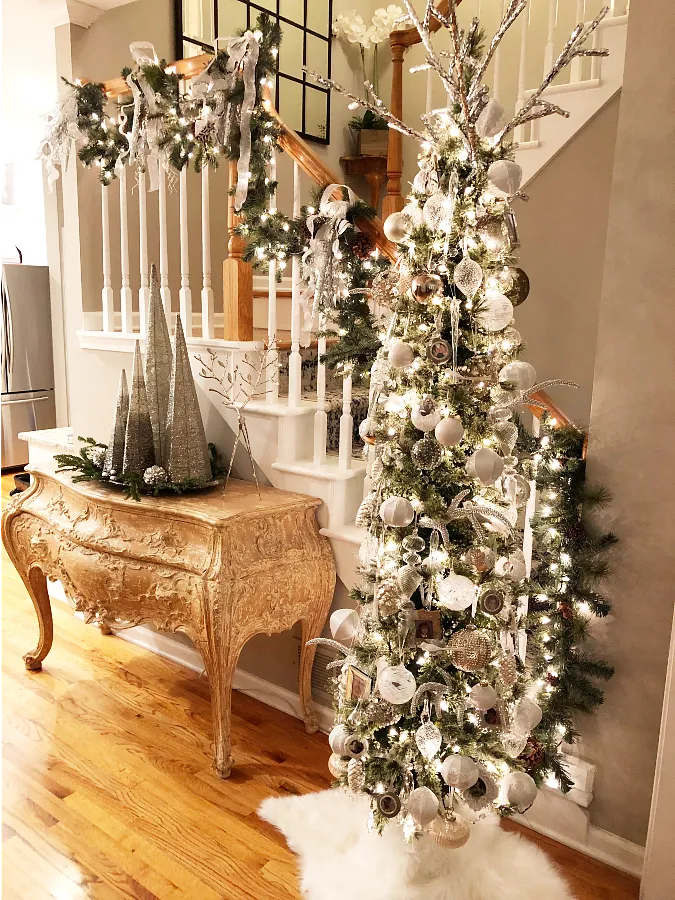
Total: $307-$1,010. The console is the swing item — thrifted and repainted, you can land the whole thing closer to $350.
Metallics in a narrow range always work. Silver, white, and champagne gold sit within a couple of shades of each other, so nothing fights, and the warm white lights add the only warmth the scheme actually needs. When you’re mixing nothing but neutrals, texture becomes the decoration — frosted branches, glittered cones, faux fur, and mirror all read as different materials even though they’re the same color.
20. A Gold Bar Cart Turned Hot Chocolate Station
Gold bar carts are everywhere on resale sites, usually because someone’s kitchen got smaller. Expect to pay $30 to $60 on Facebook Marketplace for something that retailed at $180. No cart? A $25 IKEA utility cart spray-painted gold gets you 90% of the look in an afternoon. The tiered stand can be two thrifted plates glued to a candlestick for about $6.
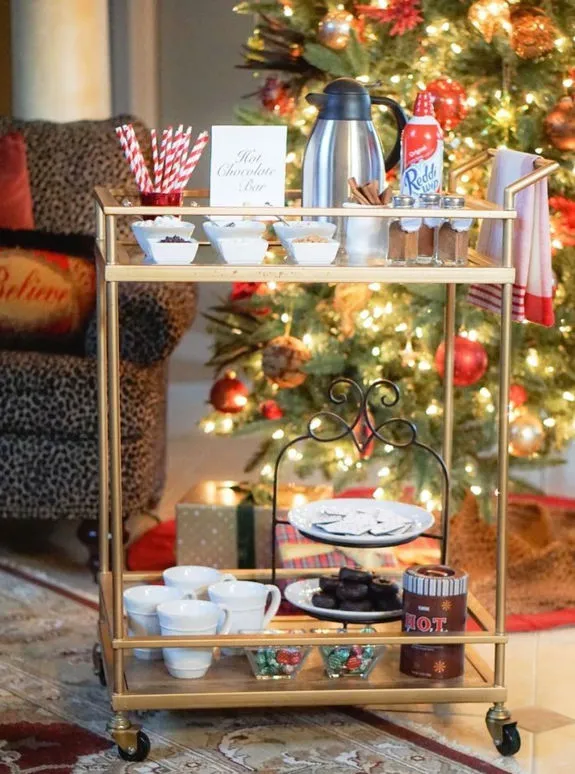
A hot chocolate bar with open toppings in a warm kitchen is a perishability experiment. Marshmallows get sticky, whipped cream needs to stay cold, and anything unwrapped collects dust within a day. Use lidded jars, keep perishables in the fridge or a small cooler and refill as needed, and if you have pets, park the cart against a wall so tails don’t take it down.
- Measure the cart’s footprint plus 12 inches of pouring clearance
- Check the wheel locks — a rolling cart full of mugs rolls
- Confirm an outlet nearby for a warmer or string lights
- Label what’s decorative versus what’s actually edible
21. Red-Bowed Cabinet Wreaths and Pink Tree Ornaments
60% white cabinetry + 20% light wood countertops + 12% forest green from wreaths and tree + 5% red bows + 3% soft pink from the tree ornaments. That pink is the wild card keeping this from looking like every other red-and-green kitchen. Not your thing? Swap it for soft butter yellow and leave everything else exactly where it is.
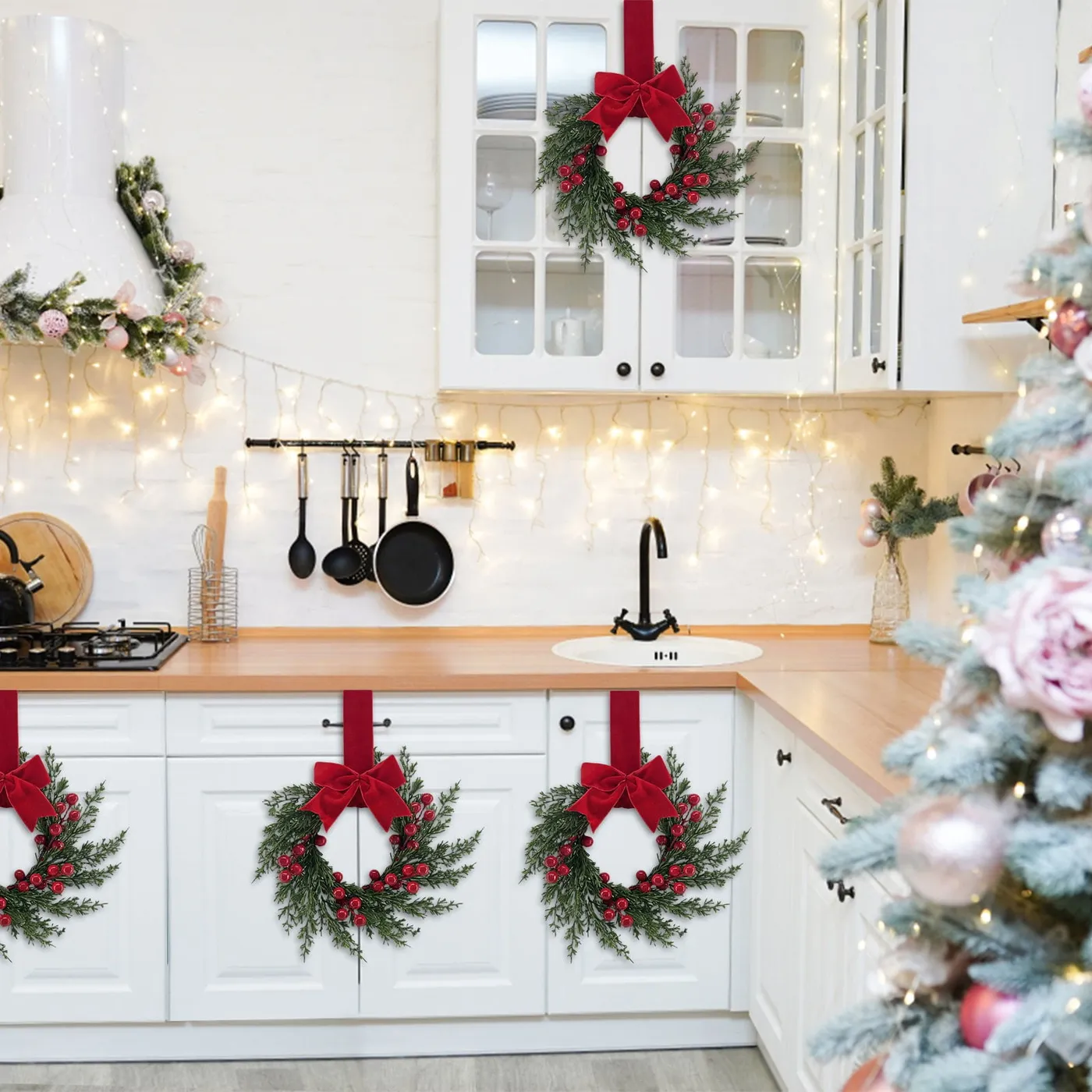
Cabinet wreaths need door fronts at least 12 inches wide to hold a 10- to 12-inch wreath without covering the handle. Hang them on alternating doors, not every door — three or four across a run is plenty. String lights along a backsplash look best when the run is at least 6 feet; shorter than that and the swag gets too tight. Kitchens under 100 square feet should pick one of these two moves, not both.
22. Clear Crystal Trees on the Island and Mistletoe Above
Crystal and glass decor in a kitchen means fingerprints and grease film, so keep a microfiber cloth in a drawer and wipe the pieces weekly. The bigger ongoing job is that mosaic backsplash — the grout traps cooking spatter, and a soft brush with warm water every couple of weeks keeps it from dulling. A ceramic tile in the same pattern is far easier to live with long term.
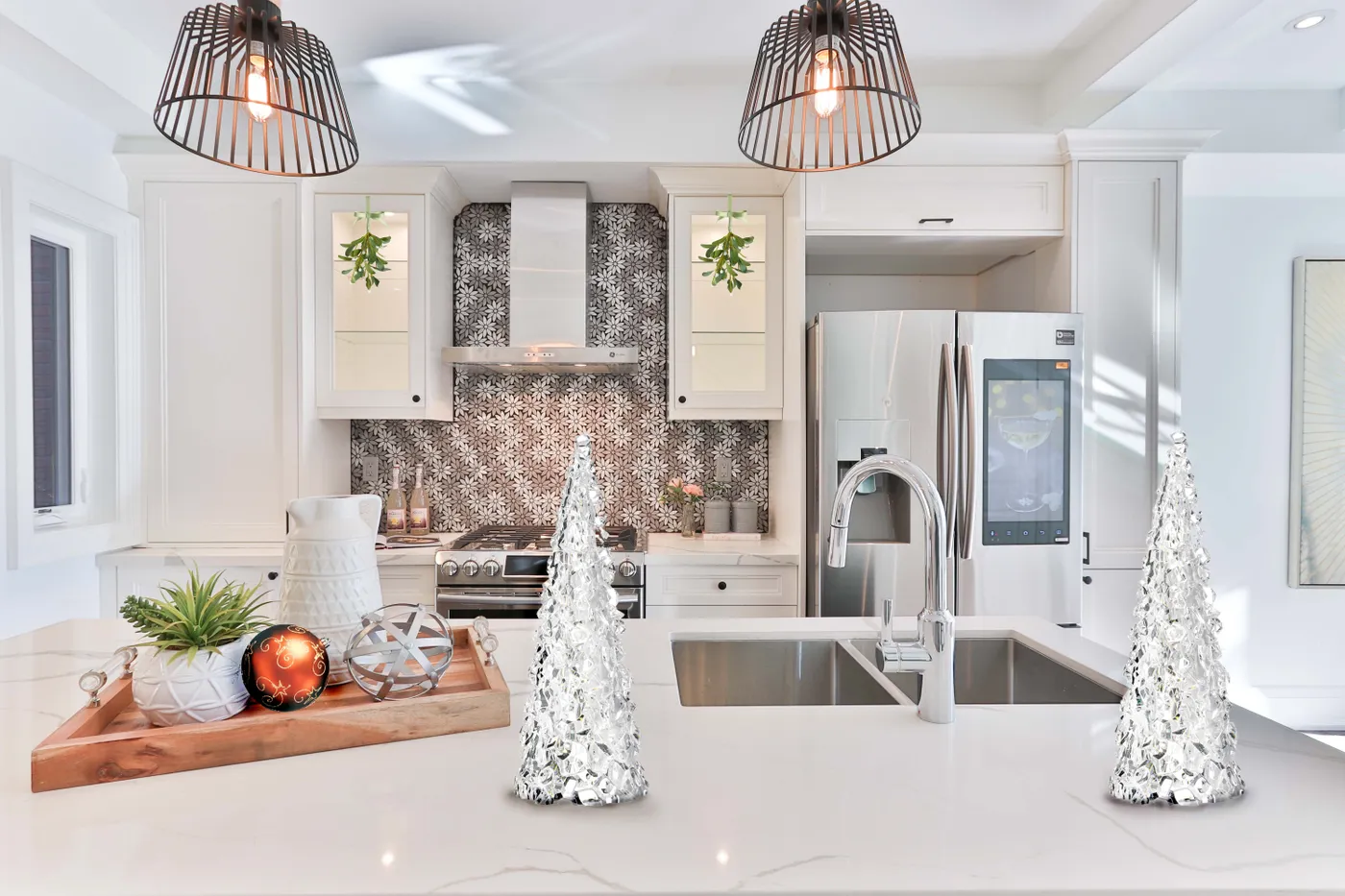
The two clear crystal trees on the island are the whole point. They’re essentially invisible until light hits them, which is why the black cage pendants above matter so much — the dark metal gives the glass something to contrast against. Take the crystal trees away and you have an extremely clean, slightly cold kitchen with no holiday feeling at all.
- Two crystal tree sculptures, 8-10 in.: $40-$120
- Wooden tray and potted succulent: $20-$45
- Mistletoe sprigs with green ribbon, set of six: $12-$30
- One statement ornament: $4-$12
Total: $76-$207. Discount-store glass trees run $8 to $15 each in early November, and nobody can tell from three feet away.
23. Three Shelves of Plaid, Santa Mugs, and Tiny Trees
- Empty the shelves and commit to a color story first — here it’s red, black and white, plus burlap.
- Put the tallest, smallest-footprint object, the mini tree, on the top shelf at one end.
- Group the mugs and tin together on the middle shelf; odd numbers read as styled.
- Stack plates on the bottom shelf with a bowl on top for height.
- Leave one third of every shelf empty. Negative space is what makes it look curated.
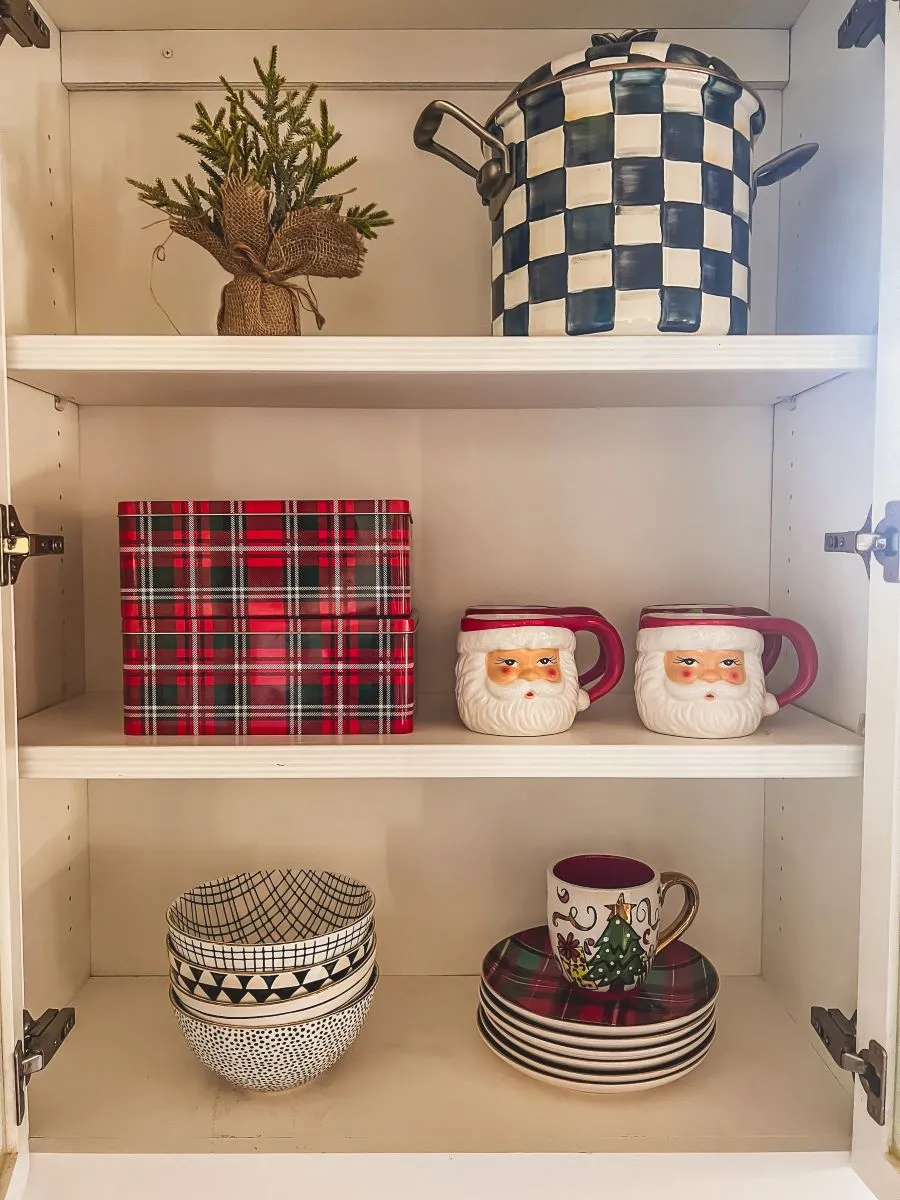
About 20 minutes and zero purchases if you already own holiday dishes.
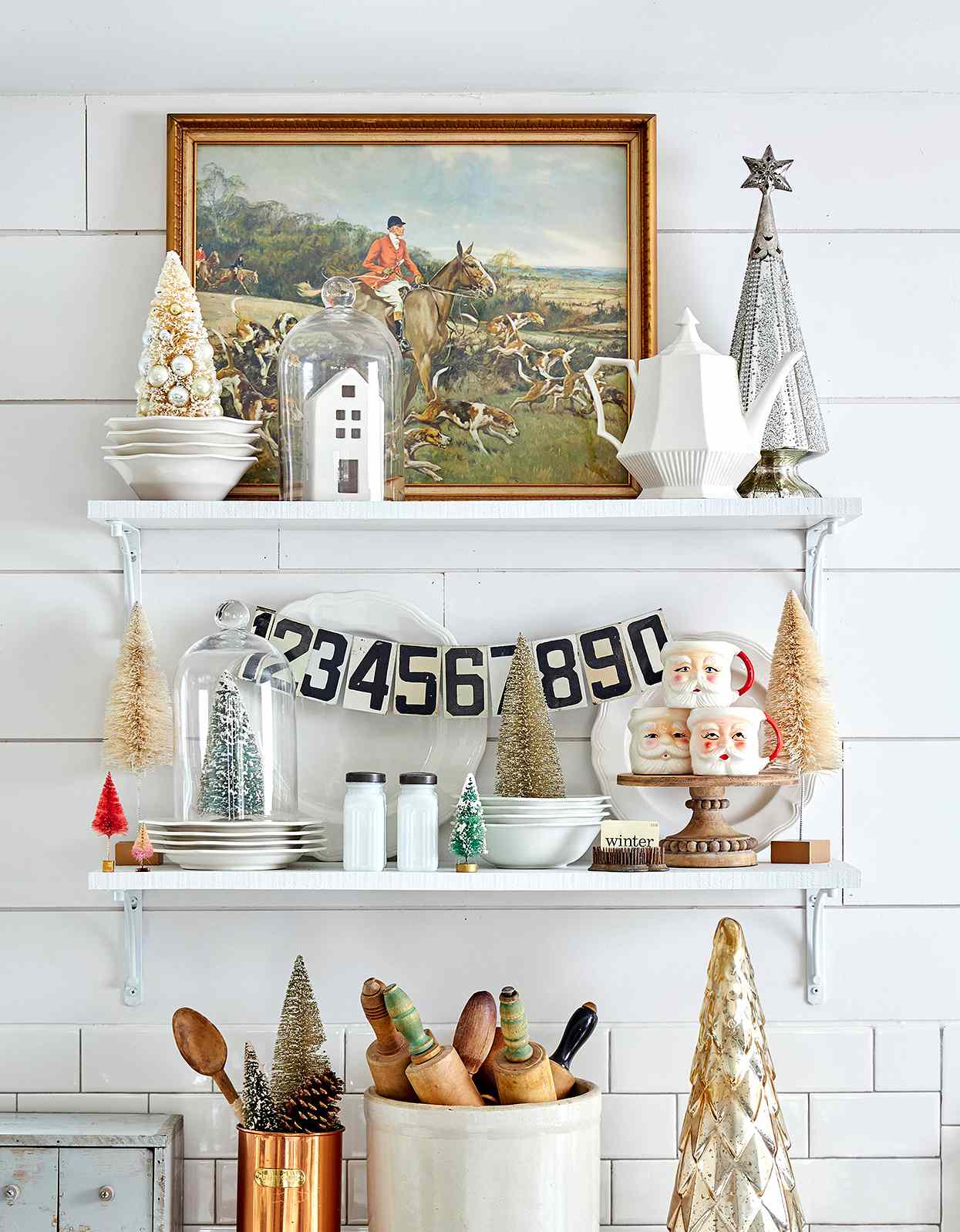
Open shelving near a stove collects a thin layer of grease you won’t notice until you touch it. Anything stored there — especially fabric like plaid napkins — needs a monthly wash or wipe. If these shelves sit within three feet of the cooktop, move the fabric items out and keep only glazed ceramics and glass, which wipe clean in seconds.
Repeating one motif — plaid — across three shelves and three materials (tin, plates, napkins) creates a collection without clutter. The black-and-white checkered pot up top gives your eye a neutral to rest on between all that red. When a display has one pattern, one neutral, and one metal, it almost always reads as intentional.
24. High Ceilings, Big Windows, and a Tree Across the Island
High ceilings are a gift and a trap: a 7-foot tree disappears under a 12-foot ceiling. The rough rule is 1.5 to 2 feet of tree per foot of ceiling height for a full look, or a tall slender tree with a wide skirt to fake the same visual mass. This open layout also needs a tree that reads from the island, so give it at least 15 feet of sightline and 3 feet of walkway on all sides.
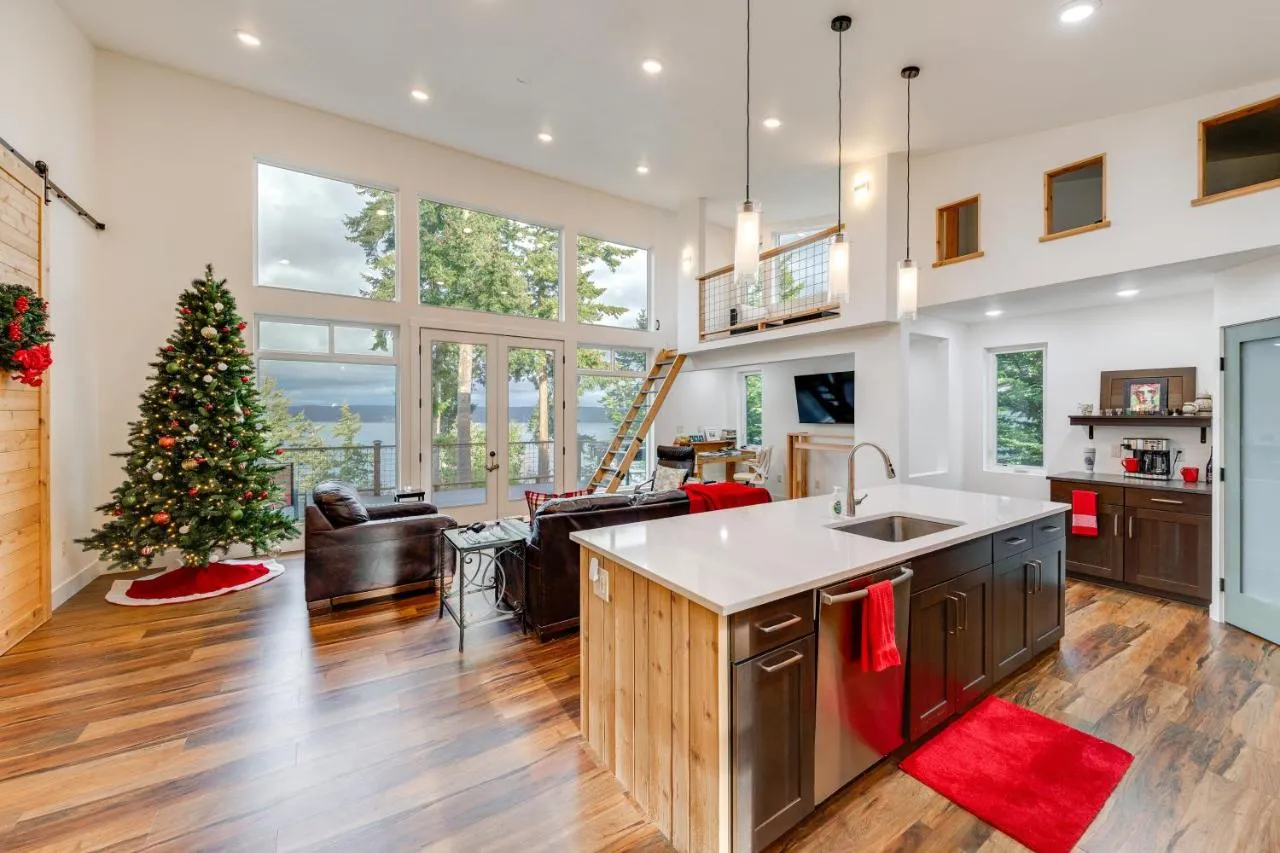
Open-concept living means the kitchen tree and the living-room tree have to negotiate. In 2026 the usual answer is one big tree in the main sightline plus smaller accents in the kitchen, rather than two competing full-size trees. Big windows and water views push people toward red and green on natural wood — high-saturation color holds up in daylight where pale palettes go flat.
25. White Brick, String Lights, and Mini Trees on the Table
70% white across the painted brick, cabinets, and runner + 18% natural wood on table and floors + 8% dark green from mini trees and taper candles + 4% warm gold from the lights. Because the base is so white, the string lights become the color, which is why this reads warm instead of stark. Swap the green candles for black and the whole table turns modern in an instant.
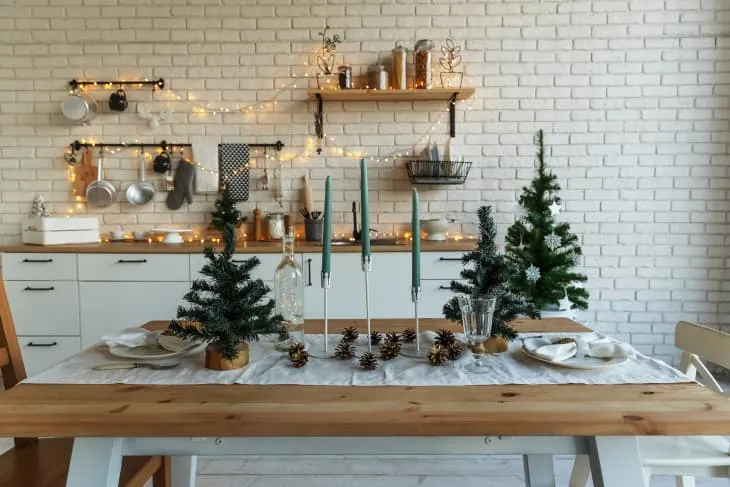
It’s the string lights — specifically that they run across the wall, not just on a tree. Without them, this is a white brick kitchen with some small evergreen pieces on a table. With them, the whole room glows from two directions and the mini trees stop being the subject. If you copy one thing, copy this. Compare with Idea #21, where the same idea runs along a backsplash instead.
26. Dark Green Cabinets Under Windows Full of Greenery
Dark cabinets in a bright kitchen work; dark cabinets in a dim one turn into a black hole. Without a window or two like these, keep the uppers light. Garland draped over a window frame blocks light and collects dust, so a few practical swaps matter: faux greenery with a matte finish over real cedar, removable hooks on the window trim instead of the painted wall, and a gap of at least 3 inches above the sash so the window still opens.
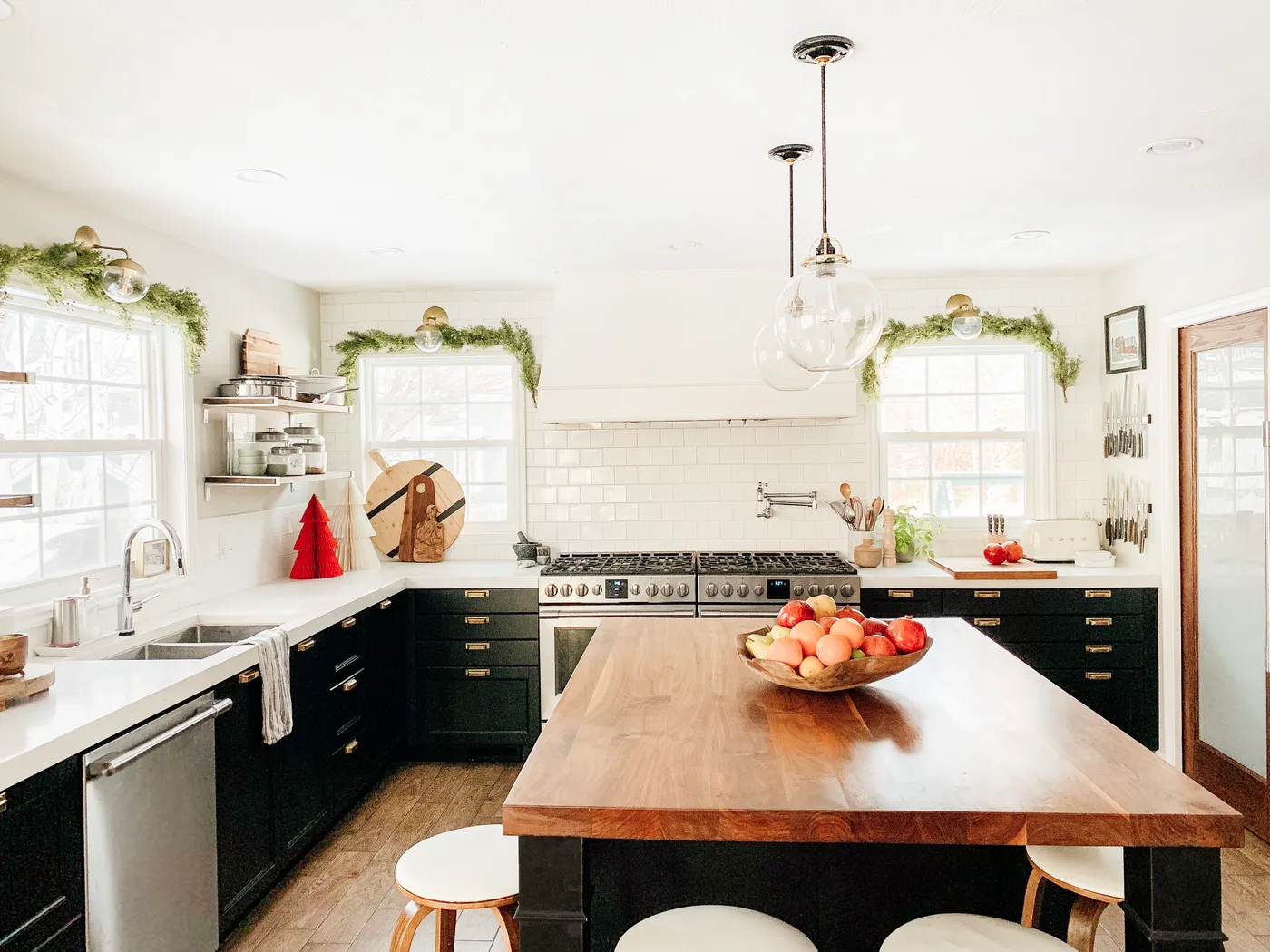
- Measure across the top of the window and add 6 inches on each side.
- Anchor the garland with small removable hooks on the window trim, not the wall.
- Weave in a second, thinner strand so the greenery looks layered.
- Keep the bottom edge clear of the sash so the window still functions.
- Fluff the branches outward, toward the room, so it looks full from below.
Thirty minutes and $25 to $70 depending on garland quality.
27. Flocked Branches, Red Berries, and a Wooden Star
Flocked trees look better with gaps left in. Aim for roughly one ornament every 6 to 8 inches of branch and then stop — an over-decorated flocked tree loses all that beautiful snowy texture. The berry garland with striped twine is the real trick here: running a secondary, thinner garland alongside a plain one adds depth for almost no money. Two strands, one look.

Three textures, one palette: fluffy flocking, glossy berries, and matte twine. That’s why a close-up like this feels rich instead of busy. The flocking is also an optical trick — white branches make the green that shows through look deeper and the red berries look brighter, which is why snowy trees photograph so well. The wooden star adds warmth that keeps all that white from going chilly.
28. A Lit Tabletop Tree Between Two Green Glass Vases
The two dark green glass vases flanking the tree are the reason this looks styled. They bookend the tree, repeat the green of the branches in a completely different material, and give the vignette a defined width. Without them, the tree and the LED candle just float. Keep the vases empty or with a single stem — anything busy inside competes with the tree lights.
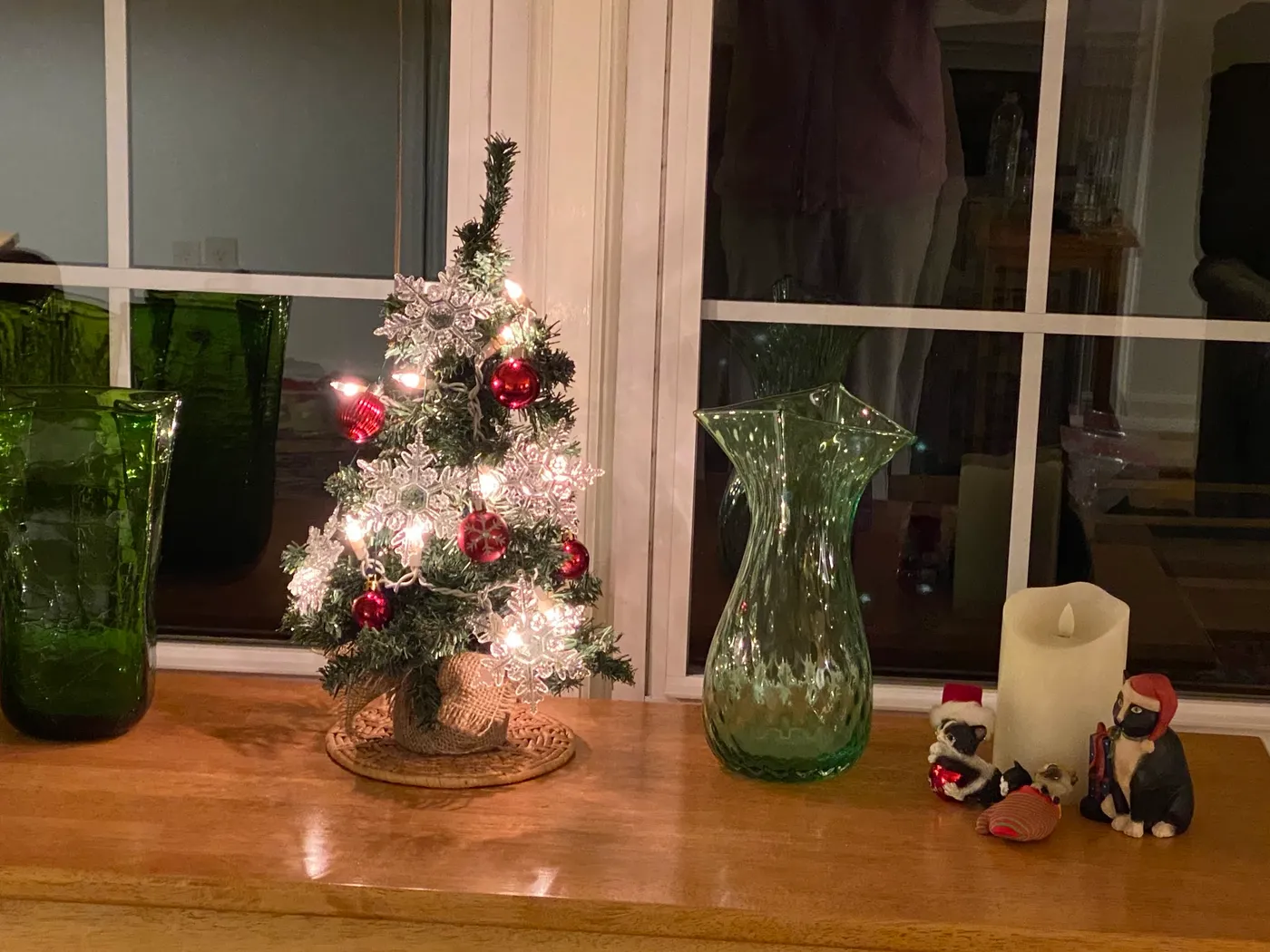
This whole vignette is a thrift-store build. Green glass vases show up constantly for $3 to $8 each, and a flameless LED pillar candle costs $6 to $12 — no fire risk next to a tree, which matters on a surface like this. The little animal figurines in Santa hats are usually a dollar or two at craft stores in November. Under $30 total, easily.
Tabletop trees with built-in lights are low effort until a bulb dies, and then you’re hunting a strand that’s often wired permanently into the tree. Buy one with a replaceable strand if you can. Dust the branches with a hair dryer on cool once a month, and replace batteries before the season starts rather than mid-December.
29. Silver Poinsettias and Pinecones on a White Round Table
Silver gets a bad reputation for feeling cold, and this is the fix: pair it with brown pinecones and a woven base. The natural materials pull warmth straight back into the scheme, and the white table plus white background let the silver shimmer without competition. It’s the same principle as mixing a metal with wood anywhere in the house — one cool, one warm, both neutral.
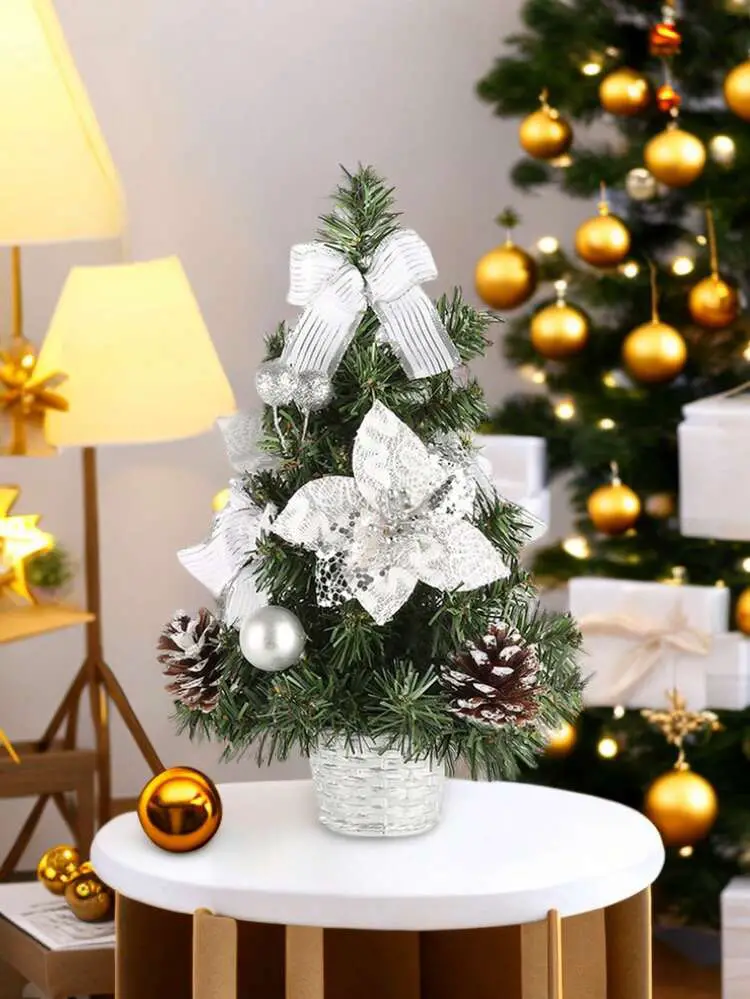
80% white and silver + 15% dark green foliage + 5% brown from pinecones and the woven basket. It’s close to monochrome, which is why it works at this small scale — the gold ornaments on the bigger tree in the background supply the contrast, and the lamp’s yellow shade keeps the corner from going gray. Swap silver for copper and you get a warmer version of the same math.
30. A Sparsely Lit Flocked Tree in the Kitchen Corner
Sparse decorating only works when the proportions are right. An 18- to 24-inch tree with 8 to 12 ornaments and one strand of 20 to 35 mini lights looks deliberate; the same ornaments on a 12-inch tree look crammed. It also wants a corner with at least 12 inches of counter depth and a light backsplash behind it. Less than 10 inches of depth? Go with a single-vase display instead.
A minimally decorated tree shows every flaw. If your ornaments don’t match in finish or the flocking is patchy, there’s nowhere to hide. It’s also hard to photograph in a kitchen with under-cabinet lighting, which casts harsh shadows from below. Turn those off and rely on the tree lights and daylight for the even, warm look this style depends on.
For a sparse look, wire your lights along the interior of the branches before anything else, then place ornaments only at branch tips — one light per 3 to 4 inches of branch, 2700K warm white. Use only two ornament finishes, here white and clear glass. Adding a third is what turns minimalist into unfinished. Compare with Idea #9, where the same finish gets dressed up instead.
31. A Wicker-Basket Tree Next to the Farmhouse Sink
- 18-in. pre-lit tree: $15-$40
- Wicker basket: $8-$25
- Green floating shelf with corbels: $30-$120
- Stacked ceramic dishes: $20-$60
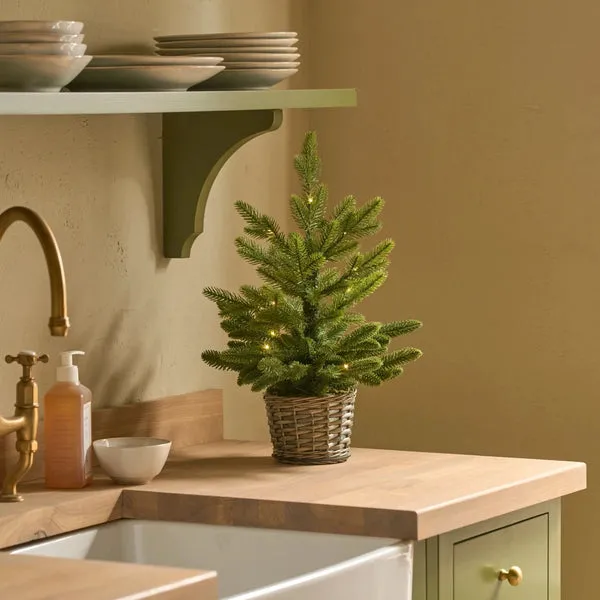
Total: $73-$245. The basket is the cheapest part to fake — a thrifted one with a little chalk paint runs $5, and you can skip the shelf entirely by staging the tree on two stacked cookbooks beside the sink.
- Choose a basket at least 2 inches wider than the tree’s stand.
- Set the tree in the basket and check it sits level — a folded towel underneath fixes any rock.
- Fold the handles down or let them fall naturally.
- Weave a short strand of lights from the tree down over the basket rim.
- Keep the whole thing at least 10 inches from the sink’s splash zone.
Ten minutes, no tools.
32. Two Christmas Tree Towels and One Honest Loaf of Bread
Kitchen towels hanging near a sink or stove are the hardest-working decor in the house. Expect to wash them weekly if they’re actually used for drying, and expect cheap cotton prints to fade after about 20 washes. A green-and-gold towel holds color noticeably better than pale cream. If yours are purely decorative, hang them higher and out of splash range.
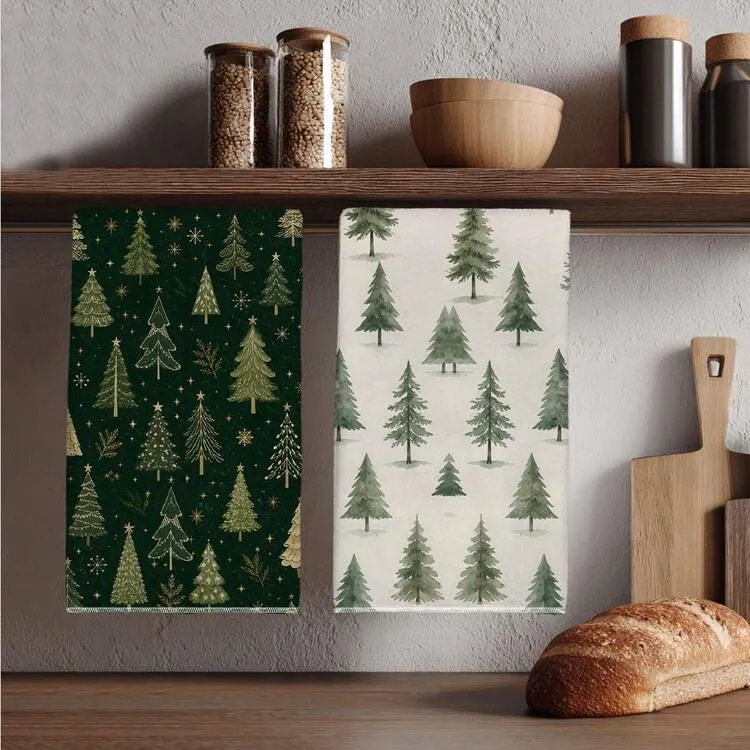
It’s the placement, not the towels. Two towels on the same bar, layered and slightly offset, read as a styled vignette; one towel reads as laundry. That overlap — where the cream towel peeks out from behind the green one — is what makes the shelf above it look designed rather than default.
Small, cheap, high-impact holiday swaps like towels, mugs, and a candle are having a moment because people are decorating less and living with it more. Swapping two towels costs about $16 and takes four seconds, which is a very different proposition from hauling out eight bins from the garage. Expect more micro-seasonal decorating in 2026.
Your Kitchen Is Already the Best Room for a Tree
You don’t need a formal dining room or a twelve-foot ceiling to make December feel like December — you need one surface, one small tree, and lights in the right temperature. Start with the version that fits the counter you actually have, then swap things in year after year.
📌 Pin your favorite from these 32 ideas now, so when you’re standing in the aisle in November you already know exactly what you’re looking for.