
You know the scroll: it’s 11 p.m., your thumb is tired, and every white Christmas tree on Pinterest looks either sterile or like a snow globe exploded. So we went looking for the ones that hold up in real rooms — not just in photos.
We spent serious time browsing Wayfair, Target, and Etsy to bring you only what’s worth your attention this year, with ideas running from a $15 felt tree skirt to an $899 sculptural A-frame tree. Heads up: this post contains affiliate links, which means we may earn a small commission at no cost to you.
Inside you’ll find 34 curated white tree ideas — heavily flocked classics, minimalist flat silhouettes, icy blue-and-silver schemes, and warm cream-and-gold setups. Budget and luxury versions sit side by side, and every idea is shoppable with direct product links. The shift driving 2026 boards is cooler whites paired with one warm element — which is why so many of these trees run at 2700K instead of icy 5000K. And stay until the end — we break down the mistakes that can ruin these looks.
📌 Save this to Pinterest for later — you’ll want to revisit these ideas.
1. A Slender White Tree Against Blue-Gray Paneling
Keep your bulbs between 2700K and 3000K. A white tree lit with cool 5000K LEDs against light blue-gray paneling reads clinical by 6 p.m. — exactly when you want the corner to feel like a hug. Warm bulbs also make the gold candle holders on the white mantel glow instead of disappearing, and they pull the cream tufted armchair into the same color family as the tree. Already own a cool-lit tree? Wrap one strand of warm white over the pre-lit set. Twenty dollars, ten minutes, completely different room.
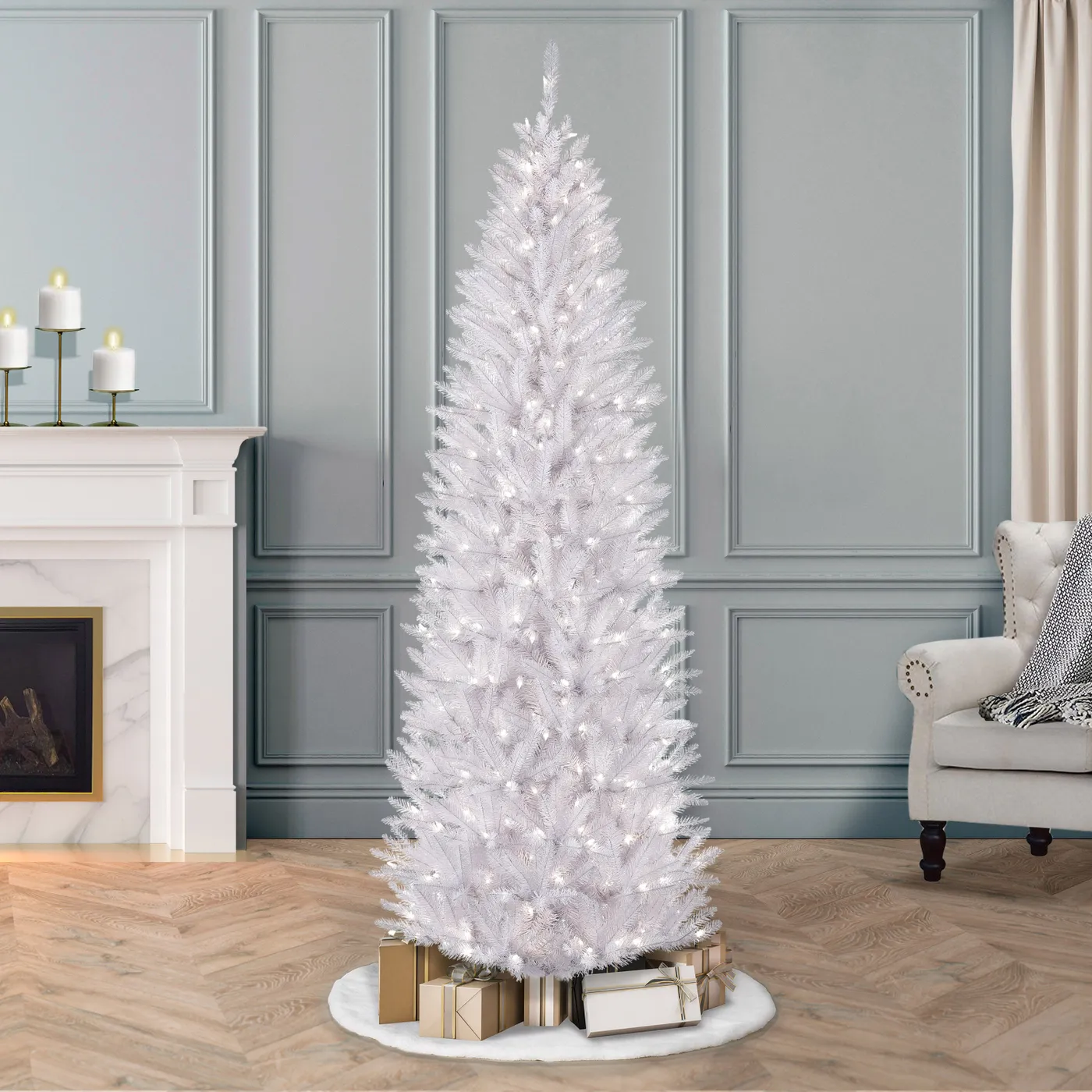
- Slim pre-lit white tree, 6.5–7.5 ft: $180–$420
- White faux fur tree skirt: $35–$90
- Gold and white wrap, ribbon, and tags: $60–$150
- Gold candle holders and taper candles for the mantel: $40–$110
- One extra strand of warm white lights: $15–$30
Total: $330–$800.
Budget alternative: a Facebook Marketplace or thrift-store white tree at $60–$120, a Target faux fur skirt at $25, and kraft paper with gold ribbon at $20 keeps the whole look under $200.
2. Why Warm Bulbs Win in Heavy Flocking
Look closely at a heavily flocked tree and you’ll notice the flocking never covers everything — dark green needle tips still poke through, and the wire between bulbs stays black. That’s the whole trick. Those little interruptions are what keep a snow-covered tree from reading as one soft blob. Small round bulbs at a warm yellow temperature add a second kind of contrast: light against matte. Switch to cool white and the green vanishes, the wire reads as dirt, and the tree flattens out. The contrast is the design.

Flocking sheds. Expect a light dusting of white flakes on the floor every time you move the tree, and a bigger drop when you pack it away in January. Vacuum the skirt and rug with a brush attachment rather than beating the branches, and never wipe flocked branches with a damp cloth — moisture sets the flakes into a paste. Store the tree in a breathable bag, not vacuum-sealed plastic, so the flocking doesn’t compress. Most quality flocking holds four to six seasons before it starts to thin.
3. Flocked Tree, Real Fire, and a Window Full of Snow
It’s the window. The snowy trees outside are doing half the decorating — the flocked tree inside is essentially borrowing their white and handing it back. Pull those white sheer curtains closed and the room gets smaller, warmer, and much less interesting. If you don’t have a snowy view, this is the one idea worth faking: a sheer panel with a frosted branch decal costs about $30 and reads convincingly at night from across the room.
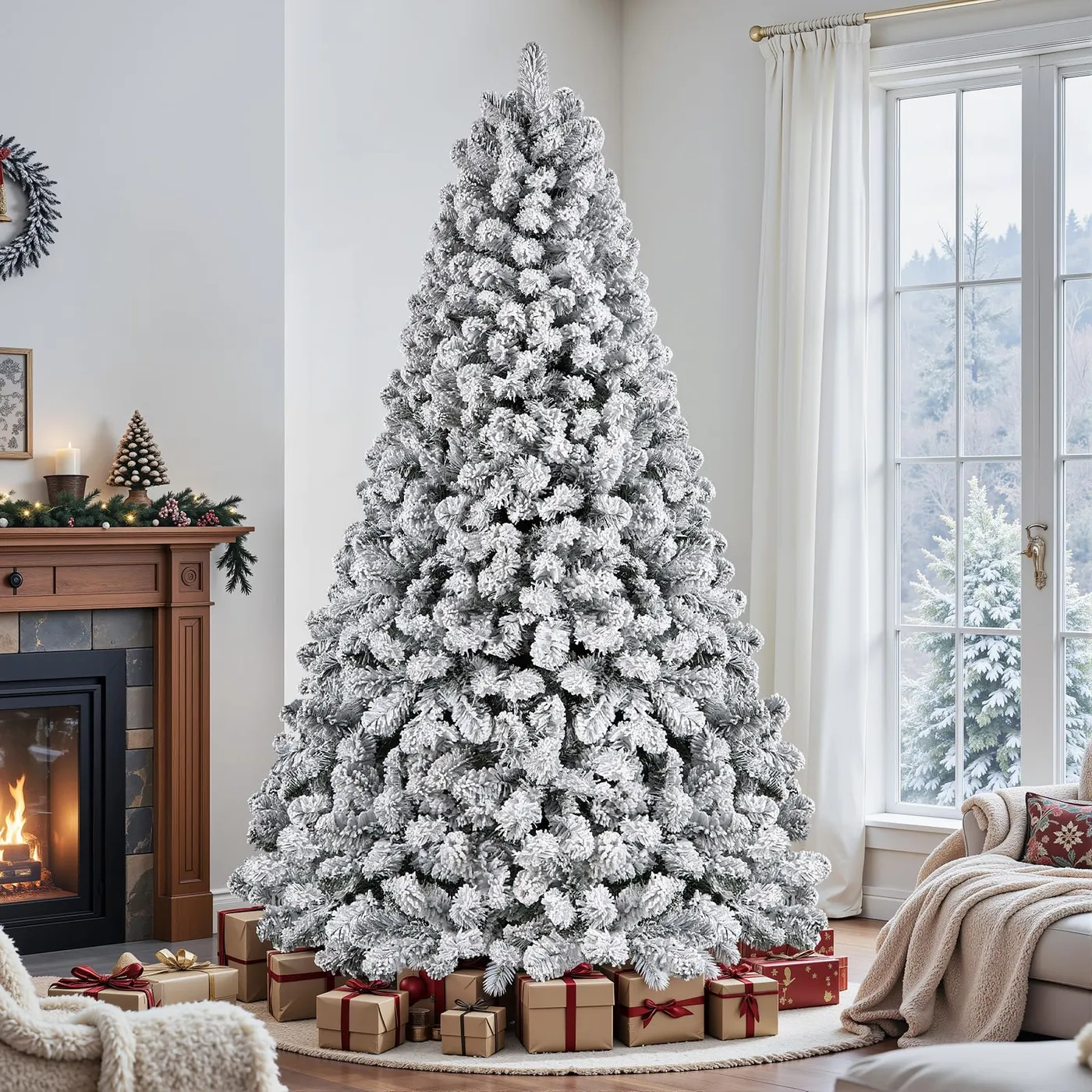
A live fire and a flocked tree in the same room need distance and supervision — keep at least three feet between the tree and the hearth, and never leave the fire burning unattended. Heat is also the enemy of flocking: sustained warmth yellows the white over a couple of seasons. If your fireplace gets heavy use, a flocked tree on the opposite wall ages far better. And those red-ribbon gifts? Save real silk ribbon for the front row.
This composition wants a generous room: roughly 200–250 square feet with 9-foot ceilings, so a 7.5-foot tree doesn’t crowd the window frame. You also want a wall or window without strong afternoon sun, since direct southern light bleaches flocking fast. Working with something smaller? The slim tree in Idea #1 delivers a similar mood in a fraction of the footprint.
4. Gold Berries, Real Pinecones, and One Disco Ball
The formula here is 60% white branch, 25% gold shimmer, 10% natural brown, 5% hard silver sparkle. That last 5% is a single silver disco ball, and it’s what stops the whole thing from being a bowl of porridge. Swap the gold glitter berries for matte copper pods and the disco ball for one mirrored star, and the mood shifts from glam to woodland — same percentages, different story. Keep the natural element under 15% or the tree starts looking like a craft fair.

Pinecones look cheap when they’re all the same size. Cluster them in threes — one 5-inch cone, two 3-inchers — and wire each cluster to a single branch tip rather than scattering singles. On a 7-foot flocked tree, 18 to 24 clusters is plenty; more than that and the flocking disappears. Leave the pinecones unfinished, or dip just the tips in white paint. Full glitter on a natural cone fights the flocking and reads messy from three feet away.
5. Five Silver Ornaments and a Whole Lot of Restraint
It’s the count. A heavily flocked tree with five silver spheres looks intentional; the same tree with fifty looks like a mall display. Removing the fluffy white rug underneath would break it too — the rug is the soft landing that makes the bare floor around the tree feel like part of the design rather than an afterthought. If you take one thing from this: on a white tree, restraint is the ornament.
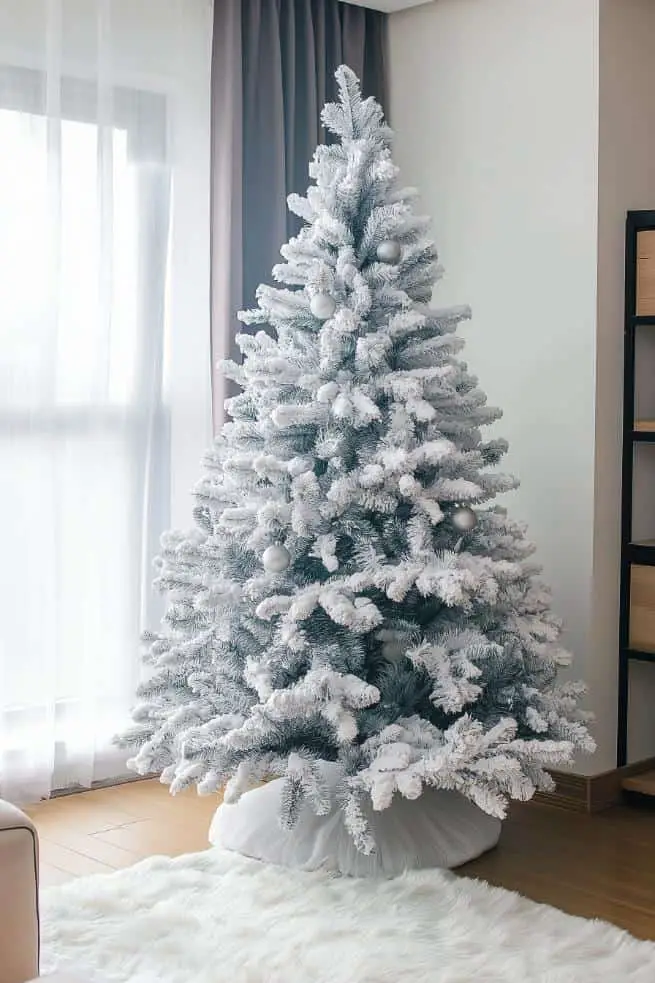
This is the rare white tree idea that works in a small room — a 10×10 bedroom corner or a narrow living room with 8-foot ceilings. Because there are so few ornaments, the tree reads as texture rather than mass, so it doesn’t visually fill the space. Just watch the ceiling clearance: a 6.5-foot tree plus a topper needs about 7.5 feet of headroom to breathe.
6. A Fur-Trimmed Skirt and a Ceramic Garden Stool
The garden stool is the sneaky hero here. A white ceramic drum runs $80–$150 at HomeGoods or Wayfair, but Target’s ceramic side tables land around $60, and a plain white drum stool plus a $12 gold deer figurine gets you 90% of the look. For the skirt, buy a basic white plush skirt for $25 and sew or hot-glue a 4-inch fur trim strip ($15) around the hem. Nobody has ever inspected a tree skirt closely. Ever.
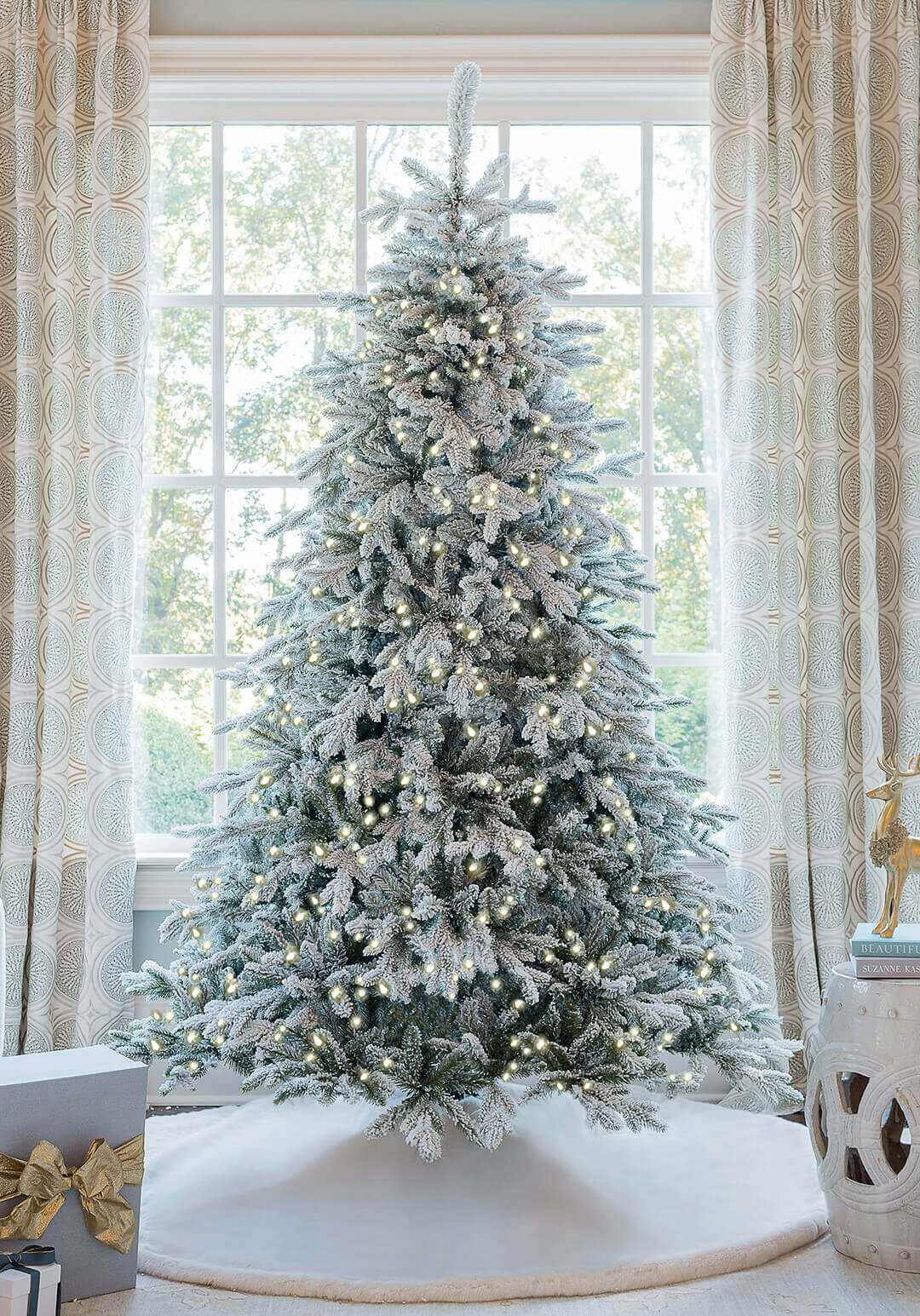
Shapes are doing the work. A Christmas tree is a cone; the garden stool is a cylinder; the window behind is a rectangle. Three shapes, three different jobs, zero competition. The stool also hits at about 18 inches — high enough to feel deliberate beside the tree base, low enough not to block the window panes. Swap it for a tall bookcase and the whole corner goes flat. Compare with Idea #3 — same white palette, but that room leans on the outdoors instead of furniture.
7. Built-In Shelves That Carry the Tree’s Palette
2026 is the year the tree stopped being the only decorated thing in the room. Call it quiet maximalism: the tree sets the palette, then the mantel, the shelves, and the coffee table echo it back in smaller doses. That’s why the most-saved holiday photos on Pinterest right now aren’t tree close-ups — they’re wide shots where you can see the gold ornament on the shelf rhyme with the gold ornament on the branch. It’s a grown-up version of color-coding, and it has real staying power.
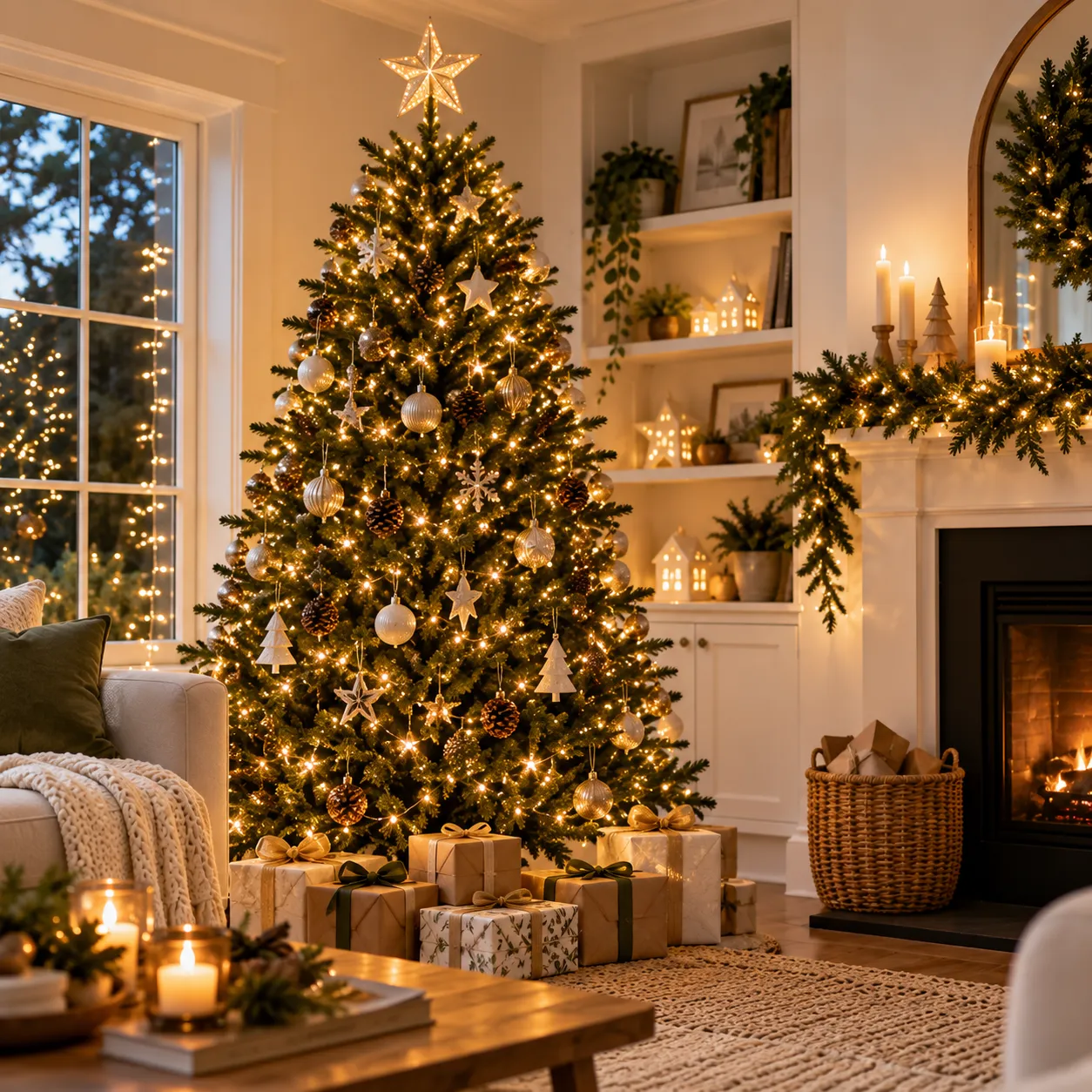
Pick three ornament colors and use them everywhere within six feet of the tree — no more. In this room that’s gold, silver, and white, plus natural pinecones as the neutral. On the built-ins, that means one gold object per shelf, one silver, one white, then let books and greenery fill the rest. If a shelf item doesn’t match one of the three, it goes in a drawer until January. Sounds brutal. Works every time.
The built-ins. Without them, this is just a nicely lit tree. With them, the wall becomes a single composition and the tree stops being furniture you decorate and starts being the center of a room that’s fully in on the joke. No built-ins? A console table with three stacked objects on each side of the tree does the same job for about a tenth of the cost.
8. White Tree, Pink Baubles, Kraft Paper Gifts
- Wrap every gift in plain kraft paper first — no patterns, no prints. About $8 for a 30-foot roll.
- Choose two pinks, not one: a pale blush ribbon and a saturated pink bauble. One pink alone looks like a baby shower.
- Ribbon the boxes in blush velvet or satin, keeping bows flat so they stack without crushing.
- Slide three small pink baubles into the gaps between boxes so the gift pile ties into the tree.
- Finish with one kraft tag per box, handwritten. Skip printed labels.
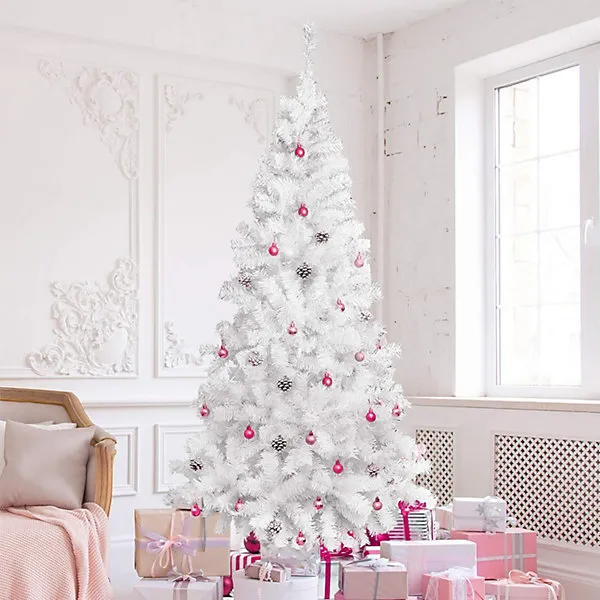
Time: about two hours for ten gifts. Materials: roughly $45.
Roughly 70% white — tree, ornate molding, window frame — then 20% pink across two tones, and 10% kraft brown. The brown is what makes it feel grown-up instead of candy-store. Swap kraft for matte black paper and the same ratio turns moody and modern; swap pink for sage green and you’ve got a completely different room without buying a new tree. The percentages are the recipe; the colors are just seasoning.
9. A Frosted Wreath Over a Cream Tufted Sofa
The brass candelabra with five tapered orange candles. Everything else in this room is cream, white, and muted gold — cool, quiet, almost archival. Those five orange flames are the only warm note in the frame, and they’re what make the room feel inhabited instead of staged. Pull the candelabra out and the wreath and sofa are pretty but a little sleepy. Leave it in and your eye finally has somewhere to land.
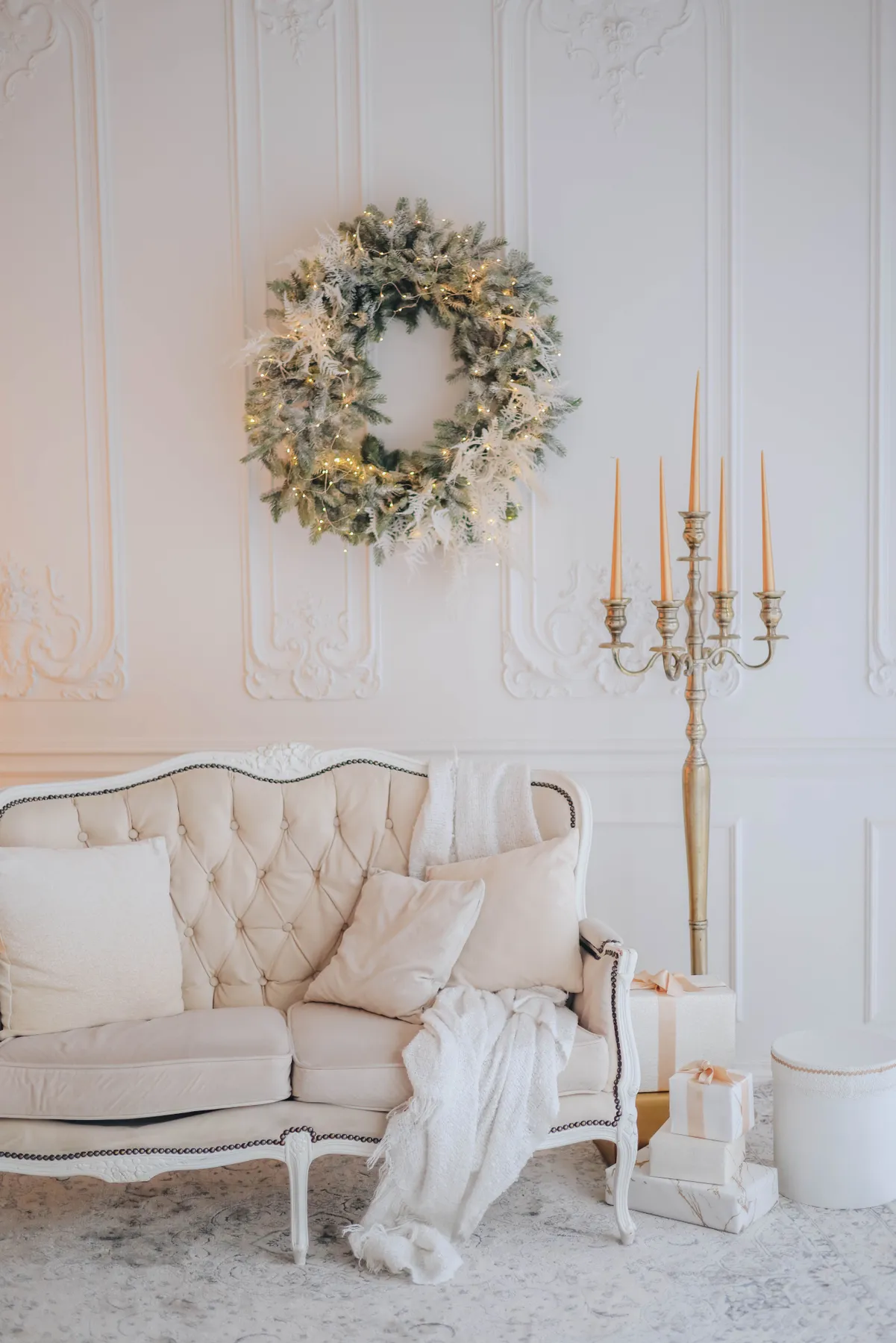
Real candles under a real wreath need real rules. Keep the wreath at least 18 inches above the tallest flame, never light the candles with a dry wreath directly overhead, and trim the candelabra down to three stems if you have kids or a cat who treats the sofa back like a highway. Battery-operated tapers have gotten genuinely good — the flicker is convincing from six feet. If you burn real wax, replace the candles every season; orange taper dye fades badly in storage.
10. A Dark Woven Basket Instead of a Tree Skirt
A slim flocked tree topped at around 7 feet needs very little floor space — figure a 3-foot circle including the basket, so a 6×8 corner is plenty. That’s why this look works in apartments and narrow townhouses where a full wide tree simply isn’t happening. Ceiling height matters more than square footage here: leave at least a foot of clearance above the topper so the eye can finish the line. In a room under 100 square feet, drop to a 6-footer and the proportions hold.
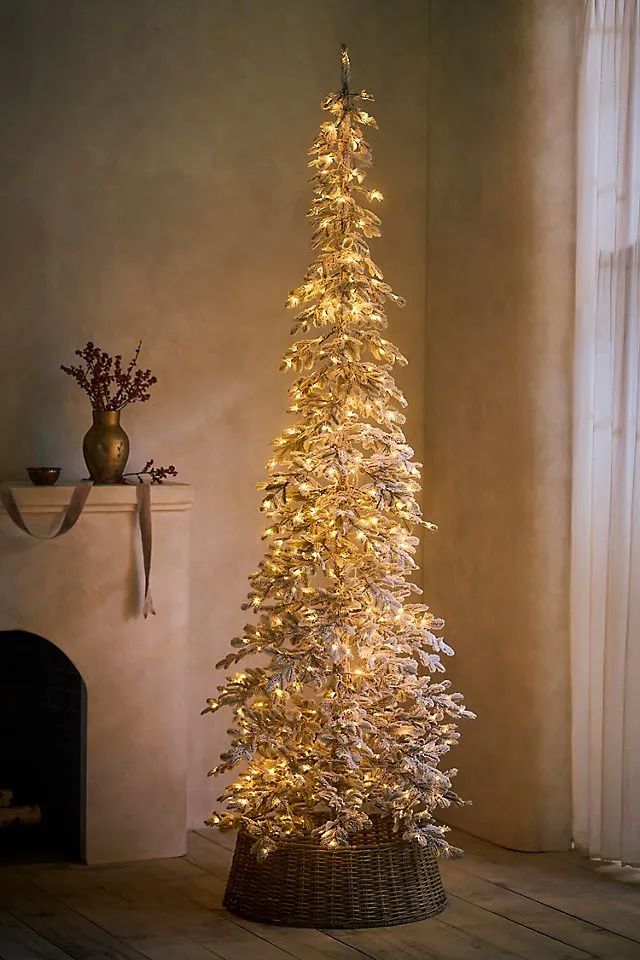
A skirt pools and softens; a basket lifts and defines. On a slim flocked tree, a woven basket gives the trunk a visible base and stops the white from bleeding into the floor. The dark brown also does something a white skirt can’t: it anchors the corner, which matters when your walls are textured beige and everything else is light. Look for a basket 2–4 inches wider than the stand, with a flat bottom — a rounded base will tip the second you add lights.
11. Multicolored Lights on a Flocked Tree (Yes, Really)
If you’re going multicolor on a white tree, block the colors instead of randomizing them. Keep pinks and purples on the left third, greens and blues on the right, and let warm yellow and red sit near the center where the eye lands. Random multicolor on heavy flocking turns to confetti and the white disappears. Also check the wire color before you buy. On a white tree, green wire shows through the flocking as dark scribbles — black is actually less visible, and clear wire is best of all.

Multicolor strand sets from Walmart start around $12 for 100 lights, and Target’s are usually $15–$20. That red skirt? A $15 flat felt circle, or a length of red fleece from a fabric store for $10 if you’ll cut a circle yourself. The dark gray fireplace surround is the one thing you can’t fake cheaply — but you don’t have to, because charcoal paint on a thrifted mantel shelf gets you the same silhouette against those sheer white curtains.
Multicolored lights on a white tree are polarizing, and they photograph badly on phone cameras, which matters if you plan to post. The pinks and purples blow out and the white branches turn gray in low light. If photos are the point, dim the room lights and lock your white balance. If the room is the point, keep it and ignore everyone in your comments. Either way, budget for a second strand — multi sets burn out in sections more often than warm white.
12. An Entryway With Two Flocked Trees and Blue Wainscoting
- Measure the door swing — a tree within 30 inches of a door edge gets knocked over by December 26.
- Check your outlets. Two lit trees plus a wreath need two free sockets, or one socket and a hidden power strip behind the bench.
- Confirm your wall color in daylight. Dark navy reads nearly black in a hallway with no window, which changes everything.
- Decide where wet boots go before you lay a light rug under them.
- Set a floor-space limit: two trees plus a bench typically need a 5×8 entry minimum.
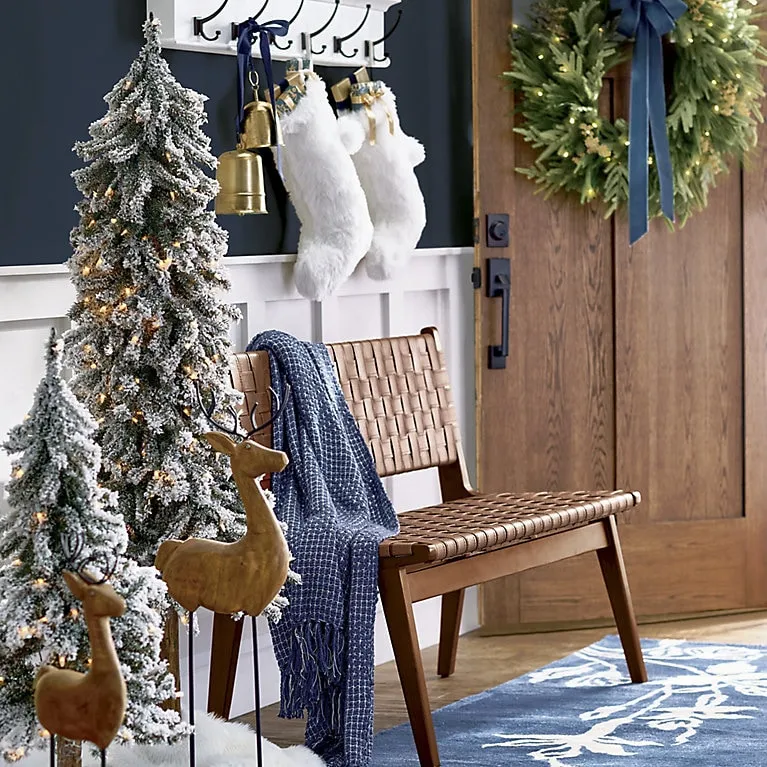
It’s the matching. Blue bows on the wreath, blue ribbons on the fuzzy stockings, a blue textured throw over the woven leather bench, a blue patterned rug underfoot. The trees themselves are neutral — all the color comes from the textiles. That means you can rebuild this whole entryway in forest green or deep burgundy next year by swapping four accessories and keeping the trees. Buy the trees neutral; spend your money on the accents.
13. A Flocked Tree on Concrete, Framed by Arched Windows
Somebody understood negative space. A plain concrete floor and blank walls would swallow most Christmas trees — but three arched windows with white frames give the tree a rhythm to sit inside. The black metal stand is the only hard black in the room, which makes it read as a deliberate line rather than an afterthought. Try this with furniture and a patterned rug and the minimalism collapses. The emptiness is the design.
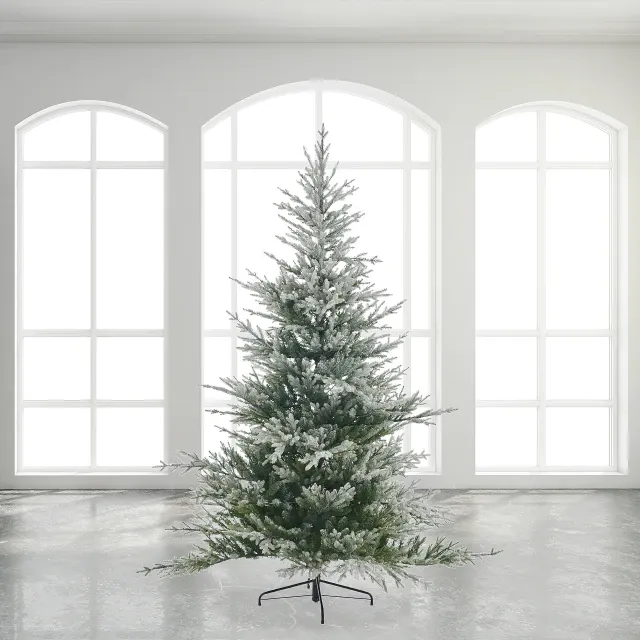
This composition needs volume — think 300 square feet minimum with 10-foot ceilings, because the arched windows have to read as bigger than the tree. On a standard 8-foot ceiling, the same tree in front of a single window looks like a tree in front of a window, not a moment. If you love the look but live in a normal-sized house, take the idea, not the room: one flocked tree, empty floor around it, one architectural feature framing it.
14. Cream Plush Ornaments on a Dark Green Tree
- Buy plush cream baubles in two sizes — 3-inch and 4-inch — plus one spool of cream satin ribbon. Budget about $60 for 24 ornaments.
- Tie a simple bow on each ornament’s cap with 8 inches of ribbon, then trim the tails at an angle.
- Hang the plush balls first, spacing them evenly — these set the rhythm.
- Fill the gaps with solid gold ribbon bows and gold glitter bows, roughly one for every three plush ornaments.
- Add tiny red baubles last, six to ten total. More than that and the cream loses.
- Finish with one oversized gold sphere near the top, slightly off-center.

Time: about 90 minutes. Cost: $80–$110.
Here it’s 55% dark green branch, 30% cream and gold combined, 10% gold ribbon, 5% red. The 5% does the heavy lifting — without those tiny red baubles, the tree reads beige-on-green and slightly flat. Swap the red for deep burgundy and the effect is warmer and more traditional; swap it for black and you’ve got something slightly edgy. Keep the accent under 10%, though. This tree works because it’s disciplined, not because it’s busy.
15. A Full-Length Mirror, a Snow-Dusted Tree, and Blue Ornaments
Angle the mirror so it catches the tree at about 15 degrees off parallel. Straight-on, a full-length mirror gives you a flat, obvious copy; angled, it catches the tree’s lit side and throws a soft glow onto the opposite wall for free. Keep at least 18 inches between the mirror and the tree base so the reflection reads as a separate tree rather than a stretched one. And dust the mirror before you photograph — on a white-on-white setup, every speck shows.
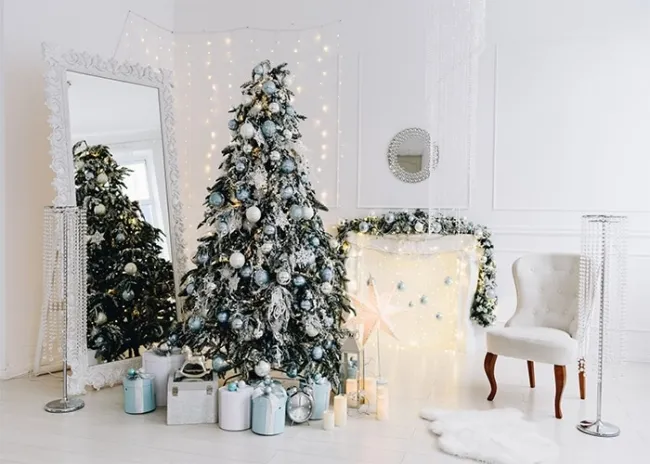
The ornate white mirror is the pricey piece — $200 and up new. Facebook Marketplace is full of oversized leaning mirrors between $40 and $90, and a can of white satin spray paint upgrades any frame with good bones. The blue and white gifts? Coordinate three papers and one ribbon color instead of buying a matched set: white paper, pale blue paper, and silver paper with a single silver ribbon costs about $35 total and looks more designed than a bundle.
A mirror beside a lit tree doubles your light sources and can create a hot spot on the opposite wall — check it after dark before you commit to the layout. More practically: a leaning mirror plus a tree plus gifts is three things competing for the same four feet of floor. If your room is under 150 square feet, wall-mount the mirror instead. And if you have toddlers, anchor it — gravity is not a design strategy.
16. Pampas Grass and Potted Plants Around a Flocked Tree
Pampas grass sheds almost as much as flocking does. Expect it to drop fluff for the first two weeks, then settle. Shake it outdoors before bringing it in, and keep it away from the tree’s lights — it’s flammable and it looks singed fast. The potted greens, on the other hand, need less water in December than you’d think; most die of overwatering in a dim winter corner, not drought. Check the soil every ten days and water only if the top inch is dry.
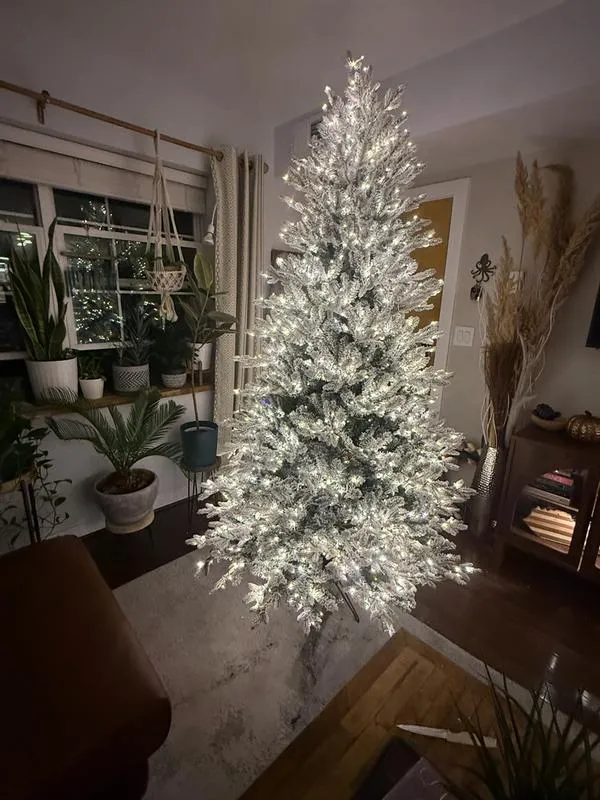
Plants in the background work best when the tree has room to stand alone in front of them. Give yourself about 12 square feet of floor for the tree, plus a separate cluster for the pots, and keep the tallest plant at least 2 feet shorter than the tree so the silhouette stays clean. Rooms between 120 and 160 square feet handle this easily; below 100, one plant and the tree is your limit before the corner closes in.
17. Pink and Purple Lights on a White Tree
Block the color instead of scattering it. Pink and purple on the left, green and blue on the right, with the transition hidden behind the trunk — that way the tree reads as two intentional statements instead of a party. Layer the colors in vertical bands, not horizontal, so the eye travels up the tree rather than around it. And when you’re using colored LEDs, put a cheap dimmer switch on the strand; running them at 80% cuts the glare and lets the white branch glow show underneath.
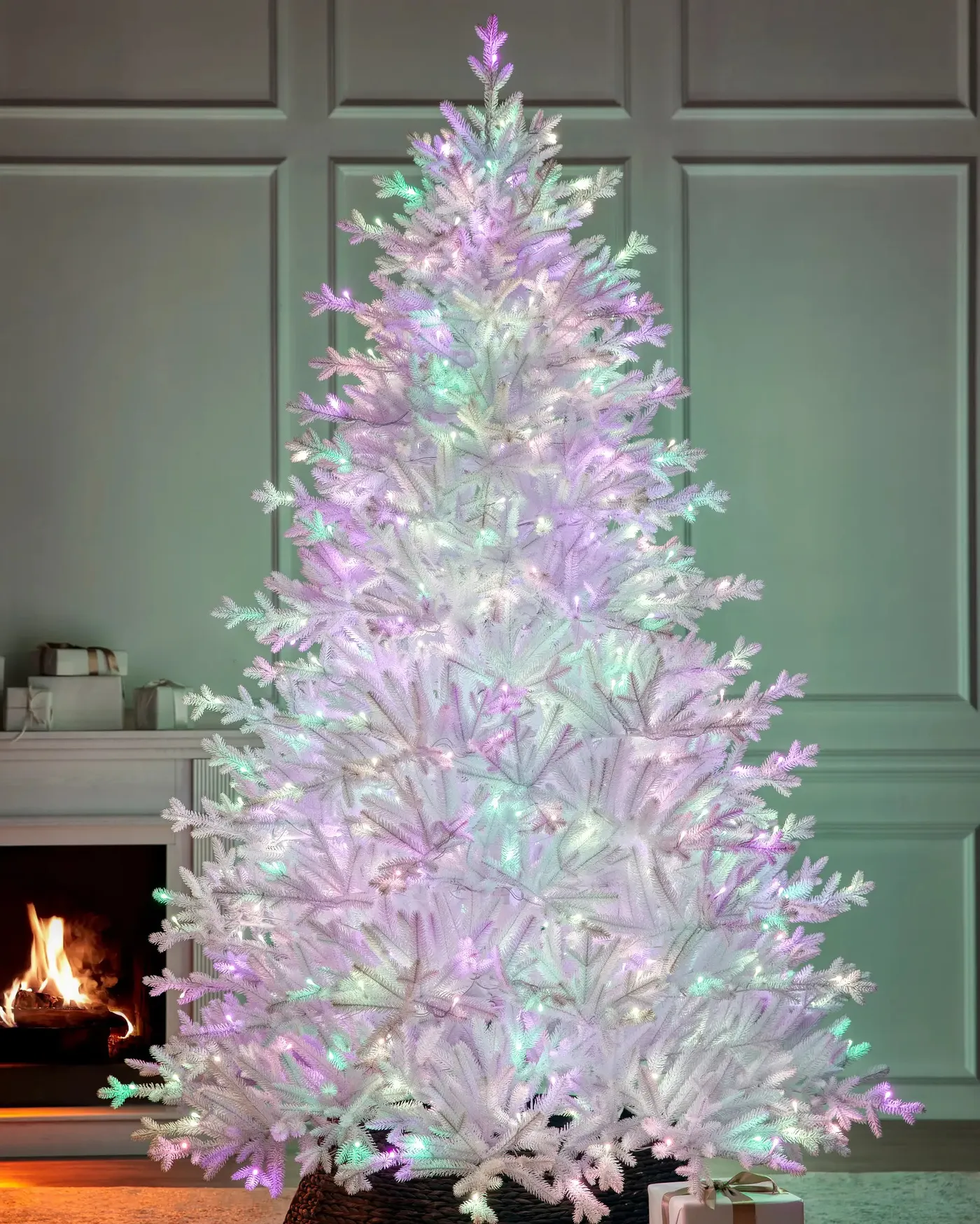
Colored lights came back hard, and the reason is generational — a lot of people in their thirties and forties grew up with multicolor sets, and warm white feels like a hotel lobby to them. On a white tree specifically, colored lights are a 2026 signature because they turn the branches into a projector screen. It’s not going anywhere soon, but the current version is tidier than the 90s: fewer colors, deliberate placement, and a woven basket base instead of tinsel. The nostalgia is real; the execution is new.
18. Star-Shaped Lights on a Slender Green Tree
The star lights do two jobs at once. As lights, they add warmth; as shapes, they add a repeating motif that ties the tree to the topper without anyone having to explain it. Repetition at two scales — small stars scattered, one big star on top — is the oldest trick in design, and it works every time. Notice the round coffee table too: a circle, a cone, and the lantern’s rectangle. Three shapes, no conflict.
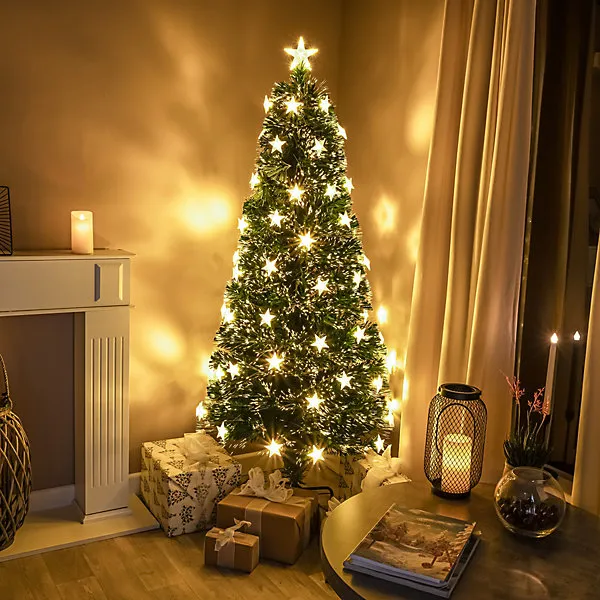
The lantern. Remove it and the corner is a tree and some presents. Keep it and you get a second, lower light source that makes the room feel lived-in — someone sat here, lit a candle, and left a book. It also stops the tree from being the only vertical thing in the frame. A $25 black metal lantern with a pillar candle does more for this corner than any ornament hanging on the tree.
19. Two Flocked Trees, One Golden Deer
Two full flocked trees is the expensive part of this room — skip it if you don’t already own them. One large flocked tree plus a small tabletop version gets you the same layered silhouette for a fraction. The golden deer statue runs $40–$120 at HomeGoods, but a gold spray-painted thrift-store figurine reads the same from across a room. And the cream shag rug? A $50 5×7 shag does the job the $400 one does.
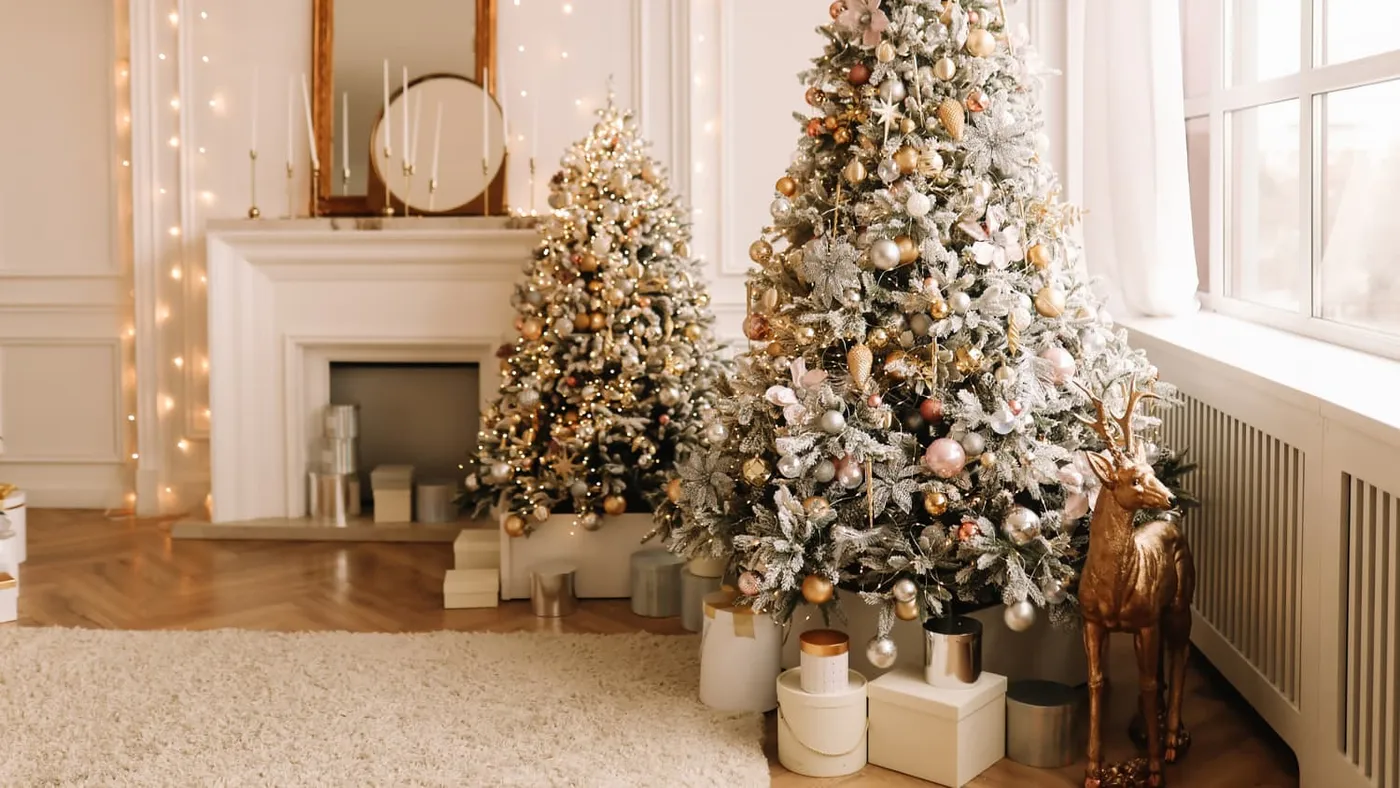
- Place the larger flocked tree first, centered on the fireplace wall, 8–12 inches off the wall.
- Set the second tree two feet behind and to the side — close enough to overlap in photos, far enough to walk between.
- Hang ornaments on the front tree in gold, silver, and soft pink at roughly a 3:2:1 ratio.
- Repeat only gold and pink on the smaller tree so it reads as an echo, not a duplicate.
- Lay the cream shag rug so the front tree’s base sits about a third of the way onto it.
- Position the deer statue at the rug’s edge, facing into the room.
Time: two to three hours. Cost: $300 to $2,000 depending on what you already own.
Two trees need breathing room: think 250 square feet and 9-foot ceilings, or at least 6 feet of clear wall width. Any closer and the smaller tree looks like a mistake instead of a composition. On 8-foot ceilings, drop the big tree to 7 feet and the small one to 4.5 feet — that two-foot height difference is what makes the pairing read as deliberate.
20. White Poinsettias and a Slatted Wood Wall
The recipe is 50% warm white light, 20% gold, 20% silver, 10% pure white blossom. That white poinsettia layer is what keeps a gold-and-silver tree from looking like a jewelry counter — it’s a matte, organic white that breaks up all the shine. Swap the poinsettias for white hydrangea and you get a softer, more spring-like tree; swap them for paper stars and it turns sculptural. Either way, keep the organic element at about a tenth of the total.
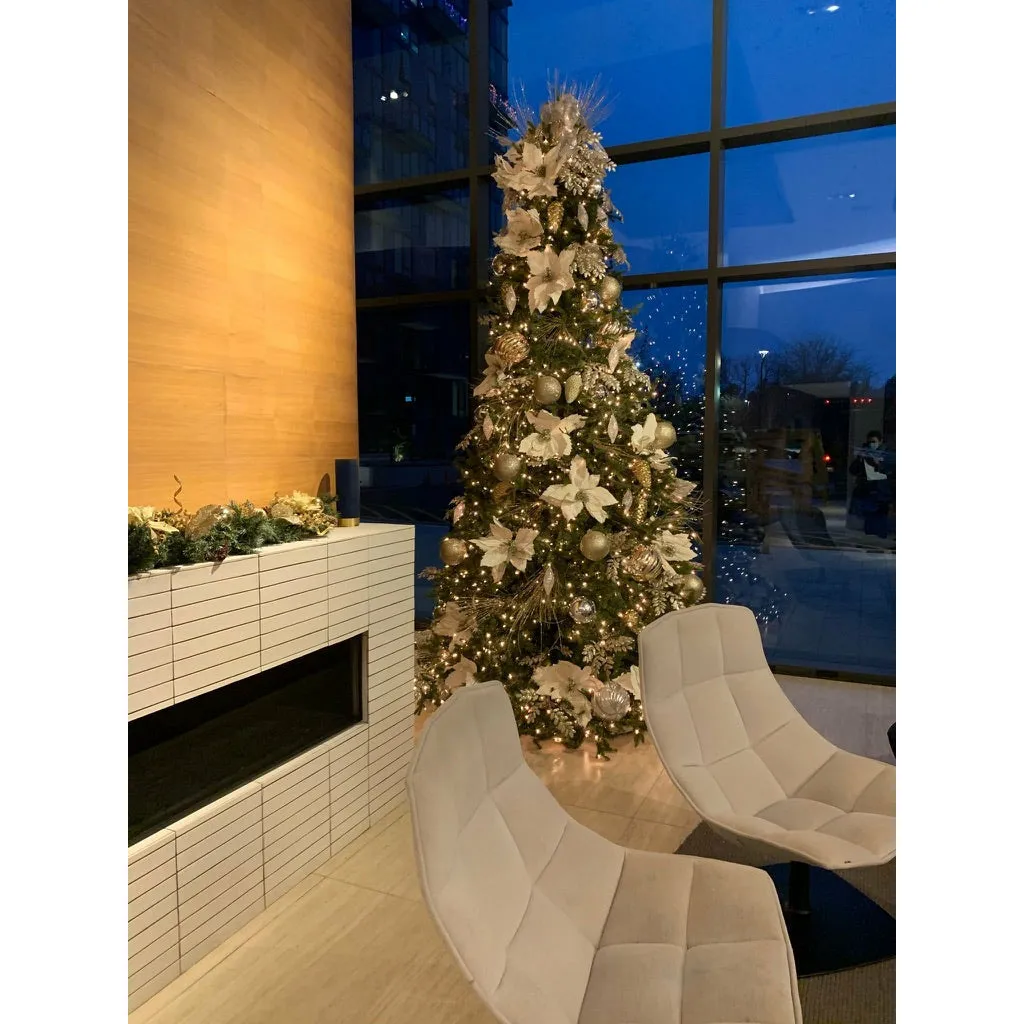
This is a lobby-scale tree — 10 or 12 feet, floor-to-ceiling windows, 200 square feet of open floor. Copy it in a normal living room and the proportions fight you. The good news is you can borrow the palette without the scale: white poinsettias, gold and silver balls, warm lights, and a light wood accent somewhere in the room. Just be honest about your ceiling height before you order a 12-footer you’ll have to return.
21. White Tree, Charcoal Sectional, No Competition
This works in a living room of roughly 180–250 square feet with 9-foot ceilings, where the sectional takes one long wall and the tree gets a corner to itself. The charcoal sofa is what makes the white tree read as a statement; put the same tree against a beige sofa and it goes soft and indistinct. If your sofa is light, add a dark throw and two charcoal pillows before you blame the tree. Under 150 square feet, the slim tree in Idea #5 gives you the same white-on-dark contrast without the footprint.
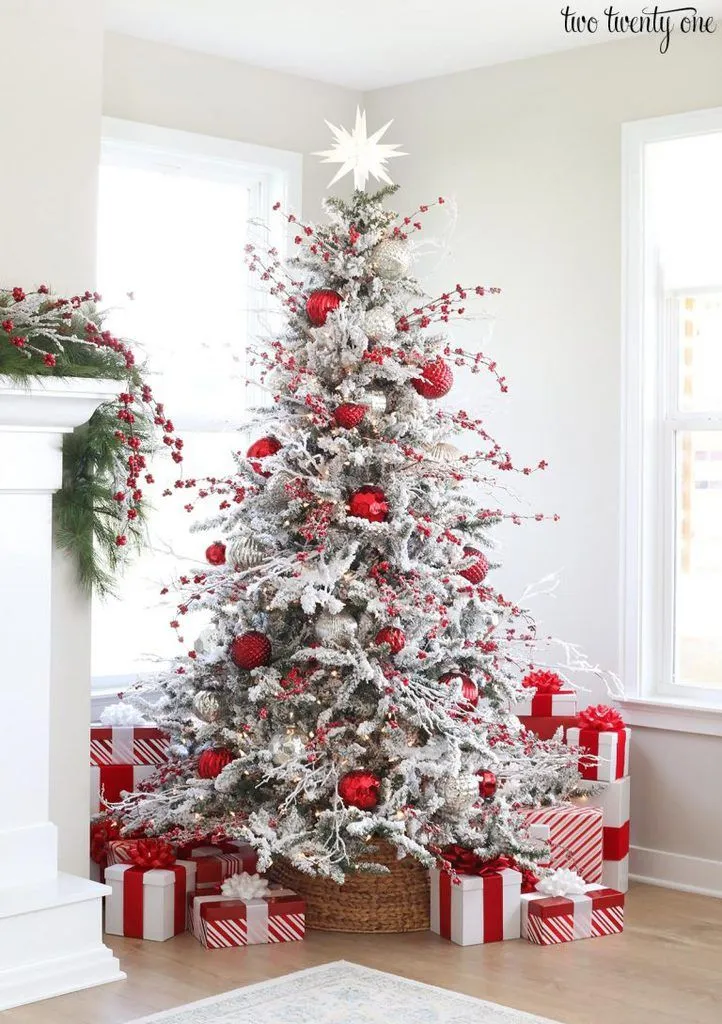
Match your tree ornaments to your sofa’s undertone, not its color. A charcoal with cool blue undertones wants silver and icy white ornaments; a charcoal with brown or green undertones wants warm gold and cream. Get it wrong and the whole room feels slightly off without anyone being able to say why. Test it by holding one ornament against the sofa arm under your actual living room lighting. Takes ten seconds, saves two hundred dollars.
22. Red and White Bunting Over a Dining Table
Dining rooms are back on Pinterest after years of being a hallway with a table in it, and the new version is casual — fabric bunting instead of swags, a garland laid down the runner instead of draped over everything, and two trees instead of one. The red and white triangle bunting specifically reads as handmade and slightly Scandinavian, which is exactly where 2026 holiday decor is landing: personal, a little imperfect, and photographed from above.
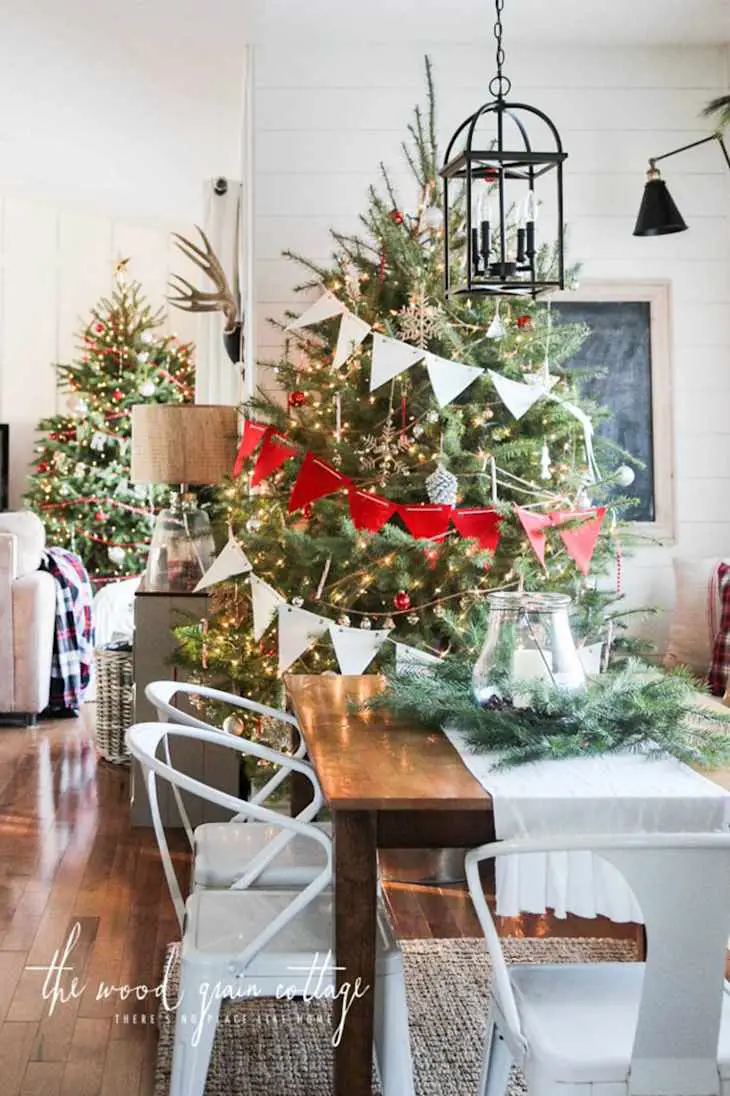
Everything here lives at a different height. The tree at seven feet, the bunting at five, the table garland at three, the plates at one. Your eye has a path to walk, which is why the room feels festive without feeling crowded. The bunting also repeats the ornament colors at a much larger scale, so the tree and the table are obviously related. Nothing in this photo was chosen in isolation, and that’s the whole lesson.
Triangle bunting is the cheapest thing in this entire article to DIY — a yard of red cotton, a yard of white, and pinking shears gets you a 12-foot garland for about $12. Real cedar roping is $2–$4 a foot at a nursery, but a $15 faux cedar garland with one $6 bundle of real offcuts tucked in reads just as good. The clear glass lantern is a $12 Target find. The whole table lands under $60.
23. A Flat White Tree for Rooms With No Floor Space
This is the answer for anything under 80 square feet. A flat tree silhouette stands about an inch off the wall and claims zero floor, so it works in a hallway, a studio apartment, or a bedroom corner where a real tree would block the door. The chunky knit pouf and the faux fur rug are the only things touching the floor, and both are movable. Ceiling height barely matters here — you can hang it high or low depending on what’s underneath.
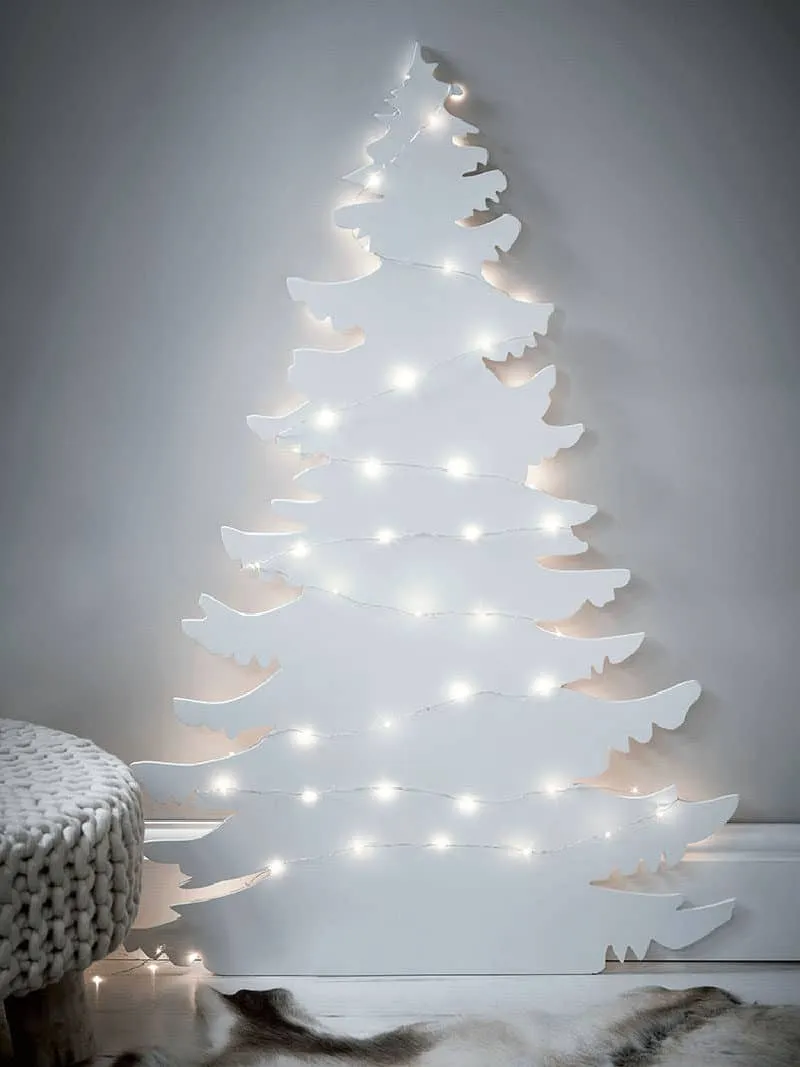
Two honest caveats. First, a flat tree doesn’t hold much weight — lightweight ornaments only, and check your wall anchors, because a leaning silhouette is top-heavy. Second, it reads as decor, not as the tree you gather around; nobody’s piling presents behind it. If the tradition matters to you, this is a second tree for a hallway or a kid’s room, not a replacement for the real thing. It’s also, honestly, the easiest December cleanup you will ever have.
Hang it so the widest point of the silhouette sits at about eye level when you’re standing in the doorway — usually 60 to 66 inches off the floor. Flat trees placed too high look like wall art; too low and they look like they fell. And run the string lights along the outline, not across the middle. The outline is the shape, and if you light the interior, the flatness becomes obvious from the side.
24. Icicles, Stars, and Every Silver Finish at Once
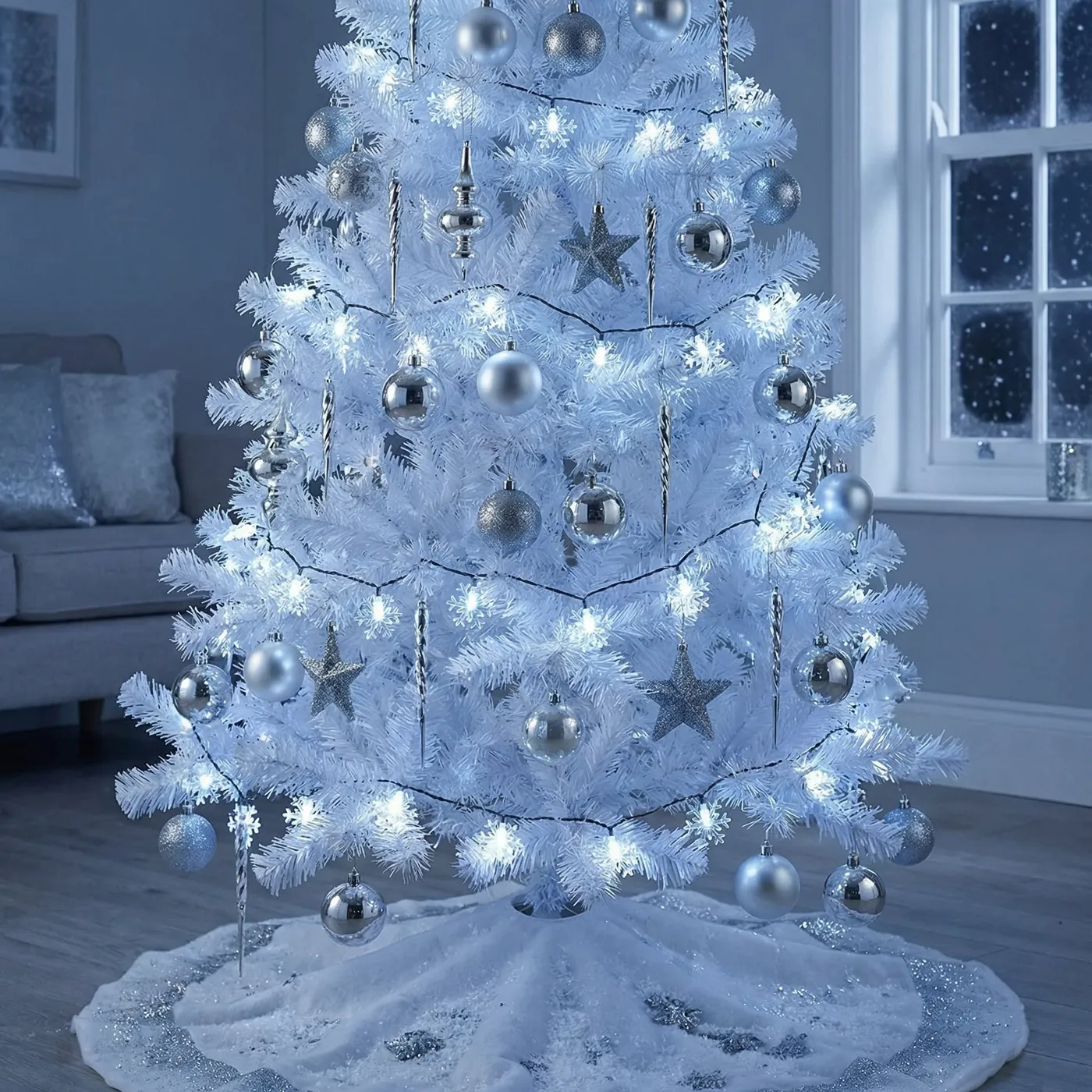
- Set the base: white branches, white lights. Nothing else yet.
- Hang the largest ornaments first — 4-inch matte silver balls — spaced 8 inches apart.
- Layer shiny silver next, tucked slightly deeper so it reflects the lights.
- Add glitter and mercury-glass pieces as the sparkle layer, one for every two matte balls.
- Finish with icicles and stars on the outer branch tips only, pointing outward.
- Cap the count at about 60 ornaments for a 7-foot tree. Past that, the white disappears.
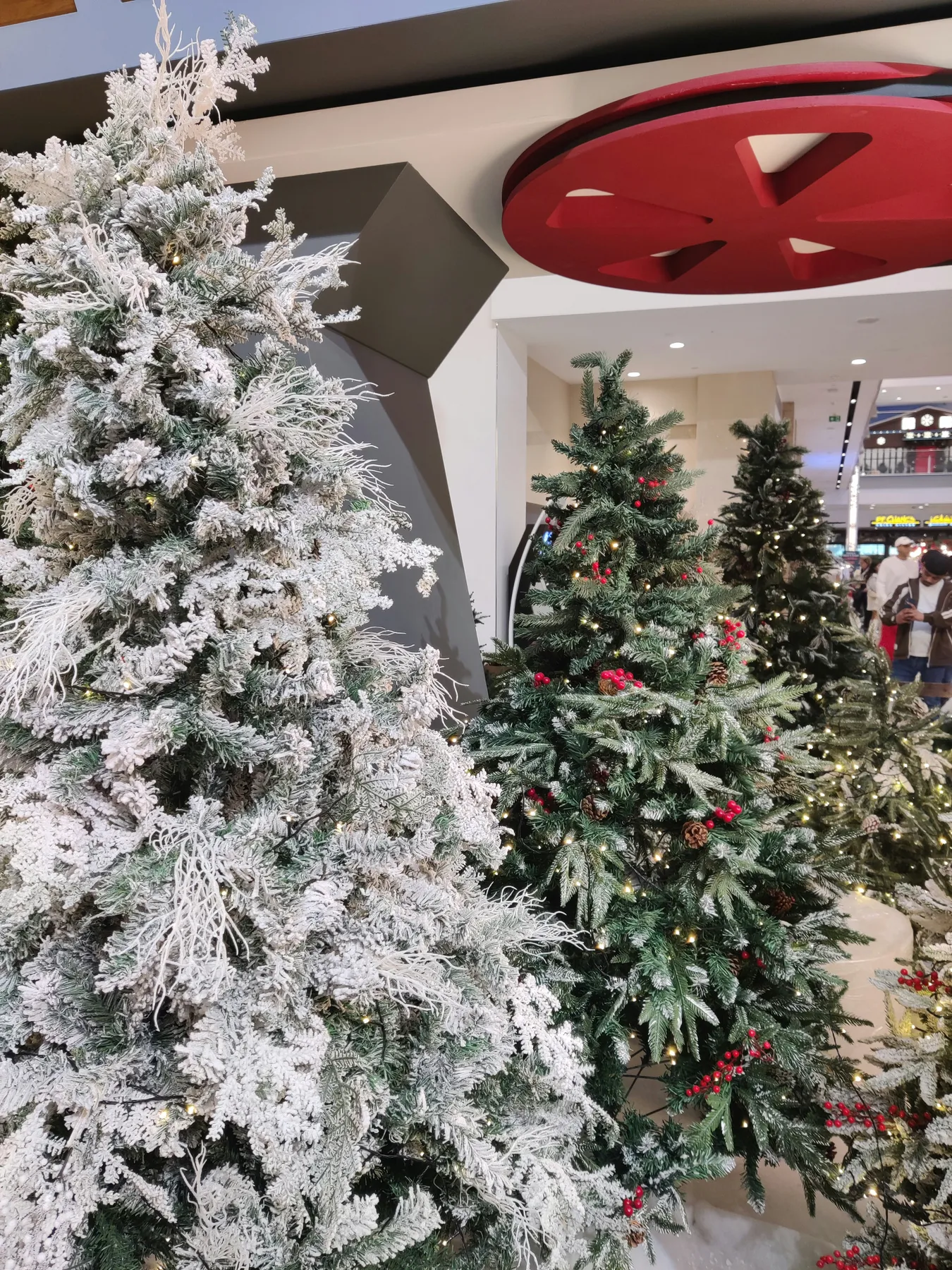
Time: two hours. Cost: $90–$160 for the ornament set.
Three finishes, one color: matte, shiny, and glitter, in roughly 50/30/20 order. If everything is shiny, the tree looks like a mirror ball; if everything is matte, it goes flat and dusty. The fluffy white skirt with silver glitter is the same formula at ground level — matte fabric, sparkle trim. Swap silver for champagne gold and the identical ratios give you a completely different, much warmer tree. Change the metal, keep the math.
25. One Flocked White Tree Among Dark Green Ones
Use the white tree as the accent, not the centerpiece. In a cluster this size, the flocked tree reads as a highlight because the dark green ones give it something to contrast against — put two white trees together and they cancel each other out. Keep the ratio around one white to three green, and repeat one shared element across all of them: here it’s the warm white fairy lights. That single repeated element is what turns a cluster into a composition.
The white ground covering. That continuous layer of fake snow under all the trees is what makes the grouping look like a forest floor instead of four separate trees on a floor. It’s also cheap — a roll of white batting or two white fleece blankets from a discount store, around $25 total, and you can roll it up every January. Without it, this is just a lot of trees in a room.
26. The Marble A-Frame Tree With Actual Shelves
- A-frame tree structure with marble-effect panels: $350–$899
- Frosted green garland for the edges, about 20 feet: $40–$80
- Warm white string lights: $20–$45
- Gold ornaments, 12–18 pieces: $50–$120
- White pillar candles, six: $30–$60
- Miniature green trees, three to five: $25–$60
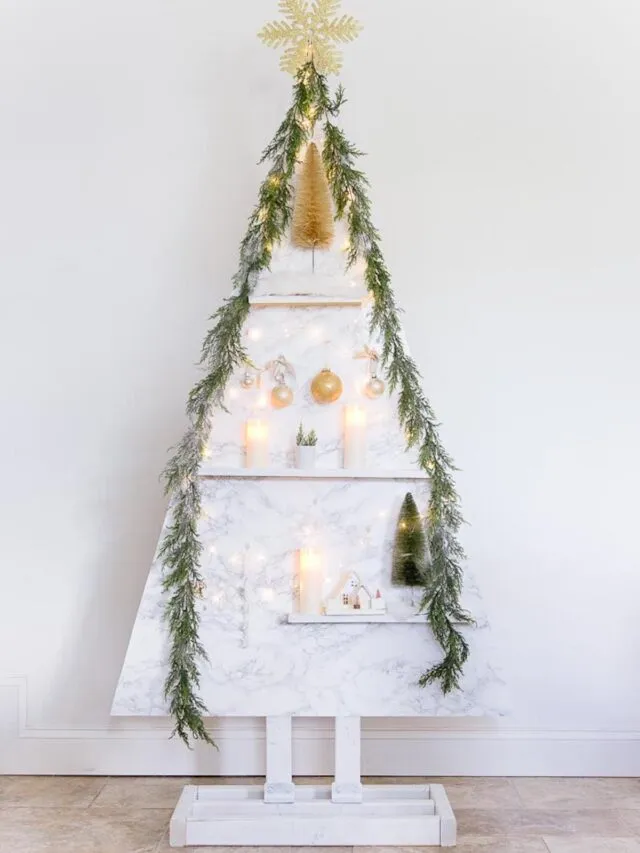
Total: $515–$1,264.
Budget alternative: build the A-frame from two sheets of white-finished plywood with marble-pattern contact paper, about $120 in materials and a weekend. The shelves are just 1×4 boards on brackets. It won’t be heirloom furniture, but it photographs beautifully and comes apart flat.
The shelves. Everything else — the marble, the garland, the lights — is a backdrop. Those horizontal ledges are the reason this tree exists, because they give you a place to put a candle or a tiny tree that isn’t a branch. Take them away and it’s a white triangle. This is the one sculptural tree in the article that earns its price tag, because it does something a real tree can’t.
27. Clear Glass Ornaments With White Glitter Swirls
Hang clear ornaments against flocked branches, never against a wall — they need something white and textured behind them to be visible at all. Space them about 6 inches apart and keep them on the outer third of the branches so light passes through both sides. If you’re mixing them with opaque ornaments, keep a 3:1 ratio of clear to opaque or the clear ones disappear entirely. On a flocked tree, clear glass is the quietest thing you can hang, and it’s usually the one people ask about.

Transparency is a texture. We talk about velvet and wool as textures, but clear glass has one too, the same way a window does. These ornaments don’t add color, they add depth, so a flocked tree gets dimension without getting busier. The white satin ribbon hangers matter too: a metal hook reads as a small dark dot, and on a white tree every dark dot counts. White ribbon keeps the line continuous.
Clear glass shows everything — fingerprints, dust, and the tiny scratches that come from six Decembers in a cardboard box. Wash them in warm water with a drop of dish soap, dry with a lint-free cloth, and store each one in tissue paper inside a divided box. Skip the dishwasher; the heat fogs the inside permanently. If you want the look without the anxiety, clear acrylic gives the same transparency for a third of the price. Layer them with the silver mix in Idea #24 and nobody will know the difference.
28. The Tiered White Tree That Fits on a Console
Small decor follows the same rules as big trees. This one stacks 70% matte white ceramic, 20% wood, and 10% festive color borrowed from whatever is behind it. The fluted texture is doing the work of flocking at tabletop scale — it gives the white something to catch light on. Repaint it cream and pair it with brass and you’d have a completely different piece; the formula would be identical. Scale doesn’t change the math, only the numbers.
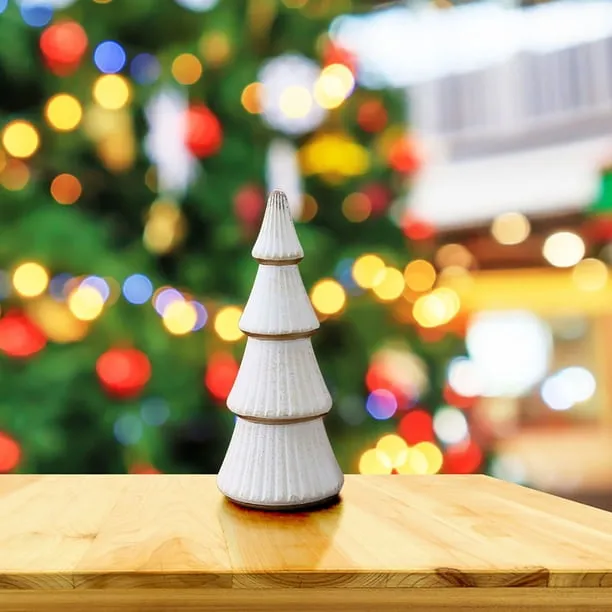
Tabletop tiered trees run $35–$70 at Target and HomeGoods, but the real move is behind it: that blurred green tree with colored lights is doing half the decorating in this photo, and it doesn’t need to be in focus or expensive. A $30 four-foot green tree with a $12 strand of colored lights, slightly out of frame, gives you the same warm bokeh. Put what you saved into the console itself — a good wood surface makes cheap decor look considered.
29. A Wreath That Matches the Tree, Not the Door
- Start with a plain green faux-pine wreath, 20–24 inches. About $25.
- Wire in six to eight silver and white baubles in mixed finishes, clustered at the lower left.
- Add the large sheer white ribbon bow at the top-left, with tails hanging about 10 inches.
- Tuck two or three white glitter reindeer figurines into the greenery so they peek out.
- Finish with clear snowflake ornaments on the outer ring, one every few inches.
- Wire everything, don’t glue — you’ll want to rearrange it next year.
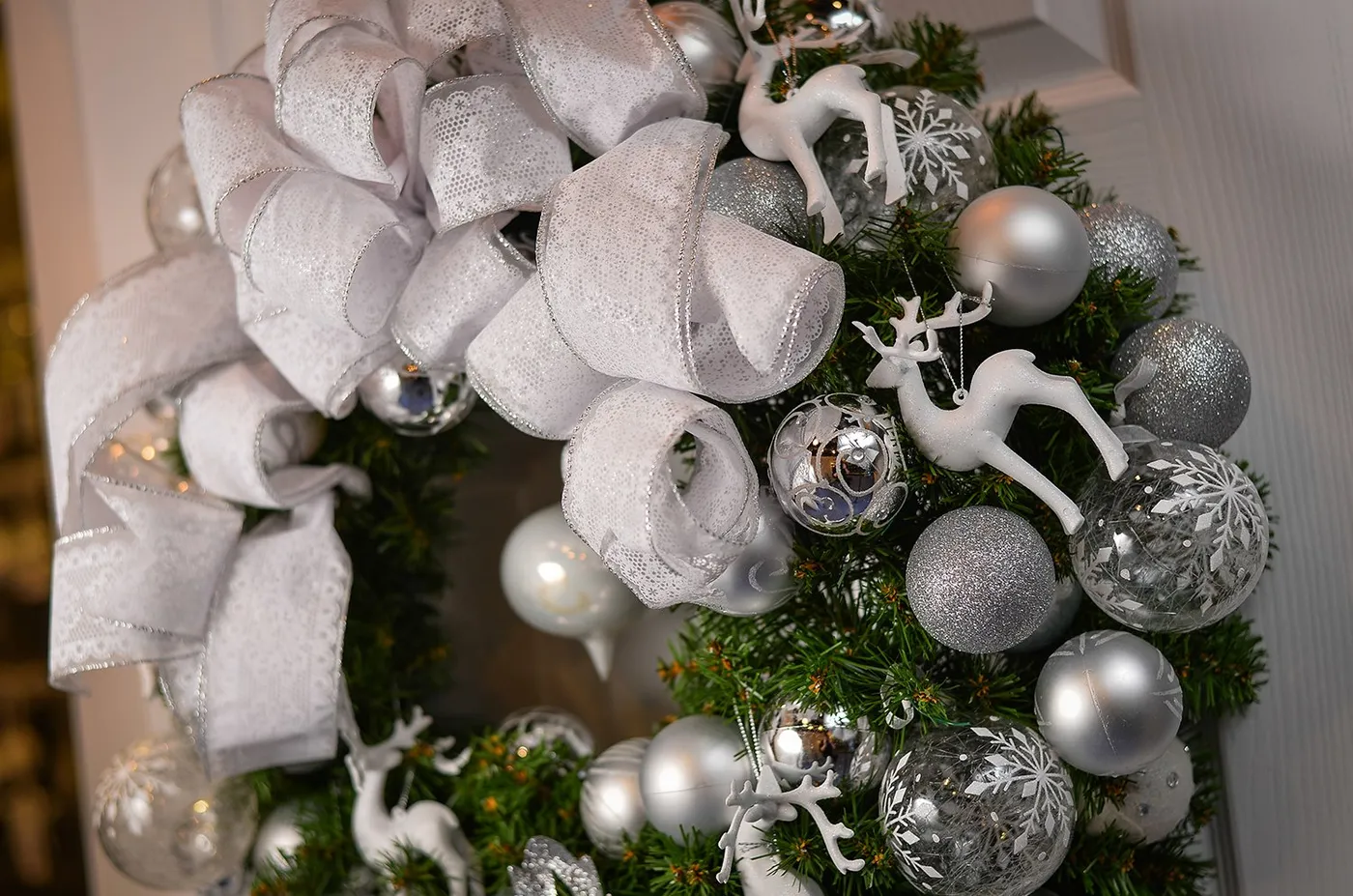
Time: about 45 minutes. Cost: $60–$90.
Faux greenery doesn’t drop needles, but it does collect dust, and by year three a wreath that lived on a door looks gray. A two-minute blast with a hairdryer on cool, outdoors, resets it. Glitter is the other issue — it sheds onto everything below, so avoid hanging a heavily glittered wreath over a light-colored console or a wood door. Store it flat in a box with tissue between layers, or on a padded hanger in a closet. Folded wreaths never come back.
30. Black and White Woven Ornaments on a Green Tree
The woven texture. Black and white alone would be graphic but flat; the weaving adds a handmade surface that catches light and makes these ornaments read as objects rather than dots. It also lets a monochrome scheme survive on a green tree, which is harder than it sounds. One rule: keep the black-and-white pieces in the majority and use the crystal stars as the accent, never the other way around. The pattern is the point.
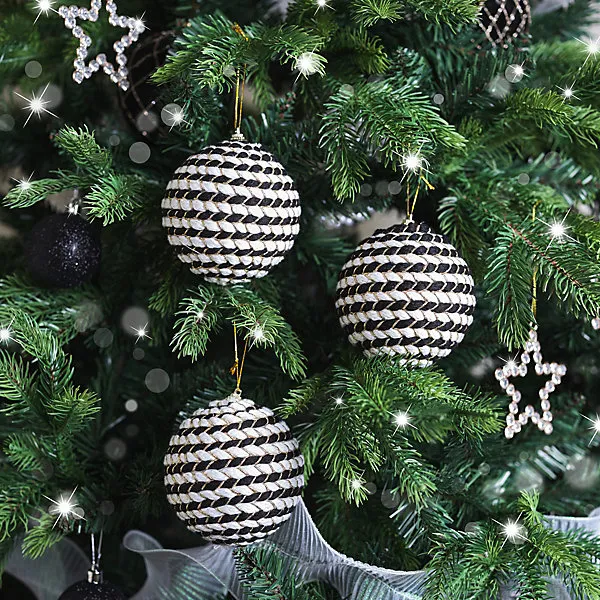
High-contrast ornament schemes need a bigger tree — these black and white pieces are visually heavy, so a 6-foot tree gets crowded fast. Aim for 7 to 7.5 feet minimum, and space the woven spheres at least 7 inches apart so the green shows through. In a smaller room, cut the count by a third rather than shrinking the ornaments; small heavy-looking pieces on a small tree just look noisy. And check the mistake list at the end — overloading a strong pattern is the fastest way to undo a tree like this.
31. What Heavily Flocked Actually Looks Like Up Close
The green is the tell. Look at a well-flocked tree and you’ll see white tips over a green core — that gradient from solid green at the trunk to bright white at the tips is what makes it read as a snow-covered tree rather than a painted one. Trees flocked evenly all the way in look artificial, because real snow settles on surfaces, not inside branches. When you shop, run your hand along a branch. You want resistance at the tip and regular needles underneath.
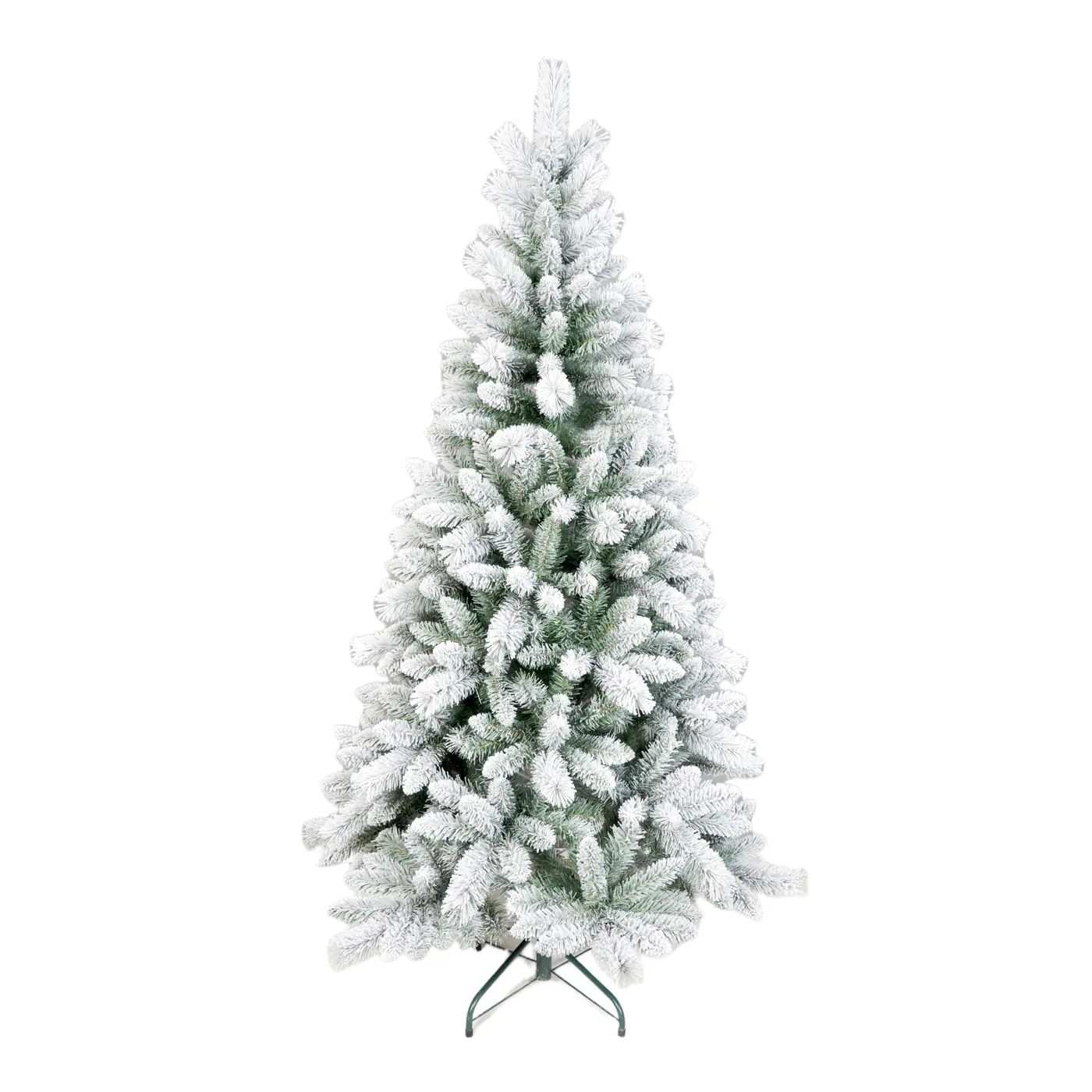
Flock density isn’t standardized, but here’s a useful benchmark: on a decent flocked tree you should lose sight of about 70 to 80% of the green, not 100%. If a listing photo shows barely any green visible, the flocking is either spray-on fiber that sheds immediately or a trick of studio lighting. Ask the seller for a photo taken in a normal room with no backdrop — that’s the tree you’ll actually get. Also check for a fire-retardant label; quality flocking is treated, cheap flocking often isn’t.
Flocked trees used to be the thing you did to a tree you already owned and hated. In 2026 they’re a category of their own — the artificial tree market has pushed heavily frosted finishes to the top of search, largely because they photograph well against the warm neutral interiors dominating current design. The white tree has also gotten permission to be the main event rather than the novelty, which is a real shift. Expect the frosted look to hold through next season at least.
32. A Green Tree That Reads Almost White
A green tree packed with white lights is a cheaper way to get the white-tree glow, and it’s more forgiving — no flocking to shed, no yellowed tips, no white tree looking grubby by year three. The trade-off is honesty: it’s a green tree, and in daylight you’ll see green. That’s fine if your room is warm-toned, and less fine if you’ve built a cool blue-and-silver scheme around cold whites. Match the tree’s actual color to the palette, not to the photo.
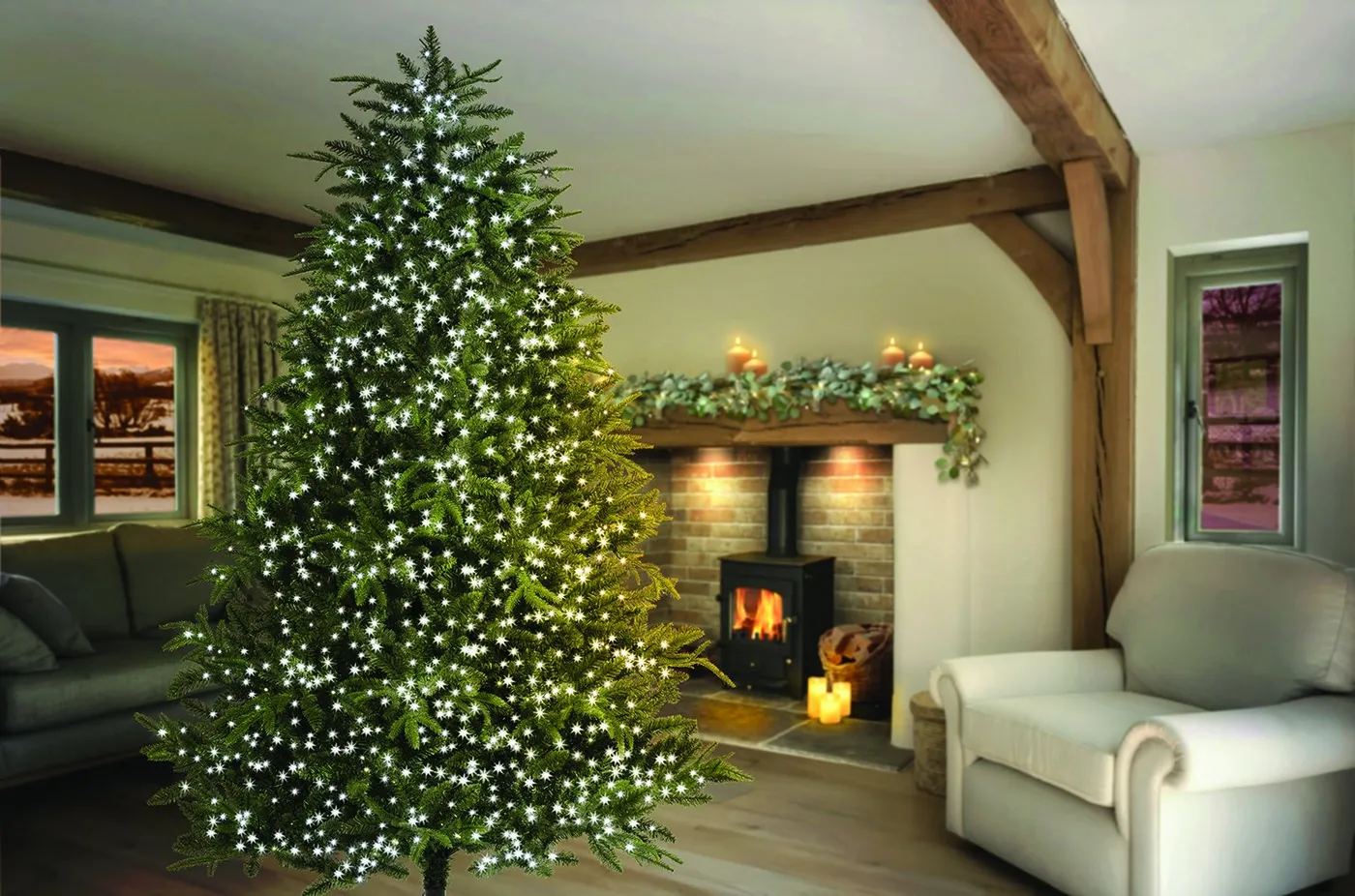
Rustic rooms with exposed ceiling beams and a wood-burning stove tend to have generous proportions — usually 250 square feet and up, with ceilings at 9 feet or higher. A big tree works here because the beams and the brick give the eye plenty to look at. In a standard 8-foot room with a plain white ceiling, the same tree needs 6 feet of wall clearance and something else architectural to carry the scale, or the proportions tip the wrong way.
33. A Snowy Window and a Red Tree Skirt
Place the tree so the window is behind or beside it, never directly in front — you want the snowy view as a frame, not a backdrop blocking the lights. Then keep the room dim. A white pre-lit tree photographed in a bright room looks pink and flat; in a dark room with only the tree and the street lights on, it looks like something out of a movie. Turn off the overheads before anyone takes a picture. That’s the whole secret.
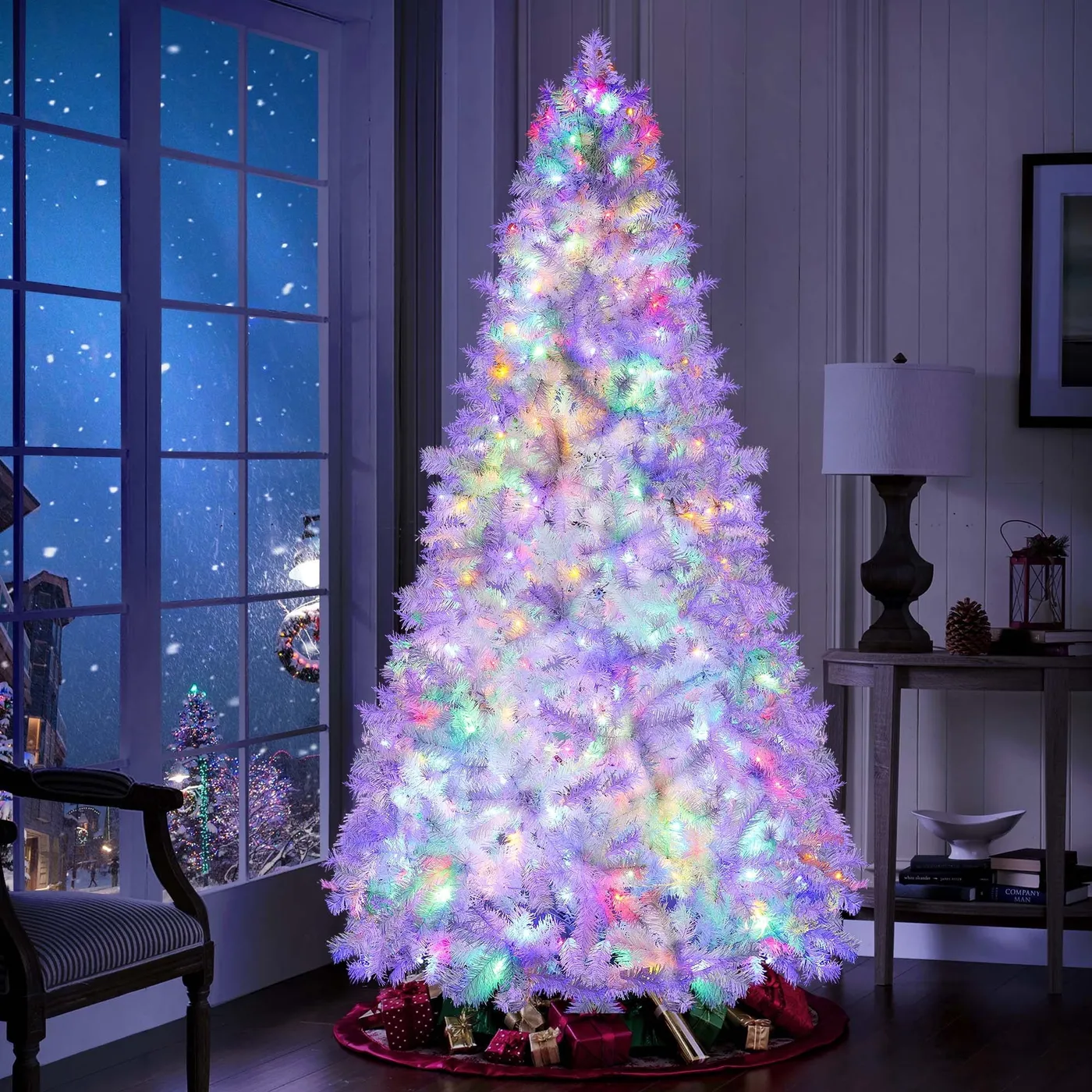
The red tree skirt is the cheapest way to warm up a white tree — $15 for a felt circle at Walmart, or $10 in red fleece from a fabric store if you’ll cut a circle yourself. The dark wood side table is a $40 Marketplace find; anything dark and simple works. And the snowy window doesn’t need a real blizzard: a $12 frosted window film with a snowflake pattern, applied to the lower half of the pane, gives you the same glowing look on a clear night.
34. Light Blue and Silver Against Falling Snow
This one’s 60% white — tree, ribbon, drapes, window frame — then 30% light blue and silver combined, and 10% warm white light. The warm light is the part people get wrong: pair blue-and-silver ornaments with cool white bulbs and the room goes arctic in a bad way. Warm bulbs against icy ornaments is the contrast that makes a winter palette feel like a home instead of a ski lodge. Swap the light blue for sage and you get the same effect, softer.

The gifts. Light blue, silver, and white paper, all using the same three papers, tied with matching ribbon and stacked in a deliberate pyramid. Without them, this is a lovely white tree against a snowy window. With them, the tree extends down onto the floor and the whole corner becomes one composition. Wrapping paper is the cheapest decorating decision in this entire article, and the one people skip most often.
One White Tree, Thirty-Four Ways to Make It Yours
White trees aren’t a forever commitment — they’re a backdrop, and backdrops are forgiving. Pick one idea here, steal two details from another, and ignore the rest. That’s how real rooms actually get built, one December at a time.
📌 Pin the ideas you love so they’re waiting for you when the boxes come down from the attic.