
You know the feeling: it’s November, you’re three hours deep in Pinterest, and every house on your feed looks like it was lit by a pro crew with an unlimited budget. Good news — most of them were, and you can still get 90% of the effect.
We combed through Home Depot, Lowe’s, Target, and Amazon to pull the ideas worth your time, from $18 strands to $1,800 installed displays. Inside are 35 real homes — traditional brick colonials with warm white outlines, modern facades running color-changing LED gradients, cottage charm, and full-on maximalist lawn displays — with budget and luxury versions compared side by side.
In 2026 the shift is toward app-controlled color and warm-white discipline: fewer, better strands, and a lot less untangling. And stay until the end — we break down the most common mistakes that can ruin these looks.
Some links here are affiliate links, which may earn us a small commission at no cost to you. 📌 Save this to Pinterest for later — you’ll want to revisit these ideas.
1. Red-and-Green Uplighting on a Stucco Estate
If you’re uplighting stucco, set the fixtures about 12 inches off the foundation and aim them slightly past vertical so the beam grazes the wall instead of punching a hot spot into it. Two fixtures per 10 feet of wall, 2700K, 35-degree beam angle. That’s the difference between architectural and someone left a flashlight on the lawn.
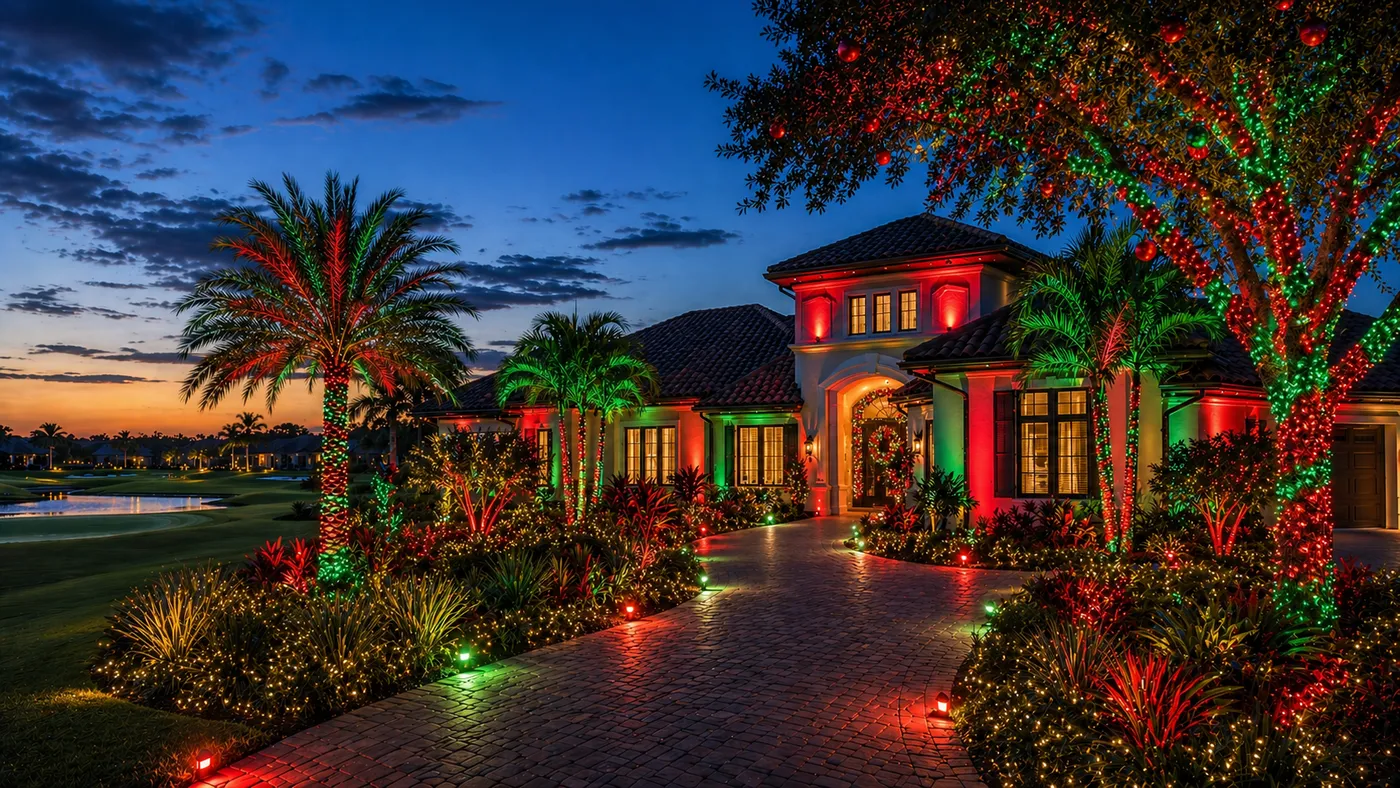
Red-and-green schemes only read as intentional when the house is big enough to hold them. Plan on at least 45 feet of frontage and tall palms or mature shrubs to balance the roofline. On a narrow lot under 30 feet, the same colors turn to noise fast — keep the red and green to the trees and let warm white carry the architecture instead.
2. Rainbow RGB Gradient Across the Farmhouse Gables
Two principles are doing all the work here. The dark vertical siding on the upper gables absorbs light, so the rainbow strand reads as a clean ribbon instead of a smear. The light brick below bounces those same colors back at lower intensity, which gives the facade depth without a second fixture. One run of lights, two very different surfaces, zero clutter.
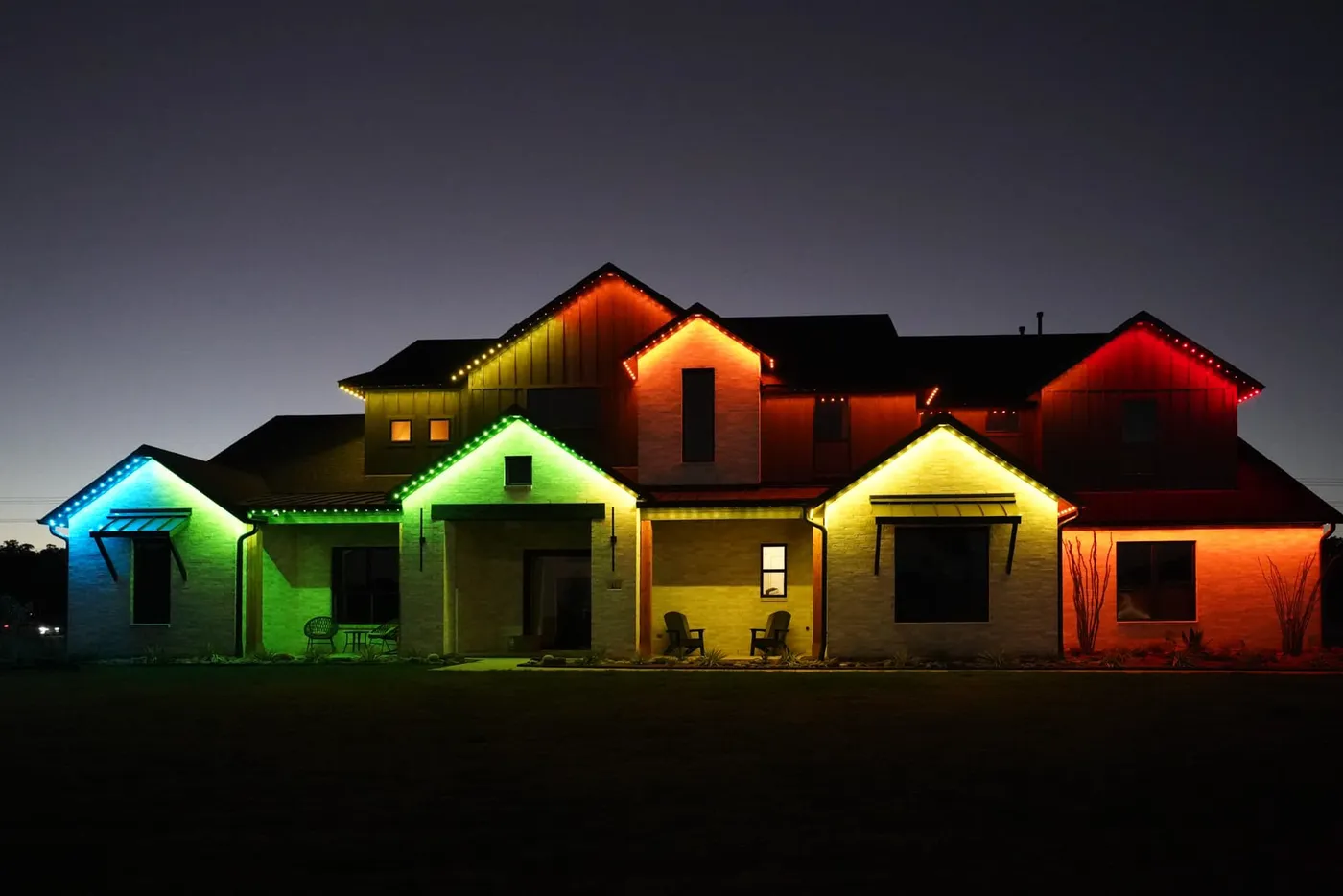
A pro-installed RGBIC run on a house this size lands between $1,200 and $2,500. A 100-foot RGBIC strip kit with app control goes for $70–$150 on Amazon, and you can clip it along the same roofline in an afternoon with a ladder and gutter clips. Skip the very cheapest strips — the $40 versions lose color accuracy at the ends, so the gradient goes muddy around the third gable.
3. Warm White Light Tunnel With a Red Tower
The arching tunnel of warm white lights is the piece that makes this yard memorable. Strip it away and you still have a beautifully lit house with a red light tower — nice, but forgettable. The tunnel gives people a reason to slow down at the curb, and it’s the one element worth spending a full weekend on. Build it first, then decorate around it.
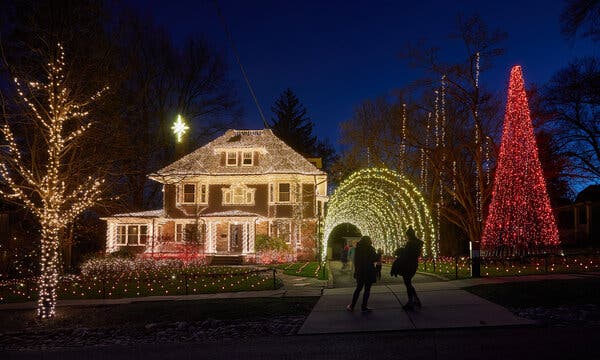
- Warm white roofline strands, 12–15 sets: $90–$220
- Light tunnel with steel hoops, 10–12 feet: $180–$450
- Conical red light tower, 8 feet: $250–$600
- Ground path stakes and borders: $60–$150
- Timers, cords, GFCI protection: $45–$110
- Total: roughly $625 to $1,530
Budget alternative: build the tunnel from PVC hoops and zip-tied strands for about $120, and swap the tower for a $60 red-wrapped tomato cage — roughly 55% off.
4. Red Rooflines and a Light-Up Deer on the Walk
Red strands are the most likely lights in your bin to have a dead section, because a failed red LED is far more visible than a failed warm white one — one dark bulb and the whole run looks broken. Test every red set on the garage floor before it goes up, and buy a spare set of the exact same brand. Nothing kills a gorgeous roofline faster than a two-foot gap you can’t safely reach until spring. Compare with Idea #9 — same restrained palette, zero red.
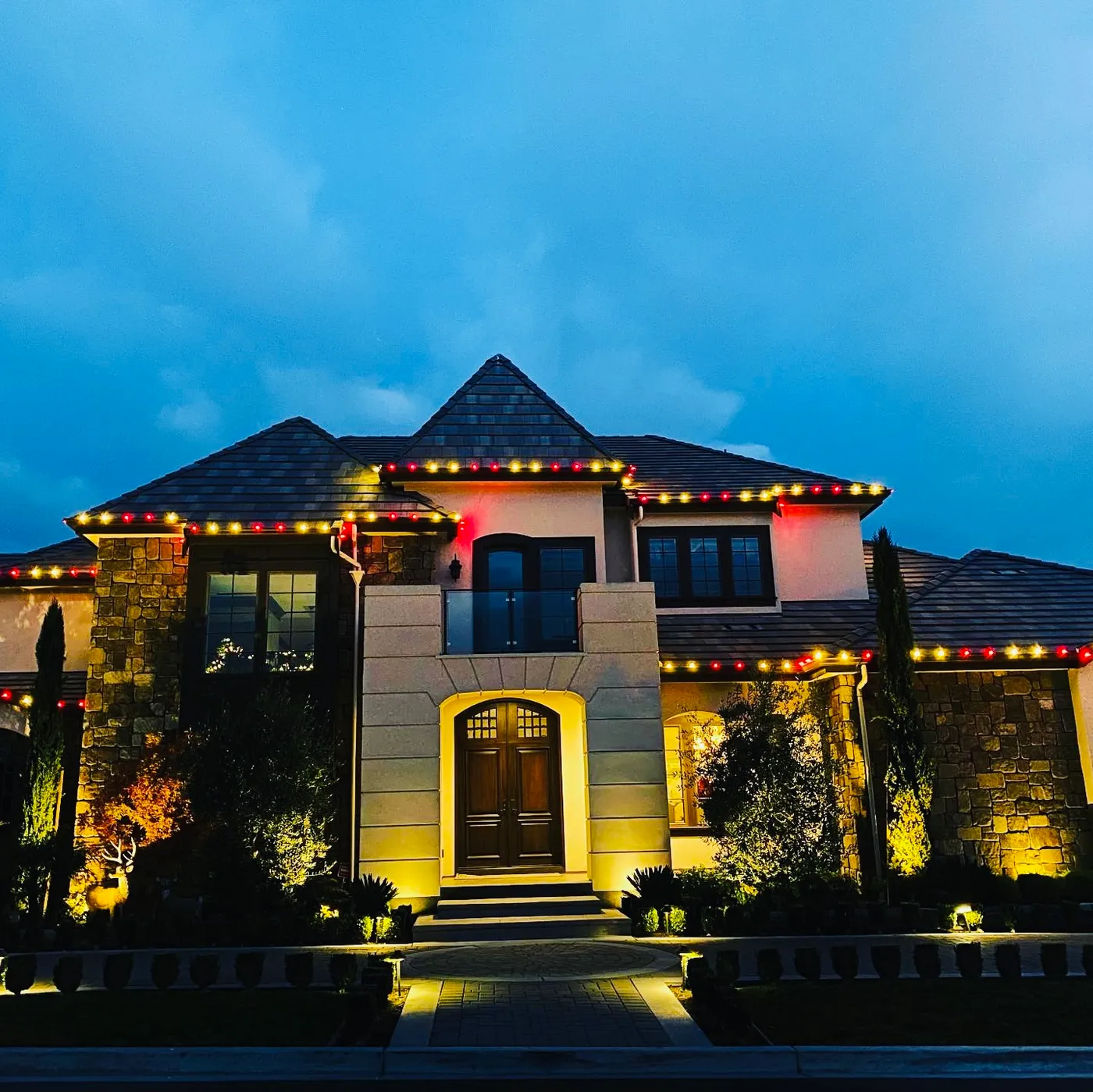
Stagger, don’t alternate. Running red-white-red-white along one eave looks like a candy cane and fights the architecture. Let warm white trace the main rooflines and reserve red for the gable peaks and window headers, so the eye reads it as an accent rather than a pattern. Keep both at 2700K and the whites will always match.
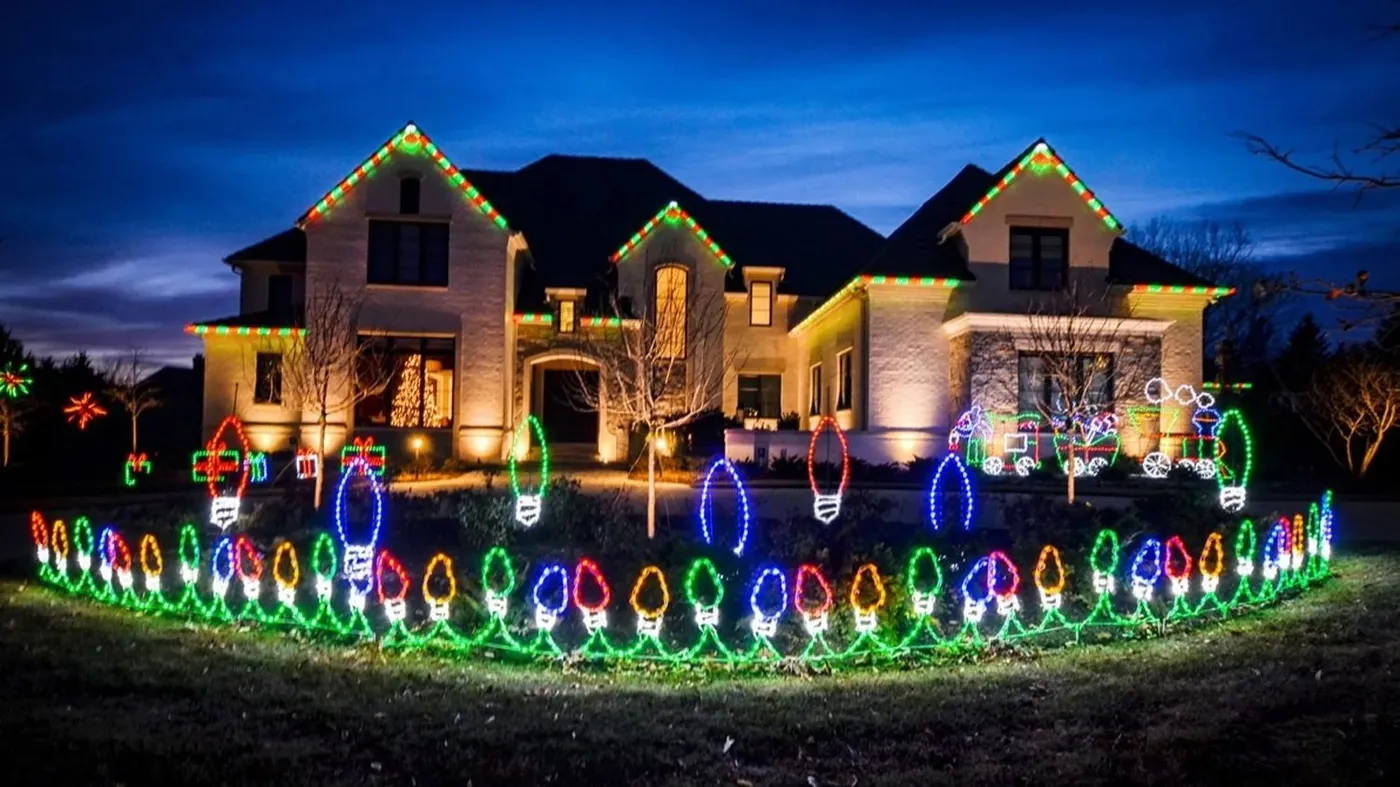
5. Oversized Bulb Outlines and a Train on the Lawn
The formula here is roughly 60% warm white structural light — rooflines, up-lighting, path borders — 25% red and green in the string lights themselves, and 15% novelty sculpture: the giant bulbs, the train, the gift boxes. Swap the novelty pieces for snowflakes or nutcrackers and the math still holds. Push past 20% novelty and the house disappears behind the props.
- Pick a level patch of lawn at least 4 feet back from the walkway.
- Drive two 18-inch galvanized stakes per figure, angled slightly outward.
- Zip-tie the figure’s frame to both stakes at two separate points.
- Run cords behind the figure and pin them down with landscape staples.
- Test the full run, then wrap every connection in electrical tape.
About two hours and $15–$30 in stakes and ties for three figures.
The oversized light-up bulb outlines are what make this yard a display instead of a decorated house. Without them you’d have a perfectly nice red-and-green roofline — the same thing every third house on the street has. Those bulbs give the lawn scale and a sense of humor, and they’re the one piece everyone points at from the car.
6. Brick Facade, Lit Shrubs, and a Balcony Tree
Three heights, one color, no drama. Warm white runs across the foundation shrubs at ankle level, wraps the doorway at eye level, and glows from a lit tree on the second-story balcony. That vertical repetition is what makes the facade feel composed — your eye climbs the building instead of scanning sideways. The red brick does the rest by warming every bulb a shade or two.
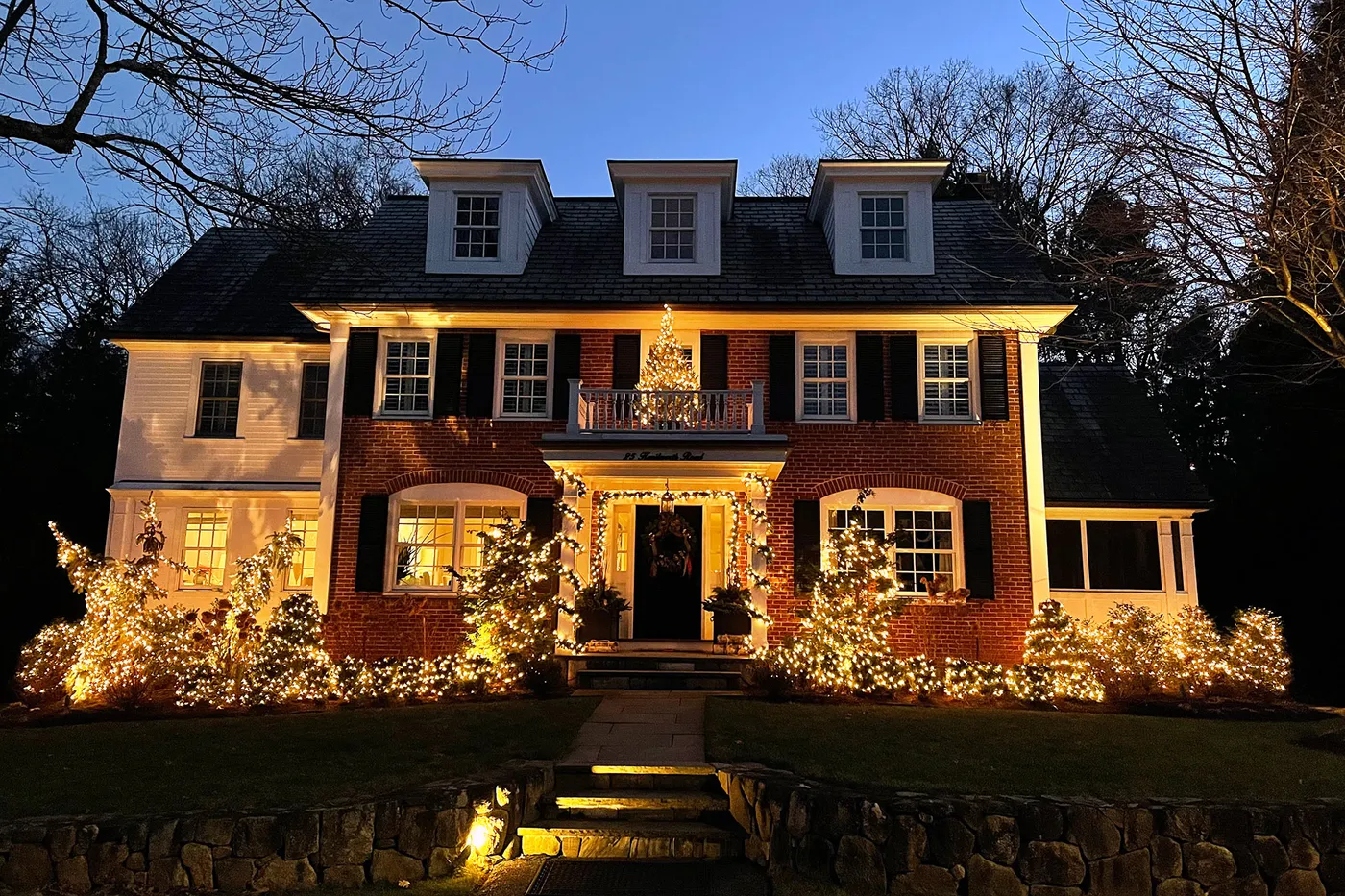
You can rebuild this for under $200. Six 100-count warm white strands from Walmart at $5–$8 each cover the foundation shrubs; two more wrap the door garland, and a $25 pre-lit 4-foot tree handles the balcony. Add a $12 mechanical timer so everything clicks on at 5 p.m. The brick is the expensive part — and you already own it.
7. Snow-Covered Victorian With a Multicolor Yard Tree
Snow looks magical and treats your wiring badly. Use only strands rated for outdoor use down to -20°F, keep every connection off the ground and wrapped in self-sealing silicone tape, and plug the whole thing into a GFCI outlet. Expect one dead section per season after a hard freeze. Replace it, don’t repair it, and store the spares somewhere dry indoors.
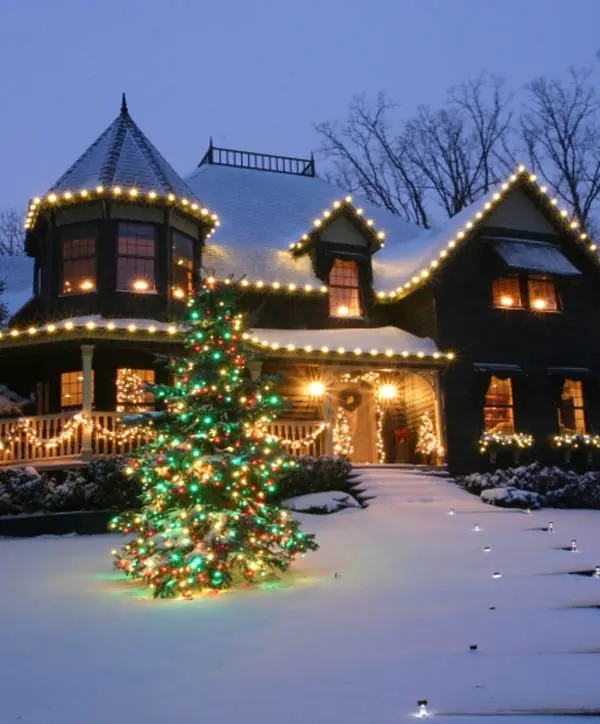
The single element carrying this whole scene is the multi-colored tree in the front yard. Everything else — the roofline outline, the turret, the porch garland — is disciplined warm white, which is exactly why one tree bursting with red, green, and gold reads as a deliberate focal point instead of chaos. Take it away and the house is elegant but anonymous.
8. Warm White Outlines Above Stacked Stone
Don’t outline the whole house. Outline the front-facing planes only: the main gable, the porch eave, and the two rooflines a driver actually sees. That’s typically 60% of the strands for 100% of the visual effect, and it keeps the side yard from turning into a tangle. Save the leftover budget for the stacked stone, which needs up-lighting to look like anything after dark.
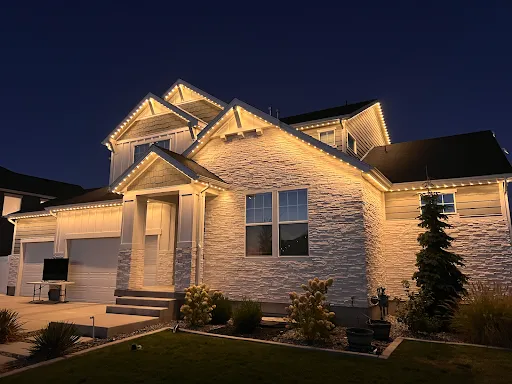
Roofline outlining is the least forgiving lighting there is. A sagging span of three inches is visible from the street, and it will be the first thing you notice in every photo you take. Run the strand through gutter clips every 18 inches, tension it gently, and never pull a set tight enough to strain the wire — the clips hold the shape, not the tension.
9. Wreaths on Every Gable and Warm White Rooflines
- Warm white roofline and window strands, 20–24 sets: $150–$380
- Pre-lit wreaths for four gables and windows: $180–$500
- Lit garland for two balconies: $120–$320
- Tree wrapping materials and clips: $70–$180
- Commercial-grade timer and cord management: $60–$140
- Total: roughly $580 to $1,520
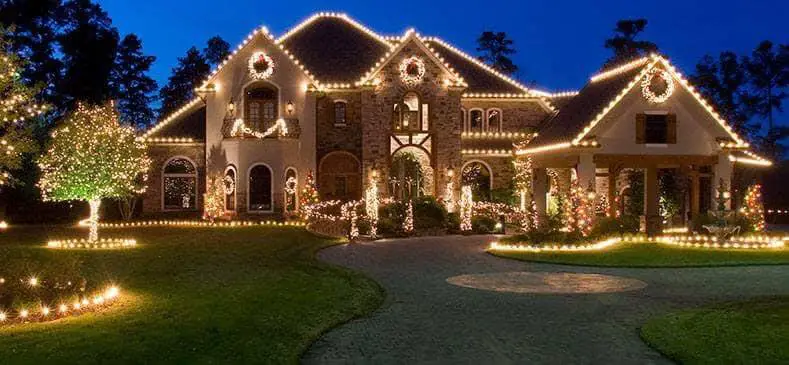
Budget alternative: three $30 wreaths from Target plus warm white strands from last year’s clearance bin get you about half the look for $260.
This is a two-story-house look. You need at least 3,000 square feet of facade with two or more gables and roughly 60 feet of frontage for the wreaths to space out properly. On a single-story ranch the same treatment crowds itself — Idea #33 shows the two-story version scaled down for a narrower lot.
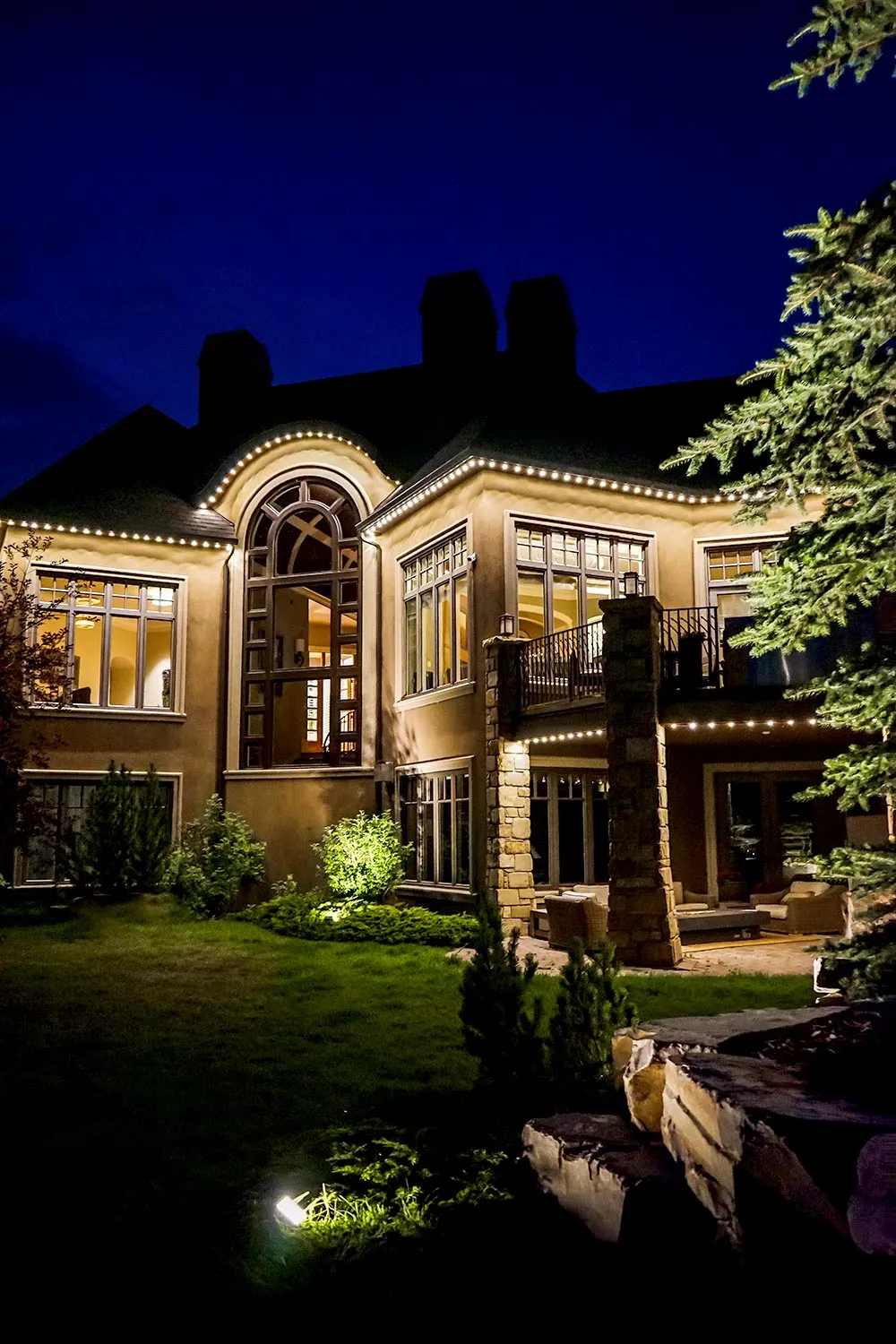
10. Roofline Lights That Let the Arched Windows Glow
The trick here is that the roofline lights never outshine what’s happening behind the glass. Interior lamps and a lit chandelier glow through the arched windows while the exterior strands sit a shade dimmer, so the house looks inhabited rather than floodlit. Warm white on both sides, same color temperature, and the stucco and stone pillar catch just enough bounce to hold their shape.
- Measure your total run before buying — roofline plus window outlines, in feet.
- Count your outdoor outlets and add a GFCI if you don’t have one.
- Note where your interior lamps sit in the windows after dark.
- Confirm you own a ladder that actually reaches the second-story eaves.
- Set a hard budget ceiling before you walk into the store.
11. Cool White Icicles Over Warm White Wrapped Trees
- Measure the eave and divide by the strand’s lit length, not its total length.
- Install gutter clips every 12–18 inches along the fascia.
- Hang the strand so the longest drips fall 3–4 inches below the gutter line.
- Start from the outlet end so the shortest plug reaches the power source.
- Step out to the street and check for even drip spacing before you climb down.
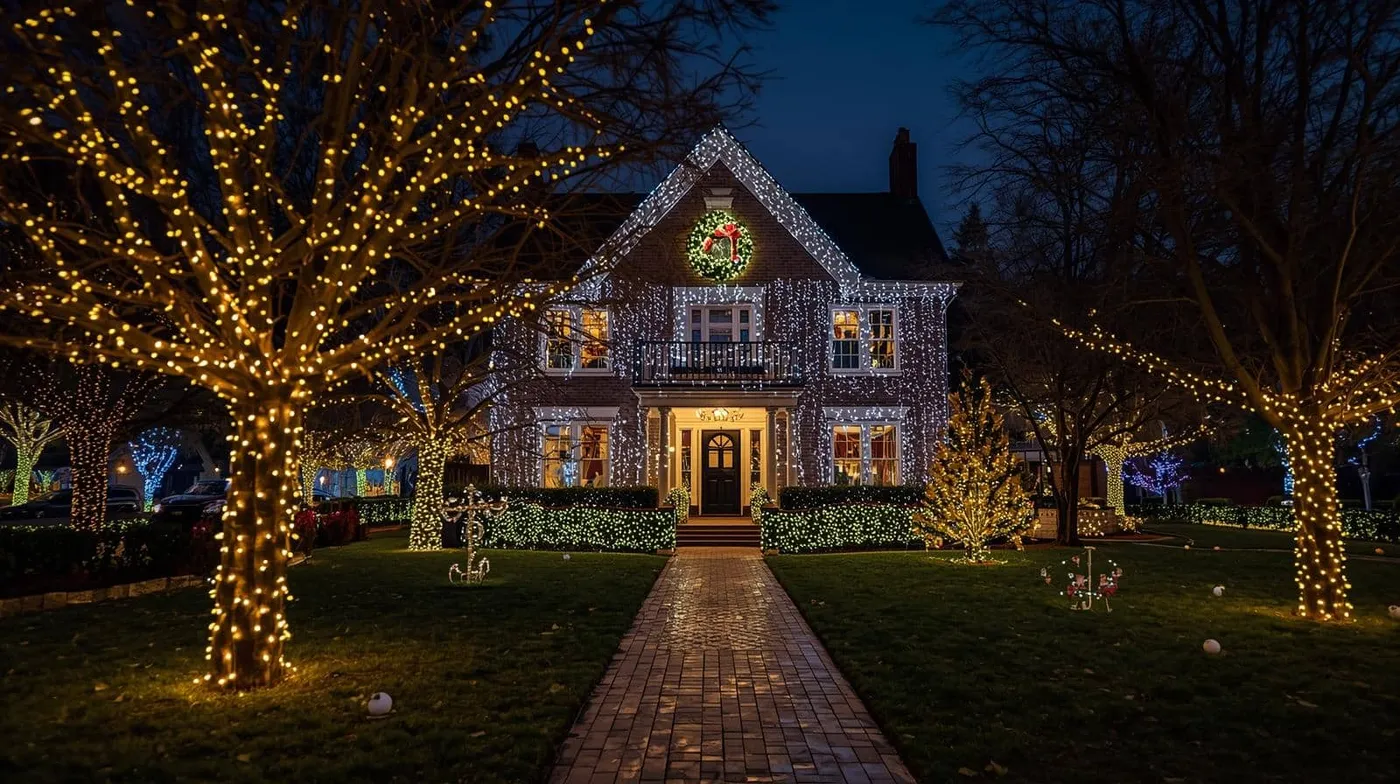
Two hours for a standard 40-foot front, about $60–$120 in clips and lights.
Cool white icicles and warm white trees can absolutely live on the same house — just keep them on different planes. Here the 4100K icicles sit on the eaves, the 2700K strands wrap the trees below, and nothing competes. Mix them on the same line and the icicles make the warm strands look yellow and dirty. Twenty degrees of color temperature is a real gap. Don’t blur it.
12. Character Cutouts and a Flag Built From Lights
The working formula is 50% roofline and path structure in warm and cool white, 30% character figures and sculptural pieces, 20% color. Swap the figures for whatever you love — penguins, a sleigh, a nativity — and the ratio stays the same. Break the 30% and the house stops being the anchor of the whole display.
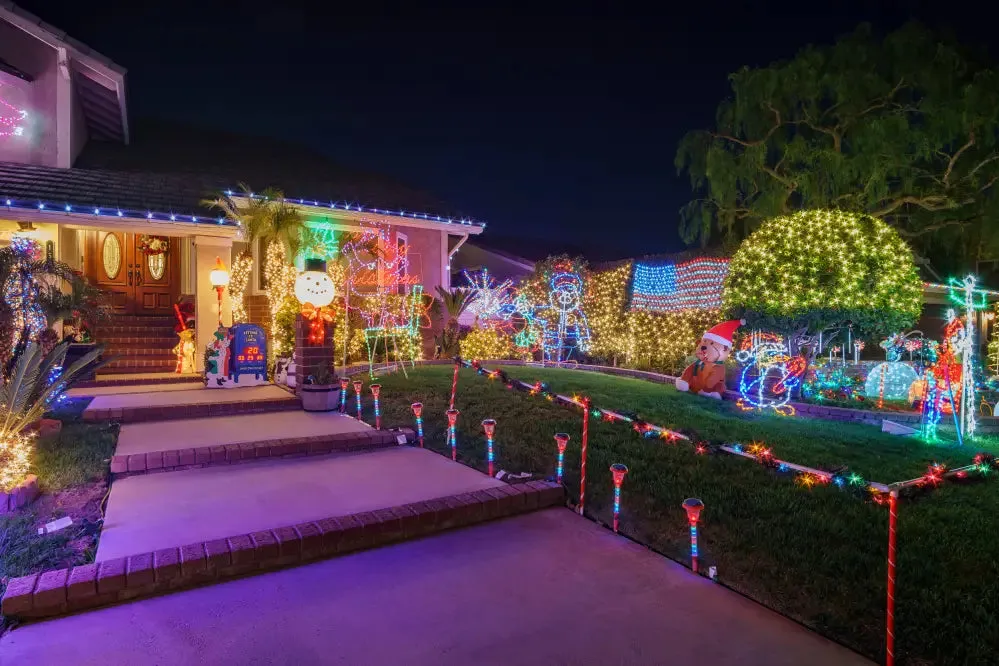
Density is the entire story. Because every square foot of lawn holds something — cutouts, wrapped bushes, candy cane stakes, a flag built from bulbs — the eye has nowhere to rest, and that’s the point. The roofline outline keeps a clean border around all of it, which is why the yard still reads as a designed display instead of a yard sale.
Store-bought character cutouts run $60–$150 each. Facebook Marketplace in early December is full of them at $15–$40, and vintage blow-mold figures are genuinely back in demand. Estate sale candy cane stakes go for fifty cents to a dollar. You’re decorating a lawn, not a gallery — mismatched eras just read as collected.
13. A Green Tree on the Left, a Red Tree on the Right
The mirrored trees are the entire idea. One bare tree wrapped solid green on the left, one wrapped solid red on the right, and the brick colonial sits between them like a frame. Everything else — the roofline, the porch, the shrubs — stays warm white so the two color statements land hard. It costs more than you’d guess, and it’s worth every strand.
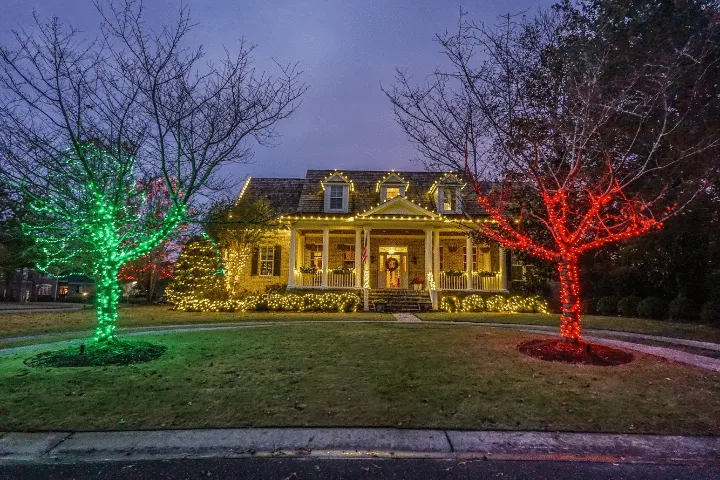
Wrapping two mature trees in single colors means buying 8–12 strands of the same color per tree, and you can’t fudge the count. A half-wrapped trunk looks like an abandoned project. Buy all of it in one trip from one brand, because dye lots on colored LEDs vary enough to show — green from two different manufacturers will not match in the dark.
14. Color-Changing LED That Shifts From Yellow to Violet
Color-changing LED strip has moved from novelty to default. In 2026 the good stuff uses addressable RGBIC chips, which means a single run can hold a gradient — yellow bleeding into violet along one continuous line — instead of one flat color. Homeowners are buying it because one $150 kit covers Halloween, the holidays, and a backyard birthday in July.
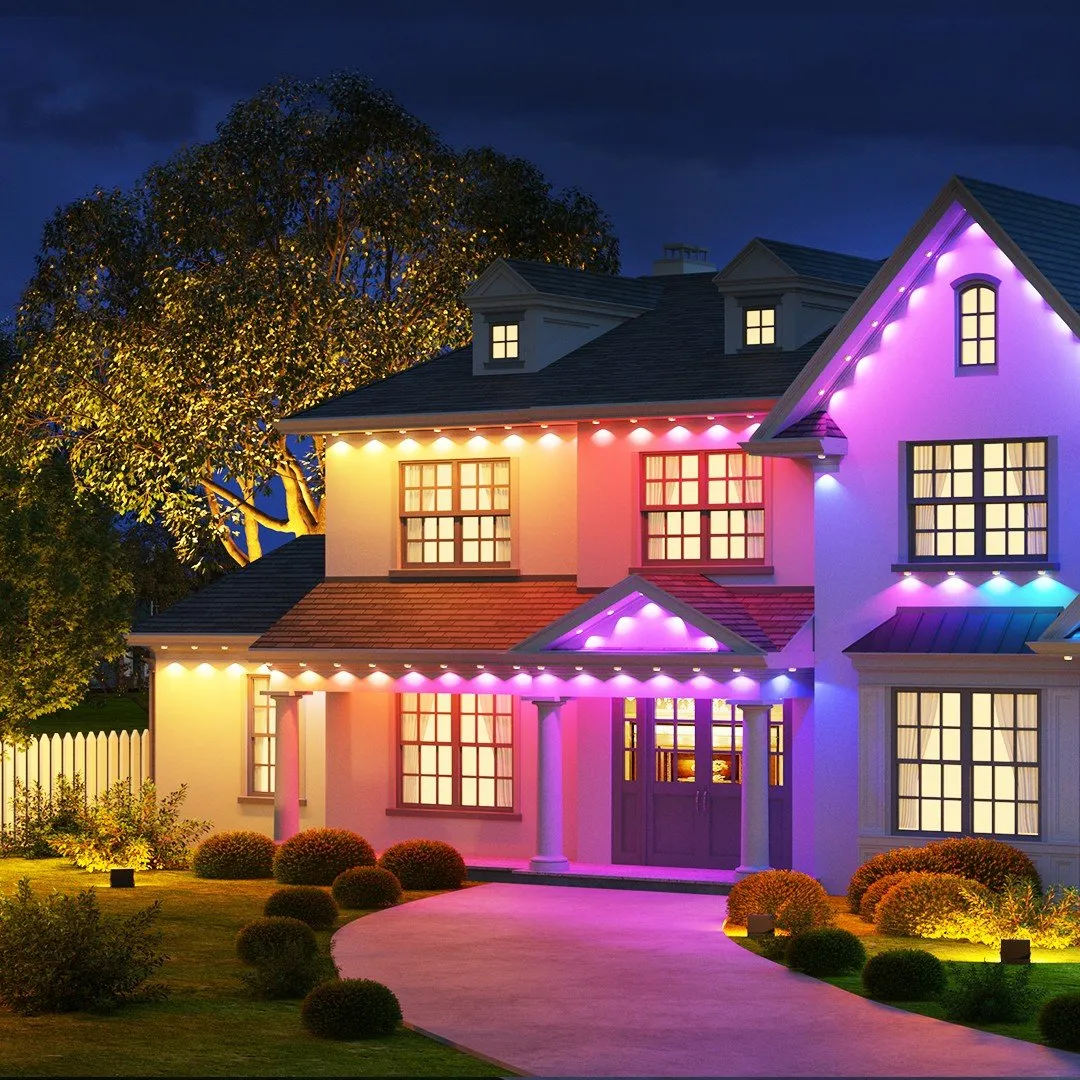
This treatment needs long, uninterrupted architectural lines. It works best on a house with at least 40 feet of visible roofline and continuous eaves; on a chopped-up facade with dormers every ten feet, the color transitions read as random. For a smaller or more traditional house, look at Idea #2, which runs a single rainbow gradient across the gables and stops there.
15. Bulbs Lining the Driveway and a Wreath in the Arch
- Warm white roofline and driveway-bulb strands: $180–$420
- Oversized lit wreath for the arched window: $90–$250
- Wrapped shrubs and small trees, 8–10 sets: $60–$150
- Stake lights along the driveway edge: $70–$190
- Timer, stakes, and cord covers: $50–$120
- Total: roughly $450 to $1,130
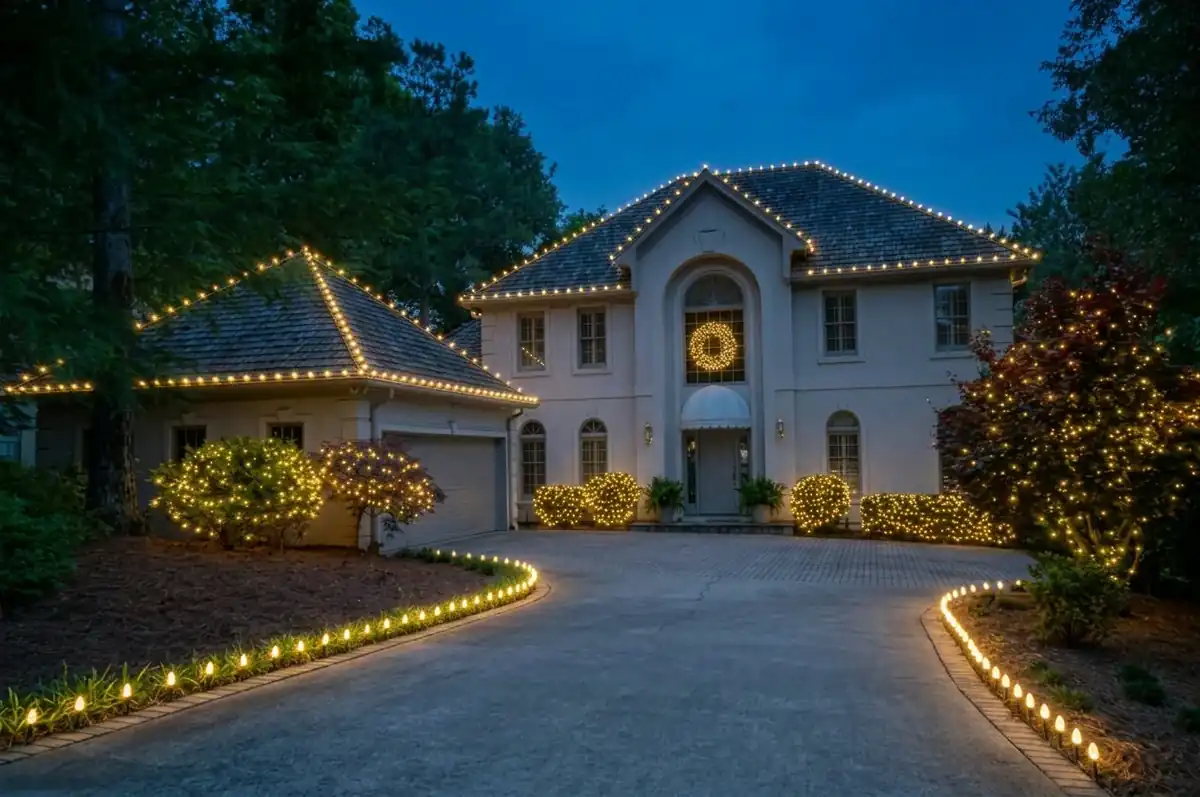
Budget alternative: skip the oversized wreath and hang a $40 pre-lit 36-inch one instead — the rest lands near $250.
- Mark the driveway edge with landscape flags so you don’t drift into the beds.
- Space stake lights 4–6 feet apart; closer looks frantic, farther reads as gaps.
- Run one shared cord along the back of the stakes instead of one per light.
- Staple or bury the cord where the lawn meets the pavement.
- Angle each stake head slightly toward the house, not up into the sky.
About 90 minutes and $25–$50 in stakes and staples.
16. Multicolor Eaves on a Tudor’s Dark Timbers
What keeps this from turning messy is separation of labor. Multicolor strands get the rooflines only — the one place your eye already expects a bold line. Warm white handles every window, shrub, and tree, so the Tudor’s dark timbers and cream stucco still read clearly underneath. Each color layer has exactly one job, and nothing overlaps.
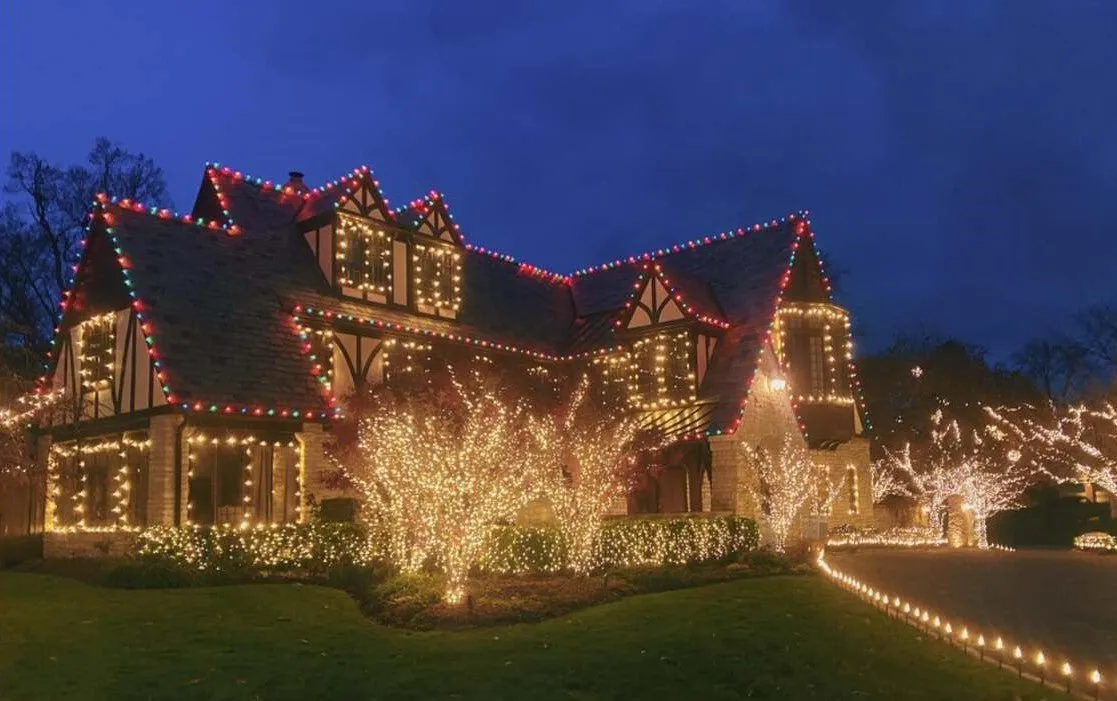
Never splice multicolor and warm white onto the same run. They draw different wattages, and one overloaded circuit is the top reason holiday lights die mid-season. Give the roofline its own timer and the warm white its own — two $12 plug-in timers, two circuits, zero flickering in January.
The multicolored eaves are the one element you’d miss. Trade them for warm white and this becomes a lovely but completely ordinary Tudor. That color band outlines the steep gables and makes the composition feel like a storybook house rather than a well-lit one.
17. Wrapped Porch Columns and a Lit Garage Wreath
Wrapping four porch columns takes roughly 25 feet of strand per column at 12-inch spacing. Instead of buying four 100-count sets, buy one 300-count spool for $30–$45 at Home Depot and work it column to column without cutting. Add two $20 wreaths — one for the door, one oversized for the garage — and the whole house lands around $180 with Target and Walmart strands.
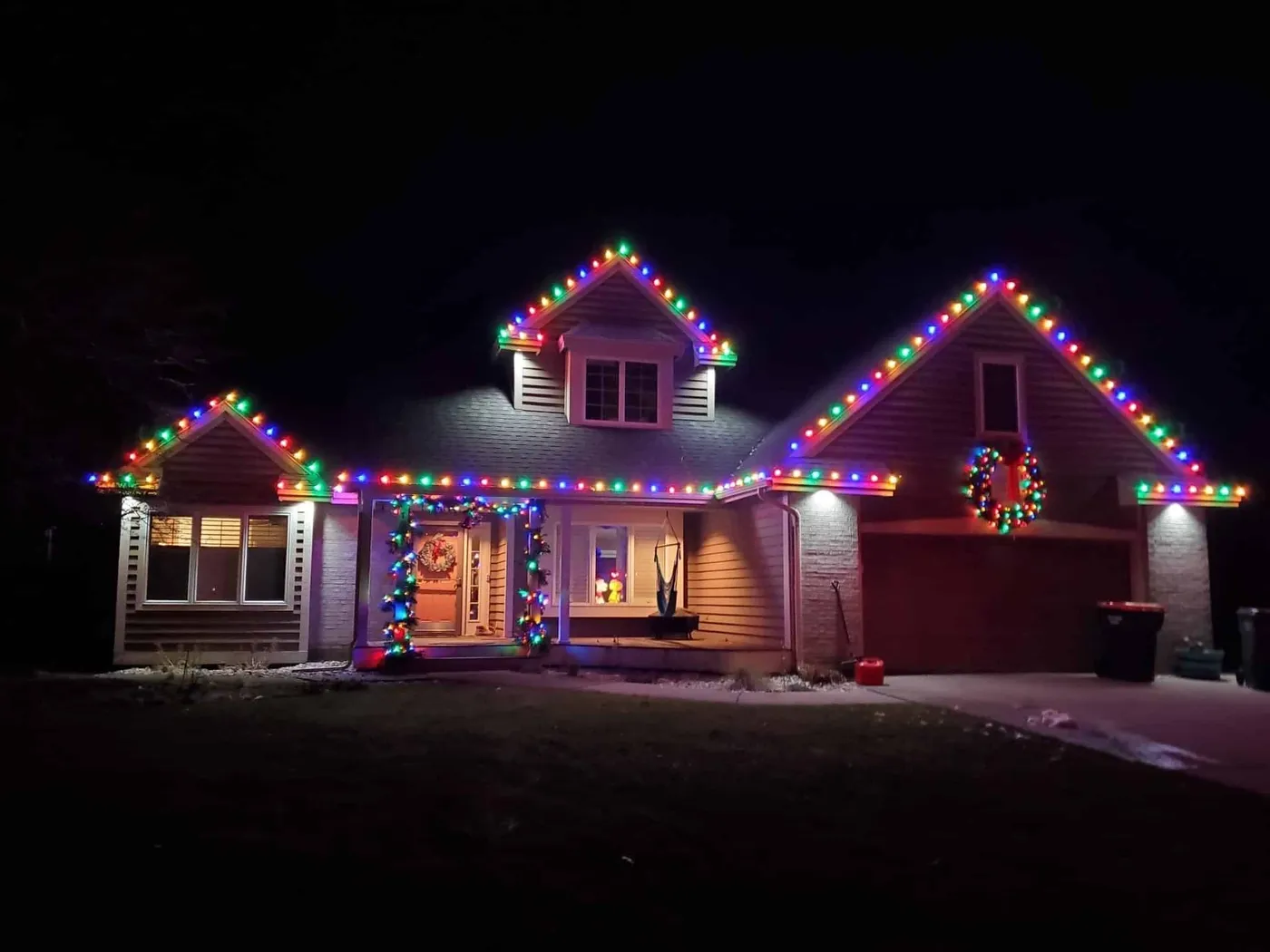
Column wrapping is the job that looks easy and eats a Saturday. Budget 20–30 minutes per column for a clean spiral, longer if you’re balancing a ladder on a step. Start at the top and wrap downward so gravity helps you keep even spacing, and secure the top and bottom with a clip — not a nail, which will rust a streak down the column’s finish.
18. Potted Evergreens and a Curved Path of Warm White
The palette formula is 65% warm white on architecture, 25% warm white on greenery, and 10% warm accent from the uplights washing the walls. There’s no second color anywhere, which is exactly why it feels calm instead of busy. Want more personality? Change the greenery, not the lights — trade boxwood for magnolia and the entire mood shifts.
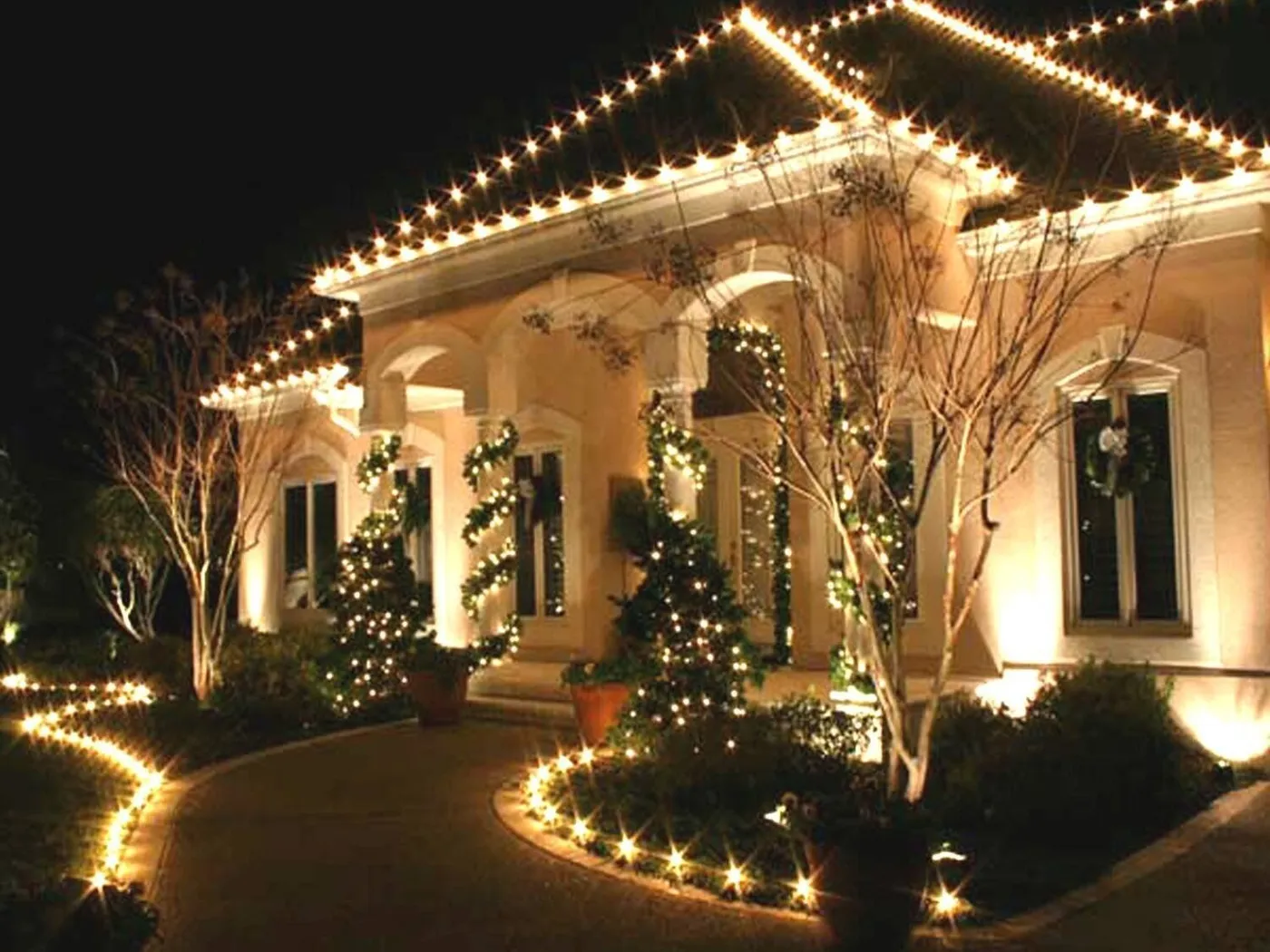
The potted evergreens flanking the entrance do more work than the roofline. They give the eye a place to land at the door, they’re the only elements at human scale, and they can be moved, re-potted, or replaced next year without touching a single clip. A $60 pair of pre-lit potted trees can carry an entire entry on their own.
19. Lit Hedges Under a Stone Facade and Two Wreaths
Net lights are the right tool for hedges, and almost nobody uses them correctly. A 4-by-6-foot net covers roughly a six-foot run of three-foot-tall hedge. Drape it over the top and let it fall down both sides instead of stuffing it into the branches — you’ll get twice the coverage from the same strand with no bare patches at the base, and the window frames above stay the star.
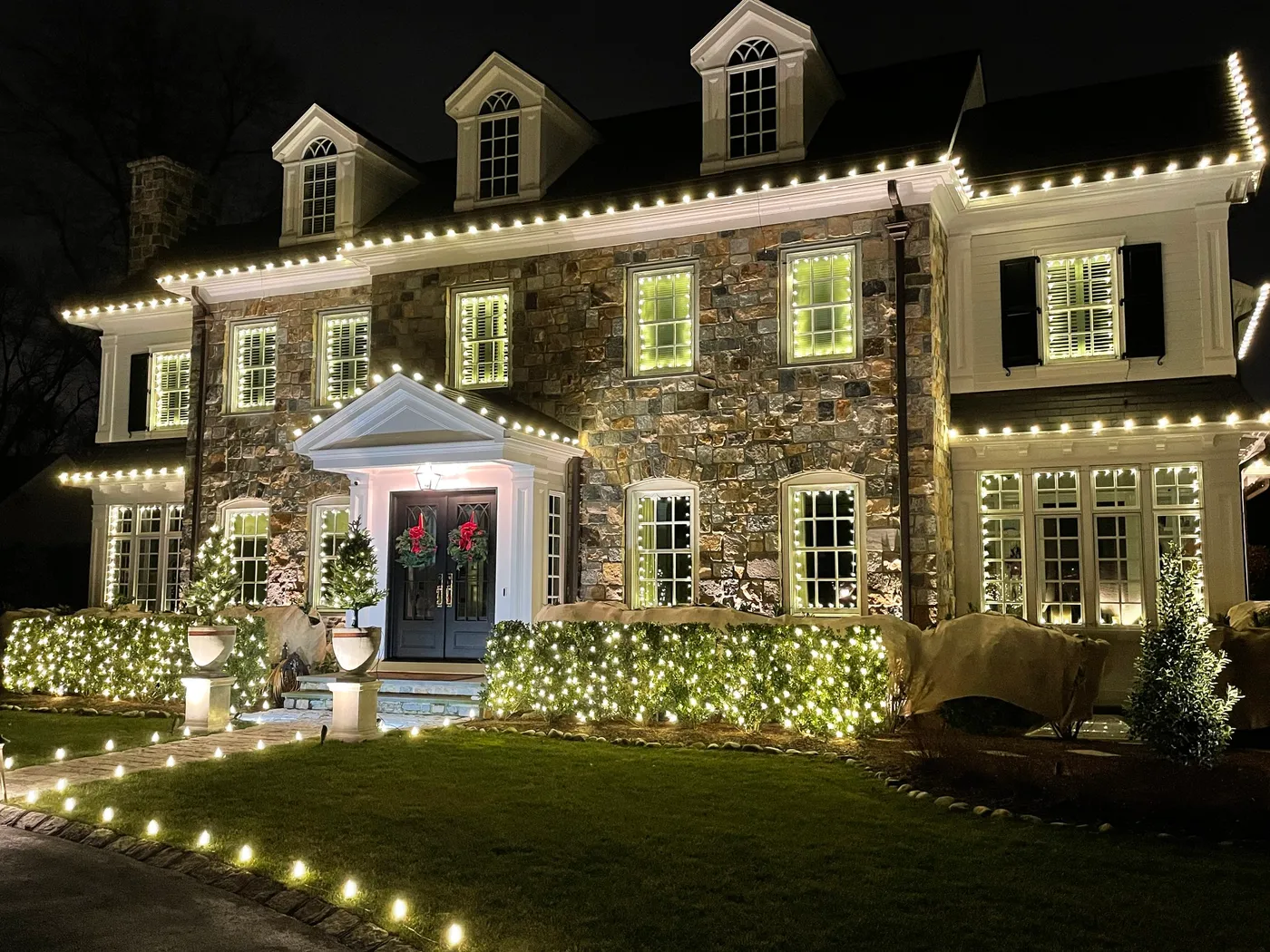
Here’s the conflict nobody mentions: net lights and hedge trimming happen in the same season. If your hedges need a cut in late fall, trim first, then net. And expect the nets to snag on every twig when you pull them down in January. Store them flat in a labeled bin, not balled up in the garage, or you’ll spend next December untangling instead of decorating.
20. Scalloped Light Drapes Under the Porch Eaves
- Measure the porch eave and divide by your desired swag width — 18–24 inches is the sweet spot.
- Install a cup hook or gutter clip at each swag point, evenly spaced.
- Drape the strand in a shallow U between hooks; deeper swags read droopy.
- Clip the strand at each hook so it can’t slide along the eave.
- Wrap the porch columns last so the drape stays the headline.
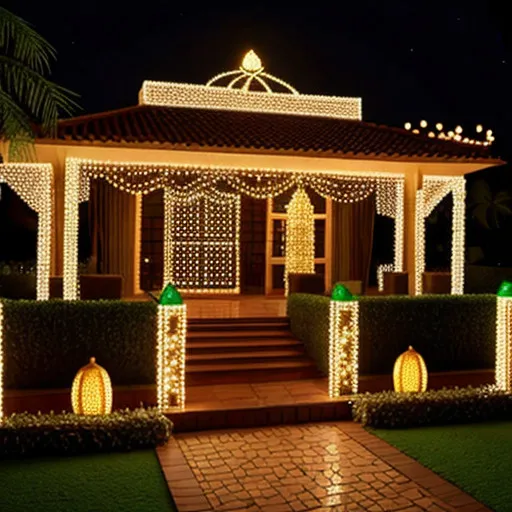
Two to three hours and about $40 in hooks and clips.
Scalloped draping needs porch height to work — 9-foot ceilings minimum, 10 is better. Below 8 feet the swags hang into headspace and the whole entry starts to feel like a tent. Wide porches with three or more visible bays look best; a narrow single-bay entry is better served by a simple roofline outline and one strong wreath.
Those lit decorative lanterns on the lawn run $80–$150 each at garden centers. A plain black metal lantern from Walmart at $18 plus a $6 battery candle gets you most of the effect for the price of one. Line them beside the walkway, set the candles on a timer, and nobody will ask where they came from.
21. Window Frames Traced Along a Winding Walk
- Warm white strands for rooflines and window frames, 16–20 sets: $130–$320
- Wrapped landscape shrubs: $50–$130
- Ground path lights for the winding walk: $60–$160
- Timers and outdoor-rated cords: $40–$90
- Total: roughly $280 to $700
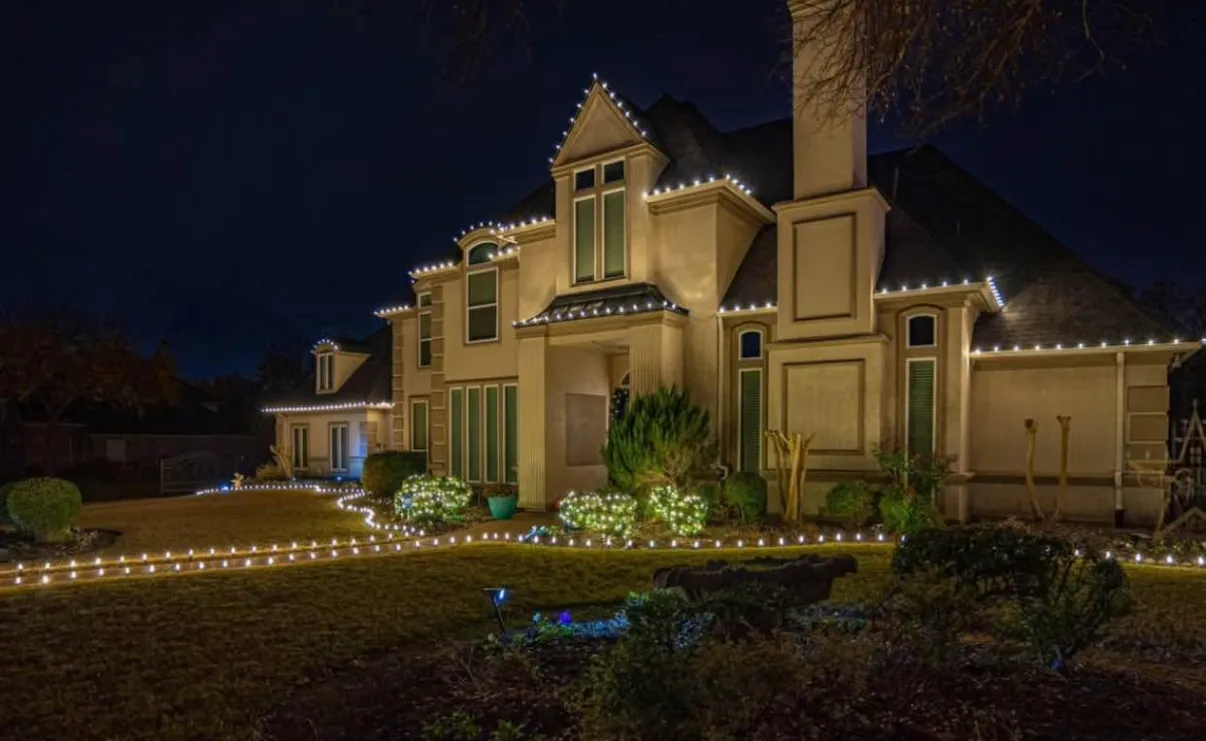
Budget alternative: outline the front windows only and use $6 Walmart strands — this look lands near $140 and still reads beautifully from the street.
Tracing window frames works because it turns each window into a lit rectangle, and repeated rectangles read as rhythm. The light beige stucco helps enormously here — a pale facade bounces warm white back and softens the edge of every frame. Dark brick would eat this treatment alive, which is why Idea #24 takes a much simpler approach with those walls.
22. WISH Letters, Plaid Banners, and a Big Lit Wreath
The illuminated WISH letters are the thing you remember. They sit beneath the wreath, in the same warm white as everything else, and they give the entry a message instead of just a glow. Take them away and the porch is pretty but quiet — that’s the difference between decorated and decorated with a point of view.
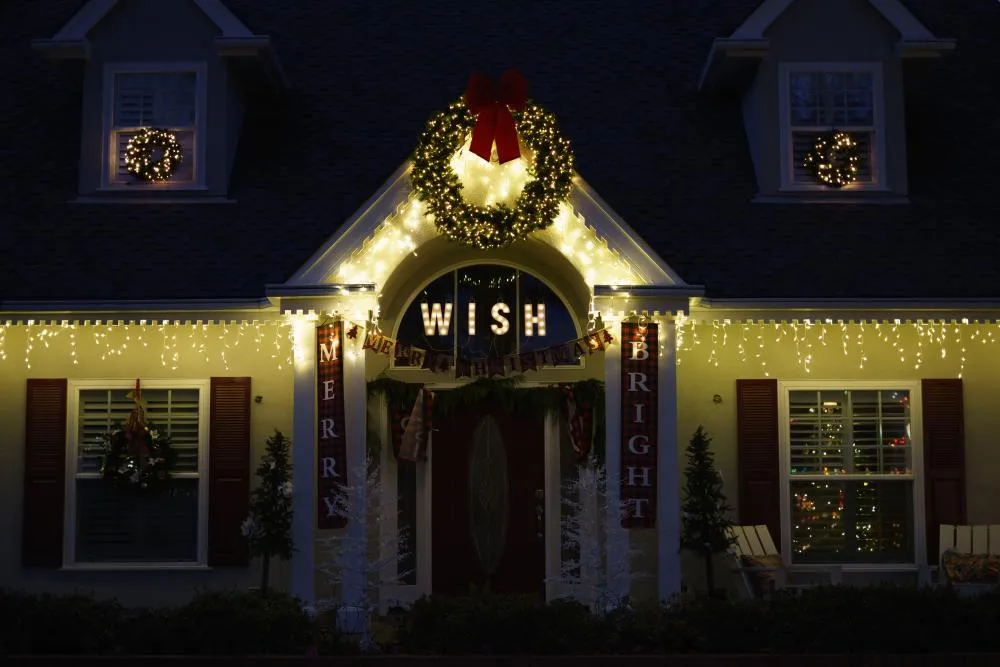
Marquee letter sets sell for $80–$200 at home decor stores. You can build your own with 12-inch papier-mâché letters from a craft store at $6 each, a can of white spray paint, and a strand of warm white fairy lights threaded through holes punched with a skewer. Total: about $45 for four letters and one cozy evening of work.
23. Red, White, and Blue Garland on a Porch Railing
Porch lighting has quietly become a year-round hobby, and the hardware proves it. Red, white, and blue garland, lighted flag wall art, and LED USA lettering are now stocked alongside the December inventory. People are leaving permanent clips on the porch and swapping light sets four times a year instead of hauling everything out of storage once.
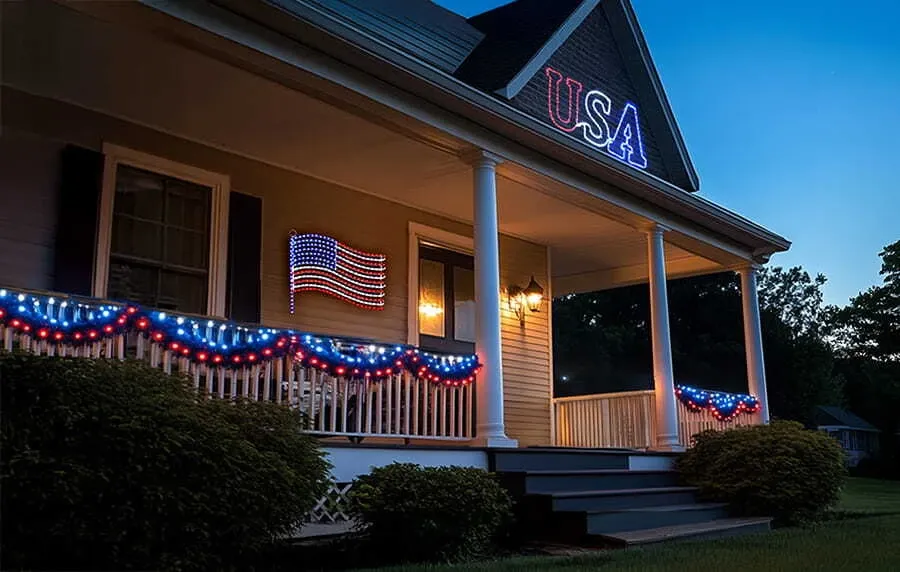
Install the clips once and the rest of the year gets easy. Put white cup hooks or adhesive clips at 18-inch intervals along the railing and the gable, then buy a different colored strand for each season. Swapping an entire porch takes under an hour when the hardware is already up, versus a whole afternoon starting from zero every time.
24. A Thin Warm White Outline on Dark Red Brick
Dark red brick swallows light. Strands that look brilliant on a beige house go dim and muddy against brick, and cool white is the worst offender — it reads grey-blue on a red surface. If your brick is this dark, buy warm white at 2700K, skip icicles entirely, and accept that you’ll need about 20% more footage than you estimated to get an even glow.
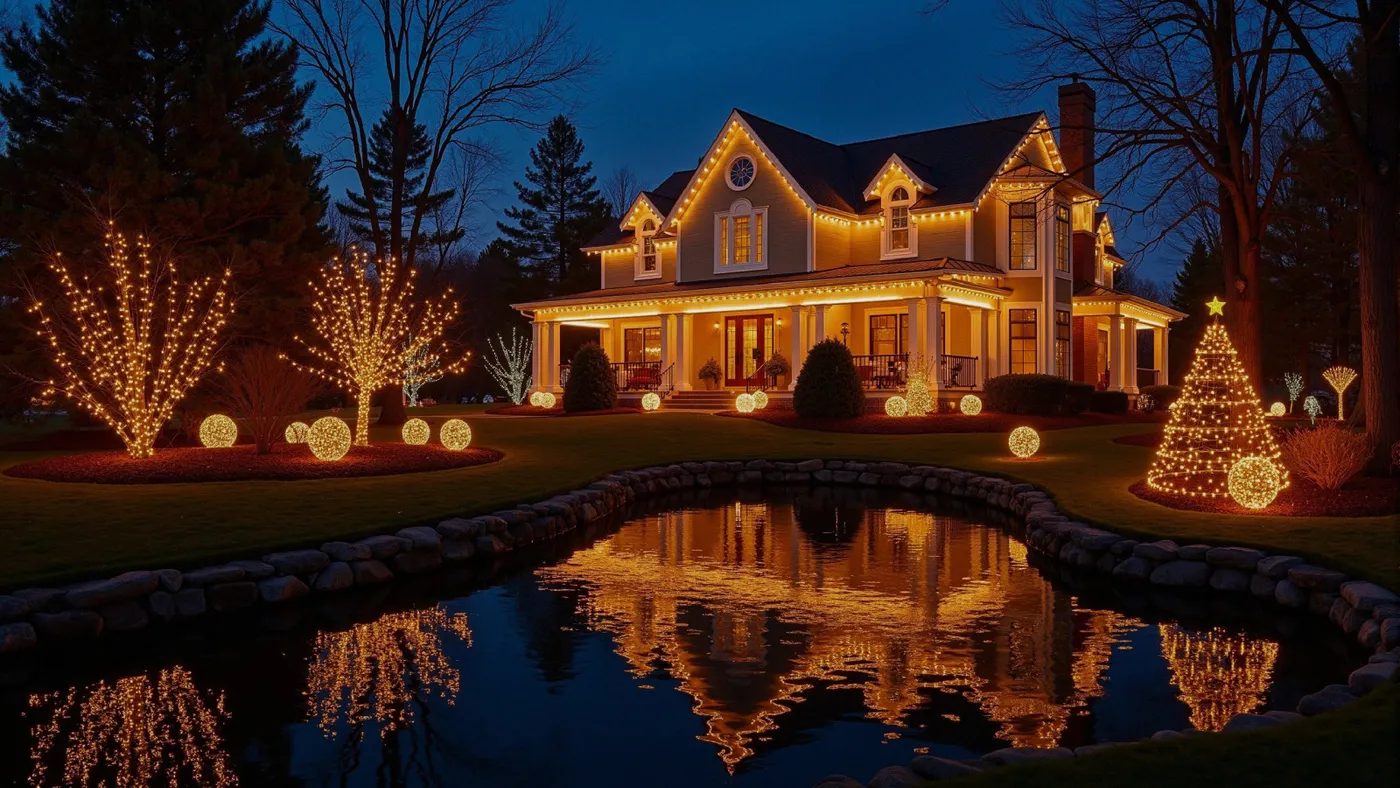
The formula here is deliberately thin: 70% unlit house, 25% warm white outline, 5% red accent on the wreath bow and nothing else. It’s the opposite of a maximalist lawn, and it works because the brick itself supplies all the texture. Swap the red bow for plaid ribbon and the whole entry tilts farmhouse without changing a single strand.
25. Bare Trees Wrapped in White Above Wet Pavement
- White strands for roofline and windows, 18–24 sets: $150–$380
- Bare tree wrapping, 4–6 trees, 30–50 sets: $250–$650
- Wreaths and door accents: $60–$160
- Clips, stakes, and cord covers: $45–$110
- Total: roughly $505 to $1,300
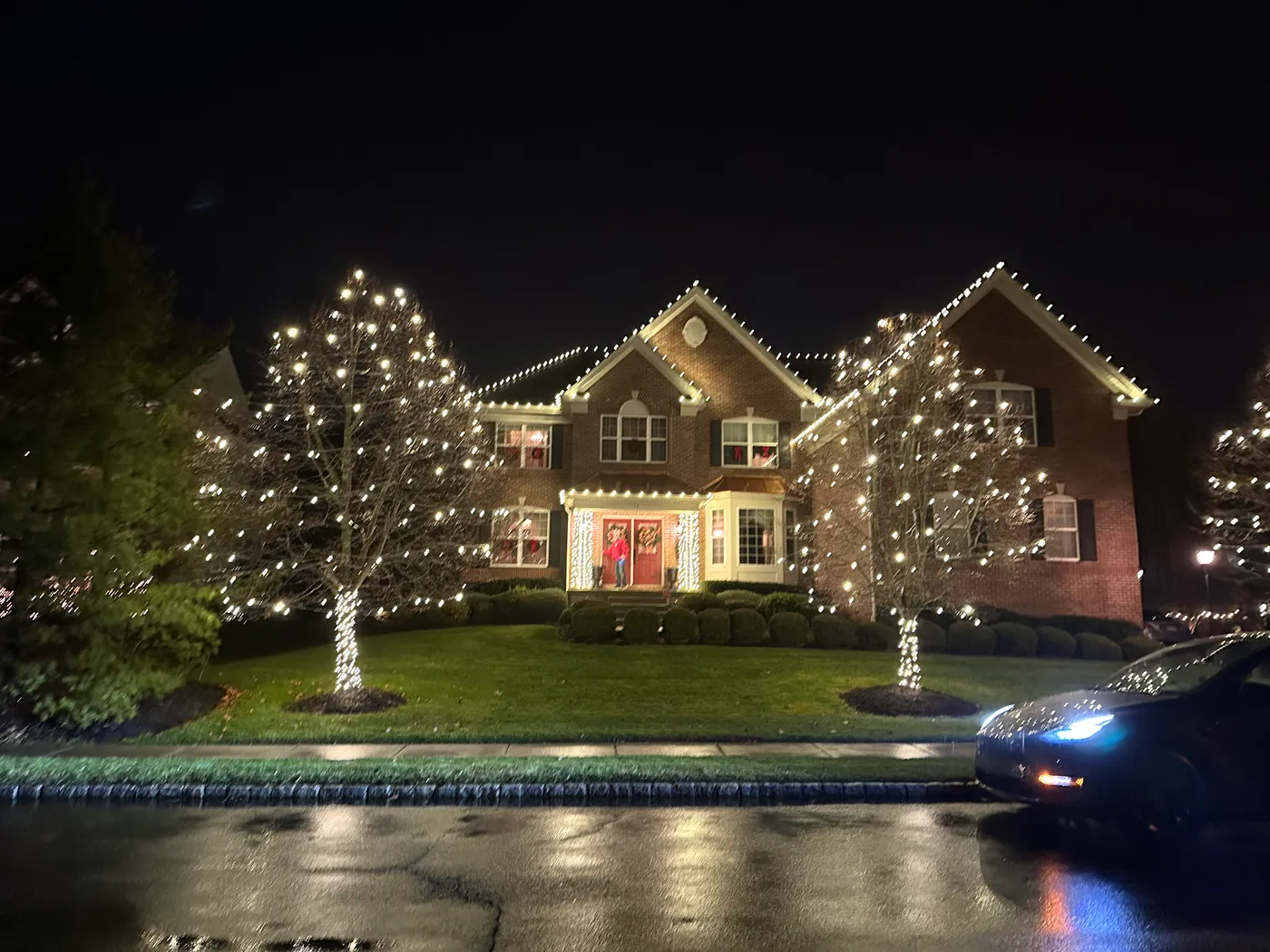
Budget alternative: wrap the two trees closest to the street and leave the rest bare — you’ll cut the light bill in half, and the silhouettes against the glow actually get stronger.
- Start at the trunk about 12 inches above the soil and anchor the strand end with a clip.
- Wrap upward in a consistent 6- to 8-inch spiral, keeping tension even.
- At each main branch, split the strand and wrap outward to the branch tip.
- Work from the center outward so the trunk stays fully covered.
- Test each tree before moving on — troubleshooting from a ladder is no fun.
About 45 minutes per medium tree; $30–$60 in lights per tree.
26. A Lit Tree Glowing Through an Outlined Window
This is one of the most forgiving looks in the entire lineup. The outline works on facades from about 28 feet wide up to 45, and a single-story version reads just as well as a two-story because the lit window gives the composition a center. You do want at least one large ground-floor window that’s fully visible from the street.
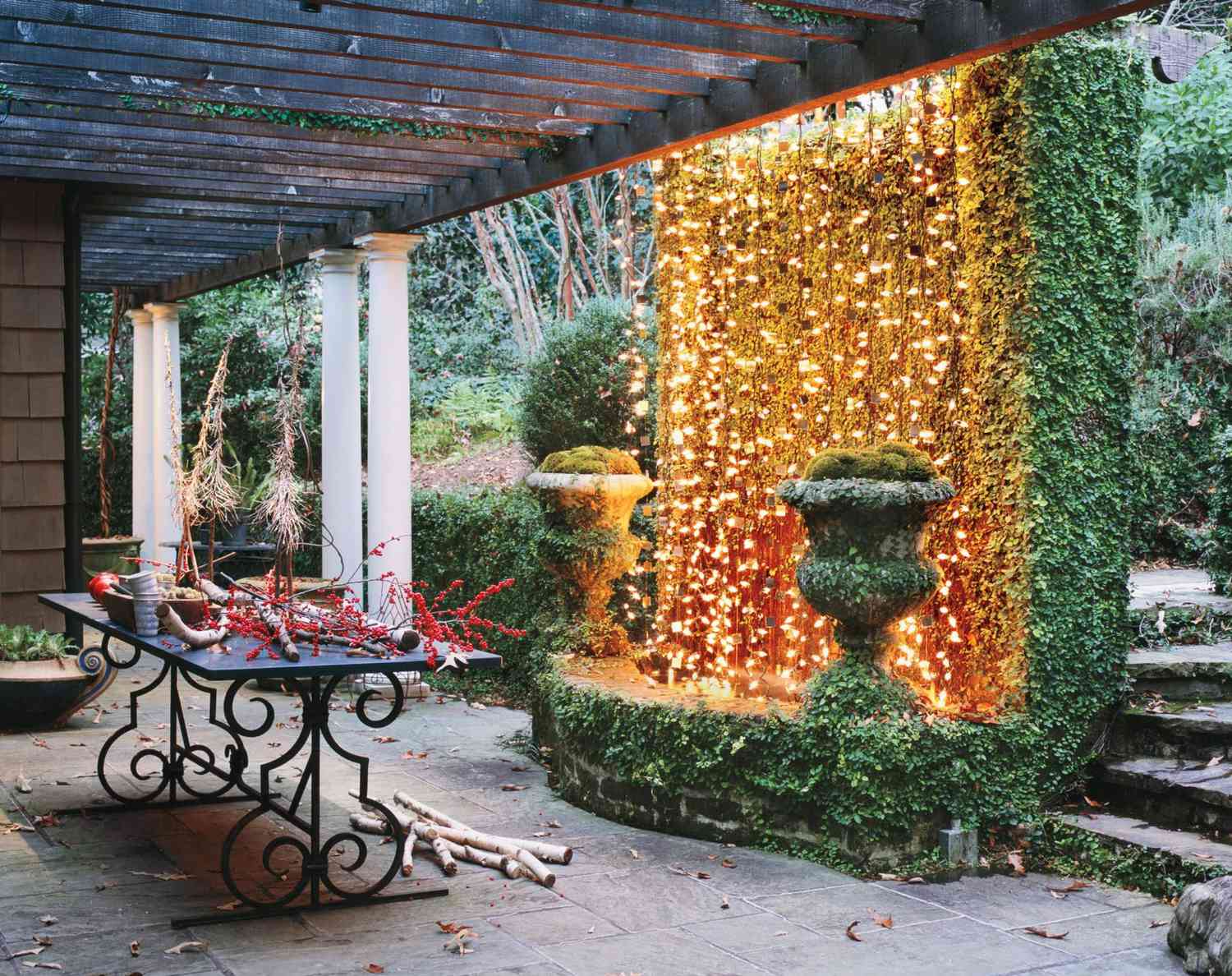
You don’t need a $400 lit tree behind that glass. A $60 six-foot unlit tree from Walmart with two $8 strands of warm white is indistinguishable from the curb, and a $25 pre-lit tabletop tree in a bay window does the same job. The exterior outline is the expensive part — let the interior be the bargain.
27. Icicle Lights Dripping Over Stone Porch Columns
Icicle lights get a bad reputation because people hang them at random depths. Here the drips stay between 3 and 4 inches and stagger evenly, so the roofline reads as one soft edge instead of a fringe. The stone columns catch the light and warm it slightly, and the big wreath in the central window gives your eye a single place to land.
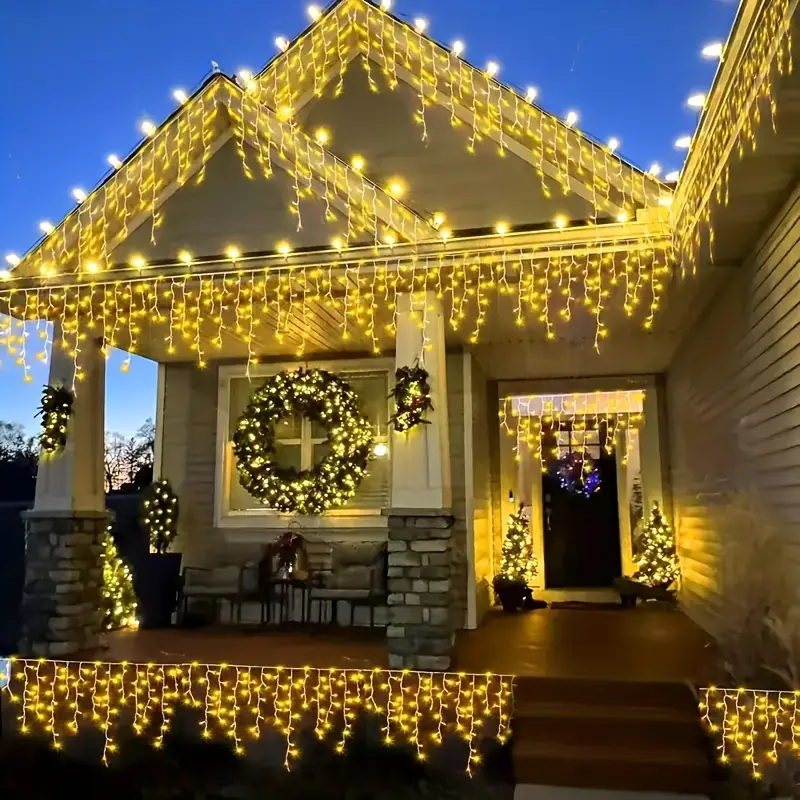
That oversized illuminated wreath is doing more than its fair share. It anchors the composition, echoes the roofline’s curve, and it’s the only thing at eye level when you walk up the steps. Without it you’d have a nicely lit porch with no focal point — and porches without focal points photograph terribly.
- Icicle lights for roofline and porch, 10–14 sets: $90–$210
- Large lit wreath, 48 inch: $120–$320
- Small potted lit trees, pair: $60–$150
- Column hooks and clips: $25–$60
- Total: roughly $295 to $740
Budget alternative: a $45 36-inch pre-lit wreath plus $6 strands everywhere else gets you to about $180.
28. Every Roofline Edge Traced on a Single-Story Ranch
On a single-story ranch, outline the roof edges and stop. Every eave, dormer, and gable traced in the same warm white creates a continuous glowing line that makes a low house look wider and more substantial than it actually is. Skip the windows on a facade this long — tracing both the roof and every window turns a clean line into a grid.
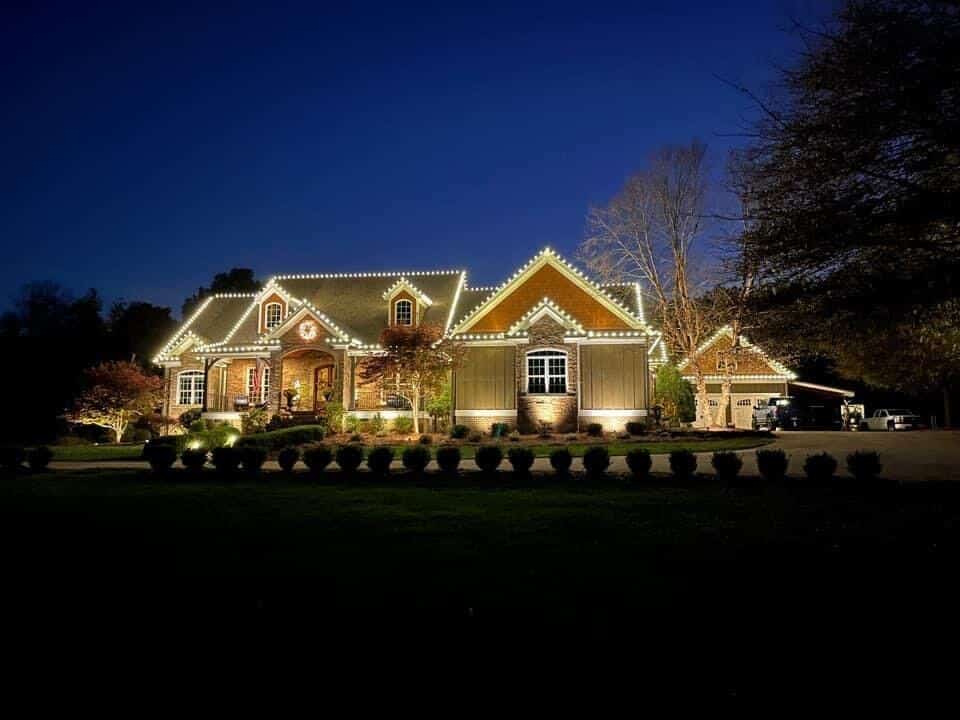
Roofline-only displays are the easiest to maintain, and that’s not an accident. Strands clipped along the fascia stay drier than anything in the landscaping, so you’ll typically lose one section every two seasons instead of one per season. Plan on replacing about 10% of your strands annually, and buy the same brand every year so the whites keep matching.
29. Uplights That Graze the Stone and Outline the Gables
- Set uplights 12–18 inches from the stone wall and aim them 30 degrees up the face.
- Space fixtures 6–8 feet apart for even grazing.
- Aim away from windows so the beam doesn’t flare into the room.
- Use 2700K lamps so the stone reads warm rather than grey.
- Run the roofline strands on a separate timer so you can dim the mood later in the evening.
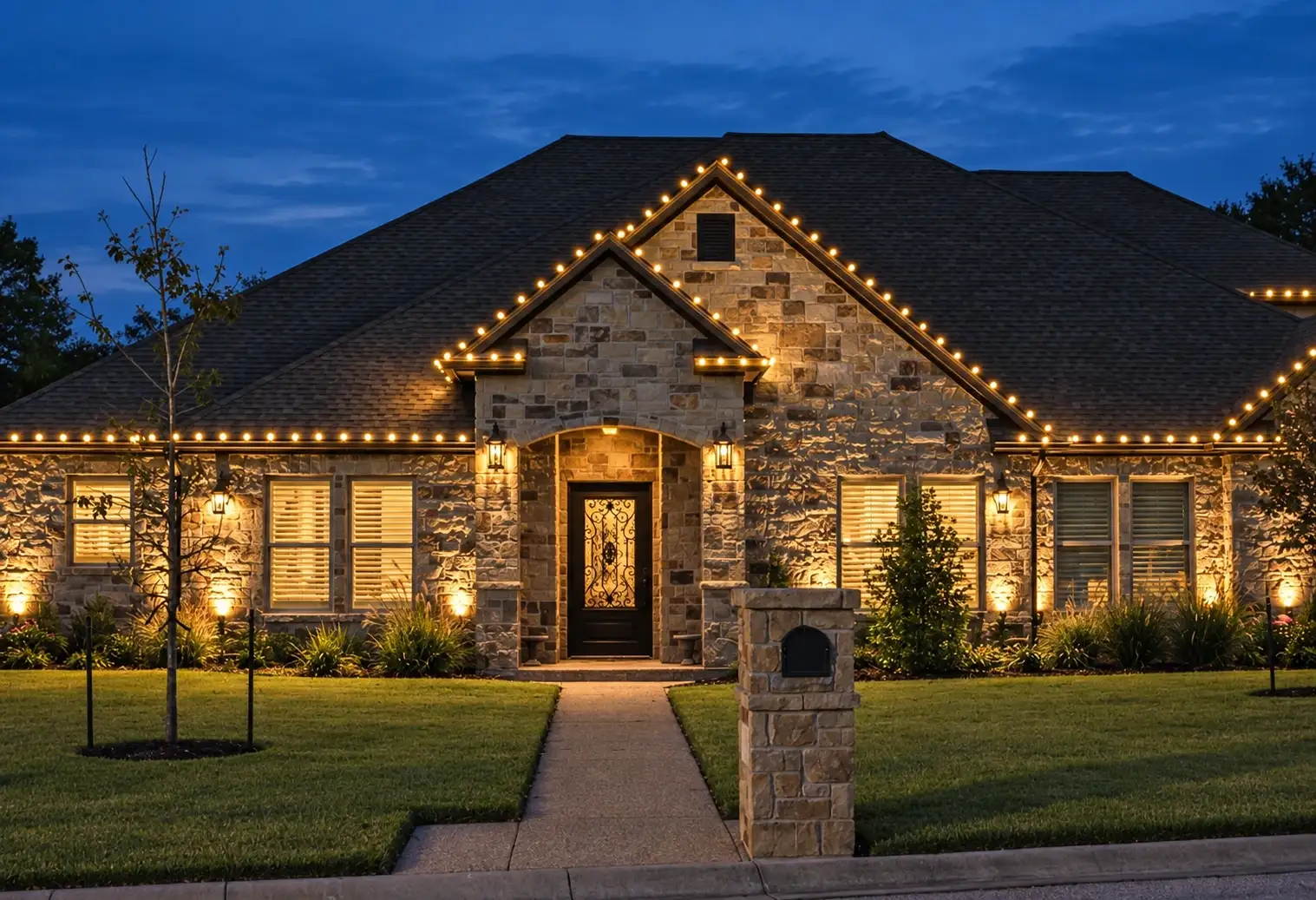
Three hours and $120–$300 for six fixtures.
Uplighting textured stone is genuinely tricky — the wrong angle flattens the texture or throws a hard-edged box of light up the wall. Test one fixture at night before installing all six, and be ready to move it two or three times. It’s the same patience required for Idea #8, which uses the same grazing technique on entirely different materials.
30. Multicolor LED Strips on a Ranch Facade
The ratio here is 55% rainbow LED on the architectural lines, 30% dark house left alone, 15% warm white accents at the entry. The dark shingles and stone veneer are what keep the colors from turning into a funhouse — your eye needs that black roof as a place to rest. Swap rainbow for red and white and the same 55/30/15 formula works for December.
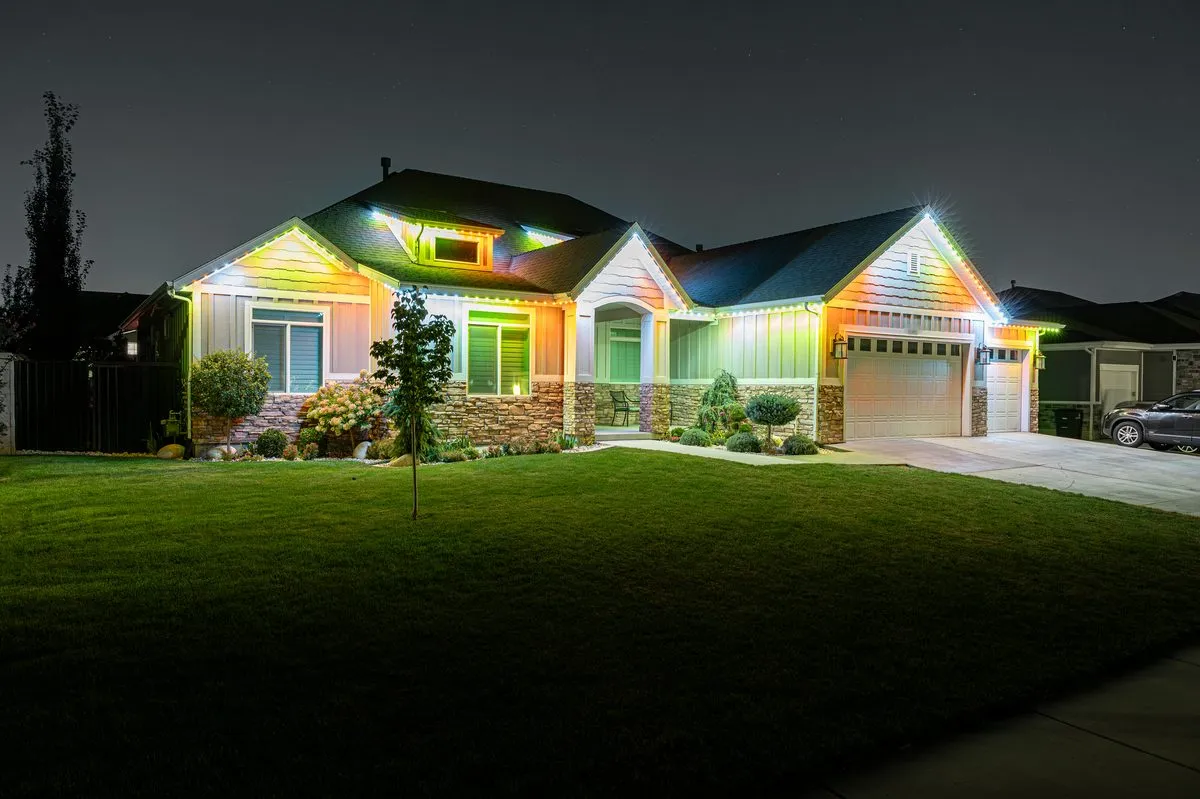
Cheap strip lighting looks cheap for one reason: visible diodes. Look for a strip with at least 60 LEDs per meter and a diffused silicone coating rather than bare epoxy. It costs about 30% more, but from the street the difference is a smooth ribbon of color versus a string of individual dots you could count from the driveway.
31. An Arched Entry Framed in Warm White With Two Wreaths
- Warm white roofline strands, 16–20 sets: $130–$330
- Arched entry and transom outlining: $40–$100
- Two lit wreaths for the front doors: $70–$180
- Clips, cords, and timer: $45–$95
- Total: roughly $285 to $705
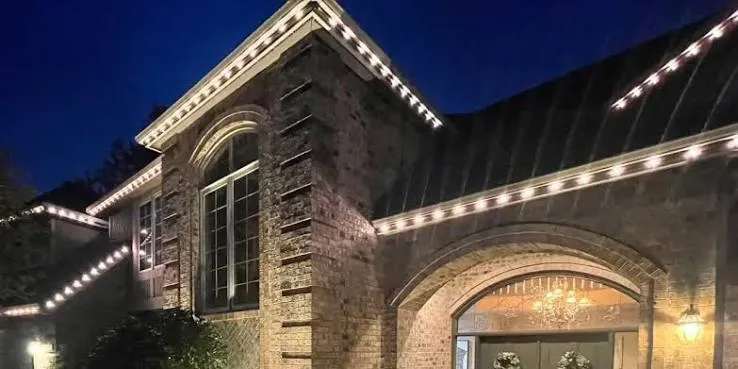
Budget alternative: outline the main rooflines and the arch only, skip the gables, and use $6 strands — you’ll come in near $160.
- Measure the arch’s circumference, not its width — curved runs eat strands.
- Check your outlet’s capacity before adding the entry lights.
- Confirm wreath size against the door width; oversized wreaths block the transom.
- Decide whether you want the foyer chandelier visible at night — it changes the mood.
- Buy extra clips; brick trim needs adhesive hooks.
The one real risk with a full roofline and a lit entry is overload. Two 100-count incandescent strands can pull more power than an entire modern LED display. If your lights are more than five years old, check the label — switching to LED lets you double the display on the same circuit without tripping a breaker.
32. Warm White House, Multicolor Hedges, Dark Wood Gable
This works because the two lighting systems are speaking to different materials. Warm white strands outline the dark wood siding and grey stucco, where a rainbow would look garish. Multicolor strands stay low in the hedges, where they’re half-hidden and read as a glow rather than a line. High neutral, low color — one rule, and it almost never fails.
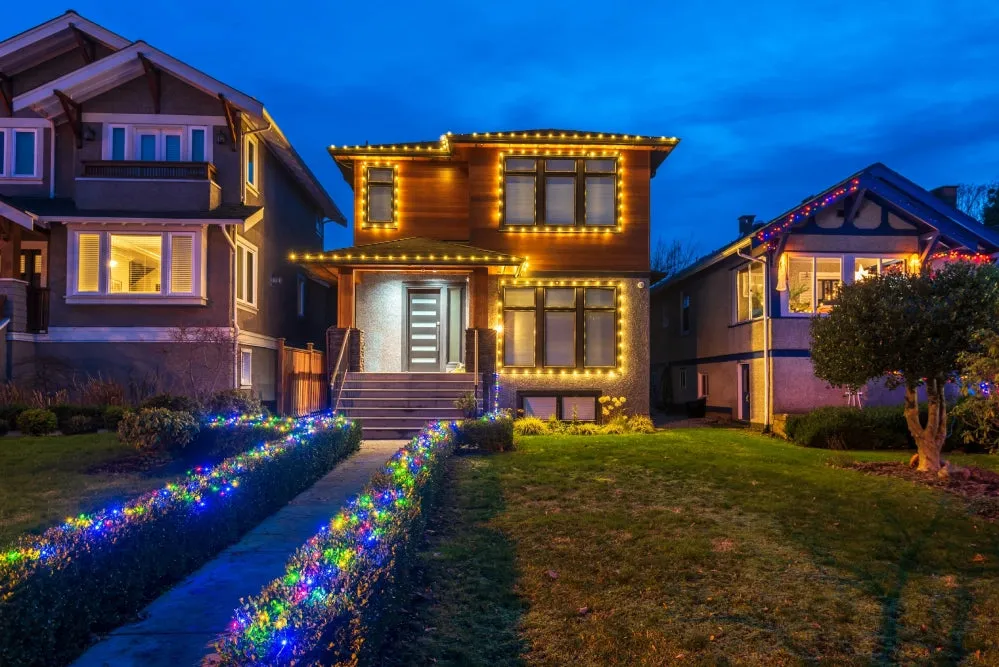
Modern facades with clean rectangular planes hold straight runs beautifully but punish anything curved or offset. If your house mixes siding materials, put lights only on the largest continuous plane and let the hedges handle the rest. Narrow modern lots under 35 feet wide are actually ideal — there’s less facade to fill, and the dark siding does most of the work on its own.
33. Lit Wreaths on the Upper Windows Above Stone
The lit wreaths on the upper windows are the piece that elevates this from good to memorable. They break up a long facade, add a second layer of light above eye level, and stay visible from far down the street. Roofline lights alone would leave the middle of the house dark and the whole composition top-heavy.
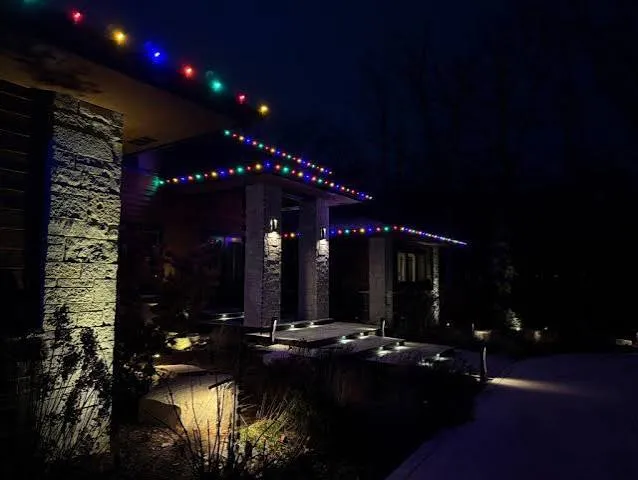
Match your wreath size to your window width — a wreath should be roughly one-third the width of the window it hangs in. A 24-inch wreath in a 6-foot window looks like a dinner plate; a 30- to 36-inch wreath fills it properly. On siding, use a magnetic or adhesive hook so you’re not putting holes in the trim every December. Compare with Idea #26 — same move, one window instead of four.
34. Red Bows on the Porch Railing and a Lit Yard Tree
- Attach a zip tie loosely around each railing baluster at the height you want the bow.
- Thread the bow’s wire through the tie and tighten just enough to hold it.
- Space bows every 18–24 inches for a rhythm that matches the railing.
- Run the icicle strand along the top rail behind the bows so the wire hides.
- Check the bottom of every bow for dangling wire before the first freeze.
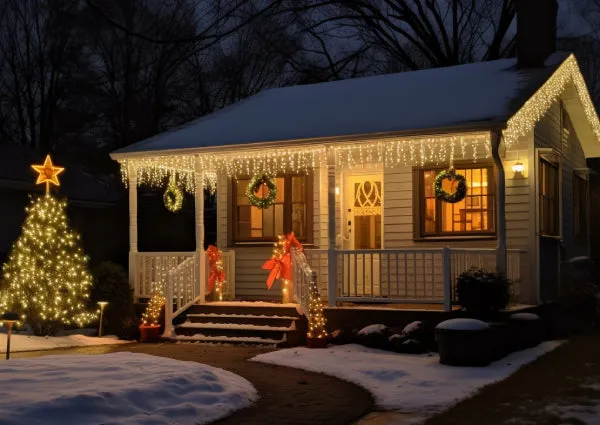
About 45 minutes and $15–$35 in ties and bows.
Wired red bows sell for $4–$8 each in the holiday aisle. You can make a dozen from one $6 roll of velvet ribbon and a spool of florist wire, and they’ll hold up better outdoors than the flimsy store versions. Snow-friendly, reusable, and roughly 70% cheaper per bow.
Icicle lights have swung back into favor after a decade of being called dated — mostly because the new LED versions finally have a proper warm white and thinner wire. On snow-covered eaves they mimic actual runoff, which is why they photograph so well and keep resurfacing on holiday boards every November.
35. Two Lit Wreaths on the Gables of a Stone House
Complex rooflines are where outlining gets expensive fast. A house with multiple gables and dormers can require 60–80 feet of lights for the front alone, and you’ll need a 24-foot ladder for the peaks — or a pro, at $500–$1,500 installed. Under 2,500 square feet, simplify to the main roof edges and leave the dormers bare.
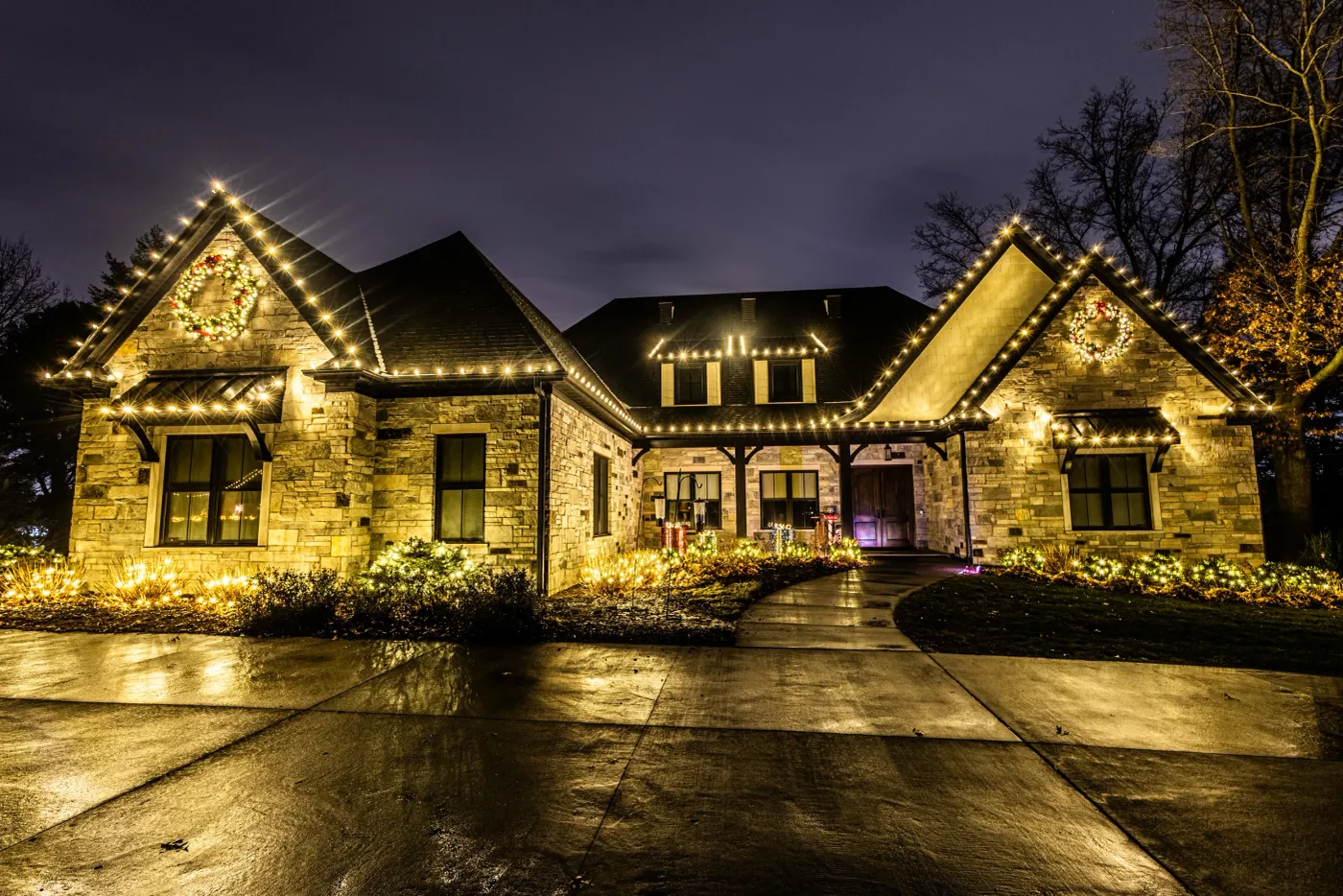
Two lit green wreaths with red bows, one on each front gable, are what make this house feel finished. That’s deliberate repetition — the same object in two places — and repetition is what turns a decorated house into a composition. Without them, the whole display is just an outline with nothing living inside it.
Now Go Make Your House the One People Slow Down For
Start with one roofline, one tree, or one wreath — the rest of the display builds itself once you see how the light hits your actual brick, siding, or stone. And if a strand dies in January, that’s not failure, that’s December.
📌 Pin your favorite idea from this list so it’s waiting for you next November.