
You know the feeling. It’s the first week of December, your apartment has exactly one usable wall, and a six-foot fir is simply not happening this year. We spent the season combing Etsy, Target, IKEA, and Facebook Marketplace for wall Christmas trees that actually look like something you’d want on your drywall — and we found options from $12 to $1,300.
Inside you’ll find 25 curated ideas, from minimalist string-light triangles and book-page trees to driftwood branches, macramé, and glass shadow boxes — spanning minimalist, rustic, handmade, and modern styles. Budget and luxury versions are broken down side by side, so you can see exactly where the money goes.
Wall trees stopped being a renter’s compromise somewhere around 2024. In 2026 they’re a deliberate design choice, part of the broader shift toward smaller, slower, more edited holiday decorating that’s been climbing on Pinterest all year.
Pin this guide for later — your future self will thank you when it’s time to actually do this.
This post contains affiliate links. If you buy through them, we may earn a small commission at no extra cost to you.
1. Minimalist Green Garlands with Gold and Bronze
The brass wall sconce is the difference between a nice garland arrangement and a room that looks designed. It throws light sideways across the green foliage, so the green, gold, and bronze ornaments catch a soft shimmer instead of sitting flat against white paint. If you rent and can’t hardwire anything, a plug-in sconce with a slim cord cover gets you ninety percent of the effect for under $100.
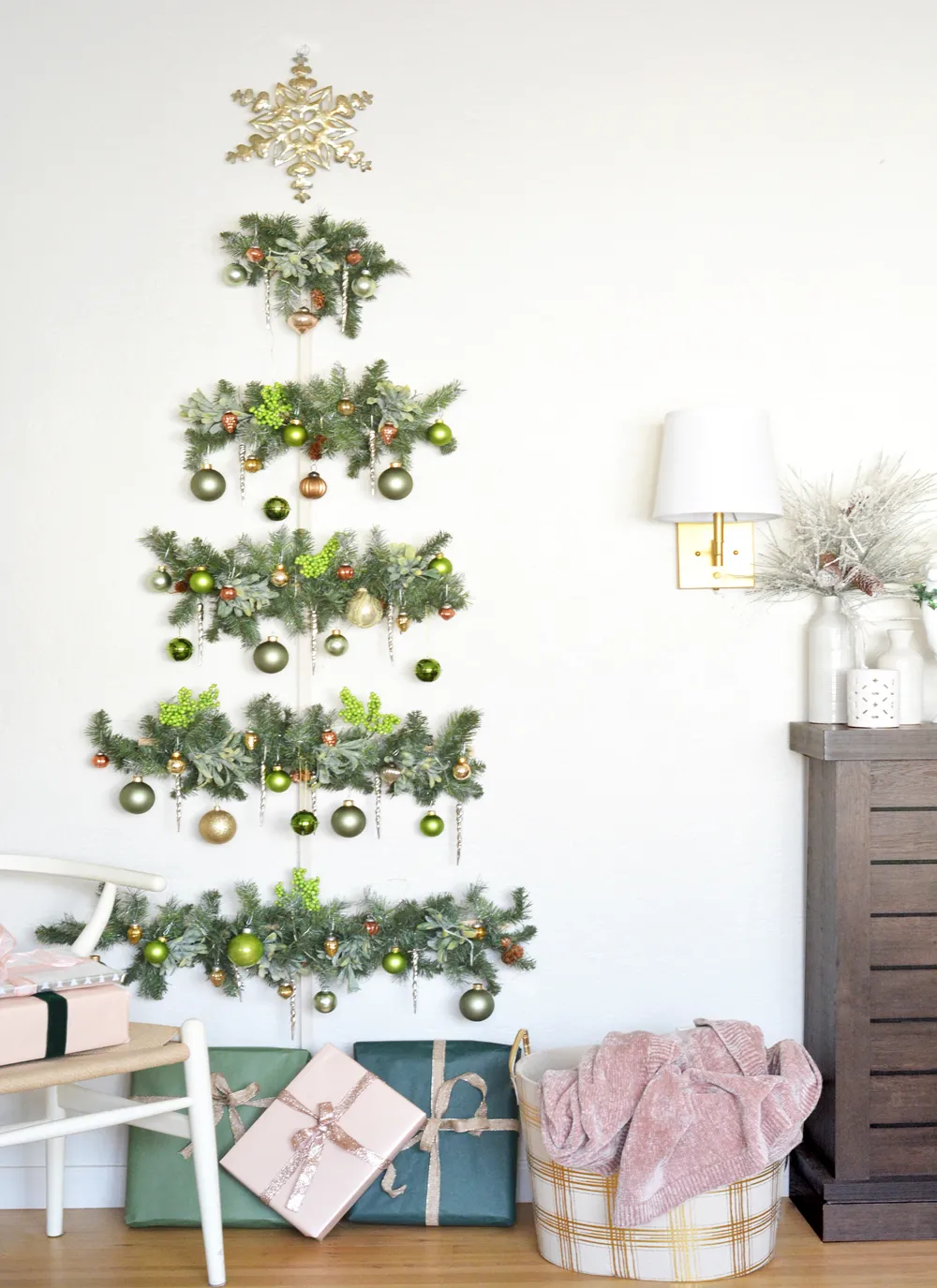
- Dark wood cabinet: $250–$700
- Garland and greenery: $60–$140
- Ornaments in green, gold, and bronze: $45–$110
- Brass wall sconce: $80–$250
- Gifts, plaid basket, pink throw: $40–$90
- Total: roughly $475–$1,290
Budget alternative: a thrifted mid-century cabinet runs $60–$120, two inexpensive garland strands layered over a wire frame cost about $30, and shopping ornaments the week after Christmas cuts that line item in half.
2. A Christmas Tree Built from Aged Book Pages
Pale blue planks, cream paper, silver frame, beige rope — everything here lives in the same washed-out neutral family, which is why a tree made of torn book pages reads as elegant instead of craft-room chaos. The rope outline matters more than it looks like it should: it draws the triangle for you, so your eye completes the tree shape even where the paper thins out. The stack of vintage books below does the grounding work a tree skirt usually would.
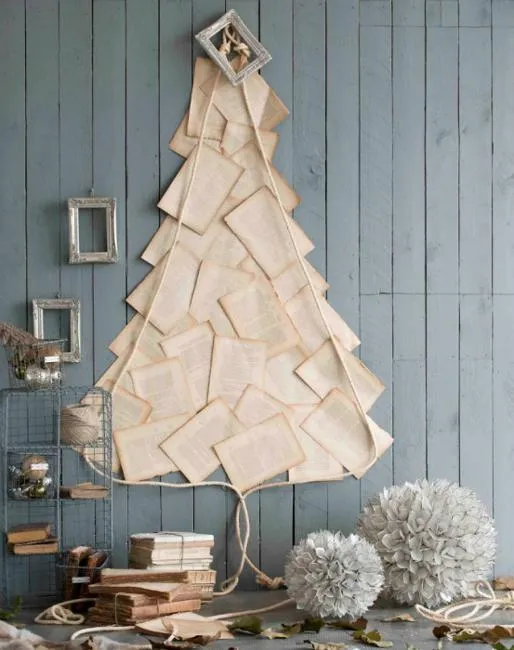
- Sketch a triangle in painter’s tape — about 40 inches tall and 32 wide at the base.
- Lay rope or jute along the tape lines, pin it down, then peel the tape away.
- Fill the interior with torn book pages, keeping the edges lighter and airier.
- Pin a small ornate frame at the top point and stack vintage books below.
Time: two to three hours. Cost: $12–$30 if you use a thrifted novel, and you can keep the covers to hang as flat ornaments next year.
3. Five Tiers of Garland with Fabric Hearts
Make each tier about 20 percent shorter than the one below it and leave 8 to 10 inches of bare wall between rows. That gap is the only thing keeping a tiered garland from reading as one solid green blob. Then keep ornament scale consistent from row to row — big hearts on the bottom and tiny ones on top makes the whole thing look like it’s melting. Warm white lights, not cool, are what make the red and off-white hearts glow instead of glare.
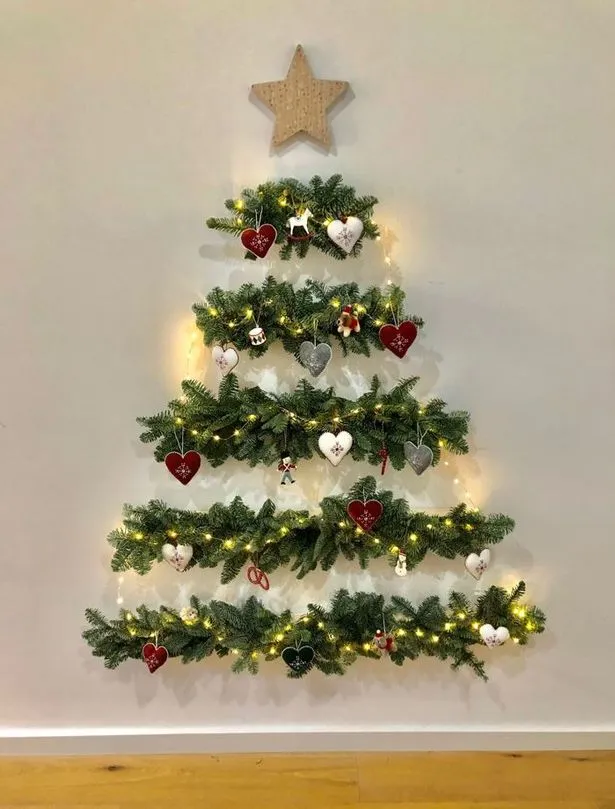
Roughly 70% plain light wall, 20% green garland, 10% red and off-white hearts. Swap the hearts for snowflakes, tiny copper cookie cutters, or wooden stars and the formula holds — the ratio is what matters, not the motif. Prefer a neutral tree? Trade red for oatmeal linen and this carries you straight through January without looking like leftover Christmas.
4. Framed Fabric Rosette Tree in Dark Wood
- Frame, thrifted or flat-pack: $15–$45
- Cream felt backing: $6–$12
- Fabric for 60–80 rosettes: $16–$30
- Black felt star plus red button: $3–$6
- Patterned fabric for the pot base: $4–$10
- Total: roughly $44–$103
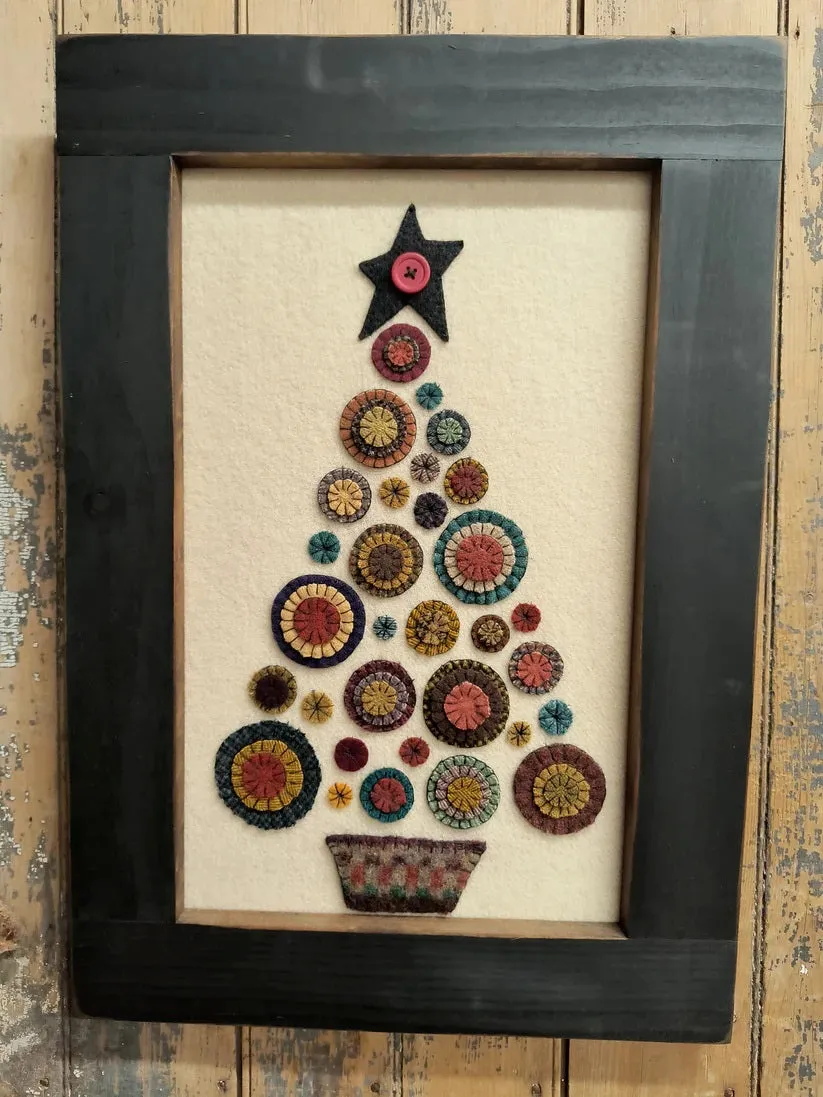
Budget alternative: cut the circles from felted wool sweaters and flannel shirts out of a thrift-store dollar bin. Five dollars of fabric yields forty-plus rosettes, and the mixed textures honestly beat new quilting cotton.
This is the slowest project on the list. A twelve-inch tree needs somewhere between sixty and eighty rosettes, and each one is a fold-and-glue job, so clear three evenings, not one. Felt grabs dust, which means a lint-roller pass every couple of weeks. And if you have cats, mount it high — rosettes look exactly like toys, and they will be treated as such.
5. String Lights, Silver Balls, and a Wood Bench
This one earns its keep in narrow spaces: a hallway wall, the side of a staircase, or a six-to-eight-foot stretch where a floor tree would block traffic. You need about 30 inches of clearance at the base for the bench and gifts, which sounds like a lot until you measure. Standard eight-foot ceilings are plenty. In a bigger room, look at Idea #3 — tiers scale up more gracefully than a single light triangle.
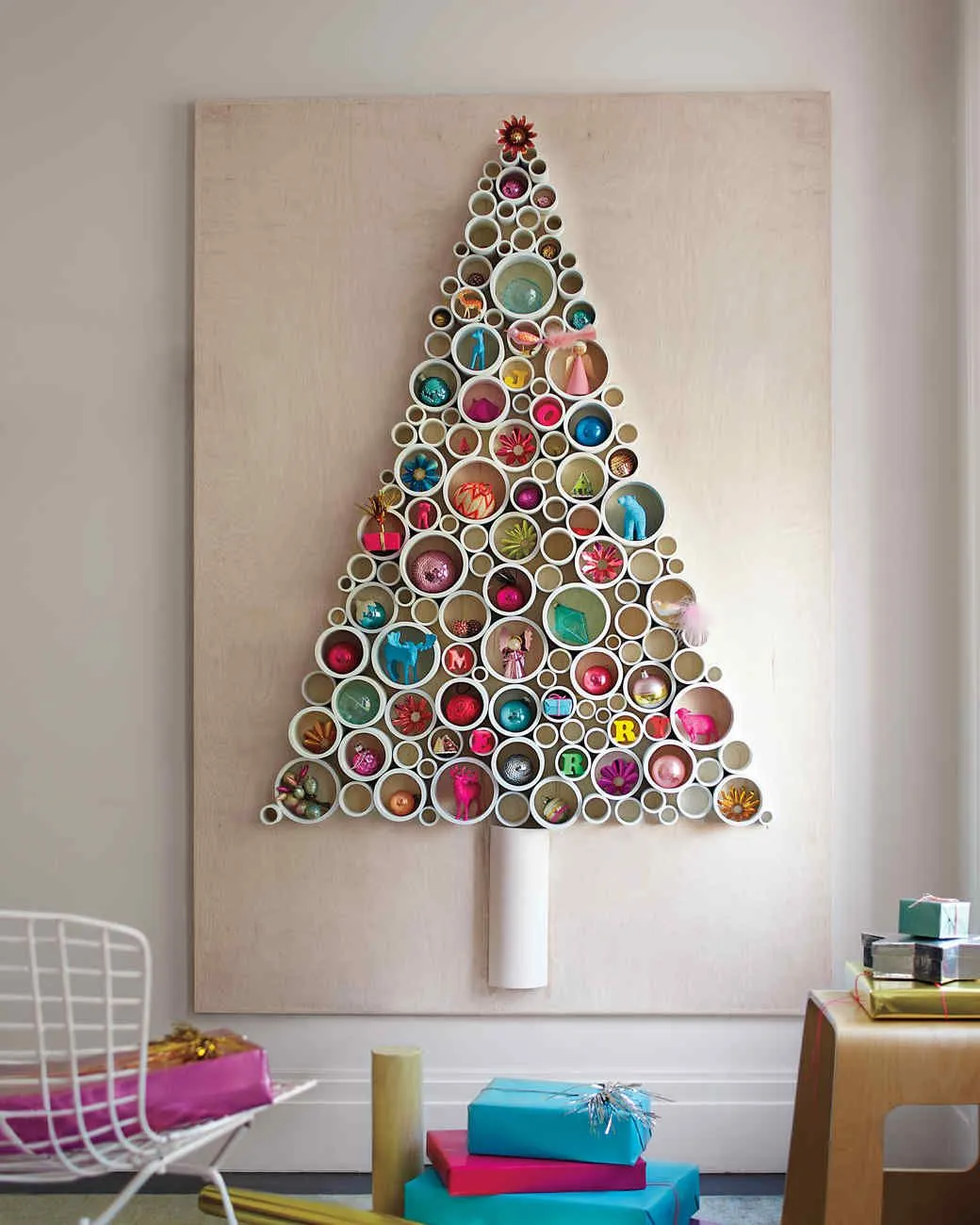
The bench. Take away the string lights and you have a triangle on a wall; take away the bench and you have a triangle floating in space with nothing beneath it. That low horizontal line — light natural wood, a folded grey throw, two small wrapped gifts — is what turns a craft project into a room. Any narrow console or low stool does the same job.
6. Cream Macramé Tree on Exposed Red Brick
Macramé rode the cottagecore wave through the early 2020s and never left. By 2026 it reads less like a trend and more like a permanent category, the same way wreaths did. What’s changed is the color: makers are dyeing cord in forest and olive green instead of uniform cream, which is exactly what’s happening against this red brick. It also stores flat in a drawer, which matters if you move a lot.
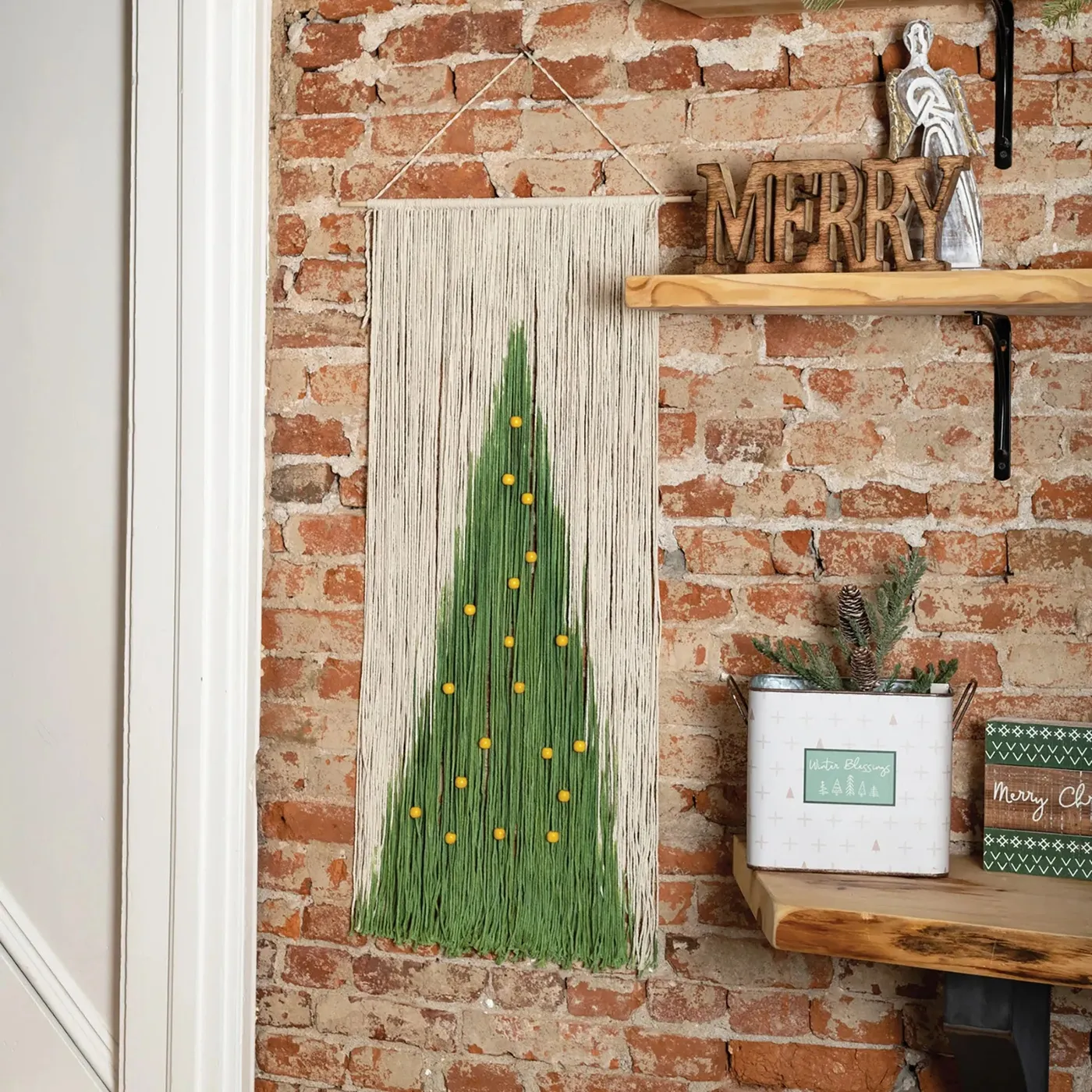
On a red brick wall, skip red ornaments — they vanish into the masonry. The cream cord and yellow beads work here because they sit at a completely different value from the brick behind them. Hang from one sturdy screw with a slim wooden dowel across the top so the fringe falls straight instead of bunching at the center, and steam the piece for thirty seconds to relax shipping creases.
7. A Dark Green Playroom Tree Above the Mantel
- Cut a tree shape from dark green felt or a painted MDF panel — 36 inches tall is right for a toddler’s eye line.
- Mount with removable strips rated for 8+ pounds, or two screws into studs if you own the place.
- Run the fairy lights along the mantel edge, not around the tree, so they read as a glow rather than a frame.
- Hang ornaments from the bottom up and stop at eye level for kids under five.
- Keep the hearth zone clear — three feet minimum from any stove or firebox.
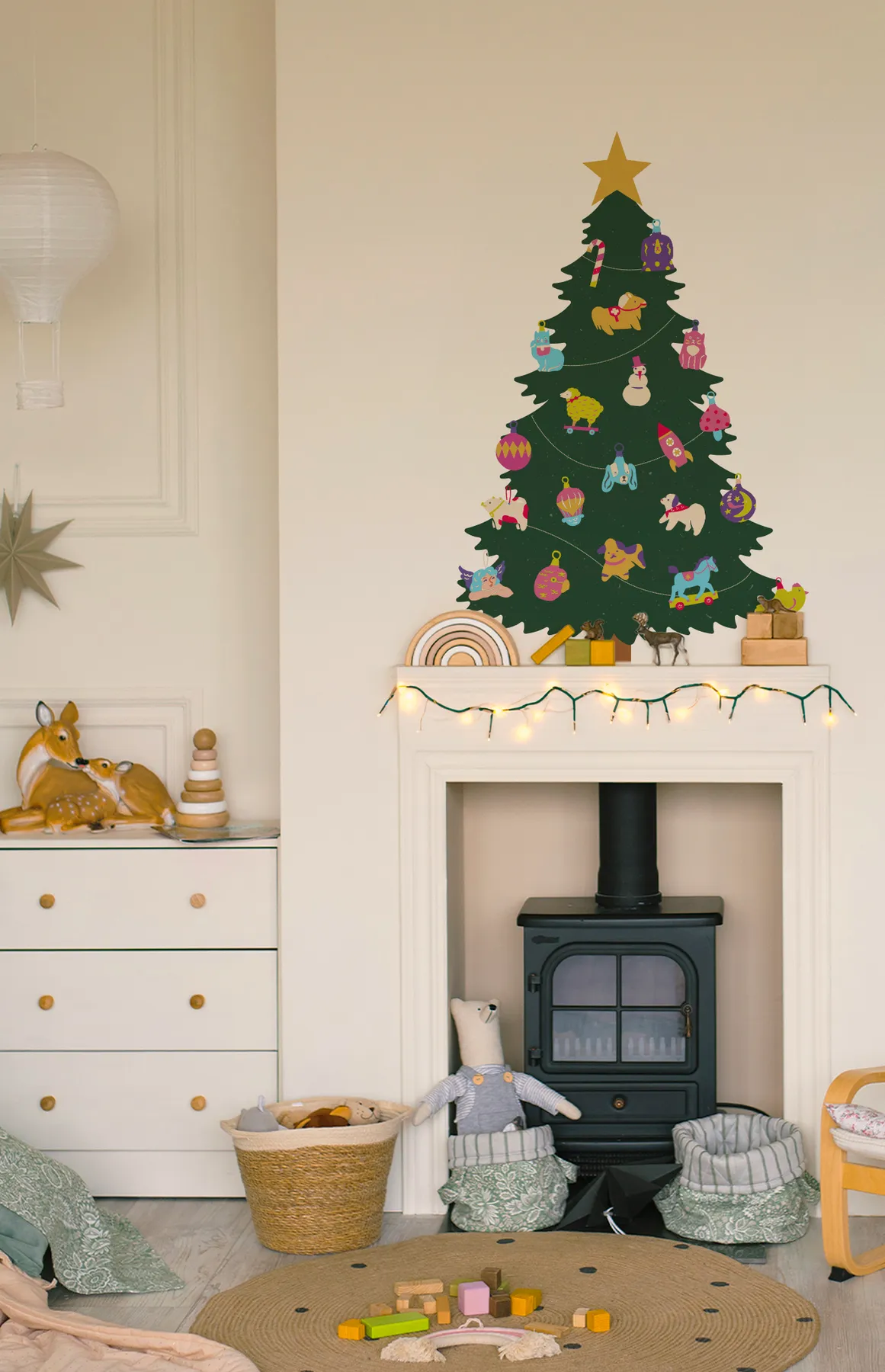
Time: one afternoon. Cost: $25–$70 depending on whether you cut your own panel.
A wood-burning stove and a felt tree in the same room need rules. Keep the tree on the wall and outside the hearth clearance — felt, jute, and paper are all faster to ignite than you’d guess. Check that your adhesive strips are rated for the panel’s weight plus ornaments; a 36-inch felt tree with wooden toys can hit 12 pounds. Better to over-mount than to hear it land.
8. Winter Tapestry with Rabbits, Birds, and a Bench
Scale is doing all the work. The tapestry is oversized — it runs from roughly chair-rail height to near the ceiling — while everything underneath stays deliberately small: a low bench, one pale grey vase, nothing else. That contrast is why a printed textile reads as art instead of as a poster. The palette repeats too, with white, blue-grey, brown, and green from the snowy scene coming back in the bench, the vase, and the geometric rug.
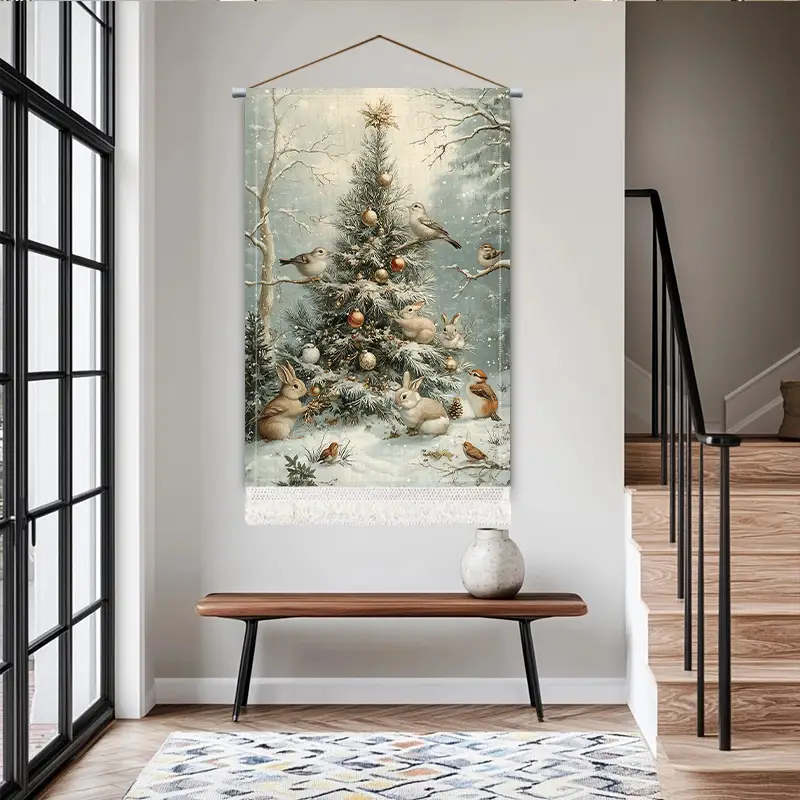
Give this at least a five-foot-wide wall so the tapestry can hang with six to ten inches of breathing room on each side. A 40-to-48-inch bench grounds the composition below. Renters, take note: this is the least invasive option on the list — one rod, two brackets, and it rolls up at the end of the season. If your wall is narrow and very bright, Idea #20 suits better.
9. Shattered Mirror Tree Between Crystal Lamps
Mirror shards and crystal lamp bases are fingerprint magnets. Plan on a microfiber wipe every two weeks — plain water only, since ammonia can cloud beveled edges over a season or two. The bigger issue is glare: face this piece into a window and you’ll get a hard hotspot for a couple of hours a day. Angle it slightly away from the glass and the sparkle stays flattering instead of blinding.
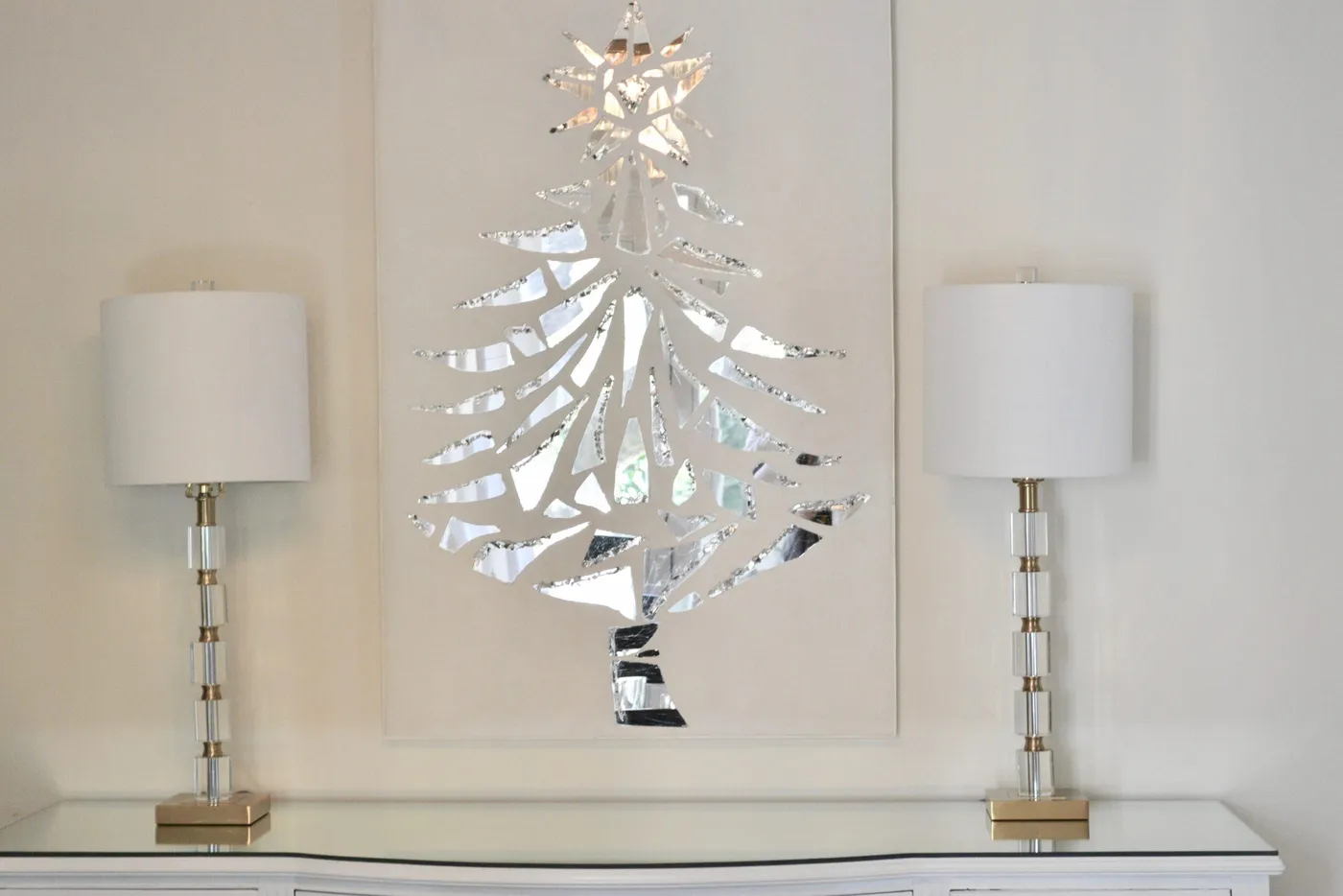
You don’t need custom glass. Self-adhesive acrylic mirror tiles run about $12 for a 24-pack, and you can cut them with household scissors into irregular shards, then mount them on a stretched canvas. A pair of glass-and-gold lamps from Target or Walmart is $40–$70 each instead of $200+. You keep the reflection and lose the invoice. For a warmer take on the same glow, see Idea #19.
10. A Splash-Paint Tree on a Deep Teal Wall
About 60% deep teal wall, 25% light wood and white, 15% gold and neon-pink accents. Teal is a saturated backdrop, so anything in front of it needs to be either very light or very metallic — mid-tone browns go muddy against it fast. Swap the teal for navy or aubergine and the same painting still works, just with a different mood. One quart covers a painted accent panel if you’re testing the idea before committing to a whole room.
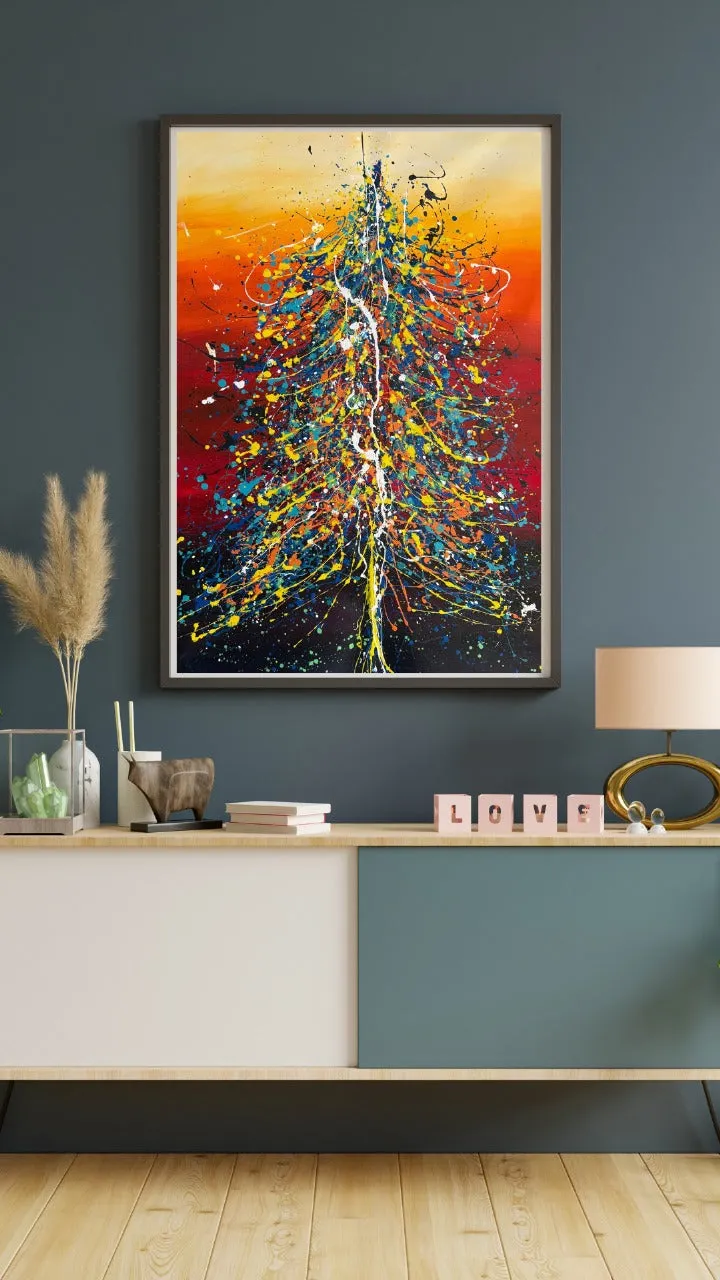
It’s the wall itself. Hang that splash-art canvas on white drywall and it’s a cheerful picture; hang it on deep teal and it becomes the moment you remember. If a full paint job feels like too much commitment, paint one five-foot-wide panel behind the console instead. Same punch, one quart of paint, and you can paint over it in a weekend if you change your mind.
11. Mixed Greenery Tiers on Painted White Brick
Mixing greenery types is what keeps a flat tree from looking like a grocery-store garland. Go roughly 2:1 — two parts fine pine or cedar picks to one part broad-leaf eucalyptus — and wire each segment to a cheap 1×2 furring strip before you hang it. The strip costs about $4, guarantees a straight horizontal line, and lets you re-fluff everything next year without rebuilding from scratch.
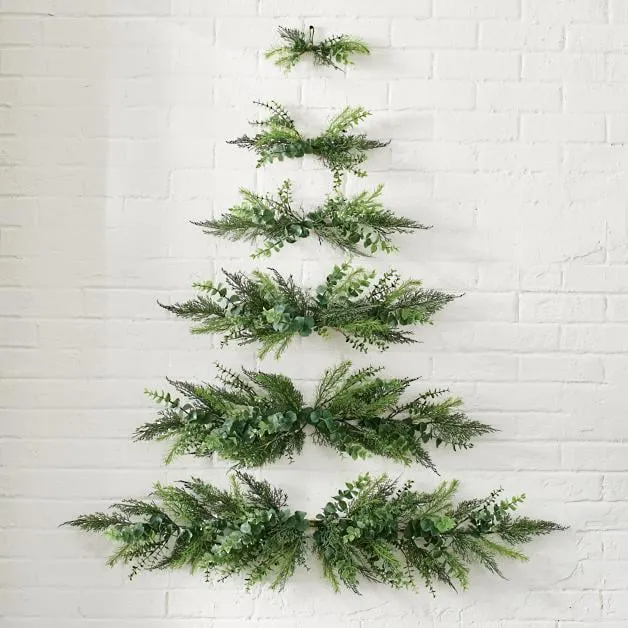
White painted brick is the quiet hero. Because it’s textured but low-contrast, green becomes the only real color in the frame, and the graduated segments get to describe a tree without a single ornament. The space between tiers is generous — close to a foot — which is why the silhouette reads crisp instead of lumpy. Compare with Idea #18, where the same logic goes fully geometric.
12. Wood Slice Tree Glowing with Warm Lights
Wood slices are heavy, and twenty 3-to-5-inch rounds add up quicker than you’d think. Dry wood also burns, so use LED strand lights only, never incandescent, and keep the cord off the cut faces. Slices shed bark, drop dust, and can crack or grow mold in a humid room if they weren’t fully dried. A coat of matte polycrylic on each face before hanging solves most of it.
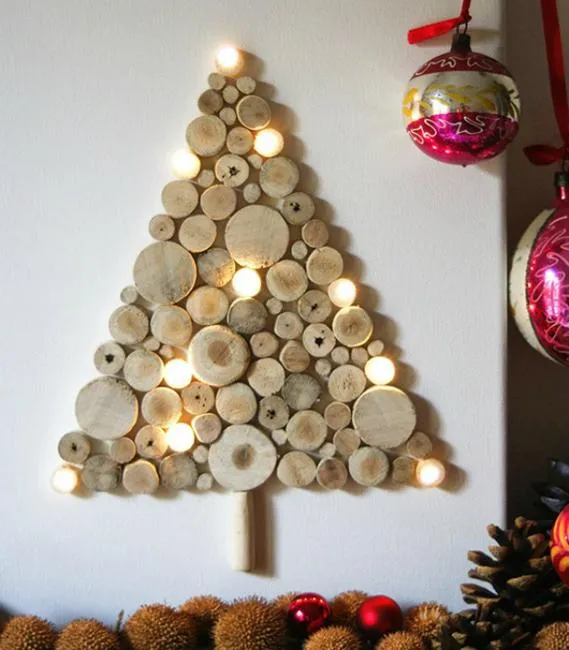
Cork trivets and coasters from IKEA or a dollar store give you the same warm circles for about a dollar each, and they weigh almost nothing — ideal for drywall. Mix in a few real slices if you want texture. Red and pink glass baubles from a thrift bin run fifty cents to two dollars apiece instead of eight at a boutique, and nobody studies the hook. They only see the shine.
13. Twig Tree with a Gold Star and Bright Baubles
- Gather nine to twelve straight twigs, 10 to 34 inches long, and strip the loose bark.
- Lay them out in a pyramid on the floor, longest at the bottom, about four inches apart.
- Tie the ends with jute twine, then bridge the rows with a vertical twig down each side.
- Wire a picture hanger across the top two twigs and hang on a single nail.
- Add ornaments after it’s on the wall so you can judge the balance as you go.
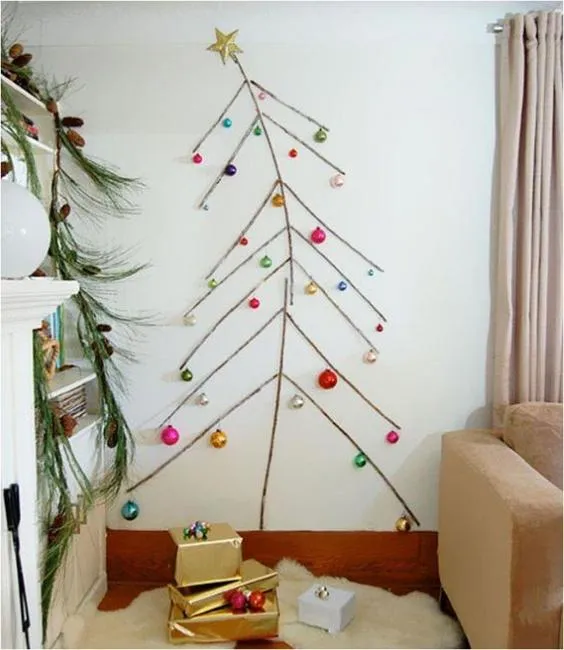
Time: one to two hours. Cost: free if you have a yard, about $15 for twine and cup hooks.
The gold star. Everything else here is brown and white and quiet — bare twigs, a handful of bright baubles, a plain wall. The star is the only polished metal in the frame, and it’s what flips your brain from ‘sticks’ to ‘tree.’ A cardboard star spray-painted gold does the same job for two dollars. If you want the light-only version of this restraint, Idea #5 is the same idea with zero wood.
14. Aqua Glass Shards in a Textured Blue Shadow Box
This is shelf-and-mantel scale — roughly 8×10 to 12×16 inches — which makes it the answer when you have fourteen inches of wall and no more. It’s happiest in apartments, dorm rooms, powder rooms, and above a kitchen sink, anywhere a full tree would be absurd. For a wide living-room wall, pair it with something larger; Idea #19 speaks the same gold-and-glow language at four times the size.
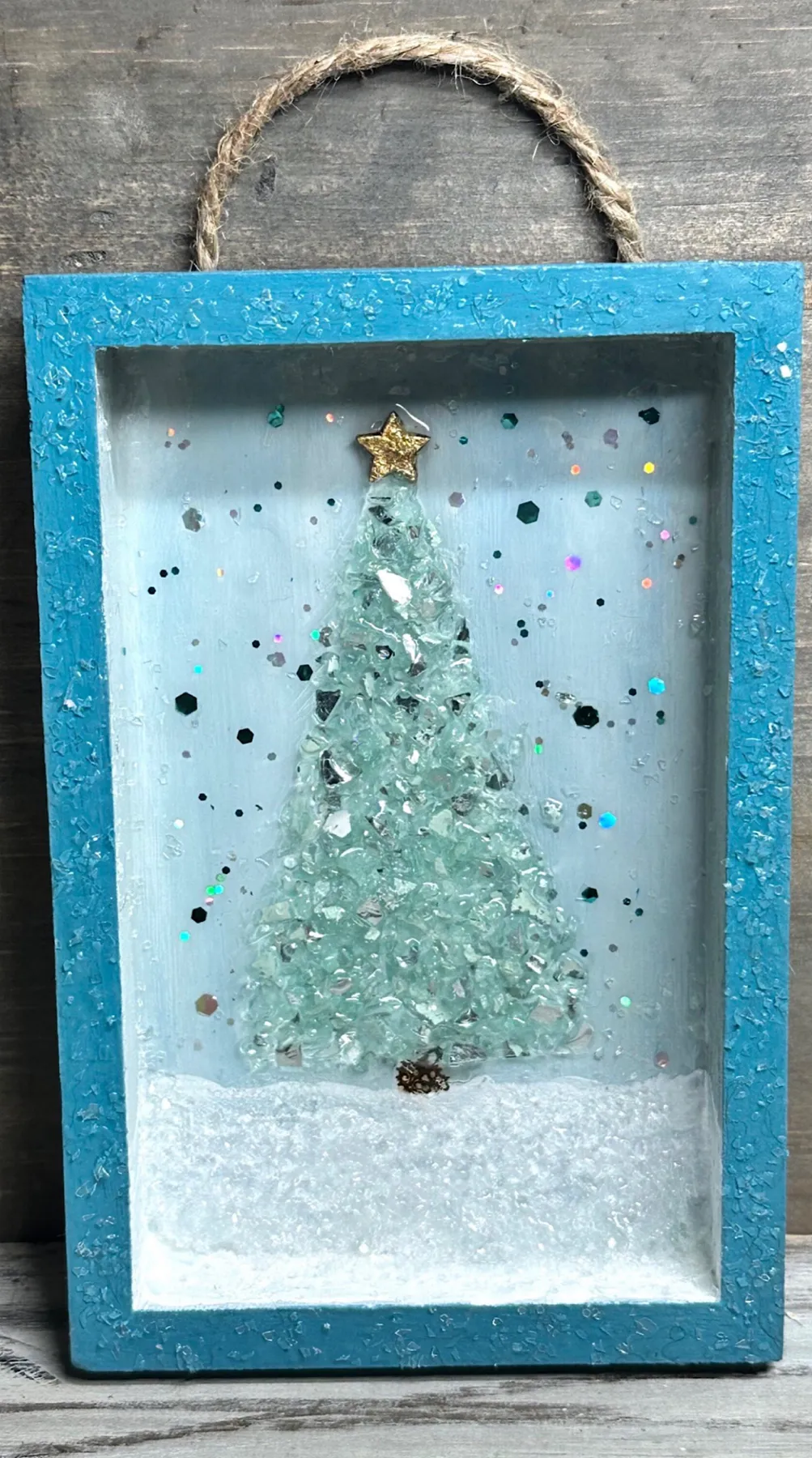
Shadow-box décor quietly became the small-space Christmas answer, and 2026 keeps pushing it toward handmade texture — glass, resin, glitter, dried botanicals sealed behind glass. It’s also a soft rebellion against maximalism: after years of oversized everything, people want one small object that’s genuinely beautiful. Staying power looks high, because it’s essentially ornament-making with a frame around it.
15. Wooden Dowels Holding Patterned Ceramic Ornaments
Dowel trees live or die on spacing. Use 5/8-inch dowels, keep about seven inches between rows, and shorten each row by six inches per side as you climb. Screw the dowels into a vertical center batten instead of gluing so you can disassemble the whole tree into a shoebox. Give white ceramic ornaments a matte clear coat so the hanging holes don’t chip against the string.
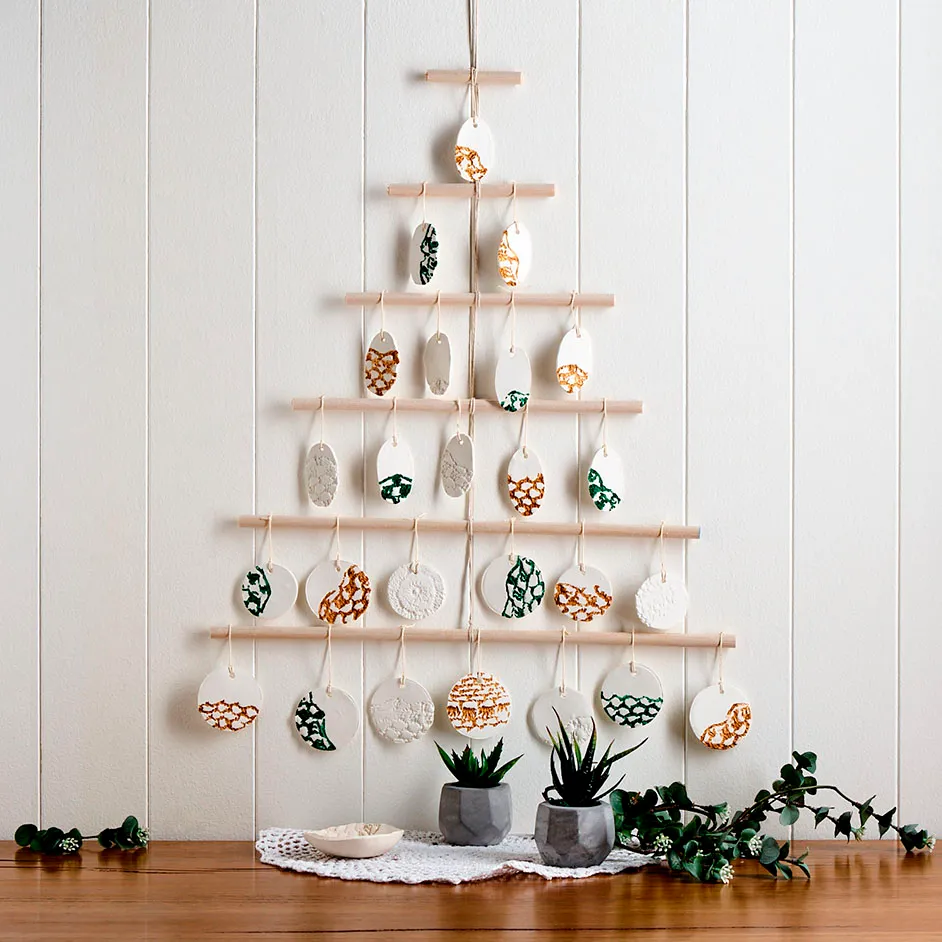
This is a display, not a hiding place. There’s no branch depth, so ornaments face the room flat and you’ll see their backs — stick to pieces that look finished from behind. Dowel ends are visible, and raw wood collects dust, so a wipe-down every few weeks is part of the deal. And a horizontal dowel thirty inches off the floor is a climbing bar to a toddler. Mount above 40 inches or skip the bottom rows.
16. Bark, Felt Stars, and a Snowy Gift Display
Roughly 55% warm brown bark, 25% white (snow, felt, gift boxes), 15% red, 5% dark metal. Those proportions are the whole game: once red creeps past about a fifth of the composition, rustic flips to toy-store aisle. Bark is the base because it carries the heaviest visual texture, and everything else has to sit lighter than it. If you want to stretch this from November into February, trade the red for mustard and cream.
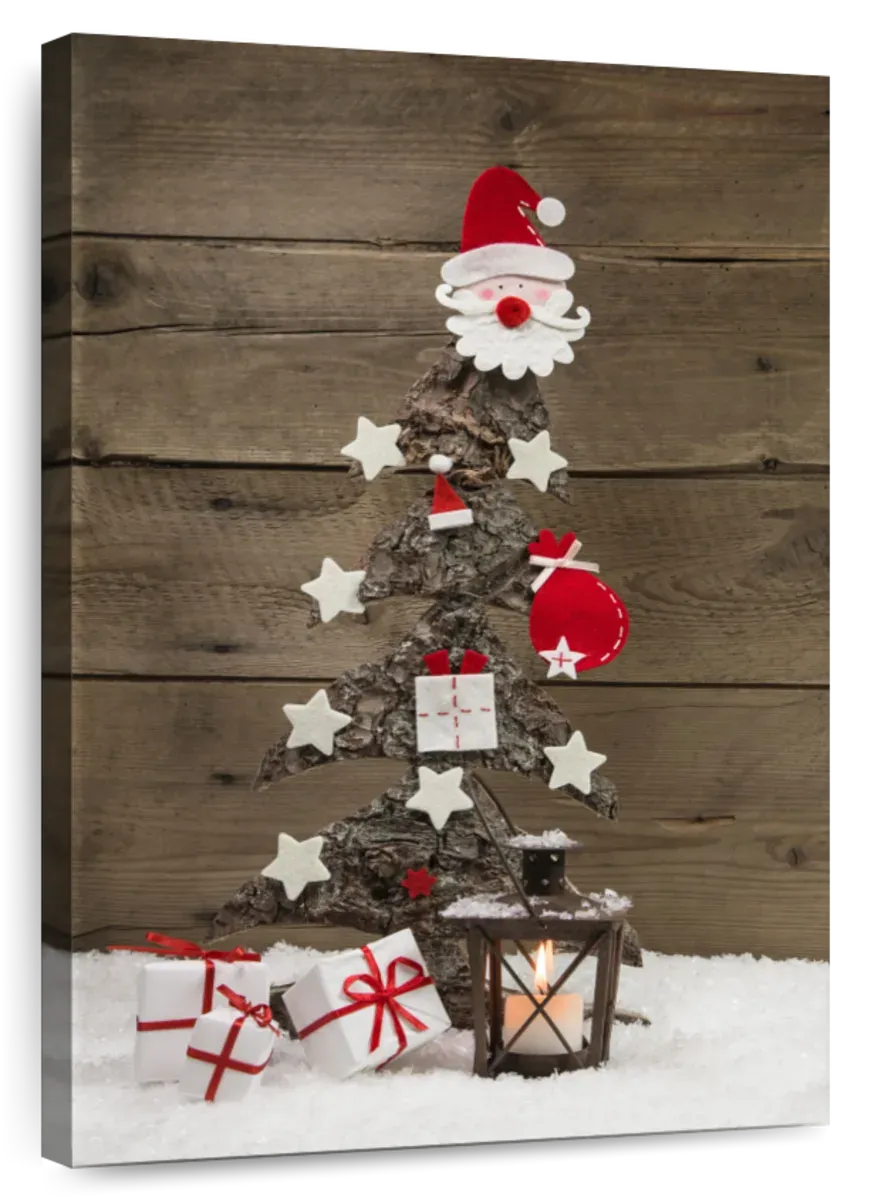
Real bark is organic, and organic means it can shed, crack, and occasionally bring tiny insects indoors. A light coat of clear matte sealer handles most of that. Artificial snow yellows after two or three seasons, so budget $10–$20 a year to refresh it. Felt ornaments collect dust at a rate that will surprise you; a lint roller kept in the holiday bin is the cheapest fix you’ll ever buy.
17. Two Macramé Christmas Trees on a Peach Wall
Two trees instead of one is the entire trick. A single macramé tree on a six-foot wall looks lonely; a pair hung at different heights reads as an installation. The cream and olive versions give contrast without introducing a third color, and the matching wooden stars tie them together visually. The muted peach wall warms both neutral tones instead of fighting them, and the fringed bottoms keep the whole thing soft.
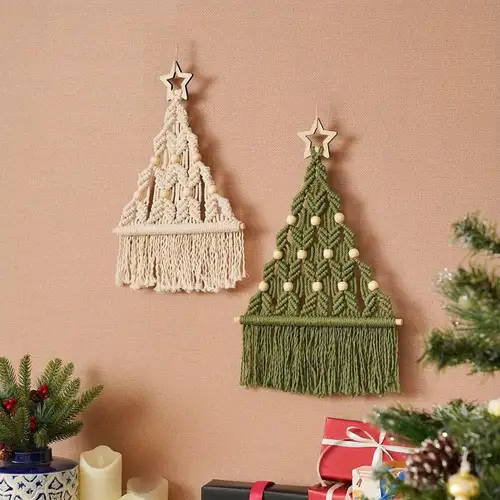
Macramé is the most DIY-friendly thing on this list. A 100-yard spool of 4mm cotton cord costs $12–$18 and yields both trees if you’re patient with square knots. Prefer to buy? Etsy makers sell them for $35–$70, and Target has carried simplified versions under $25 in recent seasons. Thrifted curtain tiebacks and old plant hangers can be unraveled for free cord.
18. Green Wooden Sticks on a Paneled White Wall
Green sticks read as a tall, narrow tree — plan on five to six feet tall and 30 to 36 inches wide. Give it a wall at least five feet across so the white Eames-style chair can sit beside it without cramping the walkway. Ceiling height barely matters here. In rooms over 200 square feet, a single stick tree can disappear entirely, which is when you go back to Idea #11 and stretch the same logic wider.
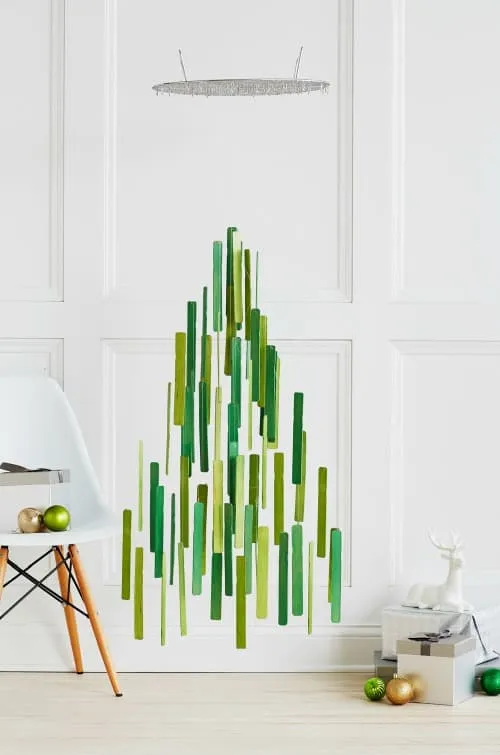
The gradient. Sort the sticks by shade before you mount anything — darkest at the bottom, palest at the top, so the tree gains built-in light and shadow. Skip that step and you have a pile of painted twigs on a paneled wall. If you simplify anything else, keep this. Even three distinct shades is enough to make the whole thing read as designed rather than assembled.
19. Natural Branches, Gold Balls, and Warm String Lights
- Natural branches, yard or craft store: $0–$35
- Warm white LED string lights: $15–$30
- Gold ball ornaments, 24–36 count: $20–$45
- Gold star topper: $8–$20
- Wire and mounting hardware: $6–$15
- Total: roughly $49–$145
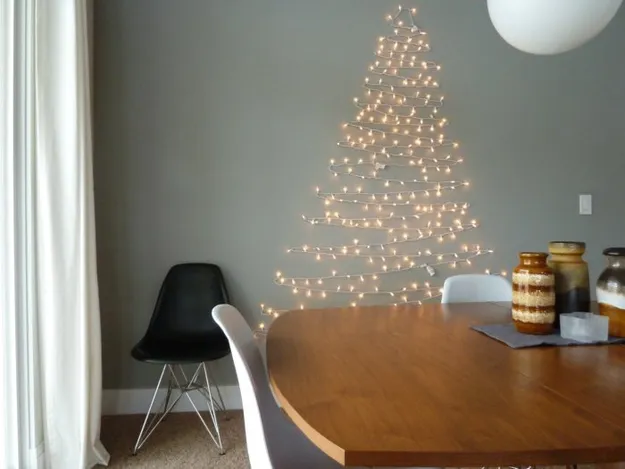
Budget alternative: dollar-store branches and ornaments keep the whole project under $25, and floral wire instead of a mounting kit saves another $10. A can of gold spray paint turns a bag of plain plastic balls from a thrift bin into matching ornaments for about $6.
About 65% light beige wall, 20% gold, 10% warm white light, 5% dark grey. It’s a deliberately low-contrast formula, which is exactly why the dark accent chair earns its place — it’s the only thing in the frame creating a hard edge. Want more drama? Push gold to 30% and swap the beige wall for charcoal. The branches stay the same either way.
20. String Light Triangle Above a White Faux Fur Rug
This is the one for genuinely small rooms — 60 to 120 square feet. You need about 40 inches of clear wall width for the light triangle, plus a chair spot that doesn’t block a walkway. It works in studio apartments, under a stairwell, in a bedroom corner, anywhere a floor tree would become a trip hazard. Anything narrower than 36 inches and the triangle starts to look cramped rather than minimal.
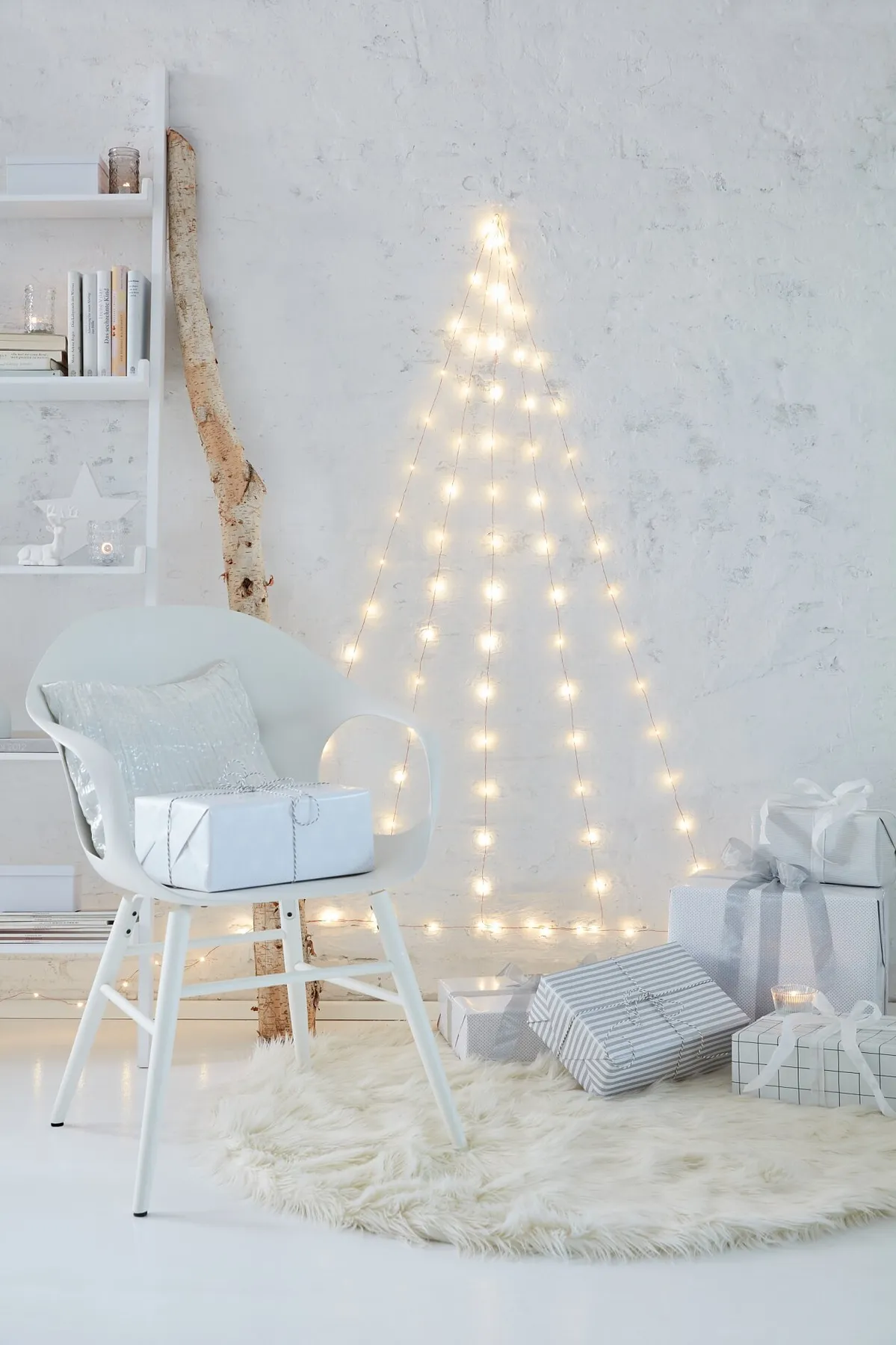
Battery-operated warm white string lights run $12 at Target or Walmart, and that’s the whole tree. A white faux fur rug is $25–$40. Facebook Marketplace is full of white-painted wood chairs for $20–$50, and a birch log is free if you know someone with a woodpile — otherwise about $8 at a craft store. The entire scene lands under $120.
21. Crocheted Snowman Garland with Poinsettias and Bells
Crochet Christmas décor has been climbing on Pinterest since 2023, pushed by the grandmillennial revival and a broader pull toward objects that take actual time to make. A wavy, non-tree garland is 2026’s version of the front-door wreath — it says handmade without saying craft fair. Pins that link to a pattern tend to outperform the ones that don’t, which tells you people want to make this, not just buy it.
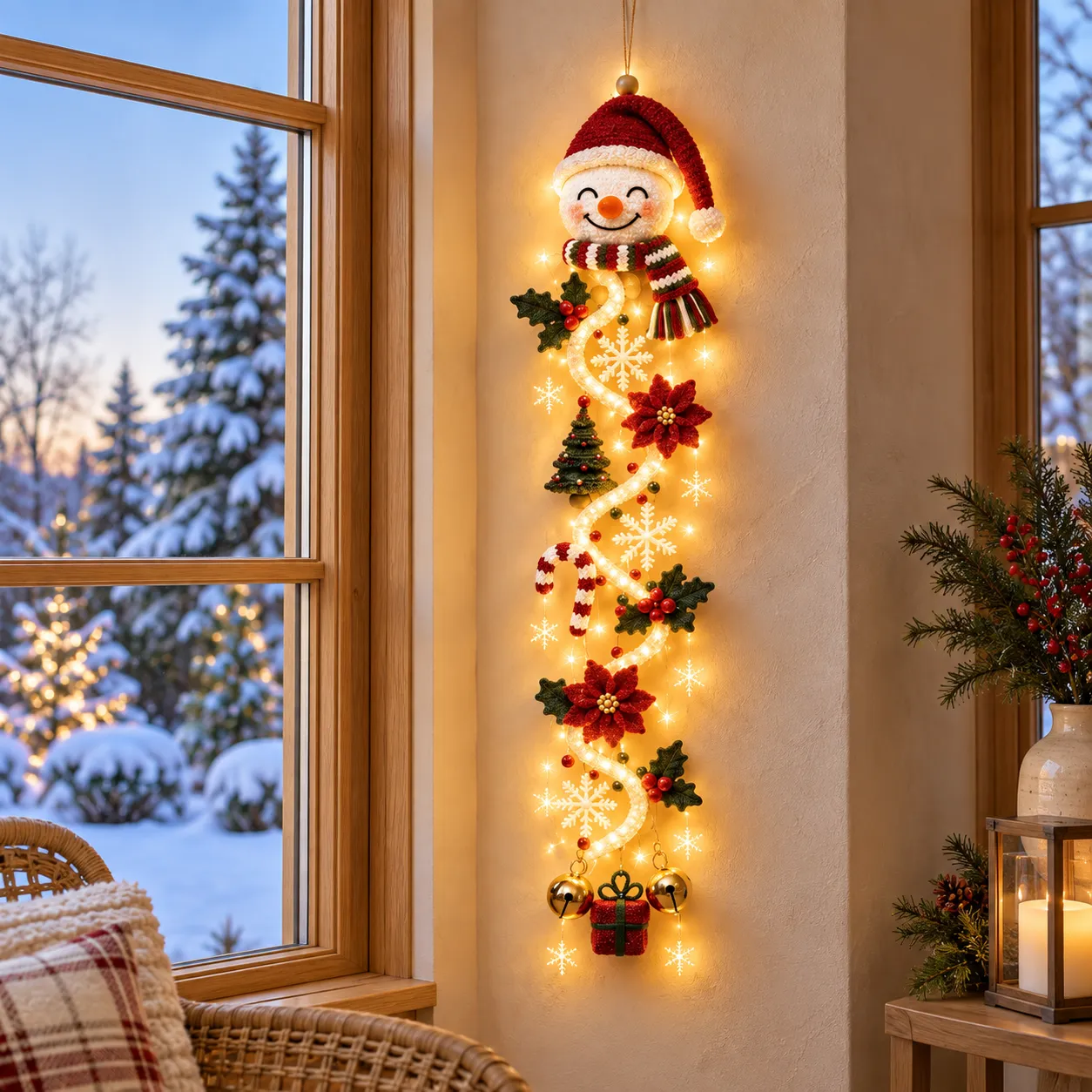
If you’re not the one crocheting it, expect to pay for the time: a full garland from a maker runs $80–$200. Lighting is the other catch — the wavy shape needs a cord route you can hide, and cool-white LEDs will kill the charm instantly, so stick to warm. Cotton yarn collects dust and hates the dryer. Hand-wash cold, reshape, and dry flat, and this lasts for decades.
22. Tiered Garland with Felt Hearts and a Cork Star
- Work out five graduated widths. For a 40-inch tree: 32, 26, 20, 14, and 8 inches.
- Wire each garland length onto a thin wooden strip so it hangs dead straight.
- Hang the tiers eight inches apart, centered on one vertical chalk line.
- Weave the light strand up one side, across, and back down the other.
- Hang the heaviest ornaments on the bottom row and the lightest at the top.
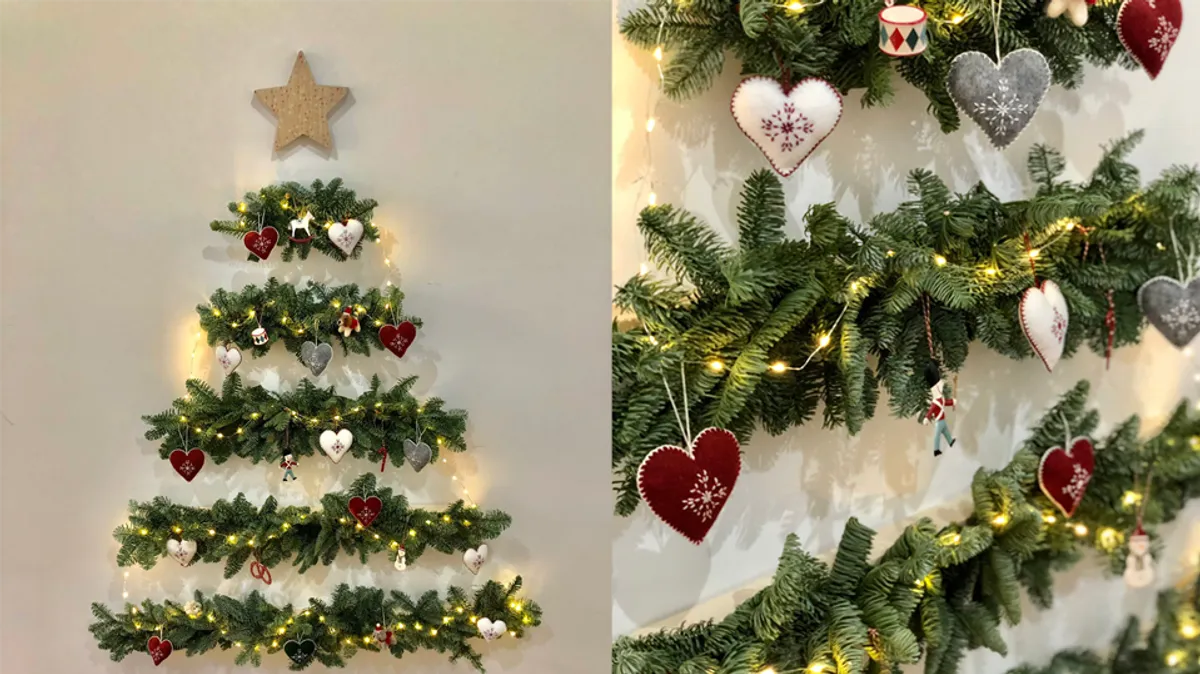
Time: about 90 minutes. Cost: $40–$80 with faux garland and lights included.
The felt hearts repeat one shape in three flat colors — red, white, grey — so your eye reads rhythm instead of sparkle, a very different feeling from glass. The miniature figures (rocking horse, drum, soldier, snowman) are punctuation, and there are only a handful, so nothing tips into chaos. The cork star is a smart swap too: it weighs almost nothing, so it never drags the top tier out of level. See Idea #3 for the same structure in a bolder palette.
23. Driftwood Tree Topped with a White Starfish
Driftwood needs prep before it comes indoors: rinse it, dry it in the sun for a few days, then seal it with a matte finish so it doesn’t shed sand onto your floor. Sealer wants reapplying every couple of years. The bigger chore is dust — all those horizontal surfaces collect it fast, and a can of compressed air is genuinely the fastest tool you’ll find. Budget five minutes a month and it stays clean.
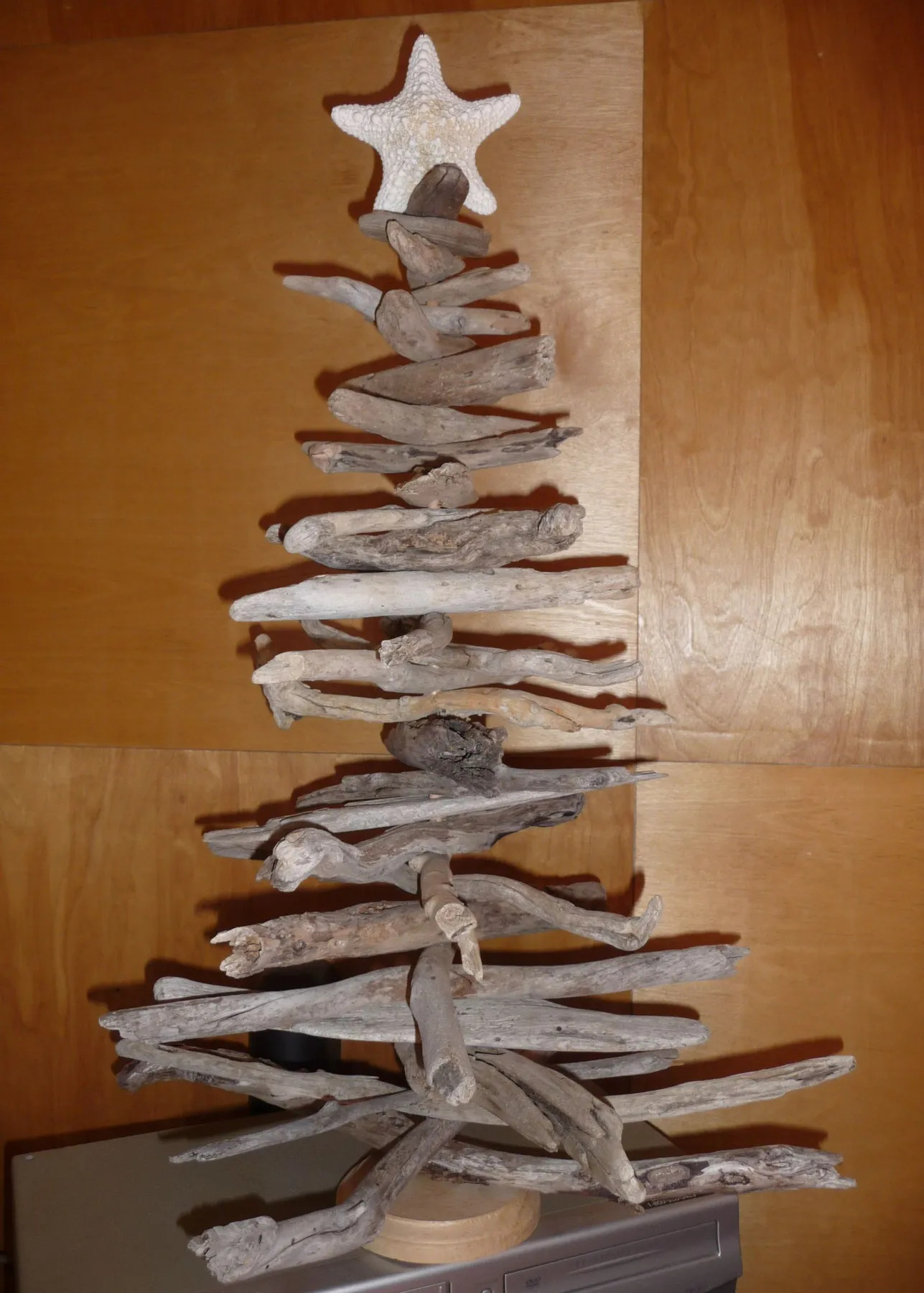
Keep the taper honest. Each driftwood piece should be four to six inches shorter per side than the one below it, or the tree goes lumpy at the shoulders. Mount everything on a round wood base so the bottom row has something to sit on, and leave the top piece noticeably bare — the starfish is the ornament here, so it needs empty space around it to register at all.
24. Branches and Multicolor Lights on a Graffiti Wall
About 45% busy multicolor background, 30% natural wood, 20% multicolor light, 5% silver. On paper that’s chaos, and it only works because the branches stay raw and unpainted — they’re the neutral holding the frame together. Recreate this on a plain white wall and you should cut the ornament count by a third, or the tree starts competing with itself instead of against the wall.
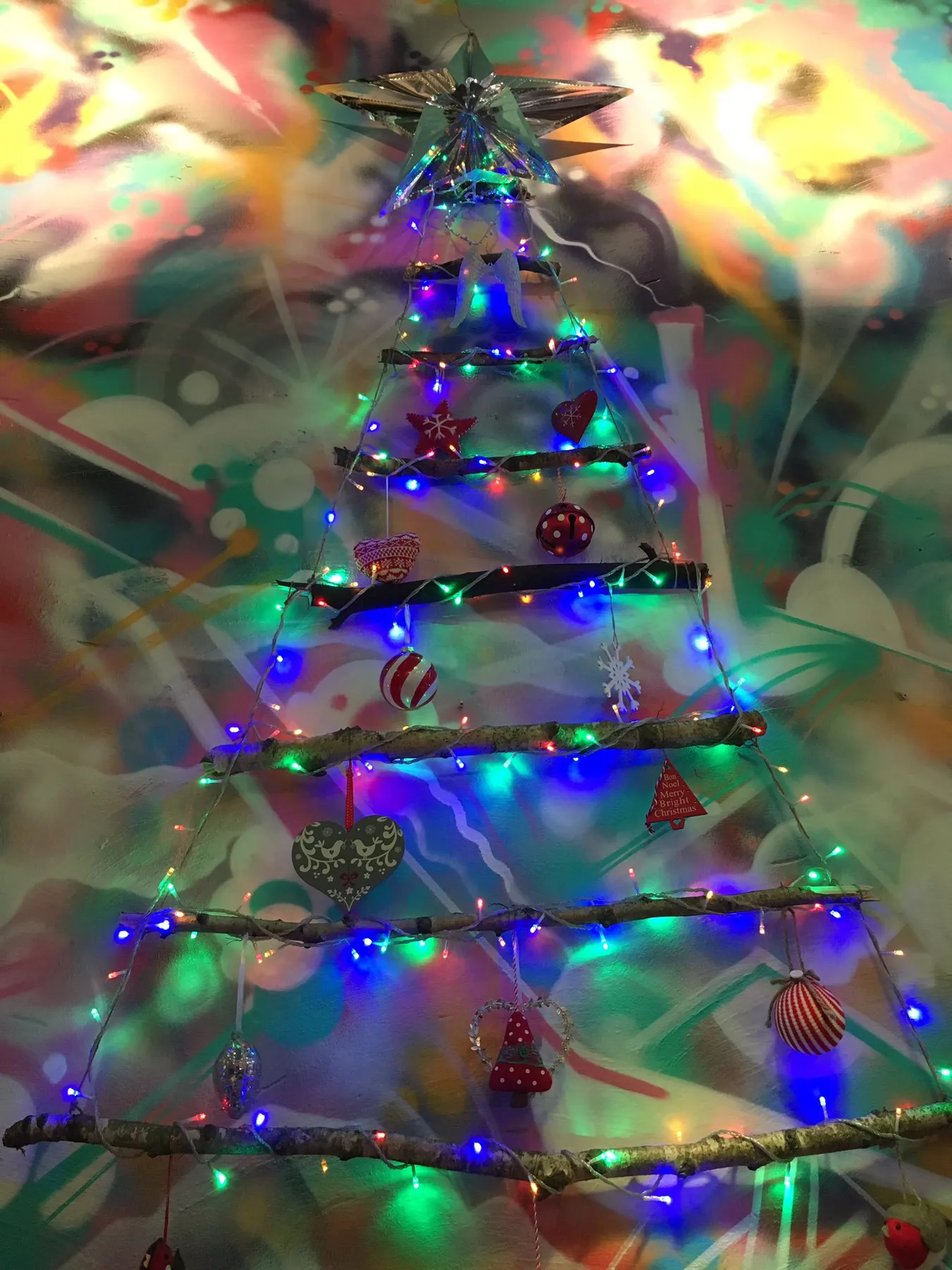
Branches are free if you’re willing to walk a park after a windstorm. A multicolor LED strand runs $10–$18, and a silver star topper is about $6. Fill the rest with thrifted ornaments at fifty cents to two dollars each and the whole thing lands between $30 and $60 — roughly what one boutique ornament costs. The graffiti wall is the splurge; a printed mural panel is the renter-friendly route.
25. Black Sofas, a Bamboo Runner, and a Corner Tree
This layout wants at least 180 to 220 square feet so the seating can breathe. Multiple sofas around a rectangular coffee table need about three feet of walkway on every side. For the tree itself, reserve 30 inches of wall beside the television plus six inches of clearance from the screen — otherwise the glow washes out the picture and you’ll be fiddling with brightness settings all December.
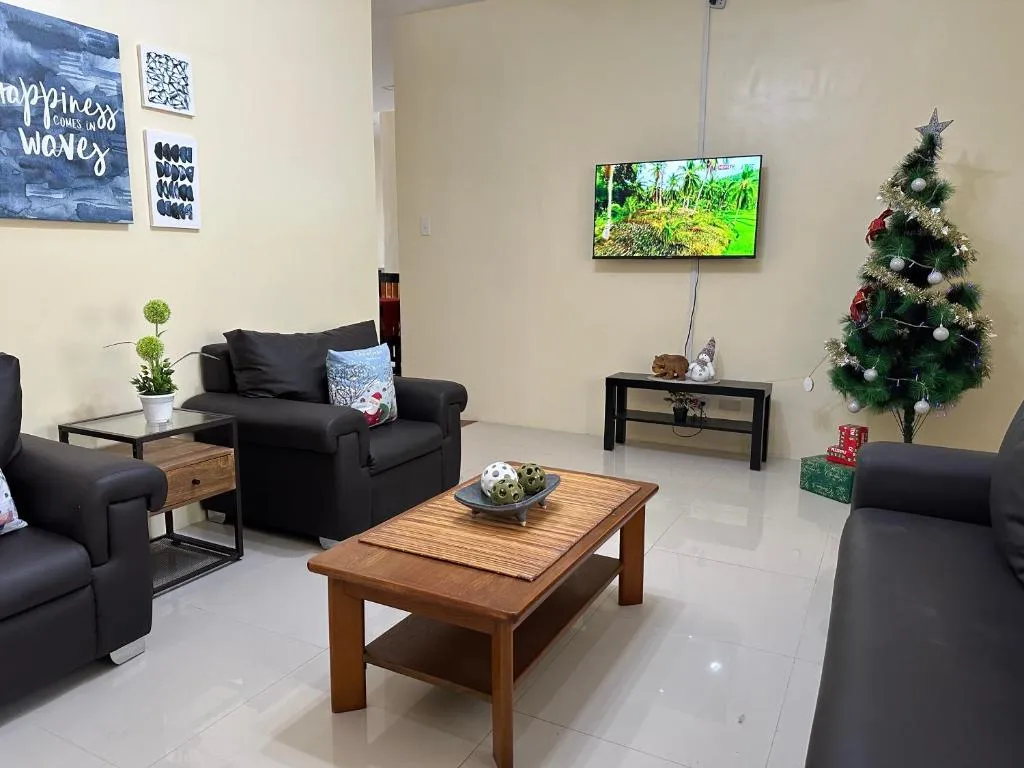
Black upholstery and Christmas lights are an honest pairing: the dark sofas make the tree glow, but they also show every crumb, every pet hair, every stray strand of tinsel. Keep a lint roller in the console drawer and you’ll stop noticing. Light tile floors are a gift here — a quick sweep handles the glitter — but they’re cold underfoot, so a rug near the seating is worth the money.
One Wall, One December, Zero Needles to Vacuum
Twenty-five ideas, and not one of them requires you to move the couch. Pick the one that matches your wall size, your budget, and how much energy you actually have in early December — then hang it and go make cocoa.
📌 Save this to Pinterest so next year’s version of you doesn’t have to start from scratch.