
You know that feeling when the tree is up, the lights are on, and something still feels unfinished? It’s almost always the garland. That single strand is the difference between we put up a tree and someone in this house actually has taste.
We spent serious time browsing Etsy, Target, and Hobby Lobby to bring you only what’s worth your attention this year — 33 garland ideas running from about $8 for a handmade strand to $180 for a fully lit, frosted statement piece. You’ll find traditional red-and-green, frosted rustic, metallic glam, and handmade fiber-craft, with budget and luxury versions compared side by side.
2026 is the year garland went analog — crocheted trees, felt balls, sheet music paper chains — because we’re all craving something that doesn’t glow from a screen. And stay until the end — we break down the most common mistakes that can ruin these looks.
📌 Save this to Pinterest for later — you’ll want to revisit these ideas.
1. Layered Evergreen Garland on a White Brick Mantel, Flanked by Twin Trees
Hang the garland on cup hooks screwed into the underside of the mantel shelf rather than draping it over the front edge. That’s the trick behind a thick, weighty swag instead of a thin green rope. Space hooks every 12 inches, use one 9-foot garland on a 6-foot mantel, then fluff each branch forward so the wire disappears into the greenery.
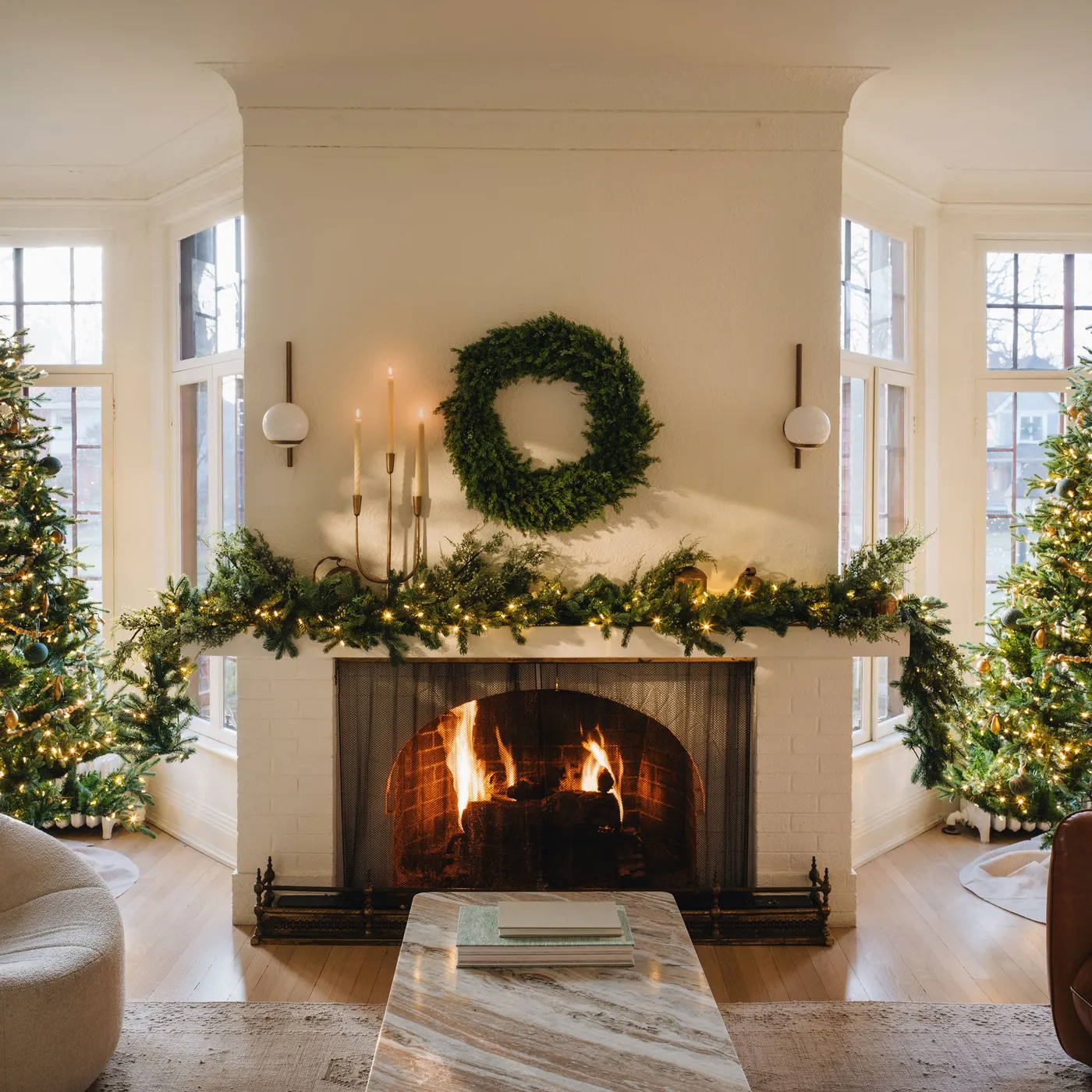
The matching pair of trees. Two decorated evergreens with plain white skirts flanking the fireplace do more for this wall than anything sitting on the mantel. They repeat the evergreen and the warm glow at eye level, so the whole composition reads as one piece. Take them away and you have a decorated mantel. Keep them and you have a room.
2. Red Berry Garland That Spills Down Both Sides of a White Mantel
The garland doesn’t stop at the corners — it runs down both sides of the white mantel, building a vertical frame that pulls your eye straight up to the wreath. That’s a classic triangle of greenery, and it’s why the fireplace feels taller than it is. The red berries supply roughly 10% of the color; the other 90% is green and white, so it reads festive rather than loud.
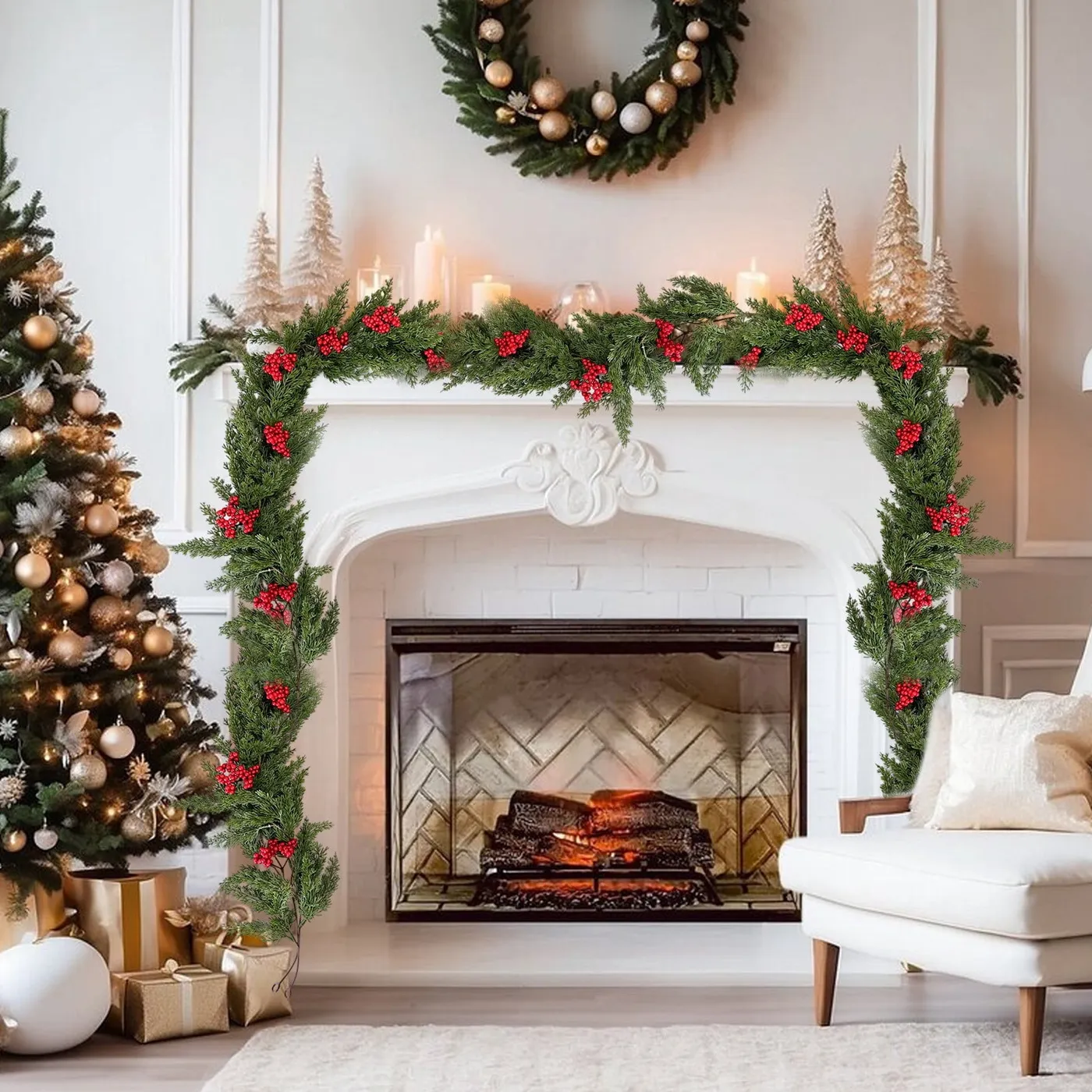
- Main furniture: faux pine garland, 9 ft — $30–$60
- Lighting: warm white string lights, 2 strands — $12–$25
- Textiles: stockings if you add them — $20–$45
- Decor: red berry picks, metallic mini trees, white pillar candles — $25–$50
- Wall treatment: green wreath with gold ornaments — $20–$55
Total: roughly $107–$235. Budget alternative: wire dollar-store berry picks into a plain green garland and skip the metallic trees — you’ll land closer to $45–$70.
3. Frosted Pinecone Garland Under a Gold Mirror on Blue-and-White
Read this mantel as a formula: about 55% dark evergreen, 20% frosted grey-green tips, 15% warm LED glow, 10% pinecone brown. Because the blue-and-white wallpaper is already busy, the garland stays quiet and lets the pattern work. Swap in solid navy and you can add gold ribbon. Swap in warm cream and go heavier on pinecones, pulling the frosting back so the textures don’t fight.
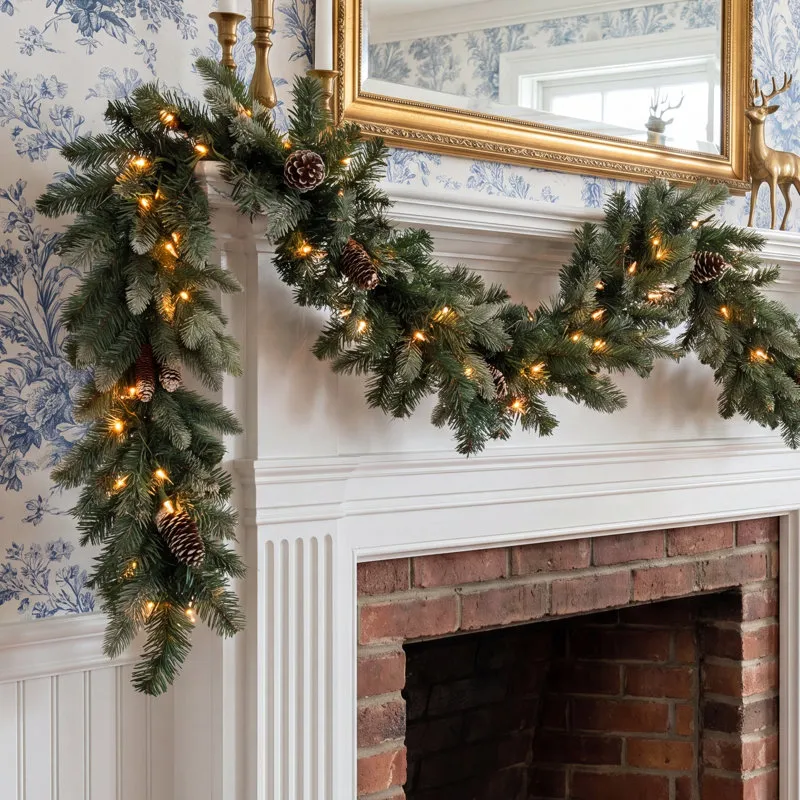
Frosted garlands shed. Expect a fine dusting of faux snow on the mantel, the hearth, and whatever the cat walks across for the first two weeks. Shake it outside before hanging, and pat it clean instead of vacuuming the flocking. Also check your light color against that wallpaper: cool white LEDs turn blue-and-white patterns icy, while warm yellow LEDs keep the whole corner golden.
4. Red Bauble Garland Piled High on a Rustic Wood Mantel
The collected mantel is back. After years of sparse, single-note styling, 2026 searches are full of nutcrackers, deer, miniature shimmering trees, and inherited nativity sets sharing one surface. It’s maximalism with sentiment attached — nothing gets stored away for not matching. The garland here is the anchor that lets all of it live together: one continuous red line holding a very busy shelf in place.
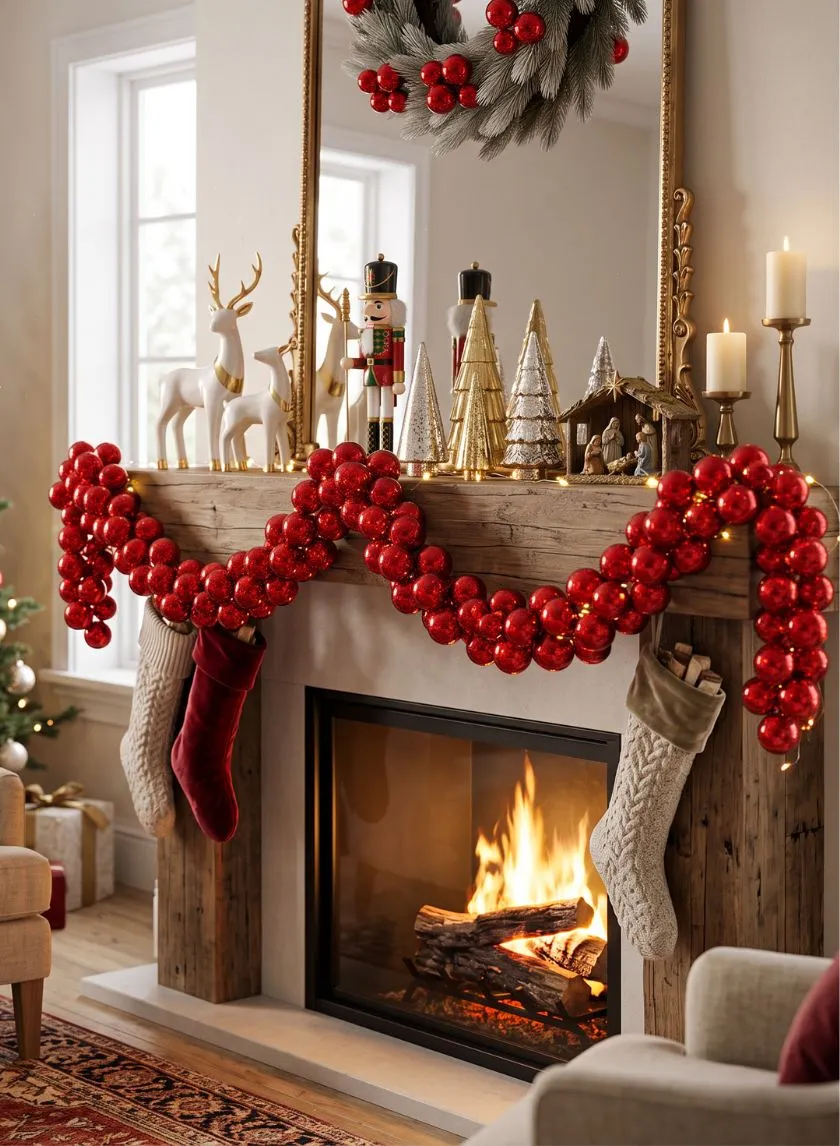
This look needs room to breathe. A mantel 5 feet or wider with an 8-foot ceiling gives the gold-framed mirror and the tall decorative pieces enough air. If your mantel is under 4 feet, cut the collection to three items and keep the red bauble garland thinner — a crowded shelf in a small room reads as clutter, not abundance. Compare with Idea #16, which gets the same dark-mantel drama with far fewer objects.
5. Horizontal Silver Tinsel and Candy Canes on a Multicolor-Lit Tree
Getting horizontal tinsel strands to sit level is the whole trick:
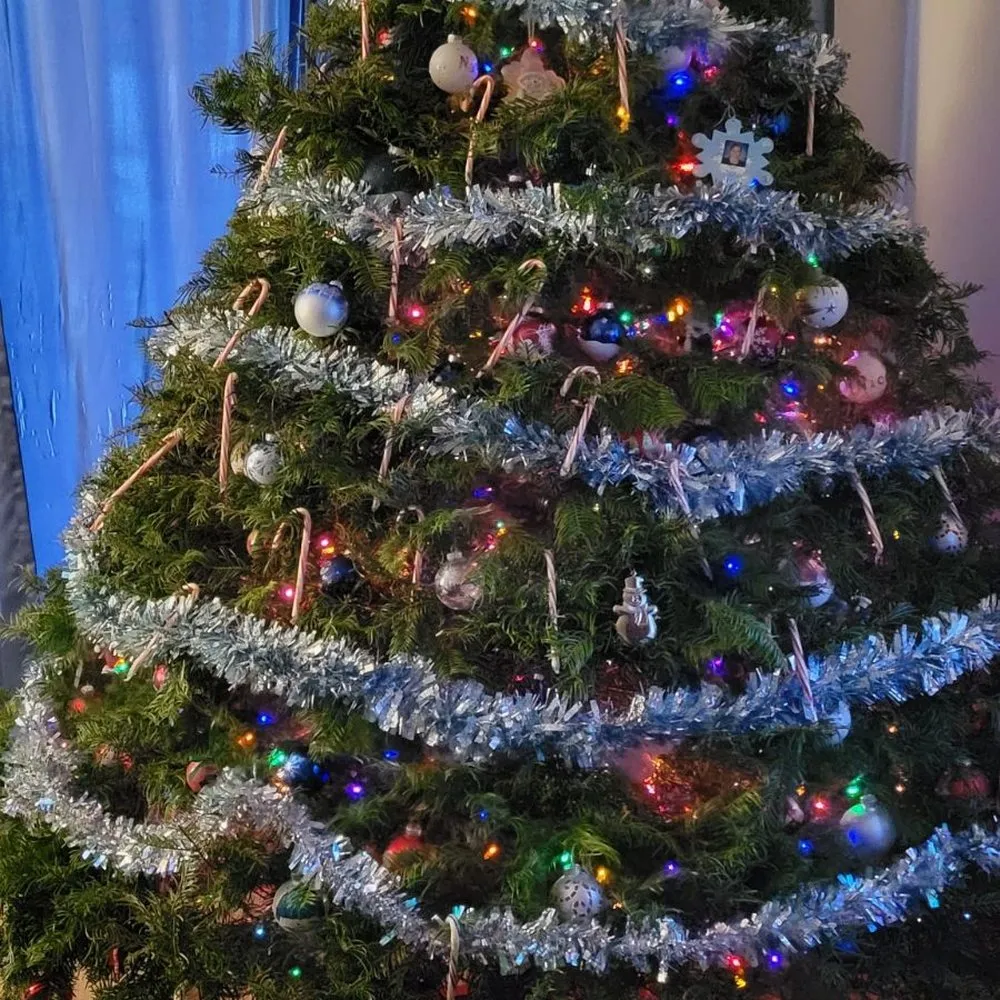
- Start at the bottom branch layer and work up, never top-down.
- Anchor one end with a twist tie, then run the strand around the back of the trunk at the same height before bringing it forward.
- Keep tension even — slack strands sag by week two.
- Add candy canes last, hanging them over the tinsel so they read as a separate layer.
- Step back every three rows and check the line from the doorway.
Time: about 90 minutes. Materials: roughly $15–$30 for tinsel and ties.
Tinsel sheds for years, not weeks — expect a thin silver trail every time you move the tree. Keep strands away from hot bulbs, since older tinsel can scorch and smell. Multicolored incandescent sets usually last three to five seasons before a section dies, and one dead bulb kills the whole strand. Test every section before you decorate, not after.
6. Rainbow Felt Ball Garland on a Tree Full of Personal Ornaments
A rainbow felt ball garland looks expensive and isn’t. Hobby Lobby and Amazon sell felt balls in bulk for about $10–$18 per 100, and a needle plus embroidery floss is another $5. Thread them in gradient order and you’re done in an evening. The rest of this tree is the real budget story: it’s covered in ornaments collected over years, not a matched set. Start with what you own and add one new piece each December.
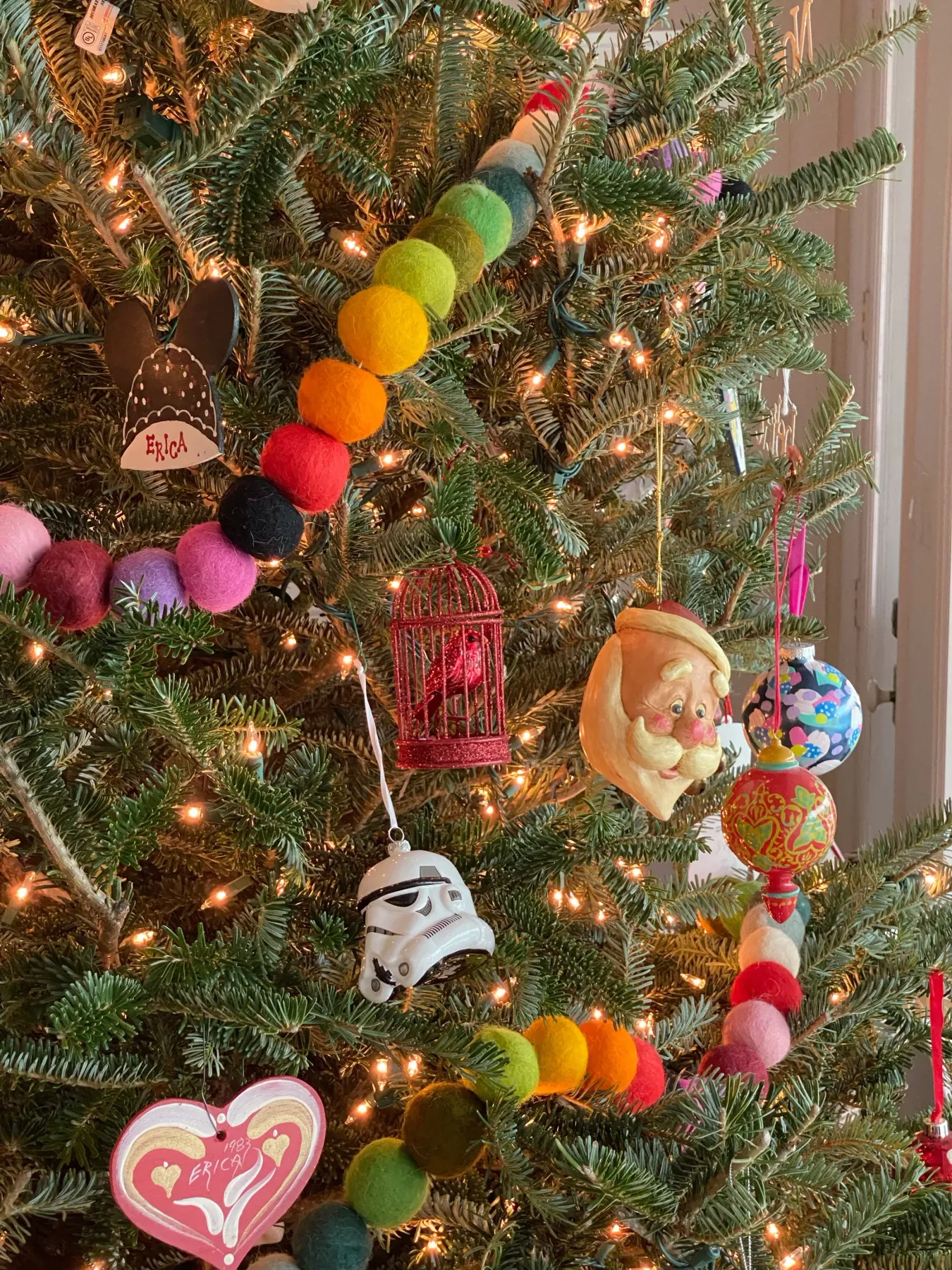
Use the personalized ornament as the focal point and build around it. Hang anything with a name or a date at eye level, slightly off-center, then cluster the chaotic pieces — the Santa face, the helmet, the glitter birdcage — in a loose triangle around it. On a 7.5-foot tree, keep the felt ball garland at 9 to 12 feet so it makes three or four passes instead of one sad stripe.
7. Pearl Strands and Crystal Icicles on a Deep Green Tree
It’s a value-contrast trick. Dark green branches, bright white pearl, and clear crystal sit at three very different brightness levels, so the tree sparkles even in low light. The white repeats in three materials — beads, baubles, icicles — which is what keeps it feeling deliberate instead of random. Add one warm light source and the whole thing glows rather than glitters.
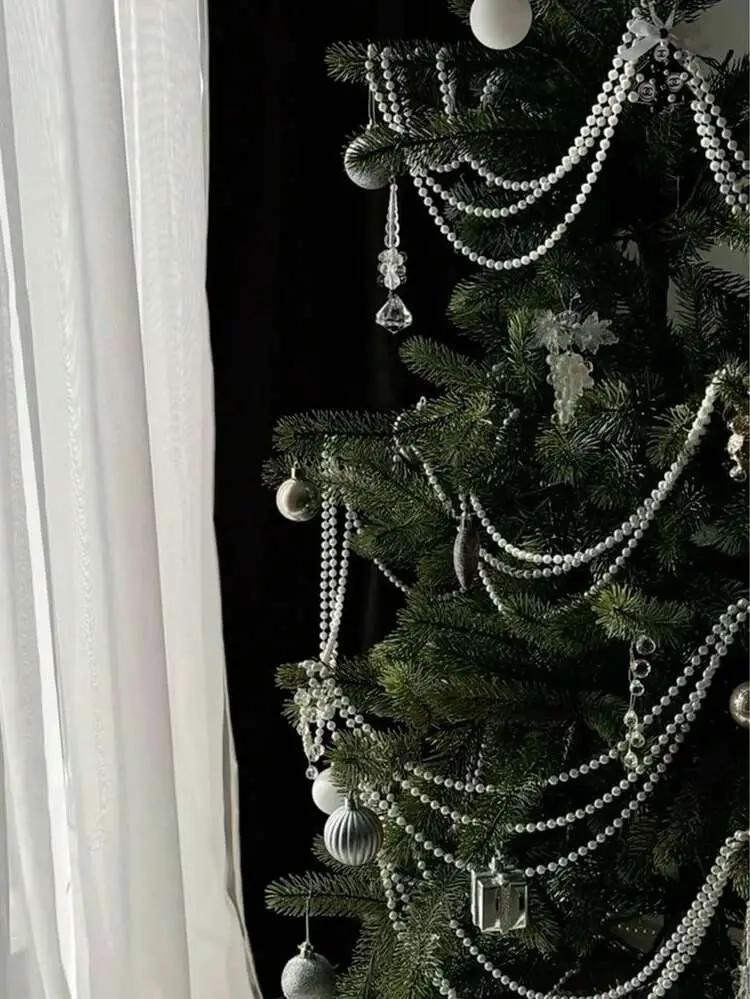
Multiple strands of pearl garland. One would look like a polite suggestion; three or four turn it into the tree’s skeleton. Run them at different depths — one near the trunk, one mid-branch, one close to the tips — and the pearls appear to float. Reduce it to a single strand and you lose the density that makes this tree look expensive. That one decision is the entire look.
8. Every Surface Gets a Garland: Red Berries, Paper Chains, Fairy Lights
This much garland means this many outlets. Count your cords before you commit — a room this layered can pull six to eight light strands, and you cannot safely daisy-chain that many on one extension cord. Use two or three circuits, hide the runs behind furniture, and keep every cord out of the walking path. Paper chains are the other consideration: they collect dust and they’re flammable, so keep them away from anything that runs hot.
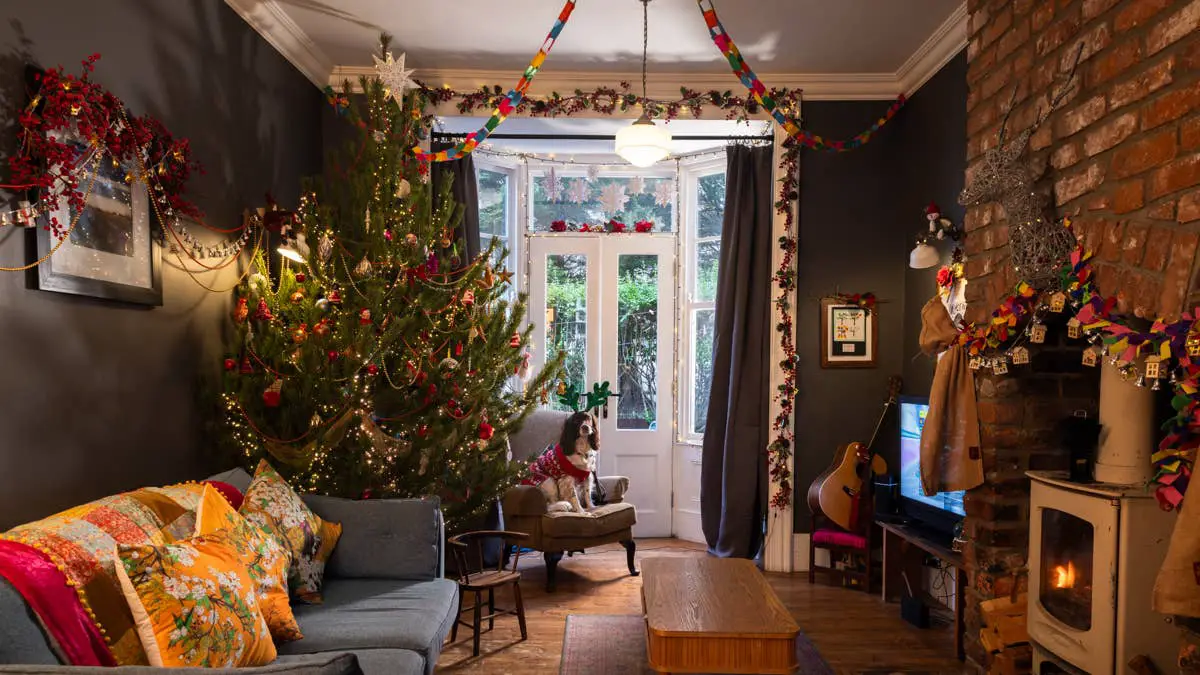
The room-wide formula here is about 60% evergreen, 20% warm light, 15% handmade paper and fiber, 5% metallic. The evergreen carries it, the light makes it feel alive, the handmade pieces give it personality, and the metallic just echoes. To shift the mood, change the 15%: swap paper chains for plaid ribbon and it turns traditional, swap them for dried orange slices and it turns cottage.
9. Silver Bead Garland Draped in Soft Swags on an Artificial Tree
Garland length is simple math most people get wrong. Plan roughly 9 feet of garland per foot of tree height for a swagged look, and about 6 feet per foot if you want it loose. On a 7.5-foot tree, that’s two 50-foot silver bead strands, draped front to back. Tight on space? See Idea #28, where a 4-foot tabletop tree gets the same treatment with a fraction of the material.
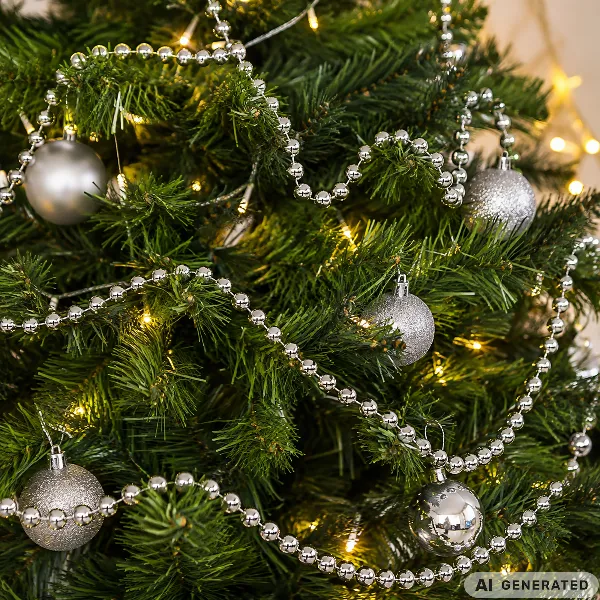
- Main furniture: 7.5 ft artificial tree — $90–$250
- Lighting: warm white string lights, 3 strands — $18–$36
- Garland: silver beaded strands, 2 x 50 ft — $20–$45
- Decor: silver baubles, mixed smooth and glittered, 60 count — $20–$40
- Storage: bin and tissue paper — $15–$25
Total: roughly $163–$396. Budget alternative: buy the bead strands at a dollar store and reuse ornaments you already own — this look is almost entirely garland and baubles, so cutting those two lines saves the most.
10. Gold and Bronze Faceted Beads in Horizontal Swags
Metallic bead garlands are the least forgiving thing on a tree. The finish dulls over time, dust settles into every facet, and a single broken thread sends beads across the floor. Store them coiled in tissue paper, never loose in a bin, and never in a damp basement — bronze and gold coatings spot with humidity. Expect a good set to last about five seasons before it starts to look tired.
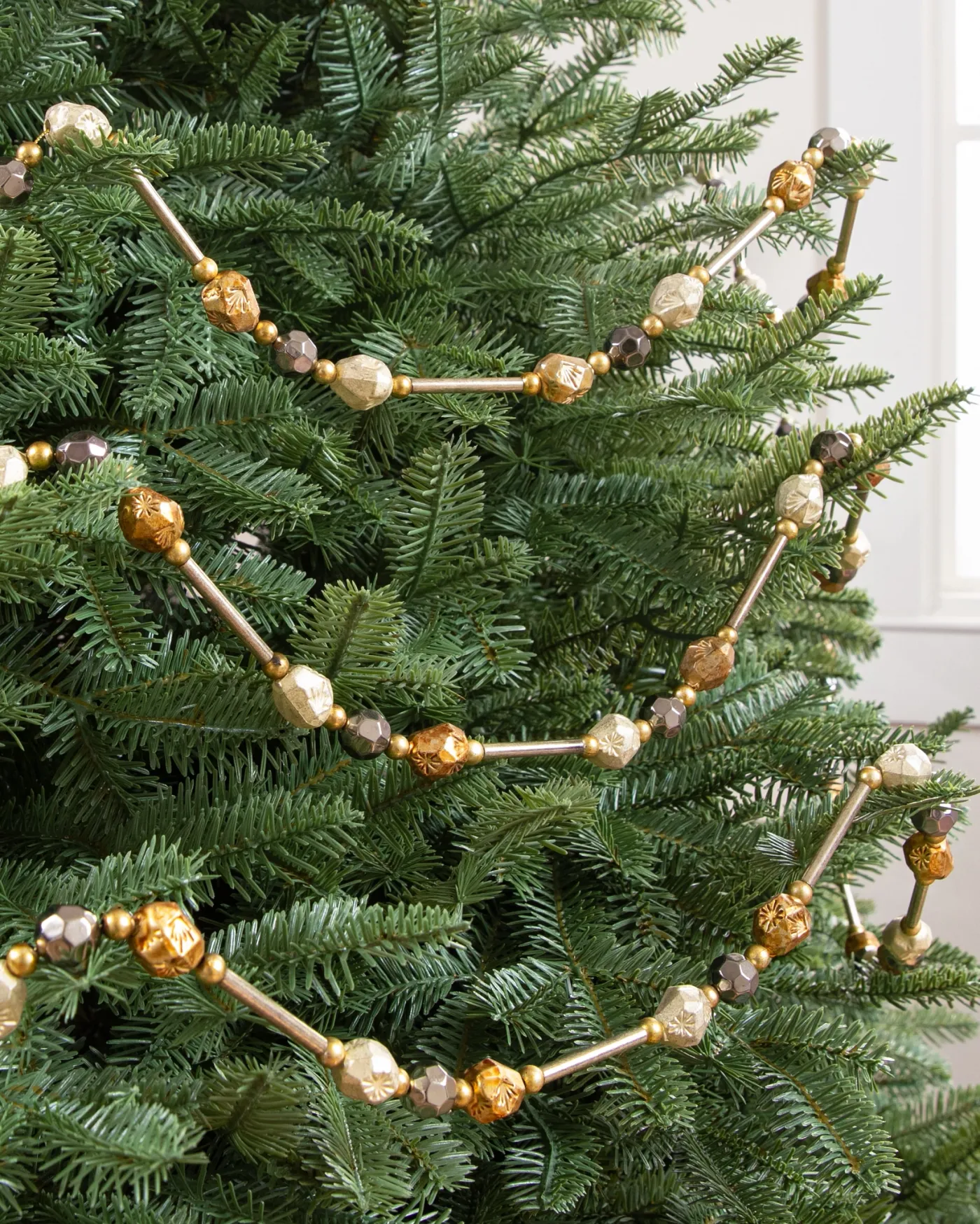
Beaded garlands from the 1990s are being pulled out of attics and sold for real money on resale sites, and new versions are showing up with faceted beads and elongated bar segments instead of plain rounds. It fits the broader 2026 move toward quiet maximalism — rich materials, restrained color, lots of texture. This one has staying power because it isn’t novelty; it’s the idea your grandmother used, updated in finish.
11. Long Needle Pine, Red Berries, and Pinecones in Close Detail
- Measure the run — mantel, shelf, or railing — and add 20% for the drape.
- Check what’s behind it: red berries disappear against a red wall.
- Confirm an outlet within reach of your light strand.
- Decide real or faux berries before you buy; they style differently.
- Set a budget floor — mixed real-touch garland starts around $35 for 6 feet.
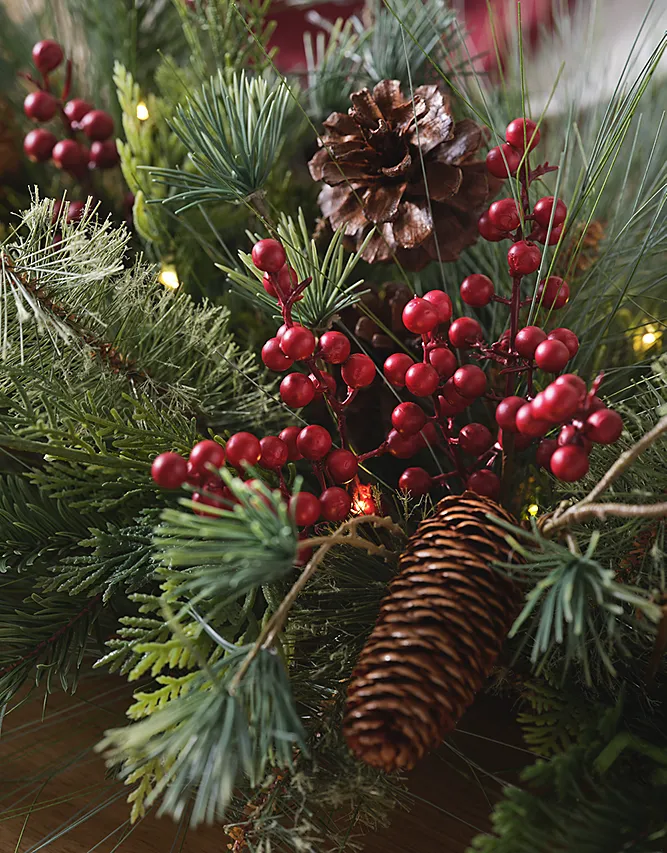
To get this natural mix:
- Fluff the garland first, bending every branch outward and alternating directions.
- Wire in berry clusters in odd numbers — three or five at a time.
- Tuck pinecones deep and angled down so they read as part of the branch.
- Weave the fairy lights last, following the vine rather than wrapping it.
- Hang it, then adjust from six feet back — close-up symmetry fools you.
Time: about 45 minutes. Materials: $35–$70.
12. A Berry Garland Centerpiece Across a Red-and-Plaid Dining Table
Keep the centerpiece under 12 inches tall so people can actually see across the table, and run one continuous garland rather than several pieces — seams are obvious at eye level when guests are seated. Place pillar candles every 18 to 24 inches, always in glass, and never directly under a low-hanging strand. The result reads generous without blocking conversation.
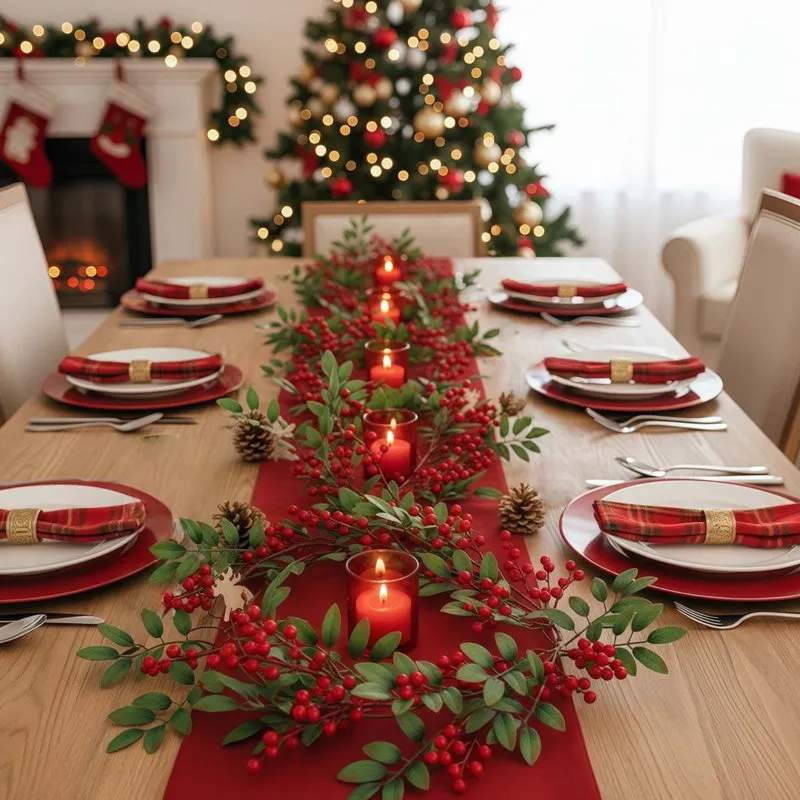
Red appears four times here — charger plates, napkins, candles, and berries — but never in the same material, so it repeats without turning into a theme. The plaid plays the same game in miniature. That’s why the table feels curated: one color, four textures, all sitting inside a green frame that keeps it from shouting. Without the garland running down the middle, all that red fights itself.
13. Gold-Wire Berry Strand Woven Through Faux Evergreen
The gold wire. It’s visible, it’s thin, and it’s doing all the work — that warm metallic line threading through green is what makes this strand feel like jewelry instead of a craft project. Swap it for green floral wire and the berries would disappear into the foliage. Same berries, completely different result. The cost difference is about three dollars.

You don’t need designer berry garland. Dollar Tree berry picks run about $1.25 a bundle, and a spool of gold-tone wire costs $3 at any craft store. Twist berry clusters onto the wire every 3 to 4 inches, then wrap the whole strand loosely through the branches. Total for a 6-foot run: under $20. The gold leaf ornaments are the one thing worth buying nicer — check Target’s seasonal aisle in October.
14. Glossy Red Berries and Pinecones Wired Into Classic Pine
Classic for a reason: 70% green foliage, 20% red berries, 10% brown pinecone. That ratio works in every room because it’s essentially the color wheel doing your decorating. Change the red to burgundy and it turns moody. Change the pinecones to bleached wood beads and it turns Scandinavian. The green stays at 70% every time — that’s the constant that keeps it from looking chaotic.
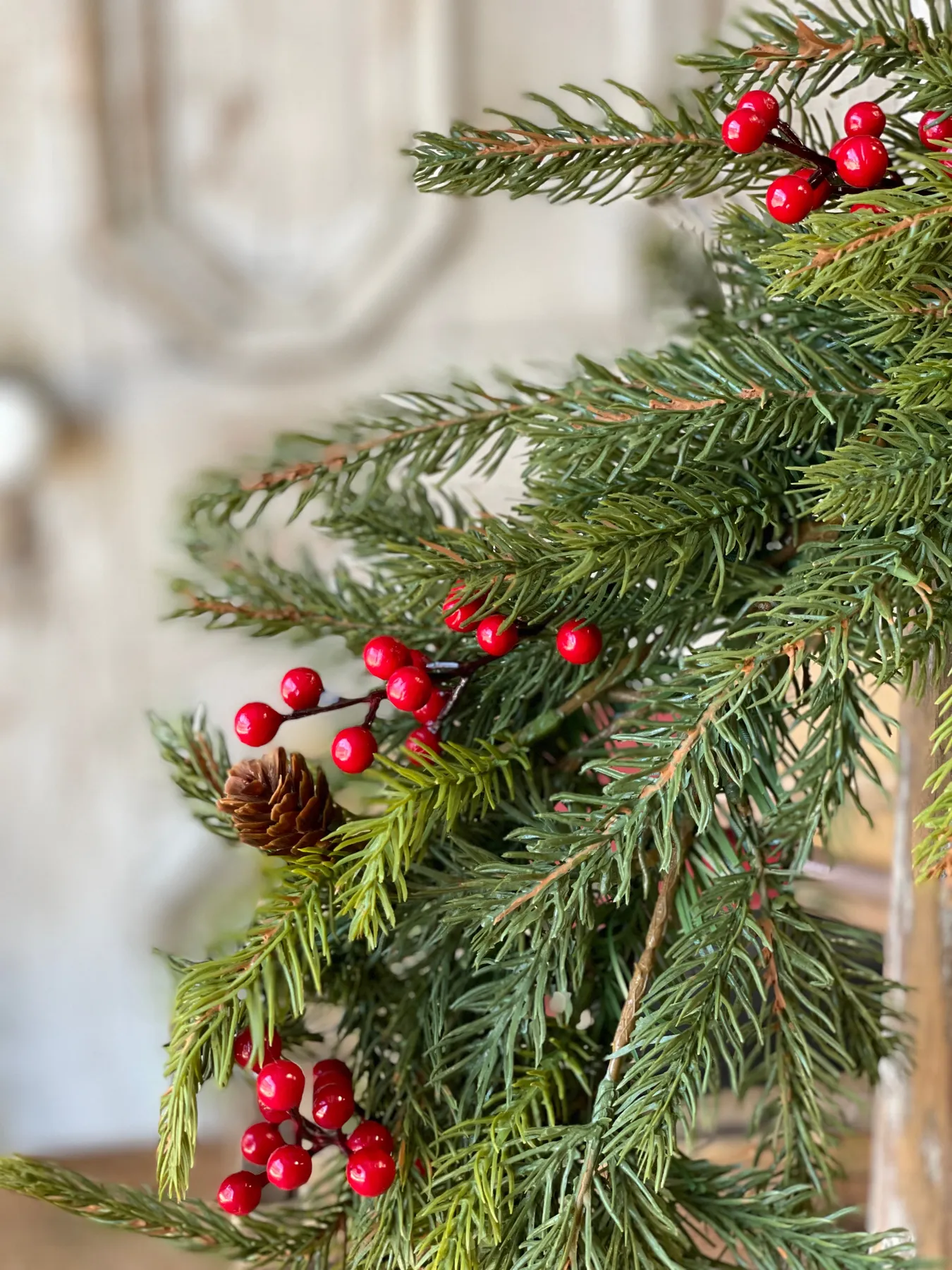
Glossy faux berries look great and photograph beautifully, but kids and dogs will pull them off. Wire each cluster with two twists, not one, and keep a handful of loose berries in a drawer for the ones that vanish. If you’re going real, remember fresh berries drop within about ten days in a heated room — this is a December 20th look, not a December 1st one. Compare with Idea #21, where the same berries go nearly bare on marble.
15. Sugared Berry Garland Draped Over Chipped White Wood
This is vignette scale, not mantel scale — a 6-to-9-foot garland over a sideboard, a shelf, or a chipped wooden crate, and it works in rooms as small as 8 by 10 feet. The beauty is you only need one square foot of surface. If you have a full mantel to fill, double the length and go heavier; this frosted look gets lost when it’s stretched across a wide fireplace.
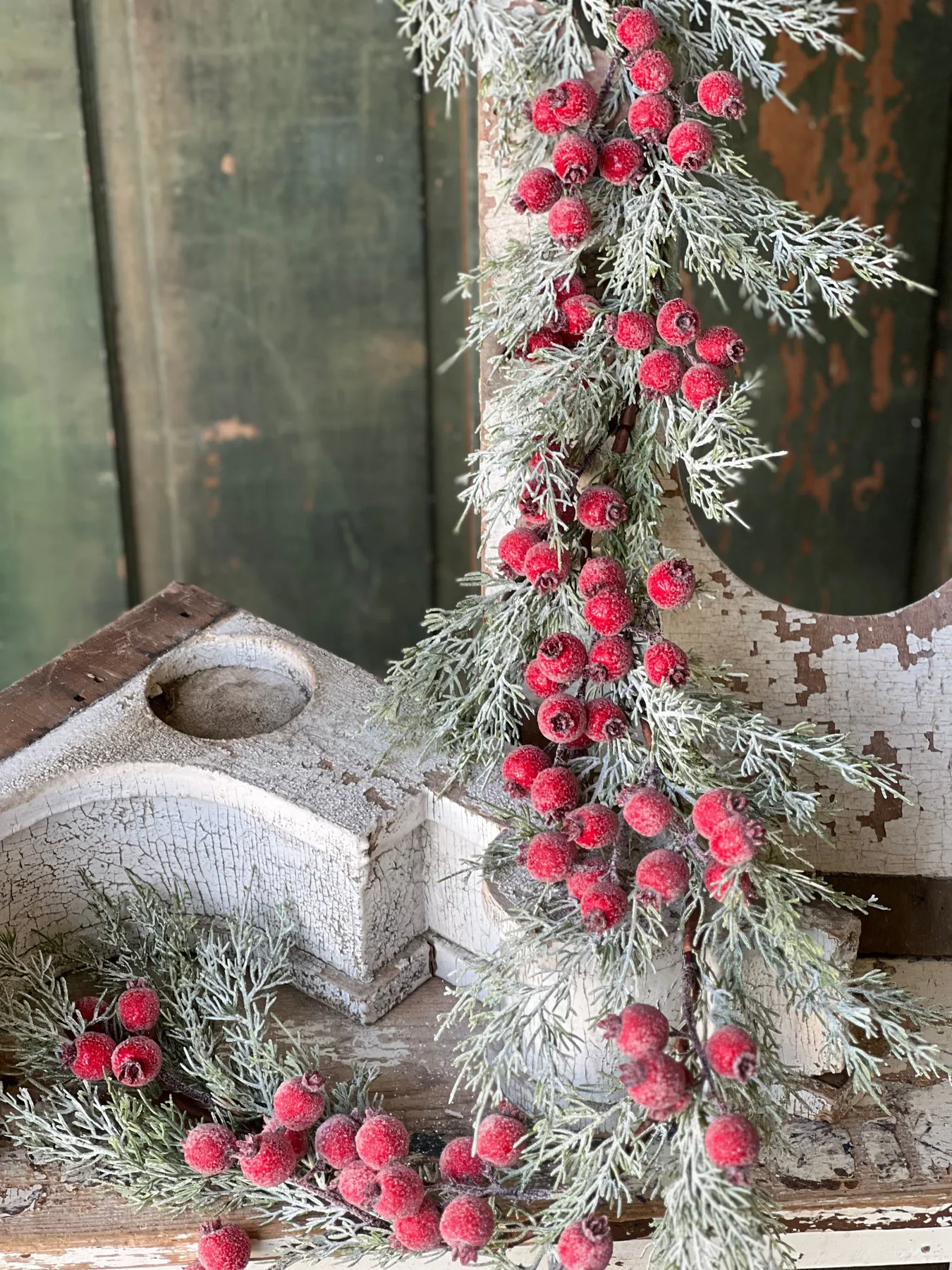
Sugared and frosted finishes shed more than plain faux greenery, and the white coating picks up dust like a magnet. Blow it clean with a hair dryer on cool — never wipe, or you’ll smear the frost right off. Red sugared berries also bleed if they get wet, so keep this away from windows and humidifiers, and store it in a bag with the air pressed out.
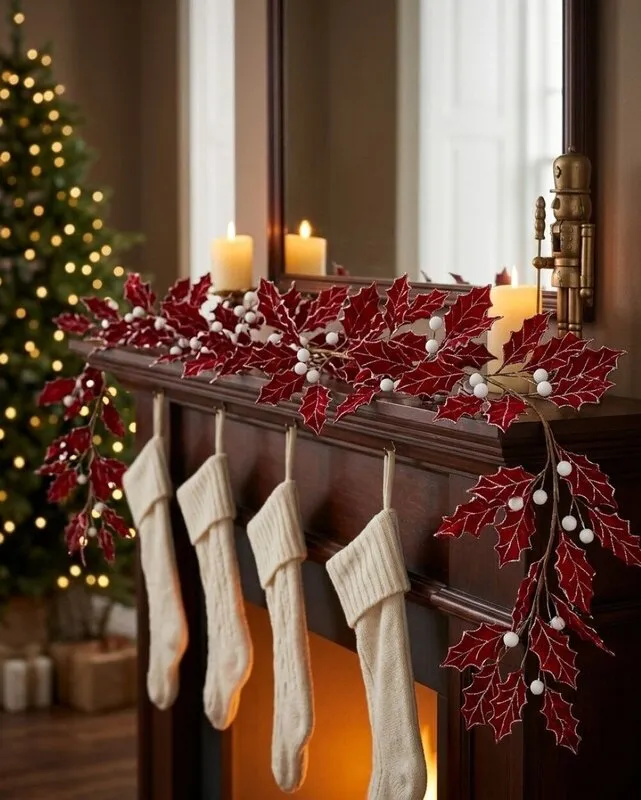
16. Deep Red Velvet Holly Garland Over Cream Knit Stockings
- Main furniture: dark wood or painted mantel shelf — existing, or $120–$400 to build
- Lighting: flickering LED pillar candles, 3 — $18–$40
- Textiles: cream knit stockings, 4 — $40–$90
- Decor: deep red velvet holly garland with white berries — $35–$85
- Accents: brass nutcracker, stocking hooks — $15–$35
Total: roughly $108–$250 on top of the mantel itself. Budget alternative: thrift the stockings, then add plain white berries and a short velvet ribbon to a cheap green garland — it reads nearly identical from three feet away.
Hang stockings so the top edge sits about 6 inches below the mantel shelf, and let the garland drape in front of the hooks. If a stocking top peeks above the shelf line it breaks the composition instantly. Space four stockings evenly on a 6-foot mantel — 14 inches center-to-center — and keep the garland depth to about 10 inches so nobody’s toes get buried.
17. Crocheted Tree Garland on Twine, Mixed With Pinecones and Wood Stars
To assemble a crocheted tree garland in an afternoon:
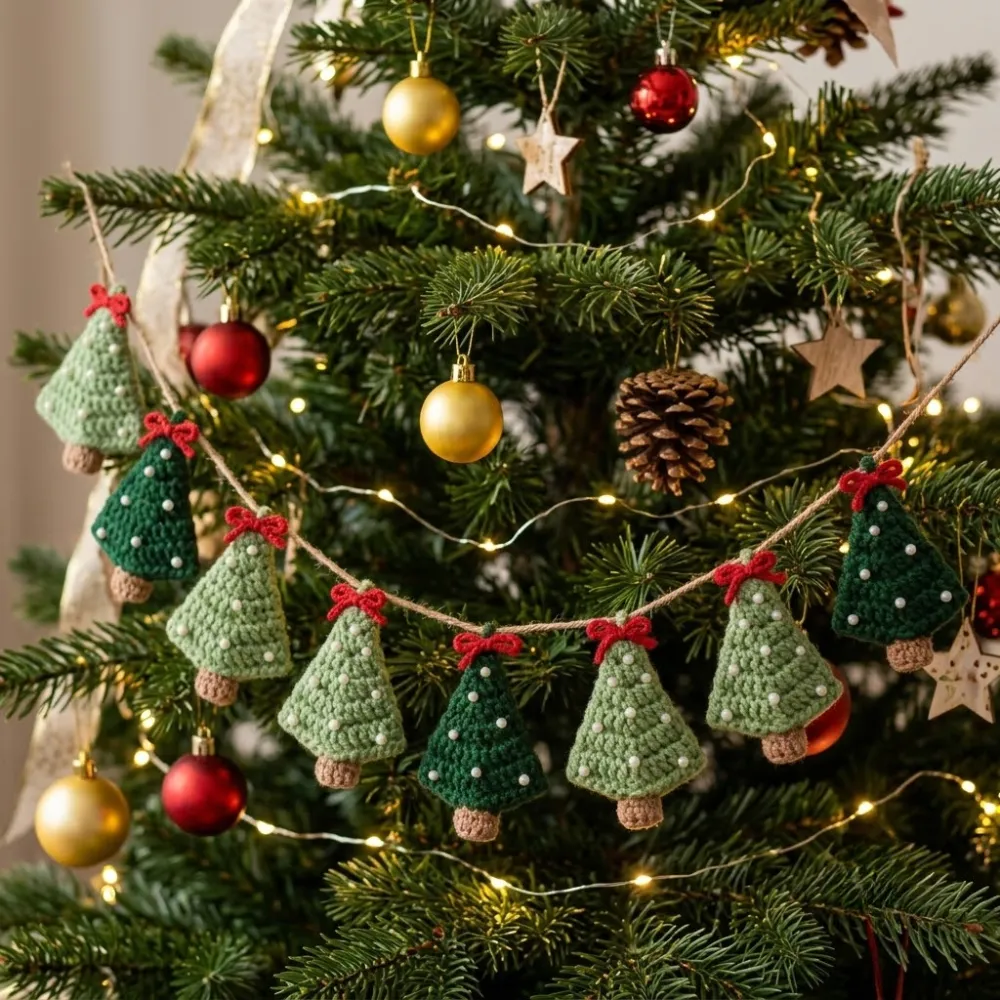
- Make or buy small tree motifs — roughly 18 to 24 for a 7-foot tree.
- Thread a blunt tapestry needle with natural twine.
- Run the needle through the top of each tree, leaving 3 inches between shapes.
- Add a tiny red bow and two white beads to each tree as you go.
- Knot both ends with a 6-inch tail for hanging.
Time: 3 to 4 hours if you’re crocheting, 45 minutes if you’re just stringing. Materials: $12–$25 in cotton yarn and twine.
The handmade Christmas is having a genuine moment — fibre craft searches climb every November, and grandmillennial styling has made crochet respectable again after decades of being filed under grandma. What’s driving it in 2026 is less nostalgia than speed: people want decor that takes one evening and costs almost nothing. Handmade garlands also stick around longer than trend-driven ones, because nobody throws away something they made.
18. Tiny Crocheted Trees Strung Along Thin Jute Twine
Three things: repetition, scale, and contrast. Nineteen identical little trees create a rhythm the eye can follow across a whole shelf. Each one is small enough that a row of them never feels heavy. And dark green yarn against a mottled grey background gives you a soft, low-contrast edge that reads as texture rather than pattern — which is exactly why it looks calm instead of busy.
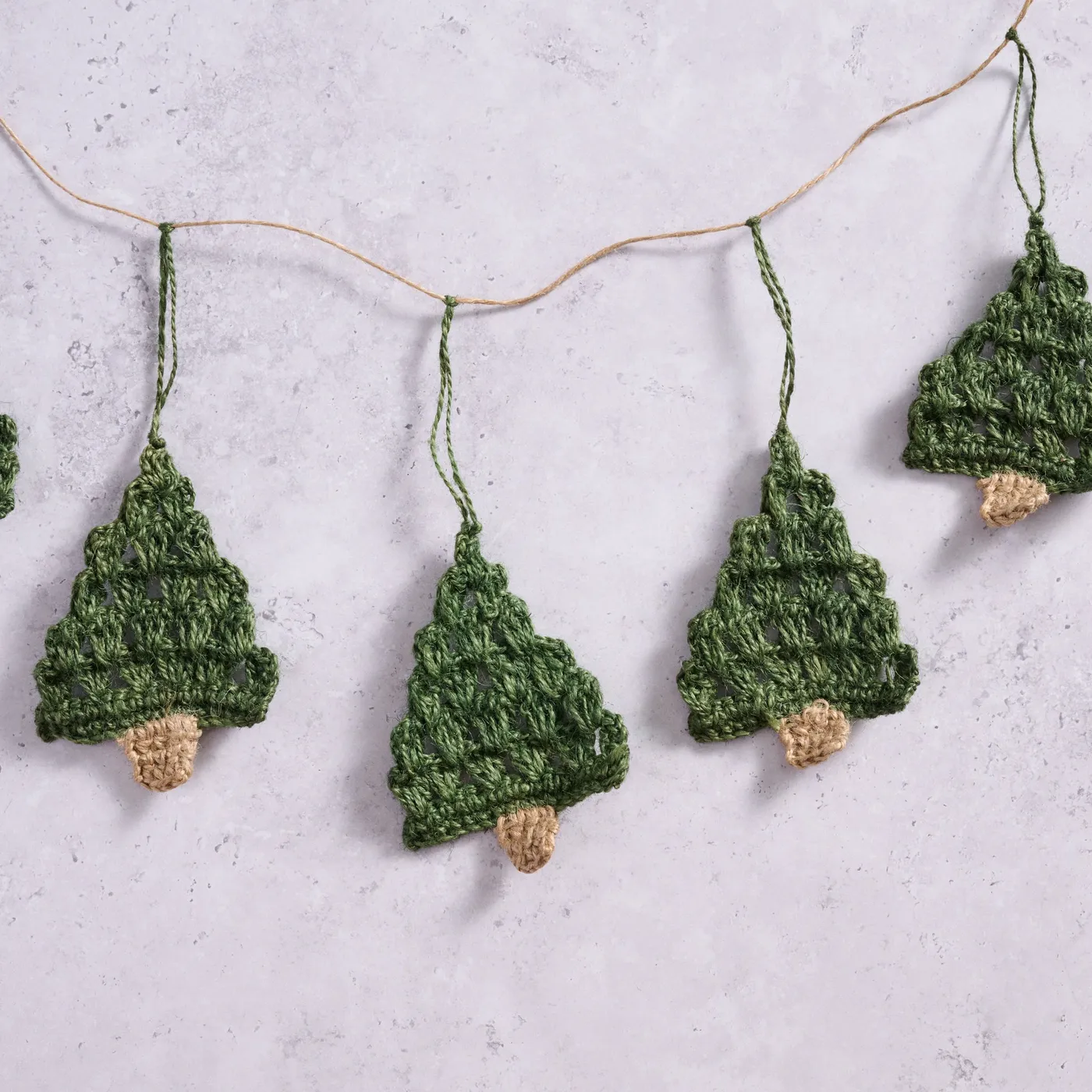
Yarn is the cheapest decorating material there is. One skein of cotton in a deep green runs $4 to $6 and makes roughly 25 small trees, so this entire garland can cost under $15 including the twine. If crochet isn’t your thing, Etsy sellers charge $28 to $55 for a finished strand — still reasonable, with about a week’s lead time. Facebook Marketplace occasionally turns one up for $10 from a crafter clearing out.
19. Two-Tier Felt Garland With Santas, Snowmen, and Stars
- Measure the wall or opening first — two garlands need double the run.
- Check your hook situation; felt is light, but two strands still need anchors.
- Confirm the wall color — red and white pop on off-white and go muddy on beige.
- Decide spacing before you hang; 12 to 15 shapes per strand looks right.
- Keep small felt pieces above 4 feet if you have toddlers.
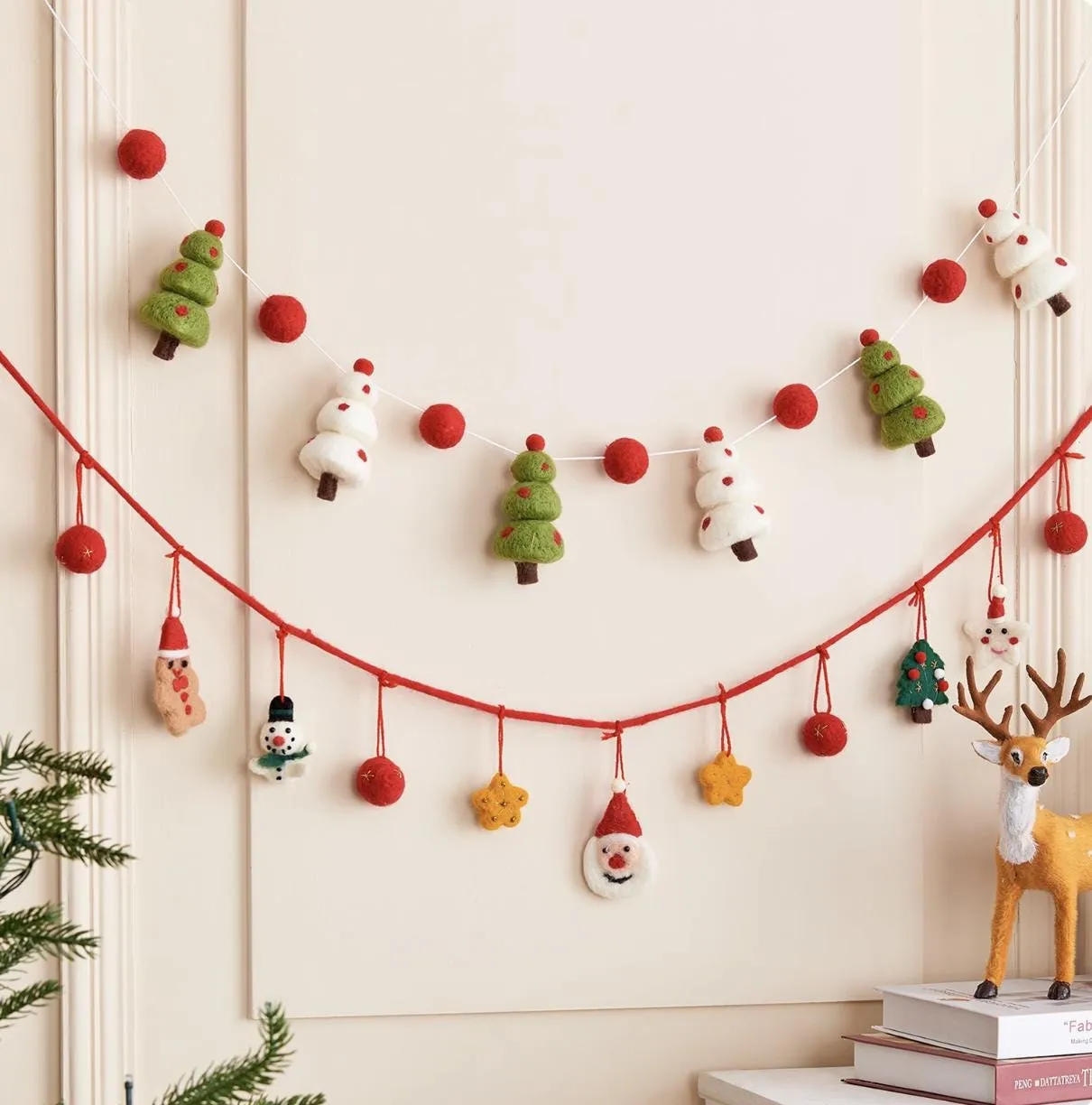
The two-tier layering. One felt garland alone is a nursery decoration. Two, offset with different motifs and a gap of about 8 inches, becomes a composition — the eye travels between them, and the plain wall between the strands does as much work as the felt does. Take the top strand away and the bottom one suddenly looks like it’s floating with nowhere to go.
20. Pom-Poms in Brights Draped on Real Evergreen Branches
Pom-poms and real trees are a slightly tense pairing. Live evergreens drop needles, and every needle that lands on a fuzzy pom-pom is a needle you’ll pick off by hand. Keep the garland toward the outer branches where air moves, water the tree daily, and skip this entirely on a tree near a heating vent — dry heat makes the needles fall faster than you can tidy. If that sounds exhausting, faux greenery behaves perfectly.
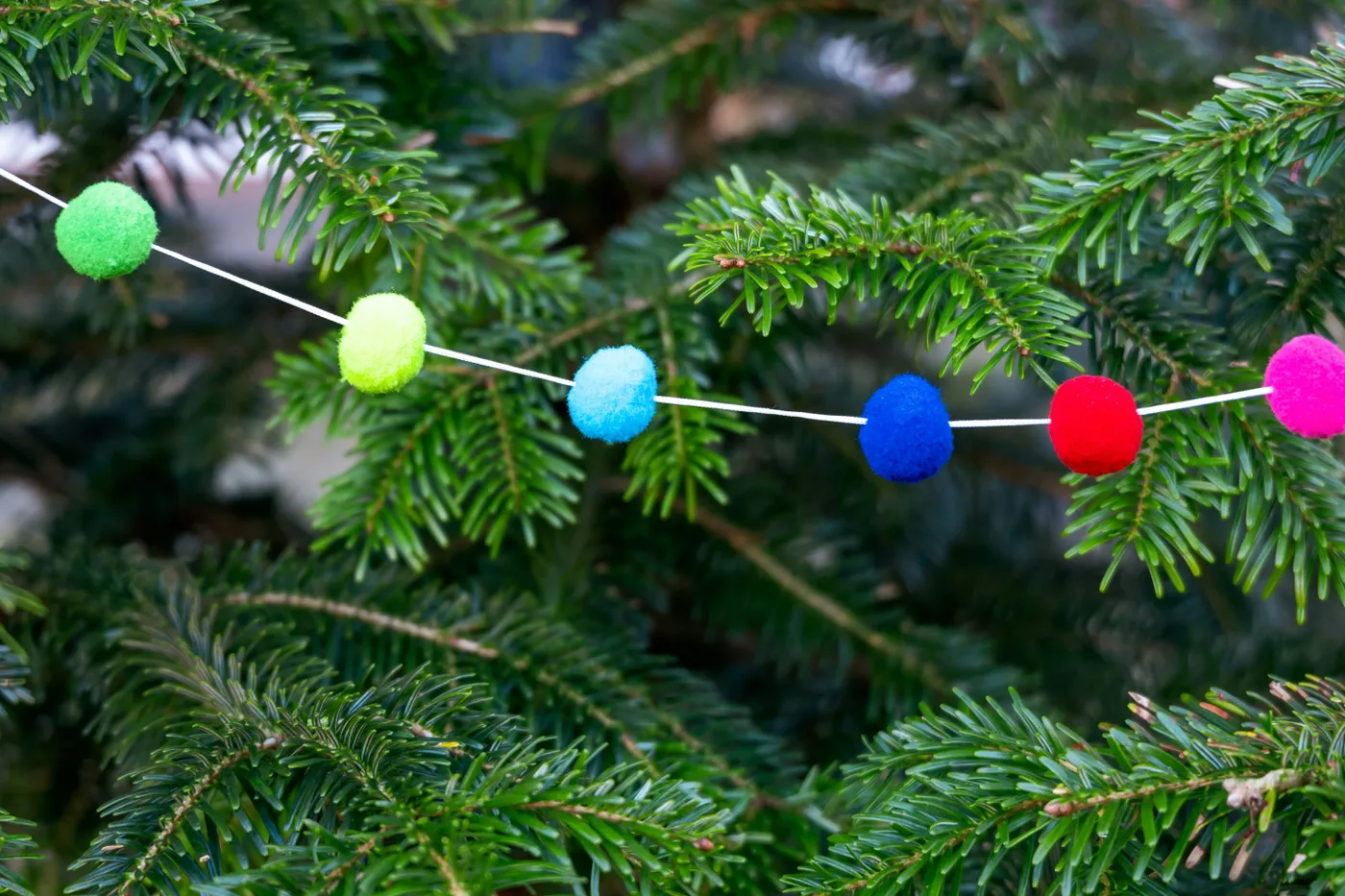
It’s the simplest formula in this whole list: 80% deep green, 20% bright pom-poms, zero metallic, zero neutral. The colors are saturated and roughly equal in intensity, which is why nothing competes. Want it calmer? Drop to three colors and keep the same 20% ratio. Want it wilder? Go to eight. Just never let the pom-poms pass 30% or the tree stops looking like a tree.
21. Loose Red Berry Garland Uncoiled Across Marble
Run a thin berry strand in the opposite direction to your greenery — diagonally up one side, diagonally down the other. Crossing directions is what makes two simple strands look like a layered arrangement, and it costs nothing. Aim for 10 to 12 berries per inch of strand; sparser than that reads as skimpy, denser and it turns into a solid red line.
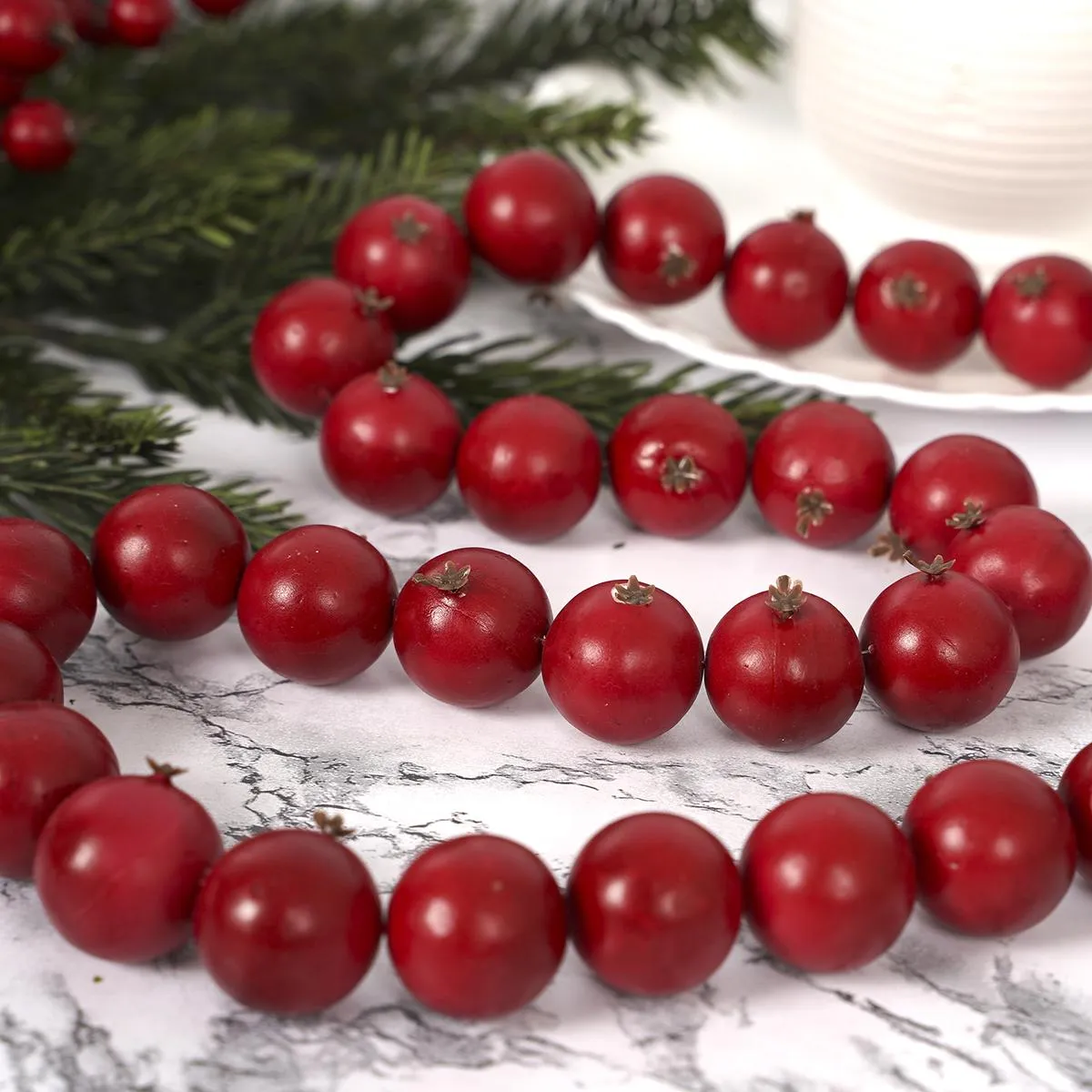
Berry strands are the friendliest option for small spaces because they add color without bulk. A 6-foot strand covers a bookshelf, a console, or half a railing in a studio apartment. They also work where a full garland won’t — around a doorway, over a kitchen window, or across rental kitchen shelving where you can’t hang anything heavy. Pair with Idea #20 if you want more volume without more weight.
22. Paper Chains Swagged From a Brass Chandelier in a Beamed Room
Paper chains are back, and not ironically. High-ceiling rooms with exposed beams make them look architectural rather than childish, and there’s real appetite in 2026 for decorations that aren’t purchased — recycled sheet music, old maps, last year’s wrapping paper. The trend underneath is a reaction to plastic: people want something they can compost in January without guilt.
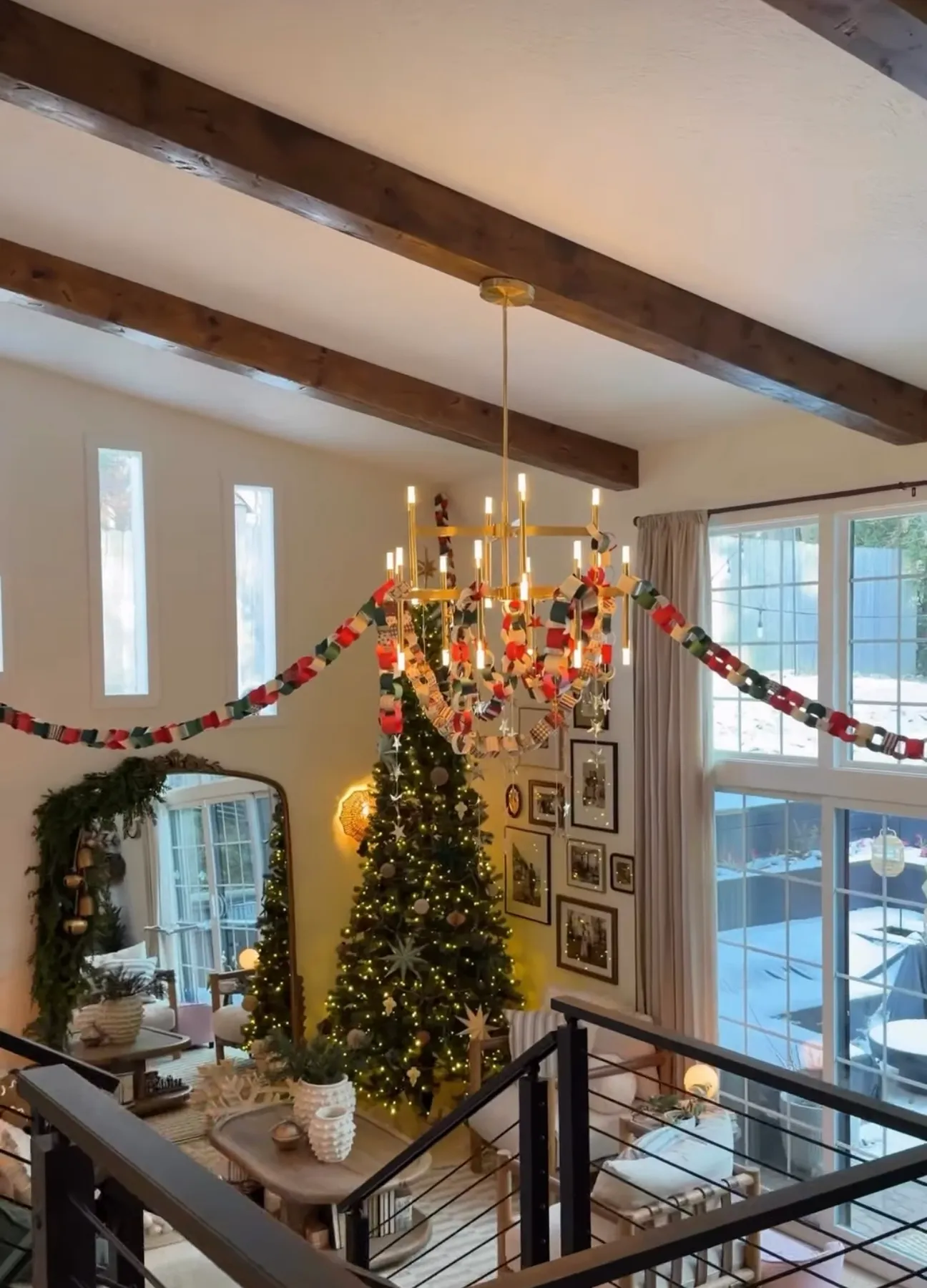
Swagging chains from a chandelier safely:
- Turn the fixture off at the breaker before you touch it.
- Tie clear fishing line to the chain’s end, not the chain itself.
- Loop the line over the chandelier arm and out to a small cup hook near the ceiling edge.
- Keep every run at least 18 inches from any bulb.
- Test the weight by hand — paper is light, but ten linked chains add up.
Time: 1 hour. Materials: $10–$20.
23. Sugared Red Berry Garland Dropped Vertically Down a Dense Tree
Frosted red berries look fantastic for about three seasons. The sugared coating flakes off at the touch points, and once a few berries go bald you notice it immediately against the green. Handle the strand by the wire, never the berries, and store it flat in a garment box instead of coiled. When it does start shedding, a light dusting of craft snow sprayed on from 12 inches revives it for one more year.
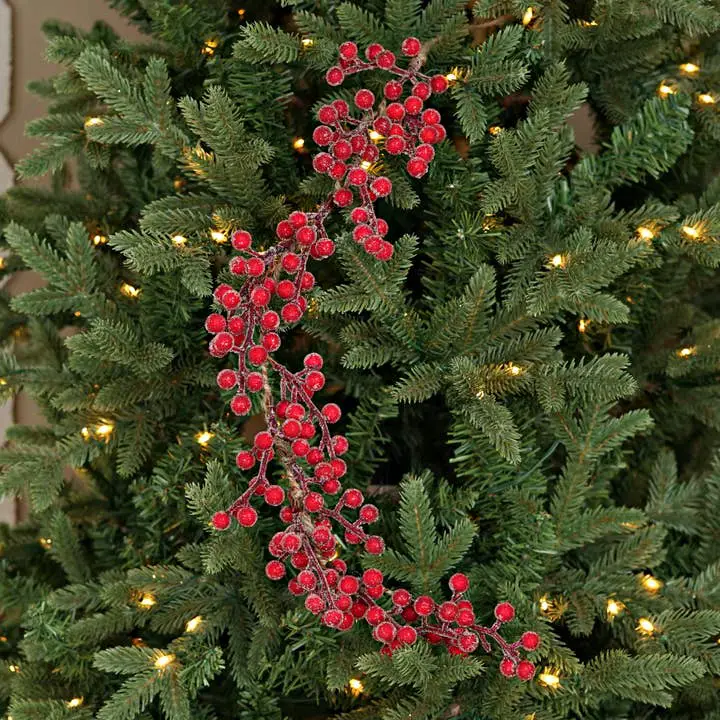
- Main furniture: 6.5–7.5 ft tree — $80–$220
- Lighting: warm white mini lights, 3 strands — $15–$30
- Garland: frosted red berry strand, 6 ft — $25–$55
- Decor: extra berry picks to fill gaps — $12–$25
- Storage: flat box and tissue — $10–$18
Total: roughly $142–$348. Budget alternative: buy plain red berry picks and a can of spray snow, and frost them yourself for about $15 total. It’s messier, but nobody can tell from the doorway.
24. Textured White Spheres Alternating With Small Gold Beads
The texture on the big spheres. They’re coated in tiny crystal-like particles with gold flecks, which means they catch light from every angle instead of one. Smooth white balls in the same spots would look flat and slightly cheap. Remove the texture and you remove the sparkle — this garland is entirely about surface. That’s the one thing worth paying for.
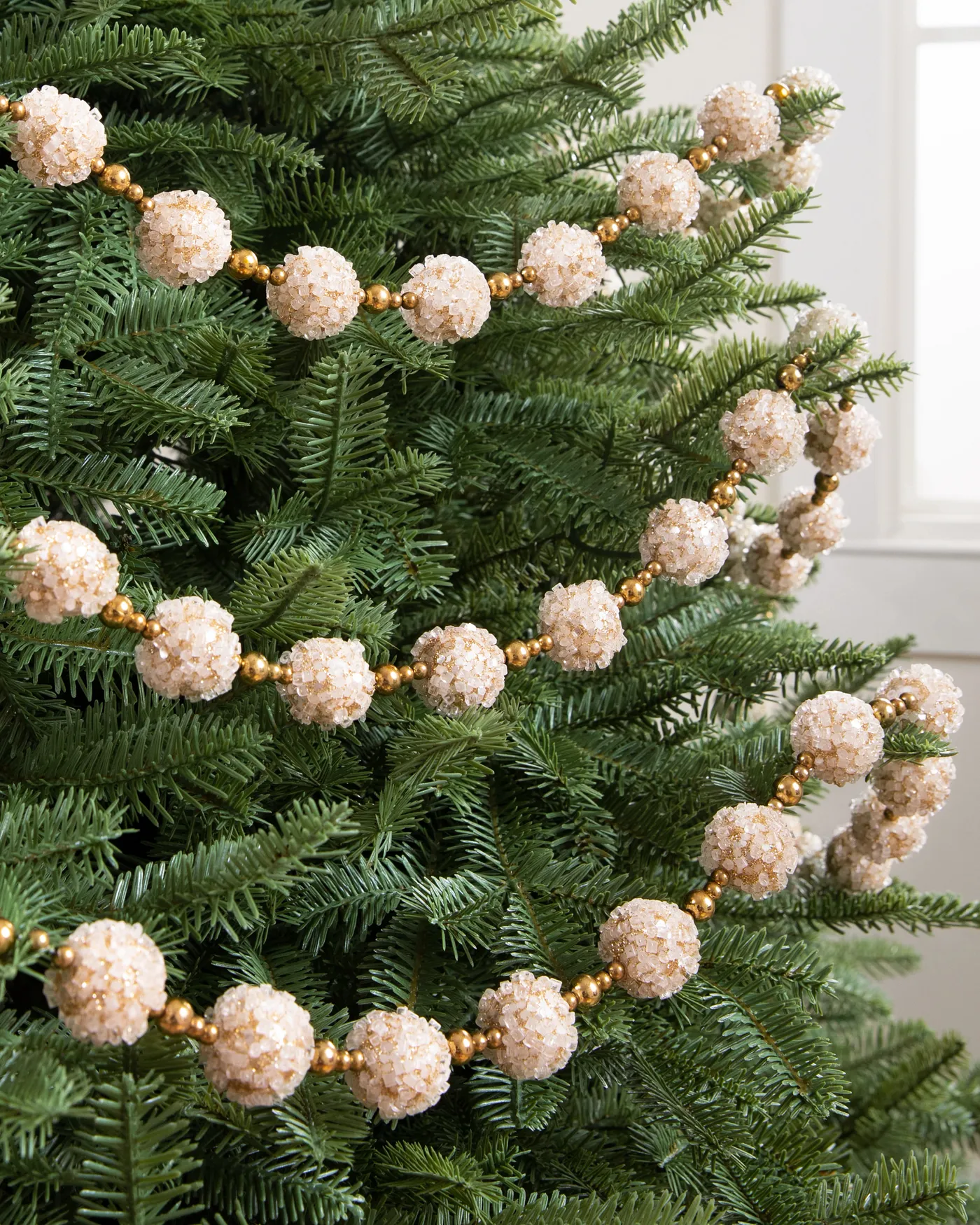
Scale contrast and alternating rhythm. The large textured spheres are roughly ten times the size of the small gold beads, so your eye gets a big beat and a small beat, over and over, which feels musical rather than uniform. The wavy drape matters too — a straight line of large spheres would look like someone dropped a string of pearls. The wave gives each one room to be seen.
25. Crochet Trees and Stars Laid Across Distressed White Wood
Handmade crochet garlands sell for $30 to $60 on Etsy, but the materials are almost free: about $5 of cotton yarn, a hook you probably already own, and a couple of evenings. The trees and stars are beginner-level — single crochet, no shaping required. If you’d rather buy, check thrift stores in January, when crafters donate what didn’t sell at holiday markets.
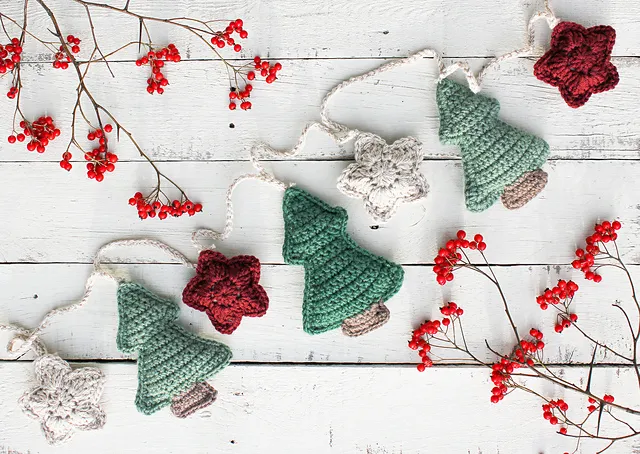
Handmade garlands are shorter than you think. Two hours of crocheting produces roughly two feet, and a full tree wants 12 to 15 feet for a loose drape. That’s why most people make a 6-foot strand and call it done — which looks great on a small tree or a shelf and disappears on a big one. Measure before you start, not after. Or plan on finishing it across two Decembers.
26. Three Crochet Trees on Brown Yarn With Holly and Nuts
Styling a small vignette like this one:
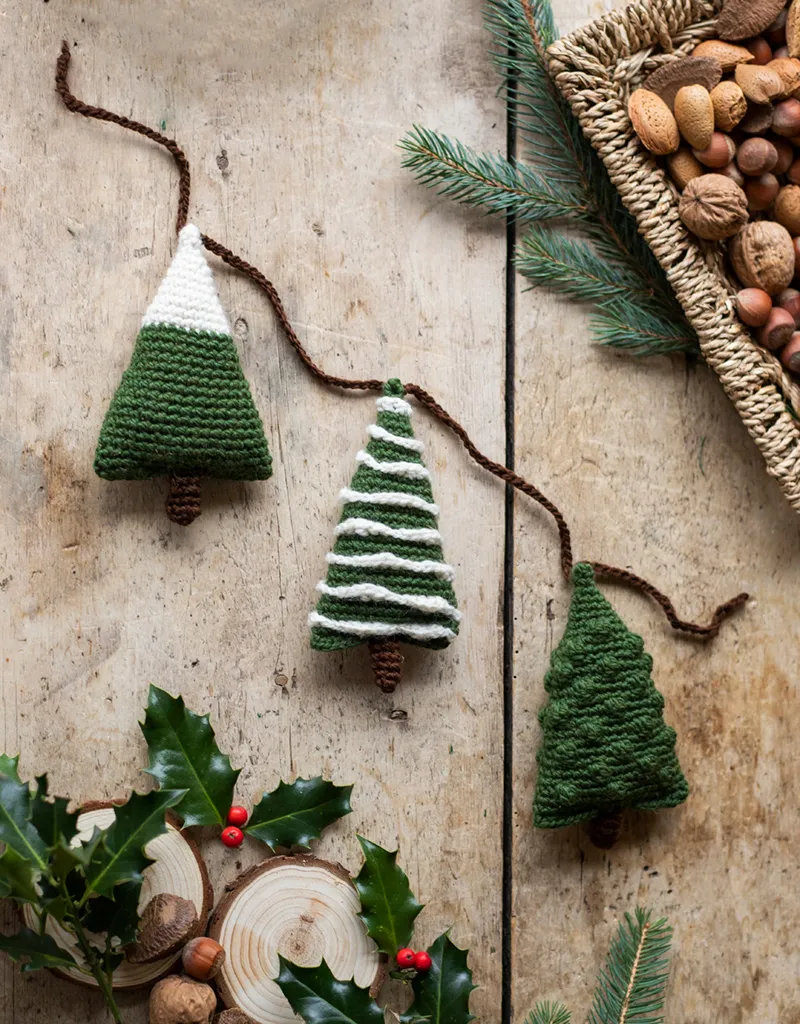
- Start with a neutral surface — bare wood, a linen runner, or whitewashed boards.
- Lay the crochet strand loosely, letting it pool in one spot rather than hanging straight.
- Tuck fresh pine sprigs under the strand so they peek out at both ends.
- Add one berry cluster for color, deliberately off-center.
- Fill the empty corner with a small basket or bowl of natural elements.
Time: 15 minutes. Materials: $10–$25 plus whatever you forage.
Match your garland string to the surface beneath it. Brown yarn on light wood disappears entirely, which makes the shapes look like they’re floating — but the same brown yarn on white marble reads as a visible, slightly messy line. On pale surfaces, switch to cream or jute. It’s a two-dollar decision that changes whether the arrangement looks intentional or accidental.
27. Dark Red Pom-Poms Against Deep Green Needles
Roughly 75% deep green, 15% dark red, 10% warm light — and almost no third color, which is why it feels so calm. Deep red rather than bright red is doing the heavy lifting here; it sits at the same value as the needles, so it recedes instead of jumping. Swap to cherry red and the whole tree changes personality, from moody to cheerful, without moving a single ornament.
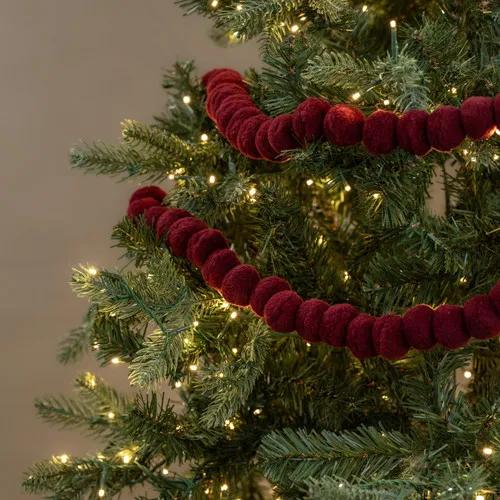
- Check your tree’s needle color — pom-poms disappear on very dark faux pine.
- Confirm the pom-pom strand length before buying; 9 ft is the usual minimum.
- Test your lights first — warm white is essential here, cool white kills it.
- Decide drape depth; shallow swags suit pom-poms better than deep ones.
- Set a ceiling of two strands — a third turns texture into a blanket.
28. Fine Silver Tinsel and Gold Beads on a Small Tree of Vintage Glass
This is a 4-to-5-foot tabletop tree, and that’s the point — it works on a console, a dresser, or the corner of a small apartment where a full tree simply won’t fit. Fine tinsel and tiny beads suit small-scale trees because they don’t overwhelm short branches. On a 7-foot tree this delicate treatment vanishes; for that, look at Idea #31, which uses a heavier white bead for bigger silhouettes.
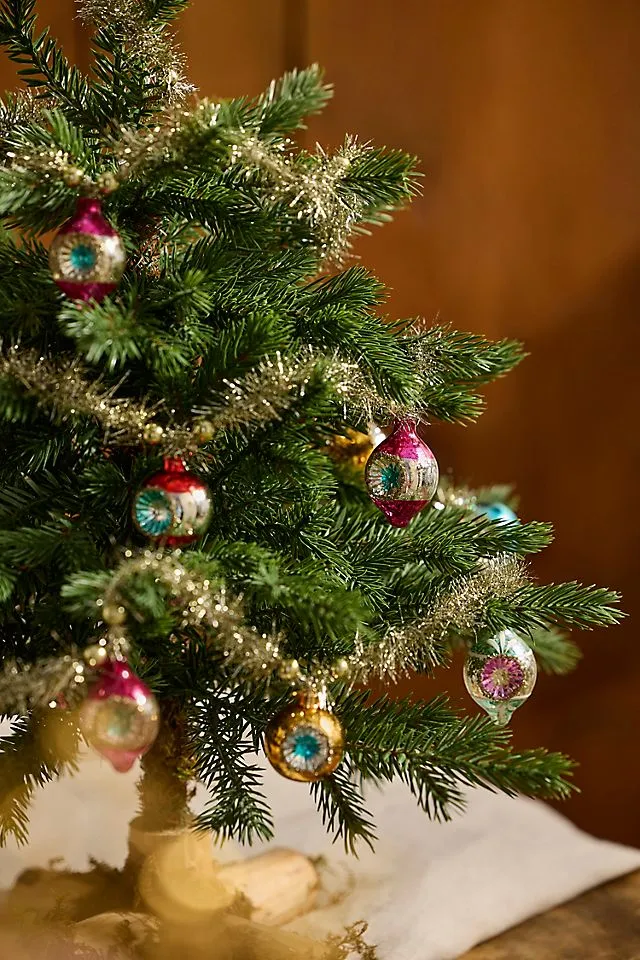
- Main furniture: 4–5 ft artificial tree and light wood stand — $45–$120
- Lighting: warm white LED mini lights — $10–$20
- Garland: fine silver tinsel plus gold bead strand — $12–$28
- Decor: vintage-style glass ornaments, 20–30 — $40–$120, or $15–$40 thrifted
- Textiles: fabric tree skirt or folded linen — $8–$20
Total: roughly $115–$308. Budget alternative: skip the vintage glass and buy one mixed set of pink-and-teal baubles — the reflection is what you’re really after.
29. Cream Crochet Stars With Red Spirals on a Fresh Fir
Handmade garlands are the fastest-growing search in holiday decor right now, and crochet stars are the reason — they read as folk art rather than craft fair, especially in cream and red against a fresh fir. It’s the same instinct behind the return of hand-stitched stockings and embroidered tree skirts: people want at least one thing on the tree that wasn’t manufactured.
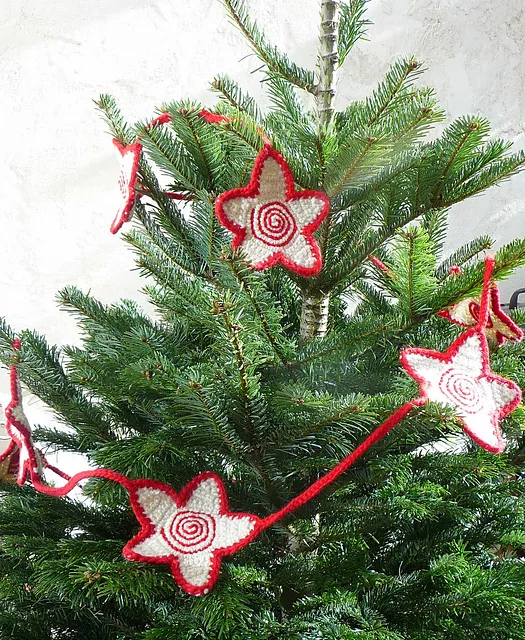
The red spiral in the center of each star. It’s a tiny detail that changes everything — without it, the stars would be plain cream shapes lost against the dark fir. The spiral pulls the eye from star to star in a way the border alone can’t, and it ties the garland to the red crocheted strand holding it together. One motif, doing two jobs.
30. Sheet Music Paper Chains on a Warm-Lit Tree
Paper chain links want to be 1 inch wide and 6 inches long — any shorter and the chain looks tight and nervous, any longer and it sags into strings. That size gives you roughly 12 to 14 links per foot, so a 6-foot run needs about 80 links. Cut strips with a paper trimmer rather than scissors; straight edges are what separate charming from messy when the tree lights catch the paper.
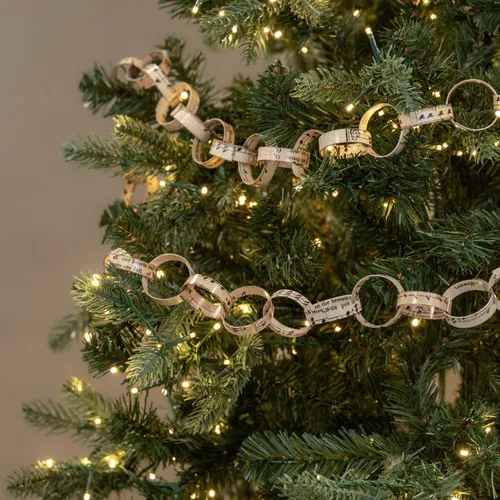
Paper chains are the one decoration here with a real safety rule: keep them at least 12 inches from any bulb that gets hot, and never let them touch a working light strand. Beyond that, they’re delicate. Humidity makes the links soften and droop, dust dulls the print, and they’re a single-season item — store them flat or plan on making new ones next year.
31. White Beaded Swags With Gold and Silver Baubles
The white bead garland is draped in identical swags, and that repetition is the entire effect. Even drape depth creates a scalloped rhythm across the tree that reads as deliberate pattern — random draping would just look like a mess. The metallic gold and silver ornaments then sit inside those scallops like objects in frames, which is why they never feel scattered.
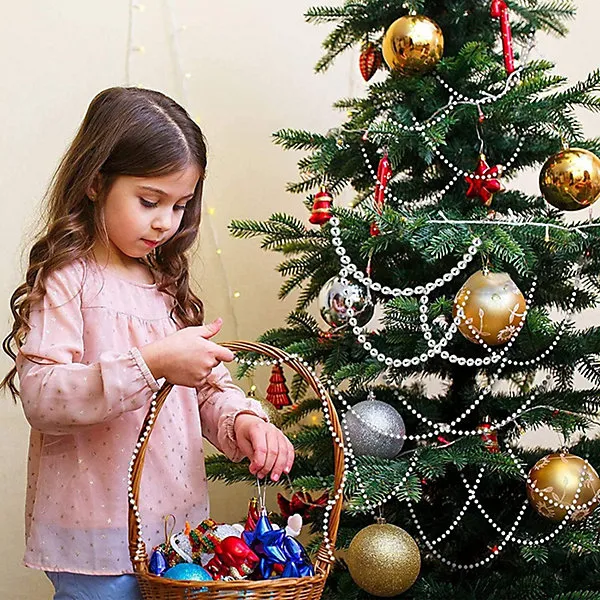
Bead garlands are one of the few places where the cheap version is genuinely fine. Dollar-store white bead strands run $1.25 to $3 each, and three or four of them produce the same swagged look as a $40 designer strand. Spend the difference on the ornaments instead — metallic balls at Target or Walmart run $10 to $20 for a mixed box, and they’re what people actually notice.
32. Berry Garland on a Painted Dark Green Mantel, Santa Watching Above
Dark green mantel plus dark green garland is a contrast problem waiting to happen. Without the red berries and brass candlesticks breaking it up, the greenery would dissolve into the paint. If your mantel is dark, add a lighter layer — cream candles, gold ribbon, or a white-berried strand — and check it in the evening with the actual room lights on, because daytime photos lie about this every time.
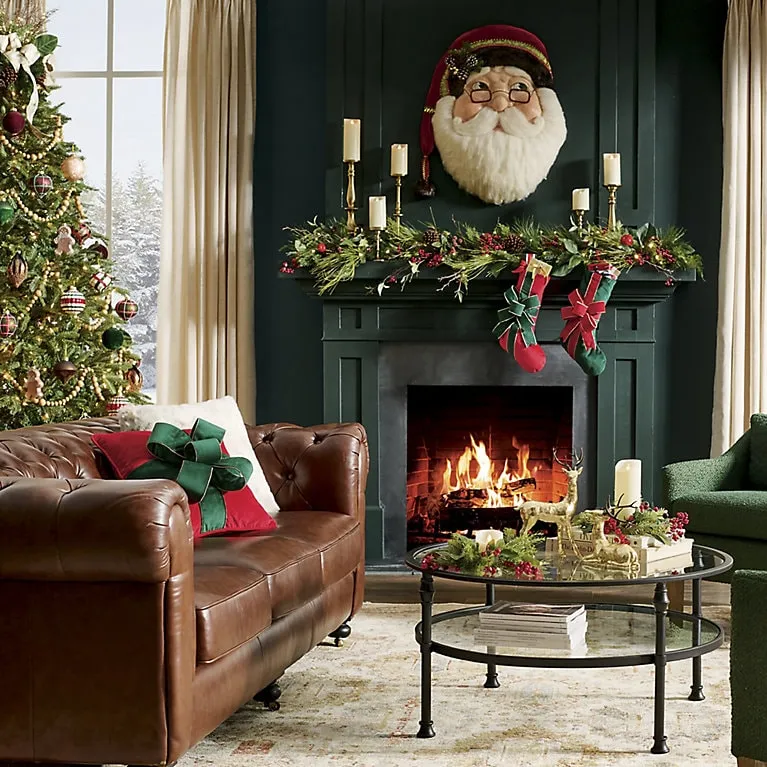
Count the whole corner: about 50% deep green, 20% red, 20% brown leather, 10% gold. The leather sofa is doing more than you’d think — it’s the warm neutral keeping all that saturated green and red from turning cold. Change the sofa to grey and the room gets sharper and less cozy. Add a cream throw and it swings back the other way.
33. A Single Slender Green Garland, Loosely Draped and Nothing More
Restraint. One slender strand, loosely draped, is the entire decoration beyond the lights — and that’s what makes the tree look natural instead of styled. Most trees fail because someone keeps adding. Here, the empty branches are the point. Add a second garland and you’d lose the airy, almost-undecorated quality that makes this one memorable. Not every tree needs a theme. Some just need room to breathe.
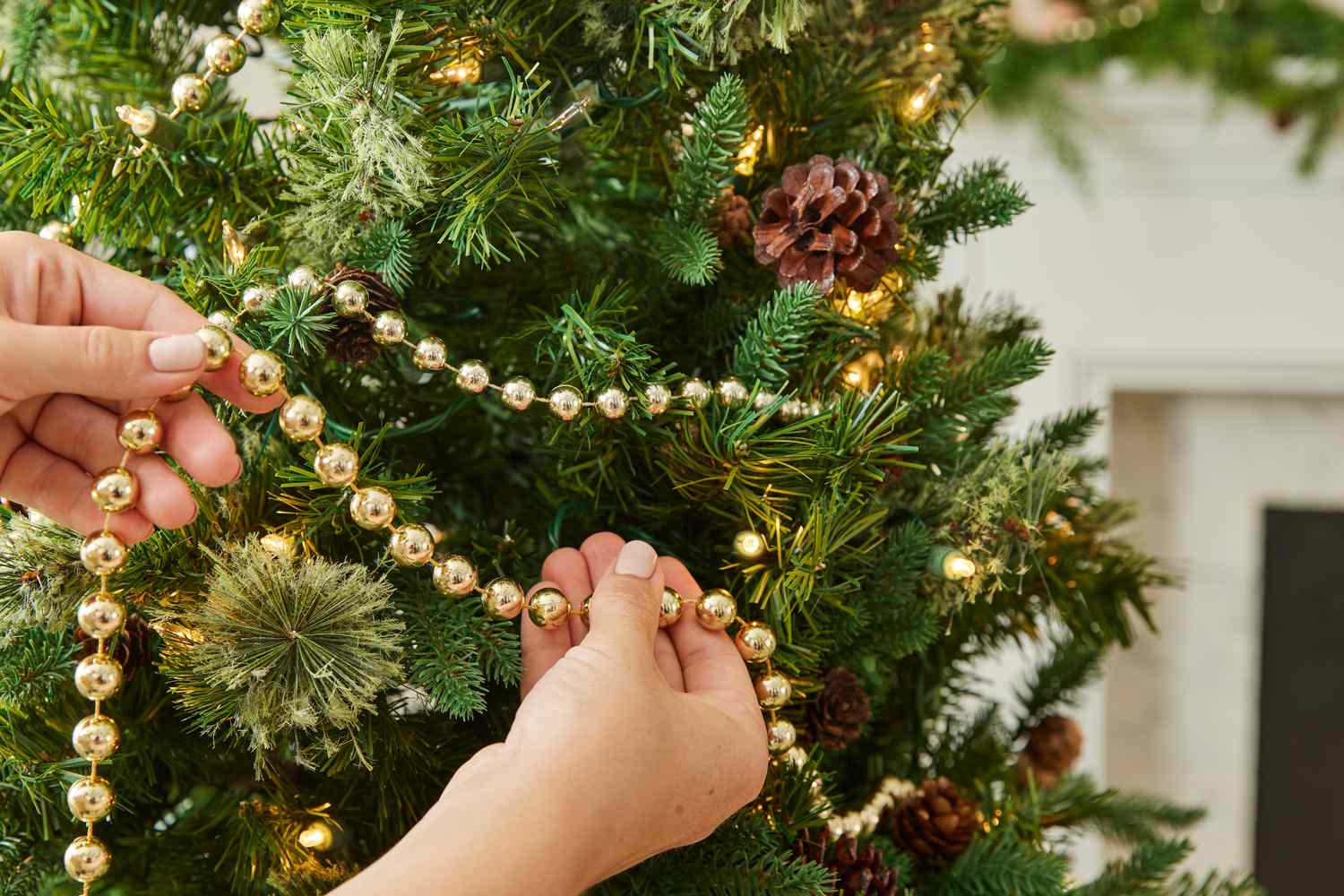
This approach suits a natural-shaped tree of 6 to 7 feet in a room with 8-foot ceilings, where the wall behind is pale and uncluttered. A slender garland needs space around it to read as intentional — against patterned wallpaper or a busy gallery wall it just looks unfinished. If your room is on the smaller side, scale the whole idea down to a shelf vignette instead.
One Strand Is All It Takes — Now Go Hang It
The garland is the cheapest, fastest upgrade in holiday decorating, and you’ve just seen thirty-three ways to prove it — from a $15 crocheted strand to a fully lit mantel swag. Pick one idea, start there, and let the rest of the room follow.
📌 Pin your favorite to your Christmas board now, so next December you’re not starting from scratch.