
Your saved folder is probably already full of wreath photos — the problem isn’t finding inspiration, it’s picking one and actually hanging it. So we did the picking for you. We spent serious time browsing Etsy, Terrain, Target, and Michaels, then narrowed hundreds of options down to 30 wreaths that genuinely deliver, from about $22 in supplies to $385 if you’d rather buy finished and skip the glue gun entirely.
Inside you’ll find fresh pine and pinecone classics alongside magnolia, eucalyptus, and hand-painted blue pinecones — rustic, traditional, and minimalist botanical styles, with budget and luxury versions compared side by side on the ones worth splurging for, plus direct product links on every single idea. Why now? 2026’s wreath moment is all about foraged texture and repeatable symmetry: matching sets across windows and doors instead of one lonely wreath doing all the work. And stay until the end — we break down the most common mistakes that can ruin these looks.
📌 Save this to Pinterest for later — you’ll want to revisit these ideas.
1. Three Matching Pine Wreaths Across a Trio of Tall Windows
When you’re hanging more than one wreath on a run of windows, the eye reads the gaps, not the wreaths. Measure the glass, divide by the number of windows, and center each wreath on that same number — then set every hook at the identical height. On a 72-inch-tall window, that usually lands around 46 to 50 inches above the sill. Use 2- to 2.5-inch-wide black grosgrain or velvet ribbon so the hanger reads as a deliberate line rather than an afterthought.
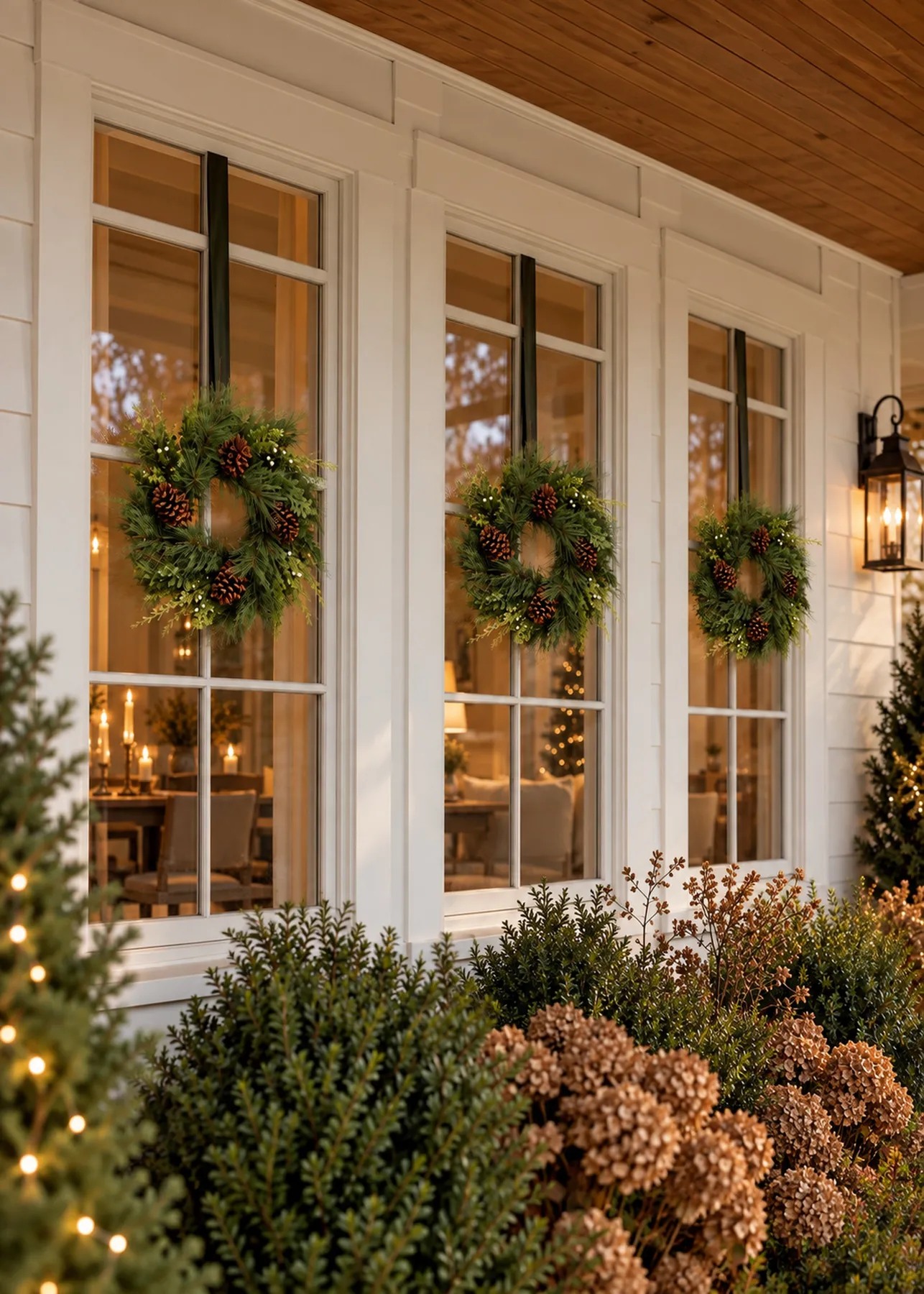
Take away the third wreath and the whole thing collapses. The magic here is repetition — three identical pine-and-pinecone wreaths, three identical black ribbons, three identical windows. One wreath is decoration. Three wreaths in a row is architecture. It tells the eye that someone made a decision and committed to it, which is exactly what separates a decorated house from a designed one.
Matching sets are quietly replacing the one-statement-wreath look of past seasons. The reason is practical: board-and-batten siding and multi-pane windows create built-in grid lines, and repeating a wreath along them feels intentional instead of cluttered. If your entry has strong vertical rhythm — tall windows, narrow siding, a row of sconces — lean into it. If it doesn’t, one beautiful wreath beats three mismatched ones every time.
2. A Fresh Pine Wreath Built by Hand at the Kitchen Table
Wiring berry clusters into a fresh pine base:
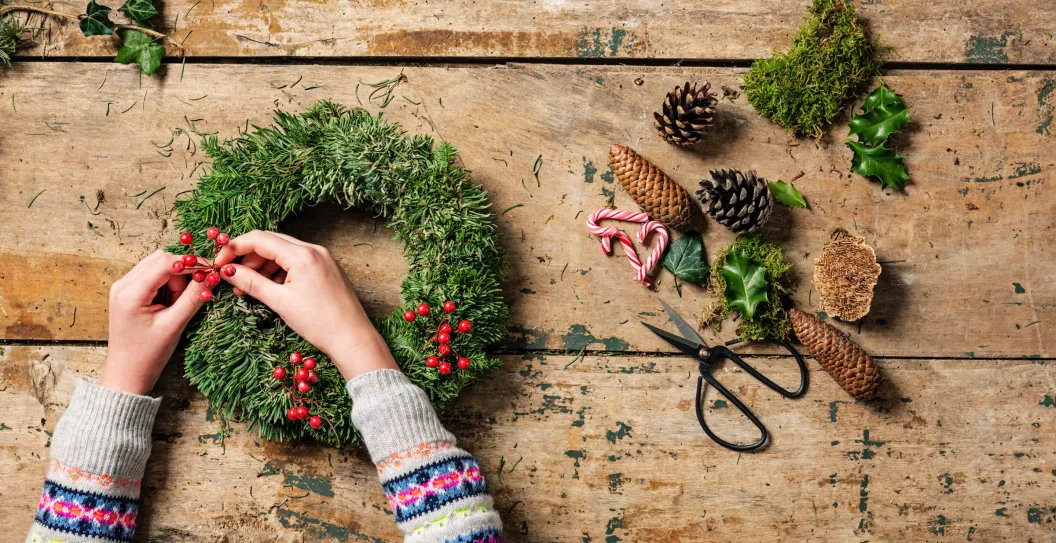
- Lay the wreath flat on parchment paper so sap doesn’t stain the wood table.
- Pre-cluster three to five berries with floral wire into a tight spray — wiring them one at a time looks fiddly and sparse.
- Push the wire through the pine, wrap it twice around the base ring, twist, then tuck the tail into the needles.
- Place clusters in odd numbers, roughly 8 inches apart, at the 4 and 8 o’clock positions so the bow doesn’t hide them.
- Add pinecones last, low and slightly off-center, so they read as heavy rather than floating.
About 45 minutes and $28–$40 in supplies for a 24-inch wreath.
Fresh wreaths shed. Give yours a day outside to drop loose needles before it comes indoors, and expect a fine dusting of dry pine underneath it by week three. Set a small tray under an interior door wreath, and never hang fresh greenery directly above a wood table, a piano, or anything pale and porous. If your door gets direct afternoon sun, a fresh wreath can look tired in ten days — go faux, or plan to replace it mid-season.
3. Magnolia Wreath With a Monogrammed Beige Ribbon
Two things are doing the heavy lifting. First, magnolia leaves are two-toned — glossy green on top, suede brown underneath — so a single-material wreath already reads as layered without a single ornament. Second, the garland runs down one side of the doorframe only. That deliberate imbalance keeps a very formal wreath from feeling like a catalog spread. The charcoal-blue door does the rest, giving all that green a cool, high-contrast backdrop.
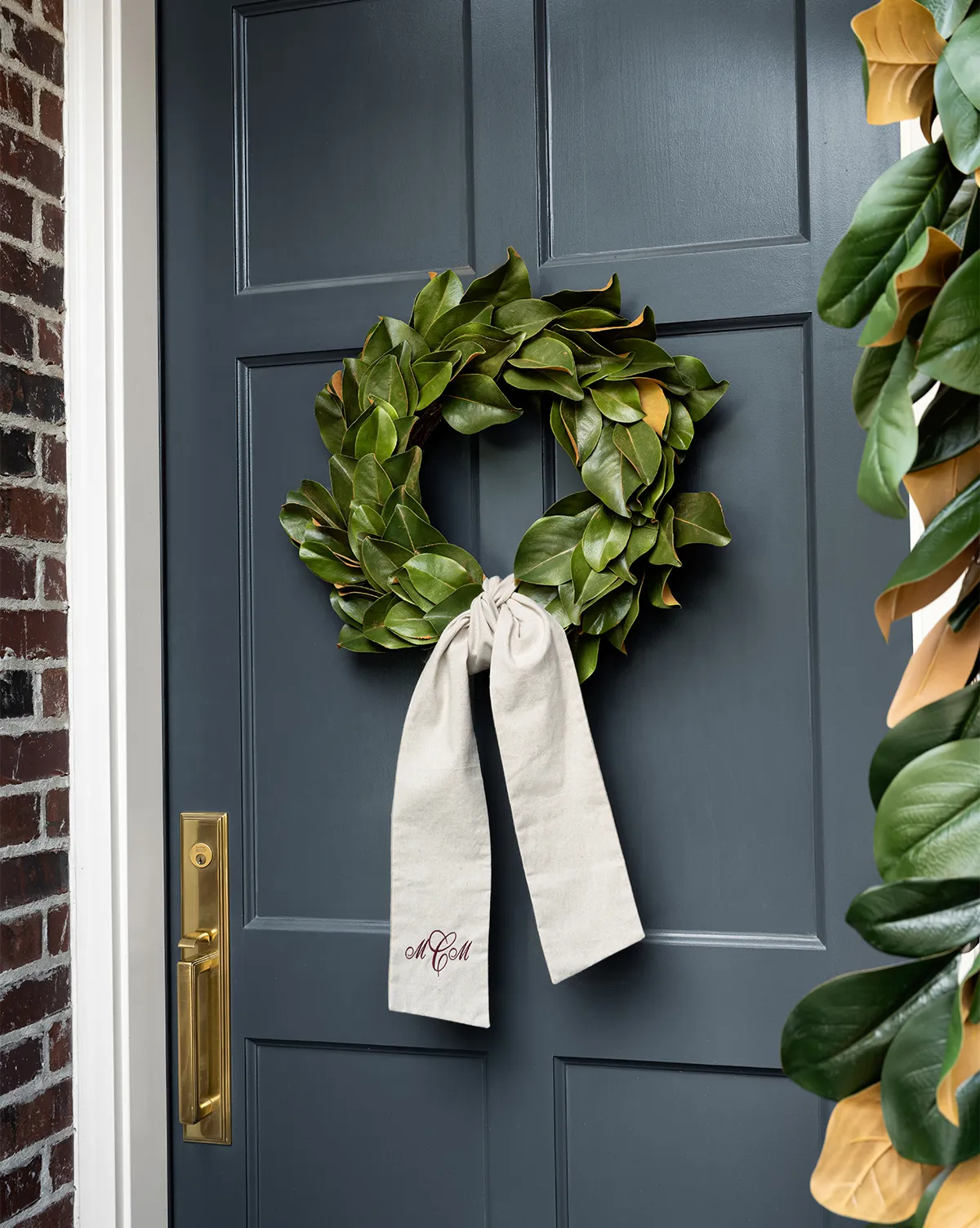
Magnolia is the marathon runner of fresh greenery — three to four weeks indoors before it starts to curl, and the leaves hold their color even as they dry. Skip leaf shine; it attracts dust and looks plasticky in daylight. If you want it to last into January, mist the backs of the leaves every few days and keep it away from direct heat. A dried magnolia wreath can be stored flat in a box and reused next year, which is more than most fresh wreaths can say.
A wide ribbon bow only looks expensive if it’s wired. Buy ribbon with a wired edge, 2.5 to 4 inches wide, fold a six-loop bow, and cinch it with floral wire rather than tying it — tied bows collapse into a sad tangle within a week. For the monogram, have it embroidered on a separate ribbon length and wrap it over the bow’s center knot, so you can swap it out next year without rebuilding anything.
4. Evergreen Wreath With a Deep Blue Burlap Bow
The formula here is roughly 70% deep evergreen, 20% royal blue, 10% snow-white and natural brown. The blue shows up in exactly one place — the burlap-textured bow — which is why it reads as a statement instead of a theme. Swap the blue for deep burgundy and you get an entirely different mood with the same structure. Keep the bow at that 20%, and keep the pinecones and bells small; oversized accents in a secondary color tip the whole thing into costume territory.
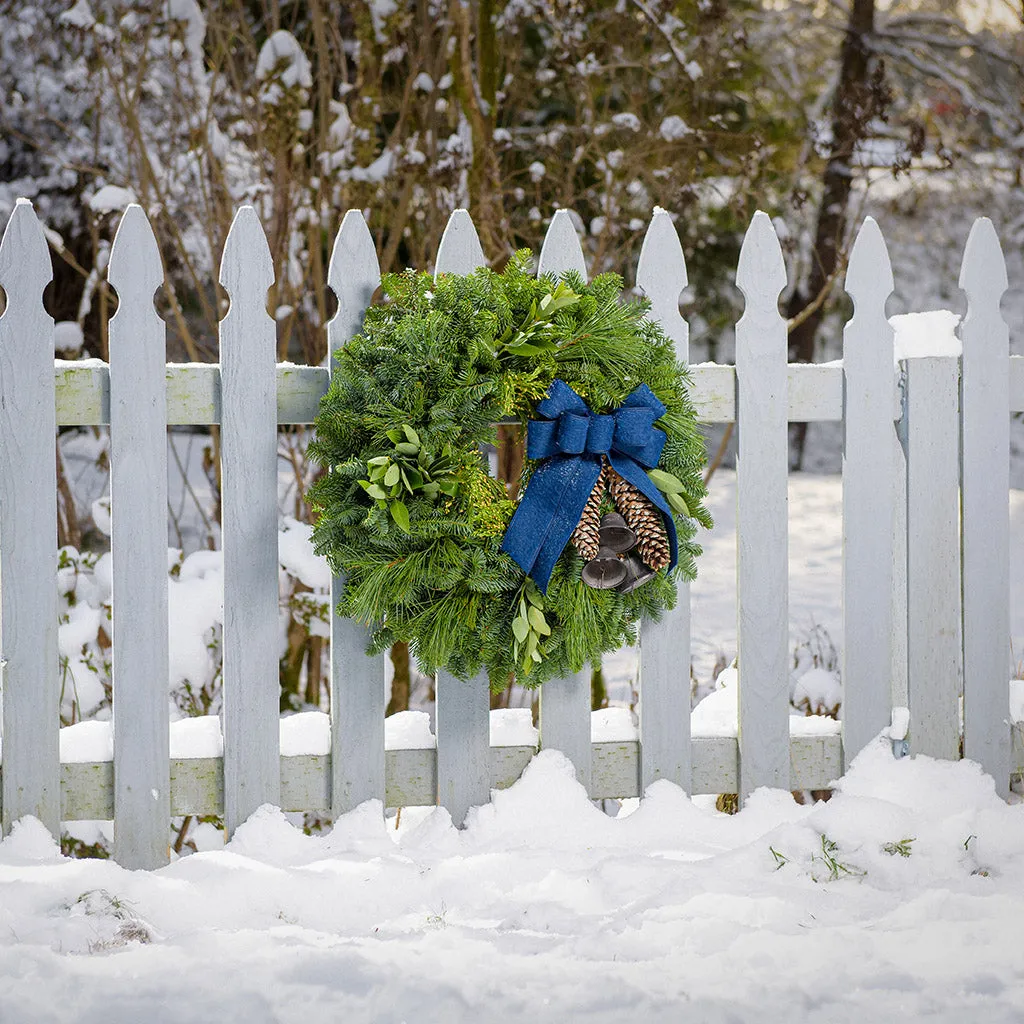
A 24-inch mixed evergreen wreath runs $20–$35 at Walmart or Costco in early December, and a roll of burlap-textured ribbon is about $6 at Michaels with a coupon. The bells are the sleeper item — check thrift stores and estate sales for real weathered brass. A bag of 20 vintage jingle bells for $4 beats a new pack every time. Total under $45, and nobody at the door will know. For a warmer palette built on the same math, see the tartan version in Idea #15.
5. Holly, Pinecones, and Red Berries Against White Shiplap
It’s the variegated holly. Everything else on this wreath — the dense evergreen base, the pinecones, the red berries — you’ve seen a hundred times. The holly leaves, green centers edged in creamy white, add a third value to the palette and make the wreath look hand-foraged rather than assembled. Those pale edges catch even dim porch light, so the wreath still reads after dark. Swap them for plain holly and it instantly becomes generic.
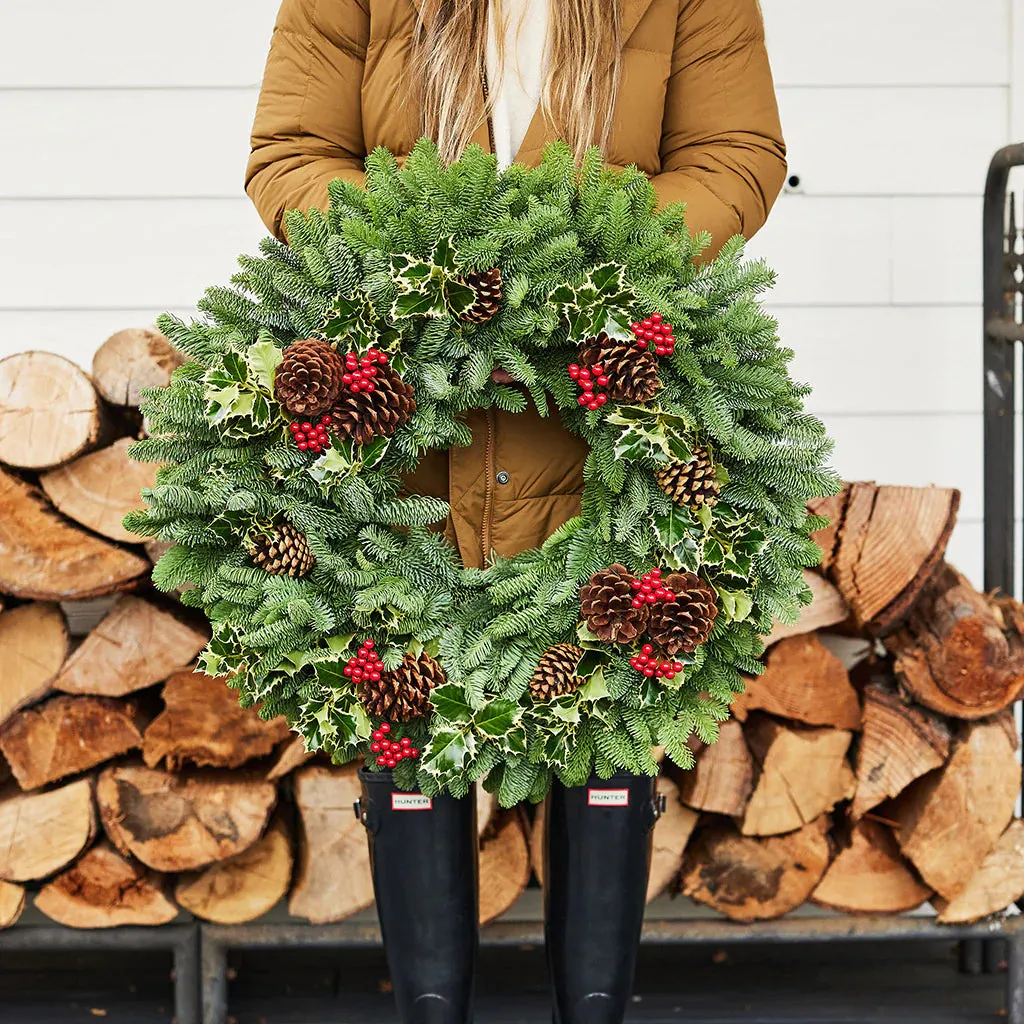
Build dense first, decorate second. A wreath with a thin base can’t be rescued by ornaments — you’ll just see gaps between the pinecones. For a 24-inch finished wreath you want enough greenery that the wire ring disappears completely, which usually means two full bunches of mixed greens, not one. That density is also what keeps the shape from going flat when the branches settle after a week indoors.
6. Glittered Green Ornaments on a Woodland Wreath
Woodland glam is the compromise style of 2026 — glitter for the people who want sparkle, feathers and seed pods for the people who want nature. It works because the shine is concentrated in a few oversized ornaments instead of sprayed across the whole wreath. If you’re decorating for a household with strong opinions on both sides of that debate, this is the wreath that ends the argument.

Texture contrast is the whole story: matte dried seed pods next to high-shine glitter, soft feathers next to stiff magnolia. The olive-green patterned ribbon pulls the eye downward and repeats the green without adding a new color. Notice the palette never leaves green and brown — sparkle comes from finish, not from hue. That’s the trick that keeps glittery from tipping into tacky.
This one wants to be the only wreath on the door, and it wants a door at least 32 inches wide. On anything narrower, feathers and oversized ornaments swallow the door. If your entry is slim, borrow the same palette in an 18-inch version and move the extras to a garland. For tighter spaces, see the minimal leaf wreath in Idea #25 — same green base, none of the volume.
7. Cardinals and Glossy Red Ornaments on a Classic Pine Wreath
Glossy ornaments on a wreath are gorgeous and slightly fragile. They chip when they knock against each other, and once the shiny finish flakes, it’s obvious. Wire them in with the cap hidden rather than threading ribbon through the loop, which lets them swing and crack. If your door faces wind or gets banged by kids and backpacks, use matte or fabric ornaments — or move the glossy ones higher, out of hip height.
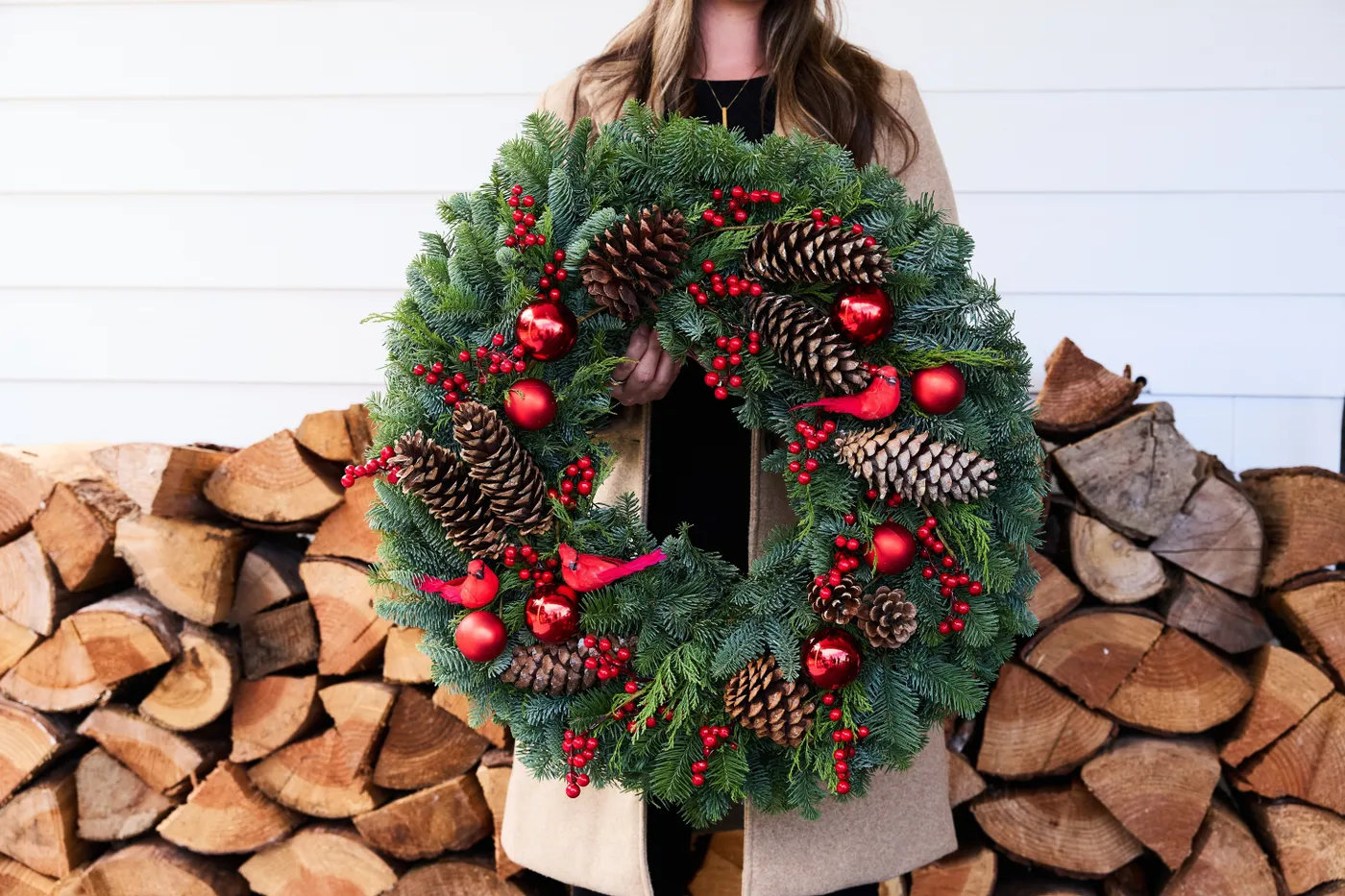
Roughly 60% green base, 30% red, 10% brown pinecone and natural texture. Three shades of red make it work: flat berry red, glossy ball red, and the darker red of the cardinal figurines. Swap the cardinals for blue jays and you’d have an entirely different wreath using the same percentages. That’s the test of a good formula — change one element and the structure still holds.
Cardinal clips are $4–$8 for a set of six at Walmart or Dollar Tree, and a bag of red ball ornaments runs about $6 at Target after the holidays — buy them in January for next year and save 70%. Use a $20 faux pine base from IKEA and spend your money on the berries, which are what people actually notice at the door. Under $45 total, versus $120-plus for the same look on a decor site.
8. An Acorn Ring Wreath With a Red Velvet Bow
Building the acorn inner ring:
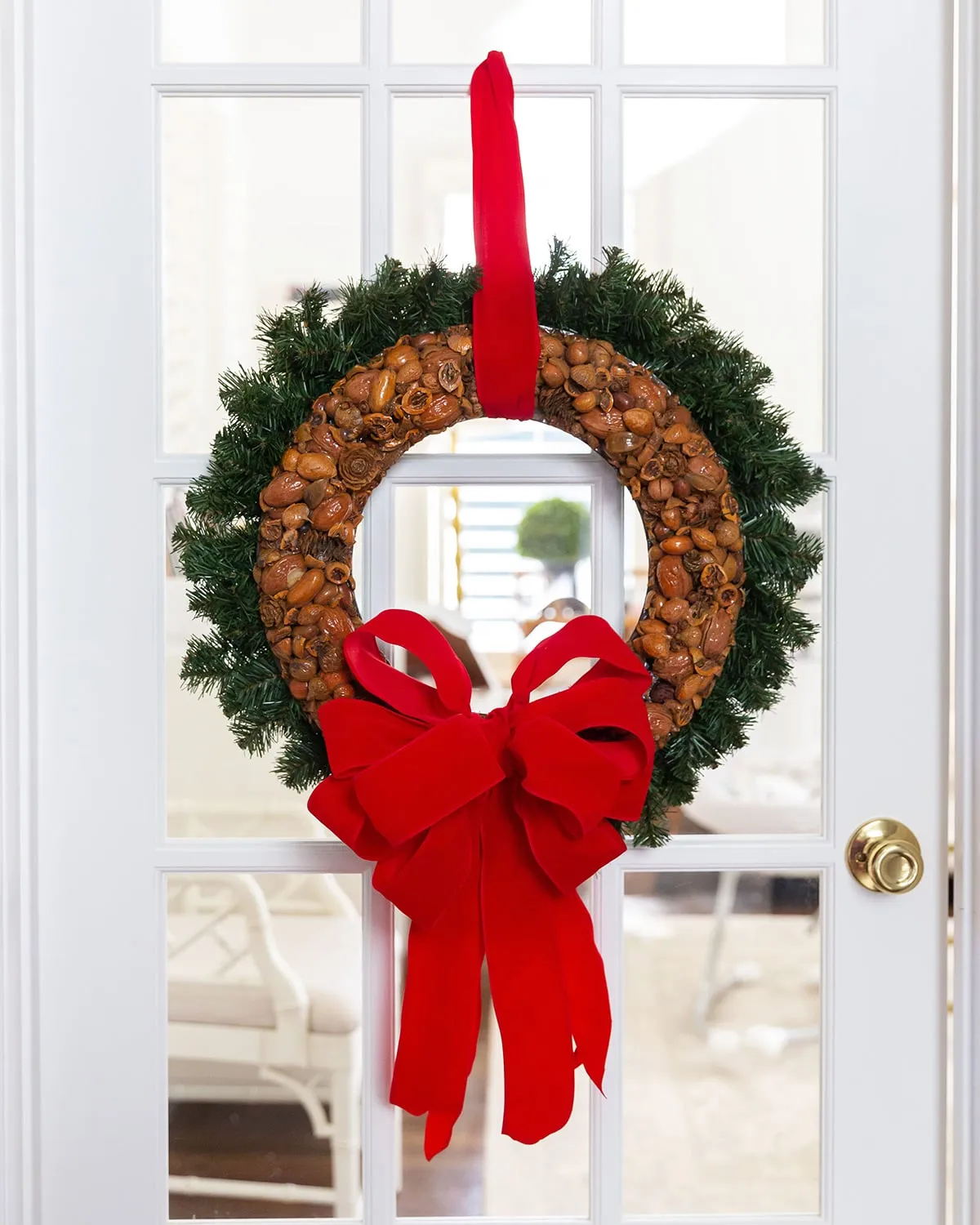
- Start with a plain faux evergreen ring, 22–24 inches across.
- Work in four quadrants so the acorns stay evenly distributed instead of drifting to one side.
- Hot-glue acorns and whole nuts in graduated sizes, largest at the outer edge and smallest near the center.
- Fill gaps with a second pass of tiny nuts rather than bigger ones — density is what makes it look collected.
- Seal the finished ring with a matte clear coat so it doesn’t shed or dull.
Roughly two hours and about $35 in materials; a bag of mixed acorns and nuts runs $12–$18 online.
The red velvet bow with long streamers. The acorn ring is the clever part, but the bow is what turns a nature craft into something that belongs on a formal entry. Velvet, not satin — satin reads cheap in daylight, while velvet holds that deep, light-absorbing red. Don’t trim the tails short; let them fall a good 10 to 12 inches below the ring, where they pick up the same vertical line as the door panels.
9. Symmetrical Magnolia Wreaths on Double Wood Doors
- Two 26-inch magnolia-and-evergreen wreaths: $60–$140 faux, or $150–$260 fresh
- Two red velvet bows: $12–$30
- Overhead garland, 9 feet: $35–$90
- Two sconce greenery swags: $20–$45
- Decorative twig sphere: $15–$35
- Command hooks and floral wire: $10–$15
- Total: $152–$355
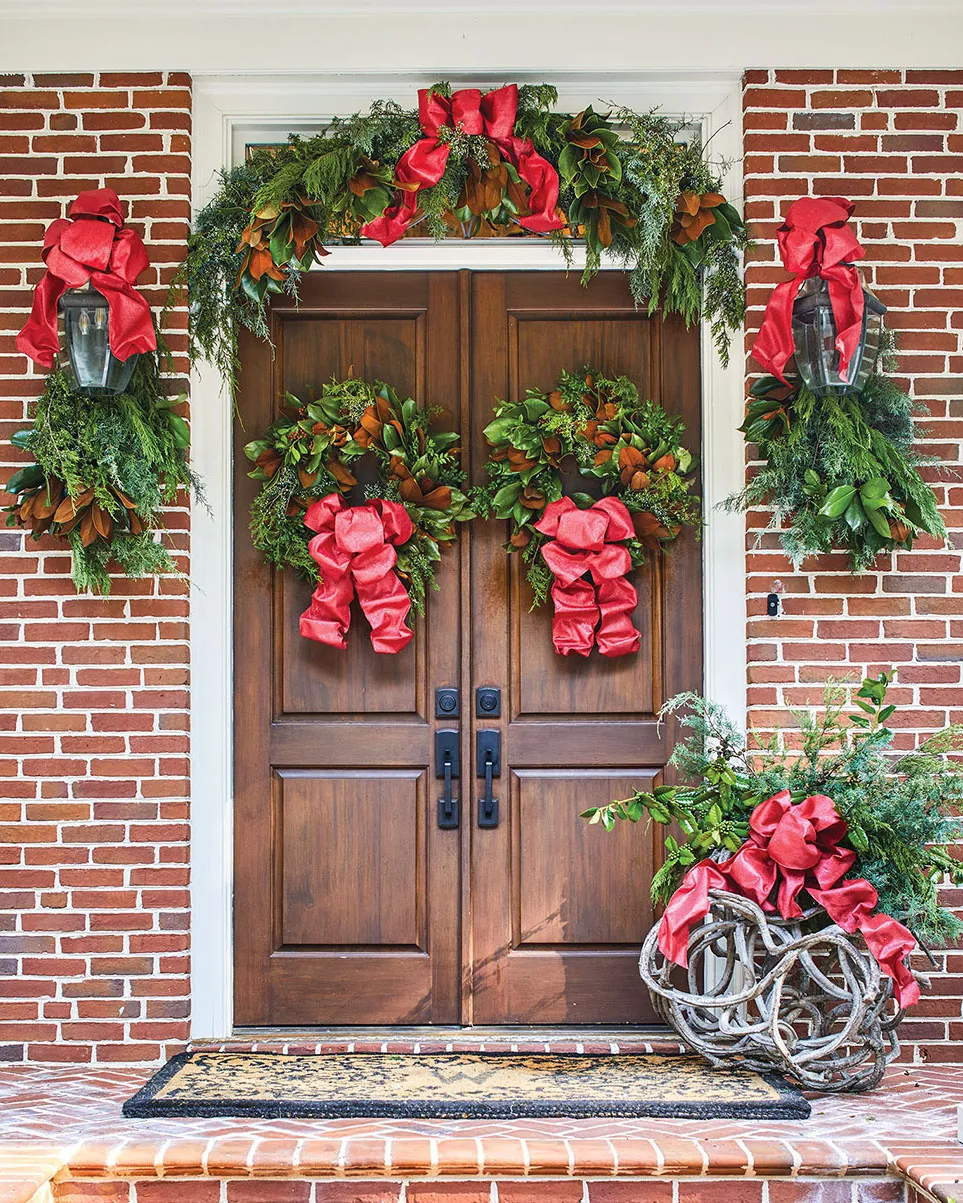
Fresh magnolia is the biggest line item and the fastest to fade, which is why most people buy one fresh wreath for the door and go faux for everything overhead.
Symmetry needs room. This layout wants double doors at least 60 inches wide overall, and ideally a 9-foot-wide entry so the garlands have somewhere to land on both sides. On a single 36-inch door the same pieces crowd each other and lose all that calm. If you’re working with one door, take just the wreath and the bow and skip the swags — then compare notes with the single-door treatment in Idea #13.
10. A Citrus-and-Magnolia Wreath With a Powder Blue Ribbon
Fruit on a wreath is beautiful for about two weeks and then it isn’t. Pears and pomegranates hold up reasonably well; sliced citrus does not — it blackens at the edges. If you’re using fresh fruit, skewer each piece onto a floral pick so you can swap them out individually, and keep the wreath out of direct sun. For a version that lasts season after season, use dried orange slices and faux fruit, and save the real thing for a bowl on the counter.
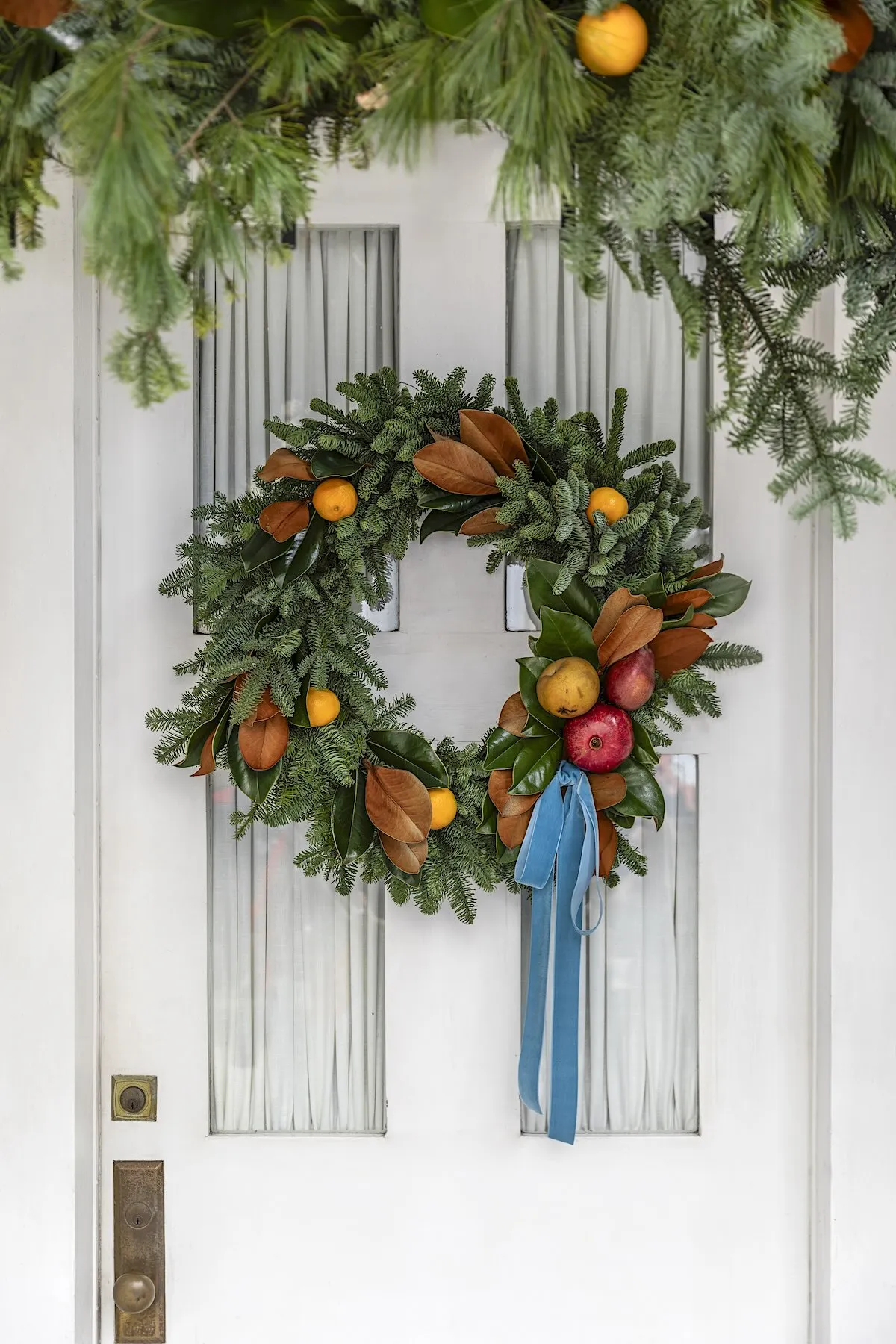
Fruit-heavy wreaths get heavy — a 24-inch wreath loaded with citrus can hit 6 to 8 pounds, which is too much for a standard over-the-door hook on a glass door. Check your door’s top clearance (you need about 1/8 inch for the hanger) and consider a suction cup rated for 10 pounds if you’re going on glass. On a paneled door a wreath hanger is fine, but pad it so it doesn’t scuff the paint.
11. Frosted Silver Foliage and Red Berries on a Navy Door
Frosted foliage sheds, and it sheds on white doors. That silver coating is a fine powder that brushes off every time the door slams. If you’re hanging this on a painted door, tap the wreath outside first and expect to wipe the sill in January. If you have a dog that noses the door every time the mail arrives, skip the frosted version here and go with plain evergreen and berries instead.
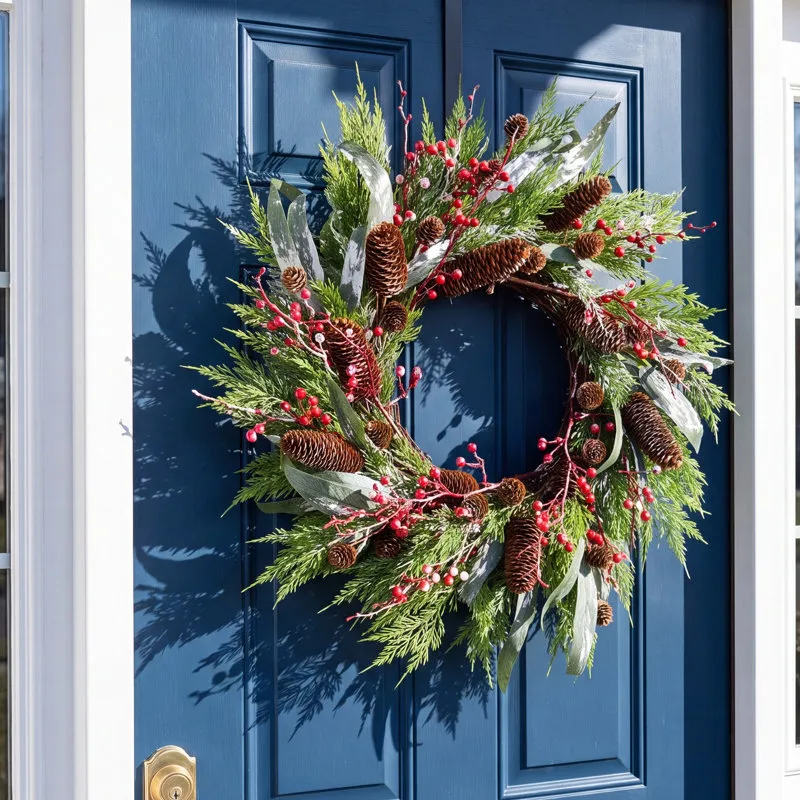
Frosted picks are the one place it’s genuinely worth buying cheap: Dollar Tree and Walmart both sell frosted berry sprays for $1.25–$3, and up close nobody can tell. Spend the real money on the base — a $12 wreath looks thin at the door no matter how pretty the picks are on top of it. Total rebuild: $15 for the base, $12 for picks, $6 for a bow, under $35 all in.
12. A Pair of Berry Wreaths on Charcoal Double Doors
Charcoal, red, and variegated green — roughly 50% neutral charcoal, 40% red berries, 10% green-and-white holly. That’s a heavier red load than most wreaths carry, which is exactly why the doors need to be dark. On white doors the same wreaths would look like valentines. Keep the holly variegated rather than solid green so the wreath doesn’t read as one red blob from across the street.
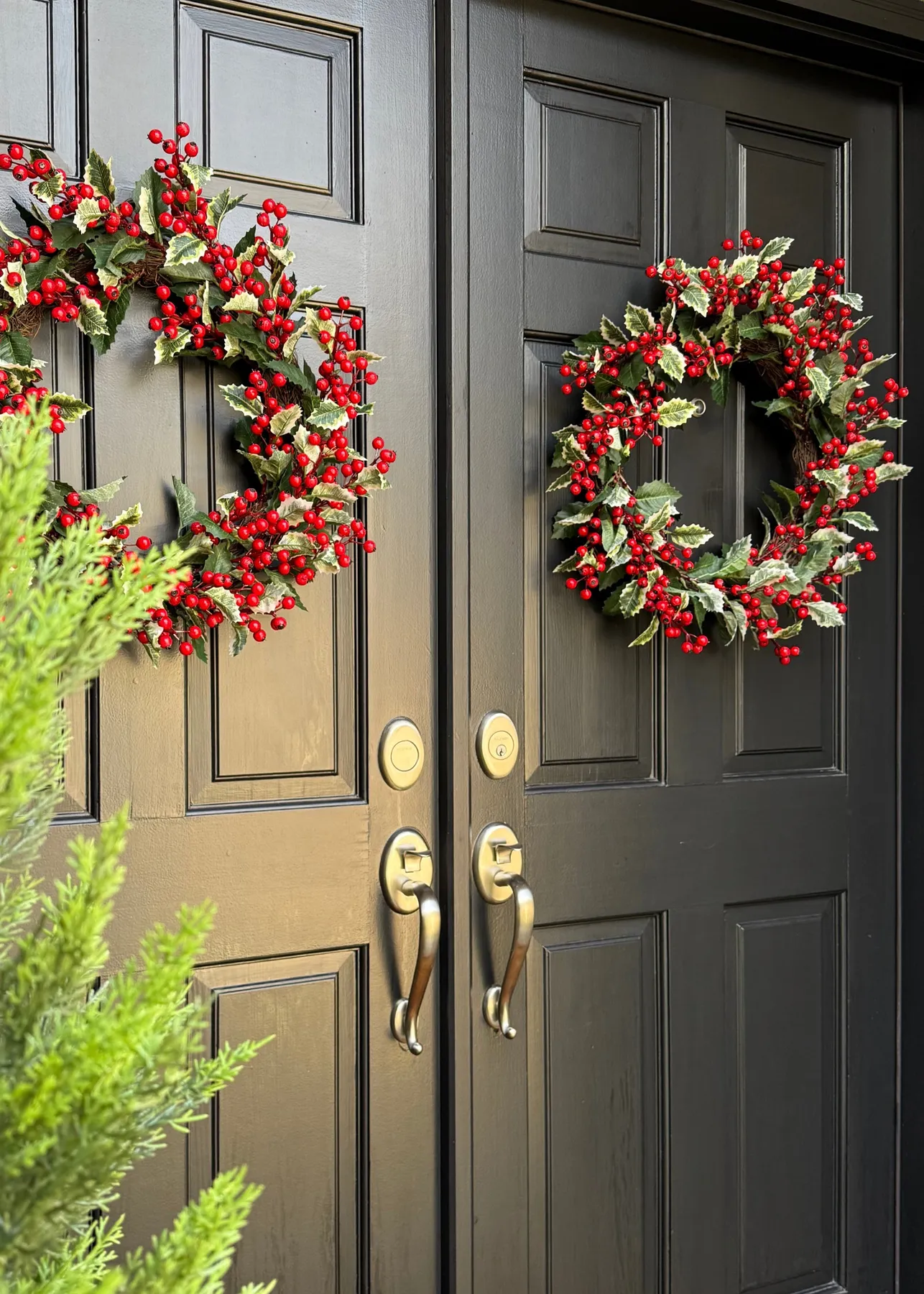
Two wreaths on double doors work only when they sit on the same visual line and are spaced evenly from the center seam — usually centered on each door panel, not on each door. The brass handles and deadbolts give the entry a warm gold anchor that keeps all that charcoal from feeling cold. Notice how the wreaths sit slightly above eye level; hung any lower, they’d fight the hardware.
Berries are the weak link. Faux berries hold forever, but real winterberry or holly berries shrivel in about two weeks in a heated entry. A light coat of hairspray or florist’s sealant buys you another week. And if your entry faces south with strong afternoon sun, expect red to fade to a dull salmon by New Year’s — rotate the wreaths between doors to even it out.
13. Lone Wreath and an Overflowing Urn by the Front Door
The urn is having a moment. A wreath alone on a door has felt slightly unfinished for the last two seasons; the current look pairs it with one asymmetric element beside it — a planter, an urn, a bench with a folded blanket. It photographs better, and it solves a practical problem: you get scale without needing double doors. The trick is that the urn greenery should be a looser texture than the wreath. Cedar cascades; wreaths stay round.
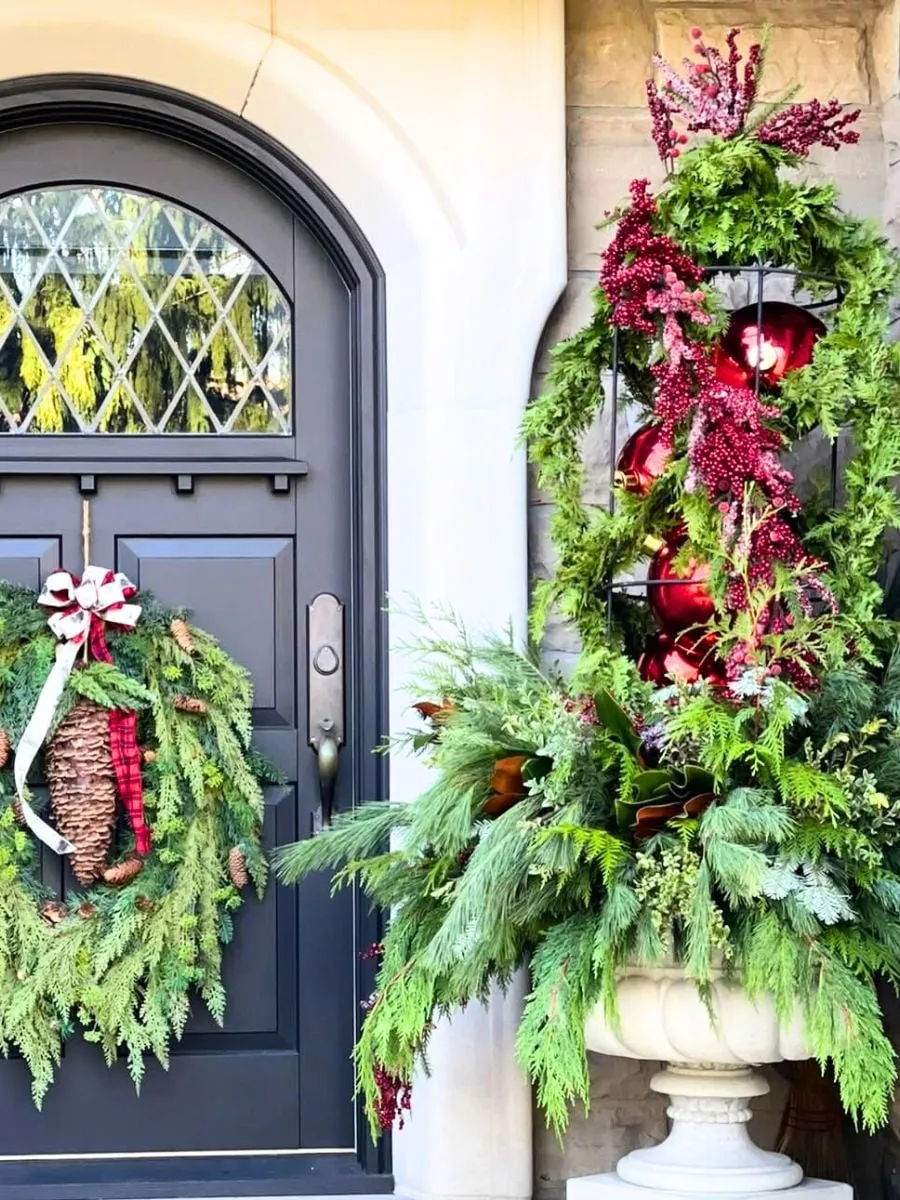
Styling the urn:
- Fill the urn two-thirds with sand or a florist’s foam block so stems have something to hold.
- Start with cedar or other trailing greens at the front edge, letting them spill 8–12 inches.
- Add upright branches at the back for height — about 1.5 times the urn’s height is the sweet spot.
- Tuck red berry sprays into three places, not evenly: left, right, and near the bottom.
- Finish with five to seven oversized shiny ornaments nestled into the greenery, never perched on top.
About 30 minutes and $40–$70, depending on what’s already in your garden.
14. An Asymmetrical Grapevine Wreath on Weathered Wood
Asymmetry has a rule: heavy on one side, airy on the other. On a wreath like this, put the mass of ivy and pinecones at 4 to 5 o’clock and leave the upper-left quadrant sparse enough to see the grapevine. Most people build evenly, then wonder why it looks lopsided instead of designed. Aim for roughly 65% of the material on the bottom third of the ring, and hang it so the light side sits toward the door’s hinge.
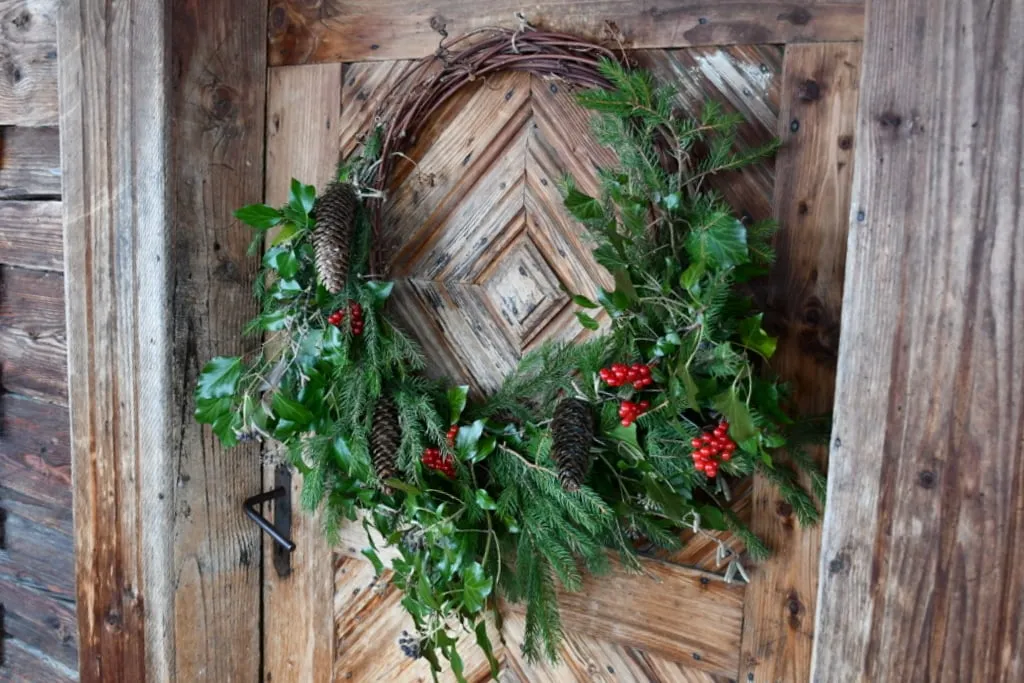
The exposed grapevine. Those dark, twisting branches poking through the pine are what make this feel foraged rather than purchased. Cover the vine completely with greens and you have a perfectly nice wreath — and a forgettable one. The contrast between crisp pine needles and dry woody vine is the entire point, so resist the urge to fill every gap.
15. Pine Needle Wreath With a Stiff Tartan Plaid Bow
Pine needle wreaths are the most affordable fresh option — $18–$28 at a grocery store or Trader Joe’s in early December. The plaid ribbon is where you spend: buy 2.5 yards of real tartan for $12–$20 instead of printed ribbon, because tartan holds a crisp bow shape. Total under $50, and that ribbon can be reused for three or four seasons if you store it rolled, never folded.
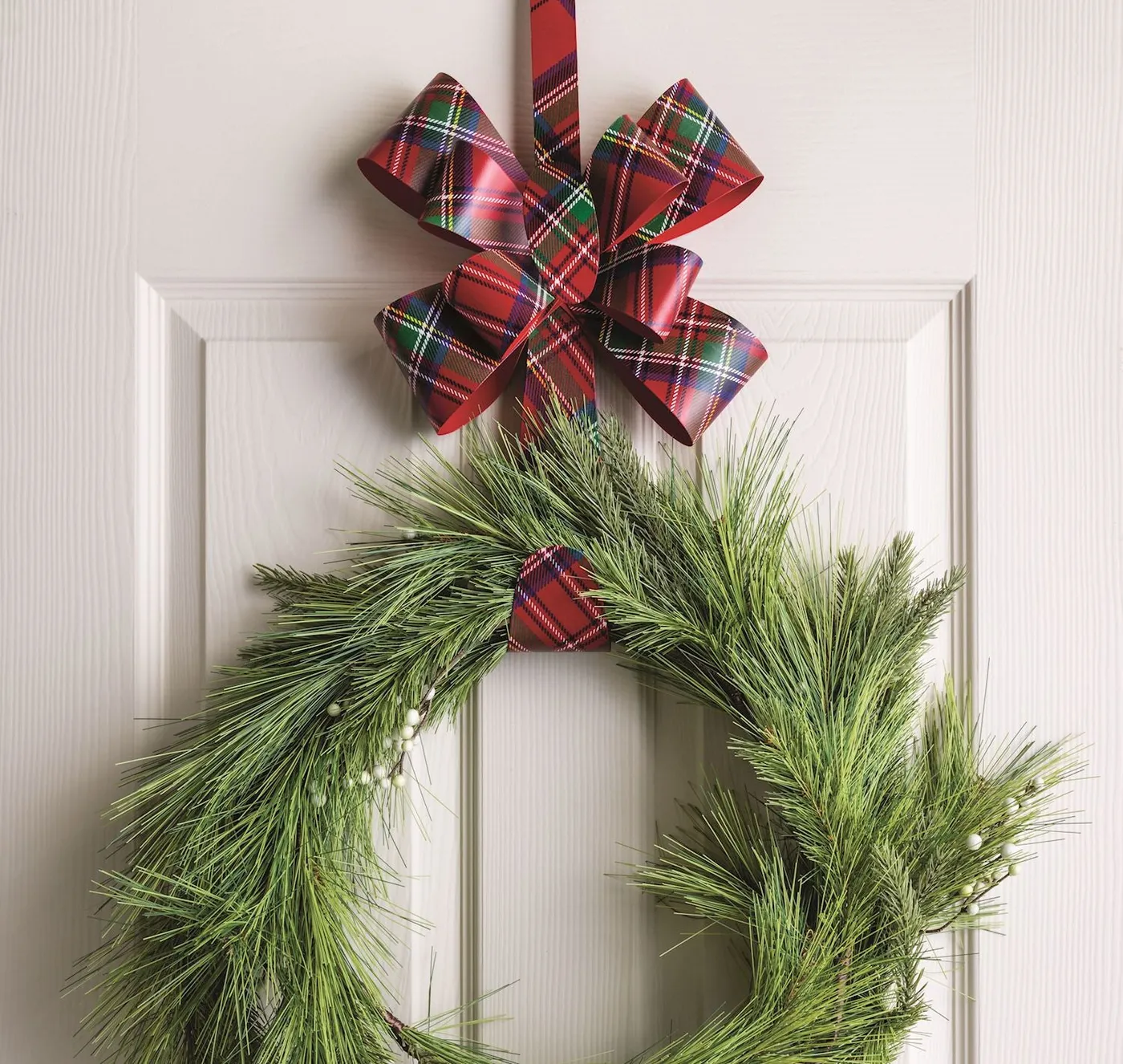
Stiff ribbon is unforgiving. A structured tartan bow looks sharp but won’t forgive a sloppy knot, and it doesn’t drape — so you can’t hide wire or a zip tie behind soft folds. Practice the bow on a chair back first, then attach it already finished. Also check ribbon width against the wreath: on a 24-inch wreath, 2.5-inch ribbon looks right; 4-inch ribbon overshadows the whole thing.
A structured bow, start to finish:
- Cut 2.5 yards of wired tartan and fold the ends into a clean V-notch.
- Make a 6-inch loop, pinch it, then mirror it on the other side to create the first pair.
- Build two more loop pairs, each slightly wider than the last.
- Cinch the center with 24-gauge floral wire — not a knot.
- Fluff the loops outward, then attach at 6 o’clock using two wire tails.
About 15 minutes once you’ve done it twice.
16. A Layered Evergreen Mantel With Lit Red Tapers
Three principles at play. Scale: the garland is roughly twice the depth of the mantel, so it overhangs and looks abundant rather than perched. Repetition: berries, candles, and pinecones all repeat at roughly even intervals, which stops the eye from snagging. Temperature: red tapers against cool green is a classic warm-cool pairing, and it’s why the candles read as decoration rather than just as light.
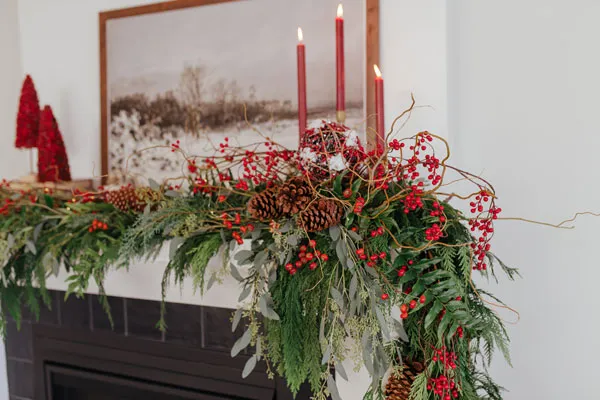
This garland needs a mantel at least 60 inches wide and a ceiling high enough that the candle flames aren’t near anything. If your mantel is under 48 inches, halve the volume and drop the tapers — tall candles on a short mantel look like a fire hazard, because they are. For narrower walls, borrow the density from Idea #30 but keep it to a single wreath.
About 55% mixed evergreen and eucalyptus, 25% red between berries and tapers, 15% brown pinecone and twig, 5% white from the framed artwork above. The eucalyptus is the secret — it adds a soft grey-green that keeps the whole thing from looking like a Christmas tree exploded on the mantel. Swap eucalyptus for magnolia and you get a glossier, more formal version of the same formula.
17. A Small Cedar-and-Boxwood Wreath With Jingle Bells
Cedar dries faster than pine. Expect a wreath this size to hold for roughly two to three weeks indoors before it starts dropping needles, and boxwood will outlast everything else in the mix. Keep it away from heat vents and fireplaces. The bells, though, get better with age — weathered metal develops the dull patina everyone wants, so don’t polish them. Store them dry between seasons and they’ll last decades.

The bell cluster:
- Cut three lengths of jute twine, 6 to 9 inches each, in staggered lengths.
- Tie a bell to each end with a double knot and a drop of clear glue on the knot.
- Gather all three twine tops and tie them together at the wreath’s 6 o’clock point.
- Hang the bells so the longest sits about 2 inches below the shortest.
- Trim the twine tails to 1 inch for a clean, hand-tied look.
Ten minutes of work and $6–$14 for a set of vintage-style bells.
18. A Twig Star and Beaded Garland on a Red Door
Red doors have always been lucky — and in 2026 the styling trick is to let the door be the color and keep everything on it rustic. A twig star instead of a wreath, snow-dusted greenery instead of glossy, tiny lit trees instead of a matching topiary pair. It’s the less-sparkle-more-story shift: people want their entry to look handmade, not merchandised.
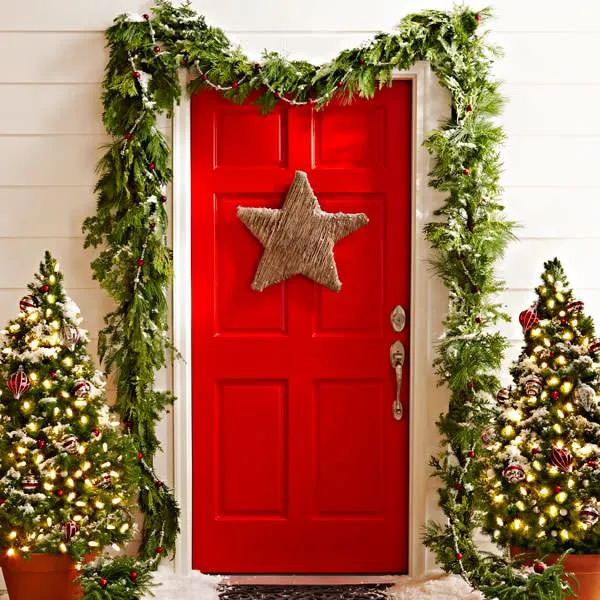
Twig stars run $8–$15 at craft stores, or bend one yourself from a grapevine bundle over a cardboard template. Beaded garland: thread wooden beads onto wire for about $10 in materials, or buy 9 feet pre-strung for $18. Miniature potted trees with lights are $12–$20 each at Target or Walmart. The whole entry lands under $80, and those light strands can move to the tree next year.
19. A Braided Cord Wreath With Tiny Dangling Charms
Cord and yarn wreaths are the rare case where the base does all the work. You want thick, tightly braided cord — a 3/8-inch braid reads as substantial, while thin yarn reads as a craft project. If you’re wrapping instead of braiding, keep one hand tensioned so the coils sit shoulder-to-shoulder with no gaps; any daylight between wraps is visible from three feet away. Wind it around a wire ring first, then glue.
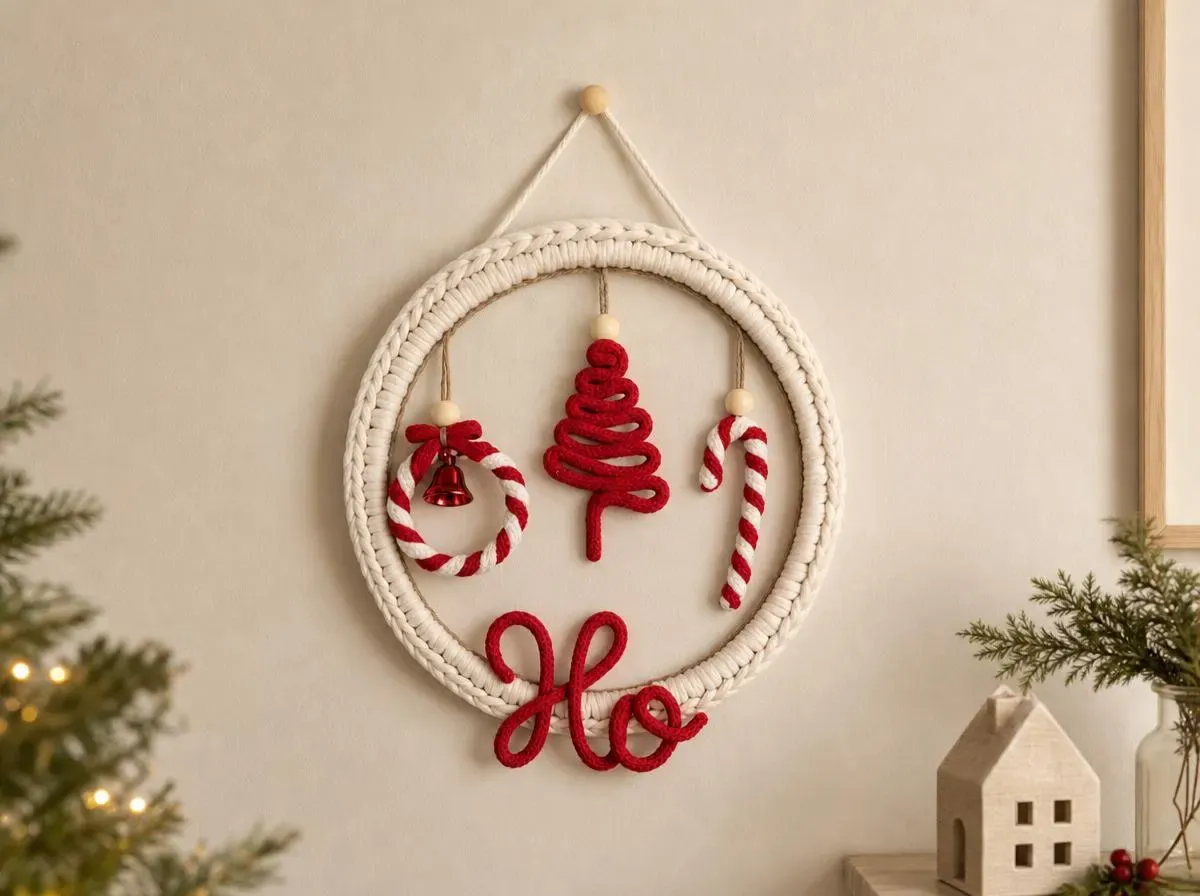
The dangling miniatures inside the ring. Without them, this is a plain white-and-red circle. The tiny wreath with a bell, the stylized tree, the candy cane — and the red script spelling out Ho at the bottom — turn it into a little scene. They’re also what makes it feel homemade in the good way: the proportions are slightly off, and that’s the charm. Keep each charm under a third of the ring’s inner width.
- Wire ring base, 12–14 inches: $4–$8
- Braided cord or thick yarn, 1–2 spools: $8–$18
- Miniature ornaments and charms: $6–$15
- Red lettering — wood cutouts or painted: $5–$12
- Hot glue, twine, and ribbon hanger: $5–$8
- Total: $28–$61
Cheaper than almost anything else on this list, and entirely doable in one evening in front of a movie.
20. The Quiet Minimalist Wreath of Dried Botanicals
90% neutral and dried, 10% muted green. That’s it. The restraint is the design — dried stems in beige, cream, and soft brown, with just enough muted foliage to say December rather than farmhouse. If you want to layer in a color, add it in the ribbon only, and keep it in the same family: oatmeal, mushroom, dusty sage. Anything saturated will obliterate the calm you’re building.
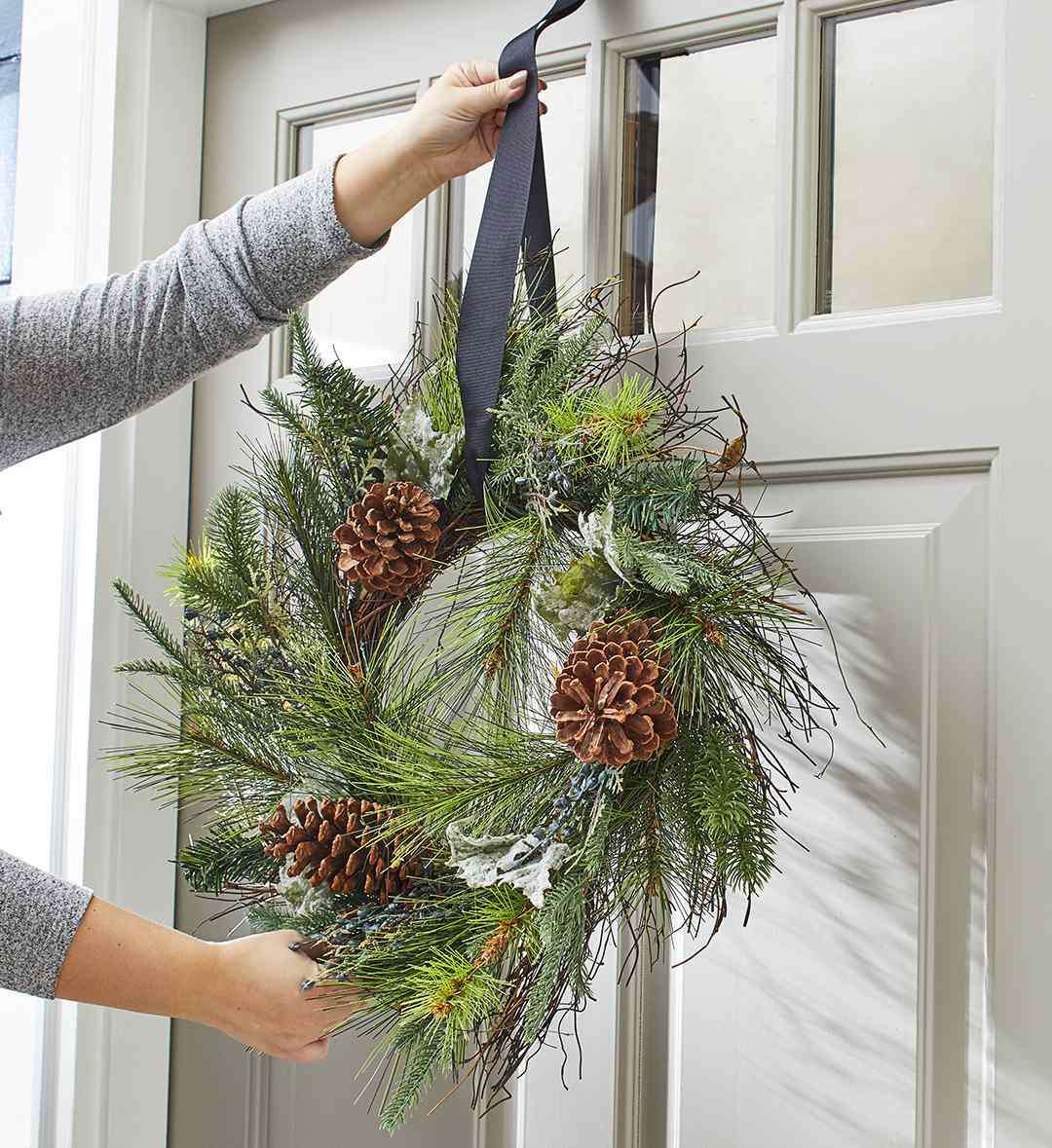
Because the volume is low, this wreath reads smaller than its actual size — a 20-inch dried wreath feels like a 16-inch fluffy one, so size up. It works beautifully on interior doors, mudroom hooks, and large mirrors, anywhere the wall behind it is textured or slightly imperfect. On a glossy front door it can look a little sparse. For a version with more presence, see Idea #24.
This is the quiet-holiday trend, and it’s still growing. People who decorate with dried grasses and linen the rest of the year aren’t swapping everything out for red and green in December — they’re adding texture instead of color. It hangs longer, too: dried botanicals don’t care about heat or low humidity and can stay up well into January without looking sad.
21. A Velvet Red Bow on a Dark Green Door
A velvet bow that big needs a wreath that can hold it. On a 20-inch wreath, a 12-inch bow eats the entire design — aim for the bow width to be about half the wreath’s diameter, so on a 26-inch pine wreath a 12- to 13-inch bow is right. Velvet also crushes. Store it loosely wrapped in tissue, never folded flat in a bag, or next year’s bow will have permanent creases right where the loops bend.
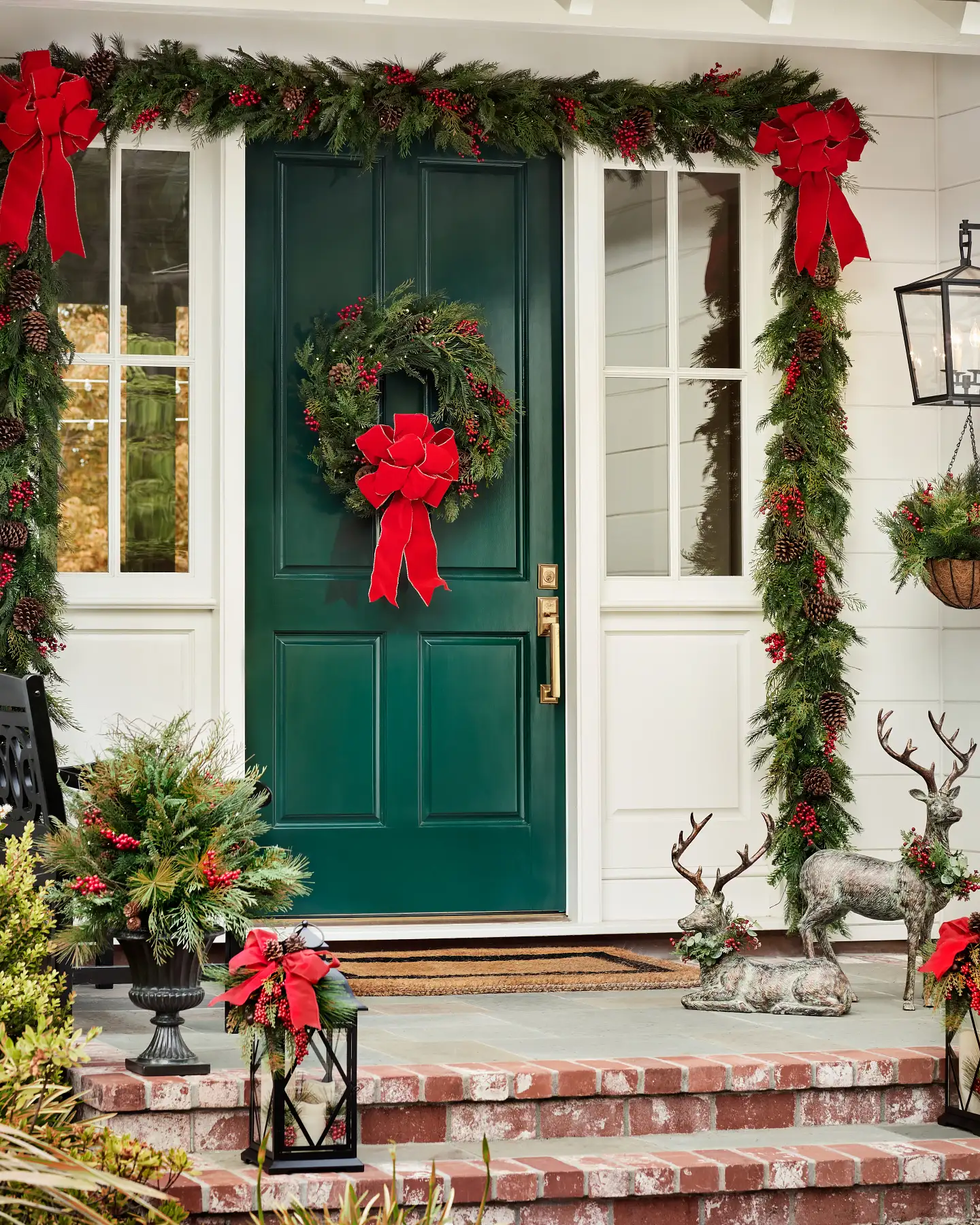
Green on green, separated by red. The dark green door and the pine wreath sit at nearly the same value, which could flatten completely — except the crimson bow lands right in the middle and gives the eye a focal point. Symmetry does the rest: matching garlands, matching sconces, reindeer and lanterns low on the steps. The bronze reindeer warm up all that cool green without introducing a new color family.
22. Hand-Painted Blue Pinecones on a Simple Pine Wreath
Painting pinecones:
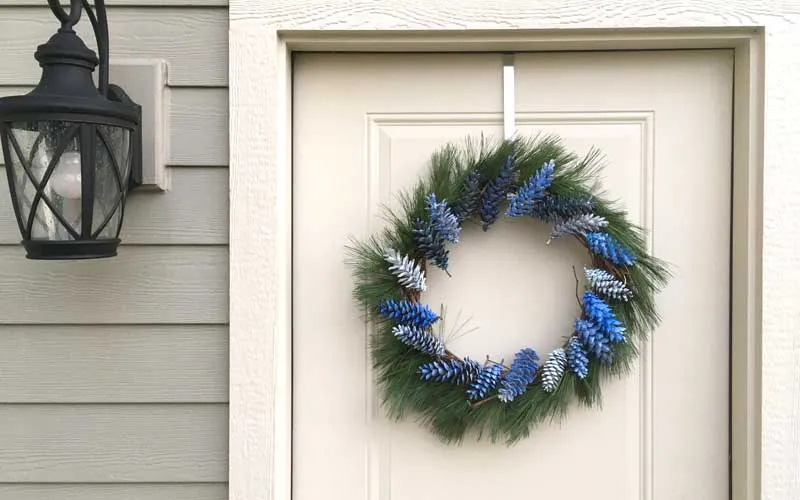
- Bake collected pinecones at 200°F for 30–40 minutes to kill anything living inside them, then let them cool.
- Tie a loop of twine around each pinecone’s base so you have a handle to hold.
- Dip the tips only with a small brush rather than spraying the whole cone.
- Use a mix of three blues — navy, dusty blue, and white — for depth.
- Let them dry 24 hours on wax paper before wiring them onto the wreath.
About an hour plus drying time; acrylic craft paint is roughly $2 a bottle.
This is the cheapest idea in the whole list, and the most personal. Pinecones are free if you have a yard or a park nearby. A plain green pine wreath is $15–$25, craft paint is $6 for three colors, and an over-the-door hanger is $4. That’s under $40 — less if you check Facebook Marketplace in early December, where people sell last year’s wreath bases for a few dollars.
Painted pinecones work here because only the outer tips carry color. Dip or brush the top third, leave the base natural, and let some cones stay plain. Spray the entire cone and you lose the shadow inside the scales, which is what makes them read as pinecones instead of decorative blobs. Budget 8 to 12 cones for a 22-inch wreath.
23. Eucalyptus, Thistle, and Dried Orange Slices
The thistle. Eucalyptus and dried orange slices you’ve seen everywhere; those spiky purple-grey thistle heads are what make this wreath look like it came from a flower market instead of a craft aisle. They also add a shape nothing else here has — spiky among round. Take them out and you’re left with a nice, ordinary botanical wreath. Two or three heads is plenty; they’re accents, not the main event.

Dried orange slices darken over time. In a warm, dry house they’ll go from bright amber to a deep tobacco brown in about six weeks — still pretty, just different. Keep them out of direct sunlight and they hold their color much longer. Don’t seal them with anything; the oils need to escape or they’ll get sticky. Eucalyptus, conveniently, dries beautifully in place and stays put for years.
24. Silver-Dollar Eucalyptus Under a Dark Green Velvet Bow
Silver-dollar eucalyptus goes limp fast — which is actually an advantage if you work with it correctly. Build the wreath slightly smaller than your target size, hang it, and let gravity pull the stems downward over the first two days. You end up with an organic, elongated shape instead of a stiff circle. Just don’t trim the stems before hanging; wait until it’s settled, then snip the outliers with sharp shears.
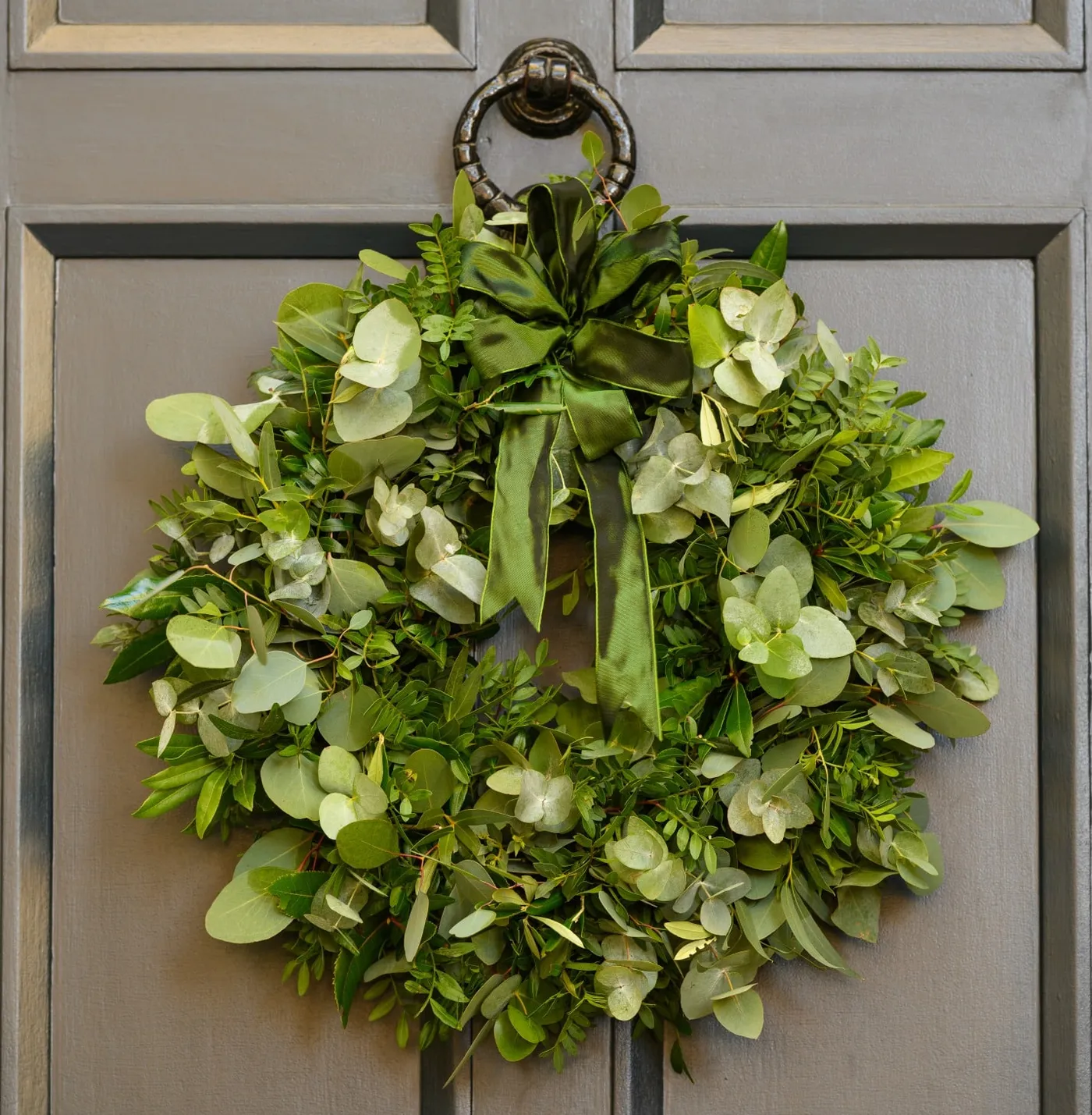
Sage-green eucalyptus is lighter than pine, so it reads less visually heavy. That means this wreath can go bigger without overwhelming a door — 26 to 28 inches works where a dense pine wreath would top out around 24. It’s also the best choice for interior doors and hallways with limited natural light: pale green holds up in low light, where deep forest green goes muddy.
25. A Slim Leaf-and-White-Berry Wreath for Modern Doors
85% fresh green leaves, 10% white berries, 5% visible natural stem. There’s no ribbon on this one, which is the point — the wire frame and slender stems are part of the design. If you want to add a color, add it in the hanging ribbon only. Swap the pointed leaves for round eucalyptus and the same formula reads soft and romantic instead of crisp and modern.
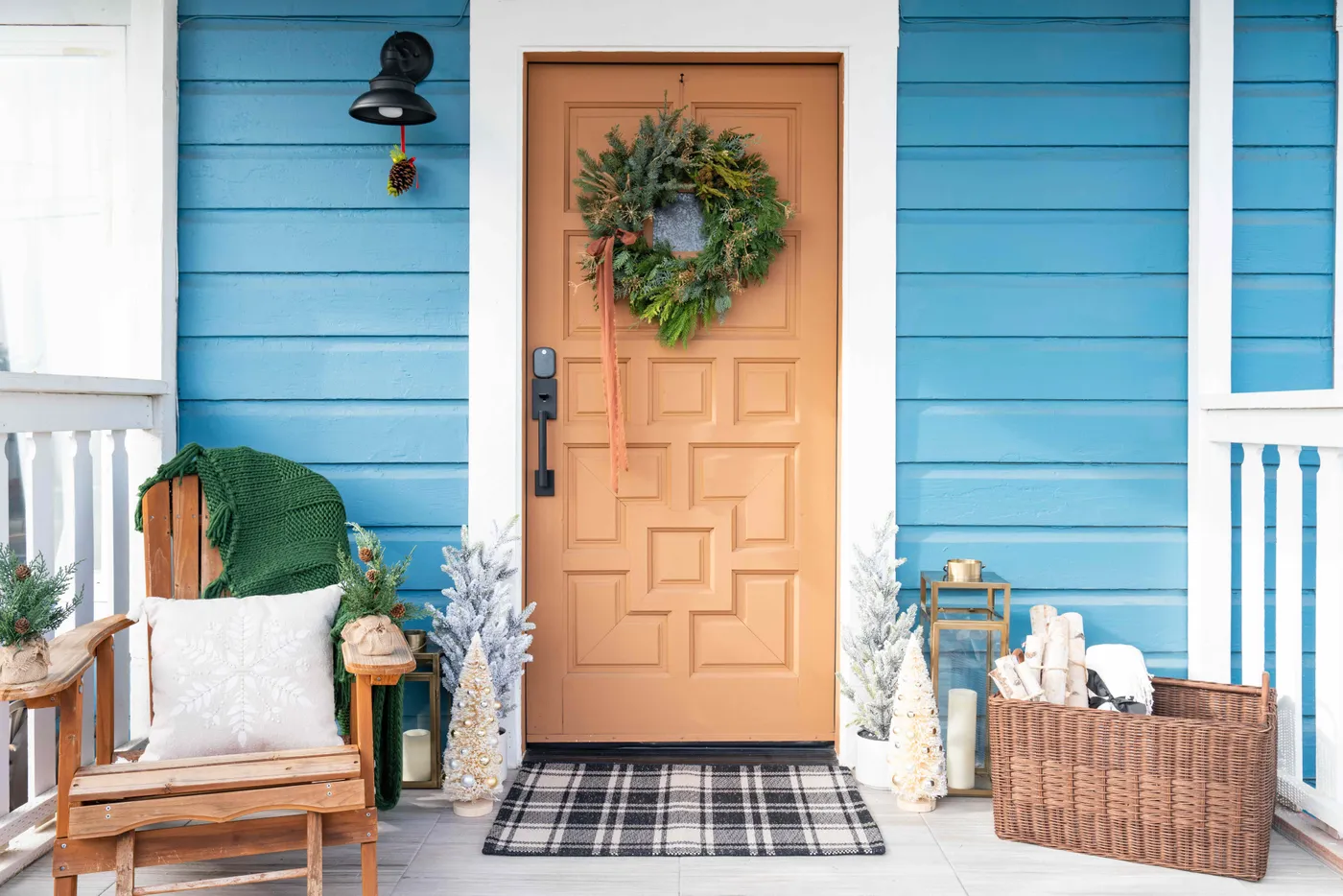
Negative space. Most wreaths fill the entire circle with material; this one leaves visible openings between stems so you can see the wall behind it. That airiness is what makes a simple wreath look considered rather than unfinished. The slight asymmetry — heavier on one side — keeps it from reading like a machine made it. Best of all, it looks just as good in a hallway as it does on a front door.
26. One Green Leaf Wreath on a Weathered Wood Door
- Simple wire wreath form, 18 inches: $3–$6
- Fresh greenery — bay, olive, or garden clippings: $0–$20
- Floral wire and twine for the hanger: $4–$7
- Optional linen ribbon, 1.5 inch: $6–$12
- Total: $13–$45
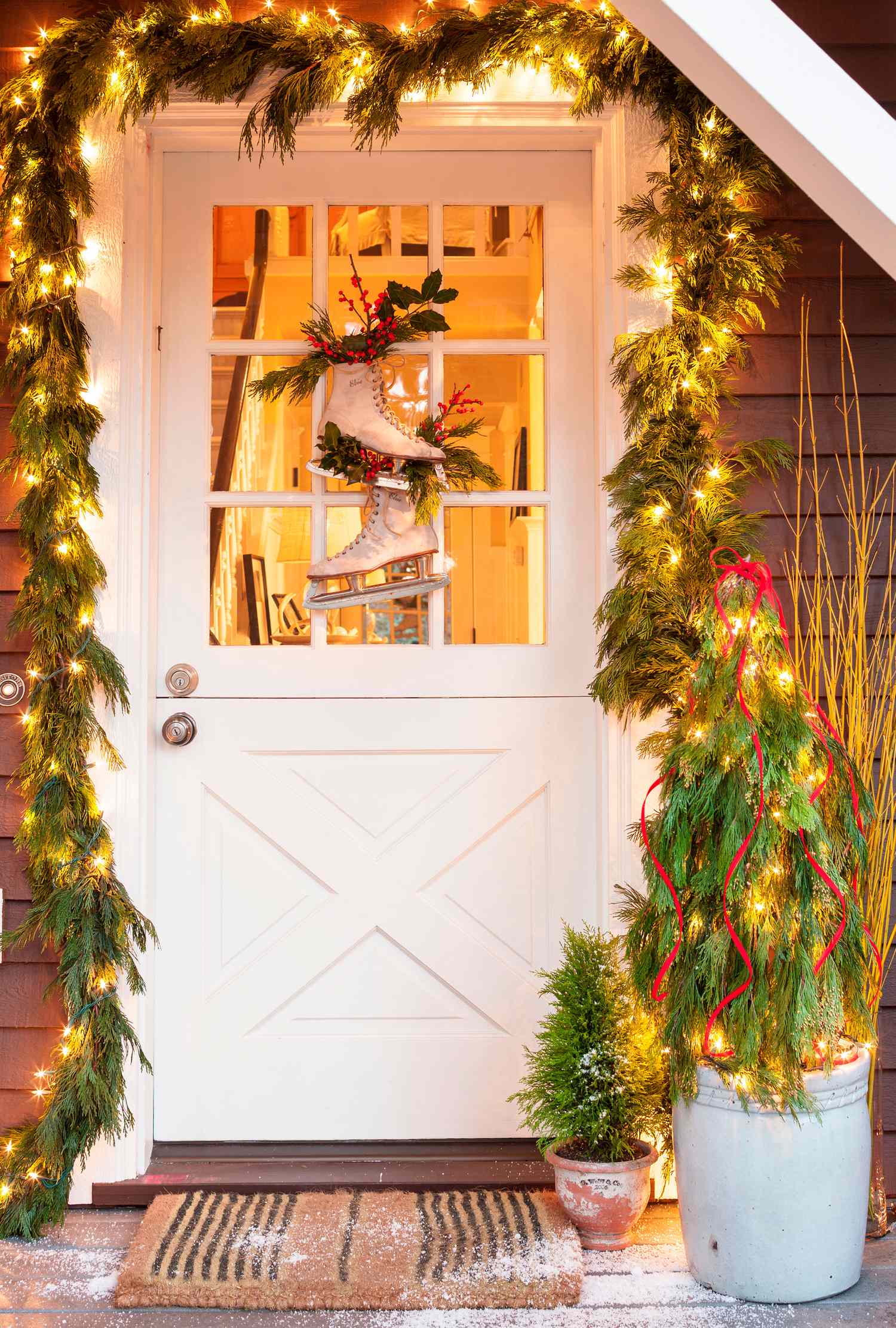
The catch is timing. The cheapest version is built from clippings you already have, and the second-cheapest comes from a $15 grocery store bunch, so make it the morning you plan to hang it.
Real leaf wreaths need water, which wreaths can’t hold — so work with greens that dry gracefully. Bay, olive, eucalyptus, and magnolia all dry in shape; ivy and fern will curl. Refresh the wreath by misting the backs of the leaves every other day. It won’t last forever, but it’ll last three weeks instead of one.
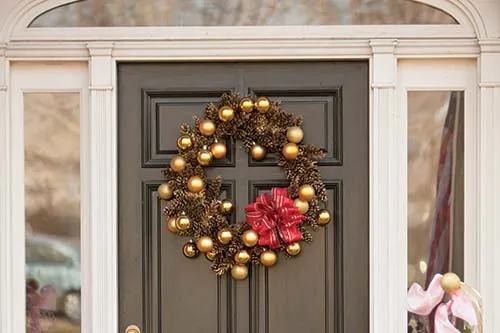
27. A Pinecone Wreath Dressed in Gold Ornaments
Building a pinecone wreath base:
- Soak your pinecones in water for 30 minutes so the scales close, then let them dry — they’ll reopen and lock into each other.
- Start with a wire ring and hot-glue the largest cones around the outer edge, pointing outward.
- Fill the middle with medium cones, then the smallest at the center.
- Keep going until you can’t see the wire, rotating the ring as you work.
- Seal the finished wreath with two light coats of matte polyurethane.
A 20-inch wreath takes about 60–70 pinecones and roughly two hours; collect them free or buy a bulk bag for $15–$25.
A pinecone wreath is heavy — 5 to 7 pounds once it’s fully packed and sealed. That’s fine on a wood door with a metal hanger, but it’s too much for a glass door and a suction cup, and too much for a hollow interior door that flexes. Unless you sealed it, it will also shed scales every time the door shuts. Seal it twice, and check your wire ring before you start — flimsy rings bend under that weight.
Pattern over color. A pinecone wreath is monochrome brown, but the overlapping scales create a repeating triangular pattern that reads as texture from thirty feet away. The gold ornaments add the only shine, and the striped red bow sits low and off to one side so the wreath doesn’t look like it’s wearing a hat. Brown, gold, and red is a warm, traditional trio that photographs beautifully at night.
28. An Autumn Foliage Wreath Between Black Grid Doors
You don’t need a florist for the autumn-to-winter handoff. A $20 faux autumn wreath from Target or At Home paired with $40 in pumpkins from a farm stand gets you 90% of this look. Tall lanterns run about $25 each at IKEA, and they double as candle holders all winter. Ornamental grasses can be divided from a $12 nursery pot and planted afterward, so nothing goes to waste.
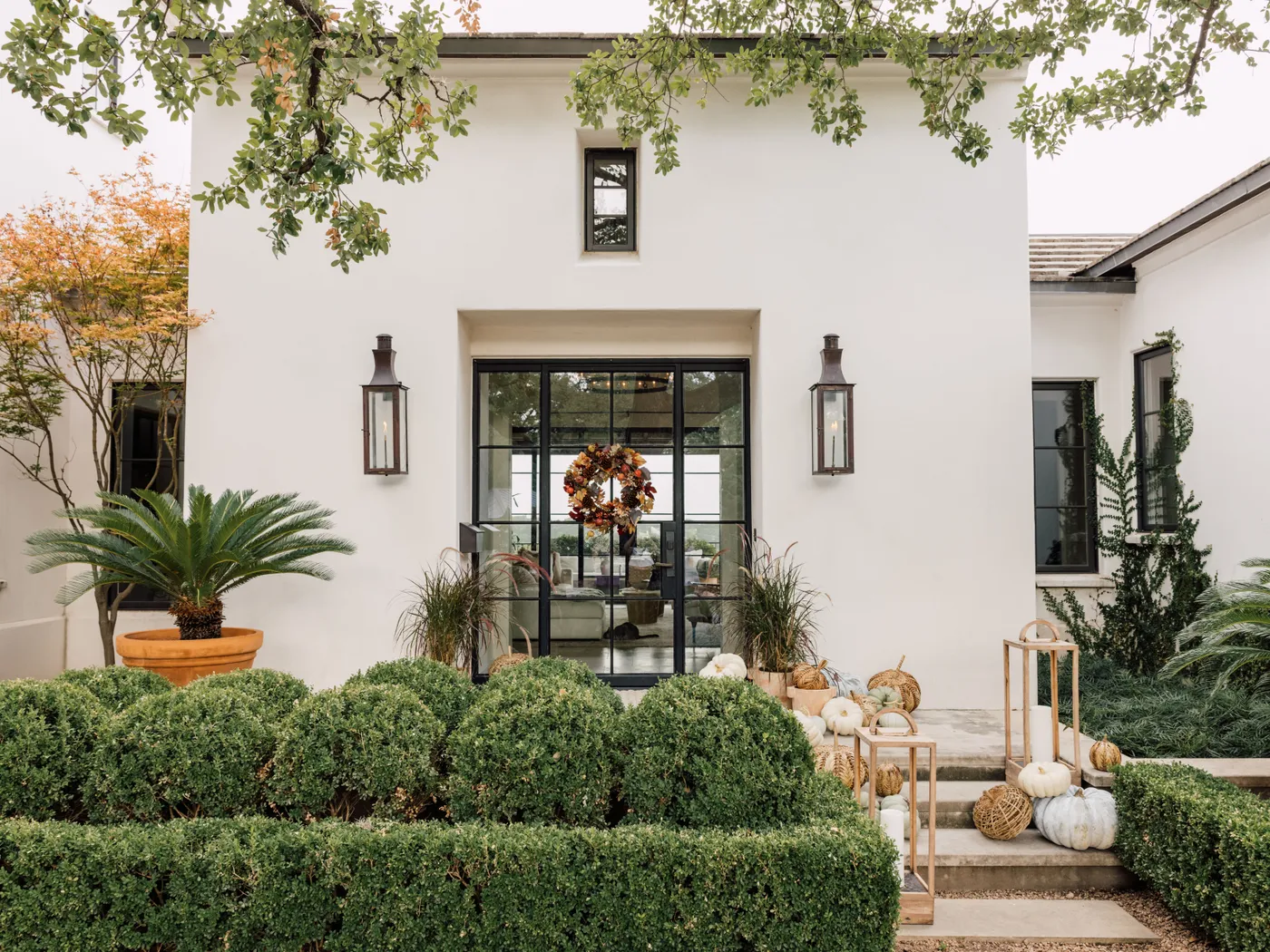
The one-wreath-three-seasons approach is gaining ground. People are choosing wreaths in copper, rust, and dried green that work from September through Thanksgiving, then layering evergreens behind them in December instead of swapping everything out. It saves money, storage, and the annual scramble. Crisp black grid doors against white stucco make the change of foliage read clearly, which is why this style of entry photographs so well.
29. A Birch Ribbon Bow With Muted Gold Bells
The birch-bark ribbon. Everything else here is a classic — pine, berries, pinecones, bells — but that wide white ribbon printed with birch bark gives the whole wreath a sense of place, like it belongs on a cabin porch. It’s an inexpensive trick: birch-patterned wired ribbon runs $8–$14 a roll. The muted gold bells hanging beneath are the second-best detail; anything brighter would fight the frosted blue-grey berries.
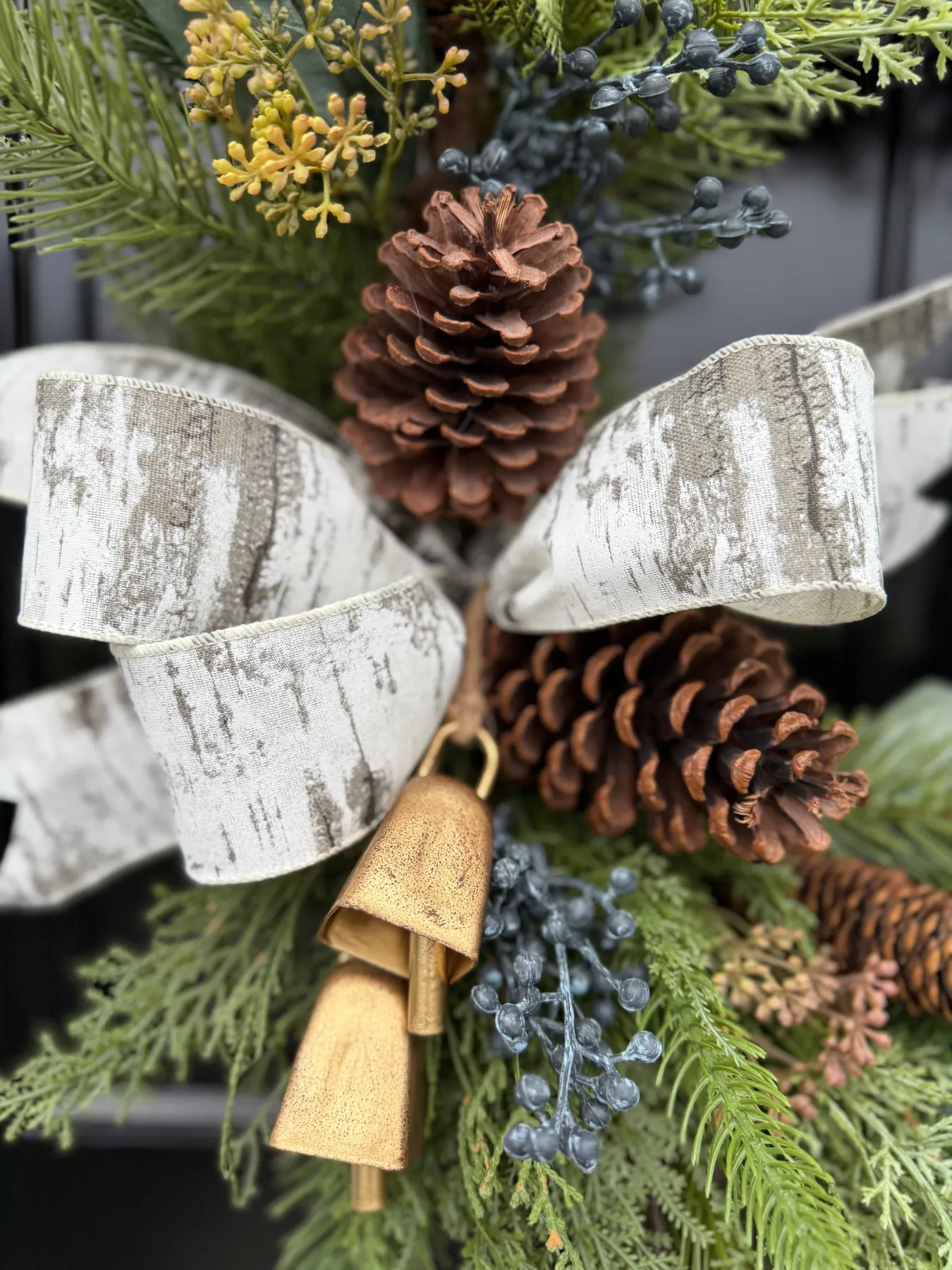
Frosted berries and a wide bow read as a winter wreath that works indoors and out, so it’s flexible on size. It’s happiest between 20 and 26 inches — big enough for the bow to have presence, small enough to hang on an interior closet or pantry door without scraping the frame. If you’re working with a narrow entry or a glass storm door, look at the slim profile in Idea #26 instead.
30. Eucalyptus and Magnolia With Frosted Pinecones
Value contrast, not color contrast. Eucalyptus is pale sage, magnolia leaves are dark and glossy, and the red berries sit almost black in shadow — three distinct values on one ring, which is what gives this density without chaos. The frosted pinecones add a matte note against all that shine. It’s the same reason good black-and-white photography works: the eye loves a clear range from light to dark.
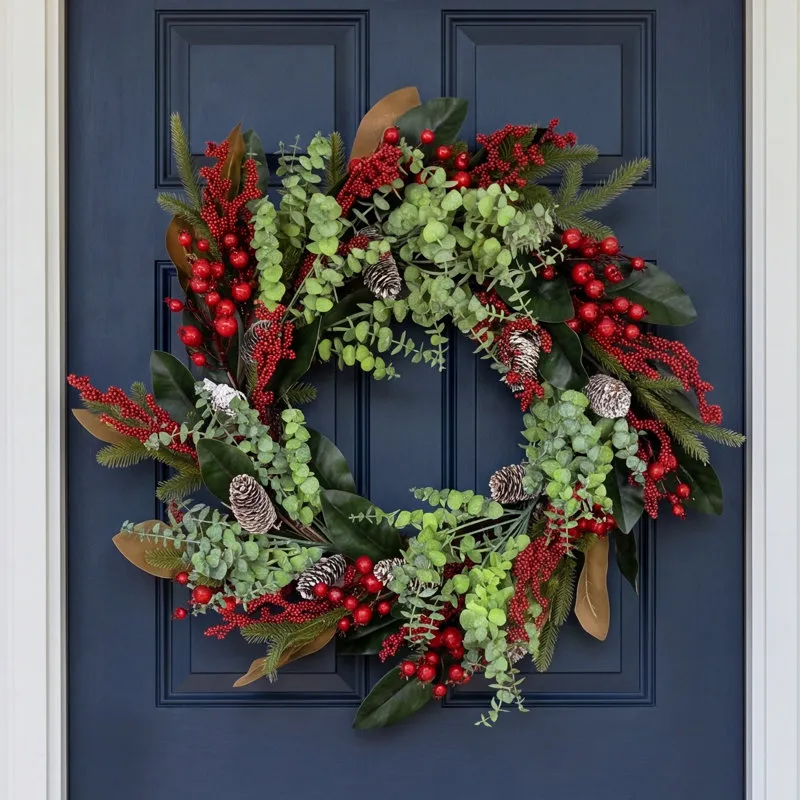
Layering this many materials onto one wreath gets heavy, and it can hide the base entirely — which means any gaps show up as holes rather than depth. Build it in one direction, not in a circle, so you can see where things are crowding. Fresh eucalyptus and magnolia together in a warm room also dry at different rates, so shake the wreath out weekly before the eucalyptus sheds into your entryway.
Wire every element to the base — hot glue alone fails on fresh greenery because stems shrink as they dry. Use 22-gauge floral wire, wrap twice around the ring, twist tight. For berries, wire the whole cluster rather than individual berries; they hold together better and you’ll finish in half the time. A 24-inch wreath needs around 90 wire twists, so give yourself a solid hour.
One Wreath, One Afternoon, One Very Good Front Door
Start with the one that matches what’s already on your door — a dark paint color wants magnolia or velvet, white siding wants pine and pinecones, and a weathered wood door was basically built for exposed grapevine. You don’t need all thirty of these. You need one that looks like you meant it.
📌 Pin your favorite to your holiday board now, so when that free Saturday finally shows up, you already know exactly what you’re making.