
Last December you saved forty tree photos and still stood in the aisle at Target, ribbon in hand, wondering which one was actually right. The difference between a tree that looks decorated and a tree that looks designed comes down to about four decisions — and none of them require a designer.
We dug through Etsy, Target, Walmart, and Wayfair listings, plus a genuinely unreasonable number of real designer portfolios, to pull 31 ideas worth your time. Prices run from $12 ornament swaps to $450 flocked showstoppers, and every idea comes with budget and luxury versions compared side by side.
Inside you’ll find farmhouse rustic, classic red-and-green, flocked snowy, and vintage retro styles — with cost breakdowns, scale rules, and sourcing notes for each one. And stay until the end: we break down the most common mistakes that quietly ruin these looks.
2026 is the year holiday nostalgia went warm. Flocked trees and vintage glass ornaments are climbing on Pinterest, and “quiet traditional” — red and green without the glitter explosion — is the aesthetic everyone is saving right now.
Go ahead and save this — you’re going to want to reference it when the boxes come down from the attic.
1. Farmhouse Living Room with a Flocked Tree in a Woven Basket Collar
Red is doing three jobs in this room — the knit stockings on the white brick mantel, the candles tucked inside the black lanterns, and the plaid throws draped over that wooden ladder. Repeating one color across three materials (wool, wax, cotton) is what keeps a farmhouse tree from reading flat. The woven basket collar grounds the flocked branches so the tree looks planted rather than stranded, and the wooden star up top quietly echoes the dark wood of the ladder and beams. Nothing matches exactly. Everything agrees.
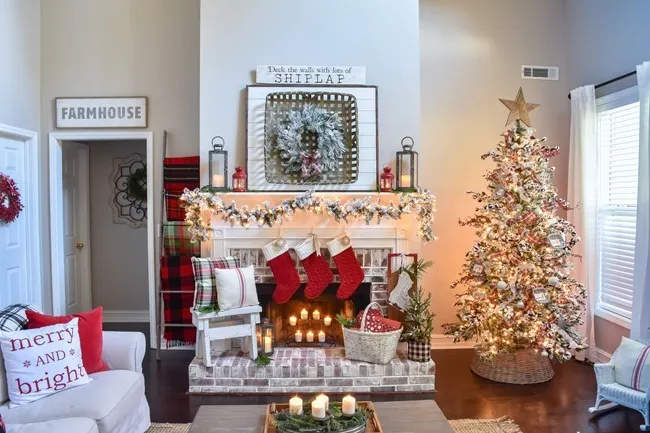
- Flocked 7.5 ft tree: $180–$450
- Woven basket tree collar: $40–$120
- Red knit stockings (set of four): $30–$80
- Black lanterns and red pillar candles: $35–$90
- Plaid throws (two): $50–$140
- Wooden star topper, frosted wreath, tobacco basket: $60–$150
Total: $395–$1,030. Budget alternative: skip the basket collar and use a galvanized bucket or a heavy linen wrap you already own, hunt plaid throws on Facebook Marketplace in January for $10–$20 each, and swap the flocked tree for a plain green one plus a $15 can of spray flock. That lands the same look closer to $180–$400.
2. Wooden Bead Garlands and Dried Oranges Against White Brick
Hang bead garlands in swags no deeper than 15 to 18 inches, and keep every swag the same depth. You’ll need roughly two feet of garland per swag on a 7.5-foot tree. If the strands are wire-strung, bend a small hook at each anchor point so they hold their shape instead of sliding down overnight. Uneven draping is the single biggest giveaway that a tree was decorated in a hurry.
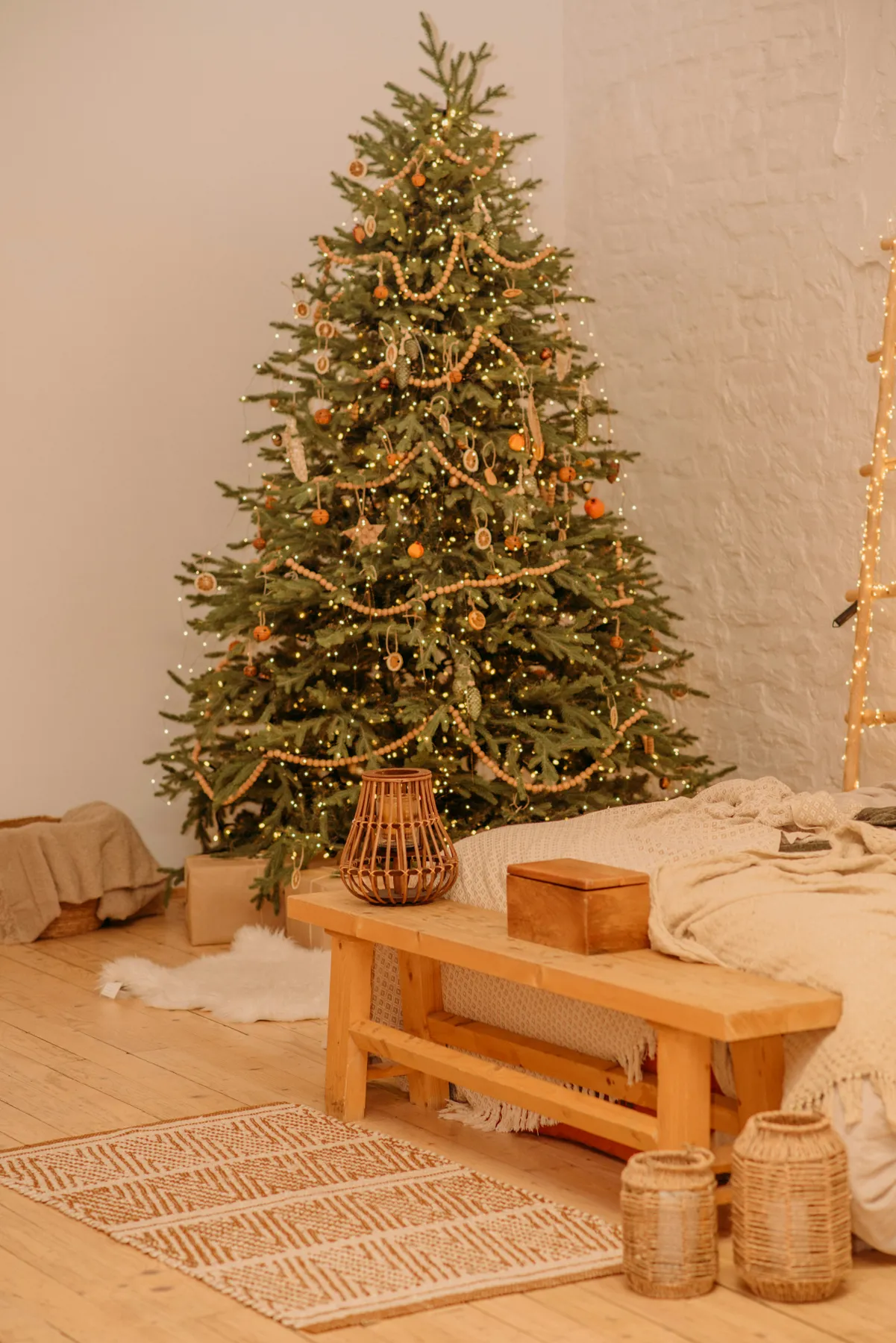
60% warm white base (the lights, the neutral blankets, that white brick) + 30% natural wood and beige (bead garlands, the bench at the foot of the bed, rattan lanterns) + 10% amber accent from the dried orange slices. To shift the mood without re-shopping, swap the amber for cobalt felt balls and the whole corner turns cool and wintry; swap it for burgundy and you land much closer to the mantel in Idea #9.
3. Paper Honeycomb Ornaments for a Quiet, Minimalist Tree
Take away the honeycomb paper ornaments and this becomes a plain green cone with a star on top. They carry the whole look — matte, featherweight, and large enough to read from across the room, which is exactly what most small ornaments can’t do. Honeycomb holds volume at six or eight inches wide, so a tree with twenty of them looks styled rather than skimpy. Think of it as the quiet version of Idea #17‘s maximalism.
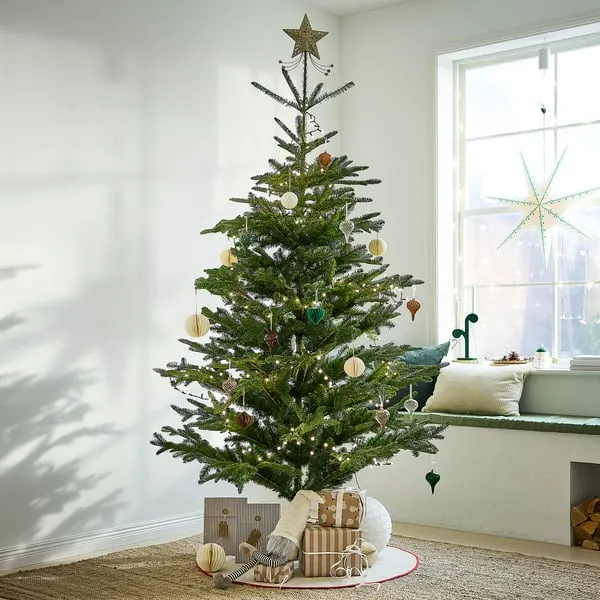
You can fold your own honeycomb baubles with tissue paper and a glue stick for about $8 total, or buy a set of twelve for $12–$20 at Target. A plain green tree from Walmart runs $60–$120, and a 5×7 jute rug is about $50 at IKEA. Kraft paper and twine for the gifts costs under $15. The entire scene tops out near $200, and the leftover paper goes toward next year.
4. Red Velvet Bow and Gold Bells: One Ornament, Close Up
- Cut a 14-inch length of red velvet ribbon and knot a loop at the top for hanging.
- Wire three small gold bells together at their crowns.
- Add two faux pine sprigs and one small pinecone behind the bells, all pointing the same direction.
- Bind the cluster with floral wire, then hide the wire under the velvet bow.
- Fluff the bow loops and trim the tails at a 45-degree angle.
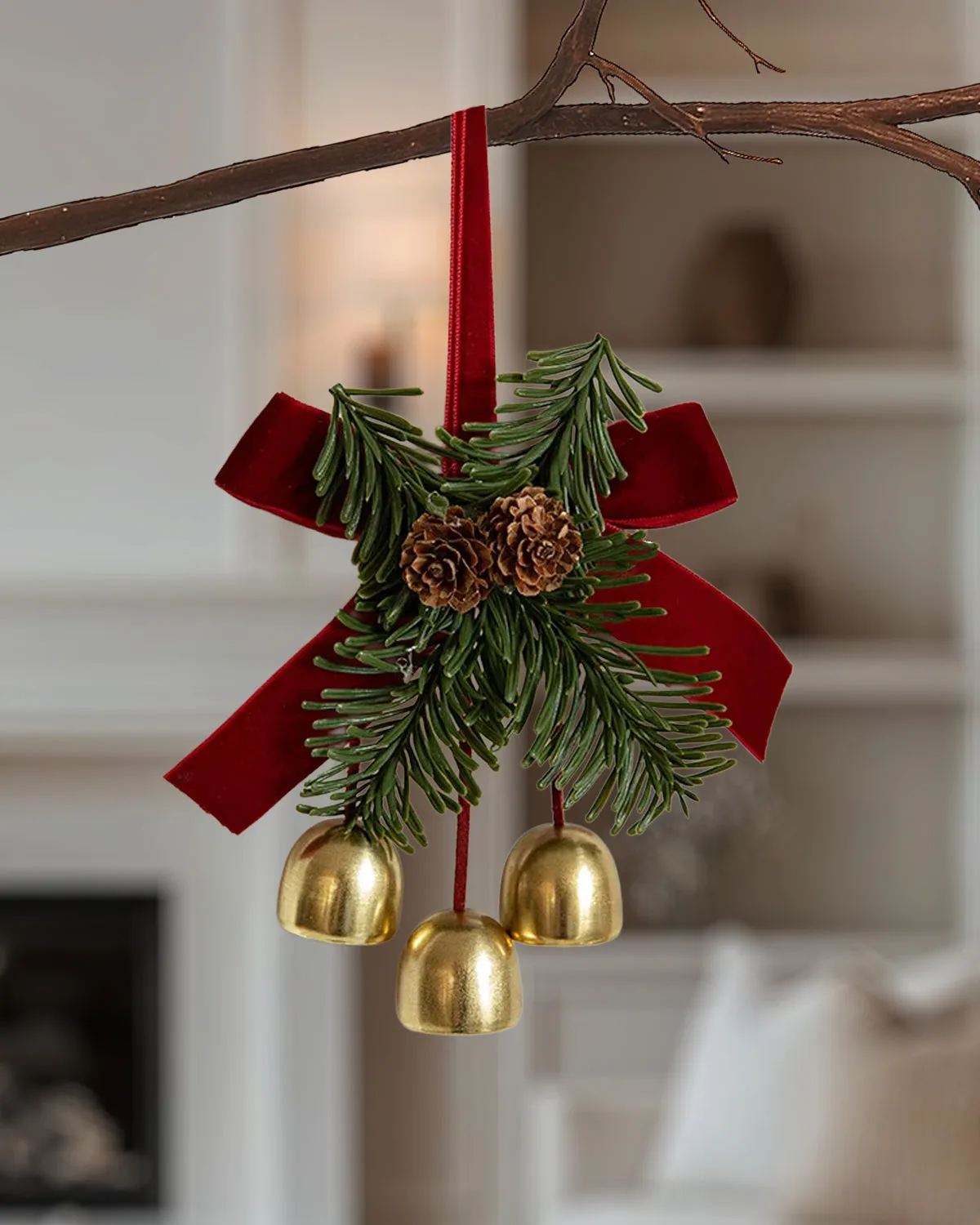
About 15 minutes per ornament and roughly $6 in materials — which adds up fast if you’re making thirty of them.
Gold bells are heavier than they look. Three bells plus pinecones and a velvet bow can push past four ounces, enough to rotate a branch downward and leave a bald patch on a lightweight artificial tree. Hang these on the upper half where branches are wired stiffer, and slide a second hook onto the branch behind to spread the load. Real velvet also fades near a sunny window, so keep them out of direct light if you plan to reuse them.
5. Pink, Magenta and Tangerine Tree Beside a Stone Fireplace
Bright, mismatched holiday color has been building on Pinterest ever since the dopamine decor wave, and by 2026 the pink-and-orange tree is fully mainstream. What makes it work here is the stone fireplace — cool gray masonry absorbs all that saturation so the tree reads as a deliberate burst rather than a mistake. It has real staying power if you keep the accents inside one family. Hot pink trees that also throw in purple and turquoise tend to age badly.
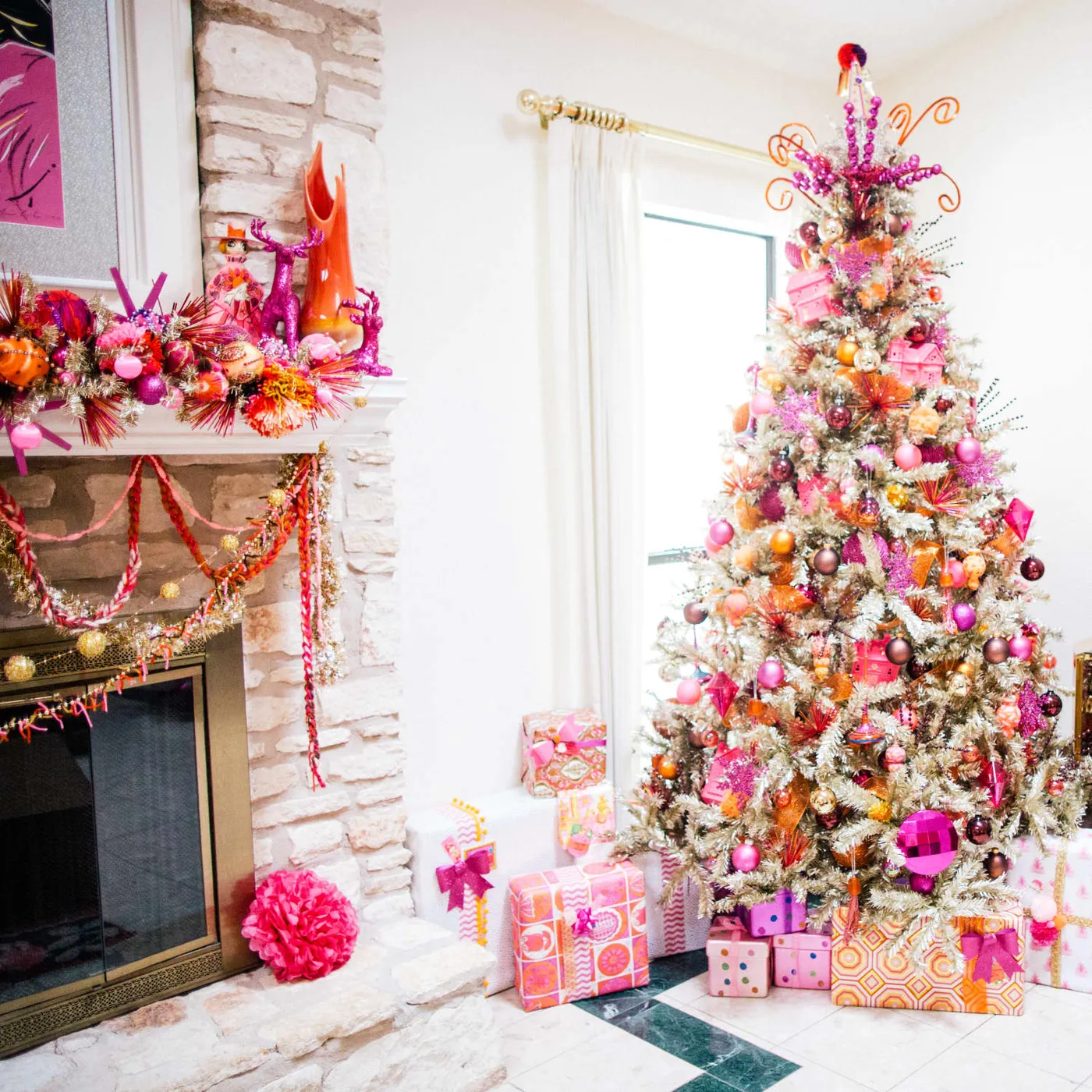
This look needs vertical room. A saturated tree this tall wants a ceiling of at least 9 feet and a wall run of 6 feet or more, because the matching mantel garland doubles the visual mass. In a standard 8-foot living room it will overwhelm everything — go with Idea #11‘s slim silhouette instead, or keep the exact color story and shrink it to a tabletop tree. Same palette, half the footprint.
6. Nutcracker Ornaments and Gold Mesh Ribbon on a Dense Tree
Two principles are pulling weight here: hierarchy and texture contrast. The nutcrackers are the biggest, most detailed objects, so they sit on the outer layer where nothing blocks them, while the gold mesh ribbon and sequined poinsettias fill the depth behind. That mesh ribbon does something flat ribbon can’t — it catches light from every angle and breaks up the dense green so the tree looks lit even in daylight. The blue patterned ribbons are the surprise note that keeps it from being a red-and-gold cliché.
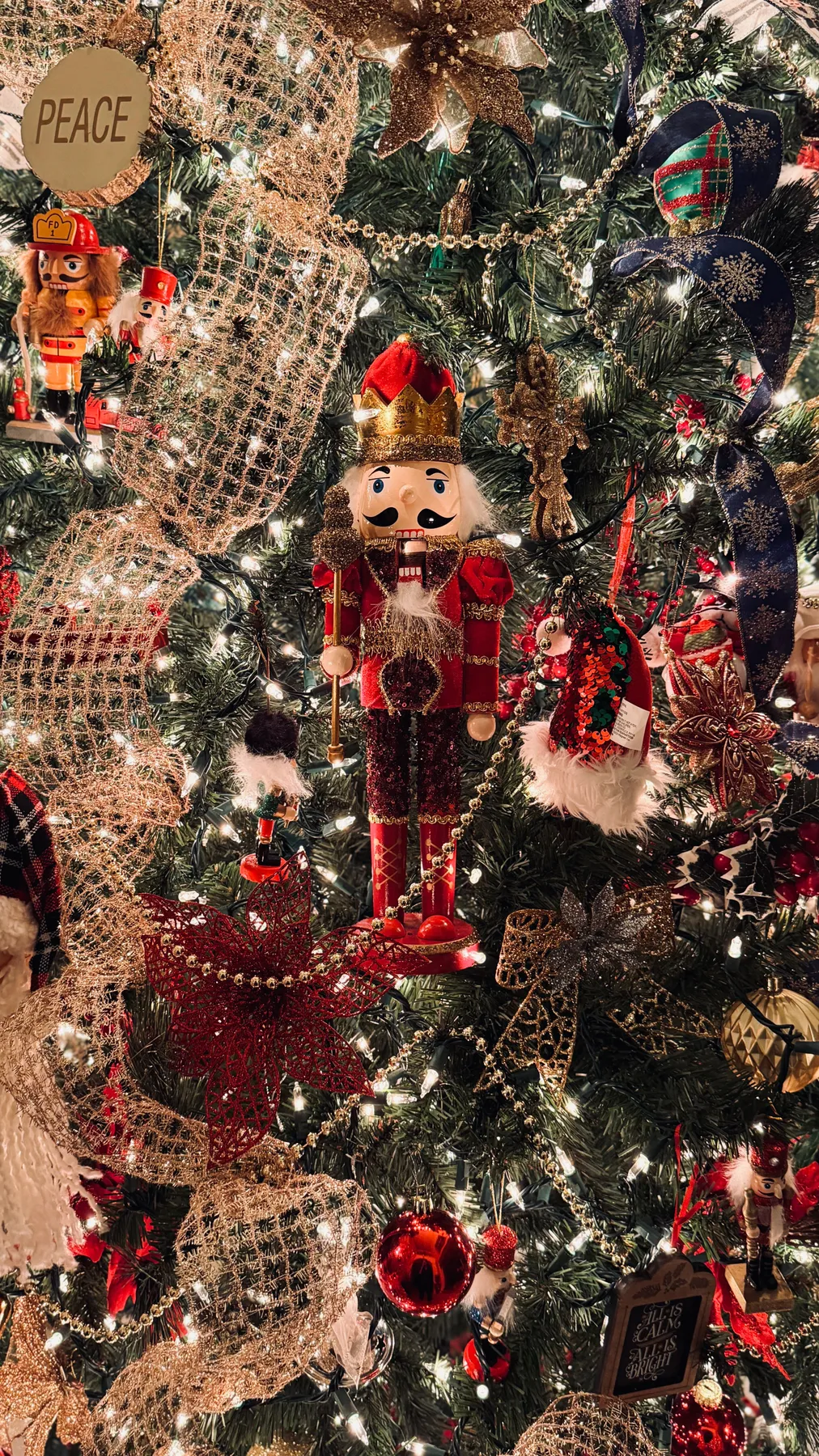
Sequin poinsettias shed. Expect a trail of gold flecks on the carpet every time you brush past, so vacuum carefully and spot-glue loose sequins before they escape. Gold mesh ribbon crushes permanently once bent, so store it wrapped around a cardboard tube rather than folded in a bin. Nutcracker ornaments with painted faces chip at the nose and hat when they knock together — pack them one per zip bag.
7. Flocked Branches, Plaid Ribbon and Cotton Boll Stems
When you layer ribbon into a flocked tree, cut it into 18-inch lengths and tuck each piece in by hand instead of weaving a continuous roll. Continuous ribbon spirals evenly and looks mechanical; cut pieces let you control the angle so the plaid faces forward from every seat in the room. Use roughly one piece per two square feet of tree surface — about 30 pieces on a 7.5-foot tree, and buy two spools, not one.
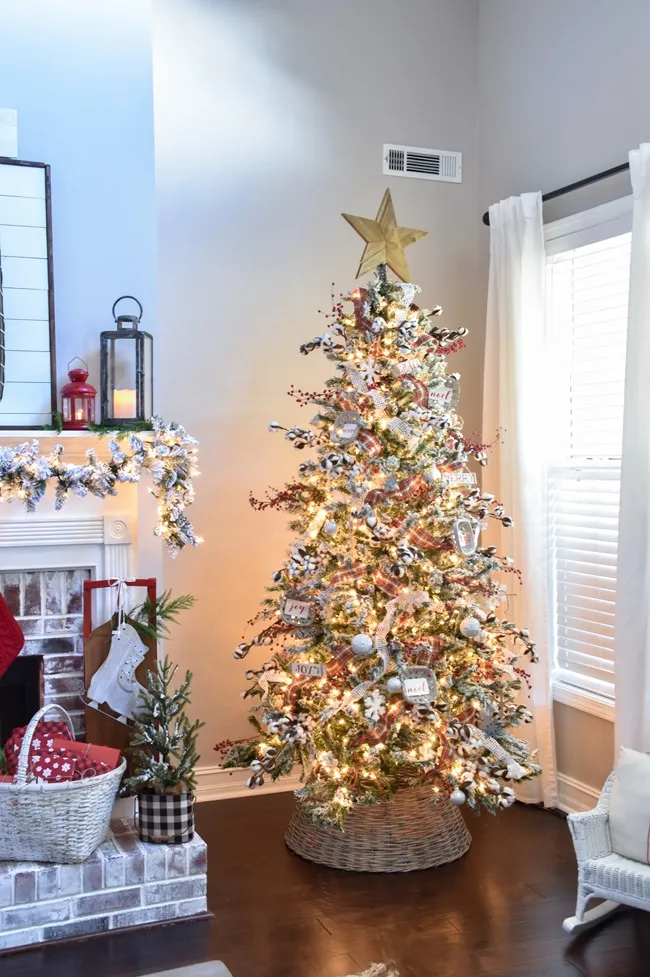
- Measure your ceiling and subtract 12 inches for the wooden star topper and clearance.
- Confirm the woven wicker collar’s opening is wider than your tree’s base pole — these collars are unforgiving.
- Check that your mantel garland and tree ribbon share at least one color, or the two zones will fight all season.
- Decide whether the tree sits in front of a window — flocked branches look dusty in strong backlight.
8. Oversized Matte Red Baubles with Natural Pinecones
It’s the scale of the ornaments. Those matte red spheres are four to six inches across, and that size is the entire reason a tree with almost nothing else on it looks finished. Small ornaments disappear into evergreen; oversized ones hold their shape from the doorway. Swap them for a hundred tiny baubles and the tree looks busier while reading as emptier. Buy fewer. Buy bigger.
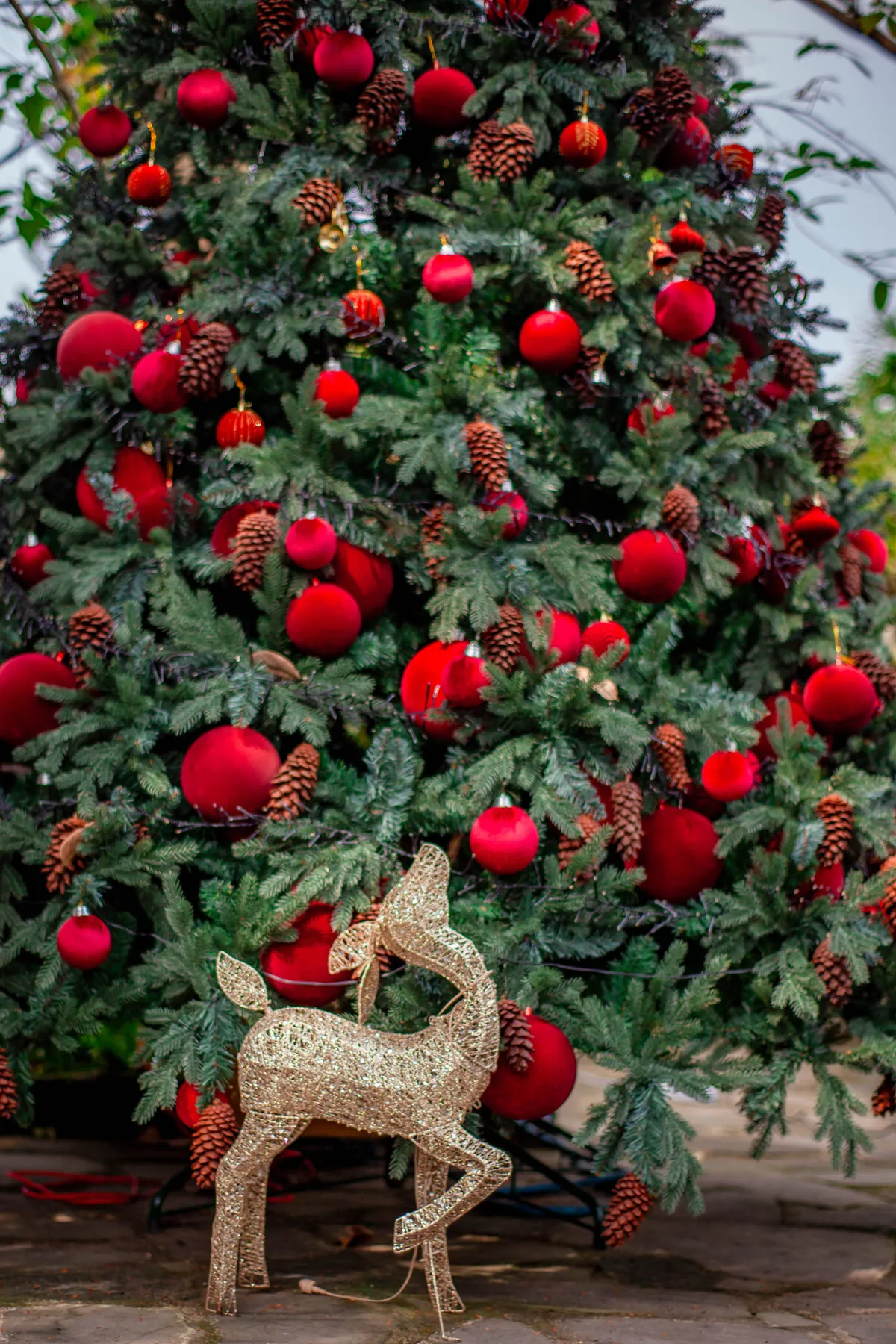
70% deep green foliage + 20% vibrant red + 10% natural brown and gold sparkle. Three colors, which is why it never looks chaotic. Trade the matte red for matte white and you get a Scandinavian snow tree; trade it for copper and the whole thing turns warm and vintage. The gold wireframe reindeer at the base counts as your 10% — metallic belongs low and reflective, where it bounces light across the floor.
9. Clip-On Candle Lights and Plaid Bows on a Flocked Tree
- Flocked 7 ft tree: $150–$400
- Red and green bulb ornaments (100 count): $25–$60
- Pre-made plaid ribbon bows (dozen): $18–$45
- Clip-on LED candle lights (set of ten): $20–$50
- Nutcracker figurine and red glitter reindeer: $30–$90
- Gift wrap and boxes: $25–$60
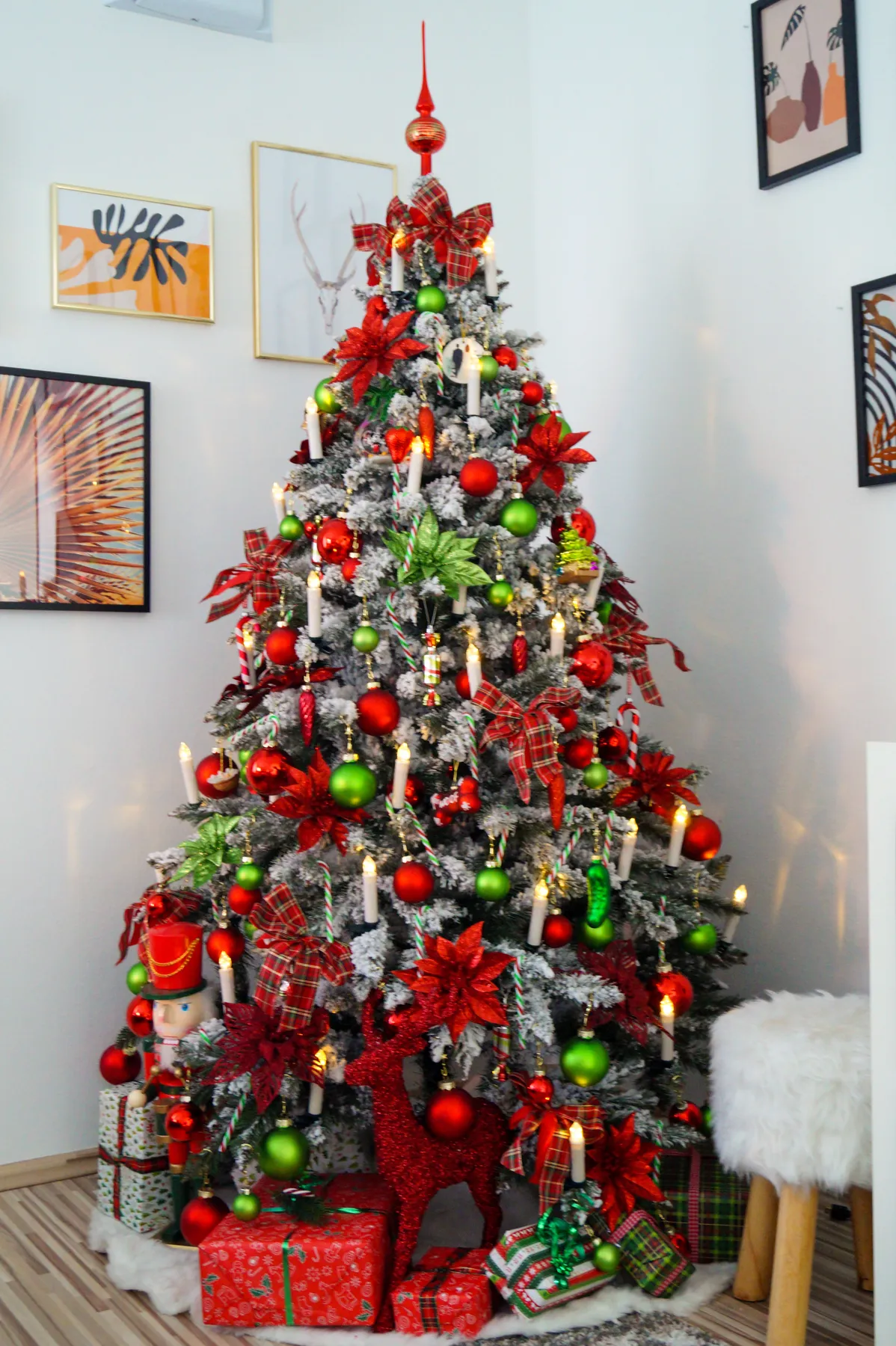
Total: $268–$705. Budget alternative: buy plaid ribbon by the roll and tie the bows yourself for about $12, and hit the after-Christmas sales for the candles — clip-on sets drop to $8–$12 in early January. A non-flocked tree plus a $15 spray can gets you the same snowy branches.
Clip-on candles are charming and mildly dangerous if you buy the wrong ones. Stick to LED or battery versions, never vintage plug-ins, and check that the clip jaws actually grip your branch diameter — flocked trees run thick, and flimsy clips slide off by New Year’s. Flocking sheds too, so vacuum beneath the tree weekly and keep the skirt secured so white dust doesn’t read as neglect.
10. Dense Red and Gold Coverage on a Lush Evergreen
Count before you hang. A tree this full needs roughly 10 ornaments per vertical foot — 75 to 80 pieces on a 7.5-foot tree — and about 100 lights per foot of height, which is far more than most pre-lit trees ship with. Work in three passes: large ornaments first at 12-inch intervals, then medium filling the gaps, then small ones tucked close to the trunk for depth. Nobody sees the trunk ones, and they’re why the tree looks expensive.
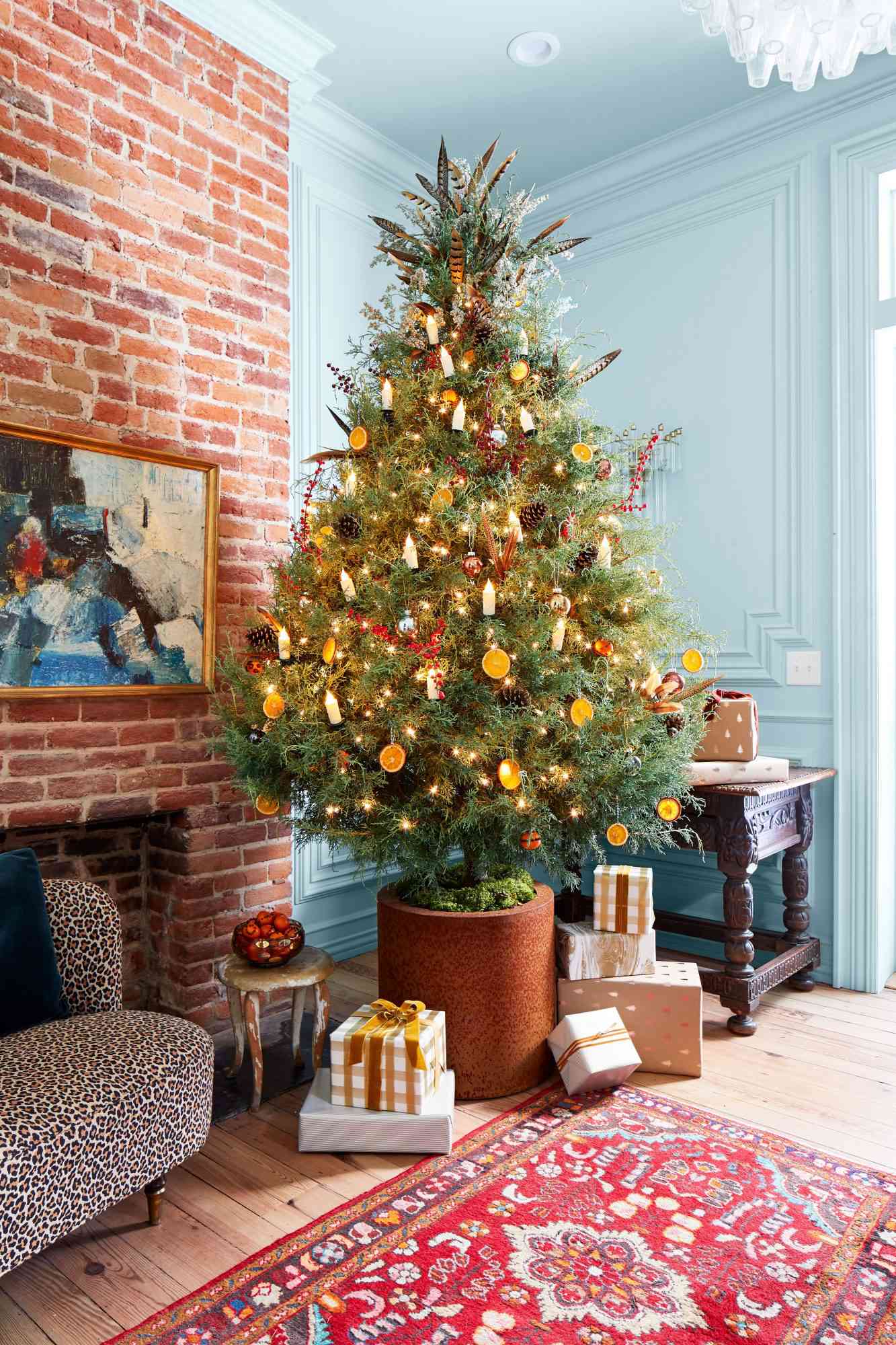
Repetition plus a tight palette. Red and gold only, no third color, which is why a tree this crowded still reads calm — every glance lands on the same two hues. The gold is also functioning as lighting: metallic finishes bounce the string lights back into the room so the tree glows a foot past its own branches. Ribbon garlands run horizontally rather than spiraling, which controls the eye and keeps the mass from feeling bottomless.
11. Slim Tree, Red Star, and a Reindeer Tree Skirt
Slim trees are the fix for small rooms, and this one makes the case. A pencil-profile tree in the 6 to 7 foot range takes about 24 inches of floor width instead of 48, which means it fits beside a fireplace in a living room as narrow as 10 by 12 feet. Eight-foot ceilings are fine here, because the slim silhouette leaves visual air on either side. If your room is larger, go wider — see Idea #20 for how much space a full tree really needs.
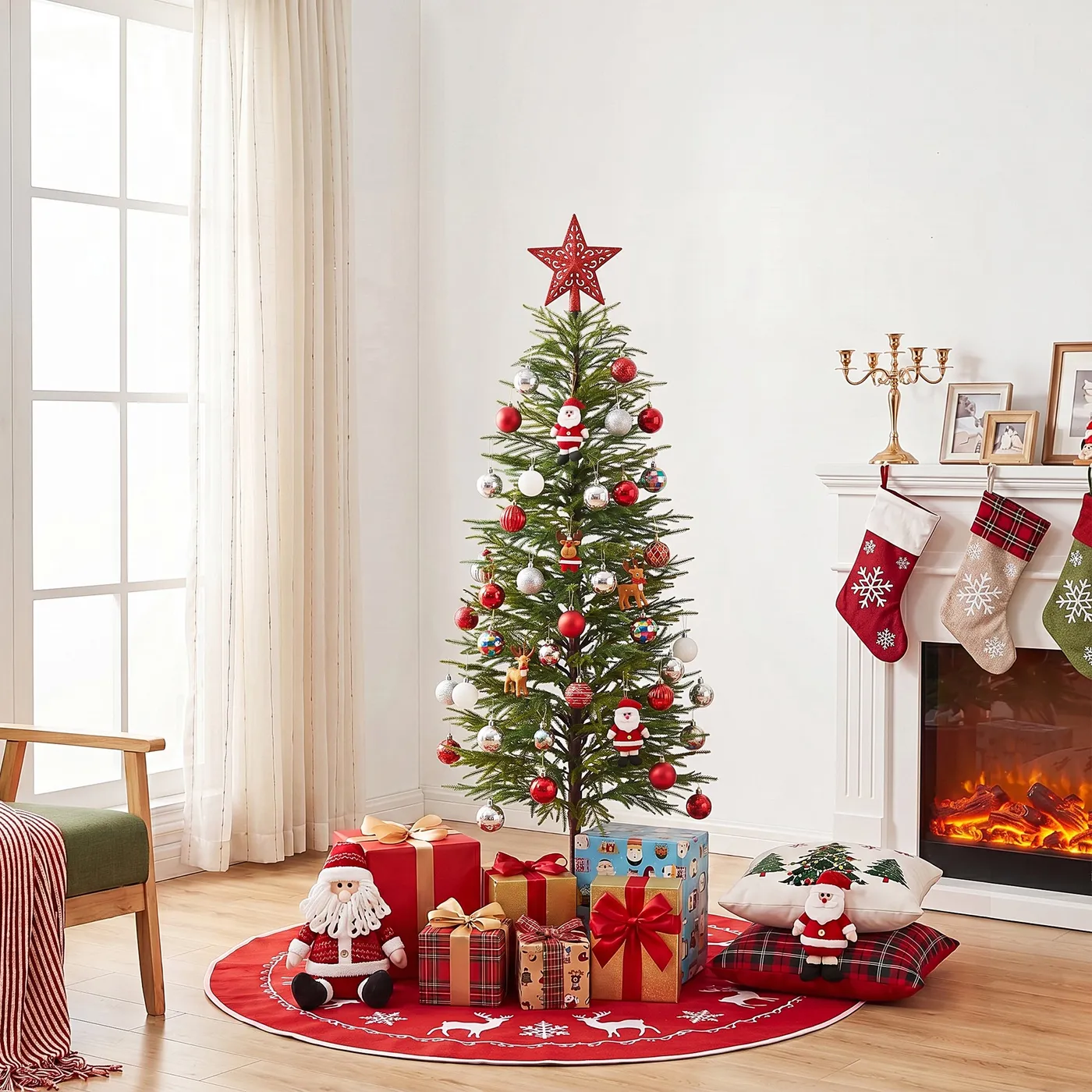
Pencil trees cost less than full ones — expect $60 to $150 for a 6.5-foot unlit version at Walmart or Target, with pre-lit running $120 to $250. The round red skirt with the white reindeer print is a $25–$45 Amazon find, and red and silver shatterproof baubles come in 100-count boxes for around $20. The plush Santa dolls are the one splurge; thrift stores carry them for $5 to $12 year-round.
12. Floor-to-Ceiling Entryway Tree with Gingham Bows
- Measure the entry ceiling and buy a tree that stops 6 inches short — anything taller crowds the staircase sightline.
- String lights from the inside out, wrapping each major branch rather than spiraling the trunk.
- Tie 60 to 80 small red-and-white gingham bows, leaving the tails long.
- Tuck each bow at a branch tip so it faces outward toward the front door.
- Run a matching garland up the stair rail and wire red berries in at eye level.
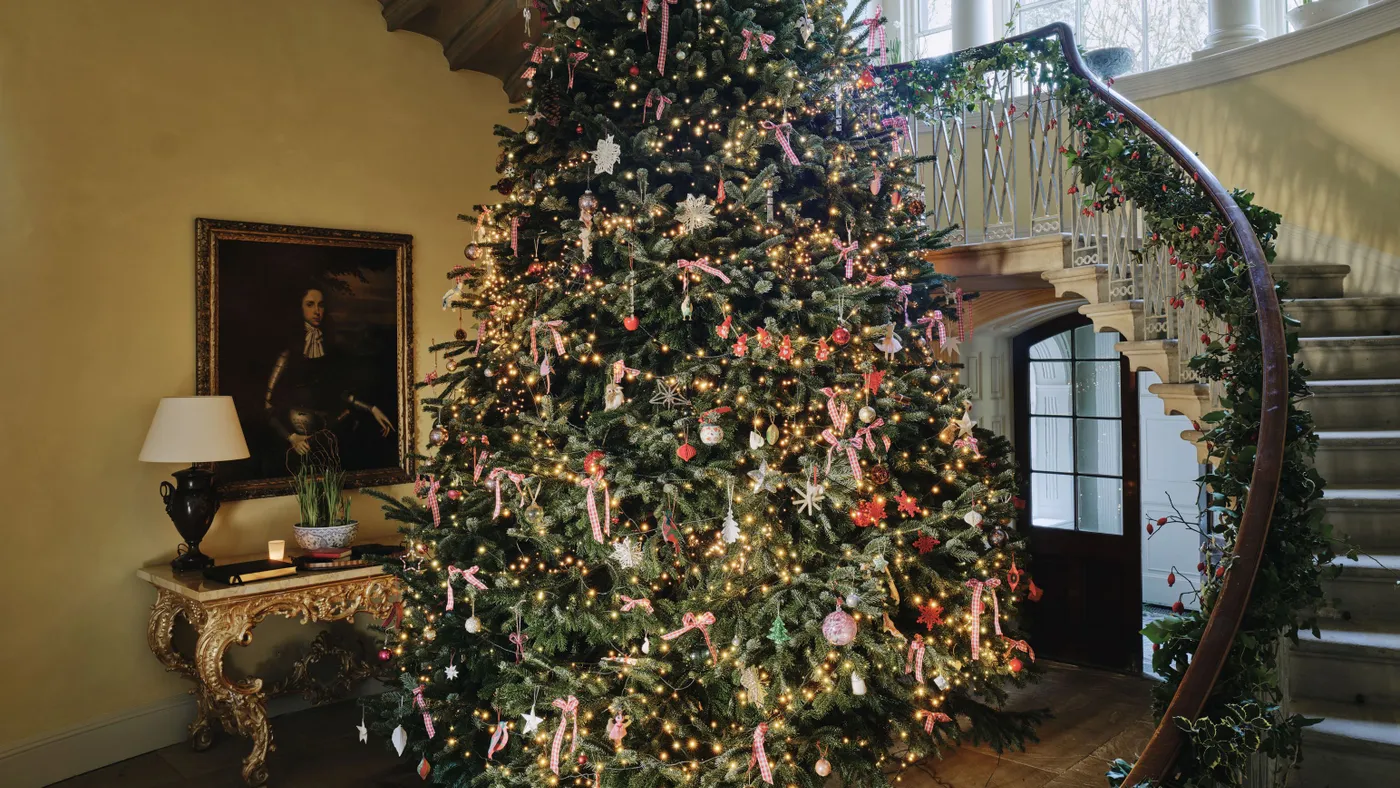
Budget a full weekend and about $60 in ribbon and berries for the staircase alone.
Grand entryway trees are back, and the reason is photographs — a two-story foyer tree is the shot people actually post. Gingham is the detail doing the heavy lifting here. It nods to farmhouse without going full buffalo check, and the small scale keeps a huge tree from feeling heavy. The staying power lives in that restraint: skip oversized bows and you can reuse the same gingham for years as your entry evolves.
13. Red and Gold Beside a White Mantel and Framed Holiday Art
The framed festive art above the mantel is what makes this corner feel designed rather than decorated. Without it you have a tree, a wreath, and a fireplace all doing separate jobs. The artwork gives the red and gold somewhere to land and ties the wall into the same color story as the ornaments. It’s also the cheapest element in the room — a printable in a thrift-store frame, maybe $9 total.
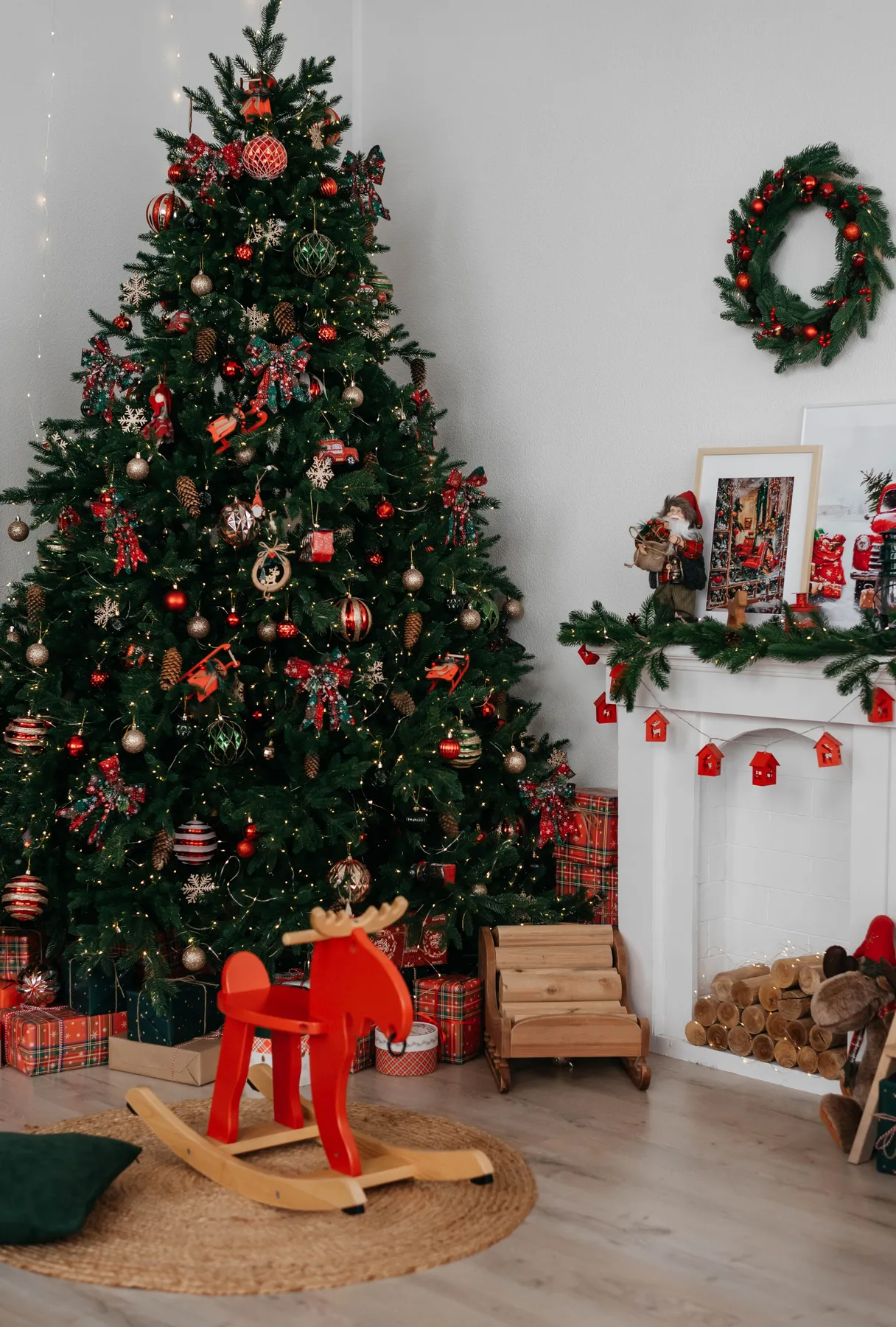
Balance the tree and mantel by weight, not by size. A 7-foot tree needs about 4 feet of garland on the mantel to feel equal, and the arrangement should be tallest in the middle with pieces stepping down 3 to 4 inches on each side. Leave the shelf about 30 percent empty. A fully lined mantel competes with the tree instead of supporting it.
14. Matching Flocked Trees — One Large, One Tabletop
60% snow white flocking + 30% shiny red + 10% green, repeated twice at two different scales. That repetition is the whole trick — your eye reads it as a matched set, not as leftovers. Notice the mantel garland follows the same ratio, which is why the fireplace doesn’t look like a separate room. Swap red for cobalt and the formula still holds. Keep the proportions and you can restyle this every single year.
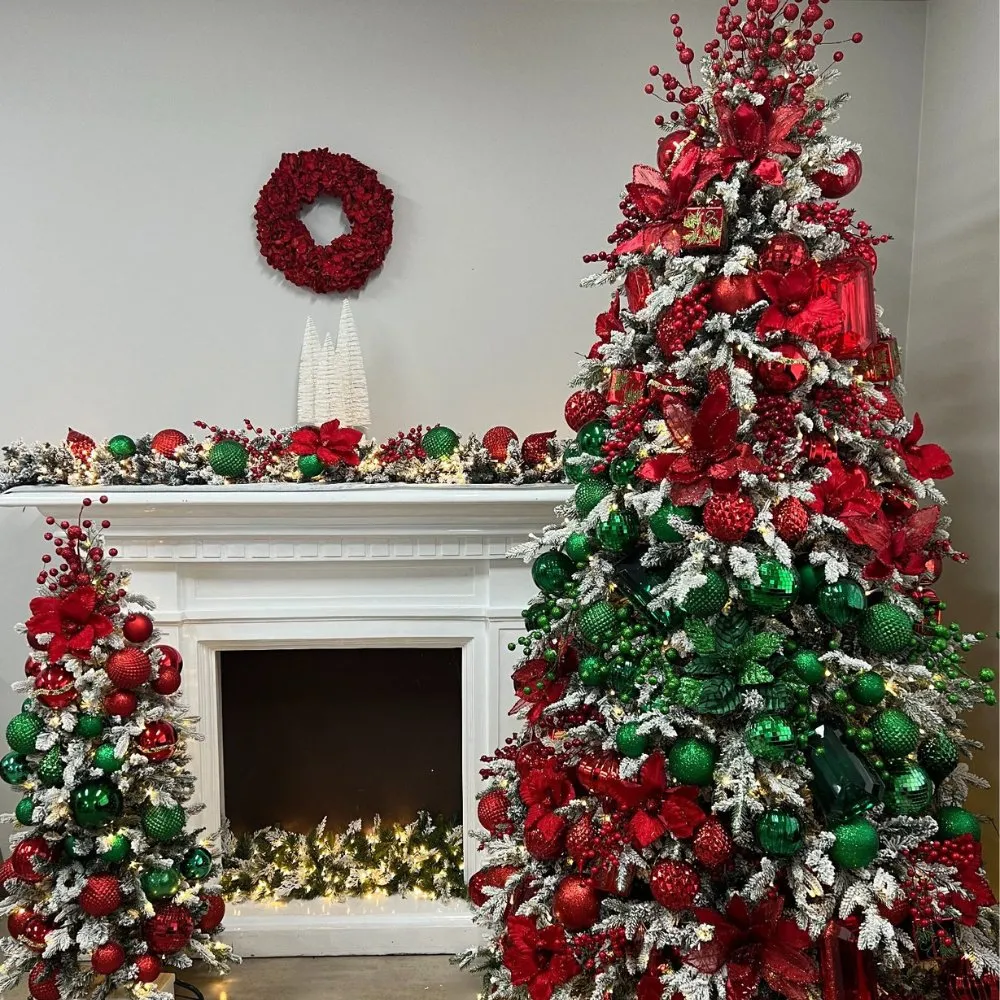
- Large flocked tree (7 ft): $150–$400
- Tabletop flocked tree (3 ft): $25–$60
- Shiny red and green ornaments (150 count): $30–$70
- Poinsettia picks and red berry stems: $25–$60
- Mantel garland plus floral wreath: $60–$160
Total: $290–$750. Budget alternative: buy one box of mixed ornaments and split it between both trees, pick up faux poinsettias at the dollar store for $3 a stem, and build the wreath from a $12 grapevine base plus picks you already own.
15. Flocked Branch Close-Up with a ‘Noël’ Basket Tag
- Paint a small whitewashed basket tag and stencil ‘noël’ in red acrylic.
- Wire the tag to a sturdy inner branch so it hangs flat instead of swinging.
- Add two cotton boll stems and one red berry sprig behind the tag in a fan shape.
- Weave a 12-inch plaid ribbon through the branch above, tails pointing down.
- Finish with a white snowflake cutout tucked just off-center.

Roughly 20 minutes and about $9 per cluster in materials — and it’s the detail guests lean in to photograph.
Flocked trees and rustic texture are a fragile pairing. Cotton bolls crush if they’re packed in a bin, berry stems snap at the wire, and whitewashed tags chip along the edges. Store each cluster in its own paper bag rather than tossing it in with the baubles. And keep flocked branches away from heat vents — warm dry air makes the flocking shed faster than anything else in the room.
16. Large Red Baubles and Shimmering Gold Ribbon
Scale contrast is doing the work. The red spheres are big and matte; the gold ribbon is fine, shiny, and cut into soft loops. Big-and-small, matte-and-shiny, round-and-linear — three contrasts stacked on the same branches. That’s why a tree this traditional doesn’t look dated in a modern living room. And the gold ribbon sits behind the ornaments rather than in front, so it glows without ever competing.
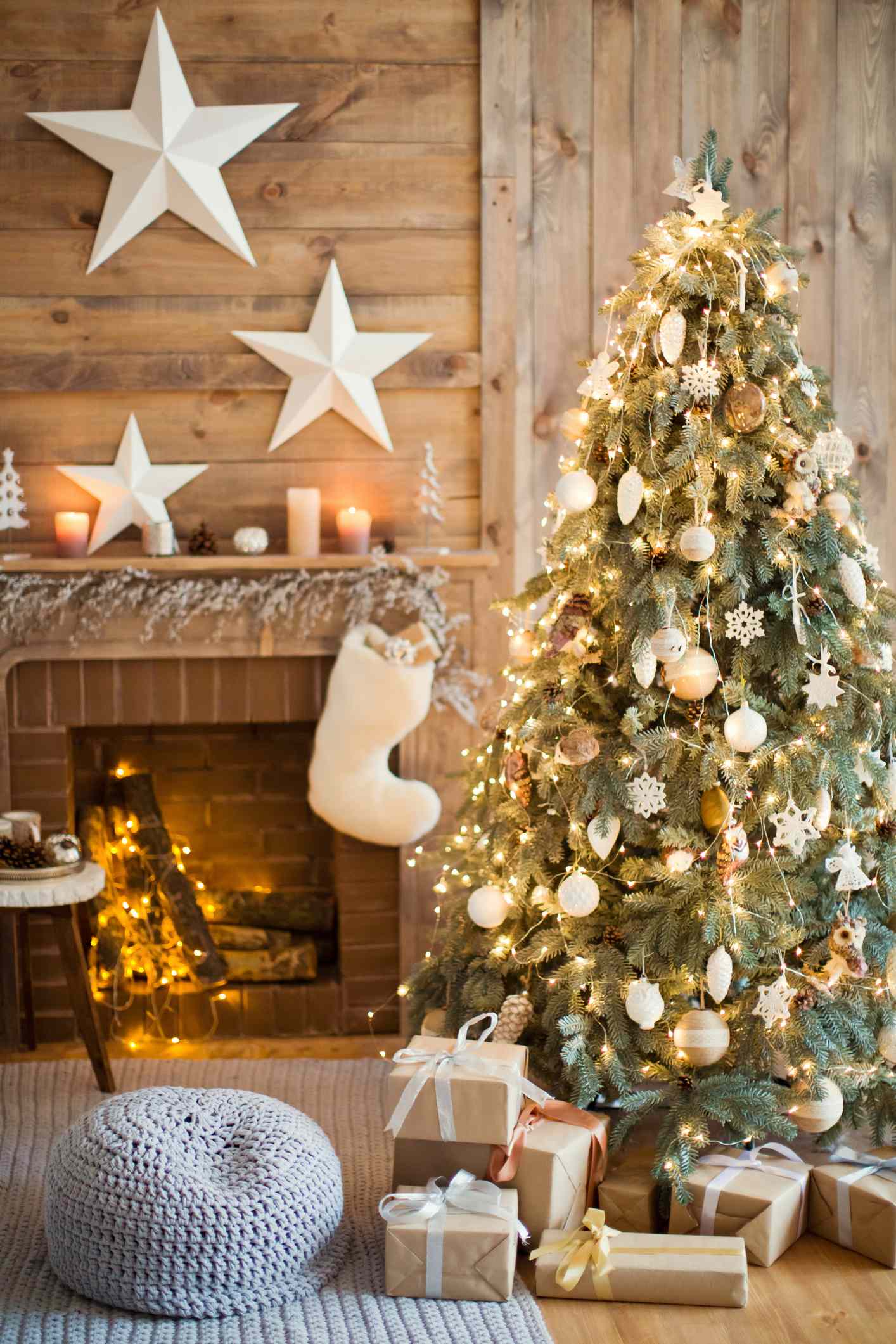
Wire-edged gold ribbon is the cheapest way to fake a luxury tree — a 50-yard roll runs $12 to $20 at Michaels with a coupon, and it fills more visual space than any ornament. Large red shatterproof baubles are $18 to $35 for a 40-count box at Walmart. A full refit of a 7.5-foot tree lands around $60, so this is essentially the warm red palette of Idea #1 without the flocked branches.
17. A Gold Tinsel Tree Loaded with Vintage Glass Ornaments
Vintage glass ornaments have climbed in price three seasons running, and 2026 is the year the metallic tree came back with them. The appeal is honesty — those old baubles are thinner, more reflective, and slightly imperfect in a way modern plastic can’t fake. It also pairs naturally with the retro-eclectic wave that’s been pushing mirrored furniture and abstract sculpture back into living rooms.
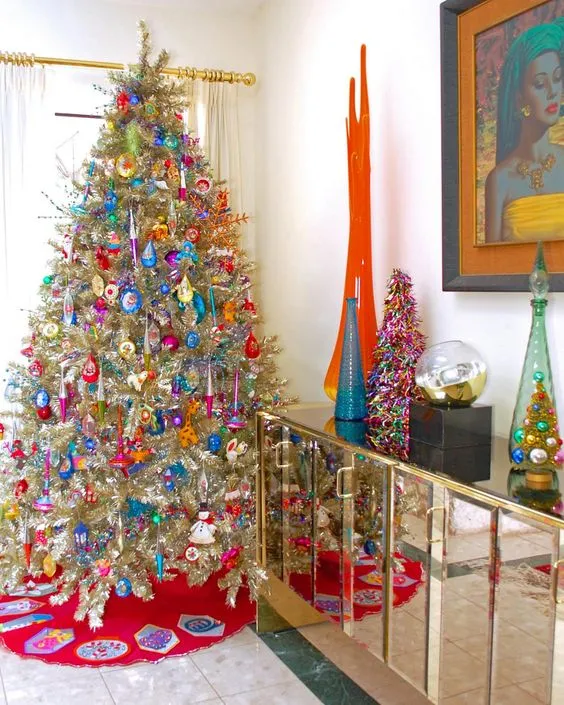
Cluster vintage ornaments by color instead of scattering them. Grouping four or five blues together and four or five pinks together creates deliberate blocks of color that read clearly in photos. Spread them evenly and the tree becomes visual static. Aim for six to eight clusters on a 7-foot metallic tree, and hang the most valuable pieces in the upper third where nothing can knock them.
18. Glossy Red and Silver Baubles Under a Striped Paper Star
This styling is built for smaller rooms and lower light. The deep red curtains and dark background mean the tree only needs 6 to 7 feet to feel generous, and the shallow ornament depth works in a corner nook as narrow as 30 inches. Ceiling height is almost irrelevant here — the paper star is light enough to sit near an 8-foot ceiling without crowding it.
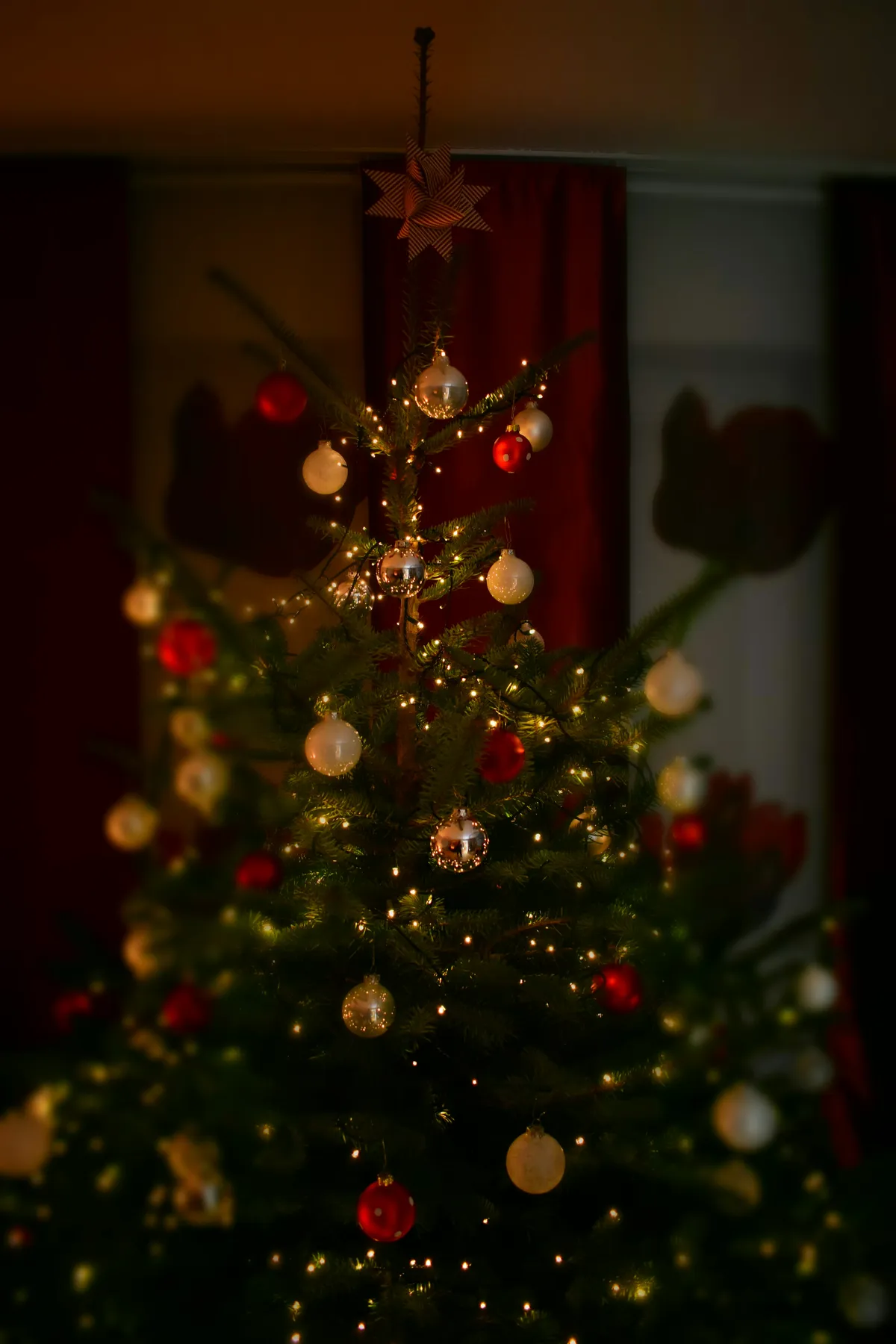
The striped paper star topper is the entire personality of this tree. Everything else is glossy and reflective; the star is matte, printed, and handmade-looking, and that single contrast keeps the whole scene from feeling like a department store display. It costs about $8. Swap it for a metallic star and the tree gets instantly more formal — and considerably less interesting.
19. A Giant Red Bow Topper and Striped Ribbon Garlands
Big ribbon toppers are the first thing to fail. A bow that size needs a wire armature inside or it collapses within a week, and the tails fray every time they brush a branch. Store it in a box with tissue wrapped around the loops, never folded flat. Striped ribbon with a printed pattern also creases permanently, so plan on replacing it every two or three seasons.
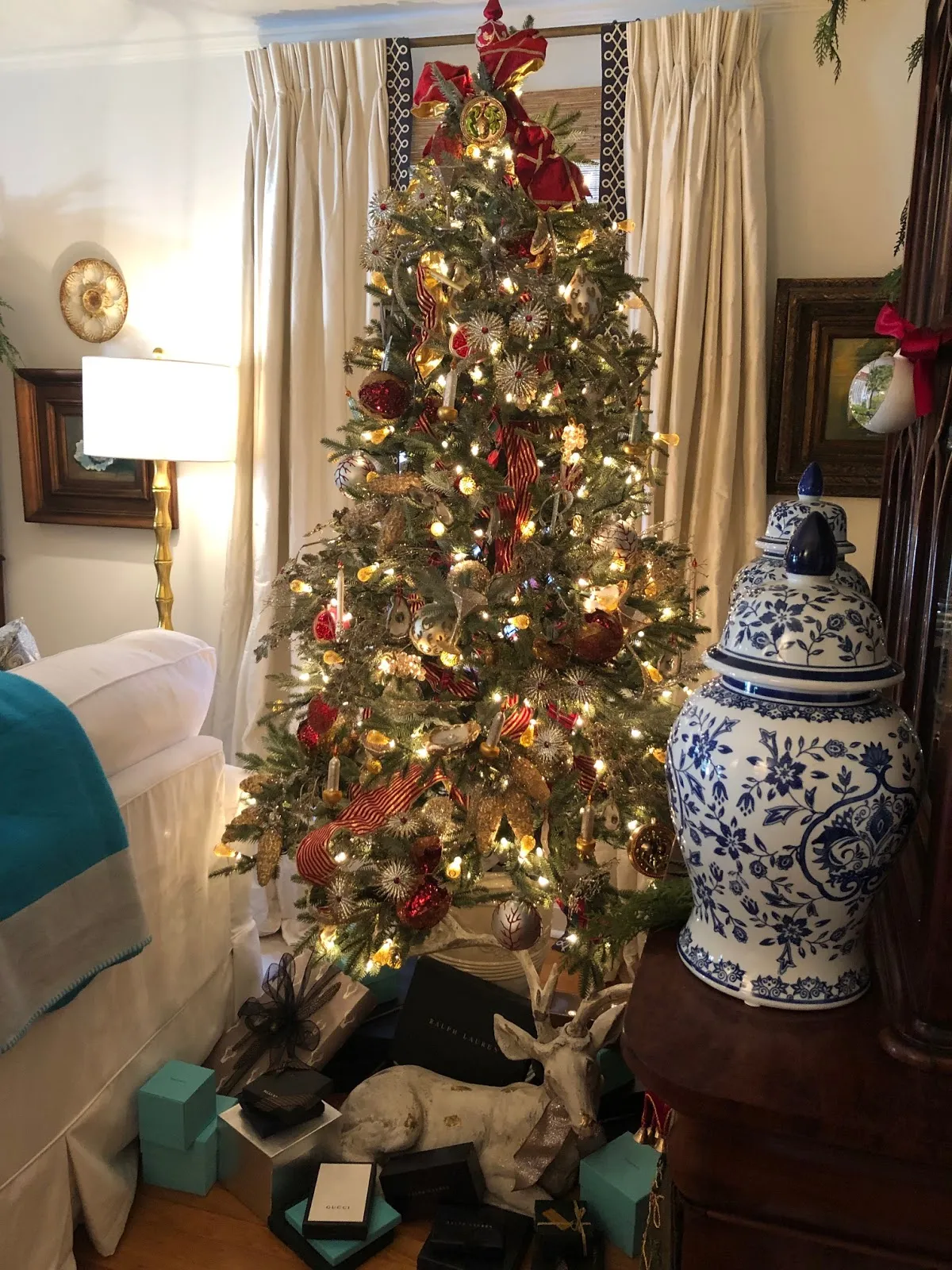
65% forest green + 25% ruby red + 10% gold and white accents. The white deer figurine at the base is doing more than it looks — it introduces a cool neutral that stops the red from going flat, and it’s the only non-red object at floor level. Swap the deer for a gold one and the room warms up. Swap it for a mirror-finish piece and the vignette turns modern on you.
20. Gold and White Ornaments with Beaded Garland
Neutral gold-and-white trees photograph beautifully but need space to breathe. This one works in a living room of at least 14 by 16 feet with 9-foot ceilings, because the faux fur textiles and bead garlands create a soft, wide silhouette rather than a tight one. In a smaller room, keep the palette but drop to a 6.5-foot tree and skip the bead garland entirely — compare with Idea #11 for the compact version of the same idea.
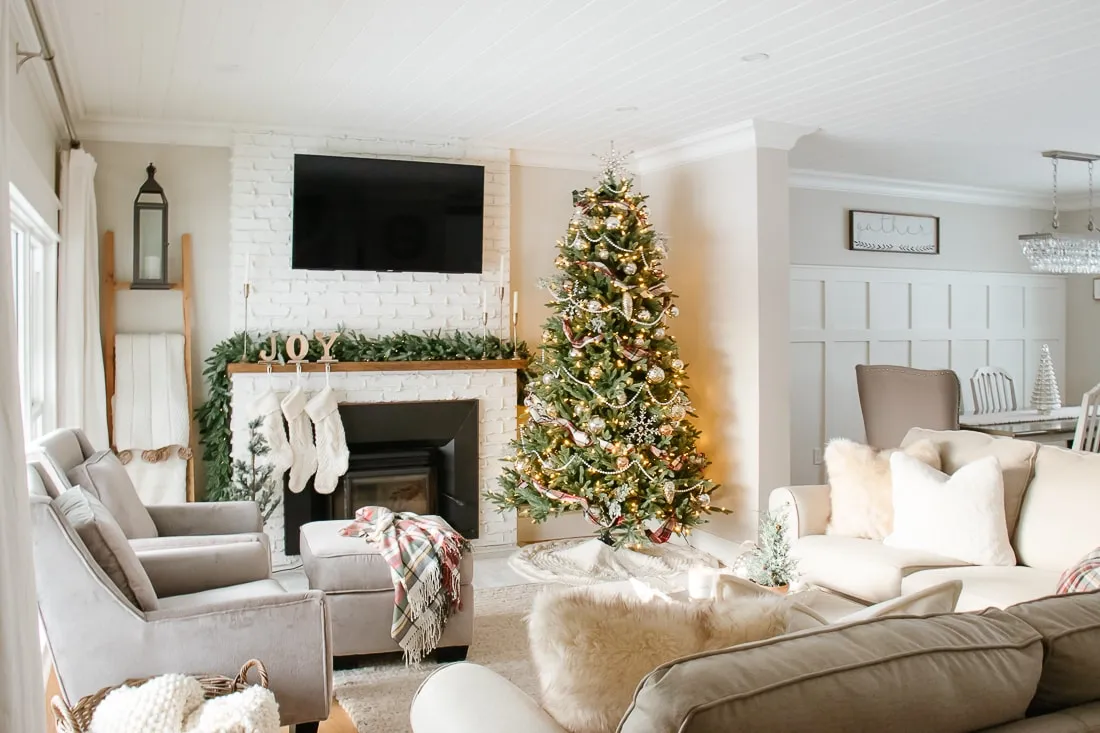
- Check how much daylight the room gets — gold ornaments turn muddy in north-facing gray light.
- Measure the wall behind the tree; bead garland swags need 8 inches of clearance.
- Confirm your sofa and the tree don’t share a walkway — faux fur sheds onto traffic paths.
- Choose your tree skirt color before buying ornaments; cream on cream disappears completely.
21. Turquoise Stair Risers and a Paper Medallion Mantel
- Pre-lit tree (7.5 ft): $180–$400
- Paper fans and medallions (set): $20–$50
- Mantel stockings (four): $40–$90
- Garland for the stair rail: $30–$80
- Turquoise paint for stair risers (quart): $18–$30
- Ornaments and tree topper: $50–$120
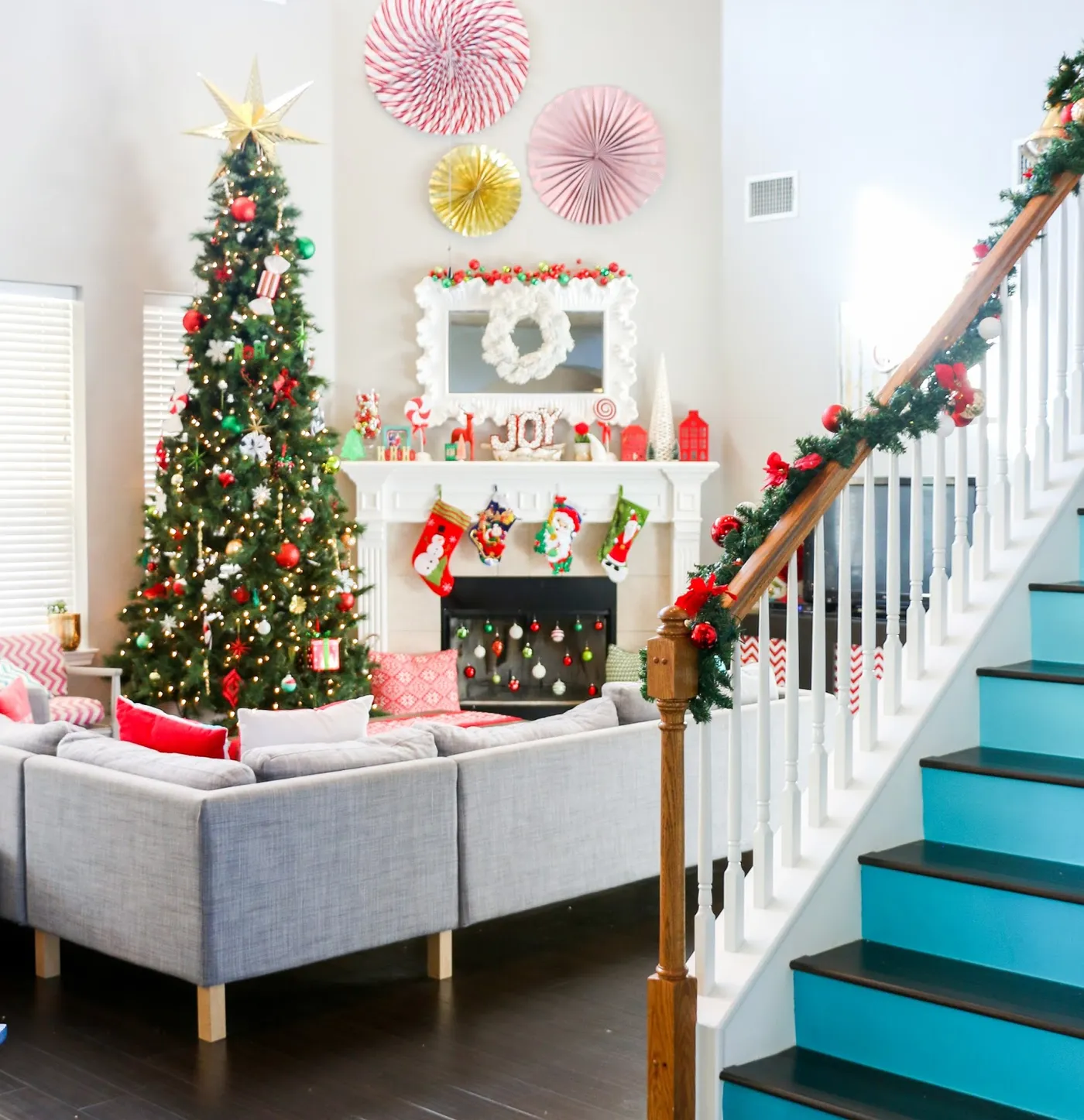
Total: $338–$770. Budget alternative: paint only every other riser for a striped effect with one quart, buy paper medallions flat and fold them yourself for about $10, and grab stockings at the after-Christmas clearance for $6 each.
Pull your garland along the handrail, not around it. Wrapping the rail itself bulks it up and hides the woodwork; laying the garland on top and wiring it every 18 inches keeps the stair profile clean. Let the ends trail 8 to 10 inches past the newel post so the eye follows the curve, and use zip ties in the same color as the railing so nothing reads as clutter.
22. Embroidered Stockings with Striped Ribbon Bows
- Order or embroider the initials before you hang anything — monogramming later means re-pinning the whole row.
- Space stockings 4 to 6 inches apart so the ruffled cuffs don’t overlap.
- Loop a red-and-white striped ribbon bow over each hanger, letting the tails fall behind the stocking.
- Add a small potted evergreen with red berries at each end of the mantel to bookend the row.
- Hang a mirror above so the lit tree reflects back into the room.
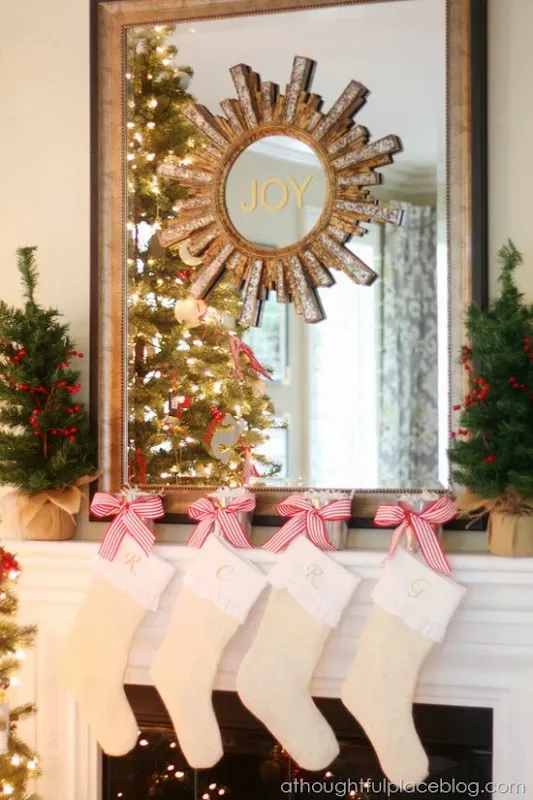
About an hour of setup, plus $10–$18 per stocking for monogramming.
Four stockings need a mantel at least 60 inches wide; five need 72. If yours is shorter, hang three and put the fourth on a staircase newel or a bookshelf hook rather than cramming. The mirror above should be no more than two-thirds the width of the mantel, otherwise the reflection gets busy and the stockings stop reading as the focal point.
23. A Painted Nativity Glass Ball with Burlap Ribbon
It’s the nativity silhouette painted on glass. Without it, this is a plain teal-and-silver ball sitting in pine branches. The painted figure gives the tree a story, and it’s the kind of detail kids point at and ask about — which is the real reason families keep heirloom ornaments for thirty years. Buy one meaningful painted ornament a year instead of a hundred generic ones.

Hand-painted glass ornaments run $12 to $30 each on Etsy, but you can make a version at home for about $4: a clear glass ball, enamel paint, and a printed stencil. Burlap ribbon is $5 a roll at Walmart and covers three or four ornaments. Thrift stores and estate sales are the real hunting ground — vintage painted glass turns up for $2 to $6 if you start looking in October.
24. Bronze, Gold and Cream Satin Bows in Progress
Cut your satin ribbon into 24-inch lengths and tie simple two-loop bows with a 6-inch tail on each side. On a 7-foot tree, plan on 25 to 30 bows, hung at branch tips where they catch light from the nearest bulb. Position each bow so the loops sit above the knot — that’s the difference between a bow that reads as fabric and one that just reads as a knot.

Warm metals plus one soft textile. Bronze and gold sit close enough in temperature that they blend into a single impression, and the cream satin introduces a matte surface that keeps all that shine from looking cheap. The round mirror behind the tree is the sneaky part — it doubles the light sources and gives the tree a backdrop, so it doesn’t float against a blank white wall.
25. Candy Canes and Matte White Baubles Between Two Windows
A tree between two windows is gorgeous at night and difficult in daylight. Backlight blows out red ornaments and turns matte white ones gray, so hang the glossier pieces toward the glass and keep the matte ones on the room-facing side. Flocked branches collect dust in window light — vacuum them with a brush attachment monthly. Also check for drafts, because cold glass dries out flocking fast.
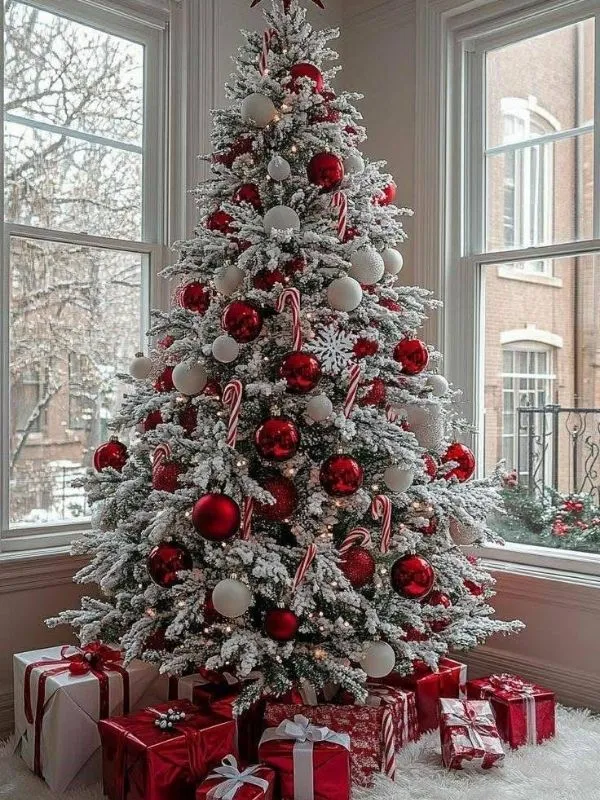
55% snow white flocking + 25% crimson + 15% green foliage + 5% candy stripe. That last five percent is what makes it feel nostalgic instead of generic — candy canes are small, cheap, and instantly legible. Swap them for peppermint swirl picks for a bigger scale, or drop them entirely and this becomes a clean red-and-white tree with a much more modern read.
26. Plum, Ruby and Gold: A Jewel-Tone Glass Bauble Tree
Glass ornaments break, and jewel tones show every chip. Budget for roughly five casualties a season if you have kids or pets. Beaded garlands tangle into knots that take twenty minutes each to undo — store them looped over a hanger, never coiled. Poinsettia picks with glitter shed onto everything below them, so keep a lint roller near the tree and accept that your rug will sparkle until February.
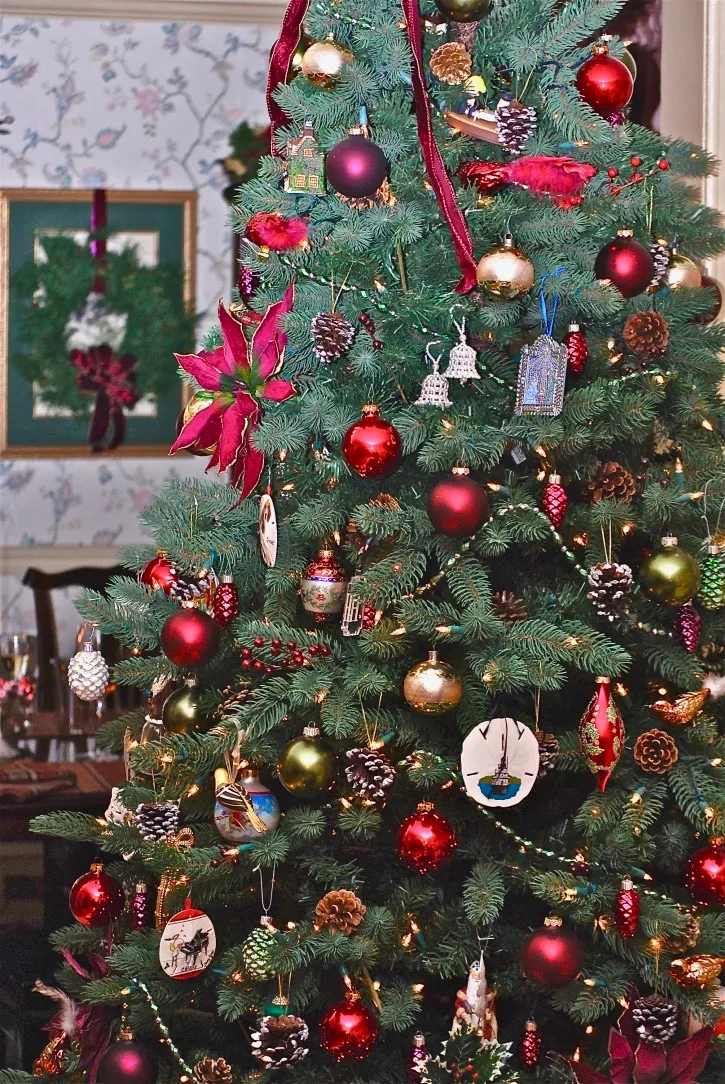
Deep, moody holiday palettes have been gaining for several years, and plum is the 2026 version of that shift. It reads traditional because the shapes are classic — glass spheres, pinecones, velvet — but the color story sits a decade past red-and-gold. It’ll last, because it’s built on heirloom forms. Just don’t mix it with bright primary red; the two reds fight.
27. A Tabletop Tree in a Plaid Bucket, Kid-Height
- Choose a 2 to 3 foot potted evergreen with a root ball if you want to plant it in spring.
- Line a plaid bucket with a plastic bag, set the pot inside, then tuck burlap over the rim.
- Wrap the trunk in a short strand of battery-powered fairy lights.
- Hang six to ten lightweight red ornaments and one plaid bow at the top.
- Set it on the floor rather than a table — kids decorate what they can reach.
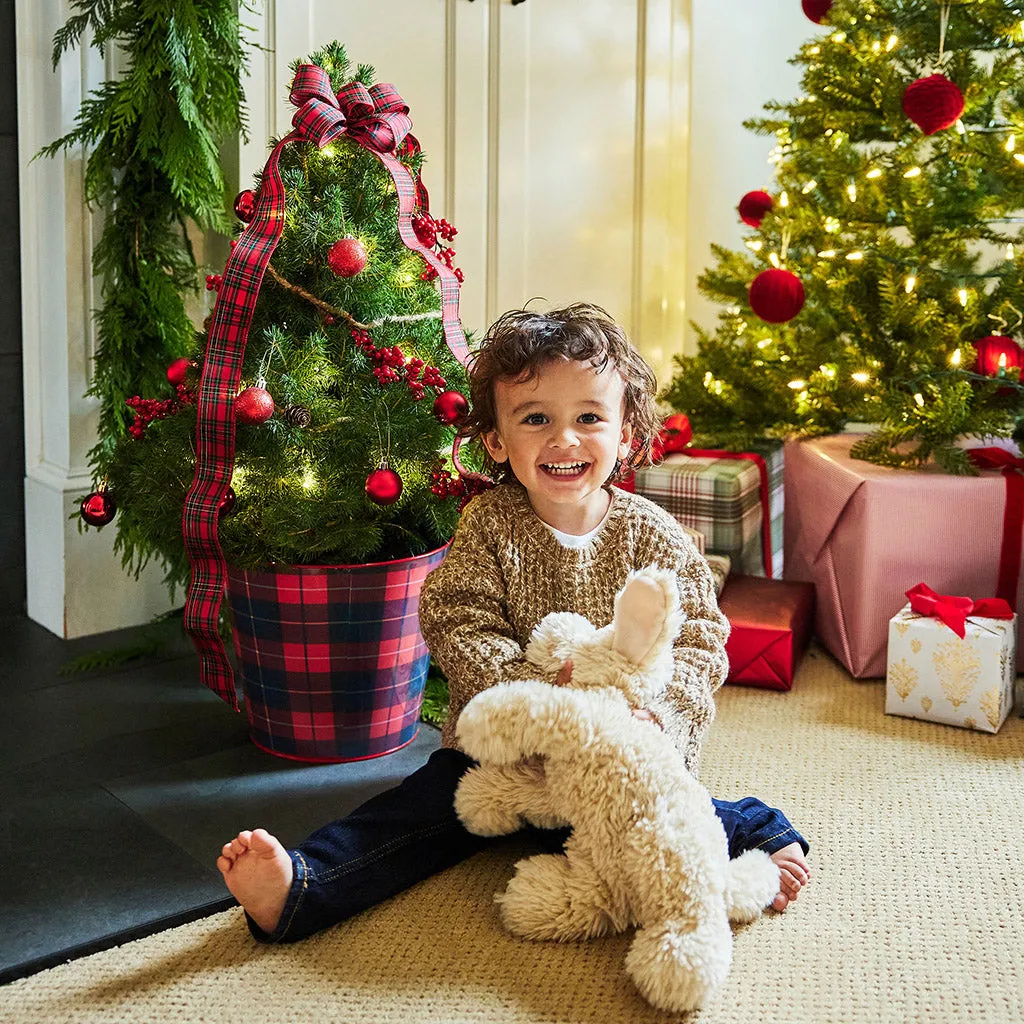
Under 30 minutes and about $45 total, tree included.
A 3-foot potted evergreen is $20 to $35 at a garden center or Trader Joe’s in early December. The plaid bucket runs $8 at Target, or repurpose a paint pail with a $6 ribbon wrap. Lightweight red ornaments from a thrift store cost $2 to $4 a bag, and battery fairy lights are $6 to $10. Total lands under $50 — and if you keep it watered all winter, it goes in the ground in April and you do this again for free.
28. Pheasant, Owl and Acorn Ornaments with Gold Fern Picks
Woodland ornaments are small and detailed, which means they need a close viewing distance. Keep this tree in a den, hallway, or reading nook where people sit within 6 feet of it — from 12 feet across a great room, a pheasant just reads as a brown blob. A 6 to 7 foot tree is ideal here. Anything bigger swallows the detail, and you’d be better off with the oversized baubles in Idea #16.
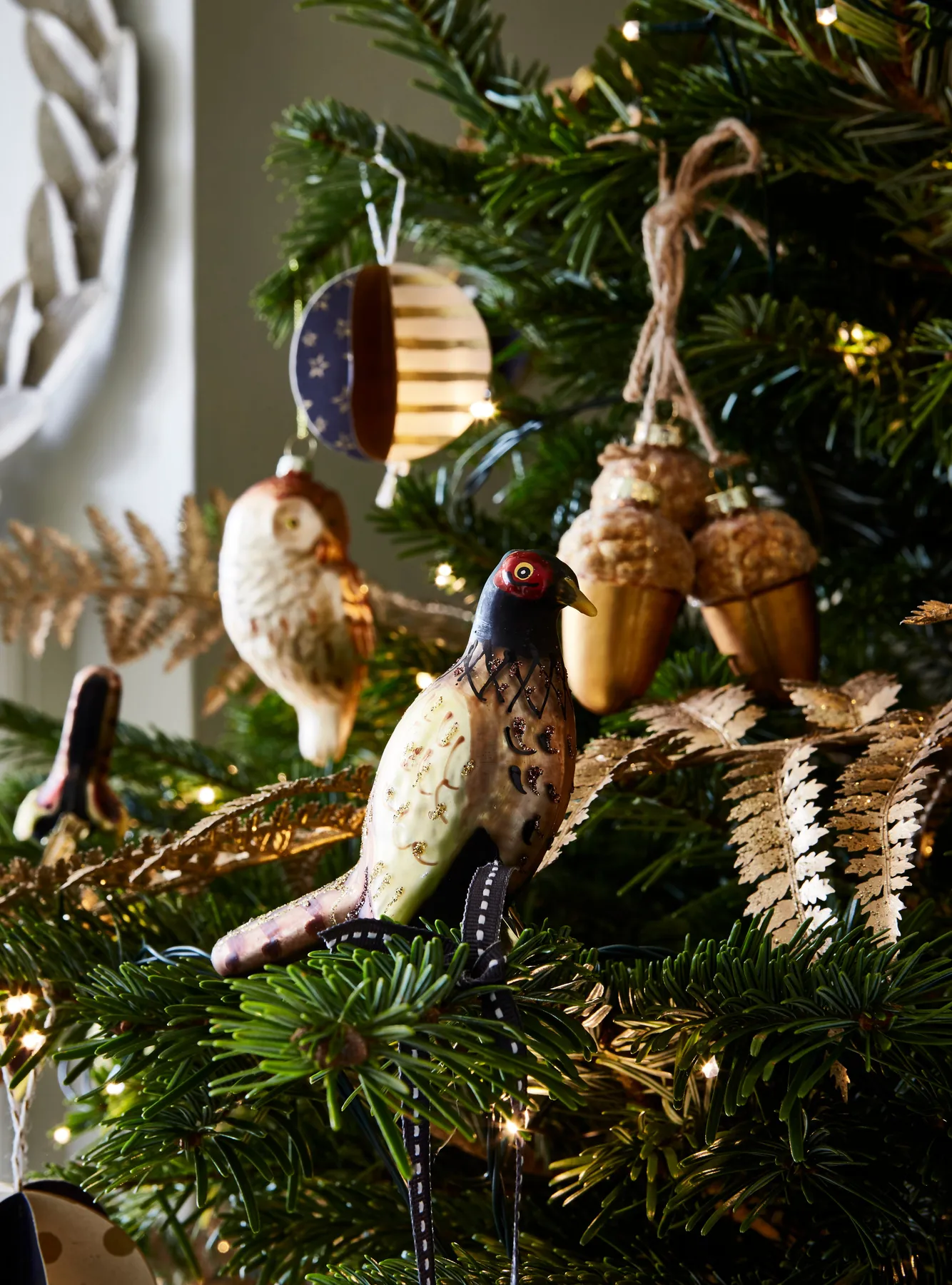
- Decide on your metal tone first — gold fern picks clash badly with silver beaded garland.
- Count your bird and animal ornaments; you want 6 to 10 to repeat the theme without building a zoo.
- Check that gold picks have wire stems, not plastic — plastic won’t hold an angle.
- Use warm-white lights only; cool white kills bronze and cream tones.
29. Wood Plank Walls, Stacked Firewood and a Tall Tree
Texture stacking. Horizontal wood planks, rough stone, stacked firewood, a nubby rug, and a beige slipcover — five surfaces, none of them shiny. Because nothing competes for reflection, the tree becomes the only high-contrast object in the room and your eye goes straight to it. The plaid throws connect the sofa to the season without touching the tree, which is how you decorate a rustic room without sliding into cabin cliché.
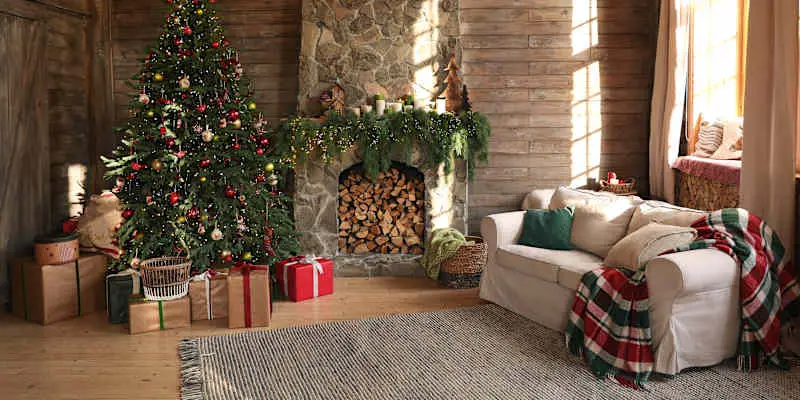
Wood walls and open firewood storage look incredible and demand real upkeep. Firewood brings in insects; keep it stacked outdoors at least 24 hours before moving it inside, and never store it directly against a wall. Horizontal planks collect dust in every groove, and a working stone fireplace means ash settles on everything within 6 feet. Plan on a monthly deep clean from November through January.
30. Oversized Red-and-Green Plaid Ribbon Garlands
- Green tree (7.5 ft, unlit): $100–$300
- Wired plaid ribbon (three rolls): $36–$75
- Round glass ornaments (60 count): $30–$70
- Warm white string lights (300 count): $20–$45
- Tree skirt and gift wrap: $30–$70
Total: $216–$560. Budget alternative: buy plaid ribbon by the spool at a fabric store and cut your own loops for $12 total, and use shatterproof ornaments from the dollar store — from 10 feet away, nobody can tell glass from plastic.
The ribbon width is the thing. Those plaid loops are three to four inches wide, and a narrower ribbon would make the same tree look fussy. Wide ribbon shows the pattern clearly from across the room and covers gaps between branches, which is why this tree gets away with fewer ornaments. If you change one thing about your tree next year, change your ribbon width.
31. Buffalo Check, Tartan and Snowflake Pillows by the Tree
Mix plaid scales deliberately: one large buffalo check, one medium tartan, one small snowflake print. Three patterns work when their scales differ by at least 50 percent; three patterns at the same scale turn into visual noise. Keep the mix to two colors plus white across all three pillows, and make sure at least one is solid — that’s the resting place your eye needs.
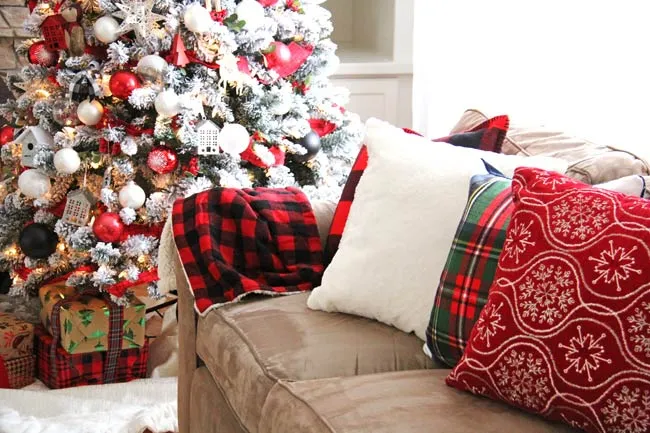
40% cream and white (faux fur cushion, flocked tree, wrapped gifts) + 35% red and black (buffalo check throw, snowflake pillow) + 25% green tartan. Green is the smallest share on purpose — it reads as a supporting note rather than a competing theme. To flip the mood entirely, make the tartan the dominant 40 percent and push red down to an accent color.
Your Tree, Your Nostalgia, Your December
Traditional doesn’t mean boring — it means you’re working with shapes and colors that have earned their place over generations, and then bending them to fit your actual living room. Pick one idea here, steal the palette from a second, and let the third wait until next year. That’s how a tree starts to feel like yours instead of like a catalog page.
📌 Pin your favorite version now so you’re not re-scrolling Pinterest at 11 p.m. on December 3rd with a half-decorated tree in the corner.