Somewhere between the third Pinterest board and the fourth scroll session, you notice the tree looks unfinished — and it isn’t the ornaments. It’s the base. A quilted tree skirt is the one holiday textile that quietly holds an entire corner together, and 2026 is the year it stopped being an afterthought.
We spent serious time browsing Etsy, Pottery Barn, and Target to bring you only what’s worth your attention this year. Every idea below maps to a real photo from a real home, with prices running from $28 to $450.
Inside you’ll find 30 curated ideas spanning traditional patchwork, rustic farmhouse, vintage heirloom, and modern minimal styles — with budget and luxury versions compared side by side, plus shoppable links for every single one. And stay until the end — we break down the most common mistakes that can ruin these looks.
Patchwork quilting had a huge revival last year, and Pinterest searches for quilted tree skirts are climbing again heading into 2026 as people lean toward heirloom pieces they’ll actually reuse for decades. 📌 Save this to Pinterest for later — you’ll want to revisit these ideas.
1. Red and White Geometric Quilt Skirt Under a Classic Tree
Two colors, one geometry, zero visual clutter — that’s the whole trick here. The red-and-white diamond quilting reads as pattern without competing with the ornaments, because the palette never expands beyond crimson, white, and the green of the pine. The quilting itself does quiet work too: those stitch lines catch ambient holiday light and give an otherwise flat cotton surface a soft, dimensional shadow.
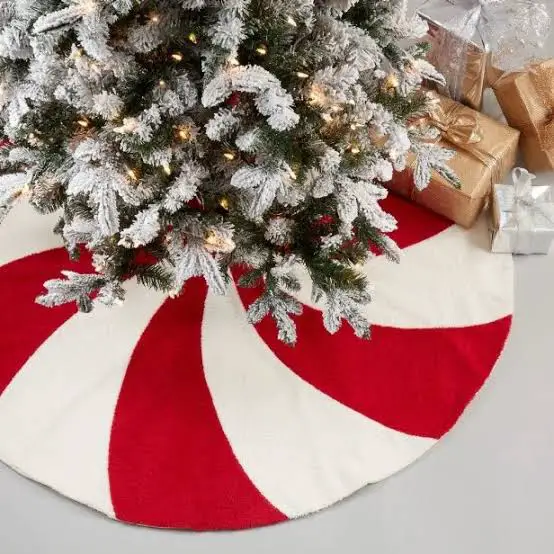
You can build this at home for roughly $35. Two yards of a red-and-white geometric print from Walmart or Joann runs about $16, a crib-size cotton batting is $10, and the rest is thread and an afternoon. If sewing isn’t your thing, Facebook Marketplace and estate sales are goldmines for vintage quilt tops in the $15–$40 range — cut a center circle, bind the edge, and you’re done.
2. Folded Quilted Skirt with Rose Prints and Striped Piecing
Here’s a rule worth stealing from quilters: keep your two fabrics at different scales. A small repeating stripe on the outside and a larger floral on the lining gives the eye a clear hierarchy — if both prints sit at the same density, the skirt turns into visual static from across the room. Aim for roughly a 1:3 scale difference, and pull your binding fabric from the darker of the two.
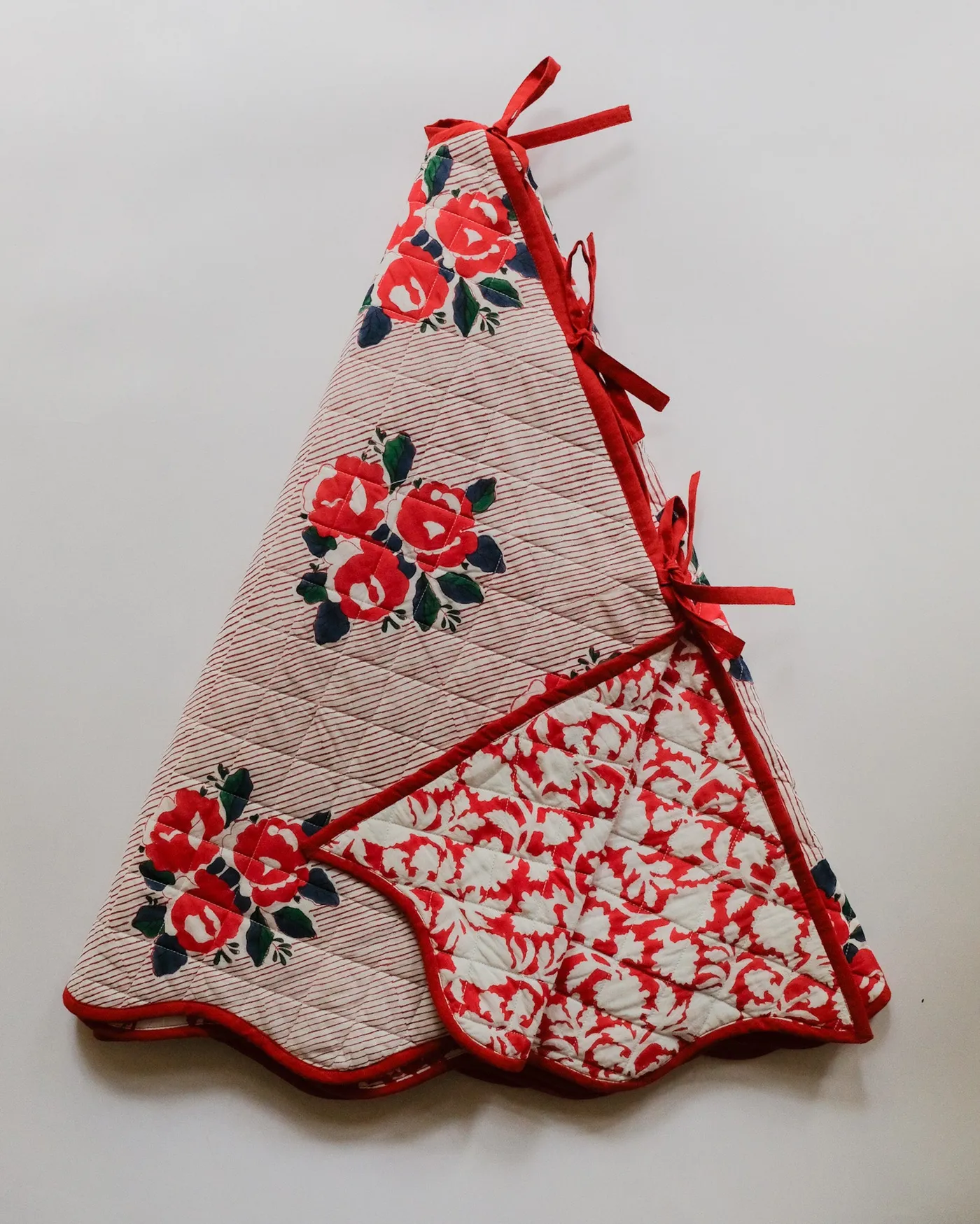
Take away the solid red binding and the matching ribbon ties, and this skirt loses its frame. The stripe-and-rose print is charming on its own, but it’s the uninterrupted band of red running the entire circumference that keeps the pattern from bleeding into the wood floor. Solid binding is the cheapest, most underrated upgrade in home sewing — a few dollars of fabric that reads as custom.
3. Grey Herringbone and Red Plaid Pieced Tree Skirt
The formula is roughly 50% grey herringbone, 35% red plaid, and 15% everything else — the white wire gift frames, the dark wood, the pine. What makes it work is that the grey does the calming and the plaid does the celebrating. Swap the herringbone for oatmeal linen and the plaid for a forest-green check, and you get the same balance with a quieter, more modern feel.
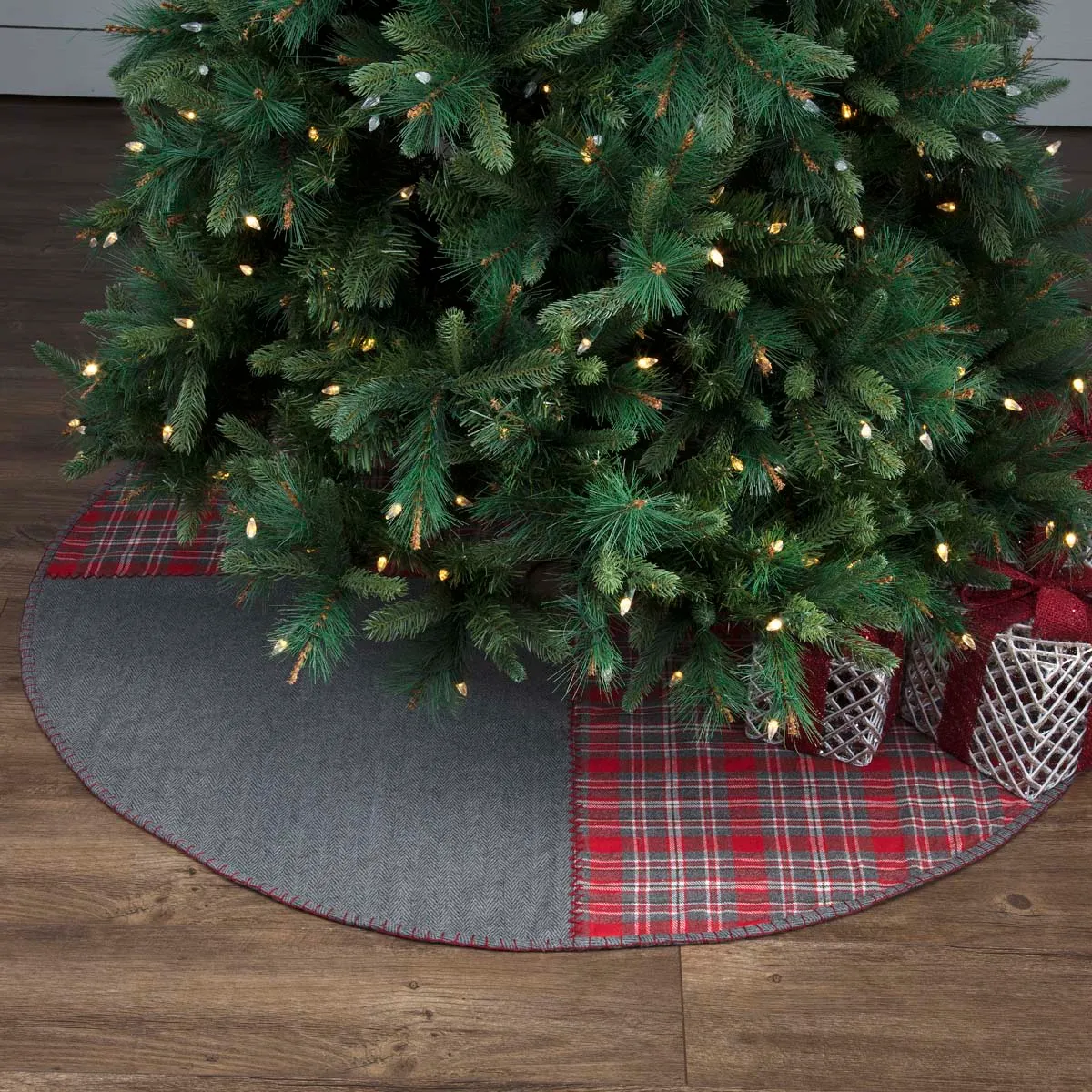
Be honest about your room size. Two strong patterns in alternating wedges look fantastic in a photo, but from across a small living room they can read as noise. If your tree sits in a tight corner, use the herringbone for eight panels and the plaid for four. And match your fabric weights — a heavy wool plaid next to a thin cotton herringbone will make the skirt hang crooked no matter how carefully you piece it.
4. Patchwork Quilted Skirt Finished with a Scalloped Edge
The scallop is what separates this from a standard round skirt, and it’s genuinely doable in a weekend.
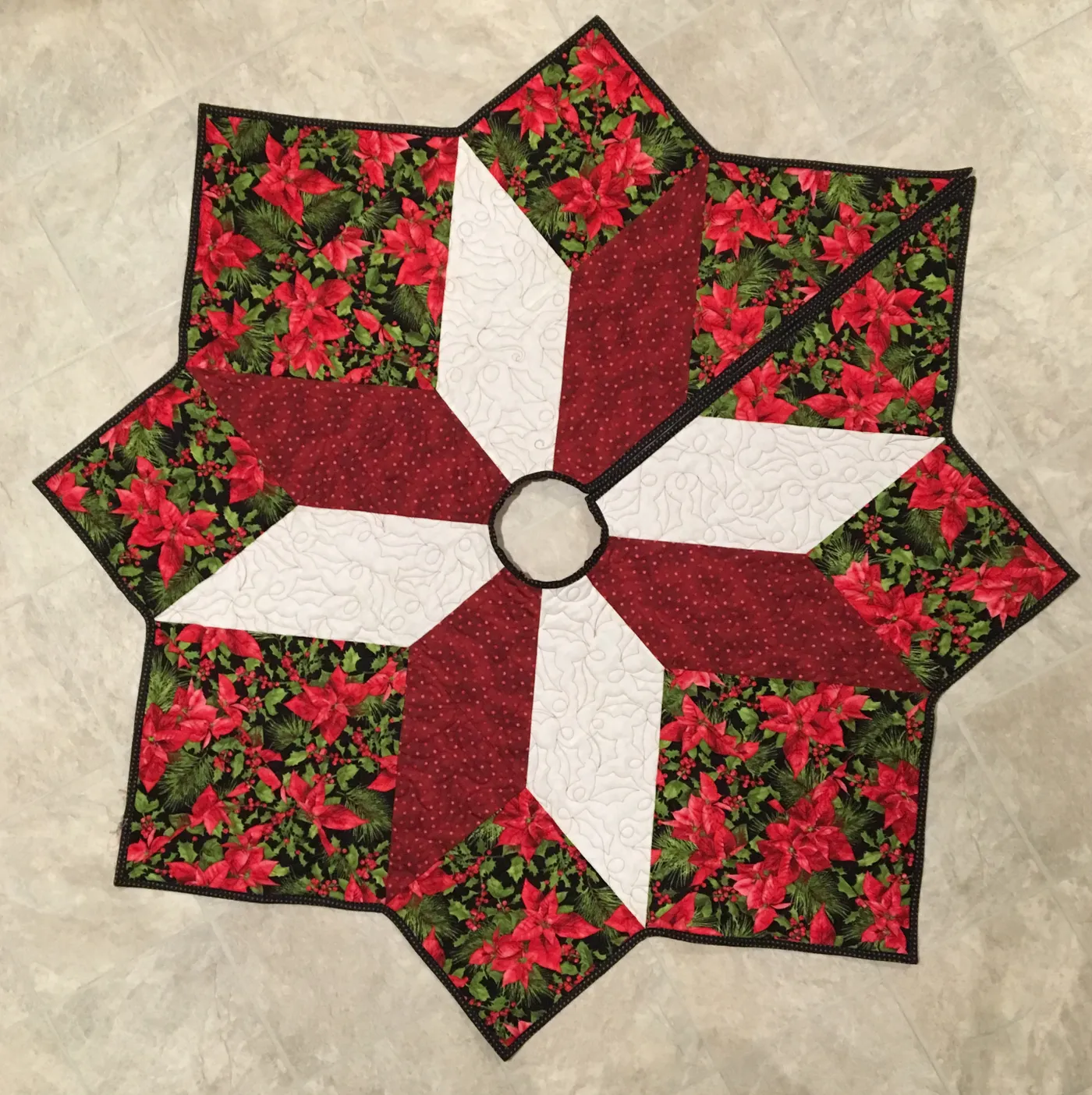
- Trace a dinner plate onto cardstock to build a repeating scallop template — aim for 14 to 18 bumps around a 48-inch circle.
- Cut two scalloped fabric layers plus a same-shape lining.
- Sew right sides together, leaving a six-inch gap for turning.
- Clip the curves every half inch so the fabric doesn’t pucker.
- Turn, press, and hand-stitch the gap closed with a ladder stitch.
Cost: about $45 in fabric and thread. Time: four to five hours.
Scalloped edges are quietly everywhere in 2026 — they’ve migrated from heirloom quilts to lampshades, table linens, and now tree skirts. It’s part of a broader shift back toward hand-finished details after a decade of clean modern edges, and it’s the kind of trim that keeps getting rediscovered rather than dated.
5. Log Cabin and Star Quilt Skirt in Red Velvet
- Velvet and cotton print fabric (3–4 yd): $60–$140
- Wool batting and backing: $20–$35
- Thread, binding, and ties: $12–$20
- Custom-finished version on Etsy: $95–$180
- Total: $95–$200 handmade, or $95–$180 to buy
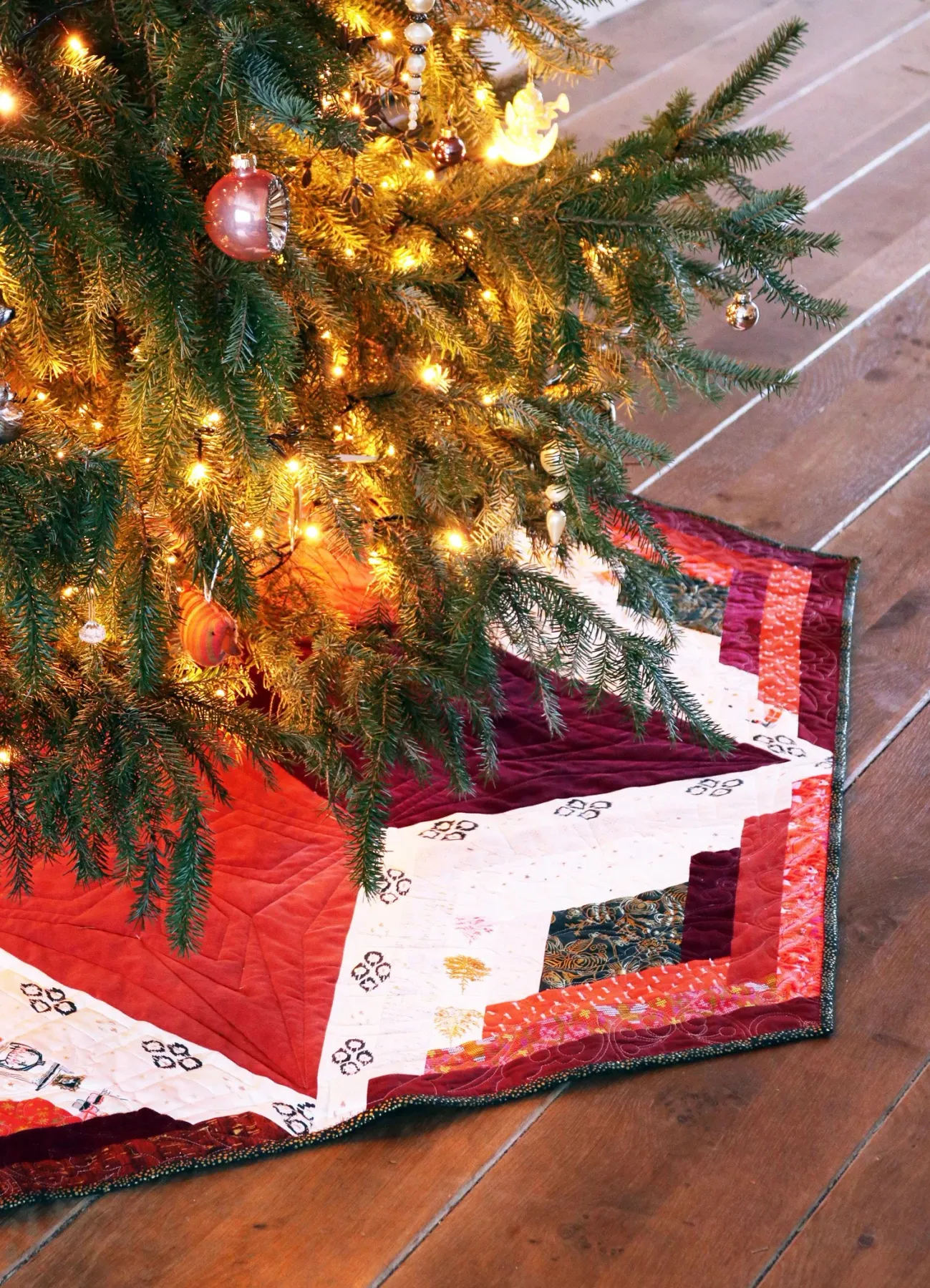
Budget alternative: skip the velvet — it’s the priciest line item — and use brushed cotton in burgundy instead. Saves about $50 and reads nearly identical under warm tree lights.
This log cabin layout wants a 48- to 52-inch finished diameter, which suits trees up to about seven and a half feet tall in rooms of 150 square feet or more. In a tighter space — say a 10×10 bedroom corner — a 36-inch version does the same job without swallowing the floor. If your room runs small, the concentric striped skirt in Idea #30 gives you the same festive punch at a smaller footprint.
Velvet behaves differently than quilting cotton under a needle. Use a low-loft wool batting rather than polyester, and keep your quilting lines no more than three inches apart — anything wider and the velvet sags between stitch rows, which is the exact opposite of what you want. A walking foot and a 90/14 needle will save you a lot of swearing.
6. Multi-Point Star Quilt Skirt with Holiday Print Fabrics
Radial symmetry is doing something clever here. Because the star’s points radiate outward from the trunk, your eye gets pulled away from the base and up into the tree — which makes even a modest six-foot fir feel rooted and deliberate. The white dotted border is the second quiet win: it’s a hard visual stop, so busy ornament prints never spill into the grain of the floor.
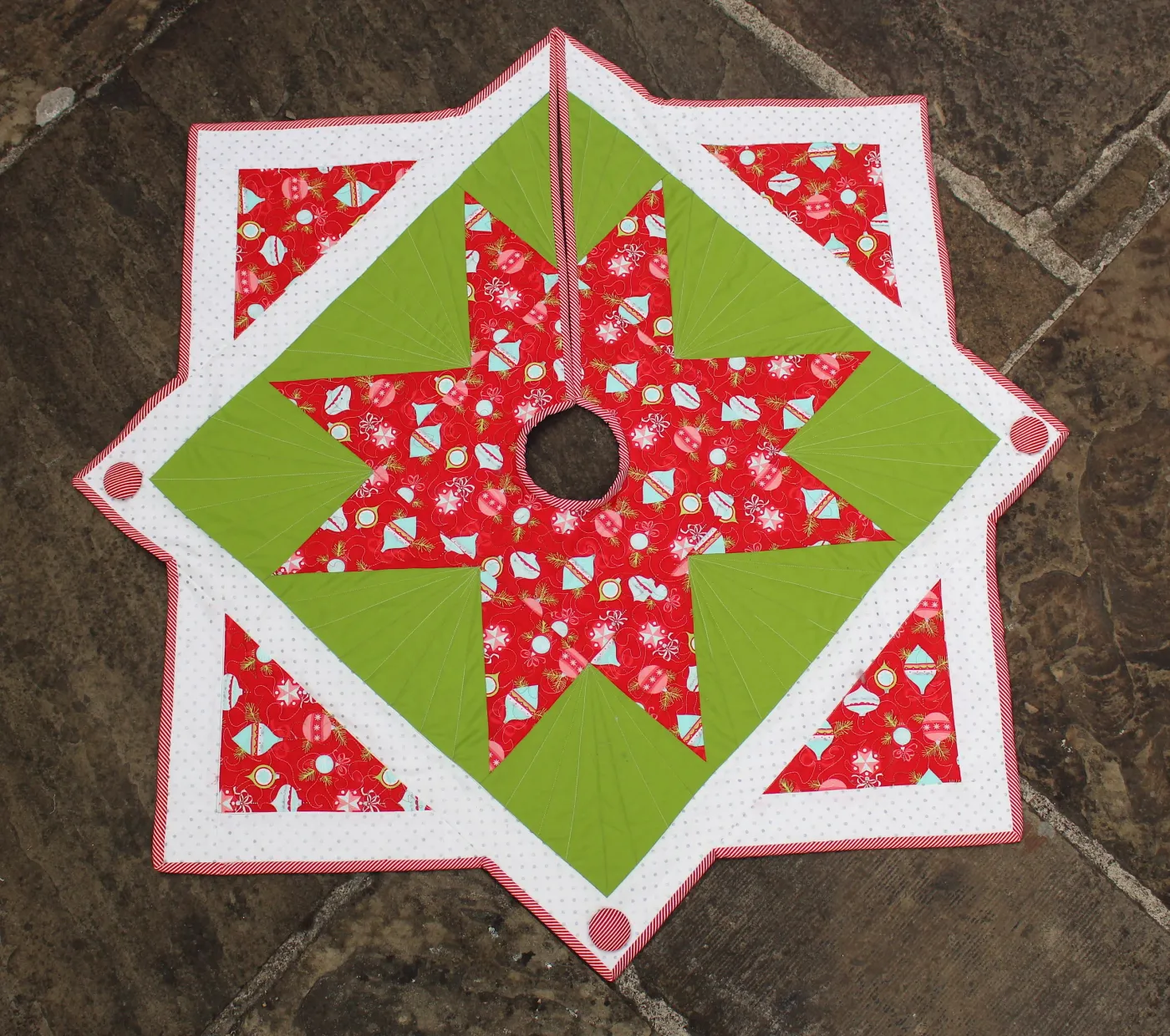
Precut fabric bundles are your shortcut, and this is basically the budget version of Idea #5. A holiday-themed layer cake (42 squares) runs $25–$35 at quilt shops and Joann, already color-coordinated, so you’re just piecing. Add a twin-size batting and a backing yard for about $20 more. Thrift stores turn up vintage Christmas cotton by the bag for $5, and mixing those prints deliberately is how the best handmade skirts get their character.
7. Dark Brown Faux Fur Skirt for a Copper and Bronze Tree
Faux fur is the low-effort, high-impact option — no piecing, no batting, no binding. Upkeep is mostly a good shake and a pass with an upholstery attachment on low every couple of weeks; a full wash is once a season at most, and only if it’s spot-cleanable. Expect pet hair to find it instantly, and expect some shedding the first year. If that sounds like too much, brushed fleece in espresso brown gives you most of the look with none of the fluff management.
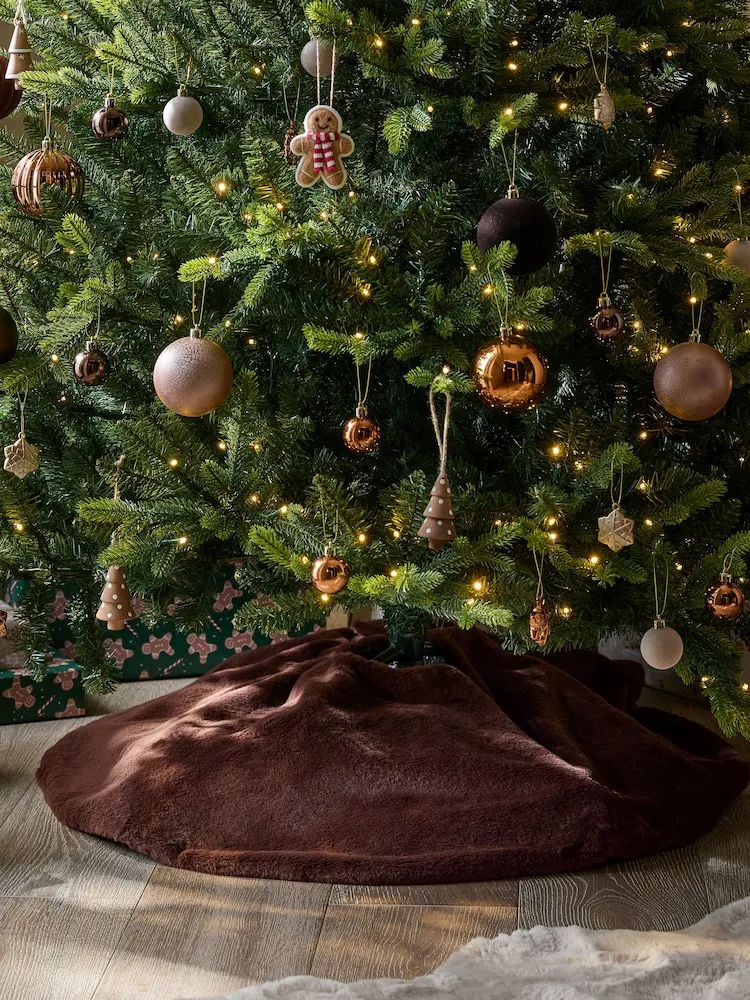
What makes this skirt work isn’t the texture — it’s the color. A white or cream skirt under a green tree is the default, and it’s a bright, cool anchor. Dark brown does the opposite: it sinks the base into shadow so the warm lights and bronze ornaments feel like they’re floating. Remove the brown and you lose the whole moody, cabin-at-dusk quality of the tree.
8. Octagonal Quilt Skirt with Snowflake Blocks and Wood Buttons
- Measure your tree stand’s widest point — the octagon’s center opening needs to clear it by at least two inches.
- Count your panels before you cut; an octagon means eight equal wedges, and coming up one short is a bad evening.
- Decide where the wooden buttons go early, and reinforce each spot with fusible interfacing.
- Check that your light blue background fabric doesn’t fight your wall color.
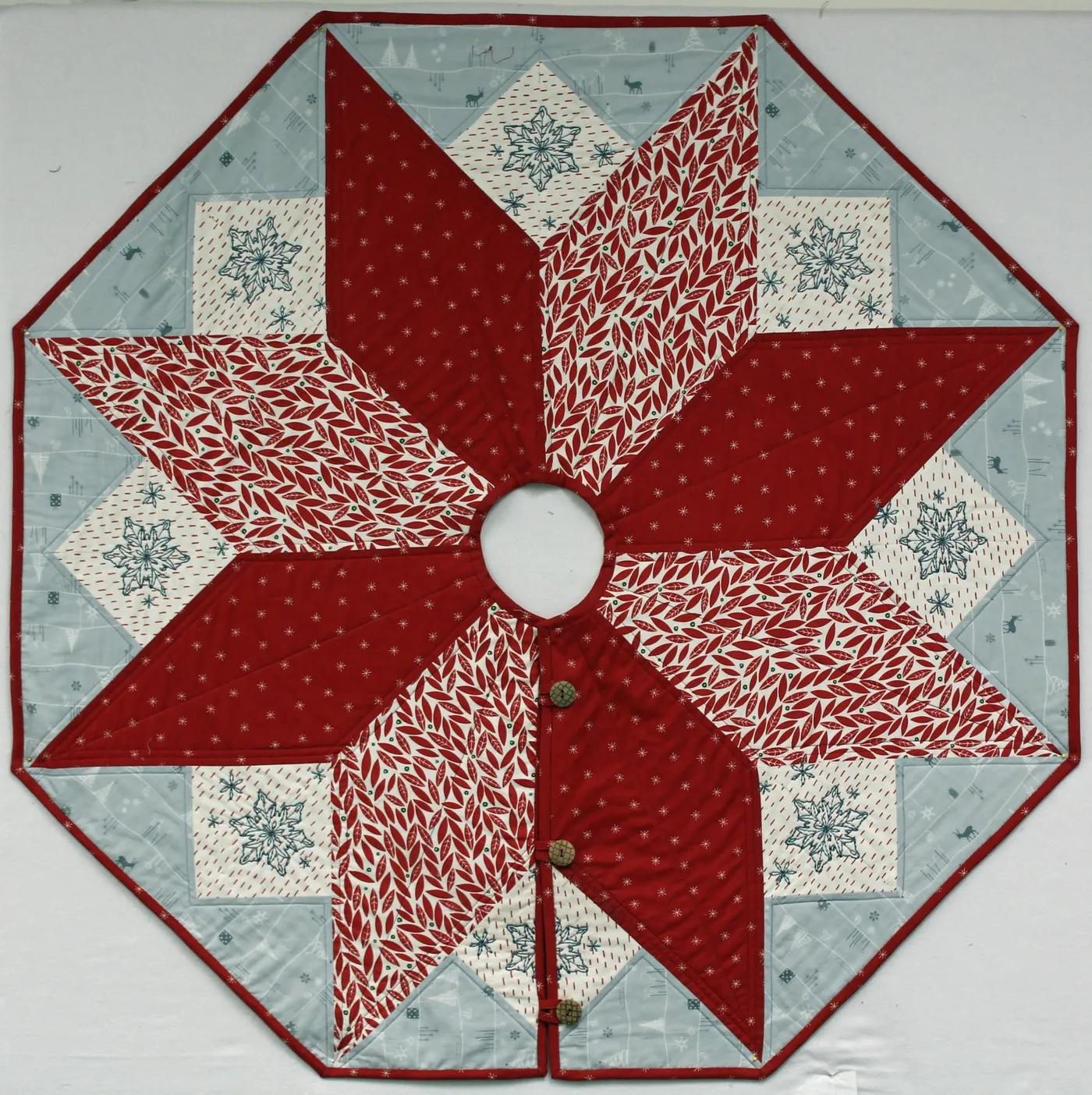
Buttons on a skirt closure aren’t just cute — they’re the most forgiving fastener you can use on a curved opening. Space them four to five inches apart, back each one with a small square of fusible interfacing, and use doubled thread so the shank sits slightly proud of the fabric. That tiny gap is what lets the button sit over thick quilting without denting it.
Straight-line quilting is easier than it looks.
- Tape a horizontal guide line across the quilt with painter’s tape.
- Engage the walking foot and keep your stitch length around 3.0.
- Sew slowly, watching the tape edge instead of the needle.
- Move the tape down two inches and repeat until the panel is filled.
Time: about 45 minutes per panel. Materials: painter’s tape, about $5.
9. Star Patchwork Skirt with Appliquéd Holly and Plaid Borders
Read the ratio: roughly 45% beige plaid, 30% rust red, 20% dark brown, and 5% olive green. The beige does the heavy lifting so the holly appliqué can pop without shouting. You can run the same formula with charcoal gingham instead of beige plaid and deep teal instead of rust, keeping the holly exactly as it is — the ornament placement, not the color, is what gives this skirt its structure.
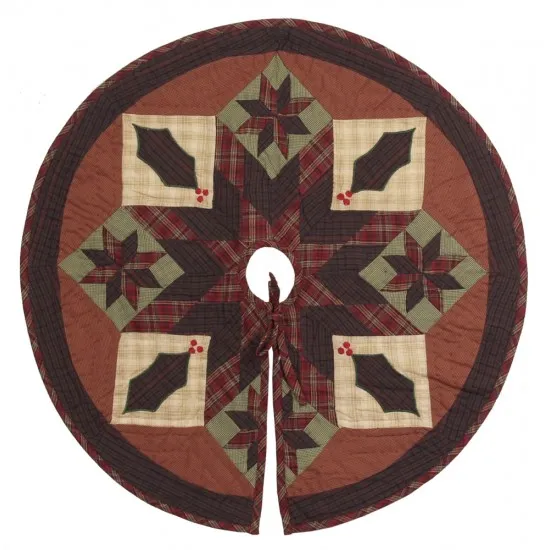
Appliqué looks expensive and costs almost nothing. Fusible web runs about $4 a yard, and you can cut holly leaves from felt squares at 50 cents each. The beige plaid? Hit the men’s section at Goodwill — a large plaid shirt yields a surprising amount of usable fabric for $6, and the weave is usually better than craft-store cotton. The whole skirt lands around $40, most of it batting and backing.
10. Red and White Diamond Quilt Skirt with Bound Edges
Two things to plan for. First, a bright red-and-white diamond pattern on dark hardwood becomes the loudest thing in the room — if your tree is already densely ornamented, this skirt will fight it. Second, white cotton and pine sap are enemies. Sap doesn’t wash out of white fabric once it sets, so line the underside or skip white entirely if you’re using a real tree. A red-and-cream version is dramatically more forgiving.
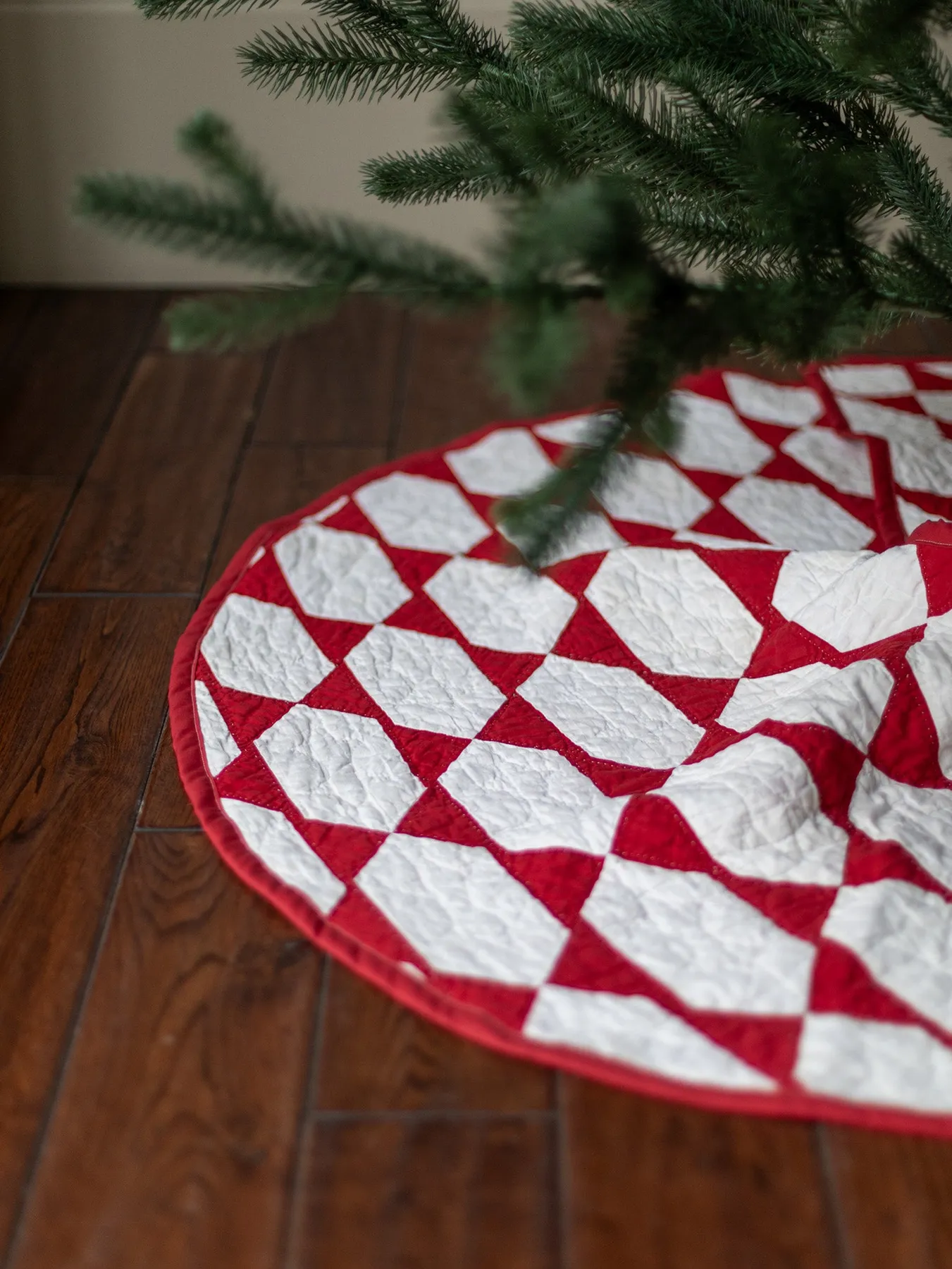
A skirt like this wants a finished diameter of at least 44 inches, so the pattern reads as a whole diamond rather than a sliver peeking out from under branches. That works in rooms from about 120 square feet up. Below that — a small apartment corner, a narrow entryway tree — drop to 36 inches and let only two or three diamond repeats show; the effect still holds. See Idea #14 for a smaller-scale pieced option.
11. Classic Patchwork Square Quilt Skirt with Stitched Borders
If you’re building a grid from scratch, work with four-inch finished squares. Anything smaller and the holiday prints get chopped into unrecognizable confetti; anything larger and the skirt looks like a checkerboard instead of a quilt. Cut five-inch squares to allow for a half-inch seam, chain-piece them in pairs first and then in rows, and press every seam flat before it meets the next one.
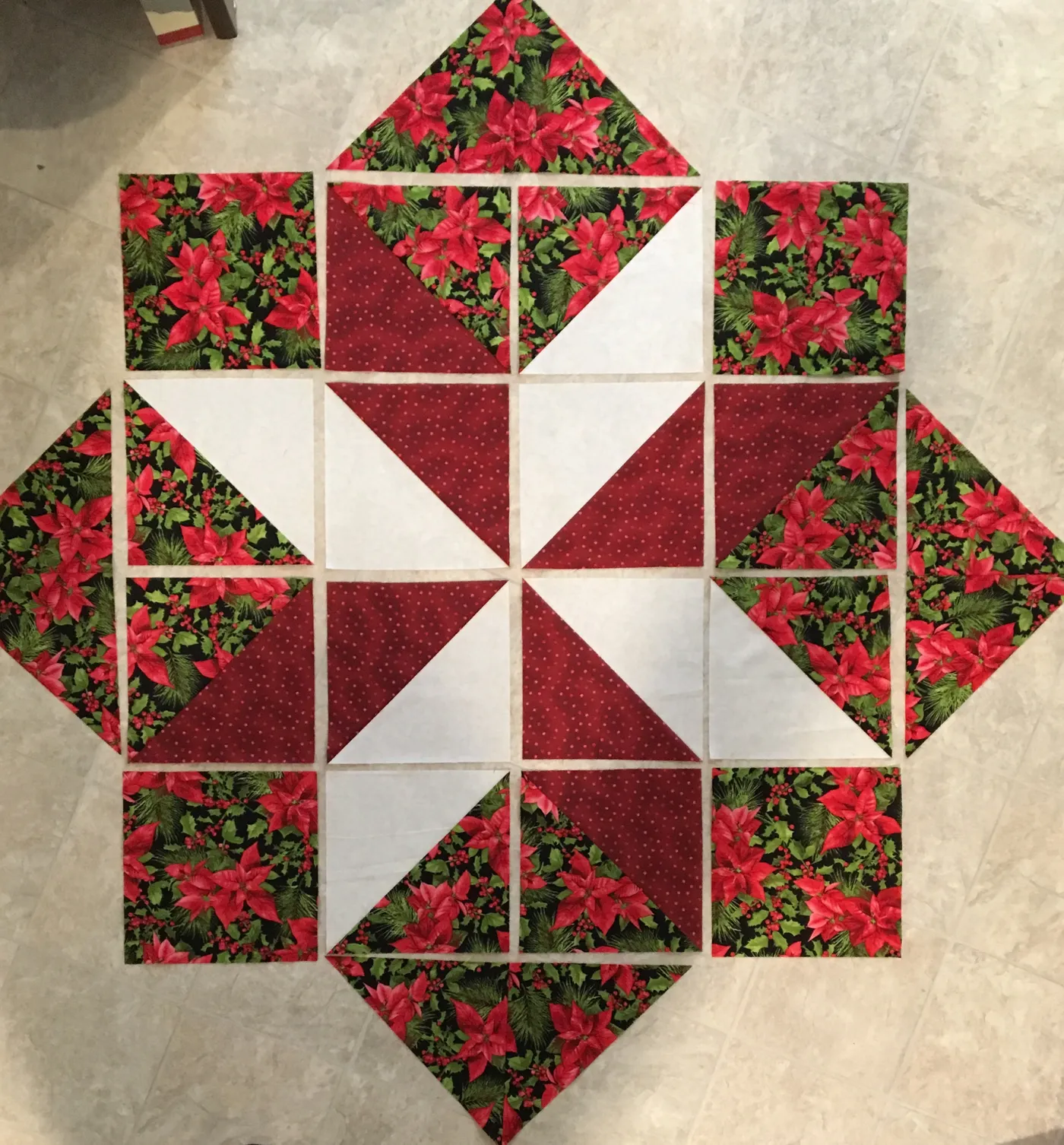
The reason a simple grid works at all is repetition. Sixteen or twenty-four identical squares create a rhythm the eye can follow, which is why patchwork never feels chaotic even when the fabrics are busy. The stitched border around the outer edge is the frame that finishes it — without a defined boundary, a patchwork circle tends to look frayed rather than intentional.
12. Radiating Star Patchwork in Burgundy, Navy, and Mustard
Mustard and burgundy together are having a real moment — call it the cottage-core-meets-grandmillennial crossover that’s been building for a few years and shows no sign of cooling. What’s driving it is a rejection of the all-white Christmas aesthetic: people want color they can leave up for a decade. A saturated palette like this one also photographs beautifully against warm wood, which is exactly why it keeps surfacing on Pinterest feeds.
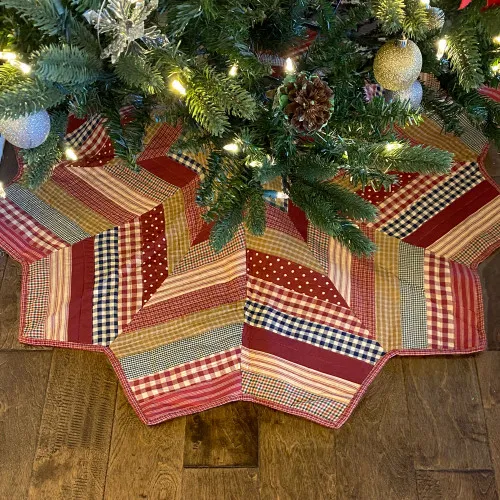
- Pieced cotton prints (5–7 fabrics, 3 yd total): $36–$70
- Batting and backing: $18–$30
- Binding and thread: $8–$15
- Custom-finished on Etsy: $140–$280
- Total: $62–$115 handmade, $140–$280 to buy
Budget alternative: raid your local quilt shop’s clearance bin and mix in thrifted plaid flannel shirts — that alone drops the fabric line to under $25.
13. Block-Print Floral Skirt with ‘Tis the Season Embroidery
The embroidered border is easier than it looks.
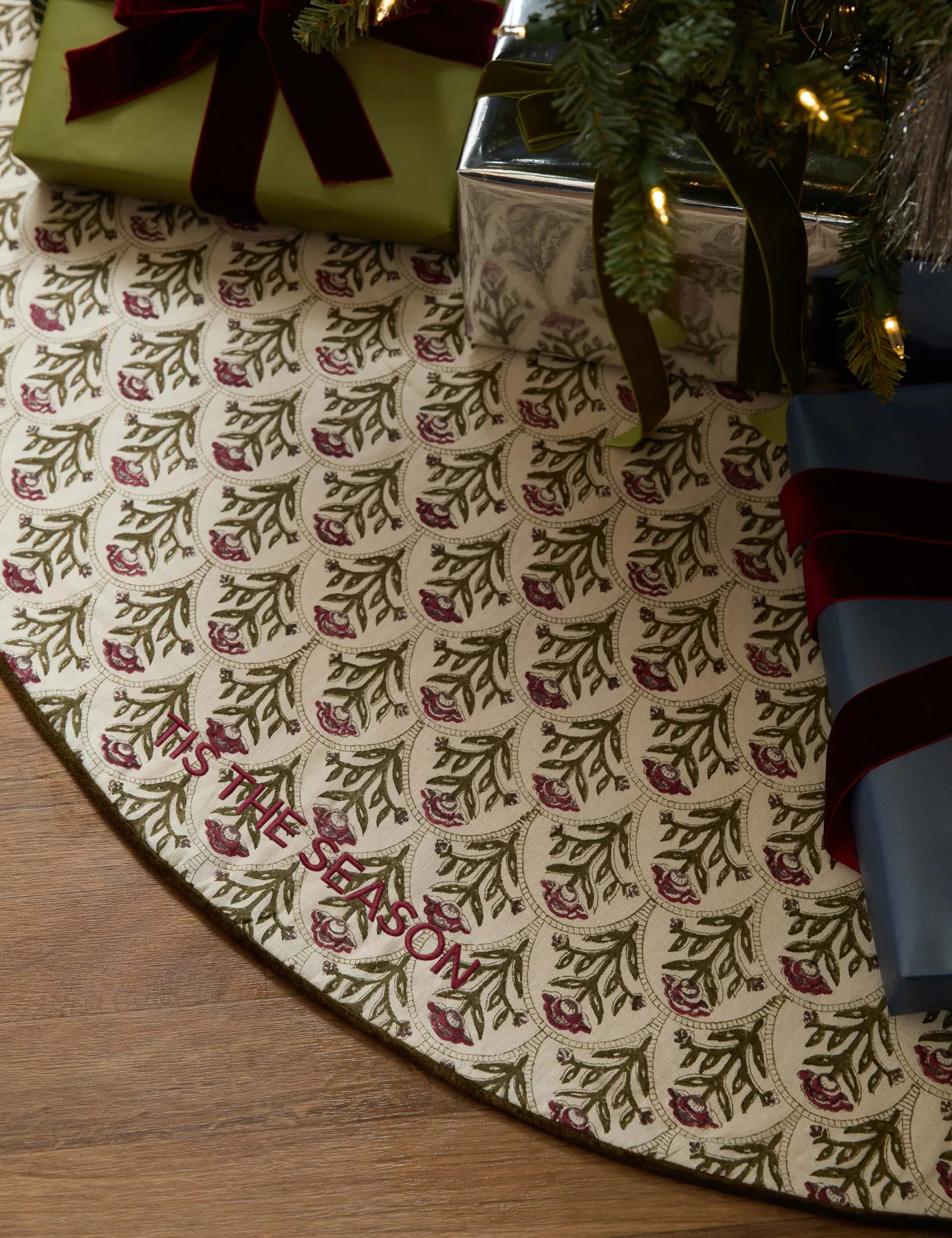
- Print your phrase in a font you like, sized to fit the curve.
- Trace it onto water-soluble stabilizer and pin the stabilizer to the skirt face.
- Backstitch the letters with three strands of embroidery floss.
- Rinse the stabilizer away with cool water and let the skirt dry flat.
Time: three to four evenings. Cost: about $8 in floss and stabilizer.
The palette math here is roughly 60% cream, 20% olive green, 15% plum, and 5% silver. That’s a sophisticated, slightly muted Christmas — no true red anywhere in sight. The formula travels well: swap plum for deep rust and it turns warmer and more autumnal; swap olive for a eucalyptus blue-green and it reads coastal. Keep the cream at 60% and it will always feel calm.
14. Octagonal Pinwheel Skirt in Green Foliage and Cream
Cotton quilts like this one are genuinely easy to live with. Spot-clean with cold water and a mild detergent, machine wash on gentle two or three times a season at most, and air dry flat — a hot dryer will shrink the batting and dull the prints faster than anything else. Store it rolled rather than folded and it’ll look the same in ten years. Skip dry cleaning; the chemicals fade green dyes first.
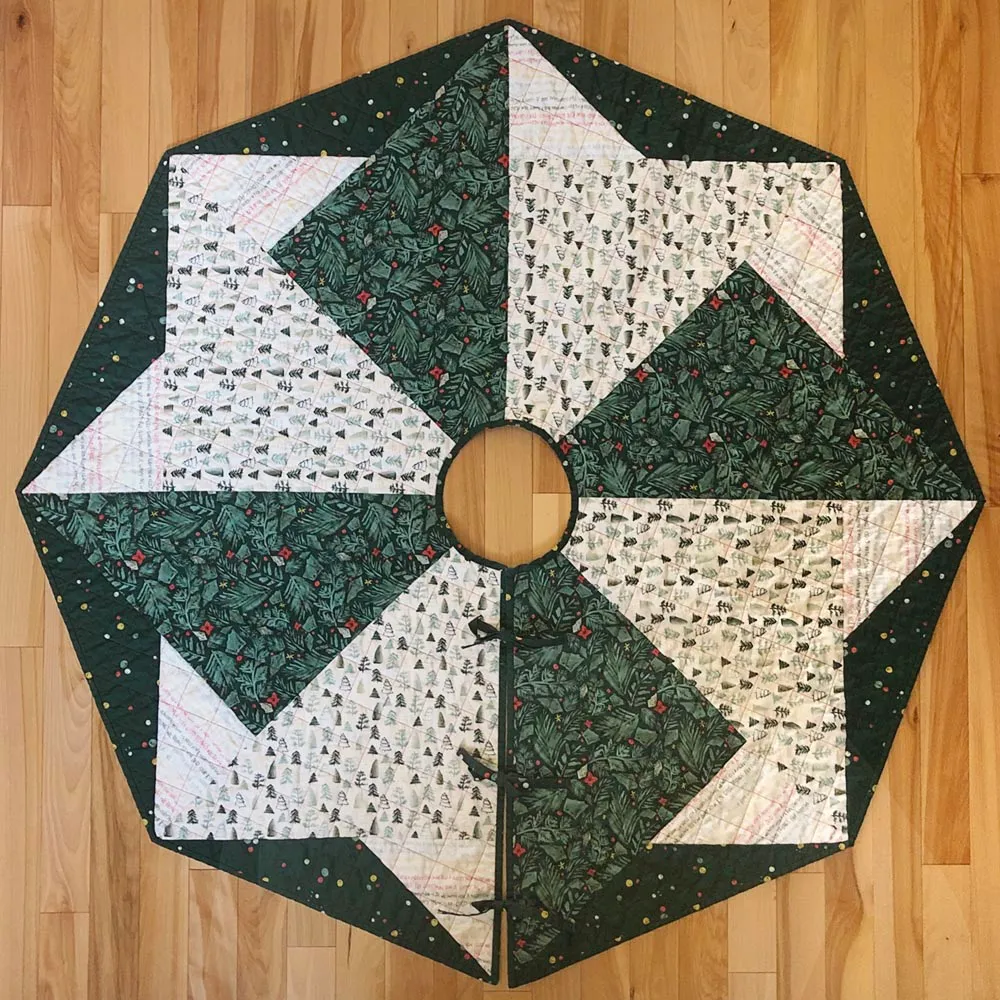
A pinwheel is unforgiving in one specific way: every wedge has to rotate in the same direction. Flip a single panel and the whole skirt reads as a mistake — you’ll see it instantly even if you can’t say why. Lay all eight wedges on the floor and step back before you sew a single seam. A phone photo from ten feet away catches rotation errors better than your eye does up close.
An octagon reads best at 40 to 48 inches across, which covers trees from five to eight feet tall. It’s a forgiving shape for awkward rooms because the flat sides sit closer to the floor than a circle’s curve — good for narrow gaps between furniture. In rooms under 100 square feet, a 36-inch octagon is the sweet spot. If your footprint is really tight, compare with Idea #26, where a basket collar replaces the skirt entirely.
15. Red and White Star Patchwork with Bright Red Binding
Red-and-white quilting cotton is one of the cheapest fabric categories in the store — expect $6 to $10 a yard, with half-price sales running constantly. A scrappy star like this one can be built almost entirely from fat quarters at $3 each; eight of them plus a yard of backing puts you at about $35 total. If you’d rather not sew at all, search Etsy for a red-and-white quilted tree skirt and filter under $80 — dozens of makers are doing this exact pattern.
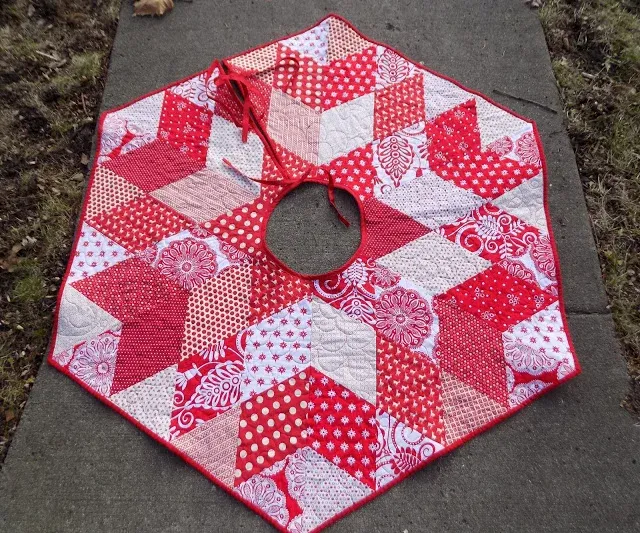
Scrappy quilts only look intentional when the values are balanced. Lay every fabric you’re considering in a single row and squint — if you can’t tell which squares are light and which are dark at a glance, your star points will disappear. Push for a clear split: whites and creams on one side, mid-to-deep reds on the other. The pattern does the rest.
16. Wreath and Cabin Quilt Blocks Framed in Forest Green
What makes this one memorable is that it’s a narrative — wreath, cabin, wreath, cabin, all the way around. Take away the alternating blocks and you have a pleasant but ordinary green-and-red skirt. Keep them, and you’ve got something guests actually bend down to look at. If you only have budget for one custom detail this year, make it a pictorial block or two.
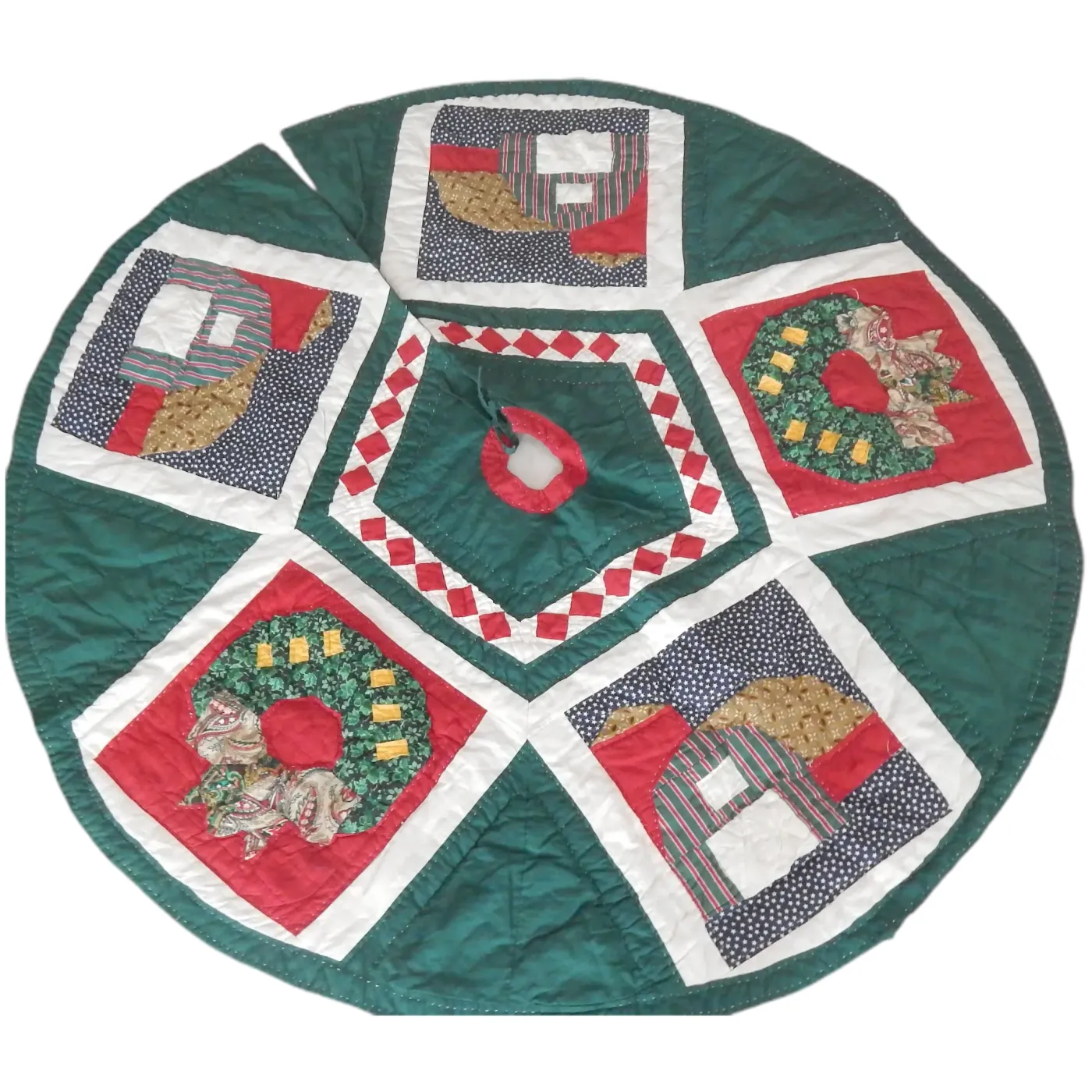
Notice the solid green panels between the pictorial blocks — they’re not filler, they’re negative space, and they’re the reason the wreaths and cabins don’t overwhelm each other. The red-and-white diamond ring around the center is a transition device too: it moves your eye from the trunk outward in steps rather than all at once. Good quilts are mostly about pacing.
17. Ornament Block Skirt with Checkered Ribbon Ties
- Confirm your blocks finish to the same size — an eighth-inch difference across eight blocks throws the circle off by a full inch.
- Decide whether the center opening will be a circle or a slit; slit styles need interfaced edges.
- Hold your checkered ribbon against the opening — anything under one inch wide looks skimpy.
- Choose your sashing color last, after the blocks are finished.
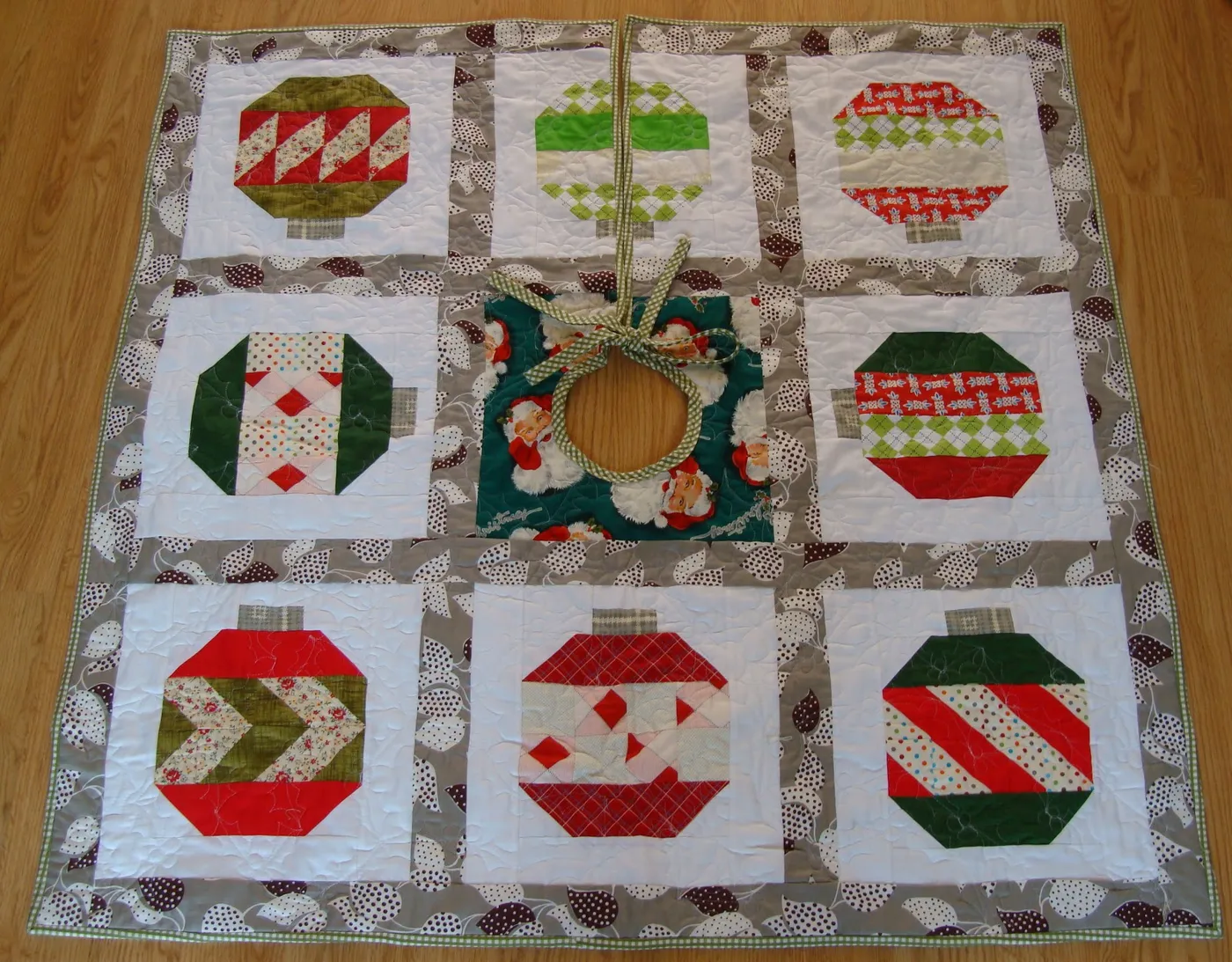
Free-motion stippling is what gives this skirt its pebbled texture.
- Lower the feed dogs and attach a darning or free-motion foot.
- Set stitch length to zero and ease the needle tension down slightly.
- Start in the center and stitch a meandering curve, never crossing your own line.
- Keep curves no wider than your thumb — bigger loops look sloppy.
- Practice on a 12-inch sandwich first. Really.
Time: about two hours for a 44-inch skirt once you’re comfortable.
- Eight ornament-print fat quarters: $24–$32
- Sashing and border fabric (1.5 yd): $14–$24
- Cotton batting: $12–$20
- Checkered ribbon for ties: $5–$9
- Total: $55–$85
Budget alternative: cut your sashing from a thrifted grey sheet ($4) and use plain cotton twill tape instead of checkered ribbon — saves roughly $18.
18. Wedge-Pieced Skirt in Vintage Holiday Novelty Prints
Novelty prints are a commitment. A rocking horse fabric is delightful at 18 inches from your eye and invisible from the sofa, where all you register is a red-and-green blur. If you love the prints, keep them large — cut wedges from the biggest motifs rather than fussy-cutting tiny ones. And watch your skirt size: a small-diameter skirt under a full tree disappears entirely. Thirty-eight inches is the floor.
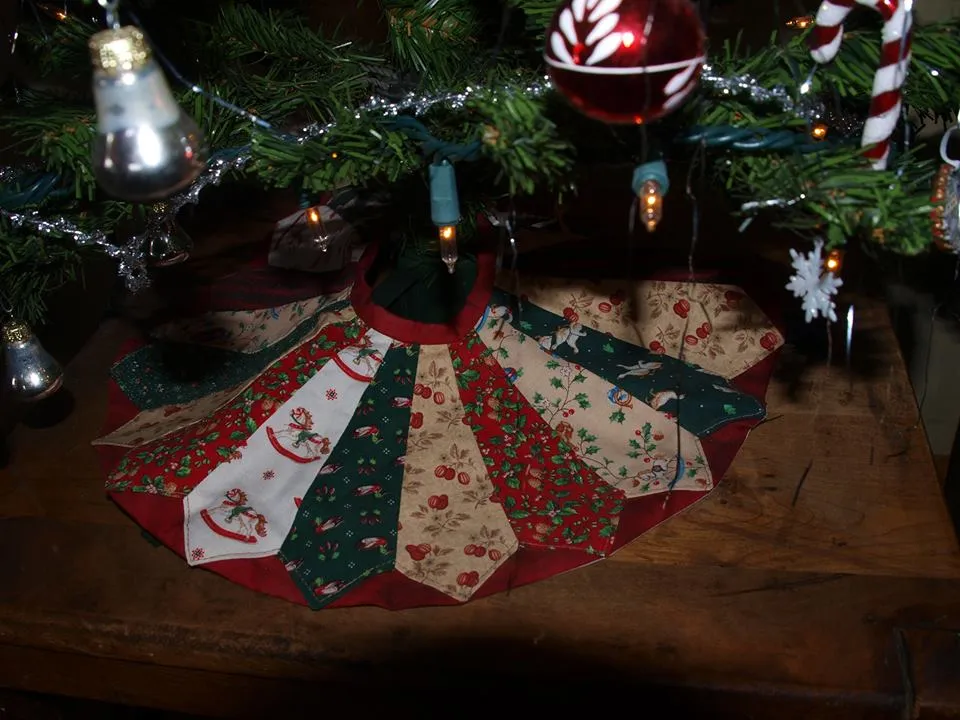
Roughly 40% red, 30% dark green, 25% beige and white, and 5% wood tone. That ratio is why vintage novelty prints feel nostalgic instead of chaotic — there’s enough neutral ground between the loud fabrics. Want a modern read? Swap the beige for charcoal, keep everything else, and the same prints suddenly look graphic rather than twee. Proportions matter more than the fabrics themselves.
19. Cream Quilted Skirt with Channel Stitching and Bow Ties
Channel quilting lives or dies on spacing. Two-inch channels look plush and intentional; four-inch channels look like a duvet cover someone forgot to finish. Mark your lines with a water-soluble pen and a long ruler before you pin the sandwich, and quilt from the center outward so the fabric doesn’t shift. Short on time? Quilt every other marked line and come back for the rest later — the eye forgives missing rows far more than uneven ones.
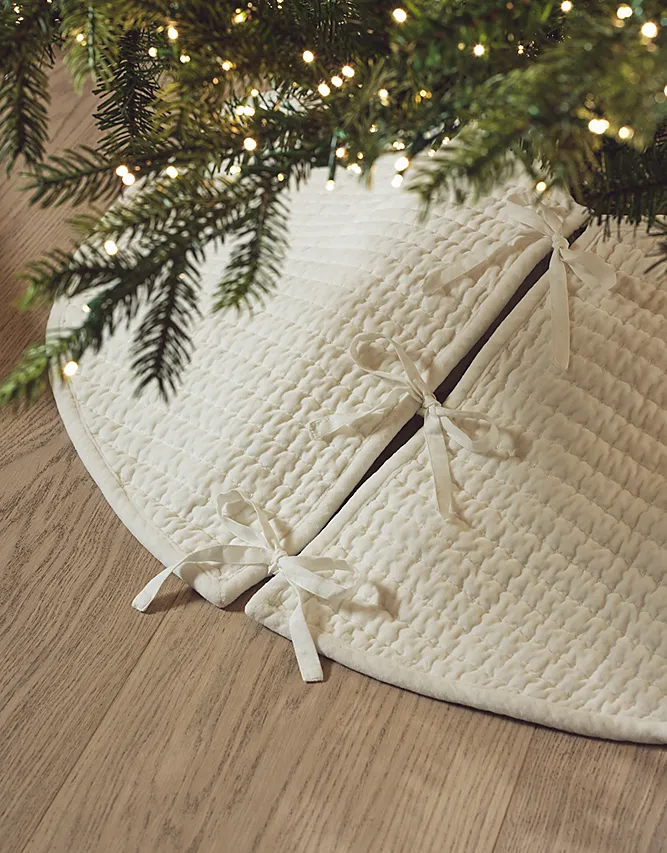
here is restraint: it’s cream on cream, and that’s entirely the point. All the visual interest comes from texture and shadow rather than pattern, which is why this reads as elegant instead of plain. Add a red border — even a thin one — and you’d lose the whole quiet, expensive feeling. This is the skirt to choose when the tree is already doing all the talking.
20. Heart Panel Skirt in Poinsettia and Holiday Patchwork
Hearts in Christmas decor are having a moment, and not just because of the Valentine’s crossover. The bigger driver is the handmade revival — people want holiday pieces that feel personal, and a heart panel reads as a gift rather than a purchase. It’s also a smart shape for quilters: a curved panel is far easier to piece than a perfect circle, which means more beginners actually finish the project.
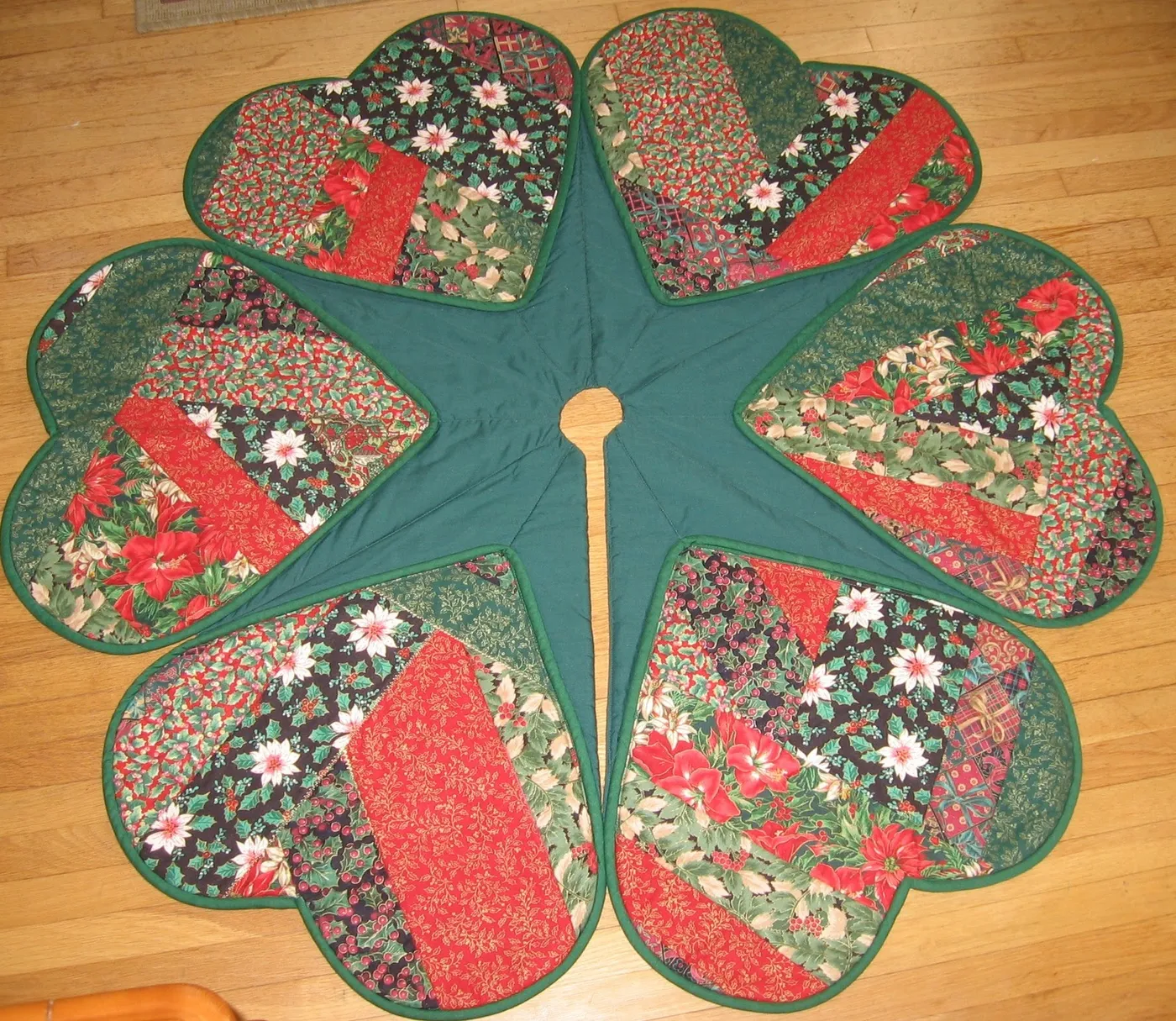
The solid dark green center is the element you’d miss most. Six heart panels alone would be a busy ring with a hole in the middle; the green base gives them somewhere to land and hides the mechanics of the slit and ties. It’s also the reason the reds read as saturated instead of muddy — a dark, cool color behind warm reds always makes them pop.
Hearts can be cut from any festive cotton you already own. A single yard of poinsettia print at Joann runs about $8 on sale, and the dark green base can come from a $6 flat sheet, dyed or left as-is. Total under $50 including batting. Check Facebook Marketplace for quilt tops with damaged corners — those sell for under $20 and have plenty of usable yardage.
21. Illuminated Gingerbread Village Tree Collar
A collar is a different animal than a skirt, and this one earns its place by glowing. Because the village is backlit, the base of the tree becomes a light source rather than a dark void — which makes the whole tree feel taller and the room feel warmer. The cut-out windows also throw small pools of shadow that read as depth from across a room, something a flat fabric skirt can never do.
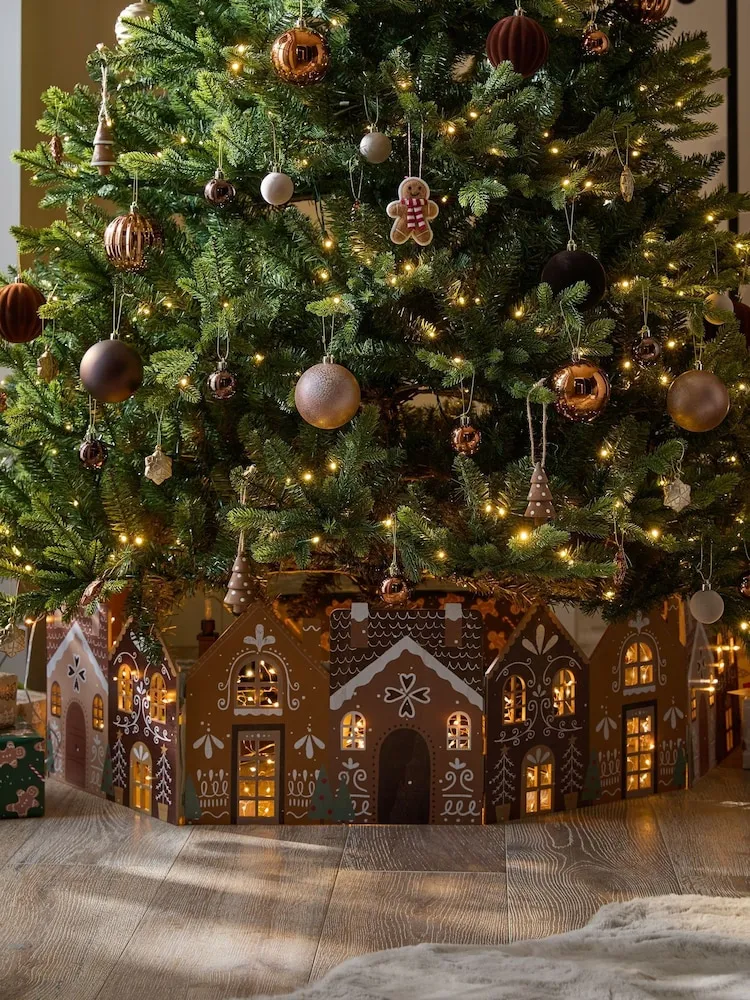
about a cardboard village: it’s sturdy for two or three seasons if you store it flat and dry, and it is not built for a hot bulb. Use LED fairy lights only — incandescent strands run hot enough to be a genuine problem against paper. Dust it with a dry soft brush, never a damp cloth, and store it in a rigid box. Most people replace it around year four, which is still cheaper than a custom skirt.
22. Patterned Quilt Skirt Under a Warmly Lit Tree
Warm white string lights cast a distinctly amber glow — around 2700K — and that shifts every color under the tree. A cool red turns brick; a crisp white turns cream. If your skirt’s pattern contains blue or grey, check it under the tree lights before you commit, not in daylight. Choosing patterns that already lean warm is the easiest way to avoid a mismatch you can’t unsee.
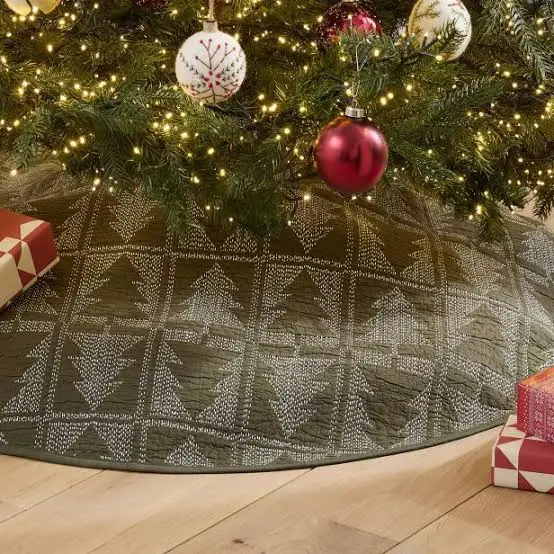
If your room already has a strong rug pattern or wallpaper, a busy quilted skirt can tip the whole corner into chaos. The fix isn’t to go plain — it’s to isolate. A solid-color rug under the tree, or pulling the tree forward so the skirt sits on bare wood, gives the pattern somewhere to breathe. One patterned element per visual zone is a decent rule of thumb.
Patterned skirts reward a little breathing room. In a room under 120 square feet, keep the finished diameter at 36 to 40 inches so there’s visible floor around the skirt — pattern needs neutral ground to read against. Larger living rooms handle 48 inches comfortably, and you can push to 54 under a nine-foot tree. For a very small space, Idea #13 shows how a lower-profile octagon solves the same problem.
23. Hand-Painted Tree Mat with Topiaries and Plaid Border
- Canvas drop cloth (6 x 9 ft): $14–$22
- Fabric paint in green, red, and blue: $18–$30
- Plaid ribbon for the border trim: $8–$14
- Plaid fabric for the topiary planters (1/2 yd): $6–$10
- Total: $46–$76
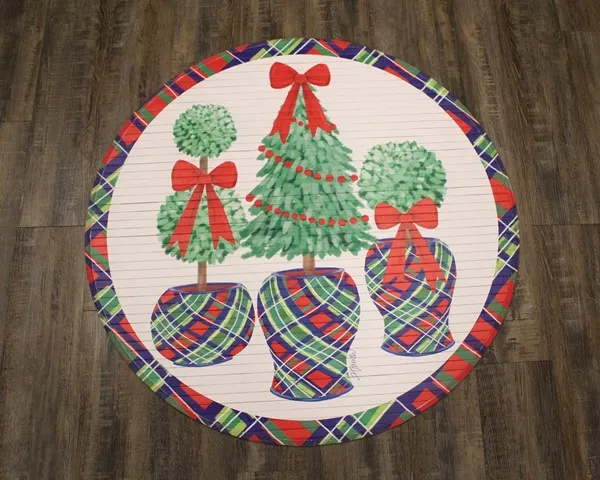
Budget alternative: skip the paint and use iron-on appliqué shapes instead — a $12 pack of Christmas transfers gets you most of the way there.
Painting a mat is a two-evening job.
- Wash and iron the canvas drop cloth so the paint grabs evenly.
- Draw your design in chalk — it wipes off with a damp cloth.
- Block in the large shapes first with a sponge brush, letting each color dry before the next.
- Add outlines last with a fine liner brush and undiluted paint.
- Heat-set with an iron over a press cloth once everything is fully dry.
Time: about five hours. Materials: roughly $46.
24. White Quilted Skirt with Wood Beads and Berry Red
This is close to a 70/20/8/2 split — white and cream dominating, natural wood tones at about a fifth, green from the flocked branches, and just a trace of berry red. That tiny red percentage is what keeps it from feeling sterile; the berries read as a deliberate accent rather than decoration. Swap the red berries for dusty blue and you get a cool, Scandinavian version of the exact same formula.
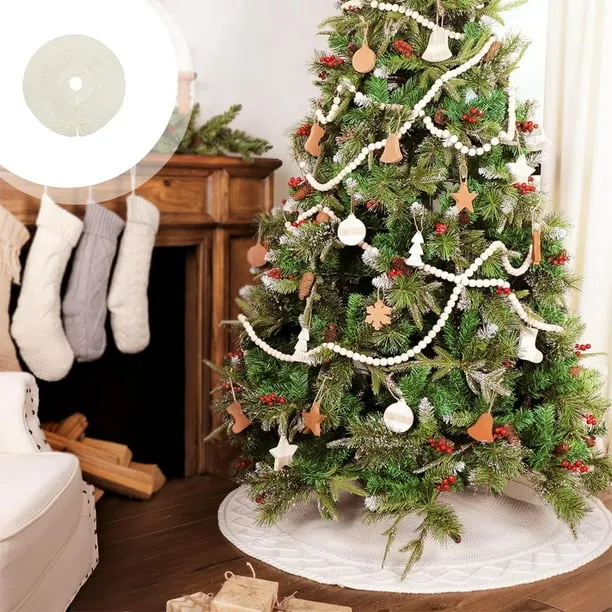
Wooden bead garlands look best when they’re draped, not strung. Hang them in loose double loops rather than a single tight spiral, and let the lowest loop rest just above the tree skirt — the beads then visually tie the tree to the base, which is what makes the whole setup feel considered. A 12-foot strand of 12mm beads is enough for a seven-foot tree.
25. Woven Basket Collar with Mauve and Brown Ornaments
The basket is the whole idea. Without it you’d have a nice tree with nice ornaments and nothing anchoring it — with it, the base has weight, texture, and a shape that doesn’t match a single other thing in the room, which is exactly why it works. If you take one thing from this article, take this: a collar changes the silhouette of your tree more than any skirt can.
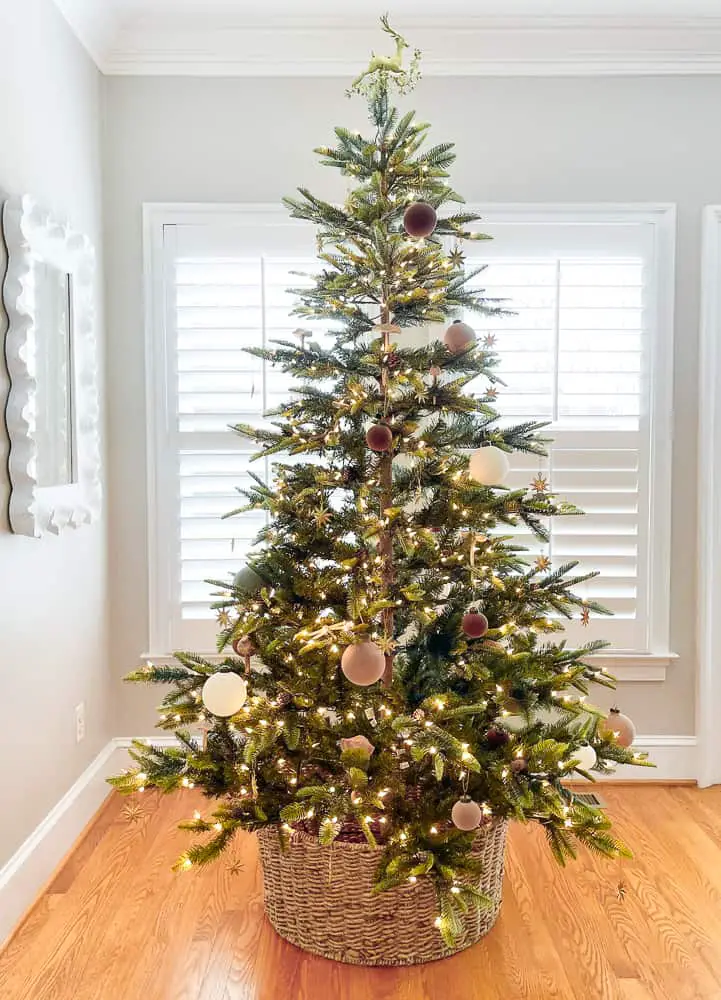
Woven collars have quietly overtaken skirts in the minimalist camp, and 2026 is looking like their biggest year yet. The reason is simple: they’re reusable, they don’t wrinkle, and they suit the natural-materials direction that’s dominated interiors for several seasons. Unlike a patterned fabric skirt, a basket doesn’t date — you’ll see these in ten years looking exactly as current as they do now.
You don’t need a $120 designer basket collar. Target carries woven planters in the $25–$40 range that invert perfectly over a tree stand — just check the top opening clears your stand by an inch or two. Thrift stores are even better: a large woven wastebasket with the handles snipped off reads identical from three feet away for $6. Line the rim with felt if it scratches your floor.
26. Wide Wicker Basket Collar with Snowflakes and Birds
The scale relationship is what sells it: the basket is roughly a third of the tree’s height in width, which is much wider than most people dare. A narrow collar under a full tree looks like a belt. Texture contrast matters too — woven wicker against dense pine needles gives the eye two completely different surfaces to rest on, so the base never disappears into the tree.
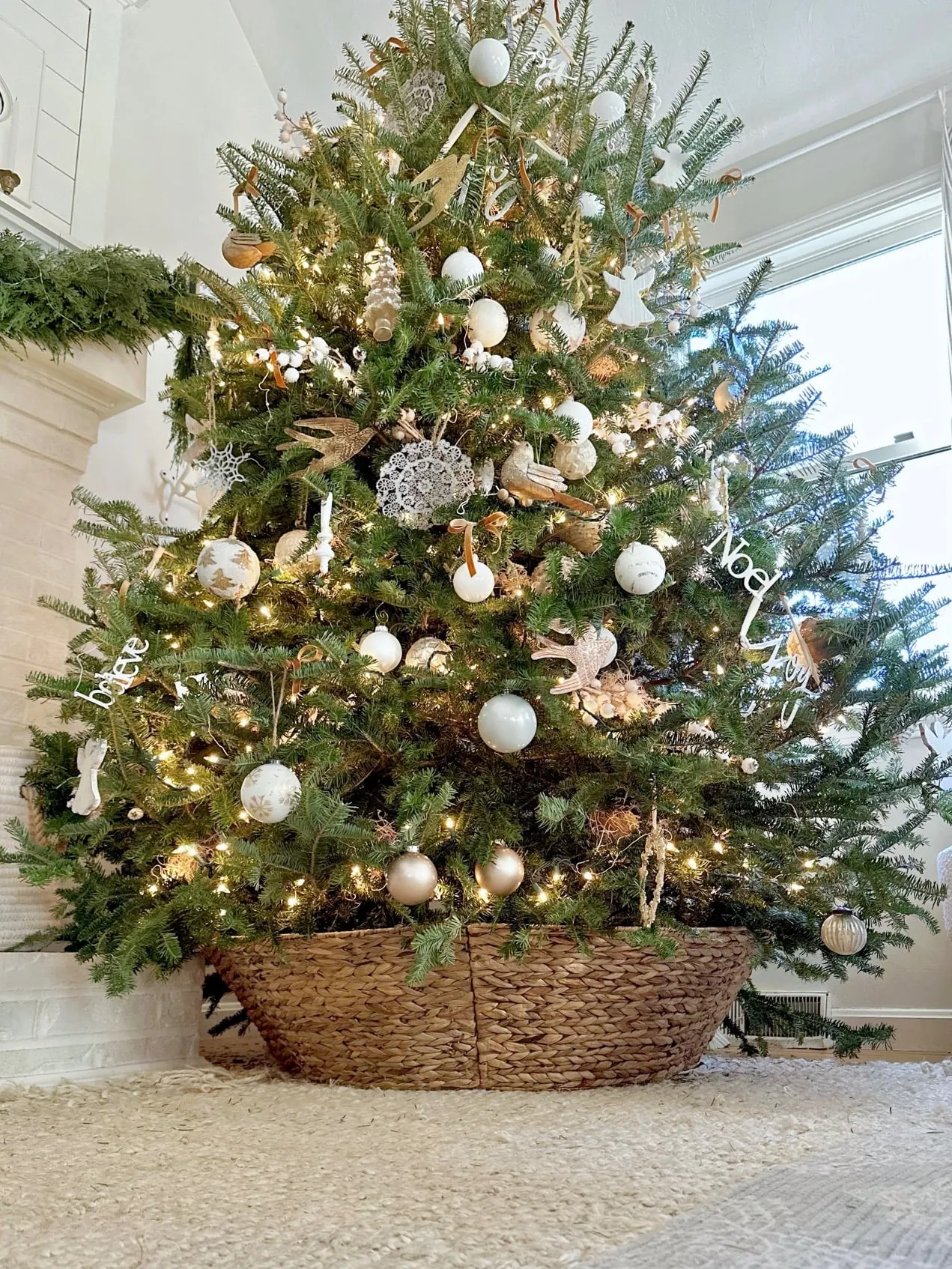
Baskets have one honest flaw: they hide nothing. Your tree stand, its bolts, and the water reservoir all live inside, which means you’re reaching over a rim every time you water — so buy a stand with a wide, easy-pour opening, or keep a funnel nearby. They also wobble on thick pile carpet. Put a felt pad underneath and set the basket on hard flooring if you can.
27. Single Quilt Block with Rust Orange and Gold Accents
If you’re scaling a single block into a full skirt, repeat it eight times and rotate each one 45 degrees. A block this graphic doesn’t need eight different variations — it needs one strong idea executed consistently, with the sashing doing the separating work. Cut your sashing strips two inches wide and you’ll get a clean, deliberate gap between blocks instead of a muddy seam.
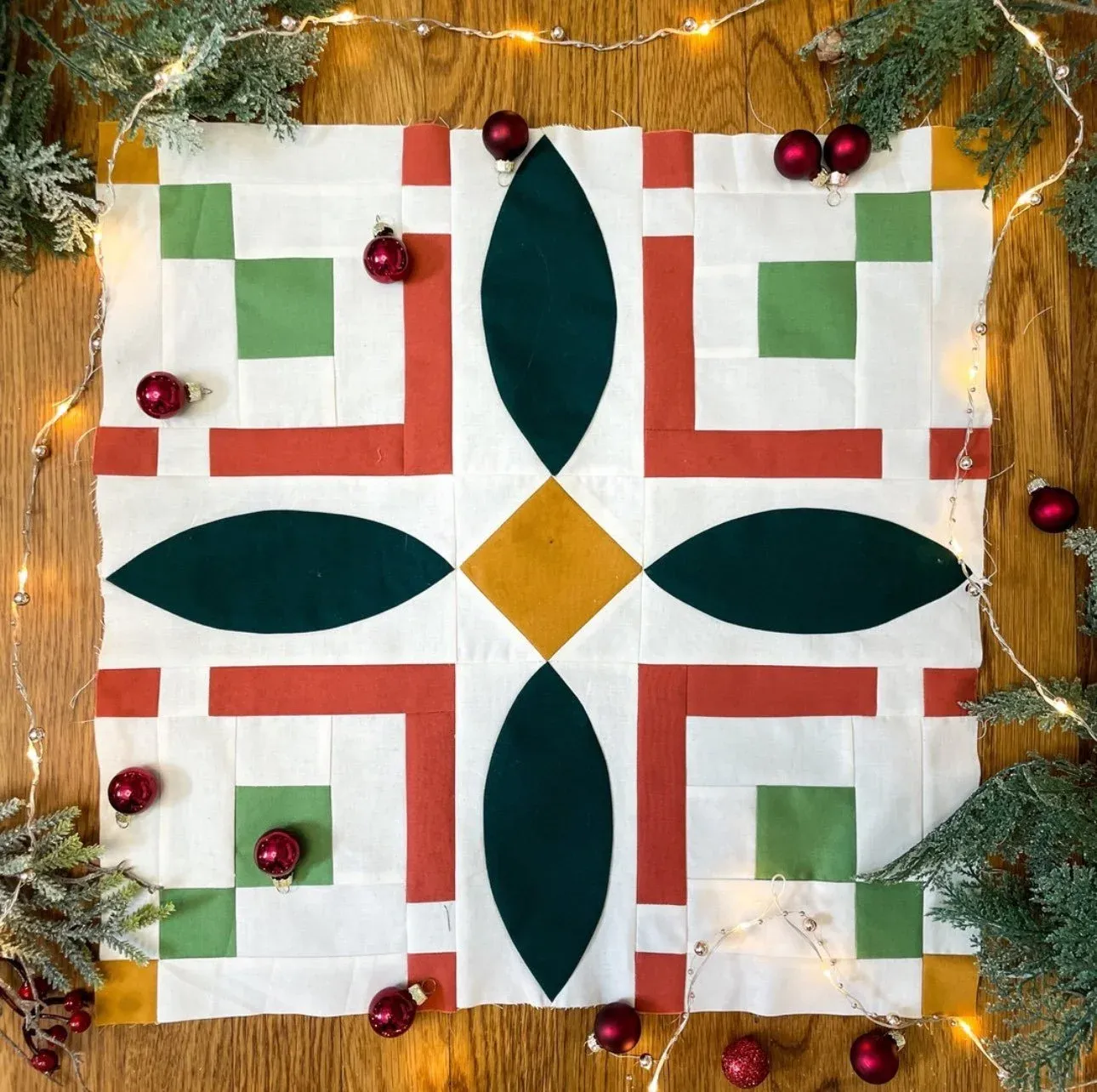
Fusible appliqué is the shortcut for the leaf motifs.
- Draw four identical leaf shapes on paper and cut them out as templates.
- Trace onto fusible web, iron the web to the wrong side of your green fabric, then cut.
- Peel the backing, position the leaves, and press for ten seconds.
- Machine-stitch around each leaf with a narrow zigzag to lock the edges.
Time: 40 minutes for all four leaves. Materials: about $6.
The block runs about 55% white, 20% rust orange, 15% green, and 10% gold. The white is unusually high for a holiday palette, and that’s exactly why the orange reads sophisticated rather than autumnal. Trade the rust for deep teal and keep the gold, and you get a fresh, slightly retro palette with identical structure. The white has to stay above half — that’s the load-bearing rule.
28. Plush Cream Quilted Skirt Against Floor-Length Curtains
Flocked trees with a cream skirt want vertical space more than floor space. This setup needs at least a nine-foot ceiling with a seven-and-a-half-foot tree, so the skirt still has hardwood visible around it. In a room with standard eight-foot ceilings, drop to a six-and-a-half-foot tree and a 40-inch skirt. The curtains behind matter too: floor-length panels in a similar cream keep the whole corner tonal and make the tree look taller. Compare with Idea #19 — same cream palette, more visible stitch texture.
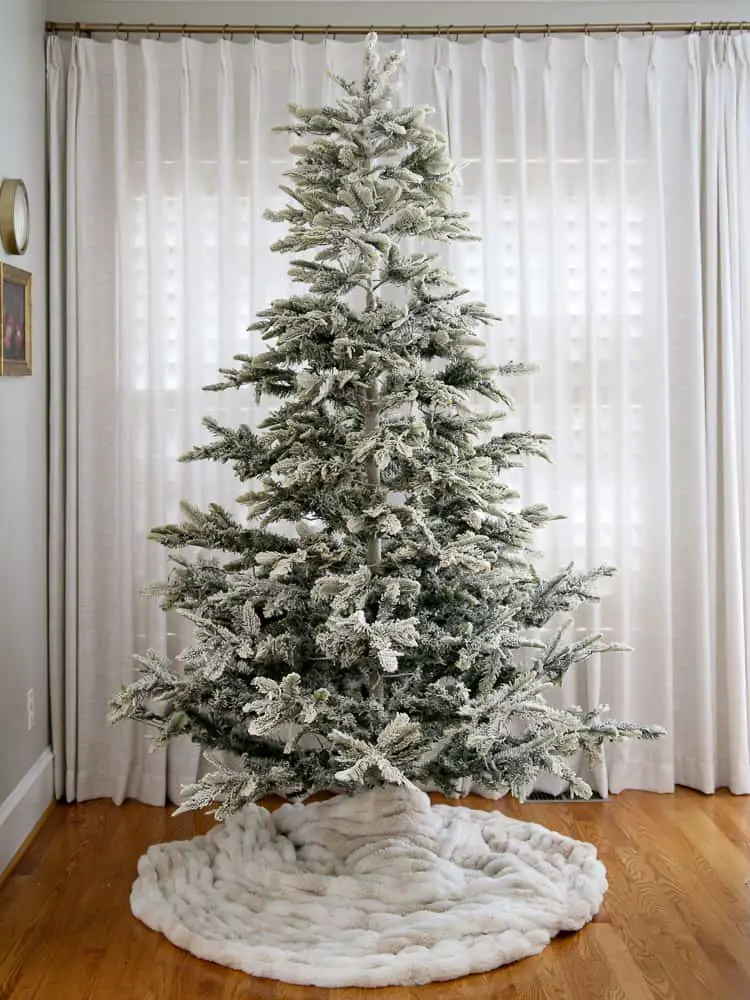
- Measure from your curtain rod to the floor — floor-length panels make a short tree look squat.
- Check whether the window gets direct afternoon sun; cream fabric yellows unevenly in strong light.
- Confirm the skirt diameter leaves at least six inches of visible floor around it.
- Plan for flocking shed — it settles into quilting and shows up against cream.
29. Braided Jute and Cream Mat with Red Ribbon Gifts
- Braided jute round mat (36 in): $30–$70
- Cream cotton for a stitched overlay: $10–$18
- Gift wrap and red satin ribbon: $12–$25
- Total: $52–$113
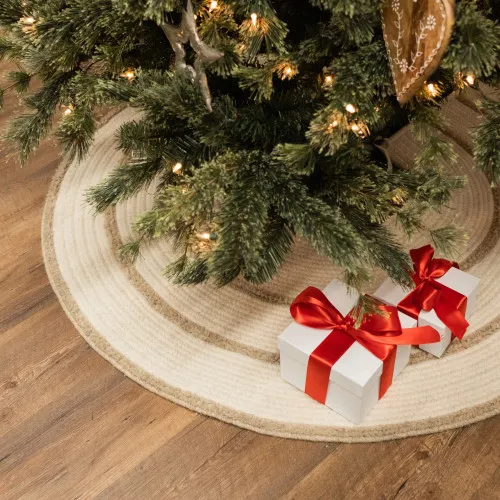
Budget alternative: a plain round jute rug from IKEA or Walmart starts around $25, and you can leave it unmodified — the braid does all the texture work on its own.
Jute is durable but not waterproof, and a tree stand reservoir inevitably drips. Set a shallow tray under the stand, inside the mat’s opening, and wipe up spills immediately — jute fibers wick water and stain brown within minutes. Vacuum the braid on a bare-floor setting a few times a season, and expect some shedding the first month. Keep it dry and it’ll last years.
30. Concentric Red and White Striped Skirt with Gift Styling
Concentric rings are the hardest patchwork shape to sew well, because every seam is a curve and every curve has to match at the closure slit. If the rings don’t line up where the skirt opens, the whole thing looks handmade in the wrong way. Cut your inner rings on the bias so they curve without puckering, and pin generously — every two inches, not every six.
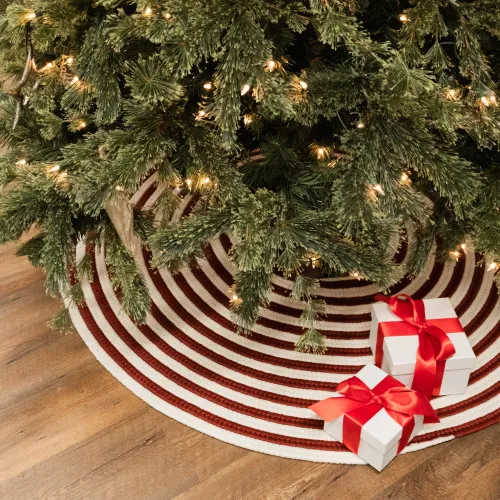
The reason this reads so clean is that the pattern runs horizontally. Horizontal bands widen whatever they sit on, which gives the base of the tree a grounded, deliberate platform instead of a decorative circle. The white gifts tied in bright red satin are doing real work too — they extend the skirt’s own stripe pattern upward and make the whole vignette feel styled rather than assembled.
Go Give Your Tree the Base It Deserves
Every one of these thirty ideas starts with the same small decision: treat the base of the tree like furniture, not an afterthought. Whether you piece one from a thrifted quilt top or set a $25 woven basket over the stand, the corner will look finished in a way no ornament collection can fake.
Pin your favorites now — December has a way of arriving faster than the fabric store’s shipping window. 📌