
Most outdoor Christmas light displays don’t fail because of bad taste — they fail because nobody measured the roofline before climbing the ladder. If you’ve been saving photos of glowing gables and wrapped trees since October, you already know what you want. You just need the plan.
We sifted through hundreds of options at Home Depot, Lowe’s, Target, Amazon, and Etsy to bring you only what’s worth your attention this year — everything from $18 strand sets to $850 full-facade setups.
Inside you’ll find 30 curated ideas covering warm white traditional, multicolor LED, color-changing strip lighting, and classic red-and-white, with budget and luxury versions compared side by side.
Linear LED mounted in aluminum channel is the trend defining 2026 — it’s why so many of this year’s best displays read as clean architectural lines instead of a tangle of bulbs. And stay until the end — we break down the most common mistakes that can ruin these looks.
📌 Save this to Pinterest for later — you’ll want to revisit these ideas. (A few links here are affiliate links; they cost you nothing extra.)
1. Warm White Rooflines on a Stone-and-Siding Facade
Outlining a roofline is a measuring job before it’s a lighting job. Walk the perimeter and total every linear foot of eave, gable, and fascia you plan to trace, then add 10 percent for waste and clips. For crisp architectural lines, use C9 bulbs on 12-inch centers — close enough to read as one continuous line, loose enough that each socket stays visible from the street. Keep the roofline strands and the ground uplights on separate timers so the facade can drop to a soft glow after 9 p.m. instead of blazing until midnight.
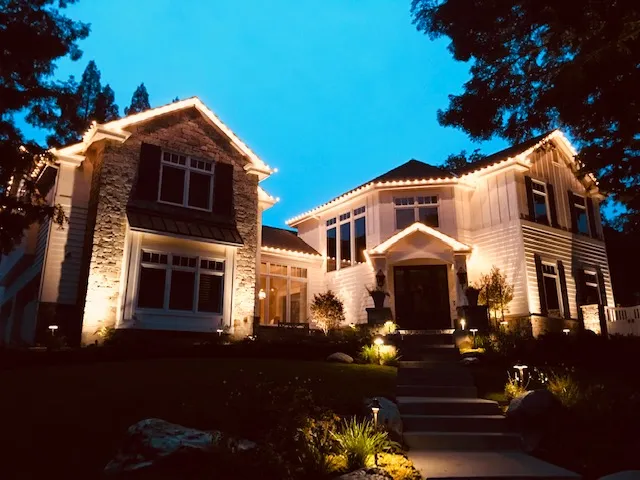
Two moves are doing the heavy lifting here. The lights trace real architectural edges — eaves, gables, ridge lines — so the house reads taller and more deliberate instead of randomly speckled. And the warm white temperature stays consistent from roof down to the pathway, which keeps gray stone, white vertical siding, and black shutters from fighting each other after dark.
- Uplights graze the stone instead of flooding it, so texture survives at night
- Path lights stay low and warm — no blue-white glare near the front door
- Potted plants at the entry get one small spot, not a nest of strands
2. Roofline Lights Plus Wreaths in the Gable Windows
Where the money actually goes on a two-story facade like this one:
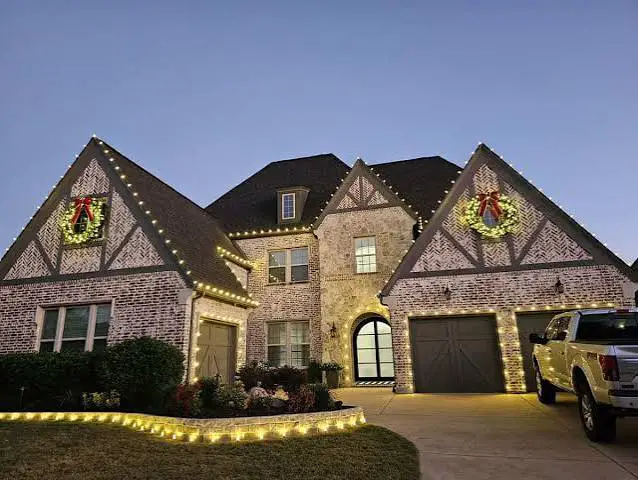
- Warm white C9 strands, roughly 275 ft: $120–$260
- Two large wreaths with oversized red bows: $70–$180
- Garage door runs, clips, and timer: $80–$160
- Path stakes and transformer: $60–$140
Budget alternative: swap C9 for 100-count warm LED mini strands and skip the wreaths for one season — you land closer to $180.
The wreaths are the entire personality of this house. Without them it’s a very nice outline; with them, your eye goes straight to the upper gable windows and the lights become a frame instead of the main event. If you’re buying one non-light item this year, buy it here — a matched pair of 30-inch wreaths, hung so the bottom of the wreath sits level with the top of the window trim.
3. Alternating Red and White Lights With a Spiraled Tree
This facade runs on a clean split: about 50 percent white string light as the architectural base, 30 percent red used in a strict alternating pattern along the rooflines and gables, and 20 percent deep green from foliage and night sky doing the quiet work in the background. The alternation is what sells it — solid red reads as an emergency vehicle, solid white loses the holiday punch. Swap red for warm gold and you get something softer and almost cottage-like. Swap it for emerald green and the whole house turns classic-and-cool.
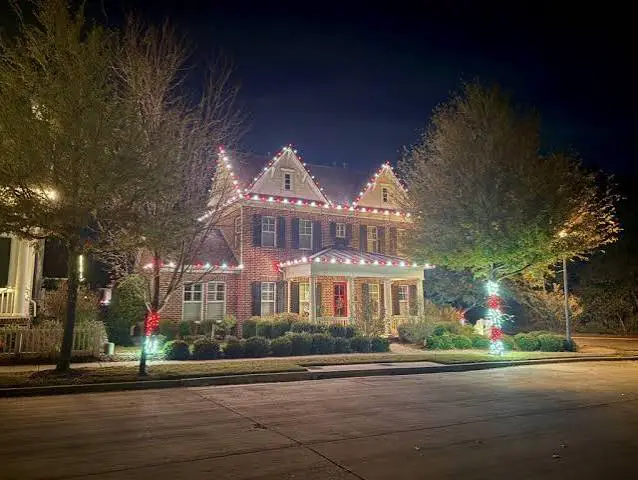
You don’t need custom-cut strands to get this effect. Big-box retailers sell 100-count red and 100-count white LED sets for around $12–$18 each. Buy matched quantities and alternate every other strand, using color-coded clips so you don’t have to think about it on the ladder — a 100-light set covers roughly 8–10 feet of roofline at 12-inch spacing, so a modest two-story front lands around $90–$150 total. If the spiral-wrapped tree is the part you love most, start there. Compare with Idea #25, where one densely wrapped bare tree does the entire job on its own.
4. Bright White Roof Lights With Illuminated Wreaths
Bright white LED has a reputation problem: cheap strands run blue and cold, and against a light gray house they can look clinical. Look for 2700K–3000K soft white LED specifically, and check the color temperature on the box rather than trusting the word white. The second reality check is the wreaths — illuminated ones mean a cord running down the window trim. Measure before you buy, choose wreaths with an inline connector and a 3-foot lead, and plan to hide the drop behind the shutter edge.
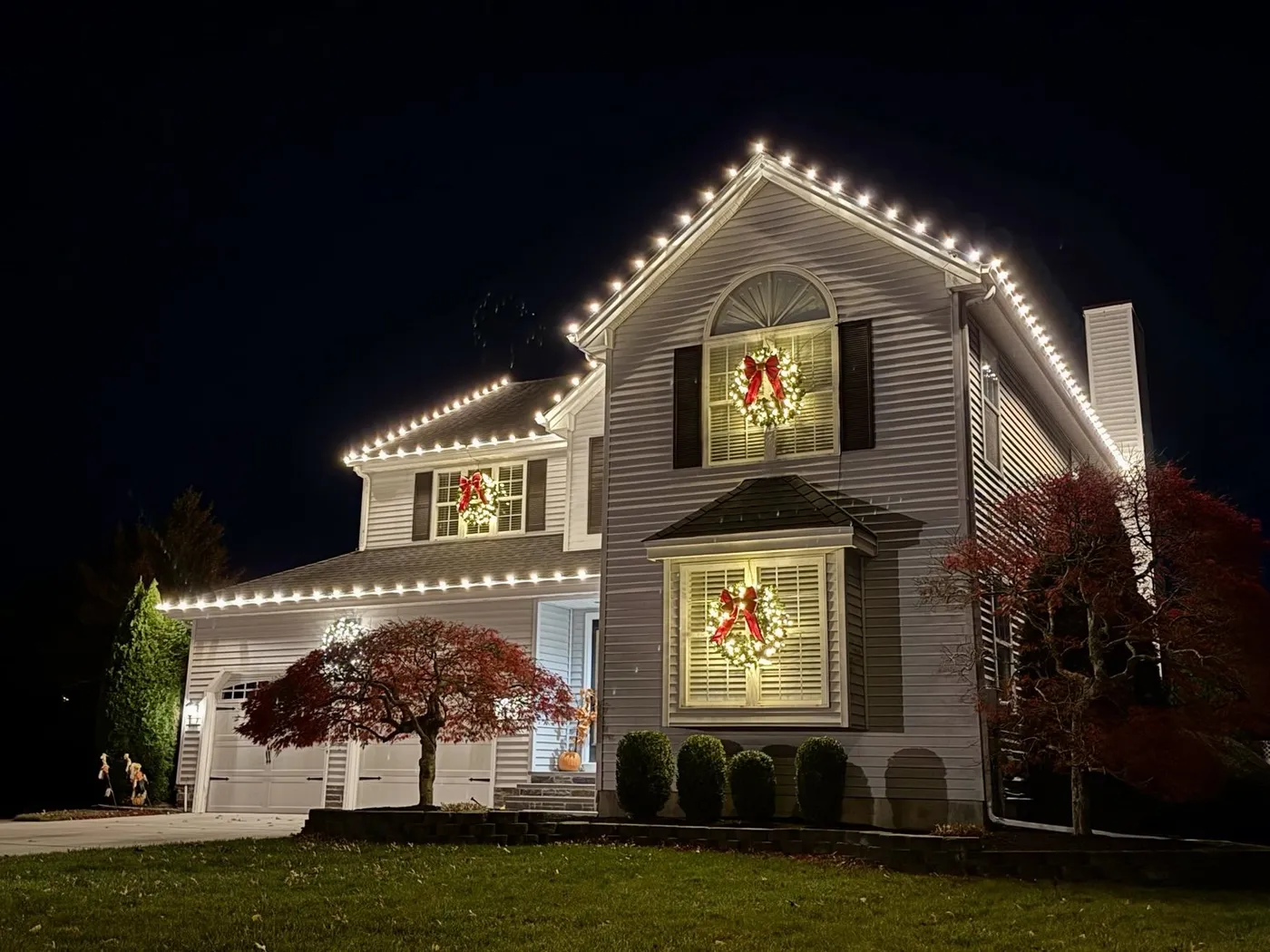
Home exteriors almost never have an outlet where you actually need one. Instead of stringing extension cords across the lawn, install a single outdoor outlet on a photocell timer near the front eave, then daisy-chain from there. It costs a licensed electrician roughly $200–$450, and it will outlive every strand of lights you buy for the next decade. Bonus: one switch kills the whole display on January 2 — exactly the kind of luxury you’ll appreciate when it’s 22 degrees out.
5. Color-Changing LED Strips Washing a Single-Story Facade
What makes this work is that the lights do two different jobs at once. The strip tracing the gable and roofline acts as a hard, graphic outline; the color wash on the siding and stone veneer is soft and diffuse. Hard edge plus soft field is an old lighting-designer trick — it gives you depth instead of a flat outline. The blue-purple-green gradient also reads cleanly because everything behind it is neutral: white-framed windows, muted stone, dark sky.
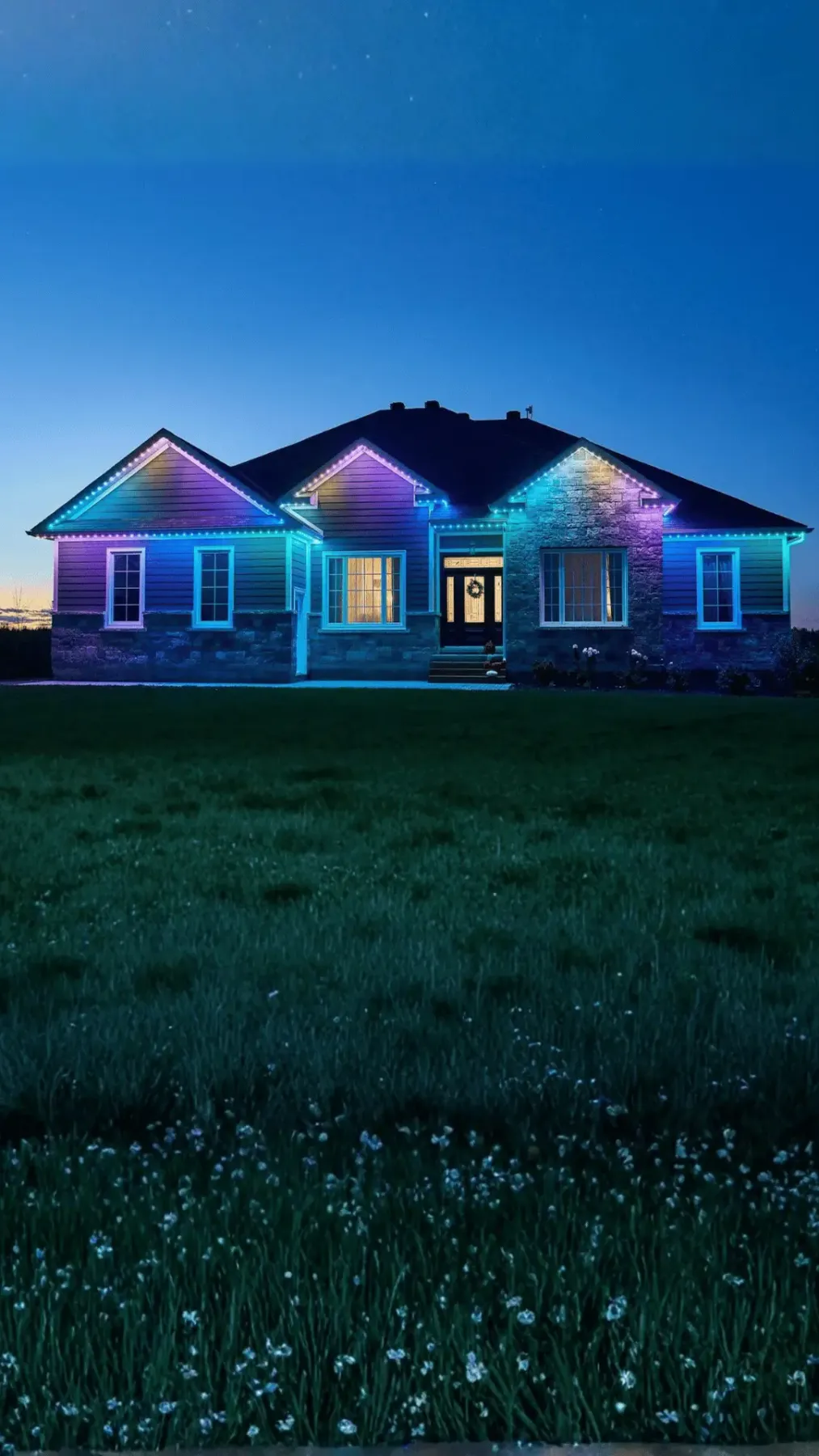
Addressable LED strips — the kind you control from an app and recolor on a whim — are the biggest shift in exterior holiday lighting since the move to LED itself. Searches for color-changing Christmas lights keep climbing because one $90 strip replaces four boxes of colored strands, and you can run warm white in November, purple on New Year’s Eve, and team colors for the game in between. It’s a trend with real staying power: the hardware keeps getting cheaper and the app ecosystems keep getting better.
6. Warm White Outlines With Lights Wrapped Around Evergreens
Wrapping small evergreens is the step people get wrong most often.
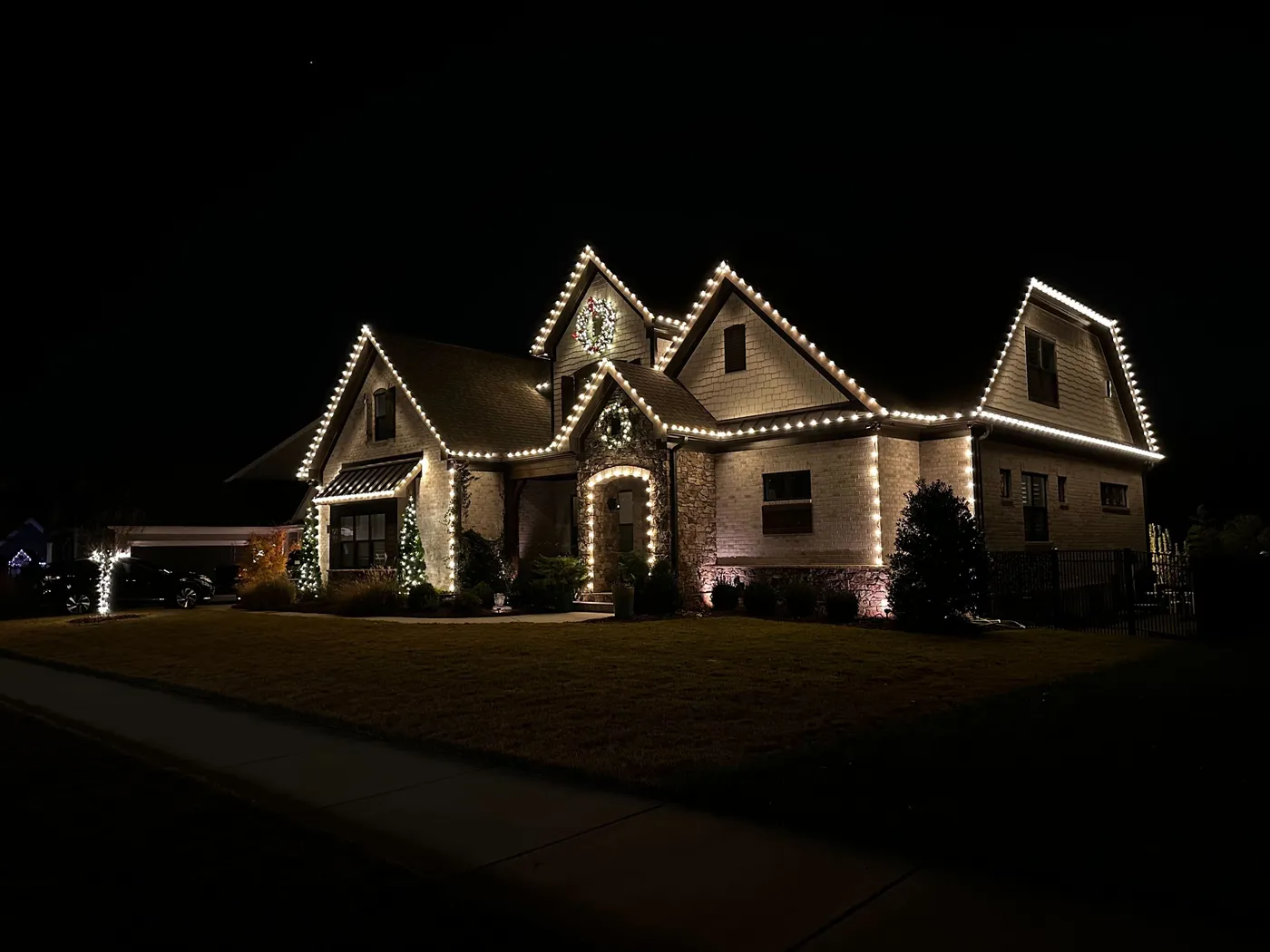
- Start at the trunk at the lowest point and tuck the first bulb where it won’t be seen.
- Spiral outward and upward, keeping 6–8 inches between passes.
- Push each pass slightly deeper into the branches so the strand doesn’t sit on the surface.
- Finish at the top, then run the lead down the back of the tree to the nearest outlet.
Time: about 20 minutes per 5-foot tree. Cost: one 100-count strand at $12–$20; a 6-foot tree takes two.
This look suits a wide facade — roughly 40 feet of frontage or more — because wrapped shrubs need room to read as separate glowing mounds rather than one bright blob. It also wants a front yard at least 12 feet deep so you can back up far enough to take in the whole composition. Working with a narrower frontage? Skip the shrubs entirely and concentrate everything on the roofline, the way Idea #16 does on a compact footprint.
7. Red and Green Rooflines Balanced by Warm Uplights
The warm white uplights are the unsung hero. Take them away and this becomes a house wearing a Christmas sweater — fun, but loud. With them, the rough stone veneer and light stucco walls pick up texture and depth, and the red-and-green outline reads as intentional rather than chaotic. The lesson: colored rooflines always need a neutral ground layer. Keep the uplights warm white, keep them aimed at the wall rather than the sky, and let the color live up top.
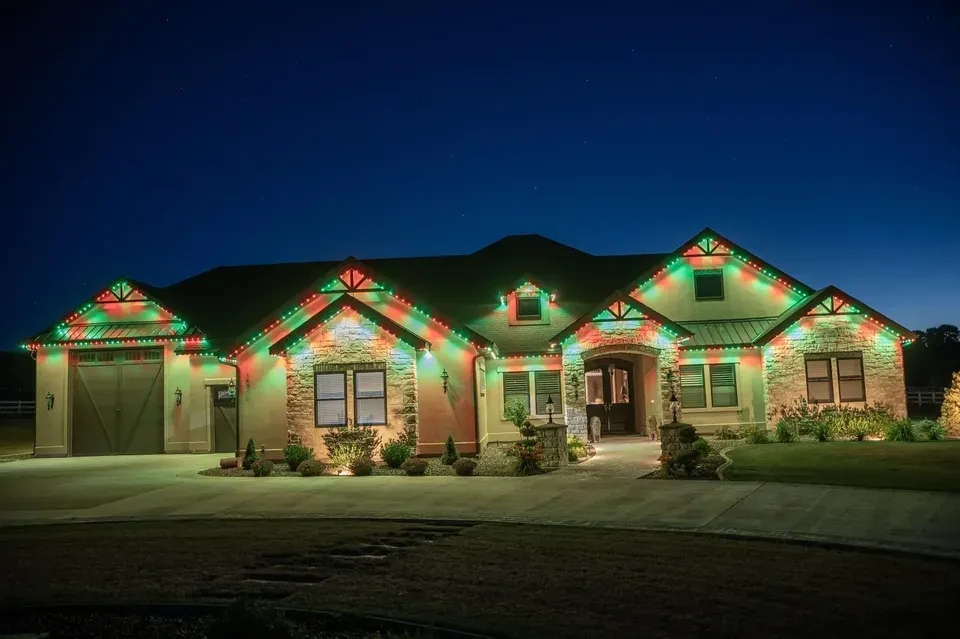
The formula here is roughly 40 percent colored light, 35 percent warm white uplight, 25 percent dark structure. That’s a heavier colored load than most houses can carry, and it only works because the greens and reds match in saturation — no pale pink-red sitting next to a true green. Want the same energy with less risk? Drop to 25 percent color, 45 percent warm white, 30 percent structure.
8. Outlined Windows and Glowing Shrub Mounds on Brick
The expensive version of this is custom-cut warm white strands sized to each window. The affordable version is 100-count LED sets at $12–$18 each, clipped to the window trim with adhesive-backed cable clips. Shrub mounds want net lights — $18–$25 per 4×6-foot net, and two or three nets will cover a decent foundation planting. Facebook Marketplace in mid-November is full of people selling last year’s display; nets and roofline strands often go for 40 percent off retail.
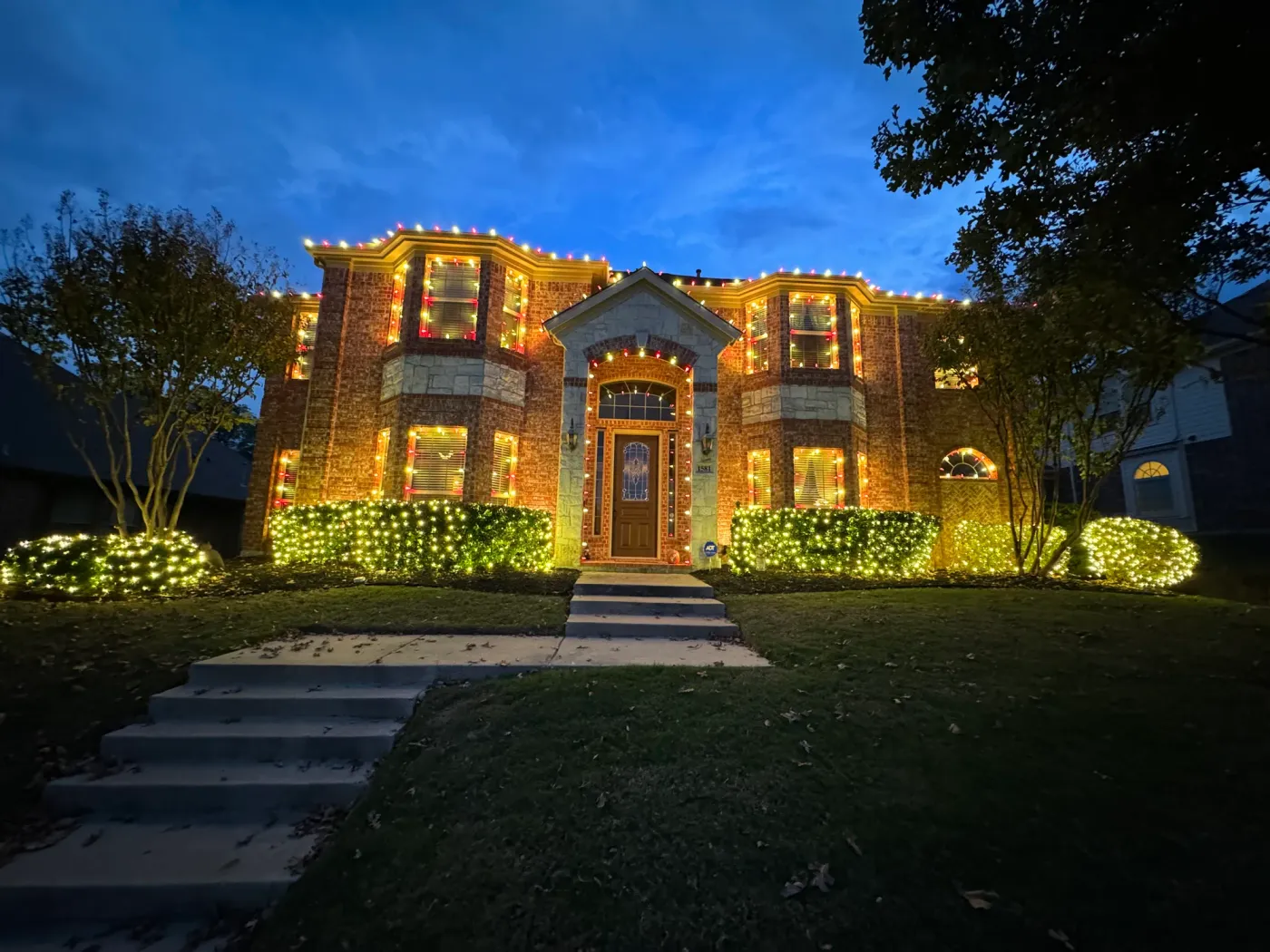
Net lights over shrubs look incredible for two seasons and then turn into a tangle you’ll dread. Budget on replacing nets every third year — the wiring inside the branches frays and moisture gets in. Dense coverage also holds snow and ice, which can snap thin branches. If you’d rather not deal with it, clip-on strands wrapped around a light garden obelisk give you the same glow with a five-minute teardown.
9. Blue Uplighting on Rough Stone With Red and Green Rooflines
Uplighting stone is all about the angle. Place fixtures 12–18 inches from the wall and aim them at roughly 30 degrees so the beam grazes the surface and every ridge and seam throws a small shadow. Aim them straight up and you get a flat blue rectangle. For this cool look, use a 4000K–5000K fixture — anything warmer turns the stone muddy next to red and green rooflines.
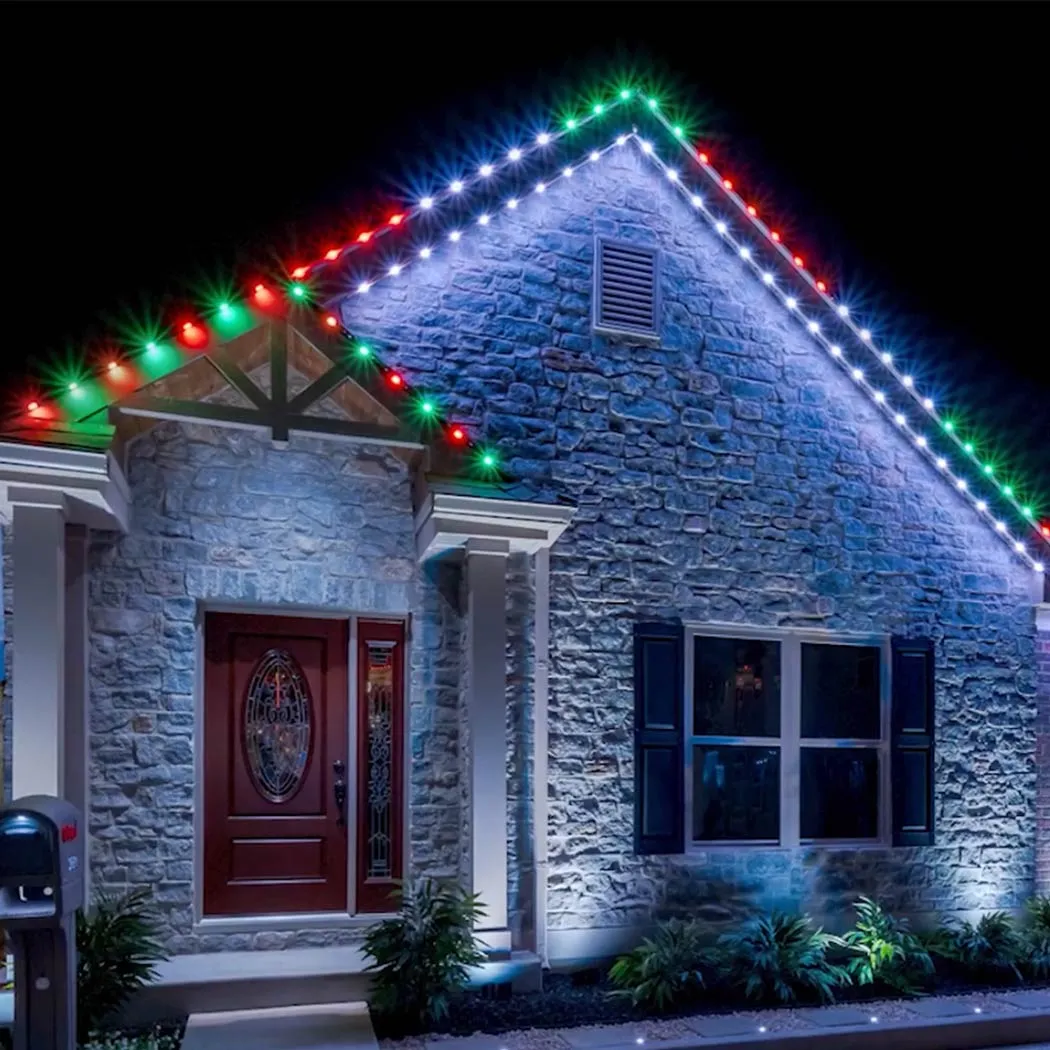
Cool uplighting against warm-colored rooflines is a deliberate temperature clash, and that’s the point: the blue makes the stone look carved, while the red and green keep the display squarely in holiday territory. Notice the white strand running across the main gable — it works as a neutral bridge between the two color temperatures so the facade doesn’t split in half. If you try this and something feels off, the fix is almost always adding that bridge.
10. A Grand Warm White Outline With Draped Foundation Shrubs
Realistic numbers for a house at this scale:
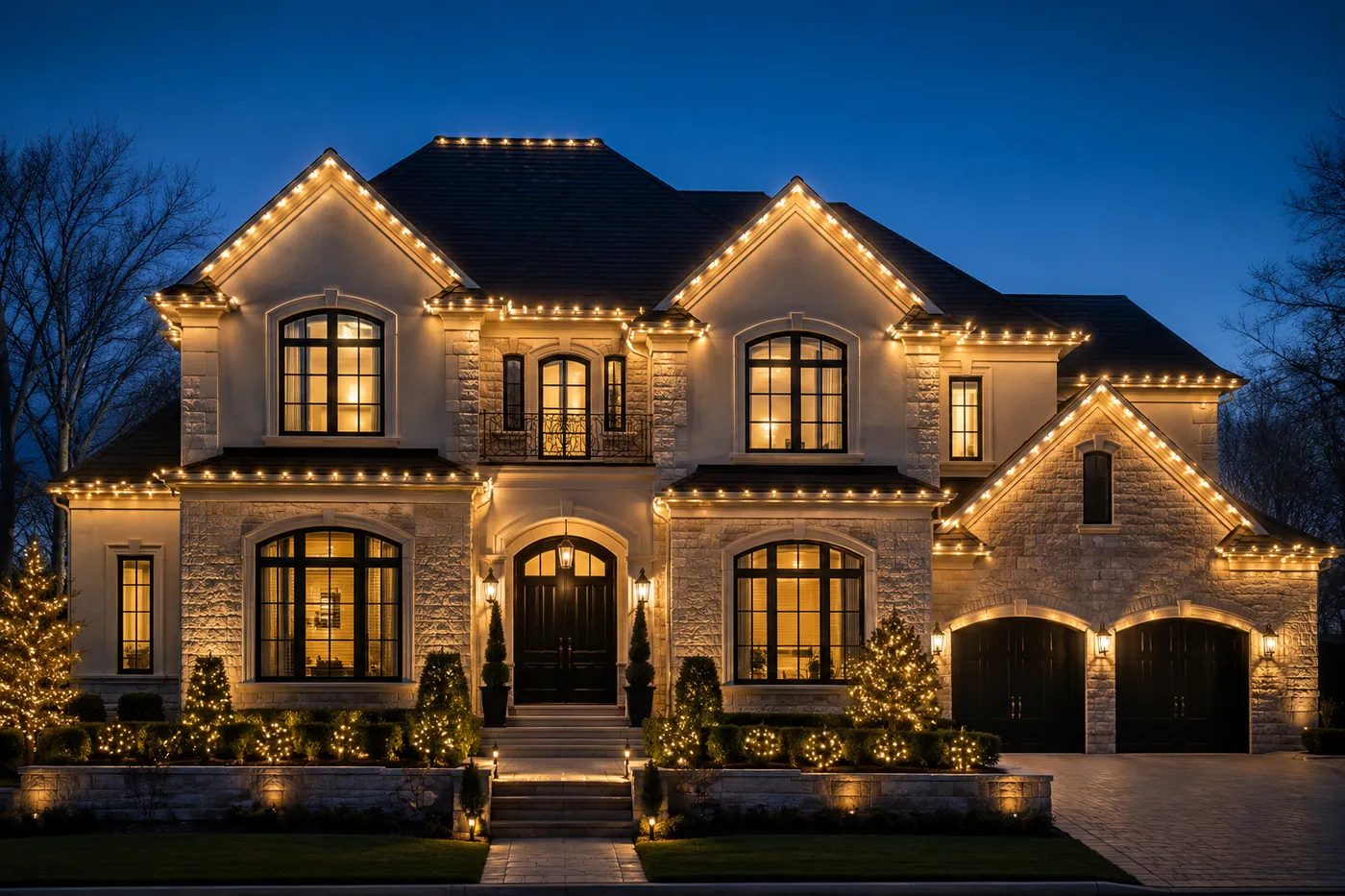
- Roofline and eave strand, 300–400 ft: $180–$360
- Draped shrub and small tree lights: $90–$200
- Ground uplights, 6–10 fixtures: $180–$420
- Transformers, timers, cords: $70–$150
Budget alternative: skip the uplights this year and put that money into the roofline — a clean outline on a big house carries more presence than half-lit landscaping.
Grand outlines need real square footage to breathe. Plan on at least 55–60 feet of frontage and a facade height of 25 feet or more; below that, the same density starts to feel cluttered rather than majestic. A generous setback helps too — 35 feet from house to street lets a passerby take in the whole silhouette at once. If your house is smaller, look at Idea #2, which gets a similar warmth with far less roofline to cover.
11. A Conservatory Courtyard With Purple and Green Tree Lights
Garden and conservatory light shows have quietly become the holiday outing of the decade — timed-entry tickets, sold out by Thanksgiving, hot cocoa in hand. That popularity is filtering back into home gardens: people come home from a botanical garden and want purple and green in their own trees. The upside is that colorful architectural lighting now feels sophisticated rather than tacky. The catch is that a garden designed for color needs structure in daylight too, so plan the planting, not just the lights.
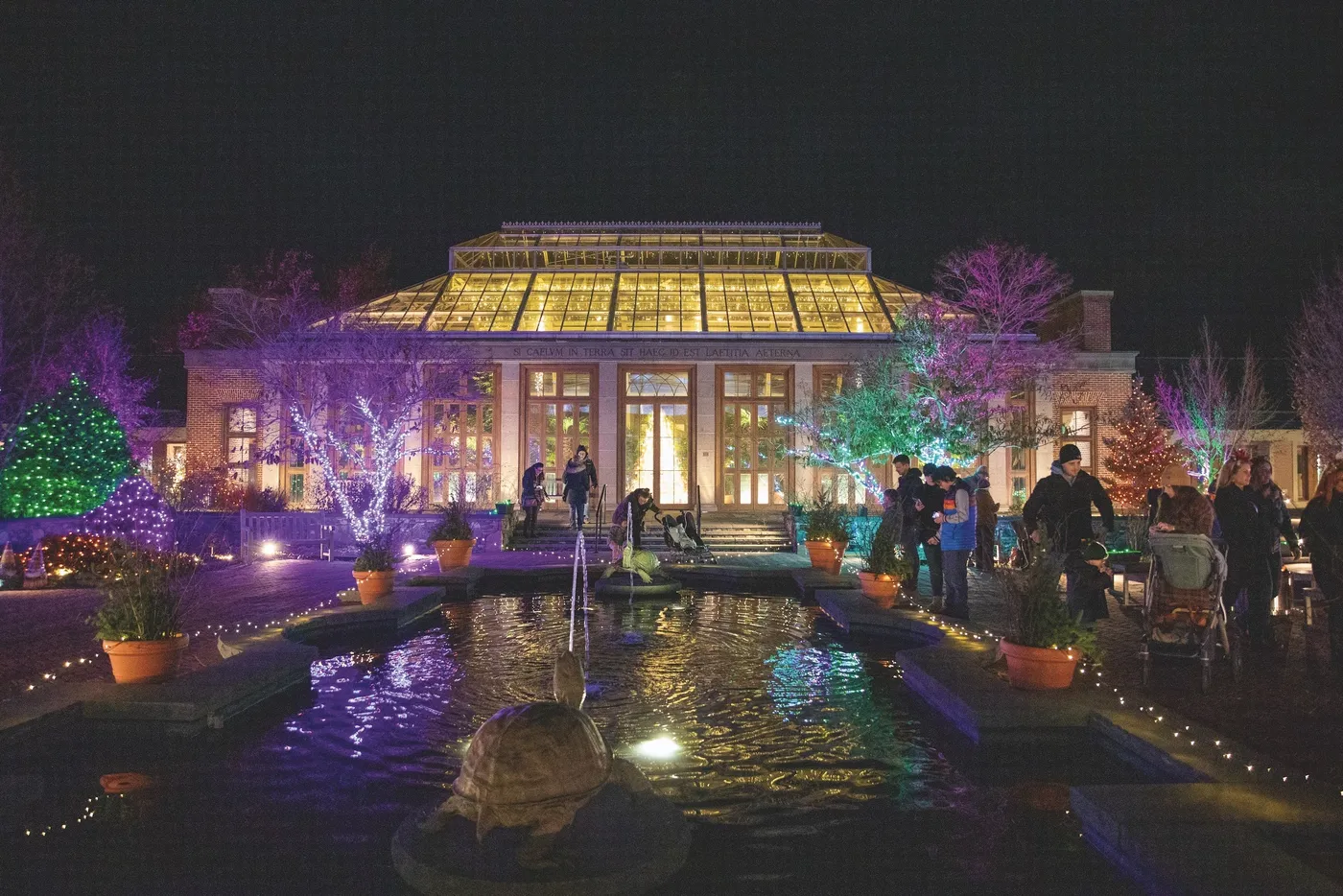
The water is the one element you can’t fake. The fountain, the pool, and the small ground-level strands tucked along the water’s edge double every light in the scene through reflection. If your yard has a pond, a birdbath, or even a wide shallow planter you can fill, put lights near it — the reflection is free, and it’s the difference between pretty and genuinely magical.
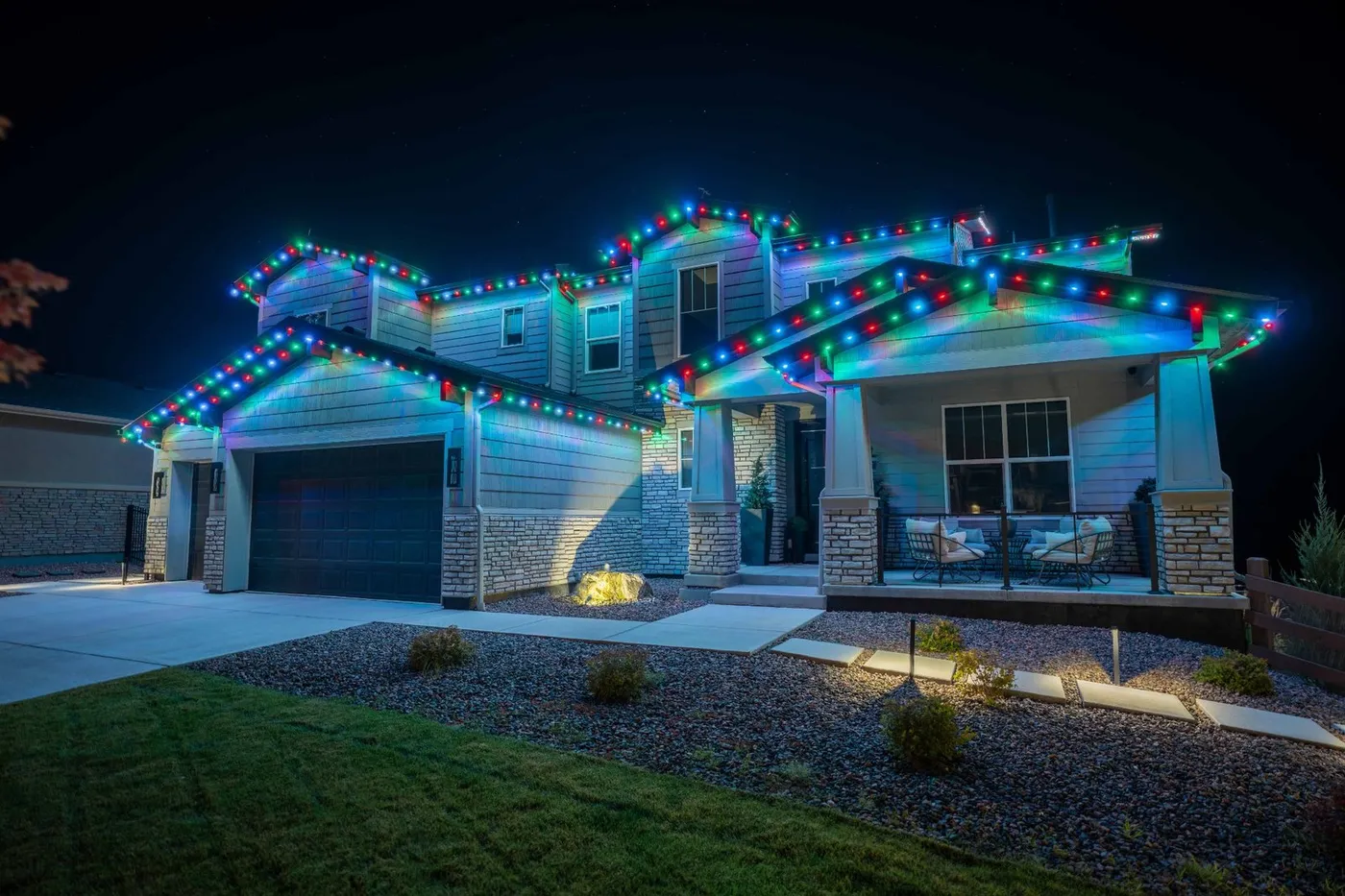
12. Red, Green, and Blue Lights on a Modern Gray Facade
Three-color multicolor is the hardest palette to keep from looking like a carnival. The rule: the more colors you use, the more uniform your bulb spacing and strand style has to be. Don’t mix C9 multicolor with mini multicolor on the same roofline — the size difference makes it look accidental. Also check white balance: cheap multicolor sets vary wildly between boxes, so buy every strand in one order, from one brand, in one season.
Modern gray siding is forgiving, which means the budget version works fine here. 100-count multicolor LED sets run $14–$20 each, and a two-story front with eaves and a garage needs roughly 10–14 sets — so $150–$280 all in. Add a $25 outdoor timer and you’re done. If you want the color without committing to a fixed palette for the entire season, addressable strips let you change the whole scheme from your phone.
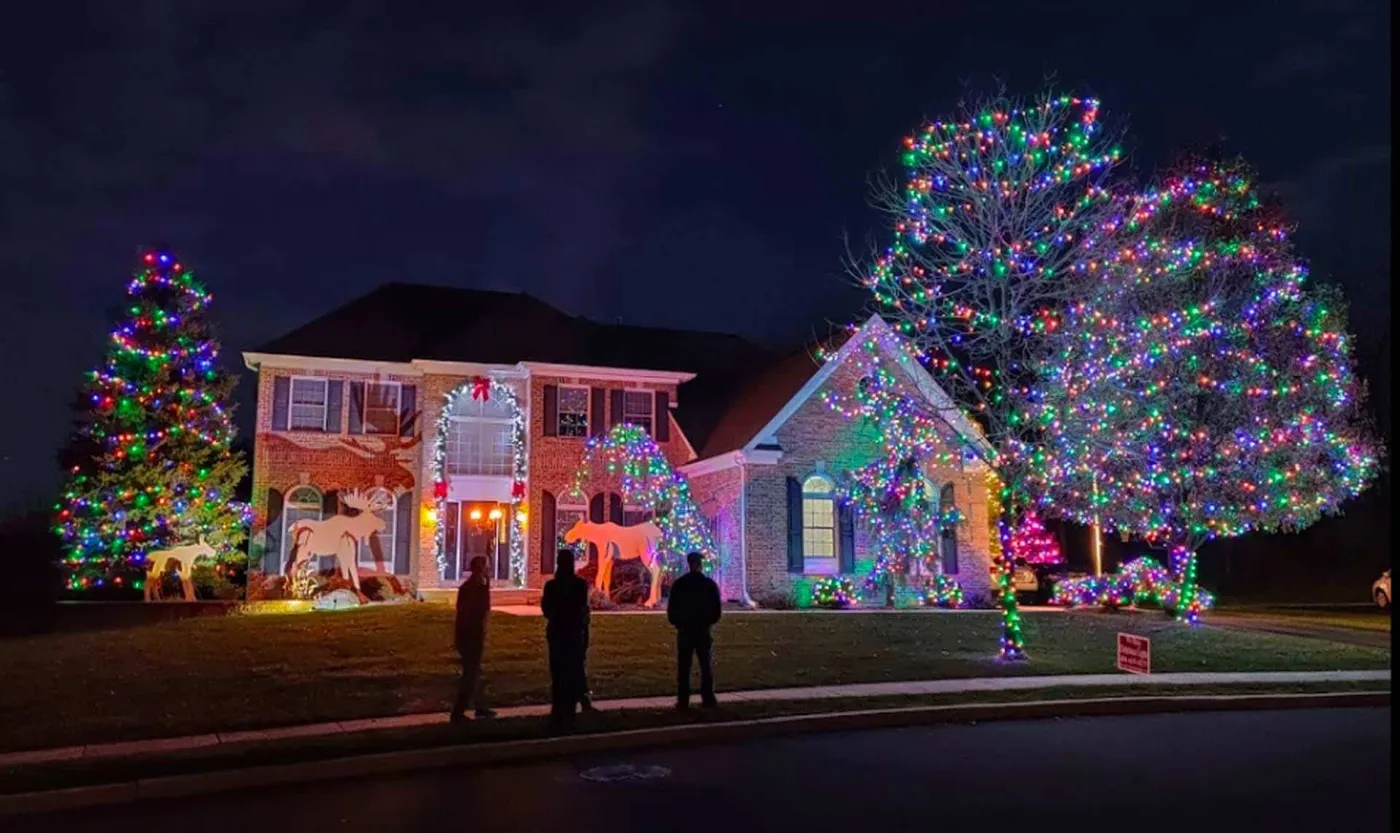
13. Multicolor Lights, Lit Trees, and Reindeer Cutouts
Lighting a large deciduous tree is easier than it looks.
- Wrap the trunk first, spiraling up about 8 feet.
- Then follow the four or five main limbs outward, wrapping each one to its tip.
- Use zip ties at the branch crotches so strands don’t slide down in wind.
- Finish with a few strands thrown loosely through the outer canopy for sparkle.
Time: 2–3 hours for a mature tree. Cost: 8–12 strands, roughly $100–$200.
Cutout figures need to be lit from the front and spaced so they don’t compete. Keep them at least 6 feet apart, orient them all facing the same direction (usually the street), and drive the stakes in at a slight angle so wind doesn’t lay them flat. A single ground-stake spotlight aimed at the group from 10 feet back will make cheap plywood silhouettes look far more expensive than they are.
14. Green and Warm White C9 Lights Along Gutters and Trim
Treat this one as a three-part formula: about 60 percent warm white, 30 percent green, and 10 percent white trim and gutters doing the structural work. The alternating pattern only reads clearly against a light trim line, so if your gutters are dark, flip the ratio and let warm white lead. Color swaps are easy here — green becomes red for a candy-cane look, or cobalt for a cool modern take, and the warm white base holds it all together either way.
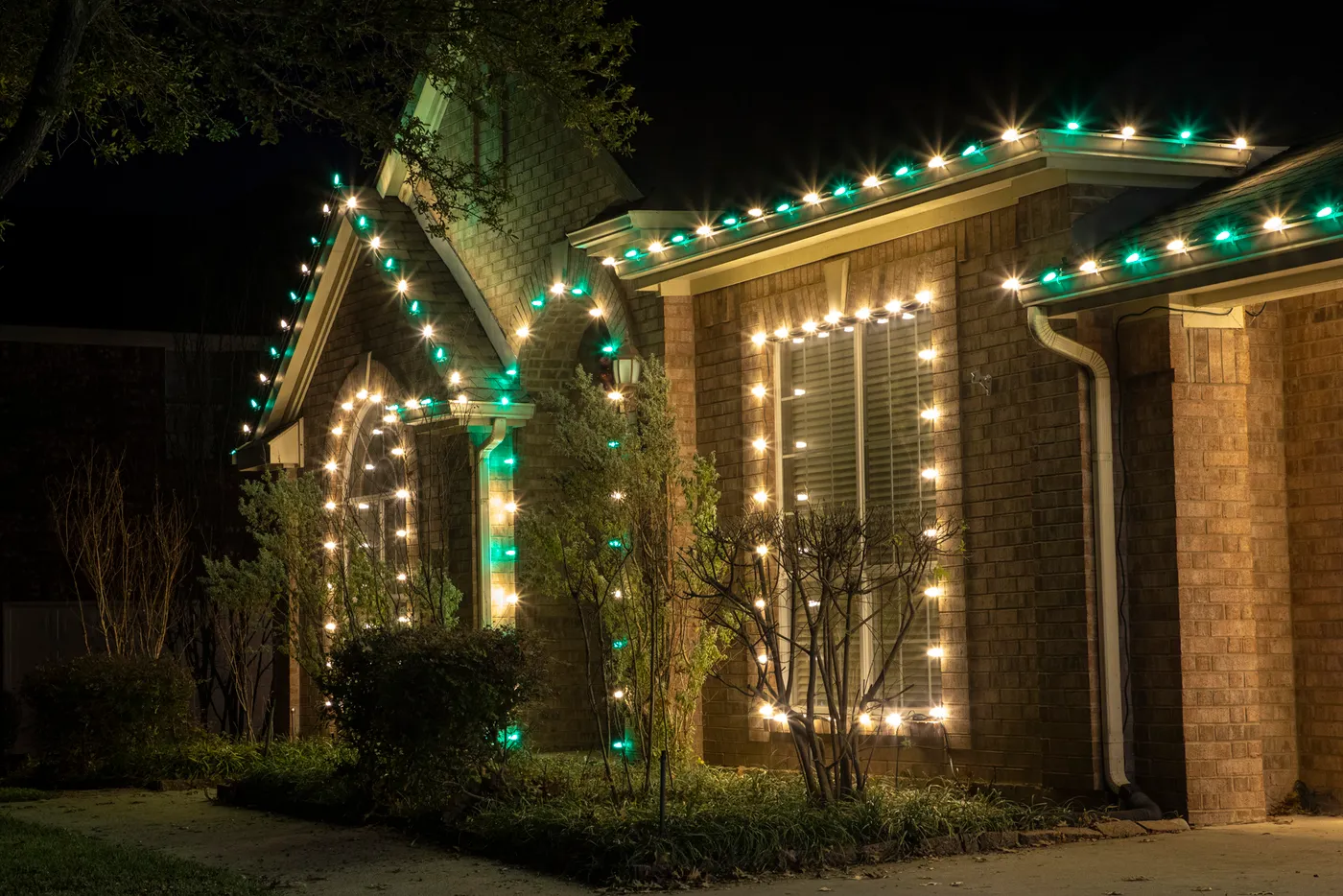
- Measure the gutter run and count every clip point — C9 clips are not interchangeable between gutter sizes
- Confirm you have a GFCI-protected outdoor outlet within reach of the run
- Check your ladder height against the actual gutter line, not the roofline
- Decide the alternation pattern before you climb, not while you’re up there
15. Projector Motifs on the Facade With Porch Red and Green
A projector works because it gives you a moving, illustrated layer without a single staple in your siding. It also solves the scale problem — large motifs read from a distance on a big blank facade where string lights would simply disappear. The porch below stays traditional with red and green strands and garland, so you get modern spectacle up top and nostalgic warmth down low. That contrast is the whole trick.
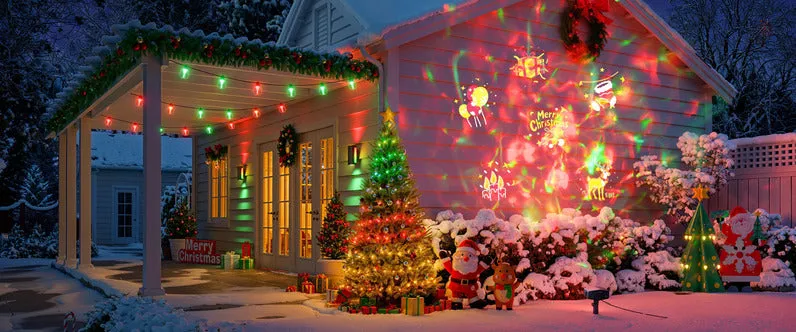
- Outdoor holiday projector: $60–$200
- Red and green porch strands plus garland: $70–$150
- Two lit trees with star toppers: $90–$220
- Figures, wreaths, and gift boxes: $80–$250
Budget alternative: projector plus porch garland only — about $140.
16. C9 Bulbs Tracing Every Gable of a Big House
Multi-gabled houses have far more roofline than owners expect — count every peak, valley, and return, then add 20 percent. A four-gable facade commonly runs 350–450 linear feet. You need C9 on 12-inch centers to keep the line legible at that distance.
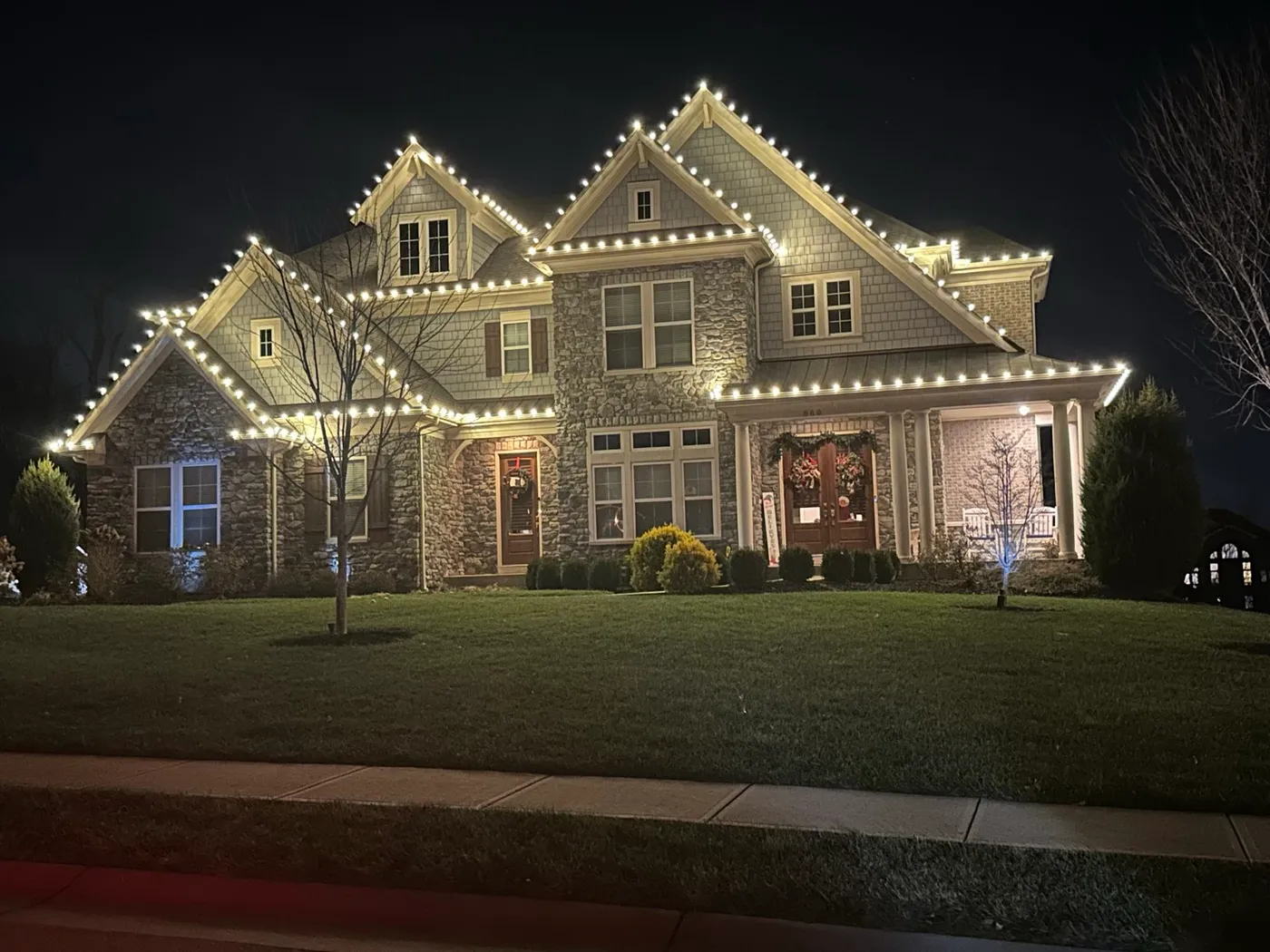
- Frontage: 45 feet or more
- Facade height: 22–30 feet
- C9 strand needed: 400–500 feet
- Best viewed from: 40+ feet back
On a smaller house, Idea #21 achieves the same warm-white precision at a fraction of the length.
The lit bare tree in the front yard is what saves this from being all outline and no soul. A house lit only along its edges can feel like a line drawing; the tree adds a soft, irregular, organic shape that breaks the geometry. Even one mature bare tree, wrapped on the trunk and main limbs, changes how the whole composition reads from the street.
17. Red, White, and Blue Rooflines With Warm White Uplights
Red, white, and blue strands are notoriously mismatched between brands — the red in one set runs orange next to another brand’s true red. Buy all three colors from the same product line, and if you can’t, test them lit on the driveway before committing to a pattern. One more thing: run blue on the gable peaks and red on the long horizontal runs. Vertical accents read as deliberate; long horizontal runs of blue read as a mistake.
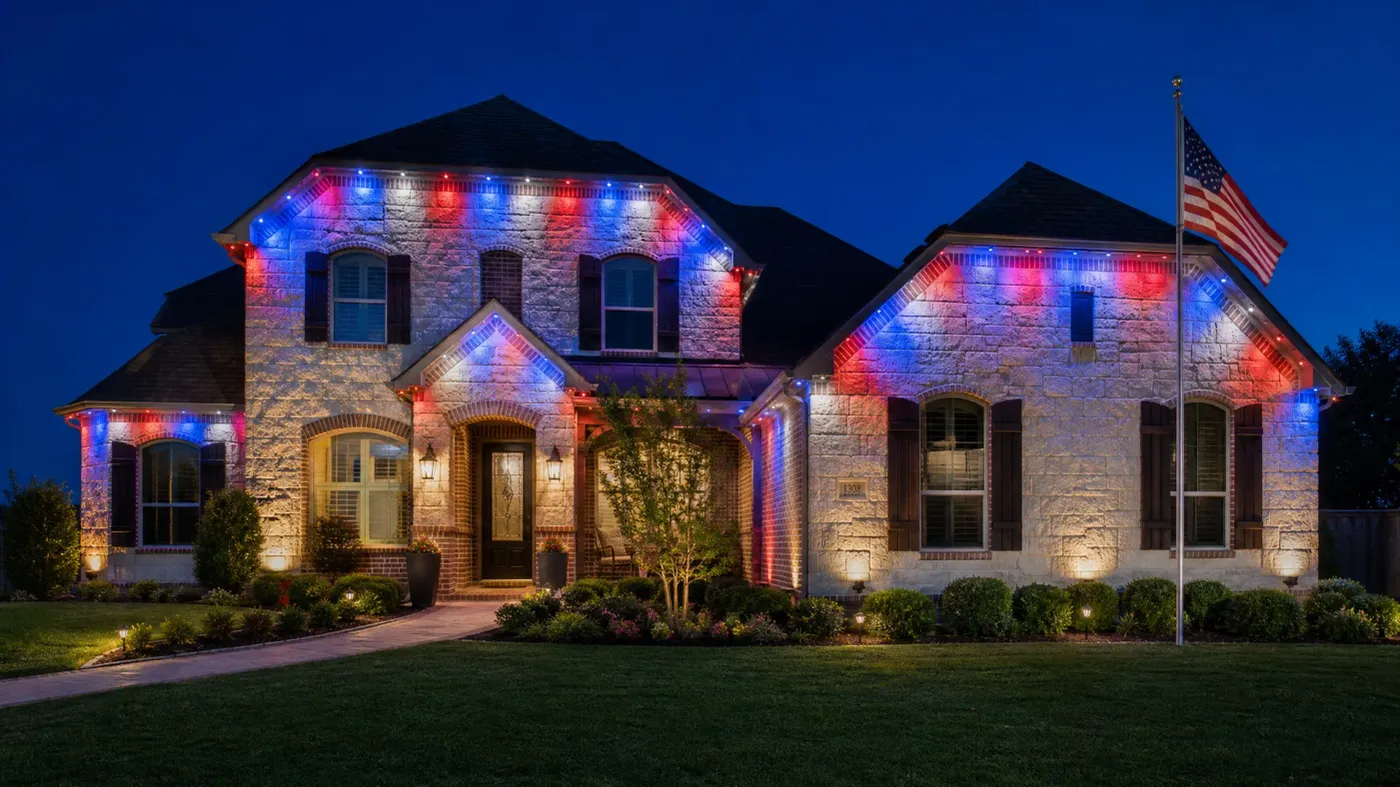
Patriotic exterior lighting isn’t new, but it’s grown into a legitimate year-round category — flags in summer, and increasingly a red-white-and-blue scheme for households that want festive without full-on Christmas. It’s a smart choice for anyone who decorates early or leaves lights up into January, because the palette works from Memorial Day through New Year’s without ever looking out of season.
18. A Porch Railing Draped in Warm White With Potted Evergreens
Porch railing draping is a 30-minute job if you work in the right order.
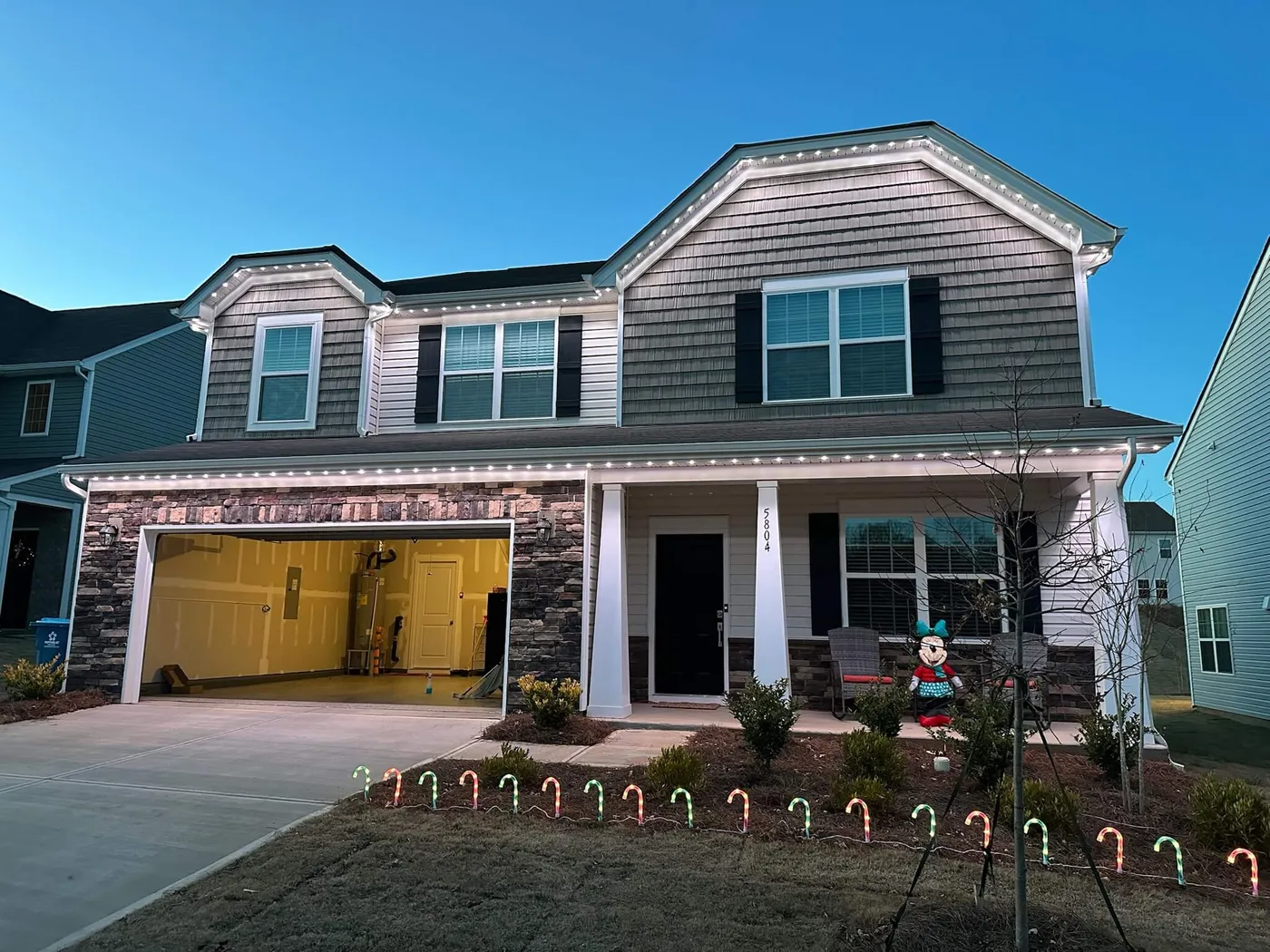
- Zip-tie the strand to the railing at the top of the stairs, leaving a 3-foot lead.
- Swag the strand in shallow loops every 18 inches — deeper swags look sloppy up close.
- Secure each swag point with a clear zip tie, never a nail.
- Wind the same strand up through the potted evergreens, then tuck the plug behind the pot.
Time: 30–45 minutes. Cost: 2–3 strands, roughly $35–$60.
Porch lights are where pet and kid reality hits hardest. Loose draping at hand height gets pulled, chewed, or used as a jungle gym. Keep swags above 40 inches on railings, run the cord along the inside face where it’s least visible and least reachable, and choose a strand with a fused plug. Also confirm your porch outlet is GFCI — damp wood plus a cheap extension cord is the most common cause of holiday electrical issues.
19. Blue and Red Rooflines With Uplit Bare Trees
Blue and pink lighting usually means color-changing fixtures, but you can get this look for a lot less. A pair of RGB floodlights on ground stakes runs $30–$50 each and will wash a bare tree beautifully; add $60–$100 in blue and red string light sets for the roofline. Total: $120–$200 for a front yard that looks like a light show. Thrift stores and Buy Nothing groups are goldmines in the first week of January.
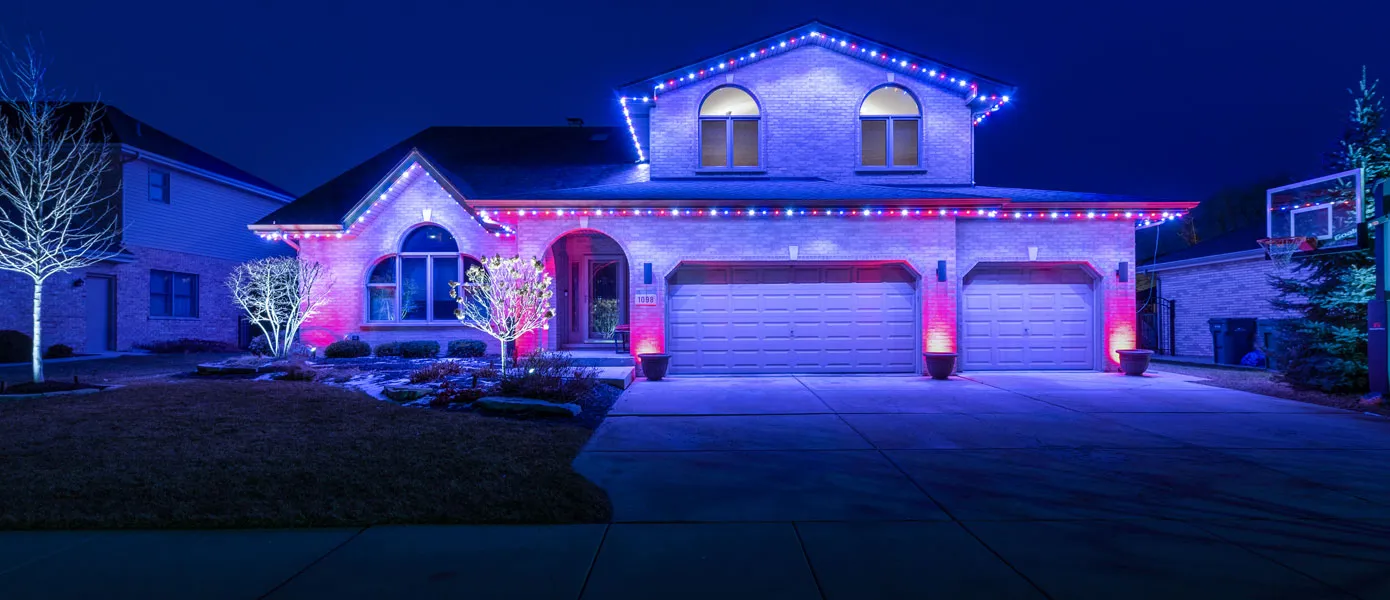
- Photograph your house at night before you buy anything — you’ll see what actually needs light
- Count your outlets and confirm GFCI protection
- Test floodlights on the ground before staking them
- Set a firm budget, then subtract 20 percent for cords and clips
20. Green, Blue, and Purple LEDs Outlining a Dark Siding Home
Addressable RGB strips are tougher than they look, but not indestructible. The adhesive backing fails in freeze-thaw cycles, so use the mounting clips and add a bead of exterior silicone at each end. Expect the controller to be the first thing to die — usually around year three — so buy a system with a replaceable one. Budget $40–$70 every few years for replacements, and store the strips indoors over summer to get a full decade out of them.
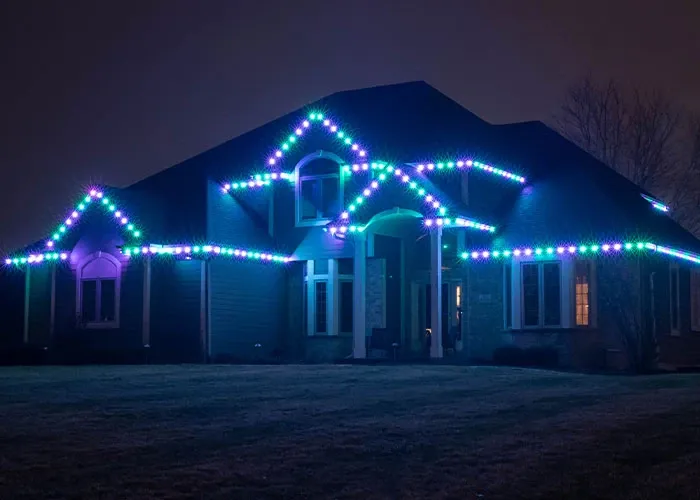
Dark siding is the ideal backdrop for saturated color — there’s no competing undertone, so green, blue, and purple come through clean and jewel-like. The alternating pattern along the rooflines also creates a rhythm that makes a fairly plain two-story box look architecturally interesting. Notice the arched window outlines: following an arch with light is much harder than following a straight eave, and it’s what makes the facade feel designed rather than decorated.
21. Warm White Window Frames Plus Wrapped Trees
Where the budget lands on a house like this:
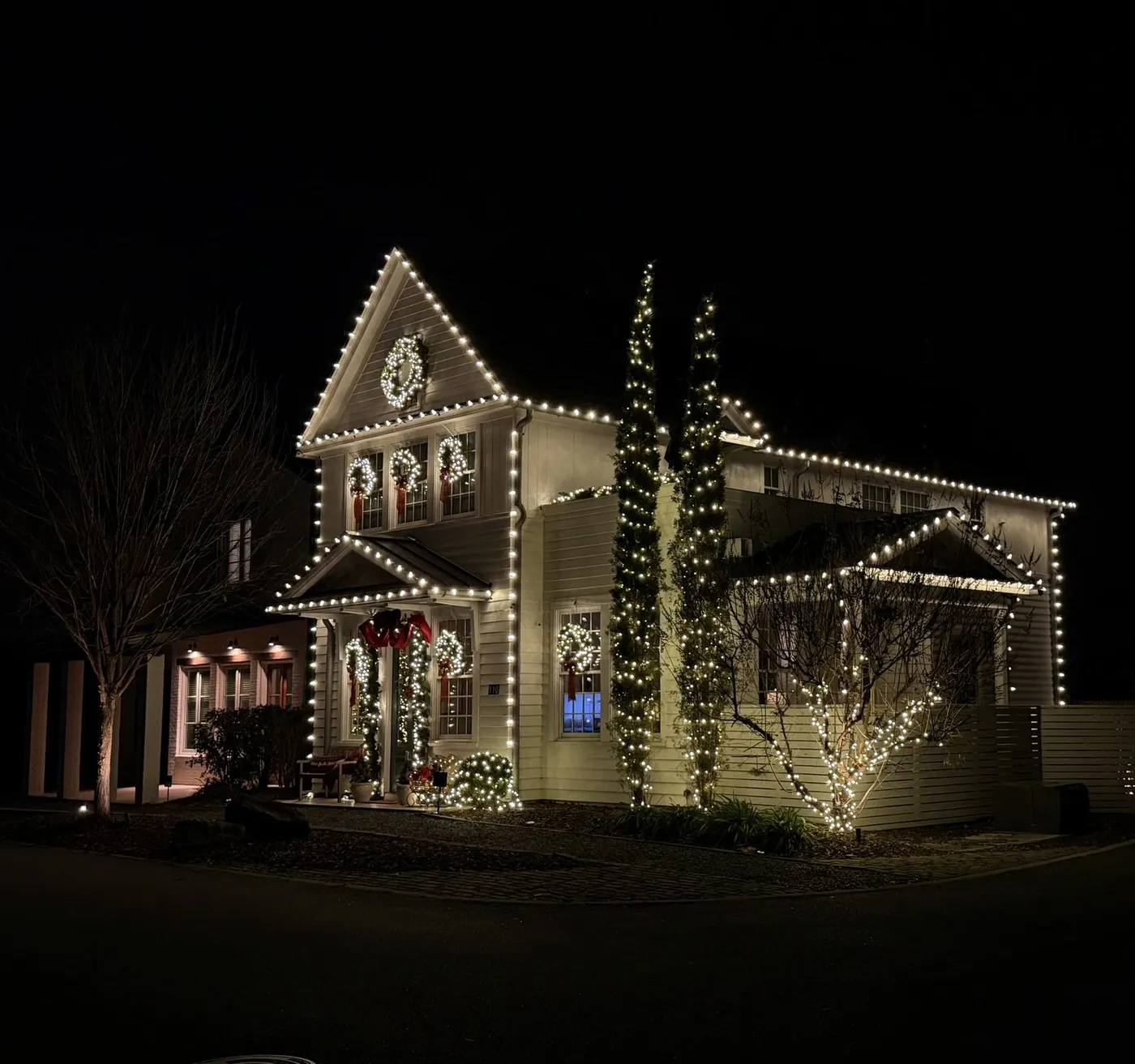
- Roofline, eave, and window frame strands: $150–$320
- Wrapped trees and bushes: $110–$260
- Wreaths with red bows, 4–6 of them: $140–$360
- Cords, clips, timers: $50–$110
Budget alternative: rooflines plus two wrapped trees only — around $220.
Outlining window frames is fussy work, and the trick is to clip rather than wrap. Use adhesive-backed cable clips on the trim face, one every 12–16 inches, and run the strand in a single continuous loop around the frame — never cut and re-splice. If your trim is dark, choose white or clear cord; black cord on white trim is the fastest way to make an elegant house look unfinished.
22. Light Stakes, Cone Trees, and a Sleigh in the Sky
The Santa sleigh in flight is the anchor of this entire yard. Everything else — the light stakes, the cone trees, the characters — is supporting cast, and without one tall element pulling the eye upward it would be a flat field of light. Whatever your theme, give the display one tall, unmistakable focal point and arrange everything else around it in descending height.
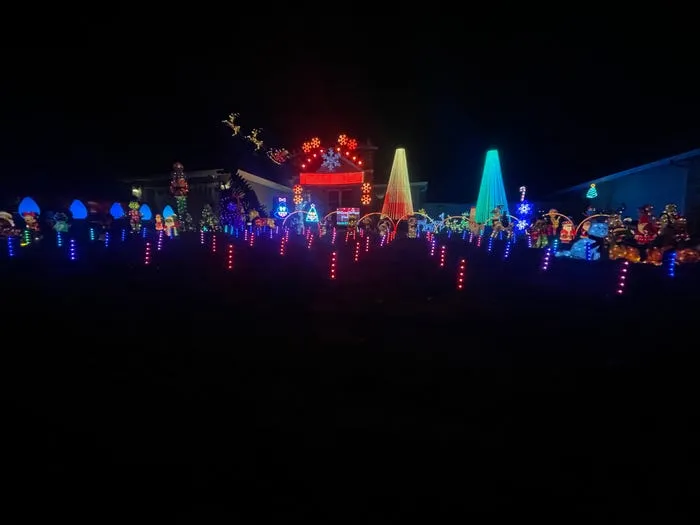
Rows of light stakes are the fastest way to cover a big yard.
- Lay out a string line or garden hose to mark the row before you push a single stake in.
- Space stakes 3–4 feet apart so the row reads as a line, not a crowd.
- Push each stake to the same depth — a level helps more than you’d think.
- Run the connecting cord along the back of the row, hidden by the light itself.
Time: about 15 minutes per 40-foot row. Cost: $1–$3 per stake.
23. Green Wall Wash With a Single Purple Uplit Pillar
Two-color schemes live or die on balance. One purple-lit pillar against an otherwise green house is a deliberate accent; two purple pillars would make it a purple house with green trim. Before you buy, decide which color is the star. Be honest about your landscaping too — gravel and rock yards bounce a lot of light back, so green wall wash can turn the whole front yard slightly sickly if the fixtures are too strong. Dim them to about 40 percent.
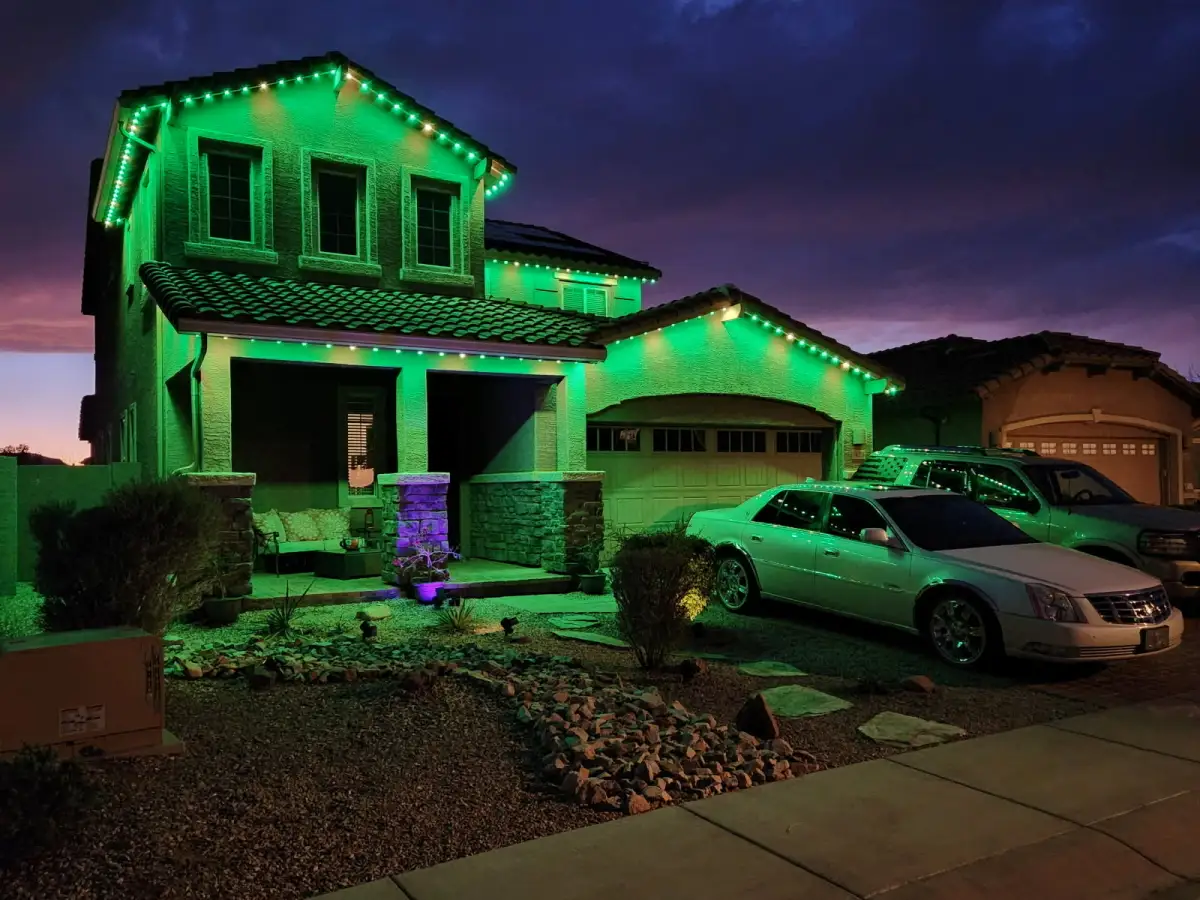
This approach loves a house with one strong architectural feature — a stone pillar, a chimney, an arch — because that’s what earns the accent color. Figure on 30–40 feet of frontage minimum, with a facade that has at least one visual break. If your house is a flat rectangle, Idea #9 shows how a textured stone wall can carry color instead.
24. Blue and White Lights on Snow-Dusted Evergreens
Cold palettes need a warm counterweight or they read as pure ice. Here it’s roughly 45 percent white architectural outline, 35 percent blue tree lights, 15 percent white snow bounce, and 5 percent red tucked into the garden bed for a heartbeat of warmth. Remove that last 5 percent and the house turns frigid. If you want the same formula with a different mood, swap blue for warm gold and red for copper.
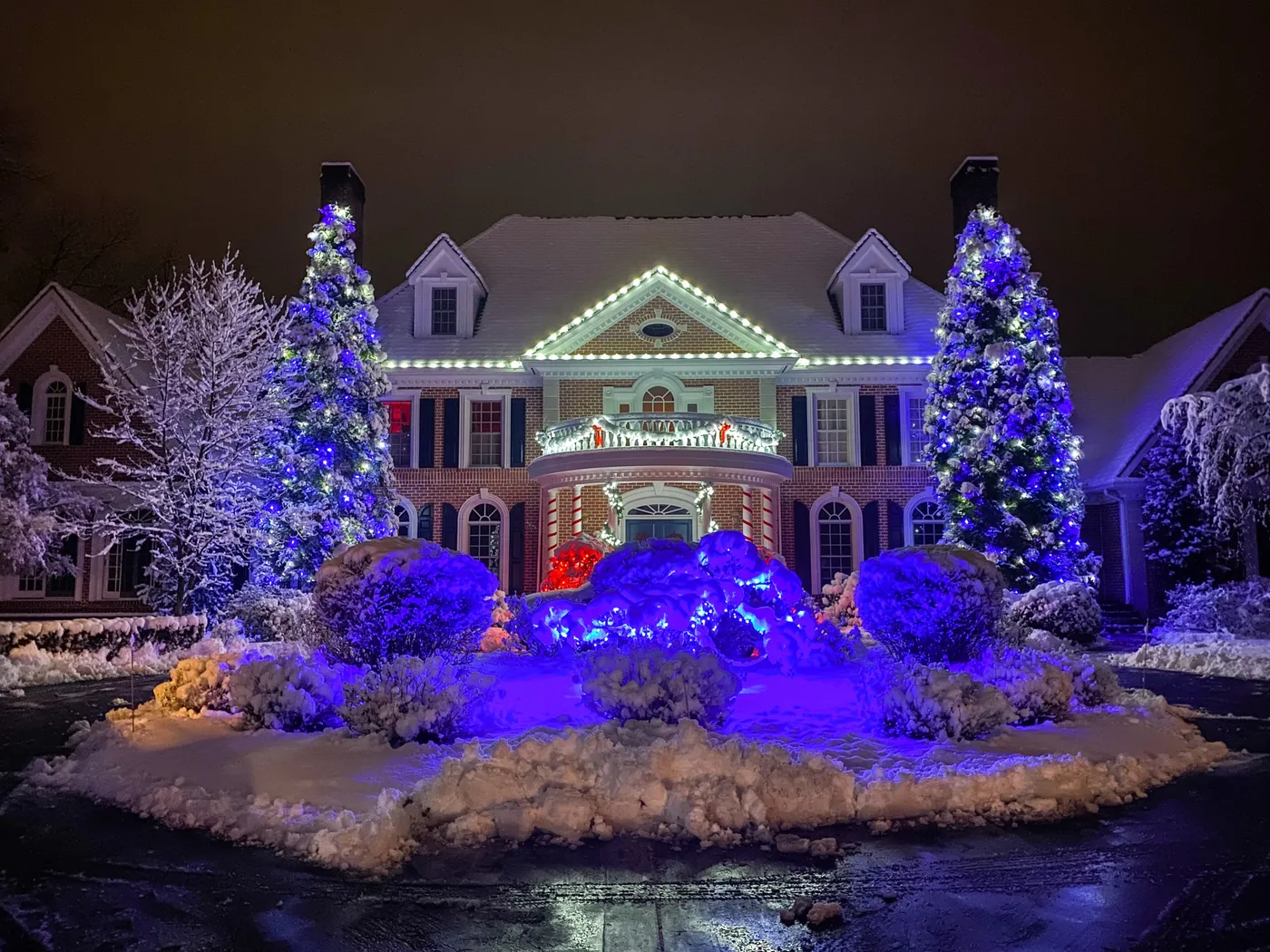
Blue-and-white is one of the cheapest sophisticated palettes to buy because both colors are stocked everywhere. 100-count blue sets run $10–$16; white sets $12–$18. Two 8-foot evergreens take about 12 strands between them, so $150–$200 covers the trees alone. Pair with $80–$120 of white roofline strands. The candy-cane porch columns are the sleeper budget win — a $12 roll of red-and-white striped ribbon wrapped around each column gets you there.
25. One Bare Tree, Densely Wrapped in Warm White
- Measure the trunk height and the length of every main limb you plan to wrap
- Confirm outdoor outlet distance — you’ll need a long, heavy-gauge cord
- Check for brittle or dead limbs before you climb anything
- Buy uniform strands from one brand and one season
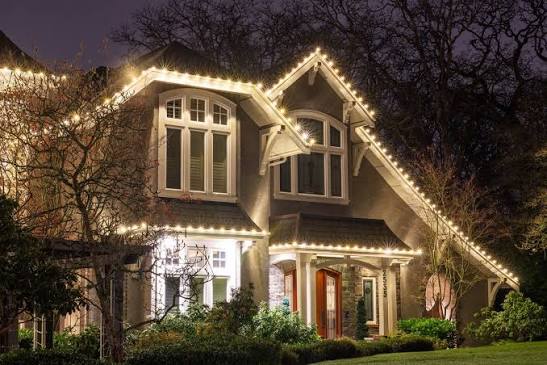
Density is everything with a bare tree. A lightly wrapped tree looks like a spiderweb; a densely wrapped one looks like it’s glowing from inside. The rule of thumb is roughly 100 lights per vertical foot of tree, so a 20-foot bare tree wants close to 2,000 bulbs. Warm white is the right call here because cool white on bare branches reads as harsh, while warm white throws that soft amber glow that makes snow look lit from beneath.
26. Neon Blue and Purple Strips With Teal Stair Risers
Linear LED — the kind that runs in a clean, unbroken line along an architectural edge — is the defining look of mid-2020s exterior lighting. It’s popular for the same reason it’s effective: a solid line reads as modern and intentional where a strand of bulbs reads as traditional. The stair-riser detail is the newest wrinkle, borrowed from commercial landscape design, and it turns a purely decorative feature into something genuinely useful on ice.
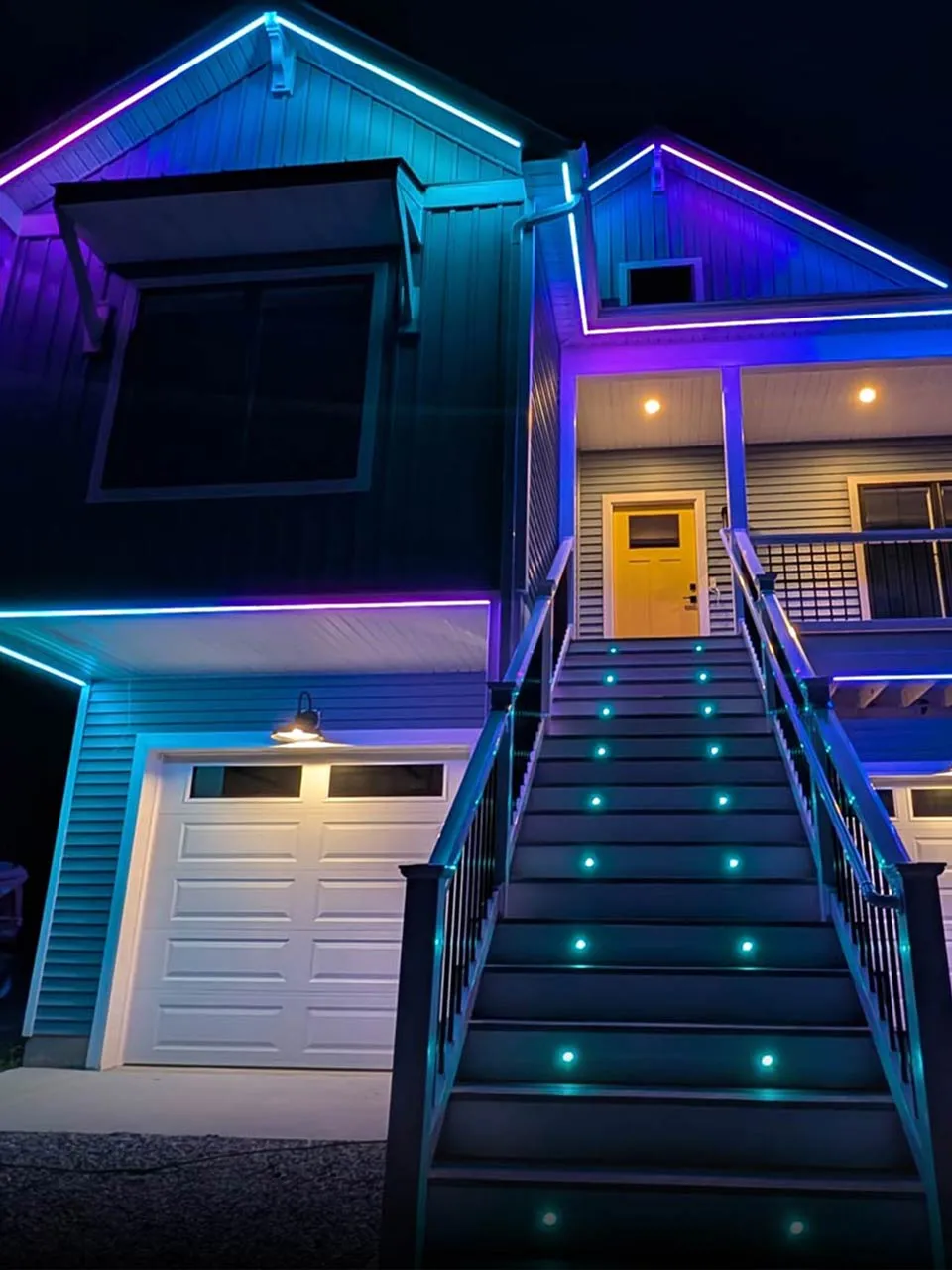
Linear strip is unforgiving about straight lines. Any wobble shows up a hundred feet away, so mount a slim aluminum channel first and clip the strip into it — the channel costs about $2–$4 per foot and it’s what separates a professional install from a weekend job. Don’t run blue and purple alternating on the same strip unless the controller supports per-segment addressing; plain alternating strips tend to shift toward pink as they warm up.
27. Pink and Blue LED Strips on White Vertical Siding
Mounting linear strip on vertical siding takes one extra step.
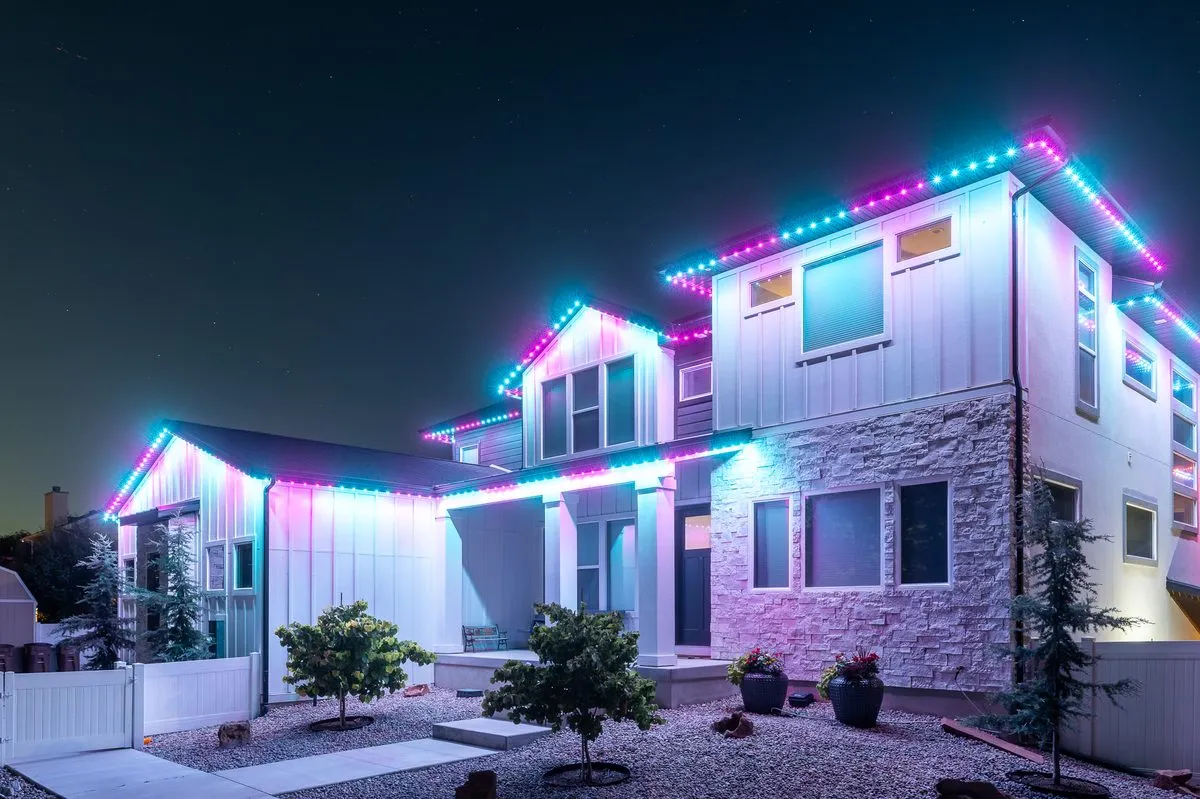
- Wipe the siding down with isopropyl alcohol and let it dry completely.
- Screw or clip the aluminum channel to the siding, not the trim, at the roofline edge.
- Press the strip into the channel, then seal both ends with clear exterior silicone.
- Bring all runs back to a single controller mounted inside the garage or on a protected wall.
Time: 3–4 hours for a two-story front. Cost: $180–$320 in channel and strip.
Linear strip is low-maintenance until it isn’t. Watch for these over the years:
- Adhesive failure in freeze-thaw — the channel prevents most of it
- Water ingress at the cut ends — silicone them in year one
- Controller drift, where colors shift a few degrees over a season
- UV yellowing on cheaper white-jacketed strips after 4–5 years
28. Purple and Yellow Rooflines With Light-Covered Cone Trees
- Purple and yellow roofline strands: $90–$180
- Purple facade uplights, 4–6 fixtures: $110–$240
- Two densely lit cone trees: $120–$260
- JOY sign with Nativity cutout: $70–$180
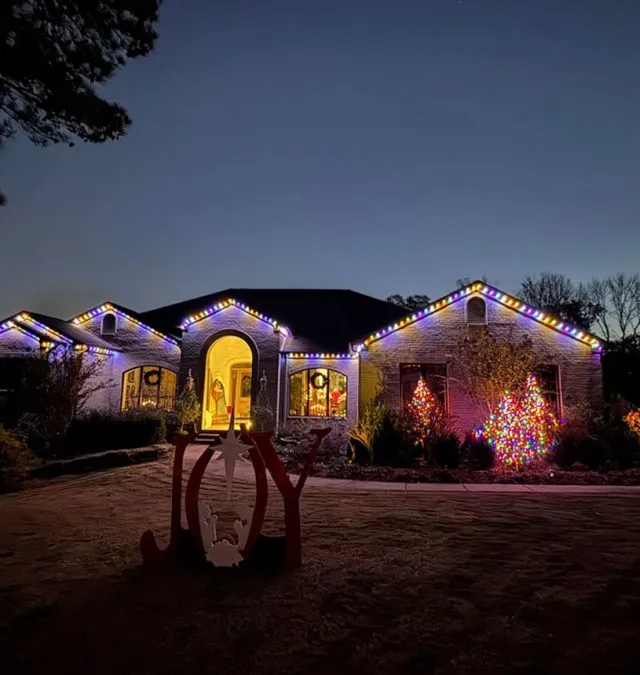
Budget alternative: rooflines and the JOY sign only — about $160, and it still reads as a full display from the street.
The oversized JOY sign is what turns a decorated yard into a destination. It gives the composition a center and a message, and it reads from the far end of the block in a way that lights alone never do. One big, graphic, letter-based element will always beat ten small ones — the same instinct behind any single oversized yard sign or lit sleigh.
29. Bright Blue Outlines Against Warm Lit Windows
Blue outline lighting is a big-house move. It needs at least 50 feet of frontage and multiple gables to keep the line from reading as a single stripe. A 25-foot facade height gives the blue something to climb, and dark siding or stone veneer is essential for the contrast to land. On a smaller home the same blue can look heavy — Idea #27 works the color at a much more modest scale.
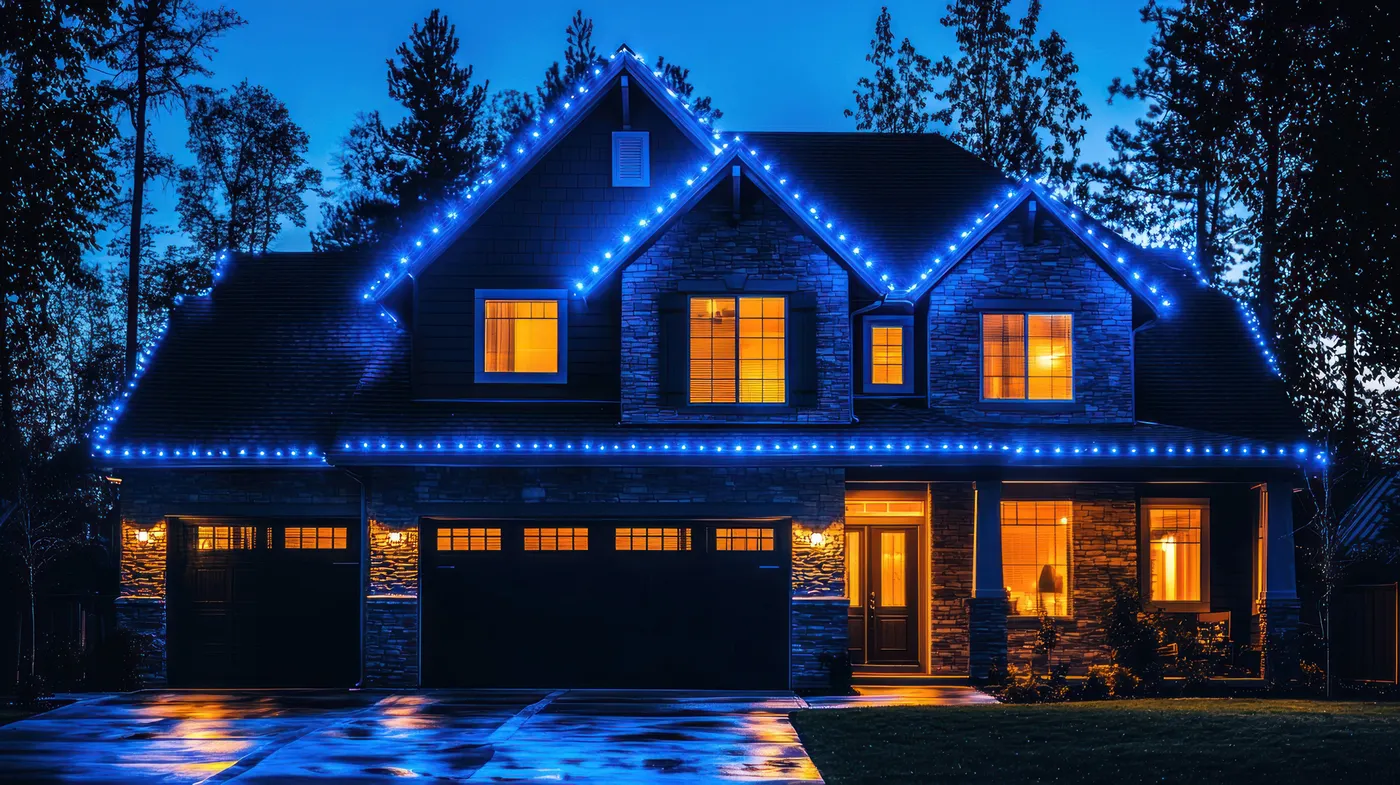
Blue light is the hardest color to photograph and the easiest to overdo. Two practical notes: warm interior lights left on behind the windows are doing half the work in this scene, so swap any cool-white bulbs in your front rooms to 2700K before you judge your display. And blue strands from different manufacturers vary wildly — some run toward violet, others toward cyan. Buy one extra set for spares, because blue is the color that gets discontinued first.
30. Warm White House Lights With Reindeer by a Frozen Pond
Reflecting a display in water is a lighting multiplier. Lights placed across the pond from the viewer double in the reflection, so you need roughly half the strands you’d otherwise buy. Angle your reindeer figures so they face the water at a slight diagonal — a silhouette reflected twice reads bigger than one facing the camera head-on. Keep the pond-side strands low and warm, because cool white on snow at close range turns harsh fast.
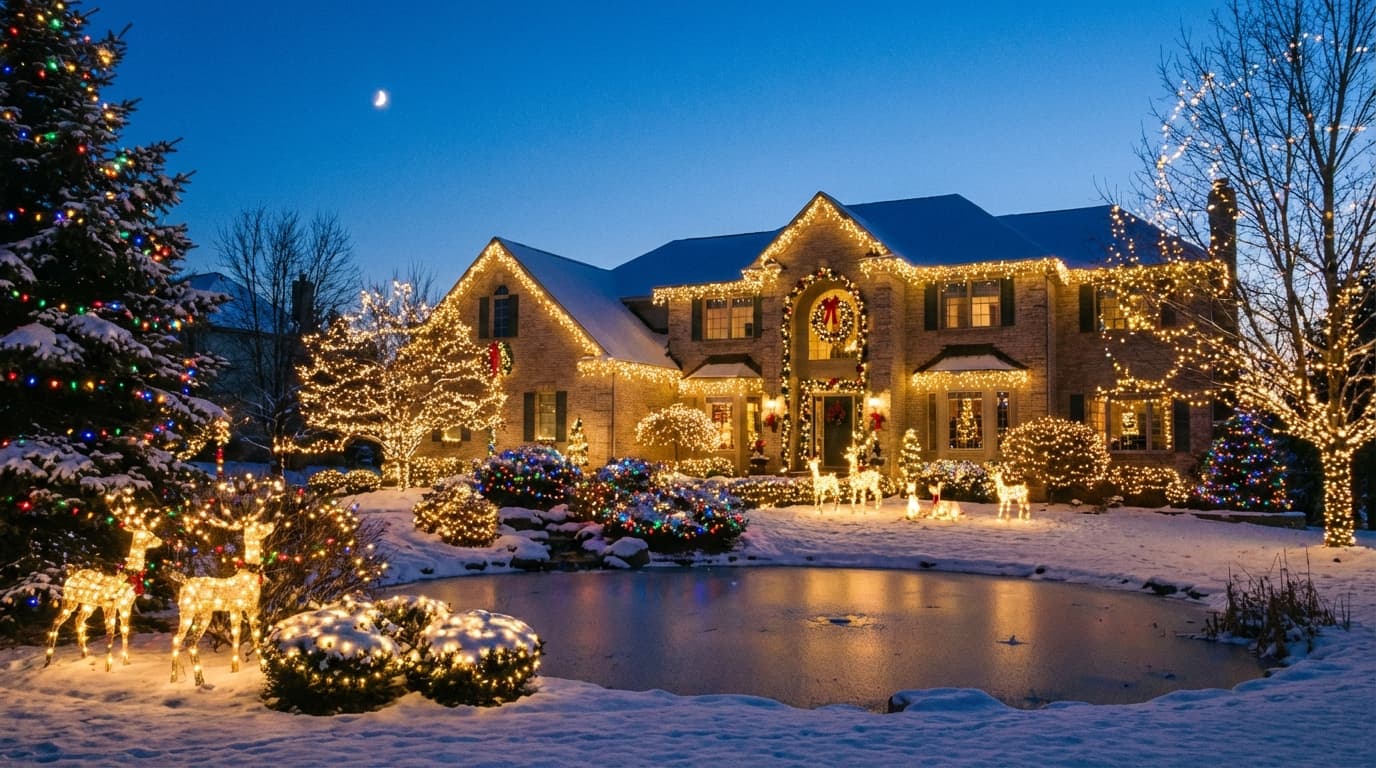
The pond is free, which makes this easier on the wallet than it looks. Warm white roofline strands for a house this size run $180–$300; wire-frame LED reindeer are $50–$120 each at big-box stores and around half that on Marketplace in early December. For mixed-color bushes, buy 100-count multi sets at $14–$18 and save the multicolor for the shrubs, where density matters more than color fidelity.
Go Light Up the Whole Block
You don’t need a designer, a crew, or a five-figure budget — you need a tape measure, one consistent color temperature, and the discipline to light two surfaces instead of ten. Start with the roofline or one spectacular tree, add the rest next season, and let the display grow with your confidence.
📌 Pin your favorite idea from this list so you can find it again when the ladder comes out — and tag us when your house is the one people slow down for.