
Somewhere between your twelfth Pinterest scroll and your third saved folder, black Christmas trees stopped looking like a novelty and started looking like the best idea in the room. We get it — a black tree turns warm string lights into candlelight and makes silver ornaments look like actual jewelry.
We spent serious time browsing Walmart, Target, Amazon, Etsy, and Wayfair to bring you only what’s worth your attention this year — from roughly $18 in craft supplies up to $855 for a full two-tree setup. Budget versions sit side by side with the splurges, so you can see exactly where the money matters and where it really doesn’t.
Inside you’ll find 31 curated ideas spanning modern monochrome, moody glam, traditional-with-a-dark-twist, and cozy lodge styling — each one pulled from a real room, not a render. And stay until the end — we break down the most common mistakes that can ruin these looks.
Why now? Black trees have quietly escaped the Halloween aisle and become year-round sculptural pieces in 2026, with designers re-dressing one tree for two seasons instead of buying twice. 📌 Save this to Pinterest for later — you’ll want to revisit these ideas.
1. Tall Pre-Lit Black Tree with a White Fireplace Backdrop
The element doing the heavy lifting here isn’t the tree — it’s the light-colored tree skirt and the stack of white-wrapped gifts sitting on it. Against black needles and a white fireplace, that pale foundation keeps the whole corner from going heavy and cave-like. Take it away and the same tree reads as a dark silhouette instead of a warm centerpiece. If your black tree already feels flat, change the skirt before you buy another ornament.

- Pre-lit 7.5 ft black artificial tree — $180–$420
- Extra warm-white strands for depth — $25–$60
- Ornaments, mantel greenery, mirror, candlesticks, stocking — $90–$250
- Tree skirt, ribbon, white gift wrap — $45–$120
Budget alternative: a secondhand black tree from Facebook Marketplace ($60–$120), dollar-store ornaments in matte white, and a plain white sheet folded as a skirt lands near $150 — and honestly, nobody will clock the difference in photos.
2. Black Tree on a Dark Wood X-Panel Base by a Flocked Wreath
The dark wood X-panel base is the detail most people scroll past. You can build one from four 1×4 cedar boards cut to about 20 inches, assembled into a box that hides the metal stand, with two diagonal braces across the front. It runs about $35 in lumber and reads like furniture rather than a tree stand. Keep the box roughly 2 inches narrower than your skirt so the wood grain still shows.
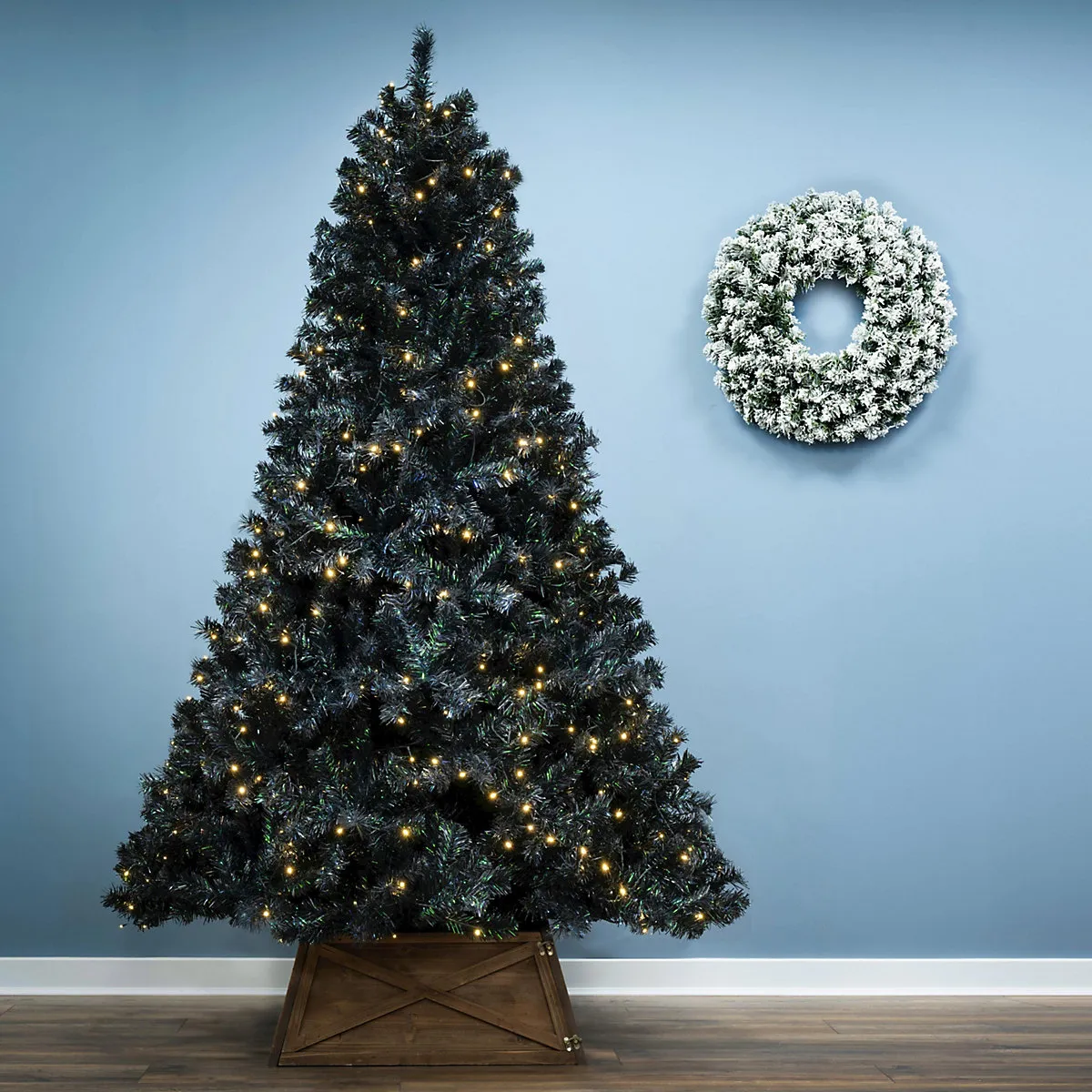
Two things are happening here, and neither is accidental. That pale blue wall gives the black tree something to push against — against a dark wall it would simply vanish into the paint. The flocked wreath then introduces white at eye level, so the tree’s darkness reads as a choice instead of an accident. Contrast isn’t decoration in this room; it’s the entire design. The dark wood plank flooring ties the base back to the room so nothing floats.
3. Red and Gold Traditional Tree Against Dark Gray Paneling
The formula runs about 55% green foliage, 30% red, 12% gold, and 3% true black. That black shows up only in the lanterns, the leather armchair, and the paneled wall — never in the ornaments themselves. Swap the red for copper and the gold for champagne, and the identical math reads modern instead of traditional. Keep the black share under 5%, or the tree starts to look bruised rather than rich.

A tree this densely dressed gets heavy fast. Faux flowers, glittered picks, and glass ornaments add up to real weight, and a standard three-leg stand can start leaning by mid-December. Anchor the trunk with a sandbag or upgrade to a wide-base stand, and skip hanging heavy glass on the top third, where the branches are thinnest and least supported.
4. White Tree, Black Bows, and a Monochrome Entry Hall
The bows are doing something clever: those black-and-white stripes repeat at three scales — the tree, the stair banister garland, and the wrapped gifts — so your eye travels down the entry without stopping. The black console table underneath acts as a dark anchor between two pale elements. Repetition like this is the difference between a styled entry and a decorated one, and the silver-green picks keep it from reading strictly graphic.
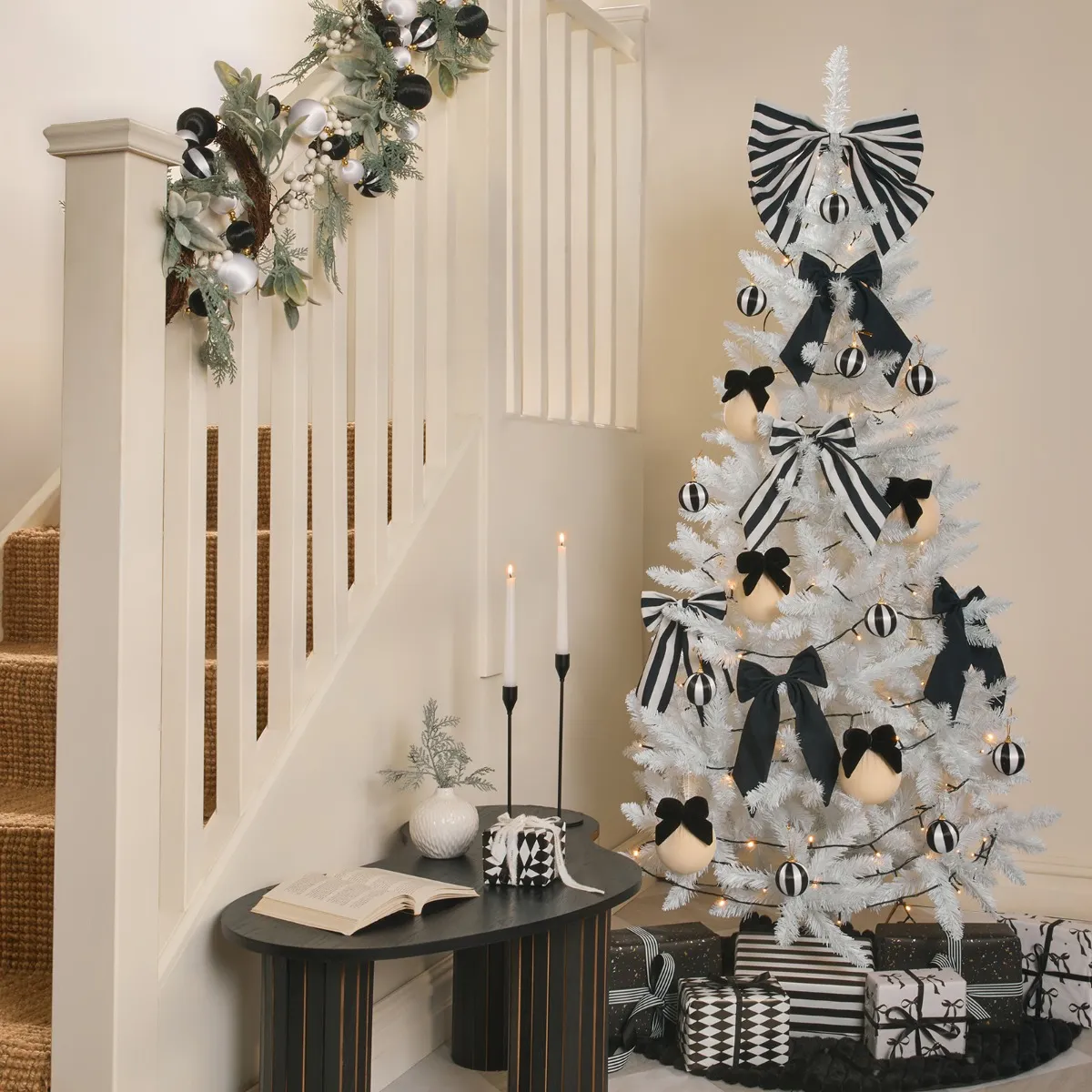
You don’t need a designer for this. Buy 3-inch black satin ribbon at Walmart (about $4 a roll) and layer it over 1-inch white satin to fake the striped bows — same graphic punch for a fraction of the price. Target’s matte black and bone-white ornaments fill the branches affordably, and kraft paper with black ribbon finishes the gift pile. It’s the same black-and-white story as Idea #15, just blown up to full-tree scale.
5. Matte Black Bead Garland Woven Through Green Branches
- Buy a 9-foot unfinished wood bead garland in 16mm beads (about $12 online).
- Wipe the beads with a damp cloth and let them dry completely.
- Brush on matte black craft paint in thin coats — two thin coats beat one thick one.
- Re-string the beads on the original jute cord once they’re bone dry.
- Drape in three uneven loops, tucking the cord behind branches so it disappears.
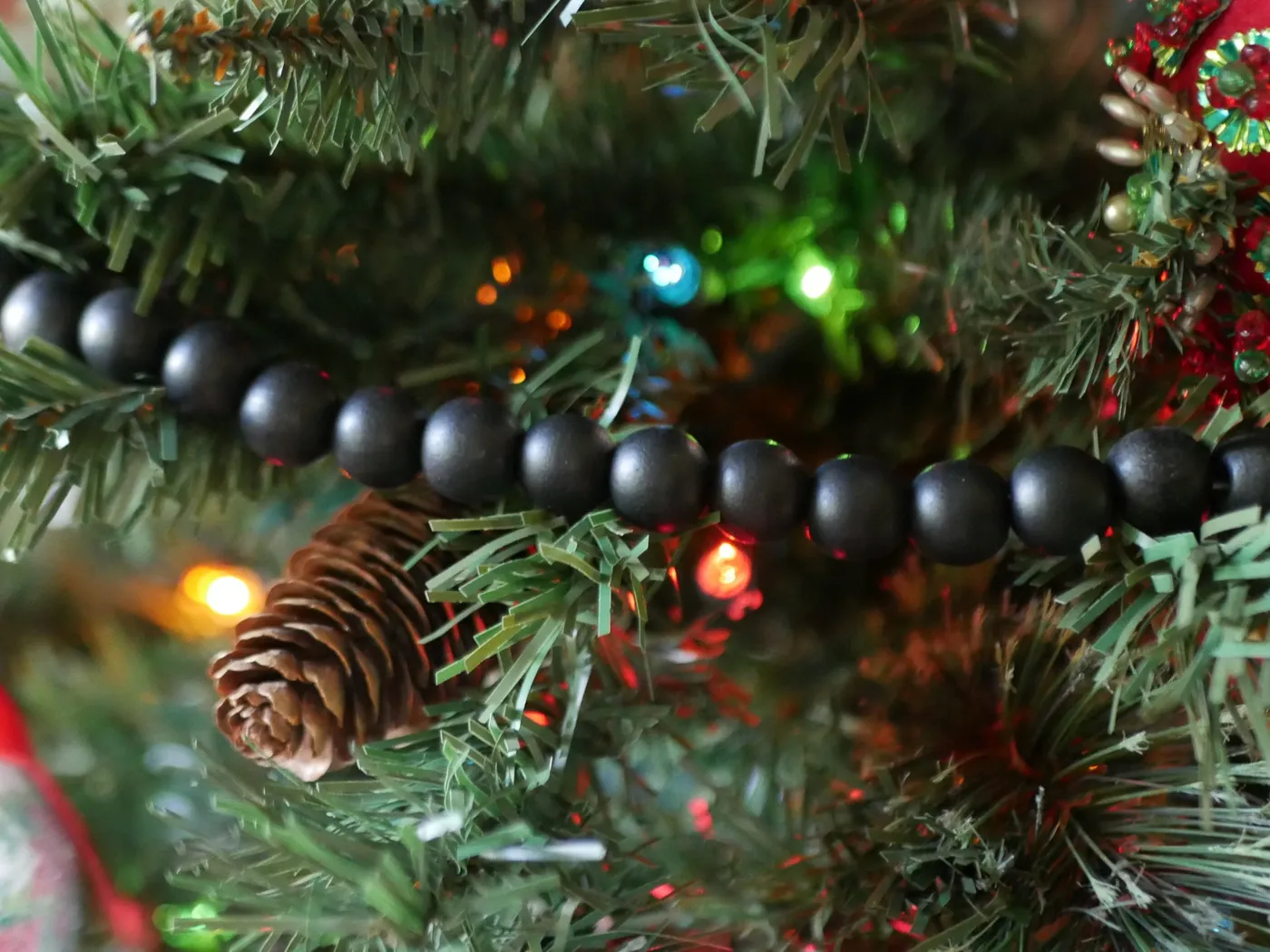
Time: about 90 minutes. Cost: $18 to $25.
It’s the matte finish that matters. Glossy black beads would sink into dark needles and read as shadow, not decoration. Matte black wood absorbs light instead of bouncing it, so the garland shows up as a soft ribbon of shape against the green — and it’s the one black accent that still works after you switch the lights off for the night.
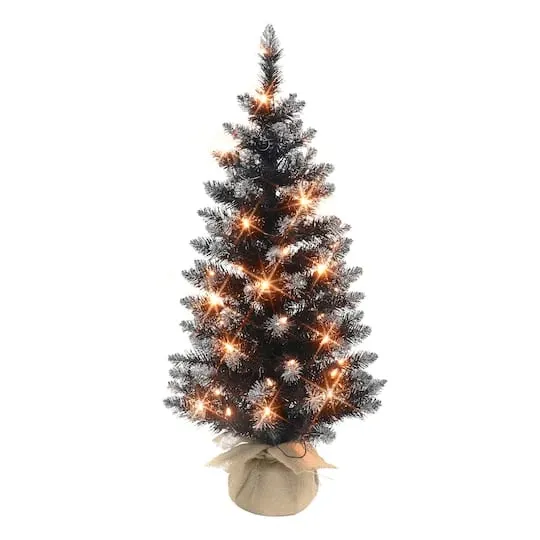
6. Slender Black Tree with Silver Globes Against a Dark Wall
Count it as 70% dark backdrop and tree, 25% silver and white ornaments, 5% warm light. Because two-thirds of the frame is already dark, the silver has to be the only reflective element — no gold, no red, no green competing for attention. Change that wall to cream and the same formula flips to 70% light, which is exactly why this tree looks completely different in a bright room.
Ornament size should scale to the tree, not to the room. On a 7-foot slim tree, stick to 3- to 4-inch globes and 60 to 70 pieces total — roughly 10 per foot of height. Anything under 2.5 inches vanishes between the branches, and anything over 5 inches makes a slim silhouette look like it’s wearing a costume. When in doubt, buy fewer and bigger.
7. Black and Silver Mantel Garland with Disco Ball Ornaments
Disco ball ornaments are magnets for dust and fingerprints, and they scratch if you stack them loose in a bin. Wipe them with a dry microfiber cloth once a month through the season, and store them in tissue-lined trays with the hangers removed. Real silver finishes tarnish over time; the mirrored plastic versions hold their shine better but can fog if they sit near a humidifier.
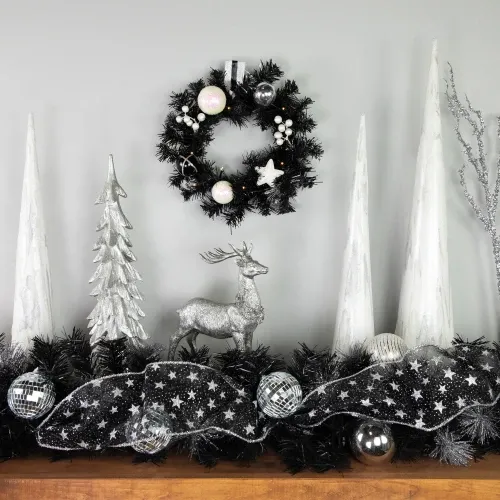
Three principles are at play: contrast (black garland against a light gray wall), repetition (the same silver sphere at three different sizes), and one deliberate rule-breaker — the star-print ribbon, which is the only pattern in the entire vignette. Pull the pattern out and the display is pretty but forgettable. Leave it in and the eye has somewhere to travel.
8. Twin Black Trees Dressed in Silver, Gold, and Bead Garlands
Twin trees need a wall at least 14 feet wide, 9-foot ceilings, and 6 to 8 feet of clear space between the trunks. Anything narrower and they crowd into one dark mass instead of reading as a pair. If your room is under 200 square feet, keep a single focal tree and put the second one on a console as a tabletop version — same palette, half the footprint.
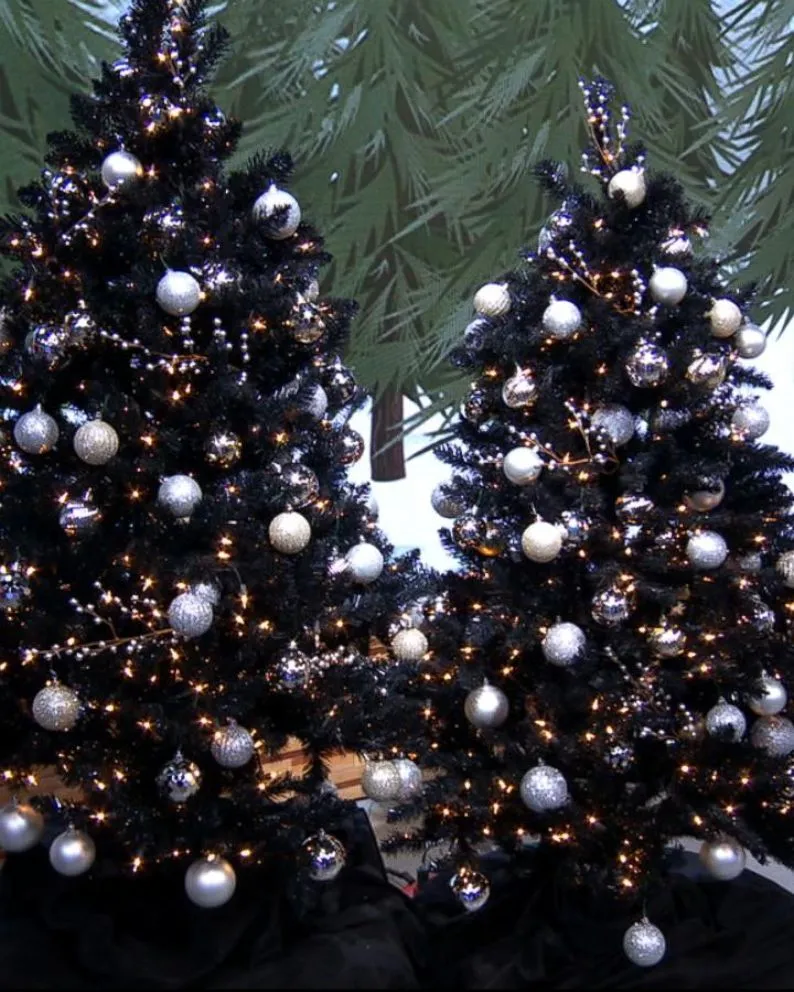
- Two 7 ft black trees, unlit — $160–$360
- Warm-white strand lights, 6 boxes — $40–$90
- Silver and champagne ornaments, about 120 pieces — $110–$280
- Silver bead garlands, 4 strands — $30–$70
- Black fabric for skirts and base wrap — $25–$55
Budget alternative: two secondhand trees from Marketplace at $50 each, dollar-store ornaments sprayed champagne, and black flat sheets as skirts comes in near $220.
9. Dark Fir Tree with Magenta Blooms and Golden Garlands
Deep-jewel and moody-maximalist holiday styling has been climbing on Pinterest for three seasons now, and magenta on near-black fir is the 2026 version of it. It reads couture rather than craft-fair, which is why florists started copying it for window displays. Trends built on color mixing instead of one specific motif tend to age well — swap the magenta for plum or rust and the whole look still holds together.

The magenta flowers are the risk that pays off. Without them, this is a nice dark tree with glitter on it. With them, the tree has a temperature and a point of view — warm pinks and golds burning against almost-black needles. That single unexpected color is the thing people remember when they see the photo three months later.
10. Dried Orange Slices and Metallic Baubles on a Dark Tree
Dried orange slices cost almost nothing: slice thin, bake at 200°F for about three hours, and you have ornaments that read vintage and smell faintly of citrus. Dollar Tree metallic baubles resprayed in matte bronze give you the disco effect for $1.25 each, and craft-store bead strands stand in for glass garlands. The whole tree comes in under $60 if you already own lights.
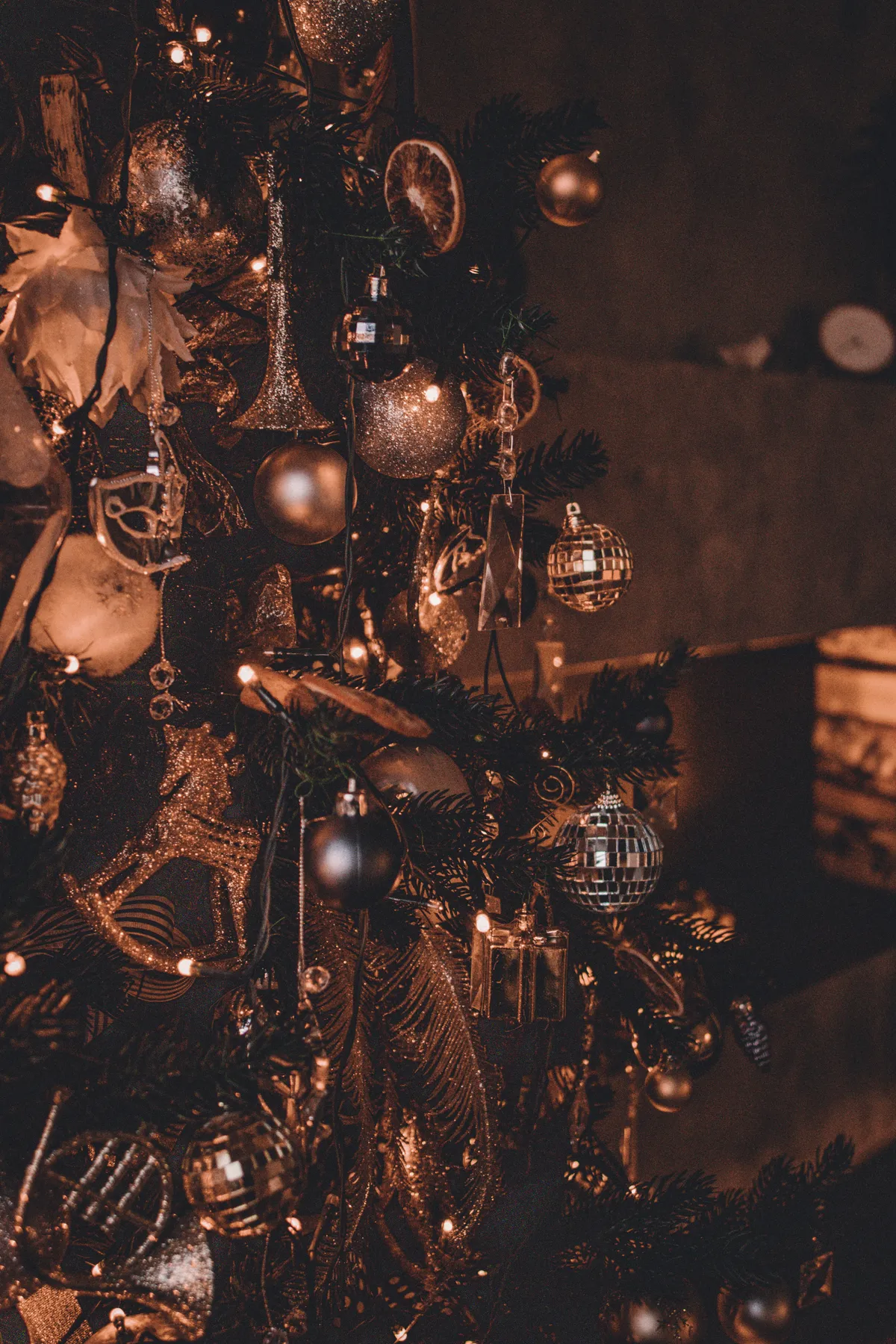
Cluster in odd numbers and vary the size inside each cluster — one large, two medium, three small, spaced 4 to 6 inches apart. Across a 7-foot tree, that’s roughly 12 clusters total. It looks casual on purpose, but it’s the difference between a tree that reads as decorated and one that reads as shaken.
11. Skinny Black Tree with Snowflake Ornaments and Gray Seating
Slim black trees work in spaces a full tree simply can’t: corners 24 inches wide, apartment rooms from 80 square feet, and ceilings as low as 8 feet. A 6.5-foot slim tree fits in about a 20-inch footprint, which is roughly the same floor space as a side table. Same slender silhouette as Idea #6, but a softer, brighter backdrop changes the mood entirely.

One honest warning: black trees against light gray walls can flip cool and clinical if your bulbs are cool white. Warm white — 2700K — is non-negotiable here, and it’s worth buying new strands rather than living with blue-ish light all December. Also check your hangers: snowflake ornaments with thin wire loops slip off easily when a cat or a toddler brushes past.
12. Flocked Tree with Black Handbag and Perfume Ornaments
Fashion ornaments — handbags, perfume bottles, shoes, logos — crossed from boutique window displays into home decor a few years back and haven’t slowed down. In 2026 it’s less about branding and more about silhouette and finish. On a heavily flocked tree, the black-on-white contrast does the heavy lifting, so you don’t need a designer label to get the effect. A quilted shape and a gold chain read instantly.
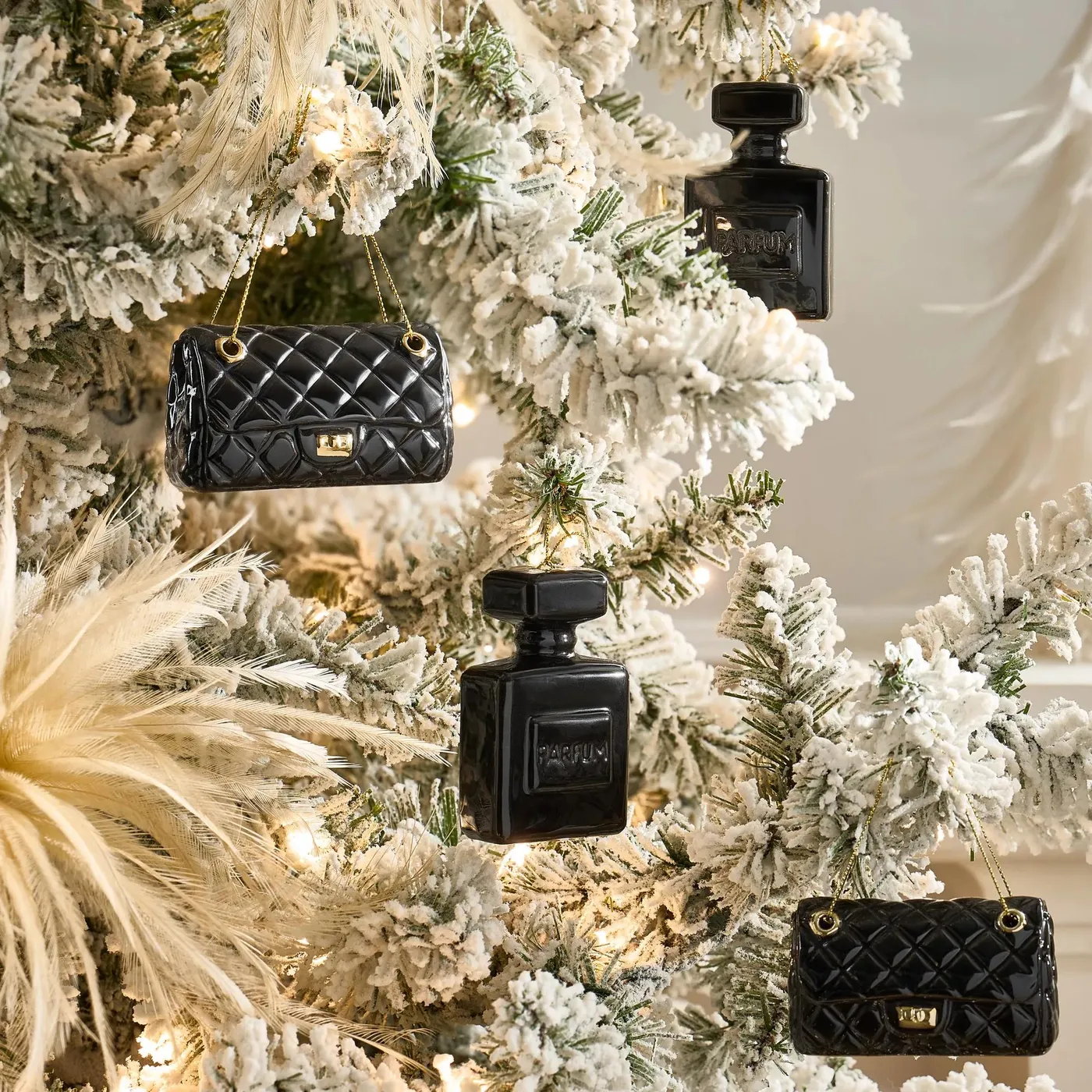
Real handbag ornaments weigh 4 to 8 ounces, which is more than a standard hook will hold. Use 20-gauge wire or a 1-inch satin ribbon loop instead, and attach them within 4 inches of the trunk where the branch wire is strongest. Three or four statement pieces per tree is plenty — treat them like jewelry, not filler.
13. Black Lantern Candlelight on a Hearth with Gold Ornaments
- Measure your hearth or countertop run and clear everything off it.
- Choose three lanterns in graduated heights — roughly 8, 12, and 16 inches.
- Place the tallest at one end and step down, keeping 3 to 4 inches between them.
- Use battery pillar candles so you can leave them glowing all evening.
- Tuck evergreen sprigs and three gold spheres around the bases.
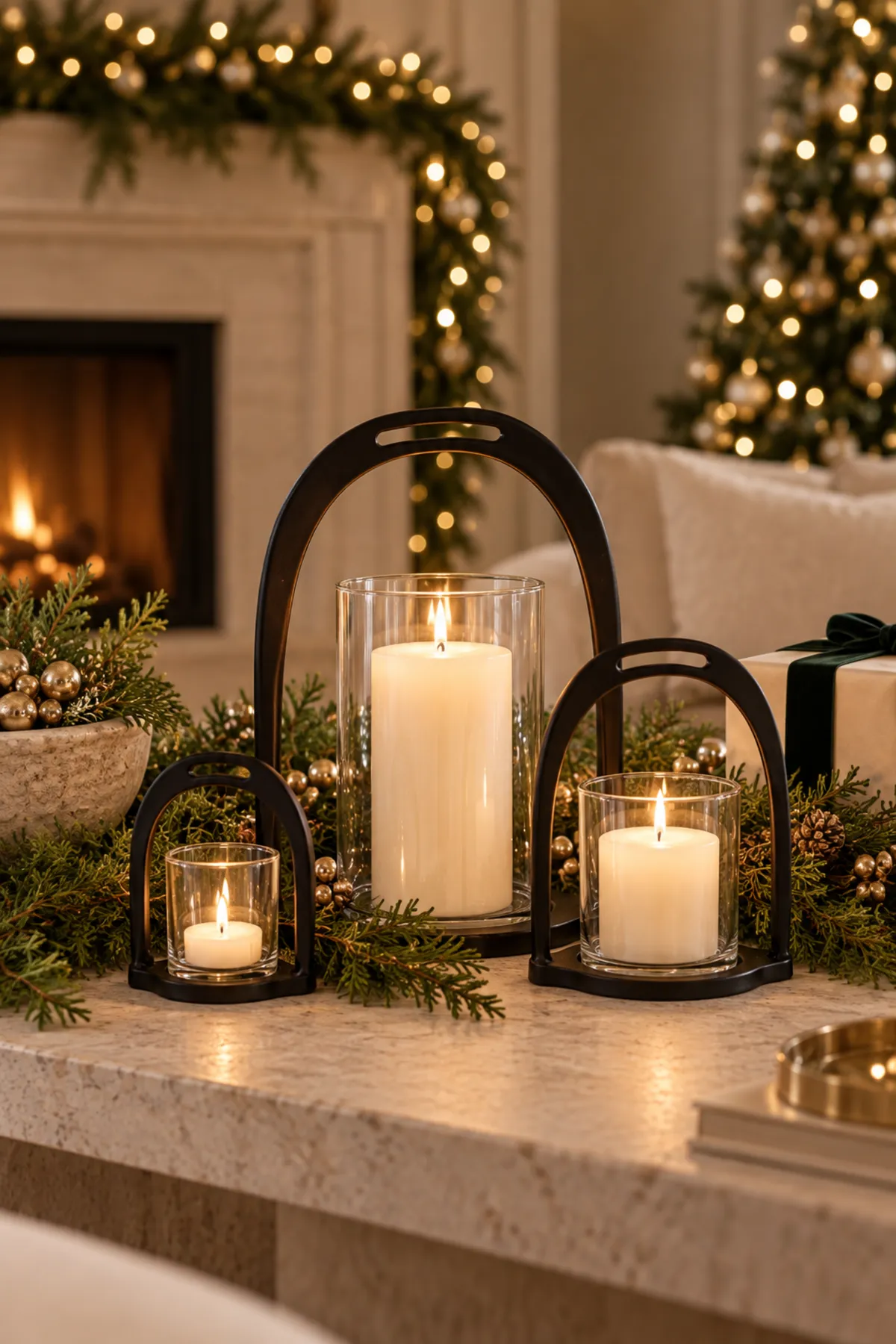
Time: about 30 minutes. Cost: $60 to $120.
Real candles inside a lantern surrounded by evergreen is a genuine fire risk — cut branches dry out within days in a heated room. Flameless candles have gotten good enough that nobody notices the difference. Keep any flame at least 6 inches from greenery, and never leave a lantern lit while you’re out of the room.
14. Three Black Trees and a Life-Sized Santa in Faux Snow
This is a scene, not a corner. Three trees plus a Santa figure need a 10-by-12-foot footprint, ceilings around 12 feet, and about 3 feet of clearance around the base for the faux snow to read as ground rather than a spill. In a standard 8-foot-ceiling room, use three tabletop trees on a low platform instead and let the Santa stand beside them.

The Santa is the one thing. Not because it’s tasteful — because it gives the whole scene a human scale reference. Without it, three black trees in fake snow are just a display. With it, the setup becomes a story, and your eye has somewhere warm and red to land. That’s the difference between a theme and a scene.
15. Black and White Patterned Ornaments in a Wooden Bowl
The mix runs about 50% black and 50% white, with green pine sprigs and brown pinecones acting as the 10% that breaks the pattern. Because the color ratio is even, texture has to carry all the interest — ribbed, matte, glossy, patterned all sitting side by side. Swap the black for deep forest green and the identical formula works for a more traditional table.
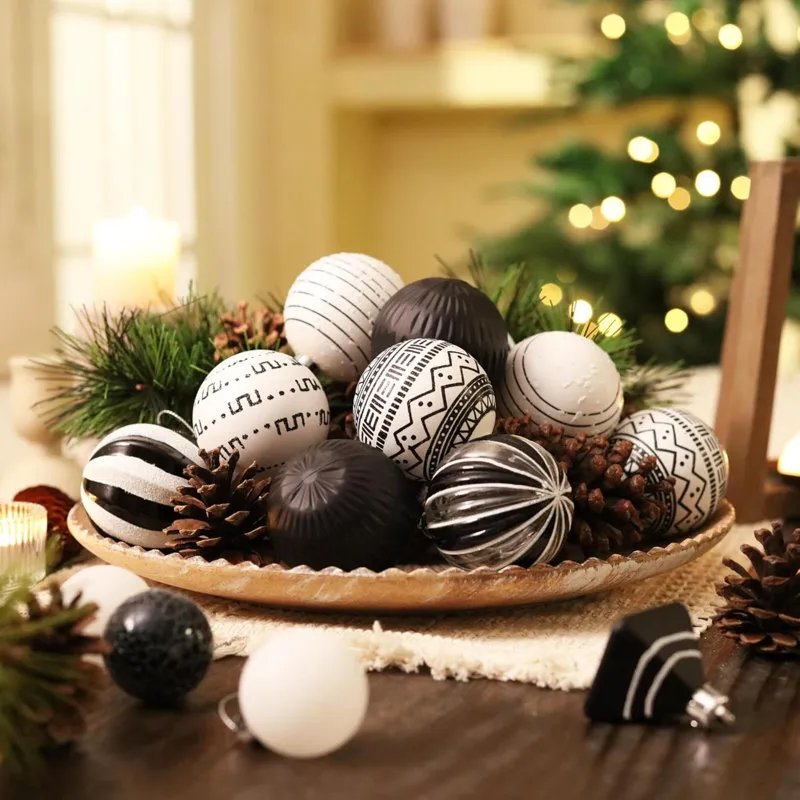
- Choose a low bowl 12 to 14 inches wide.
- Line the bottom with a folded cream cloth or textured linen.
- Place the largest ornaments first — five or six, sitting low.
- Fill in with medium and small pieces, leaving a few deliberate gaps.
- Tuck pine sprigs and pinecones into the gaps so it looks gathered, not stacked.
Time: 15 minutes. Cost: $25 to $60, less if you already own the ornaments.
16. Plaid, Velvet, and Pinecones on a Classic Green Tree
Thrift stores are packed with red and gold ornaments in January — buy next year’s tree this year for a quarter apiece. Walmart’s 2.5-inch plaid ball sets run about $8 for 12, and a roll of red velvet ribbon is under $5. Pinecones gathered from a park are free; a light dusting of gold spray makes them look store-bought. The lantern styling from Idea #13 is the cheapest way to add the same warmth nearby.
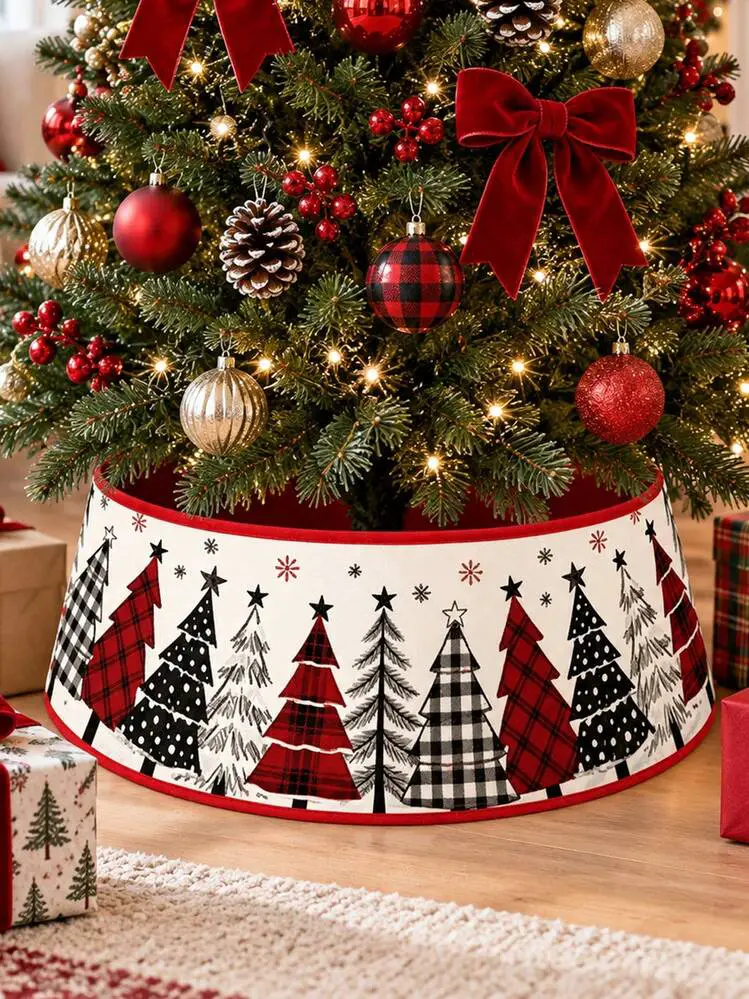
Space velvet bows every 12 to 14 inches along the visible front face of the tree, and make sure each one is wired. Unwired ribbon sags within a week and looks tired by the 20th. At that spacing, a 7-foot tree takes about 12 to 14 bows, so one roll of 2.5-inch ribbon does the whole job.
17. Red Berries and Glitter Poinsettias Beside Chevron Curtains
This close-up shows why mixed ornament sizes matter. There are clusters at four scales — berries, poinsettias, pinecones, and 3-inch balls — layered so the eye keeps finding new pieces instead of reading one flat mass of red. The grey chevron curtain in the background adds a geometric note that stops the traditional red-and-green from tipping into fussy.
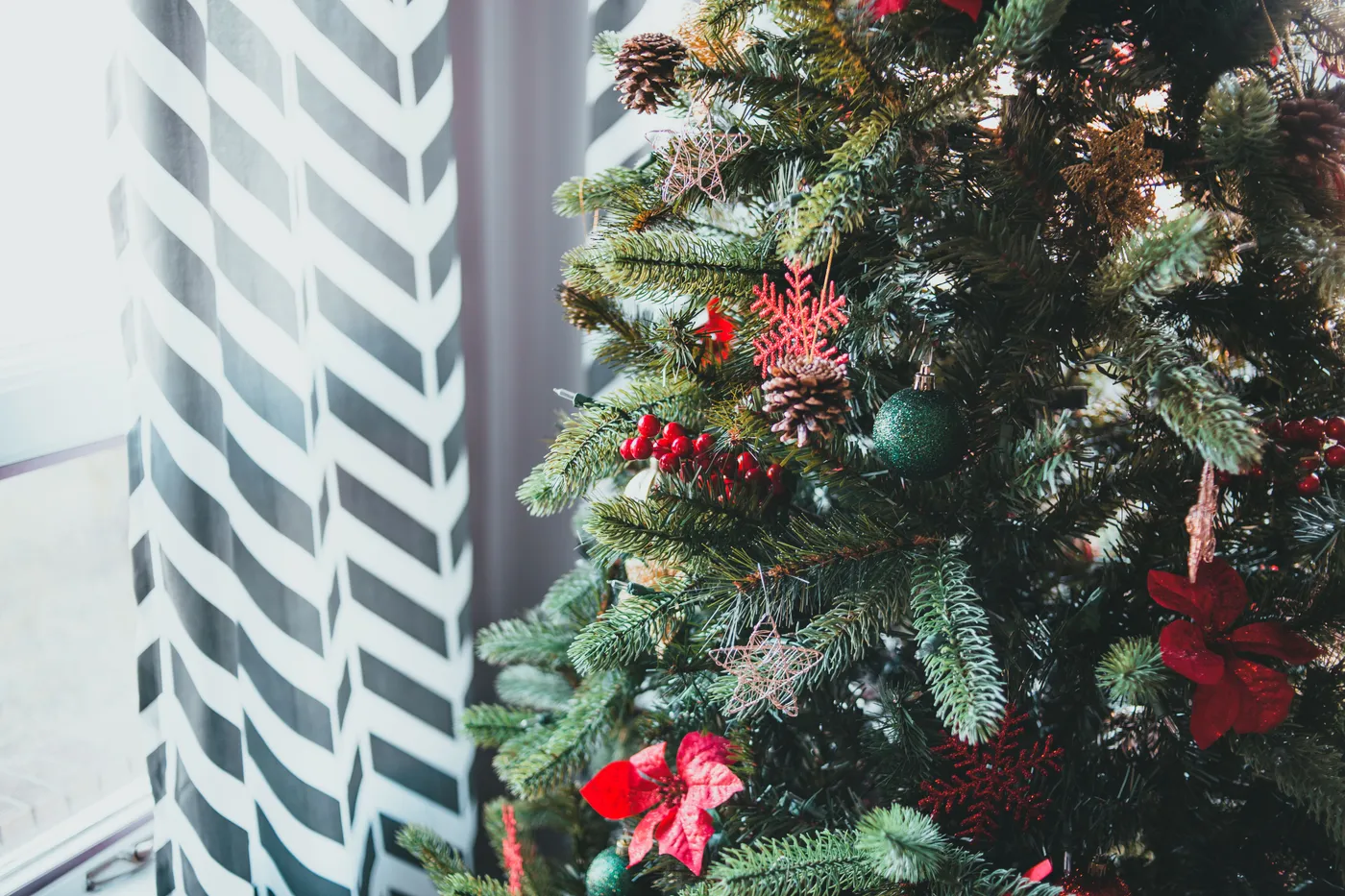
Glitter poinsettias shed. Expect a fine dusting of red glitter on the floor beneath the tree by New Year’s, and reach for a vacuum with a brush attachment instead of a broom. Real pinecones carry sap, so bake them at 200°F for an hour before they touch fabric or wood. Plastic berries fade in strong sun — keep those branches away from windowsills.
18. Pre-Lit Black Tree Dressed for Halloween with Orange Baubles
If you go this route, decide early whether the tree transitions into Christmas or comes down on November 1. Most people who dress a black tree for Halloween end up leaving it up and swapping the orange baubles for silver — which is great, as long as you plan the storage so you’re not restringing lights twice. Label your ornament bins by season while you’re at it.
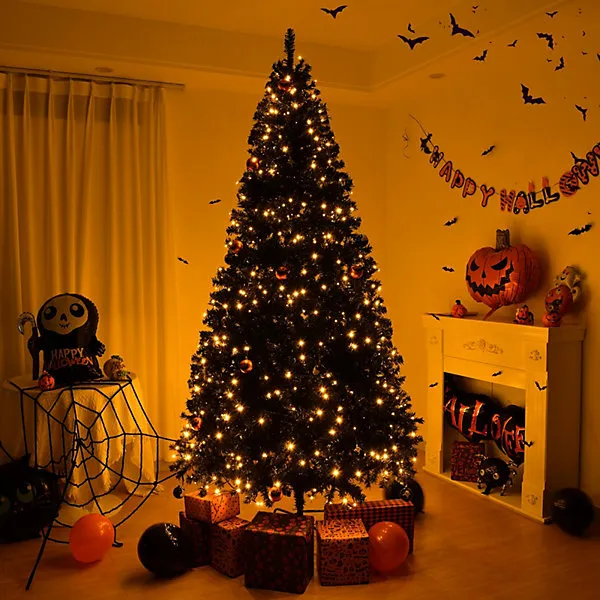
The dark tree has quietly become a year-round prop rather than a December-only purchase. Designers use black artificial trees for Halloween, strip the bat decals, then re-dress them in silver for Christmas — one purchase, two seasons. Retailers caught on, and 2026 assortments lean hard into neutral, undecorated black trees you style yourself. That flexibility is the whole selling point.
19. Assorted Black Tabletop Trees on a Dark Cabinet
It’s the texture mix. Every single piece is black, but no two pieces catch the light the same way — smooth matte, ribbed, and full glitter sitting right next to each other. Remove that variation and you have a row of identical black cones that reads as a craft project. Keep it and the grouping looks collected over years instead of bought in one afternoon.
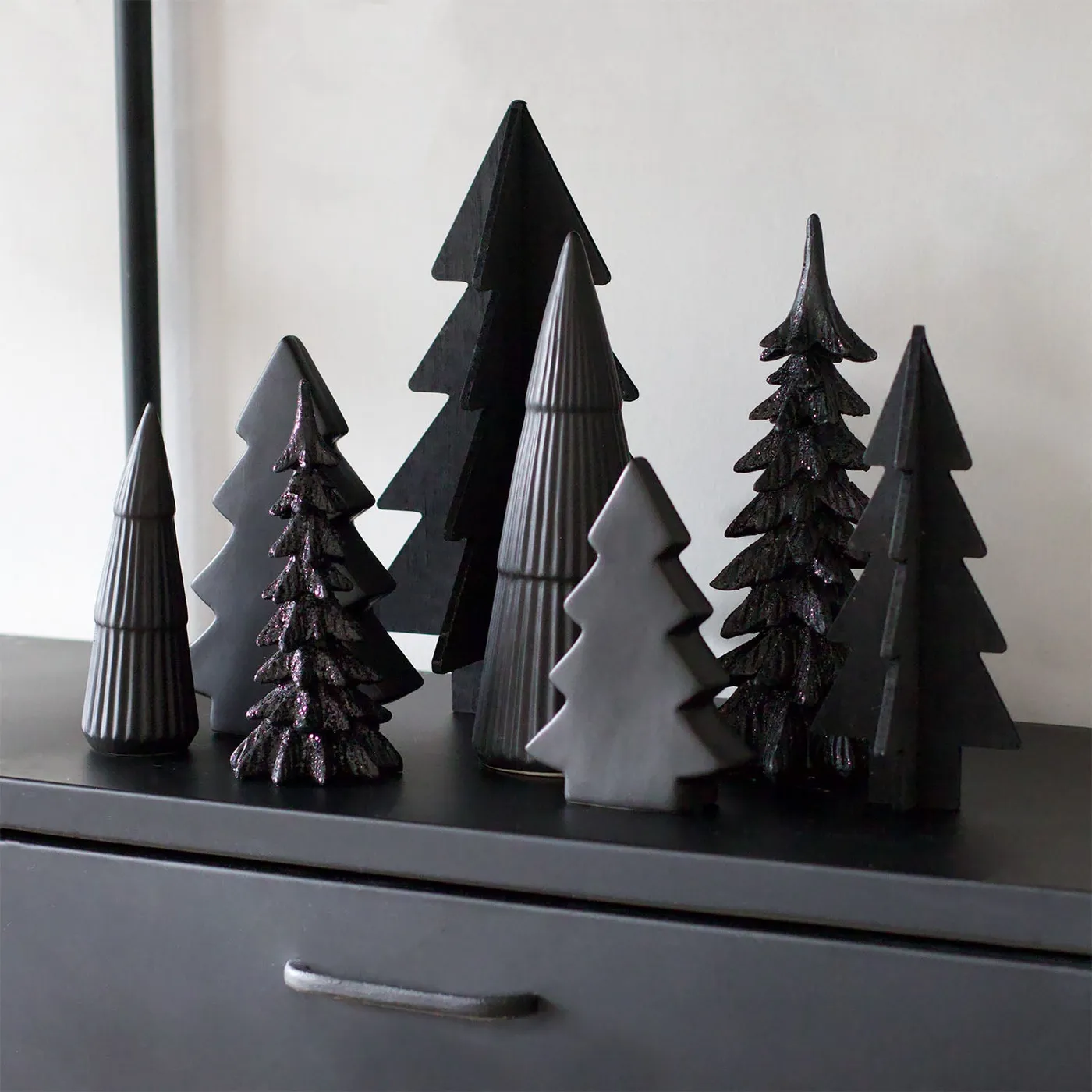
Repetition plus variation is the oldest trick in display design: same color, same family of shapes, different surface. Varying the heights in a 3-5-4 rhythm gives the group an actual silhouette instead of a flat line, and the dark gray cabinet beneath keeps the black trees from floating in mid-air.
20. Green Tree with Frosted Pinecones and a Golden Star Topper
Frosted pinecones are easy to fake: brush the tips with white craft glue, roll them in Epsom salt, and let them dry overnight — roughly 30 cents each versus $3 to $5 in stores. For ornaments, commit to three sizes only at a 4:3:2 ratio, and hang the largest in the bottom third so the tree reads grounded instead of top-heavy.
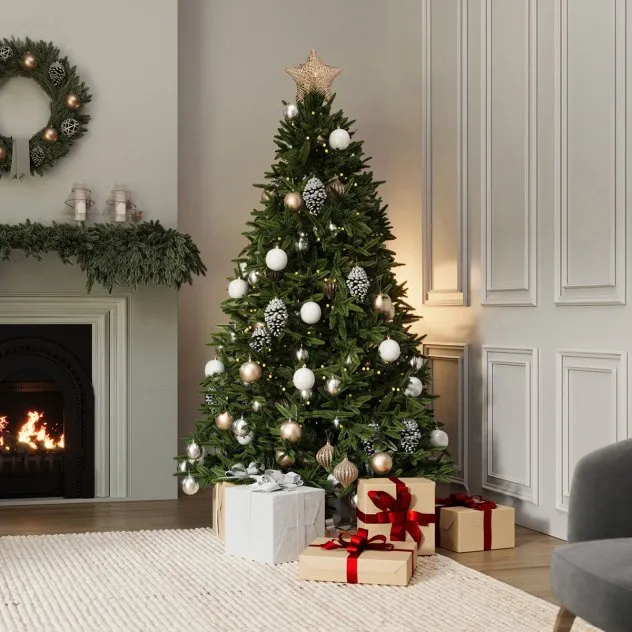
Roughly 80% green foliage, 12% gold, 6% silver, 2% white. The gold carries the warmth, the silver keeps it from going brassy, and the white lives almost entirely in the frosted pinecones and the star. Rebalance that to 60/30/10 and the tree turns noticeably more metallic — still beautiful, but a completely different room.
21. Black Fiber Optic Tree in a Wood-Paneled Cabin Corner
Fiber optic trees have one real weakness: the light source is built into the branches, so when a strand fails, the tree is done. Buy from a brand with a two-year warranty, and never store it in a hot attic — heat kills fiber strands faster than anything else. Also skip the color-changing remote if you want it to look like the photo you saved.
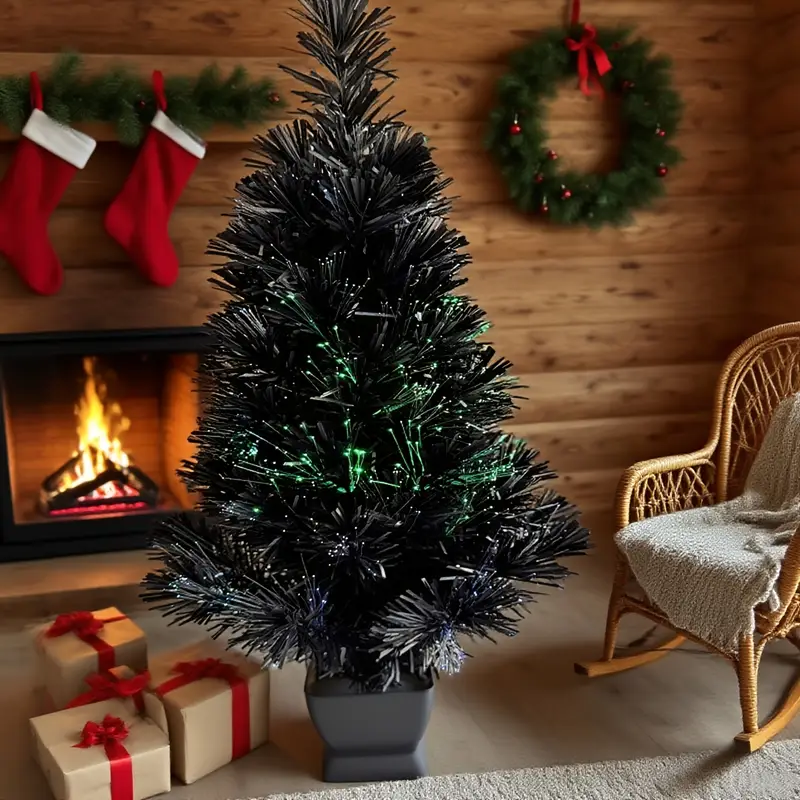
A 4-foot fiber optic tree needs about 2 square feet of floor and at least 8 inches of clearance from any heat source, which matters a lot when it sits beside a lit fireplace like this one. It’s the right pick for rooms under 100 square feet, dorm spaces, and anyone who genuinely hates stringing lights. Compare with Idea #14 if you’re working with a much bigger footprint.
22. Matte Black Reindeer with Frosted Berries on Wood
Matte black figurines disappear on dark wood, so place them against something lighter or on a pale tabletop 30 to 36 inches high — roughly eye level when you’re seated. Keep the frosted branch at a 45-degree angle behind the reindeer rather than beside it; the diagonal adds movement and stops the vignette from reading like a shelf display.

The matte finish is the whole point. A glossy black reindeer would reflect the fairy lights and turn into a shiny blob. Matte absorbs the light and holds its silhouette, which is why it reads as sculpture instead of souvenir. If you already own a glossy one, a can of matte black spray paint fixes it in ten minutes.
23. Crocheted Tree Ornaments with Wooden Beads and Gold Glitter
- Chain 12 in worsted-weight yarn, then single crochet in rows, decreasing one stitch per row.
- Stop when you’re down to a single stitch — that’s your tree point.
- Weave in the ends and thread twine through the top.
- Slide a 12mm wooden bead onto the twine above the tree.
- Brush the bottom edge with craft glue and dip it in gold glitter; dry two hours.

Time: about 20 minutes each once you’ve done one. Cost: under $1 per ornament.
Yarn ornaments are pet magnets and dust collectors. Hand-wash in cool water with mild soap if they get grimy, and reshape them while damp. The gold glitter edge sheds a little the first season, so hang these on outer branches rather than over a food surface, and store them in a breathable cotton bag instead of a sealed bin.
24. Black Hourglass Ornament with Glitter on Green Branches
An hourglass ornament looks expensive and costs about $3 at Dollar Tree or Walmart in the black-and-glitter finish. If you can’t find the shape, buy a plain black bauble and a smaller glittered one, glue them top to bottom, then wrap the joint with thin silver cord. Nobody examines ornaments at arm’s length — what registers is silhouette and sparkle.
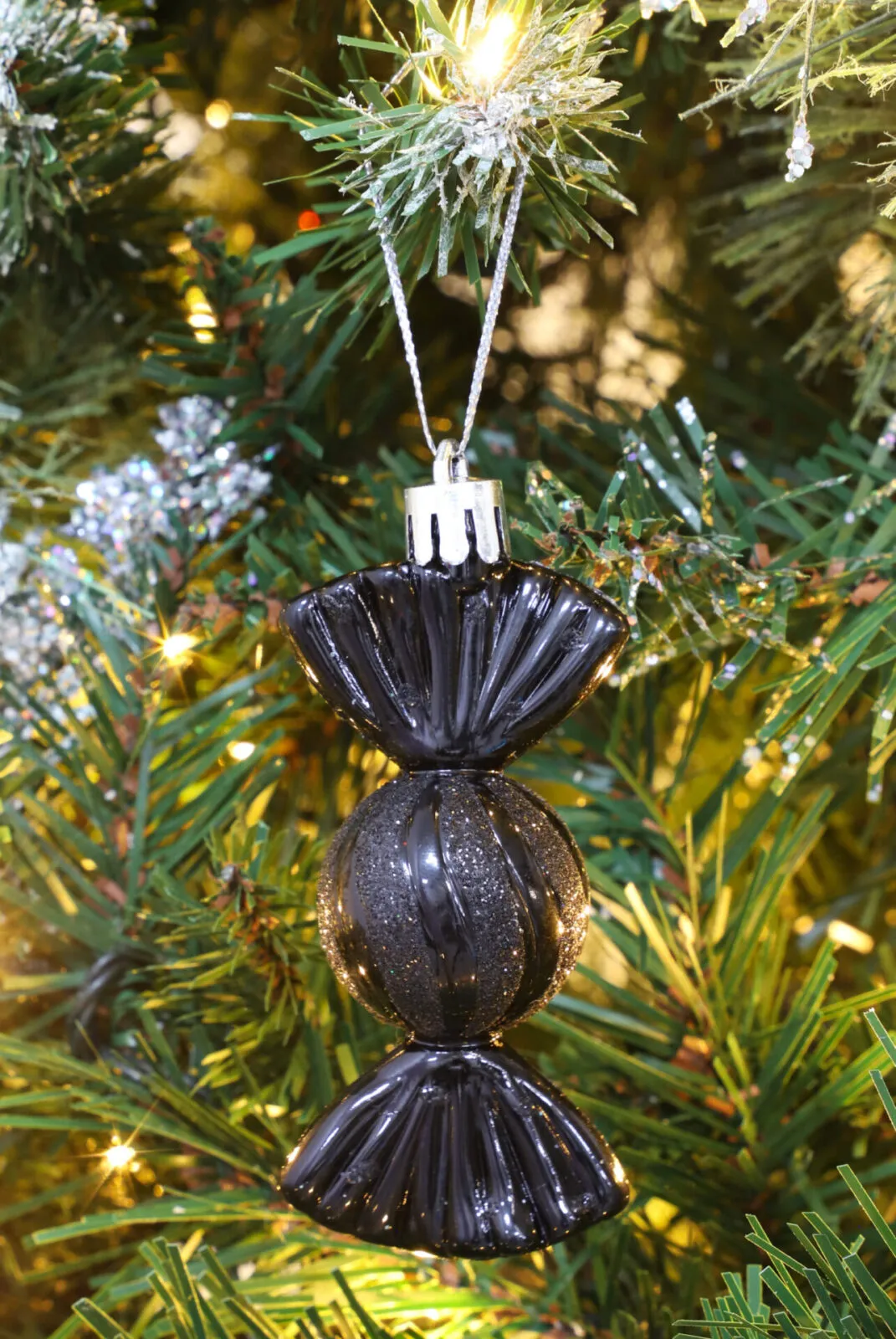
This is a light-touch formula: about 90% green needles, 8% black, and 2% silver, with the black concentrated in a handful of statement pieces instead of spread everywhere. It’s the opposite approach from the all-black tree in Idea #30, and it’s far easier if your tree is already green and you’d rather not start over.
25. Matte Black Bauble Against Green Needles and Warm Lights
- Measure your tree’s height and plan 10 to 12 ornaments per foot.
- Check the color temperature of existing lights — mixing warm and cool looks muddy.
- Confirm hooks and caps hold anything over 3 ounces.
- Test the finish under your actual bulbs; matte black reads gray near bright light.
- Lay your full palette out on a table before you touch the tree.

One matte ornament, warm lights, and a bright background — that’s the whole shot. The matte surface kills reflection, so the shape and the silver cap do all the talking. When a single ornament can hold a photograph on its own, you’ve found the right finish. Keep the rest of the tree simple and let one piece be the star.
26. Horned Cat Ornament with White Line Art and Red Ribbon
Ribbon-hung ornaments need tension. A 1/4-inch satin ribbon holds anything under 3 ounces; past that, swap to a wire hook wrapped in ribbon so the weight rides on metal instead of fabric. Cut ribbon at 7 inches, fold it into a loop, and thread it through the cap — longer loops swing and tangle the second somebody bumps the tree.
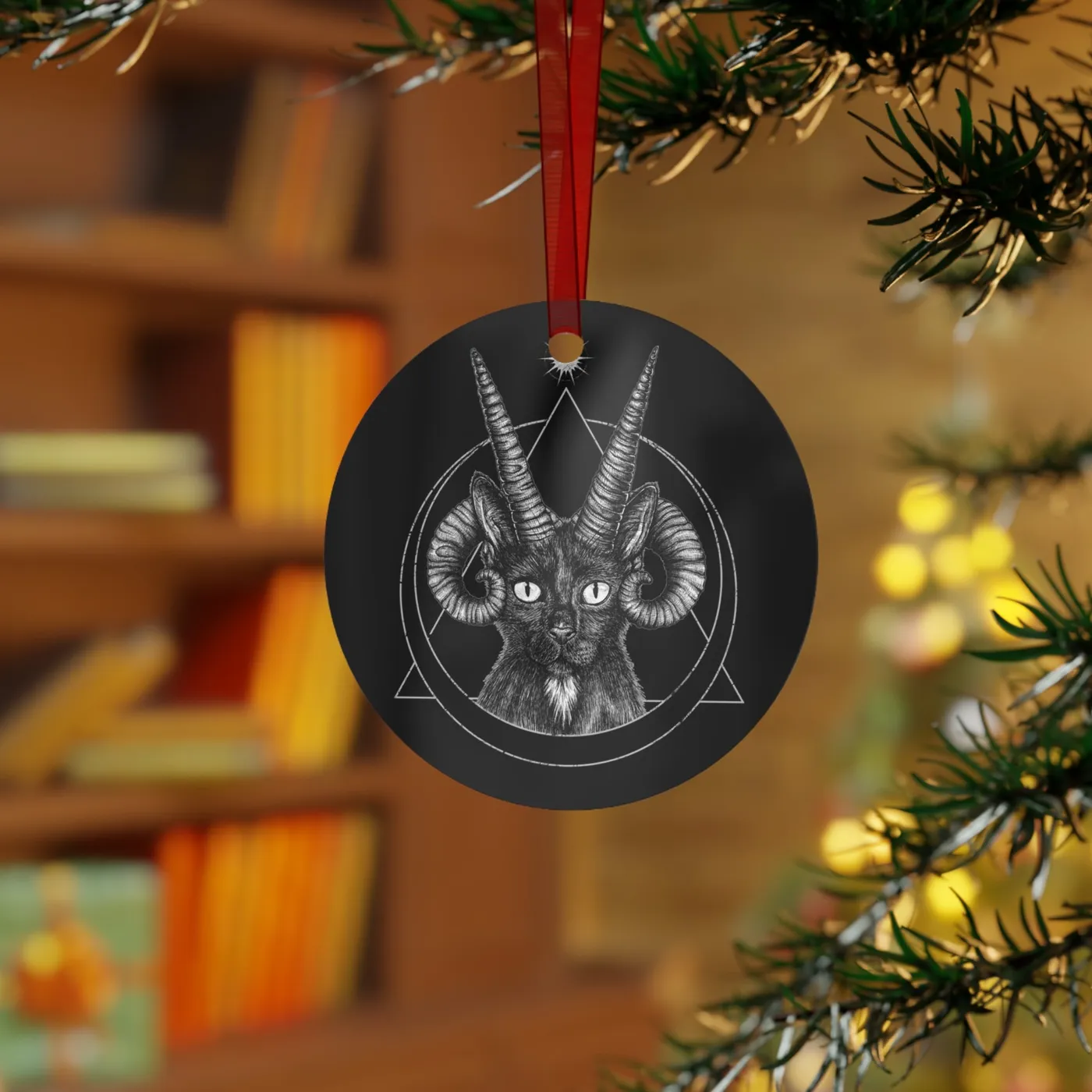
The white line art is what makes this one work. On a green tree, a solid black circle would sink into the shadows of the branches and disappear from two feet away. That thin white outline gives the ornament an edge, which is exactly why graphic novelty pieces almost always benefit from a light-colored detail.
27. Black Cat Ornaments in Santa Hats on a Green Tree
A tree decorated entirely with one motif can tip from charming to chaotic by the third craft-store run. Cap it: aim for about 60% solid filler ornaments, 30% themed pieces, and 10% purely sentimental ones that don’t match anything. That ratio keeps the theme readable instead of exhausting, and it protects your budget from a hobby you may not love in three years.

Handmade and thrifted cat ornaments run $4 to $12 on Etsy and often under $2 at estate sales. Buy a set of plain matte black balls and add tiny red bows — instant theme extender for about $8 a dozen. Blown-glass figures on after-Christmas clearance are the real deal if you can wait a few weeks.
28. Zebra Rug and Silver Ornaments in a Modern Eclectic Room
An eclectic room like this needs at least 300 square feet and 9-foot ceilings for the zebra rug, the mosaic fireplace surround, and the tree to all breathe at once. In a smaller space, pick one wild element — the rug or the abstract artwork, not both — and let the tree stay quiet. Layering bold patterns in a 150-square-foot living room just reads as noise.
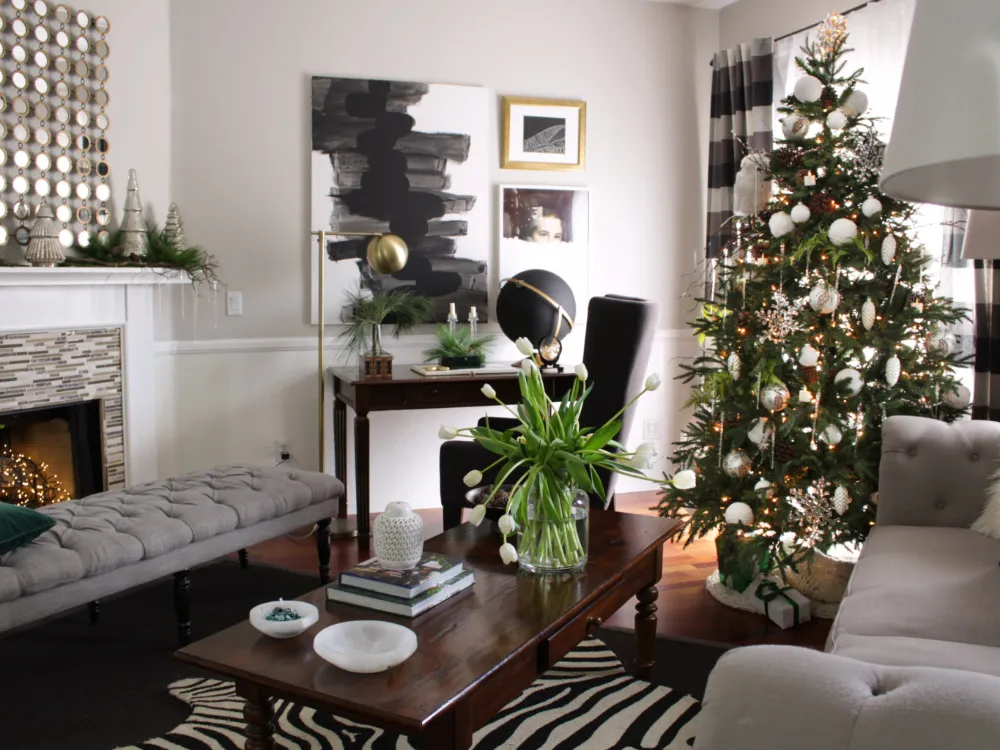
Even eclectic rooms follow a ratio: about 60% white and neutral, 25% black, 10% silver, 5% green. The tree is the smallest color share, which is precisely why it doesn’t fight the zebra print. If you want the green to lead instead, swap the rug for a solid charcoal flatweave and the room rebalances in an afternoon.
29. Twin Trees Flanking a Fireplace in a Dark Paneled Room
Two trees means double the dusting. Dark paneled walls show every fingerprint and dust film, so keep a microfiber duster on the mantel and hit the walls once a month through the season. Store artificial trees in breathable bags rather than vacuum-sealed plastic, or the branches come out of storage smelling like a garage and holding a permanent crease.
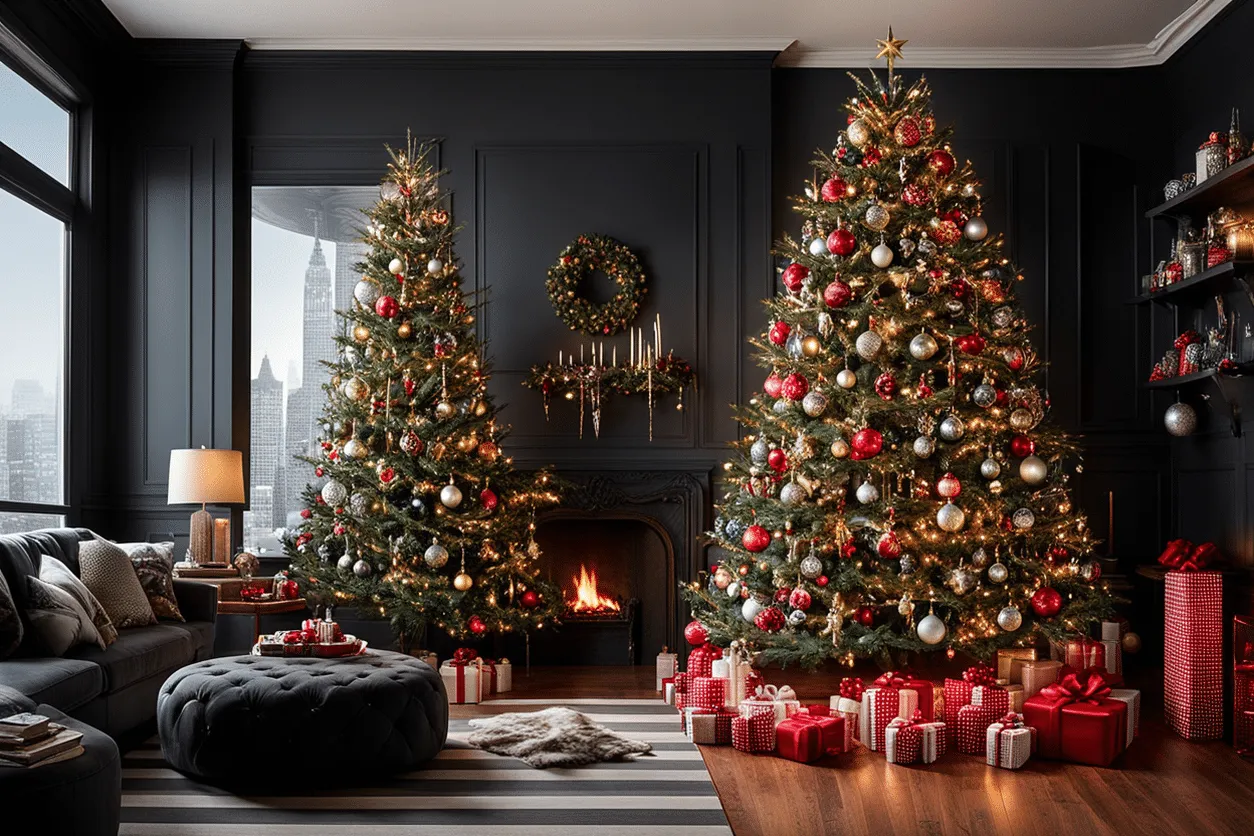
Symmetry only works when both trees match in three places: ribbon count, topper height, and light color temperature. Actually count the picks — if the left tree has 14 red ribbon clusters and the right has 9, the room reads lopsided and nobody can say why. Match the toppers within an inch and the whole thing locks together.
30. Dense Black Conical Tree Glowing on a Black Metal Stand
The exposed black metal legs. Most people bury the base under a skirt or a length of fabric, but leaving those four legs visible turns the stand into part of the design and makes the tree look deliberate rather than improvised. It’s a tiny decision with an outsized effect on how modern the whole thing reads in a photo.
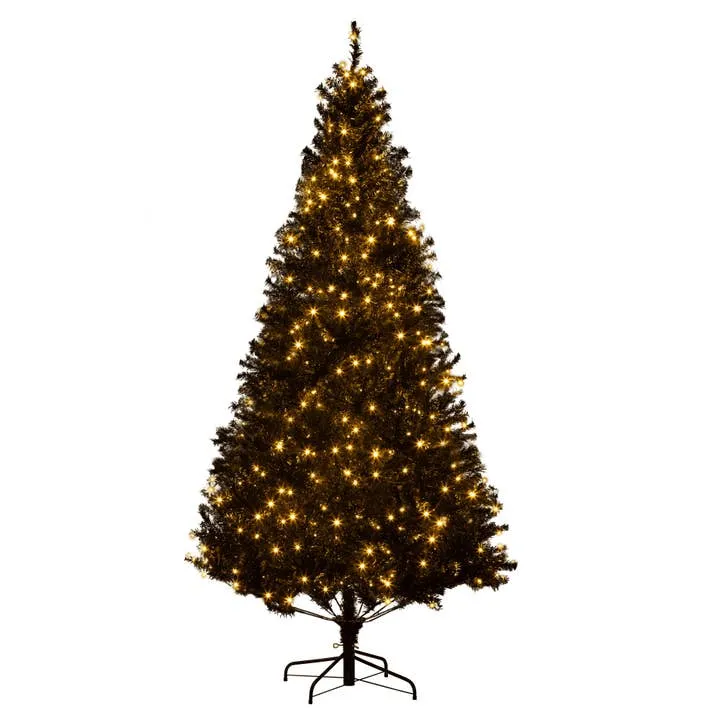
A black tree on dark hardwood with no base cover can visually merge with the floor — the tree looks like it’s growing out of the room instead of sitting in it. Add a light rug, a pale skirt, or a wooden box base. If you want the seamless look of the tall pre-lit tree in Idea #1, keep the floor underneath it light.
31. Lodge Living Room with Stone Walls and Deep Blue Velvet
Warm wood, cool blue velvet, and a green tree with warm lights — the temperature contrast is doing everything here. The blue chairs cool down the amber glow, which makes the fire and the string lights look warmer by comparison. The large sculptural chandelier adds a dark organic shape overhead so the tall ceiling doesn’t feel empty above the seating.
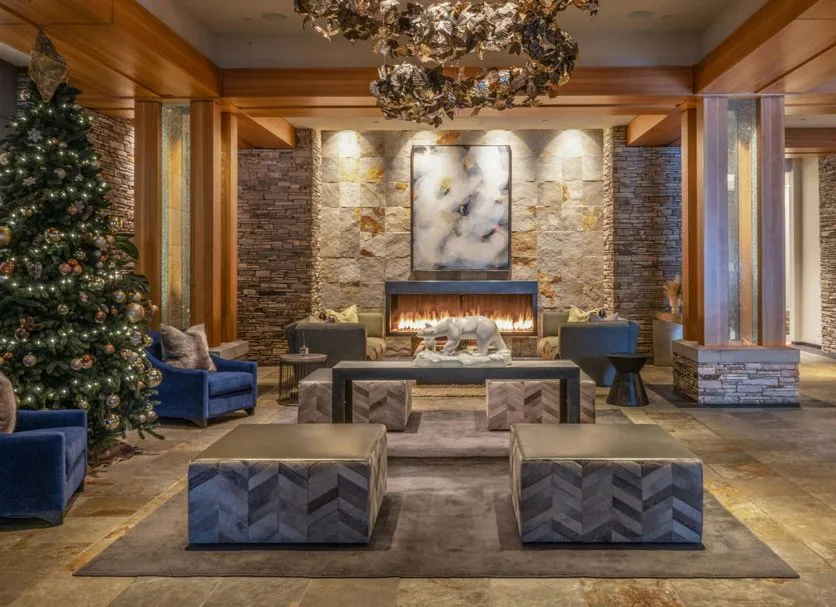
Alpine lodge styling has been the quiet counter-trend to minimalist beige rooms, and it’s peaking in 2026 as people chase rooms that feel like a getaway. Stacked stone, exposed beams, and deep blue velvet photograph beautifully and hold up to real winters. It also ages well, because timber and stone never really go out of style.
Your Black Tree, Your Rules — Now Go Hang Something
Here’s the truth: a black tree isn’t harder to style than a green one, it’s just less forgiving. Get your contrast right, keep your lights warm, and give the base something light to sit on, and you’ll end up with the kind of tree people stop in the doorway to photograph.
Start with one idea from this list — just one — and layer the rest in over a season or two. 📌 Pin this guide now so it’s waiting for you when the ornaments come out of the box.