
Still scrolling through tartan plaid Christmas tree photos without knowing which ones you would actually live with? You are not alone — plaid is one of the most saved holiday looks on Pinterest, and also one of the easiest to get slightly wrong.
We spent serious time browsing Target, Walmart, and Etsy to bring you only what is worth your attention this year, across everything from a $6 half-yard of tartan to a $1,005 full-tree setup. Inside you will find 25 curated ideas spanning classic red-and-green traditional, rustic handmade burlap-and-plaid, woodland buffalo check, and a cooler navy-and-gray take — with budget and luxury versions compared side by side.
2026 is the year tartan loosened up: designers are weaving pink, mustard, and cobalt into classic sett patterns, and flocked trees have become the backdrop of choice because they photograph like snow without the mess.
And stay until the end — we break down the most common mistakes that can ruin these looks.
📌 Save this to Pinterest for later — you will want to revisit these ideas.
1. Red Buffalo Check Tree Skirt With Classic Red-and-White Trimmings
The discipline here is that nothing breaks the red-and-white rule. The ornaments, the wrapped presents, the stockings, even the little snowflakes on the buffalo check skirt all pull from the same two colors, with forest green doing the heavy lifting in the background. Two colors plus one neutral is the easiest formula to shop for and the hardest to mess up. The distressed white cabinet earns its place by being slightly imperfect — a high-gloss finish would kill the coziness entirely.
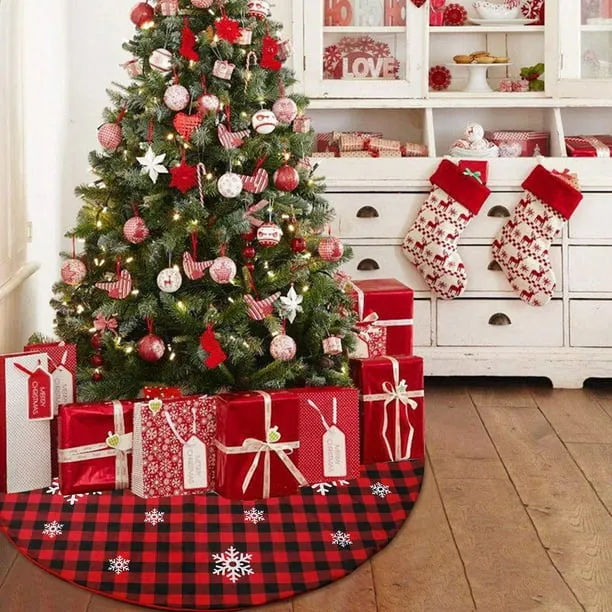
Buffalo check is unforgiving about scale. A skirt with big checks under a small tree swallows it, so measure your stand diameter first and size the skirt a few inches wider — not double. The red-and-white wrapping scheme also gets expensive fast if you buy it all at once. Paper goes on sale the week after Thanksgiving, and plain kraft tied with plaid ribbon reads just as festive for a third of the price.
It is the tree skirt. Every other element here — the ornaments, the cabinet, the hanging stockings — is a variation on a theme the skirt establishes. Remove it and you are left with a perfectly nice tree standing on bare floor, which is exactly what most people have. The pattern also visually ties the tree to the gifts and the stockings, the way a rug ties a living room together.
2. A Plaid Star Ornament Against Shiny Red Baubles
When you mix a matte fabric ornament with high-shine glass baubles, keep the ratio around one fabric to three glass. Fabric absorbs light and glass throws it, so the shiny pieces keep the tree from going flat while the plaid star gives the eye somewhere to rest. Set the fabric ornaments slightly deeper into the branches than the glass ones — glass reflects better near the outer edge, and the tartan reads better when it is nestled rather than hanging free.

Roughly 70% green needles and red baubles, 20% cool blue accent lights, 10% plaid fabric. Those blue lights are the sneaky part. They are cool-toned against warm red, which is why the star ornament’s dark green, red, and beige plaid looks crisp instead of muddy. To adapt: swap the blue lights for warm white and add cream ribbon, or keep the lights and change the red baubles to brushed gold if your living room leans cooler.
3. Navy Ribbon Tree Beside a Gray Built-In and Stacked Firewood
- 7.5 ft unlit tree — $150–$450
- Navy wired ribbon and garland — $30–$80
- Ornaments in red, blue, and gold — $60–$180
- Plaid wrapping paper and kraft rolls — $20–$45
- White faux fur rug — $40–$160
- Nutcracker figures — $25–$90

Total: $325–$1,005. Budget alternative: reuse last year’s ornaments, add two rolls of navy ribbon at $9 each, wrap everything in kraft paper with a plaid ribbon, and skip the rug — roughly 65% less.
The stacked firewood. It is not a Christmas decoration at all, and that is exactly why the tree looks like it belongs in a real house instead of a catalog spread. Wood tones warm up the cool navy and gray, and the rough bark texture plays against the smooth ribbon and glass ornaments. If your built-in has no cubbies, a simple log basket or a stack of birch logs does the same job for under $40.
4. A Tartan Mom Stocking on a Distressed White Mantel
This vignette wants a mantel at least 60 inches long and 6 to 8 inches deep — anything shallower and the ceramic houses crowd the stocking. Ceiling height barely matters here since it is a wall-level composition, so a standard 8-foot room is plenty. If your mantel runs shorter, hang two stockings instead of four and use one cluster of houses rather than a scattered row. Compare with Idea #19 for a small-space ornament approach.
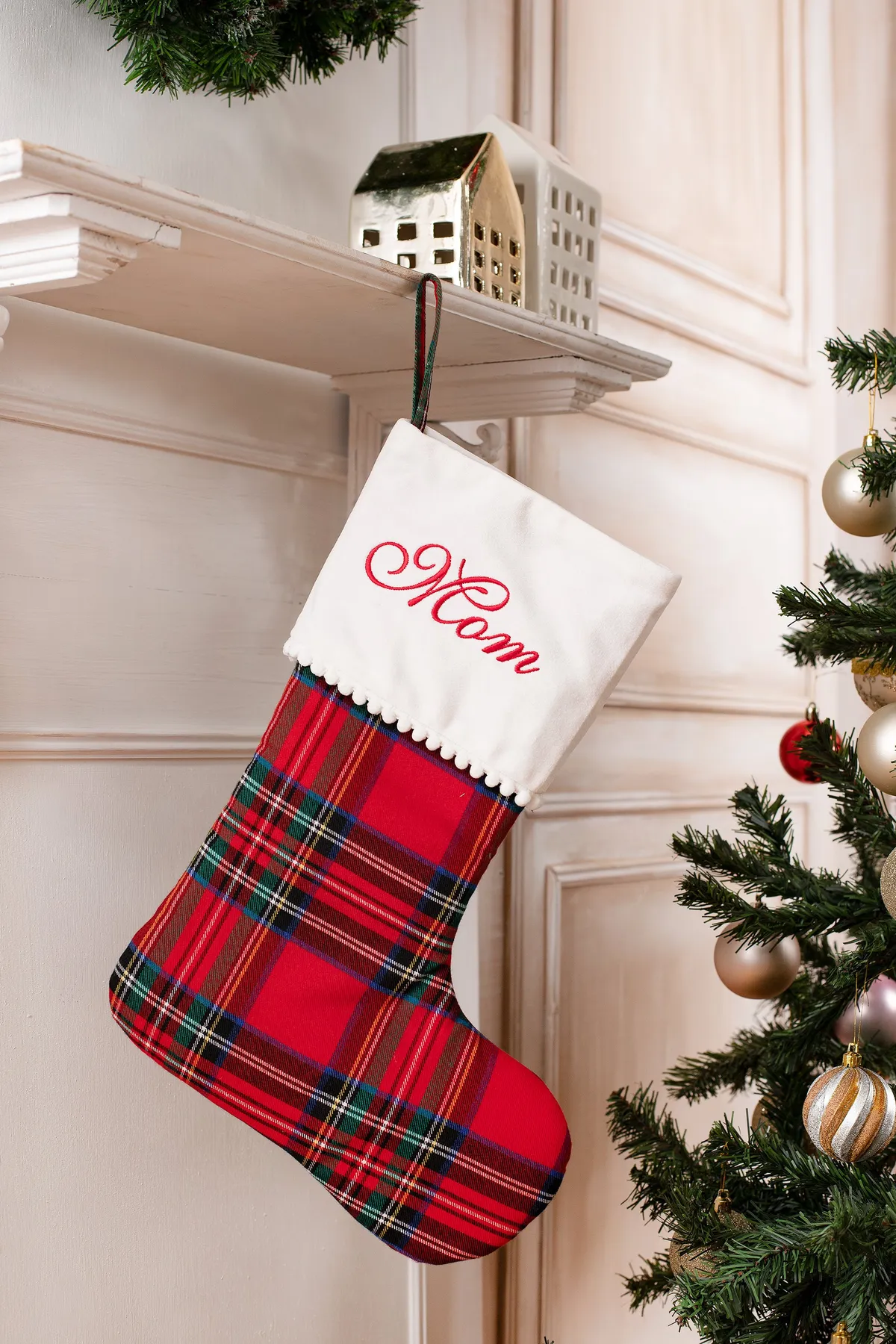
- Buy a red tartan stocking with a solid white cuff, or add the cuff yourself.
- Print your word in a chunky serif at about 1.5 inches tall.
- Trace it onto the cuff with a water-soluble pen or tailor’s chalk.
- Backstitch with three strands of floss — roughly 25 minutes for a short name.
- Press the cuff from the back with a cool iron, never directly on the floss.
Time: about 45 minutes. Cost: $12 in floss and a hoop if you already own the stocking.
Distressed white furniture and dark greens are lovely together, but distress paint chips. Pull a stocking hook hard enough and you will take a little paint with it. Mantels also mean heat, so keep stockings at least 6 inches from any candle or firebox and never drape them over a working fireplace screen. With toddlers in the house, swap the ceramic houses for wood or felt.
5. Tartan and Santa Pillows on a Tan Leather Sofa
Think 60% tan leather base, 25% red tartan, 15% navy and Santa print. The tan is what keeps this from looking like a theme park — it is warm, but it is not red, so the plaid reads as an accent rather than a takeover. Same formula, different flavor: swap the tan leather for a cream linen sofa and the red for forest green tartan, and keep the embroidered Santa pillow as your 15%.

Leather is forgiving — a damp cloth handles most of it — but red tartan and other dye-heavy plaid fabrics can transfer onto light tan hides in humid rooms. Keep the pillows off the seat cushions when you are not using them, or choose covers with a polyester back. Wool-blend covers want one dry clean per season, and the plaid-wrapped gifts under the tree will fade in direct sun if you leave them out past January.
You do not need a new sofa for this. Two pillow covers — a red tartan and a navy Santa print — run about $14 to $30 each at Target, Walmart, or Etsy, and they slip over inserts you already own. Add a plaid throw from a thrift store for $8 and wrap three empty boxes in plaid paper. Total refresh: under $75.
6. A Single Oversized Tartan Bow on a Flocked Tree
Make the bow the only thing at its scale. If your bow is 14 inches across, keep every ornament under 4 inches and skip the picks and sprays entirely for the top third of the tree. Wire the bow on with two pipe cleaners threaded through the loops, not the center knot, so it actually holds its shape. A flocked tree shows gaps more than a green one does, so push the bow in until the branches just barely grab it.

Flocked trees have been climbing on Pinterest for several seasons running now, and the reason is simple: they photograph like a snow day without the wet boots. Pairing flocking with one dramatic tartan bow instead of a full ribbon-and-mesh treatment is the newer move — it reads Scandinavian cabin rather than mall window. My honest take: flocking sheds, and it does not suit every climate. In a dry house with forced-air heat, expect white dust on the rug for the first week.
7. Patchwork Plaid and Olive Fabric Ornament
- Cut six 3-inch circles from a tan-and-green plaid and six from solid olive cotton.
- Pin them right sides together in pairs and sew around the edge, leaving a 1-inch gap.
- Turn right side out, stuff with a handful of polyester fiberfill, and hand-stitch the gap closed.
- Run a dashed stitch in reddish-brown thread across the olive sections for the visible accent.
- Add a brass cap and a 6-inch twine loop and hang it deep enough that the cap disappears into the needles.
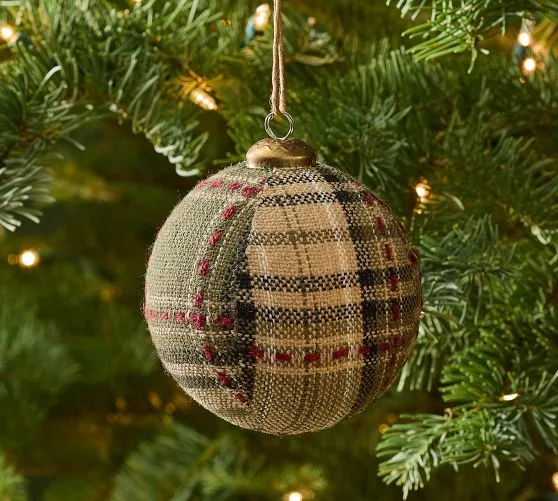
Time: about 90 minutes for six ornaments. Cost: $14 in fabric and filler.
The stitching is doing the work here. Without those reddish-brown dashed lines, this is just two fabrics sewn together. With them, the olive panels pick up the red in the plaid and the whole ornament unifies — the same trick a tailor uses with contrasting topstitching. Fabric ornaments also weigh almost nothing, so they hang on the flimsiest branch without dragging it down.
8. Buffalo Plaid Wooden Trees on Light Wood Stands
About 80% neutral backdrop, 15% pattern, 5% organic texture. The backdrop here is the distressed off-white surface and the grey wall, which is why three bold red-and-black trees do not overwhelm the shot. Swap the buffalo check for green-and-cream plaid and you have a completely different mood from the same composition. Keep the base in light natural wood either way — that is the constant that makes the pattern feel intentional instead of accidental.
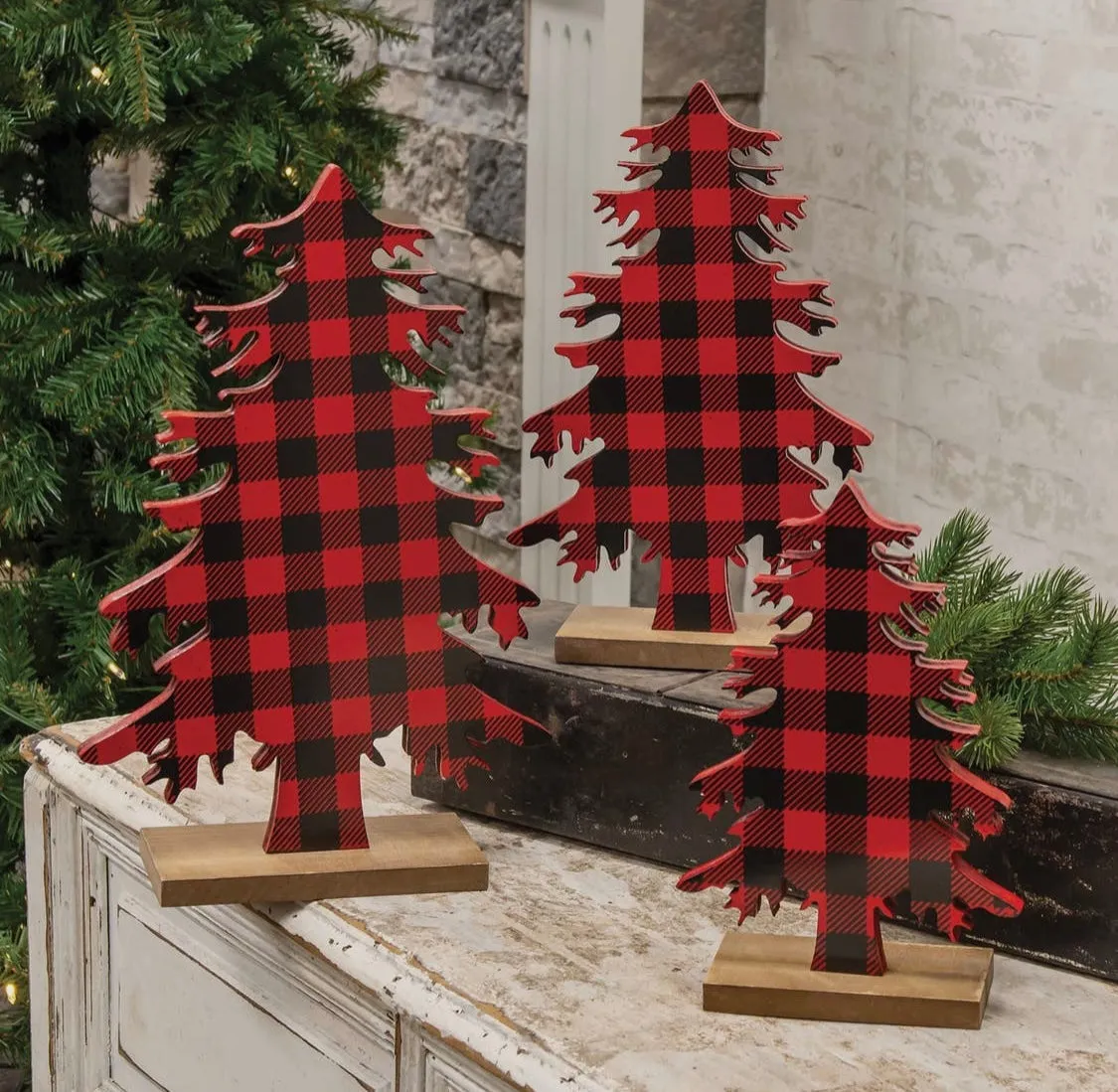
Flat wooden cutouts are basically maintenance-free, but the painted edges are the weak point. Store them wrapped in tissue rather than stacked loose in a bin, or you will get chips along the silhouette. Dust with a dry microfiber cloth — water lifts a craft acrylic finish. If you display them on a covered porch, seal them first with a matte polyurethane and plan to reseal every other year.
9. A Plaid Tree-Shaped Pillow on the Beige Area Rug
The tree shape. A square pillow in the same red, green, and white plaid would be perfectly nice. Cut into a tree silhouette and it becomes the thing guests pick up and ask about. Shape is the cheapest way to make a pattern feel custom — no new fabric, no extra cost, just a different outline. It also solves a styling problem, because a shaped pillow can sit on the floor without looking like something fell off the sofa.
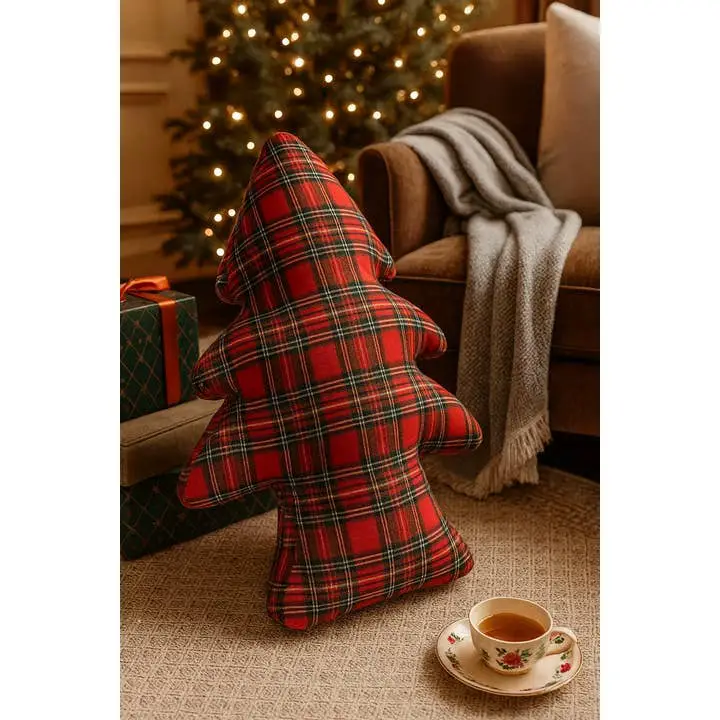
Three different plaid scales appear here — the pillow, the wrapped boxes, and the tree decorations — and they do not compete because the colors stay put. Same red, same green, different sizes. Scale variety without color variety is the safest way to layer pattern. The brown armchair anchors it all in a warm neutral, so the room reads collected rather than themed.
Plaid pillows on the floor are a magnet for whatever walks through the room. With a dog or a toddler, treat this as a December-only accent and put it up when the tree comes down. The cream knit throw is also a snag risk against a plaid weave, and red dyes on the pillow will fade faster than you expect in a south-facing room.
10. Laser-Cut Snowman Ornament Backed in Red Tartan
Openwork ornaments need a backing with contrast or the cutout disappears. When you are choosing tartan fabric to sit behind a laser-cut shape, pick a plaid with a light beige or cream line running through it — pure red and black reads as a dark blob from across the room. Size the fabric a quarter inch larger than the disc all the way around, glue it to the back, and trim it flush after it dries.
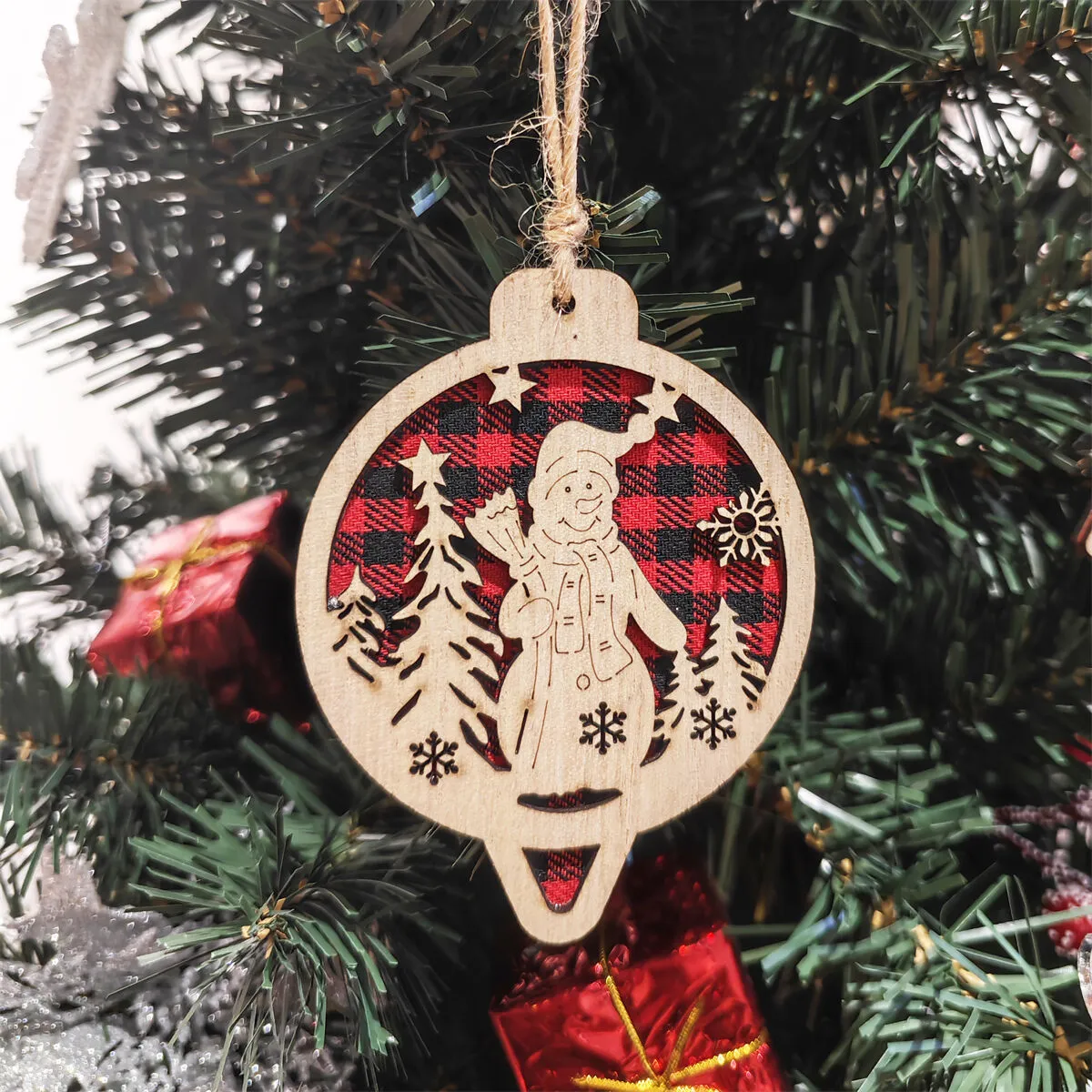
These read best on a tree 6 feet or taller with at least a 40-inch base, because the cutout detail disappears on a tabletop tree. On a narrow pencil tree, use two or three and skip the rest of the ornaments entirely. If your tree is under 5 feet, look for a smaller 3-inch version rather than the standard 4-inch. For small spaces, see the fabric sphere approach in Idea #17.
11. Plaid Ribbon on a Gold Chevron Gift
The ribbon, not the paper. Gold chevron wrapping is nice but ordinary. A red tartan ribbon tied over it is what makes the gift feel chosen rather than bought. Ribbon also does something paper cannot — it repeats the plaid from the tree and the cushion down to the floor, tying the whole corner together. Buy 2.5-inch wired tartan and cut it longer than you think you need, because a short tail ruins the effect.

Tartan ribbon runs about $8 for 10 yards at craft stores and Walmart, and 10 yards wraps roughly fifteen medium boxes. Buy one roll of gold chevron paper at $6 and one roll of kraft at $5 and alternate them under the tree. Skip printed tags and use kraft gift tags with a red marker. For a knitted red textile under the tree, a thrift-store sweater cut up one side makes a convincing tree skirt for about $6.
12. Black-and-Red Plaid Skirt With Wooden Button Closures
The matte black wrapping paper is the quiet hero. Everyone expects red-and-green gifts under a green tree. Matte black with plain twine reads modern against the black in the plaid skirt, so the entire base of the tree looks considered. It also makes the red berries and pinecones pop twice as hard, because there is no competing pattern sitting down at floor level where your eye would normally go.
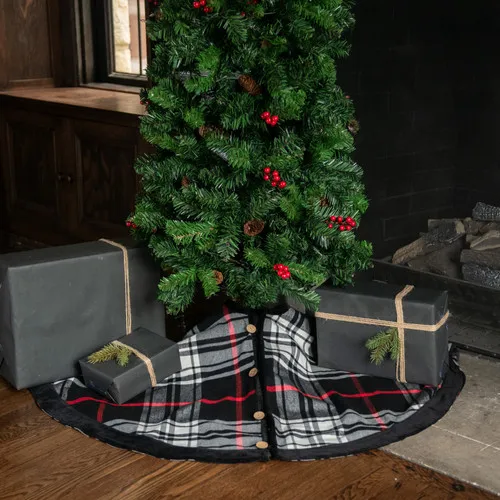
A patterned tree skirt on dark wood is the most forgiving combination in holiday decor — shed needles and stray glitter basically vanish into it. The buttons are your upkeep item, since they loosen over a season, so check them each November and re-sew with doubled thread. Spot-clean with a damp cloth only. On a wool blend, expect pilling where gifts press against the fabric, and plan on a lint roller all December.
13. Heart-Shaped Tartan Ornament on a Gold String
Roughly 65% forest green, 25% shiny red, 10% plaid and gold. The plaid heart is the smallest share and the most important one, because it is the only element carrying more than a single color. Swap the heart for a plaid star and nothing else changes. Swap the red baubles for cream and the whole tree turns quiet and vintage. Keep the gold string either way — it is the thread connecting the warm lights to the red.

It is the gold string. A twine loop would have made this ornament rustic; a gold cord makes it a keepsake. That is a twelve-cent detail that changes the price bracket the ornament reads as. If you are making these as gifts, a $4 spool of gold cord covers about fifty ornaments. Small material upgrades like this are the whole difference between handmade and homespun.
14. A Dark Tartan Bow Resting on Fresh Conifer
- Cut a 4-inch-wide strip of dark tartan 24 inches long, plus a second strip at 12 inches.
- Fold the long strip into a figure eight, pinching the center flat between two fingers.
- Wrap the short strip around the pinch and hot-glue the tail to the back.
- Fluff the loops and trim the tails on a diagonal so they do not ravel.
- Rest it on the greenery rather than tying it — a loose placement looks more natural.
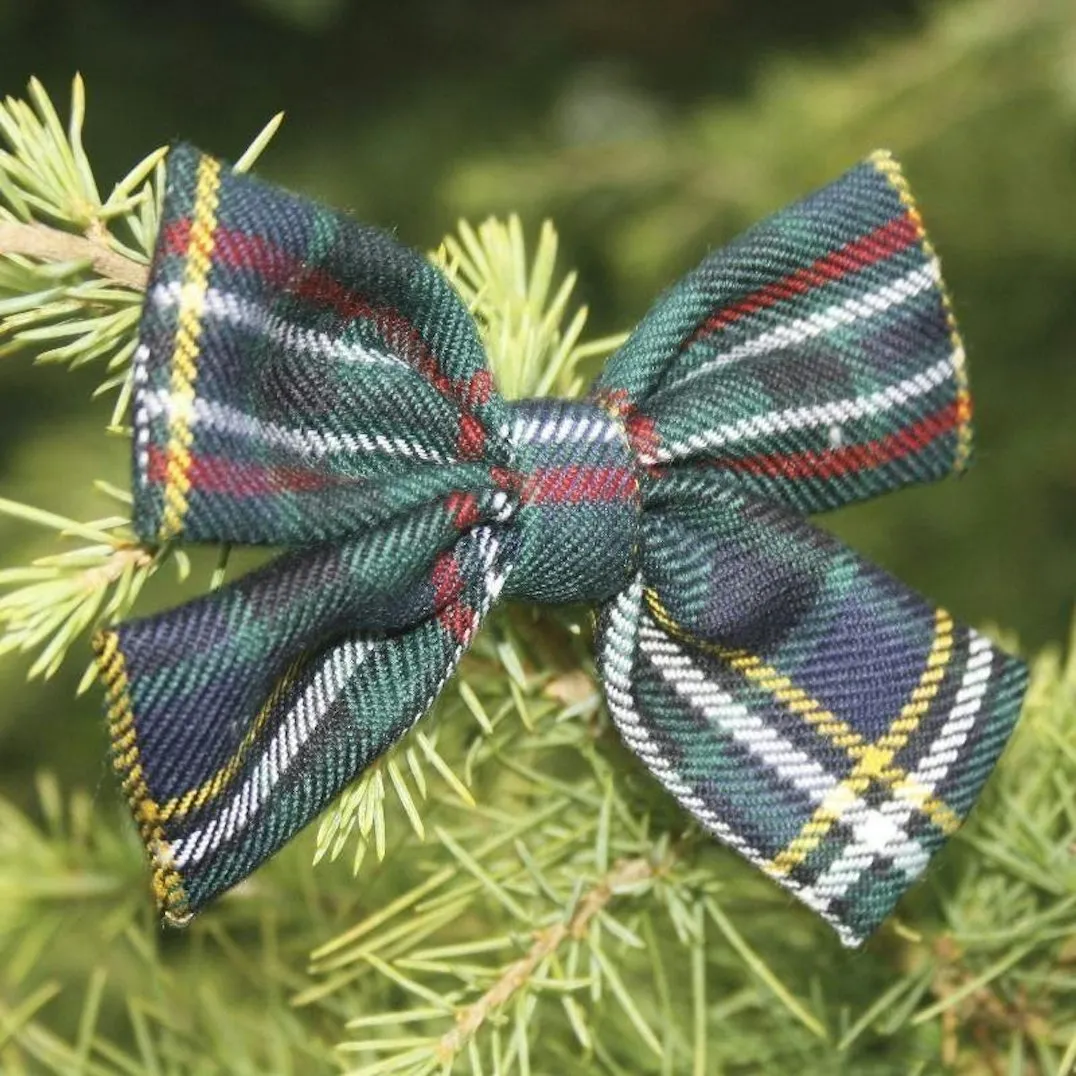
Time: 15 minutes. Cost: $6 for a half-yard of tartan.
Tartan is doing something different this year. It is not the red-and-green Victorian version — the plaids gaining ground now have navy, yellow, and white lines woven in, closer to a Scottish clan sett than a department store check. That wider color range is why you can pair tartan with olive, mustard, or even pink without it feeling off, and why this reads trend-proof where buffalo check does not.
A bow this size suits wreaths 20 to 24 inches across, garland swags at least 8 feet long, and treetops above 7 feet. On a small porch wreath, scale down to a 2-inch ribbon or it will look like a hat. Indoors, it wants a mantel with at least 5 feet of clear space. For tighter arrangements, see the fabric spheres in Idea #17.
15. Multi-Loop Red Plaid Bow With Black Braided Trim
Multi-loop bows stay full only if the ribbon is wired. Look for 2.5- to 3-inch wired plaid with a visible black braid along the edge — that trim is what gives each loop a defined outline, which flat ribbon simply cannot do. Budget about 3 yards for every 8 loops. Pin each loop to a cardboard backing as you build rather than trying to shape the whole thing at the end, and store it in a box instead of a bag.
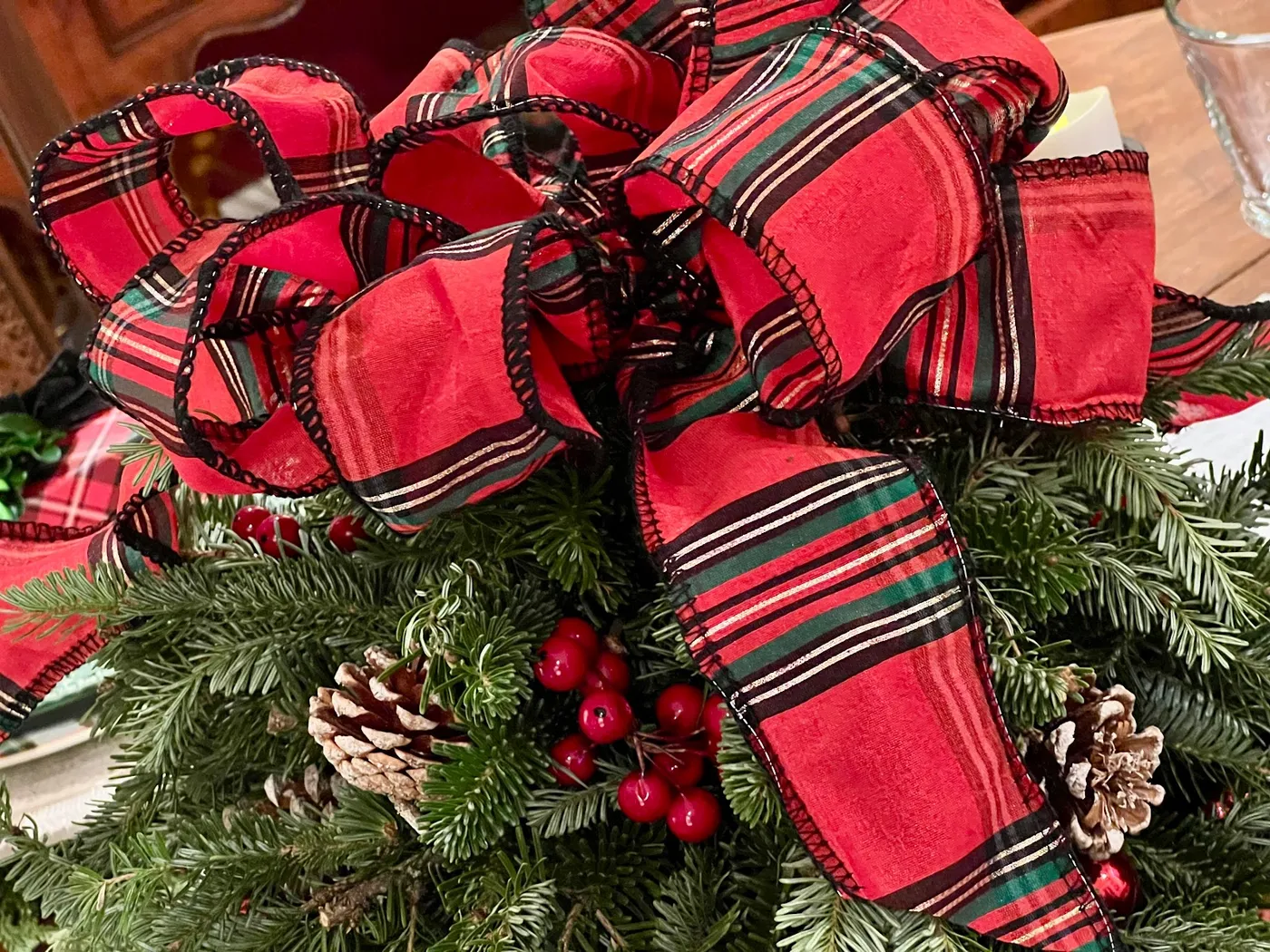
Fresh pine needles mean sap, and sap means a sticky mantel. Lay down parchment or an inexpensive runner before you build this, especially on painted wood. Red berries and pinecones shed too — the berries flake and the cones drop seeds — so give the whole arrangement a weekly shake over a trash can. On a live tree in a heated room, expect the pine to dry out in about ten days.
16. Fabric Tartan Ornaments With Jute Twine Hangers
Handmade fabric ornaments are having a moment that store-bought cannot match, mostly because people want their tree to look like it came from somewhere. The ruffled garland especially is a Facebook Marketplace and thrift-store staple that people are now recreating at home. It photographs warm and slightly imperfect, which is exactly what is winning over the polished matching-set look — and it means a tree can be built over several years instead of one shopping trip.
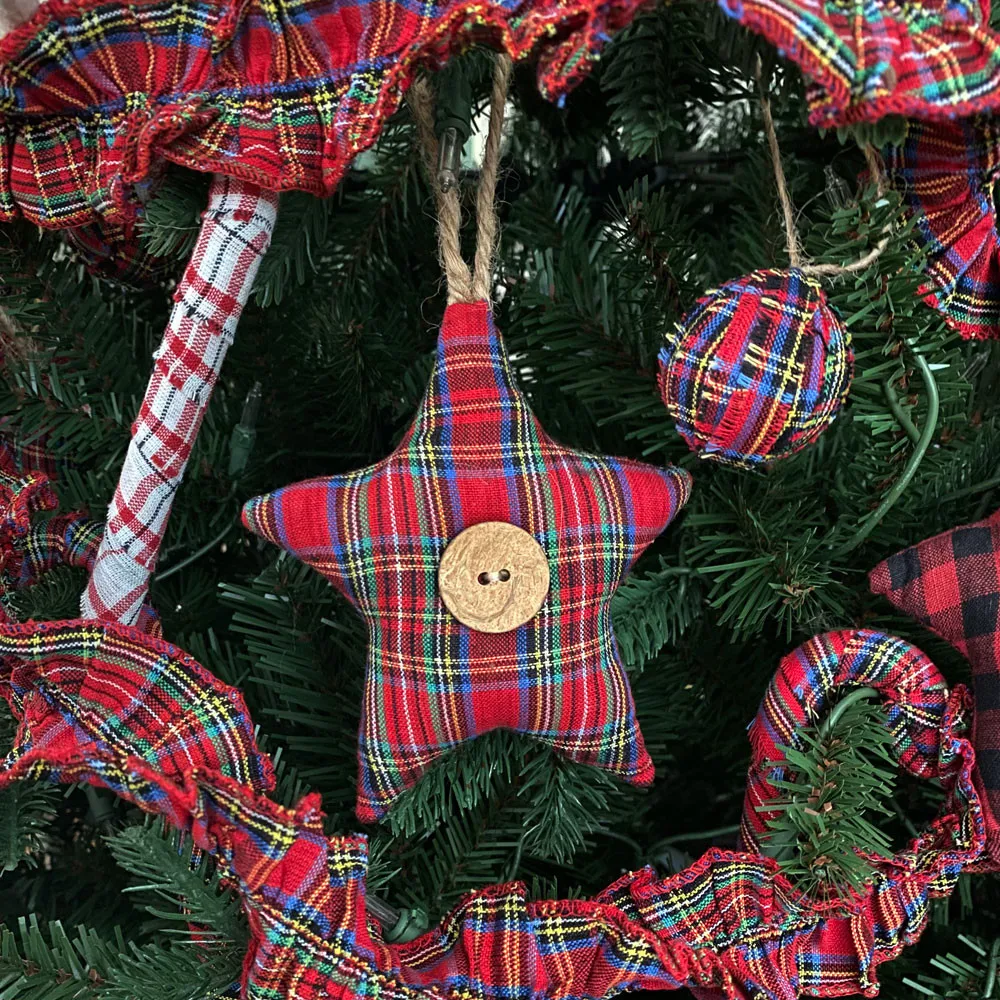
A half-yard each of red tartan and buffalo check runs about $12 total and makes eight to ten ornaments, roughly $1.30 apiece versus $6 to $9 for similar store-bought fabric ornaments. Use scrap cardboard for the star and candy cane templates, dollar-store jute for hangers, and a craft pack of wood buttons. A ruffled garland takes 3 yards of fabric strip, about $9. A whole handmade tartan tree lands under $40.
17. Plaid Fabric Spheres on a Rustic Wood Fence
Two opposite colorways of the same plaid do the heavy lifting. Red plaid on beige fabric next to beige plaid on red fabric creates a pattern-within-pattern effect that a single fabric cannot. Then the raffia and light green foliage interrupt the geometry, so it never reads as too matched. The black metal star is the punctuation — one dark note that keeps the whole arrangement from floating away into beige.
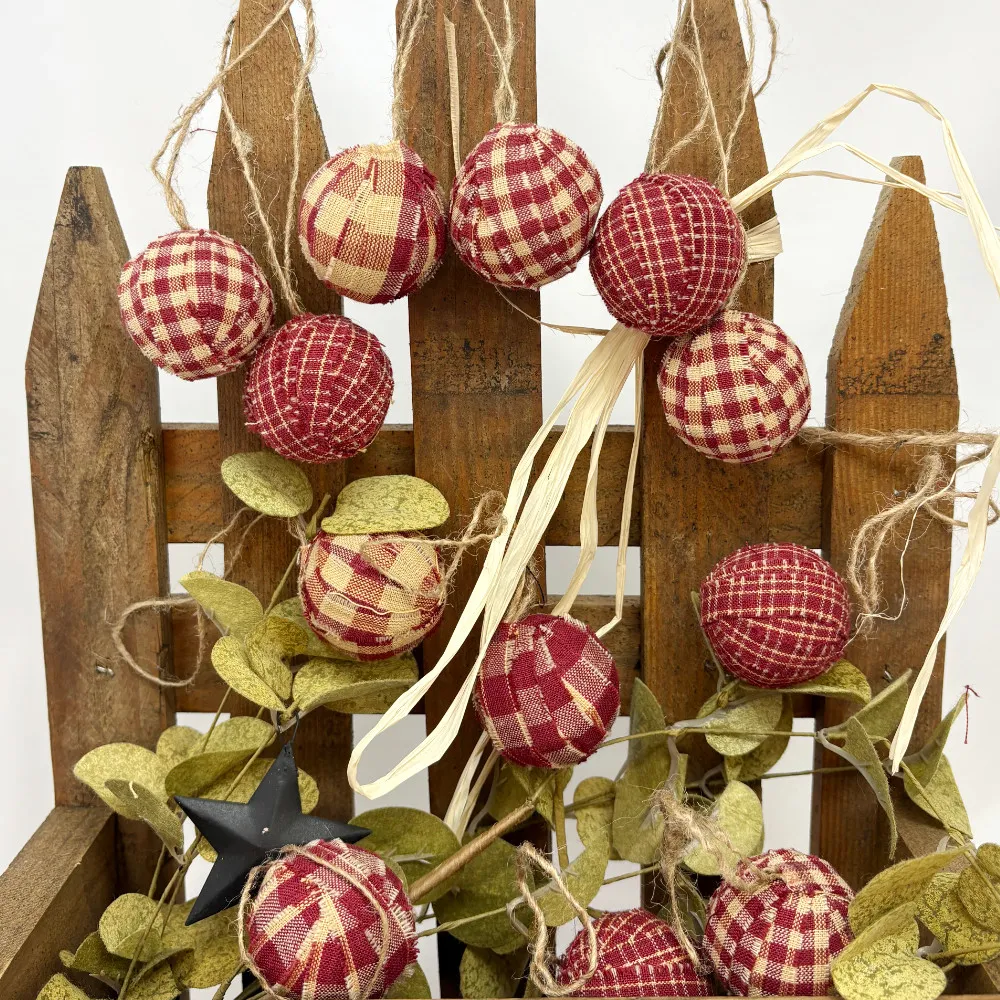
This kind of vertical display needs a wall or structure at least 30 inches wide and 4 feet tall to feel intentional. It works on a covered porch, a mudroom wall, or the back of a bookcase. The arrangement reads best from about 5 feet away, so keep it out of tight rooms. In a narrow entryway, hang three spheres on a single hook instead. Compare with Idea #10 for a single-ornament approach.
18. A Wide Tartan Ribbon Draped Vertically Down the Tree
About 75% green tree with white ornaments, 15% wide red tartan ribbon, 10% white string lights. Keeping every ornament white is what lets a bold ribbon run the full height without chaos. Change the formula by swapping white ornaments for cream and gold, or by running two narrower ribbons instead of one wide one. The plaid has to contain the same red as your ribbon ends, or the tree looks pieced together from leftovers.
- 7 ft unlit tree — $120–$400
- Wide tartan ribbon, 3–4 rolls — $40–$90
- White shatterproof ornaments, 60–80 — $45–$140
- White string lights, 600 count — $25–$60
- Topper and stand — $20–$70
Total: $250–$760. Budget alternative: a 100-count bulk box of white shatterproof ornaments runs about $30, and discount-store tartan ribbon at $7 a roll keeps the whole tree under $70.
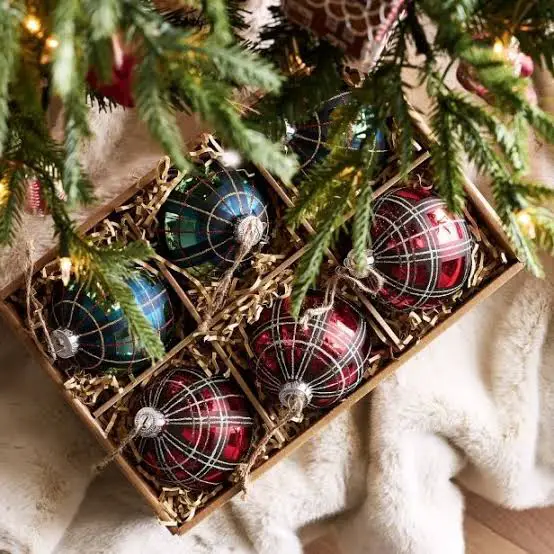
19. Red-and-White Checked Glass Ornament on Pine
The clear glass. A solid red or white ball in the same check pattern would be fine but predictable. Casting the checked pattern inside clear glass lets the pine branch show through, so the ornament picks up the green around it and shifts slightly depending on the light. It also catches warm white bulbs in a way opaque ornaments cannot — a small, cheap upgrade that makes an entire tree look more expensive than it was.
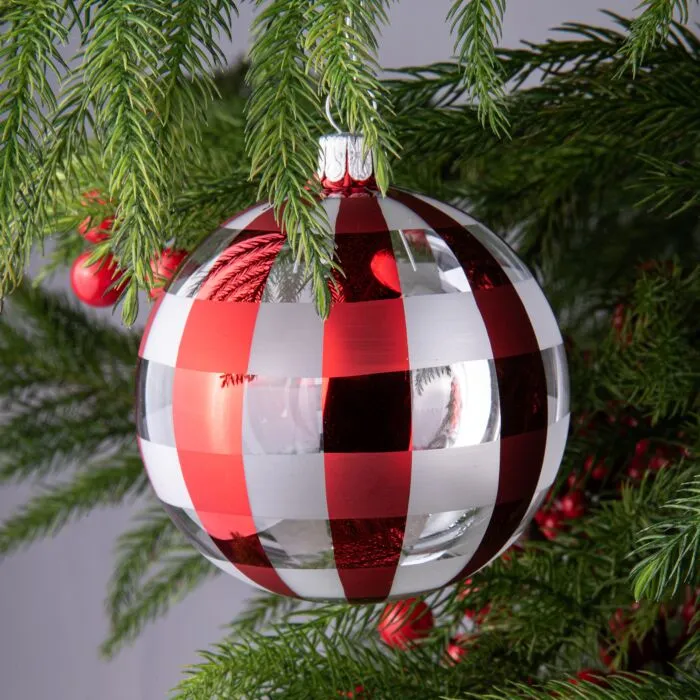
Glass ornaments chip, and clear glass shows every chip. Store them in their original divided box or wrap each one in tissue, never loose in a bin. Dust with a dry cloth — glass cleaner streaks the inside of a hollow ornament and you cannot reach in to fix it. If you have a cat, hang these in the top third of the tree. Shatterproof lookalikes give you the same checkered effect with none of the risk.
20. Burlap and Plaid Handmade Ornaments With Ruffled Garland
Burlap and plaid work because the textures are opposites: burlap is scratchy and matte, plaid is smooth and slightly reflective. Keep the mix around 60% burlap to 40% plaid, and use warm white lights only — multicolor bulbs fight this natural palette hard. For the ruffled garland, gather fabric strips at 2.5 times the finished length; anything less and the ruffle flattens against the branch instead of standing up.
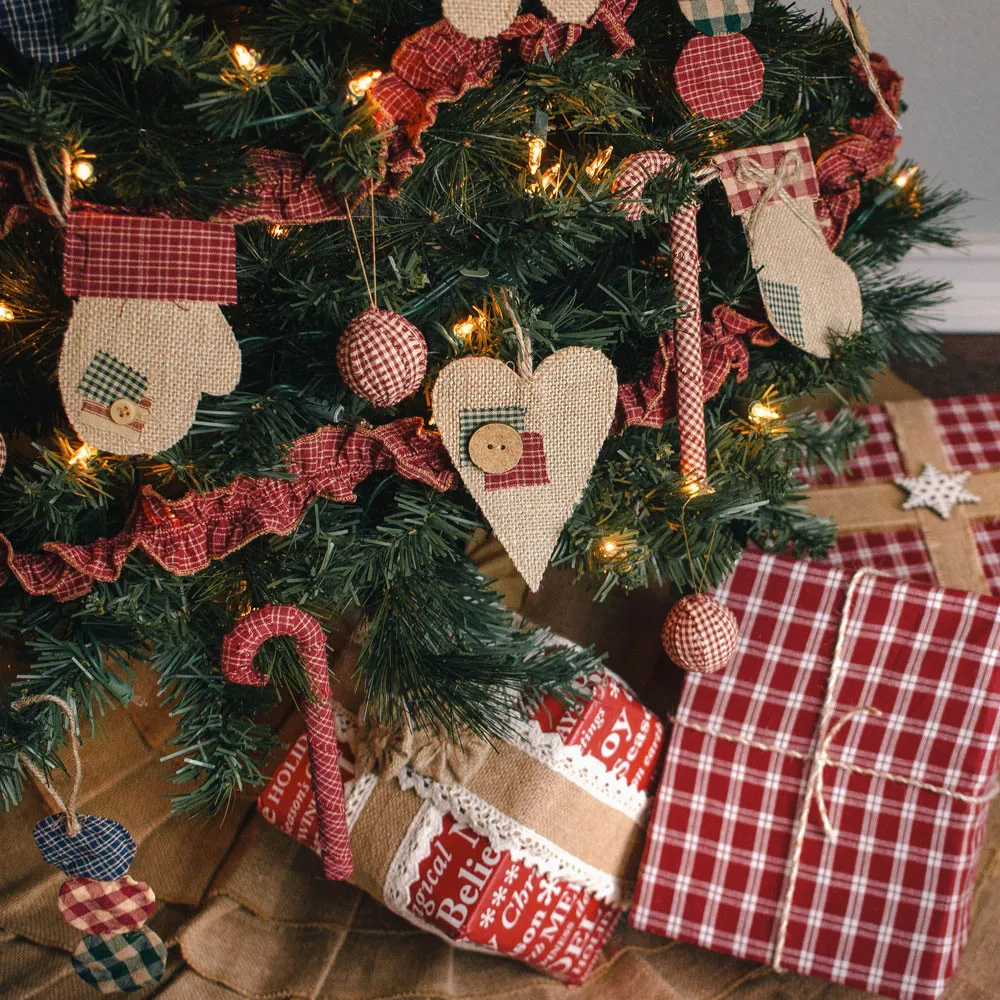
- Cut plaid fabric into 5-inch squares and burlap into 4-inch squares.
- Layer a plaid square over a burlap square with both right sides facing out.
- Fill with two tablespoons of fiberfill and gather the corners into a pouch.
- Wrap the gathered neck with twine, knot it, and leave a 5-inch tail as the hanger.
- Trim the top corners into a leaf shape for the heart version.
Time: roughly 12 minutes each. Cost: about $0.75 per ornament in fabric and twine.
21. Buffalo Check and Gingham Ornaments on Dark Gray
Mixing buffalo check with gingham is a fine line. Buffalo check is two colors of equal weight; gingham is one color with white space, so they read at completely different volumes. Two gingham ornaments against three buffalo check worked here — go to five gingham and the arrangement turns busy. Keep these off a light-colored tree, too. On dark gray the red and black pop, but on white they go muddy. Compare with Idea #8 for a bolder approach.

Fabric-covered ornaments are one of the cheapest DIYs in holiday decor. Buy a fat quarter of buffalo check and one of black-and-white gingham for about $6 total, plus a pack of foam balls for $5 and silver caps for $3. Cut the fabric into circles, wrap around each ball, and hot-glue at the top. That is fourteen ornaments for under $15, versus $8 each at retail.
22. A Tartan Deer Ornament With a Jingle Bell Collar
Animal-shaped ornaments need room to be recognized — hang them with at least 4 inches of clear branch around them, never buried behind tinsel or sprays. They suit trees 6 feet and up with a wide base. On a slim tree or a tabletop version, a deer silhouette turns into an unreadable blob. If you are working with limited space, stick with round fabric ornaments instead. See Idea #7 for a smaller-scale alternative that holds up close.
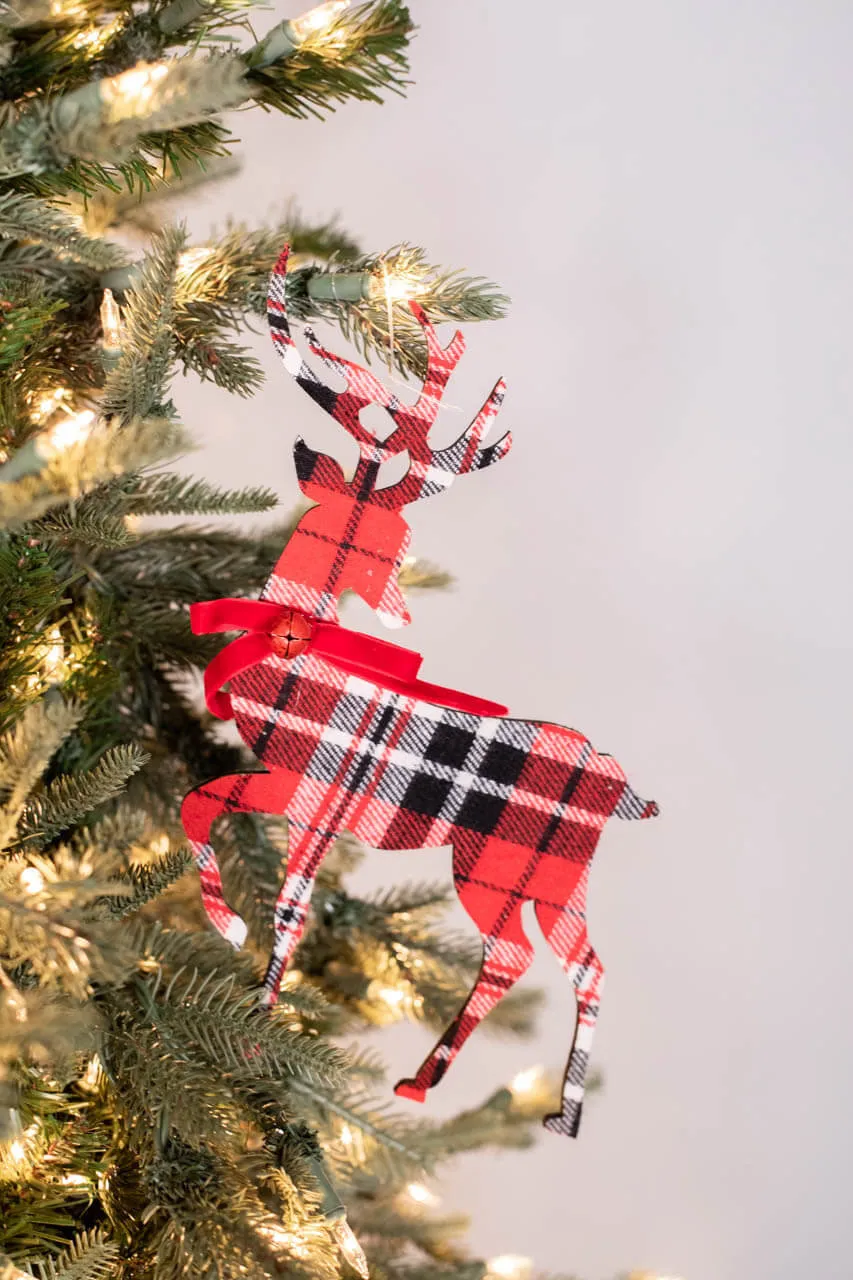
The tiny red ribbon and jingle bell is what turns a fabric shape into a character. Without the collar, the deer is a plaid silhouette. With it, you notice the neckline and the whole ornament reads as designed rather than cut out. It also adds a second material — metal — that catches tree lights and gives the matte tartan a spark of contrast. Small embellishments on simple shapes are the most reliable way to make handmade look bought.
23. The Red-Flag Check Before You Buy Another Plaid Anything
- Measure your tree’s widest branch span, not its height — plaid ornaments disappear on narrow trees.
- Photograph the plaid you already own in daylight before you shop for more.
- Match your tartan’s dominant color to your ribbon, not to your ornaments.
- Confirm your lights are all warm white or all multicolor — never mix the two.
- Set a ribbon budget before you fall for a $22-a-yard wool tartan.
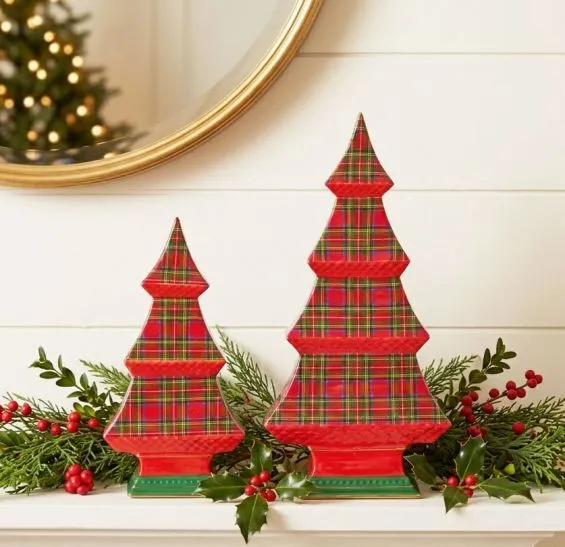
Here is the honest part that never makes it into a shopping guide: plaid is a pattern, and patterns multiply. Buy a tartan ribbon, a plaid skirt, and a plaid pillow in the same season and you can end up with a room that looks like a catalog page instead of a home. Pick two plaid pieces, tops, and let everything else be solid. If you are buying a plaid you will live with for years, choose a smaller sett over a big bold check — it dates far slower.
24. Tartan Reindeer and Snowflake Tree Ornaments in Gold and Berries
When you have two plaid ornaments in one cluster, offset them with something organic and something metallic. Here that is red berries and gold clustered accents, which keep the plaid from looking flat and matched. Angle the plaid pieces so they are not facing the same direction, and tuck them into the branch rather than letting them hang free. A 3-inch gap between the two plaid ornaments is usually enough breathing room.
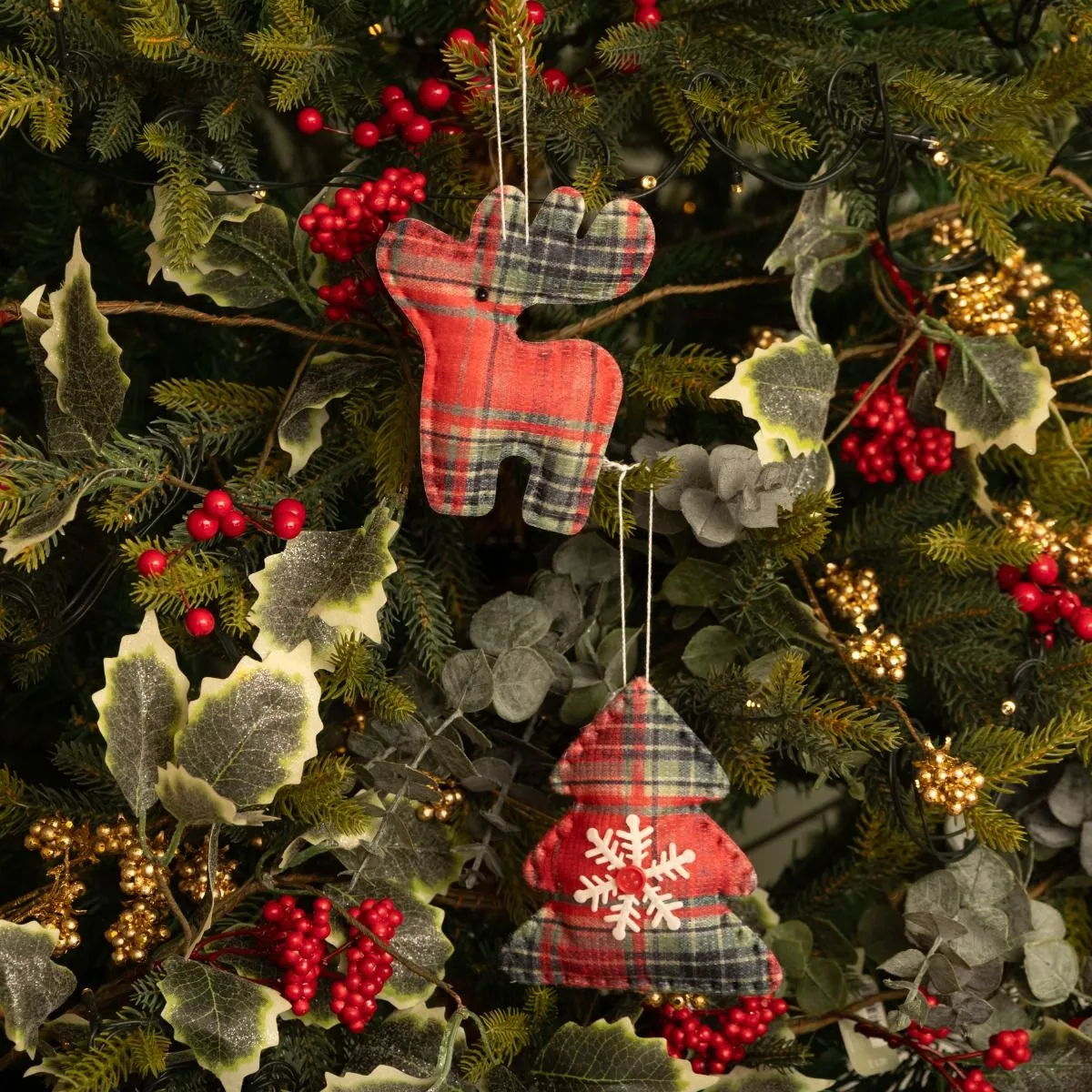
The glitter-dusted holly leaves. They are small, cheap, and easy to overlook, but they give the red berries a shadow and a little shimmer that keeps the cluster from reading as one flat spot of red and green. Remove them and the ornaments are fine but ordinary. The plaid tree ornament also carries a snowflake detail that echoes the reindeer silhouette, and that repetition is what makes the pairing feel like a set.
25. Frosted Tree With a Hot-Pink Plaid Bow and Checkered Skirt
Plaid stopped being only red and green. Over the last two seasons, designers have been sneaking unexpected colors into tartan — hot pink, mustard, cobalt — and it is showing up in holiday collections because it photographs beautifully against flocked white. Pink tartan reads playful rather than traditional, which fits the broader shift toward decor that looks personal instead of formal. It has staying power because the base is still a classic plaid.
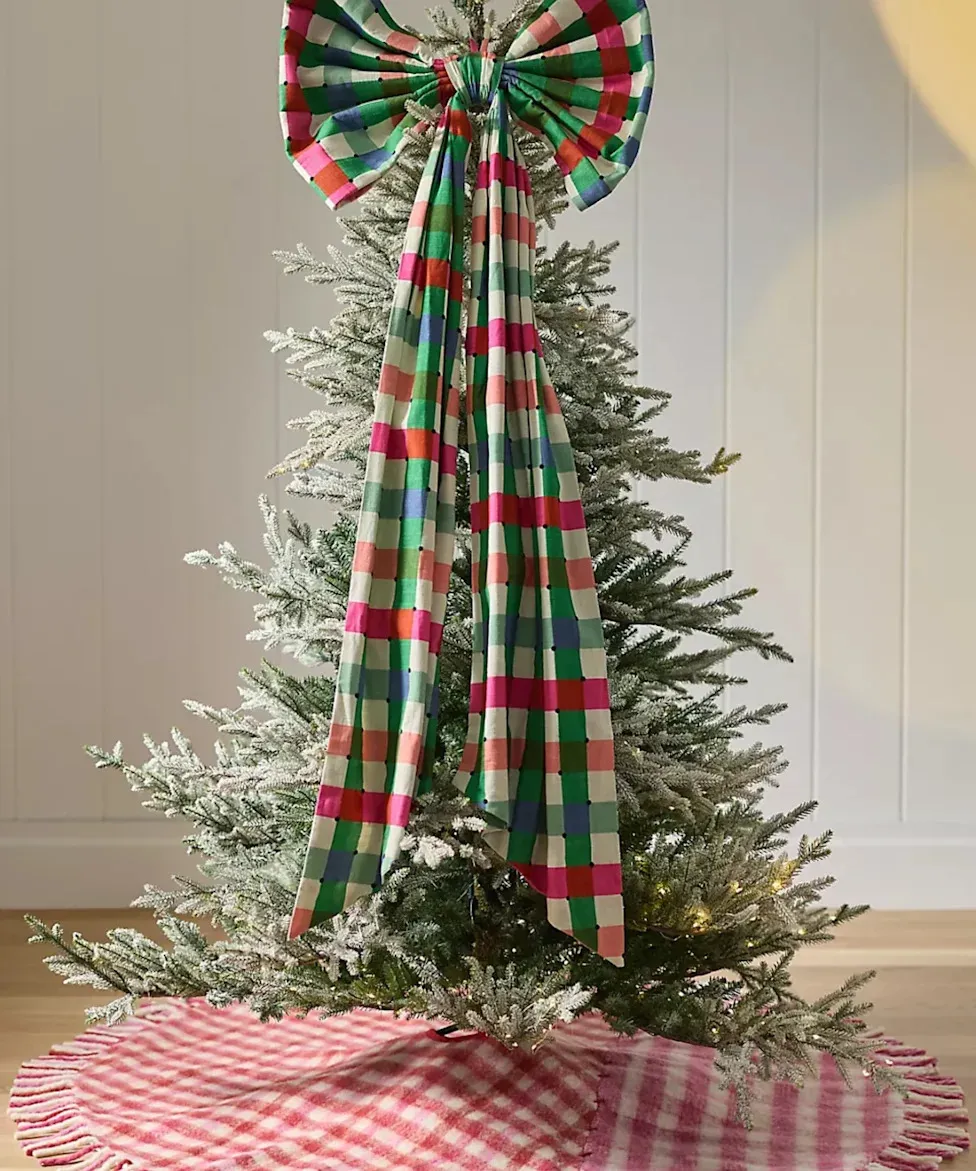
Roughly 55% frosted white tree, 25% multi-color plaid bow and drape, 15% red-and-white checkered skirt, 5% pink accent. Frosting carries a lot of visual weight, so the plaid has to bring real color to compete with it. If you want things calmer, cut the pink to a hint and let the checkered skirt handle the pattern. Swap that skirt for solid red and you lose the playfulness entirely — it is the load-bearing piece.
The skirt and the bow are different patterns and it still works because they share a color. The checkered skirt is red and white; the plaid bow carries red, green, pink, and white. Overlapping a single color is enough to hold two patterns together. The frosting helps by giving both a soft white field to sit on, so neither has to fight for attention at the same intensity.
Your Tartan Tree Starts With One Good Bow
Tartan is forgiving in the ways that matter and demanding in only a couple of places: keep your patterns to two per view, keep your lights warm, and let one plaid piece be the star instead of five. Everything else here is a detail you can add next year, which is honestly the best way to build a tree that looks like yours and not a display floor.
Save this guide to Pinterest now — come November, you will be glad you have the measurements, the budget numbers, and the ribbon widths already sorted.